The Morning After: Apple takes on cheap Windows laptops and Chromebooks with the $599 MacBook Neo

Right off the back of the iPhone 17e, new iPads and MacBook Airs, Apple also announced a keenly priced new laptop. The MacBook Neo is a multi-colored low-cost Mac ($599), running on an iPhone chipset with most but not all of the hardware features you find on the MacBook Air and Pro. All models of the MacBook Neo ship with an extremely scant 8GB of RAM, which might be the main productivity bottleneck for demanding tasks.

The Neo has a 13-inch Retina display, a 1080p webcam, two USB-C ports, a headphone jack and optional Touch ID, if you're willing to pay a little more. A lot has been said about whether this is Apple marching to the beat of its own drum again, in a year of RAM shortages and AI obsessions. This is a direct attack on cheap Windows laptops and underperforming Chromebooks. Tempted? Check out our initial impressions from Apple's event earlier this week, right here. Oh, and for everything Apple announced – we've pulled all the news together here.

– Mat Smith

The other big stories this week

TMA
Engadget

There's no flagship Nothing Phone 4 this year, but the company has put a lot of effort into making its A-series almost flagship, including a notable design pivot with the Phone 4a Pro. The transparent back is now aluminum, and the trademark Nothing aesthetic has been boxed into the camera unit. It looks more grown-up, perhaps, but a little less fun? That said, the egregious camera bump on the Nothing 3a Pro last year is no more. Both 4a phones are sleek slabs of smartphones. The company has also substantially upgraded the devices, with better cameras, more batteryand improved screens. Only the 4a Pro will be coming to the US later this month.

Continue reading.

TMA
Engadget

While MWC 2026 offered us plenty of Chinese smartphones ready to wow us, established player Samsung managed to surprise us with its S26 Ultra the week before. Sure, it doesn't have a ton of major improvements, but it brings subtle upgrades across the board, along with a standout new display for anyone who cares about privacy.

The Privacy Display is the standout new feature – one we've never seen before on a smartphone. When you turn the Privacy Display on and view the phone from less than head-on, everything fades to black, like those privacy-sticker screen protectors, but at the hardware level.

The S26 ultra can even selectively activate Privacy Display under specific situations, turning on when you get notifications or open certain apps (like for banking or authenticators). The phone can also enable the feature when you need to enter a PIN, pattern, or password, though this is only for system-level prompts, such as your lock screen.

Continue reading.

TMA
Engadget

What could go wrong?

Continue reading.

This article originally appeared on Engadget at https://www.engadget.com/general/the-morning-after-engadget-newsletter-121523538.html?src=rss

Nothing Phone 4a Pro hands-on: A premium design with a price to match the Pixel 10a

Nothing has announced its latest premium midrange device, the Phone 4a Pro. The company says it's the thinnest full-metal phone on the market, measuring in at 7.95mm. It also looks notably different from the prior A-series phones – and pretty much any of the company's phones to date.

It features an aluminum unibody while retaining Nothing’s retro-clear hardware design touches, with a clear, redesigned camera unit. Yes, the aggressively protruding circular camera unit of the Phone 3a Pro is gone, replaced with an oblong housing that houses the triple-camera array and a tweaked Glyph Matrix, similar to what debuted on last year’s Nothing Phone 3. It also feels incredibly premium – more so than even the company’s flagship phones.

Despite that, Nothing seems to be strikeinga balance between affordability and wow factor with the Phone 4a Pro. It has a slightly higher price tag ($499) than the 4a and alongside a major hardware redesign, a lot of the improvements here make this phone feel “pro” compared to its smaller sibling. This new premium vibe comes at a cost of design excitement, though. 

It also looks a little like another certain smartphone or two. Don’t call it a camera plateau.

Nothing Phone 4a Pro hands-on
Image by Mat Smith for Engadget

The Phone 4a Pro has its own take on the Glyph Matrix, composed of 137 mini-LEDs. That’s fewer LEDs than the Nothing Phone 3, but they are 100 percent brighter at around 3000 nits. It supports pretty much all the Glyph toys we enjoyed on last year’s Nothing flagship, although the 4a Pro lacks a dedicated Glyph Button, which is a shame. This means in order to hop between toys and modes, you’ll have to dig into Glyph settings inside the settings menu – not the existing Glyph menu – in order to flit between them. Honestly, may make me less likely to play around with the Glyph, but I’ll have to see after further testing. It’s a little odd when there’s a circular metal detail on the lower left corner that looks like it could have been a Glyph button. Ah well.

The Phone 4a Pro will land in three different colors: silver, black and pink. The pink hue is tastefully subtle. So subtle, in fact, that you'd think it was the silver option. I like the black version. 

Nothing Phone 4a Pro hands-on
The gigantic camera unit seen on the Phone 3a Pro is no more.
Image by Mat Smith for Engadget

The Phone 4a Pro has a slightly bigger screen than both its predecessor and the 4a, but the real news isn’t just the extra fraction of an inch. The 6.83-inch display can now reach 144Hz refresh rates, while it can also top out at 5,000 nits of brightness with HDR content. That makes it up to 66 percent brighter than its predecessor, and it was noticeably easier to read in Nothing’s harsh spotlights and daylight.

Nothing has further refined the cameras, and the 4a Pro uses the same telephoto sensor as the flagship Phone 3. That’s paired with a new 50-megapixel Sony LYT-700C camera sensor that’s 24 percent bigger than the 50MP sensor inside the 3a Pro. It’s also faster at auto-focus than its predecessor, and seems to more easily lock onto subjects without having to tap on what you want in focus.

There’s also a new triple 12-bit Image Signal Processor (ISP), which enables up to 140x ultra zoom, like we’ve seen on Galaxy phones for the last few years. Don’t expect to be blown away by those zoom extremes: it seems to work well on the easy-to-guess structures of buildings and patterns, but a 70x zoom range and higher aren't settings I'm going to lean into much.

I haven’t had time yet to fully scrutinize the 4a Pro’s camera, but there’s a lot of feature parity with pricier phones. It can capture super-slow 120fps video at full HD, while Action Mode is built directly into the camera app to shoot up to 30 Ultra XDR images in a row. Codeveloped with Google, Ultra XDR images are high-dynamic-range images that capture 13 RAW frames at different exposures and combine them into a single image. In practice, this should offer another way to pull usable shots from challenging low-light or harsh-light environments.

Power users may also like new presets, alongside Nothing’s own collection of camera filters. There are seven new editing options, letting you tweak (and save) contrast levels or even apply a vignette effect. I’m a fan of the built-in presets, but it’s nice to have access to the same camera settings to make and save my own B&W filter.

Nothing says you can expect 30 percent improved graphics performance and 27 percent faster CPU speeds, with “flagship” LPDDR5X memory, which makes it 100 percent faster than last year’s 3a Pro. Improvements to the chipset and memory speed weren’t immediately noticeable during my time seeing the device.

Nothing Phone 4a Pro hands-on
Image by Mat Smith for Engadget

Nothing continues to refine its own OS skin, but it’s still a refreshing, different take on the Android interface you’re used to. And if you’re not a fan, you can turn it back to a more stock look. Based on user feedback, there are new size options for the home screen widgets and a new custom lock screen. It may be due to the more powerful processor, but both the 4a Pro and the base 4a seem to have smoother animation flourishes when opening and switching between apps or swiping across content.

New AI software includes a formal launch of Essential Search, able to scour the entire device for information, images, documents, apps and more. The 4a series include the first Nothing devices to include cloud access for the still useful Essential Space app, housing your voice notes, screengrabs, text notes, and more. This means, hopefully, I can transition everything across from my Nothing Phone 3. (Or even between the Phone 4a and 4a Pro.)

Nothing Phone 4a Pro hands-on
Image by Mat Smith for Engadget

It’s a different look for Nothing, and the 4a Pro’s price (and timing) will pit it against both the Pixel 10a (priced the same) and base flagship devices from Samsung. The Phone 4a series pre-orders are open now at nothing.tech and other retailers, with sales of the Phone 4a Pro starting March 27. Expect our full review in the coming weeks.

This article originally appeared on Engadget at https://www.engadget.com/mobile/smartphones/nothing-phone-4a-pro-hands-on-price-launch-date-123053485.html?src=rss

Nothing Phone 4a hands-on: A more technically accomplished entry-level smartphone

Nothing is back with two new smartphones, the entry-level Phone 4a and the mid-range Phone 4a Pro. With the base 4a in particular, there’s no shortage of substantial hardware upgrades since the 3a, even if the design doesn’t quite stand out as much. This year, that’s apparently the role of the Nothing Phone 4a Pro. That said, the base 4a’s two new color options (blue and pink) are gorgeous additions to the usual monochrome duo of white and black.

There have been many upgrades since 2025’s Phone 3a. It comes with IP64 dust and water resistance, and is also physically tougher: Nothing says it has increased bend resistance by 34 percent, but I always considered all of the company’s phones pretty solid. The display also gets Gorilla Glass 7i, something I’ve wanted to see Nothing improve on its cheapest phones. My Phone 2a’s screen got pretty messed up when I tussled with my keys a few years ago. The 6.78-inch display is also 23 percent brighter than its predecessor, reaching 1,600 nits during outdoor viewing.

The main upgrades are centered around the cameras, marking a major improvement over what the Phone 3a last year. A new tetraprism periscope telephoto camera extends to up to 3.5x optical zoom, further than the base Phone 3a.

Nothing Phone 4a hands-on
Image by Mat Smith for Engadget

Nothing says the main camera, with a new Samsung GN9 50-megapixel sensor, captures up to 64 percent more light than similarly sized camera sensors. The company has also upgraded its computational photography and tone mapping, which help it deliver on a new 70x ultra zoom mode, which beefs up your images with AI smarts. While it’s unlikely to be a regular feature for me, it’s still an option. It works well with straight lines and architecture, but don’t expect faces and nuanced detail at 70x zoom. But hey, sometimes you want that up-close picture of an iconic landmark. Fortunately, you’ll get up to a 7x lossless zoom by combining the 3.5x optical zoom with sensor cropping, which works well.

I’ve been testing the Phone 4a for a few days – because I can’t get enough phones – and noticed that photo image quality is noticeably better compared to the Phone 3a. Images have less noise and more detail, with the Phone 4a being far more capable in poor lighting conditions.

Nothing Phone 4a sample image in low light
Image by Mat Smith for Engadget

The Phone 4a has a 1.5K (1,224 × 2,720) display, up from the full HD display (1,920 × 1,080) on last generation’s phone. It supports up to 120Hz refresh rates and has a peak brightness of 4,500 nits for HDR content. That resolution boost means Nothing’s meticulously designed UI and icons look sharper and everything is easier to see when using the 4a in the bright spring sunlight.

Nothing says the new Snapdragon 7s Gen 4 processor offers 10 percent better power efficiency, but what will make the Phone 4a go the distance is more likely the 5,080mAh battery – the biggest yet in Nothing’s midrange phones. Even the storage has been upgraded, with 47 percent faster read and 380 percent faster write speeds. I almost immediately clocked the improvement while attempting some light video editing and installing a few games.

This year’s Glyph system has turned into a Glyph Bar. It’s made up of 63 mini-LEDs in seven square lights in a row. These top out at 3500 nits, which is 40 percent brighter than the Phone 3a’s Glyph Interface. Over the years, I go through waves of loving Nothing’s take on notifications through to forgetting they’re there. Nothing is gradually adding more utility each year, and it’ll double as a notification tracker for a few select apps, like Uber, indicating how far away your ride is. The Glyph Bar can apparently double up as a fill light, although I couldn’t get that to work on my pre-release sample. I’ll update this story when I can test it out. Likewise, Nothing’s Playground of fan-made widgets and mini-apps isn’t entirely compatible with the 4a — at least not yet.

Nothing Phone 4a hands-on
Image by Mat Smith for Engadget

The Nothing Phone 4a is an upgrade over its predecessor in every way – and the improvements are tangible, and I noticed them almost immediately – something that can be challenging with other phone refreshes. The display is crisper, as are the photos and video it can capture.

Like previous Nothing phones, despite the “global launch,” this phone won’t be headed to the US. However, in the UK, starting at £349 (roughly $467), it’s only marginally more expensive than its predecessor and you get a lot more bang for your buck. It’s also a good chunk of change cheaper than the $500 Pixel 10a. For those looking for an eye-catching, capable phone at a similar price, the Phone 4a’s biggest competition may be its bigger brother, the $499 Phone 4a Pro. Expect our hands-on for Nothing’s other phone very soon. The Phone 4a is open for preorders now at nothing.tech, going on sale starting March 13 next week.

This article originally appeared on Engadget at https://www.engadget.com/mobile/smartphones/nothing-phone-4a-hands-on-price-launch-date-111533547.html?src=rss

MWC 2026’s most bizarre phone can start fires (on purpose)

This isn’t a Galaxy Note 7 debacle. Oukitel's WP63 is a ruggedized smartphone that’s meant to set things alight. It has a built-in electric igniter, aimed at emergency response and camping, helping to start fires when you forgot matches, but you brought this beastly phone along for the adventure. It’s got several other notable features, like a 20,000mAH battery, a loudspeaker, and even its own built-in USB-C cable for charging other devices.

Still, the igniter was why I was here. The WP63 has an electric coil that heats up, similar to cigarette lighters in cars circa 1987. This is hidden away behind a protective cover at the top of the device, and once it pops out, you activate it using an app. An Oukitel spokesperson was able to light some rolled-up paper, and I was surprised how gentle and seemingly in control it was. (The paper looked like a cigarette, too.)

Unfortunately, another spokesperson told me that it can’t be used to light candles, although I can’t understand why. I don’t start campfires, but I do light candles.

Oukitel WP63 at MWC 2026
Image by Mat Smith for Engadget

The phone will be priced at $399. and completely ignoring the tendency for thinner and thinner phones, it’s 27mm thick. Another outdoor use? If a bear decided to attack you in the woods, you might be able to concuss it with the WP63.

Update, March 4 2026, 7:30AM ET: Oukitel says the phone will be priced at $399. 

This article originally appeared on Engadget at https://www.engadget.com/mobile/smartphones/oukitel-wp630-mwc-2026-smartphone-igniter-101046023.html?src=rss

At MWC, Tecno’s super-thin modular concept phone doesn’t even have a wired charging port

On its own, at 4.9mm thin, Tecno's modular phone concept barely feels like a smartphone. It has a screen, a basic camera module, four low-profile pogo-pin connectors and that's about it. From there, you can seemingly build your conceptual phone however you want.

At its booth at MWC 2026, Tecno had two families of modular components in two different colorways, which is surprising at this concept stage. The chunky telephoto lens and housing must weigh over three times as much as the base phone, adding up to 20x zoom capabilities, even if it was a little glitchy during my hands-on. The barrel also offers manual focus, which is always a nice touch. The lens itself is huge, though, making even Vivo's latest 400mm telephoto lens peripheral look reasonable by comparison.

Tecno's modular concept phone at MWC 2026
Image by Mat Smith for Engadget

There are more subtle camera modules, including ultrawide options and a more streamlined periscope telephoto. There's even an action cam that can attach through Wi-Fi and be used on its own. Depending on the module, transmission is also done through Bluetooth and even mmWave. One module has an antenna that folds out, turning the phone into a walkie-talkie messenger… thing that can communicate without cell service or Wi-Fi. There were also lanyard connectors, grip clips, and several that I may have forgotten. Sadly, the game controller mod wasn't on the stand, though I'm not sure how you'd use it blindly on the back. 

It's a lot of fun to swap out and even stack the modules, most of which were functionally working. There are plenty of questions left to answer, and I'm concerned about how rigid the magnetic connection would be when pulling this kind of phone out of your pocket repeatedly. Also, who's going to carry around an attaché case filled with all these things? 

Tecno's modular concept phone at MWC 2026
Who doesn't love an aerial?
Image by Mat Smith for Engadget

Naturally, due to its thickness, the phone has a tiny battery cell (I don't know the capacity), but you can add 3,000mAh battery packs to the back. And another. And even another, topping out at around 10,000mAh, beating the capacity of most mainstream smartphones. It was only then that I realized it lacked any traditional USB-C charging port. Instead, a charging module can be attached to either of the two pairs of connectors. (And you can add further modules on top of that.)

Tecno often has thrilling concepts and one-off devices at trade shows, so we can't vouch that this will eventually make its way to consumers. Modular phones are a tricky sell, as they can often lose the efficiencies that come from unified components. Google ended its Project Ara modular concept over 10 years ago, while Motorola's Moto Mods just weren't very good and even I struggle to remember LG's G5 modules.

Adding to that, the company also rarely sells its phones in Western Europe and the US. Judging by the moves being made by other Chinese phone manufacturers in the last year, that could change.

This article originally appeared on Engadget at https://www.engadget.com/mobile/smartphones/at-mwc-tecnos-super-thin-modular-concept-phone-doesnt-even-have-a-wired-charging-port-123129135.html?src=rss

TCL is upgrading its easy-on-the-eyes glare-free NXTPAPER display tech with AMOLED

TCL has been making smartphones and tablets at an impressive clip for years. While most companies have focused on foldable display tech — and TCL has dabbled — the focus has been on its NXTPAPER screens. Aimed at being friendlier on the eyes, and pitched as a device somewhere between e-ink slates and traditional tablets, NXTPAPER has gradually been upgraded and refined, reaching an apex at CES 2026 earlier this year with the Kindle Scribe-alike, the Note A1 NXTPAPER and its latest smartphone, the NXTPAPER 70 Pro.

At MWC, just a couple of months later, it's preparing for a major leap forward on future phones and tablets. It's been announced (and backed up with tech demos) that it's developing AMOLED NXTPAPER displays, aiming to combine the eye comfort benefits of TCL's current displays with flagship visual performance. This involved fundamentally redesigning and re-engineering the display architecture. Still, it should address the biggest problems with current LCD-based NXTPAPER, such as mediocre brightness, poor outdoor performance, and dull colors.

This NXTPAPER AMOLED screen, well, it looks like AMOLED:

TCL NXTPAPER AMOLED at MWC 2026
Image by Mat Smith for Engadget

On the showfloor at CES, the company had several demo devices showcasing the new screen technology's brightness. While still photos don't really do it justice, it's impressive, and the anti-glare effect seems premium compared to third-party anti-glare protective films. 

TCL says its incoming AMOLED display — it hasn't announced a device yet — will reach 3,200 nits of brightness. For reference, TCL's 70 Pro topped out at a mere 900 nits. TCL says it will also feature 120Hz refresh rates, 100 percent color gamut coverage, and blue light reduction that can go as low as 2.9 percent, which is 15 percent less than existing NXTPAPER displays.

The company plans to launch an AMOLED NXTPAPER smartphone before the end of the year.

This article originally appeared on Engadget at https://www.engadget.com/mobile/smartphones/tcl-is-upgrading-its-easy-on-the-eyes-glare-free-nxtpaper-display-tech-with-amoled-085736065.html?src=rss

Motorola Razr Fold hands-on at MWC 2026: Bright screens, inside and out

After briefly announcing its new foldable at CES, Motorola is now ready to debut its first book-style foldable in full at MWC 2026. There are several features we already knew, including support for Motorola’s new Pen Ultra stylus and no fewer than five cameras. However, many specs were still unknown. There are some pleasant surprises.

Motorola decided to make both screens brighter than any of its rivals by quite a margin. The main 8.1-inch foldable display of the Razr Fold has a peak brightness of 6200 nits, while the external screen almost matches it with 6000 nits. For comparison, both screens on the Pixel 10 Fold Pro have a peak brightness of 3000 nits and other foldables’ internal screens typically have substantially lower brightness levels. Inside Motorola's demo room, filled with windows and Barcelona sun, I had no trouble reading either screen.

The main display is a 2K (2,484 x 2,232) LTPO display that can reach a peak refresh rate of 120Hz, while the external display has a 2,520 x 1,080 resolution and peaks at 165Hz. Both screens also support Dolby Vision.

Motorola Razr Fold at MWC 2026
Image by Mat Smith for Engadget

With those high-brightness levels, Motorola has opted for a silicon-carbon 6,000mAh battery, another leading specification among foldables at the time of writing. It’ll be interesting to see how battery life fares, powering those big, bright screens. The Razr Fold also supports fast charging at up to 80W with the company’s own (sold separately) TurboPower charger and up to 50W wireless charging.

With a silicon-carbon battery that offers higher energy density, Motorola’s biggest foldable yet remains surprisingly svelte, despite its huge battery. The Razr Fold is 4.6mm (0.181 inches) thin when open and 9.9mm (0.39 inches) when closed. Yes, Samsung’s latest Z Fold is thinner (4.2 mm; 8.9 mm), but it has a substantially smaller 4,400mAh battery.

Motorola Razr Fold at MWC 2026
Image by Mat Smith for Engadget

The Razr Fold’s hardware continues with many of the design touches found on recent Razr phones. I spent most of my time with the Blackened Blue iteration of the Razr Fold, with a woven piqué design that felt both easy to hold and didn’t seem to hold onto fingerprints. There will also be a Lily White color that doesn’t have the piqué design, but a more satin finish.

The Razr Fold has a Snapdragon 8 Gen 5 processor, the de facto flagship Android processor at this point. The foldable also has its own liquid-cooling system to maintain consistent performance during tougher tasks and gaming sessions.

The Razr Fold’s cameras will have to do more than what we’re used to seeing on the flip-style Razr smartphones, which have underwhelmed in the past. Fortunately, it looks like it could be a very capable smartphone camera. The main 50-megapixel sensor has a f/1.6 lens and 3.5 degrees of optical image stabilization. It’ll also work alongside a multi-spectral 3-in-1 light sensor to improve color accuracy. The Razr Fold’s ultrawide camera has a 50MP sensor, a 122-degree field of view, and support for macro photography. The 50MP periscope telephoto camera can reach up to 3x optical zoom and 100x SuperZoom, through image cropping and AI-boosted image processing. And finally, there are two selfie cameras: a 32MP internal camera that can record up to 4K video and a 20MP external selfie cam, both with a f/2.4 lens.

Motorola Razr Fold at MWC 2026
Image by Mat Smith for Engadget

Motorola is already claiming this is the best camera on a foldable smartphone, with the highest DXOMARK score among foldables. If you haven’t heard of DXOMARK before, it’s a benchmarking website and lab in France that offers professional image quality testing for smartphones, camera lenses and cameras. It also offers a consultancy service to help manufacturers improve their devices’ camera performance.

It’s too early to tell whether this is objectively a better cameraphone than Samsung’s Z Fold 7, but I was particularly impressed by the Razr Fold’s telephoto camera results. Similarly, I’m intrigued by Motorola’s decision to support its newest stylus, the Moto Pen Ultra. It warrants further testing when the foldable lands for review.

Motorola hasn’t announced pricing and availability for the Razr Fold. It’ll be coming to North America “in the coming months.”

This article originally appeared on Engadget at https://www.engadget.com/mobile/smartphones/motorola-razr-fold-hands-on-mwc-2026-050027092.html?src=rss

Lenovo’s robot concept can help you digitally sign documents (and maybe annoy coworkers)

Lenovo can make a robot, too. Alongside proof-of-concept foldable gaming PCs and modular laptops, it introduced the AI Workmate Concept at MWC 2026. With its own Intel Core Ultra processor, 64GB of memory and its own Pico projector, it’s an AI-laced “workmate” meant to streamline office tasks and collaboration. And it has an LCD face.

For now, it’s a proof of concept, musing on how to integrate voice commands and LLMs (large language models) into workplace settings. It's meant to sit on your desk, but preferably also near a wall – more on that later.

Voice commands aside, the concept bot supports writing, voice and gestures with on-device AI processing. While it can answer the usual voice assistant questions, it can also scan and summarize documents (both digitally and physically) and even assist with creating a PowerPoint presentation – though you might want to check its work.

Lenovo AI Workmate Concept at MWC 2026
Mat Smith for Engadget

The 3.4-inch 480 x 480 screen doesn’t seem to offer any data visualization or numbers. During my demo, it only seemed to show the bot's eyes and facial expressions: it’ll sip coffee as it listens (with a moustache), cup a floating hand to the side of its face when it needs you to repeat a command, or twinkle when it’s processing more complicated tasks, like that fictional PowerPoint presentation.

With its articulated head, which houses the projector, cameras and LCD face, you can ask it to project images or documents on either the desk in front of it or a wall nearby. No need to flip around your monitor or laptop to share with colleagues. In one example, a spokesperson asked for a postcard. The Workmate then projected a (Lenovo-branded) image of Barcelona onto the desk. The rep laid paper down, then signed the ‘postcard’ and got the robot to scan it (with two downward-facing 5-megapixel cameras), and then send the file to a nearby printer.

Lenovo AI Workmate Concept at MWC 2026
Image by Mat Smith for Engadget

In theory, this sort of flow could transition to document signing or adding notation to images and files. However, one caveat here is whether those of us who work in offices want the extra workplace noise of a chatty robo and the person barking orders at it.

Lenovo says this concept (and it has a few at MWC) is meant to demonstrate the company’s “exploration of spatial and physical AI experiences” that integrate “seamlessly into professional environments.” Hopefully, further evolutions offer a text-based way to make using it a little less noisy.

Lenovo was also showing a simpler AI work device, the AI Work Companion Concept. It’s a completely different premise, despite the name being a little too close to the AI Workmate Concept.

Lenovo AI Workmate Concept at MWC 2026
Image by Mat Smith for Engadget

The AI Work Companion is not a robot, but a handsome chunky desk clock, with a solid, satisfying dial on the top and programmable buttons. The front is almost entirely display, able to show calendars, task lists and other work-centric dashes. It runs independently, plugging into a USB-C port for power and pulling data down wirelessly, while also acting as a port hub for charging other accessories and devices.

It’s certainly not as high-concept as the robot, but there are some AI smarts inside.

The Work Companion’s “Thought Bubble” uses AI to sync a user’s tasks and daily schedule across devices, synthesizing a daily action plan. It will even suggest times to break up bursts of work and attempt to monitor screen time to better manage burnout.

According to the press release, Lenovo says it also has “playful interactions with the user” and will, kind of bleakly, offer an end-of-week celebration report of tasks completed. It’s lucky it’s a good-looking desk clock.

This article originally appeared on Engadget at https://www.engadget.com/ai/lenovo-concept-robot-ai-workmate-mwc-2026-230159746.html?src=rss

A closer look at Honor’s Robot Phone

While Honor has already made plenty of product announcements, with tablets, foldables and more, its most interesting device at MWC 2026 is the Robot Phone — and maybe the humanoid robot that came alongside it.  

After briefly showing off a model at CES, Honor isn't quite ready to launch its Robot Phone. However, we got more specs, tech demos and a closer look following the company's MWC press event in Barcelona. The Robot Phone is currently set to launch later this year.

Honor Robot Phone at MWC 2026
Image by Mat Smith for Engadget

Honor has put a lot of effort into ensuring its camera gimbal is highly mobile, to the point of creating a tiny personal robot that is, dare I say, adorable? The Robot Phone's pop-up camera can cock its head, shake to say no, nod to agree, and even "flip" – or at least rotate 360 degrees. According to Honor's presentation, it can even bop along to songs. A spokesperson told me that it's got five songs in its repertoire, so it's not clear whether they're programmed for these kind of demos, or will be a feature of the final retail device.

Another demo here at MWC showed how you could make the Robot Phone "sleep" by covering its gimbal eye, though it's odd that the camera is still exposed rather than folded away. My main concern with the Robot Phone is the robustness and durability of its robotic mechanisms. We've lived through several waves of smartphones that attempted much simpler mechanical camera functions and the threat of dust or heavy-handed users can't be ignored.

Honor Robot Phone at MWC 2026
Image by Mat Smith for Engadget

The company says it's taken what it learned from foldables, regarding high-performance materials and simulation accuracy, and applied it to shrinking the camera module. On stage, Honor CEO James Li revealed what he calls the industry's smallest micro motor, much smaller than a 1-euro coin and, he added, 70 percent smaller than existing micro motors. 

As this component has been reduced substantially, the Robot Phone's gimbal will be the industry's smallest 4-degrees-of-freedom gimbal system. That's a spec – we finally got a spec! It'll also offer three-axis stabilization in this tiny camera package, with the primary camera using a 200-megapixel sensor. 

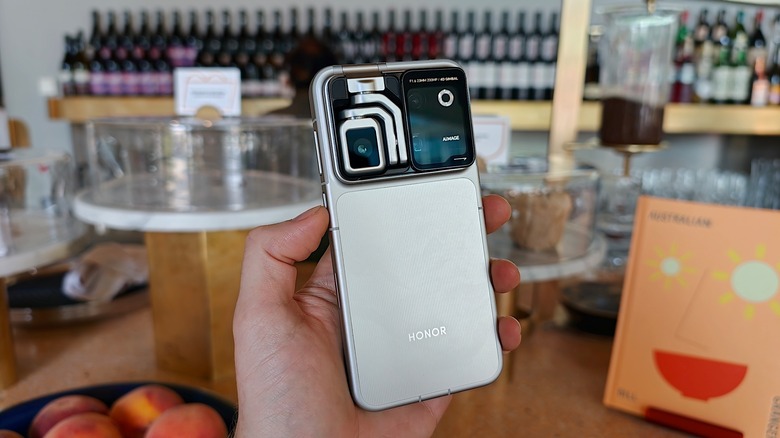
The fold-away panel that the primary camera tucks into also reveals more typical cameras, so you're not forced to use the gimbal if you don't need it. Still, that's one very thick camera unit:

Honor Robot Phone at MWC 2026
Image by Mat Smith for Engadget

Honor has already started building out camera modes and features, with a Super Steady Video mode that enhances stability while swinging the Robot Phone around to capture video. AI Object Tracking will apparently intelligently follow subjects, while AI SpinShot supports intelligent 90-degree and 180-degree rotational movement for more cinematic transitions. We've seen these sorts of pre-programmed movements and functions in full-size phone gimbals and action cams. If Honor can nail it in such a tiny form, it'll be impressive. 

Other specifications during Honor's press event were sparse, although the company announced a collaboration with ARRI Image Science to bring its cinematic smarts to the Robot Phone's gimbal camera. 

In a press release, Honor's Li said the collaboration would bring ARRI's "cinematic standards and professional workflows" into mobile imaging. It's apparently the first time elements of ARRI Image Science are being integrated into a consumer device. Dr. Benedikt von Lindeiner, VP at ARRI, said the goal is to bring a true cinematic aesthetic, such as "natural color, gentle highlight roll-off, and a sense of depth," to shooting with an Honor smartphone.

Honor Robot Phone at MWC 2026
Image by Mat Smith

Honor also made a humanoid robot companion for its Robot Phone. The bot took to the stage alongside the Robot Phone, danced alongside human dancers, did a backflip and shook hands with CEO James Li. It didn't say a thing, but fortunately, during some on-the-rails banter between the robot, Robot Phone and Honor's CEO, the Robot Phone was particularly chatty.

Like the many humanoid robots we've reported on and seen in person, Honor hopes to put it to work in both industrial and domestic settings, pitching it as a central part of the company's multi-million-dollar push into AI. For now, it's being called Honor Robot.  

This article originally appeared on Engadget at https://www.engadget.com/mobile/smartphones/a-closer-look-at-honors-robot-phone-145935198.html?src=rss

Xiaomi 17 Ultra hands-on: Incredible cameras, but maybe hard to get

China’s biggest phone makers continue to relentlessly forge ahead with high-spec phones that you may never see in the US. With the Xiaomi 17 Ultra this year, the company has continued its pattern from previous iterations by focusing on powerful camera sensors, huge batteries and… being selective about global availability.

Xiaomi’s 17 series is launching across multiple European territories months after its Asia debut, but at the time of writing, no word yet on US availability. Another logistical point of interest? When we last checked out Xiaomi’s devices, it was the 15 series, and the company has decided to skip 16 and leap straight to 17, conveniently matching Apple’s latest number.

Storied camera brand Leica has been involved with Xiaomi’s phones for a few years and its newest flagship doesn’t disappoint in that regard, because this is another Xiaomi device dedicated to photography.

Xiaomi 17 Ultra hands-on at MWC 2026
Image by Mat Smith for Engadget

The 17 Ultra has a huge 1-inch 50-megapixel main camera sensor with a f/1.67 lens, and a telephoto setup with a 200MP 1/1.4-inch sensor and going up to 4.3x optical zoom. Xiaomi claims it’s capable of up to 17x “optical-level zoom,” but quality doesn’t measure up to, say, the Oppo Find X9, with its dedicated telescopic lens add-on. There’s also a 50MP ultrawide camera to round things out.

The main camera is very impressive, delivering plenty of detail and performing incredibly well in low light, seemingly before any computational photography kicks in. A new Light Fusion 1050L sensor features LOFIC HDR technology, delivering stronger control over highlights and more detail in darker areas of your shots. I've been impressed by the balanced color tone and contrast, without having to edit or add one of the (many) Leica camera filters.

If anything, the slightly heavy-handed algorithms can sometimes ruin parts of a shot. For instance, by scrambling lettering or capturing blurry, AI-mutated faces where computational photography takes a swing (and a miss) at people in the distance.

Xiaomi 17 Ultra hands-on photo samples
Mat Smith for Engadget

The telephoto camera alone is also technically interesting in a few ways. It offers continual optical zoom across the 75-100mm range without in-sensor cropping. This means the lenses physically move to deliver lossless zoom across a range of distances, without jarring leaps between camera sensors and crops. This doesn’t run across the full gamut, but it does roughly cover the 3-4x optical zoom range, which is often used in portrait photography.

The APO (apochromatic) lens design on the telephoto is more immediately useful and effective. An APO lens significantly reduces chromatic aberration by focusing three wavelengths of light (red, green and blue) onto the same focal plane. This lens design means it can correct color fringing and improve image sharpness.

Xiaomi 17 Ultra hands-on photo samples
At full optical zoom, this light fitting at Soho Theatre Walthamstow doesn't bloom or fringe to the extent that most smartphone zooms suffer from.
Mat Smith for Engadget

At higher zoom levels, fringing and lighting bloom often hamper telephoto photos on smartphones, and Xiaomi’s solution has some appeal. I noticed less fringing than on other zoom-capable Android phones from Samsung, Oppo and Google. It also supports macro photography, but is hindered this time by a minimum focal distance of 30cm (11.8 inches). Most smartphone cameras’ macro modes let you get much closer.

The 17 Ultra can capture up to 8K video (at 30 fps), 4K Dolby Vision up to 120 fps, and 4K 120 fps Log video, ensuring you can make the most of that huge 1-inch sensor in video, too. That said, it seems to struggle with stabilization at times, while its low-light performance doesn’t match its prowess in still photography, lagging behind flagship phones from Apple, Google and Samsung.

There's also a special Leica edition of the 17 Ultra, which is largely the same, specification-wise, but with a manual zoom ring around the camera unit. It's a cool gimmick, but felt oddly loose on a few devices I've handled. 

Xiaomi made a few design changes to its Ultra line this year, with a new, entirely flat display, and flattened edges that look like a certain family of devices. In fairness, it’s not the only company using imitation as flattery. There’s also IP68 protection against dust and water.

While cameras may be the highlight, this is a flagship device by any specification metric. With a 6.9-inch display, this expansive OLED display has variable refresh rates (1-120Hz) and peaks at 3,500 nits of brightness.

At that size, the Xiaomi 17 Ultra is in the territory of devices like the iPhone 17 Pro Max and S26 Ultra. A phone this size isn’t for everyone, but it is the thinnest Ultra phone from Xiaomi to date, with a profile measuring 8.29mm. Xiaomi has also reduced the camera unit’s diameter and raised it on the device, making it easier to use and helping keep fingers out of your shots.

Xiaomi 17 Ultra hands-on at MWC 2026
Image by Mat Smith for Engadget

Also, I’d be remiss if I didn’t mention the huge 6,000mAh silicon-carbon battery, with support for Xiaomi’s 90W HyperCharge (if you have the right charger) and 50W wireless HyperCharge (which also requires Xiaomi’s own dock) speeds. Other phone makers: Please put a battery this huge in your flagship.

At MWC 2026, the company announced the global launch and rollout of the device across Europe, including the UK where the Ultra will start priced at £1,299 (roughly $1,750). We're still waiting to confirm US availability and pricing.

While the specs are powerful, “launching” a flagship device that’s already been in the wild for a few months — even if elsewhere in the world — reduces the spectacle.

This article originally appeared on Engadget at https://www.engadget.com/mobile/smartphones/xiaomi-17-ultra-global-launch-hands-on-leica-camera-143006810.html?src=rss