MetMo Eddy Makes Gravity Look Like It Changed Its Mind

Watch a small metal ball drop through a tube, and normally that’s it; blink, and it’s over. But drop it through MetMo Eddy, and something strange happens: the fall stretches out, like gravity took a breath. This palm-sized copper cylinder is a precision-machined desk toy that turns a real electromagnetic effect into something you can hold, flip, and watch happen right in front of your eyes, no batteries required.

That slow-motion trick isn’t new; it’s just never looked this good on a desk. Back in 1855, physicist Léon Foucault noticed that moving a magnet near a conductive disc created currents that pushed back against the motion. He called them eddy currents, and engineers have used the same principle in brakes and sensors ever since. MetMo just gave it a much better home.

Designers: Sean Sykes & James Whitfield

Click Here to Buy Now: $109.

Here’s the simple version: as the magnet drops through the copper tube, it stirs up little loops of electrical current in the metal around it. Those currents create their own magnetic field, one that opposes the fall. Gravity is still very much in charge; it’s just arguing with physics on the way down. No motors, no gears, no hidden switches, just two materials doing what they’ve always done.
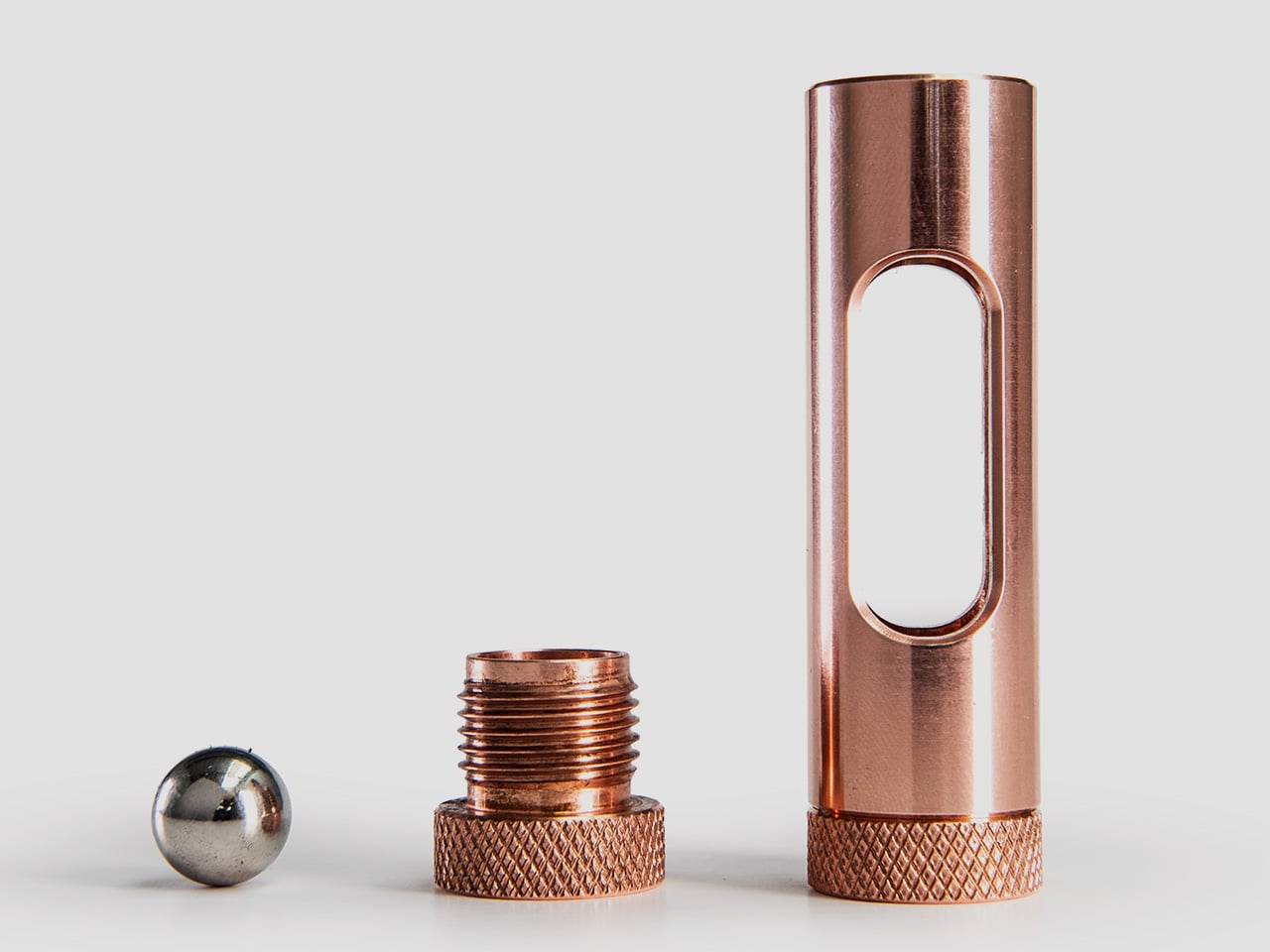
Copper does more than look good here, though it certainly does that too. It happens to be one of the most conductive non-magnetic metals around, which means it generates a stronger eddy current response than most alternatives could manage. That translates to a more pronounced, more watchable slowdown. It also happens to give Eddy that warm, rose-toned glow that looks better on a desk than aluminum or steel could.
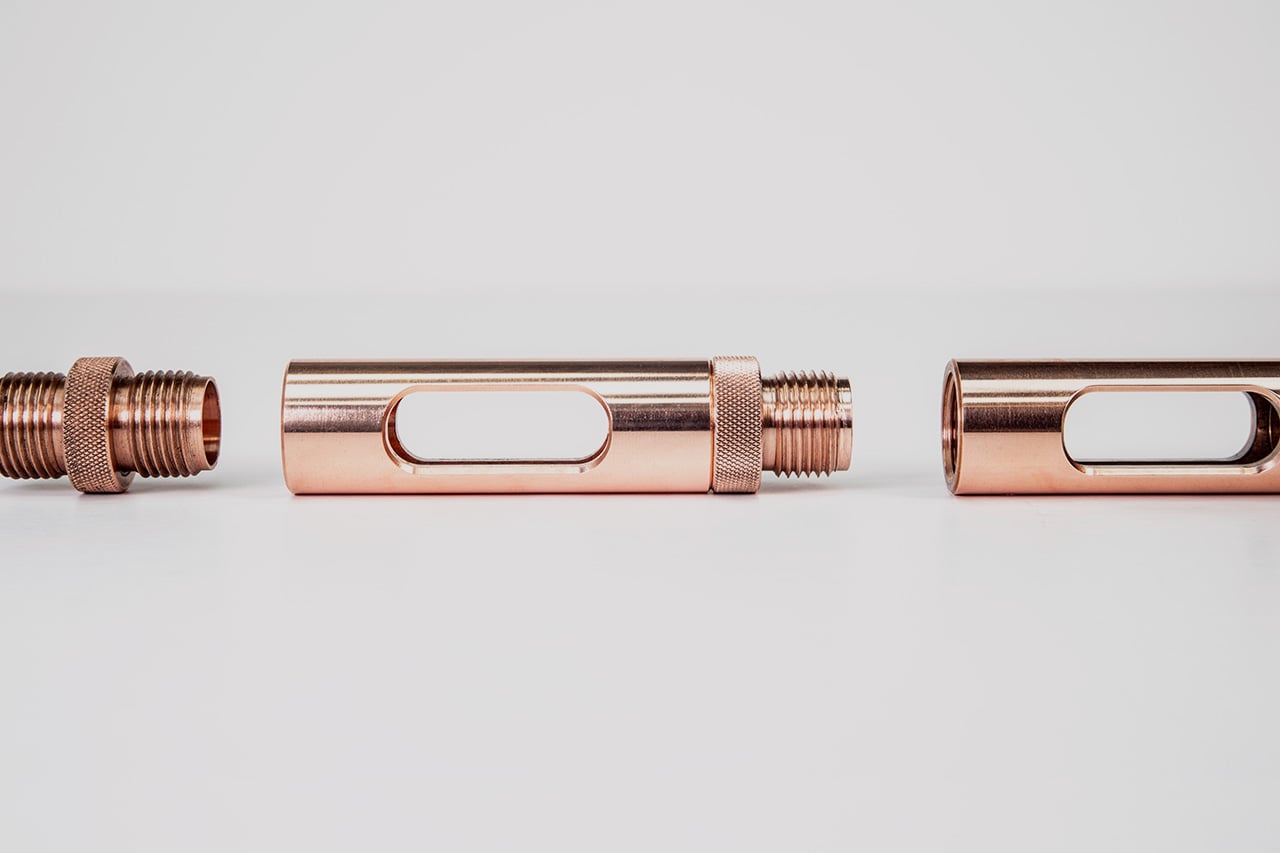
Every tube starts as a solid block of lead-free, ultra-high-purity copper before it’s CNC-machined to tolerances tight enough to bring the inner wall almost, but not quite, into contact with the magnetic sphere. That tiny gap matters: the closer the copper sits to the magnet, the stronger the eddy current effect, and the smoother the drop looks. Designed and finished by hand in the UK, the machining is the point.
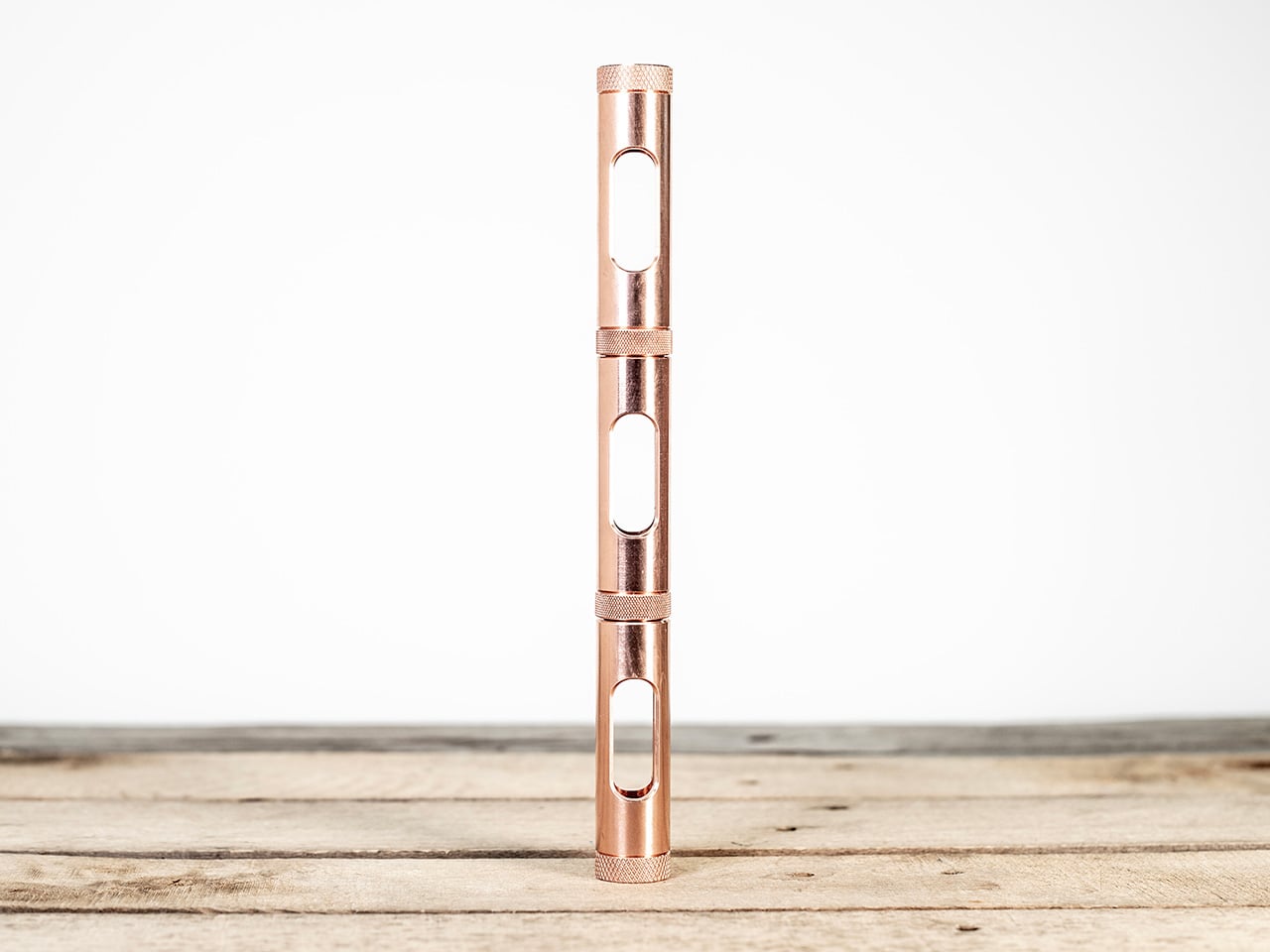
Pick it up and the size makes sense immediately: just under 3 inches tall, less than an inch wide, and just 3 ounces, enough heft to feel substantial without weighing down a pocket. Knurled caps on both ends give your fingers something to grip, while the smooth, brushed middle section contrasts nicely against them. It’s the kind of detail that separates a toy from an object somebody actually designed.
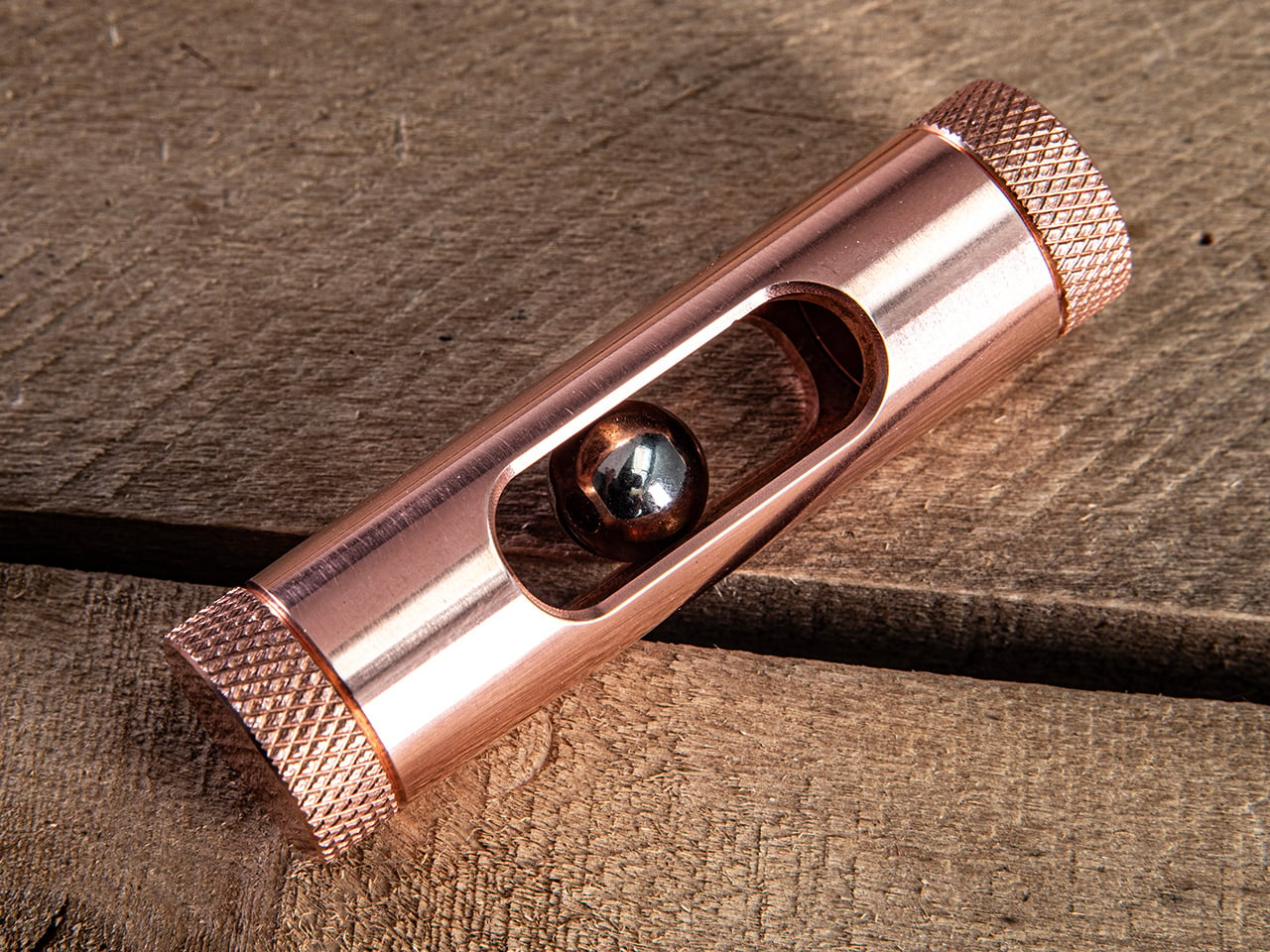
A passivated surface finish keeps the copper looking freshly machined for longer, slowing down the natural oxidation that usually dulls exposed metal within weeks. Eddy will still age the way copper ages, gradually and with character, but it won’t need constant polishing to stay presentable on a desk. It’s a small, easy-to-miss detail, but it’s the sort of thing that tells you somebody thought this through past the prototype stage.

Maybe the most underrated part is that it makes zero noise. No click, no rattle, no thud when the magnet reaches the bottom, just silence. Flip it over, and the drop starts again, and before long that one-handed flip becomes a habit your fingers pick up between emails or during a call. It’s less a fidget toy and more a five-second reset button that happens to double as desk decor.

An elongated window cut into the tube lets you watch the magnet fall instead of guessing what’s happening inside, and that visibility is what makes the whole effect land. Unscrew either end cap, and there are a few different ways to drop and catch the ball. For a longer drop, a small coupling piece threads two tubes together end to end, without changing anything about how the effect works.

Some desk objects need explaining before anyone appreciates them. Eddy doesn’t. Hand it to someone, let them drop the magnet once, and watch their eyebrows go up when it takes way longer to fall than it should. That reaction doesn’t really wear off with repetition either, which says something about how good the underlying idea is, dressed up in copper and finished by hand.

Click Here to Buy Now: $109.

The post MetMo Eddy Makes Gravity Look Like It Changed Its Mind first appeared on Yanko Design.

Physicist Peter Higgs, who predicted ‘the God particle’, has died at 94

Peter Higgs, the physicist who predicted the Higgs boson particle, has passed away at the age of 94 due to a blood disorder. His work proposing the particle — and showing how it helped give mass to some matter — won him the Noble price in 2013. The Higgs boson is informally referred to as the God particle, after a book by Nobel laureate Leon Lederman.

Higgs came up with the idea in the early 1960s as an attempt to explain why atoms have mass in the first place. The research didn’t get any traction in scientific journals, primarily because few understood the concept, but he was finally published in 1964. This was just a theory at the time, but led to a 50-year race to prove the Higgs boson particle actually exists.

Scientists hit pay dirt in 2012, thanks to physicists working at the Large Hadron Collider at CERN in Switzerland. It took four years of experiments, but the Higgs boson particle was finally discovered, proving his ideas and adding a major puzzle piece to the corpus of particle physics knowledge known as the Standard Model.

As a matter of fact, modern theoretical physicists have posited the existence of up to five Higgs boson particles that fill up what is now called the Higgs field. Scientists hope to use the Higgs boson to one day find proof for ever-elusive dark matter.

The Royal Swedish Academy of Sciences, which awards the Nobel, wrote about the importance of his discovery ahead of the ceremony in 2013. “Even when the universe seems empty this field is there. Without it, we would not exist, because it is from contact with the field that particles acquire mass.” The Nobel was shared with François Englert, a Belgian theoretical physicist whose work in 1964 contributed to the discovery.

"At the beginning I had no idea whether a discovery would be made in my lifetime”, Higgs once said. He leaves two sons, Chris and Jonny, his daughter-in-law Suzanne and two grandchildren. His former wife Jody, a linguistics professor, died in 2008.

This article originally appeared on Engadget at https://www.engadget.com/physicist-peter-higgs-who-predicted-the-god-particle-has-died-at-94-153635259.html?src=rss

Physicist Peter Higgs, who predicted ‘the God particle’, has died at 94

Peter Higgs, the physicist who predicted the Higgs boson particle, has passed away at the age of 94 due to a blood disorder. His work proposing the particle — and showing how it helped give mass to some matter — won him the Noble price in 2013. The Higgs boson is informally referred to as the God particle, after a book by Nobel laureate Leon Lederman.

Higgs came up with the idea in the early 1960s as an attempt to explain why atoms have mass in the first place. The research didn’t get any traction in scientific journals, primarily because few understood the concept, but he was finally published in 1964. This was just a theory at the time, but led to a 50-year race to prove the Higgs boson particle actually exists.

Scientists hit pay dirt in 2012, thanks to physicists working at the Large Hadron Collider at CERN in Switzerland. It took four years of experiments, but the Higgs boson particle was finally discovered, proving his ideas and adding a major puzzle piece to the corpus of particle physics knowledge known as the Standard Model.

As a matter of fact, modern theoretical physicists have posited the existence of up to five Higgs boson particles that fill up what is now called the Higgs field. Scientists hope to use the Higgs boson to one day find proof for ever-elusive dark matter.

The Royal Swedish Academy of Sciences, which awards the Nobel, wrote about the importance of his discovery ahead of the ceremony in 2013. “Even when the universe seems empty this field is there. Without it, we would not exist, because it is from contact with the field that particles acquire mass.” The Nobel was shared with François Englert, a Belgian theoretical physicist whose work in 1964 contributed to the discovery.

"At the beginning I had no idea whether a discovery would be made in my lifetime”, Higgs once said. He leaves two sons, Chris and Jonny, his daughter-in-law Suzanne and two grandchildren. His former wife Jody, a linguistics professor, died in 2008.

This article originally appeared on Engadget at https://www.engadget.com/physicist-peter-higgs-who-predicted-the-god-particle-has-died-at-94-153635259.html?src=rss