This Anti-Gravity Humidifier Makes Water Flow Upwards So It Isn’t ‘Another Boring Appliance’

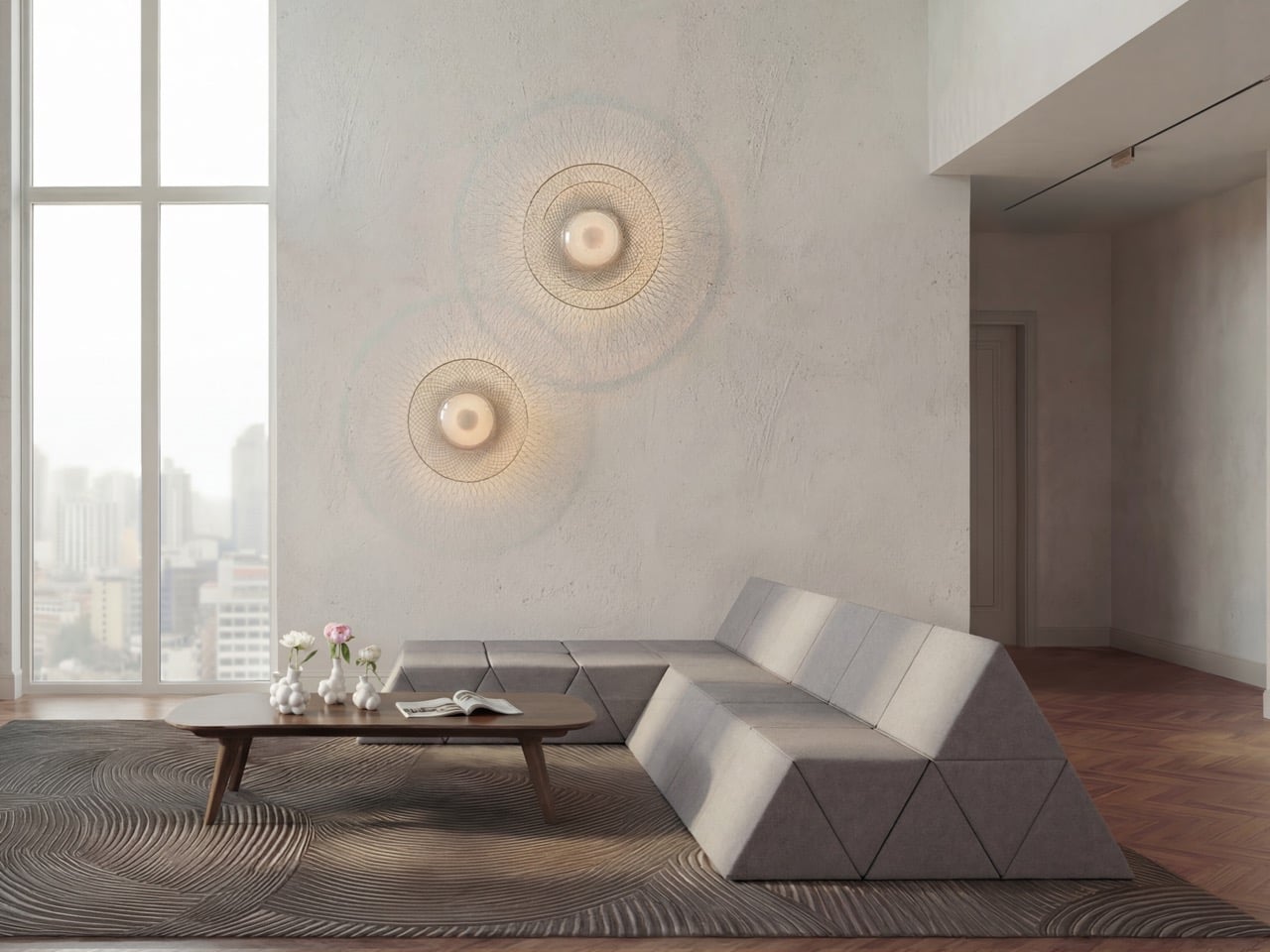
Remember that jaw-dropping scene in “Now You See Me 2” where rain seemingly reverses direction? The Serena Anti-Gravity Humidifier turns that cinematic spectacle into everyday home decor. The device actually uses visual persistence technology to create a convincing illusion of water droplets climbing upward, defying gravity with every pulse of its synchronized LED system.

Designer Kexin Su and the team at LuXun Academy of Fine Arts spent months perfecting the synchronization between water flow and light timing. The challenge was maintaining the illusion while delivering practical humidification for modern living spaces. Their solution borrows liberally from Dyson’s design vocabulary: a circular aperture, minimal controls, premium metallic finishes. But where Dyson multiplies air, Serena bends perception. The transparent colored ring frames the ascending droplets like a gallery piece, while the compact base houses the miniature pump and strobe system that make the whole spectacle possible.

Designer: Kexin Su

The tech here hinges on visual persistence, which is basically your brain holding onto an image for about 1/16th of a second after seeing it. LED strobes flash in sync with falling water droplets, catching each one in nearly the same position as the last. Your brain stitches these snapshots together and interprets the result as water flowing upward or hanging motionless in air. Think about how movie projectors work at 24 frames per second, except here the timing tolerance is even tighter. If the strobe drifts even slightly out of phase with the droplet release, the whole illusion falls apart and you’re just watching normal gravity do its thing. The miniature pump has to maintain ridiculously consistent droplet size and timing while the LED controller stays locked within millisecond precision.

At 478mm tall and 260mm across, this thing commands attention. You’re not tucking it behind a bookshelf. The whole point is putting it somewhere visible where the illusion can do its work. You get burgundy or amber options for the transparent ring, and honestly, the color choice matters more than you’d think because it completely changes the mood when backlit. The control scheme strips down to a single button and four indicator dots, probably for different intensity modes or timing presets. Touch controls let you tweak both strobe speed and brightness, which means you can dial in how fast the water appears to climb or how subtle you want the effect. Slower intervals make for dreamier upward motion, while cranking the brightness turns it into more of a statement piece.

What might feel like an optical gimmick actually does something pretty remarkable – it makes the humidifier way more interesting. Most of us shove these things into corners or bedrooms where they can do their job without being seen. Serena flips that equation entirely. It wants to be your living room centerpiece, which takes real conviction in the concept. I’ve seen similar strobe effects at science museums and in art installations, but domesticating that technology into something you’d actually plug in at home represents a different kind of design challenge. The Dyson influence is unmistakable, from the bladeless aperture aesthetic to the premium metallic finish, but they’re applying that visual language to something genuinely novel rather than just iterating on existing fan technology… and the A’ Design Award given to this humidifier is just proof that it’s a clever idea with brilliant visual execution.

The post This Anti-Gravity Humidifier Makes Water Flow Upwards So It Isn’t ‘Another Boring Appliance’ first appeared on Yanko Design.
Nothing Phone 4 Delayed: How RAM Prices and ‘Meaningful Upgrades’ Pushed the Release to 2027

Nothing is skipping the Phone (4) entirely this year. Not delaying it, not soft-launching it later, just straight up not making one. The Phone (3) holds down the flagship spot through all of 2026, which Carl Pei spins as a refusal to follow industry conventions for their own sake. He’s got a point about meaningful upgrades mattering more than arbitrary annual cycles, but the timing feels less like strategic patience and more like acknowledging that last year’s flagship push didn’t quite land the way they hoped. The Phone (3)’s pricing crept higher than fans expected, and Nothing even experimented with discounts to move units.

The Phone (4a) picks up the slack as Nothing’s solo 2026 release. Pei describes a “complete evolution” that pushes the A-series toward flagship experiences through premium materials, upgraded displays, enhanced cameras following the 3A Pro’s periscope success, and better overall performance. Design-wise, expect new colors and continued polish on Nothing’s transparent aesthetic, aiming to stay distinctive while appealing broader. But here’s where things get complicated: RAM prices have gone absolutely wild thanks to AI demand, forcing Nothing to raise prices across their smartphone portfolio. The (4a) was already their bestselling series partly because of competitive pricing. Now it needs to absorb component cost increases, justify premium positioning, and deliver enough differentiation to matter in a crowded mid-range field, all while being Nothing’s only new phone for the year. That’s a lot riding on one device.

Designer: Nothing

And I get it… The whole “we only upgrade when there’s something meaningful to say” pitch sounds refreshingly anti-corporate, but it’s also a somewhat tacit admission that the Phone (3) didn’t make the splash they hoped. They pushed pricing into the $600-700 range depending on region, which immediately put them against devices from brands with way deeper pockets and established reputations. Then they started running promotions to move inventory. That’s not the behavior of a company confidently sitting on a hit product. So yeah, taking 2026 off from flagship releases makes sense, even if the official messaging talks about meaningful innovation.

The 4A becomes the entire story by necessity. Pei promised a complete evolution across materials, display, camera, and performance, which sounds great until you remember the 3A series already delivered solid specs for the money. The 3A Pro brought a periscope camera to the mid-range, decent build quality, and respectable performance. Upgrading to UFS 3.1 storage is nice, but that’s table stakes at this point. Premium materials could mean anything from metal frames to glass backs, and new color experiments might freshen things up visually. But here’s the fundamental problem: all of this costs more to produce right when RAM prices are spiking hard enough that Pei called it unprecedented in his 20 years in the industry.

AI demand has component suppliers laughing all the way to the bank while phone makers scramble to absorb costs or pass them along. Nothing chose the latter. Price increases across the entire smartphone portfolio means the 4A’s value proposition takes a direct hit. The A-series worked because it offered flagship-adjacent experiences at mid-range prices. Now it’s offering mid-range experiences at mid-range-plus prices while the flagship sits idle for a year. You can see the squeeze happening in real time. Nothing needs the 4A to justify higher costs through tangible improvements, maintain enough distinctiveness to feel like a Nothing product, and somehow convince people it’s worth paying more for when every other mid-range phone is also getting more expensive.

The design question looms large here too. YouTube comments are already asking for glyph lights to return, which makes sense given that’s Nothing’s most recognizable feature. But adding glyph interfaces costs money, and if the A-series never had them before, suddenly including them now while also raising prices feels like asking for trouble. You either keep the transparent aesthetic without the lights and risk looking like any other glass-backed phone, or you add them and watch your margins evaporate. Neither option is great when you’re already dealing with component cost inflation and no flagship to absorb the premium features.

What Nothing built its reputation on was being the scrappy alternative that delivered distinctive design and solid performance without asking flagship money. The Phone 4A needs to thread an impossible needle: cost more but feel worth it, look different but stay affordable, deliver flagship experiences but remember it’s still mid-range. All while being the only new Nothing phone anyone can buy in 2026. That’s a tough spot for any device, let alone one from a company still finding its footing in a brutally competitive market.

The post Nothing Phone 4 Delayed: How RAM Prices and ‘Meaningful Upgrades’ Pushed the Release to 2027 first appeared on Yanko Design.
This $50 Smart Ring Has a Screen (And Works Like A Tiny Smartwatch)

The smartwatch got smaller. Then the smart ring arrived. Now Rogbid has released something that splits the difference and costs less than a nice dinner: the Fusion, a hybrid device that looks like someone shrunk a fitness tracker and stuck it on a ring band. For fifty dollars, you get a legitimate OLED display, actual health sensors, and the ability to wear your technology on whichever body part feels right that day.

This is more than just miniaturization for the sake of novelty. The Fusion measures 20.6 x 21 x 8.2mm and weighs about as much as three quarters stacked together, yet it monitors heart rate, tracks sleep, measures blood oxygen levels, and survives underwater thanks to 5ATM water resistance. Rogbid includes both a finger-sized adjustable strap and a wrist band, turning the device into whatever you need depending on your outfit, activity, or tolerance for questions from strangers. Battery life hits five days with regular use, which means this tiny screen actually pulls its weight between charges.

Designer: Rogbid

You have to give Rogbid credit for seeing Casio’s G-Shock ring sell out and thinking, “we can do that, but with actual tech inside.” That Casio piece was pure nostalgia, a fun gimmick that proved a market existed for finger-watches. Rogbid’s move feels like the logical, if slightly unhinged, next step: taking the novelty and injecting actual utility.

We’re talking over 100 sports modes, which is a software problem I don’t even want to think about navigating on a half-inch screen. But the hardware is there: an optical heart rate sensor, blood oxygen monitoring, and all the usual motion tracking. They even added prayer time reminders and a “couple interaction mode” for sharing codes, which feels like they just kept adding features from a hat until they ran out of room. It’s the kind of feature creep that’s almost admirable in its audacity, especially when most competitors are still trying to get basic step counting right in the ring form factor.

This whole thing is a fascinating gamble on what people want from a smart ring. The entire appeal of the Oura and its competitors is their subtlety; they disappear into your daily life. The Fusion, however, plants a glowing OLED screen right on your knuckle and demands attention. It’s a complete rejection of the minimalist aesthetic that defined the category. Maybe that’s the point. For fifty bucks, Rogbid isn’t trying to compete with the thousand-dollar jewelry pieces. They’re creating an entirely new, wonderfully weird sub-category of wearable that’s too cheap and too interesting to ignore.

The post This $50 Smart Ring Has a Screen (And Works Like A Tiny Smartwatch) first appeared on Yanko Design.
This LEGO Hula Girl Actually Dances When You Crank It

The dashboard hula dancer has been swaying her way through American car culture since the 1960s. Perched on dashboards from coast to coast, these spring-mounted figurines became synonymous with road trips, Hawaiian kitsch, and carefree summer drives. Their hypnotic hip movements, triggered by every bump and turn, transformed them into beloved symbols of vintage Americana.

LEGO builder SuperDuperD has now brought this nostalgic icon into the world of bricks with a stunning mechanical recreation. The Dancing Hula Girl is not just a static display piece. Through an ingenious crank mechanism hidden in the base, this 1,070-piece MOC captures the authentic swaying motion of the original dashboard dolls, complete with a flowing chain-link grass skirt that moves naturally with each turn.

Designer: SuperDuperD

The real genius here lives in the skirt. SuperDuperD used tan LEGO chain links to recreate the grass skirt, and this decision alone elevates the entire build from clever homage to genuinely impressive engineering. Chain pieces provide the draping, the texture, the flow, and critically, the flexibility needed for the mechanism to actually work. You could have built a rigid skirt from standard bricks, sure, but then you’d lose the entire essence of what makes a hula dancer’s movements captivating. The chains move independently yet cohesively, mimicking real fabric behavior in a way that feels almost organic for a plastic brick construction.

The mechanism itself relies on beautiful simplicity. A hand crank at the rear rotates an axle beneath the skirt, topped with a technic wheel sporting a single offset pin. That pin creates the up and down motion as the wheel spins, translating rotational movement into the characteristic hip sway. SuperDuperD mentions the trickiest part was connecting the upper and lower body while maintaining stability, which makes complete sense when you consider the forces at play. You’re essentially asking a static torso to remain balanced while the entire lower half oscillates beneath it. The solution required careful weight distribution and structural reinforcement that isn’t immediately visible in the final build, which is exactly how good engineering should work.

At 1,070 pieces and 450 grams, you’re looking at maybe a weekend build, which feels appropriate for something that’s half display model, half kinetic toy. The functional crank changes how you interact with this compared to a static build. Display models get built, photographed, then slowly fade into your peripheral vision until you stop noticing them entirely. Kinetic sculptures stay relevant because they invite interaction. You walk past your shelf, give the crank a few turns, watch the hips sway, then continue with your day with a smile on your face.

This MOC is live on LEGO Ideas right now, currently sitting at around 100 supporters with 59 days left to hit the first milestone of 10,000 votes. Reaching that threshold gets it in front of LEGO’s review board, where they decide which fan designs become official retail sets. If you think a mechanical dashboard hula dancer belongs in LEGO’s catalog, the voting process takes half a minute. All you need to do is go to the LEGO Ideas website hit the vote button!

The post This LEGO Hula Girl Actually Dances When You Crank It first appeared on Yanko Design.
This LEGO Hula Girl Actually Dances When You Crank It

The dashboard hula dancer has been swaying her way through American car culture since the 1960s. Perched on dashboards from coast to coast, these spring-mounted figurines became synonymous with road trips, Hawaiian kitsch, and carefree summer drives. Their hypnotic hip movements, triggered by every bump and turn, transformed them into beloved symbols of vintage Americana.

LEGO builder SuperDuperD has now brought this nostalgic icon into the world of bricks with a stunning mechanical recreation. The Dancing Hula Girl is not just a static display piece. Through an ingenious crank mechanism hidden in the base, this 1,070-piece MOC captures the authentic swaying motion of the original dashboard dolls, complete with a flowing chain-link grass skirt that moves naturally with each turn.

Designer: SuperDuperD

The real genius here lives in the skirt. SuperDuperD used tan LEGO chain links to recreate the grass skirt, and this decision alone elevates the entire build from clever homage to genuinely impressive engineering. Chain pieces provide the draping, the texture, the flow, and critically, the flexibility needed for the mechanism to actually work. You could have built a rigid skirt from standard bricks, sure, but then you’d lose the entire essence of what makes a hula dancer’s movements captivating. The chains move independently yet cohesively, mimicking real fabric behavior in a way that feels almost organic for a plastic brick construction.

The mechanism itself relies on beautiful simplicity. A hand crank at the rear rotates an axle beneath the skirt, topped with a technic wheel sporting a single offset pin. That pin creates the up and down motion as the wheel spins, translating rotational movement into the characteristic hip sway. SuperDuperD mentions the trickiest part was connecting the upper and lower body while maintaining stability, which makes complete sense when you consider the forces at play. You’re essentially asking a static torso to remain balanced while the entire lower half oscillates beneath it. The solution required careful weight distribution and structural reinforcement that isn’t immediately visible in the final build, which is exactly how good engineering should work.

At 1,070 pieces and 450 grams, you’re looking at maybe a weekend build, which feels appropriate for something that’s half display model, half kinetic toy. The functional crank changes how you interact with this compared to a static build. Display models get built, photographed, then slowly fade into your peripheral vision until you stop noticing them entirely. Kinetic sculptures stay relevant because they invite interaction. You walk past your shelf, give the crank a few turns, watch the hips sway, then continue with your day with a smile on your face.

This MOC is live on LEGO Ideas right now, currently sitting at around 100 supporters with 59 days left to hit the first milestone of 10,000 votes. Reaching that threshold gets it in front of LEGO’s review board, where they decide which fan designs become official retail sets. If you think a mechanical dashboard hula dancer belongs in LEGO’s catalog, the voting process takes half a minute. All you need to do is go to the LEGO Ideas website hit the vote button!

The post This LEGO Hula Girl Actually Dances When You Crank It first appeared on Yanko Design.
This LEGO Hula Girl Actually Dances When You Crank It

The dashboard hula dancer has been swaying her way through American car culture since the 1960s. Perched on dashboards from coast to coast, these spring-mounted figurines became synonymous with road trips, Hawaiian kitsch, and carefree summer drives. Their hypnotic hip movements, triggered by every bump and turn, transformed them into beloved symbols of vintage Americana.

LEGO builder SuperDuperD has now brought this nostalgic icon into the world of bricks with a stunning mechanical recreation. The Dancing Hula Girl is not just a static display piece. Through an ingenious crank mechanism hidden in the base, this 1,070-piece MOC captures the authentic swaying motion of the original dashboard dolls, complete with a flowing chain-link grass skirt that moves naturally with each turn.

Designer: SuperDuperD

The real genius here lives in the skirt. SuperDuperD used tan LEGO chain links to recreate the grass skirt, and this decision alone elevates the entire build from clever homage to genuinely impressive engineering. Chain pieces provide the draping, the texture, the flow, and critically, the flexibility needed for the mechanism to actually work. You could have built a rigid skirt from standard bricks, sure, but then you’d lose the entire essence of what makes a hula dancer’s movements captivating. The chains move independently yet cohesively, mimicking real fabric behavior in a way that feels almost organic for a plastic brick construction.

The mechanism itself relies on beautiful simplicity. A hand crank at the rear rotates an axle beneath the skirt, topped with a technic wheel sporting a single offset pin. That pin creates the up and down motion as the wheel spins, translating rotational movement into the characteristic hip sway. SuperDuperD mentions the trickiest part was connecting the upper and lower body while maintaining stability, which makes complete sense when you consider the forces at play. You’re essentially asking a static torso to remain balanced while the entire lower half oscillates beneath it. The solution required careful weight distribution and structural reinforcement that isn’t immediately visible in the final build, which is exactly how good engineering should work.

At 1,070 pieces and 450 grams, you’re looking at maybe a weekend build, which feels appropriate for something that’s half display model, half kinetic toy. The functional crank changes how you interact with this compared to a static build. Display models get built, photographed, then slowly fade into your peripheral vision until you stop noticing them entirely. Kinetic sculptures stay relevant because they invite interaction. You walk past your shelf, give the crank a few turns, watch the hips sway, then continue with your day with a smile on your face.

This MOC is live on LEGO Ideas right now, currently sitting at around 100 supporters with 59 days left to hit the first milestone of 10,000 votes. Reaching that threshold gets it in front of LEGO’s review board, where they decide which fan designs become official retail sets. If you think a mechanical dashboard hula dancer belongs in LEGO’s catalog, the voting process takes half a minute. All you need to do is go to the LEGO Ideas website hit the vote button!

The post This LEGO Hula Girl Actually Dances When You Crank It first appeared on Yanko Design.
This LEGO Hula Girl Actually Dances When You Crank It

The dashboard hula dancer has been swaying her way through American car culture since the 1960s. Perched on dashboards from coast to coast, these spring-mounted figurines became synonymous with road trips, Hawaiian kitsch, and carefree summer drives. Their hypnotic hip movements, triggered by every bump and turn, transformed them into beloved symbols of vintage Americana.

LEGO builder SuperDuperD has now brought this nostalgic icon into the world of bricks with a stunning mechanical recreation. The Dancing Hula Girl is not just a static display piece. Through an ingenious crank mechanism hidden in the base, this 1,070-piece MOC captures the authentic swaying motion of the original dashboard dolls, complete with a flowing chain-link grass skirt that moves naturally with each turn.

Designer: SuperDuperD

The real genius here lives in the skirt. SuperDuperD used tan LEGO chain links to recreate the grass skirt, and this decision alone elevates the entire build from clever homage to genuinely impressive engineering. Chain pieces provide the draping, the texture, the flow, and critically, the flexibility needed for the mechanism to actually work. You could have built a rigid skirt from standard bricks, sure, but then you’d lose the entire essence of what makes a hula dancer’s movements captivating. The chains move independently yet cohesively, mimicking real fabric behavior in a way that feels almost organic for a plastic brick construction.

The mechanism itself relies on beautiful simplicity. A hand crank at the rear rotates an axle beneath the skirt, topped with a technic wheel sporting a single offset pin. That pin creates the up and down motion as the wheel spins, translating rotational movement into the characteristic hip sway. SuperDuperD mentions the trickiest part was connecting the upper and lower body while maintaining stability, which makes complete sense when you consider the forces at play. You’re essentially asking a static torso to remain balanced while the entire lower half oscillates beneath it. The solution required careful weight distribution and structural reinforcement that isn’t immediately visible in the final build, which is exactly how good engineering should work.

At 1,070 pieces and 450 grams, you’re looking at maybe a weekend build, which feels appropriate for something that’s half display model, half kinetic toy. The functional crank changes how you interact with this compared to a static build. Display models get built, photographed, then slowly fade into your peripheral vision until you stop noticing them entirely. Kinetic sculptures stay relevant because they invite interaction. You walk past your shelf, give the crank a few turns, watch the hips sway, then continue with your day with a smile on your face.

This MOC is live on LEGO Ideas right now, currently sitting at around 100 supporters with 59 days left to hit the first milestone of 10,000 votes. Reaching that threshold gets it in front of LEGO’s review board, where they decide which fan designs become official retail sets. If you think a mechanical dashboard hula dancer belongs in LEGO’s catalog, the voting process takes half a minute. All you need to do is go to the LEGO Ideas website hit the vote button!

The post This LEGO Hula Girl Actually Dances When You Crank It first appeared on Yanko Design.
This LEGO Hula Girl Actually Dances When You Crank It

The dashboard hula dancer has been swaying her way through American car culture since the 1960s. Perched on dashboards from coast to coast, these spring-mounted figurines became synonymous with road trips, Hawaiian kitsch, and carefree summer drives. Their hypnotic hip movements, triggered by every bump and turn, transformed them into beloved symbols of vintage Americana.

LEGO builder SuperDuperD has now brought this nostalgic icon into the world of bricks with a stunning mechanical recreation. The Dancing Hula Girl is not just a static display piece. Through an ingenious crank mechanism hidden in the base, this 1,070-piece MOC captures the authentic swaying motion of the original dashboard dolls, complete with a flowing chain-link grass skirt that moves naturally with each turn.

Designer: SuperDuperD

The real genius here lives in the skirt. SuperDuperD used tan LEGO chain links to recreate the grass skirt, and this decision alone elevates the entire build from clever homage to genuinely impressive engineering. Chain pieces provide the draping, the texture, the flow, and critically, the flexibility needed for the mechanism to actually work. You could have built a rigid skirt from standard bricks, sure, but then you’d lose the entire essence of what makes a hula dancer’s movements captivating. The chains move independently yet cohesively, mimicking real fabric behavior in a way that feels almost organic for a plastic brick construction.

The mechanism itself relies on beautiful simplicity. A hand crank at the rear rotates an axle beneath the skirt, topped with a technic wheel sporting a single offset pin. That pin creates the up and down motion as the wheel spins, translating rotational movement into the characteristic hip sway. SuperDuperD mentions the trickiest part was connecting the upper and lower body while maintaining stability, which makes complete sense when you consider the forces at play. You’re essentially asking a static torso to remain balanced while the entire lower half oscillates beneath it. The solution required careful weight distribution and structural reinforcement that isn’t immediately visible in the final build, which is exactly how good engineering should work.

At 1,070 pieces and 450 grams, you’re looking at maybe a weekend build, which feels appropriate for something that’s half display model, half kinetic toy. The functional crank changes how you interact with this compared to a static build. Display models get built, photographed, then slowly fade into your peripheral vision until you stop noticing them entirely. Kinetic sculptures stay relevant because they invite interaction. You walk past your shelf, give the crank a few turns, watch the hips sway, then continue with your day with a smile on your face.

This MOC is live on LEGO Ideas right now, currently sitting at around 100 supporters with 59 days left to hit the first milestone of 10,000 votes. Reaching that threshold gets it in front of LEGO’s review board, where they decide which fan designs become official retail sets. If you think a mechanical dashboard hula dancer belongs in LEGO’s catalog, the voting process takes half a minute. All you need to do is go to the LEGO Ideas website hit the vote button!

The post This LEGO Hula Girl Actually Dances When You Crank It first appeared on Yanko Design.

This LEGO Hula Girl Actually Dances When You Crank It

The dashboard hula dancer has been swaying her way through American car culture since the 1960s. Perched on dashboards from coast to coast, these spring-mounted figurines became synonymous with road trips, Hawaiian kitsch, and carefree summer drives. Their hypnotic hip movements, triggered by every bump and turn, transformed them into beloved symbols of vintage Americana.

LEGO builder SuperDuperD has now brought this nostalgic icon into the world of bricks with a stunning mechanical recreation. The Dancing Hula Girl is not just a static display piece. Through an ingenious crank mechanism hidden in the base, this 1,070-piece MOC captures the authentic swaying motion of the original dashboard dolls, complete with a flowing chain-link grass skirt that moves naturally with each turn.

Designer: SuperDuperD

The real genius here lives in the skirt. SuperDuperD used tan LEGO chain links to recreate the grass skirt, and this decision alone elevates the entire build from clever homage to genuinely impressive engineering. Chain pieces provide the draping, the texture, the flow, and critically, the flexibility needed for the mechanism to actually work. You could have built a rigid skirt from standard bricks, sure, but then you’d lose the entire essence of what makes a hula dancer’s movements captivating. The chains move independently yet cohesively, mimicking real fabric behavior in a way that feels almost organic for a plastic brick construction.

The mechanism itself relies on beautiful simplicity. A hand crank at the rear rotates an axle beneath the skirt, topped with a technic wheel sporting a single offset pin. That pin creates the up and down motion as the wheel spins, translating rotational movement into the characteristic hip sway. SuperDuperD mentions the trickiest part was connecting the upper and lower body while maintaining stability, which makes complete sense when you consider the forces at play. You’re essentially asking a static torso to remain balanced while the entire lower half oscillates beneath it. The solution required careful weight distribution and structural reinforcement that isn’t immediately visible in the final build, which is exactly how good engineering should work.

At 1,070 pieces and 450 grams, you’re looking at maybe a weekend build, which feels appropriate for something that’s half display model, half kinetic toy. The functional crank changes how you interact with this compared to a static build. Display models get built, photographed, then slowly fade into your peripheral vision until you stop noticing them entirely. Kinetic sculptures stay relevant because they invite interaction. You walk past your shelf, give the crank a few turns, watch the hips sway, then continue with your day with a smile on your face.

This MOC is live on LEGO Ideas right now, currently sitting at around 100 supporters with 59 days left to hit the first milestone of 10,000 votes. Reaching that threshold gets it in front of LEGO’s review board, where they decide which fan designs become official retail sets. If you think a mechanical dashboard hula dancer belongs in LEGO’s catalog, the voting process takes half a minute. All you need to do is go to the LEGO Ideas website hit the vote button!

The post This LEGO Hula Girl Actually Dances When You Crank It first appeared on Yanko Design.

This $17 Power Bank (20,000mAh) can charge a MacBook Air and it’s cheaper than Apple’s cleaning cloth

Apple sells a polishing cloth for about twenty bucks. TESSAN is out here offering a 20,000 mAh power bank with 30 watt USB C charging and built in USB C and Lightning cables for less than that. One cleans fingerprints off your screen. The other can recharge your phone several times, top up a thin and light laptop, and keep a tablet alive through a long flight. It is hard not to see the contrast as a snapshot of the current accessory market.
For roughly the price of Apple’s most meme worthy add on, you can buy a brick that quietly solves the most common charging headaches. No extra cables to pack, no hunting for outlets in crowded airports, no arguing over the one free plug at a conference. Just a single charger that covers most of the devices you actually carry. The polishing cloth may be softer. The value proposition is not.

Designer: TESSAN

Click Here to Buy Now

The built in cables are what make this thing actually useful instead of just another rectangular battery that sits in a drawer. You get a Lightning cable and a USB C cable permanently attached to the bank itself, plus a separate USB C port and USB A port on the side. So you can charge an iPhone, an Android phone, and something like a tablet or a laptop all at once without carrying a single extra cord. The 30 watt output means you can actually fast charge modern phones or keep a thin laptop limping along during a long meeting. TESSAN says it will push an iPhone 15 Pro to 53 percent in half an hour, which tracks with standard USB C PD speeds.

The 20,000 mAh capacity is enough to fully charge a MacBook Air once with a bit left over, or get about three to four full phone charges depending on your device. Real world usable capacity will be closer to 13,000 or 14,000 mAh after conversion losses, but that is normal for every power bank on the market. You are still looking at multiple days of phone backup or one solid laptop rescue. The whole thing weighs enough that you will know it is in your bag, but it fits under most airline carry on battery limits, so you can actually travel with it.

At 17 dollars, this feels like one of those weird Amazon lightning deals where the price accidentally makes sense for about 48 hours before it jumps back up. Most 20,000 mAh banks with any kind of name recognition sit closer to 40 or 50 bucks, and the ones with built in cables usually add another 10 or 15 on top of that. TESSAN is an Amazon brand that does travel adapters and charging accessories, so you are trading some of the premium build quality and safety margin you would get from Anker or Belkin for a price that just barely registers as a purchase. If the cables fray in a year, you discard it as e-waste and buy another one for less than the cost of replacing a single USB C cable from Apple. Sounds bonkers, no?

Click Here to Buy Now

The post This $17 Power Bank (20,000mAh) can charge a MacBook Air and it’s cheaper than Apple’s cleaning cloth first appeared on Yanko Design.