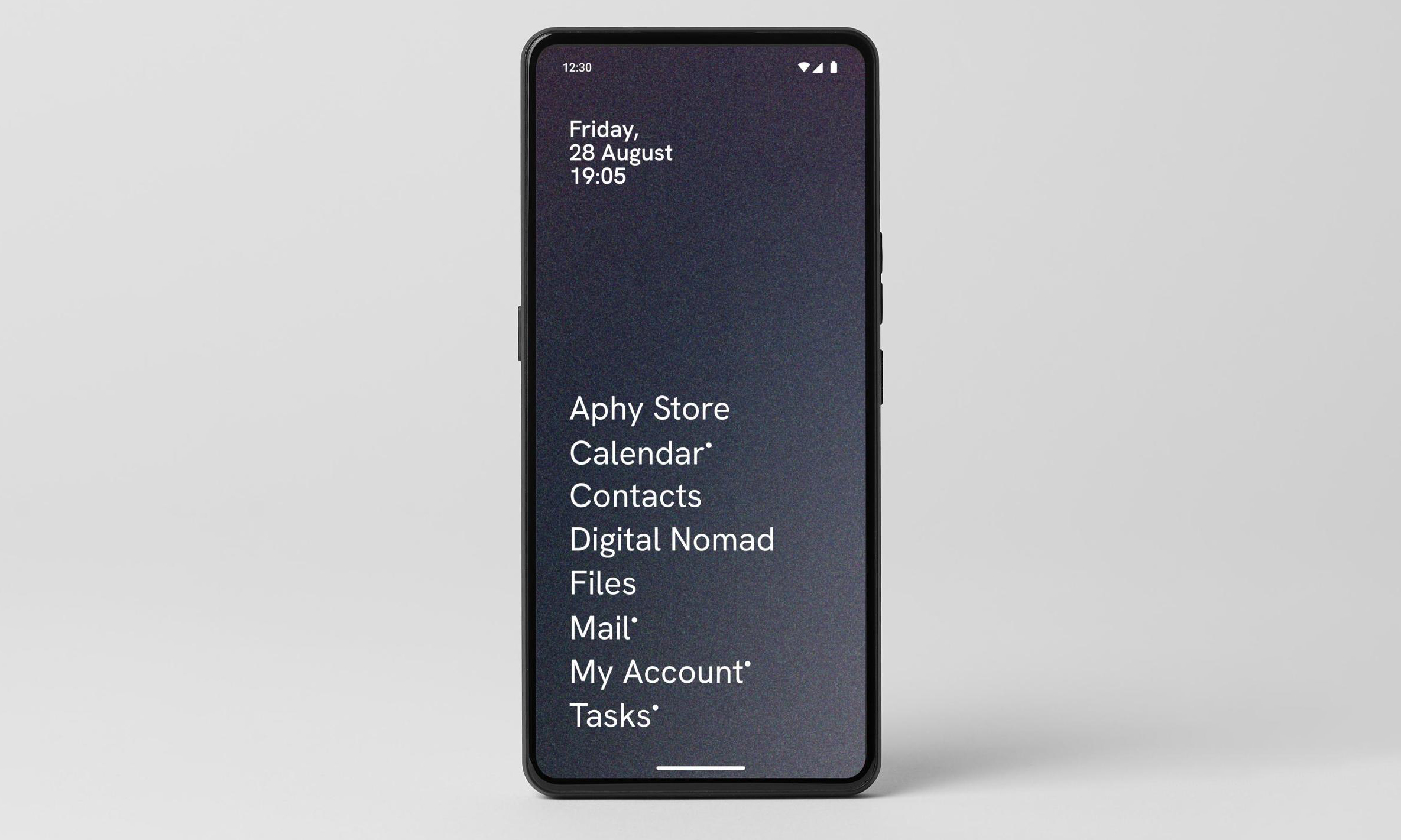
Nothing Phone 3 owners, your Android 16 update is here. Owners of other models? Well, you’ll have to wait a bit longer. Regardless, the company's Nothing OS 4.0 update brings Google's newest mobile software, along with a bunch of UI tweaks.
In addition to Android 16, Nothing OS 4.0 should deliver a smoother, zippier experience. The company promises "faster responses, cleaner visuals, smoother interactions" and more. Along those lines, app transitions, the notification shade and gestures have been redesigned to respond "with sharper tactility and depth."
Nothing also redesigned its first-party icons, with cleaner, more minimal styling. "The home screen feels balanced, modern and comfortable to use," the company claims. Status bar icons have been refined, drawing inspiration from Android 16’s stylings. There are also new lock-screen clocks to choose from, and an "extra dark mode" (in addition to standard dark mode), designed for nighttime reading.
A marketing grid, showcasing Nothing OS 4.0's new features.
Nothing
The Glyph Interface has always been one of Nothing's most unique features, and it gets some updates, too. Glyph Progress integrates with Android 16's Live Updates. "Rides, deliveries, and timers now sync across your screen and the Glyph Interface," as the company describes it.
You can read up on all the changes on the release page. Nothing OS 4.0 is rolling out now to the Nothing Phone 3. Most other devices will start seeing it "over the coming weeks." The company's (recently spun off) CMF brand devices will receive the update by the end of 2025. Finally, Phone 3a Lite owners have to wait until "early next year."
This article originally appeared on Engadget at https://www.engadget.com/mobile/smartphones/android-16-starts-rolling-out-to-nothing-phones-182637951.html?src=rss
Command & Conquer: Red Alert 2 knew how to lay on the camp. But it wasn’t only known for having some of the most delightfully cheesy cutscenes this side of The 7th Guest. Red Alert 2 was also an acclaimed real-time strategy game for its time, and it’s still perfectly playable today. Want to see for yourself? It’s now as easy as opening your browser.
The Chrono Divide project (via PC Gamer) lets you play the 2000 RTS in Chrome, Edge, or Safari. Although it supports Firefox, too, its developer says it should be avoided if you want “good performance.” It even works in mobile browsers.
Chrono Divide supports cross-platform multiplayer using all the original maps. (You can use some mods, too.) In fact, according to PC Gamer, multiplayer is about your only option. Red Alert 2’s single-player campaign modes (where you’ll encounter those “so bad, they’re good” cutscenes) are still a work in progress.
“The project initially started out as an experiment and was meant to prove that it was possible to have a fully working, cross-platform RTS game running in a web browser,” the project’s website reads. “Now, with a playable version already available, the end-goal is reaching feature parity with the original vanilla ‘Red Alert 2’ engine.”
You can take it for a spin on the Chrono Divide webpage. You’ll need to import the original game files to begin. (The website automatically inserts a link to them on the Internet Archive.) But we won’t fault you if you’d rather opt for watching Red Alert 2’s fabulously corny cutscenes below.
This article originally appeared on Engadget at https://www.engadget.com/gaming/you-can-now-play-command--conquer-red-alert-2-in-your-browser-213815557.html?src=rss
Remember way back in 2024, when Qualcomm said most x86 Windows games would run smoothly on its Arm chipsets? Well, those promises were, shall we say, a bit premature. But with this week's launch of the Snapdragon Control Panel (along with other updates), the company says things are finally looking up for Snapdragon X Elite laptop owners.
Alongside the launch of faster new chips, Qualcomm has made some quality-of-life improvements on the software end. Chief among them is this week's arrival of the Snapdragon Control Panel: the company's answer to NVIDIA and AMD's GPU tools. Like those apps, the Snapdragon software includes familiar features like automatic game detection, per-game settings and Adreno GPU driver updates. On that note, Qualcomm says its drivers have squashed bugs and boosted performance for over 100 games since last year.
Qualcomm
The crucial x86 emulation layer has also gotten some love. Microsoft's Prism Emulator now supports Advanced Vector Extensions (AVX) x86 emulation on Qualcomm chips. Meanwhile, the more advanced AVX2 will be supported out of the box on upcoming Snapdragon X2 Elite laptops. (Expect to hear more about those at CES.) Current Snapdragon X Series devices will receive the update "in the coming weeks."
One Windows gaming obstacle Qualcomm acknowledged last year was kernel-level anti-cheat tech. At the time, multiplayer games that relied on it simply wouldn't work on its devices. But as part of its gaming announcements this week, Qualcomm highlighted Fortnite's availability. That's thanks to Epic Online Services Anti-Cheat support. Qualcomm says it's also "working with" leading anti-cheat providers to add wider multiplayer support. That includes anti-cheat tech from Tencent, Roblox and more.
This article originally appeared on Engadget at https://www.engadget.com/gaming/pc/qualcomm-promises-better-gaming-performance-with-latest-windows-on-snapdragon-update-183529616.html?src=rss
Black Friday is as good a time as any to upgrade your home audio setup. You can get the Sonos Era 300, the company's only standalone speaker with spatial audio, for $379. That's $100 off what Engadget's Nathan Ingraham called "a great speaker, whether or not it is playing songs in Dolby Atmos."
That Dolby reference points to the Era 300's core novelty. It produces spatial audio without requiring additional speakers. (You can use Apple Music or Amazon Music to stream compatible tracks.) Expect those Dolby Atmos tracks to sound better with newer music than older songs remixed for Dolby's tech.
Even if you don't bother with its spatial tricks, the Era 300 is a terrific-sounding speaker. It delivers rich, detailed and balanced audio that can hang with just about anything else Sonos offers.
The speaker supports voice control via Alexa or Sonos Voice Control. It also offers Trueplay tuning, which listens to how your room shapes the sound and adjusts accordingly. In this model, you don't need to use your phone: Its built-in mics scan your room for you. That's especially handy for Android users, since phone-based Trueplay (from other models) is iOS-only.
If the Era 300 is a bit out of your budget, Sonos has loads of other products on sale for Black Friday. You can get the smaller — but still mighty — Era 100 for $169 (23 percent off). The portable Move 2 is down to $399 (20 percent off). Even the company's headphones, Sonos Ace, are on sale for $279 (30 percent off).
Sonos home theater products are discounted, too. You can get the Arc Ultra soundbar for $879 (20 percent off), or the Sub 4 subwoofer for $719 (also 20 percent off). Or, if you're in the market for both and have the budget, save even more on a bundle: Get the Arc Ultra and Sub 4 for $1,499 (25 percent off).
This article originally appeared on Engadget at https://www.engadget.com/deals/sonos-black-friday-deals-get-the-era-300-speaker-on-sale-for-100-off-120048024.html?src=rss
Our pick for the best robot vacuum (or at least one of its many variants) is on sale. Amazon's Black Friday deals include the Shark AI Ultra robot vacuum. This model has a list price of $599, but you can snag one for $250. That's 58 percent off — and a record low.
One of this model's standout features is its bagless design. Like many robovacs, it has an auto-empty station. But here, you can remove part of the base, dump its contents in the garbage, and lock it back in place. The base holds up to 60 days of dirt and debris, and you'll never need to order bag refills.
The Shark AI Ultra has strong suction and decent obstacle avoidance (via LiDAR). The robovac cleans in a matrix grid. It auto-maps your home and supports Google Assistant and Alexa for voice control.
The vacuum has a runtime of about 120 minutes. (If it needs to stop and charge, it will auto-resume afterward.) Also note that this is a vacuum-only model: no mopping here.
This article originally appeared on Engadget at https://www.engadget.com/deals/one-of-our-favorite-shark-robot-vacuums-is-58-percent-off-right-now-for-black-friday-100013224.html?src=rss
Amazon Black Friday deals almost always include discounts on Fire TV devices and Fire TV sets. This year is no different, and some of the best discounts bring Fire TV streaming dongles down to near record-low prices. Case in point: the Fire TV Stick 4K Max is 41 percent off and down to only $35.
The Fire TV Stick 4K Max is one of Engadget's favorite streaming devices. The stick supports a solid mix of advanced technologies for its price: Dolby Vision, Dolby Atmos, 4K and HDR10+. As long as the rest of your entertainment setup can handle it, you'll get a high-quality picture and sound. It also supports Wi-Fi 6E, enabling better, faster connectivity with compatible routers.
The 4K Max has the fastest processor of any Amazon Fire TV Stick, so expect zippy navigation. It also supports Amazon's Ambient Experience. This mode displays art (like on Samsung's The Frame) while the device is in standby. It's also a solid choice for gaming: It supports Xbox cloud streaming and works well as a retro game emulator, too.
The UI is where Amazon appears to be subsidizing the device's low cost. Expect to see loads of Prime Video content promos, along with other ads. But for $35 (compared to its MSRP of $60), you may find it easier to justify that tradeoff.
Also on sale is Amazon's Fire TV Stick HD, our pick for the best budget streaming stick. This model doesn't support 4K; instead, it limits you to 1080p at 60 fps. At $18 for Black Friday, it's certainly cheap. But if you have a 4K TV (or plan to soon), you may want to consider the slightly more expensive model.
This article originally appeared on Engadget at https://www.engadget.com/deals/the-fire-tv-stick-4k-max-is-on-sale-for-42-percent-off-in-amazons-black-friday-deals-132100743.html?src=rss
This story about Paul McCartney begins with one of his old bandmates. "I'm not really Beatle George," the ever-philosophical George Harrison once said. "For me, Beatle George was a suit or a shirt that I once wore. And the only problem is, for the rest of my life, people are going to look at that shirt and mistake it for me."
On one hand, that’s, well, George being George. But his quote does speak to our need to mythologize the Beatles. It’s hard not to! The music is so exquisite, influential and timeless that we look for grand stories to tell about it. We want a stronger connection to it, so we pore over biographies, interviews and documentaries. We seek meaning and purpose in their story.
Still, it must be surreal to be one of the four protagonists of that story. At some point, the narrative takes on a life of its own that may not reflect your experience. McCartney alluded to that in the 2013 song "Early Days." "Now everybody seems to have their own opinion on who did this and who did that," he sang. "But as for me, I don't see how they can remember when they weren't where it was at."
So, I’ll try not to mythologize the Beatles too much as I describe my experience photographing Sir Paul McCartney last month. I will, of course, fail spectacularly at that mission.
The crowd ranged from seniors to teens in Sgt. Pepper costumes.
Will Shanklin for Engadget
Months before I watched him play for nearly three hours in front of 15,000 fans (at age 83!) at Albuquerque’s Isleta Amphitheater, I sent a press request to his team. A few days before the concert, I learned that my photography pass had been approved. Once it sank in, I screamed and giggled, not unlike the teenagers in Ed Sullivan's audience. (Don't judge those gals until you've been near a Beatle!)
But there wasn’t much time to soak up the excitement. Without any real cameras on hand — my iPhone 17 Pro certainly wasn’t going to cut it — and only a few days to prepare, some quick decisions were in order. After enough internal debate to make my head spin off its axis, I settled on an oddball combination. For the body, I went with the Canon EOS R50, an ultra-compact mirrorless with a 24-megapixel APS-C sensor.
Was it the best one available? Not at all. But instead of renting a $3,000 camera, I decided to buy something in my budget that I'll enjoy using for years. I'd already eyed it after handling a display model and reading Steve Dent's review. Plus, it created a fun challenge: How can a sub-$800 consumer-facing camera stand up to the unique demands of concert photography?
The lens, on the other hand, is no place to mess around. So I rented the Canon EF 70-200mm f/2.8 L IS USM, a gargantuan, professional-grade telephoto one. (It's the precursor to this $2,399 one.) This choice was simple: It was by far the most concert-appropriate lens available to rent. It maintains sharpness and contrast across its long zoom range, its autofocus is fast and its f/2.8 aperture is crucial for the unique demands of stage lighting.
Put the tiny camera and ginormous lens together (with this $38 adapter), and you get the odd couple you see below. To say this sucker was front-weighted would be an understatement.
"She's so heavy..."
Will Shanklin for Engadget
Camera in hand (and Beatles hoodie equipped), I took my position in the tight press pen. The photography area was about 150 yards from the stage and didn’t allow for lateral movement, so ideas for creative compositions were set aside. My only option was to push that glass out to 200mm (or close to it) and fire away. Save those composition ideas for when it's time to crop.
When photographing someone like Sir Paul, you ideally want an image that captures not only the man and the musician, but also that larger-than-life myth. It should be something grand that you’d want to hang on your wall. No pressure!
Sir Paul's first number was the John Lennon-penned classic "Help!" Until this year's leg of the Got Back tour, McCartney hadn't played the song in full since 1990. We can only speculate about his reasons for pulling it out of his bag now. But I feel like the song's desperate pleas gain new poignancy in 2025. I can't count the times I've wanted to cry out to someone — anyone! — to "Please, please help me" after reading the news.
We were huddled close enough together that I was glad I wore these $16 kneepads under my jeans. When the crowd in front of us settled down a bit, I kneeled to give my photographer cohorts more elbow room. My right knee bounced pleasantly onto the cozy leg pillow.
Will Shanklin for Engadget
With one song already down, the R50's burst mode was getting a workout. The stock Canon battery was still going strong, but I had these two third-party spares stashed in this camera bag to swap out if necessary. (I didn't end up needing them, despite snapping over 600 photos.)
McCartney transitioned into his second number, "Coming Up," the first track from 1980's McCartney II. That LP was ahead of its time, embracing synths, drum machines and other studio tricks before they became commonplace. Contemporary critics didn’t care much for it, but it later became a cult classic. That combination illustrates something about his solo career: always experimenting, sometimes misunderstood, but ultimately vindicated.
Two songs were over in a flash. Macca addressed the crowd, and picture time was over. Off to leave my camera with security, and claim the faraway lawn seat I bought long before I knew I'd have press access.
The rest of McCartney's set included a perfect balance of Beatles, Wings and solo numbers. (There was even an old Quarrymen song, "In Spite of All the Danger.") As you can see in the photos, he started on his trademark Höfner bass. But he moved on to piano, acoustic and electric guitars and ukulele. The latter was for his beautiful rendition of Harrison's "Something."
That number wasn’t the only point that moved me. The most notable was where he teamed with Lennon on "I've Got a Feeling." Present-day McCartney singing with 1969 Lennon, who appeared on the giant screen above (via the restored rooftop concert footage in Get Back), was profound. "I love that one because I get to sing with John again," he said.
Will Shanklin for Engadget
Sir Paul strikes me as someone who’s always looking forward. But the Got Back tour is a chance to look back. It lets us, the romanticizing fans, join him on the long and winding road from the Quarrymen to today. The entire production made me feel like a passenger on his journey.
I could go on. But you don't need me to elevate Paul McCartney's musical legacy any more than you need me to explain Michael Jordan's basketball skills or Meryl Streep's acting chops. Listen to the music — and catch his tour if you can — and you'll feel it.
As for the photos, my favorite is the one at the top of this article. (I also included a color version in the gallery below.) It’s the only one that (to me) captures the man, musician and myth as he plays his Höfner bass. Out of more than 600 rapidly-fired photos, one that feels just right is good enough for me.
But even if they all sucked, who cares! Decades from now, I'll tell everyone at the old folks' home that, when I was young (and my heart was an open book), I snapped some pictures of Sir Paul McCartney. The story may grow more inflated by then, and maybe I’ll invent new details. But perhaps I can be forgiven for a bit of mythologizing.
This article originally appeared on Engadget at https://www.engadget.com/cameras/the-gear-i-used-to-photograph-paul-mccartney-133033591.html?src=rss
Sony AI released a dataset that tests the fairness and bias of AI models. It's called the Fair Human-Centric Image Benchmark (FHIBE, pronounced like "Phoebe"). The company describes it as the "first publicly available, globally diverse, consent-based human image dataset for evaluating bias across a wide variety of computer vision tasks." In other words, it tests the degree to which today's AI models treat people fairly. Spoiler: Sony didn't find a single dataset from any company that fully met its benchmarks.
Sony says FHIBE can address the AI industry's ethical and bias challenges. The dataset includes images of nearly 2,000 paid participants from over 80 countries. All of their likenesses were shared with consent — something that can't be said for the common practice of scraping large volumes of web data. Participants in FHIBE can remove their images at any time. Their photos include annotations noting demographic and physical characteristics, environmental factors and even camera settings.
The tool "affirmed previously documented biases" in today's AI models. But Sony says FHIBE can also provide granular diagnoses of factors that led to those biases. One example: Some models had lower accuracy for people using "she/her/hers" pronouns, and FHIBE highlighted greater hairstyle variability as a previously overlooked factor.
FHIBE also determined that today's AI models reinforced stereotypes when prompted with neutral questions about a subject's occupation. The tested models were particularly skewed "against specific pronoun and ancestry groups," describing subjects as sex workers, drug dealers or thieves. And when prompted about what crimes an individual committed, models sometimes produced "toxic responses at higher rates for individuals of African or Asian ancestry, those with darker skin tones and those identifying as 'he/him/his.'"
Sony AI says FHIBE proves that ethical, diverse and fair data collection is possible. The tool is now available to the public, and it will be updated over time. A paper outlining the research was published in Nature on Wednesday.
Update, November 5, 2025, 2:01 PM ET: This story has been updated to clarify that the participants were paid, not volunteers.
This article originally appeared on Engadget at https://www.engadget.com/ai/sony-has-a-new-benchmark-for-ethical-ai-160045574.html?src=rss
Nintendo's lawsuit against Palworld just hit a snag. The US Patent and Trademark Office (USPTO) has ordered a reexamination of a key Nintendo patent expected to be wielded in the case. Games Frayreports that the office is reviewing the Switch maker's patent regarding "summon subcharacter and let it fight in 1 of 2 modes." If we view Nintendo's Palworld lawsuit as a test bed for monopolizing game mechanics, the development can only be seen as a good thing.
Several factors make the reexamination unusual. First, Nintendo's patent in question (No. 12,403,397) was just granted in September. The review was personally ordered by newly sworn-in USPTO Director John A. Squires. The Trump appointee has historically sided with patent holders, making it harder to contest them. Stranger still, Games Fray says this may be the USPTO's first patent reexamination in over a decade.
Palworld
Pocketpair
Those ingredients suggest widespread blowback may be the driving force. Although Palworld developer Pocketpair is Nintendo's immediate target, it's easy to see the case opening a Pandora's box where developers fear using well-established game mechanics. Indie developers would be particularly vulnerable. The "slippery slope" commentary practically writes itself.
If Nintendo's patent is ultimately invalidated, we may be able to thank Konami. A 2002 patent application from the maker of Metal Gear and Castlevania was cited as prior art, casting doubt on Nintendo's claim. A separate Nintendo patent, published in 2020, was also listed as possible prior art. Games Fray's report dives much deeper into the legal weeds.
Nintendo now has two months to respond. During that period, third parties can come forward with additional prior art references. As a nervous industry eyes Nintendo's case as a potential test bed for monopolizing game mechanics, don't be shocked if gaming lawyers search far and wide for more examples.
This article originally appeared on Engadget at https://www.engadget.com/gaming/nintendo/nintendos-patent-on-summoning-fighting-npcs-is-being-reexamined-180949135.html?src=rss
The esports partnership between the International Olympic Committee (IOC) and Saudi Arabia is no more. On Thursday, the IOC said that it and the Saudi Olympic and Paralympic Committee (SOPC) have "mutually agreed" to part ways. The breakup comes weeks after Saudi Arabia's sovereign wealth fund and other investors bought EA for $55 billion.
The IOC and SOPC agreed on a 12-year esports partnership in 2024. At the time, the IOC was reportedly in talks with publishers of Rocket League, Street Fighter and League of Legends. The two sides discussed holding the Olympic Esports Games every two years. (The first games were initially scheduled for this year, but were pushed back to 2027.) Potential hosts for later installments were said to include South Korea and the US.
Instead, the two sides are now "committed to pursuing their own esports ambitions on separate paths," according to the IOC. The organization now plans to "spread the opportunities presented by the Olympic Esports Games more widely." It still wants the inaugural games to happen "as soon as possible."
The APnotes that the dissolution comes seven months into Kristy Coventry's IOC presidency. We don't know the details of how the deal came apart. However, the IOC wants to connect with younger fans through esports, but in a way that "Olympic values are respected." Saudi Arabia's Esports World Cup features MOBAs, shooters and fighting games.
If the IOC wants to project a squeaky-clean image while connecting with young gamers, it may have an uphill battle. (For the record, games don't lead to violence.)
This article originally appeared on Engadget at https://www.engadget.com/gaming/the-ioc-and-saudi-arabia-call-it-quits-on-their-olympic-esports-partnership-163148341.html?src=rss