Dell revives its XPS laptops after a boneheaded rebranding

Last year, Dell killed off all of its PC brands, including the iconic XPS lineup, and replaced them with a simplified naming scheme. It was a move meant to make it easier for people to discern between the company's many brands, but in reality, it just just made the company's lineup even more confusing. We called it an unforced error at the time, but after seeing how much Dell's PC market share fell over 2025, it's fair to say that rebranding was an absolute marketing disaster.

So, with its tail between its legs, Dell has returned to CES some welcome news for its fans: XPS lives! And the company plans to double-down on the brand in ways it never did before. Today, Dell revealed the new XPS 14 and 16 notebooks, which feature a more practical design than the previous models. There's a new function row with traditional keys, instead of the odd capacitive buttons that disappeared in sunlight. And while the company is sticking with its "invisible" trackpad, which sits flush alongside the wrist rest, there's now a light border around the edges that lets you feel exactly where the trackpad begins and ends.

So, in short, Dell seems to have solved most of our recent complaints about the XPS lineup. To signify its commitment to the brand, it's also emblazoning the XPS logo on all of these new machines, replacing the previous Dell name. That’s something I could never imagine a less humbled Dell doing.

The redesign also gave Dell room to shave off some weight and thickness from both machines. The XPS 14 weighs around three pounds now, a half-pound lighter than the previous generation, while the XPS 16 weighs 3.6 pounds, a whole pound lighter than before. The new cases make both machines look a lot more like Microsoft’s extra-subtle Surface Laptop, but that’s not necessarily a bad thing. Both systems are powered by Intel’s new Panther Lake Core Ultra Series 3 chips, and they also offer tandem OLED display options.

Dell also briefly teased the return of a new XPS 13 later this year, which is set to be the company’s thinnest and lightest notebook ever. Dell says it’ll be cheaper than the XPS has been in the past.

The new XPS 14 and 16 will be available on January 6, starting at $2,050 and $2,200, respectively. A Dell representative tells us these aren’t entry-level configurations, instead we can expect to see cheaper prices with lower specs in February.

Update 1/6/26, 12:30p: Pricing updated to reflecrt new numbers from Dell. Originally, we were told they would start at $1,650 and $1,850.

Update 1/12, 3:00p: Added a mention of lower entry-level configurations coming eventually.

This article originally appeared on Engadget at https://www.engadget.com/computing/laptops/dell-revives-its-xps-laptops-after-a-boneheaded-rebranding-001028029.html?src=rss

Samsung brought an absolute beast of a 130-inch Micro RGB TV to CES 2026

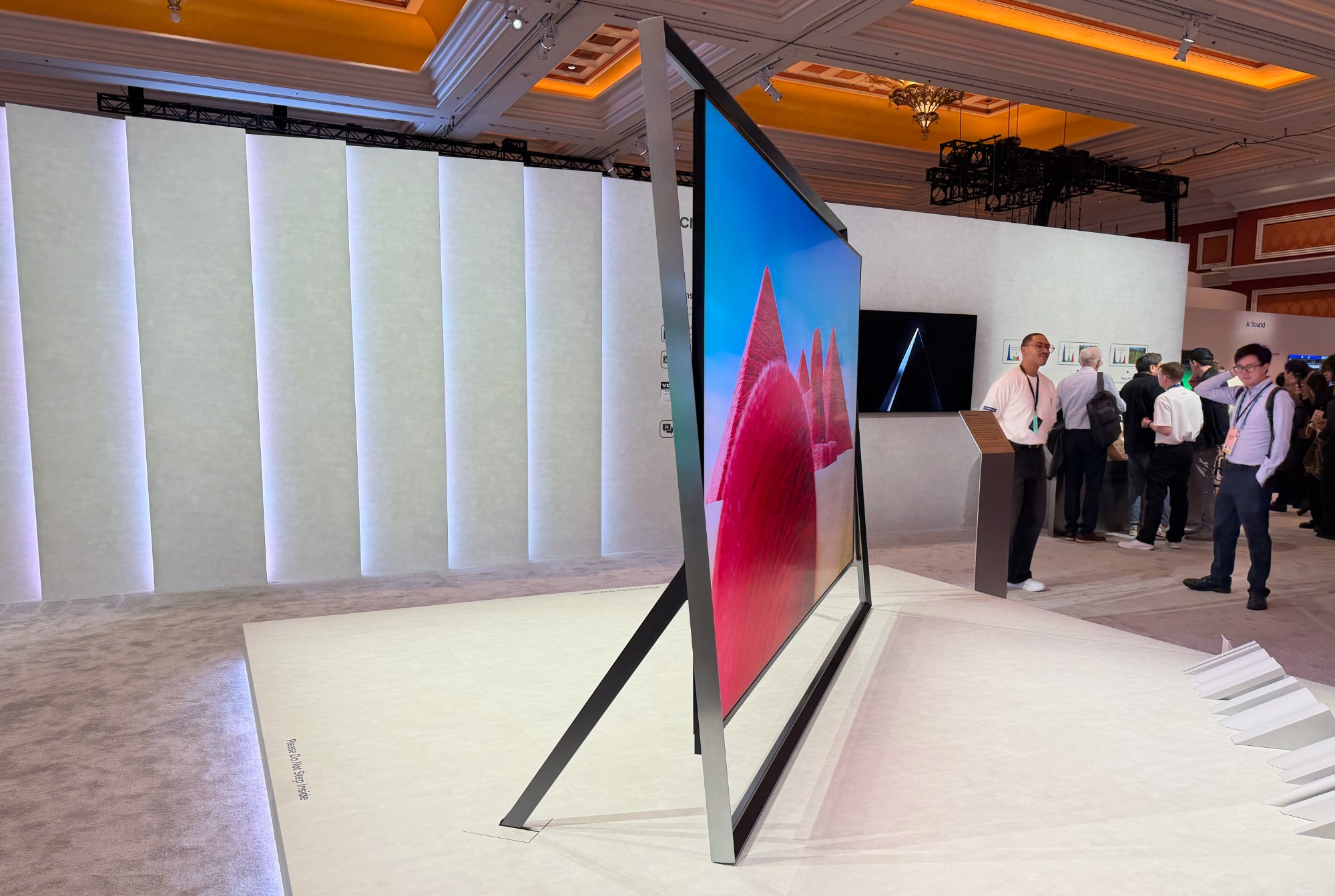
Amid endless AI hype and a guest visit from the CEO of Hartford Steam Boiler (?!), Samsung had a big surprise for us tonight at CES 2026: A massive 130-inch Micro RGB TV. It’s so large, it’s suspended by a large metal stand that surrounds the entire screen, which also lets you tilt the screen just a bit. (For the Samsung diehards, it’s basically a reinvention of its “timeless gallery” stand from 2013.) I imagine bringing this TV home would be like Bart Simpson adopting his beloved elephant Stampy: Your pets would be terrified, and your family would probably be annoyed at this television dominating so much of your home.

But boy, it sure looks amazing in person. Just like LG’s Micro RGB set, it’s using an evolved form of Mini LED technology that allows for far better color accuracy and richness. As I fought through the crowds of Samsung’s CES First Look event to catch a glimpse of it, I couldn’t help but notice how everyone just looked a bit stunned, like the monkeys from 2001 seeing the monolith for the first time.

Samsung's 130-inch Micro RGB TV from the side.
Devindra Hardawar for Engadget

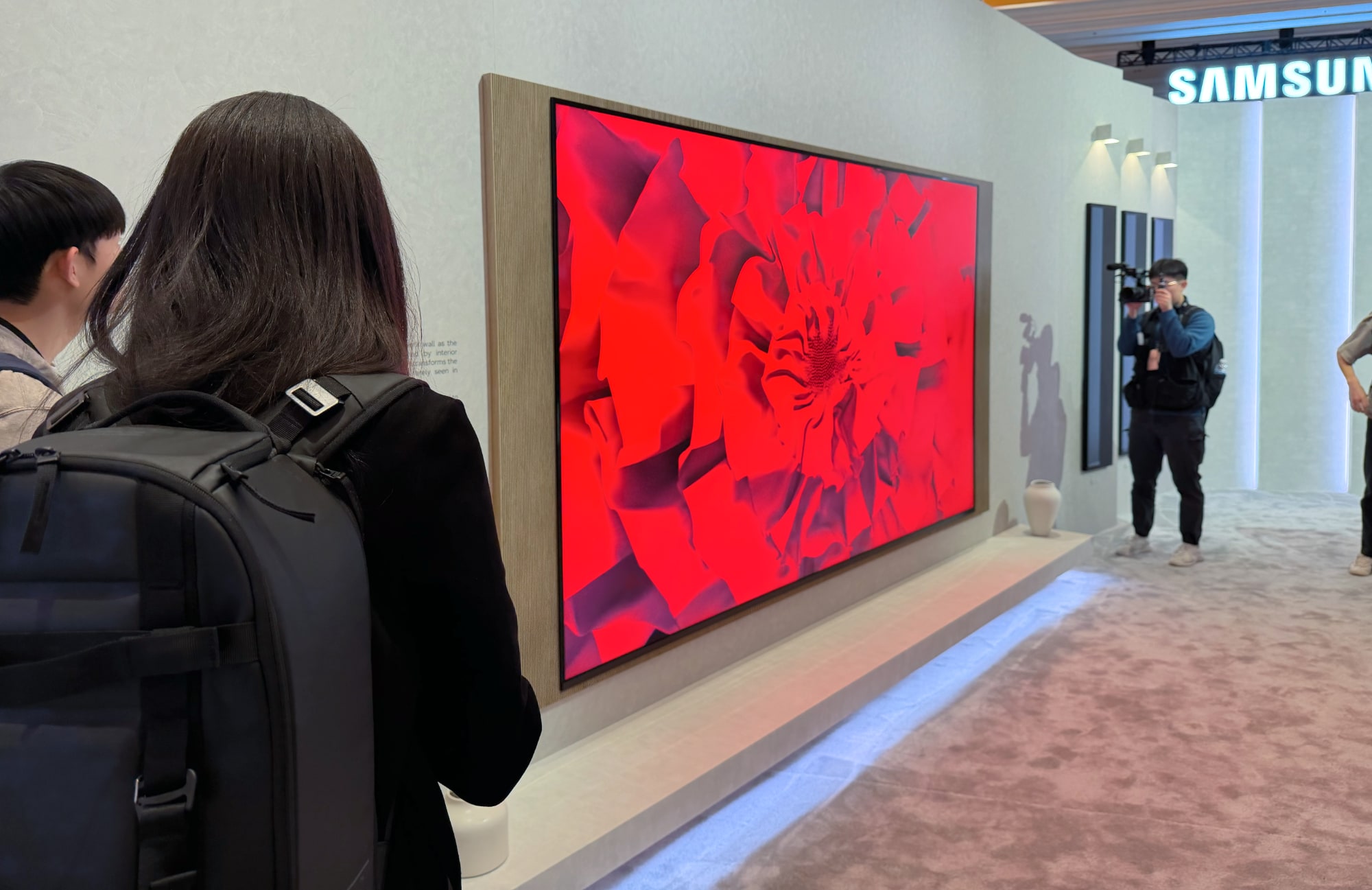
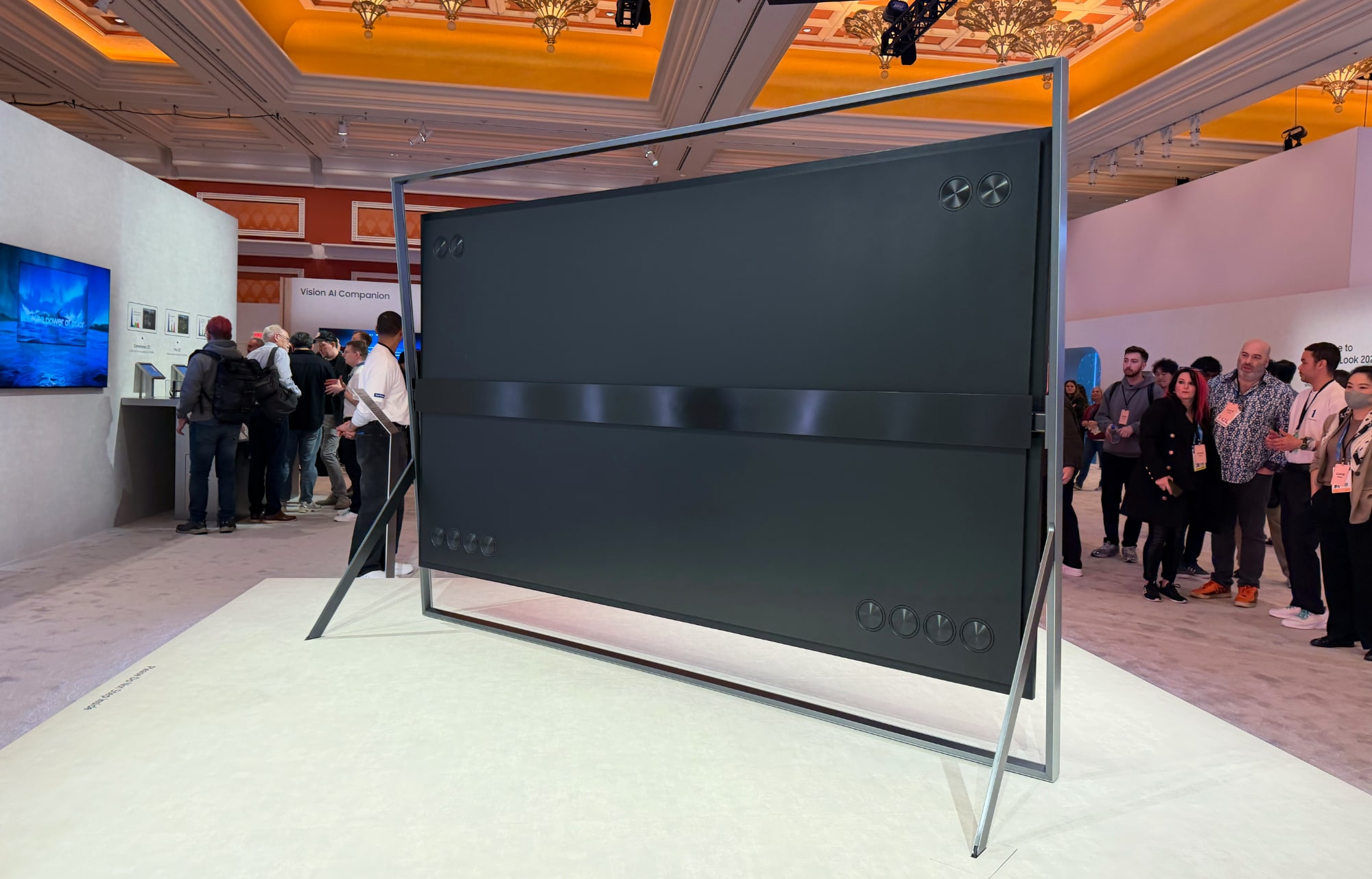
Samsung representatives were clear that this Micro RGB set was only a concept of what the company could do with the technology, it’s not an actual product it plans to ship. In another demo, Samsung took the 130-inch screen and mounted it directly on a wall (below). Of course, it still looked stunning. I also learned that if you wanted to wall mount the “timeless gallery” stand concept, you actually have to mount the entire stand to the wall, since it’s part of the TV’s speaker system.

Samsung didn’t have too many details about the technical aspects of the 130-inch Micro RGB TV, but it did shout buzzwords at us during its announcement. it’s powered by the company’s “Micro RGB AI Engine Pro” processor, which includes “Micro RGB Color Booster Pro” and “Micro RGB HDR Pro” technology, using AI to “enhance dull tones and refine contrast, delivering vivid color and subtle detail across bright and dark scenes alike for realism and picture fidelity.”

Samsung's 130-inch Micro RGB TV mounted in a wall.
Devindra Hardawar for Engadget

The Micro RGB set also sports the company’s Glare Free technology to reduce reflections, and it supports HDR 10+ Advanced and the company’s Eclipsa Audio. It can also tap into Samsung’s Vision AI Companion for conversational search, as well as Microsoft Copilot and Perplexity.

But of course, those details really don’t matter, because you won’t be able to buy the 130-inch Micro RGB TV in its current form. We were impressed by last year’s 115-inch model, but its $30,000 price didn’t make it feasible for anyone but the ultra-rich. And those folks would be better off investing in Samsung’s own Micro LED sets, which offer the benefits of OLED that Micro RGB does not. (Sure, those TVs start at $110,000, but for that’s not exactly a huge leap for those with deep pockets.)

Samsung's 130-inch Micro RGB TV from the rear.
Devindra Hardawar for Engadget

This article originally appeared on Engadget at https://www.engadget.com/home/home-theater/samsung-brought-an-absolute-beast-of-a-130-inch-micro-rgb-tv-to-ces-2026-060245387.html?src=rss

LG TVs at CES 2026: A stunning Wallpaper set, glorious Micro RGB colors and a better Gallery TV

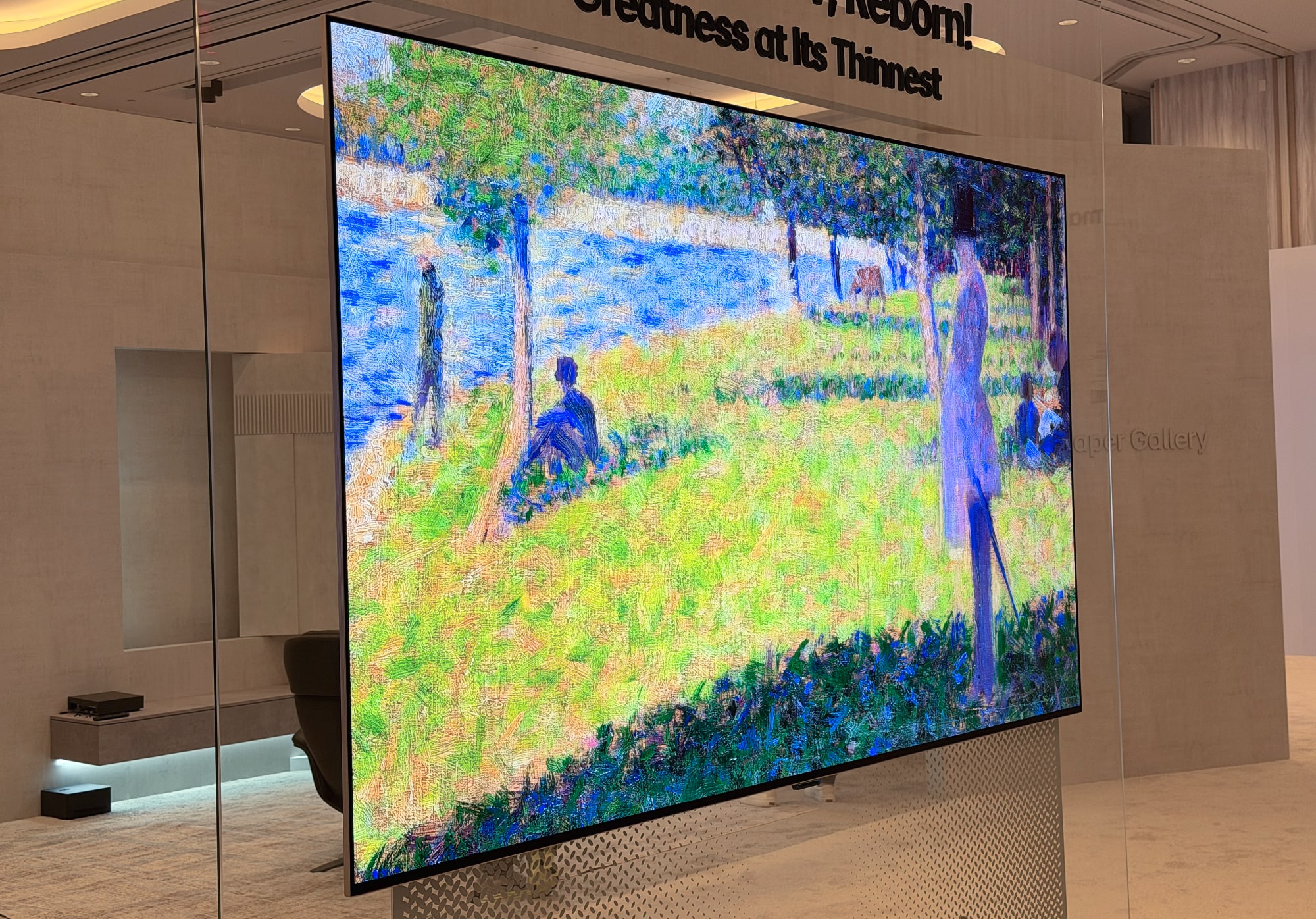
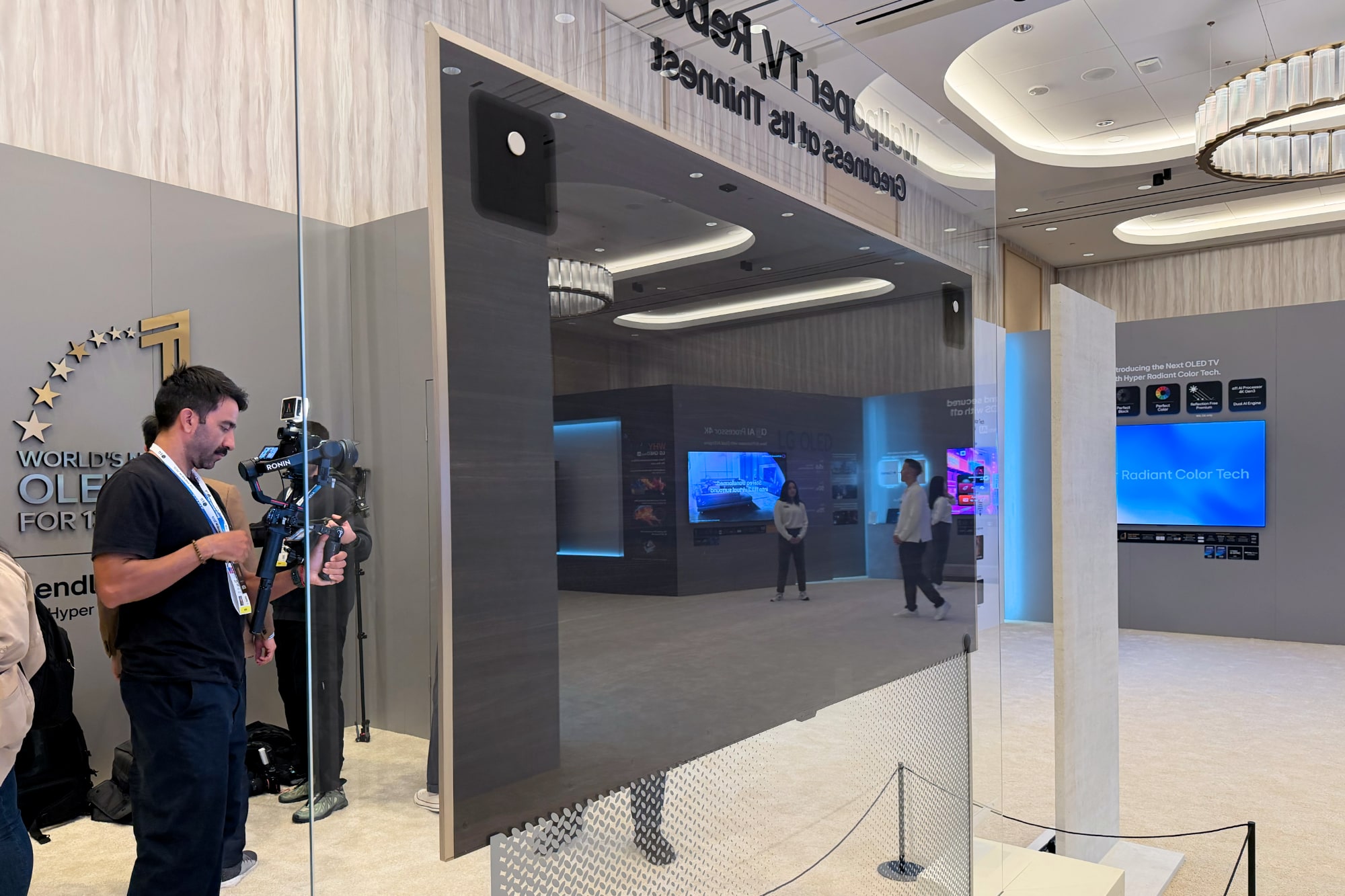
We typically see LG TV announcements a bit before CES, but this year the company had a surprise in store. CES 2026 marks the return of LG's ultra-thin "Wallpaper" TV. The latest version sports a gorgeous OLED screen and wireless connectivity, and it's about as thin as a pencil. We were able to check out the new Wallpaper TV during a CES preview event, along with LG’s Gallery and Micro RGB sets. The company also announced refreshed OLED and LED sets for this year, but it's clear that 2026 will be filled with intriguing TVs for a variety of consumers.

LG's 2026 Wallpaper OLED TV
Devindra Hardawar for Engadget

The Wallpaper TV (LG W6)

If money were no object, I'd want a 100-inch LG Wallpaper TV in my family room immediately. It looks shockingly thin in person — almost as if it's some sort of sci-fi prop — and it delivers the rich colors and dark levels we expect from OLED. Cable management is also a cinch, since it requires just a single power cable. The A/V inputs are handled by LG's One Connect box, which you can position wirelessly up to 10 meters away from the TV.

LG's 2026 Wallpaper OLED TV from the rear
Devindra Hardawar for Engadget

The LG W6 combines the best of LG's OLED technology, including "Hyper Radiant Color" for improved black levels and color, "Brightness Booster Ultra" to crank up luminance 3.9 times more than conventional OLEDs and a reflection free screen material. LG's Alpha 9 Gen 3 processor beefs up its performance, and its NPU also helps to improve upscaling and overall image performance. (And yes, you can also access generative AI features via Microsoft Copilot and Google Gemini, if you're into that sort of thing.)

All of that adds up to one of the most remarkable TVs I've seen in years. I haven't been too enamored with other TV gimmicks lately, like everything trying to mimic Samsung's The Frame, or the usless 8K sets. But a super-thin wireless TV with the best OLED panel available? That's the stuff dreams are made of.

LG's 2026 Gallery TV
Devindra Hardawar for Engadget

The Gallery TV competes with Samsung’s Frame

While LG has made Gallery TVs before, in 2026 it's making a more concerted effort to take on Samsung's popular Frame TV. LG says the new sets were designed with the help of museum curators, which helps the "Gallery Mode" adjust brightness and contrast to specific works of art. They also ship with magnetic frame-like bezels, and they have anti-reflective screens to help make the art shine.

In person, the new Gallery TV looks fine, though it's easy to tell that the colors and contrast levels don't match LG's premium OLED TVs. To avoid burn-in issues, these sets feature Mini LED panels. As I noted above, I'm not the core consumer for one of these TVs, but it's nice to see more competition against Samsung's Frame TVs. (Despite pioneering the idea of TVs displaying art, the Frame sets are still fairly mediocre when it comes to actually watching TV shows and movies.)

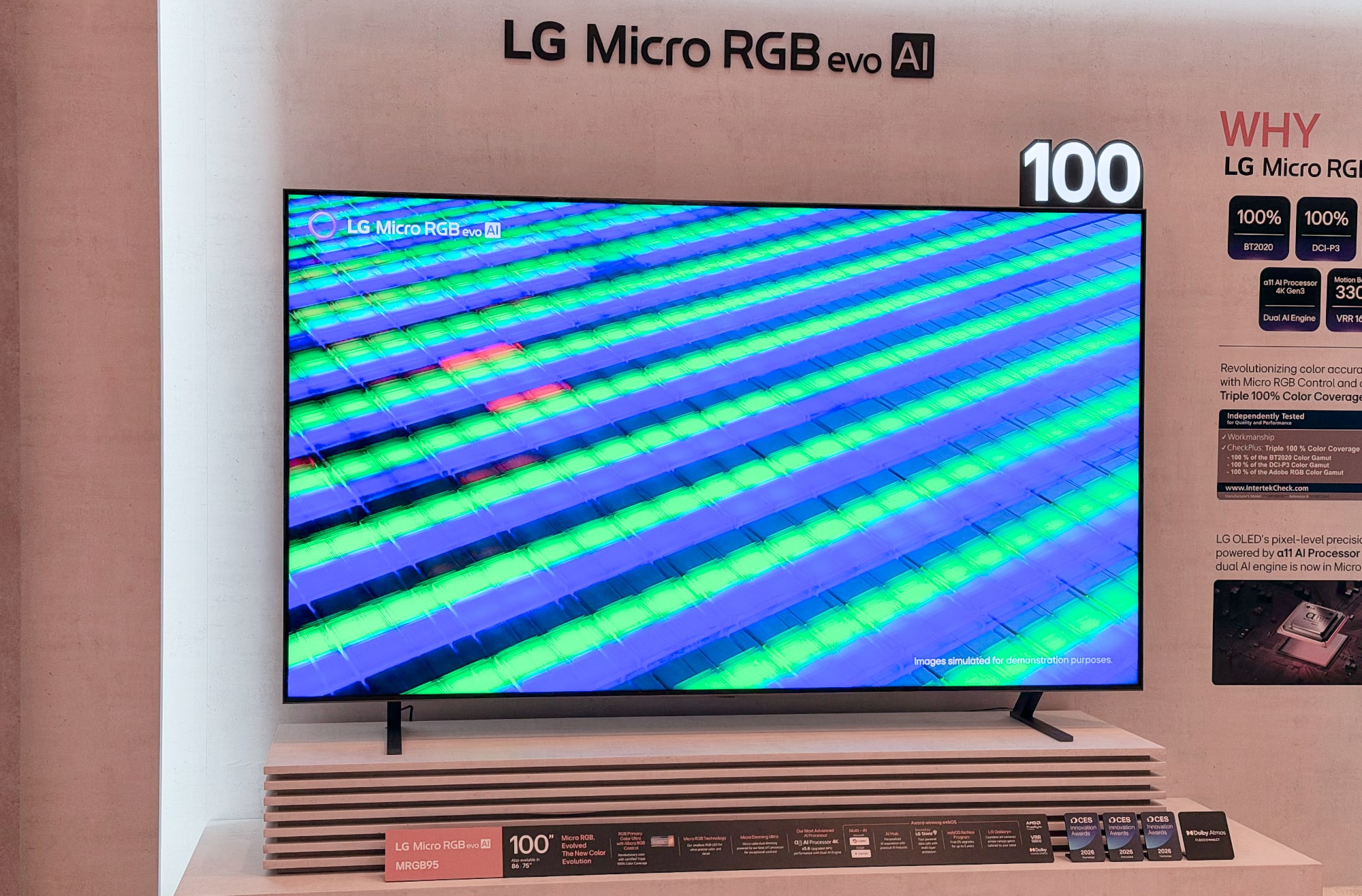
LG's Micro RGB TV
LG's Micro RGB TV
Devindra Hardawar for Engadget

Micro RGB looks like a genuine Mini LED upgrade

As if we needed more TV acronyms to worry about, say hello to Micro RGB, a new technology built atop Mini LED to cover vastly more color range. Just don't confuse it with Micro LED, which is the wildly expensive evolutionary step forward for OLED. LG already announced its Micro RGB set a few weeks ago, but that didn't prepare me for standing in front of the 100-inch demo TV it brought to CES. Throughout a variety of clips, colors looked wonderfully rich, and the overall texture of the images looked surprisingly life-like.

I'd have to compare it to LG's Wall TV side-by-side to truly see how Micro RGB competes with OLED, but technically OLED should still offer better contrast and black levels, since each of its pixels are self-emissive. But sure, if I couldn't get a 100-inch Wall TV in my family room, I certainly wouldn't turn down an enormous Micro RGB.

What about LG's other OLED TVs?

All of the next-generation OLED technology in the wallpaper TV will also make its way into LG's G6 OLED models, while the new C6 and other lines will see improvements of their own. All I can say is that the new G6 OLED looked impressive, with a noticeably brighter picture and HDR elements compared to G-series OLEDs from several years ago.

This article originally appeared on Engadget at https://www.engadget.com/home/home-theater/lg-tvs-at-ces-2026-a-stunning-wallpaper-set-glorious-micro-rgb-colors-and-a-better-gallery-tv-033739600.html?src=rss

The Subtle Voicebuds use AI to transcribe your words below a whisper, or in very loud spaces (like the CES show floor)

There's a good chance you spend more time talking to your phone's virtual assistant, or dictating text with your voice, instead of actually calling people these days. But, as convenient as voice input can be, you don't want to be the obnoxious person shouting commands to Siri or ChatGPT in a quiet library. And you probably won't have much luck dictating an email in a room with toddlers screaming and Peppa Pig blaring on the TV. (Ask me how I know.)

At CES 2026, the startup Subtle is unveiling its solution to those issues: Voicebuds. While they look like a typical pair of wireless earbuds, they feature a custom AI model that lets you dictate text below the sound of a whisper. Additionally, they can also filter out noisy environments so that you don't have to shout for dictation and voice commands. The Voicebuds seem similar to the WHSP ring we saw at CES 2024, which let whisper to your phone, and they also compete with other AI earbuds like the Notebuds One.

Subtle Voicebuds.
Subtle Voicebuds.
Subtle

Subtle claims its Voicebuds deliver five times fewer transcription errors than the AirPods Pro 3 with OpenAI transcription. At $199, they're also priced competitively with Apple's best buds. As with many new hardware products, though, there's also an additional subscription for premium features on Subtle's app, including instant dictation and the ability to transcribe notes without looking at your phone. You'll get a year's worth of access to the Subtle iOS app (there's no Android support so far) when you buy the Voicebuds, but after that it's a $17 a month fee. Without the subscription, the Voicebuds still offer better overall transcription accuracy with its on-device machine learning model.

When I tried the Voicebuds at the absolutely raucous CES Unveiled show floor, it was able accurately dictate several sentences at my normal speaking voice. Subtle CEO Tyler Chen was able to replicate that experience across several demos. In a separate remote demonstration, he was also able to dictate several sentences while barely whispering in a quiet room. (He was so quiet, I couldn't even hear what he was saying over video chat).

As you’d expect, you can use Voicebuds to take calls and listen to audio just like any other pair of headphones. They also offer other modern features, like active noise cancellation and a multi-mic array. Still, I can't imagine a fledgling startup will be able to match the refined audio quality we've seen from the AirPods Pro 3 and Sony's latest buds, or their well-honed ANC capabilities.

As someone who's practically attached to my AirPods Pros, primarily because they handle Siri voice commands so well, it would have to take a truly transformative product to replace them. Voicebuds won't support Apple's "Hey, Siri" command, since that involves having one of Apple's proprietary chips, though Chen says the company is integrating its own AI assistant. But if the Voicebud's transcription is as great as the company claims, they may eventually earn a coveted place in my pocket alongside Apple's buds.

This article originally appeared on Engadget at https://www.engadget.com/audio/headphones/the-subtle-voicebuds-use-ai-to-transcribe-your-words-below-a-whisper-or-in-very-loud-spaces-like-the-ces-show-floor-000000019.html?src=rss

LG’s ‘Aerominum’ Gram Pro laptops feel impossibly light and strong

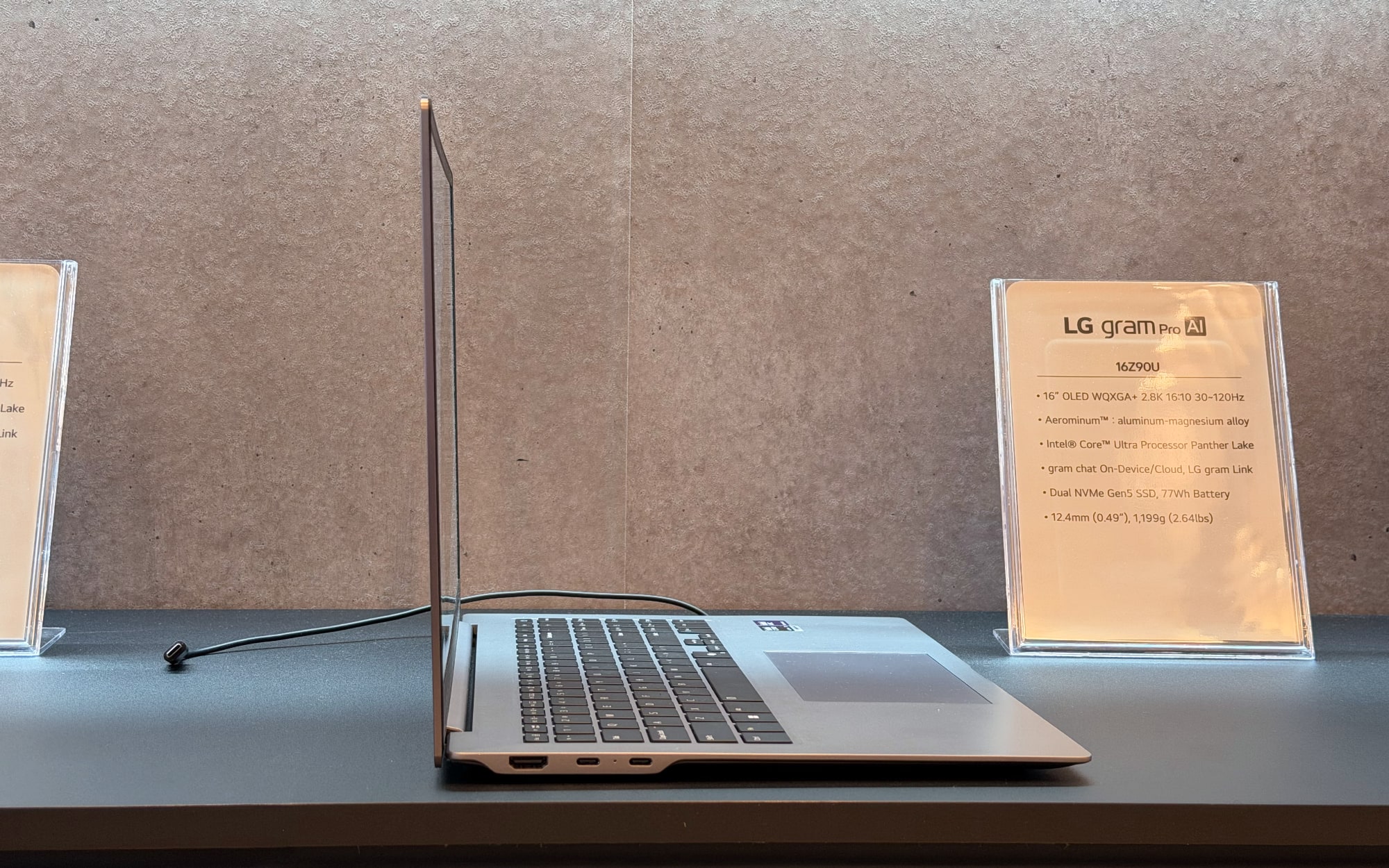
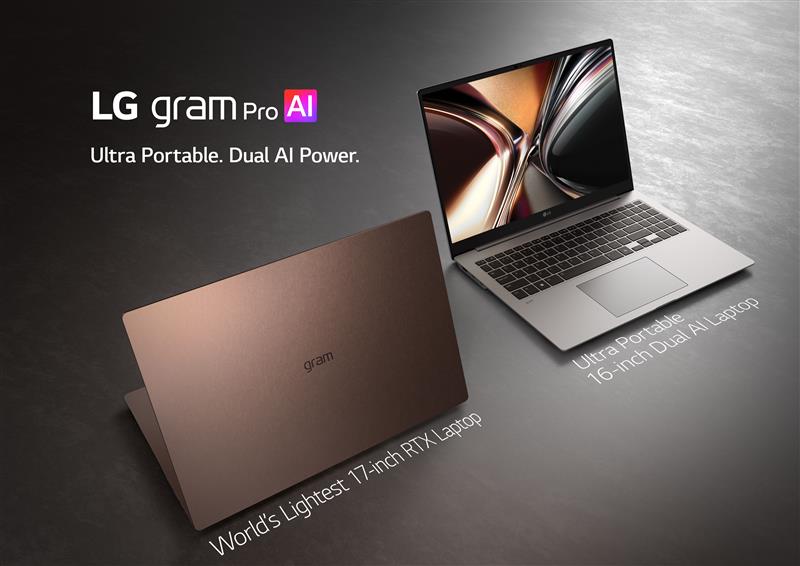
For years, LG has pushed its ultra-light Gram laptops as a way to stand out from the PC crowd, for better or worse. I was't a big fan of the flex-prone case in the 2017 Gram, and we had similar concerns with the first 17-inch Gram in 2019. But in fairness, it's been a while since we've reviewed one, and we found a lot to like in our preview of last year's AI-equipped model. Now LG is back with a major Gram Pro redesign at CES 2026, which features a new aluminum/magnesium alloy it's dubbed "Aerominum." And finally, it seems LG has found a balance between building a super-light notebook (the 16-inch Gram Pro weighs just 2.6 pounds), and crafting something that actually feels durable.

Admittedly, the Gram Pro doesn't look particularly impressive at first glance. It has a large 16-inch 2.8K OLED screen, which certainly looks nice, but doesn't really stand out from the glut of other OLED laptops on market. It's also powered by Intel's new Panther Lake chips, and it supports dual NVMe SSDs. The magic happens when you pick it up: My brain had a hard time computing how such a large computer felt so light in my hands. And best of all, it didn't flex much when I tried to squeeze the case.

LG Gram Pro 16 side ports.
Devindra Hardawar for Engadget

There's still a bit of give, to be clear, but it didn't feel as precariously bendy as earlier models. I wouldn't stress too much about throwing it into a messenger bag without additional protection. The more I handled the Gram Pro, the more I wished other PC makers strived for similar weight reduction. The Gram Pro weighs about as much as the 13-inch MacBook Air! That's certainly an impressive feat.

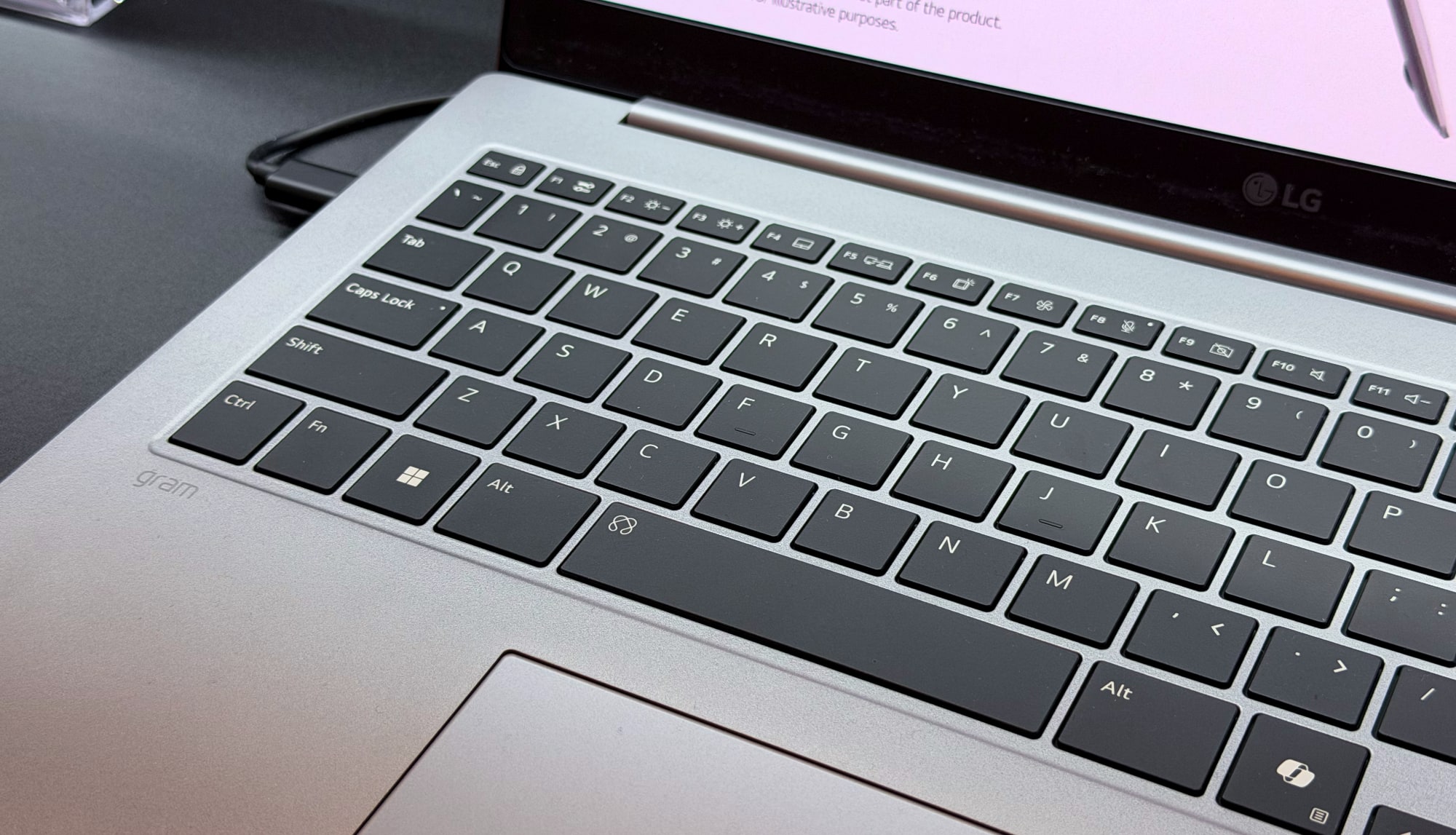
The LG Gram Pro 16's disappointing keyboard.
Devindra Hardawar for Engadget

I just wish LG spent as much time refining the Gram Pro's keyboard as its case design. There's barely any key travel, which made for an unresponsive and unsatisfying typing experience. I get it, LG probably doesn't have the available vertical height for much key movement, but there are other ways to make typing feel more dynamic. The Gram Pro's trackpad, meanwhile, is serviceable, but it also didn't feel as smooth and responsive as what we see from Apple's notebooks or Microsoft's Surface Laptop.

LG Gram Pro 17
LG Gram Pro 17
LG

In addition to the 16-inch Gram Pro, LG also debuted a 17-inch model with an Aerominum case, which is notable for being the lightest notebook at that size with an NVIDIA RTX GPU. Specifically, it's toting the RTX 5050, which should be enough to play most games at the laptop's native 2,880 by 1,800 resolution (or 1440p blown up a bit). Given the more powerful hardware, the Gram Pro 17 is heavier than the 16-inch model, but it still comes at a relatively light 3.8 pounds. I didn't get a chance to play any games on the laptop, unfortunately, but overall it looks like a decent option for someone who wants a large screen with a bit of horsepower.

This article originally appeared on Engadget at https://www.engadget.com/computing/laptops/lgs-aerominum-gram-pro-laptops-feel-impossibly-light-and-strong-200317743.html?src=rss

Engadget Podcast: Everything we expect at CES 2026

We’re gearing up for CES 2026! Engadget will be on the ground, once again, to dive into the latest TVs, wearables and other wild tech from the world’s biggest consumer electronics show. In this episode, we chat about some new products we expect to see, like Micro RGB LED TVs and AI devices, and peer into what’s ahead for the rest of 2026.

Subscribe!

Credits

Hosts: Devindra Hardawar
Producer: Ben Ellman
Music: Dale North and Terrence O'Brien

This article originally appeared on Engadget at https://www.engadget.com/social-media/engadget-podcast-everything-we-expect-at-ces-2026-144657955.html?src=rss

Engadget Podcast: Why is the Nex Playground ‘AI console’ such a hit?

Over the past two years, the Nex Playground has carved out a niche for itself with kids and parents alike. It's a small box that sits in front of your TV and uses a camera, along with computer vision AI processing, to track your movement for interactive games. Think of it like a simplified version of Microsoft's Kinect (RIP), with a bit of the local multiplayer we see from the original Wii. In this bonus episode, we chat with David Lee, Nex's CEO and co-founder, about how he went from building a basketball tracking app to one of the most intriguing gaming console alternatives on the market. (The Nex Playground even managed to outsell Xbox in November!)

Subscribe!

Topics

  • What led to the development of the Nex Playground? — 2:04

  • Who helped design and build the console? — 8:36

  • Questions about the Nex PlayPass subscription and other ways to get new games — 13:23

  • How did Nex convince major brands to build for Nex Playground? — 19:10

Credits

Host: Devindra Hardawar
Guest: David Lee, CEO and co-founder of Nex
Producer: Devindra Hardawar
Music: Dale North

This article originally appeared on Engadget at https://www.engadget.com/social-media/engadget-podcast-why-is-the-nex-playground-ai-console-such-a-hit-181151201.html?src=rss

2025 was the year Xbox died

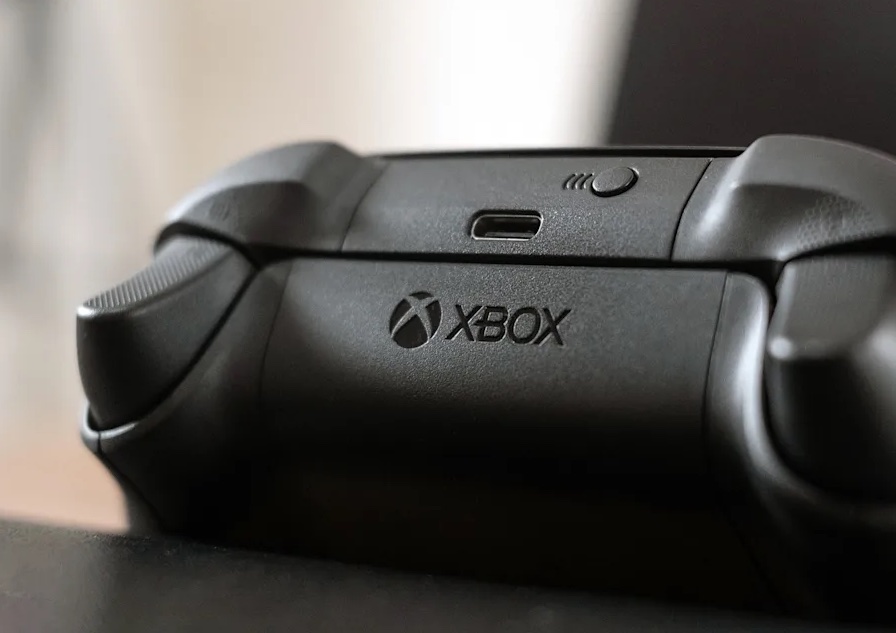
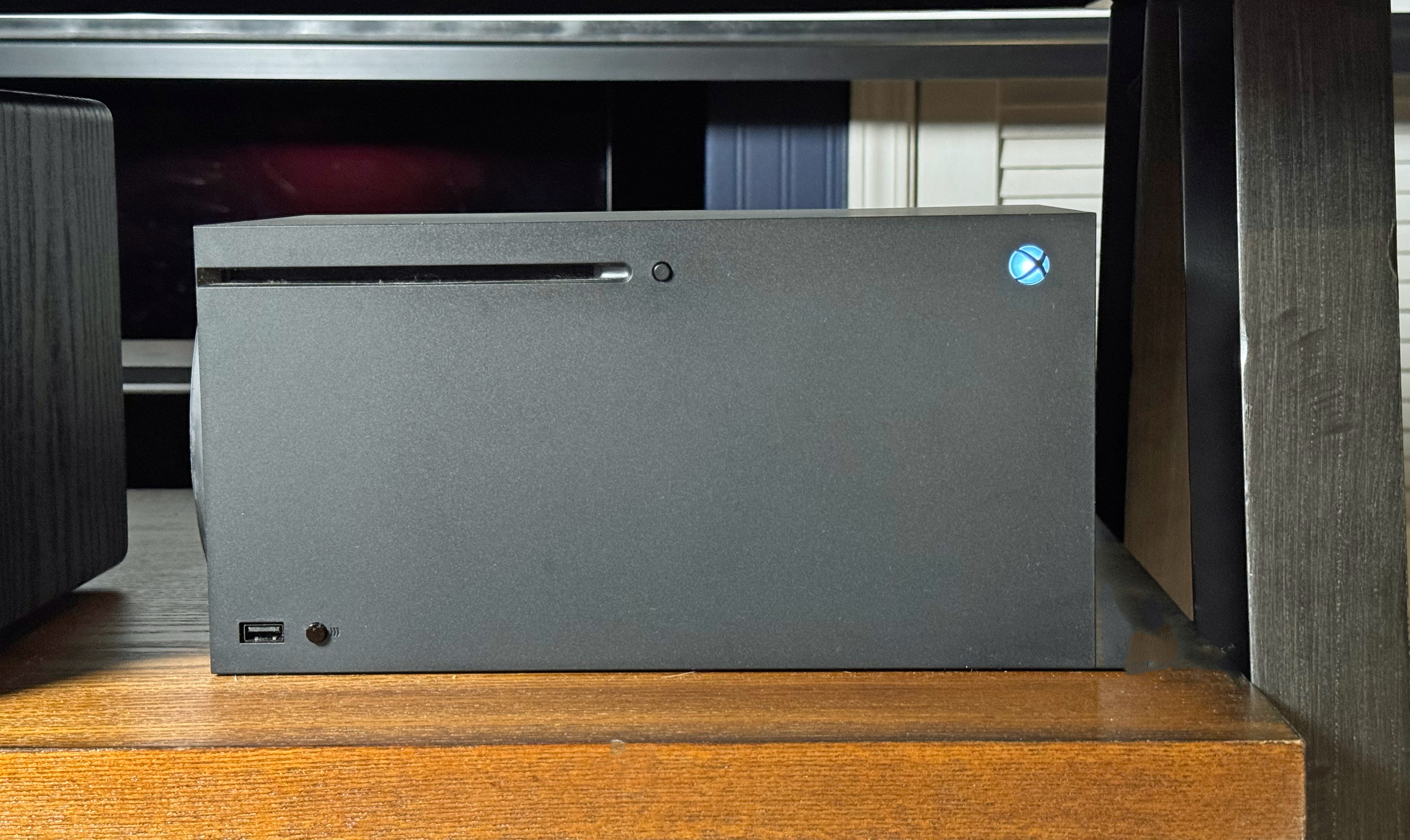
Want to see a dead body? I present to you the Xbox. After a subdued launch at the height of the COVID pandemic in 2020, the Xbox Series X quickly lost the fight against the PlayStation 5. Microsoft simply couldn't deliver enough compelling games, despite some huge acquisitions, while Sony leaned on its goodwill from the PS4 era and a handful of desirable exclusives. As prices rose due to supply chain issues and the Trump administration's volatile tariff scheme, there was even less of a reason to get an Xbox (even the cheaper Series S). When I re-reviewed the Series X last year, it was clear that it never lived up to its potential. Anyone in their right mind would be better off buying a PlayStation 5.

Xbox didn't enter 2025 in a great state, and it's leaving the year grasping for help, like an Arc Raider player desperate for a revival after being knocked out. Microsoft cancelled the Perfect Dark reboot and Everwild, two of the most interesting games in its weak upcoming slate. The company brought titles like Forza Horizon 5 over to the PlayStation 5, which prompted Engadget Deputy Editor Nathan Ingraham to declare he no longer needed an Xbox

Xbox Series X controller
Engadget

Making things worse this year, Microsoft raised prices across the board, with the Xbox Series S starting at $400 and the cheapest Series X going for a whopping $600. And slow sales prompted Costco to stop selling Xbox consoles entirely. Microsoft didn't even try to push systems during Black Friday — why go through the trouble of having sales if nobody is buying the hardware in the first place? 

Even Game Pass, which was once renowned as one of the best deals in gaming, almost doubled in price over the last year, reaching up to $30 a month (or $360 a year) for the Ultimate tier. Sure, Microsoft tried to add more value to its cheaper Game Pass tiers, and finally upgraded its cloud streaming platform, but the lack of consistent must-play exclusive titles has devalued the service (and Xbox as a whole). Avowed and South of Midnight were among the few exclusive highlights, but the latter will hit PS5 and Switch 2 next year. There's no word on Avowed reaching other consoles yet, but given Microsoft's current trajectory (and the fact that it's a genuinely great game), I wouldn't be surprised if it becomes available elsewhere.

There was a chance for Microsoft to reinvigorate the Xbox brand with the ASUS ROG Xbox Ally and Ally X gaming handhelds, but the $600 and $1,000 launch prices placed them out of reach for most gamers. It also doesn't help that Windows still isn't well-optimized for portable devices with touchscreens, and those systems also aren't compatible with older Xbox titles like the consoles. At the very least, Microsoft now has a handheld foothold. But a future portable Xbox console would need to be significantly cheaper to compete with the likes of the Steam Deck, which starts at $549 (following the discontinuation of the $400 LCD model).

And speaking of Valve, the company's recently announced Steam Machine has also stolen a lot of potential thunder from Xbox. The Steam Machine is basically a tiny gaming desktop for your TV, running the Steam Deck's SteamOS. That platform is a Linux distribution optimized for emulating Windows titles. But unlike an Xbox console, it's not closed off in any way. You're free to install whatever you'd like on a Steam Machine — even Windows!

While we still haven't seen the Steam Machine in action, the Steam Deck's excellent performance and game compatibility makes me think its desktop sibling could be genuinely compelling to console players looking for something new. And it will likely directly compete with the next Xbox, which is rumored to arrive in 2027 as a PC in a TV-friendly case (according to Windows Central's Jez Corden). Microsoft's recent partnership deal with AMD also hints at a more PC-like experience — Xbox President Sarah Bond noted that the Xbox team is "working closely with the Windows team to ensure that Windows is the number one platform for gaming."

It's worth remembering that only a single generation of the Xbox — the Xbox 360 — was successful enough to truly compete with Sony's PlayStation. The original Xbox reportedly cost Microsoft $4 billion over the course of four years, leading the company to quickly jump ship and move to its successor. The Xbox 360 was genuinely innovative, thanks to Xbox Live and smarter online integration, and it had a healthy amount of third-party support. In comparison, Sony's PlayStation 3 was $100 to $200 more expensive than the Xbox 360 at launch, it had far worse online support and developers found it hard to program for.

Xbox Series X
Xbox Series X
Devindra Hardawar for Engadget

Unfortunately, Microsoft squandered most of its good will with the Xbox One. That console was first announced as an "always online" device with restrictive DRM features that limited how you could share and sell games; it was bundled with a Kinect camera that could potentially surveil you; and at $499, it was $100 more than the PlayStation 4. Microsoft quickly reversed many of its DRM-heavy plans for the Xbox One, but by that point the damage was done. Sony ultimately sold more than twice as many PS4 units as the entirety of the Xbox One family (which included the cheaper One S and more powerful One X), according to data from Ampere Research

Things are looking worse this generation: The Xbox Series S and X reportedly only sold around 33 million units as of July, according to Statista estimates, while Sony confirmed it sold 84.2 million PS5s as of November. If this trend continues (and it doesn’t appear as if Xbox sales will be increasing any time soon), Sony could end up selling three times as many consoles this generation, compared to Microsoft. Xbox sales have been so slow that the family-focused Nex Playground managed to outsell it in November, according to data from Circana.  

Given Xbox's inability to compete with the PlayStation 5, it's no wonder Microsoft could be changing things up entirely for its next system. Its partnership with AMD could easily lead to new handhelds, and it also gives Microsoft a leg up in producing a compact and powerful Xbox PC. After all, why should the company keep trying to go toe-to-toe with Sony's closed PlayStation platform? Why shouldn't Microsoft embrace its PC roots to give us a gaming desktop under our TVs? The company has already committed to bringing new Xbox games to PCs immediately, so the line between the two is already blurring. 

It may be a risk, but evolving into a PC proves there’s still life in the Xbox brand. And crucially, it’s also something Sony can’t easily replicate.


This article originally appeared on Engadget at https://www.engadget.com/gaming/xbox/2025-was-the-year-xbox-died-130000467.html?src=rss

Engadget Podcast: 2025 was the year of AI, smartglasses and spineless Big Tech

This week, Engadget Managing Editor Cherlynn Low joins us to look back at some of the highlights (and lowlights) of 2025. We dive into our favorite gadgets of the year, the many ways Big Tech bowed to Trump, the disappointment of AI PCs and the rise of smart glasses. We also learn way too much about our skincare routines.

Subscribe!

Topics

  • Our favorite gadgets of 2025: Kindle Scribe Colorsoft, Airpods Pro 3, bluetooth lav mics and more – 2:26

  • Favorite Media of 2025: Andor, self-improvement via podcast, and a shoutout to your library – 34:30

  • iRobot declares bankruptcy – 47:29

  • Warner Bros. Discovery board rejects Paramount’s hostile bid, shareholders yet to vote  – 53:47

  • The Oscars will air on Youtube starting in 2029 – 56:05

  • Ford to turn its F-150 Lightining into a gas generator EV – 57:41

  • Around Engadget: smart glasses had a great run in 2025, against social media age verification – 58:20

Credits

Hosts: Devindra Hardawar and Cherlynn Low
Producer: Ben Ellman
Music: Dale North and Terrence O'Brien

This article originally appeared on Engadget at https://www.engadget.com/social-media/engadget-podcast-2025-was-the-year-of-ai-smartglasses-and-spineless-big-tech-143000338.html?src=rss

Big Tech bent the knee for Trump in 2025

Sure, we've seen millions poured into lobbying and other means of influence during every presidency, but the last two years set a whole new bar. Business leaders, including those from almost every Big Tech company, stepped over themselves to prove fealty to Donald Trump's second administration. It's easy to see why: Their kowtowing was meant to secure regulatory favors, gain tax and tariff advantages and avoid Trump's ire. Ultimately, it was all in the service of appeasing their shareholders. Why else would Apple CEO Tim Cook, someone who typically cultivates a progressive image, hand deliver a gold plaque to the President of the United States? 

Before we leave 2025 behind, it's worth documenting the many ways tech companies and leaders debased themselves for political favor with the Trump administration. 

Alphabet (Google)

Google dropped diversity recruitment goals in February, following Trump’s executive orders dismantling DEI programs in the federal government. Google also changed its AI principles to allow AI in weapons and surveillance, a move that is in line with the relaxed artificial intelligence regulation the Trump administration would later adopt for its AI Action Plan. To the chagrin of geographers everywhere, the company also replaced the Gulf of Mexico in Google Maps with "Gulf of America," following Trump's executive order.

Additionally, Alphabet agreed to pay $24.5 million to settle Donald Trump's lawsuit against YouTube, following the suspension of his YouTube accounts after the January 6th riot. Trump will receive $22 million, while another $2.5 million of the settlement will be paid out to additional plaintiffs who were part of the class action — which is to say, other rioters involved in the storming of the Capitol.

Joining plenty of other tech companies, Google donated $1 million to the Trump inauguration, and it’s also contributing to the cost of Trump’s reported $300 million White House ballroom.

Amazon

In August, Amazon Web Services said it would provide up to $1 billion in credits to the Trump administration through 2028. Those credits can be put towards AWS cloud services, training and certification and direct contracts.

Amazon founder Jeff Bezos also did his fair share to support Trump: He donated $1 million to Trump's inauguration, and since purchasing the Washington Post in 2013 he pushed the paper to the right. This year, Bezos declared that the Post’s opinion pages would be devoted to the support and defense of “personal liberties” and “free markets.” He added, “We’ll cover other topics too of course, but viewpoints opposing those pillars will be left to be published by others." To that end, the Post also hired three new conservative columnists. Bezos reportedly also blocked his paper from endorsing Kamala Harris in the 2024 election.

Amazon, too, is contributing to Trump's $300 million White House ballroom. The Washington Post, unsurprisingly, was one of the first major publications to praise Trump’s ballroom

Apple

Apple relied on big numbers and flashy trinkets to ingratiate itself to the Trump administration. In February, it said it planned to invest $500 billion into the US economy over the next four years. While that sounds impressive, Apple previously announced another $430 billion multi-year investment for the US in 2021. In a potential bid to avoid the administration’s volatile tariff plans, Apple also said it would invest another $100 billion into the US in August.

Tim Cook personally donated $1 million to the Trump inauguration fund, Cook's first political donation since 2017. At that August event, he also gave Donald Trump a now infamous gold statue for being a special little guy.

Additionally, Apple followed in Google’s footsteps by replacing the Gulf of Mexico in Apple Maps with the “Gulf of America.” The company is also chipping in for Trump’s $300 million White House ballroom.

Meta

Meta CEO Mark Zuckerberg wasted no time trying to get into Trump’s good graces, perhaps to erase his previous statement that the President should be “held responsible for his words” for inciting the January 6 Capitol riot. On top of donating $1 million to Trump's inauguration, Meta announced that it would be getting rid of third-party fact-checkers on Facebook and Instagram on January 7. Instead, it's relying on community notes similar to X. Meta also ended its DEI initiatives and changed its hate speech rules to allow for calling LGBTQ people “mentally ill.” 

"We do allow allegations of mental illness or abnormality when based on gender or sexual orientation, given political and religious discourse about transgenderism and homosexuality and common non-serious usage of words such as 'weird,'" reads the company’s updated policy.

Even Zuckerberg’s charity, which he runs alongside his wife, bowed to Trump. The Chan Zuckerberg Initiative ended its diversity programs and stopped providing “social advocacy funding,” which supported immigration and racial equity efforts. According to The Guardian, the charity’s website removed every reference to diversity or promoting scientific research from underrepresented groups.   

Similar to Google, Meta said it will pay Donald Trump $25 million to settle his lawsuit related to his Facebook suspension after the January 6 riot. And yes, Meta is also contributing to Trump's $300 million White House ballroom. 

Microsoft

Microsoft contributed $1 million to Trump's inauguration fund. Previously, it donated $500,000 to Biden's fund and the same amount for Trump's first term. It’s also contributing to Trump’s $300 million White House ballroom.

Similar to Amazon, Microsoft also offered up to $3.1 billion worth of services to the Trump administration as part of the American-centric “OneGov” strategy. That includes discounts for Microsoft 365, Azure cloud services and cybersecurity tools. Copilot AI will also be discounted to government agencies, and it’ll be completely free for a year for agencies subscribing to Microsoft G5 service.

Elon Musk (X, SpaceX, Tesla)

Elon Musk was by far the biggest booster for Trump in the business world. He spent a whopping total of $277 million to back Trump and other candidates in 2024, including $239 million to America PAC, his super PAC focused on securing votes for Trump and other Republicans. 

Musk went so far as to offer $1 million to people who said they would vote for Trump, a move that the Justice Department warned might be illegal. Wisconsin's Attorney General challenged Musk's ploy but the state's Supreme Court declined to hear a case on the matter, thereby giving Musk leeway to award two $1 million checks to voters. Musk's team edited a video of one of the recipients to remove her admission that she was paid "to vote." 

He also joked that he could be jailed if Kamala Harris won the 2024 election, which could be referencing potential election fraud, his penchant for busting unions, national security concerns from his uncomfortably close relationship with Vladimir Putin or any number of potential crimes.

Elon Musk spearheaded DOGE (Department of Government Efficiency), an unelected position from which he was given nearly unprecedented federal oversight. Once installed he hired his techie acolytes to chip away at government budgets and staffs. For the first few weeks of the second Trump administration, it appeared as if Musk had unfettered power to manipulate the government.

And let's not forget, while leading DOGE, the world's richest man also destroyed USAID, the world's largest food aid provider, for no apparent reason other than cruelty. 

After purchasing Twitter in 2022 and renaming it "X," Musk has also transformed Twitter into a Trump-friendly social network focused on “free speech.” He reinstated Trump’s Twitter account, which was banned after the January 6 Capitol riot, and he also paid Trump around $10 million to settle his lawsuit over being kicked off the platform. X is now a platform that amplifies far-right extremists, treats the inclusive term “cisgender” as a slur and doesn’t punish users for deadnaming and misgendering trans people.

What about the rest?

This is by no means an exhaustive documenting of every single tech tycoon that has bent the knee. NVIDIA CEO Jensen Huang, for instance, told Joe Rogan in an interview that “everything that [Trump] thinks through is very practical and very common sense, and, you know, it's very logical.” According to Axios, Huang added that Trump "wants to make sure that that the important, critical technology of our nation is built in United States, and that we re-industrialize and get good at manufacturing again, because it's important for jobs."

It’s also worth remembering that OpenAI CEO Sam Altman and Oracle chairman Larry Ellison joined President Trump onstage in announcing Stargate — “the largest AI infrastructure project by far in history.” The two were joined by Softbank CEO Masayoshi Son, who called the moment the “beginning of a golden age.” The next day, Altman posted on X that he believed Trump “will be incredible for the country in many ways!”

Ellison’s son David is the CEO of Skydance, and has infamously been rebuilding Paramount with Bari Weiss since the merger of Paramount Global and Skydance Media was approved this year. The list of major tech players bowing to Trump only grows from here, and putting the bulk of the transactions in one place should serve to remind us how closely tied Big Tech is with American (and global) politics.

This article originally appeared on Engadget at https://www.engadget.com/general/big-tech-bent-the-knee-for-trump-in-2025-140000365.html?src=rss