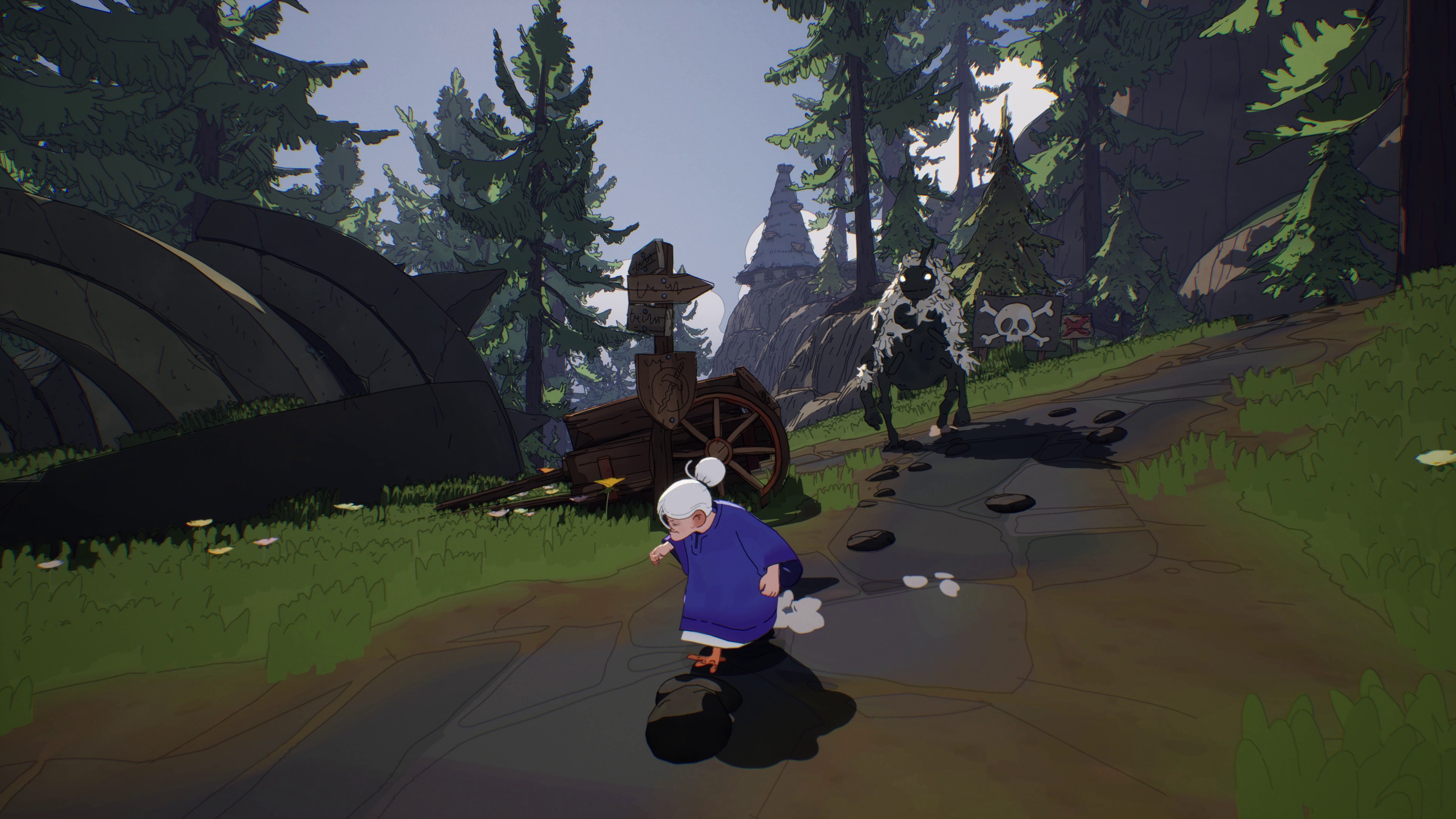
Coven of the Chicken Foot has a lot of things going for it already, in my book. It stars a hero rarely seen in video games, an elderly woman, and it has gorgeous storybook-style art in a lush fantasy setting. It’s a single-player puzzle platformer, it relies on wordless storytelling and the woman, a witch named Gertie, travels with a creepy-cute companion. Plus, Gertie has chicken feet. I love her little chicken feet.
Coven of the Chicken Foot is the first game from Wildflower Interactive, the independent studio founded by Naughty Dog veteran Bruce Straley. The game is coming to Steam and it’s available to wishlist now, though there’s no firm release date. The first trailer for Coven of the Chicken Foot premiered at The Game Awards 2025, showing Gertie and her friend traveling together through caves, forests and temples.
Gertie is on a quest to prove herself to the local coven by standing up to the self-appointed, prideful heroes of the land. She doesn’t have a sword or a dodgeroll, and instead has to figure out how to work with her strange friend to survive. Her companion develops unique behaviors based on individual play styles, shaping how Gertie gets around.
Straley left Naughty Dog in 2017 after almost 20 years with the studio, where he directed The Last of Us and Uncharted 4. He announced Wildflower Interactive in July 2022 with a brief YouTube message, saying, “In 2017 I left the industry not sure if I wanted to make games anymore. But the longer I was away, I kept thinking about this medium, and everything yet to be done and everything I wanted to do still. And this idea kept following me. So I grabbed some friends and we started prototyping.”
This naturally led to the formation of a studio, Straley explained.
“We have to do it the right way,” he said in the video. “It has to be inclusive, equitable and collaborative, full of big-hearted people that want to grow both professionally and personally. The culture needs to be as iterative as the way we make games.”
Coven of the Chicken Foot
Wildflower Interactive
Today Wildflower Interactive has 16 employees from AAA and smaller-scale backgrounds, according to its website. Its mission statement reads as follows:
“We’re making ‘small-ish,’ creatively-charged, uniquely-stylized games that explore the possibilities of our medium. And we’re building a small, open-hearted team of creators that want to improve their skills and still lead a good life outside of work. People that want to hone their craft, have a say in the process, feel respected for their contributions, and be a part of the evolution of this awesome medium.”
I’m not going to say the studio’s direct and repeated emphasis on work-life balance, diversity and compassion is a response to the soulless capitalistic grind built into the AAA development complex, but I’m not going to not say that, either.
This article originally appeared on Engadget at https://www.engadget.com/gaming/pc/coven-of-the-chicken-foot-is-the-debut-game-from-naughty-dog-alum-bruce-straleys-indie-studio-014004553.html?src=rss
You gotta love that post-Day of the Devs showcase feeling. The organization, founded by Double Fine Productions and iam8bit, consistently highlights top-tier games from independent developers across the globe, providing space for creators to share their stories in both online and in-person events. This year’s Day of the Devs: The Game Awards Digital Showcase was an hour-long celebration of 22 upcoming indie games, including six world premieres and three release date announcements.
Settle in and bask in the afterglow with us:
World Premieres
Virtue and a Sledgehammer - Deconstructeam
Deconstructeam is a small Spanish studio that’s responsible for some of the most cerebral, sexy and darkly philosophical games around, including Gods Will Be Watching, The Red Strings Club and The Cosmic Wheel Sisterhood. The team’s next project is Virtue and a Sledgehammer, and it represents a new look with 3D, cel-shaded animations and a third-person perspective rather than the studio’s typical pixelated planar fare. The vibes are just as sinister and introspective as expected, though.
Virtue and a Sledgehammer is a moody coming-of-age experience set in a wooded ghost town dotted with robots and lost locals. Spend quiet moments with old friends and then swing the sledgehammer to raze your hometown and uncover memories that can help you move on. The game’s buildings and objects are highly reactive, which can only help with the catharsis of it all.
Virtue and a Sledgehammer is due to hit Steam in 2026, published by Devolver Digital.
UN:Me - Shueisha Games
Now, this is a horror game. UN:Me comes from Japanese publisher Shueisha Games and developer Historia, and it’s a creepy, mind-bending exploration of primal fear. It stars a young woman with four souls trapped inside of her body, fighting for control of her consciousness. She wanders sterile, illogical hallways and encounters grotesque horrors representing common human fears like heights, authority figures and confined spaces. The souls switch randomly, each one manifesting a specific anxiety. As she wanders, the player has to choose souls to eliminate until only one remains. Whether it’s her real soul or a fake isn’t disclosed until the very end.
Funktronic Labs is mainly known as a VR studio, with games like Cosmic Trip, Fujii and The Light Brigade under its belt, but its latest project doesn’t require a headset at all. Scramble Knights Royale is coming to PC and Xbox in 2026, and it’s a battle royale with adventure game twists. You begin on a boat with 30 to 40 other online players, make your way to land on the back of a turtle, and then it’s essentially Naked and Afraid from there. Find resources, fight creatures, upgrade your gear and play your own game, only battling other players when you encounter them in the wild.
Don’t let the sweet, clay-like animations fool you, either — Funktronic says the combat mechanics are incredibly deep and finely honed. Scramble Knights Royale also supports local split-screen.
Mirria - Mografi
Mografi made a name for itself with the adorable Jenny LeClue detective game, but now it’s time for something different. Mirria is an atmospheric puzzle experience from ISLANDS: Non-Places artist Carl Burton, published by Mografi, and it looks like a delicious mix of Kentucky Route Zero and Monument Valley. In Mirria, you explore mirror worlds and attempt to make the two realities match, paying attention to small details and making minute adjustments until the unsettling environments are perfect reflections. It looks and sounds like soul-soothing stuff.
Mirria is due out in 2026 on Steam.
CorgiSpace - Finji
In recent years, Finji founder Adam Saltsman has been involved in high-profile indie games like Overlands, Night in the Woods, Tunic and Usual June, but his new project taps into his simplistic and mechanics-driven Canabalt roots. Corgispace is a collection of 8-bit games with off-kilter premises, including the soulslike Rat Dreams where you can only dodgeroll, the no-jumping platformer Skeleton Jeleton, and Prince of Prussia, an adventure where you stab Nazis “but in a fun new way,” according to Saltsman. Also, he says there are no secrets in this game, which leads us to believe there is at least one secret in this game.
If the former Fall Guys developers at Panic Stations know how to do one thing, it’s make a silly-physics multiplayer game, so that’s exactly what they’re doing. Frog Sqwad is a co-op experience where you and your fellow frogs search the sewers for food in order to satiate the swamp king. You can eat food to grow bigger and become the mega frog, vomit to shrink, and use your long sticky tongue to swing, hang and slingshot your friends. The sewer levels are procedurally generated, so your froggy playground will always be different, and each run gets harder as the swamp king requires more food.
Frog Sqwad is coming to Steam in 2026, with a playtest beforehand.
Release dates
Dogpileby Studio Folly, Toot Games and Foot: Today, like literally right now
The stream featured a dozen other in-development titles, including the super spooky Lucid Falls, a 90s-grunge-band rhythm game called Rockbeasts, the soothing alien musicality of Soundgrass, an impressive-looking follow-up to The Invincible called Into the Fire, and Unshine Arcade, a creepy game about the secret lives of tamagotchis and claw machines.
Day of the Devs: The Game Awards Digital Showcase 2025 wrapped up with a neat little announcement. Day of the Devs partnered with the Video Game History Foundation to release Xcavator 2025, a finished version of a long-lost game from legendary programmer Chris Oberth. It was originally developed by Big Buck Hunter studio Incredible Technologies but never found a publisher. It’s been revived by Mega Cat Studios, Retrotainment Games and iam8bit, and an NES cartridge of Xcavator 2025 is available to pre-order now on iam8bit. Proceeds will benefit the Video Game History Foundation.
This article originally appeared on Engadget at https://www.engadget.com/gaming/the-world-premieres-and-other-hotness-from-the-game-awards-2025-day-of-the-devs-stream-200000447.html?src=rss
The Game Awards 2025 edition of the Day of the Devs digital showcase goes live on Wednesday, December 10 at 1PM ET on Twitch and YouTube. That’s more than 30 hours before The Game Awards itself kicks off, which makes perfect sense. It is called Day of the Devs, after all, and if we’re judging by pastappearances, the event absolutely deserves its own full 24 hours in the spotlight.
This year, the Day of the Devs: The Game Awards Digital Showcase will feature 22 indie titles, including three release date announcements and six world premieres. That’s a packed show, even by Day of the Devs standards. Expect to see projects from developers including 17-BIT, BONE Assembly, Capybara Games, Deconstructeam and Panic Stations, and publishers Annapurna Interactive, Devolver and Blumhouse Games, among others.
Each Day of the Devs showcase lasts about an hour and highlights a batch of extremely rad-looking independent games across a wide range of genres, complete with commentary from creators. The featured games are curated by industry veterans at Day of the Devs, and past shows have offered early looks at future hits like Animal Well, Blue Prince, Cocoon, Despelote, Crow Country, Phoenix Springs, Skate Story, UFO 50, Eternights, Sorry We’re Closed and many others.
Day of the Devs is a non-profit operation that provides a platform for select independent creators to showcase their games to large audiences for free, founded by folks at Double Fine Productions and iam8bit. On top of accepting donations, it receives support from various industry players, including Xbox, PlayStation and Summer Game Fest.
The Game Awards 2025 begins on Thursday, December 11 at 7:30PM ET, with a half-hour pre-show up first. The whole thing will certainly last longer than one hour, but we’ll find out together whether it’ll have more game reveals than Day of the Devs.
This article originally appeared on Engadget at https://www.engadget.com/gaming/watch-the-day-of-the-devs-game-awards-2025-edition-right-here-at-1pm-et-060000319.html?src=rss
It looks like 2025 is going to be an excellent year for action role-playing games. We’ve already started things off with a big Dragon Age: Veilguard bang, but next year will also bring Kingdom Come: Deliverance 2, Fable and the subject of today’s dissection, Avowed. Each title offers something distinct for single-player RPG fans, and Avowed is poised to provide top-tier dialogue trees and rich worldbuilding, courtesy of Fallout: New Vegas, The Outer Worlds and Pentiment studio Obsidian Entertainment. This is the studio's first tentpole title under the Xbox Game Studios banner and its first AAA fantasy game ever.
While I couldn’t determine its full scope in the preview I played this week, I’m pleased to report that so far, Avowed’s world is as gorgeous as its writing.
The preview included the game’s first two hours or so, from character creation through the initial main missions. Avowed is a spin-off of the Pillars of Eternity series and it’s set in the Living Lands, an area unexplored in the existing games, giving Obsidian a blank canvas for an epic original story. A blight called Dreamscourge is spreading across the region, infecting plants, animals and people with a prismatic fungus that induces madness, rage and death. You play as the envoy of the emperor of the Aedyr Empire, which has a deep history of invading and colonizing the surrounding lands.
Of course your protagonist is special, even by the standards of this magical world. Players are a godlike, meaning they’ve been touched by the divine and marked by facial growths of rainbow fungus. Generally, your godlike status and relationship with Aedyr automatically instills respect and suspicion in the people you meet. As you learn more about the Dreamscourge, it becomes impossible to ignore its similarities to the godlike marks you carry, and this existential terror builds beautifully in the game’s first few hours.
Are nature’s mutations madness or divinity? It’s a thin distinction with a long and dark history, and Avowed wallows in this gray area. Its first few hours introduce multiple narrative themes that can be mined throughout the game — the violence of colonization, palace intrigue, spiritual visions, insanity and religious fervor form the most prominent talking points. These arcs play out in conversations with supporting characters and in interactive pieces of lore scattered around the environments, each concept unspooling in a natural and intriguing fashion. There are plenty of opportunities in the dialogue trees to investigate these ideas and learn more about the world or your companions, with specialized responses that unlock if you have the right stats. In general, dialogue in the Avowed preview is nice and quippy, and each new character comes with a distinct, believable personality. Already, I’m curious to know more about the people of the Living Lands.
There are no strict classes in Avowed. Instead, players freely level up their abilities across fighter, ranger, and wizard using acquired skill points. There’s also a godlike tree, a page to upgrade your companions’ skillsets, and a character sheet with classic RPG attributes that you can place points into. I focused on building up my magic, health and damage, and it took a minute to find my preferred combat style. There are two weapons loadouts you can swap between on the fly, a pop-up radial with extra abilities, and four programmable spots on the D-pad. It’s a lot to manage in the frenzy of battle, but new weapons and tools are added to your inventory at a steady pace and it’s easy to experiment with different builds. In terms of weapons, I stumbled across a knife, spear, bow, shield, grimoire, wand, pistol and giant hammer, but I suspect there were even more tools hidden in the world. The bow and pistol have unlimited ammo, but reloading the pistol is a lengthy process, and the hammer is incredibly powerful, but its swing takes a moment to connect, leaving you vulnerable between hits. Combat is chaotic — especially when fighting hordes of giant spiders — but the game responds well to rapid-fire inputs and generally, each encounter feels like a real skills test.
Obsidian Entertainment
For me, everything felt right once I found the wand. I closed out the preview with the bow in one loadout, and the grimoire and wand in the other, and I was starting to feel like a real badass. The wand is a quick midrange weapon, and combined with the rechargeable spells in the grimoire and the long range of the bow, it worked really well for my preferred fighting style. One annoyance I noted was the fact that I couldn’t draw my bow while taking sustained toxic damage, as each small hit made my character lose focus — this was a tough lesson to learn while trying to fight off a gang of rat-toothed reptilian creatures, but I definitely absorbed it.
In any RPG, I have a hard time leaving an area without smashing every vase, breaking every box and exploring every path. Avowed rewards this behavior with bits of worldbuilding, potions, strange animals, coins and tools hidden in the corners and crannies of the Living Lands. Or, sometimes, there’s just a breathtaking view. Either way, it makes me excited to see what secrets the full game is hiding.
I also played Avowed for about 45 minutes at Xbox’s Gamescom event in August, starting with a pre-built mage character in the middle of a search-and-rescue mission a few hours into the game. I had a good time flinging spells from my grimoire and chatting with characters in the caves I was exploring, but I sensed a slight disconnect that I attributed to the rushed and public nature of the demo. Now, I know what was missing: Character creation.
Obsidian Entertainment
Rich character customization is a massive reason RPGs can feel so immersive and emotionally powerful, and it was a treat to play around with this system in Avowed’s latest preview. As a godlike, your character’s face is dotted with technicolor fungal growths, and tweaking the placement and appearance of these details was delightful, allowing my brain to build the foundations of my character’s story immediately. I chose a face with fuschia butterfly-wing paddles covering my eyes and forehead, and a crown of neon ridges draped over my skull. I then started molding my character’s backstory as a witchy scholar with a logical mind and a heart of gold, and swapped a dexterity attribute point for constitution. All of the expected customization mechanics were there, allowing me to tweak the size and shape of each facial feature, and change my hairstyle and color, skin tone, body type, voice, background, basic skills, pronouns and name. Put simply, the Monster Factory boys could have a lot of fun with this one.
That said, it’s hard to find anything ugly in Avowed. It’s shaping up to be a beautiful game, and the preview showcases expansive medieval vistas, shimmering psychedelic spores, rainbow-flecked animals and highly detailed NPCs. I was particularly impressed with the skin textures in the preview: Our main companion, Kai, has snakelike teal skin, and I very much enjoyed watching the light shine on his scales as we chatted by the fire of our party camp. Maybe I’m developing a reptile fetish, or maybe Avowed is just a really pretty game — at least when running on a PC with an RTX 4070 Super. I haven’t had the chance to try it out on an Xbox yet, and I’m curious to see how it will perform on both the Series X and Series S.
Obsidian Entertainment
I have it on good information that Pillars of Eternity players will recognize the rainbow fungus and its infesting ways, but I don’t because I’ve never played those games. Avowed is my introduction to Obsidian’s dark fantasy universe, and I’m not alone in this position. Developers at Obsidian are keenly aware that Avowed will be the first Pillars game for many players, as art director Matt Hansen and production director Ryan Warden explained to me in August.
“We don't want players to feel like there's required reading,” Hansen said. “So everything that we do should be accessible and fun and enjoyable on its own. If you're just playing Avowed and that's the only game you play, you'll have a good time. And then on top of that, we're finding ways to weave in little winks and nods.” He specified that these take the form of documents, books and even a few familiar faces. He continued, “We just wanted to make sure that this is a game that's fun for everyone, and thankfully the world is rich enough that it's easy to inject someone in at any point. It's also part of the reason we picked the Living Lands. Its unexploded territory gives us a lot of freedom.”
Warden added, “Even on the quest front, we try to keep it enriched by lore, but you’re not completely lost when you're a new player.” He said that characters in Avowed offer more information on the history of any given situation if you’re interested in asking them for it, and there’s a lore tooltip feature that allows you to look up terms mid-conversation (which is also a thing in Pillars of Eternity 2: Deadfire, so it’s kind of like a meta wink).
Obsidian Entertainment
Hansen and Warden also shared some thoughts about the scope and layout of the full game, something that can’t be conveyed in a two-hour preview.
“The game is structured similar to Outer Worlds, where there's open zones that are open-world in structure, but not one contiguous open world,” Warden said. “So it allows the critical path, the main story to be more focused and have key moments that happen at a cadence that doesn't feel weirdly paced, but it also allows a ton of freedom for player choice. You can go off and do side quests and the regions are just small enough to be manageable. You can do a lot, you can explore, but it’s not just checking off a bunch of icons. Everything is bespoke. It's hand-done. There's not much reuse of things.”
Hansen nodded and said, “Lots to explore, but you're not punished for not exploring it. I mean, frankly, I'm becoming an old man. I don't want to spend 120 hours on a game anymore. I like being able to play through our game relatively swiftly. Or, I've had playthroughs that were like six times as long as other playthroughs because I started to get into the nitty gritty. And that's a nice accommodation.”
“It can be as long as you want it to be,” Warden finished.
Avowed is due to hit Steam and Xbox Series X/S on February 18, 2025.
This article originally appeared on Engadget at https://www.engadget.com/gaming/xbox/avowed-preview-classic-obsidian-fantasy-on-a-aaa-budget-140056761.html?src=rss
Lorelei and the Laser Eyes is one of the most twisted, trippy, satisfying and deeply complex puzzle games to hit the market in years, and it's heading to a new platform. Lorelei and the Laser Eyes will debut on PlayStation 4 and PS5 on December 3, joining the game's existing versions on PC and Switch. PlayStation players, prepare yourselves for mind-bending riddles in a lonely hotel that exists outside of time.
Lorelei and the Laser Eyes comes from Swedish indie studio Simogo, which previously made Device 6, Year Walk and Sayonara Wild Hearts. Simogo is helmed by its two co-founders, Simon Flesser and Magnus “Gordon” Gardebäck, though they collaborate with other creators on each new project. Lorelei is published by Annapurna Interactive.
Lorelei and the Laser Eyes presents a dramatic mystery in a grayscale world shot through with red accents, glitching and bright like the player is watching everything play out on an old surveillance feed. Most of its puzzles require mind-numbing amounts of logic and deduction, though others are solvable by pure instinct, and both types are incredibly gratifying. At the same time, a current of quiet terror underpins every scene: The hotel grounds are filled with maze-faced phantoms, the remnants of unhinged artists, memories of death and ghostly children with owl faces. Simogo knows how to make a puzzle game that David Lynch would love.
Lorelei and the Laser Eyes is one of the most innovative titles of 2024, and it's nominated in the Best Independent Game category at this year's Game Awards, alongside Animal Well, Balatro, Neva and UFO 50. That's an absolutely stacked category and Lorelei certainly deserves to be there.
This article originally appeared on Engadget at https://www.engadget.com/gaming/playstation/lorelei-and-the-laser-eyes-makes-its-way-to-ps4-and-ps5-on-december-3-170013561.html?src=rss
Blumhouse wasn’t going to publish a game in 2024. The studio, one of the leading names in horror films, announced in February 2023 that it was launching a video game publishing business and executives were scouting projects from independent teams with budgets under $10 million. The goal of Blumhouse Games was to support a few rad horror titles per year, with a tentative plan to start publishing them in 2025.
But then, in September 2023, the Blumhouse folks stumbled across Fear the Spotlight. It was a moody, voxelized horror game about two friends sneaking around their haunted high school and communing with the ghosts of students that died in a fire in the ’90s. Spooky shenanigans and mysterious puzzles ensued, all presented in third-person and with a gritty PS One aesthetic. Fear the Spotlight was a PC game made by Crista Castro and Bryan Singh of Cozy Game Pals, a husband-and-wife team with impressive professional credentials: Castro was an art director at Nickelodeon and the art lead on the Animaniacs reboot, and Singh was a programmer who worked on The Last of Us and Uncharted series and Journey. They left their corporate jobs and founded Cozy Game Pals during the pandemic, and Fear the Spotlight was their first major project together.
Cozy Game Pals
Fear the Spotlight didn’t have a particularly buzzy debut, but a few weeks after it hit Steam, Blumhouse Games president Zach Wood and creative lead Louise Blain happened to spot it on Twitter. Castro told Engadget how it went down:
“Zach found it, and he and Louise Blain sat down and played it together and were like, oh my gosh, this is exactly the kind of game that we want to be publishing, this is really great. Let's reach out to them and see, do they need any help? Is there something here that we can work together on?”
“Meanwhile, yes, we did need help,” Singh added, laughing. “We had released it, but we had no idea how to get people to know about it. The people that were finding it were saying very positive things, and we're like, OK, that's great, but now what do we do? We know how to make things, but we don't know anything else about marketing.”
Blumhouse signed Cozy Game Pals and asked how they could help improve Fear the Spotlight. At first, Castro and Singh suggested porting it to consoles and adding additional languages, basic things to get the existing game in front of more players.
“They were excited about the idea, but then they also offered more time,” Singh said. “They asked, what would you do if you had an extra year to work on it?”
The opportunity to expand Fear the Spotlight caught Castro and Singh by surprise. It also scared them, at first.
Cozy Game Pals
“We had never really considered a significant addition to the game before that,” Singh said. “And we also had what we thought was a finished game that we were really proud of. So it was really, really difficult to figure out how to add to a thing that we felt was finished; we didn't want to ruin it. Part of it is our taste and our work, but also part of it feels like black magic. Like, if we mess with it, is it going to come out in a way that we're proud of?”
Castro and Singh took the chance. On October 26, 2023, about one month after Fear the Spotlight’s debut, they removed it from Steam with the promise that they’d add new gameplay, console versions and localization features. They didn’t mention Blumhouse at the time. Behind the scenes, Blumhouse Games gave Cozy Game Pals one year to create the definitive version of Fear the Spotlight, with no creative restrictions.
The revamped version of Fear the Spotlight came out on Steam, PS4, PS5, Switch and Xbox Series X/S on October 22, 2024, developed by Cozy Game Pals and published by Blumhouse Games. It’s the first game in Blumhouse’s publishing roster, which includes future titles from EYES OUT, Half Mermaid, Perfect Garbage, Playmestudio and Vermila Studios.
Cozy Game Pals used the year of extra development time well. Rather than messing with the black magic of the original, Castro and Singh added an entirely new segment, doubling the game’s run time and expanding on their initial ideas in sophisticated, extra-horrific ways. Fear the Spotlight, by the way, is an excellent horror experience. It has low-poly environments, low-res textures and grainy CRT effects, but its animations are smooth and the camera uses friendly third-person controls, nailing the nostalgia without compromising modern conveniences. The story revolves around two teenage friends, Vivian and Amy, and takes them on individual but connected journeys through twisted, spirit-infested versions of reality. Their dialogue and personalities feel authentic, and their emotions are incredibly relatable, whether in the face of unspeakable horrors or just when talking to a crush. It has a few good jump scares, too.
Cozy Game Pals
The first half of Fear the Spotlight is packed with satisfying puzzles, spooky phantoms and tense hide-and-seek mechanics. The second half, created after Blumhouse’s intervention, adds layers of emotional depth and introduces a truly terrifying foe. Vivian is the main playable character in the original version and Amy's story takes center stage in the expanded content.
“The first Vivian story was really us figuring out how to make this game,” Castro said. “But then by the time we were making Amy's, we had so many lessons learned. I feel like the monster is better, the puzzles are better, the storytelling is more streamlined. The second half wraps it up really nicely.”
On top of handling the art, Castro was the main writer on Fear the Spotlight, while Singh handled programming. Castro was the diehard horror fan in the relationship — he was a Resident Evil boy, she was a Silent Hill girl (read to the theme of Avril Lavigne’s Sk8er Boi) — and together, they wanted to capture the fun of being scared in video game form. Fear the Spotlight draws from their personal lives and memories of high school, when every emotion felt new, extreme and sometimes silly. From this lens, Fear the Spotlight also deftly handles serious topics like loss, death, prejudice and love.
“It's just such an impactful time in our, in most people's lives,” Castro said. “I grew up playing these games in the ’90s or in the early 2000s, like Silent Hill one and two and three. So thinking back to high school and how I felt, writing the story was just like, I can only write from my own personal experience. Having a crush and feeling awkward, and when you actually bond with someone, how special that is.”
Singh continued the thread, saying, “I think the home-life stuff — we bond over a lot of our shared experience, which is also represented in the game. Families are complicated, family structures. Having a father that's not present in your life, or the loss of a very close family member, it just changes you and affects you. Those are just pulled from our lives.”
Castro and Singh lovingly described Blumhouse Games as a scrappy team of horror fans, with fewer than 10 people supporting a handful of projects at once, and doing so while trying to prove themselves in a new market. On top of handling trailers and press for Fear the Spotlight’s re-release, the Blumhouse crew helped Cozy Game Pals find a contractor to do a logo and key art, a porting company to help get the game on consoles, and a localization team. More than any of that, though, Castro and Singh said the people at Blumhouse Games seem to truly enjoy the projects they’ve signed.
“They've just been the ideal partner, incredibly supportive,” Castro said. “They really let us decide everything for our game, the game is completely our vision. We would show them prototypes and level designs and of course, they had feedback and thoughts, but yeah — ”
“They know our game really well,” Singh said. “They're genuine fans of the original release. They know our game intimately and can talk to us about our ideas from a very informed perspective.”
Castro concluded, “They come from it from a support perspective. Like, how can we help you guys create your vision that you care about, that you're happy with. It's been amazing.”
Fear the Spotlight is available now for $20 on Steam, PS4, PS5, Switch and Xbox Series X/S.
This article originally appeared on Engadget at https://www.engadget.com/gaming/how-fear-the-spotlight-became-blumhouses-first-video-game-140044877.html?src=rss
I have absolutely nothing negative to say about Neva. As a story, Neva is a living fairy tale that plays out in dreamlike scenes of natural beauty, starring two creatures bonded by tragedy and propelled by an intense need to protect each other — and save the world in the process. As a game, Neva offers exquisite swordplay and intuitive platforming action, with a contained suite of abilities that evolves purposefully with each new stage. As a piece of art, every frame of Neva is breathtaking.
This is what a faultless game looks like. This is how it feels to play something perfect.
Alba is the protagonist in Neva and she’s badass. When we meet her, she’s a seasoned warrior and nomad with a cloud of silver hair, dancer’s limbs, and a billowing red cape that hides a slender sword. Her wolf companion, Neva, is just a cub at first, easily distracted and still learning how to navigate the forests and fields of their world. In the beginning, Neva needs Alba. By the end of the game, after seasons of growth and vicious battles, Alba also needs Neva.
Nomada Studio
None of these descriptors are spelled out in words, but the characters’ actions and a few beautifully animated vignettes make their backstories clear, and the entire story unspools in a similar fashion. The only speech in the game comes from Alba as she calls out, “Neva?” or, “Neva!” or, “Nevaaa,” with each press of the interaction button. Her tone and level of panic shifts dynamically with Neva’s position in the environment — Alba’s voice is strained with worry when she and the wolf are separated, and it’s soothing or playful when they’re near each other. Standing next to Neva and pressing to interact lets Alba pet her (and yes, there are achievements for doing so). In a million small ways, the game’s mechanics forge a deep emotional connection between Alba and Neva, until it eventually feels like they’re a singular entity, fighting the darkness as one.
Alba and Neva’s world is stunning. It’s composed of lush forests, sun-drenched valleys, soaring mountains and twisting cave systems — and all of it is being consumed by an oozing, ink-black decay spread by swarms of bulbous monsters with stark white faces. The decay acts like cordyceps, suffusing the bodies of massive animals and transforming them into zombie-like murder machines. In other areas, it takes the form of spiky brambles and skeletal vines that deal damage if you touch them. The monsters — round bodies, screaming faces and spidery limbs — appear consistently with a variety of ranged, melee, airborne and rushing attacks. It’s Alba and Neva’s mission to destroy the decay and the monsters, and reclaim their land. For the completionists among us, there are also glowing white flowers hidden among the levels, and finding them all unlocks something special.
Nomada Studio
The game is divided into four seasons, and as Neva grows, so do her abilities. Alba, meanwhile, is always strong and she only becomes more powerful as she and Neva learn how to fight together. To start, Alba can jump, double jump and dodge, and she has a basic sword attack and a downward thrust that can strike enemies and burst through weak floors from above. In the back half of the game, Neva is able to leap on invisible platforms and essentially teleport to any area she pleases, watching from high ridges as Alba climbs walls of white flowers to reach her.
This is a distinct contrast to the early stages, when Alba had to coax cub-Neva to jump across small gaps, and it drives home the game’s core theme of parental love. Eventually, Alba is able to throw Neva into battle like an aimed projectile, and she’ll ferociously attack whatever enemy she hits. This ability is a little silly at times — like when you’re trying to reach a hidden flower and you end up hurling Neva into a wall repeatedly until the angle is just right — but it quickly feels like a natural, necessary extension of Alba’s arsenal. Besides, Neva doesn’t seem to mind.
Nomada Studio
Mechanically, Neva is an incredibly light and responsive platformer. Playing on PlayStation 5, inputs never lag; Alba is able to jump, double jump and dodge with ease, and this trio of abilities resets with the lightest of touches to the terrain. Enemy hitboxes are tight, encouraging players to fight up close and dodge through dangers in between swings of Alba’s sword. Health regenerates as Alba lands hits without taking damage herself, and healing cairns are sprinkled generously throughout the scenes. Mid-air levels, where Alba leaps between cliff sides and bounces off floating enemy blobs, cultivate a brilliant sense of precision, daring players to push Alba’s maneuvers to their absolute limits. Neva offers subtle yet clear direction through environmental cues alone, and I never once felt lost in its platforming sauce. The levels shift with the seasons: complex navigation puzzles and delightfully tricky mirror levels are steadily added to the sidescrolling action, constantly testing Alba and Neva’s capacity to work together.
Alba and Neva are connected in every scene, but their bond is tangible during battles, particularly once the wolf throw becomes a reliable part of Alba’s attack-dodge rhythm. This only makes it more distressing when, in some stages, Alba has to battle on her own. Neva’s presence brings a fullness to Alba’s abilities, and especially in the game’s last few hours, my controller felt distinctly empty any time she didn’t fight alongside me.
Nomada Studio
I don’t want to say too much about the final stages of Neva. The game builds to an inevitable, emotionally intense conclusion, with pockets of deep longing and sublime reconciliation sprinkled throughout the rising action. Yes, Neva will make you cry. I definitely did, with big, ugly tears.
Neva is infused with magical realism, blending the familiar with the impossible in a format that looks like a living children’s book. Otherworldly terror creeps around the edges of each landscape, foreboding and exquisite, and the game’s animations are anime-smooth. Neva looks incredible and it plays just as beautifully — a rare and powerful combination. Just like Alba and Neva.
Neva comes out on October 15 on PC, macOS, PS5, Xbox Series X/S and Switch, developed by Nomada Studio and published by Devolver Digital.
This article originally appeared on Engadget at https://www.engadget.com/gaming/neva-review-a-platformer-thats-so-perfect-it-made-me-cry-160037311.html?src=rss
The next Tron game is a follow-up to Tron: Identity, but it’s also something completely new. Where Tron: Identity was a visual novel, Tron: Catalyst is an isometric action game with a looping narrative, and it’s coming to PC, PlayStation 5, Xbox Series X/S and Switch in 2025. Tron: Catalyst is in development at Bithell Games, the award-winning studio behind Tron: Identity, John Wick Hex and Thomas Was Alone.
In Tron: Catalyst, players return to the Arq Grid, a virtual world that’s evolved without human input, creating a siloed, Galapagos Islands type of space populated by sentient computer programs. The protagonist is Exo, a program who’s able to relive segments of time by exploiting a system-level glitch that no one else can sense. She’s on a mission to uncover and stop the unsavory goals of the Arq Grid’s overlords, sniffing out secrets and bypassing enemies with each new loop.
Combat includes melee and ranged attacks, and Exo will collect data shards that grant her new abilities as the game progresses. Exo’s identity disc is a crucial tool in her fight to stabilize the Arq Grid, and one thing players will do with it is customize their upgrade paths.
“As you're playing through, all combat flows from your identity disc, but you're going to be able to upgrade that disc in order to satisfy the kind of action you'd like,” Bithell Games founder Mike Bithell said during a media preview of Tron: Catalyst. He showed off a disc kick, a ranged move that (fittingly) let Exo kick her disc back at the enemies encircling her, in between close-combat slices and standard throws. On top of parkour traversal, players will also be able to ride light cycles.
Tron: Catalyst will make complete sense even if you haven't played Identity, but anyone who played the first installment will encounter a few familiar faces and locales. The new game is a narrative-driven experience where players’ choices have a small but noticeable impact on the world around them. The game has voice acting for major characters and in pivotal scenes.
Bithell Games
“We have a text-based dialogue system here,” Bithell said. “This is at times linear in that way. The player also gets to make dialogue choices. The game is very straight ahead with its action, so there's not an enormous amount of branching, but it does let you be expressive. So as a player, you can decide if you want to be snarky with people, polite with people, and kind of make some choices — for example, choosing if you want to lie or not to this character, and you'll see the echoes of that in your character interactions.”
In the demo, Exo was on a mission to edit her identity disc — in the first loop, she fought her way through stages of enemies in order to access a club and talk to the proper character, who then sent her on an escort mission in order to prove her worth. She completed it, got her disc wiped, and restarted the loop. The second time around, she didn’t need to fight anyone because her identity disc scanned clean. From that point on, the city was open to Exo in a new way.
Bithell Games
Tron: Catalyst isn’t an open-world game, but it’s composed of multiple “big levels,” as Bithell called them.
He added, “We probably need to come up with a better term.”
Essentially, Tron: Catalyst is composed of multiple large hubs that take players from the city streets to rooftop penthouses, providing plenty of points of interest, even after multiple loops. As players explore, they’ll be able to add shortcut codes to Exo’s disc, removing some of the tedium from the playthroughs.
“When you travel somewhere, you may get a taxi to the hotel, but then once you start to get comfortable, you might go to a coffee shop nearby,” Bithell said. “Slowly, in ever-increasing concentric circles, a kind of iterative exploration. That's something we've really tried to pull in here. So as you're playing the game, you're building up that knowledge of the space and how to use it.”
Characters in the world of Tron: Catalyst don’t shift cycle to cycle — at the start of each loop, everyone returns to their original place, doing what they were originally doing. Still, Exo’s perception of each situation changes with every refreshed loop, revealing new paths, and the world reacts according to the edits in her identity disc.
Bithell Games
“It's meant to be a game about playing with those relationships and exploring how characters can kind of be influenced and have their minds changed,” Bithell said. “There's lots going on there, but it’s different to Hades, definitely. It's not a 100-loop roguelite. It's not that kind of game. It's much more story-driven.”
Bithell Games has a team of about 20 developers working on Tron: Catalyst, and it’s being published by Devolver Digital’s new hub for licensed indie games, Big Fan. Of course Disney is also involved — technically the new game’s full name is Disney Tron: Catalyst, so don’t be alarmed if it appears higher up in your alphabetized library than expected once it lands in 2025.
This article originally appeared on Engadget at https://www.engadget.com/gaming/the-next-tron-game-is-an-isometric-action-adventure-due-out-in-2025-130050360.html?src=rss
Playing Phoenix Springs feels like being trapped in a gorgeous dream that’s steadily becoming a nightmare. It’s a point-and-click mystery set in a bleak futuristic world of dramatic shadows and muted primary colors, its scenes connected by streams of anxious static. The game stars Iris Dormer, a technology reporter who’s searching for her estranged brother, Leo. Her hunt takes her from the abandoned buildings of a rundown city, to a rich suburb, and finally to Phoenix Springs, a desert oasis bathed in golden light and occupied by a handful of odd, disconnected people.
Iris is the heart of Phoenix Springs. She narrates the on-screen action in a stoic, unaffected tone that belies the cutting poetry of her observations. Iris has just three options when interacting with people and items: talk to, look at or use. Relevant concepts and objects are collected in her mental inventory, a simple word cloud of black text on a white background. Open the inventory with a right click and select a word to bring it into the scene, where it’s combinable with other ideas and with Iris herself, prompting her to remember the clue or provide more details about it. Making Iris remember certain things is a key mechanic throughout the mystery, and it’s a good move to keep in mind if you ever feel stuck in a point-and-click hole while playing.
Iris is the game’s only voice and she talks directly to the player, sharing unfiltered thoughts as she processes each new set piece. Iris is jaded, dogged and insightful, and her cadence is sedate but sharp. It’s the kind of voice that could make a take-out menu sound both sinister and profound, and it’s a thrill to listen to throughout Phoenix Springs.
Iris’ city is desolate and rife with inequity. The streets are dotted with deserted buildings and barbed wire, and only the richest citizens are allowed to use energy without restriction. Down one alleyway, an intoxicated man is passed out on top of a shipping container, while a mute boy sits nearby, making a plant dance with an electronic box. In an abandoned university, a DJ blasts a thundering playlist for days on end as part of a mass sleep-deprivation experiment, delirious dancers and unconscious bodies piling up on the auditorium floor. The city's shadows are tinged with green, oppressive and sickly.
There’s a mid-century edge to the game’s technology — globe lights, push-button intercoms, bulky computer terminals and long train rides — which makes the world feel intensely familiar, at least until the stasis pods appear. Make no mistake, Phoenix Springs is hard cyberpunk.
Oddly enough, this only becomes clearer once you make your way to the oasis. The lushness of Phoenix Springs is an immediate relief, its flowing waters, red wooden huts and vibrant natural textures highlighting the sterility of the city’s metal, glass and wires. It’s almost relaxing enough to make you ignore the high strangeness of everything and everyone there. Almost.
Calligram Studio
On top of combining items to generate new leads about Leo’s disappearance, it’s critical to speak with people, bring them relevant ideas from your inventory and listen closely to their answers. The game relies on making common-sense connections and following your intuition, and rarely are solutions provided at face value. At times trial-and-error is a valid way to progress, and in other cases it’s just a matter of taking a breath and thinking about the problem from a fresh angle. My advice is to have patience and try absolutely everything that comes to mind; if you’re paying attention, chances are, you’re on the right track.
Phoenix Springs occasionally suffers from the most common issue in point-and-click games, where it feels like you’ve tried every combination and nothing is working, so you just randomly click around until something happens — but I encountered only two instances like this in about six hours of playtime. Thankfully, Calligram Studio provides a link to a walkthrough guide in the pause screen, so hope is never truly lost.
Calligram Studio
The game’s simple control scheme supports a surprisingly complex narrative that unspools in Iris’ measured narration. There’s nothing rushed about Phoenix Springs. Iris walks leisurely across expansive wide shots, her light blue silhouette cutting through high grasses and across cold concrete at the same unhurried pace. When she speaks, she gives each thought time to permeate the scene, sentences short and powerful. Haunting choir chords and droning bass lines are eventually replaced by pristine silence and birdsong. Where the environments aren’t blanketed in shadow, their colors constantly shift like there’s a stop-motion river flowing just beneath the screen. Each second of Phoenix Springs demands your attention. In return, the game provides a million moments of intrigue for your eyes, ears and deductive mind. And at the inevitable conclusion, every small detail slides elegantly into place.
I want to print out this game, frame by frame, and plaster its hand-drawn neo-noir vistas over every square inch of my office walls. Phoenix Springs is an interactive art installation that happens to use point-and-click game mechanics, and Calligram Studio’s emphasis on creating something beautiful — and then using this canvas to tell a twisted story about biohacking and familial love — is clear.
Calligram Studio
What’s exciting about Phoenix Springs is that it excels as both a piece of art and a detective game. It occupies a similar territory as Kentucky Route Zero, another title that offers depressing social commentary in a visually fascinating package, also made by a small artist collective. In the case of Phoenix Springs, stunning art direction, expert writing, incredible sound design, fabulous voice acting and satisfying mechanics combine to create an unforgettable, utterly unique sci-fi experience. Sure, Phoenix Springs is a game — but mostly, it’s gorgeous.
Phoenix Springs is now available on PC, Mac and Linux, developed and published by Calligram Studio.
This article originally appeared on Engadget at https://www.engadget.com/gaming/pc/phoenix-springs-review-a-dazzling-and-disquieting-sci-fi-mystery-120029156.html?src=rss
You do not need a PS5 Pro. The Pro is Sony’s latest version of the PS5, offering more power and storage, faster Wi-Fi, and expanded support for tricks like advanced ray tracing, all for the audacious price of $700. That’s nice, but if you already have a PS5, you do not need to rush out and snag the new console. The PS5 Pro is similar to the Steam Deck OLED in this way: It’s a noticeable upgrade, but its existence doesn’t diminish the appeal of the original model. The PS5 you’ve had for years remains very cool and impressive, and if you’re content with it — or if you don’t have the cash to spare — maybe just stop reading right here and go play Astro Bot with your bliss intact.
Now that it’s just us, let’s really get into it. If you regularly play PS5 games and can afford to waste (at least) $700 on a more powerful console with extra gills, you absolutely should get a PS5 Pro.
The PS5 Pro will ship on November 7 with a 2TB SSD, Wi-Fi 7, faster memory, improved rendering capabilities, and support for VRR, advanced ray-tracing and “8K gaming.” With the Pro, Sony has introduced a proprietary upscaling system called PlayStation Spectral Super Resolution, which fills out details at the pixel level using machine-learning technology in a similar fashion to NVIDIA’s DLSS. There’s also PS5 Pro Game Boost, an enhancement suite that can apply to backward compatible PS4 games, stabilizing or upgrading their performance on the fresh hardware. Sony says this can also improve the performance of supported PS5 titles.
These upgrades theoretically mean players no longer have to choose between a premium resolution and high, consistent framerates, so long as the game you’re playing is updated to take full advantage of the console. On the standard and Digital Edition PS5s, players generally pick between Performance mode, which activates 60 fps or 120 fps at a lower resolution, or Fidelity mode, which offers crisp resolution at 30 fps. The Pro, thanks to the increased power and upscaling system, can easily handle simultaneous 4K output and 60 fps, and then some.
PS5 Pro games
In action, this means games look and feel exceptional on the PS5 Pro. I played a handful of titles on the Pro over two hours at Sony’s San Mateo studio, and many of the setups included a second screen with the game running on existing PS5 hardware, for comparison’s sake. Overall, the standard PS5 games never looked bad, but the Pro screens definitely looked better.
More than anything though, the Pro games felt better. Hopping from 30 fps on the standard PS5 to 60 fps on PS5 Pro — at the same or an even higher perceivable resolution — was all the convincing I personally needed. The Last of Us Part II Remastered offered a poignant demonstration of this difference: I played for a minute in Fidelity mode at 4K/30, and then swapped over to the Pro at 4K/60, and the shift instantly felt right. I questioned how or why I’d ever played a game at 30 fps in my life. Why choose between image quality and framerate when you can have both, you know?
Each developer approached the Pro’s power from a bespoke angle. With Spider-Man 2, for instance, Insomniac was focused on improving draw distance and upgrading the resolution of far-away objects in expansive cityscapes. The result is a crisply detailed web-slinging experience around downtown Manhattan with none of the slight fuzziness that the standard version offers. Hogwarts Legacy developers at Avalanche Software wanted to improve the game’s lighting and reflections, and they did: The Pro version presents a castle filled with slick stones and vibrant stained glass rainbows that ripple realistically as the player moves.
F1 24, meanwhile, can now handle ray-tracing at 4K/60 during races, and the team at Codemasters built new fences and implemented more realistic, auto-generated reflections on the tracks. The difference between ray-tracing and none is stark, and the game’s Performance mode can hit 4K at 120 fps on the Pro, rather than maxing out at 1440p on current models. A new Resolution mode outputs in 8K/60, but to experience that one, you’ll first have to get your hands on an 8K TV.
As with the last generation of upgraded consoles — the Xbox One X and PS4 Pro — a lot of the responsibility for making the PS5 Pro worthwhile lands at the feet of publishers and developers. At yesterday’s State of Play event, Sony announced a second batch of titles that will be upgraded for PS5 Pro, including Stellar Blade, Alan Wake 2, Resident Evil Village and Dragon Age: Veilguard. That's a solid start, but anyone spending $700 on a console will rightfully expect many more upgrades over time.
Talking with all of the developers at the event, there was a shared sentiment: This is an exciting era of experimentation and customization, and the Pro represents a chance for studios to create the definitive console versions of their games. We’ve only seen the tip of the iceberg when it comes to Pro improvements — and, therefore, the future of console experiences in general.
Designwise, the Pro is big, but then again, so is every version of the PS5. It looks enormous next to the updated Slim PS5, but side on and standing vertically, the Pro is the same height as the launch PS5 and it’s only as wide as the current Slim version. This makes for an elongated, skyscraper kind of aesthetic that only highlights how intrusive the console truly is, but if you’re a PS5 player, this is nothing new. The black gills slicing through the top half of the Pro do little to dispel the visual heft, but on top of providing necessary ventilation, they nicely mirror the look of the wider PS5 line.
Jessica Conditt for Engadget
The stand that allows the Pro to be positioned vertically is sold separately and costs $30. There’s also an option to add an Ultra HD Blu-ray disc drive to the new console, just like the Digital Edition, and that costs $80. So if you’re in the market for the full Pro package, you’ll have to throw down $810.
It’s a beastly price tag for a beastly console, but thankfully that descriptor applies to performance as well as appearance.
Sony is mining a niche market with the Pro, targeting dedicated PS5 players who happen to have money to burn. It’s not for everyone, and Sony will need to convince lots of developers to support this small audience. But for the type of console player who doesn’t balk at dropping $200 on a controller or $700 on a console — me, for instance — it feels like a worthwhile upgrade.
This article originally appeared on Engadget at https://www.engadget.com/gaming/playstation/ps5-pro-preview-i-dont-need-it-but-i-want-it-150042508.html?src=rss