NVIDIA reportedly won’t release new graphics cards this year

With gaming becoming an ever-smaller part of NVIDIA's lucrative business, the company reportedly won't bother releasing new graphics cards this year. The Information reported on Thursday that NVIDIA has pushed back its plan to release an update to the RTX 50 line in 2026. This would be the first time in three decades that the company hasn't launched new gaming chips. The culprit? Why, AI, of course.

AI demand has driven the current memory chip shortage, throwing the consumer electronics industry out of kilter. Many product prices are expected to rise (as if tariffs hadn't already done enough damage there). And the scarcity of memory chips has made components that rely on them, including GPUs, nearly impossible to find. Even the auto industry isn't spared.

Facing those constraints, NVIDIA, which made its bones on graphics chips for PCs and gaming consoles, is essentially brushing off that demographic. The Information notes that in the first nine months of 2022, NVIDIA's gaming GPUs made up 35 percent of its total revenue. During that same period in 2025, only around 8 percent came from gaming components. In addition, NVIDIA's AI chips have much higher profit margins: 65 percent vs. 40 percent for graphics cards.

That means gamers, already hard-pressed to find last year's RTX 50 series, likely won't get the expected "Super" version in 2026. On top of that, The Information says the delay will also push back NVIDIA's next-gen graphics card (likely "RTX 60"). That component was initially expected to begin mass production at the end of 2027.

But hey, at least you can shop (and view ads!) in ChatGPT, have a talk with your Gmail inbox and record everything the people around you say. Who needs games anyway, right?

This article originally appeared on Engadget at https://www.engadget.com/gaming/pc/nvidia-reportedly-wont-release-new-graphics-cards-this-year-173002651.html?src=rss


Bipartisan SCAM Act would require online platforms to crack down on fraudulent ads

Without meaningful deterrents, Big Tech companies will do what's profitable, regardless of the cost to consumers. But a new bipartisan bill could add a check that would make them think twice, at least in one area. On Wednesday, Senators Ruben Gallego (D-AZ) and Bernie Moreno (R-OH) introduced legislation that would require social platforms to crack down on scam ads.

The Safeguarding Consumers from Advertising Misconduct (SCAM) Act would require platforms to take reasonable steps to prevent fraudulent or deceptive ads that they profit from. If they don't, the Federal Trade Commission (FTC) and state attorneys general could take civil legal action against them.

L: Arizona Sen. Ruben Gallego, R: Ohio Sen. Bernie Moreno
The bill's sponsors, Ruben Gallego (L) and Bernie Moreno
Ruben Gallego / Bluesky / Bernie Moreno

The backdrop to the SCAM Act is a Reuters report from last November. Meta reportedly estimated that up to 10 percent of its 2024 revenue came from scam ads. The company is said to have calculated that as much as $16 billion of its revenue that year was from scams, including "fraudulent e-commerce and investment schemes, illegal online casinos and the sale of banned medical products."

Making matters worse, Meta reportedly refused to block small fraudsters until their ads were flagged at least eight times. Meanwhile, bigger spenders were said to have accrued at least 500 strikes without being removed. Executives reportedly wrestled with how to get the problem under control — but only without affecting the company’s bottom line. At one point, managers were told not to take any action that could cost Meta more than 0.15 percent of its total revenue. (See what I mean about needing meaningful deterrents?)

According to the FTC and noted in the text of the bill, Americans’ estimated total loss from fraud in 2024 (adjusted for underreporting) was nearly $196 billion. An estimated $81.5 billion of that came from seniors.

"If a company is making money from running ads on their site, it has a responsibility to make sure those ads aren't fraudulent," Sen. Gallego said in a statement. "This bipartisan bill will hold social media companies accountable and protect consumers' money online."

"It is critical that we protect American consumers from deceptive ads and shameless fraudsters who make millions taking advantage of legal loopholes," Moreno added. "We can't sit by while social media companies have business models that knowingly enable scams that target the American people."

Correction, February 5, 2026, 8:18AM ET: This story originally stated that Americans’ estimated loss from fraud in 2024 was $19 billion. It was nearly $196 billion. We apologize for the error.

This article originally appeared on Engadget at https://www.engadget.com/big-tech/bipartisan-scam-act-would-require-online-platforms-to-crack-down-on-fraudulent-ads-210316594.html?src=rss

You can pre-order the Pixel 10a on February 18

The Pixel 10a is official, though details are limited. On Wednesday, Google posted a teaser video showing the mid-range phone dancing around colorful backgrounds. You can pre-order the Pixel 10a on February 18.

Google hasn't yet revealed the phone's specs. In the short video, we can see a blue model that's virtually indistinguishable on the outside from the Pixel 9a. And alleged leaks point to a phone with few changes on the inside. That (unconfirmed) list includes a 6.285-inch display, dual rear cameras (48MP wide and 13MP ultra-wide) and a 5,100mAh battery.

Pixel 10a
Google

The teaser's tagline appears to be an attempt to assure Pixel fans that there will, in fact, be meaningful upgrades. "A phone with more in store, in store soon," it reads. Hopefully, its pricing and specs will be "in store" for us soon as well.

In the meantime, you can visit the Google Pixel website to register for more info.

This article originally appeared on Engadget at https://www.engadget.com/mobile/smartphones/you-can-pre-order-the-pixel-10a-on-february-18-180712018.html?src=rss

Fitbit founders launch Luffu, a way to integrate your family’s health data

Fitbit's founders have a new startup. Two years after leaving Google, James Park and Eric Friedman announced a new platform that shifts the focus from the individual to the family. They say the Luffu mobile app "uses AI quietly in the background" to collect and organize family health information.

"At Fitbit, we focused on personal health — but after Fitbit, health for me became bigger than just thinking about myself," Park said in a press release. The app is particularly focused on the "CEO of the family" — the person who manages appointments, prescriptions and other health-related tasks.

But the definition of family isn't limited to parents raising children. The company sees its tool as especially valuable for caregivers in their 40s and 50s who may be managing the needs of both aging parents and kids. It even tracks pets' health habits.

"We're managing care across three generations — kids at home, busy parents in the middle, and my dad in his 80s who's living with diabetes and still wants to stay fiercely independent," Friedman wrote. "And the moments that matter most are often the most chaotic: a late-night fever, a sudden urgent care visit, a doctor asking questions you can't answer quickly because the details are scattered."

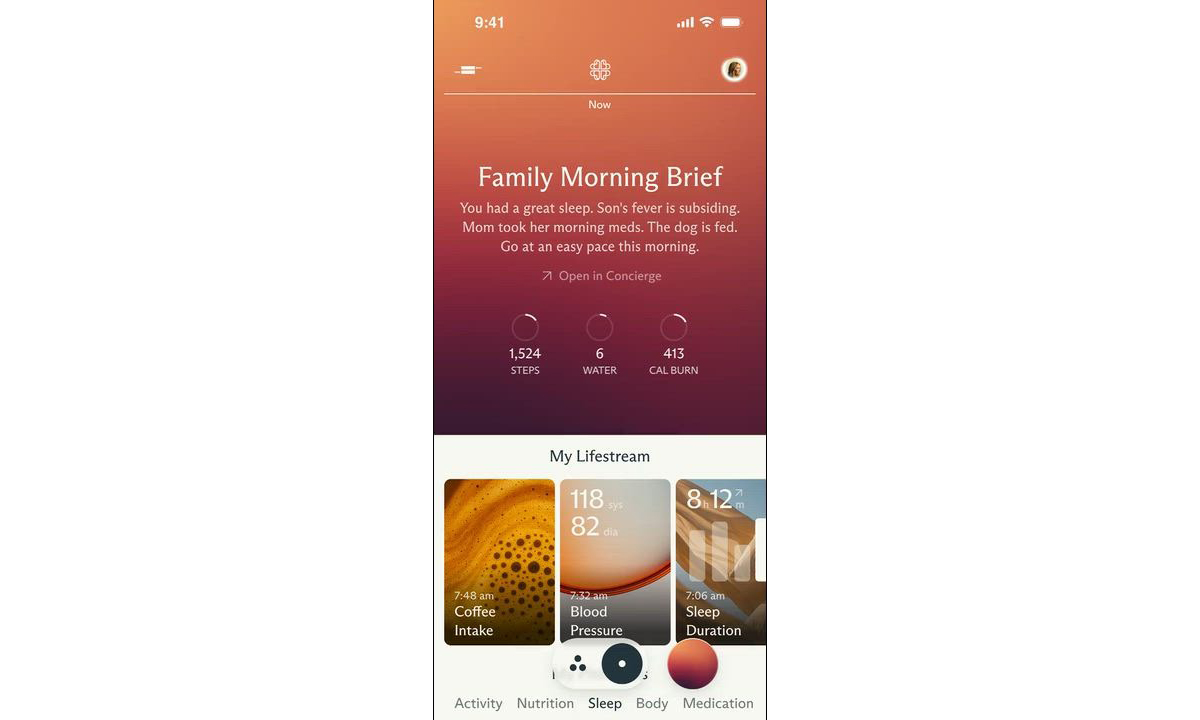
Screenshot from the Luffu app. "Family morning brief" summarizes everyone's health habits.
The app's AI includes a Morning Brief that recaps everyone's health.
Luffu

The company claims the app's AI "isn't a chatbot layer." Rather, it serves as a "guardian" — proactively monitoring for changes silently in the background. The AI then provides insights and triggers alerts when something is out of whack. You can also ask the app health data questions using plain language (so, there is some kind of chatbot) and share data with family members.

The company clearly wants to make entering data as easy as possible. Luffu allows family members to log info using voice, text or photos. It integrates with health platforms such as Apple Health and Fitbit. And the company eventually wants to expand into a hardware ecosystem — presumably, devices that make health data collection even easier.

Speaking of data collection, Luffu says, "Users are always in control of exactly what is shared, with whom, and privacy and security are paramount for all family data." In addition, the company told Axios that users can choose whether their data is used to train its AI. On the other hand, Big Tech has repeatedly shown that its most egregious data-collection practices are always wrapped in comforting language. So, at the very least, I'd take their pitch with grains of salt and, most importantly, make sure each family member knows exactly what they're consenting to. After all, this is a for-profit company, and we don’t yet know its monetization strategy.

Luffu is currently taking waitlist sign-ups for a forthcoming limited public beta. You can learn more and sign up for the waitlist on the company website.

Update, February 3, 2026, 1:14PM ET: This story has been updated to note that the Luffu public beta hasn’t started yet, but you can sign up for a waitlist to eventually get access when it starts.

This article originally appeared on Engadget at https://www.engadget.com/mobile/fitbit-founders-launch-luffu-a-way-to-integrate-your-familys-health-data-173251994.html?src=rss

Rivian made an electric ambulance for Grey’s Anatomy

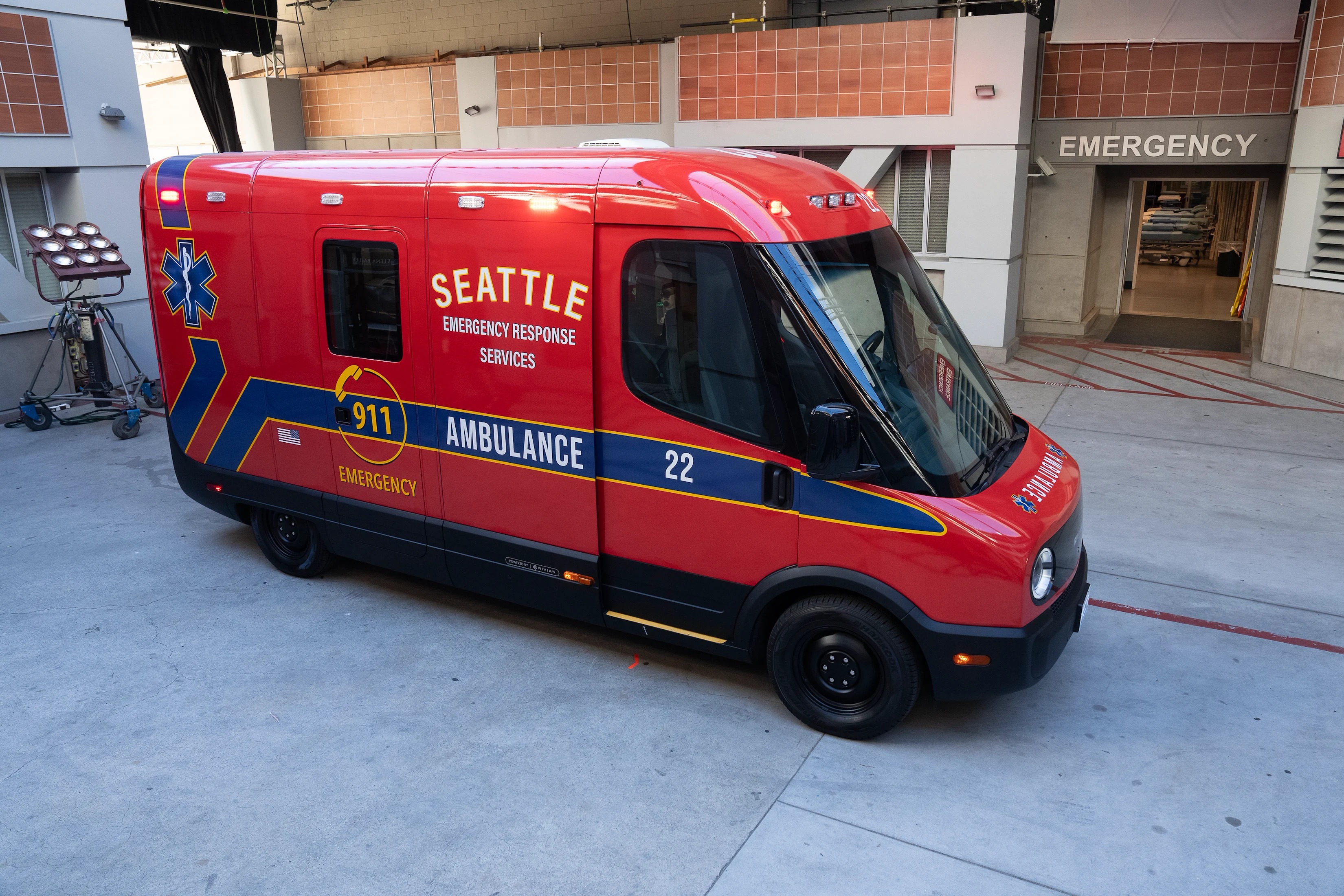
America’s once-promising EV transition may have taken a U-turn, but at least some in Hollywood are trying to do their part. Rivian partnered with Grey’s Anatomy to make a custom electric ambulance for the long-running series.

The ambulance is a modified version of Rivian’s Commercial Van. The custom “vanbulance” serves a dual purpose: preventing on-set exhaust fumes (which could harm the cast and crew) and integrating a green storyline. “As an added benefit, the elimination of engine noise brought a welcome quiet while cameras were rolling,” Rivan wrote in a blog post.

View of an ambulance interior for a Hollywood set
Among other modifications, it has rear double doors instead of a roll-up one.
Rivian

The vehicle includes some production-specific touches. Its walls and roof panels are removable, allowing cameras to reach angles required for interior shots. In addition, Rivian replaced the standard van’s rear roll-up door with double doors while adding a side entry to the cargo area. The company also added custom lighting and an exterior wrap reading “Seattle Emergency Response Services.”

The team consulted with the Huntington Beach Fire Department and the Los Angeles Fire Department to inform the interior layout. “Their feedback was invaluable to understand how first responders actually use their vehicles,” Rivian wrote.

An electric ambulance used on a Hollywood set
At least Hollywood's fictional worlds are transitioning to electric.
Rivian

The Hollywood Reporter notes that the electric ambulance debuted in the November 13, 2025, episode of Grey’s Anatomy. However, it was featured more prominently in Thursday’s episode — hence Rivian choosing this week to highlight it.

This article originally appeared on Engadget at https://www.engadget.com/transportation/evs/rivian-made-an-electric-ambulance-for-greys-anatomy-194358967.html?src=rss

Sonos soundbars and home theater gear are up to 20 percent off right now

It's big-game season, which means it's a good time to look for home theater gear on sale ahead of Super Bowl 2026. There are plenty of Super Bowl TV deals to consider, but if you have arguably the most important piece of the puzzle down, you may want to upgrade your sound system instead. Sonos' latest sale may have just what you need; a bunch of the company's home theater gear is up to 20 percent off right now. You can save $130 on the Beam (Gen 2) soundbar, bringing its price down to $369, and you'll also find deals on the flagship Arc Ultra soundbar, subwoofers, and more.

The Sonos Beam is the company's sub-$500 soundbar. Engadget's pick for the best midrange model, the compact speaker has impressive sound for its size. Part of that is its Dolby Atmos support. Although the soundbar lacks upward-firing speakers, it uses software tricks to compensate. Audio timing and frequency adjustments make sound seem to come from the side or slightly above.

One of the biggest drawbacks is that the Beam only has one HDMI port. Regardless, that compromise may be easier to accept at Beam's current $369 than at its usual $499.

Several more home theater speakers are included in Sonos's sale. If you have a loftier budget for a soundbar, there's the Arc Ultra. Typically $1,099, it's now $899. The company's pair of subwoofers is included as well. You can get the Sub Mini for $399 (down from $499) or the Sub 4 for $759 (from $899).

Although they aren't explicitly sold as home theater products, the Era 100 ($179) and Era 300 ($379) are also included in the sale. The portable Move 2 isn't discounted individually, but you will find it in a couple of bundles. You can check out the sale page for the complete list.

Follow @EngadgetDeals on X for the latest tech deals and buying advice.

This article originally appeared on Engadget at https://www.engadget.com/deals/sonos-soundbars-and-home-theater-gear-is-up-to-20-percent-off-right-now-174053415.html?src=rss

Elon Musk’s SpaceX and xAI are reportedly holding merger talks

Two Elon Musk companies are reportedly planning to merge. On Thursday, Reuters reported that SpaceX and xAI are holding merger talks ahead of a planned IPO. Part of their plan is to launch AI data centers into space (but unfortunately, only as far as Earth's orbit).

Last week, it was reported that Musk planned to take SpaceX public despite having once said it wouldn’t happen until the company had a presence on Mars. Now, the IPO could happen as early as this year. Shares of xAI would reportedly be exchanged for shares in SpaceX under the merger. Reuters reports that two entities were set up in Nevada on January 21 to facilitate the deal.

If the idea of two Musk companies becoming one sounds familiar, that's because it happened less than a year ago. In March 2025, xAI bought X, putting Grok (known for nonconsensual "nudifying" images) and X (infamous for being a far-right hellscape) together under one unholy roof.

The latest idea Musk is pitching is blasting AI data centers off into space. At last week's gathering of the rich and powerful in Davos, Switzerland, he said, "The lowest cost place to put AI will be in space. And that will be true within two years, maybe three at the latest." The idea is that data centers in orbit could harness solar power and reduce cooling costs. However, industry analysts and executives consider it a risky bet, questioning whether the savings would warrant the massive investment. If or when the AI bubble bursts, the plan could go down in flames — if not literally, then figuratively.

This article originally appeared on Engadget at https://www.engadget.com/big-tech/elon-musks-spacex-and-xai-are-reportedly-holding-merger-talks-211740150.html?src=rss

Waymo begins service at San Francisco International Airport

As fans and media prepare to descend on the Bay Area for Super Bowl LX, what does a high-tech city like San Francisco do? Why, call in the robotaxis, of course. On Thursday, Alphabet's Waymo began offering fully autonomous rides at San Francisco International Airport (SFO).

There are some limits. For now, SFO access is restricted to "a select number of riders." However, access will gradually expand over the coming months. The service is also limited to the SFO Rental Car Center (pickups and drop-offs) at launch. Waymo says it will expand to other airport locations, including terminals, "in the future."

The San Francisco Standard notes that SFO is now the third airport in Waymo's repertoire. The San Francisco launch follows the company's service at Phoenix Sky Harbor and San Jose Mineta. As for the Bay Area, Waymo now serves more than 260 square miles in the region.

Unfortunately, this isn't Waymo's only appearance in the news this week. On Wednesday, the company said one of its robotaxis struck a child, who sustained minor injuries. The incident took place on January 23 in Santa Monica. The National Highway Traffic Safety Administration (NHTSA) has opened an investigation.

This article originally appeared on Engadget at https://www.engadget.com/transportation/evs/waymo-begins-service-at-san-francisco-international-airport-192913050.html?src=rss

Maingear’s latest retro gaming desktop takes you back to the Quake era

Maingear is back with another nostalgia-fueled gaming PC. The Retro98 may look like it's made for playing Quake while you wait for The Phantom Menace trailer to drop. But on the inside, the beige box is powerful enough to slay today's most demanding AAA games. "You're not going to find this PC at your local Radio Shack," Maingear promises.

If you're at least middle-aged, the Retro98's exterior is instantly familiar. The hand-built tower includes an LED fan-speed display, a working turbo button and a power-lockout key. Sticking with the nostalgic motif, its front I/O is hidden behind the Maingear logo. I can already hear The Beastie Boys' “Intergalactic” playing in the background.

Fortunately, you won't be limited to 1998 games. (Dope as they are.) It has up to a Ryzen 9 9950X3D processor, GeForce RTX 5090 graphics, 64GB Kingston Fury RAM and 4TB Kingston FURY Renegade NVMe Gen5 SSD. The maxed-out version (described by Maingear as "unapologetically overkill") even includes open-loop liquid cooling.

Two beige-tower PCs that look like they were ripped from 1998. One is opened, revealing modern components inside.
The Retro98 starts at $2,500 and goes all the way up to $9,799.
Maingear

Now for the bad news. As you might expect from a retro novelty PC like this, you'll have to pay a pretty penny. The base model (Intel Core Ultra 7 265K / NVIDIA GeForce RTX 5070) costs $2,499. There are two other standard tiers, priced at $3,499 and $4,999. Finally, the open-loop-cooled "Alpha" build is a whopping $9,799. Hey, those aren't 1998 prices!

The Retro98 also has an extremely limited run. Maingear is producing only 32 standard units and six alpha units. The company says it won't bring this build back once those sell out. However, there is a workaround for tinkerers: Since it's based on the SilverStone FLP02 tower PC case, you could grab one of those and build your own.

Those wealthy and nostalgic enough to take the plunge can order the Retro98 today from Maingear’s website.

This article originally appeared on Engadget at https://www.engadget.com/gaming/pc/maingears-latest-retro-gaming-desktop-takes-you-back-to-the-quake-era-174958445.html?src=rss

Patreon creators have to switch to subscription billing by November, thanks to Apple

Patreon creators will need to make some changes soon, thanks to Apple. On Wednesday, Patreon said Apple has renewed its requirement that all Patreon creators must move to subscription billing. The deadline to do so is November 1, 2026.

Patreon's blog post announcing the change made it clear that it had no other choice. "We strongly disagree with this decision," the company wrote. "Creators need consistency and clarity in order to build healthy, long-term businesses. Instead, creators using legacy billing will now have to endure the whiplash of another policy reversal — the third such change from Apple in the past 18 months."

Up to this point, Patreon’s billing model has operated in a gray area, allowing its creators to charge fans outside the App Store without paying Apple’s fees. When the issue first surfaced, TechCrunch described it as stemming from how paid content was accessed (only some creators offered content that could be consumed in-app). On Wednesday, a Patreon representative described the gray area as being “because Apple’s In-App Purchase system doesn’t support some of Patreon’s longstanding billing models.”

But now Apple has reimposed its subscription mandate, eliminating the gray area. "We know that Apple is serious about enforcing this mandate," Patreon wrote. "Late last year, they blocked a Patreon app update and made it clear that in order to remain in the App Store, we have to comply with their billing requirement. Because millions of fans use iOS as their primary way to access Patreon and connect with creators, having our app blocked — or not available in the App Store at all — isn't an option."

Patreon’s "whiplash" description isn't hyperbole. Apple first announced the mandate in 2024. At that time, the deadline for all Patreon creators to make the switch was set to November 2025 — one that Patreon grudgingly accepted. But according to the company, Apple told it last May that the original 2025 deadline was no longer in effect. Now, it appears to have reversed that again.

If there's a silver lining, TechCrunch notes that only 4 percent of Patreon creators are using the affected (legacy) billing models. And fans can still bypass Apple's fees on iOS by joining via their iPhone's web browser. Patreon has much more detail for creators in its announcement post.

DAVOS, SWITZERLAND - JANUARY 21: U.S. President Donald Trump (R) speaks to Apple CEO Tim Cook (L) as he attends a reception for business leaders at the World Economic Forum (WEF) Annual Meeting on January 21, 2026 in Davos, Switzerland. The annual meeting of political and business leaders comes amid rising tensions between the United States and Europe over a range of issues, including Trump's vow to acquire Greenland, a semi-autonomous Danish territory. (Photo by Chip Somodevilla/Getty Images)
DAVOS, SWITZERLAND - JANUARY 21: U.S. President Donald Trump (R) speaks to Apple CEO Tim Cook (L) as he attends a reception for business leaders (Photo by Chip Somodevilla/Getty Images)
Chip Somodevilla via Getty Images

As for Apple, well, this familiar role of "Big, Bad App Store Taxman" pales in comparison to some of its other recent headlines. For starters, there was its removal of the ICEBlock app (and another that logged ICE arrest recordings) in October. At least as concerning is an app category that the “Privacy is a human right” company won't remove. Grok, X and (reportedly) dozens of other apps now allow iPhone owners to "digitally undress" real people, including children. 28 advocacy groups even called on the company to remove them, to no avail.

To top it all off, Tim Cook decided that Saturday — the day Alex Pretti was shot and killed by federal agents — would be a good time to attend the screening of Melania at the White House. He even posed for a selfie with accused rapist Brett Ratner, the film’s director.

Update, January 28, 2026, 5:22 PM ET: This story has been updated to clarify how the Patreon app operated in a gray area before Apple’s changes.

This article originally appeared on Engadget at https://www.engadget.com/big-tech/patreon-creators-have-to-switch-to-subscription-billing-by-november-thanks-to-apple-203759852.html?src=rss