The new reMarkable Paper Pro adds a color display

If you remember the reMarkable 2 when it was announced in March 2020, you'll be excited to hear about its successor: the reMarkable Paper Pro. This new distraction-free writing slate comes with a nicer chassis, faster internals, a bigger display and most importantly, a color screen. 

If you’re unfamiliar, reMarkable is the standard bearer for those devices standing in the delta between high and low tech. It’s an e-paper slate with a stylus (or keyboard) for reading, writing or editing your own documents, or annotating PDFs. The focus is giving you a calmer space to get some Serious Work(™) done, free from the distractions a “proper” computer or tablet would harbor. The company has always maintained that its devices offer you a way to feel like you’re working on paper, without actually having to work on paper. Despite its age, the reMarkable 2 has been a mainstay in our E Ink tablets guide as the pick that's the best option for most people. The only other products currently in the conversation are the Kobo Libra Colour and Onyx Book Tablet Note Air 3 C. Those models also boast color screens and stylus compatibility, but both have smaller displays — 7 inches diagonally on the former and 10.3 inches on the latter.

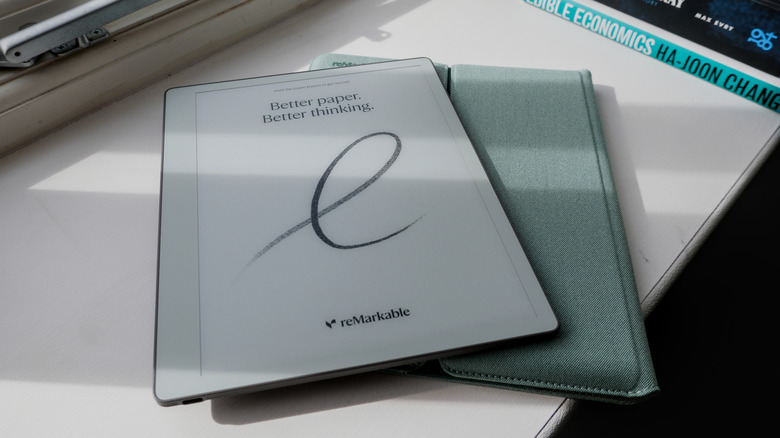
The Paper Pro is a little more than an inch taller and a quarter inch wider than its predecessor but has been able to cram in a lot more stuff. The rM2 had a 10.3-inch monochrome display while the Paper Pro’s stretched to 11.8-inches. reMarkable’s Chief Design Officer Mats Solberg explained his team worked to reduce the size of the bezels and chin to accommodate the bigger display.

Image of the new Remarkable Paper Pro, the company’s first distraction-free writing slate with a color display.
Image by Daniel Cooper / Engadget

Whereas the older model stuck to a rigid notion of post-iPad design language, the new Paper Pro gets a more austere look and feel. The edge band is sharper, if still comfortable to hold, and Solberg emphasized the grooves etched into the sides. He explained they both evoke the idea you’re holding a sheaf of paper, and to add some much-needed grip to a device this thin.

There’s dramatic changes on the inside, with a new 1.8Ghz quad-core Cortex A53 paired with 2GB RAM and 64GB storage. For comparison, the rM2 had a 1.2GHz dual-core chip, 1GB RAM and just 8GB storage. As soon as you turn the Paper Pro on, you’ll see the benefits of the new silicon, with far faster response times. You even get proper animations during the setup process.

But the real showstopper here is the display, which uses a modified version of E Ink’s Gallery 3 technology dubbed “Canvas Color.” It means the display holds a series of ink particles inside each pixel — a White, Cyan, Magenta and Yellow — as in most regular printers. reMarkable says the display is similar to newsprint and it’s an apt analogy with clear, if muted, colors on show.

Image of the new Remarkable Paper Pro, the company’s first distraction-free writing slate with a color display.
Image by Daniel Cooper / Engadget

The technology can also dither colors, mixing each ink particle to produce up to 20,000 other colors, and the colors can also be layered. It means you can highlight sections of text in the same way you’d use a highlighter on paper, the more layers you draw, the darker the color. Of course, the benefit of using a digital device is that you can highlight it as many times as you want without anything becoming soggy.

As usual, reMarkable has leveraged a limit and turned it into a benefit, offering you colors with a heavy dose of restraint. And you don’t really need your retinas to be burned inside out if you’re trying to organize your thoughts ahead of a big meeting. Although, having been spoiled by so many well-made displays of late, I do wish the colors popped a little bit more than they do.

The Paper Pro is the first reMarkable with a frontlight, finally letting you get some work done in dark environments. Solberg explained the frontlight was one of the hardest challenges to build without harming the distance between the stylus tip and the display itself. He said the team was determined to keep the gap between the pen and the display to under one millimeter, and succeeded.

The last two slates had active displays but passive styluses, but the Paper Pro gets an Apple Pencil-esque active stylus as well. It’ll charge while magnetically connected to the side of the bezel and the new components help improve accuracy and latency. Solberg said the reMarkable 2 had an input latency of 22ms, and he had targeted 15ms for this model. He was proud to say that the team smashed that target, with the Paper Pro’s latency down to just 12ms.

And yet, for all the headline changes, it’s the added responsiveness that’s the really compelling feature. The rM2 was no laggard, but the faster input really does help sell the idea you’re sketching out ideas on paper. You can always credit the company for sweating the details, too, like the fact you can add a highlight or handwritten annotation to typed text that will follow the text around as you edit it.

Image of the new Remarkable Paper Pro, the company’s first distraction-free writing slate with a color display.
Image by Daniel Cooper / Engadget

The company is launching a new Type Folio to go with the Paper Pro which, like its parent, is bigger and gets backlit keys. I’ll admit, I was one of a few critics who loved the older model and felt that it made the right compromises to keep its size small. The new model is able to take advantage of the extra room to offer better spacing and a palm rest. It’s fundamentally the same keyboard as before, and I found it pretty easy to work on for long stretches of time.

I’m also impressed with reMarkable’s commitment to making the Paper Pro easier to repair and refurbish than older models. Solberg explained that the Paper Pro is far more modular under the hood, with easily-swappable components. He ruled out end-user repairs, but said that the only adhesive used in the chassis are two replaceable glue strips to keep the battery in place. Repairs would likely need to take place at reMarkable HQ or a partner distributor, but the fact it’s been designed with an eye on long-term repair at all is laudable.

reMarkable Paper Pro is available to order today from reMarkable’s website and Best Buy, priced at $579 with the standard Marker and $629 for the Marker Plus. If you want to add a case, and I heartily recommend you do, it’ll cost you between $89 and $179, depending on your material choice. And if you want to add the Type Folio, you’ll need to cough up an additional $229. The reMarkable 2 is remaining around as a lower-cost option (unsurprisingly, as it’s a really good piece of kit) and will now be available with the standard Marker for $379.

Of course, you and your wallet will have to decide if that’s the sort of sum you can bear to part with, especially in these tightened times. With a product like this, the intentional choices and limits made means it’ll always stack badly in a head-to-head with a similarly-priced iPad. The trick is to work out if you’ll be more productive with less mental and physical clutter in your computing environment, and go forward from there. I’ve found, when I’ve got a lot of work to do and need to focus, it’s a better way to hammer out first drafts than other devices I could name.

Update, September 6, 4:43PM ET: This story was updated after its original publication to include a comparison to competing writing tablets with color screens. 

This article originally appeared on Engadget at https://www.engadget.com/mobile/tablets/the-new-remarkable-paper-pro-adds-a-color-display-120059067.html?src=rss

The Morning After: The iPhone 16 launches September 9

Apple pretty much always announces the year’s iPhone in the first chunk of September, so no surprise here. It’ll announce the iPhones 16 on September 9 with the usual pomp and show at Apple’s campus, complete with global live stream. Dubbed It’s Glowtime, the event name hints at the new features leveraging Apple Intelligence.

Being a diligent technology news outlet, we already have a detailed roundup of all the rumors. It’s likely the hardware won’t change too much, with small tweaks all around. That includes slightly bigger screen sizes, new colors and a faster chipset better able to run Apple Intelligence. Personally, I’m excited for a second action button as a camera trigger, given how often I’m snapping with my iPhone.

— Dan Cooper

​​You can get these reports delivered daily direct to your inbox. Subscribe right here!

Real-life Batman villain Martin Shkreli has been ordered to hand over any copies he may have made of the Wu-Tang Clan album that propelled him to infamy. The album’s current owner gained an injunction demanding he document any copies made and hand them over within the next week. Probably shouldn’t have boasted he’d sent the album to various people and stored copies in safes all around the world.

Continue Reading.

Pavel Durov, CEO of Telegram, the messaging platform, was arrested by French authorities on the weekend. French law enforcement says Durov’s arrest is part of a wider investigation into online crime, but Durov’s connection isn’t clear. Shortly after the arrest, Telegram said it’s “absurd” to arrest its CEO because some users may be misusing its platform.

Continue Reading.

Image of the Polaris Dawn crew
SpaceX

Bankrolled by billionaire Jared Isaacman, Polaris Dawn is a private space mission that aims to complete the world’s first civilian spacewalk. Due to launch August 27, the Polaris Dawn capsule will travel into the high atmosphere before two of the four crew members exit the craft. The flight will also test SpaceX’s innovative idea of not building the capsule with an airlock. Instead, the crew will all don spacesuits then open the door, exposing the rest of the crew and the spacecraft to the vacuum of space. We’re all keeping our fingers crossed.

Continue Reading.

Image of NASA astronauts Butch Wilmore and Suni Williams
NASA / Robert Markowitz

After years of having its backside handed to it by SpaceX, Starliner was meant to be Boeing’s comeback story. Sadly, after its first trip to the International Space Station, the vessel will return to Earth without its two crew members. NASA has announced that, instead, Butch Wilmore and Suni Williams will get home on a SpaceX Crew Dragon scheduled for February 2025.

Continue Reading.

This article originally appeared on Engadget at https://www.engadget.com/the-morning-after-the-iphone-16-launches-september-9-111546820.html?src=rss

The Morning After: Is Google’s Pixel 9 worth buying?

There’s a lot of power in the notion of the default: The obvious, sensible choice you won’t get picked on for making. Until now, the default choice for an Android flagship is whatever model of Galaxy Samsung is stamping out this year. Sam Rutherford has been using Google’s new Pixel 9 as his daily driver, and he feels the winds of change are blowing. This may be the first time a Google handset has well and truly taken the lead as the default choice.

What has pulled the Pixel 9 out from under Samsung’s shadow is the better industrial design, with its utterly gorgeous look and feel. That, combined with class-leading cameras, a great display and all of Google’s newfangled AI smarts, makes it a winning handset. You’ll have to read the full review to find out just why it’s worth your cash, but the list of downsides is so short you’ll have to make an effort not to buy one right now.

— Dan Cooper

​​You can get these reports delivered daily direct to your inbox. Subscribe right here!

Image of Snap CEO wearing the old glasses
Snap

Snap is reportedly gearing up to launch its fifth-generation pair of Spectacles with some more augmented reality features. The last pair released, in 2021, had limited availability and only lasted 30 minutes on a charge. It’s thought the latest pair has addressed many of the hardware issues inherent in the last model, but it still may not be ready for wide sale.

Continue Reading.

Image of a peloton bike close up
Photo by Jamie Rigg / Engadget

Peloton’s financial doldrums mean the company is looking for any and every way to get more cash in the door. Even if that means further alienating users it could otherwise rely upon for some of that sweet, sweet subscription revenue. Like insisting on charging a $95 activation fee for users who buy a used Peloton before they can get riding. Don’t you just love the smell of being nickeled-and-dimed even when you’re buying second-hand?

Continue Reading.

Neuralink says the second patient in its human trials has had a more successful implant experience than the first. The company claims it observed no thread retraction — connective threads pulling away from the brain — in its latest test. It’s hoped this will, if successful over the long term, offer more communication and connectivity for patients with accessibility needs.

Continue Reading.

Mike Lynch, founder of Autonomy and Darktrace, was confirmed dead after a days-long search and rescue operation. Lynch was with his family on a yacht that capsized on Monday in a violent storm.

Continue Reading.

This article originally appeared on Engadget at https://www.engadget.com/the-morning-after-is-googles-pixel-9-worth-buying-111528828.html?src=rss

The Morning After: Our verdict on the Pixel 9 Pro and XL

Google is selling its ultra-premium Pixel 9 Pro in two sizes, but it’s not the size that counts here. Instead, it’s the suite of AI features Google hopes will revolutionize how you use your phone. The Morning After’s Mat Smith has spent plenty of time with both handsets to work out if they’re good enough to justify your cash.

He explores headline features, like Gemini Advanced, as well as the smart new AI-enabled photo tweaks. One of my favorites is Add Me, which puts you in the background of a group shot you were holding the phone for. Or Zoom Enhance, which offers a CSI-like level of clarity enhancement for the furthest point in a photo.

I won’t spoil the review beyond saying Mat thinks the Pixel 9 Pro, sorry Pixels 9 Pro, are well worth the cash. But you’ll have to read it all to work out why.

— Daniel Cooper

​​You can get these reports delivered daily direct to your inbox. Subscribe right here!

Rotten Tomatoes has become a perpetual battleground in the internet’s perpetual culture war. But it’s trying to placate its user base by launching a Certified Hot label that reflects rapturous viewer reviews alongside those of critics. Viewers will need to prove they’ve seen a film but can only do so if they bought tickets via Fandango. Will that be enough to end the culture of review-bombing the site is suffering from? Who knows.

Continue Reading.

Promotional image of Xbox pre-orders
Microsoft

Microsoft’s strategy of pushing cloud gaming with one hand and a dedicated console business with the other hasn’t necessarily been a winner. But the company isn’t deterred and has now opened pre-orders for the disc-free version of its Xbox Series X. The console is $50 cheaper than the disc-enabled version and, uh, the list of benefits with this new model stops there. But you can pre-order today, with shipping due to begin October 15.

Continue Reading.

Image of JBL OnTour 3
JBL

JBL reaches for the useful side of quirky with its Tour Pro earbuds, and the third-generation model is no exception. The true wireless earbuds already have a screen in the charging case and can now transmit audio wirelessly. Plug the case into a USB or analog source and you can listen along, ideal for plane trips or when you need to listen to an old-timey record player.

Continue Reading.

Ford has canceled plans to build a three-row electric SUV as part of a broader pull back from the EV market. It has also delayed the launch of its next-generation electric truck that would have followed the F-150 Lightning. Losses on current EV models are mounting up, which could total as much as $5 billion by the end of the year, and that’s too rich even for Ford’s blood.

Continue Reading.

This article originally appeared on Engadget at https://www.engadget.com/the-morning-after-our-verdict-on-the-pixel-9-pro-and-xl-111535947.html?src=rss

Framework nips and tucks its 13-inch laptop

It’s hard not to be awed by Framework’s commitment to its original 13-inch modular laptop, which it has been updating every year since it launched. When a new Intel (or AMD) chip rolls around, it builds new mainboards that can be swapped in to keep your machine on the cutting edge. And it’s done plenty of work to ensure that the still-working mainboards that you no longer use can have a second (or third) life.

This year, the company is bringing Intel’s new Core Ultra (Series 1) processors to its mainboards with the Ultra 5 125H, Ultra 7 155H and the Ultra 7 165H all available. These offer more efficient power use, better thermals and the option to add up to 96 GB of DDR5 RAM. To accompany the new silicon, the company has launched a second-generation webcam and display.

Given the need to fit into an existing template, the mainboards are almost identical to their predecessors. Except for the fact the thermal system has been tweaked to hopefully keep things cooler without as much noise. Intel’s new Core Ultra Chips are meant to be a little more gentle with their power consumption and how much heat they kick out. Existing Framework machines are notorious for spinning their fans to full whenever they get the slightest amount of workout.

Sadly, I haven’t had the upgrade in long enough to make any serious benchmarks, but it does appear to be a lot faster than its predecessor. The company says you should expect to see improvements in power efficiency, battery life and video and gaming performance. As for the fan noise, it's a bit quieter than the previous model, especially when running games — which it can now do quite easily. You’ll still hear the fan when playing a game like Grand Theft Auto V, but it won’t sound like a jet engine taking off.

I have fewer meaningful things to say about the 2,880 x 1,920, 120Hz display. The only really notable difference is that while the original display had a peak brightness of 400 nits, this one will go all the way up to 500. The extra backlight is a mercy, especially in bright weather, but I’m less whelmed by the extra resolution.

Framework’s first-generation webcam was no slouch but even that is subject to the whims of time’s ceaseless march. The space constraints of laptop lids means it’s only now we can see better sensors, like the sort we see in phones, shrinking to the point of fitting in that gap. The OXO8X is a 9.2-megapixel sensor with backside illumination and pixel binning: the former allowing for better low-light performance; the latter crunches the 9.2-megapixel picture to get a higher-quality 1080p image than we've seen before. In front of the sensor is a five-element, f/2.0 lens with an 87-degree field of view, again with the promise of better picture quality.

Installation of the webcam — and everything else — is, as usual, a breeze. But while putting the new module in is fine enough, the image you get out the other end isn’t a massive improvement. The colors are still pretty muted and I’m not sure, apart from some better detail, that I can see enough of a difference between both models to consider upgrading. And while the pixel binning does make the picture sharper, it’s not a night and day shift. While new buyers will get the new module as a matter of course, those with existing Framework Laptop 13s shouldn’t feel like they’re missing out.

This article originally appeared on Engadget at https://www.engadget.com/computing/laptops/framework-nips-and-tucks-its-13-inch-laptop-160053383.html?src=rss

Tenways AGO-T is a well-equipped, but heavy e-bike

There’s a problem with most e-bikes, which is that you’ll never find one that does every job perfectly. A city cruiser with no grunt will leave you stranded when you reach an incline while a beefy cargo bike can haul gear, but it’s too big for commuting. Tenways’ AGO-T has tried to square many of these circles by sticking almost too much power onto a Dutch-style step-thru frame.

It’s marketed as a bike for city living, but for cities where you’re not just dealing with flat, well paved roads. It’s got a beefy motor and battery, giving it enough power to tackle the steepest hill with ease, and a decent pannier rack for cargo capacity. But all of that extra power comes with the weight that comes with it, and so while it’s meant to be nimble, it’s also hefty.

Image of Tenways' AGO-T e-bike
Photo by Daniel Cooper / Engadget

The e-bike market is sufficiently homogeneous that I won’t look at a unit unless it’s got some eye-catching features. The AGO-T’s spec-list sold me on a test ride given the sheer volume of stuff bolted onto its frame: A Bafang M420 mid-drive motor with 80 Nm max torque (although you’ll get less of that in day-to-day-use); a Gates carbon belt; and Enviolo’s stepless shifting hub. You also get hydraulic disc brakes, a Selle Royal seat, an integrated front light and an integrated rear light built into the pannier rack.

There’s often something a little medicinal about most bikes with a step-through frame. But a combination of paneling to hide away a lot of its mechanisms and the fancy “Jungle Green” paint job sets the AGO-T apart. In fact, I’d go so far as to say that it's a rather stylish way to get around town, even if it’s built more for power than maneuverability.

You can expect to pay a pretty penny for those sorts of specs, and the AGO-T is priced £2,699 (around $3,500). That’s a lot of cash for a bike, but not unreasonable given the gear on show, and the fact it’s been packaged so neatly. You can get a cheaper alternative like Gazelle’s Paris C7+ for a grand less, but you’ll notice compromises, like the weaker motor.

Image of Tenways' AGO-T e-bike
Photo by Daniel Cooper / Engadget

The AGO-T has a range of 100km (62 miles) with its motor-assisted top speed limited, as per the law, to 15 miles per hour. Put it this way, I rarely if ever felt like I was going too slow on this thing, and often had to dial down its speed.

The last few e-bikes I’ve tested had basic digital displays offering little more than your speed and how much assist the bike was giving you. By comparison, the AGO-T’s full-color LCD display comes across almost as too much, especially given its enormous size. There’s a lot of negative space in the UI, too, and it looks more like the instrument cluster on a car. Sometimes less is more. And, yes, a TFT LCD isn’t ideal when you’re out in really strong sunlight.

Image of Tenways' AGO-T e-bike
Photo by Daniel Cooper / Engadget

Up top is the time and battery level, while the middle shows speed in miles or kilometers per hour. The lower third indicates the assist level (from 0-5) and then there are two boxes, which cycle through a number of data points: Average speed, maximum speed, trip time, range, the amount of CO2 you haven’t burned and the trees you’ve commensurately saved. I’m not sure I’d ever need those last two data points available to me all the time, and I’m not sure what the basis for that claim is anyway. Especially when those sorts of metrics are far better suited to the app than the primary display.

As for the app, it’s like every other e-bike app in that you probably won’t ever look at it except to satisfy your curiosity. There is a built-in GPS that you can use by mounting your phone to the handlebars or, even better, with the directions pushed to the bike display. Sadly, the quality of the GPS on offer is well below Google or Apple Maps, with many local landmarks not listed. Similarly, the turn-by-turn directions routed to the bike screen consist only of turn signal and distance, which is a far cry from what a good GPS should offer. This is a feature that could be world class and suffers by merely being adequate, if that.

Image of Tenways' AGO-T e-bike
Photo by Daniel Cooper / Engadget

The AGO-T weighs 31kg (68 pounds) and you will feel every gram of that weight when you’re holding it. I do not recommend carrying it up and down stairs unless you’re built like the worst person you see at the gym. If you live in a poorly-served apartment building I don’t think this is the bike for you, but if you can safely store this at ground level, go for it. It’s like owning an SUV which is great when you’re tooling around town, and awful when you can’t fit into a small space in the parking lot.

Its heaviness means it’s a little stodgier when you’re on the road, especially at low speeds where you’ll have to work harder to maintain balance. There’s an accessibility argument often made about e-bikes that they help empower folks who may not be as physically strong. A bike like this might fall at this hurdle given its heft. But in motion, the AGO-T is tuned to be sedate, gliding around the roads rather than zooming down them. This smoothness makes sense, because you’re looking at this to get you from A to B, as well as haul some bags or a kid along with you.

Tenways markets the AGO-T on the basis it can take whatever a city can throw at it. I had no doubts, given the power of that Bafang mid-drive motor, that it would be able to tackle the steep hills in my home city of Norwich. When I test e-bikes or scooters, I try to zip up a hill with an incline of 22.4 degrees, which regularly defeats lesser bikes. But with the AGO-T, I actually had to turn the gears down because it felt too easy and weightless with the assist up to the max. Even after I’d tweaked things, I think this is the first time I’ve ridden up that hill and not broken even the merest hint of a sweat.

This does, however, come at the cost of the range, and the estimates quickly started dropping once I’d started tackling hills. That said, you can easily get 30 miles out of this on a charge, which is more than enough for most days, right?

Tenways also claims the AGO-T can tackle rough terrain on this bike, so I took it over a few dirt tracks. The adjustable front forks and suspension seat meant that the bike evened out some pretty bumpy areas. Obviously, I wouldn’t want to take this off-roading but I was surprised at how well it coped with gravel tracks and dirt pathways riddled with tree branches.

Image of Tenways' AGO-T e-bike
Photo by Daniel Cooper / Engadget

As a city cruiser that can eat hills like they’re cotton candy, the Tenways’ AGO-T is a bit of a fantasy bike. I could easily see myself using this as my primary bike, especially given the variable terrain of my home city. Whether you should buy one becomes less a question of its qualities that your needs in the given moment. Are you in need of a bike that can handle all types of terrain at any gradient that’ll also give you cargo space? Are you strong enough to wrestle with its considerable weight? And, of course, do you have enough cash in the bank to buy it and then make sure there’s safe places to park it? If the answer to all of those is yes, then this is pretty much a slam dunk.

This article originally appeared on Engadget at https://www.engadget.com/transportation/tenways-ago-t-is-a-well-equipped-but-heavy-e-bike-133005101.html?src=rss

The Morning After: Google replaces Chromecast with the TV Streamer

Ahead of next week’s Pixel devices event, Google has unveiled its latest product for the living room, the Google TV Streamer. It replaces the Chromecast and is a standalone set-top box as opposed to the dongles we’ve been used to. The tiny wedge-shaped doodad supports all the expected features, including HDR, Dolby Vision, Dolby Atmos and spatial audio. But Google is also making a big deal of the device’s smart home bona fides, with support for Matter and Thread. You’ll get a popover Google Home panel too, letting you tweak your smart home from the comfort of your TV.

Of course, you might wonder why Google needs to push this product out given how many Smart TVs exist. Or the ubiquity of other platforms that do much of the same job, from Roku to most streaming-friendly cable boxes. On one hand, Google wants to keep a toehold on the biggest screen in your home, and on the other, it’s a good way to advertise the search giant’s AI prowess, offering custom recommendations for things to watch. Plus, if you have been looking for something a bit more Made By Google, then you can snag this for $100 when it launches in September.

As for the Chromecast, we’ve prepared a little obituary for the dirt-cheap little streaming stick that could.

— Dan Cooper

Reddit CEO teases AI search features and paid subreddits

macOS Sequoia may require weekly permissions for screen recording apps

Disney is increasing prices (again) for standalone streaming plans

Star Wars Jedi: Survivor is coming to PS4 and Xbox One on September 17

​​You can get these reports delivered daily direct to your inbox. Subscribe right here!

Nest Learning Thermostat
Google

Google isn’t done shuttling out products ahead of its 2024 Pixel Event, however, and has also updated the Nest Learning Thermostat. The fourth-generation model gets a bigger LCD display, curvier design and customizable faces, including switching the screen to a clock when idle. You will also get more AI gimmicks to improve your energy efficiency, because of course you do.

Continue Reading.

X has announced it’ll sue the Global Alliance for Responsible Media (GARM), an ad-industry group. CEO Linda Yaccarino claims the body, which publishes standards for digital advertising, has organized an “illegal boycott” of the platform. GARM, which counts Mars and Unilever in its member lists, stands accused of influencing where mega-brands spend their money.

Now, I’m just a simple country lawyer who doesn’t know much about advertising, moderation or business. But I wonder if firing your trust and safety team, making the site run as reliably as a British train and allowing hateful content to be posted next to ads might be an issue. No, of course not, that’d be silly. Let’s all try to find the guy who did this.

Continue Reading.

Image of the new TE Sampler
Teenage Engineering

I don't care it’s a stupid gimmick, and I don't care I have no real interest in making this sort of music. Damnit, friends, I just want to play with Teenage Engineering’s EP-1320 Medieval sampler chock full of old-world sounds. Yes, it’s just the K.O. II with a different paint job, but you have to reward commitment to the bit this extreme.

Continue Reading.

This article originally appeared on Engadget at https://www.engadget.com/general/the-morning-after-google-replaces-chromecast-with-the-tv-streamer-111523672.html?src=rss

The Morning After: Google replaces Chromecast with the TV Streamer

Ahead of next week’s Pixel devices event, Google has unveiled its latest product for the living room, the Google TV Streamer. It replaces the Chromecast and is a standalone set-top box as opposed to the dongles we’ve been used to. The tiny wedge-shaped doodad supports all the expected features, including HDR, Dolby Vision, Dolby Atmos and spatial audio. But Google is also making a big deal of the device’s smart home bona fides, with support for Matter and Thread. You’ll get a popover Google Home panel too, letting you tweak your smart home from the comfort of your TV.

Of course, you might wonder why Google needs to push this product out given how many Smart TVs exist. Or the ubiquity of other platforms that do much of the same job, from Roku to most streaming-friendly cable boxes. On one hand, Google wants to keep a toehold on the biggest screen in your home, and on the other, it’s a good way to advertise the search giant’s AI prowess, offering custom recommendations for things to watch. Plus, if you have been looking for something a bit more Made By Google, then you can snag this for $100 when it launches in September.

As for the Chromecast, we’ve prepared a little obituary for the dirt-cheap little streaming stick that could.

— Dan Cooper

Reddit CEO teases AI search features and paid subreddits

macOS Sequoia may require weekly permissions for screen recording apps

Disney is increasing prices (again) for standalone streaming plans

Star Wars Jedi: Survivor is coming to PS4 and Xbox One on September 17

​​You can get these reports delivered daily direct to your inbox. Subscribe right here!

Nest Learning Thermostat
Google

Google isn’t done shuttling out products ahead of its 2024 Pixel Event, however, and has also updated the Nest Learning Thermostat. The fourth-generation model gets a bigger LCD display, curvier design and customizable faces, including switching the screen to a clock when idle. You will also get more AI gimmicks to improve your energy efficiency, because of course you do.

Continue Reading.

X has announced it’ll sue the Global Alliance for Responsible Media (GARM), an ad-industry group. CEO Linda Yaccarino claims the body, which publishes standards for digital advertising, has organized an “illegal boycott” of the platform. GARM, which counts Mars and Unilever in its member lists, stands accused of influencing where mega-brands spend their money.

Now, I’m just a simple country lawyer who doesn’t know much about advertising, moderation or business. But I wonder if firing your trust and safety team, making the site run as reliably as a British train and allowing hateful content to be posted next to ads might be an issue. No, of course not, that’d be silly. Let’s all try to find the guy who did this.

Continue Reading.

Image of the new TE Sampler
Teenage Engineering

I don't care it’s a stupid gimmick, and I don't care I have no real interest in making this sort of music. Damnit, friends, I just want to play with Teenage Engineering’s EP-1320 Medieval sampler chock full of old-world sounds. Yes, it’s just the K.O. II with a different paint job, but you have to reward commitment to the bit this extreme.

Continue Reading.

This article originally appeared on Engadget at https://www.engadget.com/general/the-morning-after-google-replaces-chromecast-with-the-tv-streamer-111523672.html?src=rss

Samsung (finally, properly) launches the Galaxy Ring

At Samsung Galaxy Unpacked, Samsung has today announced the Galaxy Ring, a finger-worn wearable bolstering its ecosystem of health-tracking gear. Yes, this is the third or fourth time it’s been announced, but today is the day it’s actually available for you to pre-order. It’s a conscious attempt to corner a market held by plenty of smaller players in the space, most notably the Oura Ring. You’ll also get the usual AI woo insights to help you take better care of your body when you think things might not be going well.

The company boasts that it has embedded its existing sensor technology into the far smaller space a ring affords. It’s carrying an accelerometer, PPG / heart rate and skin temperature sensor, which will feed data to Samsung Health to build a portrait of your body. In the app, you’ll be able to look at your sleep score, how much you move during sleep, your heart and respiratory rate as well as your menstrual cycle. An overall Energy Score will track how well it thinks you’re feeling every day and offer suggestions on what to change.

You’ll also benefit from Heart Rate Alerts should your ticker get too slow or too fast, and give you a heads-up to avoid any trouble. There’s the table-stakes stuff, too, like automatic workout detection and alerts when the ring doesn’t think you’ve moved enough of late. Not to mention the ring can be used as a remote shutter trigger for your Galaxy-branded smartphone.

Image of the Galaxy Ring on a finger.
Photo by Sam Rutherford / Engadget

Of course, there's only so much a smart ring can do given the constraints inherent in the form, an issue I outlined in detail back in April. But if you're already in Samsung's ecosystem and want to ensure that you are always getting the most detailed insights on your body possible, this is a no-brainer.

Galaxy Ring is made from titanium and is rated for depths of water up to 100 meters, with an IP68 for water and dust ingress. Depending on the size of ring you opt for, it’ll weigh between 2.3 and 3 grams, with a quoted battery life of up to seven days on a single charge. Galaxy Ring is available in Titanium Black, Silver or Gold, and will cost $400. Pre-orders in the US begin on July 10, with general availability starting July 24.

Catch up on all the news from Samsung's Galaxy Unpacked 2024 here!

This article originally appeared on Engadget at https://www.engadget.com/samsung-finally-properly-launches-the-galaxy-ring-130055455.html?src=rss

Apple’s ‘F1’ movie looks really good

I’ve sneered at Apple’s F1 movie since it was announced, assuming it’ll be a cynical exercise in brand building. Given the close involvement of the sport’s governing body, its stars and teams, it has the vibes of a two-hour commercial. But the teaser trailer for the film has made me worried, because it actually looks like it could be quite good. Oh no.

F1 was co-produced by (F1 great) Lewis Hamilton himself, who pledged to make it the most realistic racing movie ever made. It centers on Brad Pitt’s Sonny Hayes, who is recruited from retirement to be a mentor to Damson Idris’ hot new prospect, Joshua Pierce. The last sequence in the teaser, all roaring engines and heavy breathing as the car warps around the track, is enough to make me think this has to be seen in IMAX.

There’s still time for it all to go wrong, and you can’t make a plucky underdog sports movie in this of all environments. After all, even the smallest team is a multi-multi-million dollar outfit with millionaire drivers behind the wheel of each car. And it’s not as if you can make a wacky design tweak to improve your car above the others given the yearslong homologation process.

But I have to hope that any movie that features (former Haas F1 team principal and living meme) Guenther Steiner in a reaction shot can’t be all bad.

This article originally appeared on Engadget at https://www.engadget.com/apples-f1-movie-looks-really-good-120035709.html?src=rss