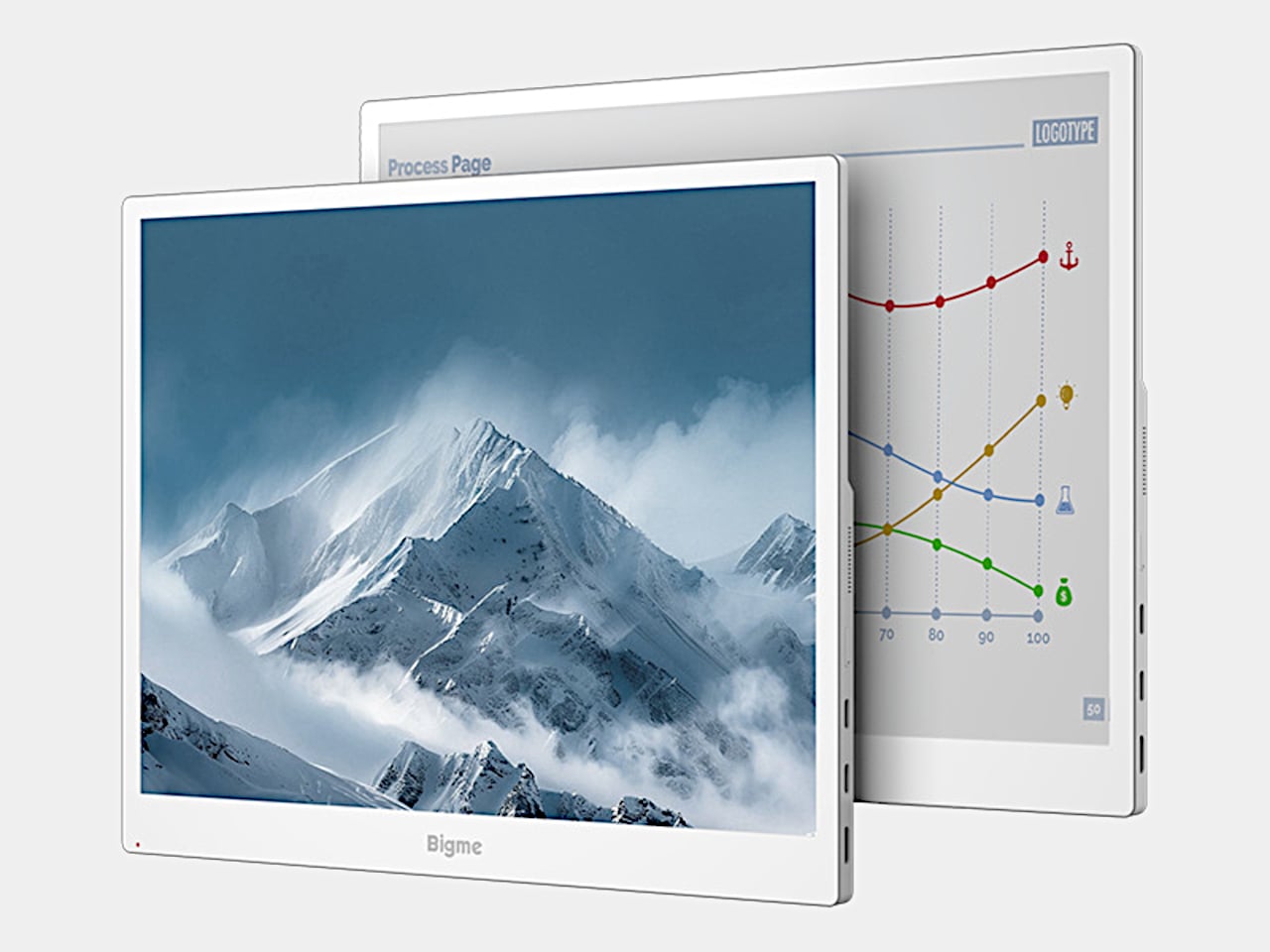
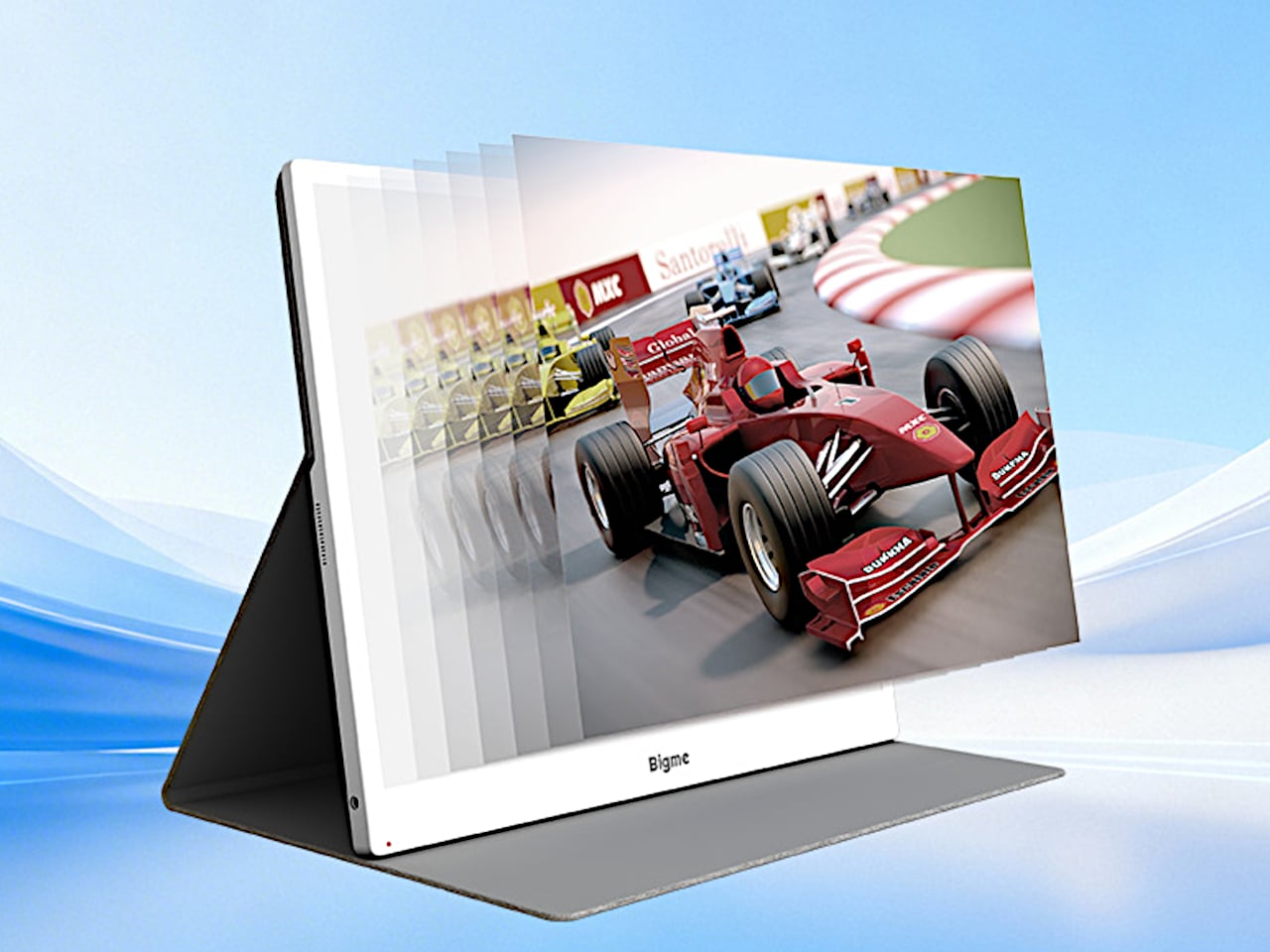
Reading reports or writing all afternoon doesn’t necessarily call for the same kind of display you’d choose for a movie. E-paper offers a different surface, but sluggish updates can make computer work frustrating. Bigme’s B13 Pro tackles that compromise with a 13.3-inch color e-paper monitor and a claimed 60 FPS refresh capability, bringing a more paper-like screen alongside your laptop without abandoning everyday desktop tasks.
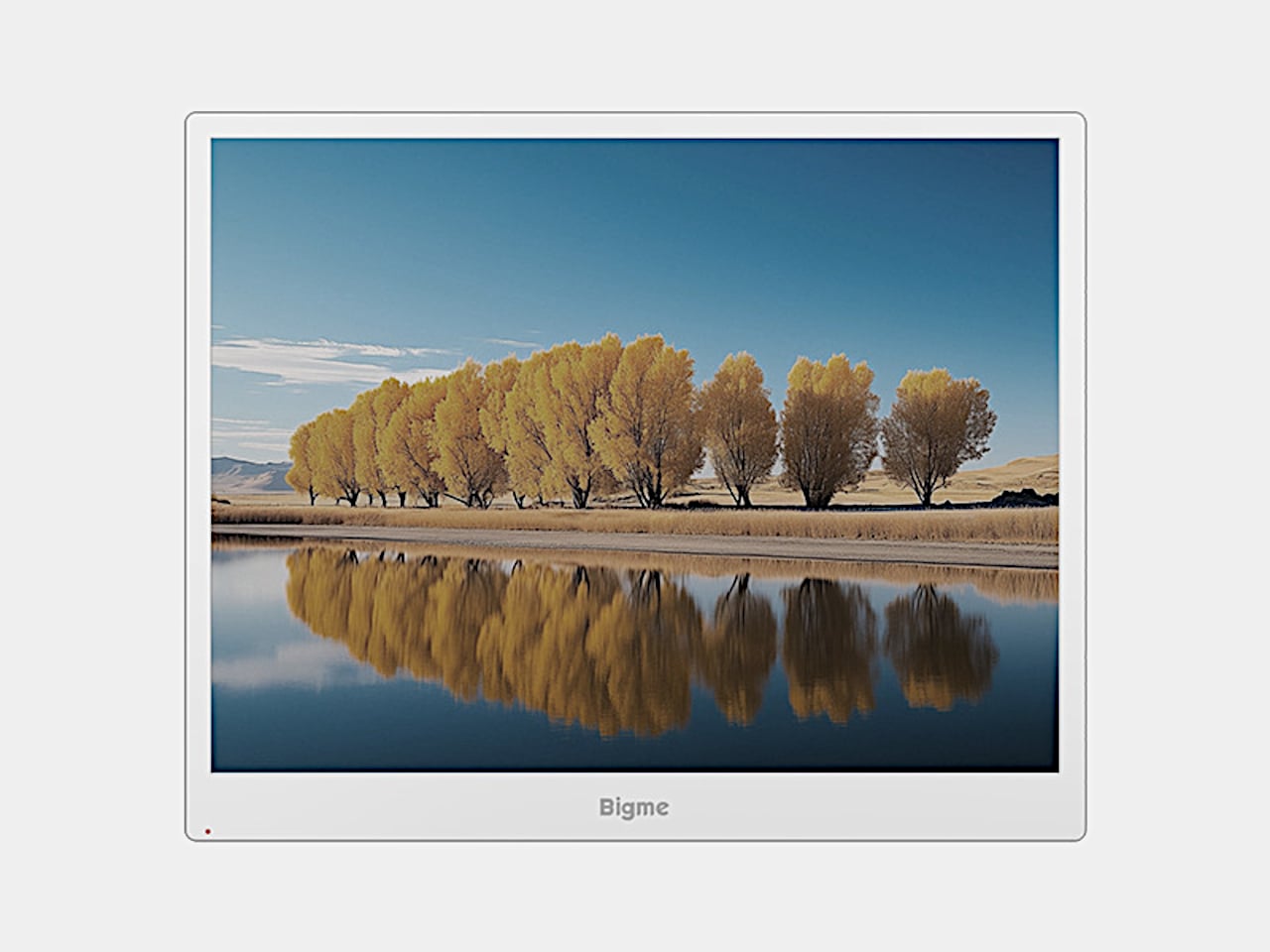
The white frame keeps the appearance closer to an e-reader than a typical gaming monitor, with a broader lower bezel and controls along the edge. Its 4:3 proportions also give documents more vertical room than an equally wide widescreen panel. At roughly 11.3 by 9.1 inches and 1.46 pounds, it’s another object for your bag, though not a full-size desktop monitor.
Rather than shining a backlight through the panel, Kaleido 3 e-paper uses reflected light, with an adjustable frontlight for dimmer surroundings. The listed 3200×2400 resolution delivers 300 pixels per inch for black-and-white content. That gives text-heavy work a more natural role here than cinematic entertainment. Keeping a reference document beside your draft makes sense when the information matters more than constant on-screen motion.
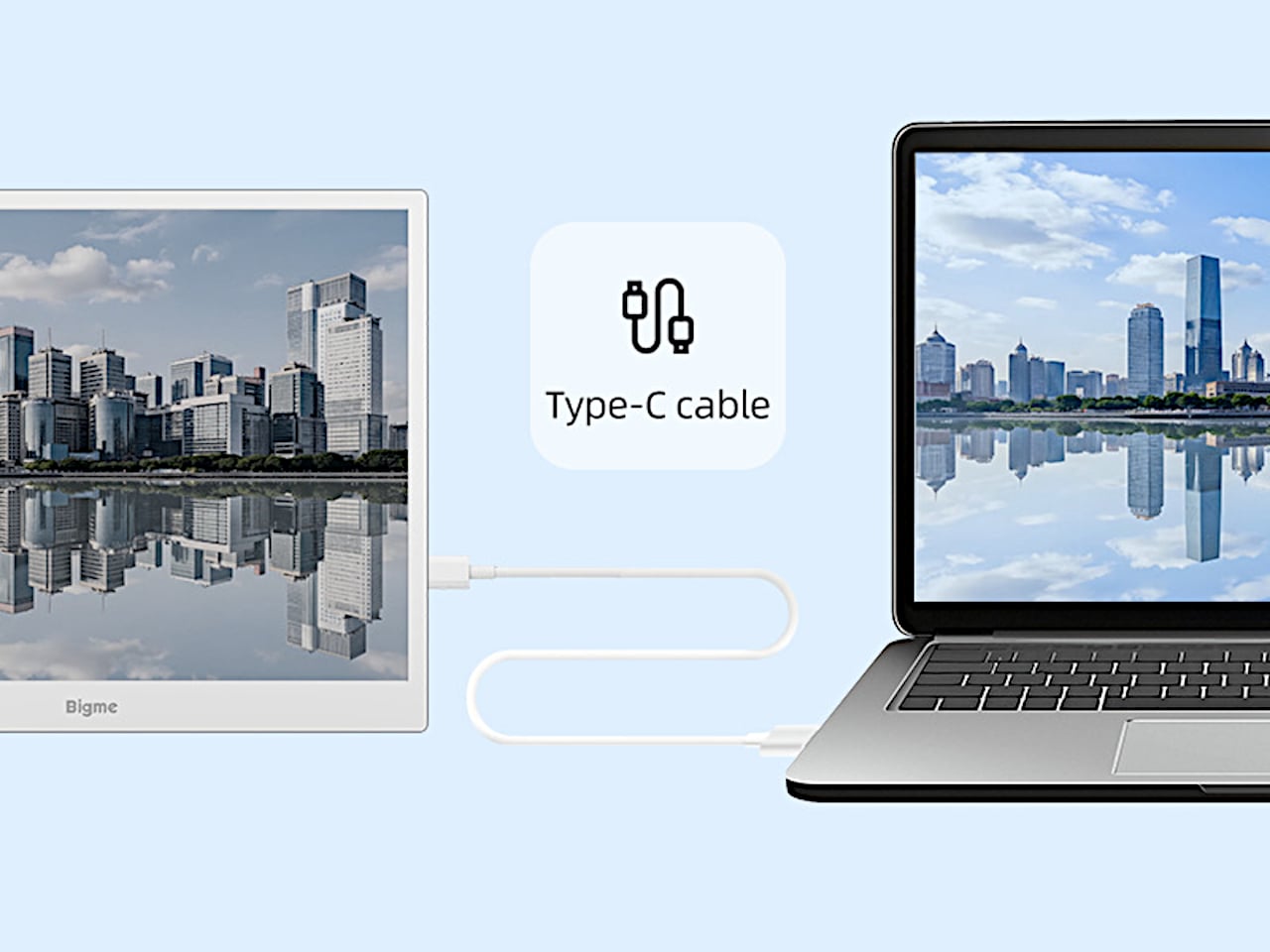
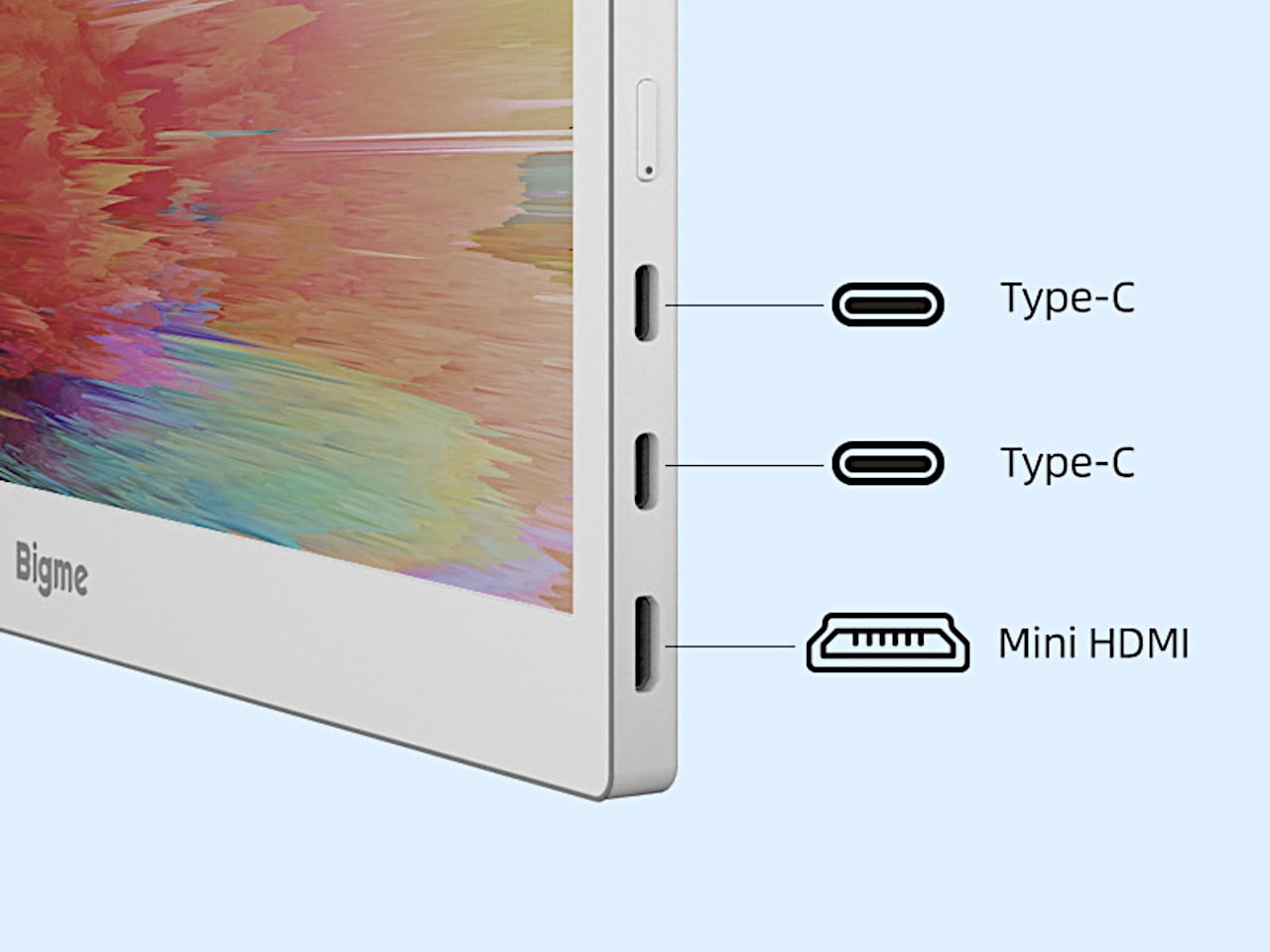
Getting that extra workspace doesn’t have to mean spreading adapters across the desk. A compatible USB-C connection carries both video and power through one cable, although the source device must support both functions. Two USB-C ports and Mini HDMI provide wired options, while wireless casting offers another route.
Of course, Bigme’s claimed jump from 30 to 60 FPS is the attention-grabber. If that translates into cleaner scrolling and cursor movement, it could make the display less awkward for everyday computer use. That doesn’t make it a gaming monitor, however. Without independent response-time or ghosting measurements, treating it like a conventional 60Hz monitor would be getting ahead of the evidence.
Color also comes with qualifications. Kaleido 3 supports 4,096 colors, with color density dropping to 150 pixels per inch. That’s useful for distinguishing lines on a chart or highlighting passages without reducing everything to gray, but don’t expect the richness of an LCD or OLED. Color-critical editing belongs on your regular screen; the e-paper panel makes more sense for keeping supporting material visible.
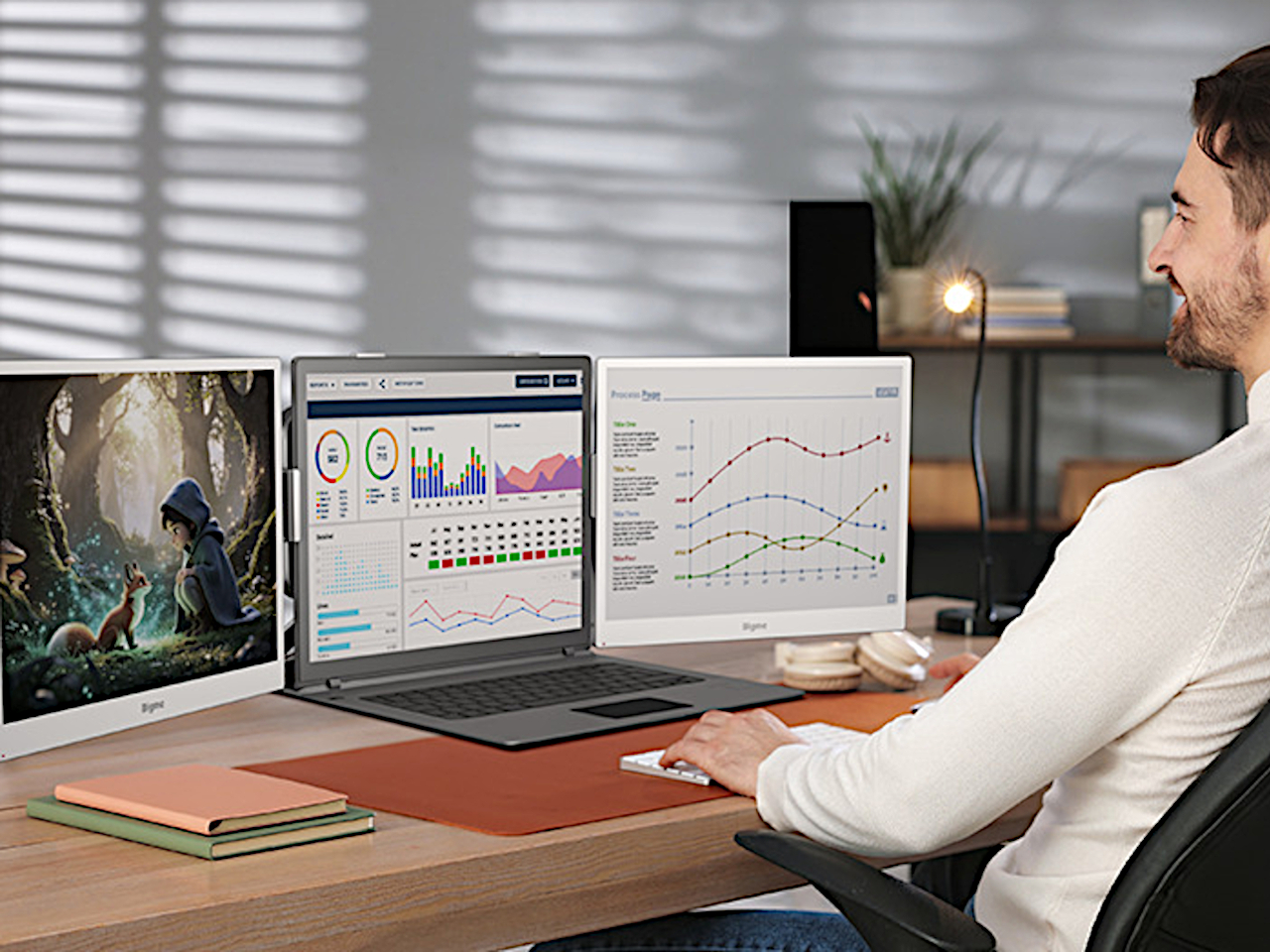
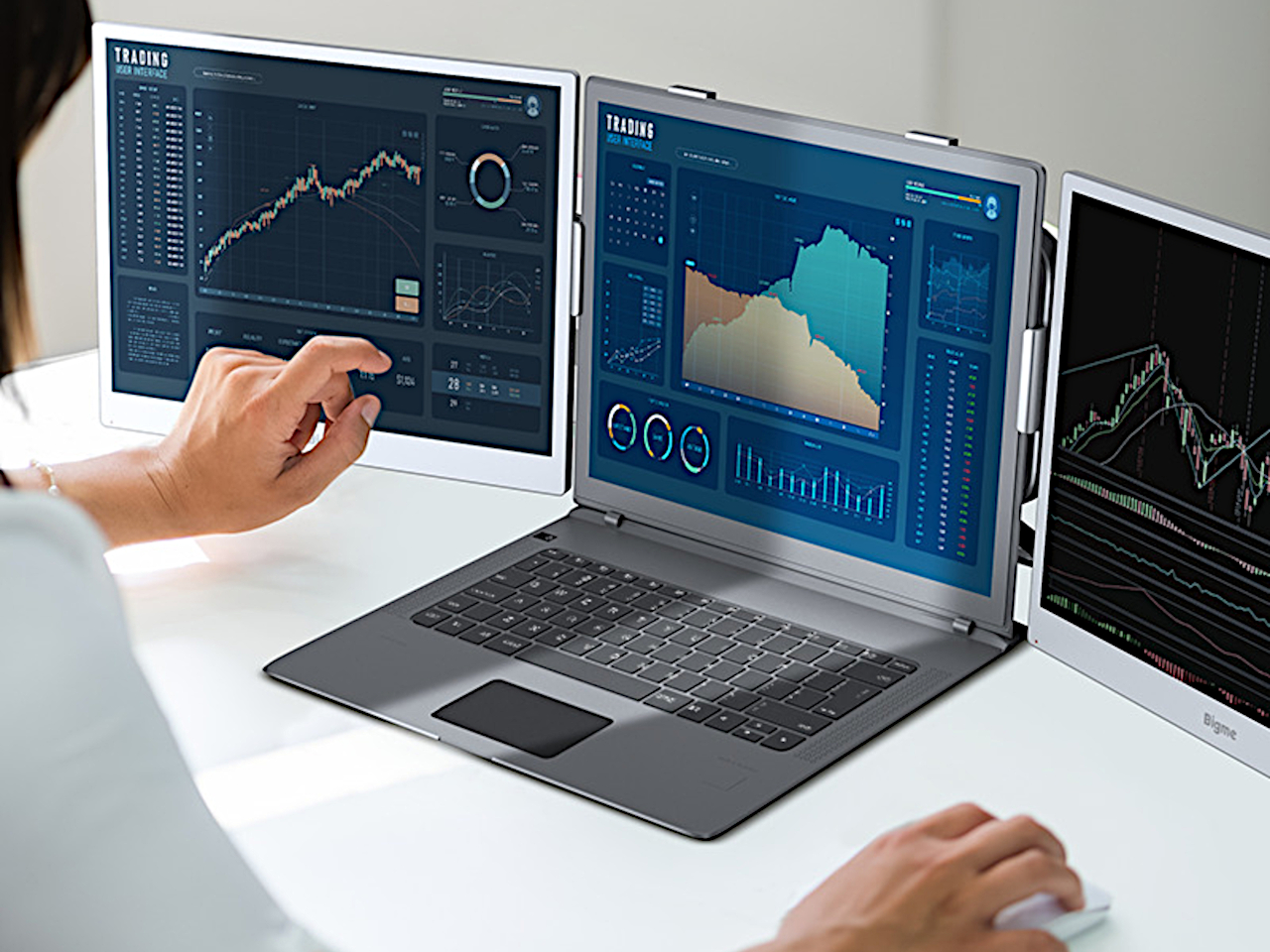
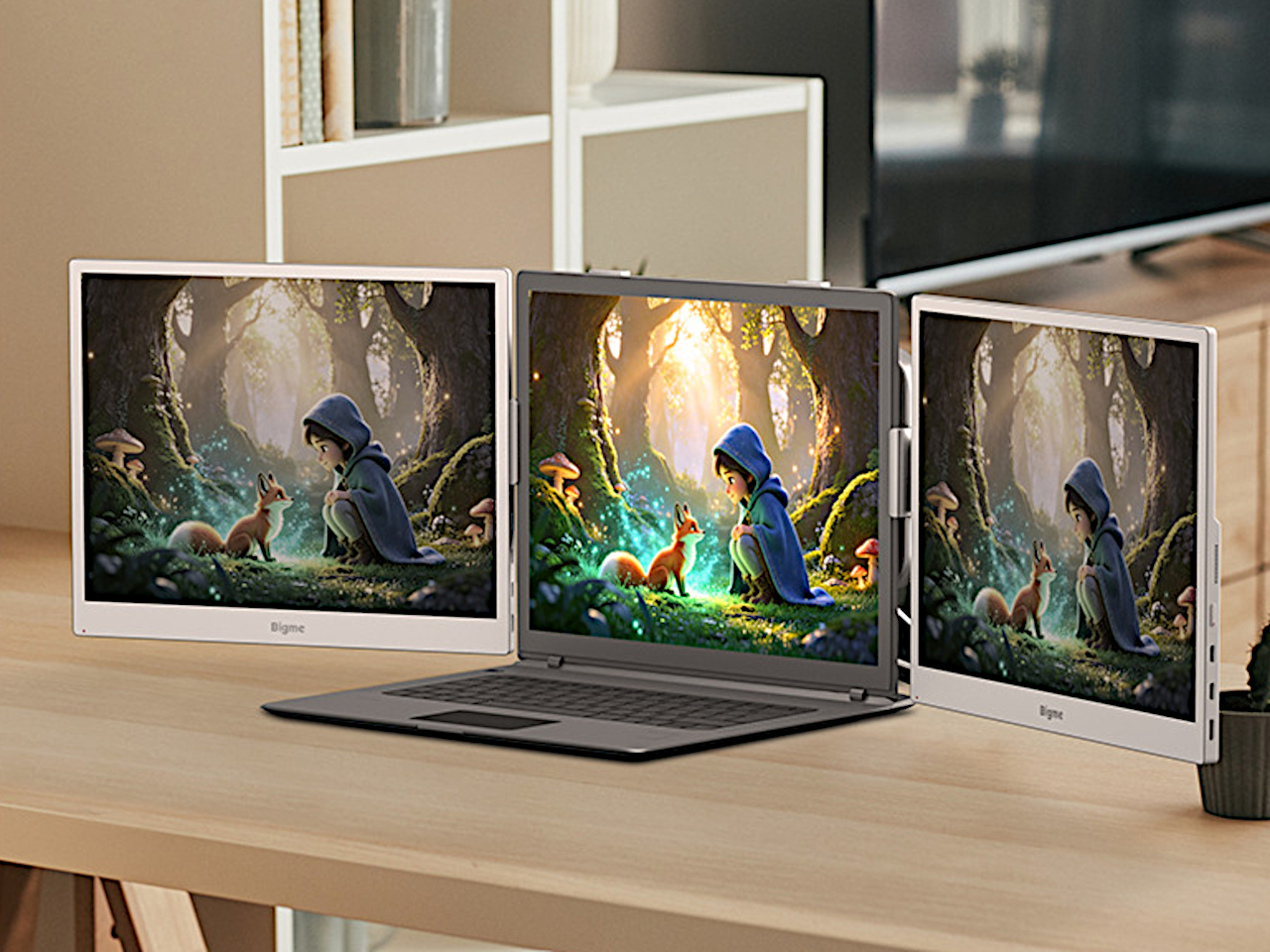
You can take that division further by putting a B13 Pro on either side of a laptop, leaving the central screen for work that needs conventional display behavior. That arrangement requires two monitors plus mounting hardware purchased separately, not a three-screen device unfolding from one box. It also doubles the added display weight, so the hardware holding everything together deserves some attention.
Bigme lists a $569 preorder price against a $749 regular price, but the product page doesn’t specify a firm shipping date. That’s a substantial investment for a 13.3-inch companion screen, especially if you’re planning a pair. The one-cable arrangement keeps the desk simpler, but the real decision is which tasks you want to move onto e-paper and which should stay on the laptop.
Elgato unveiled a little box of 15 LCD buttons in 2017, priced at $149.95, and it quietly rearranged how streamers sat at their desks. The Stream Deck got so popular that Corsair bought Elgato’s gaming business in 2018. Then the obvious question hung around for years: what if the buttons were just a screen? A screen can be any button, any dial, any chart, or any chat window, and it never runs out of room for one more shortcut. Anyone who has maxed out a 15-key pad knows that pain. Corsair eventually got around to answering.
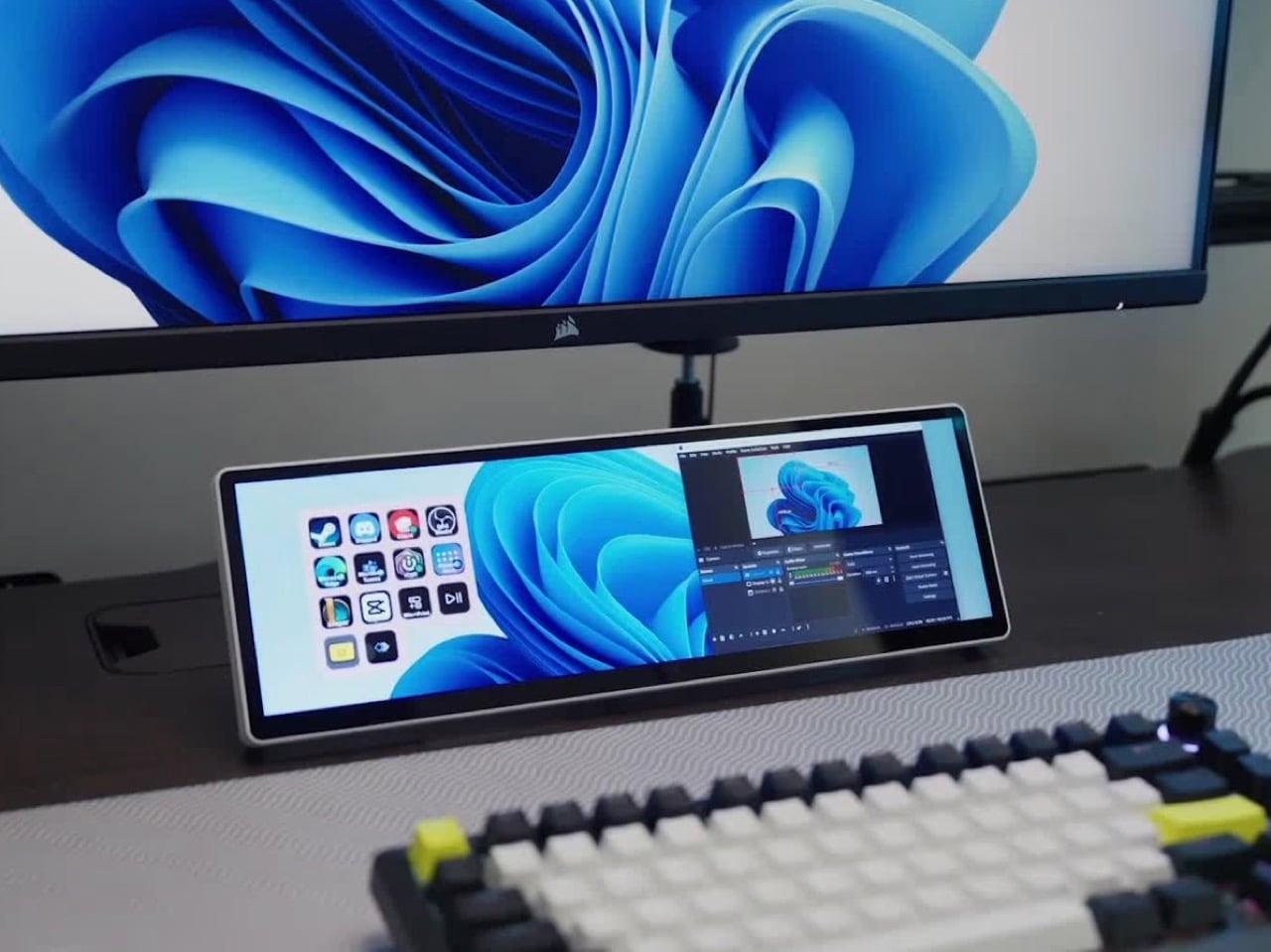
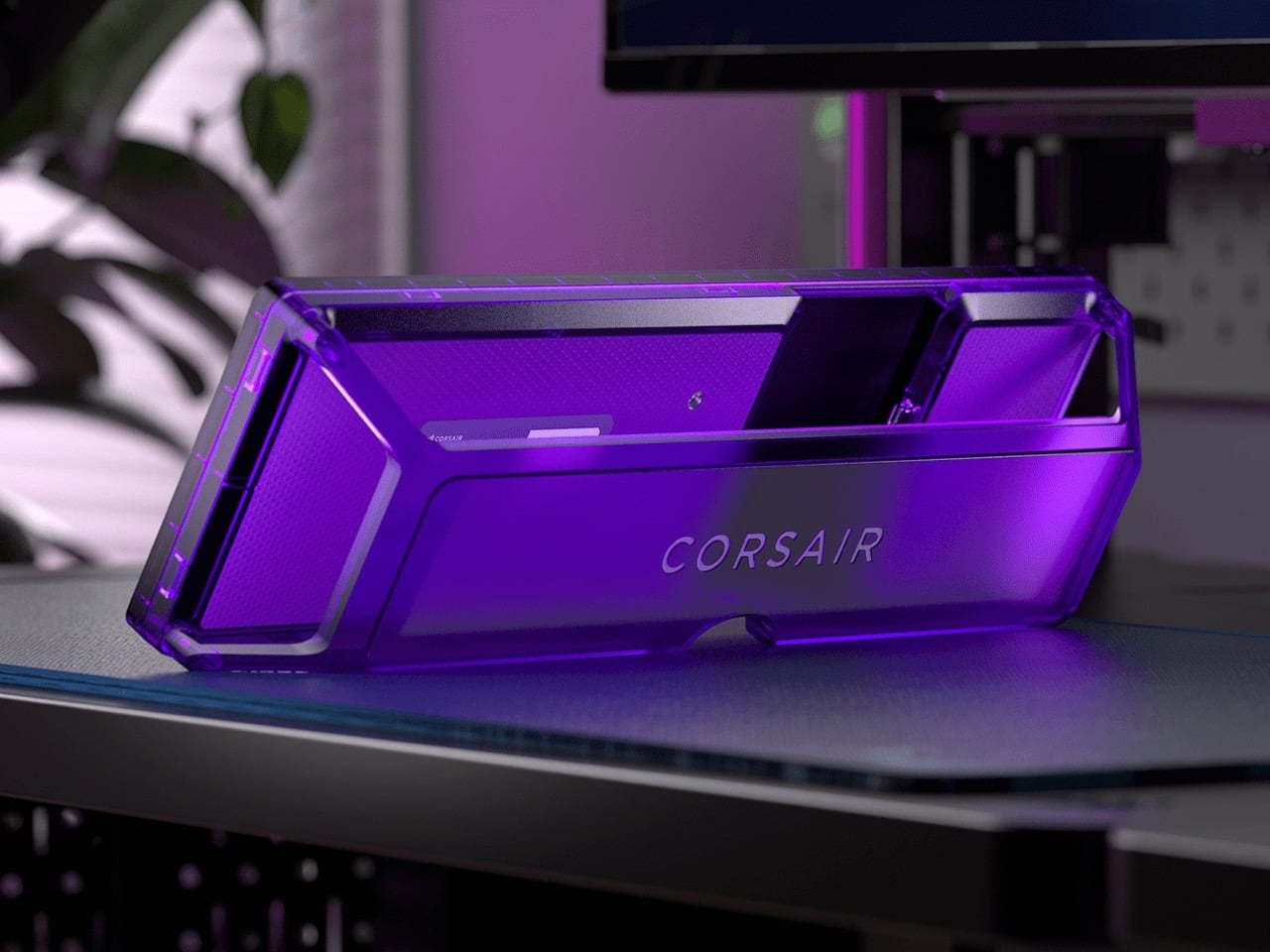
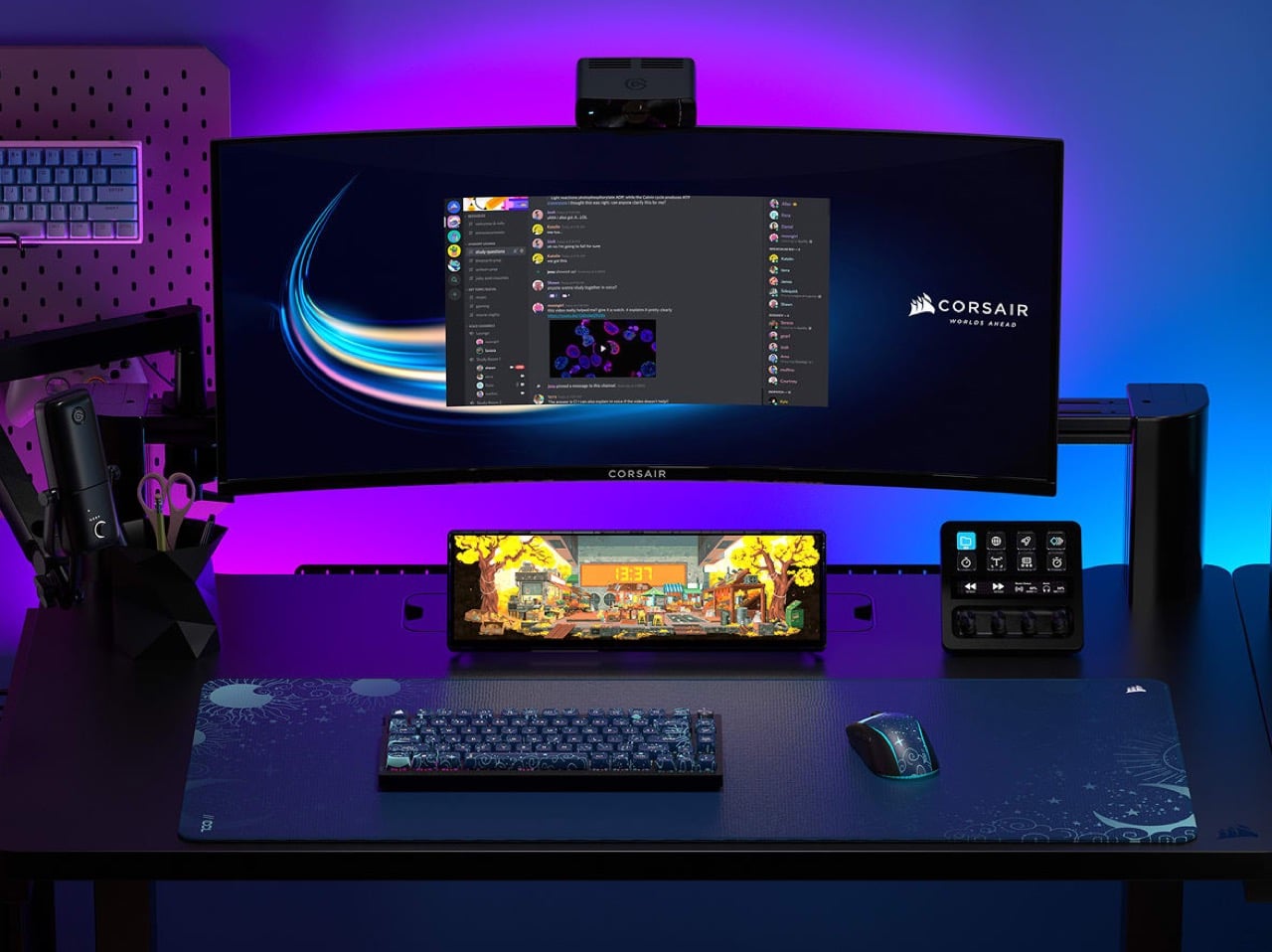
The answer is the Xeneon Edge, a 14.5-inch touchscreen with a 2560 x 720 panel and a 32:9 shape that sits under your main monitor like a very ambitious soundbar. It runs Elgato’s Stream Deck software, so your old button grid gets a much bigger canvas. Fourteen magnets, a detachable stand, and two ¼-20 threads let it live on a desk, a steel panel, or inside your PC case. It lists at $249.99 and is currently $199.99 at Corsair in the US, in all five colors.
Designer: Corsair
A 32:9 strip built for the stuff you only glance at
Think of 32:9 as two 16:9 monitors glued side by side, then shrunk until they fit beneath your main screen. The body measures about 14.6 by 4.7 by 0.8 inches (372 x 120 x 20mm) and weighs roughly 2.2 pounds (1 kg). That works out to about 183 pixels per inch, tighter than the 163 you get on a 27-inch 4K monitor, so small text stays crisp. At 720 pixels tall, the screen is shallow enough to tuck under a monitor without crowding your view. It also rotates to portrait, which turns it into a tall column beside your main display.
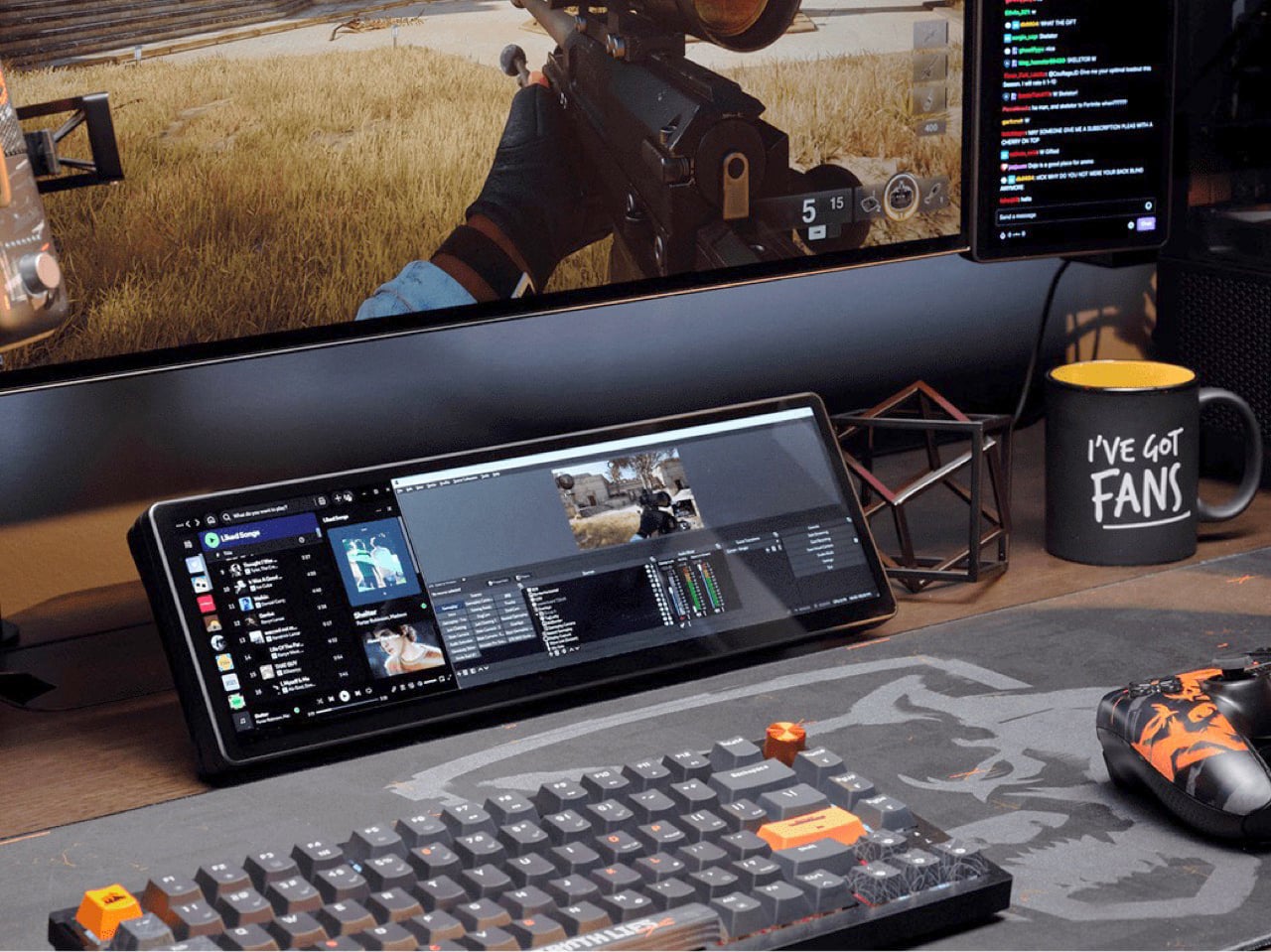
On a typical Tuesday, Spotify, Discord, a calendar, and your GPU temps all want a window, and your main screen is busy with actual work. Park them on the Edge and they stay put, one glance away, while you do your thing above. Video calls can live there too, so a meeting you only half-care about stays visible without eating your spreadsheet. Nothing needs alt-tabbing, and nothing gets lost behind a browser with 40 tabs. It’s the same idea as a phone propped next to your keyboard, except it’s wider, brighter, and plugged into your PC.
Fourteen magnets, two threads, and a 360mm radiator slot
Fourteen magnets sit under the plastic shell, so the Edge sticks to any steel surface without scratching it. That includes a steel desk, a PC side panel, a monitor stand, and yes, a fridge, if the cable is long enough. Inside a case, it takes the place of a 360mm radiator, a slot built for three 120mm fans, and it’s thinner than a regular case fan, so clearance is rarely an issue. Corsair also sells an LCD kit that mounts it into the side panel of the Frame 4000D and 5000D cases. Your build’s best view just got a clock and a temperature gauge.
Two ¼-20 threads on the back, the same screw size camera gear uses, let you hang the Edge from Elgato Multi-Mount hardware or any standard AV arm. That mount-anywhere thinking echoes the Elgato accessory support on Corsair’s Platform:6 desk, which we covered at its Gamescom reveal. Corsair also posts free 3D-printable accessories on Printables, including a taller stand that raises the screen behind a keyboard. The community has jumped in too, and Corsair has spotlighted a modular adapter mount from a creator named Naaackers. If you can think of a place for a screen, someone has either printed a bracket for it or soon will.
Widgets in iCUE and the Elgato Marketplace
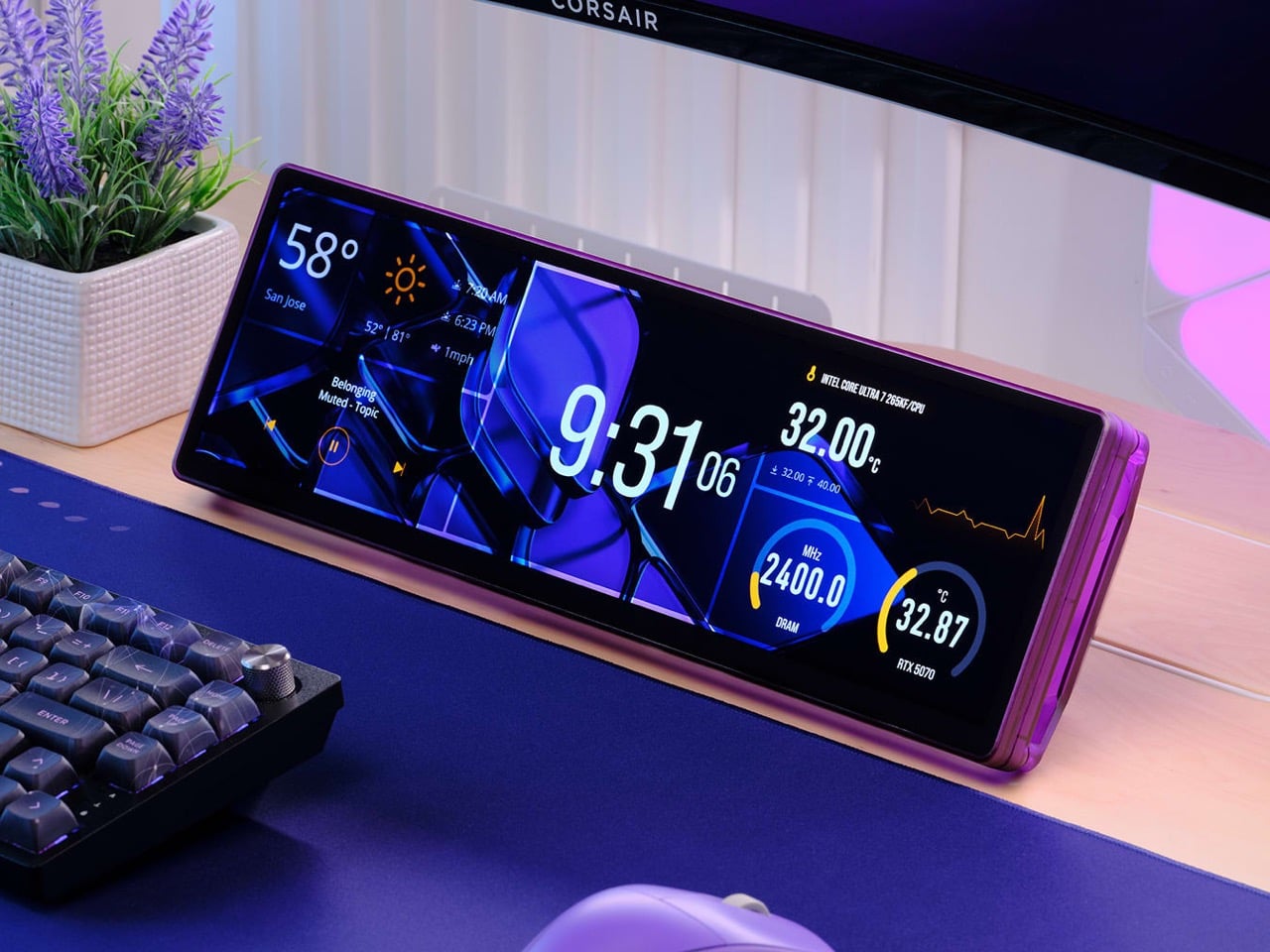
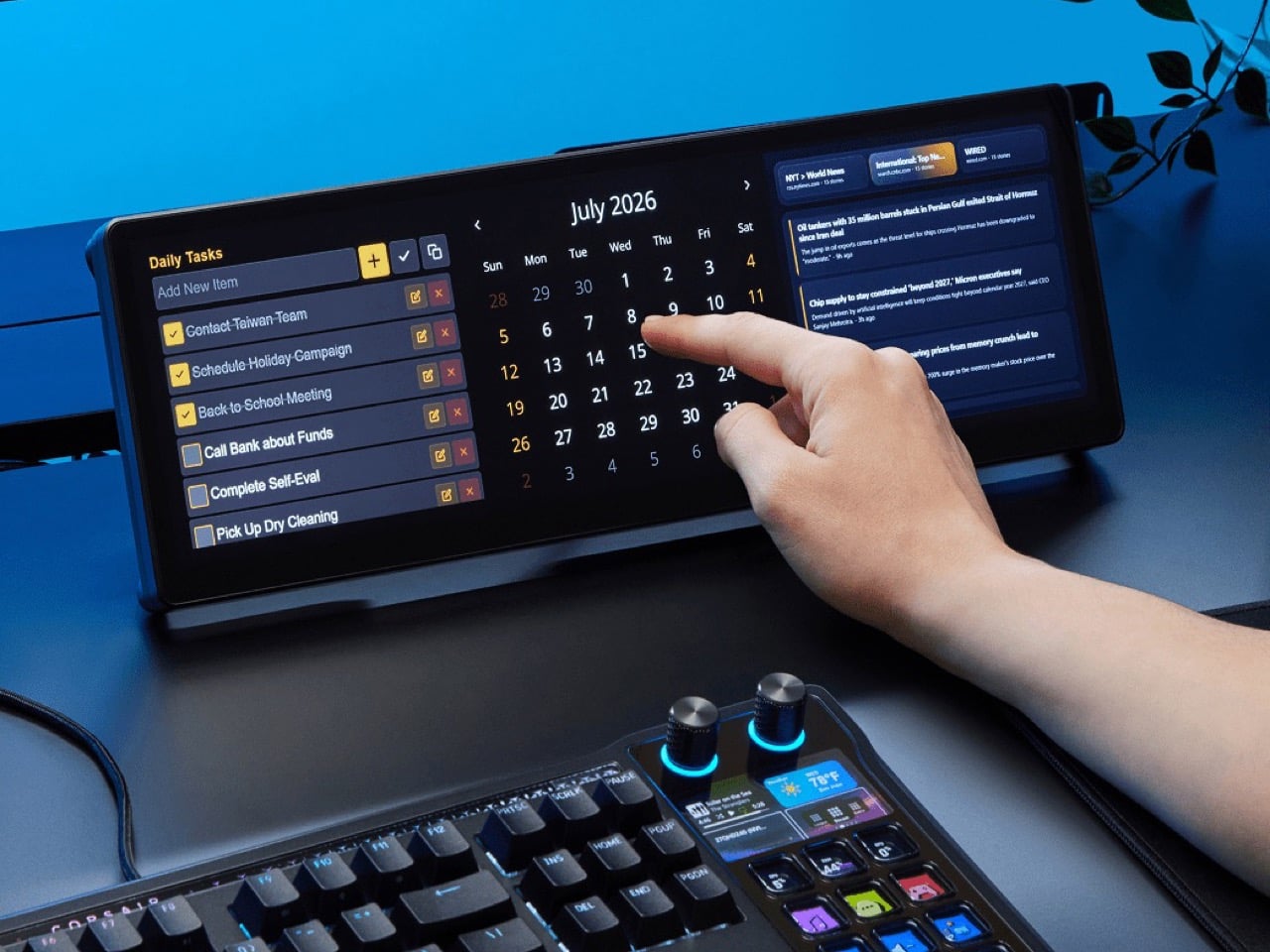
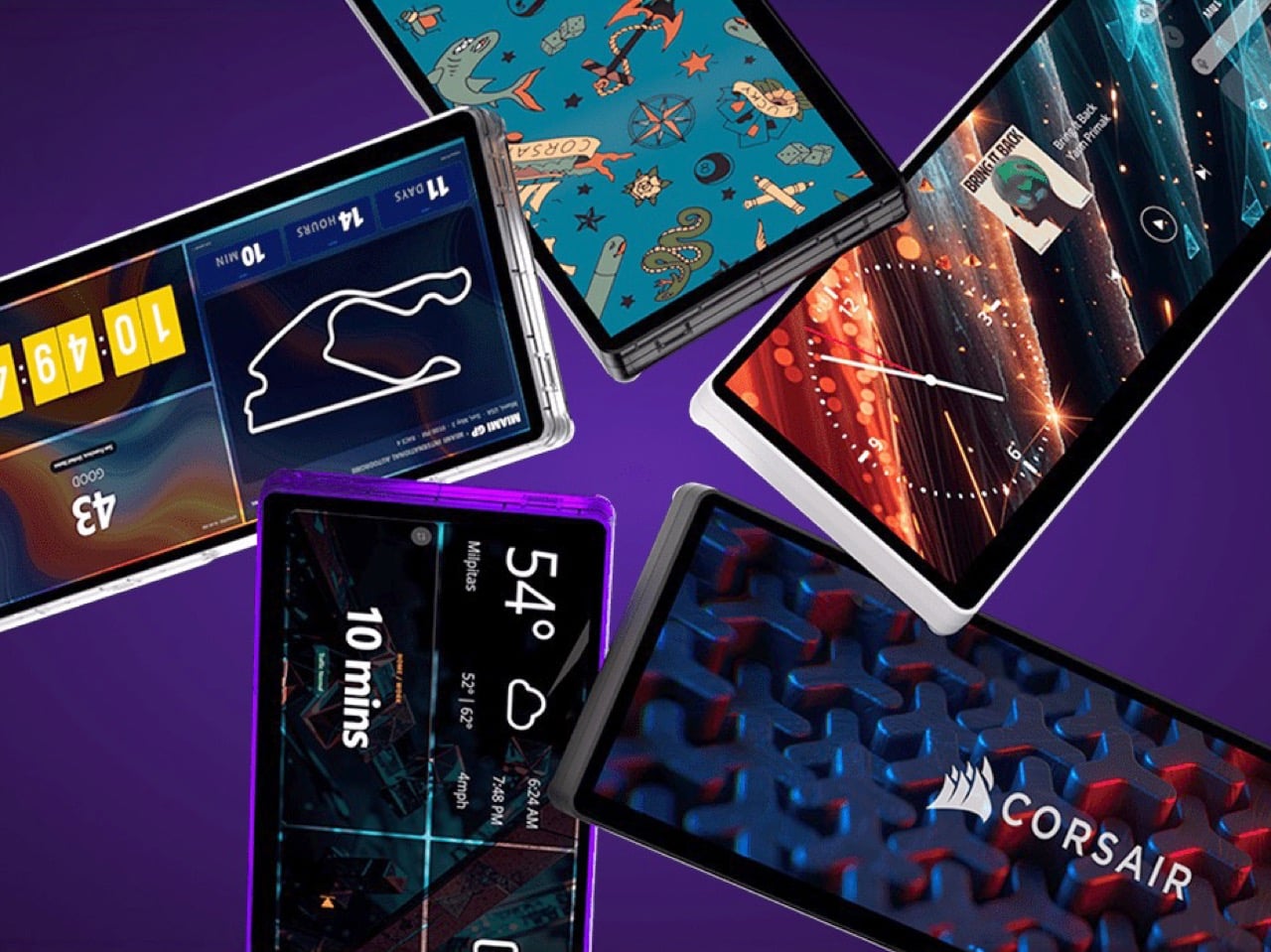
Plug it in and Windows treats the Edge as an ordinary second monitor, touch included. Corsair’s iCUE software for Windows adds widgets on top: a clock, a calendar, weather, news headlines, a task list, and system sensors showing CPU and GPU temps. Each widget lands on a grid you arrange yourself, so your layout can look as busy or as clean as you like. Since May 2026, widgets live on the Elgato Marketplace, where anyone can download or build one. Corsair’s developer docs even point to AI coding tools as a shortcut, which means a custom widget can start as a plain-English wish.
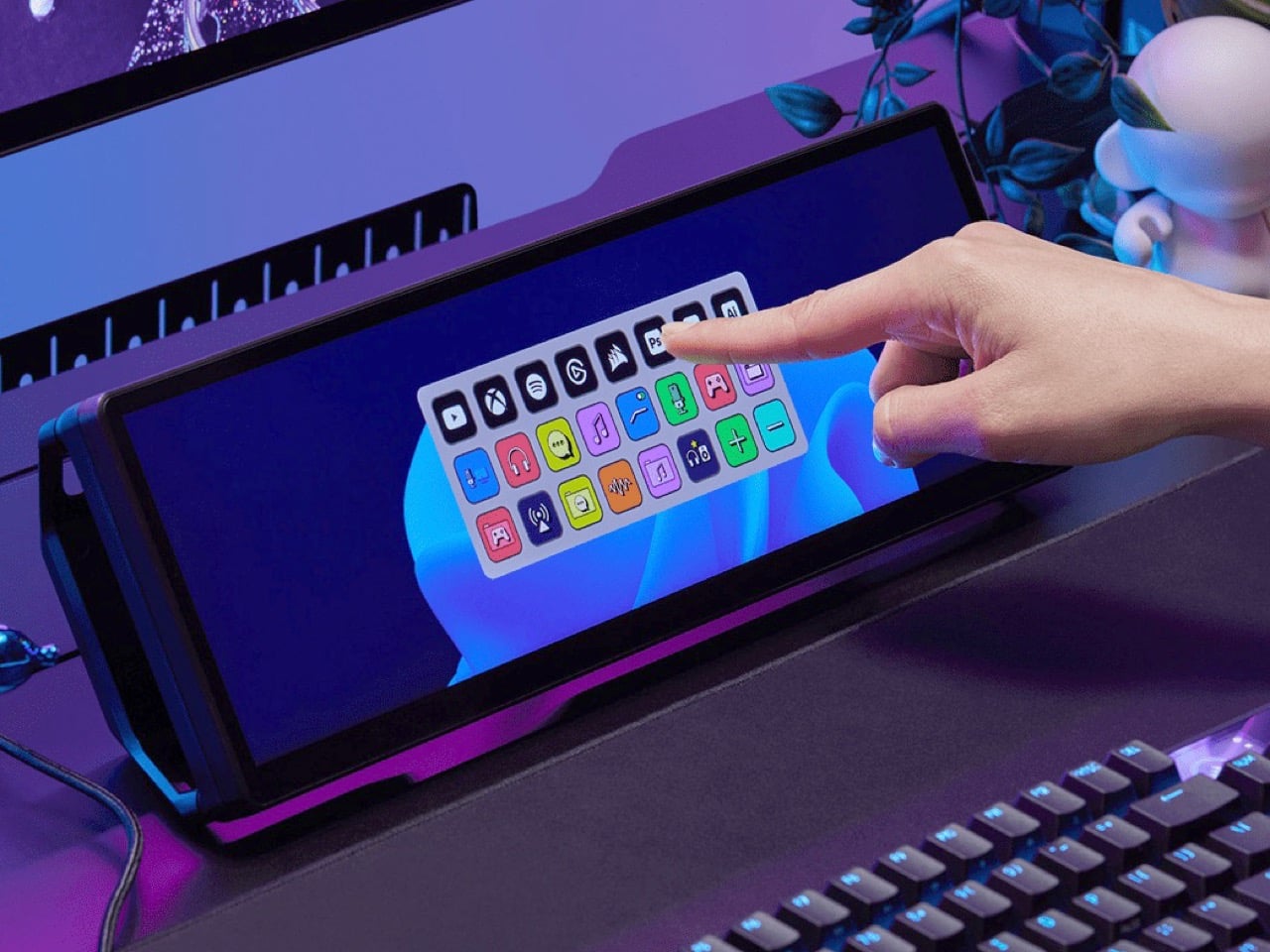
The widget that matters most for old Stream Deck fans is the native Stream Deck widget in iCUE. It drops a full grid of tappable keys onto the Edge, and you add actions in Elgato’s Stream Deck software exactly as you would for a physical deck. Resize the grid and you get more keys than any 15-button pad ever offered. Launch a game, mute your mic, switch an OBS scene, or toggle your desk lights, each with one tap. Because the screen is still a screen, the same strip can show your calendar or GPU temps right next to the keys.
A bright 2560 x 720 panel and touch that behaves like a phone
The panel is AHVA, Corsair’s version of IPS, so colors and viewing angles hold up even when you’re looking at it from the side. It runs 2560 x 720 at 60Hz with 350 nits of peak brightness, plenty for a desk lit by a window and a lamp. Touch is 5-point capacitive, the same technology as your phone, so tapping, swiping, and pinching all feel familiar. A single USB-C cable with DP Alt Mode (video over USB-C) can carry picture and power when your PC supports it. HDMI 2.0 covers everything else, and Corsair includes cables for both in the box.
Not every shell is black, either. Colors include black, white, and the translucent Atomic Purple, Crystal, and Smoke, which channel the see-through plastic of late-90s gadgets. We’ve seen that look return in a fully transparent Game Boy Color mod and Analogue’s Game Boy Color-inspired Pocket, and it suits a desk accessory just as well. Translucent plastic also makes the stand look like part of the design, not an afterthought. Pick whichever matches your keyboard, or your mood, or your last impulse buy.
Price, rivals, and where the Edge fits on your desk
The Xeneon Edge lists at $249.99 and is currently $199.99 at Corsair in the US, across all five colors, with a three-year warranty and a zero-dead-pixel guarantee. For comparison, Elgato’s 15-key Stream Deck MK.2 lists at $149.99, and the 32-key Stream Deck XL lists at $249.99. The Edge costs the same as the XL and brings an actual display to the party. ASUS makes the closest rival, the ProArt PA147CDV, a 14-inch 32:9 touchscreen with a physical dial and pen support, but it runs a lower 1920 x 550 resolution and sells for roughly twice the Edge’s list price. Cheap no-name touchscreens exist too, but most skip the magnets, the threads, and the Stream Deck tie-in.
The Stream Deck taught desks that a small control room beside the keyboard beats hunting through menus. The Edge keeps that lesson and swaps the plastic keys for pixels that can become anything. It mounts where you want it, shows what you need, and gets better as the widget library grows. It’s available now at Corsair’s site for $199.99 in the US while the current sale runs, with $249.99 as the regular price. Fifteen buttons were a good start. A 14.5-inch strip of pixels is a much better sequel.
Desks are overrated. So are the cables that come with them. The 4URPC is a 15.6-inch wireless touchscreen monitor built for people who’d rather not be chained to an outlet just to get a bigger screen. It’s slim, self-powered, and ready to mirror whatever’s on your phone, tablet, or laptop the moment you need more room to work, watch, or play.
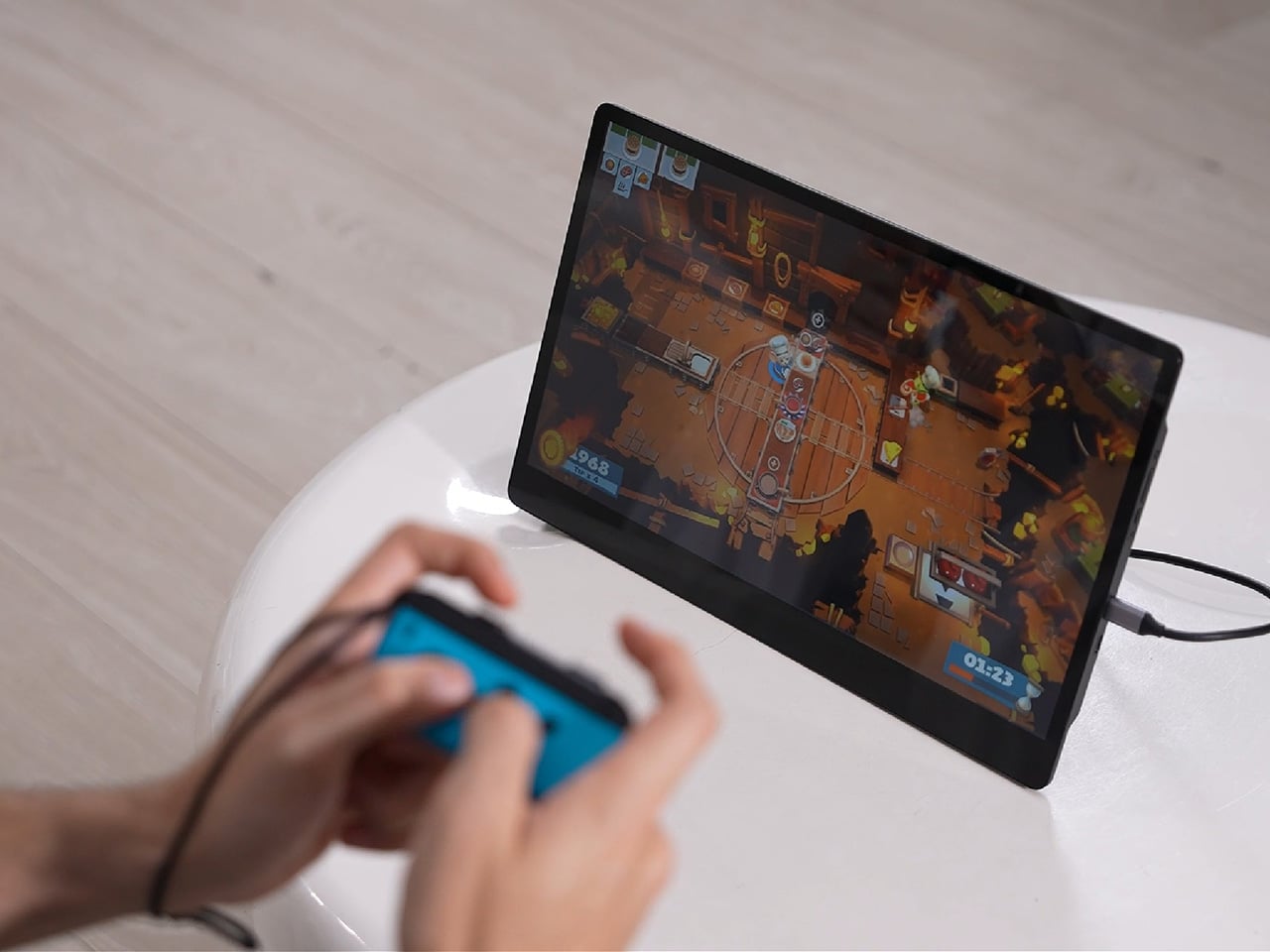
Cutting the cord doesn’t mean cutting functionality. The monitor mirrors an iPhone or Android device through a peer-to-peer wireless connection, no home Wi-Fi or app required. For streaming platforms like YouTube, Netflix, or Hulu, connecting to Wi-Fi and tapping the built-in TV Cast icon sends video to the screen. Either way, there’s no dongle to lose or cable to untangle before the movie starts.
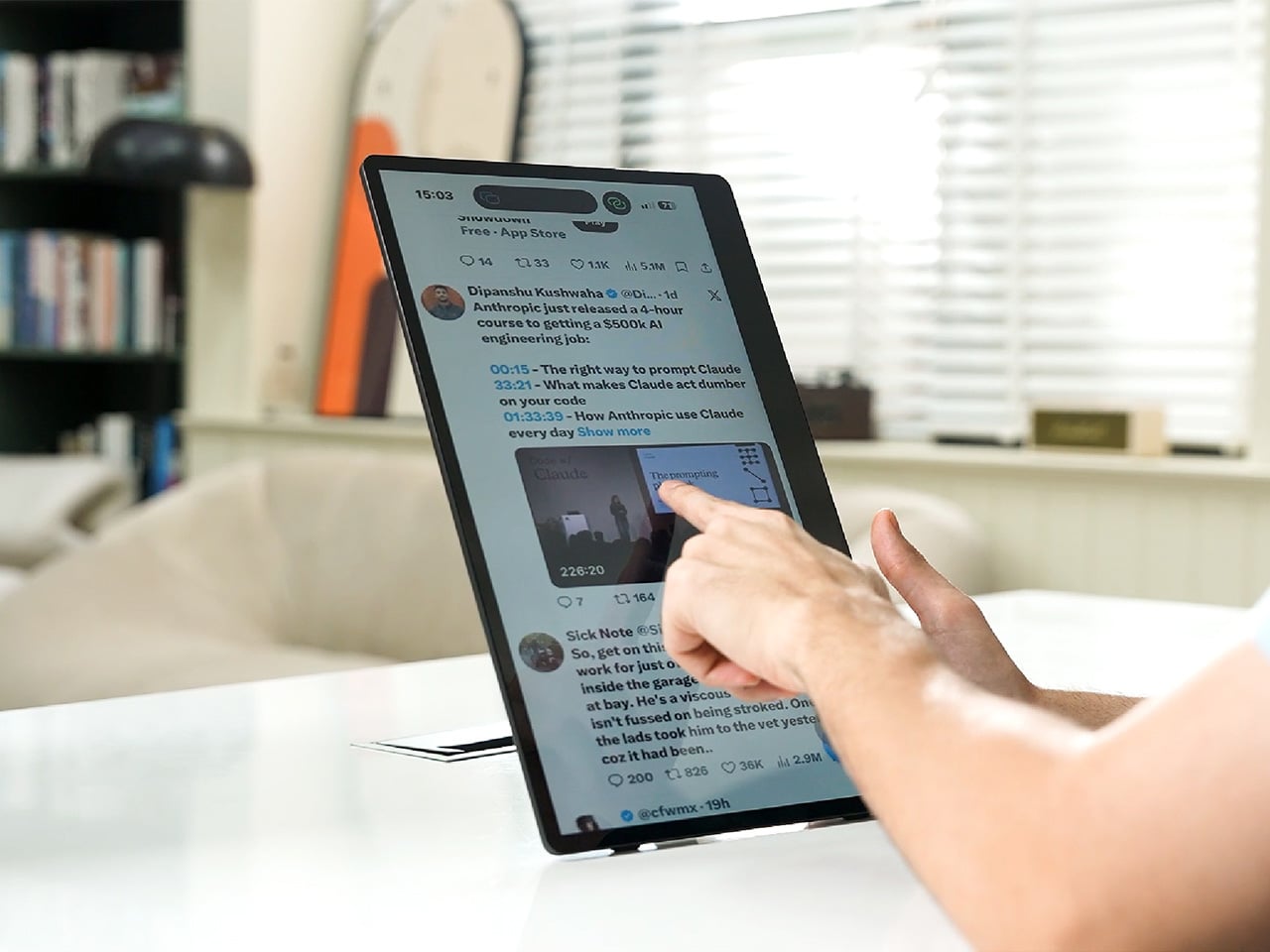
The more interesting trick happens after mirroring starts. The 10-point touchscreen can send input back to the connected phone, turning the monitor into a larger, shared control surface. Flip through photos with a friend, walk a colleague through a presentation, or hand someone the reins without handing over your phone. It’s a shift that makes shared screen time less awkward.
None of this would matter much if the monitor were bulky. At half an inch thick and just over 2 pounds, it’s built to disappear into a backpack rather than dominate it. The matte, textured shell keeps fingerprints and glare to a minimum, and a fold-out kickstand on the back means setup takes seconds on a desk, a kitchen counter, or the arm of a couch.
A built-in 4,000 mAh battery backs up that portability by taking the wall outlet out of the equation. Setting up on a train, in a hotel room, or on a patio doesn’t mean scouting for the nearest plug first. That same battery can lend a charge to a connected phone, turning the monitor into a backup power bank when the moment calls for it.
Plug it into a laptop with a USB-C cable, and the 4URPC switches roles, becoming an extended display rather than a wireless mirror. Dragging a browser tab, a chat window, or a reference document onto the second screen takes a second, and the touchscreen works over the wired connection. The laptop stays focused on the main task while the extra display handles everything else.
The screen also rotates between landscape and portrait without any fuss, which sounds minor until it changes how you use it day to day. Landscape suits video calls, games, and spreadsheets, while portrait mode fits scrolling through documents, reading long articles, or checking social feeds. Switching between the two takes a twist of the stand, not a trip through a settings menu.
Compatibility runs wide enough that most people won’t need to think twice before connecting. Wireless mirroring covers iPhones, Android phones running version 10 or later, MacBooks, and most Windows laptops, while the wired USB-C or HDMI input works with game consoles, streaming boxes, and the Nintendo Switch. There’s no software to install and nothing to configure; connecting the device and turning it on is the entire setup process.
Under the glass sits a 1920×1080 matte IPS panel running at 60 Hz, built more for comfortable, glare-free sessions than eye-popping color numbers. Dual USB-C ports split power delivery and video duties, small stereo speakers cover casual audio, and a VESA mount plus a standard camera screw thread add mounting options beyond the built-in stand. It’s a practical set of choices rather than a flashy one.
There’s something telling about a monitor that assumes you won’t always be sitting at the same desk tomorrow. Work has scattered across kitchen tables, coffee shops, and airport gates for a while now, and screens are only starting to catch up. The 4URPC doesn’t try to be the sharpest or brightest display around; it just tries to be wherever you happen to land next.
Triple screen setups are widely considered the socially acceptable limit to a multi-screen setup. Take your laptop, add a screen to the left, one to the right, and you have a panoramic multi-display array for effortless multitasking. The reason 3 displays is widely considered the agreeable upper limit, is because a fourth display does two things. It makes your setup more linear, requiring you to strain your neck looking from left to right. It also means having a table that long to accommodate the many displays.
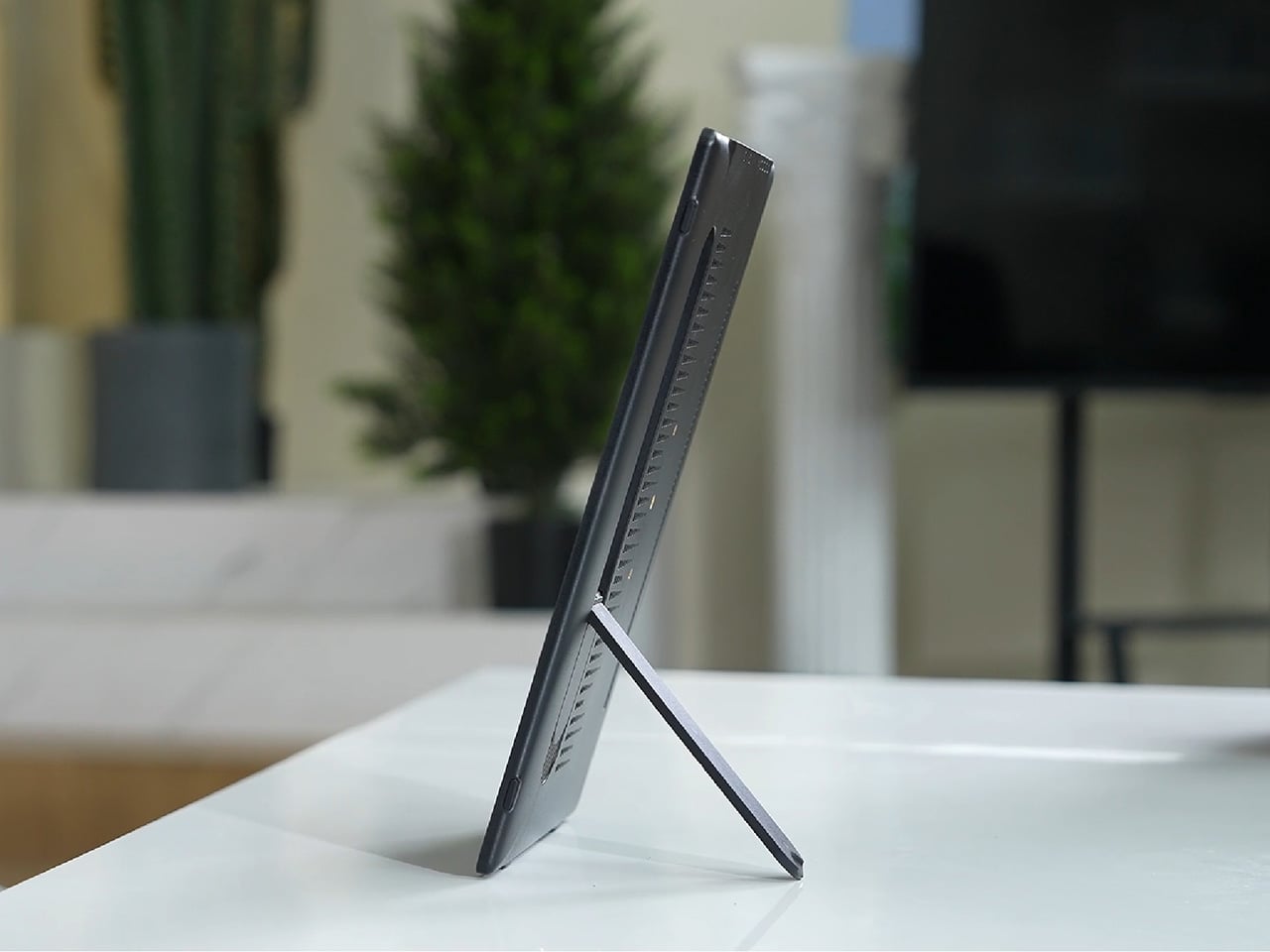
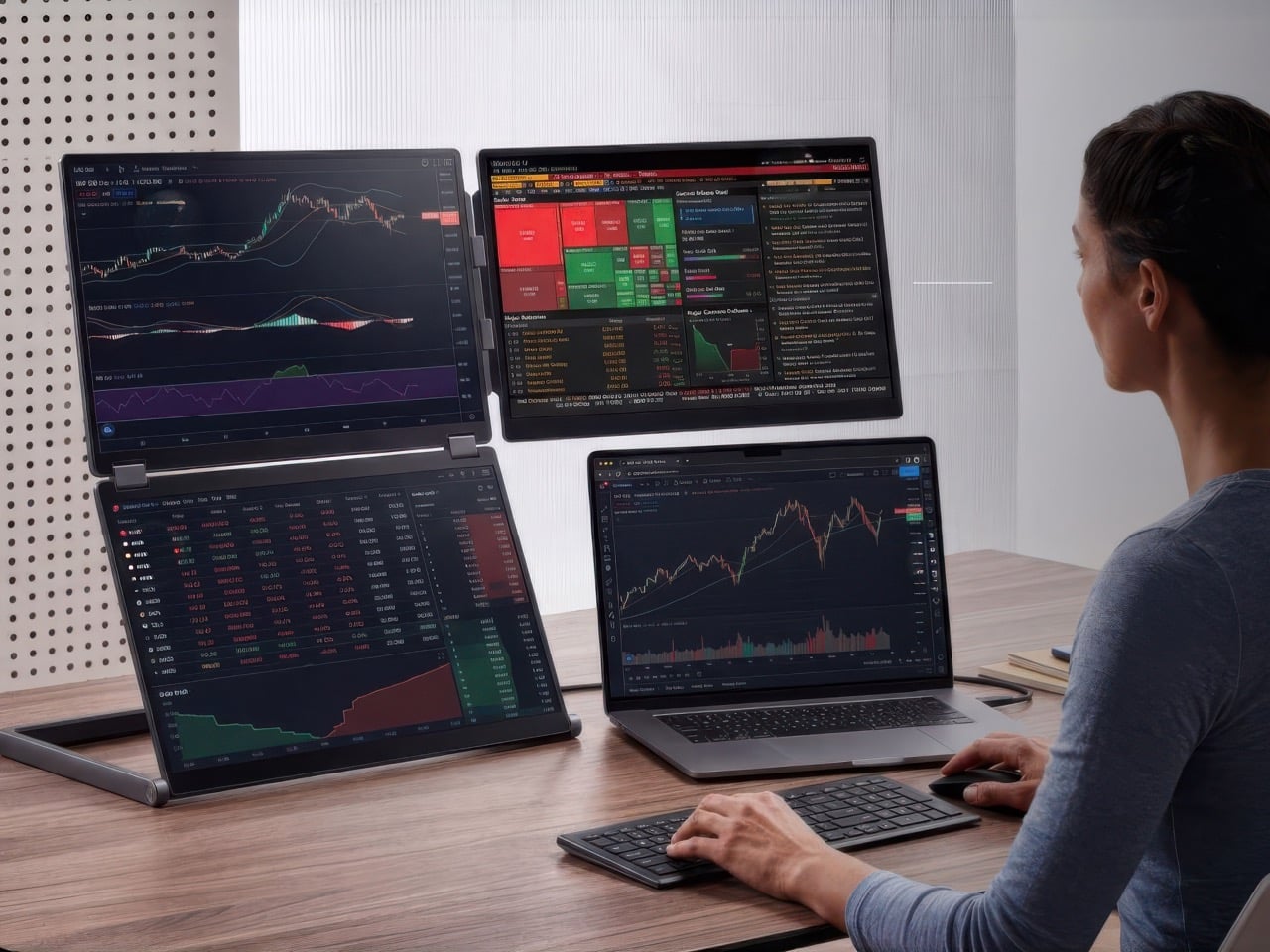
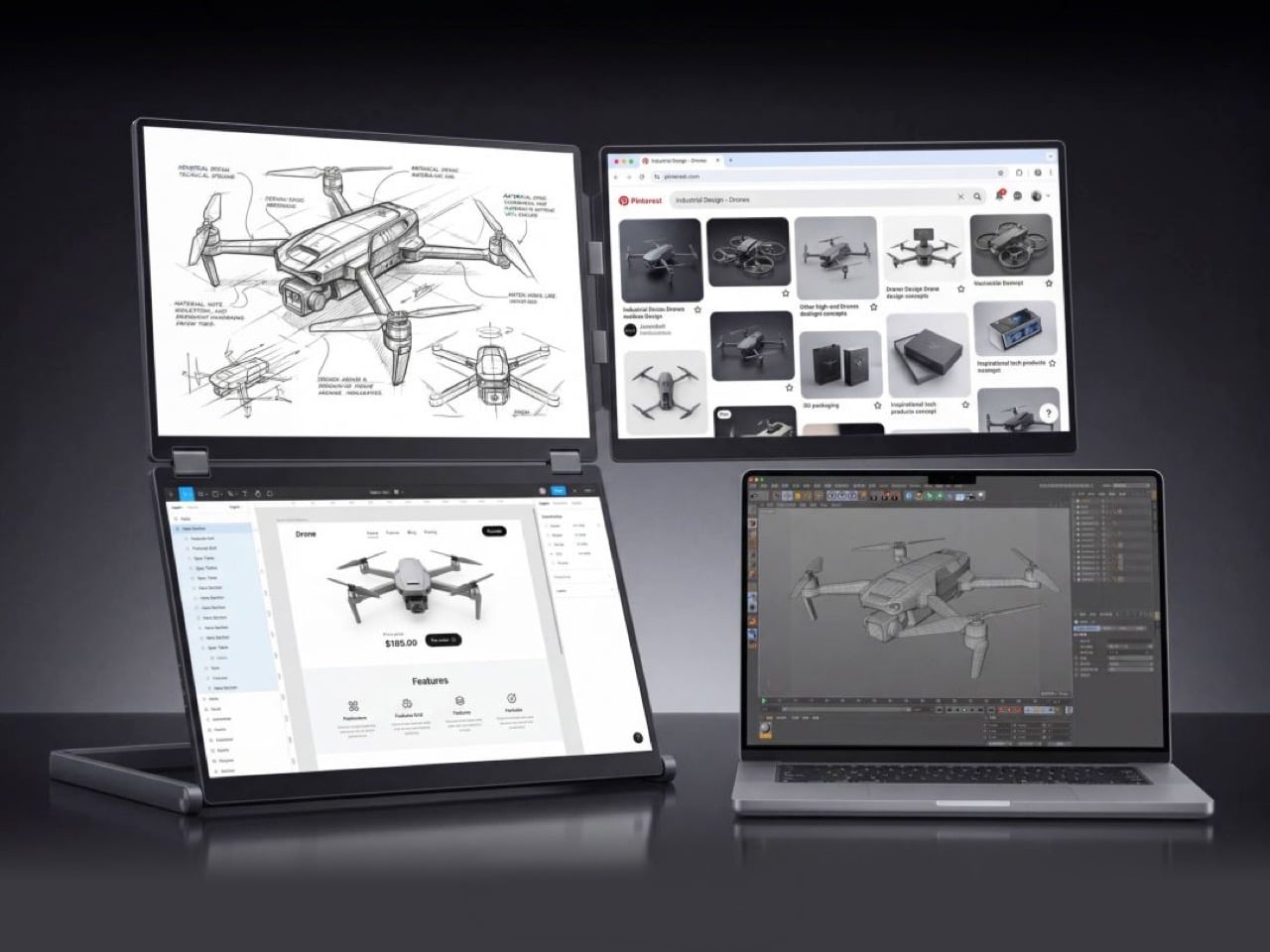
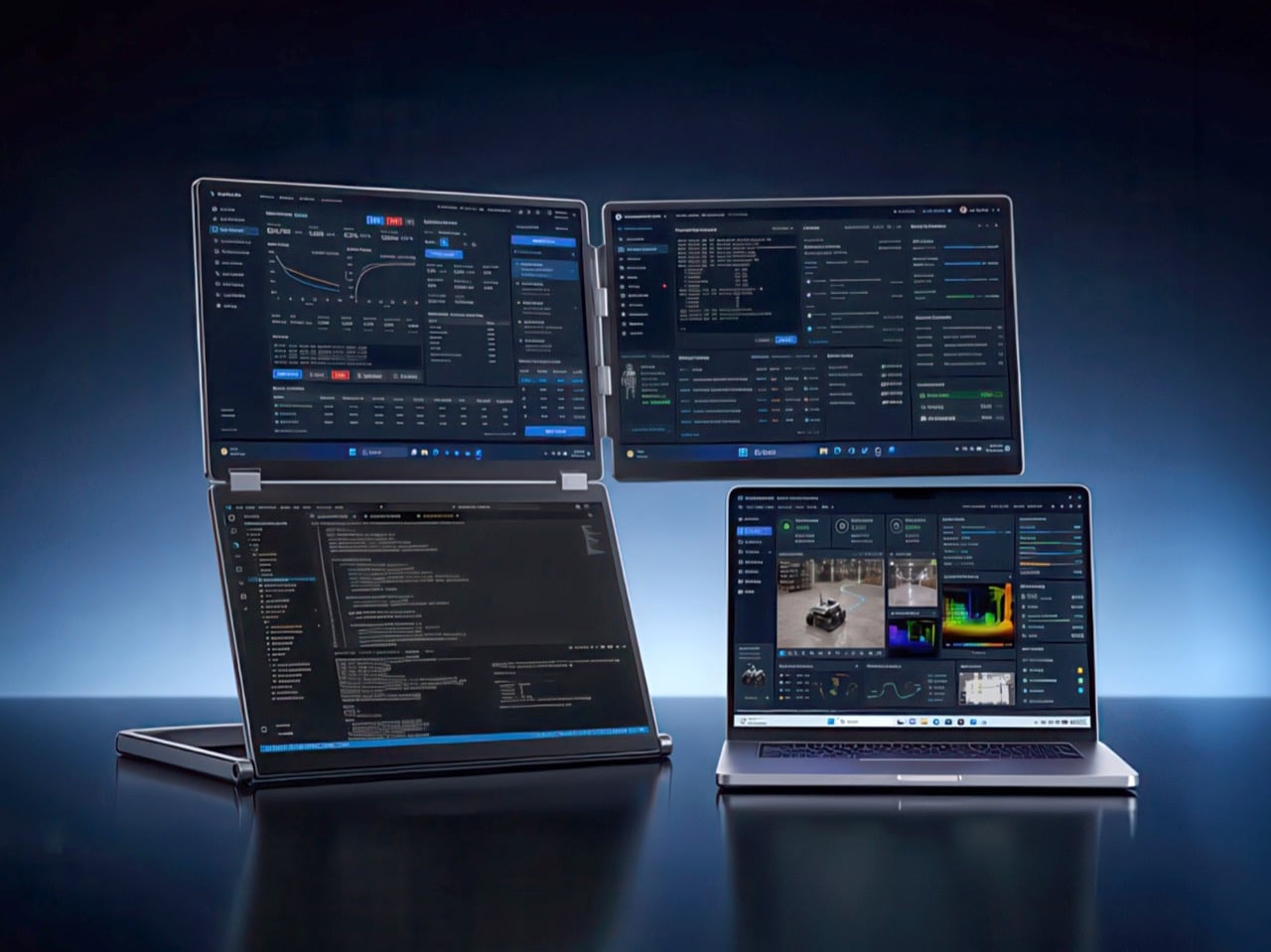
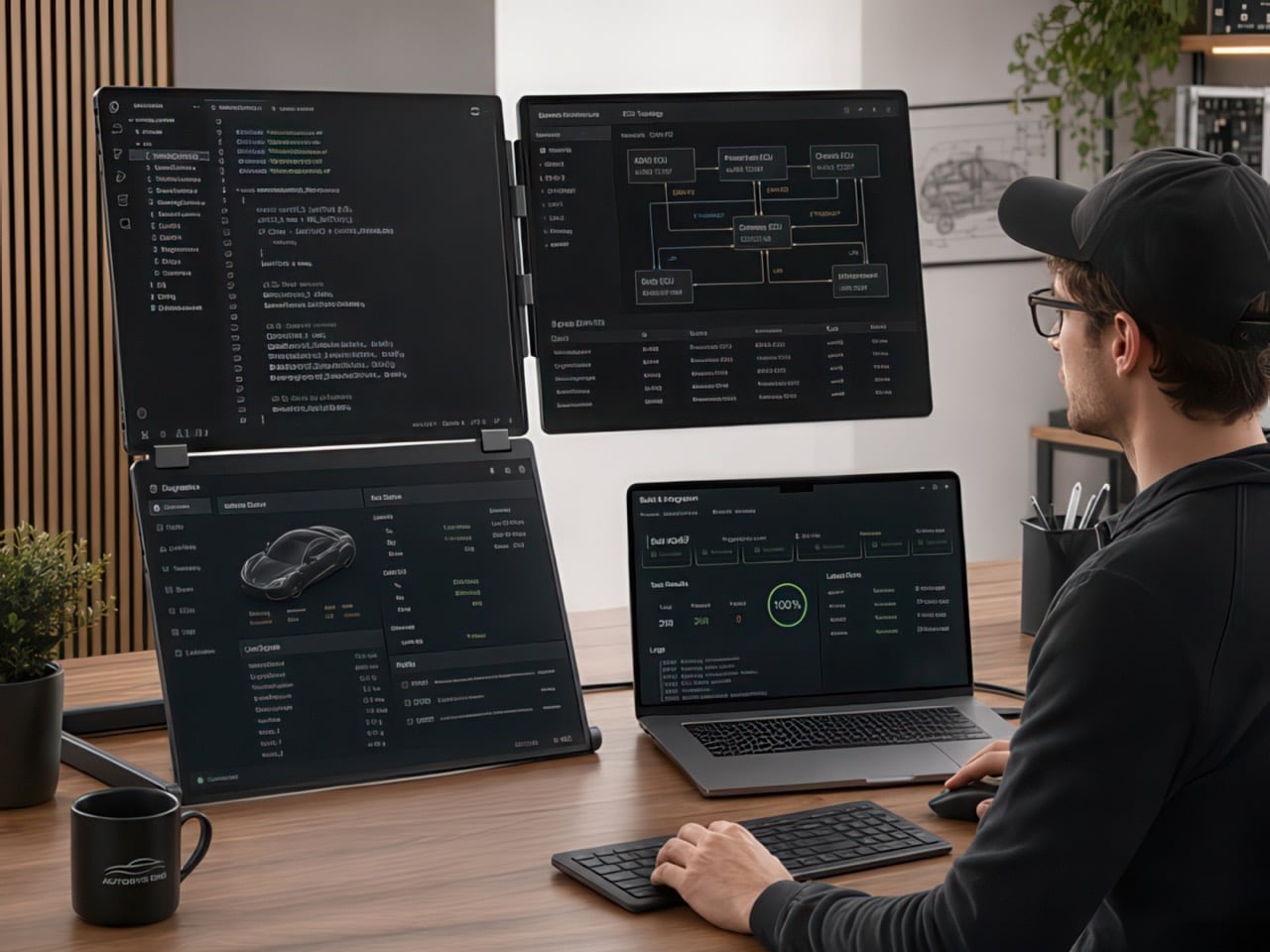
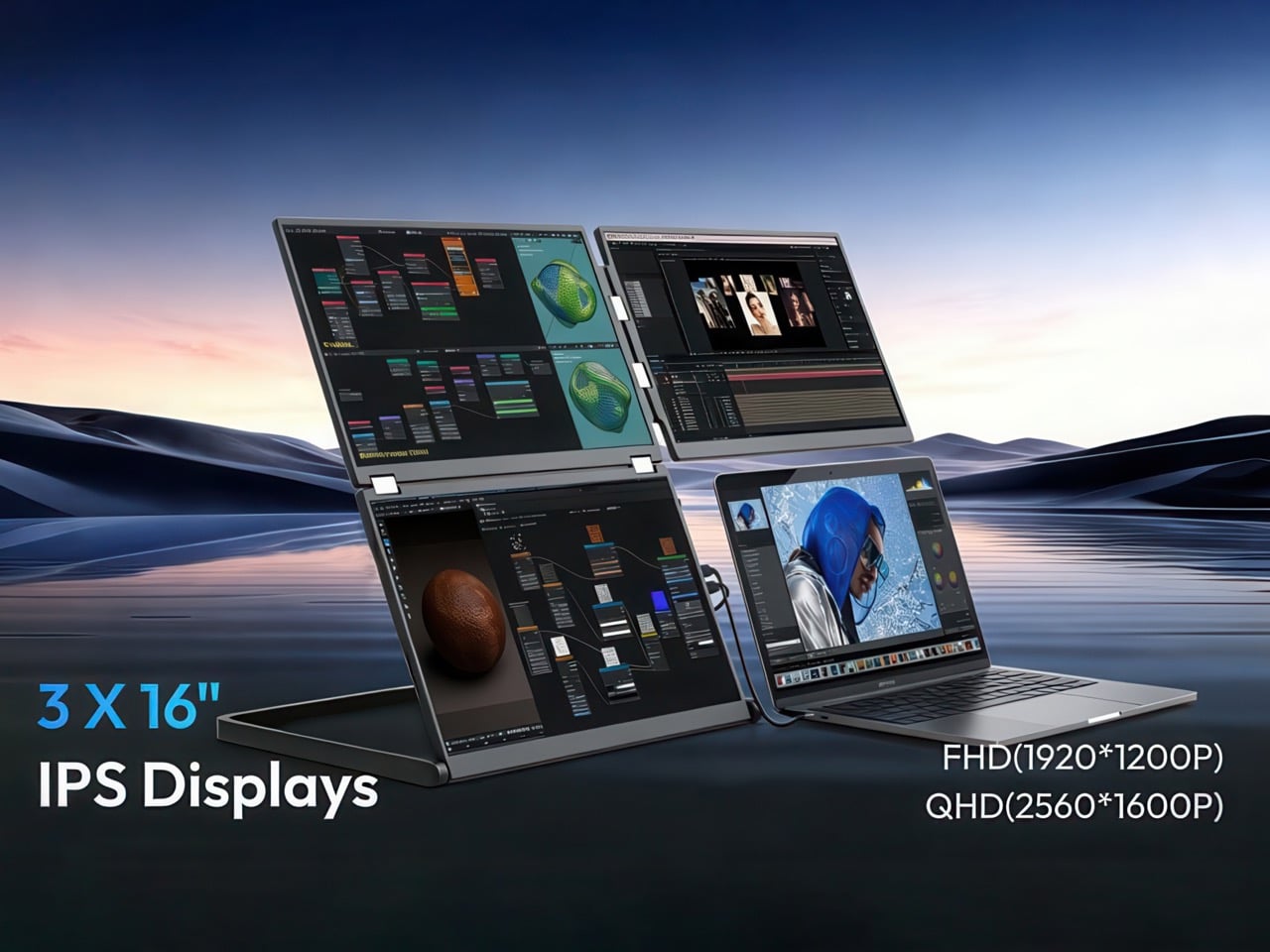
The obvious answer to people looking to push things to a quad-display setup is to go for a 2×2 layout. Yes, that works with a bit of planning. Mount some monitors on the wall, keep enough space to place your laptop somewhere, and you’re good to go. This system is maximalist, but until now it wasn’t portable. NexFold decided that needed to change, with the first ever inverted L-shaped triple-display external monitor, the Fold 7. As the previous sentence explains, this monitor array forms an inverted L, leaving a bottom quadrant empty for your laptop, giving you the 2×2 quad-display setup you crave. The best part, the Fold 7 collapses down to the shape and size of a 16″ laptop, and can be carried around with you.
The three panels that make up the Fold 7 each measure 16″ and use a 16:10 aspect ratio rather than the standard 16:9. That extra vertical height translates directly into more visible lines of code, longer documents without scrolling, and taller browser windows. All three screens use IPS panels with 100% sRGB coverage and viewing angles rated at 85° both vertically and horizontally. The layout arranges two screens vertically on the left side, stacked one above the other, while a single screen extends horizontally along the top right. Your laptop fills the fourth quadrant at the bottom right, staying within your natural line of sight while the auxiliary panels wrap around it.
NexFold offers two resolution options depending on how you work. The FHD version runs at 1920 x 1200 per panel and hits 300 nits of brightness, aimed at general productivity users, remote workers, and anyone who values sharpness and clarity for writing, browsing, video calls, and everyday multitasking. The QHD version steps up to 2560 x 1600 per panel with 500 nits of peak brightness, targeting developers, designers, and power users who work with dense information, need pixel-accurate detail, or spend long hours staring at code, design tools, spreadsheets, and data dashboards. Both versions refresh at 60 Hz and weigh in at 3.1 kg. or 6.83lb.
Connection flexibility is paramount when you’re trying to run three external displays off a laptop, with the Fold 7 supporting two primary modes – Mode 1 uses a single USB-C cable with DisplayPort Alt Mode and 65W power delivery, lighting up all three screens if your laptop has a full-function USB-C port and you install drivers. Mode 2 combines USB-A with mini HDMI, designed for older laptops that lack modern USB-C video output. NexFold recently added a driver-free FHD variant that works plug-and-play, though that version currently supports Windows only. Each screen can also connect individually via mini HDMI if you need to mix and match devices or run the Fold 7 with a MacBook and an iPad simultaneously.
The hinge system uses adjustable clips to grip laptops ranging from 13 inches to 18.5 inches, with a built-in kickstand that props the entire structure upright. Setup involves snapping the clips onto your laptop’s lid, unfolding the panels, and plugging in the cables. The whole thing folds flat when you’re done, collapsing into a form factor roughly the size and shape of a 16-inch laptop, slim enough to slide into a backpack or laptop bag. At 3.1 kg it sits well above the weight of a typical single portable monitor, but that mass distributes across three full-size displays and the aluminum frame that holds the entire setup rock-solid.
NexFold touts 60% less neck movement and 40% faster task switching compared with a conventional horizontal triple-monitor arrangement, figures rooted in the inverted-L geometry keeping more content within a tighter visual cone. Developers can run a code editor and terminal in the vertical stack on the left while keeping browser tabs and Slack in the horizontal panel on the right. Designers working in Figma or Photoshop can dedicate the vertical screens to canvas and layers while keeping reference images, email, and project management tools in the top-right quadrant. Financial analysts monitoring live data streams can stack charts vertically and keep news feeds or communication tools horizontal. The laptop remains the anchor point for input and primary interaction.
Compatibility spans Windows, macOS, Linux, and ChromeOS, with the caveat that driver requirements vary by connection method and operating system. The Fold 7 works with nearly any laptop that has USB-C or HDMI output, though full three-screen functionality depends on your machine supporting DisplayPort Alt Mode or multiple display outputs. The company includes a USB-C to USB-C cable, a USB-A to USB-C cable, an HDMI to mini HDMI cable, and a power adapter in the box. Physical controls sit along the side of the unit, including a menu button, power key, and directional inputs for adjusting brightness, contrast, and per-screen settings.
The Fold 7 FHD starts at $649 for the first 200 backers (41% off the eventual $1,099 retail price). The QHD model follows a similar structure at $799, discounted 43% from retail pricing of $1,399. Both models come in silver or black finishes. Add-ons include a $29 protection sleeve and a $20 wool felt sleeve. NexFold backs the hardware with a 2-year manufacturer warranty covering defects, though accidental damage falls outside that coverage. Shipping begins in September 2026 and covers North America, Europe, Asia, and Oceania.
The laptop has become the default portable workstation, but it has one limitation that’s hard to overlook: you’re still stuck with one screen. Freelancers, students, and remote workers have learned to manage with a single panel, but demand for more display real estate on the go keeps growing. Cramming a presentation into one corner while notes fill the other half gets old quickly.
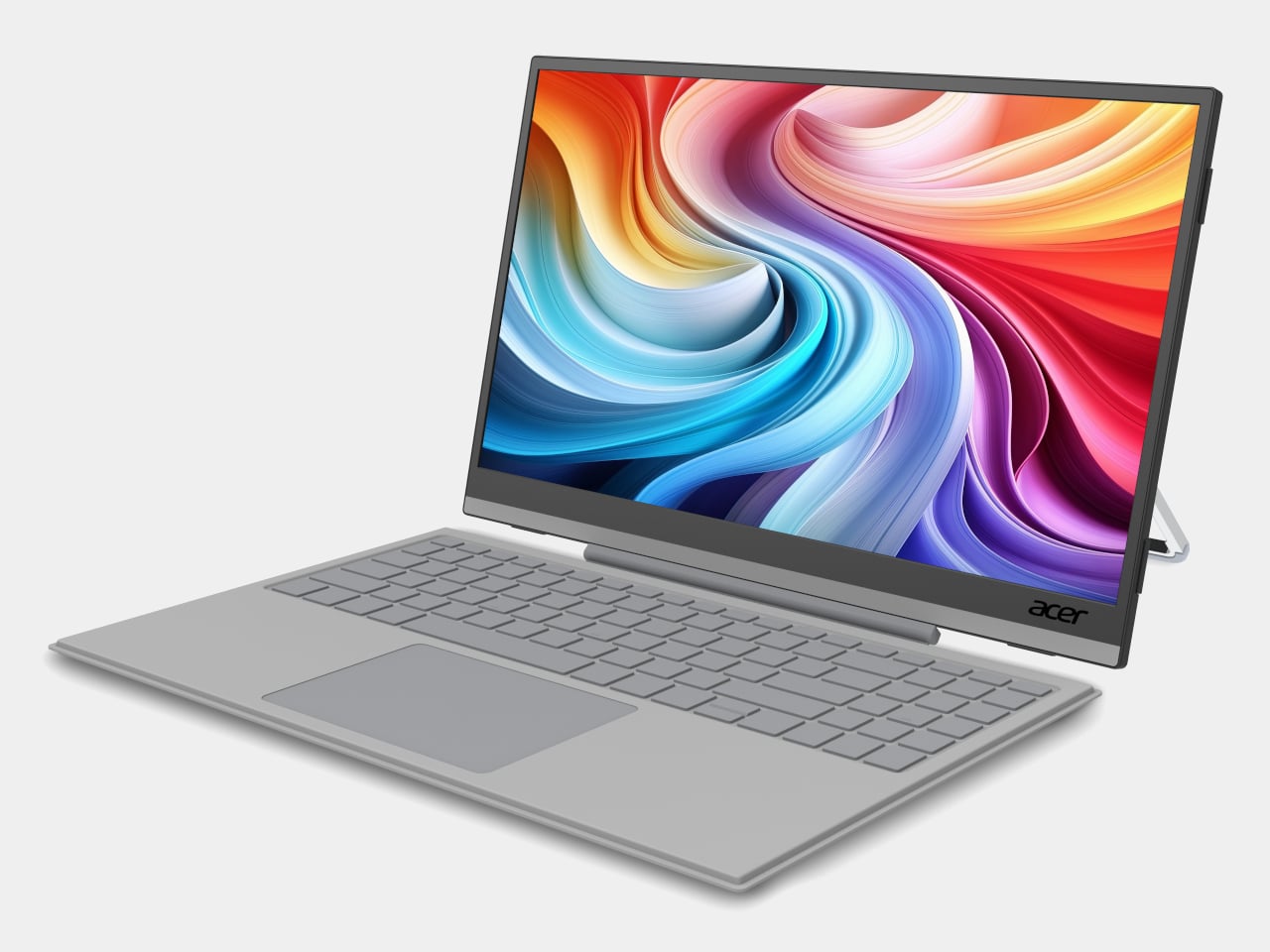
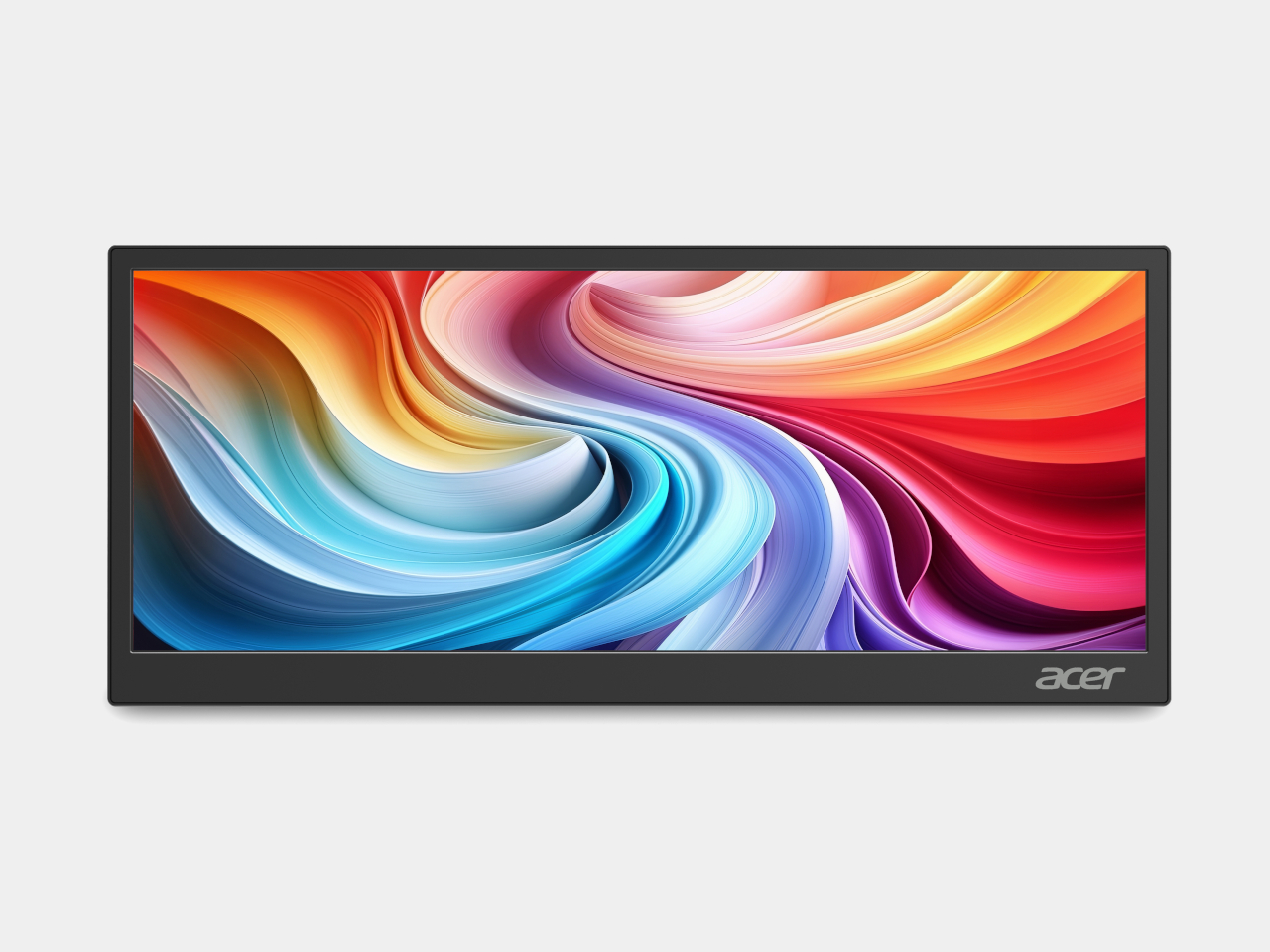
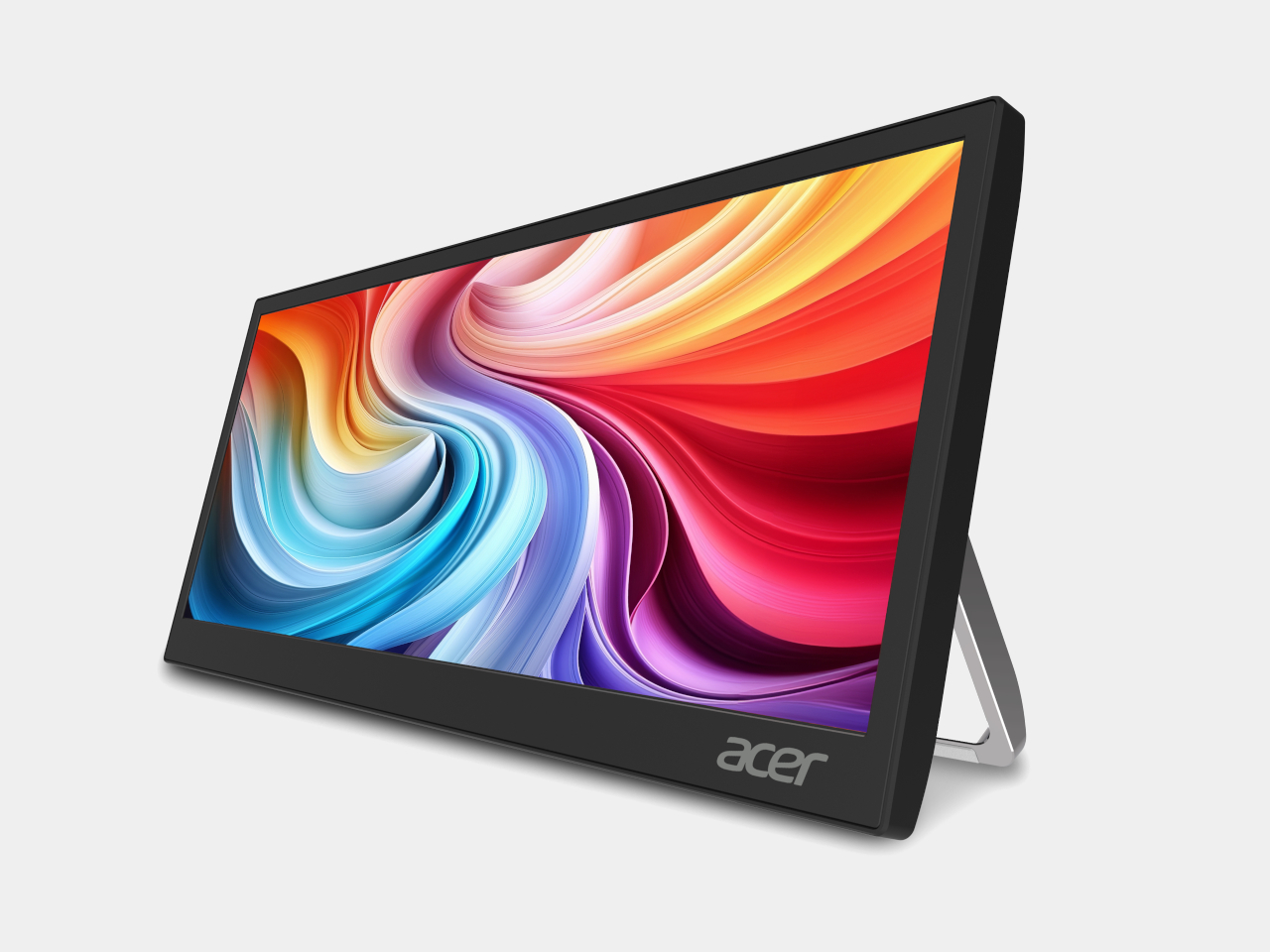
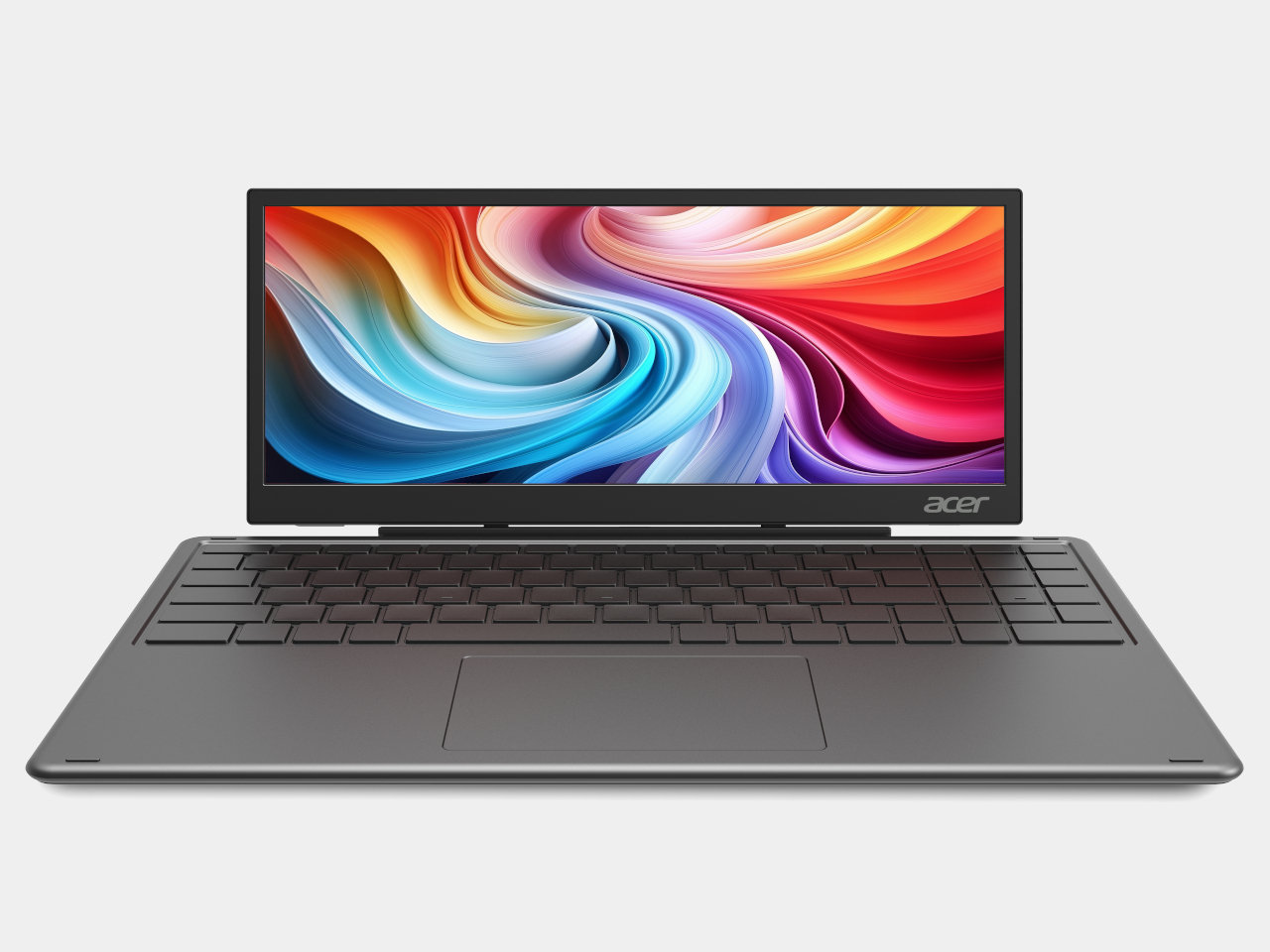
Acer is addressing that gap with two new portable monitors announced at Computex 2026, along with a third product aimed at an entirely different audience. The PM161Q JB and PM131QT cover professionals and digital nomads who need an extra screen wherever they land. The Aspire Badge is something else: a wearable display for kids and young creators who want to carry their personality with them, literally.
Designer: Acer
PM161Q JB
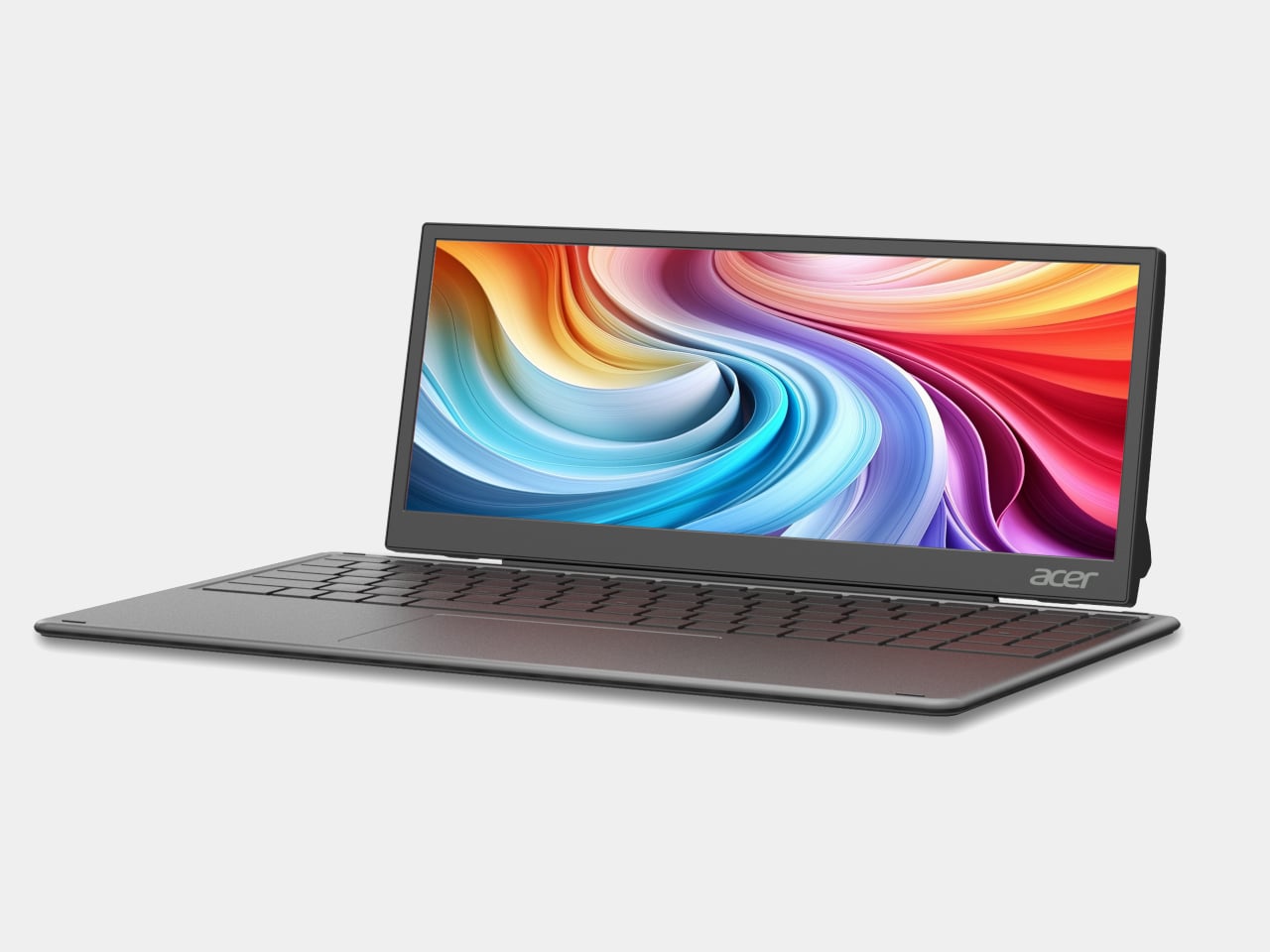
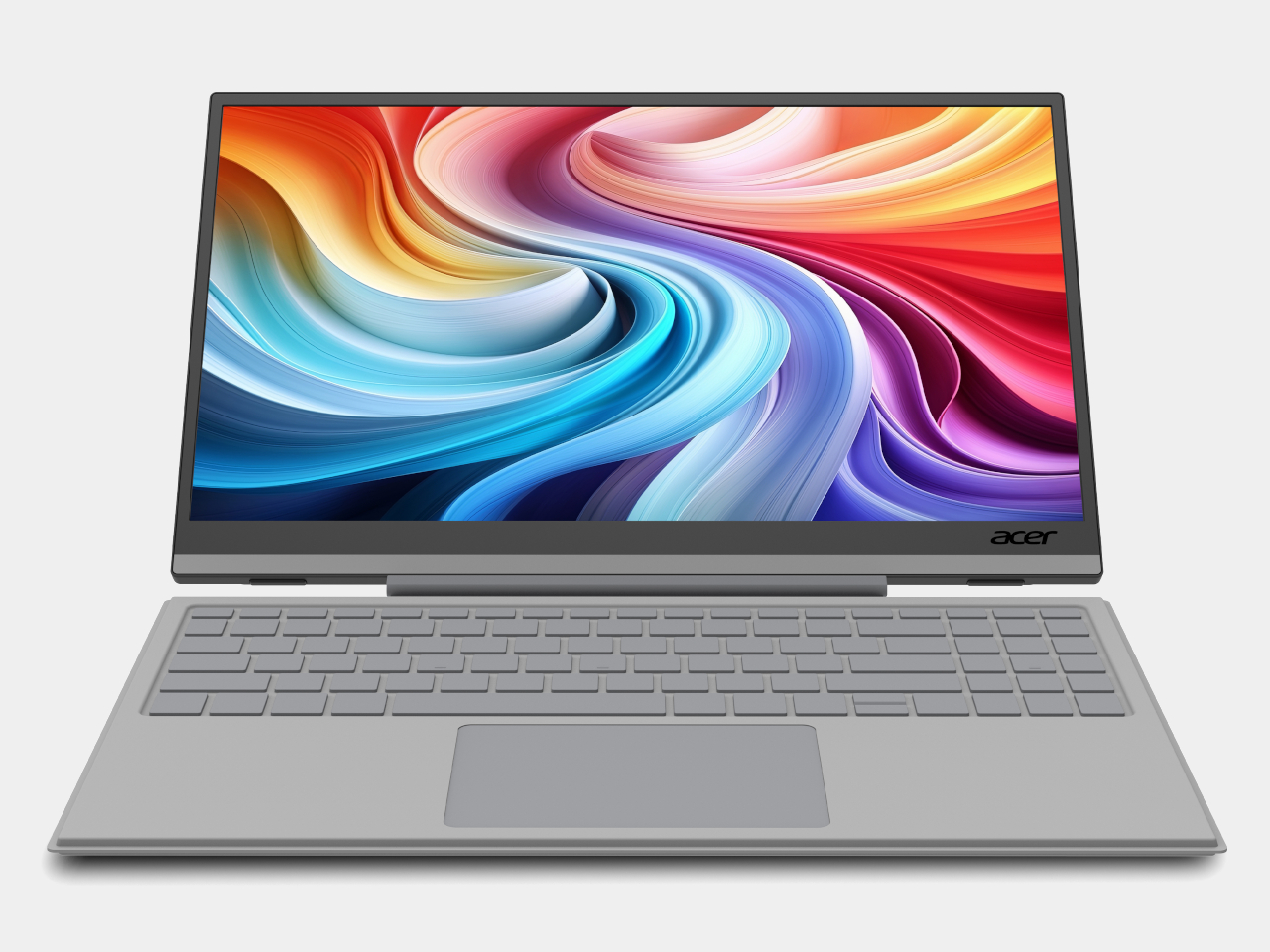
The PM161Q JB is the larger of the two portable monitors, coming in at 15.6 inches with a Full HD IPS panel and 170-degree viewing angles. A pair of Type-C ports and an HDMI input handle connectivity, and a single-cable setup means it’s ready to go as soon as you find a seat. A compatible detachable pogo keyboard turns it into a compact workstation without needing anything else nearby.
PM131QT
The PM131QT takes a different approach with a 12.3-inch touchscreen in an ultrawide 1920 × 720 format, a shape that suits secondary-display work rather than standalone use. Five-point touch makes it practical as an interactive panel, and the magnetic mounting design lets it attach to various surfaces, including a car dashboard. It also functions as a dedicated display for AI assistant interfaces on the road.
PM131QT
Both monitors connect over a single Type-C cable and support VESA mounting alongside a standard ¼-inch tripod thread, so a camera tripod becomes a workable monitor stand when there’s no desk in sight. The PM161Q JB starts at $149.99 in North America, arriving in Q4 2026, while the PM131QT comes in at $179.99 in the same window. Both reach Australia in Q3 2026.
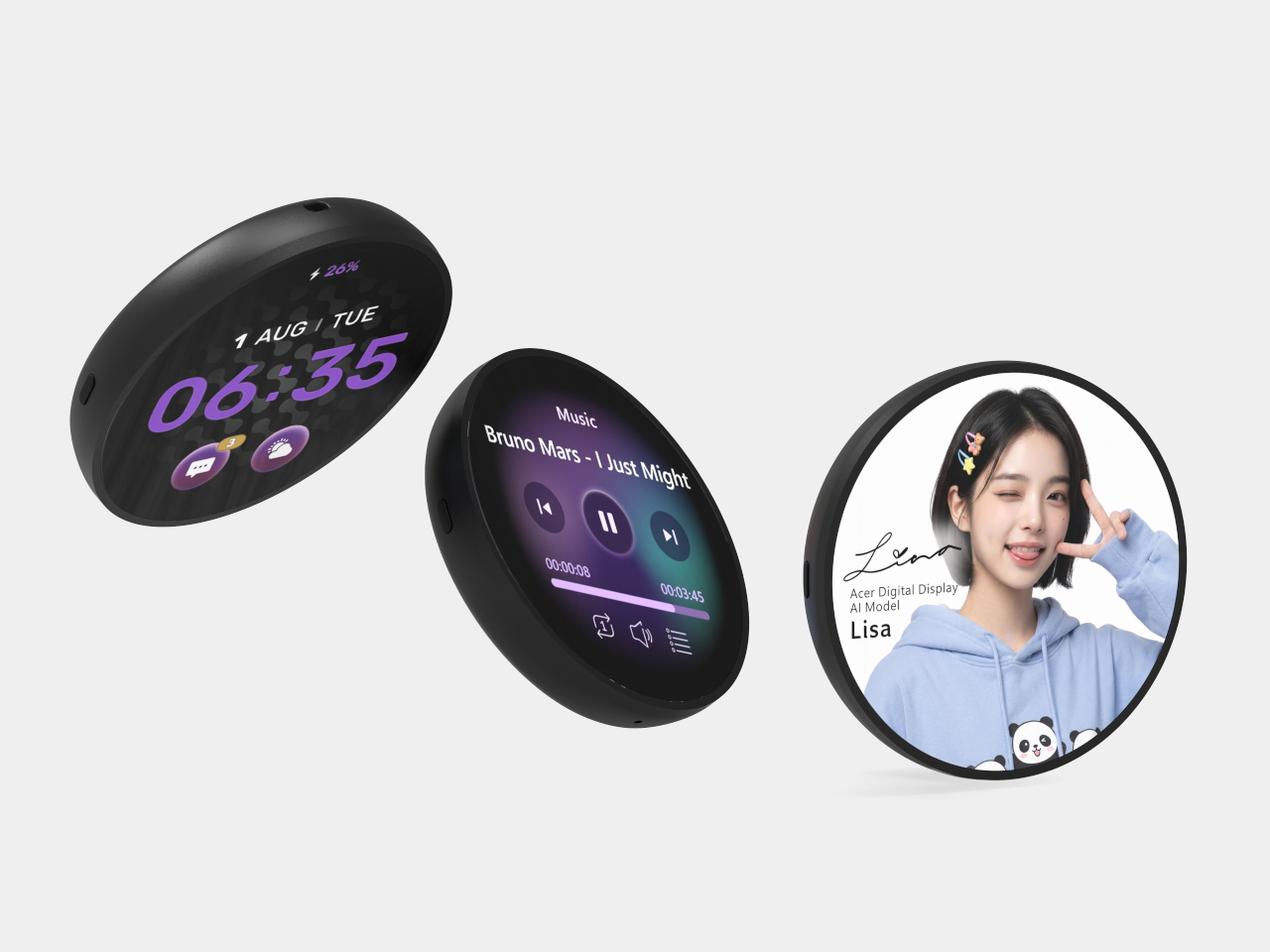
The Aspire Badge is a round wearable with a 1.85-inch IPS screen that clips onto a shirt, hangs from a lanyard, or attaches magnetically to a bag. It pairs with a companion app over Bluetooth 6.0 and displays any image or animation pushed from a phone. Battery life runs up to four hours at full brightness or eight at minimum, with contact charging to restore it.
The Badge isn’t purely decorative. It includes an emergency alarm, an SOS alert that flashes in Morse code, and a night flash mode for improved visibility in the dark, adding a safety layer that makes it more than a novelty for kids walking to school or staying out after dark. It supports JPG, GIF, and PNG formats, and comes in at $49.99 in North America.
The three products together cover a broader range of needs than a typical monitor announcement does. The PM161Q JB and PM131QT reflect how seriously portable screen real estate has become for people working away from a fixed desk. The Aspire Badge takes the same logic in a completely different direction, treating a display not as a productivity tool but as something you wear out the door.
Portable monitors have quietly become one of the most appealing accessories for people who work on the go. Pack a slim second screen, connect it to your laptop, and you’ve doubled your workspace without lugging a desktop around. What nobody really advertises, though, is the trade-off: those displays almost always draw power from the laptop they’re attached to, cutting into the battery life you were counting on.
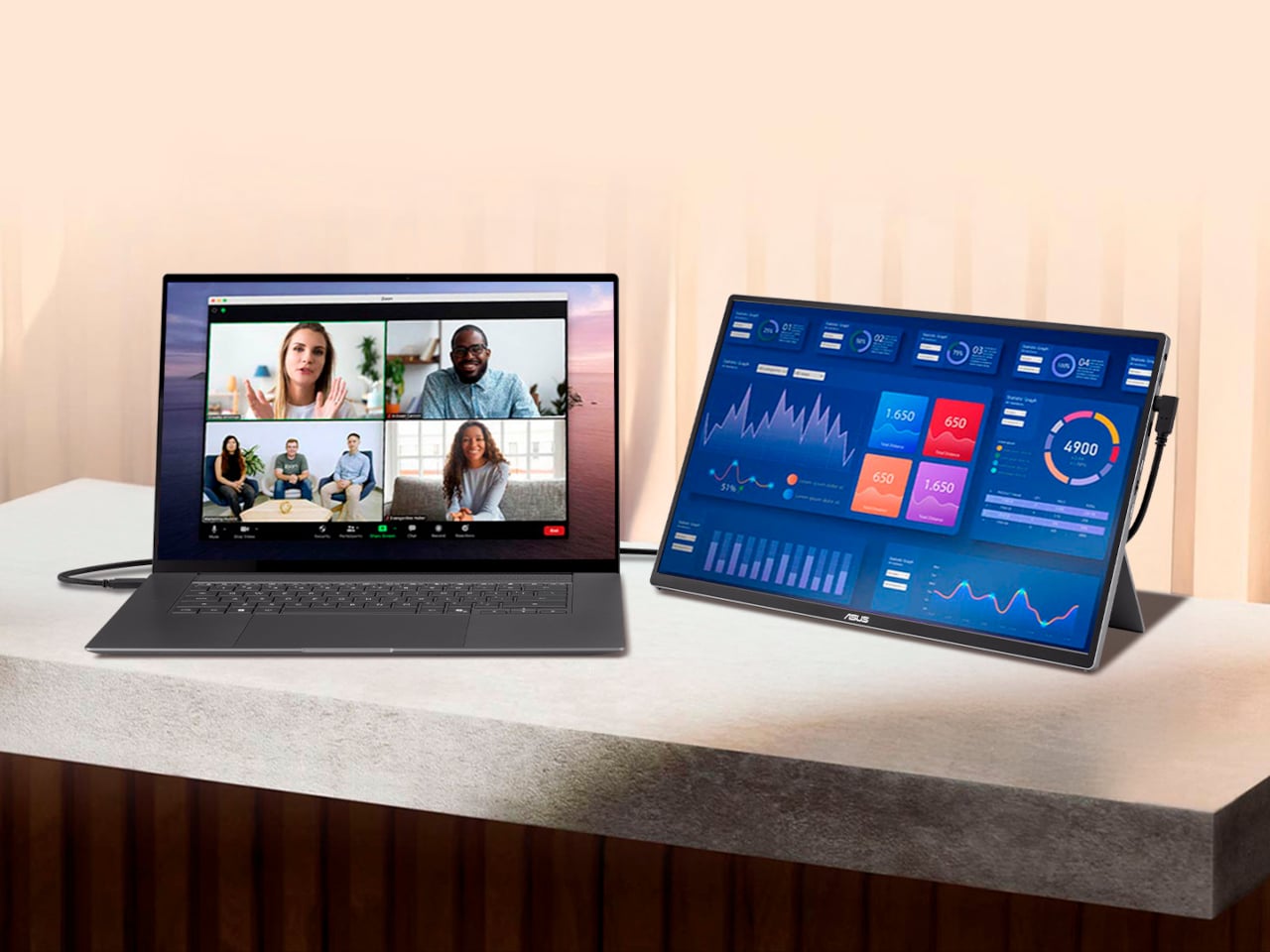
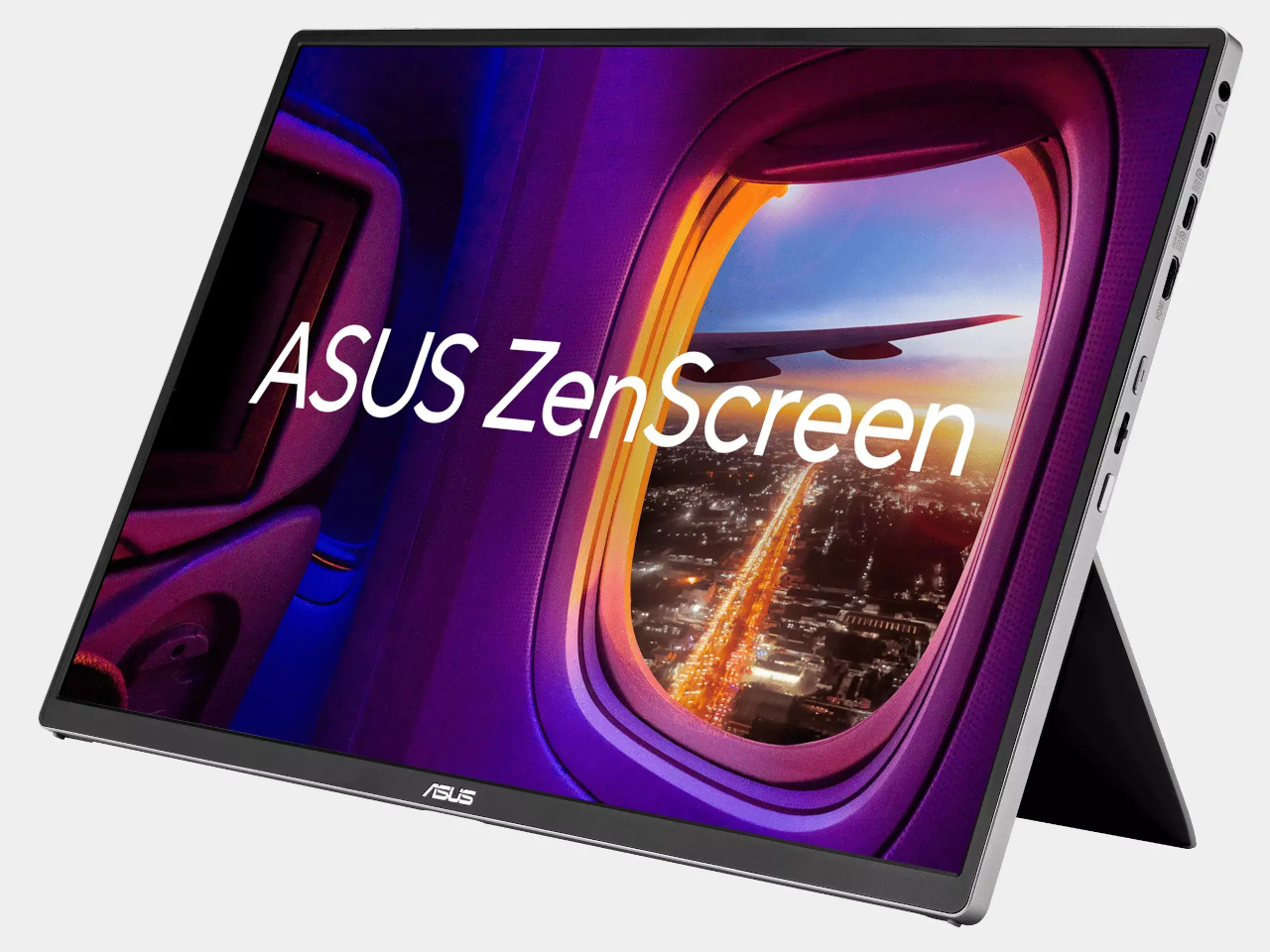
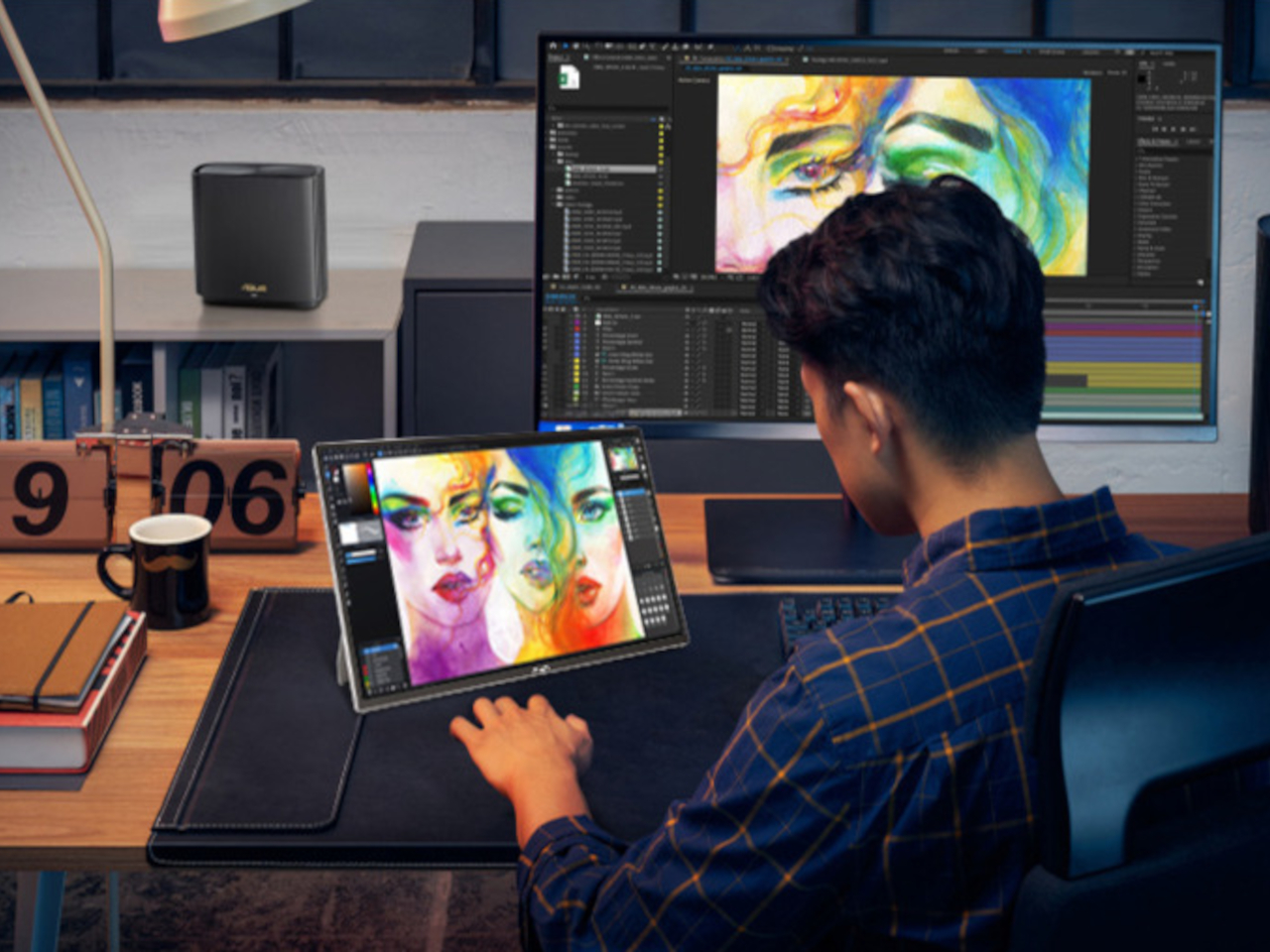
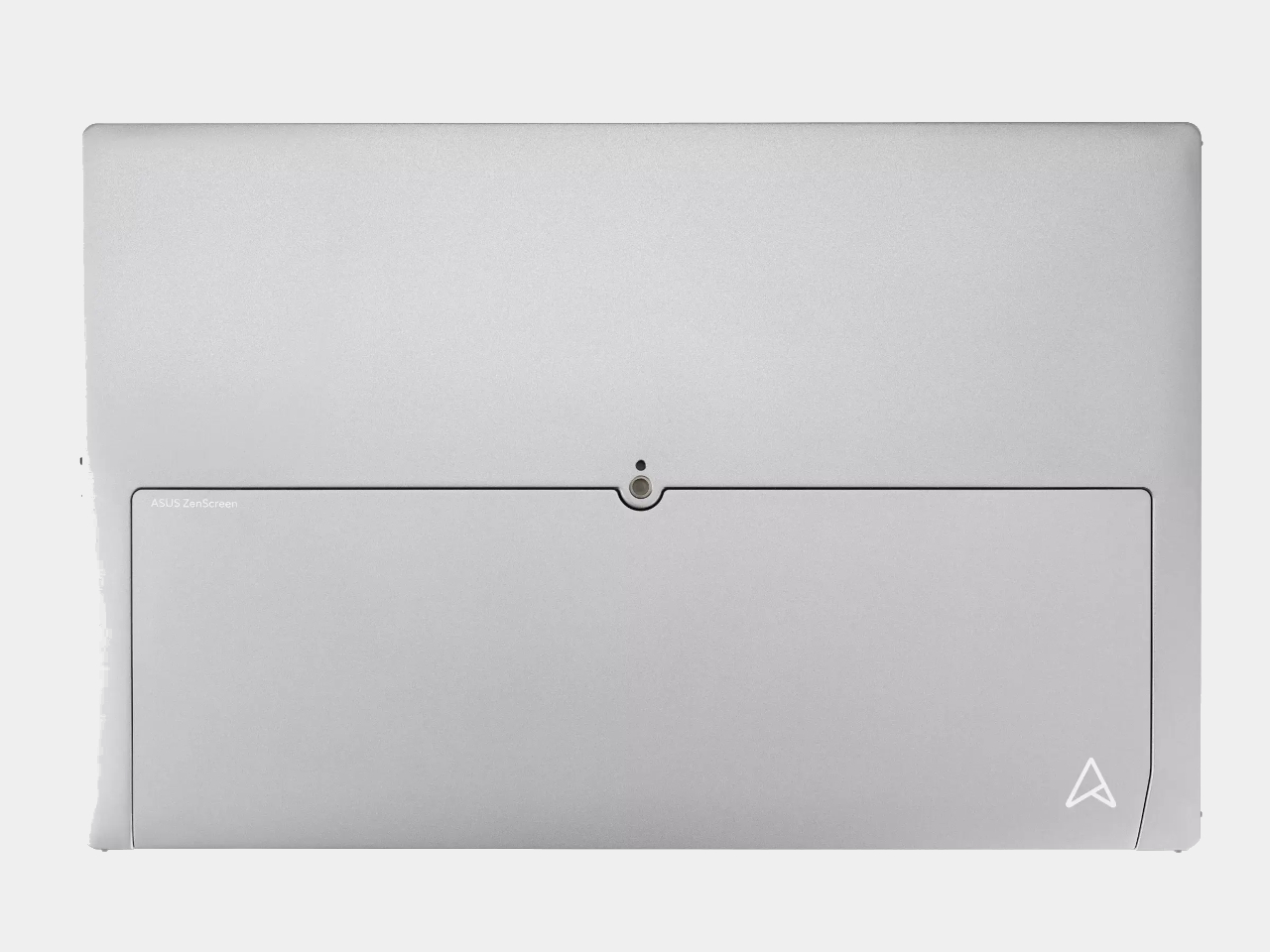
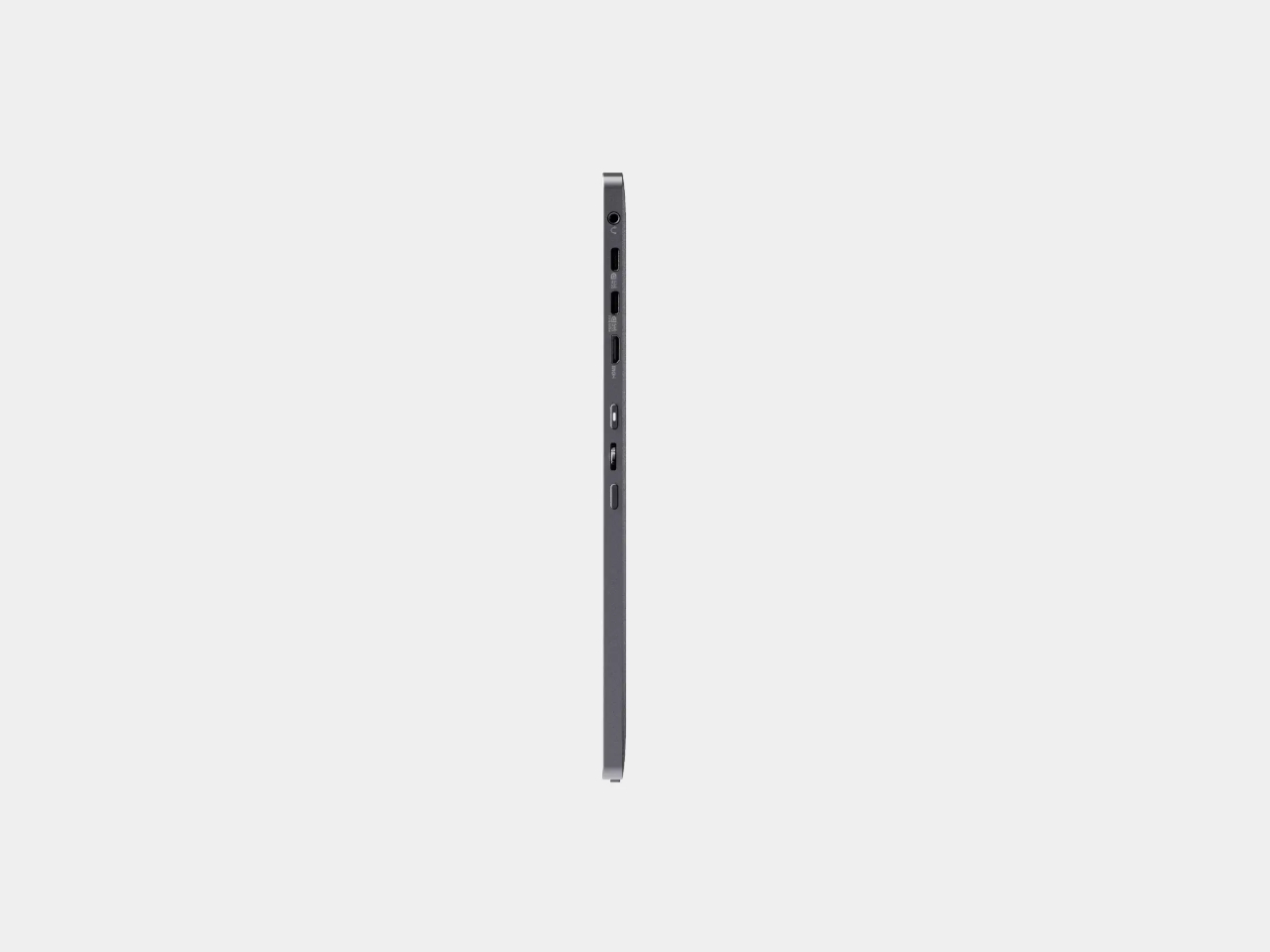
The ASUS ZenScreen OLED MQ16FC tries to fix that. It’s a 16-inch portable OLED display that launched in Europe in early May 2026 at around €280 to €300, measuring 9mm thin and weighing roughly 0.68 kilograms. Those are already respectable numbers for a display of this size, but what actually sets it apart is buried in the port specification: two USB-C connections that can send power in either direction.
Here’s how that works in practice. Plug a USB-C charger into one port on the monitor, then run a single cable from the second port to your laptop. That cable carries both the video signal and up to 65 watts of power, so your notebook keeps charging while the display is running. No power brick plugged separately into the laptop, no second cable hunting for a free port.
It’s worth pausing on why that matters. Most portable monitors are passive in the power conversation; they take whatever the laptop offers and give nothing back. ASUS’s approach treats the power relationship between screen and computer as something the monitor has a responsibility to manage. That’s a small but meaningful shift in thinking, one that asks the accessory to do more work instead of quietly billing the host.
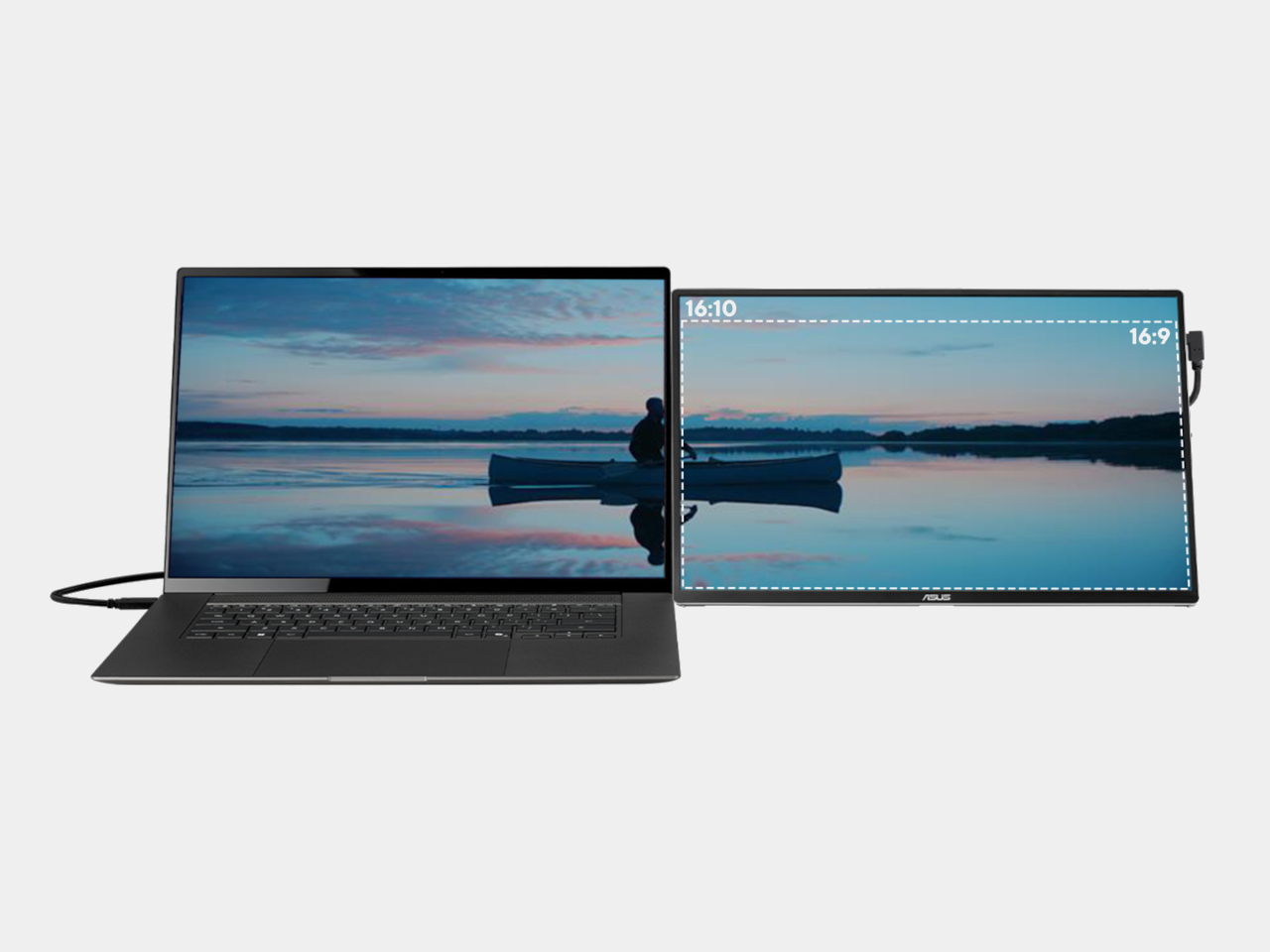
Beyond the power story, the MQ16FC has a display worth carrying. The OLED panel covers 95% of the DCI-P3 color gamut at a 1920 x 1200 WUXGA resolution in a 16:10 aspect ratio, which adds that extra vertical breathing room that widescreen layouts tend to cut off. Contrast is practically infinite by OLED standards, and a 1ms response time keeps things clean enough for video and everyday multitasking.
That said, the MQ16FC isn’t without its quiet losses. There’s no internal battery, so without a charger in the loop, the monitor can still draw from your laptop’s reserves. The 60Hz refresh rate and WUXGA resolution are competent but not particularly exciting for a display positioned as premium. The kickstand-only stand can be awkward on tray tables, and the glossy OLED panel isn’t always your friend in brighter environments.
None of those shortcomings cancels out what makes the MQ16FC interesting. Adding a second screen to a laptop has always been a negotiation between convenience and cable chaos, and for years, the hardware hasn’t done much to simplify that deal. A portable monitor that treats power routing as part of its job description is making a quiet argument about what the category should have been doing all along.
External monitors have evolved far beyond the basic plug-and-play secondary screens they once were. Over the years, we’ve seen brands experiment with more flexible and lifestyle-focused approaches to portable displays. Lenovo Yoga Pad Pro blurred the line between tablet and external monitor by integrating a built-in kickstand and HDMI input, and more recently, an ultra-premium foldable portable monitor challenged the traditional “rigid slab” design by introducing a folding form factor aimed at improving portability and multitasking.
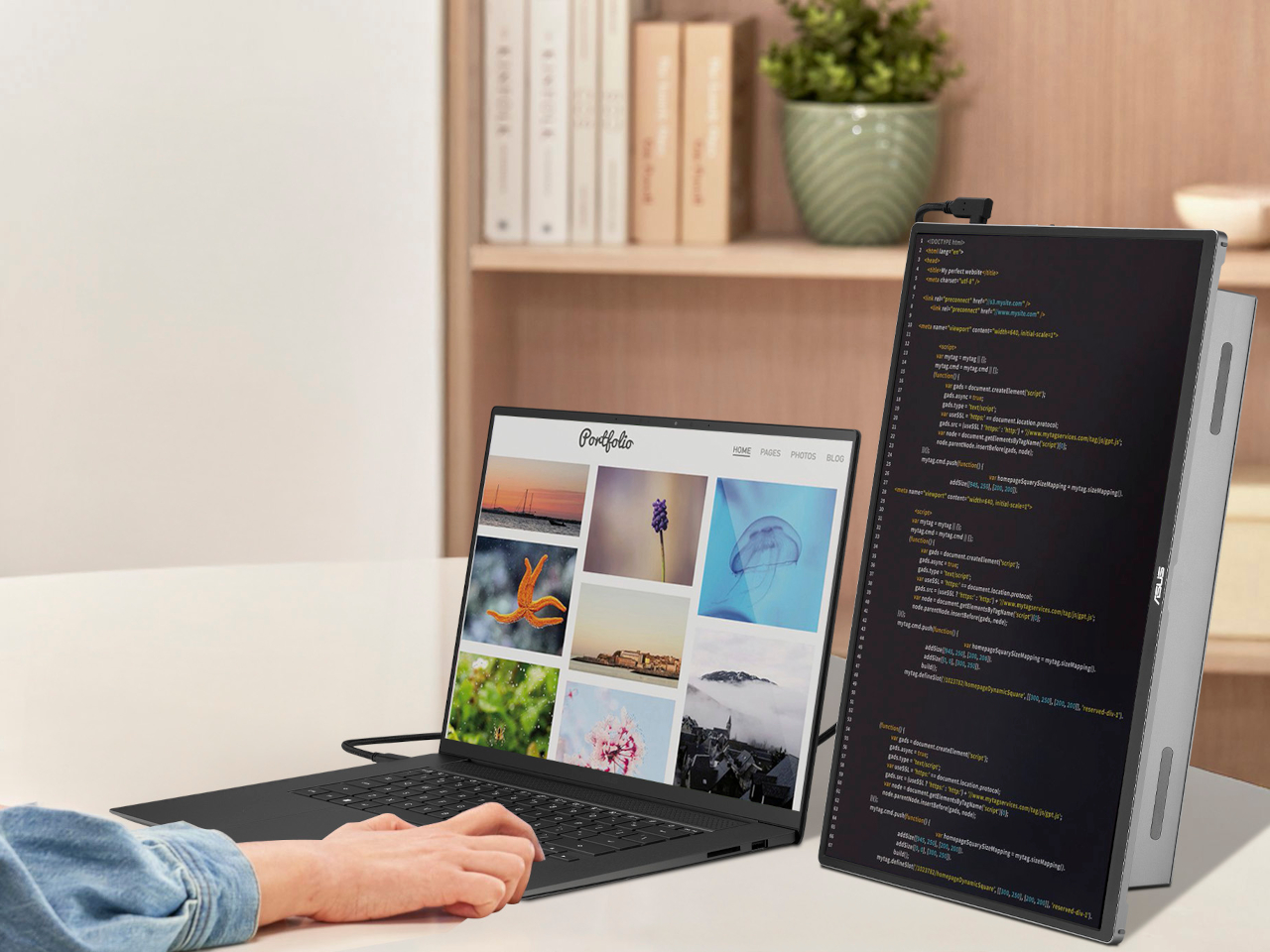
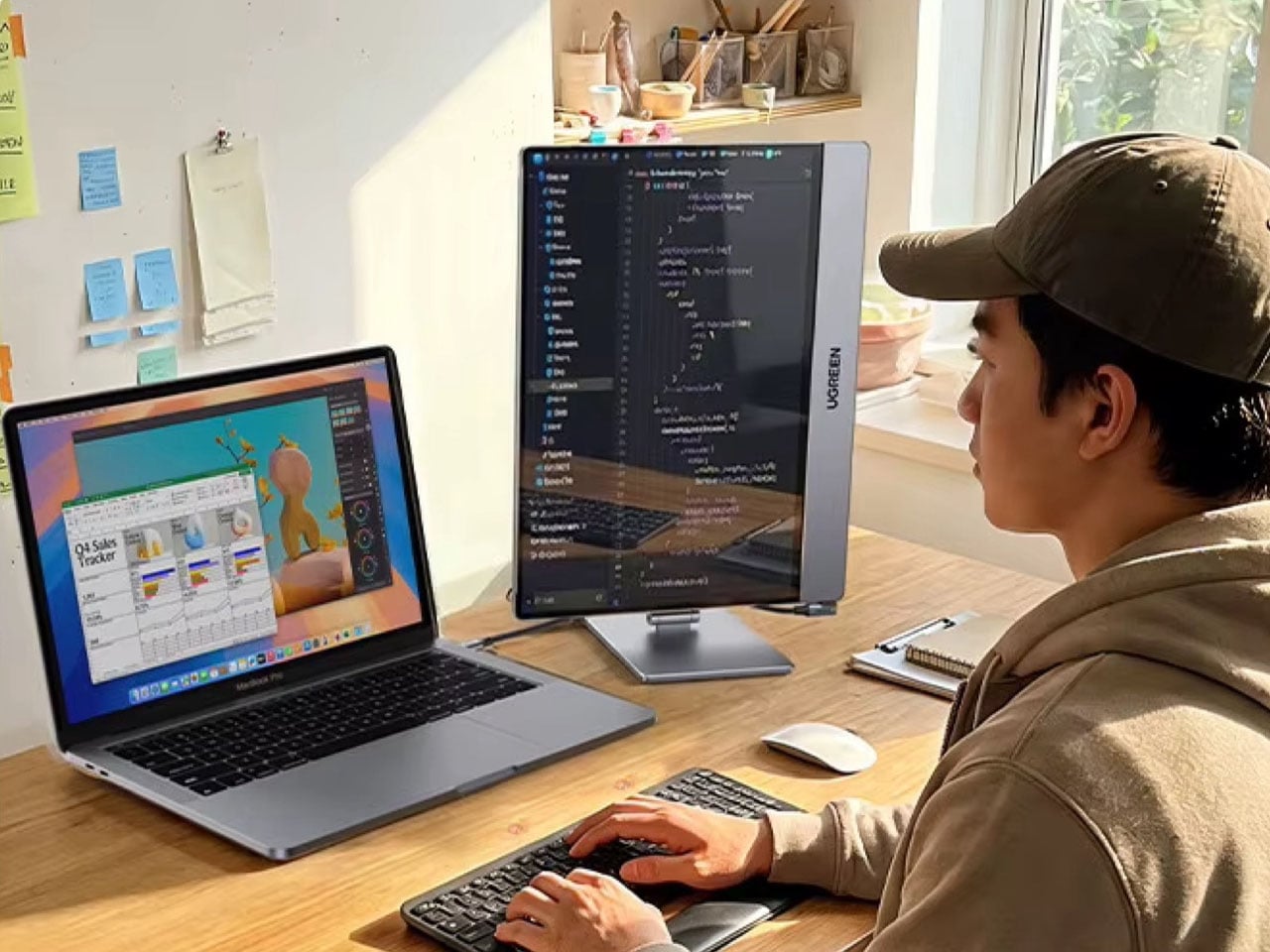
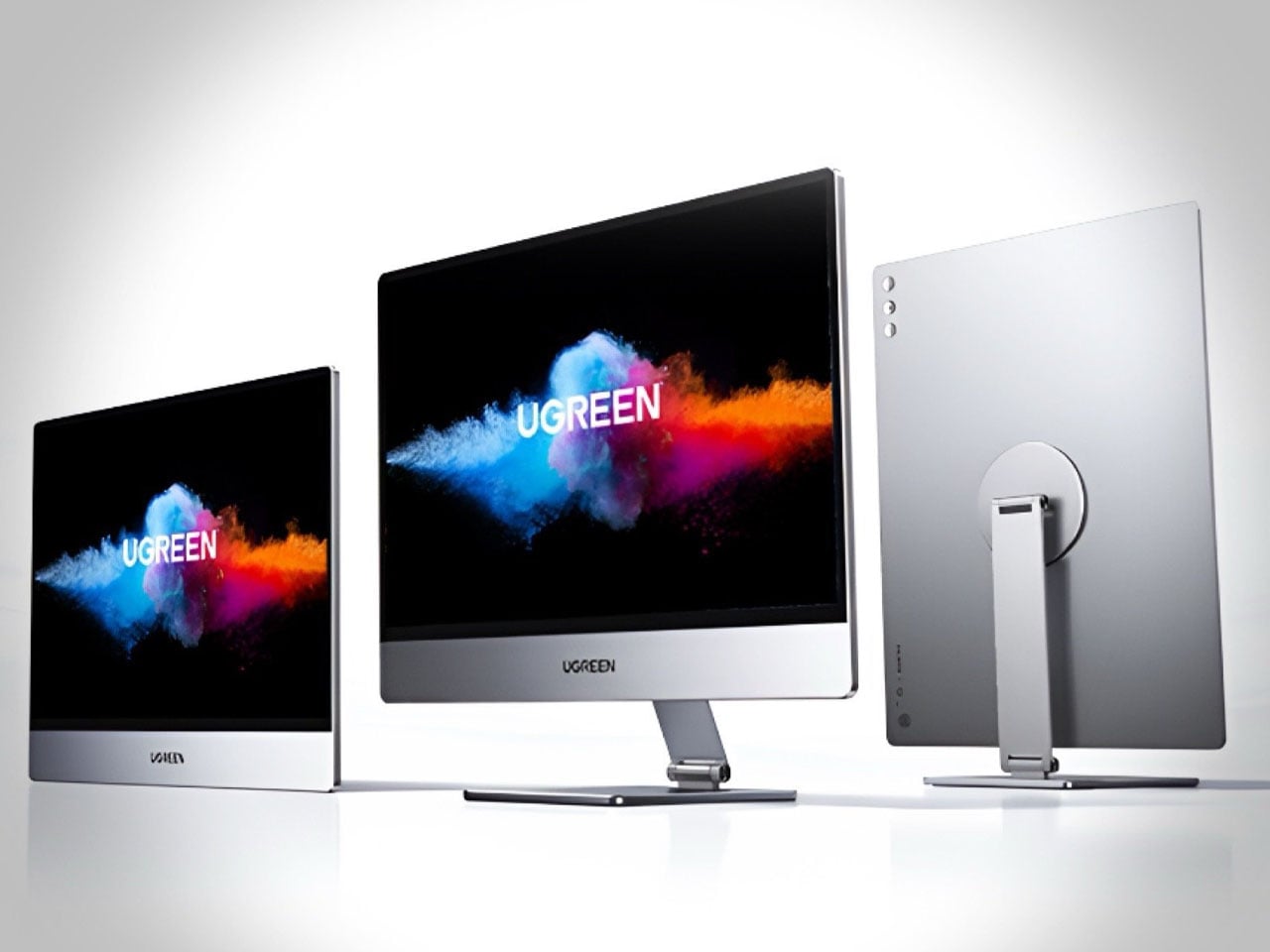
Against this backdrop of innovation, Ugreen’s AP16 portable monitor debuts with the promise of delivering flagship-level display specs in a slim and travel-friendly package. It is designed for users who need a compact secondary screen for work, gaming, and entertainment on the go. The new model combines a high-resolution display, fast refresh rate, and slim construction, making it suited for power users.
The portable monitor features a 16-inch IPS panel manufactured by BOE with a 2560 x 1600 resolution and a 16:10 aspect ratio. Compared to traditional 16:9 portable monitors, the taller aspect ratio provides additional vertical workspace, which can be useful for productivity tasks such as document editing, coding, or web browsing. Ugreen has also equipped the monitor with a 165Hz refresh rate, making motion appear smoother during gaming sessions or while navigating through fast-moving content.
Brightness reaches up to 500 nits, a notable figure for a portable monitor and significantly higher than many mainstream models that typically stay around the 250-300 nit range. The screen also offers a 1200:1 contrast ratio and supports 100 percent of the sRGB color gamut, allowing it to deliver more vibrant and accurate colors. Ugreen says the panel supports 10-bit color through 8-bit plus FRC technology and comes factory calibrated with a Delta E value below 2, indicating improved color precision for creative workloads such as photo editing and content creation. TÜV Rheinland’s low blue light certification is also included to help reduce eye strain during extended use.
The monitor adopts a metal unibody construction with a thickness of just 6.5 mm and a weight of 928 grams. Its slim profile makes it easy to carry alongside a laptop in a backpack or travel bag. Rather than integrating a standard folding kickstand into the chassis, Ugreen bundles the AP16 with a magnetic stand that supports both landscape and portrait orientations while offering flexible tilt adjustments. This setup gives the monitor a more desktop-like appearance and improves ergonomics compared to many portable displays that rely on basic folio covers.
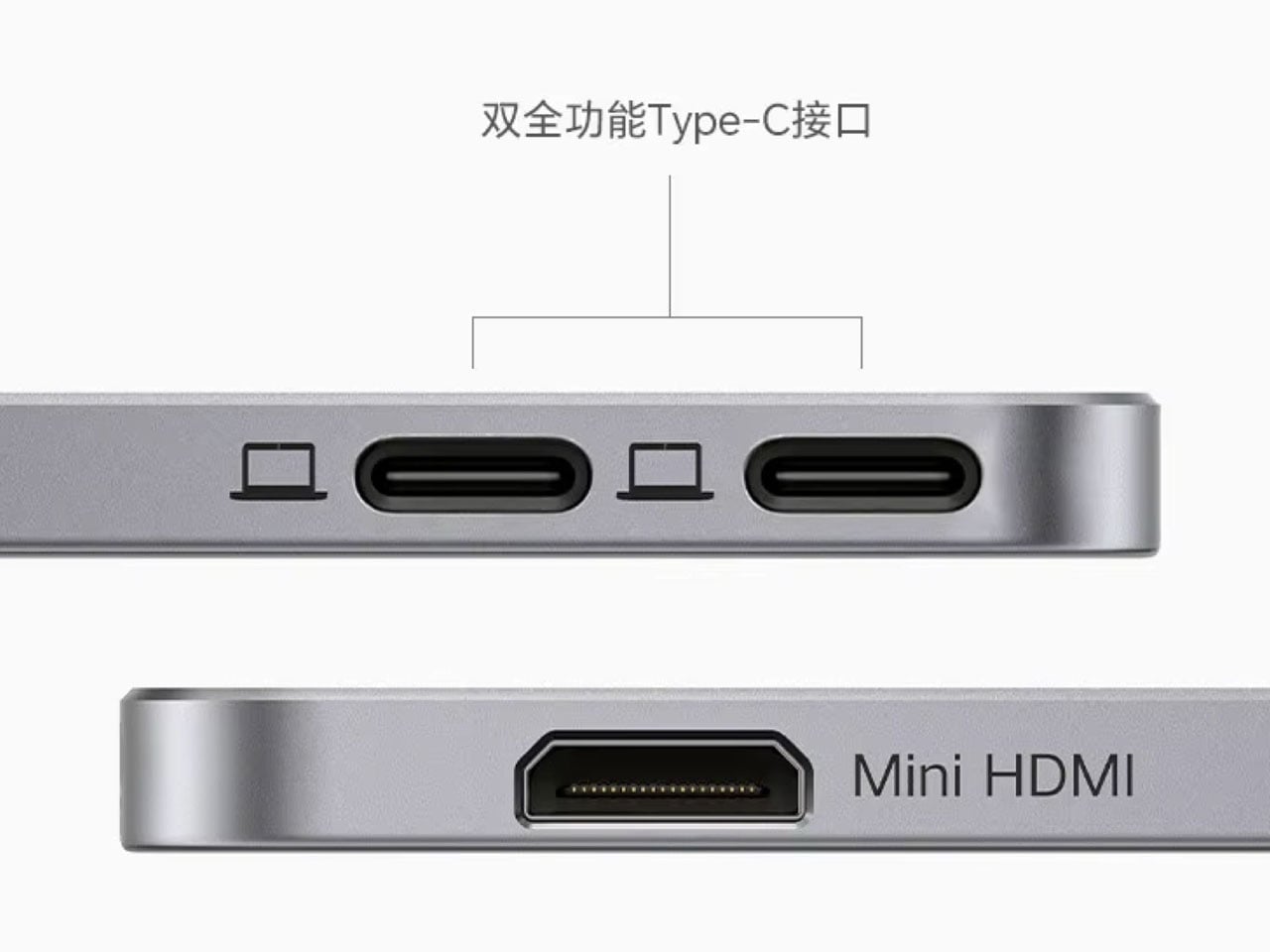
Connectivity options include two full-function USB-C ports and a Mini HDMI port. The USB-C inputs support pass-through charging, allowing connected devices to receive power while using the display. The monitor can charge connected laptops with up to 60W when connected to an external charger. The AP16 is compatible with a wide range of devices, including MacBooks, Windows laptops, iPads, recent iPhones, Nintendo Switch consoles, PlayStation systems, and handheld gaming devices from brands such as Asus and Lenovo. Ugreen has also included dual stereo speakers for basic multimedia playback.
The Ugreen AP16 portable monitor will debut in China with a retail price of 1,799 CNY (around $270). It is already listed on AliExpress for international buyers, though the imported price is significantly higher at approximately $490.
Portable monitors have become a legitimate part of the modern mobile workspace, with countless options available across every price range. But almost all of them share one fundamental constraint: they’re flat, rigid panels in protective cases, indistinguishable from each other in form even when they vary in quality. The screen that travels in your bag looks exactly the same as it did before you packed it.
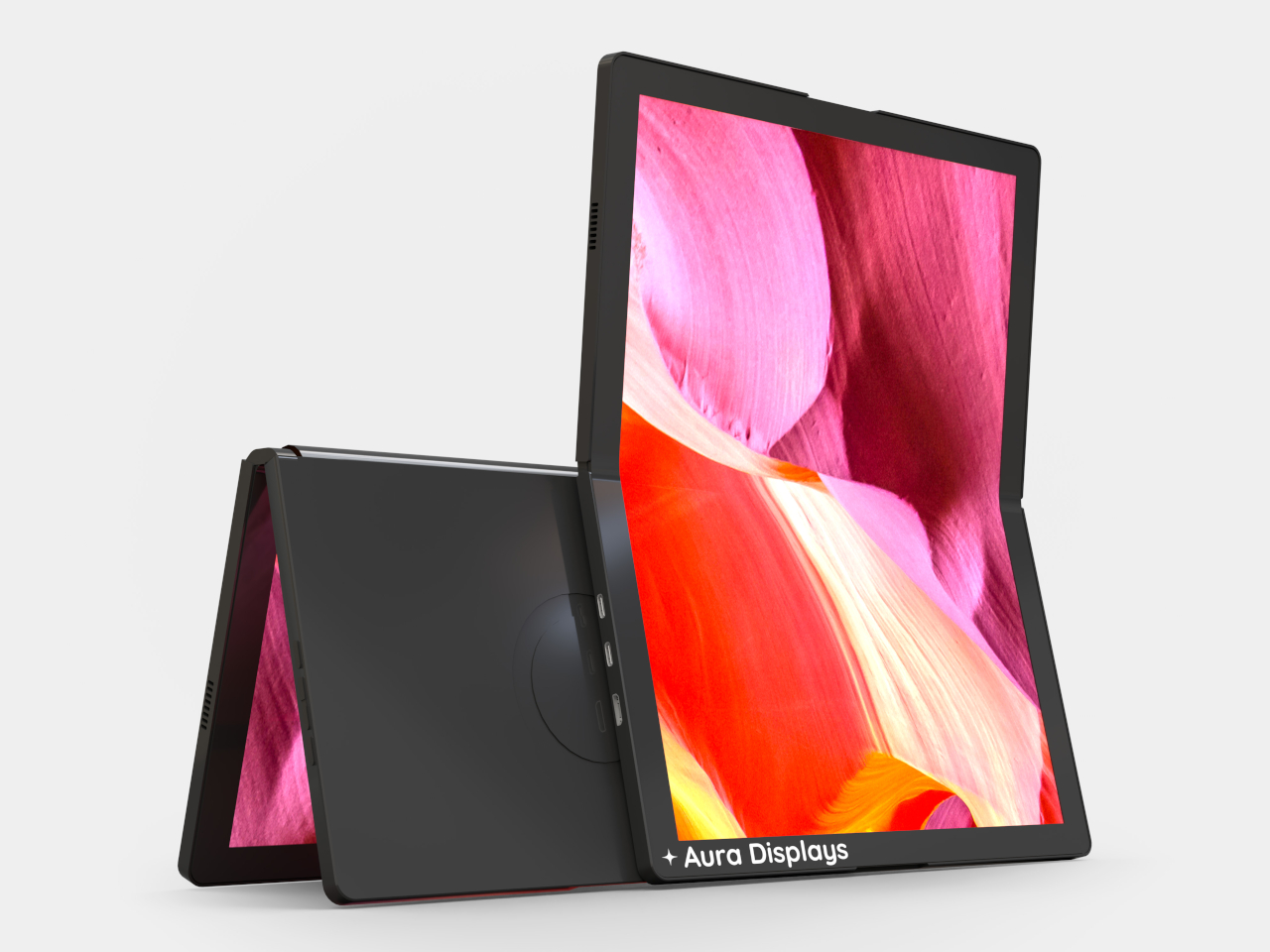
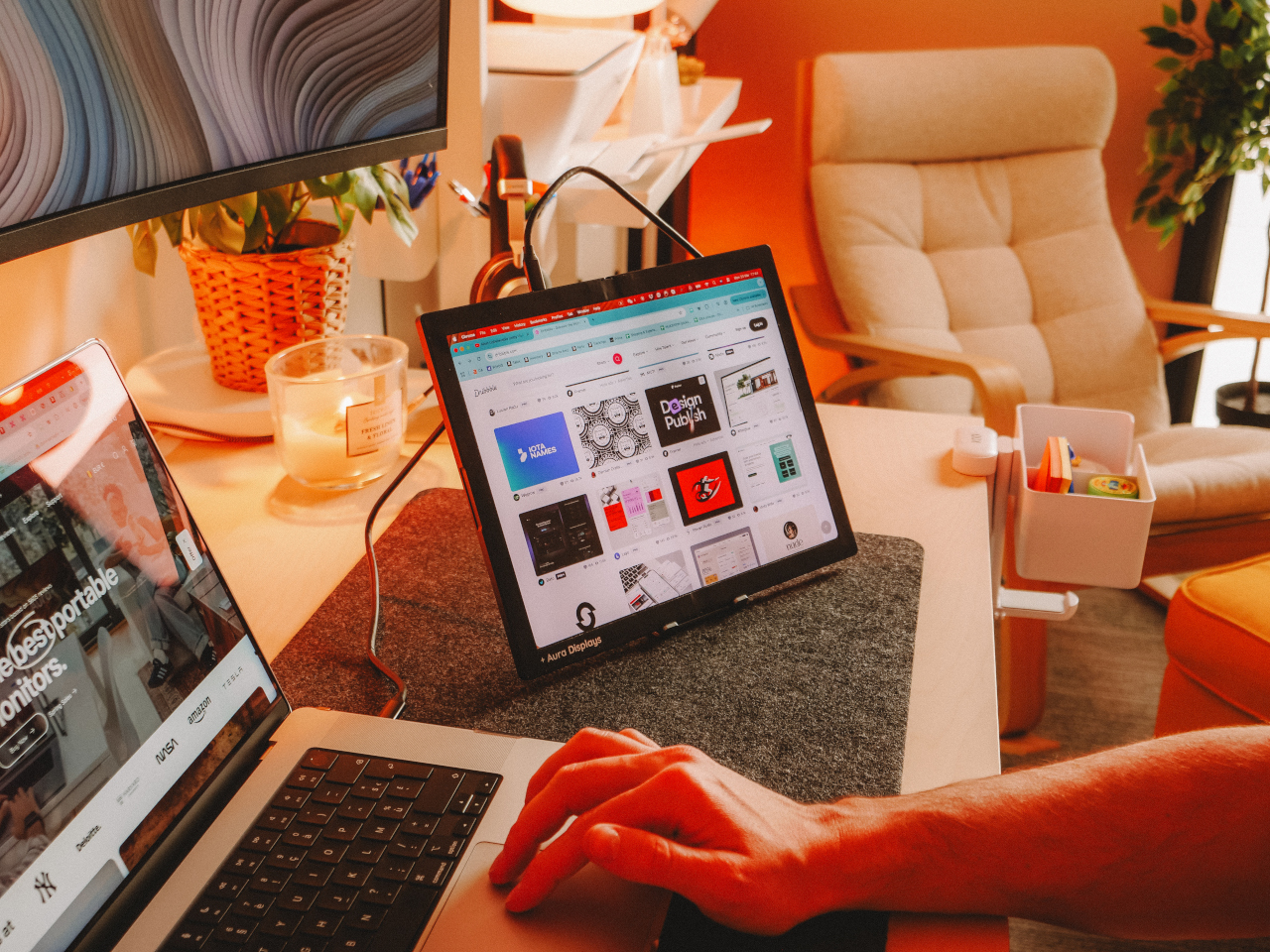
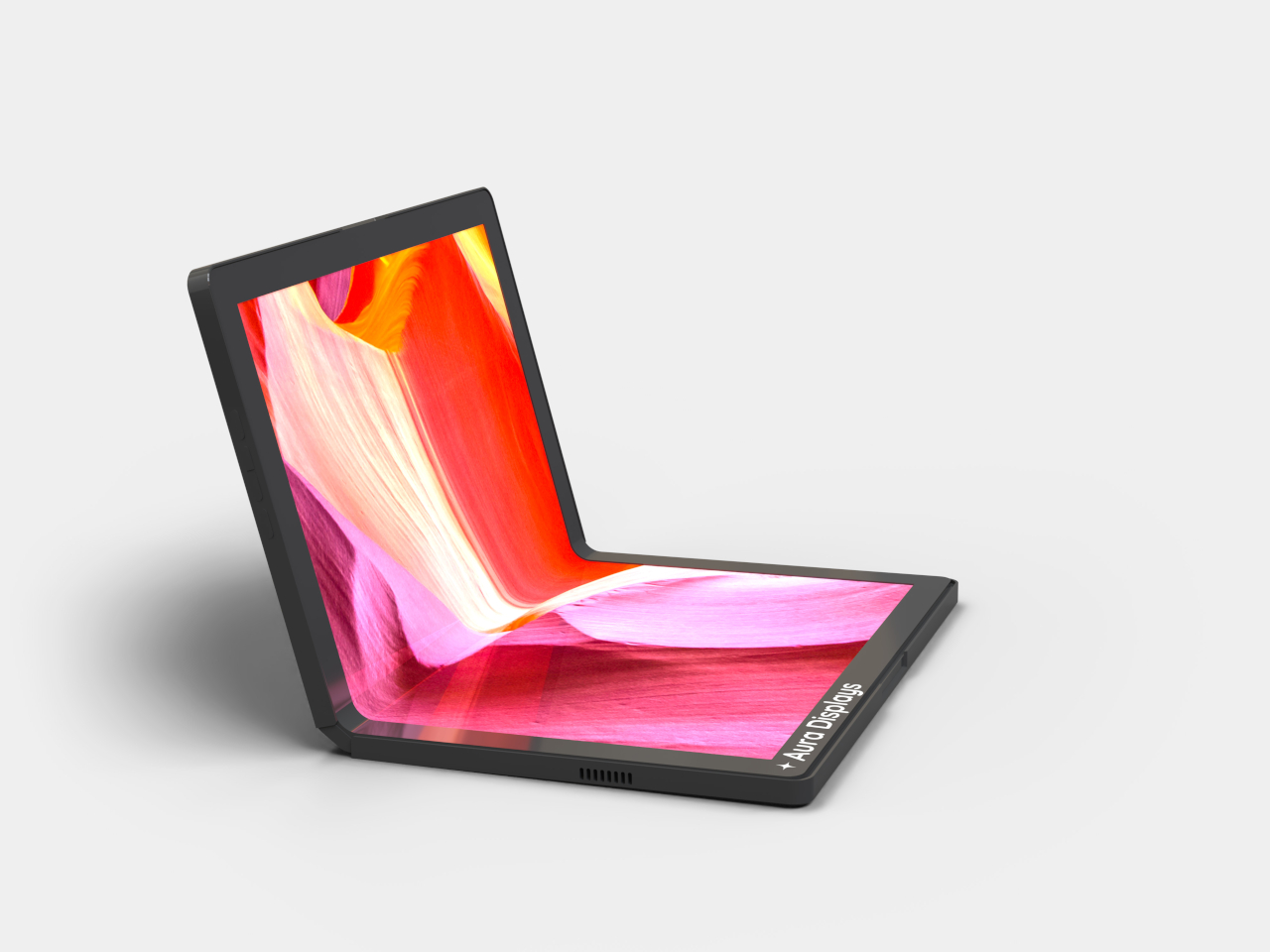
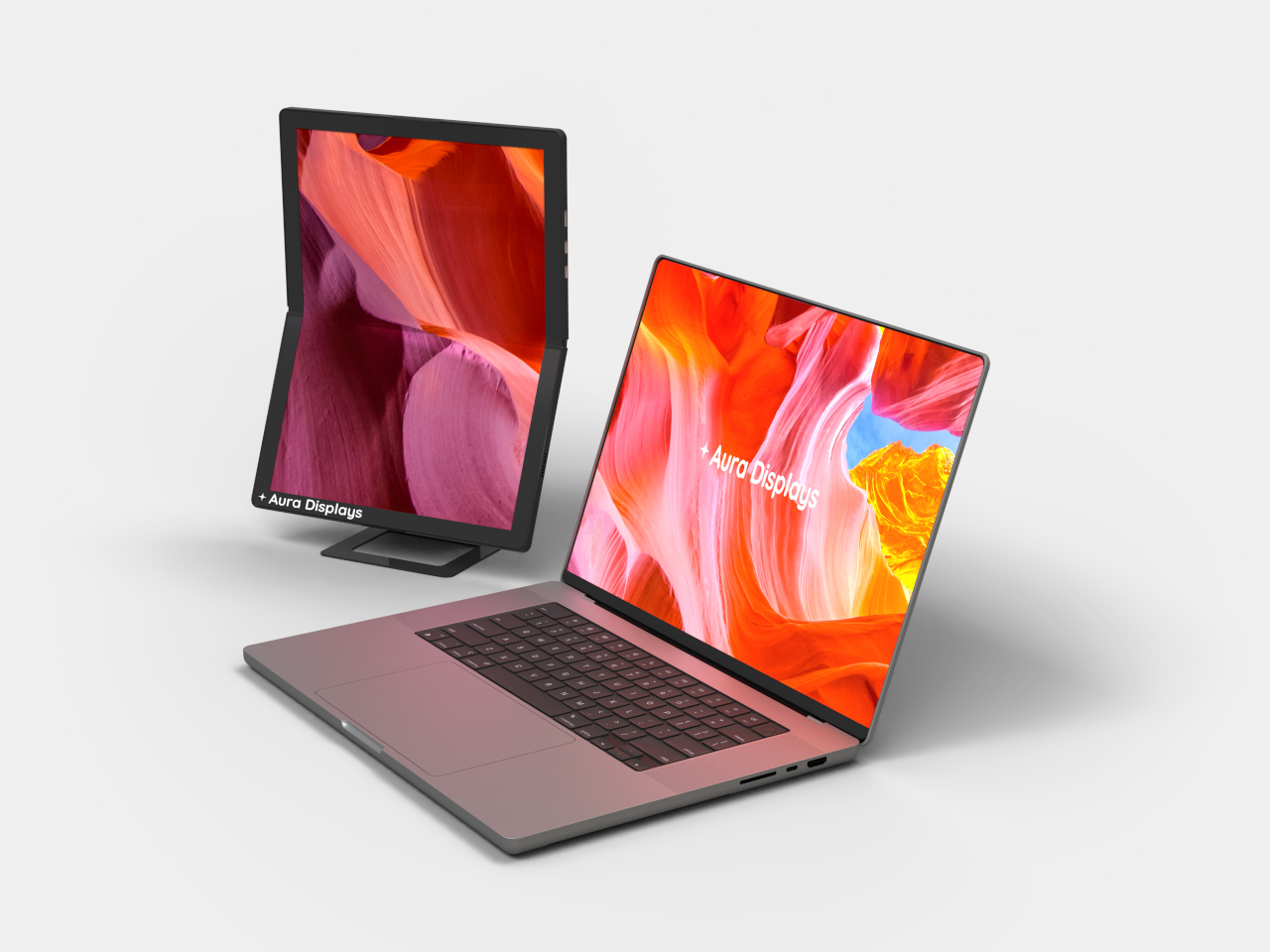
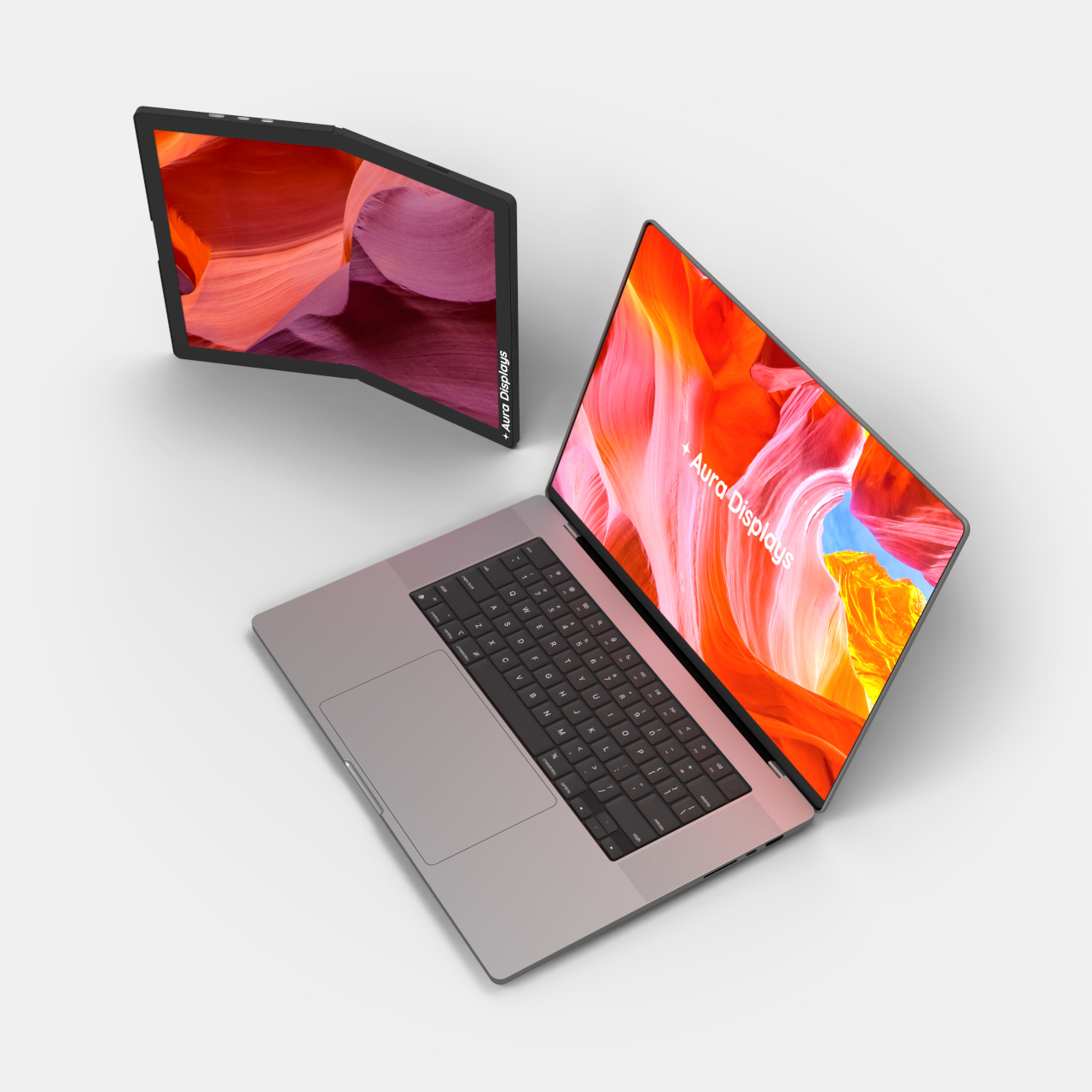
Foldable display technology has been reshaping the smartphone market for years, but making it work meaningfully for laptop accessories has proven far more complicated. Aura Displays’ Single Flex Pro Gen 1 is a portable monitor that does exactly that, introducing FlexMatrix technology that lets the screen bend, fold, and adapt to angles and surfaces that no rigid display can match.
Consider what it actually means to carry a second screen around all day. With conventional portable monitors, you’re always working with the same fixed rectangle, propped up at the same angle, regardless of the surface. A display that folds to just 6.1 by 9.3 inches and opens flat in seconds turns that into a fundamentally different proposition: the form factor adapts to the space, not the other way around.
The actual display is a 13.3-inch AMOLED panel with a 1536×2048 resolution at a 3:4 aspect ratio, meaning it’s portrait-oriented rather than the standard widescreen format. That’s a deliberate choice for someone editing a document, annotating a PDF, or reviewing design layouts in a vertical workflow. The screen covers 117% of the NTSC color gamut, with a 2ms response time and touch input support built in.
AMOLED as a panel technology brings practical advantages worth noting. Contrast is technically infinite since each pixel generates its own light and can switch off entirely, so blacks are genuinely black rather than a deep gray approximation. For anyone reviewing color-critical artwork or working on dark-themed interfaces for long stretches, those aren’t trivial differences; they affect how accurately you read what’s on screen throughout the day.
The physical construction is built around pro-grade hinges and a premium aluminum chassis, keeping the whole unit to 1.54lb despite the structural complexity of a panel that needs to flex repeatedly without degrading. Folded, the monitor is just about 0.63 inches thick; unfolded, it drops to 0.31 inches. Connectivity runs entirely through USB-C, plug-and-play, with no drivers or software installations needed before you can start using it.
There’s also a 17-inch version in the works, currently in pre-production and expected to arrive in June 2026. That suggests Aura isn’t treating this as a one-off experiment but as the beginning of a product line built around this flexible form factor. The Gen 1 name further implies future revisions, which is a reasonable expectation for a product type that genuinely hasn’t existed before now.
The Single Flex Pro Gen 1 is on sale at $1,299, down from its regular $1,499 price, available in Midnight Black. It ships with a USB-C to USB-C cable and a USB-C to USB-A adapter, backed by a one-year warranty. For something claiming a genuine category first, that price reflects both the novelty of the technology inside and the engineering required to keep a flexible AMOLED panel reliable through daily use.
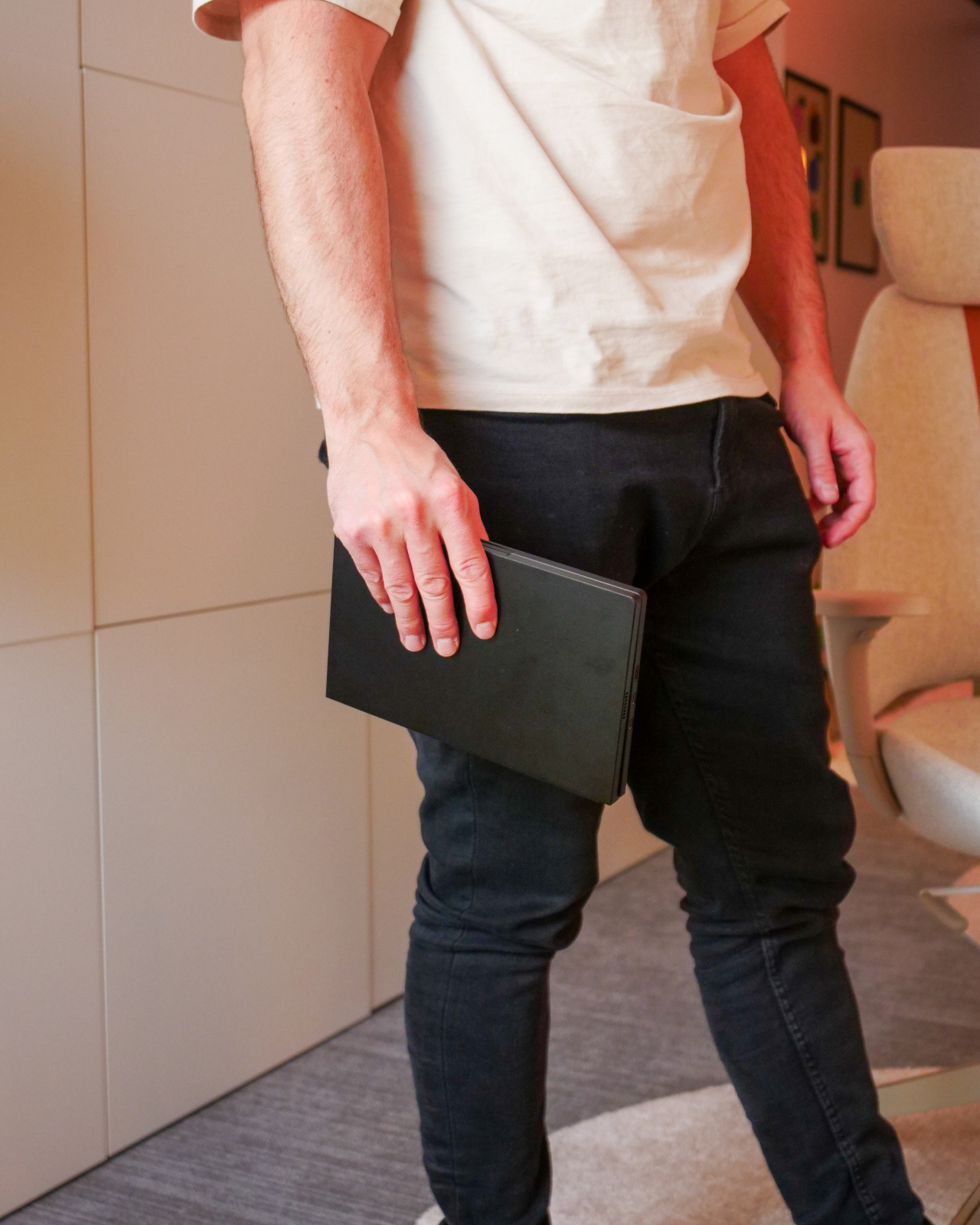
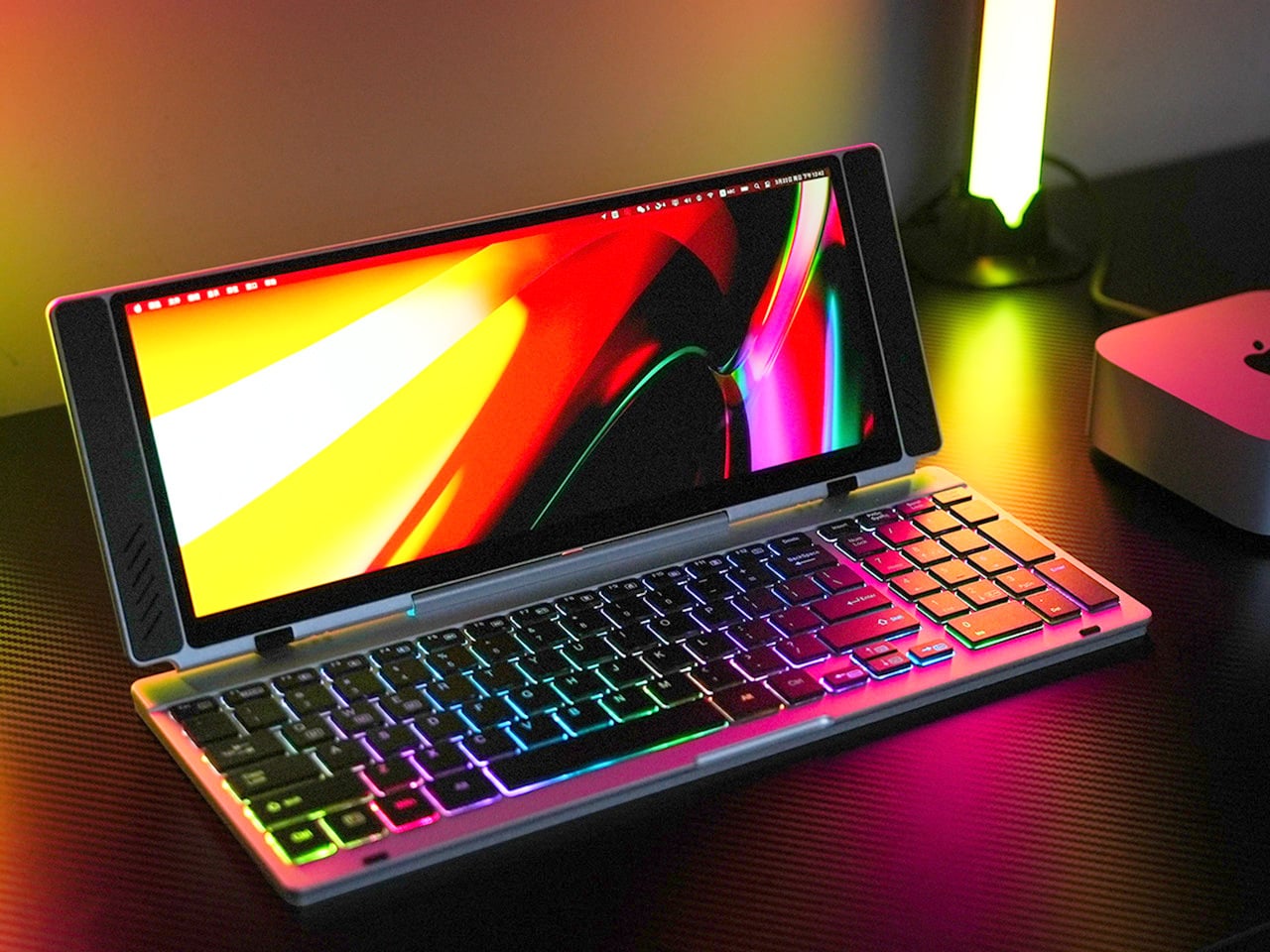
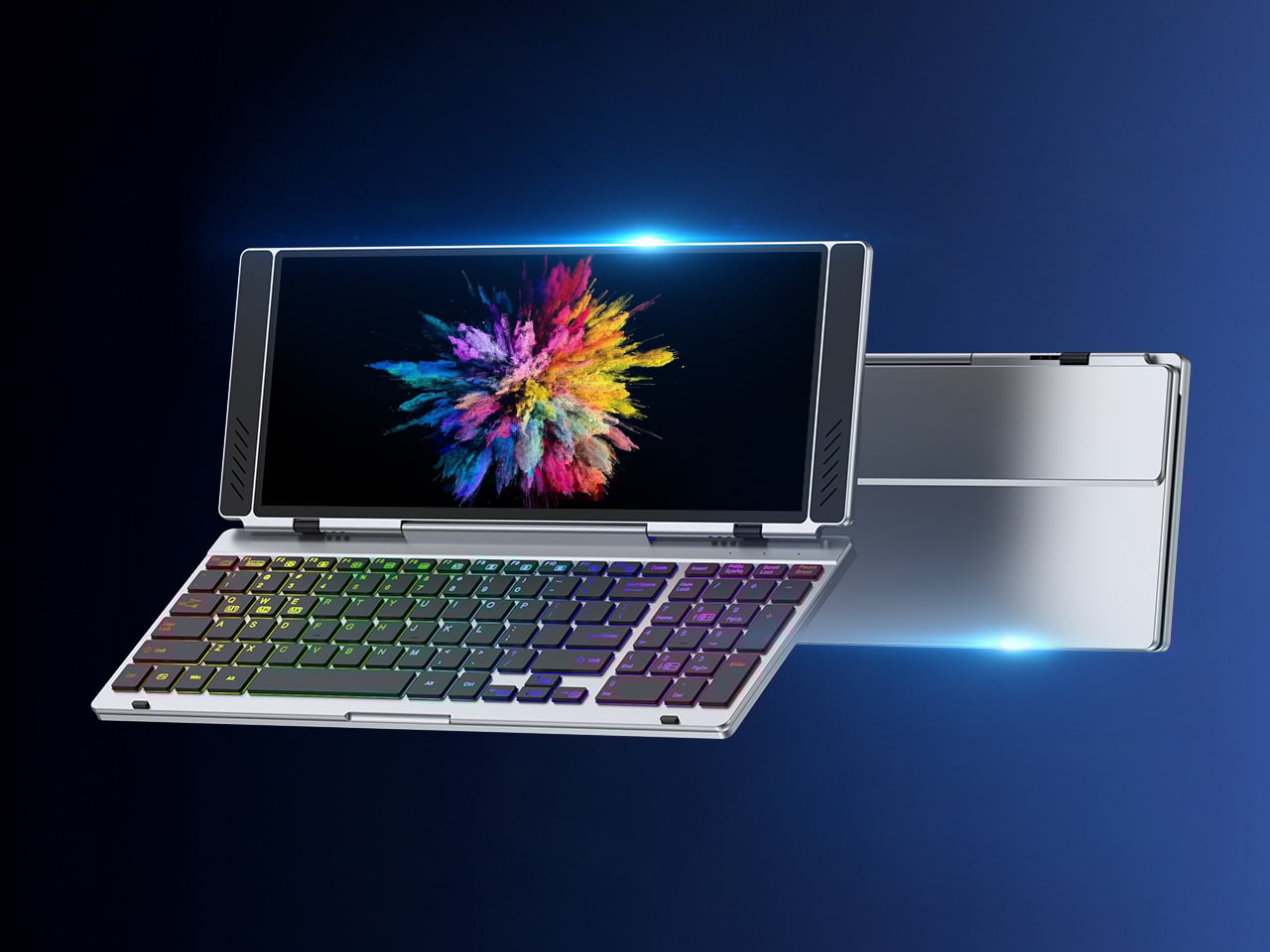
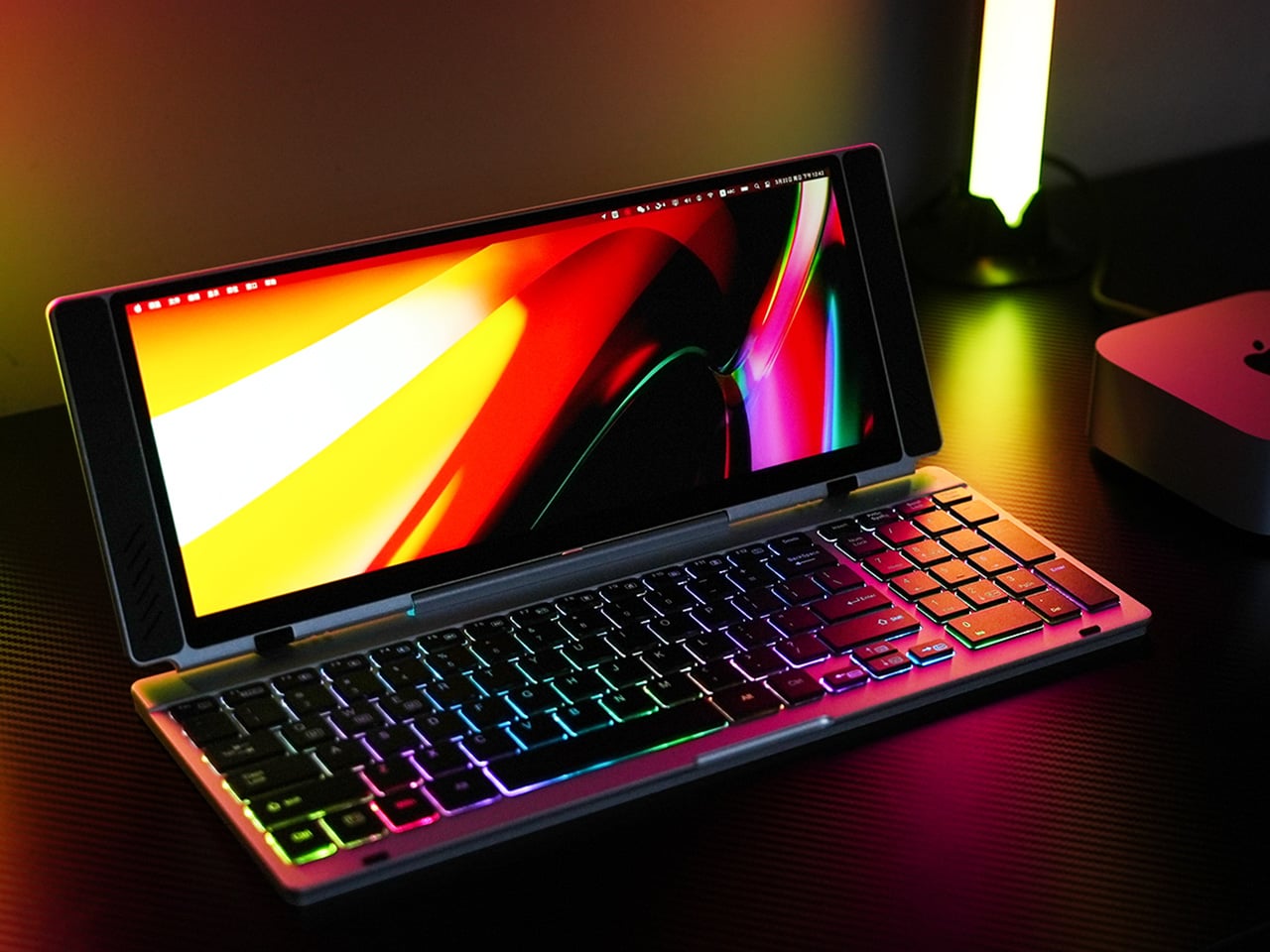
Closed, the VitaLink looks like a very flat book, silver, about the footprint of a large paperback, with nothing to suggest it carries a 4K display inside. At 20mm thick with a CNC-machined aluminum shell, it weighs 1200 grams and travels the way a slim notebook does; it fits in a laptop sleeve, takes up a predictable corner of a bag, and requires no dedicated case beyond what you already carry. Then it unfolds at 180 degrees. The screen lifts above the keyboard, the whole unit settles into a 34 by 15 centimeter footprint, and what you have is a self-contained dual-screen workspace that happened to be a thin slab a moment ago.
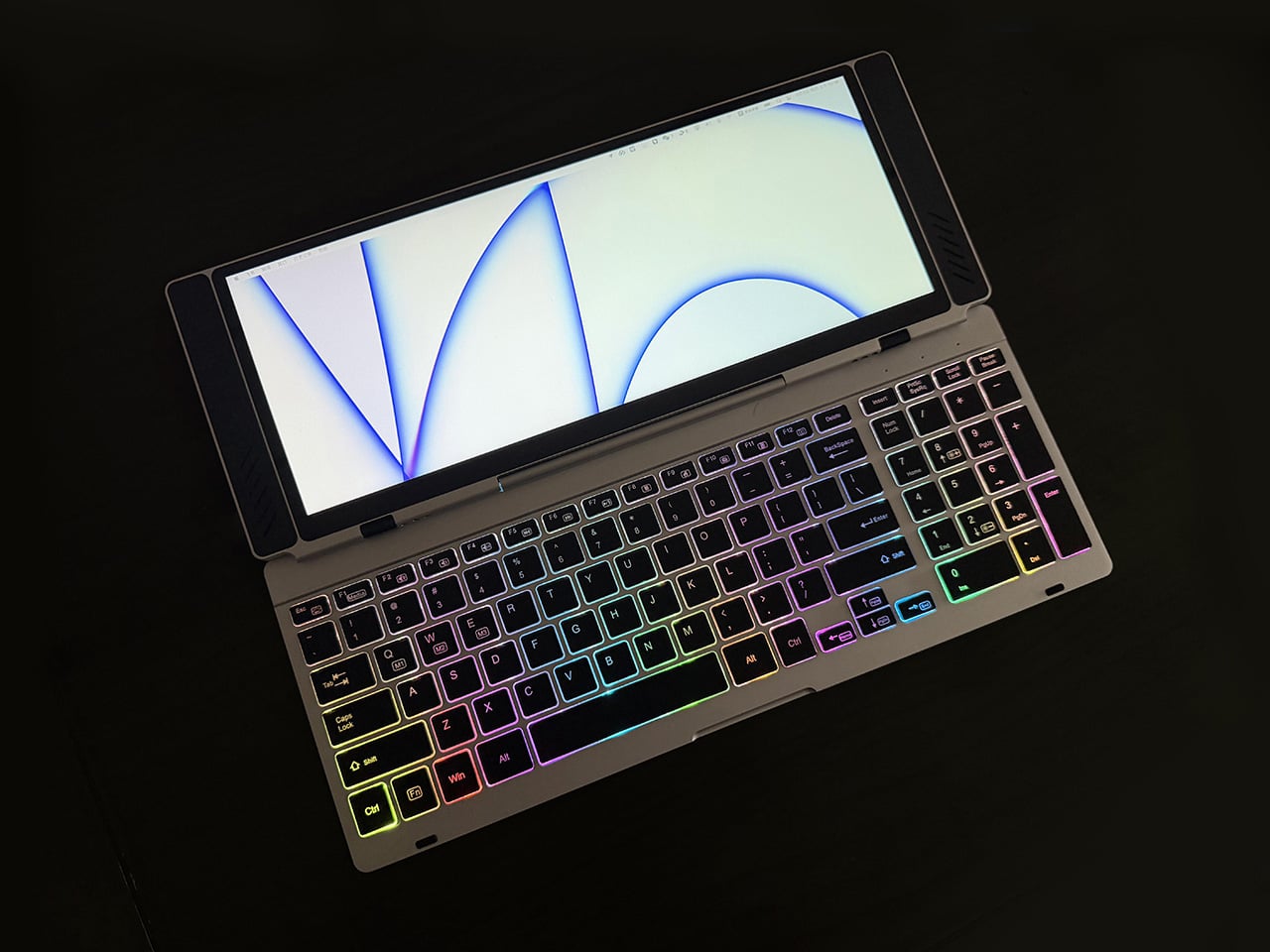
The keyboard is the part that usually betrays products like this. Portable keyboards compress key spacing to save millimeters, shorten travel to save thickness, and leave you typing on something that feels like a shallow membrane rather than actual keys. VitaLink went in the opposite direction, widening key spacing to 3.27mm and setting travel at 0.8mm, with scissor switches tuned for speed and quiet actuation. The display above it runs at 3840×1600 with a 2.4:1 aspect ratio, a cinematic proportion that gives the screen an unusually wide horizontal span, well-suited to keeping a reference panel open alongside a working document without feeling like you’re squinting at either side.
The resolution translates to 298 pixels per inch, which puts it in the same territory as Apple’s Retina displays and well above the pixel density of most portable monitors in this category. Text holds sharp at native scaling, fine details in images stay crisp, and the 60Hz refresh rate keeps touch input feeling immediate. Ten-point multitouch means gestures respond the way they do on a tablet, with swipes, pinches, and drags registering without lag. The screen covers 100 percent of the sRGB color gamut, which makes it viable for color-sensitive work where you need confidence that what you see on the display matches what the final output will deliver. That 2.4:1 ratio keeps showing up as the design’s defining decision; it gives you enough horizontal real estate to run a code editor with a console window beside it, or a timeline with a preview panel, without either side feeling like it’s been compressed into a narrow strip.
Typing on the VitaLink is designed to feel deliberate in a way that most travel keyboards do not. The 0.8mm of key travel sits in a range where the keys actuate fast but still give tactile confirmation that you pressed them, a balance that makes a difference during long writing sessions where you need speed without sacrificing accuracy. The 3.27mm key spacing is wider than what most compact keyboards offer, eliminating that cramped sensation where your fingers feel like they’re hunting for keys in tight quarters. RGB backlighting runs through three modes, activated with function key shortcuts: a breathing gradient, a solid single-color backlight, and a rainbow wave that ripples across the keys as you type. The backlighting does actual work in low-light environments, but the rainbow mode leans more toward visual flair than strict utility.
CNC machining means the aluminum body starts as a solid block and gets precision-carved, producing the kind of structural rigidity that protects the screen during transit and prevents flex when you’re typing hard. The 180-degree hinge lets the unit lay completely flat, which matters both for stability on uneven surfaces and for low-angle use when you’re working on a cramped airplane tray table or a café counter. Dual USB-C ports handle video, data, and power delivery up to 65W, so a single cable from your laptop, tablet, or phone brings the display to life with no drivers to install. Compatibility spans Windows, macOS, Linux, and Android, with plug-and-play recognition across all of them. Connect a Steam Deck or a Nintendo Switch via USB-C, and the VitaLink becomes a 13-inch 4K external display for handheld gaming, turning a small console screen into something considerably more immersive.
VitaLink offers eight keyboard layout options, covering US Windows (the default), US Mac, German QWERTZ, Japanese JIS, UK, French AZERTY, Nordic, Italian, and Spanish. The standard US Windows layout ships at no extra cost; upgrading to US Mac adds ten dollars, German or Japanese layouts add twenty, and UK, French, Nordic, Italian, or Spanish layouts add thirty. The layouts require specific laser engraving and dedicated production runs, so they’re available as optional add-ons rather than default configurations. You select your preferred layout during checkout or in a post-campaign survey if you miss it the first time.
VitaLink is currently available on Kickstarter starting at $299, down from a retail price of $658. The package includes the VitaLink keyboard and display unit plus two USB-C cables. Eight keyboard layout options are available as add-ons, including US Mac, German QWERTZ, Japanese JIS, UK, French AZERTY, Nordic, Italian, and Spanish, with upgrade fees ranging from $10 to $30 depending on the layout. Shipping is scheduled for September 2026, with delivery fees ranging from approximately $18 to $33 depending on region. VitaLink covers all taxes and customs duties, so the listed shipping fee is the only additional cost beyond the pledge amount.
Working on the go rarely looks as tidy as productivity-tool adverts suggest. Most people who travel with serious work needs end up carrying at least two or three things that don’t quite fit together: a tablet or laptop, a compact keyboard if the touchscreen isn’t enough, maybe a portable monitor, and a cable situation that somehow multiplies every time you pack.
VitaLink is trying to simplify that. The concept combines a full-size keyboard and a large touch display into one foldable object in a CNC aluminum shell. Connect it to any USB-C device and your workspace expands immediately, without a separate stand, a monitor arm, or a bag pocket devoted to adapters. It folds down to 20mm and opens into something that feels genuinely designed.
The integrated 13-inch display sits directly above the keyboard in what amounts to a compact laptop form factor. The screen runs at a 3840×1600 pixel resolution, a 2.4:1 ultra-wide format rather than a standard 16:9 panel, giving it an unusual amount of horizontal room. There’s enough space to keep two apps open side by side without either feeling squeezed into a corner.
The 180-degree hinge is what makes the compact form actually practical. When you’re done, everything closes into a flat 20mm slab that slips into a laptop sleeve without awkward bulk. The open footprint sits at around 34 × 15 cm, compact enough for a plane tray table, a crowded café counter, or a hotel desk that never seems to fit anything comfortably.
The panel supports 10-point touch, runs at 60 Hz, and delivers 298 PPI pixel density with 100% sRGB color coverage. Touching a screen this size changes how you interact with content. You can swipe, drag, and tap directly on the display while still using the keyboard below, which means managing layers in an editor, scrubbing a timeline, or pulling up references doesn’t require switching between input modes.
The keyboard uses scissor-switch mechanisms with 0.8mm of key travel and wider-than-typical spacing. That added spacing sounds like a minor detail until you’ve spent an hour trying to type accurately on a portable board that prioritizes size above everything else. Three RGB backlight modes let you set the visual tone, and the keys are designed to stay quiet enough for cafés and shared offices.
Two USB-C ports handle video, data, and power delivery through a single cable, and the plug-and-play setup works across Windows, macOS, Linux, iOS, and Android without requiring additional drivers. That compatibility extends to mini PCs, tablets, and handheld gaming consoles, so VitaLink isn’t tied to one kind of device. You’re not locked into a single workflow or a single ecosystem, which is most of the appeal.
Think about what that actually means. You’re in a hotel room with just your iPad and need a proper keyboard and enough screen space to write, edit, and reference something at once. Or you’re at a café with a mini PC and want a setup that doesn’t take over the whole table. Those are the moments where having the keyboard and the display in one object makes a real difference.
The aluminum body does more than keep things thin. CNC-machined aluminum with a frosted anodized finish gives it a rigidity that plastic travel accessories rarely have, protecting the display in transit and keeping the keyboard deck from flexing during typing sessions. It carries more like a slim hardcover notebook than a peripheral, which is a meaningful difference for anyone who’s dealt with a flimsy portable monitor in a crowded bag.
There’s something worth noting in the fact that portable work setups have gotten faster without necessarily getting more cohesive. The bag is still a loose collection of things that don’t quite belong together. VitaLink is at least making a case that the keyboard and the display belong in a single intentional object, built from the start for people whose work doesn’t stay in one place.









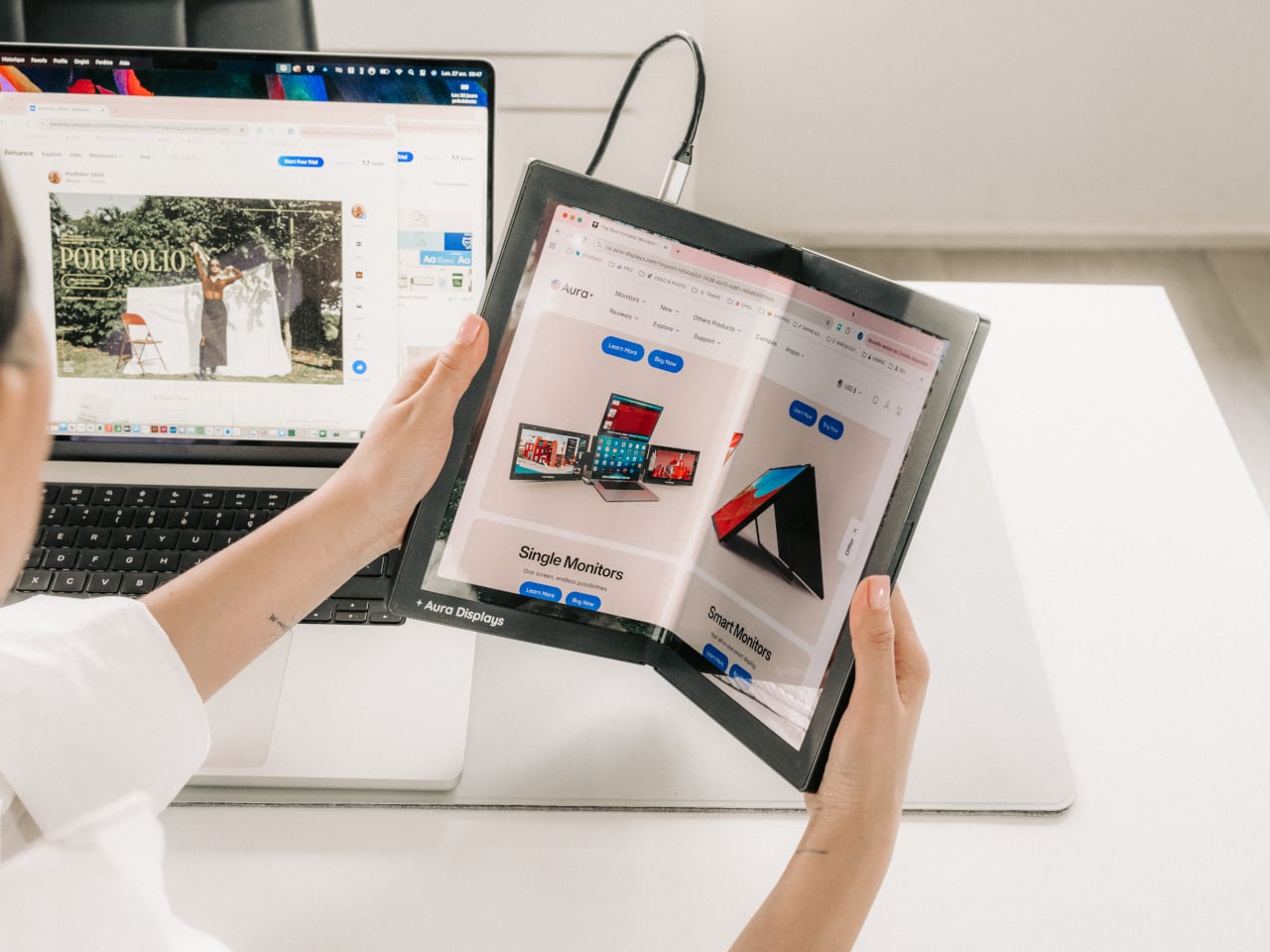
 technology that lets the screen bend, fold, and adapt to angles and surfaces that no rigid display can match.