The Dynamic Island is Finally Changing: New iPhone 18 Leak Reveals 35% Smaller Design

The Dynamic Island is Finally Changing: New iPhone 18 Leak Reveals 35% Smaller Design Graphic showing iPhone 18 launch timing rumors, with Pro models in September 2026 and base model in early 2027.

The iPhone 18 is poised to be a pivotal release for Apple, emphasizing internal advancements over a dramatic redesign. Recent leaks suggest a blend of innovative technology and strategic adjustments that could reshape your experience with the next generation of iPhones. While the exterior design may remain familiar, the internal upgrades promise to deliver meaningful […]

The post The Dynamic Island is Finally Changing: New iPhone 18 Leak Reveals 35% Smaller Design appeared first on Geeky Gadgets.

Posted in Uncategorized

Vaultwarden a Free Password Manager Without Monthly Subscription Fees

Vaultwarden a Free Password Manager Without Monthly Subscription Fees Docker Compose file on screen with Vaultwarden container settings and mapped storage volumes for data persistence.

Managing passwords effectively is a challenge, especially when balancing privacy, functionality and cost. In a recent guide by Better Stack, the focus shifts to Vaultwarden, a self-hosted, open source password manager that offers a compelling alternative to subscription-based services like 1Password or Bitwarden Cloud. Vaultwarden stands out for its end-to-end encryption and the ability to […]

The post Vaultwarden a Free Password Manager Without Monthly Subscription Fees appeared first on Geeky Gadgets.

Posted in Uncategorized

Using Google Stitch to Build High-Converting Landing Pages in Minutes

Using Google Stitch to Build High-Converting Landing Pages in Minutes A prompt in Google Stitch generates a landing page layout with colors, fonts, and sections already arranged.

Google Stitch, part of Google’s Vibe Design initiative, is an AI-powered platform that simplifies the process of creating landing pages and other web assets. Unlike traditional design methods that often require significant technical expertise, Stitch enables users to generate layouts, stylesheets and even interactive dashboards through simple prompts. Marketing Against the Grain highlights how this […]

The post Using Google Stitch to Build High-Converting Landing Pages in Minutes appeared first on Geeky Gadgets.

Posted in Uncategorized

The Eames House Was Always Meant to Be Yours

If you’ve ever stood in front of a photograph of the Eames House and felt a quiet longing, you’re not alone. That black steel frame, the jewel-toned panels, the floor-to-ceiling glass looking out onto a California meadow. It’s one of those images that lodges itself somewhere deep in your design-brain and refuses to leave. Most of us just assumed it would stay a photograph. Turns out, Charles and Ray Eames had other plans all along.

The Eames House, or Case Study House #8, was completed in 1949 in Pacific Palisades, California. It was built as part of Arts & Architecture magazine’s Case Study House program, which challenged architects to design homes using post-war industrial materials and techniques. Charles and Ray made something so effortlessly beautiful that it became one of the most photographed residences of the 20th century. But here’s the part most people miss: they always saw it as a starting point, not a masterpiece. Their real goal was a universal architectural system, one accessible to almost anyone and deployable almost anywhere. They never got there. That dream stayed tucked in archives, in sketches, in proposals that never left the studio. There was even a flat-pack modular concept the couple researched independently, informally called the “Supermarket House.” That name alone tells you exactly what they were going for.

Designer: Kettal

Nearly 80 years later, the Eames Office and Spanish manufacturer Kettal are finally making it happen. The Eames Pavilion System is a modular building kit that draws directly from those decades of unpublished drawings and ideas. Eckart Maise, former chief design officer at Vitra, spent three years digging through the Eames archives to surface material that had largely never been seen, including an unrealized California dome home and those flat-pack housing studies. What emerged is not a replica of Case Study #8, but something more faithful to its spirit: a system built on the same principles of efficiency, flexibility, and honest materiality.

The structure is made from aluminum throughout, a significant upgrade from the original steel and considerably more weather-resistant. You get interchangeable roof types, triple-glazed windows, and wall panels that echo the bold primary colors Ray loved. The visual DNA is unmistakable. Zig-zag trusses, black-painted frame, chicken wire-reinforced glass. It is recognizably Eames without pretending to be a museum piece.

Pricing starts at around $325 per square foot. A 4-by-4-meter indoor pavilion begins at roughly €45,000 (about $52,000), and an outdoor version of the same size starts at €60,000. The double-height configuration that most closely resembles Case Study #8 comes in at €145,000. For a lot of people, that’s still a stretch. But compare it to what custom architecture typically costs, and it starts to read more like a genuine offer than a luxury souvenir.

The use cases are broad by design. A home recording studio, a backyard office, a guest pavilion, a poolside retreat. With enough modules assembled and stacked, a full two-story house is achievable. Kettal also factors in the support of a trained advisor, someone who makes sure the configuration you choose actually works for your specific site and climate conditions. The indoor version hits the market at the end of 2026, with the outdoor version following in 2027.

The Eames Pavilion System is making its debut at Milan Design Week 2026, as part of a Triennale di Milano exhibition called “The Eames Houses,” opening in April. Seeing it presented there feels appropriate. The Triennale has always been a place where design gets to ask bigger questions than just whether something looks good. The question this project raises is genuinely worth sitting with: what does it mean to actually democratize an icon, and not just sell the idea of one?

I think Charles and Ray would have approved of the answer Kettal and the Eames Office arrived at. Not a knockoff. Not a nostalgia play. A real building system, rooted in the same rigorous thinking that produced the original house, finally getting the chance to do what it was always supposed to do: show up wherever someone needs it.

The post The Eames House Was Always Meant to Be Yours first appeared on Yanko Design.

Apple M4 Ipad Air at $600 Targets Hybrid Use with 12GB Memory

Apple M4 Ipad Air at $600 Targets Hybrid Use with 12GB Memory Rear view of the aluminum M4 iPad Air highlighting camera placement and available color finishes.

The M4 iPad Air establishes itself as a benchmark in the mid-tier tablet category, offering a compelling mix of performance, affordability and versatility. Powered by the advanced M4 chip and equipped with 12GB of memory, it delivers a substantial performance upgrade over its predecessor, the M3 iPad Air. Designed as a hybrid device, it bridges […]

The post Apple M4 Ipad Air at $600 Targets Hybrid Use with 12GB Memory appeared first on Geeky Gadgets.

Posted in Uncategorized

Why Lenovo’s 8.8-Inch Tablet is Secretly a Portable PC Gaming Rig

Why Lenovo’s 8.8-Inch Tablet is Secretly a Portable PC Gaming Rig Game Assistant panel on Legion Y700 Gen 5 with FPS counter, key mapping, and performance modes.

The Lenovo Legion Y700 Gen 5 is an 8.8-inch Android tablet designed with both performance and versatility in mind. According to ETA Prime, it features the Snapdragon 8 Elite Gen 5 processor, which delivers efficient multitasking and reliable performance for demanding applications. The tablet’s display includes a 165Hz refresh rate, Dolby Vision support and a […]

The post Why Lenovo’s 8.8-Inch Tablet is Secretly a Portable PC Gaming Rig appeared first on Geeky Gadgets.

Posted in Uncategorized

Apple’s 8GB Mystery: What’s Really Inside the iOS 26.5 Beta 1?

Apple’s 8GB Mystery: What’s Really Inside the iOS 26.5 Beta 1? Featured image for iOS 26.5 - This is it !

Apple has officially launched the first beta of iOS 26.5, marking the final significant update to iOS 26 before the highly anticipated release of iOS 27. While this update does not introduce dramatic overhauls, it focuses on incremental improvements that enhance usability, refine existing features, and prepare users for the next generation of Apple’s mobile […]

The post Apple’s 8GB Mystery: What’s Really Inside the iOS 26.5 Beta 1? appeared first on Geeky Gadgets.

Posted in Uncategorized

6 New Teacher Specific Copilot AI Tools Unlocked In Microsoft 365

6 New Teacher Specific Copilot AI Tools Unlocked In Microsoft 365 Teacher views Microsoft 365 Copilot Teach tools for aligning lesson content to local standards in multiple languages.

Microsoft 365 has introduced six AI-driven features within its Teach module, aimed at helping educators create more effective and accessible learning materials. These updates include options for aligning lesson content with educational standards across 35 countries, as well as features like “Add Supporting Examples,” which allows teachers to incorporate real-world scenarios into their lessons. According […]

The post 6 New Teacher Specific Copilot AI Tools Unlocked In Microsoft 365 appeared first on Geeky Gadgets.

Posted in Uncategorized

iPhone Power, Mac Soul: How the MacBook Neo’s A18 Pro Chip Changes Everything.

iPhone Power, Mac Soul: How the MacBook Neo’s A18 Pro Chip Changes Everything. Price chart comparing MacBook Neo tiers, including $499 student pricing and the $699 512GB Touch ID model.

Apple has unveiled the MacBook Neo, a laptop designed to bridge the gap between affordability, performance, and premium design. As the most cost-effective MacBook in Apple’s lineup, it caters to a diverse audience, including students, professionals, and casual users. Starting at just $499 for students, the MacBook Neo delivers a blend of premium features and […]

The post iPhone Power, Mac Soul: How the MacBook Neo’s A18 Pro Chip Changes Everything. appeared first on Geeky Gadgets.

Posted in Uncategorized

Lenovo’s $799 Puck-Shaped PC Weighs 600g and Drives 4 Displays

The traditional desktop PC has been losing ground for years, not to laptops or tablets, but to a growing class of machines that ask a surprisingly simple question: why does a powerful computer have to be big? Mini PCs have carved out a real niche, attracting everyone from home office workers to creative professionals who’d rather not surrender half their desk to a tower.

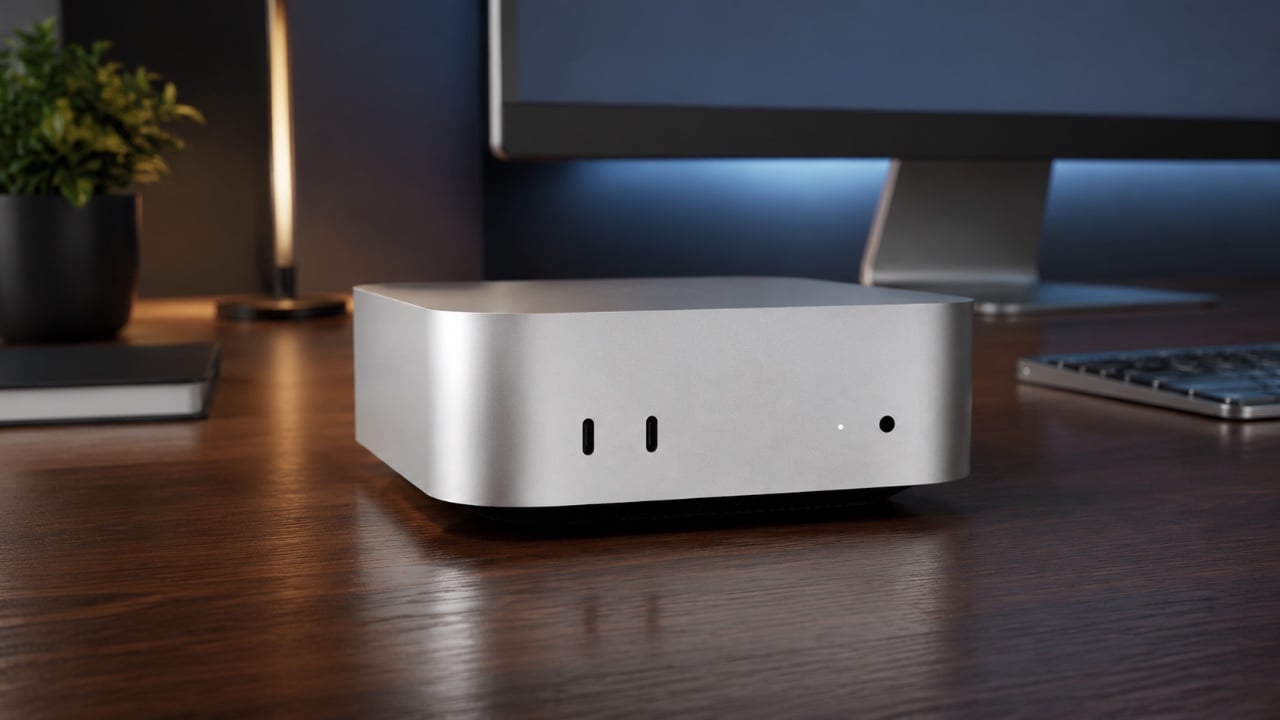
Most mini PCs, however, don’t quite look like they belong in the spaces they’re meant to save. They’re functional, sure, but rarely memorable. Lenovo’s Yoga Mini i Gen 11 tries to do something about that. First shown at CES 2026 and now moving toward a global release, it arrives as a circular, aluminum-clad machine with a polished Seashell finish, designed to feel as considered as it is compact.

Designer: Lenovo

The chassis weighs just 600 grams and occupies only 0.65 liters of space, small enough to perch on a desk corner, mount behind a monitor, or move between rooms without a second thought. Lenovo describes the circular form as a deliberate design choice, meant to create a cleaner, more efficient footprint both physically and visually, rather than simply shrinking a conventional rectangular box.

Under the hood, the Yoga Mini i Gen 11 runs on Intel’s Panther Lake platform, one of the first consumer chips built on the company’s 18A manufacturing process. The top-tier configuration uses the Core Ultra X7 358H, a 16-core processor that boosts up to 4.8 GHz with 18 MB of smart cache. Both the X7 and the base Core Ultra 5 325 chip include an onboard NPU for AI-accelerated tasks.

The NPU on the X7 model delivers up to 50 TOPS, enough to keep AI tasks running without taxing the main processor. Supporting it are up to 32 GB of LPDDR5X memory and up to 2 TB of NVMe storage, paired with Intel Arc B390 graphics. That combination makes it capable of handling light creative work, video editing, and multi-application workflows without breaking a sweat.

Connectivity is where the Yoga Mini i Gen 11 gets genuinely impressive for a machine this size. It supports up to four simultaneous displays through dual Thunderbolt 4 ports, multiple USB-C ports with DisplayPort, and HDMI 2.1 at 4K and 60 Hz. USB-A, 2.5 GbE Ethernet, Wi-Fi 7, and Bluetooth 6.0 round out a connectivity lineup that punches well above its weight.

A few smart touches add a layer of intelligence to the everyday experience. Wi-Fi Sensing detects nearby presence to wake or lock the machine automatically. Adaptive Lighting adjusts to surrounding sound and activity, while touch controls and an onboard accelerometer enable gesture-based inputs. A fingerprint reader in the power button, Microsoft Pluton, and Secured-core PC certification handle security for users with more sensitive data requirements.

Lenovo has already launched the Yoga Mini i Gen 11 in China ahead of its originally planned July 2026 global release window, with an entry-level model priced at CNY 5,499, roughly $799. Broader availability across other regions is expected before mid-year. It also carries ENERGY STAR, FSC, and carbon-neutral certifications, which add a sustainability angle to its otherwise performance-driven pitch.

The post Lenovo’s $799 Puck-Shaped PC Weighs 600g and Drives 4 Displays first appeared on Yanko Design.