Taiwan issues arrest warrant for Pete Lau, CEO of OnePlus

Taiwanese officials have issued an arrest warrant for OnePlus CEO Pete Lau on allegations of illegally employing workers in Taiwan. Two Taiwanese citizens who worked for Lau have also been indicted. The China-based smartphone company has been accused of illegally recruiting more than 70 engineers from Taiwan. 

Members of the Shilin District Prosecutors Office claim that OnePlus reportedly set up a shell company in Hong Kong with a distinct name, then launched a branch in Taiwan in 2015 without government approval. The branch reportedly worked on research and development for OnePlus mobile phones. Taiwanese officials claim these actions by OnePlus violated the Cross-Strait Act, which is designed as a guide for relations between Taiwan and mainland China. One of the act’s provisions requires Chinese companies to obtain permission from the Taiwanese government to hire workers from Taiwan.

This article originally appeared on Engadget at https://www.engadget.com/mobile/smartphones/taiwan-issues-arrest-warrant-for-pete-lau-ceo-of-oneplus-185400997.html?src=rss

The Morning After: The best of CES 2026

We’re wrapping up coverage of the biggest tech show in the world. CES 2026 is almost over, and while we have more stories and wrap-ups to come, here are the most interesting products we’ve spotted, written about and critiqued/praised. That includes our picks for the best of CES. We gave out 15 awards as well as our best of show, and you might be surprised by some of our picks — I know I was.

Read on for some of the best things to come out of Las Vegas this week, but first up, our Best of the Best winner, which was Lego Smart Play. As Engadget’s editor-in-chief Aaron Souppouris put it, “Lego could almost be seen as the antithesis of the typical CES product.”

Regardless of trends, Lego has always persisted. And in 2026, it’s getting much smarter.

TMA
Lego

The system consists of a Smart Brick, Tags and Minifigures. They’re packed with modern technology, so they can respond to how you play with them or the sets you build. The Smart Brick has a 4.1mm ASIC chip, which Lego says is smaller than a standard Lego stud. It senses things like motion, orientation and magnetic fields, but also has a tiny built-in speaker, which produces audio “tied to live play actions,” not just canned clips.

It’s hard to explain it in only a few words (we’ve got a deep-dive hands-on right here), but what immediately drew me in was the lack of smartphone pairing and screens. The ability of each part to detect and interact with others can lead to some ridiculous setups, whether it’s ducks and police officers or a helicopter or an X-Wing.

Naturally, it’s a little pricier than basic Lego, but not out of the realm of being a special gift or birthday present. One of the first sets, with a smart Darth Vader Minifigure, one Smart Brick and one Smart Tag, is $70.

We'll be back to our regularly scheduled newsletter next week. Have a great weekend!

— Mat Smith


TMA
Engadget

With no further ado, here are our winners.

Best robot: Switchbot Onero H1

Best accessibility tech: WheelMove

Best TV: LG’s Wallpaper TV

Best AI hardware: Subtle Voicebuds

Best smart home: IKEA Matter-compatible smart home

TMA
Engadget

Best home theater: Samsung HW-QS90H

Best audio: Shokz OpenFit Pro

Best outdoor tech: Tone Outdoors T1

Best toy: Lego Smart Play

Best PC or laptop: Dell XPS 14 + 16

Best health tech: Eyebot eye test booth

Best gaming tech: ASUS ROG Zephyrus Duo

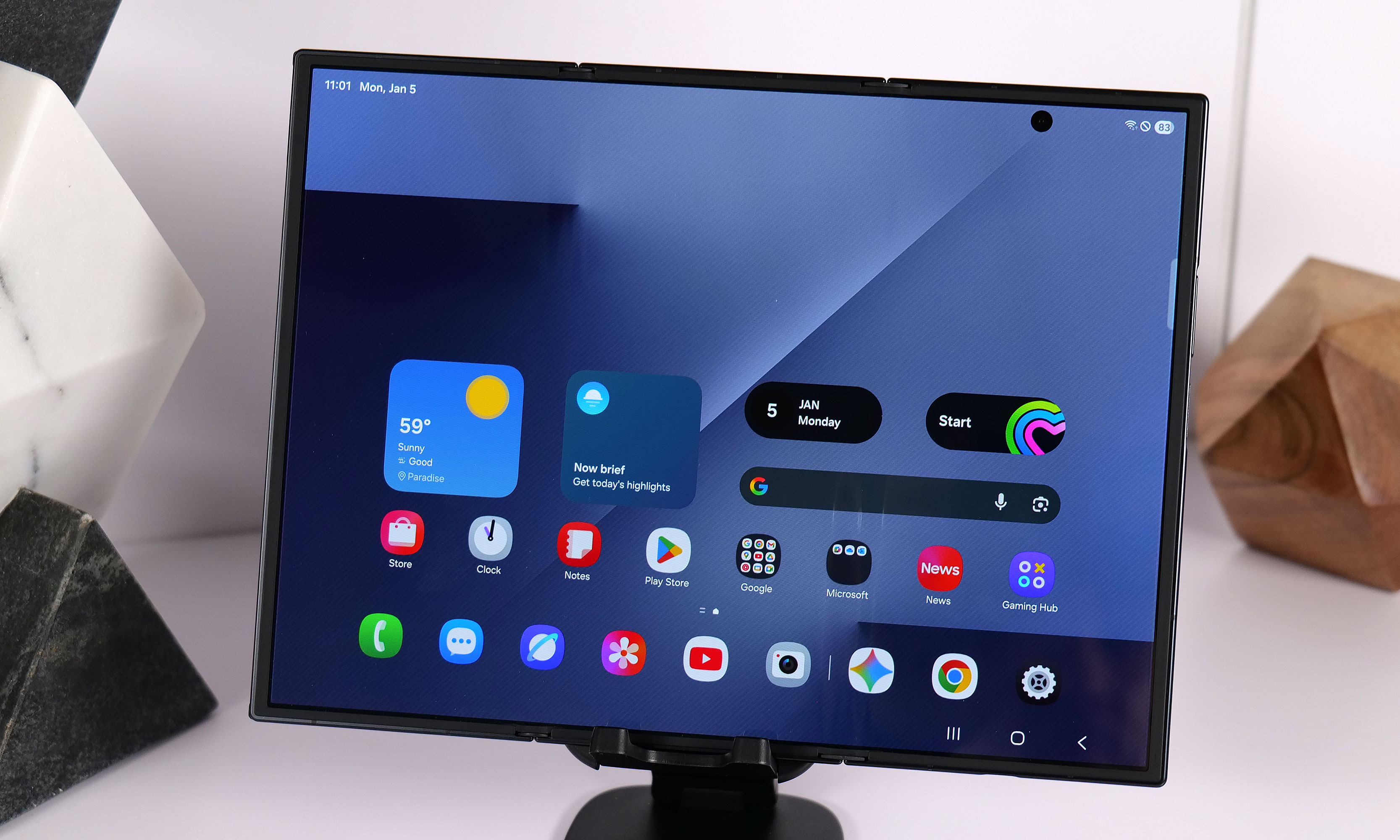
Best mobile tech: Samsung Galaxy Z TriFold

Most promising concept: Lenovo Legion Pro Rollable

Best emerging technology: IXI autofocus lenses


TMA
Engadget

On Monday, which feels like an age ago, Jensen Huang shared the latest from NVIDIA. While the presentation was more a refresher than a barrage of new announcements, it was a pretty low-key presentation, with lots of AI chat. One announcement was Alpamayo, a family of open-source reasoning models designed to guide autonomous vehicles through difficult driving situations. The centerpiece is Alpamayo 1, a 10-billion-parameter chain-of-thought system NVIDIA says can drive more like a human.

When it comes to tech we all might use, we had to wait for a separate event, when NVIDIA announced DLSS 4.5 and G-Sync Pulsar. For both features, you’ll need a 50-series GPU. You got one, right?

Continue reading.

This article originally appeared on Engadget at https://www.engadget.com/general/the-morning-after-engadget-newsletter-193045065.html?src=rss

Pebble brings its round-faced smartwatch back from the dead

You’ve probably heard people say it’s impossible to go back and correct some error from the past. To those people, you should raise a middle finger in defiance (they are miserable, after all), and then point them to the tale of Pebble’s unlikely revival. The smartwatch pioneer’s return was a surprise of 2025, and now the company has resurrected one of its last great triumphs. It’s announcing the Pebble Round 2, and company founder Eric Migicovsky is looking to put right what once went wrong.

The Pebble Round 2 is the successor to the Pebble Time Round, which debuted in 2015 to what can only be described as frustrated reviews. It was a truly thin smartwatch, with a glorious round display, but that came at the cost of battery life and durability. The fancier components also added to the cost which pushed it to an unreasonable-for-the-time $249. It’s these flaws which the company has sought to address with the Round 2, as well as some of the issues that weren’t deal breakers at the time, but certainly weren’t ideal. 

For instance, the massive bezel around the display is now a thing of the past, with the Round 2’s 1.3-inch color e-paper touchscreen now stretching to the edge of its case. The viewing angles have also been dramatically improved, enabling you to check the time without having to move your wrist. The display has also been bonded to the glass crystal, reducing reflectivity and glare which was another downside for the original model. 

Better still, the battery life is now more than two weeks on a single charge, giving it the sort of Pebble-esque longevity its users demand. And it’s retained that thinness — measuring in at just 8.1mm — which is far more elegant than the chunkier smartwatches from other manufacturers. Plus, there’s dual microphones for interacting with AI agents and dictating messages, as well as step and sleep tracking.

Migicovsky explained that the focus here isn’t just to correct some of the more glaring issues from the first model. As he wrote back in 2022, Pebble’s failure was down to its attempt to broaden its appeal beyond the users who had so warmly adopted it in the first place. Consequently, rather than include bulky features like a a built-in optical heart-rate sensor, the focus is on utility. Not to mention a desire to reintroduce some much-needed whimsy into hardware, and empowering users to tinker with their devices, enabling them to craft their own watch faces.

Hopefully, we’ll get some time in person with the Pebble Round 2 in the next few days, but in the meantime, it’s up for pre-order from today. It’ll set you back $199, and will begin shipping in May. And if you’ve already put down cash for a Pebble Time 2, and want to change your mind, you can switch your order over, no questions asked.

This article originally appeared on Engadget at https://www.engadget.com/wearables/pebble-brings-its-round-faced-smartwatch-back-from-the-dead-150000172.html?src=rss

Save on Crunchyroll annual subscriptions this holiday season

If you're struggling to find your next binge-watch, you can't go wrong with anime. For the holidays, you can save on a Crunchyroll subscription, giving you access to its vast library of anime series to watch. Through December 29, you can sign up for an annual Fan subscription for $67, down from the usual $80, or a Mega Fan subscription for $100, down from $120.

While both the Fan and Mega Fan plans are ad-free, you do get some different benefits depending on which you decide to pay for. Fan subscribers get full access to Crunchyroll's library, new episodes "shortly after they air in Japan" and five percent off select purchases in the Crunchyroll Store. Mega Fan subscribers get all those benefits, plus the ability to stream on four devices at the same time, download HD quality episodes and movies to view offline, play games from the Crunchyroll Game Vault and receive 10 percent off select products in the Crunchyroll Store.

Notably missing from either subscription is access to Crunchyroll's new Manga service, but unless you're specifically looking for reading material, you'll get plenty of entertainment out of Crunchyroll's video library. Outside of Netflix, which produces and licenses its own growing collection of anime, Crunchyroll is the de facto place to watch Japanese animation in the US. You'll find long-running series like One Piece and newer hits like Spy X Family, alongside hundreds of more niche series.

Crunchyroll has its issues, of course. Since the streaming service was acquired by Sony, it's been particularly interested in using generative AI to subtitle shows, which has already produced poor results. It's hard to beat Crunchyroll's library, though, and for as little as $65, you'll get more than your money's worth.

Check out our coverage of the best streaming deals for more discounts, and follow @EngadgetDeals on X for the latest tech deals and buying advice.

This article originally appeared on Engadget at https://www.engadget.com/deals/save-on-crunchyroll-annual-subscriptions-this-holiday-season-194345431.html?src=rss

Samsung Wallet to gain support for digital Porsche keys

Owners of the Porsche Macan and upcoming Porsche Cayenne Electric will be able to unlock and start their cars with their Galaxy phones, Samsung has announced. The cars, alongside other Porsche models, are gaining support for Samsung Wallet's Digital Key feature, which lets users wirelessly control their car over a secure UWB or NFC connection.

Digital Key support will be available in Europe in December, before rolling out globally, "aligned with the launch timeline of Porsche vehicles," Samsung says. Samsung Wallet is available on Samsung devices as old as the Galaxy S20, Note 20, Galaxy Z Fold 2 and Galaxy Flip 5G, and is included on the majority of the company's new phones. Like similar features on Google's Pixels and Apple's iPhones, Digital Key allows Porsche owners with a supported Galaxy phone to unlock, lock and start their car directly from their phone. If your phone is ever taken, you can also remotely lock or delete a Digital Key to keep your car safe.

Samsung added Digital Key support to select Volvo and Polestar EVs in February 2025. The feature first became available in 2021, and is one of several ways the phone maker imagines people will use Samsung Wallet. Beyond digital car keys, the app can also store credit and debit cards and be used to transfer money with a tap.

This article originally appeared on Engadget at https://www.engadget.com/mobile/smartphones/samsung-wallet-to-gain-support-for-digital-porsche-keys-193000085.html?src=rss

Pick up our favorite Anker MagSafe power bank while it’s on sale for 34 percent off

If you're traveling for the holidays, there are few things more useful to take with you than a portable charger. Whether you're using your phone for music and navigation on a long drive or music and logistics before, during and after a flight, you'll want it to stay alive for the entire door-to-door journey. A number of our favorites — like this Anker MagGo 10K bank — are on sale right now for record-low, or close to them, prices.

Even better, the Anker MagGo power bank is currently on sale for $60, down from $90. This 34 percent discount brings the power bank to only $5 more than its all-time low price. We're big fans of Anker's MagGo power bank — one of the first and best Qi2-certified products available. You can get about 1.7 iPhone 15 charges out of it and bring your phone from five percent to 60 percent in a little more than 45 minutes. Plus, the stand makes it easy to keep using your phone while it charges. 

Two of our other picks for best MagSafe power bank are also on sale — and down to record-low prices. The Baseus Picogo 25W Power Bank is 24 percent off and down to $53 from $70. Meanwhile, the Ugreen MagFlow 10,000mAh 25W Power Bank has dropped to $60 from $90 — a 33 percent discount. 

Follow @EngadgetDeals on X for the latest tech deals and buying advice.

This article originally appeared on Engadget at https://www.engadget.com/deals/pick-up-our-favorite-anker-magsafe-power-bank-while-its-on-sale-for-34-percent-off-151039668.html?src=rss

Snapdragon devices will soon be able to transfer files to iPhones via Quick Share

Building on Google's recent announcement that Android's Quick Share will work with iOS' AirDrop for Pixel 10 smartphones, Qualcomm revealed in a post on X that the cross-platform file-sharing feature will be available on devices powered by its Snapdragon chips. In the post, Qualcomm said that it "can't wait for people to use this once enabled on Snapdragon in the near future."

It's not a complete surprise since Google mentioned in its announcement that Quick Share to AirDrop would come to more Android devices. However, the Snapdragon confirmation acknowledged that this new compatibility wouldn't be limited to Pixel smartphones or devices running Google Tensor chips. Soon, we could have the ability to share files with iPhone users, even if it's with a Samsung Galaxy smartphone, a OnePlus device or even Nothing phones.

Qualcomm didn't specify exactly when or which smartphones will get this Quick Share to AirDrop feature, but we might see it come to more devices than just smartphones, like tablets or laptops. Along with this latest file-sharing feature, Apple's announcement of iOS 18 getting RCS compatibility has reduced the longstanding friction between smartphone operating systems.

This article originally appeared on Engadget at https://www.engadget.com/mobile/smartphones/snapdragon-devices-will-soon-be-able-to-transfer-files-to-iphones-via-quick-share-164835065.html?src=rss

Apple and Issey Miyake’s iPhone Pocket is a knitted sleeve to hold your phone

Apple has announced a new accessory that feels a bit out of left field, to say the least. Say hello to the limited edition iPhone Pocket, a 3D-knitted "ribbed open structure" designed in collaboration with Issey Miyake. Available with a short or long strap design, it can be worn on your arm, attached to a bag or across your body. 

"The design of iPhone Pocket speaks to the bond between iPhone and its user, while keeping in mind that an Apple product is designed to be universal in aesthetic and versatile in use," Miyake Design Studio design director, Yoshiyuki Miyamae, said in a statement. "iPhone Pocket explores the concept of ‘the joy of wearing iPhone in your own way.'"

Yes, this "additional pocket" is a real item that you can purchase and decide for yourself if it's bizarre or — dare we say — kind of chic? The iPhone Pocket's short strap model is available in lemon, mandarin, purple, pink, peacock, sapphire, cinnamon and black. The long strap design comes in sapphire, cinnamon and black. Apple’s vice president of industrial design, Molly Anderson, added that the different options were "intentionally designed to mix and match with all our iPhone models and colors."

iPhone Pocket colors.
Apple

The iPhone Pocket is available this Friday, November 14, on Apple's website. However, the release is not only limited in quantity, but in location. You can pick one up online from the US, France, Greater China, Italy, Japan, Singapore, South Korea or the UK. With phone theft so high in the latter, it isn't the worst option we've seen to keep your phone secure while out and about. 

If you live in very specific cities then you might also be able to see one in person. In the US, it will only be available at New York City's SoHo Apple Store. Whether you buy it in person or online, the iPhone Pocket will put you back a pretty penny. The short strap is going for $150, while the long strap retails for $230. 

This article originally appeared on Engadget at https://www.engadget.com/mobile/smartphones/apple-and-issey-miyakes-iphone-pocket-is-a-knitted-sleeve-to-hold-your-phone-103504776.html?src=rss

The best MagSafe power banks for your iPhone

Whether you were won over by the cameras on the new iPhone 17 or you’re sticking it out with your iPhone 12, having a little extra power around is never a bad thing. The best MagSafe power bank is one that attaches firmly, charges quickly and blends in with your handset — or better yet, adds a handy stand to the mix. Right now, the fastest wireless portable chargers are Qi2 25W-certified, but so far there are only a few of those on the market (and we have our favorite). But speed isn’t everything, looks, features and price factor in as well. We’ve tested more than a dozen portable chargers to help you find the best MagSafe battery you can buy.

Choose the right capacity. Most portable MagSafe chargers have either a 5,000 milliamp hour (mAh) or 10,000mAh capacity. Obviously, the larger capacity batteries are physically bigger, but thanks to an iPhone’s magnetic attachment points, you can still use the phone comfortably as it charges. If you’re worried about overall bulk, you may prefer the slimness of a 5,000mAh battery.

Just note that a 5K battery pack won’t deliver its entire capacity to your phone due to energy loss from voltage conversion and heat dissipation. Over the years, I’ve measured around a 60-percent delivery rate for wireless banks. For example, that means an iPhone 16 with its 3,561mAh battery will get about 85 to 90 percentage points from a 5K battery. A 10K bank will charge that same phone fully once, with enough for a 50- to 60-percent boost next time.

Understand MagSafe versus Qi2. All iPhones model 12 and later have MagSafe technology, which rely on embedded magnets to align the phone with a wireless charger and can support charging speeds of up to 15 watts. The MagSafe name is owned by Apple — third-party chargers can’t freely use the term and instead call their accessories “magnetic,” or apply a branded name like Anker’s MagGo or UGreen’s MagFlow. Be sure to check the product details before buying: anything that works with Apple’s technology will be listed as MagSafe-compatible.

Qi2 is a standard from the Wireless Power Consortium (of which Apple is a member) and has the same stipulations as MagSafe (15W charging and magnetic alignment). Any company can submit their tech for this certification. iPhones 13 and later are Qi2 compatible.

The newest standard, Qi2 25W (also called Qi2.2), bumps wireless charging speeds up to 25W. The WPC says a certified smartphone using a certified charger can wirelessly go from dead to half full in about 30 minutes (keep in mind that both the charger and phone need to be certified to get those speeds) and that aligns with our testing. 

Accessories, like power banks that support the new standard are starting to hit shelves now. As for phones, Google’s Pixel 10 Pro XL, Apple’s iPhone 17, iPhone 17 Pro and Pro Max all support the standard as well. iPhone 16 models (except the 16e) support the standard after an update to iOS 26.

Remember travel restrictions. You may have seen news reports of flights being grounded because a power bank caught fire in the cabin. Currently, the TSA allows them in your carry-on luggage as long as they’re rated at 100 watt-hours or lower (about 27,000mAh for lithium ion batteries).

But some airlines have enacted further restrictions. Southwest, for example, requires you to keep power banks out of the bag and visible while charging. Even if your airline doesn’t make such demands, keeping a power brick out in the open while it’s in use is a good idea — it’ll keep it cooler and you’ll be more likely to notice if it starts to overheat. Most, if not all, MagSafe battery packs come in at under the 100-watt-hour limit, so traveling should be easy with one.

Consider the extra features. You may not need them, but the little extra perks of a MagSafe power bank can come in handy. Some have stands so you can watch your phone while it refills. Some have LED displays that tell you how much charge is left, which can be a little more precise than the lighted pips other banks use. Some also have straps to make the bank easier to carry around or fish out of your bag.

When Apple introduced the iPhone Air, it announced the new $99 iPhone Air MagSafe Battery in the same breath. It’s now the sole Apple-branded MagSafe power bank — but it only works with the iPhone Air. It’s a pretty divisive battery. In his review of the new phone, Engadget’s Sam Rutherford appreciated that the accessory keeps with the sleekness of the iPhone Air design and liked that it can also charge the new AirPods 3 wirelessly. But Valentina Palladino called out its dismal price-to-capacity ratio.

Anker’s Nano MagGo Slim is probably a better bet for all but the most devoted iPhone user. It has the same minimalist look and pocketable thinness as Apple’s proprietary battery, but it’ll attach to other phones in addition to the Air. Plus it’s $35 cheaper.

Among the first results when I search for MagSafe power banks on Amazon is the Torras MiniMag power bank, so I thought I’d check it out. The max wireless charging output is 7.5 watts, but it was actually pretty speedy in refilling an iPhone 15, giving it a little less than 80 percentage points in about two hours. The battery itself recharges a bit slowly, and it’s a bit expensive at its full MSRP of $60, but it comes in pretty colors and if you can catch it on sale, it’s a decent choice.

The Mophie Powerstation Slim 5K, too, has a super slim design that nearly disappears into the back of the phone as it charges. It makes excellent use of its 5K capacity, delivering a 90 percent refill to an iPhone 15. But it’s a little more expensive than the our top slim pick, Anker’s Nano MagGo Slim, and the squared off design makes it feel bulkier than it actually is. Neither of those make it a bad choice; the MagSafe battery playing field is just terribly competitive right now.

Belkin’s BoostCharge Pro is Qi2-certified and was only a touch slower than other models in terms of charging speeds, boosting an iPhone 15 from 5 percent to full in about two and a half hours. The feel is premium and the stand is sturdy, but it got quite hot during charging, took overly long to refill itself and is pricer and a bit bulkier than similar models.

The Picogo 5K from Baseus is teensy but still packs a stand and a 5,000mAh capacity. It’s Qi2-certified and delivered a 43 percent bump to our tester iPhone 15 in 42 minutes, ultimately charging it to 91 percent. The slim slab of the Anker Nano battery is sleeker. But that one doesn’t have a stand — so if you want to prop up your phone while it charges, go for this one.

MagSafe is Apple’s own technology that supports up to 25W wireless charging speeds and incorporates embedded magnets to align the phone with chargers and other accessories.

iPhones 12 and later support 15W MagSafe technology, though only iPhones 13 and later can reach the 15W charging speed with third-party Qi2 accessories. The iPhone 12 maxes out at 7.5W with non-Apple accessories.

The new iPhone 17, 17 Pro and 17 Pro Max support up to 25W charging speeds with Qi2 25W-certified chargers. iPhone 16, 16 Pro and 16 Pro Max should also support those speeds after an update to iOS 26. The iPhone Air supports MagSafe charging at a max speed of 20W.

In most cases (heh), yes. The wireless charge can travel across a distance of a few millimeters. If the case is more than 5mm thick or contains metal components, the wireless charge can be blocked. Many iPhone cases are marketed as MagSafe-compatible, which means the case itself has complimentary magnets inside and should not interfere with charging accessories. We tested a MagSafe power bank on an iPhone 15 with and without a MagSafe case and got the same charging speeds and amounts in both tests.

That depends on the power bank. If it is Qi2-certified, it can provide up to 15 watts of wireless power. Qi2 25W-enabled chargers can deliver up to 25 watts to a compatible handset. Non-Qi2 batteries typically deliver around 7.5 watts.

The amount of charge delivered depends on the capacity. Most MagSafe portable chargers are rated at 5,000mAh or 10,000mAh. The former can get a standard iPhone 15 from five percent to around 90 percent. The latter can fill the phone completely with enough left over for another half charge.

This article originally appeared on Engadget at https://www.engadget.com/computing/accessories/best-magsafe-power-banks-120015338.html?src=rss

The best smart home gadgets for 2025

Turning your home into a smart home is easier than ever. Today’s gadgets can do everything from warming the house before you wake up to locking the door behind you at night. You can ask a voice assistant to dim the lights, set a reminder or play music while a robot vacuum takes care of the floors. With more devices working together across platforms, it’s never been simpler to make everyday life feel a little more connected.

The best smart home gadgets save time and effort by automating the small things. You can control lighting, climate and security from your phone or with a quick voice command. Smart displays act as control hubs, video doorbells show who’s outside and sensors can trigger routines when you walk through the door.

What once felt futuristic now just feels useful. Whether you’re starting small or expanding an existing setup, the latest smart home devices fit neatly into daily routines. From connected plugs to cleaning robots, they bring convenience, comfort and peace of mind to every room.

While plenty of the best smart home devices are platform agnostic, there are some — smart speakers and smart displays in particular — that require you to choose your voice control assistant. Currently, that means deciding if you’ll use the Google Assistant or Amazon’s Alexa on a regular basis (I’ll address Siri in a moment.)

They’re both compatible with various smart home tech products from light switches and bulbs to robot vacuums, but there are certain devices that work best with either Google or Amazon. Nest products, for example, are more compatible and have more functionality with Google-powered speakers and displays. They can still work with Amazon devices, but certain features might be disabled. The same holds true with Amazon products: They work better if they’re in the same ecosystem.

So how do you choose between Alexa and Google Assistant? It really depends on your personal preferences. Do you listen to Audible, watch Prime Video and tend to do a lot of shopping on Amazon? Then you might lean toward an Alexa-powered home automation setup. Alexa supports a wide range of devices — including smart locks, smart thermostats and motion sensors — and many of its speakers and displays include remote control functionality for lights, plugs and other smart gear.

If you want a voice assistant that’s great at answering questions, Google Assistant tends to be better than Alexa. Amazon’s helper, on the other hand, currently supports more smart home products. The company’s smart speakers and displays also support the Zigbee smart home protocol, and some devices even have built-in smart home hubs. Both Google and Amazon devices can sync with your calendar, though Google’s tend to work better with Google services. Plus, if you already have an Android smartphone, you might be more comfortable with Google Assistant anyway.

But what about Siri? Apple’s assistant supports voice control as well, but it doesn't have as many compatible devices as Google or Amazon. The HomePod mini and the full-sized HomePod are the only Siri-compatible speakers on the market at the moment, too. That said, it’s not too hard to find Apple HomeKit-compatible gear as more third-party companies add support for it, but you currently have a smaller pool of devices to choose from.

This article originally appeared on Engadget at https://www.engadget.com/home/smart-home/best-smart-home-gadgets-125608958.html?src=rss