Web designers of the world: The Automattic-owned WordPress.com is further embracing AI on its platform. On Tuesday, it expanded its one-off AI site builder into a persistent AI assistant for editing and media creation.
In the site editor, the AI assistant can help with site-wide structure and design choices. For example, you can ask the chatbot to "give me more font options that feel clean and professional or “change my site colors to be brighter and bolder." It also includes image generation and writing assistance, such as "rewrite this to sound more confident." (Who needs learning when you have automation!)
The assistant can also now be integrated into your site's media library. It can generate new images or make prompted edits to your existing ones. Examples include "update this image to be black and white" or "replace this stack of pancakes with waffles." (Just don't fake that if your business sells breakfast food, okay?) WordPress says the assistant understands your website's look and brand and can tailor the media accordingly.
WordPress also added the AI assistant to the platform's team chat, Block Notes. You can summon the chatbot from within your team chat threads.
The tool is available for WordPress.com's Business or Commerce plans. (Or, if you made your site using the AI builder, it's enabled by default, no matter which plan you use.) The feature works best with the platform's block themes; it's much more limited with classic ones. You'll find the toggle to activate the AI assistant in your site settings under the "AI tools" section.
This article originally appeared on Engadget at https://www.engadget.com/ai/wordpress-adds-an-ai-assistant-174719676.html?src=rss
The head of the antitrust division is out at the US Department of Justice. Gail Slater, a former JD Vance adviser and Fox Corp VP, reportedly clashed with Attorney General Pam Bondi. Their longstanding feud is said to have centered around Slater's skepticism of corporate mergers.
"It is with great sadness and abiding hope that I leave my role as [Assistant Attorney General] for Antitrust today," Slater posted on X. "It was indeed the honor of a lifetime to serve in this role."
Although Slater technically resigned, The Guardianreports that she was forced out. The fallout was said to be over her differences with Bondi (who just yesterday yelled, insulted and deflected her way through a hearing over the DOJ's stonewalling of the Epstein files). In recent weeks, Bondi reportedly reiterated to the White House that Slater's views on the antitrust division's direction made the pair's relationship irreconcilable.
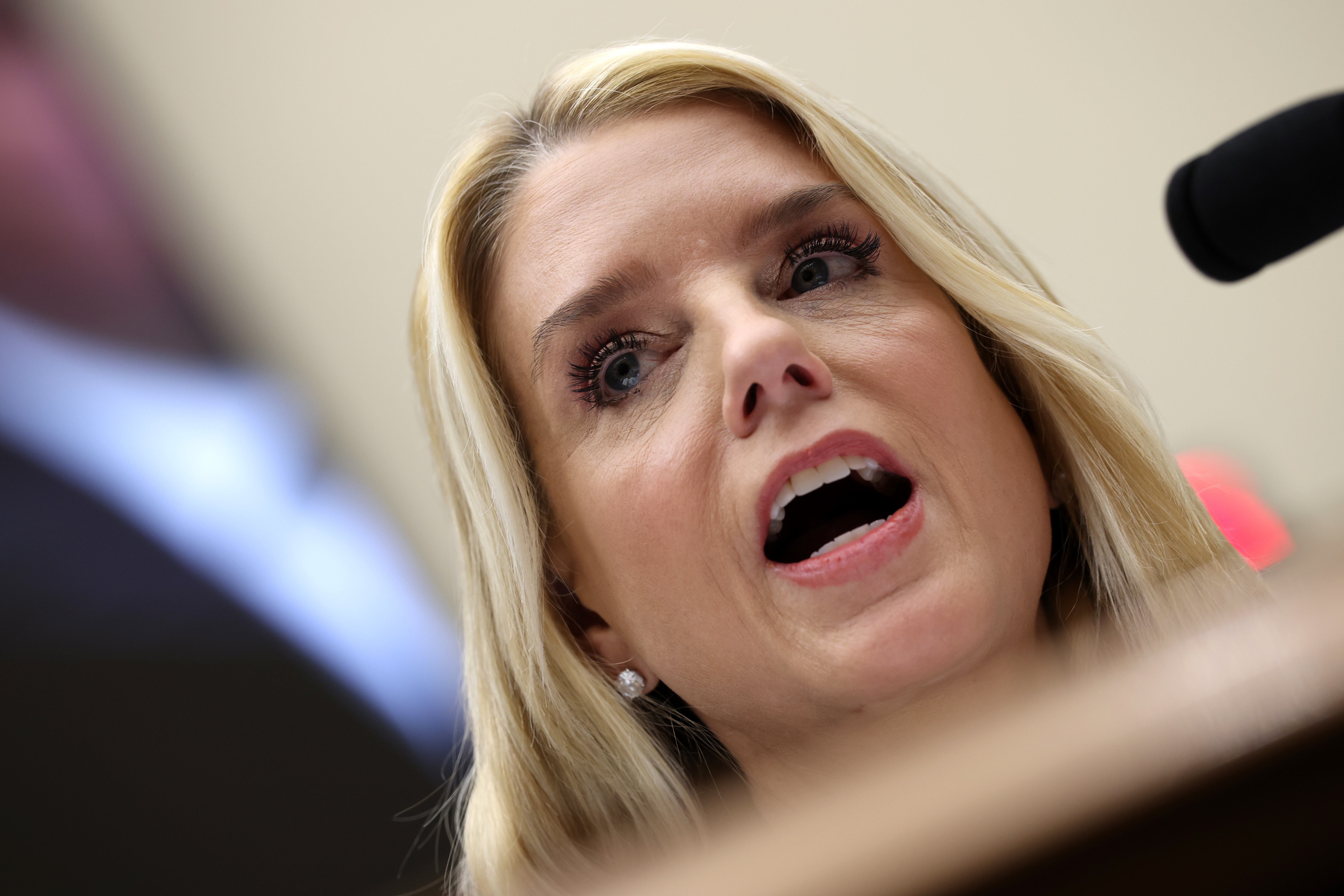
Attorney General Pam Bondi (Photo by Win McNamee/Getty Images)
Win McNamee via Getty Images
The tensions reportedly began simmering last summer, when Slater sought to block the merger between Hewlett-Packard Enterprise and Juniper Networks. She opposed the deal out of concerns that it would create a duopoly in cloud computing and wireless networking. In addition, Slater reportedly told Bondi that US intelligence hadn't raised any concerns about blocking the merger. However, CIA Director John Ratcliffe later claimed that blocking it would pose national security risks because it could lead to the loss of business to China. The Trump administration's merger-friendly DOJ ultimately approved the deal.
Alongside Bondi, Slater was overseeing the DOJ's review of Netflix's proposed acquisition of Warner Bros. Discovery. In December, Trump said he would be involved in the regulatory review. That followed intense lobbying by Netflix and Paramount, the latter of which launched a hostile takeover bid. Earlier this month, The Wall Street Journal reported that the department was investigating whether Netflix was involved in anticompetitive practices during the process.
Slater's ousting also comes weeks ahead of the DOJ's antitrust trial against Ticketmaster owner Live Nation. The department's lawsuit was filed during the Biden administration. It claims that Live Nation is operating as a monopoly, harming competition, fans, industry promoters and artists.
This article originally appeared on Engadget at https://www.engadget.com/big-tech/antitrust-head-overseeing-netflix-warner-merger-resigns-192854114.html?src=rss
Anthropic is upgrading Claude's free tier, apparently to capitalize on OpenAI's planned integration of ads into ChatGPT. On Wednesday, Anthropic said free Claude users can now create files, connect to external services, use skills and more.
Anthropic added the ability for paid users to create files in September. Starting today, free users of the chatbot can also create and edit Excel spreadsheets, PowerPoint presentations, Word docs and PDFs. Claude's file creation abilities are powered by Sonnet 4.5.
Free users can now create and edit Excel spreadsheets, PowerPoint presentations, Word docs, and PDFs.
Anthropic
Meanwhile, Connectors allow free users to link Claude to third-party services. There's a long list of available ones, including Canva, Slack, Notion, Zapier and PayPal.
Skills, on the other hand, let you teach Claude to "complete specific tasks in repeatable ways." In short, the chatbot loads folders of instructions, scripts and other resources when performing relevant tasks. Other upgrades to the free tier include longer conversations, interactive responses and improved voice and image search.
Claude's free-tier upgrades appear to be a direct response to ChatGPT's planned introduction of ads for its free users. Anthropic's announcement today ended with the tag line, "No ads in sight." This follows the company's promise last week that Claude will remain ad-free. Anthropic even poked fun at OpenAI's cash-seeking move in a Super Bowl ad (below), which also took a swipe at GPT-4o's penchant for kissing ass.
This article originally appeared on Engadget at https://www.engadget.com/ai/anthropic-beefs-up-claudes-free-tier-as-openai-prepares-to-stuff-ads-into-chatgpts-194100939.html?src=rss
Hubble may no longer be the gold standard, but it can still capture some impressive images. The telescope's latest snapshot is our clearest view yet of the Egg Nebula. Roughly 3,000 light-years away from Earth, the nebula's name is derived from its dense layer of gas and dust cloaking a central star.
The new image shows the nebula's four beams of starlight (from that central star) escaping from its gas-and-dust "shell." On either side of the disc-like cloud are fast-moving outflows of hot molecular hydrogen. The orange highlights in this image indicate the glow of infrared light.
As the beams of starlight stretch out from the center, they illuminate concentric rings of gas. The gas’s ripple-like pattern suggests it was created by successive bursts from the star, with a little more ejecting every few hundred years.
Hubble image of the Egg Nebula. A disc of gas and dust surrounded by beams of light and concentric rings of dust.
SA / Hubble & NASA, B. Balick (University of Washington)
The Egg Nebula, found in the constellation Cygnus, was first discovered in 1975. Nebulae in this preplanetary phase are rare finds. Since the stage only lasts a few thousand years (and because they're often faint), they're relatively difficult for astronomers to spot. By comparing this new image with previous Hubble snapshots of the Egg Nebula, astronomers can learn more about it and shed more light on its processes. But for the rest of us, it makes for some pretty sweet eye candy, right?
This article originally appeared on Engadget at https://www.engadget.com/science/space/hubble-showcases-the-egg-nebula-in-all-its-dying-star-glory-174239769.html?src=rss
Discord is the latest company looking to bolster its child safety (again). Starting in March, all users will have a "teen-appropriate experience" by default. Unlocking adult content and age-gated spaces will require a (usually one-time) verification process. However, following blowback, the company appears to have pivoted. It now says its age prediction AI will verify the identities of “the majority of adult users” without requiring a manual age check.
The platform's big safety update encompasses communication settings, restricted access to age-gated spaces and content filtering. Users who aren't verified as adults will see blurred sensitive content. In addition, age-restricted channels, servers and app commands will be blocked. DMs and friend requests from unknown users will be routed to a separate inbox.
If you're an adult who didn’t pass the automatic age check, removing these restrictions will require one of two verification methods at launch. You can take a selfie video for age estimation or submit a government ID to Discord's vendor partners. (Let's just hope the age estimations work better than Roblox's.) The company stresses that the video selfies you submit for age estimation never leave your device. And it claims ID documents sent to its vendor partners are deleted quickly, "in most cases, immediately after age confirmation."
Although Discord says the process will be one-and-done for most people required to submit manual verification, some may be required to submit multiple forms. Its original announcement stated that additional verification options would be introduced, including an age inference model that runs in the background. However, following backlash to its initial announcement, the company now suggests that the inference model will be the norm for most adults.
“For most adults, age verification won’t be required, as Discord’s age inference model uses account information such as account tenure, device and activity data and aggregated, high-level patterns across Discord communities,” the company wrote in a statement sent to Engadget on Tuesday. “Discord does not use private messages or any message content in this process.”
Alongside today’s changes, Discord is recruiting for a new Teen Council. The group will include 10 to 12 teens aged 13 to 17. The company says this "will help ensure Discord understands — not assumes — what teens need, how they build meaningful connections, and what makes them feel safe and supported online." This sounds like the corporate equivalent of the parenting advice: “Don’t just talk to your children; listen to them, too.”
The child safety changes will start rolling out globally in early March. Both new and existing users may be required to submit verification for adult content.
Update, February 10, 2026, 5:57 PM ET: This story has been updated to add Discord’s clarification and statement that claims most adults won’t need to conduct a manual age check.
This article originally appeared on Engadget at https://www.engadget.com/social-media/discord-will-soon-require-age-verification-to-access-adult-content-140000218.html?src=rss
If you haven't yet played Alan Wake 2, here's your chance to immerse yourself in its terrors for free. Prime members can play it this month on Amazon's Luna cloud gaming service at no additional charge.
The "fantastic" Alan Wake 2 oozes "psychedelic terror," as Engadget's Jessica Conditt put it in our review. The 2023 horror-survival game uses a dual-protagonist motif, alternating between the lost author Wake and the stoic FBI agent Saga Anderson. It "tells a twisted, serpentine story of paranormal murder, shifting realities and demonic possession, with two brooding investigators at its core." Not a bad way to sublimate the all-too-real horrors of life in 2026.
The Order of Giants DLC for Indiana Jones and the Great Circle also arrives on Luna this month. Ditto for Disney Universe, a knockoff of the Lego game franchise starring the Mouse's IP.
Setting Luna aside, Amazon also has downloadable PC games that Prime members can claim for free this month. Starting today, you can snag the Borderlands spinoff Tiny Tina's Wonderlands from the Epic Store. Later this month, you can also claim the highly rated strategy title Total War: Attila (Epic Store, Feb. 26).
This article originally appeared on Engadget at https://www.engadget.com/gaming/prime-members-can-play-alan-wake-2-for-free-on-luna-193509728.html?src=rss
With gaming becoming an ever-smaller part of NVIDIA's lucrative business, the company reportedly won't bother releasing new graphics cards this year. The Informationreported on Thursday that NVIDIA has pushed back its plan to release an update to the RTX 50 line in 2026. This would be the first time in three decades that the company hasn't launched new gaming chips. The culprit? Why, AI, of course.
AI demand has driven the current memory chip shortage, throwing the consumer electronics industry out of kilter. Many product prices are expected to rise (as if tariffs hadn't already done enough damage there). And the scarcity of memory chips has made components that rely on them, including GPUs, nearly impossible to find. Even the auto industry isn't spared.
Facing those constraints, NVIDIA, which made its bones on graphics chips for PCs and gaming consoles, is essentially brushing off that demographic. The Information notes that in the first nine months of 2022, NVIDIA's gaming GPUs made up 35 percent of its total revenue. During that same period in 2025, only around 8 percent came from gaming components. In addition, NVIDIA's AI chips have much higher profit margins: 65 percent vs. 40 percent for graphics cards.
That means gamers, already hard-pressed to find last year's RTX 50 series, likely won't get the expected "Super" version in 2026. On top of that, The Information says the delay will also push back NVIDIA's next-gen graphics card (likely "RTX 60"). That component was initially expected to begin mass production at the end of 2027.
This article originally appeared on Engadget at https://www.engadget.com/gaming/pc/nvidia-reportedly-wont-release-new-graphics-cards-this-year-173002651.html?src=rss
Without meaningful deterrents, Big Tech companies will do what's profitable, regardless of the cost to consumers. But a new bipartisan bill could add a check that would make them think twice, at least in one area. On Wednesday, Senators Ruben Gallego (D-AZ) and Bernie Moreno (R-OH) introduced legislation that would require social platforms to crack down on scam ads.
The Safeguarding Consumers from Advertising Misconduct (SCAM) Act would require platforms to take reasonable steps to prevent fraudulent or deceptive ads that they profit from. If they don't, the Federal Trade Commission (FTC) and state attorneys general could take civil legal action against them.
The bill's sponsors, Ruben Gallego (L) and Bernie Moreno
Ruben Gallego / Bluesky / Bernie Moreno
The backdrop to the SCAM Act is a Reuters report from last November. Meta reportedly estimated that up to 10 percent of its 2024 revenue came from scam ads. The company is said to have calculated that as much as $16 billion of its revenue that year was from scams, including "fraudulent e-commerce and investment schemes, illegal online casinos and the sale of banned medical products."
Making matters worse, Meta reportedly refused to block small fraudsters until their ads were flagged at least eight times. Meanwhile, bigger spenders were said to have accrued at least 500 strikes without being removed. Executives reportedly wrestled with how to get the problem under control — but only without affecting the company’s bottom line. At one point, managers were told not to take any action that could cost Meta more than 0.15 percent of its total revenue. (See what I mean about needing meaningful deterrents?)
According to the FTC and noted in the text of the bill, Americans’ estimated total loss from fraud in 2024 (adjusted for underreporting) was nearly $196 billion. An estimated $81.5 billion of that came from seniors.
"If a company is making money from running ads on their site, it has a responsibility to make sure those ads aren't fraudulent," Sen. Gallego said in a statement. "This bipartisan bill will hold social media companies accountable and protect consumers' money online."
"It is critical that we protect American consumers from deceptive ads and shameless fraudsters who make millions taking advantage of legal loopholes," Moreno added. "We can't sit by while social media companies have business models that knowingly enable scams that target the American people."
Correction, February 5, 2026, 8:18AM ET: This story originally stated that Americans’ estimated loss from fraud in 2024 was $19 billion. It was nearly $196 billion. We apologize for the error.
This article originally appeared on Engadget at https://www.engadget.com/big-tech/bipartisan-scam-act-would-require-online-platforms-to-crack-down-on-fraudulent-ads-210316594.html?src=rss
The Pixel 10a is official, though details are limited. On Wednesday, Google posted a teaser video showing the mid-range phone dancing around colorful backgrounds. You can pre-order the Pixel 10a on February 18.
Google hasn't yet revealed the phone's specs. In the short video, we can see a blue model that's virtually indistinguishable on the outside from the Pixel 9a. And alleged leaks point to a phone with few changes on the inside. That (unconfirmed) list includes a 6.285-inch display, dual rear cameras (48MP wide and 13MP ultra-wide) and a 5,100mAh battery.
Google
The teaser's tagline appears to be an attempt to assure Pixel fans that there will, in fact, be meaningful upgrades. "A phone with more in store, in store soon," it reads. Hopefully, its pricing and specs will be "in store" for us soon as well.
In the meantime, you can visit the Google Pixel website to register for more info.
This article originally appeared on Engadget at https://www.engadget.com/mobile/smartphones/you-can-pre-order-the-pixel-10a-on-february-18-180712018.html?src=rss
Fitbit's founders have a new startup. Two years after leaving Google, James Park and Eric Friedman announced a new platform that shifts the focus from the individual to the family. They say the Luffu mobile app "uses AI quietly in the background" to collect and organize family health information.
"At Fitbit, we focused on personal health — but after Fitbit, health for me became bigger than just thinking about myself," Park said in a press release. The app is particularly focused on the "CEO of the family" — the person who manages appointments, prescriptions and other health-related tasks.
But the definition of family isn't limited to parents raising children. The company sees its tool as especially valuable for caregivers in their 40s and 50s who may be managing the needs of both aging parents and kids. It even tracks pets' health habits.
"We're managing care across three generations — kids at home, busy parents in the middle, and my dad in his 80s who's living with diabetes and still wants to stay fiercely independent," Friedman wrote. "And the moments that matter most are often the most chaotic: a late-night fever, a sudden urgent care visit, a doctor asking questions you can't answer quickly because the details are scattered."
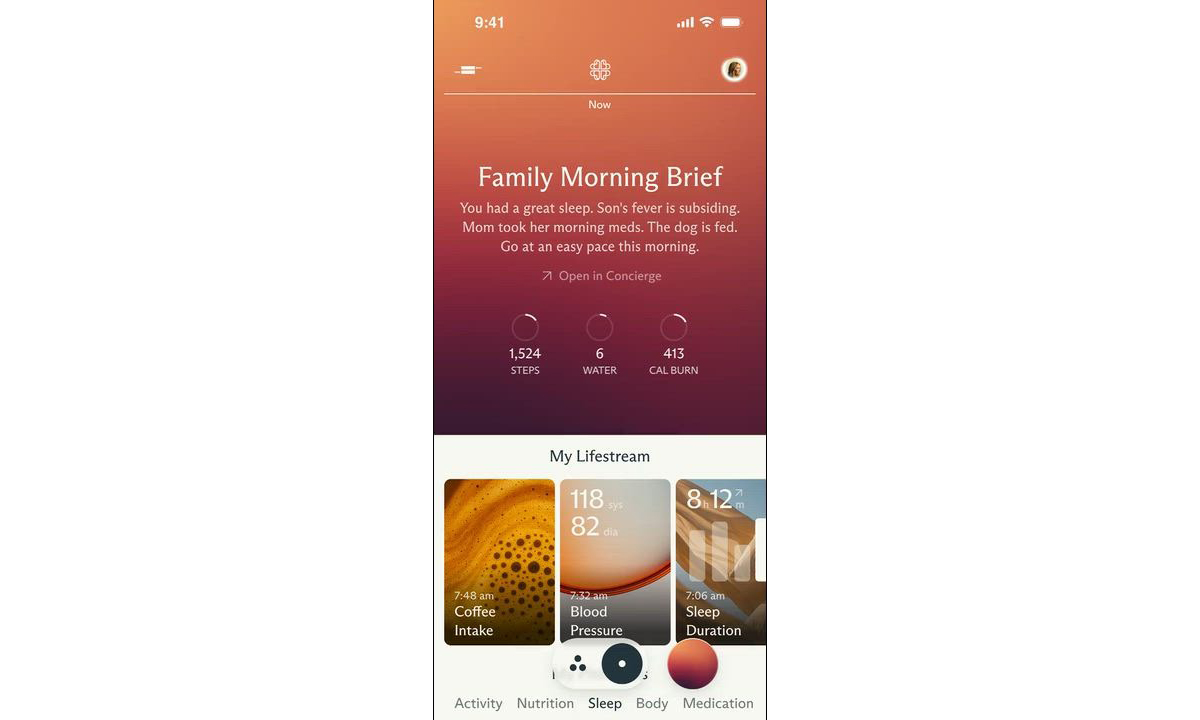
The app's AI includes a Morning Brief that recaps everyone's health.
Luffu
The company claims the app's AI "isn't a chatbot layer." Rather, it serves as a "guardian" — proactively monitoring for changes silently in the background. The AI then provides insights and triggers alerts when something is out of whack. You can also ask the app health data questions using plain language (so, there is some kind of chatbot) and share data with family members.
The company clearly wants to make entering data as easy as possible. Luffu allows family members to log info using voice, text or photos. It integrates with health platforms such as Apple Health and Fitbit. And the company eventually wants to expand into a hardware ecosystem — presumably, devices that make health data collection even easier.
Speaking of data collection, Luffu says, "Users are always in control of exactly what is shared, with whom, and privacy and security are paramount for all family data." In addition, the company told Axios that users can choose whether their data is used to train its AI. On the other hand, Big Tech has repeatedly shown that its most egregious data-collection practices are always wrapped in comforting language. So, at the very least, I'd take their pitch with grains of salt and, most importantly, make sure each family member knows exactly what they're consenting to. After all, this is a for-profit company, and we don’t yet know its monetization strategy.
Luffu is currently taking waitlist sign-ups for a forthcoming limited public beta. You can learn more and sign up for the waitlist on the company website.
Update, February 3, 2026, 1:14PM ET: This story has been updated to note that the Luffu public beta hasn’t started yet, but you can sign up for a waitlist to eventually get access when it starts.
This article originally appeared on Engadget at https://www.engadget.com/mobile/fitbit-founders-launch-luffu-a-way-to-integrate-your-familys-health-data-173251994.html?src=rss