The air taxi revolution has so far been imagined in miniature. Companies across Europe and the United States have poured billions into developing sleek, four to six seat electric aircraft designed to hop across congested cities. These nimble vehicles promise a new era of urban mobility, whisking passengers over traffic jams on short, efficient flights. The prevailing industry wisdom has been to start small, prove the technology, and then gradually scale up. This cautious, incremental approach has defined the first chapter of the eVTOL story, creating a landscape of compact, lightweight designs.
Then, Fengfei Aviation Technology decided to skip a few chapters. With the successful transition flight of its V5000 Sky Dragon, the company has introduced a heavyweight contender into a field of lightweights. This five ton aircraft is less of an air taxi and more of a sky bus, built to carry ten passengers or significant cargo loads. By achieving stable flight in a machine of this scale, Fengfei has fundamentally challenged the industry’s step by step consensus. The V5000 suggests that the future of electric aviation might arrive sooner, and in a much larger package, than anyone was expecting.
Designer: Fengfei Aviation Technology
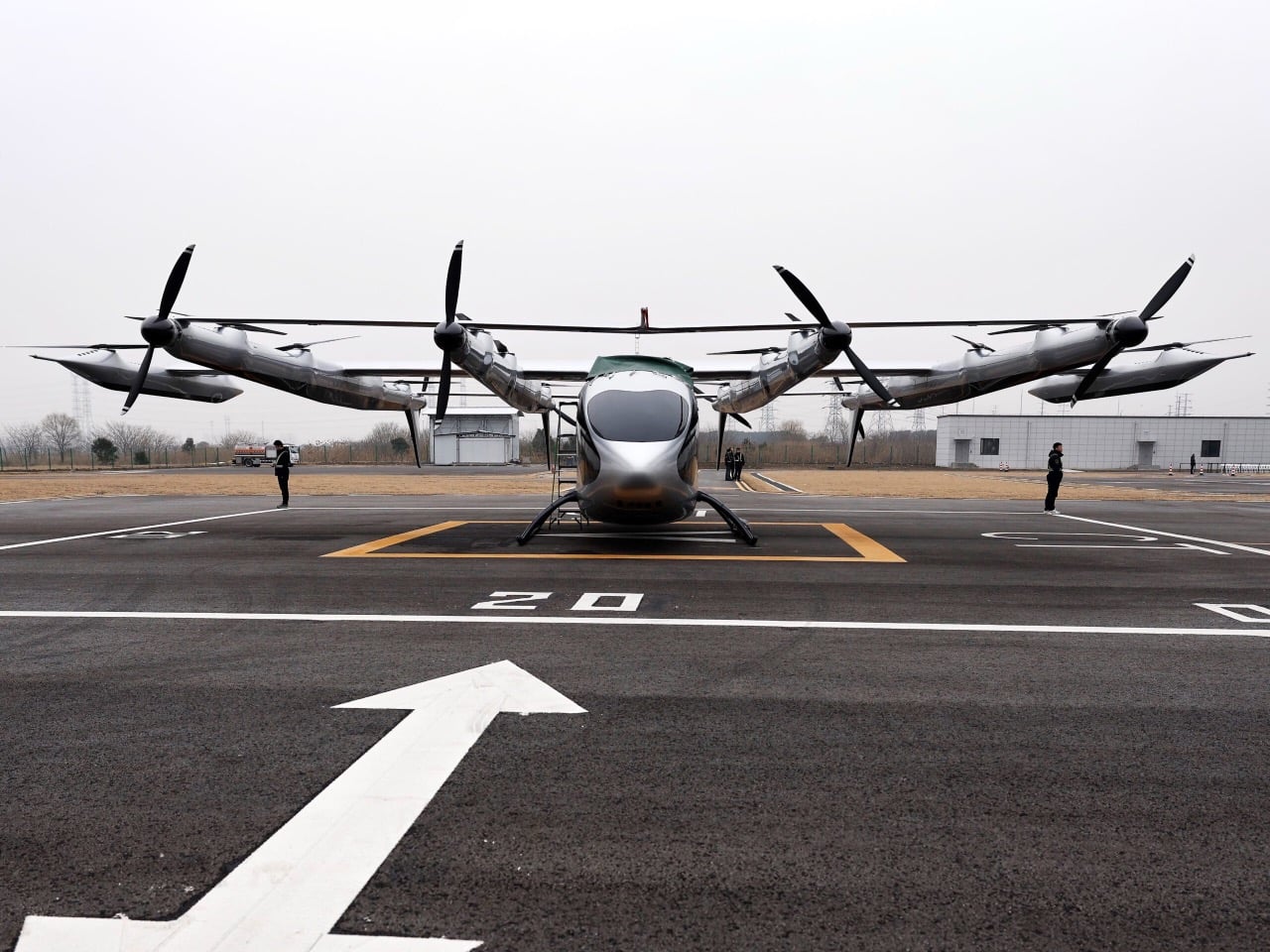
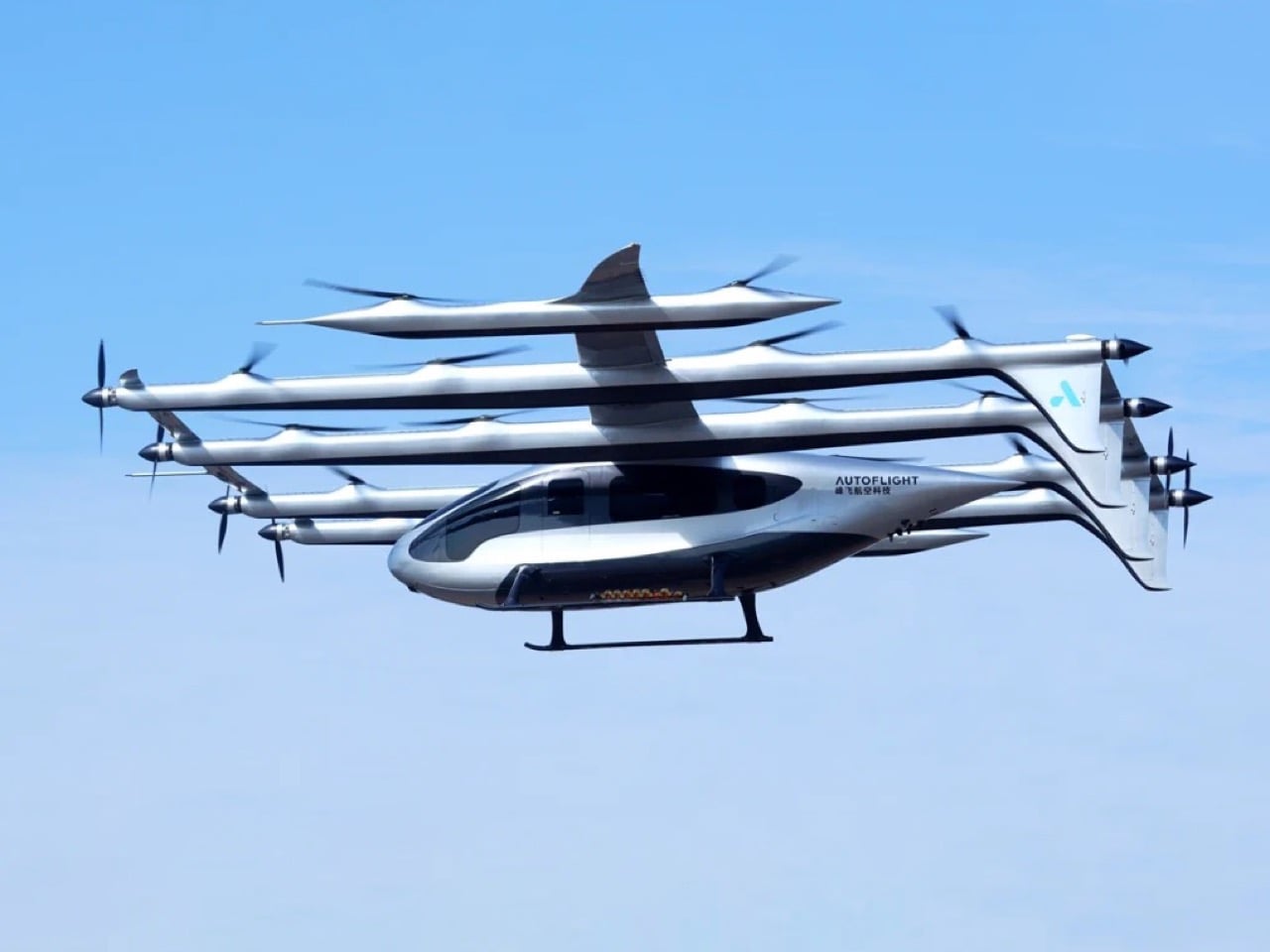
The design is dominated by stacked booms and a multitude of rotors, an architecture that prioritizes aerodynamics and redundancy over conventional aesthetics. This form-follows-function approach gives the airframe an honest, engineered quality. It avoids any attempt at flying car nostalgia, presenting itself as a purpose-built system for vertical lift and efficient forward flight. The fuselage is a smooth, automotive-like pod, but the wings tell the real story. Multiple rotor booms create layers that resemble a giant quadcopter stretched over a commuter plane frame. It looks precisely like what it is: a new class of aerial vehicle that doesn’t pretend to be anything else.
As a five ton class eVTOL, its ability to carry ten people or an equivalent cargo payload places it far beyond typical prototypes currently flying. The pure electric version has a stated range of 250 kilometers, sufficient for many inter-city routes. A hybrid variant extends that operational radius to 1,500 kilometers, enabling regional logistics and transport missions that were previously theoretical for electric aircraft. This leap in capacity and range fundamentally alters the economic models and potential use cases for operators. Suddenly routes that required traditional turboprop aircraft or simply didn’t exist become viable with vertical takeoff capability.
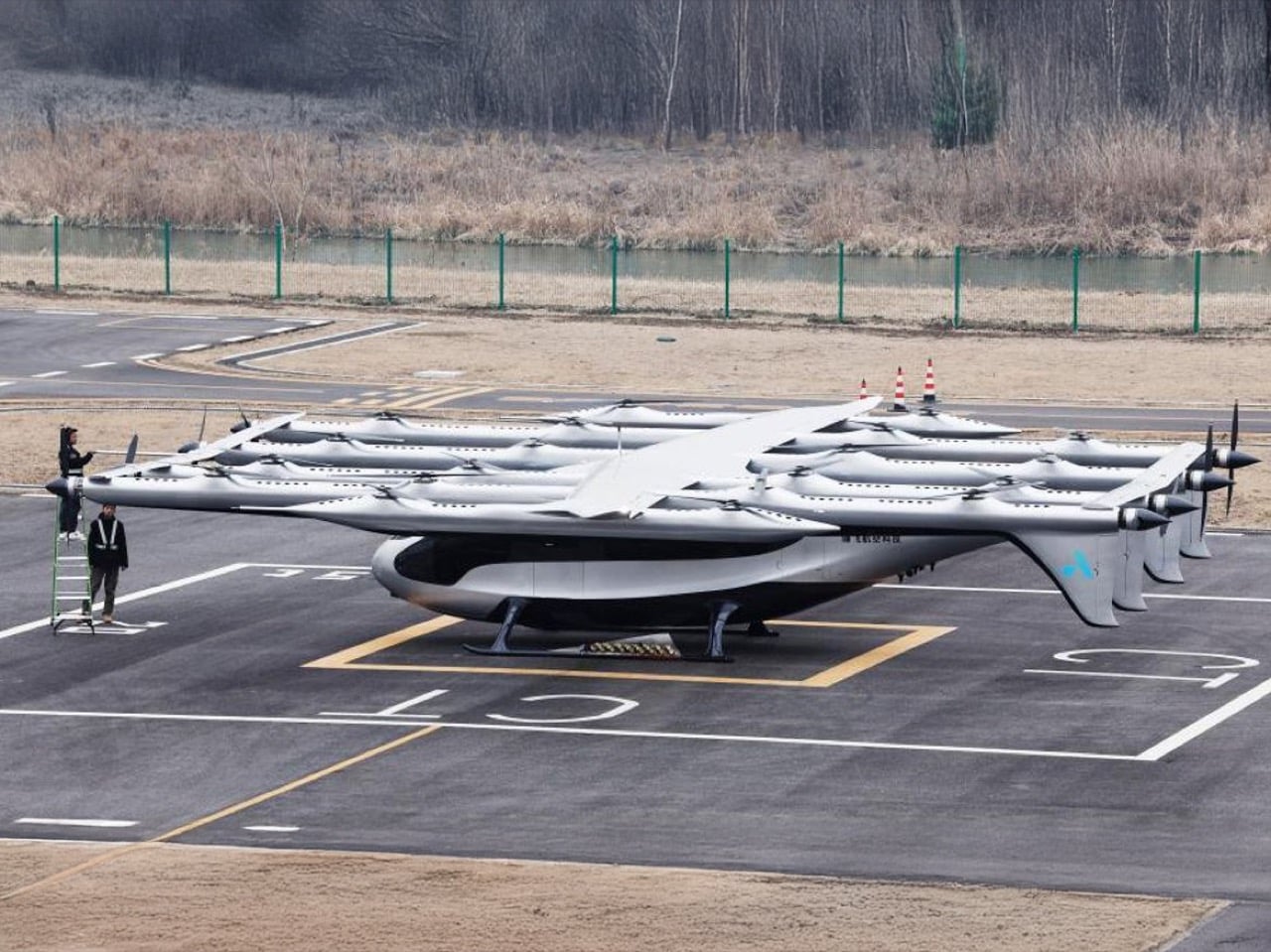
The V5000 executed a complete transition at the Kunshan test base, shifting from vertical takeoff to fixed-wing cruise and back to a vertical landing. For a five ton airframe, this proves the maturity of its flight control software, which must manage up to 20 lift motors and forward propulsion systems simultaneously. The stability required to navigate this transition phase cleanly is a core challenge in eVTOL development. Smaller prototypes have demonstrated wobbly, uncertain transitions. Achieving it at this scale, with this much mass and complexity, represents a substantial systems integration accomplishment. Any control hiccup in that flight regime becomes dramatically more consequential as weight increases.
The distributed electric propulsion, with its numerous motors spread across compound wings, means a single motor failure is a manageable event, not a catastrophic one. This design philosophy trades the mechanical complexity of traditional aircraft for the electronic complexity of advanced power management and flight control algorithms. The V5000 operates less like a conventional airframe and more like a distributed computer with wings, a direction indicative of modern EV platform design. Instead of gearboxes and mechanical shaft redundancy, you get software managing power distribution across independent electric motors in real time. The approach mirrors how automotive platforms evolved, leaning into electronics rather than adding mechanical safeguards.
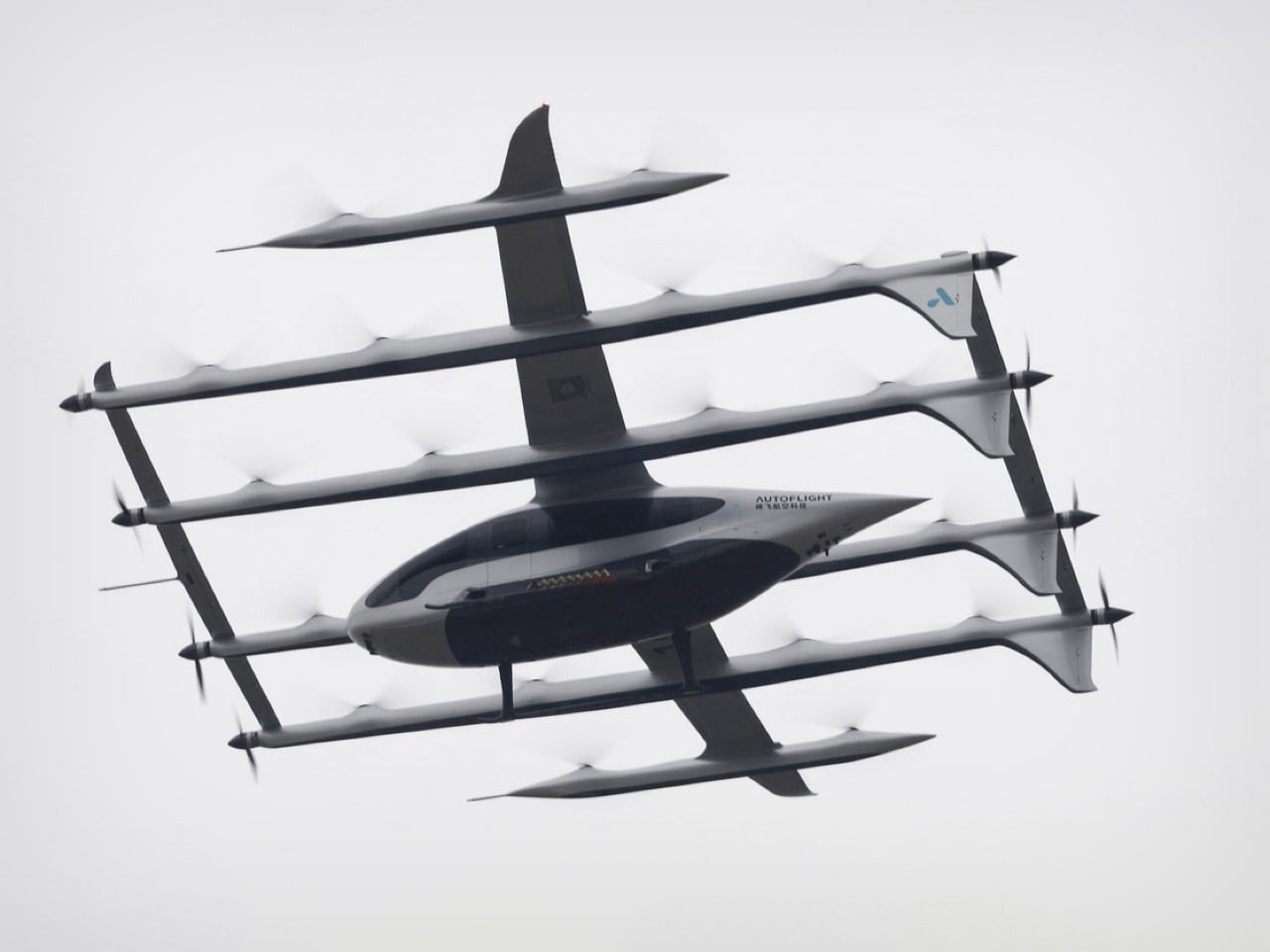
Western competitors have largely treated the three ton plus category as a future goal, to be addressed after smaller air taxis gain regulatory approval and market acceptance. Joby, Lilium, and Archer are all focused on lighter machines designed for short urban hops. Nobody in that group has attempted a five ton airframe yet. Fengfei’s flight effectively bypasses that incremental roadmap, establishing a credible presence in the heavyweight class right now. It forces a strategic reconsideration for other players, proving that the technology for larger, more practical eVTOLs is viable today. The psychological shift matters as much as the technical one, reframing expectations about how quickly the sector can move toward serious payloads.
More transition flights will follow, along with envelope expansion testing and the inevitable slog through certification, particularly for its multi-motor and hybrid systems. The key development will be observing its initial commercial applications. Cargo operators, who can tolerate tighter operational constraints and don’t need passenger certifications, may adopt the platform first. Regional passenger services would follow, potentially redefining connectivity between cities and offering a direct alternative to ground-based infrastructure. The V5000 has shifted the eVTOL narrative from urban mobility experiments to the creation of genuine regional air networks, the kind that can move meaningful numbers of people and goods across distances that matter.
The post World’s First 5-Ton 10-Seater eVTOL Takes Flight In China first appeared on Yanko Design.