Ultra-silent brass fidget piston is built with such precise tolerances that air becomes the spring

Pneumatics is an industrial workhorse, a brute-force technology that uses compressed air to power everything from factory robots to freight train brakes. It is almost always loud, powerful, and hidden deep inside a machine’s guts. The idea of holding it in your hand, of feeling its power at a small, personal scale, has always been out of reach. It was a force to be used, not a phenomenon to be experienced. MetMo, however, specializes in turning these forgotten industrial principles into beautiful, handheld objects.

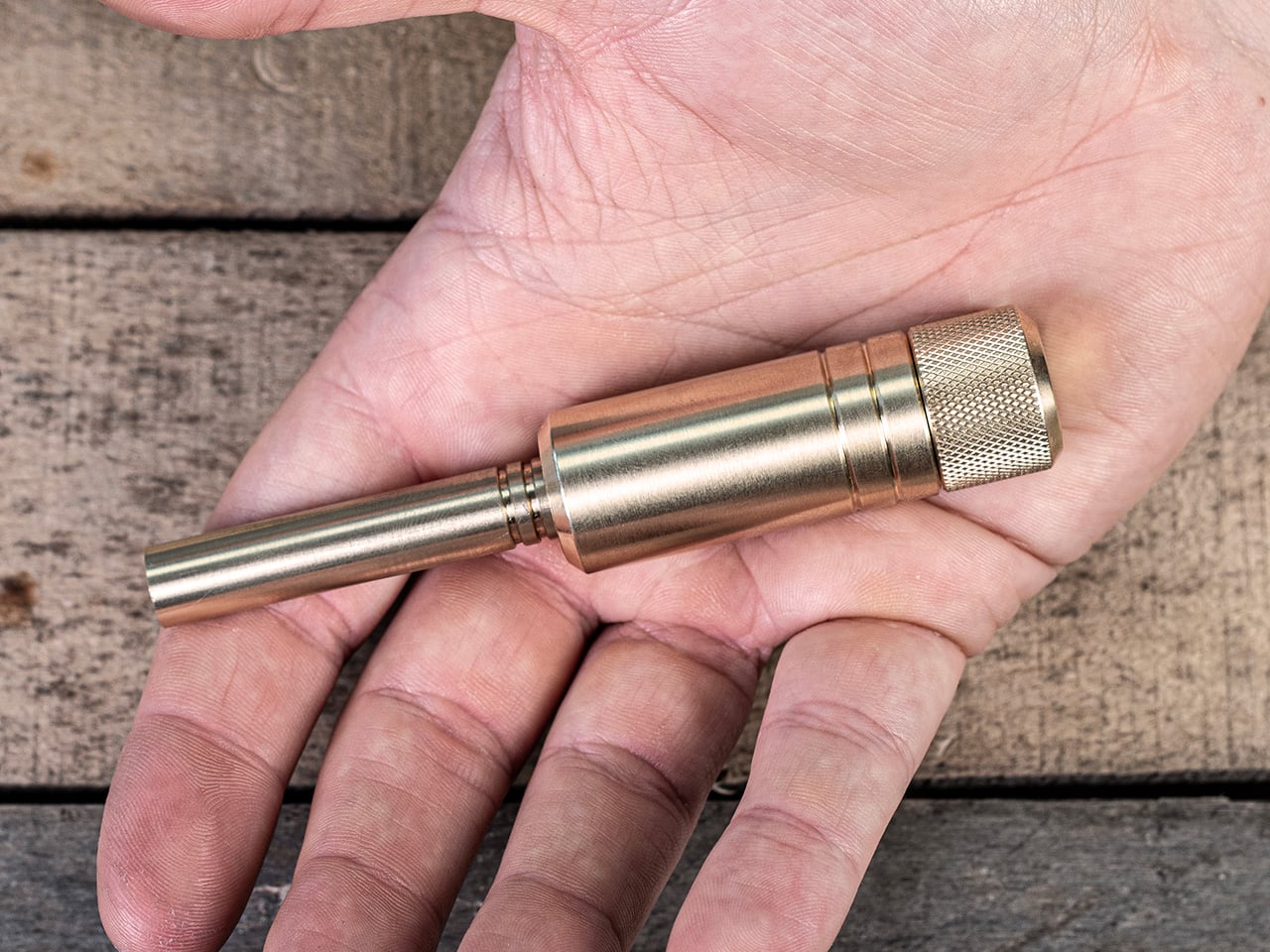
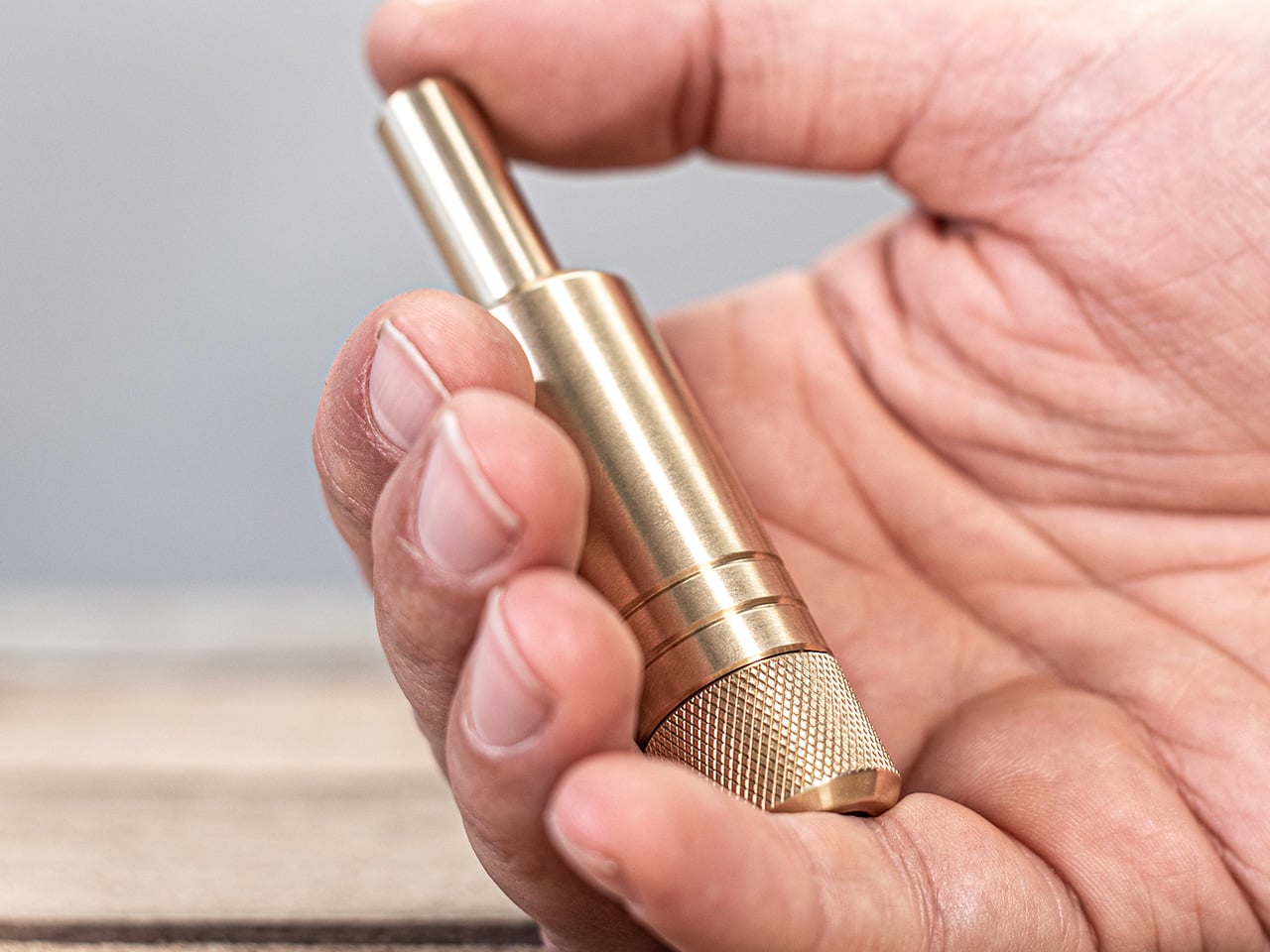
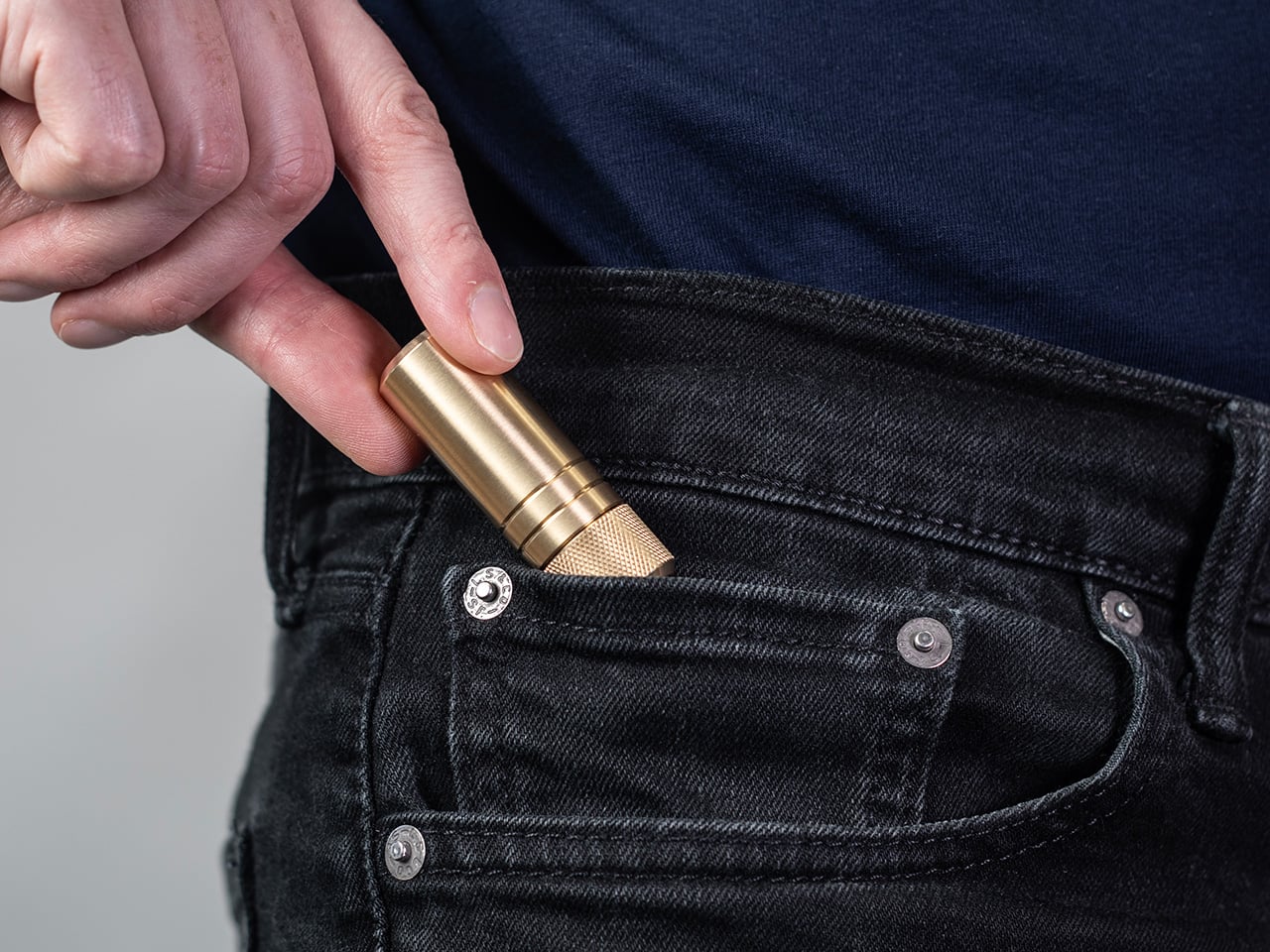
The MetMo Piston is what happens when you shrink a pneumatic system down to pocket size and machine it from solid brass. The slow, satisfying resistance you feel when you press down is the feeling of air compressing in a perfectly sealed chamber. The silent rebound is that same air expanding, pushing the piston back with a gentle, inevitable force. For anyone who appreciates engineering, it is a tiny, working demonstration of physics. For everyone else, it is just an incredibly satisfying object to hold and press.

Designers: Sean Sykes & James Whitfield (MetMo)

Click Here to Buy Now: $89.99

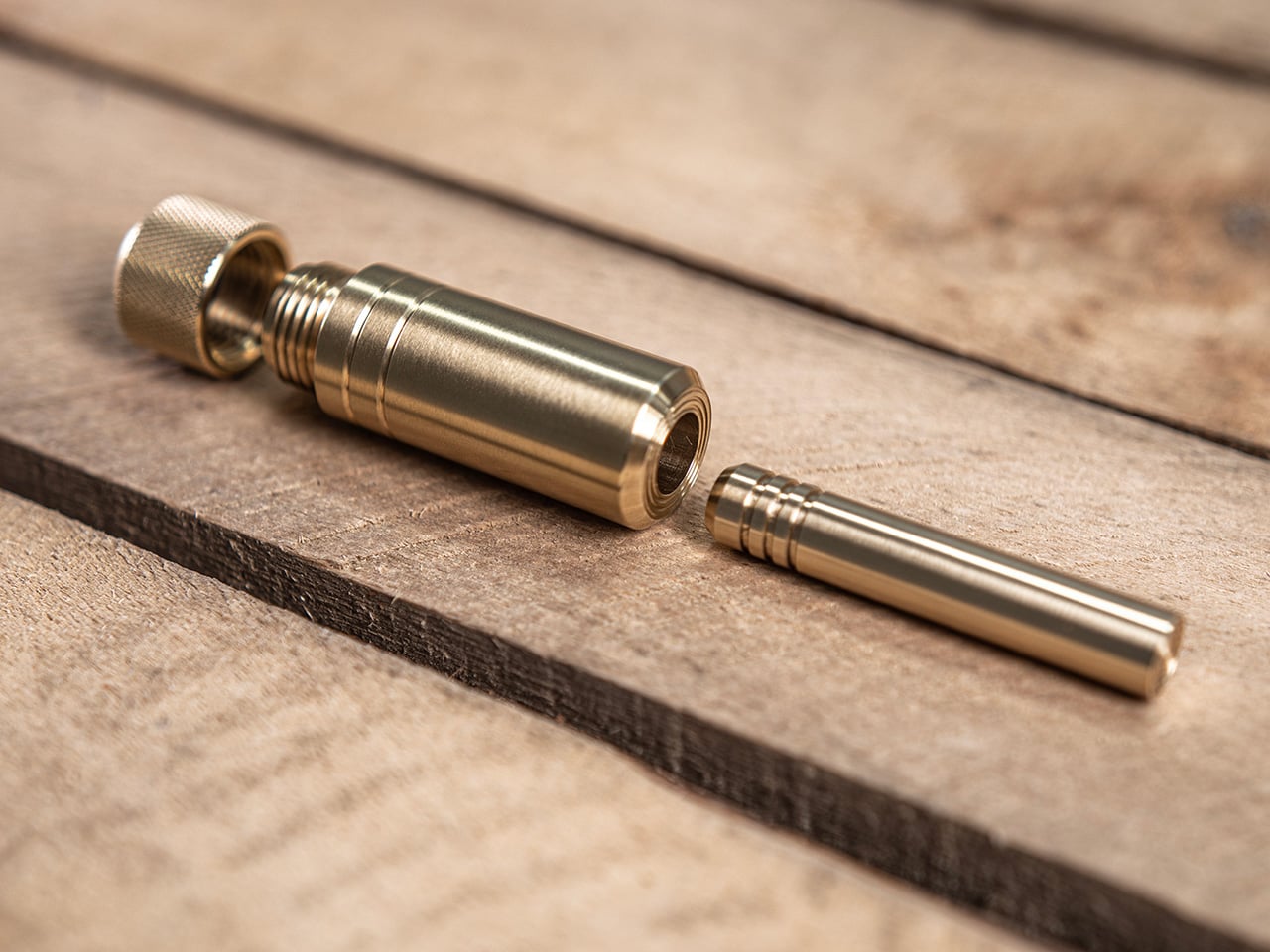
The mechanism itself is deceptively simple, which is why MetMo felt it important to reiterate – no springs, no magnets. A precision-machined piston pin slides into an equally precise cylinder block, and the tolerances between the two are so tight that air cannot escape, even under pressure. When you press the piston down, you are compressing the air trapped inside the chamber, and that compressed air is what pushes back against your thumb. No hidden parts, springs, neodymium magnets, mechanical detents. The feedback is purely pneumatic, the same principle that powers much larger systems like robot arms, hammer drills, and train brakes… scaled down to something you can operate with one hand.

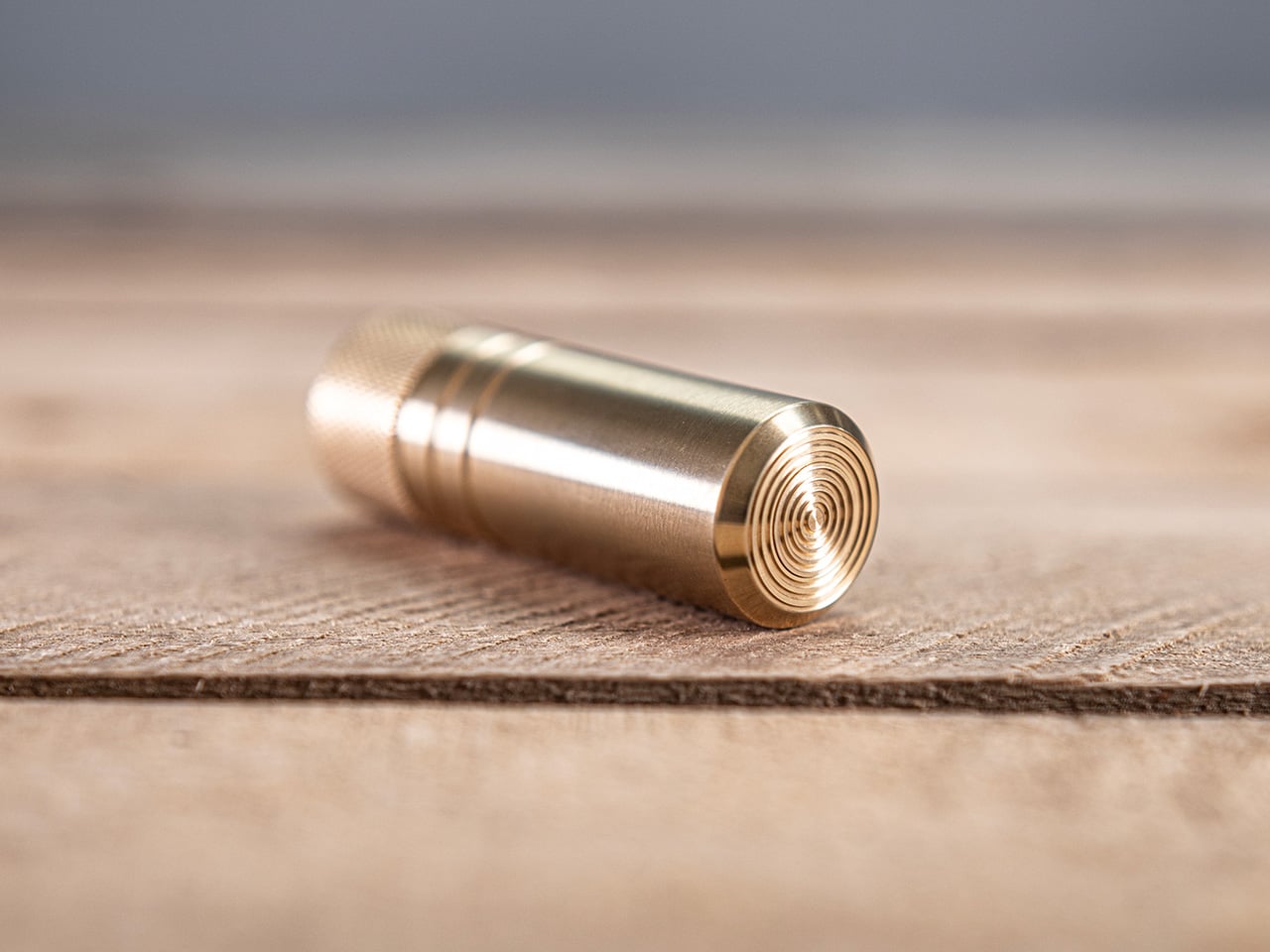
What separates this from every other fidget object on the market is the sheer precision required to make it work. No sourcing ball-bearings from AliBaba to make $2 fidget spinners. MetMo machines each component from solid HTB1 brass, a high tensile alloy chosen specifically for its wear resistance and smooth surface finish. The piston pin and cylinder block are both machined to tolerances typically reserved for aerospace engineering, because even a microscopic gap would let air escape and ruin the pneumatic seal. The fit is so precise that when you press down and feel that cushion of resistance, you are experiencing the literal limits of what air molecules can do when trapped in a perfectly sealed chamber. It’s engineering you can feel through your fingertips.

The Piston also features a secondary interaction that might be even more satisfying than the press itself. Spin the knurled housing, and the piston pin rotates on what MetMo calls an aerodynamic bearing, a thin cushion of air that forms between the pin and the cylinder block. The result is a nearly frictionless spin that feels almost supernatural, like the object is hovering inside its own housing. It is the same principle used in precision scientific instruments, and experiencing it in a handheld desk toy is quietly mesmerizing. You can spin it for minutes at a time, and the motion stays smooth, silent, and hypnotic.

One of the best practical benefits of the Piston is its complete silence. If you have ever been stuck in a meeting next to someone clicking a pen, you understand why this matters. The pneumatic mechanism operates without any noise at all, which means you can fidget freely without disrupting anyone around you. It is a desk toy that respects shared spaces, and that alone makes it more thoughtful than most of its category competitors. The tactile satisfaction is entirely private, which is exactly how it should be.

MetMo also included a pressure release valve that lets you adjust the drop speed and rebound behavior of the piston. Tighten it for a slow, controlled descent, or loosen it for a faster, bouncier response. It is a small detail, but it transforms the Piston from a fixed experience into something you can tune to your own preference. For people who appreciate control over their tools and objects, that adjustability is a quiet but meaningful touch.

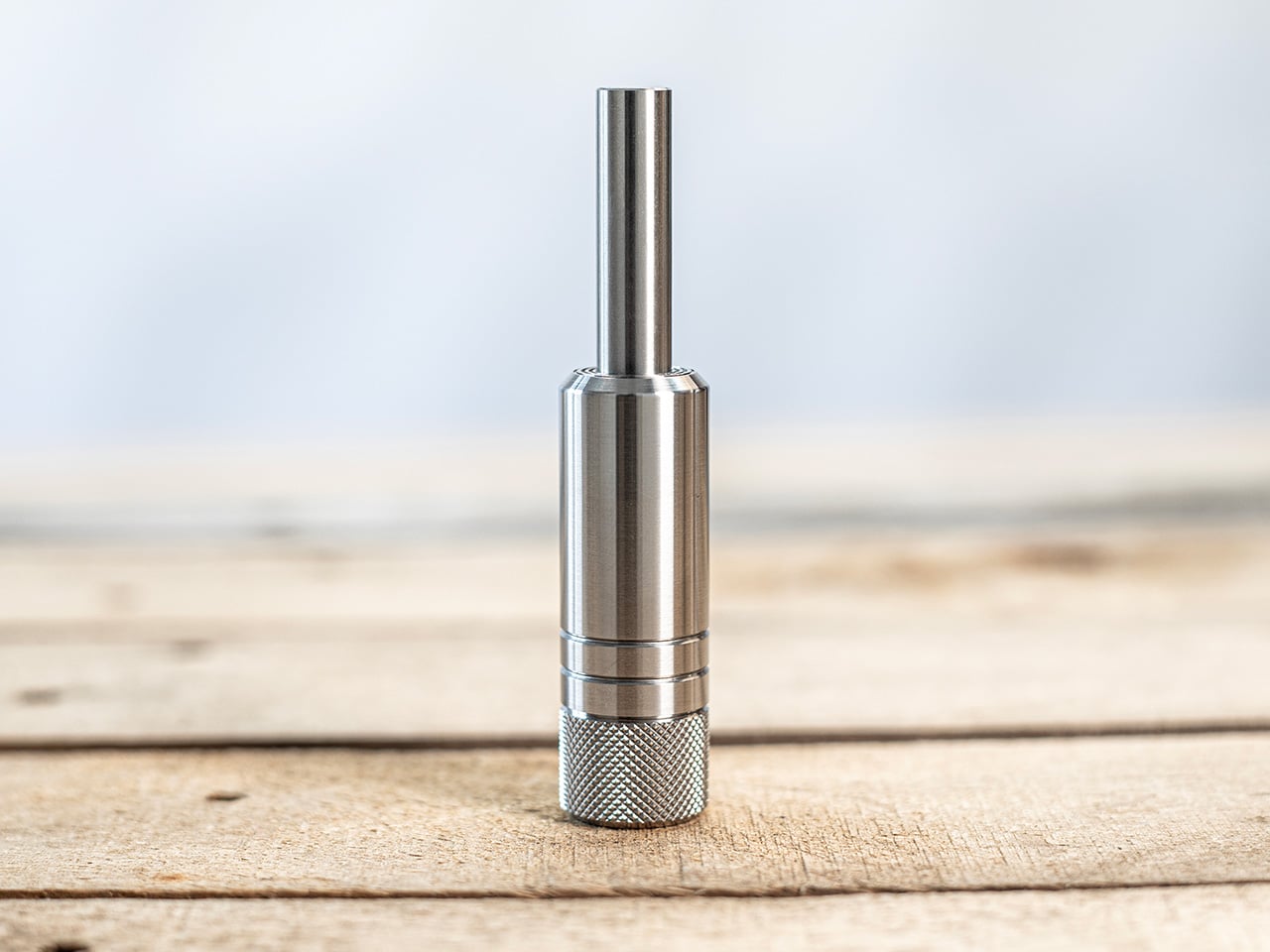
The MetMo Brass Piston is priced at £59.99 GBP ($81.23 USD) and is available directly from MetMo’s UK workshop. It is machined from solid brass, although there’s a stainless steel version priced at £94.99 ($126.4 USD) too, hand-assembled to order, and backed by MetMo’s 200-year guarantee. For anyone who thinks with their hands, who values mechanical honesty over gimmicks, or who simply wants a desk object that does one thing exceptionally well, this is one of the most compelling fidget toys I have come across in a while.

Click Here to Buy Now: $89.99

The post Ultra-silent brass fidget piston is built with such precise tolerances that air becomes the spring first appeared on Yanko Design.

The 5 Details Every Great EDC Design Shares in 2026

Cheap knives and great knives can share a steel type, a similar price bracket, and even a similar silhouette, yet one gets carried every day for years while the other sits in a drawer after a month. The difference rarely comes down to one dramatic failure. It comes down to five small decisions that most buyers never learn to check for, decisions about lock geometry, screw heads, pivot bearings, dimensional proportion, and low-light findability. Spend enough time with a stack of 2026 releases side by side and the pattern gets impossible to unsee.

I spent the better part of last week breaking down those five decisions using five knives currently earning their keep in pockets around the EDC community, each one chosen because it executes a single detail without compromise. None of these are the flashiest releases of the year, and none needed to be. What ties them together is a kind of restraint, the willingness to spend real machining time and material cost on a part of the knife most buyers never think to inspect. A locking mechanism gets tuned for years of one-handed use rather than a flashy debut video. A screw gets sized and disclosed rather than hidden behind a proprietary driver. That restraint is expensive to execute and easy to skip, which is exactly why so few knives manage all five at once.

1. The Lock: Why Button and Crossbar Mechanisms Made the Liner Lock Feel Dated

Liner locks and frame locks have one quiet flaw nobody talks about until they’ve sliced a thumb pad on a fast close. To fold the blade back down, your fingers have to reach across its path and nudge the lock out of the way, which is fine ninety nine times out of a hundred and a genuine hazard on the hundredth. Button locks and crossbar locks solve this by moving the release off the blade’s line entirely. Press a button or pull a bar mounted on the spine, and the blade drops shut without your fingers ever crossing the edge. It sounds like a minor ergonomic tweak until you realize it’s the same logic that made Benchmade’s AXIS lock a cult favorite for two decades, just freed up for everyone else to build on now that the patent has expired. That single expiration is why crossbar and button locks have exploded across mid-tier knives in the last two years, and why a lock type that used to signal premium exclusivity now signals a maker who’s simply paying attention.

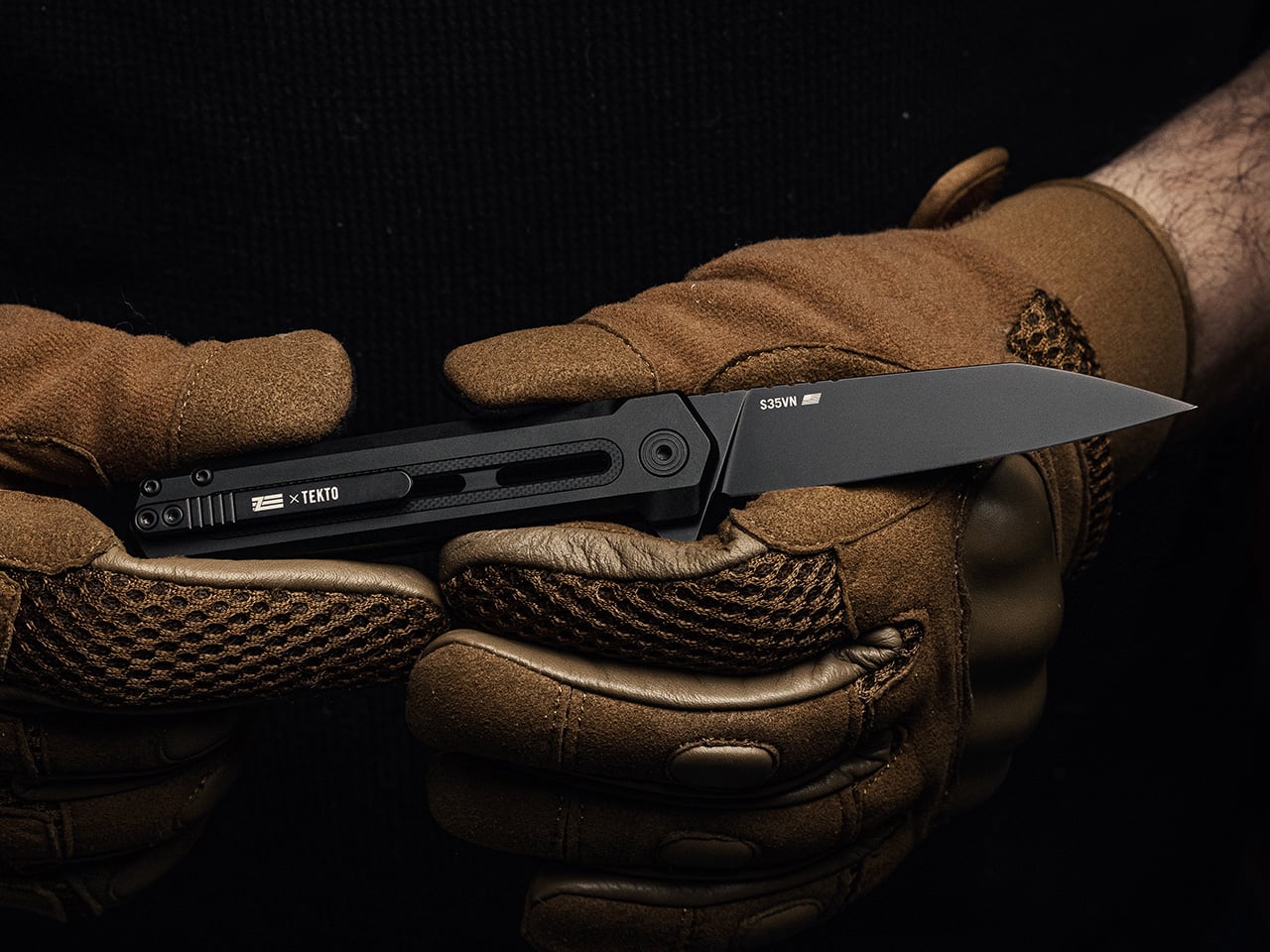
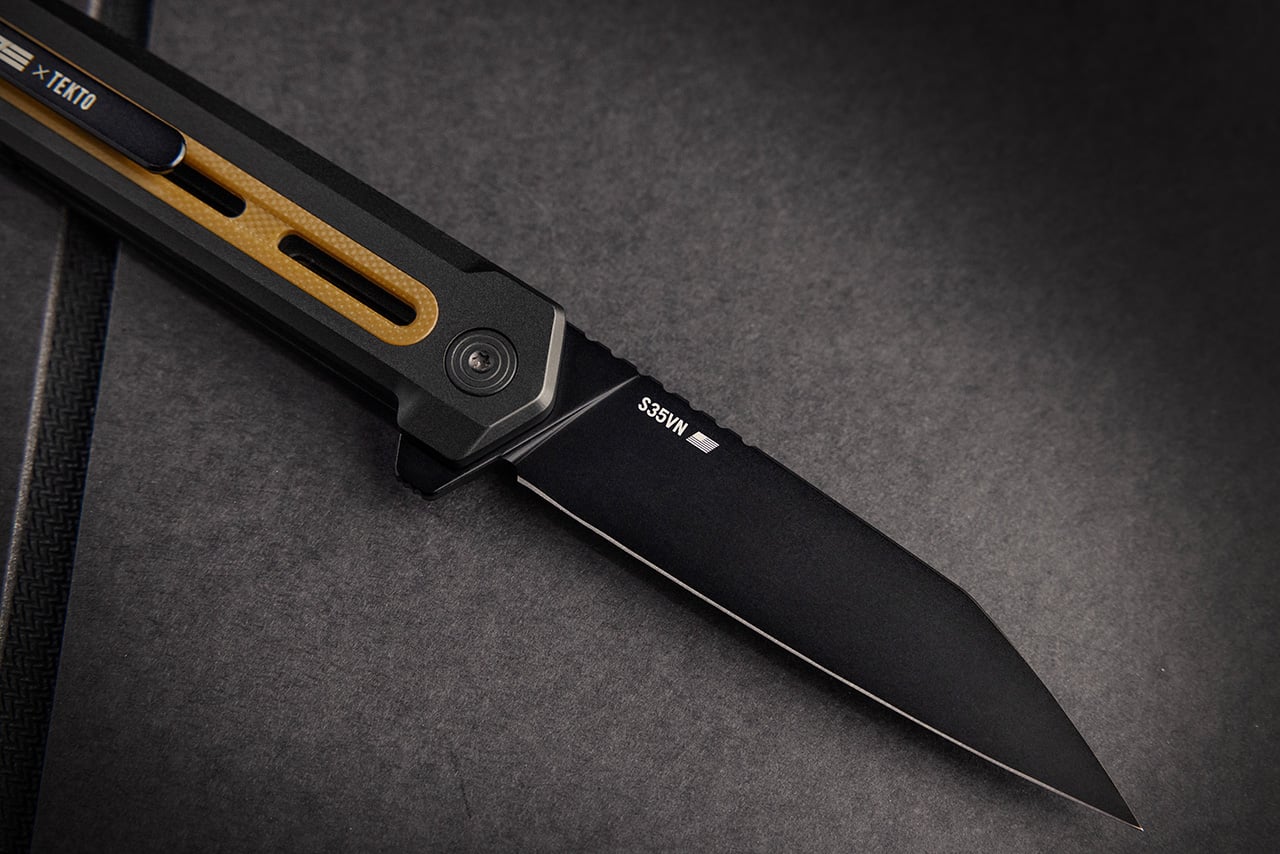
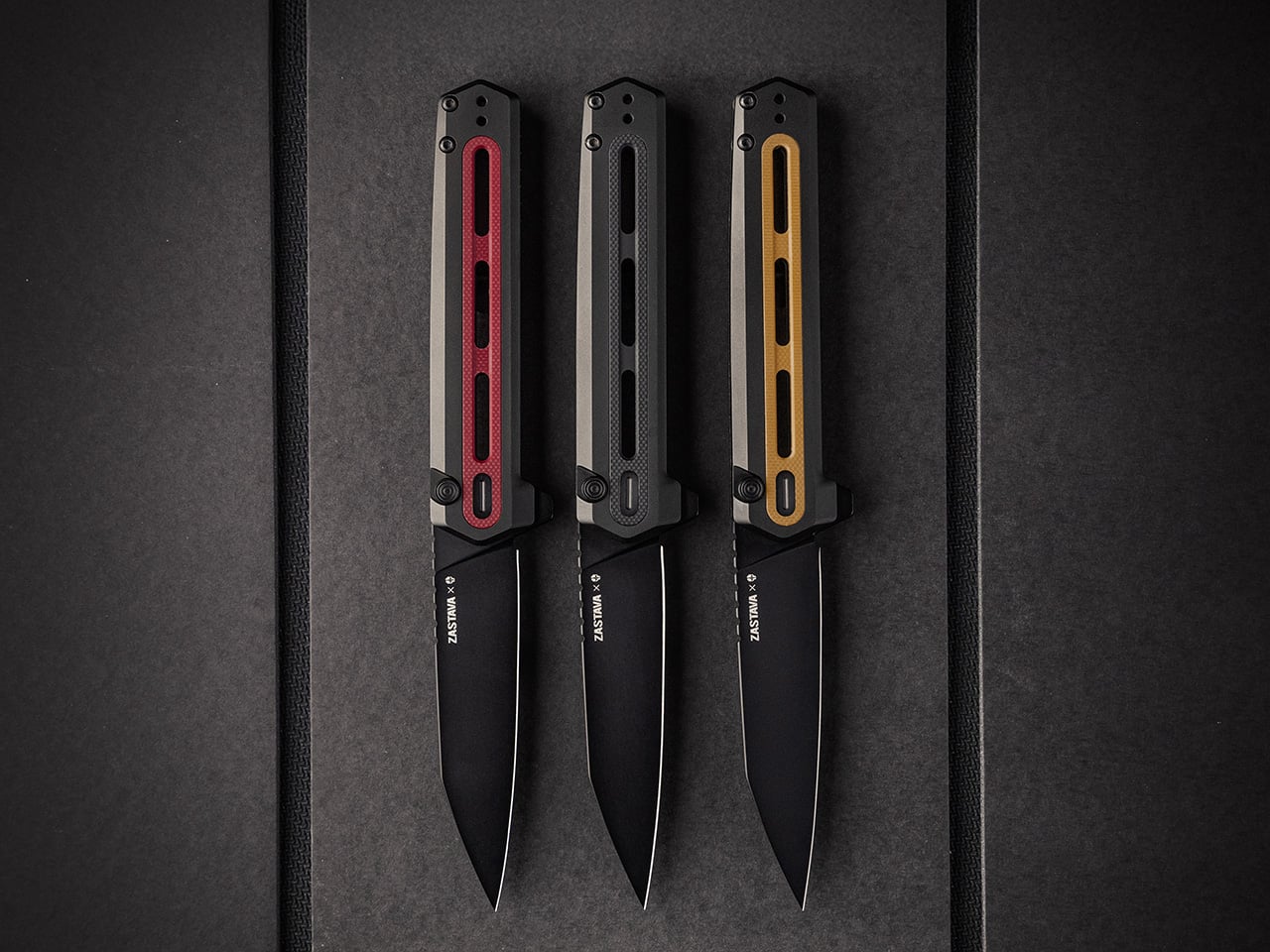
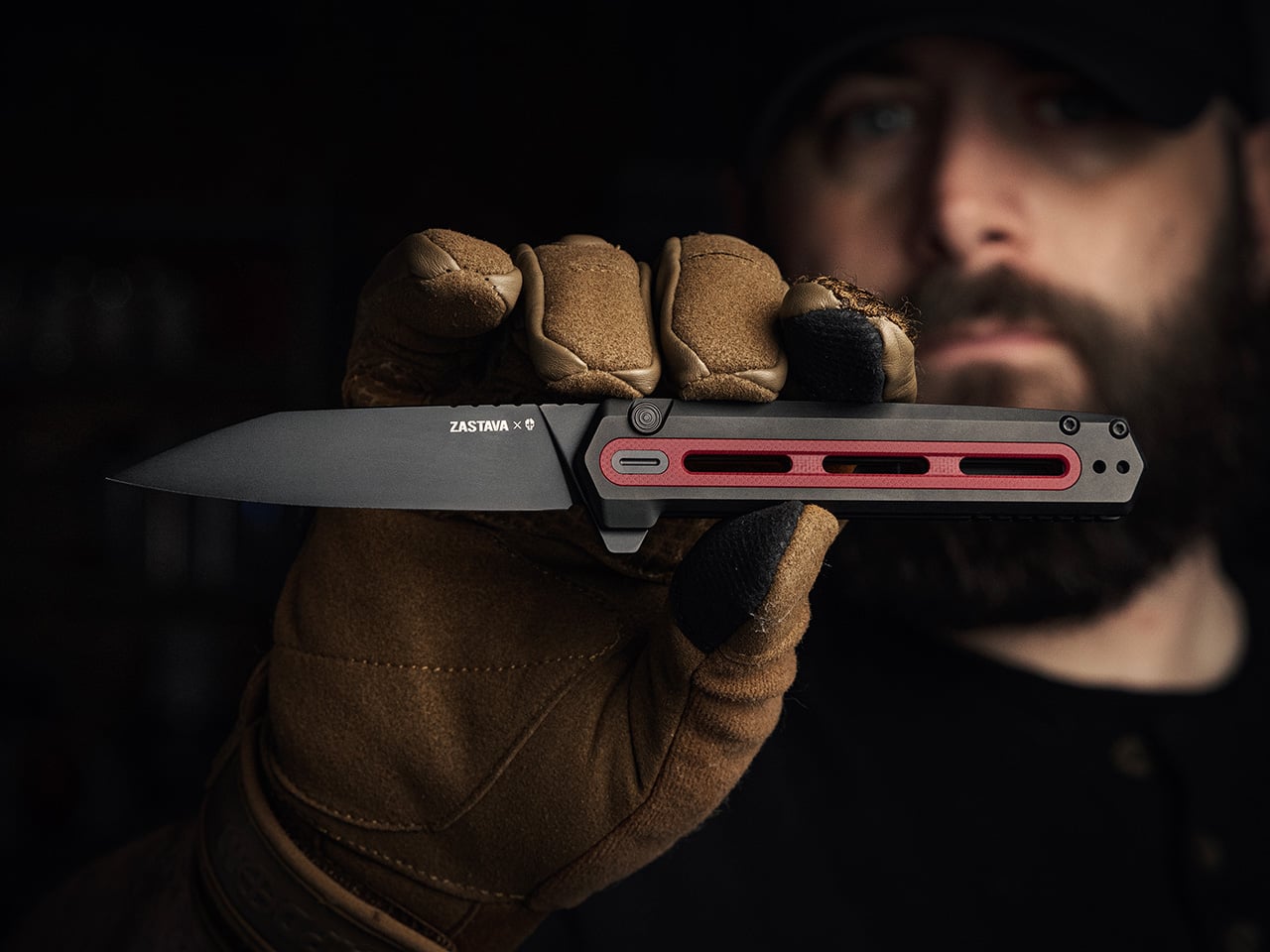
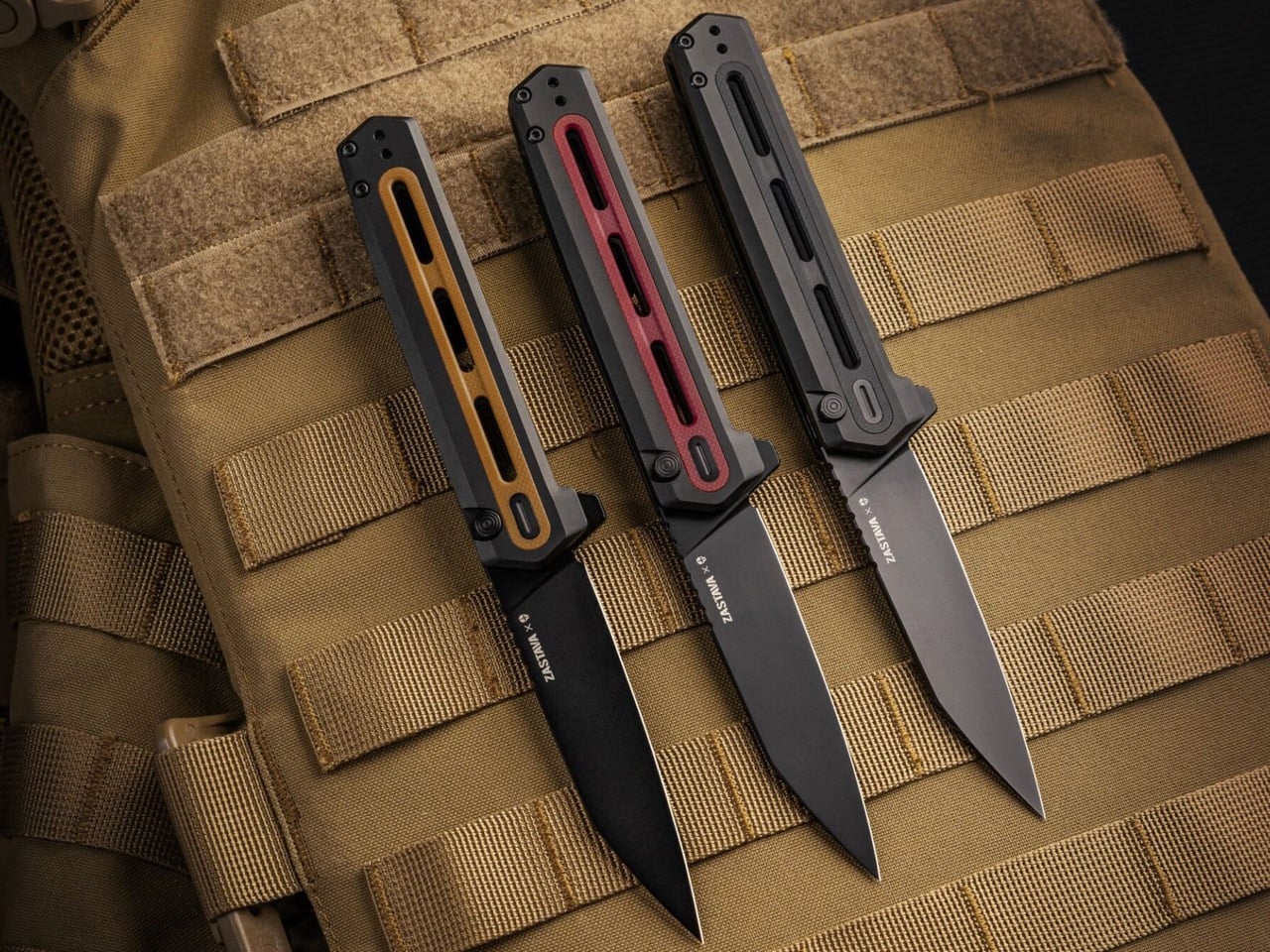
Tekto’s F4 Echo, a collaboration with Zastava Arms USA that leans hard into the gunmaker’s rifle heritage, runs exactly this kind of button lock, and it’s tuned well enough to matter. Press the button and the CPM S35VN blade drops free with none of the mushy half-engagement that plagues cheaper button locks, then a flick of the flipper tab snaps it back open with the same crisp confidence. Closing it is a one-handed motion, thumb on the button, palm rolling the spine shut, no crossed fingers anywhere near the reverse tanto edge. It’s a satisfying click too, the kind that turns into an idle fidget habit whether there’s anything to cut or not. At $199.99 it isn’t chasing budget-tier button locks racing to the bottom on price. It’s proof the mechanism has fully arrived at the mid-tier, executed with a materials upgrade to match, and Tekto clearly built it for people who’ll notice the difference immediately.

Click Here to Buy Now: $170 $199.99 (15% off with code YANKO). Hurry, deal ends in 48-hours! Free FedEx 2Day shipping within the USA.

2. The Pivot: Why Ceramic Bearings Turned Washers Into a Warning Sign

Pull apart any budget folding knife from a decade ago and you’ll almost always find phosphor bronze or Teflon washers wrapped around the pivot, a setup that works fine until grit, lint, or a humid afternoon gets between the layers. Washers rely on flat surface contact, so any contamination turns a smooth flip into a gritty drag that needs a hard wrist snap to force open. Ceramic bearings solve this by replacing that flat contact with a caged ring of hardened balls that roll instead of scrape, cutting friction dramatically and staying consistent even when the knife is dirty. They also can’t rust the way steel bearings eventually do, so a knife that’s been caught in the rain still deploys glassy smooth a year later. This used to be the detail separating a $50 knife from a $300 one, and in 2026 that gap has mostly closed. Once ceramic bearings became cheap to source and simple to cage correctly, there was no honest excuse left for a stiff pivot at any price.

Civivi’s Elementum earned its reputation as the reset button for budget EDC largely by being one of the first sub-$50 folders to ditch washers for a caged ceramic ball bearing pivot outright. The Elementum II carries that same pivot forward while adding a tuned button lock, and the bearing underneath does most of the work on how the knife actually feels in hand. Flick it open and it glides with none of the initial stiffness a washer knife needs to work through, and the closing motion rides that identical smooth pivot rather than some separate mechanism bolted on for the button. At 2.96 inches of Nitro-V steel and under $100 across most configurations, it’s proof the bearing upgrade never had to live exclusively at the premium end of the market. Civivi more or less forced the rest of the budget category to either match that pivot or explain why they hadn’t.

3. The Glow: Why Tritium Slots Separate Findability From Decoration

Tritium vials are sealed glass tubes filled with a radioactive gas that emits a faint, self-powered glow for roughly 25 years with no batteries and no charging required, and EDC makers have been drilling slots for them since around 2020. Plenty of that early adoption was pure theater, vials tucked into handle scales where your palm covers the glow the moment you pick the knife up, or embedded on a blade spine where they serve no purpose beyond looking tactical in a product photo. A well-placed slot solves an actual problem instead. Drop a knife in a dark bag, a glove box, or beside a bed at 2am, and a tritium vial is the difference between patting around blind and spotting a faint green dot exactly where you left it. Vials run $15 to $40 each, so a maker adding two of them made a deliberate call. Decoration gets bolted on wherever there’s leftover space, while findability gets placed exactly where your eye needs to land first.

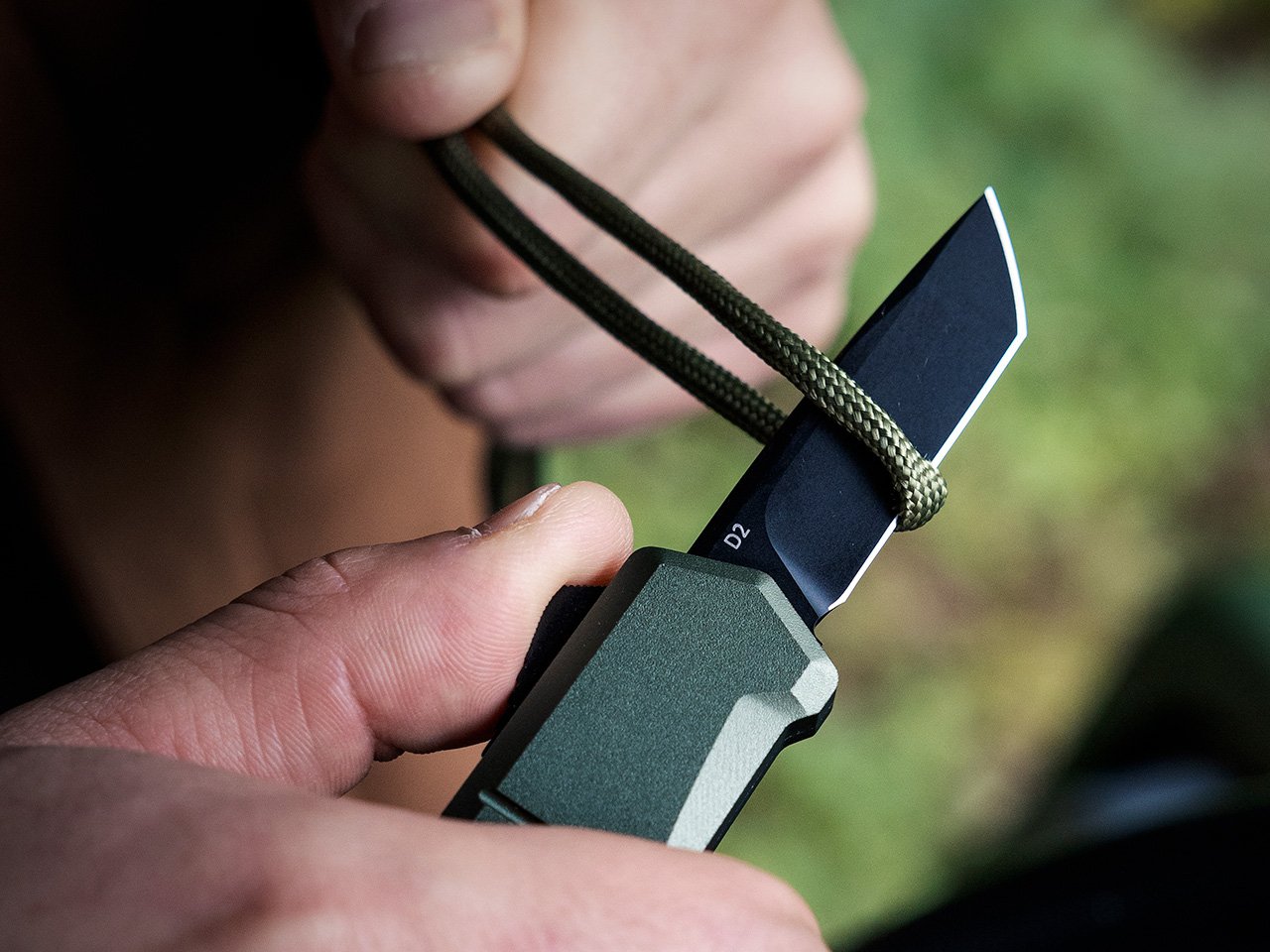
TiNova II puts that logic to its intended use. The two tritium slots sit on the flat faces of its Grade 5 titanium scales, and depending on the finish, you get either raw sandblasted titanium letting the glow read plainly or a black-coated version that makes those same vials do most of the visual work in a dark pocket or bag. At 2.54 inches closed and just 59.3 grams, this is a knife built for keychain duty first, exactly the kind of small object that goes missing in a junk drawer or backpack pocket without a locator built in. The D2 steel blade deploys with a 360 degree spin off a ball bearing pivot, more fidget toy than tactical folder, but the tritium slots keep it from being purely a novelty. It’s a genuinely small detail on a genuinely small knife, and it’s exactly the kind of detail that separates a maker thinking about how the object gets used at night from one just checking a spec sheet box.

4. The Footprint: Why 8 Inches Became the Serious EDC’s Sweet Spot

EDC has spent the better part of a decade chasing extremes in either direction, keychain folders under 4 inches closed competing with hard-use tank knives pushing past 9 inches open, both categories treating size as the headline spec. Somewhere in the middle sits a range most serious knives have quietly converged on, an overall open length around 8 to 8.3 inches paired with a blade close to 3.5 inches. That proportion isn’t an accident or a coincidence across brands. It’s large enough to give a full four-finger grip real purchase on the handle, yet compact enough to disappear into a front pocket without printing through the fabric or announcing itself in a waistband. The blade length lands right at the edge most carry jurisdictions still consider reasonable, long enough for food prep, package handling, and cordage work without crossing into knife-you-have-to-explain territory. Novelty chases a headline number. Dimensional maturity chases the number that actually gets carried every day.

Tactile Knife Co.’s Maverick sits almost exactly on that mark, running 8.18 inches open with a 4.7 inch closed length and a 3.5 inch CPM MagnaCut blade that splits the difference between edge retention and rust resistance better than almost anything at this price. Richard Rogers designed the knife’s tri-lobe handle shape specifically to fill a full-size hand without adding bulk, and the crossbar lock keeps the release off the blade’s path the same way the better button locks do, so drawing and closing it one-handed never feels like a negotiation. At 3.9 ounces in titanium, it carries with enough presence to feel substantial without dragging a pocket down, which is the entire argument for this dimensional range in one knife. Tactile built it in Dallas alongside its better-known pen line, and the proportions read like a team that already understood exactly where the size ceiling for daily carry actually sits.

5. The Fastener: Why Torx Screws Signal a Maker That Expects You to Stick Around

A screw head sounds like the last thing worth judging a knife on, but it quietly tells you how a maker feels about your relationship with the tool over the next decade. Torx resists cam-out under torque, distributes pressure evenly across the star pattern, and doesn’t strip the way a Phillips head does after the third disassembly. Cheaper knives lean on Phillips because the drivers are everywhere, or worse, they use a proprietary bit tucked into a tiny plastic bag that gets lost within a month, quietly forcing you back to the store when the pivot finally needs a clean. The real tell in 2026 isn’t whether a knife uses Torx at all, since most premium builds do by now. It’s whether the maker actually tells you the size. A listed T6 or T8 is an invitation to keep the knife running for years. A vague “tool included” is a maker who’s already planning for you to lose it and buy another knife instead.

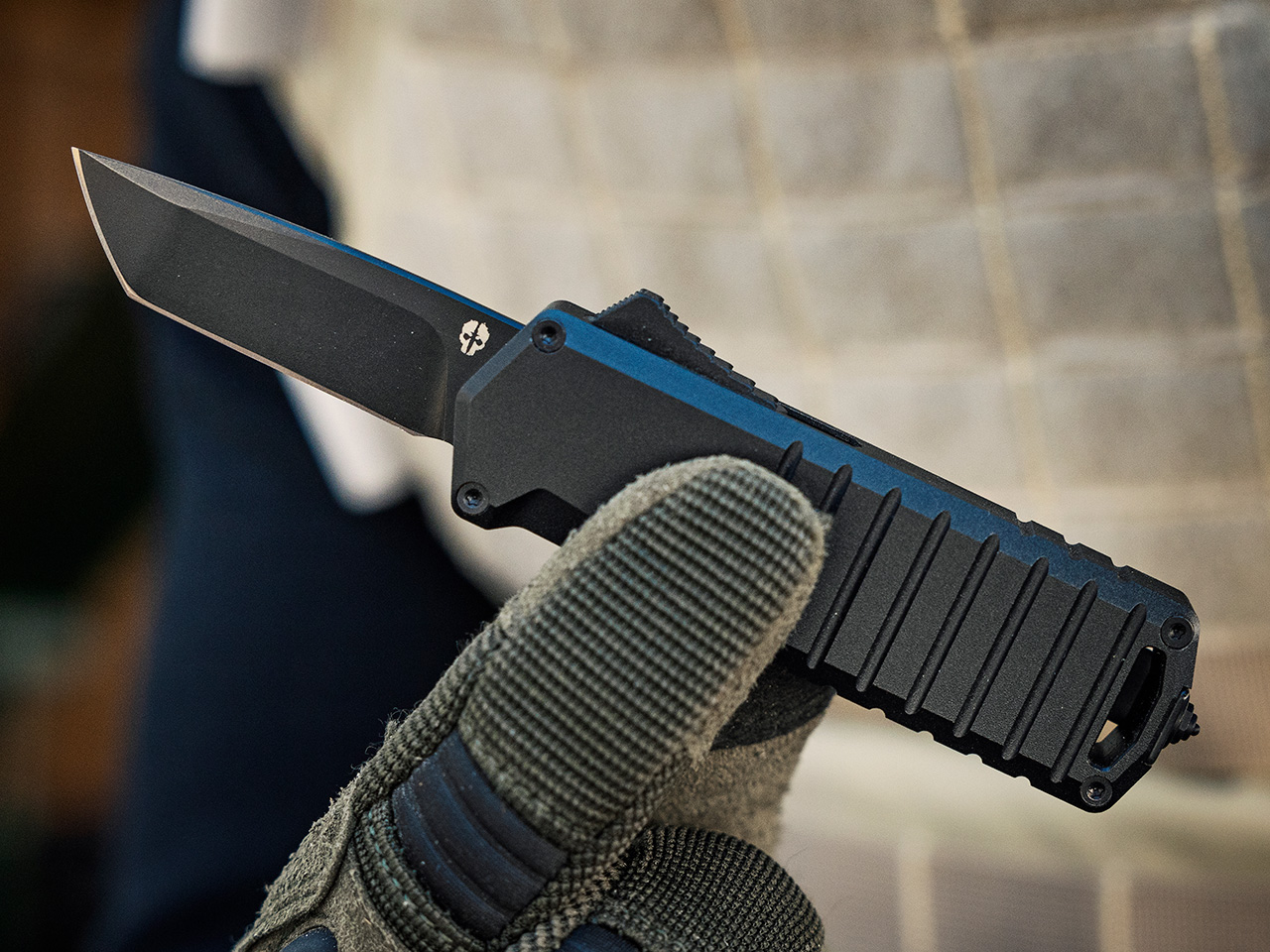
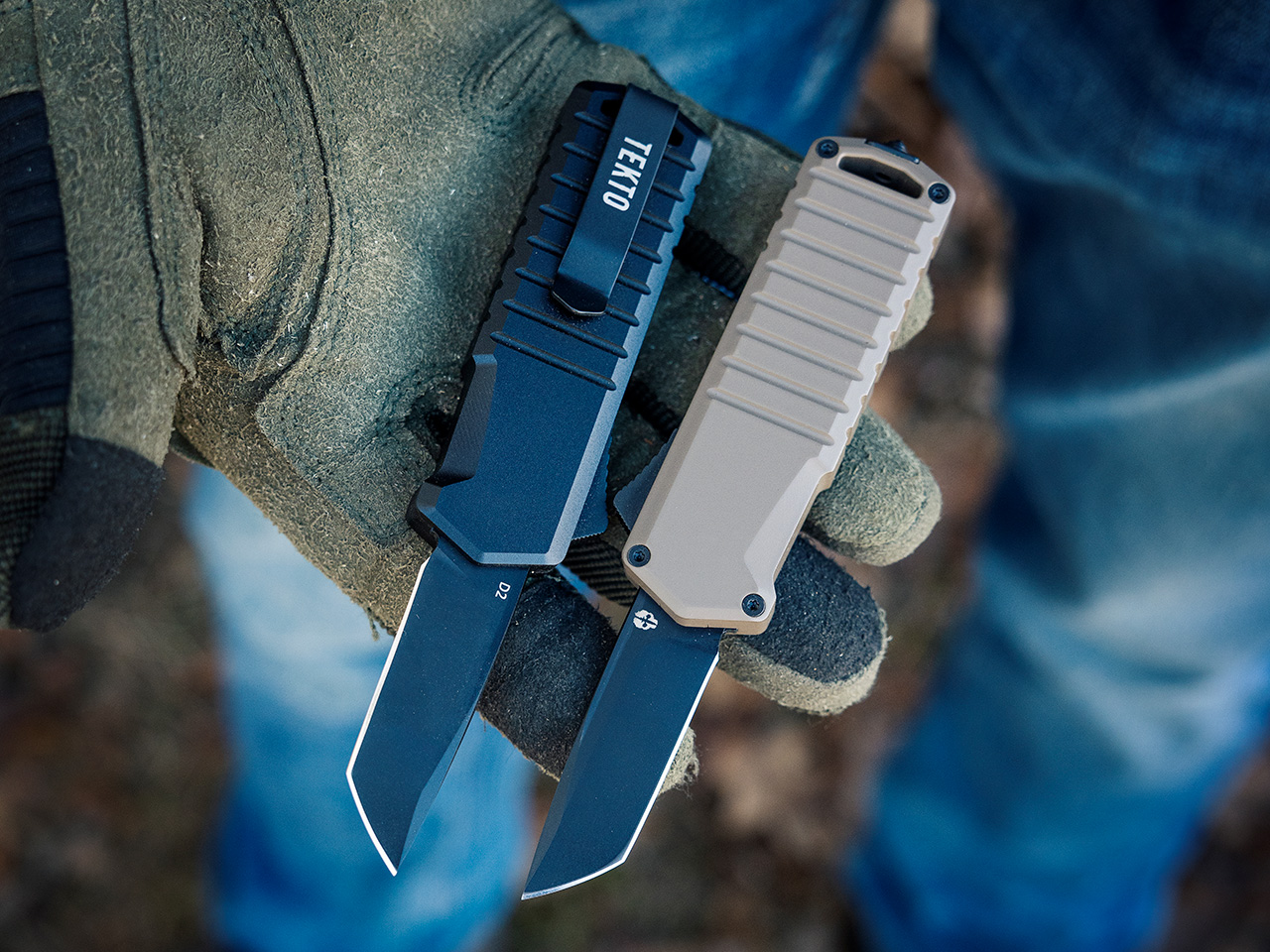
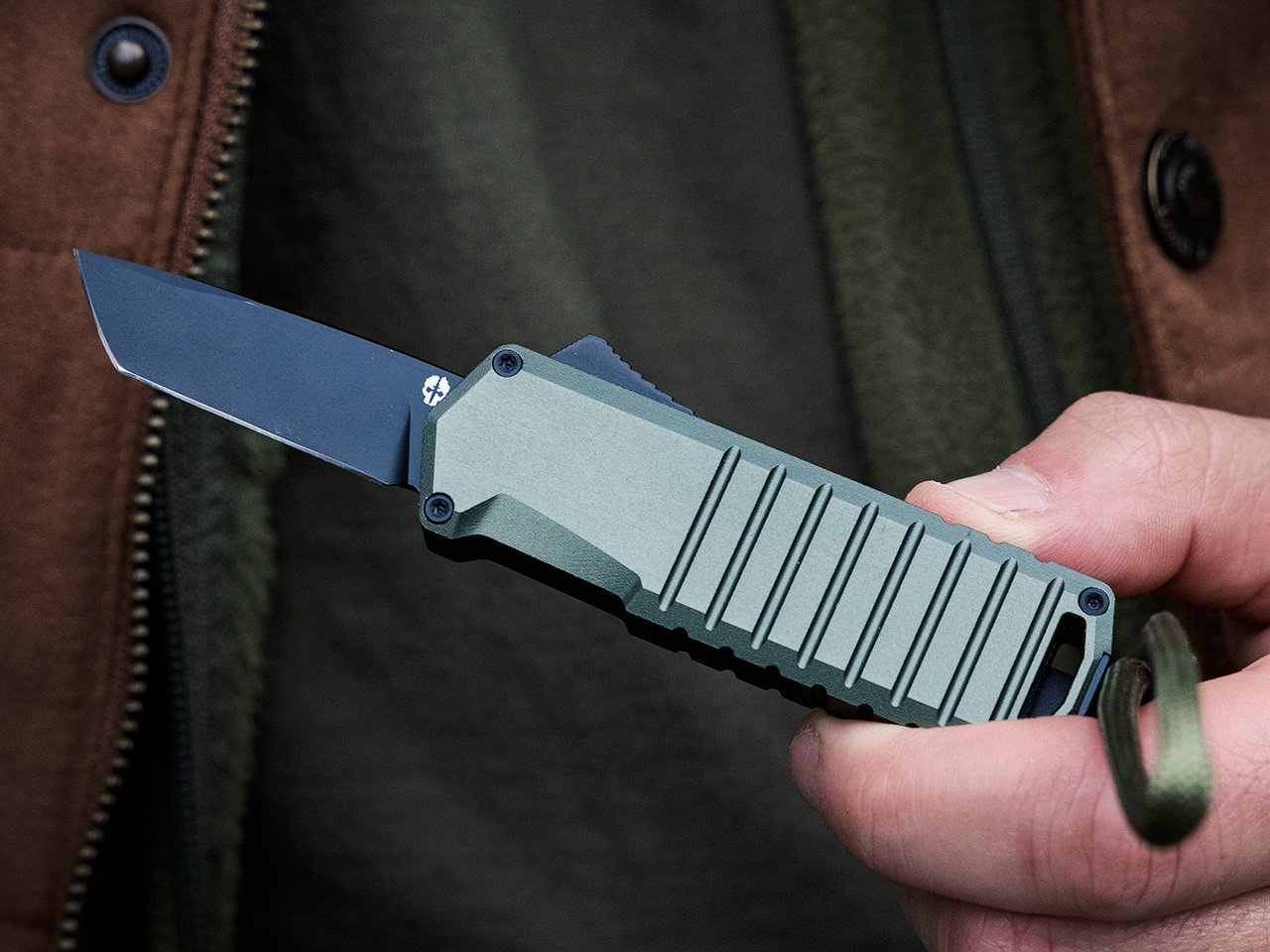
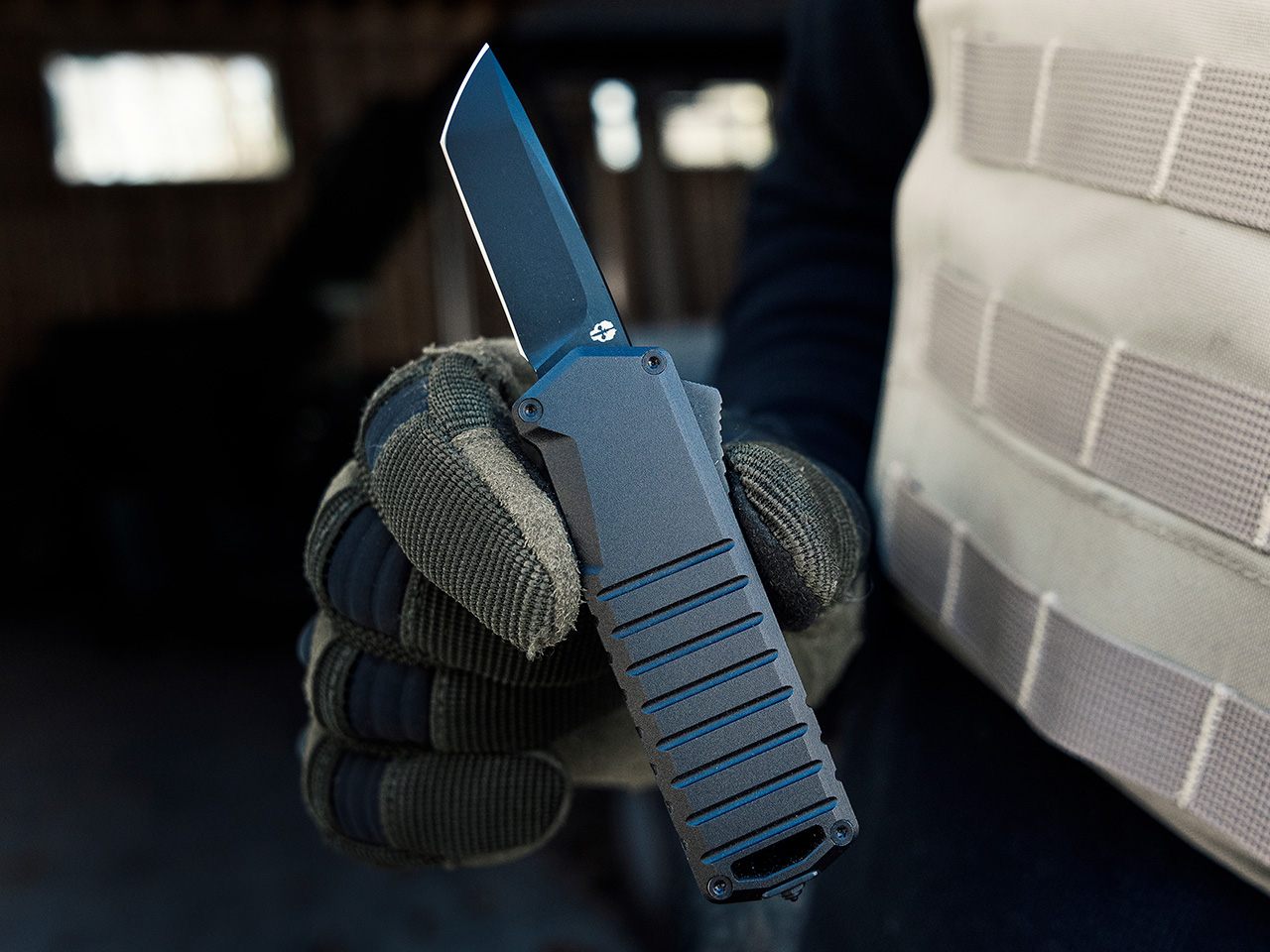
Tekto builds the A2 Badger around that same philosophy, running Torx head screws visible on all four corners of the chamfered aluminum handle rather than hiding the hardware or pressing it in permanently. That transparency matters more than usual here, since the Badger is an OTF, a mechanism with more moving parts than a standard folder and one that benefits from an owner who’s actually willing to open it up and relube the slide over time. At 2.18 ounces with a titanium coated D2 blade under two inches, the Badger was built specifically to slip past the length restrictions that plague OTF knives in restrictive states, and Tekto backs that engineering with a full warranty against material or manufacturing defects. Standard Torx hardware on every corner means an owner can actually service the thing rather than just carry it until something inside finally gives out. It’s a small, unglamorous decision, and it’s exactly the kind that separates a knife built to last from one built to sell once.

Click Here to Buy Now: $119 $139.99 (15% off). Hurry, deal ends in 48-hours! Free FedEx 2Day shipping within the USA.

The post The 5 Details Every Great EDC Design Shares in 2026 first appeared on Yanko Design.

Ever wondered how gearboxes and torque work? MetMo’s latest EDC turns the physics into fidget fun

There is a piece by kinetic artist Arthur Ganson called Beholding the Big Bang, a gear train stretching over a meter long, where the final gear is embedded in solid concrete. With a motor running at one end, the reduction is geared down so severely that even with the first gear spinning at speed, it would take 13.7 billion years for the last gear to turn. Ganson built it as an art piece, a meditation on cosmic time. But buried inside that sculpture is an engineering principle so tactile and immediate that it feels almost criminal to lock it in a gallery. Gear reduction, in its raw form, is one of the most satisfying mechanical phenomena a person can interact with.

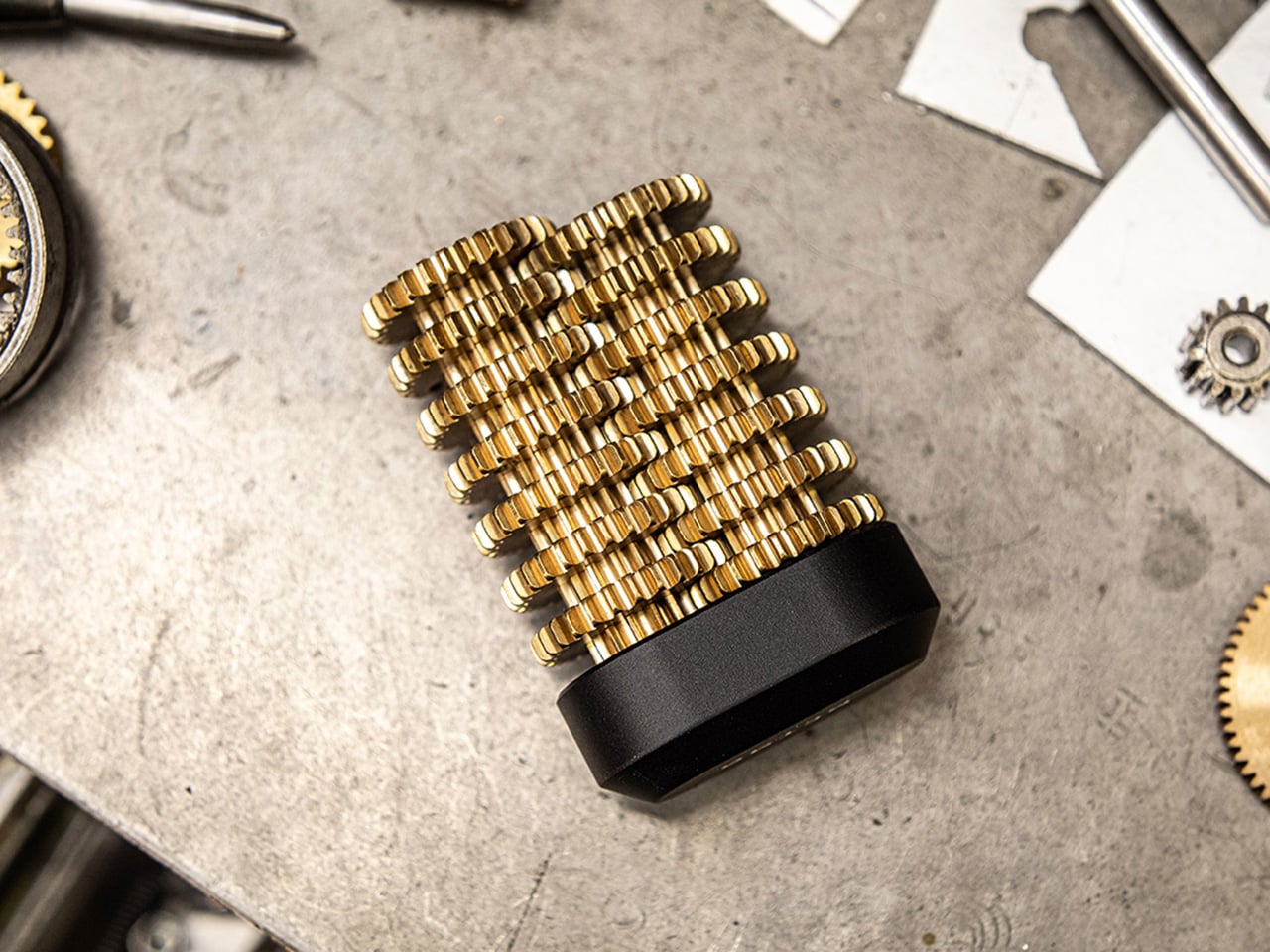
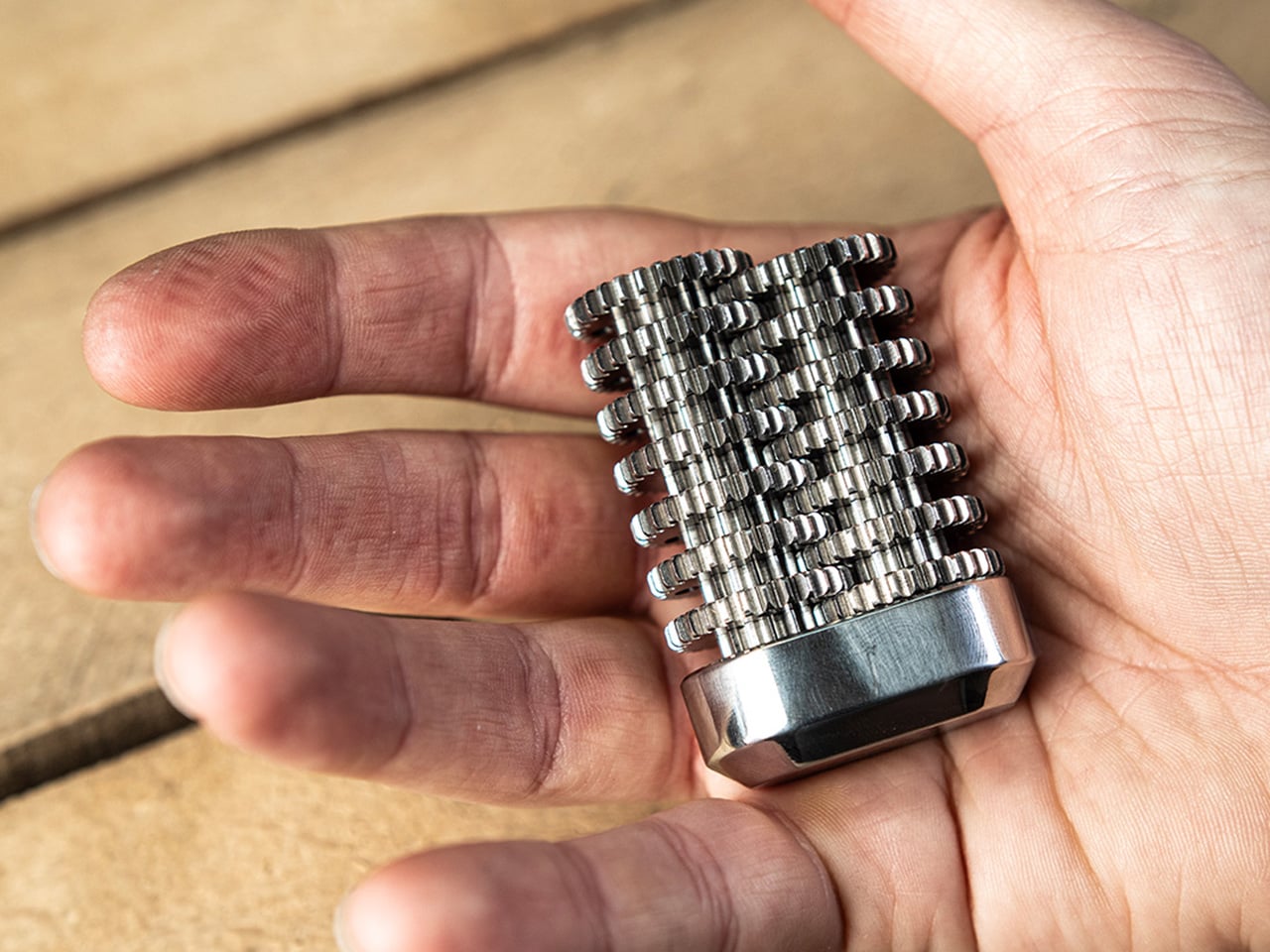
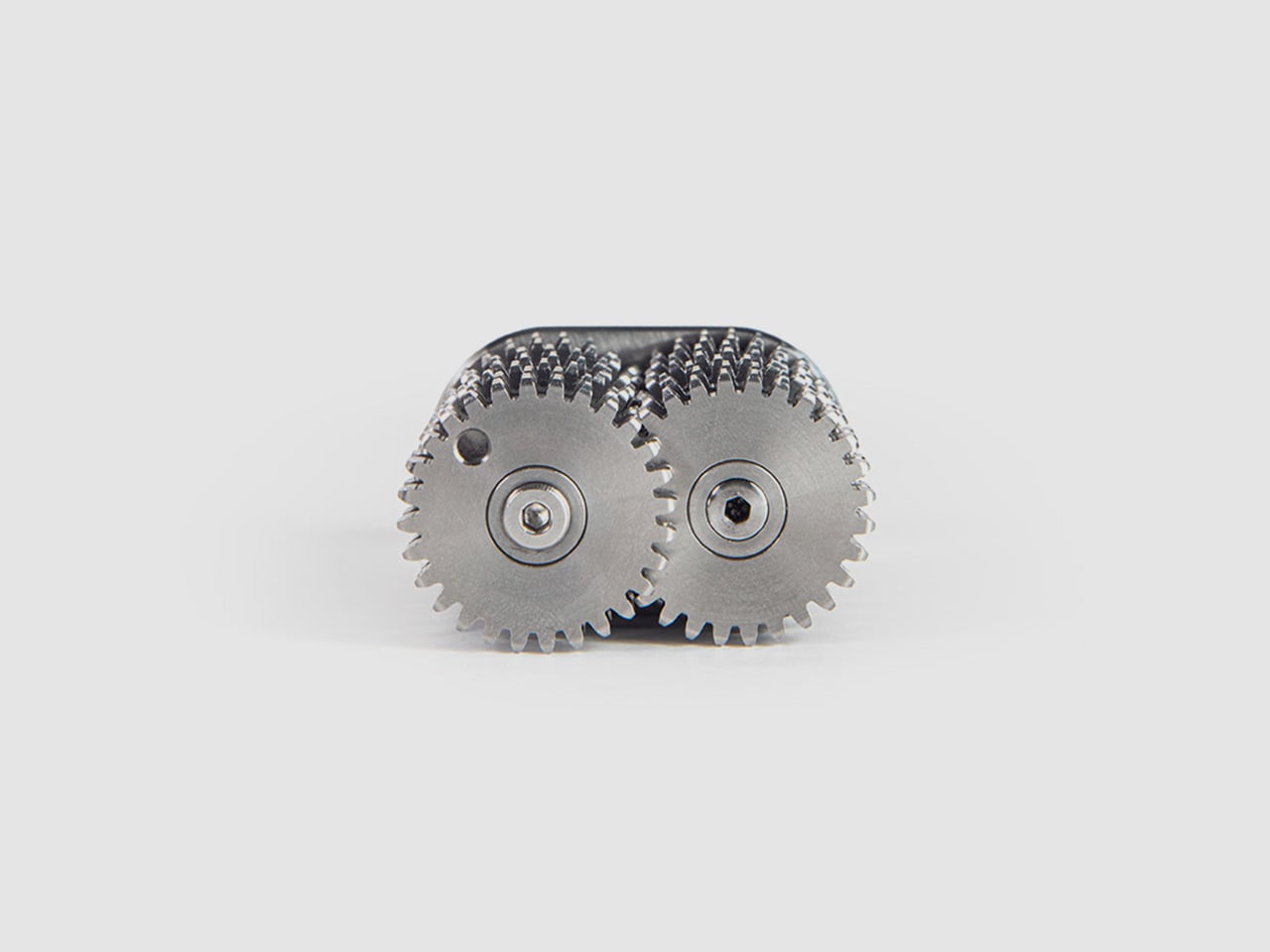
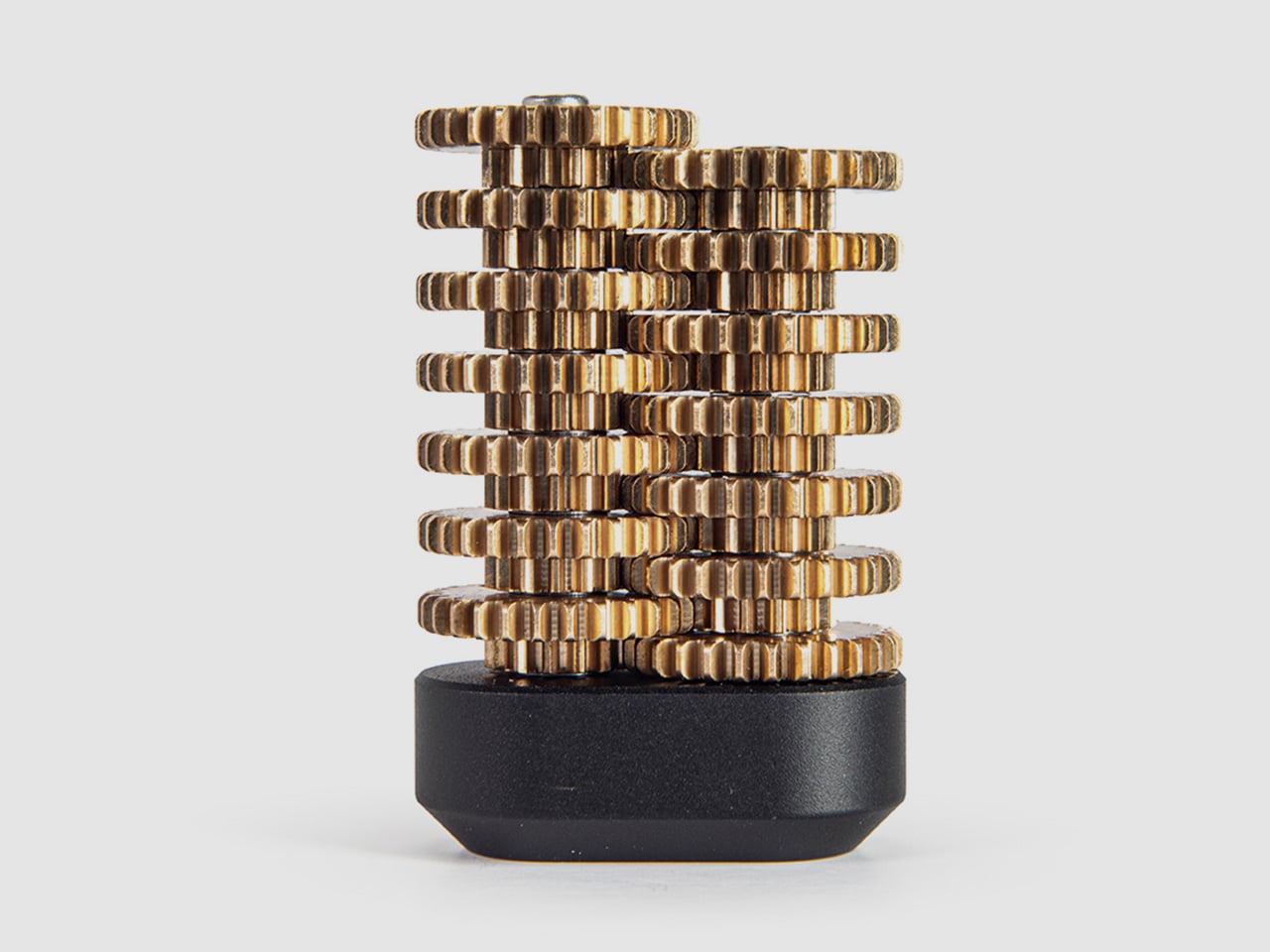
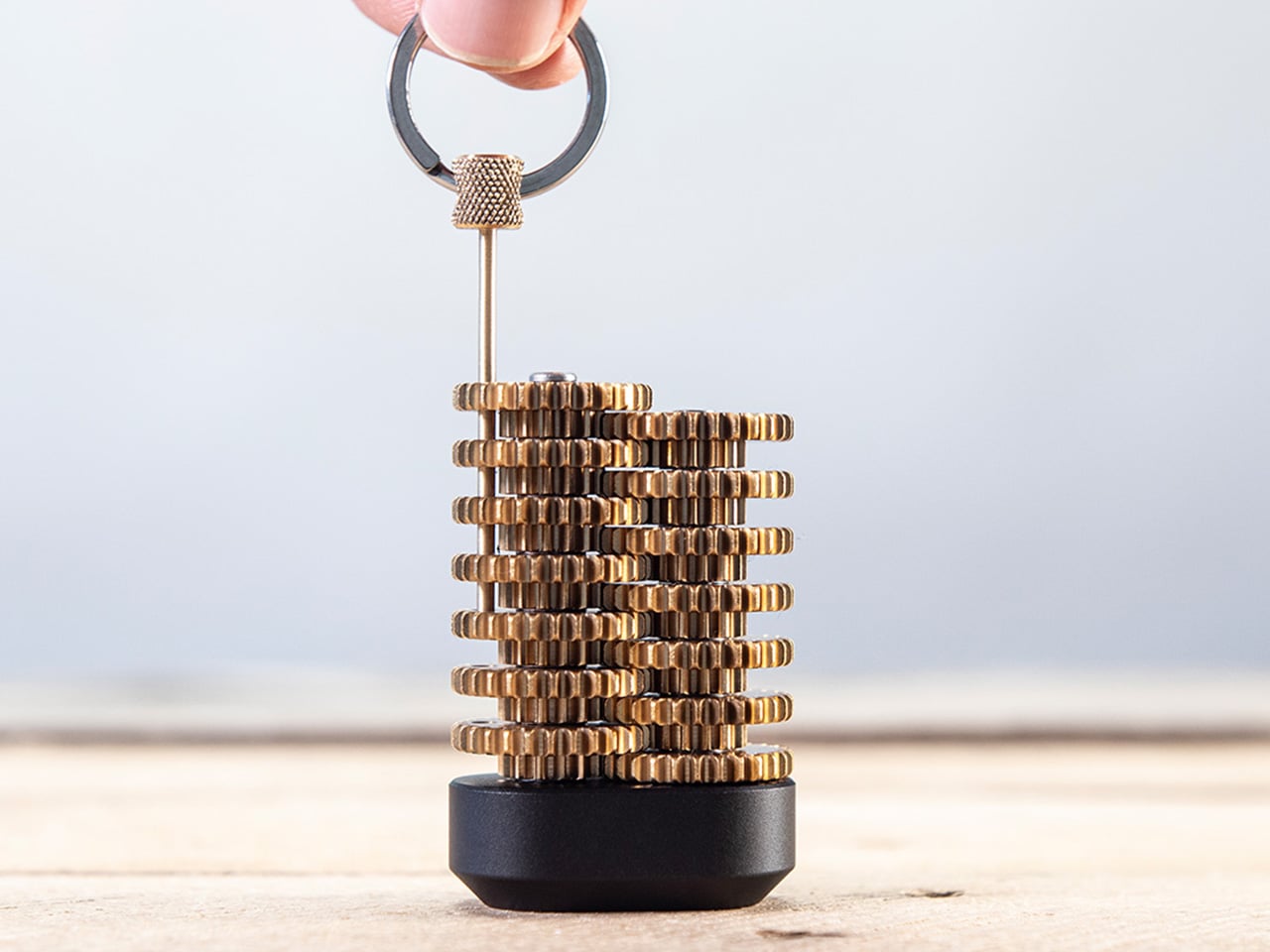
MetMo appears to have agreed with that assessment. The Brass Gear Train takes the same physics and compresses it into a palm-sized, hand-assembled object machined to aerospace tolerances in a UK workshop. The reduction ratio is 16,384:1, which means the top gear and the bottom gear are functionally living in different time zones. Every gear in the stack doubles the torque of the previous one. What reads on paper as an engineering spec feels, in practice, like a magic trick that happens to be fully explainable… and a treat for the eyes and hands.

Designers: Sean Sykes & James Whitfield (MetMo)

Click Here to Buy Now: $148.58.

The trick plays out immediately the moment you start turning the gears. Spin the topmost gear at a comfortable pace, and the lowest gears in the stack appear frozen, barely registering motion. The visual disconnect is mesmerizing because your brain knows they should be moving, but the reduction is so steep that a full rotation at the top translates to near-invisibility at the bottom. You can reverse the operation too, gripping the lower gears and turning them while the top spins wildly out of control, the torque climbing exponentially as you work your way down the train. The interaction is simple enough for anyone to understand within seconds, but satisfying enough that most people who pick it up will keep spinning it for several minutes straight. If you are someone who thinks while touching things, who solves problems by turning objects over in your hands, or who just appreciates when engineering reveals itself rather than hiding behind a housing, this is built for exactly that impulse.

Each gear in the stack doubles the torque input from the gear above it, which means by the time you reach the bottom of the train, your effort has been multiplied 16,384 times over. Turning the first gear feels effortless, barely any resistance. Move down one level and there is a slight increase in drag. By the third or fourth gear, you start feeling real resistance. By the sixth gear, most people will struggle to turn it with just their fingers. The lower you go, the more mechanical advantage you are fighting against, and the feedback is immediate, visceral, and surprisingly addictive. It turns an abstract engineering principle into a tangible workout for your hand, and the challenge of working your way down the entire gear stack becomes a desk-toy dare that most visitors cannot resist attempting.

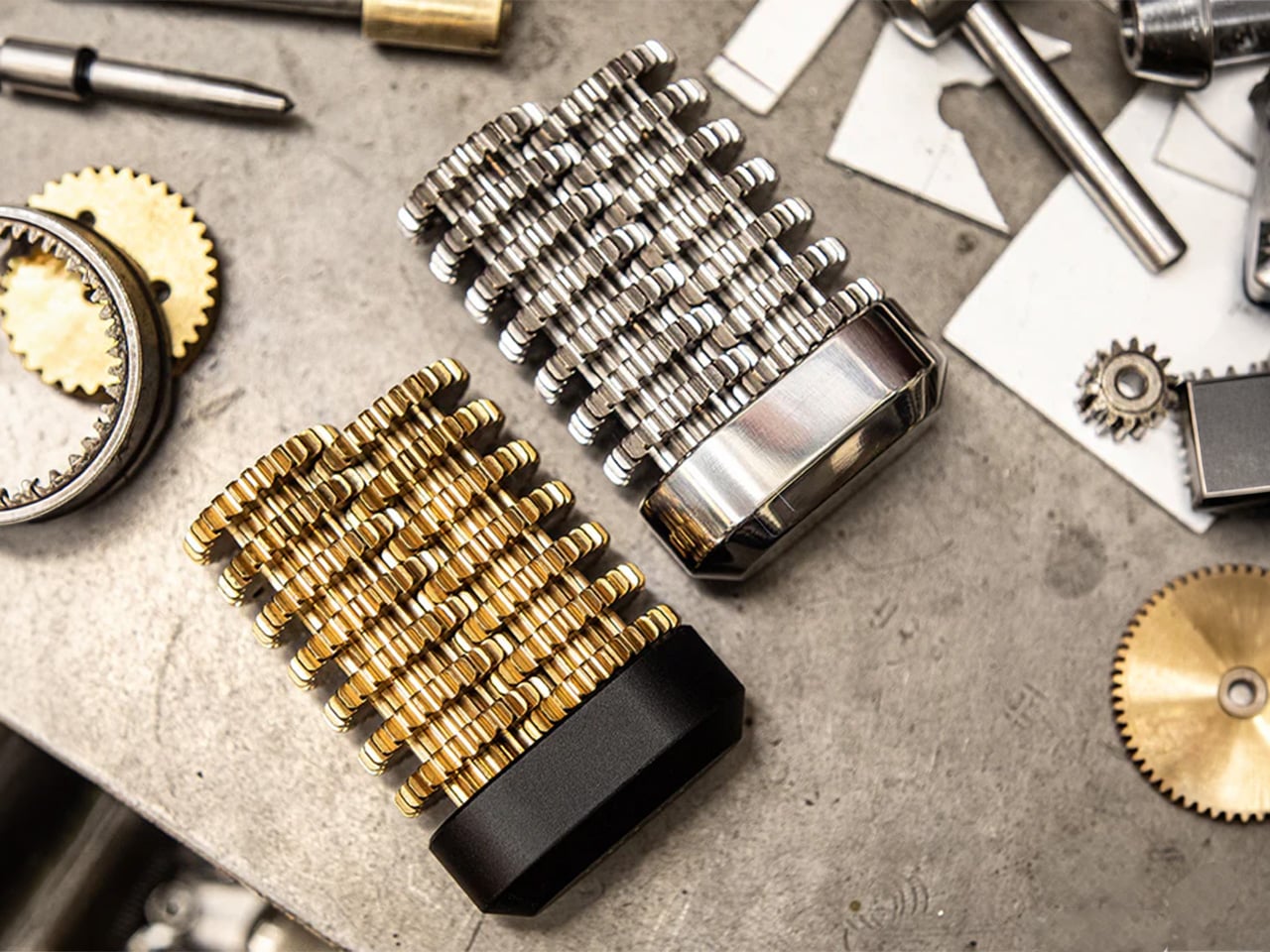
The gears are precision CNC-machined from solid brass, chosen specifically to echo the clockwork mechanisms of old. The warm metallic tone, the weight distribution, and the smooth meshing of teeth all call back to antique engineering, when gears were visible, celebrated, and built to outlast their makers. The gears sit on a hard anodized aluminum base, which serves a dual purpose: it provides a low center of gravity that makes the object comfortable to hold, and the hard anodizing prevents corrosion, ensuring the base stays flawless even after years of desk duty. The Gear Train comes with a pin that holds everything in place – taking the pin out lets you fidget with the gear’s movement. When you’re done testing the laws of physics, you can slide a pin back through the gears, locking them in place so they don’t shift around in your pocket and accidentally snag your earphone cable.

The only way to reinsert the pin is to rotate the gears back into perfect alignment, a 16,384-revolution journey where all the holes must line up simultaneously. It is planetary alignment in miniature, a needle threading that requires patience, memory, or just a willingness to turn the stack slowly until everything clicks into place. Some users will treat this as a one-time puzzle, solving it once and leaving the pin in. Others will pull it out deliberately, turning the Gear Train into an ongoing fidget challenge that resets itself every time.

Every component is machined by Metmo in their UK workshop, running solid metal stock through CNC mills to the same tolerances used in aerospace engineering. There are no mass-manufactured parts anywhere in the assembly. Each gear is hand-finished, with edges smoothed to perfection so there are no sharp bits, no rough patches, nothing that interrupts the tactile pleasure of turning the stack over in your hands. The gears mesh perfectly, tight enough to eliminate backlash but smooth enough that the motion feels like silk. When the product page says the gears fit together like a Swiss watch, that is not marketing poetry, it is an accurate description of what you feel when you spin them.

MetMo built this object to live on a desk, and the visual presence reflects that intent. The stacked brass gears catch light beautifully, the gear-tooth profiles creating a repeating pattern that reads as both mechanical and decorative. The weight feels substantial without being cumbersome, and the passivated brass doesn’t patina like regular brass does, ensuring your gear-train looks shiny and precise even after years. People walking past will stop and ask what it is, which gives you the opportunity to demonstrate the reduction ratio in real time, and most onlookers will immediately want to try it themselves. It functions as a conversation piece, an engineering demo, and a desk sculpture simultaneously, occupying the same category as premium perpetual motion toys or kinetic sand timers, objects that justify their presence through sheer fascination rather than utility. For designers, engineers, makers, or anyone whose workspace doubles as a place to think, this belongs within arm’s reach.

The Brass Gear Train is available in two material configurations. The brass version featured here uses solid brass gears with a hard anodized aluminum base, delivering that warm, vintage-clockwork aesthetic MetMo designed it around. There is also a stainless steel variant, which trades the brass warmth for a more industrial, corrosion-resistant finish with a heavier feel in hand. Both versions are hand-assembled, both carry the same 16,384:1 reduction ratio, and both come with the removable alignment pin for puzzle play. MetMo backs both configurations with a 200-year guarantee, the same confident warranty they extend across their entire product line, a statement that this object was built to outlast you, your desk, and probably your great-grandchildren.

The MetMo Brass Gear Train is priced at £99 GBP (approx $149 USD) and ships directly from MetMo’s UK workshop. For those interested in the stainless steel version, pricing and availability can be found on the MetMo website. Both versions qualify for free shipping on orders over £200.

Click Here to Buy Now: $148.58.

The post Ever wondered how gearboxes and torque work? MetMo’s latest EDC turns the physics into fidget fun first appeared on Yanko Design.
This Titanium EDC Keychain Has 20 Tools Inside and Looks Exactly Like a Regular Key

Keys are the only objects humans carry with religious consistency. Wallet habits change, phone pockets shift, watches come and go, but keys stay anchored to the same loop every single day. That makes the key form factor the most reliable real estate in EDC. A tool that mimics a key doesn’t just blend into your carry, it hijacks the one item you’ll never leave behind. EDC Monster understood this from the start when they launched the original KeyMaster in 2023, a 14-in-1 titanium multitool that slipped onto keyrings and disappeared. Version 2.0 expanded to 18 functions, refining the tool selection and ergonomics. Now, three generations and three years later, they’ve perfected the shape that hides in plain sight. KeyMaster 3.0 proves that sticking with a form factor long enough to truly master it beats chasing novelty every product cycle.

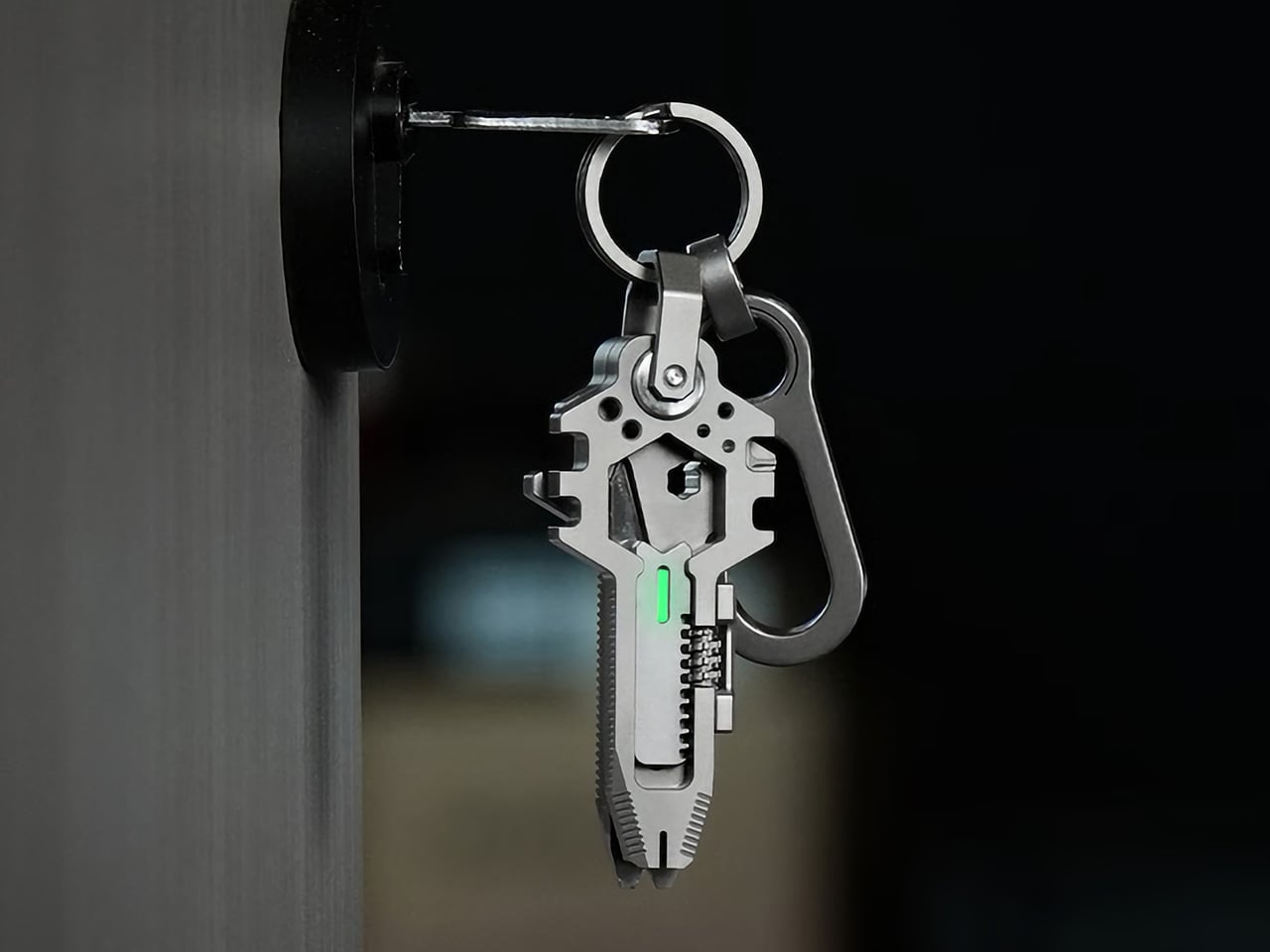
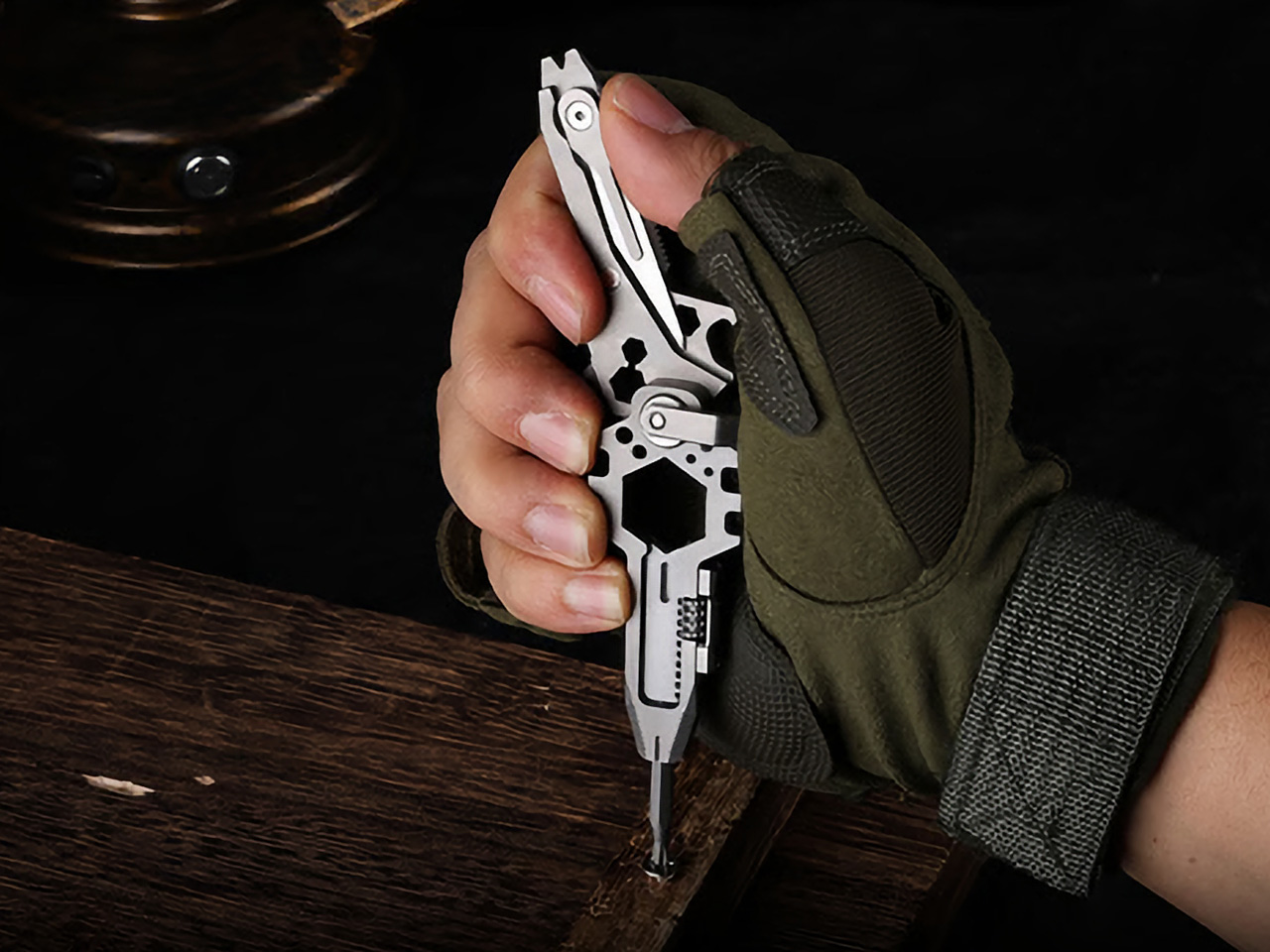
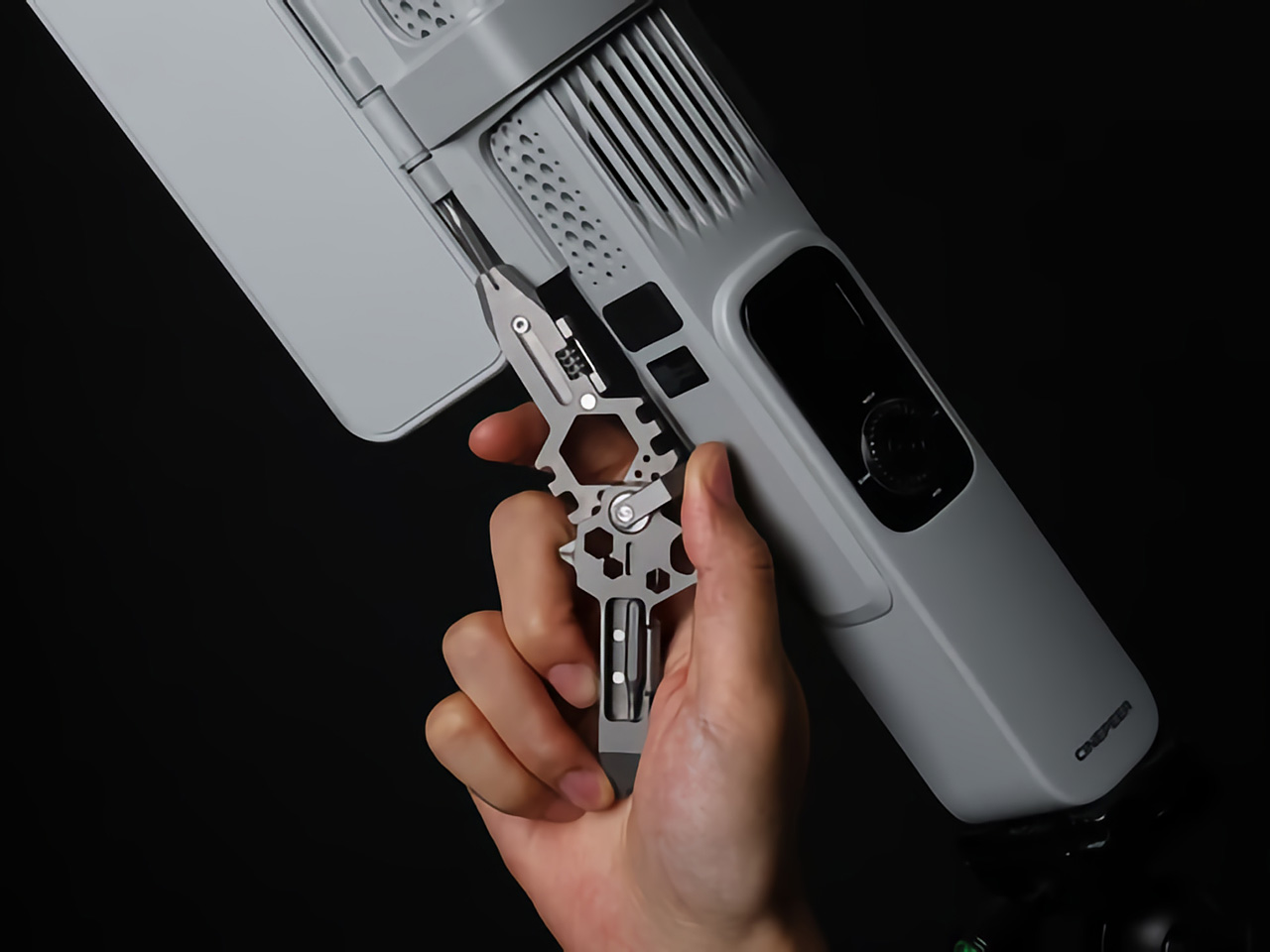
KeyMaster 3.0 takes the key-shaped multi-tool concept and rebuilds it around adaptability. The body is Grade 5 titanium, precision-machined and sandblasted to a matte finish that feels refined in hand. At 74.5mm long and 53.7 grams, it sits flat on a keychain next to your car fob and house key. The tool count hits 20-plus, but the real upgrade lives in three systems: an adjustable spanner with a 0-16mm range that replaces six fixed wrenches, a magnetic bit driver that locks bits in place without slippage, and a blade holder that accepts standard #11 replaceable blades. EDC Monster designed it to solve the problems the first two generations couldn’t.

Designer: EDC Monster Design team

Click Here to Buy Now: $79 $119 ($40 off). Hurry, only a few left! Raised over $61,000.

Every multi-tool with a fixed wrench eventually meets the bolt it can’t turn. Previous KeyMaster generations shipped with fixed hex wrenches sized for common fasteners, which worked cleanly in controlled situations and failed quietly in the field. The 3.0’s adjustable spanner covers 0 to 16mm, handling everything from M5 bolts to M12 hardware without swapping tools or approximating the fit. EDC Monster also designed the second plate of the tool’s two-body construction to double as a grip handle when the spanner is deployed, adding real purchase for tighter fasteners. That range maps directly to the kind of real-world repairs where keychain tools actually get deployed: furniture assembly, bike adjustments, appliance tinkering, and the inevitable IKEA emergency at a friend’s new apartment.

The same logic applies to the screwdriver system, where friction-fit bits have plagued compact tools for years. Under even moderate torque, a bit that isn’t mechanically retained will wobble, slip, and strip the fastener before the job is done. EDC Monster’s magnetic retention snaps bits into the driver head with zero play, and the redesigned top-mounted driver position delivers a more natural wrist angle and better torque transfer than the side-mounted configurations common in smaller tools. Two bits live in onboard magnetic storage slots inside the body, and the 4mm standard keeps the system open to any aftermarket supplier rather than tying you to EDC Monster’s own replacements.

The everyday toolkit built into the body covers the situations that repeat. The pry bar handles box seams, stubborn lids, and light leverage without needing a dedicated tool for each variation. The Phillips and flathead drivers handle cabinet hardware, furniture bolts, and the loose screws that accumulate in any lived-in space. The bottle opener is self-explanatory. The nail file, nail puller, and mini ruler sound mundane until the moment they’re useful, which is the entire argument for carrying a tool this small. You don’t pack a ruler because you expect to need one. You pack it because when you do need one and don’t have it, you feel the absence more sharply than the weight would have ever justified.

Where KeyMaster 3.0 separates itself from the category is in its willingness to go further. The mini saw handles cuts on wood, plastic, and cord in situations where a blade would bind or skip. The wire bender manipulates cable for improvised fixes that tape simply won’t hold. The spoke wrench addresses bicycle wheel truing with a specificity that no Swiss Army knife has ever bothered with, and the firestarter edge covers the gap between urban carry and trail use without requiring a second tool on the keychain. These aren’t tools for every day. They’re tools for the day when something goes wrong and the nearest hardware store is twenty minutes away, or the nearest anything is considerably further.

The Grade 5 titanium construction keeps the weight at 53.7 grams while delivering the strength to handle real torque loads without flexing or failing. EDC Monster chose a matte sandblasted finish that hides scratches and wear far better than polished titanium, so the tool maintains its aesthetic even after months on a keyring alongside jangling metal keys and carabiners. The 74.5mm length matches the profile of a standard house key, which means KeyMaster 3.0 doesn’t create an awkward bulge or unbalanced weight distribution in your pocket. The 35mm width keeps it slim enough to layer flat with other keys, and the 4mm thickness at its thickest point tapers down to 2mm at the edges. EDC Monster drilled a 6mm keyring hole at the base, large enough to accommodate split rings, carabiners, or paracord lanyards. The entire tool feels substantial without feeling heavy, a balance that titanium achieves better than steel or aluminum in this weight class.

The person KeyMaster 3.0 is built for tends to sit between two extremes. They’re not the enthusiast who carries a full Leatherman and considers it light. They’re also not the person who treats their keychain as a keychain and nothing more. They’re the cyclist who needs spoke access and hex drivers on the road and won’t check a bag for a wrench. They’re the urban renter who tackles household repairs without owning a proper toolkit and has resorted to using a shoe as a hammer more than once. They’re the frequent traveler who wants something genuinely capable that clears security without a second glance. What EDC Monster grasped three generations ago, and has refined ever since, is that this person doesn’t want to think about their tools. They want to reach into their pocket, find what they need, and get on with things.

KeyMaster 3.0 is currently available for pre-order at $69 for early backers, a 30% discount off the planned retail price of $99. EDC Monster estimates shipping in August 2026 for Kickstarter backers, with general retail availability following later in the fall. The campaign includes free worldwide shipping, and backers can add extra #11 blade packs (10 blades for $5) and additional bit sets (6 bits for $12) during checkout.

Click Here to Buy Now: $79 $119 ($40 off). Hurry, only a few left! Raised over $61,000.

The post This Titanium EDC Keychain Has 20 Tools Inside and Looks Exactly Like a Regular Key first appeared on Yanko Design.
This $45 Titanium Pocket Knife Uses Centrifugal Force and Neodymium Magnets Instead of A Button Lock

Most pocket knives are designed for the moment you need to cut something. The TiNova II is designed for that moment, but also for the five minutes after, when you find yourself opening and closing it just because the mechanism feels satisfying. That shift in priorities is intentional, and it required Ideaspark to rethink the entire knife after the first version shipped to over 1,300 Kickstarter backers in 2025.

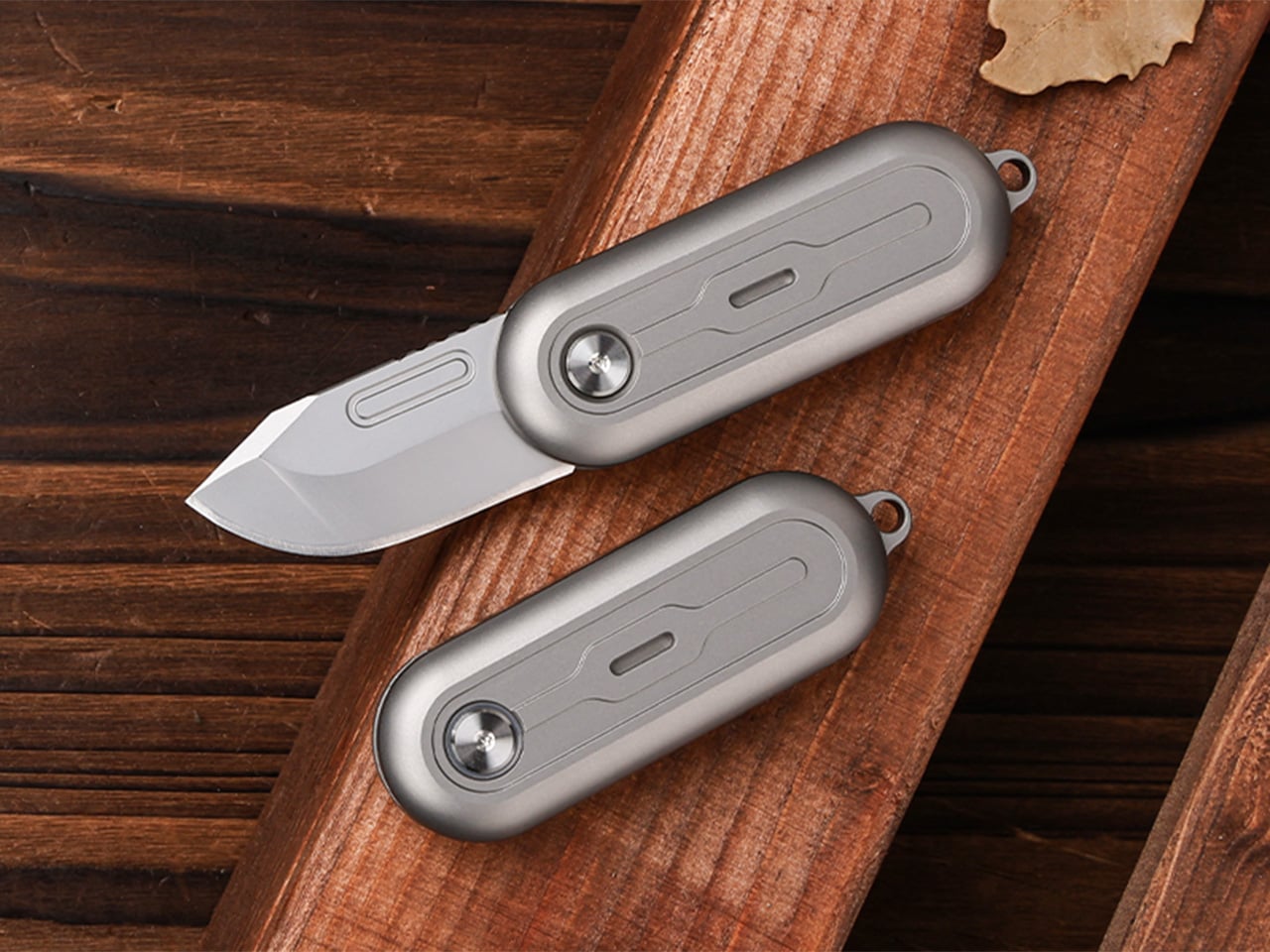
The mechanism itself is straightforward. Two titanium handle scales connect at a single roller bearing pivot point. One scale stays fixed, the other rotates a full 360 degrees around it. Neodymium magnets sit at strategic positions to create resistance, so when the blade swings open or closed, you get a crisp magnetic snap that locks it in place. Flick your wrist and the momentum carries the blade through a smooth rotation with a satisfying ‘click’. Hold it differently and you can coax out a slower, weighted spin. What changed between Gen 1 and Gen 2 is the body shape. The original had flat sides and sharp edges like a traditional folding knife. The TiNova II uses an oval profile that matches the natural curve your hand makes when your fingers relax into a loose fist. That single geometry change makes the knife feel completely different when you’re holding it, which matters when the whole point is creating something you’ll keep picking up. The magnetic resistance is tuned tight enough to keep the blade from accidentally deploying in your pocket, but smooth enough that you can flip it open one-handed without effort.

Designer: Ideaspark

Click Here to Buy Now: $49 $70 (30% off). Hurry, only 64/100 left! Raised over $62,000.

The handle scales are machined from Grade 5 titanium, the aerospace alloy that shows up in everything from jet engine components to high-end bike frames. The material delivers the strength-to-weight ratio you’d expect (the entire knife weighs 59.3 grams, roughly two U.S. quarters), but the more interesting property is how it wears. Titanium doesn’t corrode, rust, or tarnish the way steel does. Instead, it develops a patina over time, recording scratches and scuffs as a visual history of use. Every mark becomes permanent, which means the knife you carry for a year looks distinctly different from the one that arrived in the mail. Ideaspark leans into this with two finish options: a raw sandblasted titanium that shows wear immediately, and a black PVD coating that creates higher contrast when the underlying metal starts to peek through.

The blade is D2 tool steel, heat-treated to HRC 58-60. D2 sits in an interesting zone within the steel hierarchy. It holds an edge longer than most budget steels (think 8Cr13MoV or AUS-8), and is a go-to choice for premium knives. The choice here makes even more sense for a keychain knife where you’re cutting tape, breaking down cardboard, trimming threads, or slicing through packaging, with practically negligible wear and tear over time compared to a knife that experiences the brunt of rugged outdoor use. The blade profile is a drop-point with a full belly, which gives you a long cutting edge relative to the 40.5mm blade length. The curve naturally guides material into the sharpest part of the edge, making it effective for slicing motions even when you’re working with something as small as this.

At 64.4mm closed, the TiNova II is shorter than a standard credit card (85.6mm). Opened, the entire knife measures 100mm, just under four inches. The thickness is 12.4mm, slimmer than a stack of three coins. These dimensions put it squarely in the micro-folder category alongside knives like the CRKT Pilar or the Kershaw Chive, but the deployment method sets it apart. Most compact folders use a flipper tab or a thumb stud, mechanisms that require deliberate engagement. The TiNova II uses rotational momentum, which feels closer to spinning a fidget toy than opening a knife. The roller bearing does most of the work. Ideaspark uses what they call a Kugellager bearing (the German term for ball bearing), which is a pretty great way of saying their precision-made bearings boast the kind of well-engineered frictionless movement you’d expect from the Germans. The result is a glide that feels even smoother than air, with no grinding or resistance as the handle rotates.

The magnetic system does several jobs simultaneously. First, it holds the knife closed when it’s in your pocket, preventing accidental deployment. Second, it provides tactile and audible feedback at both the open and closed positions, giving you a satisfying click that confirms the blade is locked. Third, it creates just enough resistance during the spin to make the motion feel controlled rather than loose. The magnets are arranged to pull at the end of each rotation, which is why the knife doesn’t just spin freely like a bearing on a shaft. You feel the mechanism working with you, and that feedback loop is what makes the fidget factor so addictive. The physics here are simple but effective. The magnetic force increases as the scales approach their final position, so the last few degrees of rotation feel like they’re being pulled into place.

An elliptical body shape means there’s no fixed orientation when you’re holding it. You can rotate the knife in your palm, flip it between fingers, or just run your thumb along the curved surface. The absence of sharp edges or defined corners makes it comfortable to manipulate for extended periods, which sounds trivial until you compare it to a traditional rectangular folder that starts digging into your hand after a few minutes. Ideaspark claims this design philosophy came directly from user feedback on the Gen 1 model, where backers loved the mechanism but found the angular body uncomfortable during long fidget sessions. The oval profile solves that problem by removing pressure points entirely.

Two tritium slots run along the length of each handle scale, sized for 1.5mm x 6mm tubes. Tritium is a self-luminous isotope that glows continuously for around 25 years without batteries, charging, or external light. Drop a pair of green, blue, or orange vials into those slots and the knife becomes visible in complete darkness, which is useful for finding it in a bag or on a nightstand. The glow is subtle, not the kind of thing that lights up a room, but enough to catch your eye when you’re fumbling around in the dark. The tritium slots also add a small visual detail that breaks up the otherwise minimal design.

The blade deployment works two ways depending on how you hold it. The long spin involves gripping one handle scale and flicking your wrist, which uses centrifugal force to carry the other scale through a full 360-degree rotation. The motion is slow, weighted, and deliberate. The short flip is faster: a quick wrist snap that sends the blade open with a crisp tick as the magnets engage. Both methods work one-handed, and both feel satisfying in different ways. The long spin has a hypnotic, rolling quality. The short flip is sharp and immediate. You’ll find yourself alternating between them depending on your mood or how much time you’re killing during a meeting.

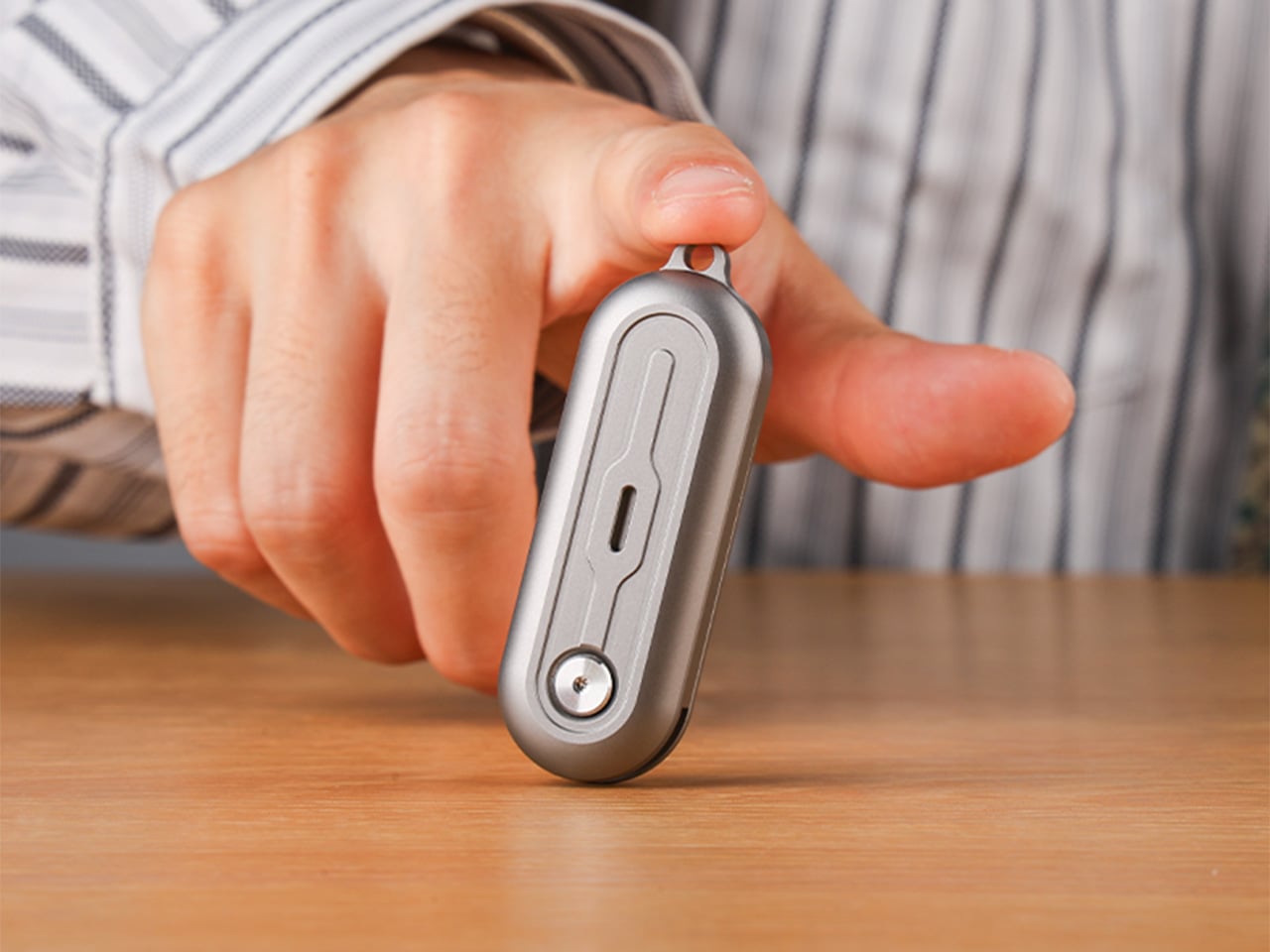
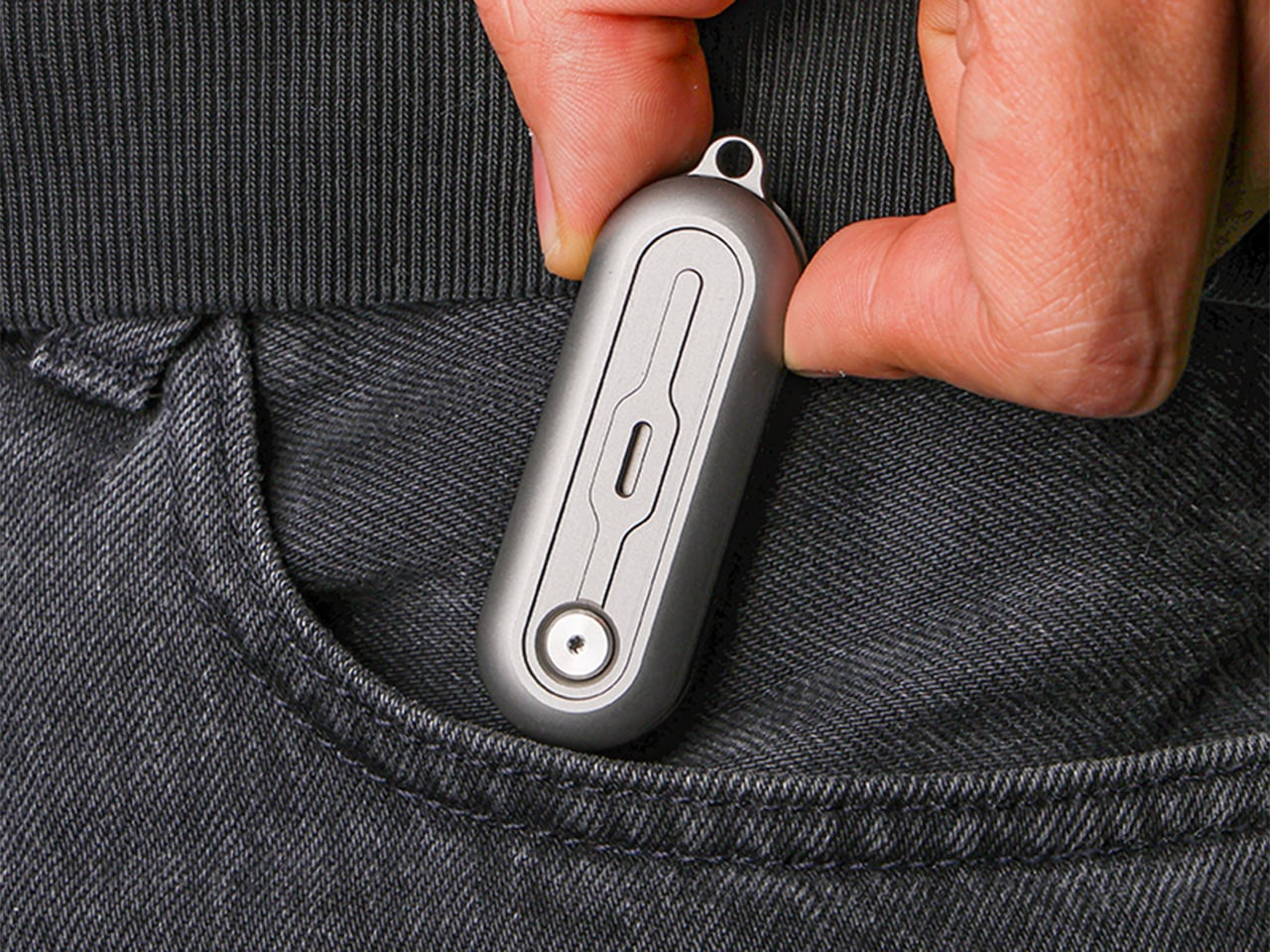
The knife comes with a keychain hole at one end, sized for a standard split ring. Slip it onto your keys and it disappears into the cluster, weighing less than most car fobs. The compact dimensions mean it works equally well on a wallet chain, a backpack strap, or worn as a necklace pendant if you’re leaning into the EDC-as-jewelry aesthetic. The tritium glow makes it viable as a functional piece of illuminated jewelry, though calling it that probably annoys traditional knife collectors who prefer their folders utilitarian and unadorned.

The TiNova II ships in two finishes: sandblasted (raw titanium) and black coated (PVD). Both finishes come with the same lifetime warranty, which covers manufacturing defects and structural failures. The knife is available now starting at $45 for the launch day special (36% off the $70 MSRP), with free worldwide shipping included. International shipping is scheduled for August 2026.

Click Here to Buy Now: $49 $70 (30% off). Hurry, only 64/100 left! Raised over $62,000.

The post This $45 Titanium Pocket Knife Uses Centrifugal Force and Neodymium Magnets Instead of A Button Lock first appeared on Yanko Design.
This Tiny Titanium EDC Knife’s Hawk-Talon Blade Profile Makes It Ruthlessly Effective

Hawks don’t cut with force. They grip with precision, using curved talons that naturally guide prey into the cutting path while the arc of the claw does the work. That geometry has been proven in harvesting tools, marine rigging knives, and rope work for centuries, but the EDC market keeps defaulting to straight blades that demand downward pressure rather than working with natural hand motion. Curved blades slice with less effort, grip flexible materials without slipping, and concentrate force at the point of contact in ways a straight edge simply cannot replicate. The form factor exists in karambits and hawkbills, but those tools tend to be aggressive, oversized, and built for hard use rather than keychain carry.

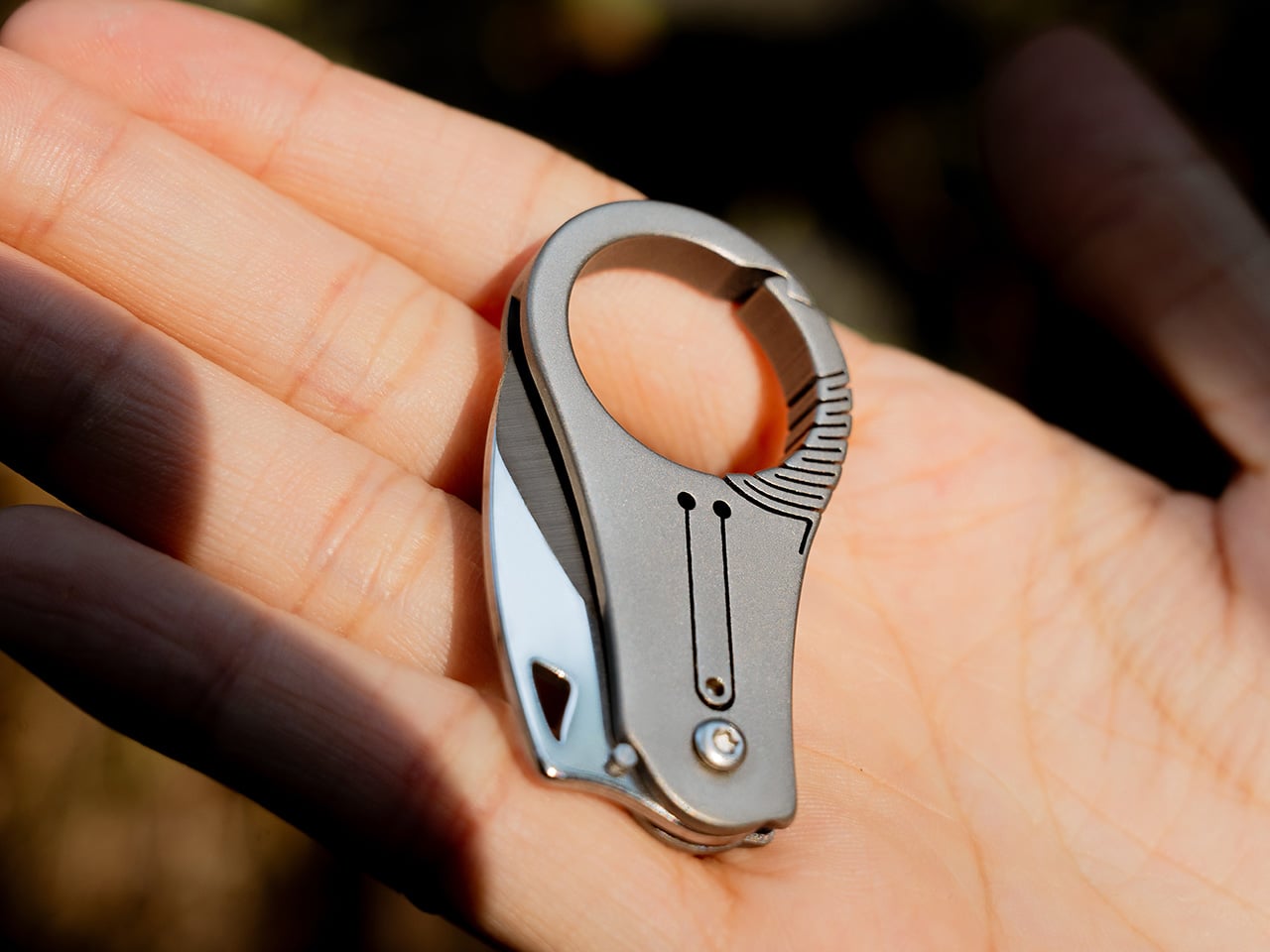
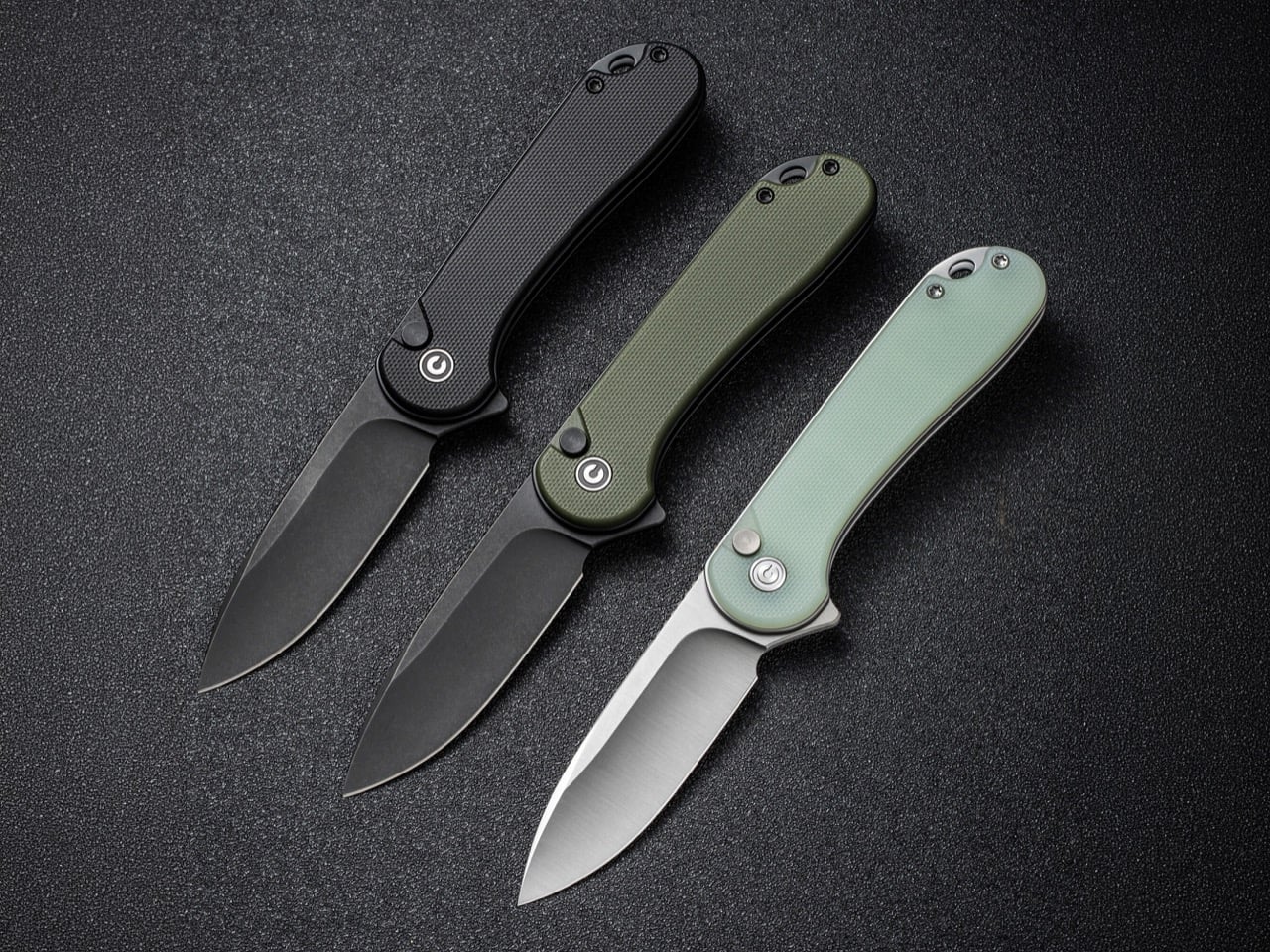
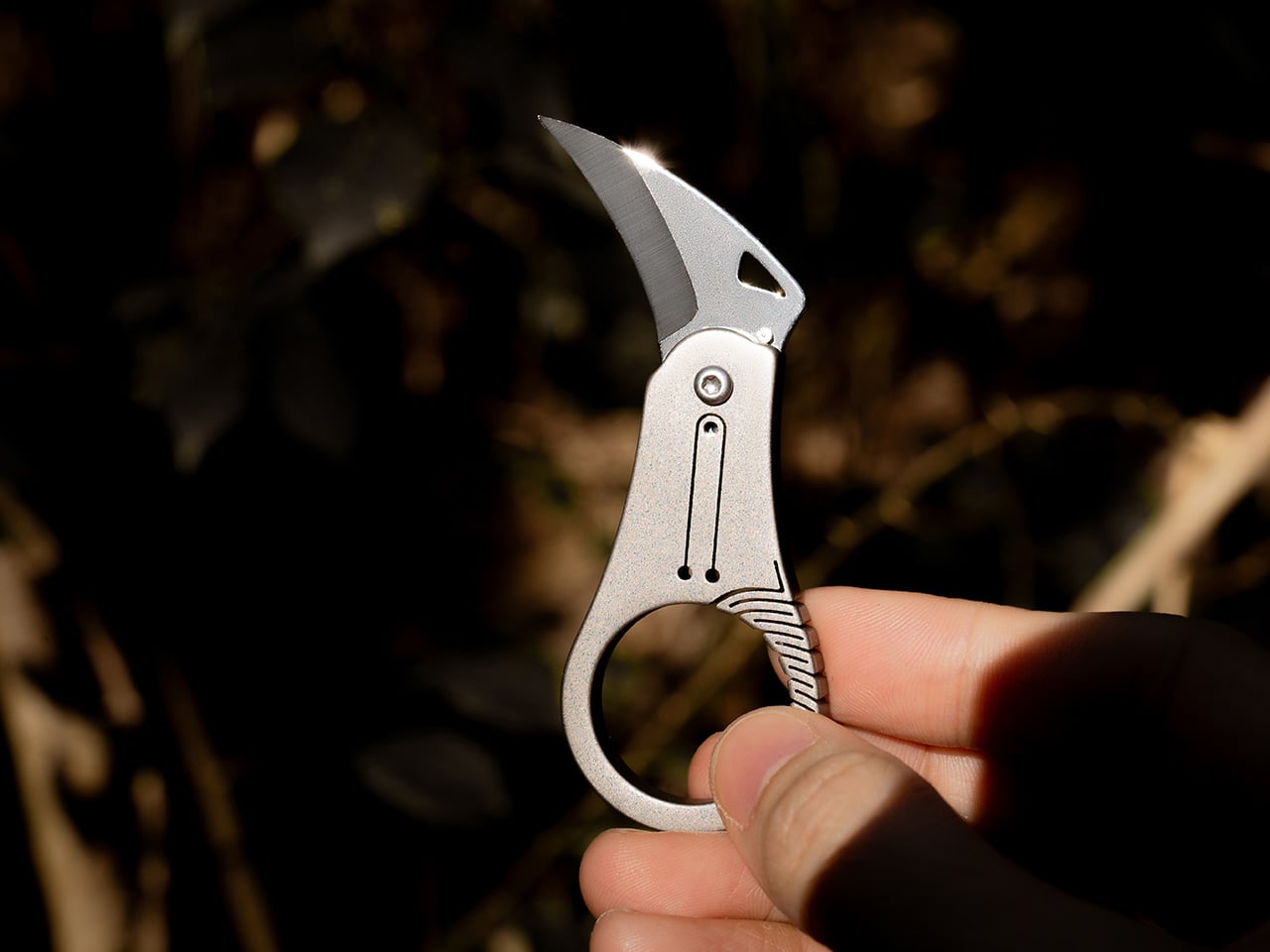
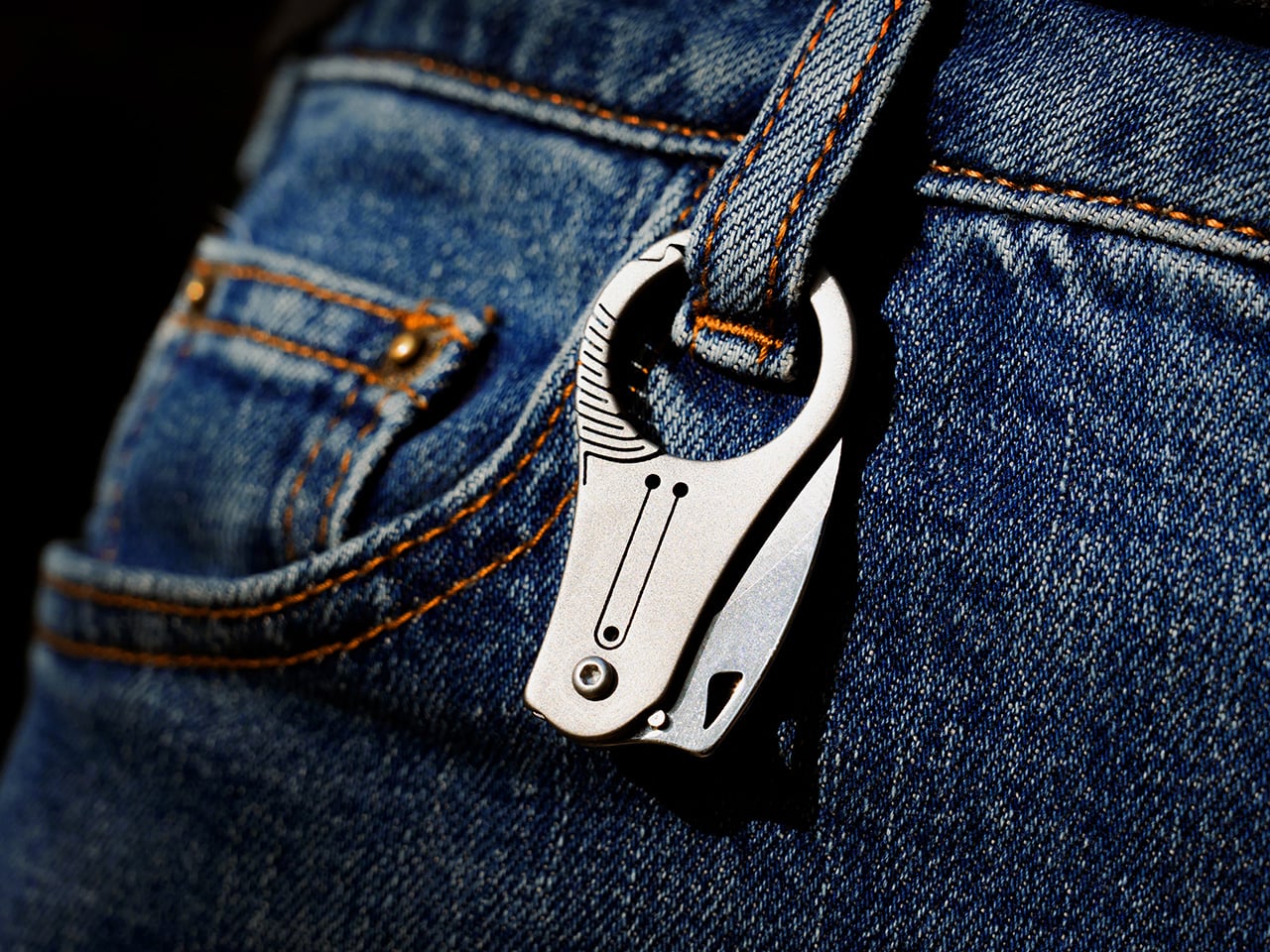
Edgelet’s SpearEdge takes that talon geometry and compresses it into a 66.3mm titanium folder designed for controlled pull cuts in everyday tasks. The curved spine and sharp tip follow the motion your hand already makes when you pull a blade through packaging, cordage, or tape. The finger ring adds stability points to prevent slips, the detent system provides tactile feedback during deployment, and the whole thing weighs almost nothing on a keychain. The blade is 7Cr steel, the handle is titanium, and the open keyring slot at the tail allows instant attachment without tools. Early bird pricing on Kickstarter starts at $29, with free shipping on all rewards.

Designer: Edgelet

Click Here to Buy Now: $32 $50 (35% off). Hurry, only a few left!

Edgelet’s previous knife, the ScytheBlade, earned a spot in Yanko Design’s Best EDC Knives of 2025 for its curved talon profile and 46mm frame, but users consistently reported the handle felt too small during extended use. The SpearEdge addresses that directly by stretching to 66.3mm open (up from 46mm) and adding a finger ring grip system that gives your thumb and forefinger actual purchase on the tool. Closed length measures 47.7mm with a 5mm thickness, with a blade geometry tailormade for pull cuts rather than straight-edge slicing. The 7Cr steel blade can be touched up with any basic sharpener, which separates it from tungsten-tipped competitors like the BITZ that hold an edge longer but can’t be resharpened in the field.

The cutting sequence happens in two phases. The sharp tip pierces materials first, allowing precise entry when you’re opening packages without damaging contents or cutting cordage without fraying the ends. Once the tip penetrates, the curved edge guides the cut in a smooth arc that reduces resistance and grips flexible materials to prevent slipping, which straight blades cannot replicate. The micro-curved spine follows natural hand motion during a pull cut, turning geometry into mechanical advantage. Edgelet tested this extensively on tape, rope, and packaging materials, all of which resist straight blades by pushing away from the edge rather than staying engaged during the cut. The talon profile keeps constant contact with the material as you pull, which is why hawkbill and karambit geometries have dominated rope work and marine rigging for centuries.

The finger ring creates a stability point that prevents the tool from rotating or slipping during use, critical when operating a blade this small with only thumb and forefinger pressure. You can apply controlled force without worrying about misalignment, and the ring doubles as a secondary grip surface when repositioning mid-cut. Titanium handle construction keeps weight minimal and corrosion-resistance high, while the pivot tension and detent system provide audible clicks when the blade locks into open or closed positions. That tactile feedback confirms the blade has seated properly, reducing accidental deployment or closure during carry. The detent ball engages a notch in the blade tang, creating enough resistance to keep the knife shut in your pocket but light enough to deploy with a thumbnail flick on the jimped wheel.

The open keyring slot at the tail threads directly onto keys, carabiners, or lanyards without split rings or additional hardware. Titanium construction keeps the knife light enough to genuinely disappear on a keychain rather than creating a bulge or hotspot against your leg. The folded profile stays slim at 5mm, comparable to two stacked house keys. Edgelet designed this for people who have tried carrying full-sized EDC knives and found them too heavy, too bulky, or legally questionable depending on local blade-length restrictions. Urban carry, travel, and office environments all favor tools that stay under the radar while remaining functional. The curved blade geometry also suits anyone cutting packaging, cordage, or flexible materials where straight blades tend to push rather than slice.

The SpearEdge is currently live on Kickstarter with early bird pricing starting at $29, with standard pricing at $32 for a single unit. All rewards include free shipping worldwide. Add-ons are available, including replacement blades for $9.90, a titanium bottle and can opener for $14.99, and an EDC carry pouch for $5.99. The SpearEdge ships globally starting June 2026. The SpearEdge works as a primary carry for minimalists or as a backup blade for those already carrying a larger folder but wanting something lighter on a secondary keychain or bag loop. If you’ve used the ScytheBlade and wished for more cutting edge and better grip, this delivers both without adding meaningful bulk.

Click Here to Buy Now: $32 $50 (35% off). Hurry, only a few left!

The post This Tiny Titanium EDC Knife’s Hawk-Talon Blade Profile Makes It Ruthlessly Effective first appeared on Yanko Design.
Tekto F4 Echo Review: S35VN Steel, Button Lock, and a Zastava-inspired Tactical Design

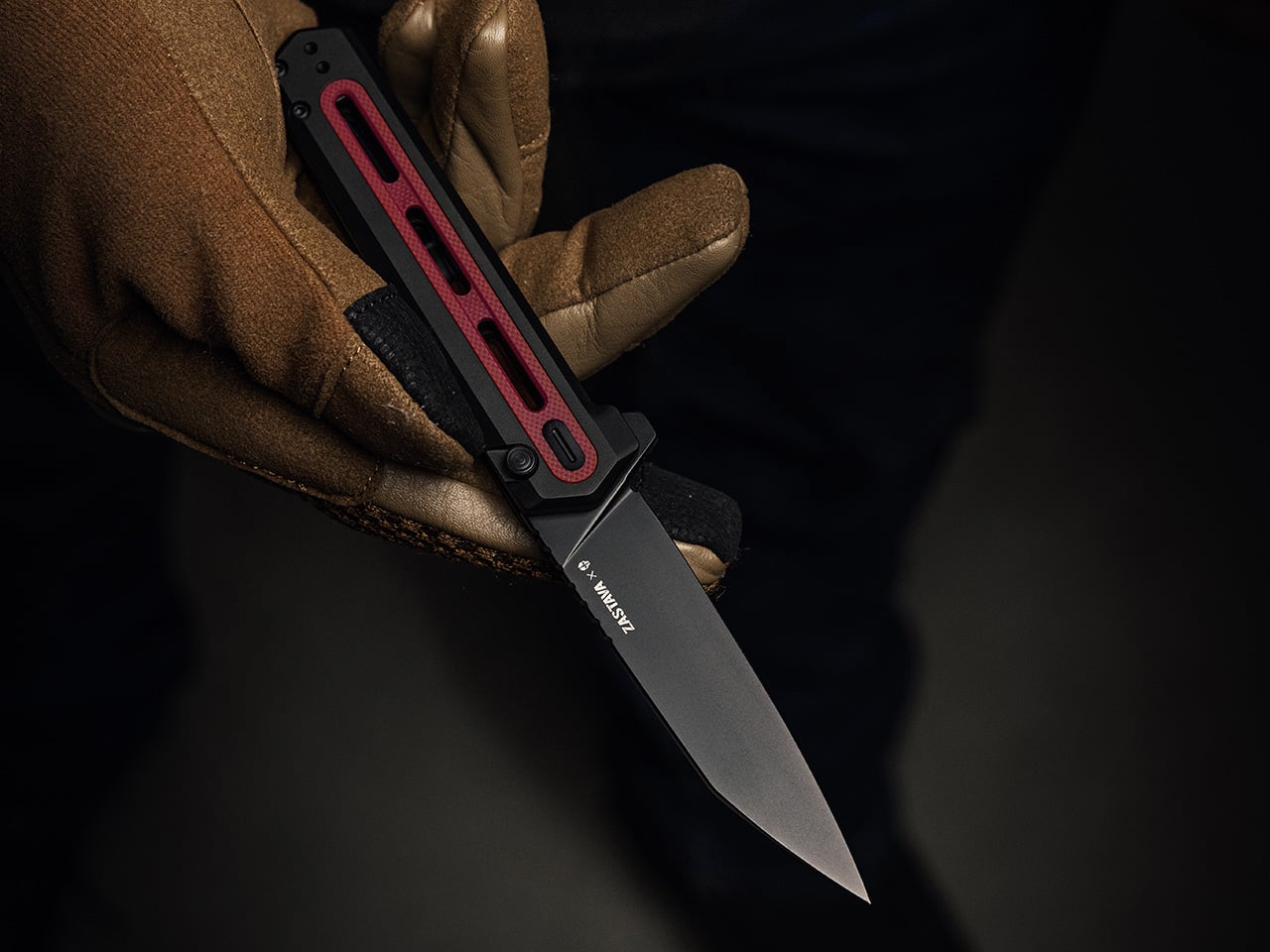
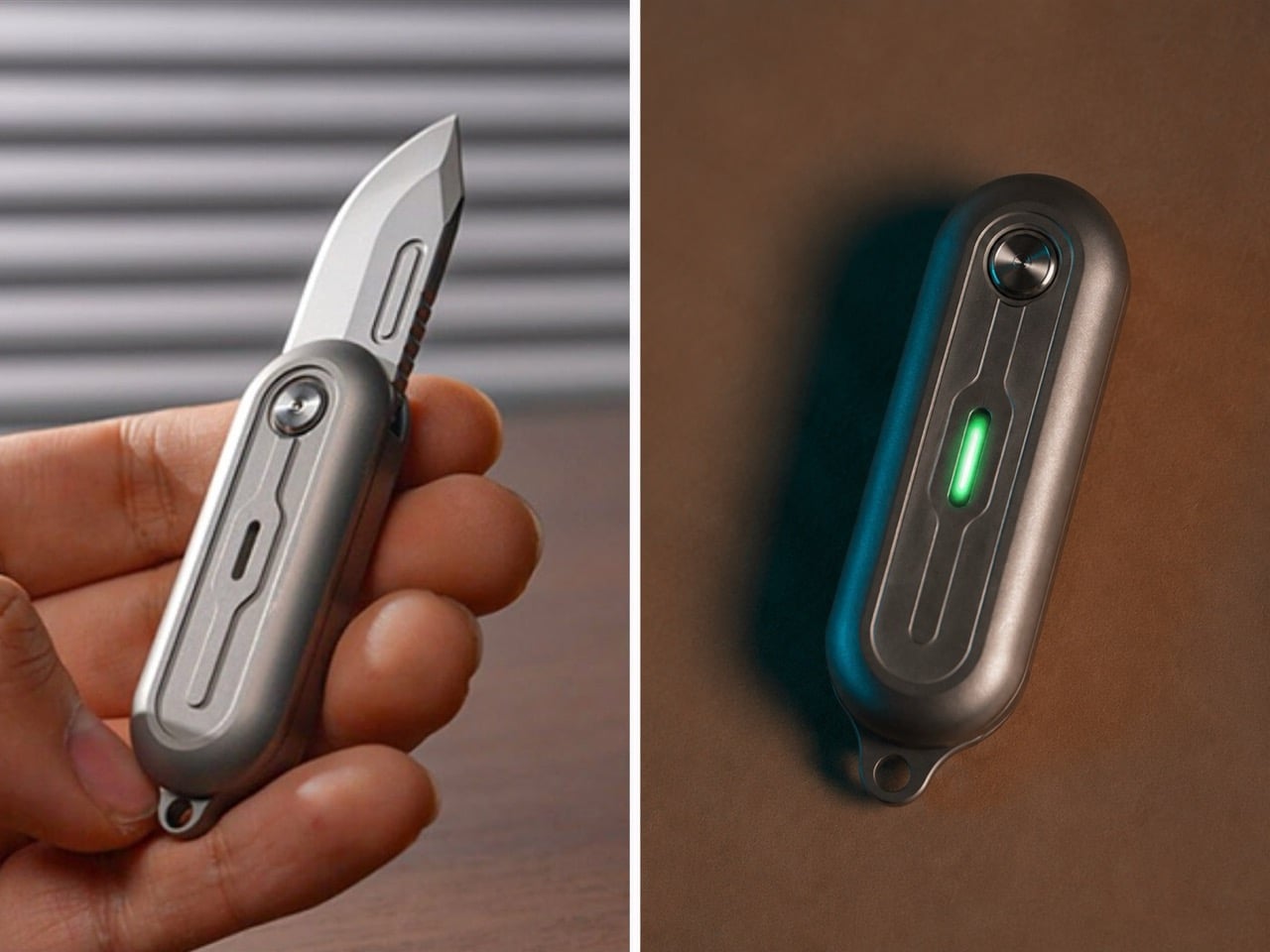
Zastava Arms USA doesn’t put their name on just anything. The firearms manufacturer built its reputation on rifles that perform under pressure, and their latest collaboration with Tekto Knives seems designed to carry that legacy into everyday carry territory. The F4 Echo folding knife arrives with S35VN steel, button lock mechanics, and design details that reference Zastava’s rifle heritage. At $199.99, it positions itself as a collector’s piece that still claims serious utility credentials.

Tekto has been steadily building credibility in the tactical knife space, with Yanko Design covering their OTF automatics and folding models over the past two years. Their collaborations tend to bring recognizable names from adjacent industries, and Zastava’s involvement signals an attempt to bridge firearm aesthetics with blade functionality. Three colorways launch simultaneously: Serbian Red G10, American Walnut G10, and Tactical Black G10, giving all EDC fans something to look forward to.

Designer: TEKTO

Click here to Buy Now: $170 $199.99 ($29.99 off, use coupon code “F4YANKO”). Hurry, deal ends in 48-hours!

That choice of S35VN steel is the first real indicator they’re serious about building a flipper as strong and reliable as the Zastava brand itself. They could have stuck with D2 and priced this at $150, but the upgrade to a Crucible powdered steel shows they’re aiming for the enthusiast crowd. S35VN isn’t just about holding an edge longer; its real-world benefit is corrosion resistance. You can carry it all day without worrying about humidity turning your blade into a rust-spotted mess. This choice elevates the F4 Echo from a simple co-branded product to a genuinely competitive tool. It’s a smart move that demonstrates Tekto is listening to the market’s demand for better materials without jumping straight to exotic steels that would double the price.

The move to a button lock is a significant step up from the liner locks found on some of their earlier folders. Button locks provide a strong, reliable lockup and make for incredibly smooth one-handed closing, which is a huge quality-of-life improvement for anyone who actually uses their knife throughout the day. Tekto also describes the flipper action as “deliberate,” which suggests they’ve tuned the detent for controlled deployment rather than a snappy, aggressive action. For a tool with tactical roots, that makes a lot of sense; you want the blade to appear exactly when you intend it to, without any ambiguity.

The G10 handle scales provide plenty of traction, and the machined patterns create a visual link to Zastava’s firearm furniture that’s undeniably clever. The colorways are a smart bit of market segmentation too. Serbian Red is clearly for the Zastava die-hards, American Walnut appeals to a more traditional outdoorsman aesthetic, and the tactical black is for everyone else. It’s a thoughtful approach that shows they understand their audience isn’t a monolith. The design feels cohesive, like a genuine partnership rather than a simple logo slap.

Tekto’s shipping the F4 Echo with their standard deep-carry pocket clip and a pouch, which is table stakes at this price point. They’re advertising 24-hour shipping, which feels fairly radical, but if you’re really keen to get a pair in your hands fast, it’s better than placing an order for Thanksgiving and receiving your EDC by Christmas. The F4 Echo has all the right ingredients to be a standout piece: a proven blade steel, a popular and functional lock, and a design story that connects with a passionate firearms community. And even though the knife carries the Zastava brand, it isn’t just for true-blue Zastava fans. Tekto is betting that the combination of premium S35VN steel, a robust button lock, and the unique Zastava branding will appeal to users who want something different. It’s a collector’s piece with the heart of a workhorse.

Click here to Buy Now: $170 $199.99 ($29.99 off, use coupon code “F4YANKO”). Hurry, deal ends in 48-hours!

The post Tekto F4 Echo Review: S35VN Steel, Button Lock, and a Zastava-inspired Tactical Design first appeared on Yanko Design.
The Ultimate Tactical EDC Upgrade: Tekto’s A2 Badger OTF Knife Packs a Punch

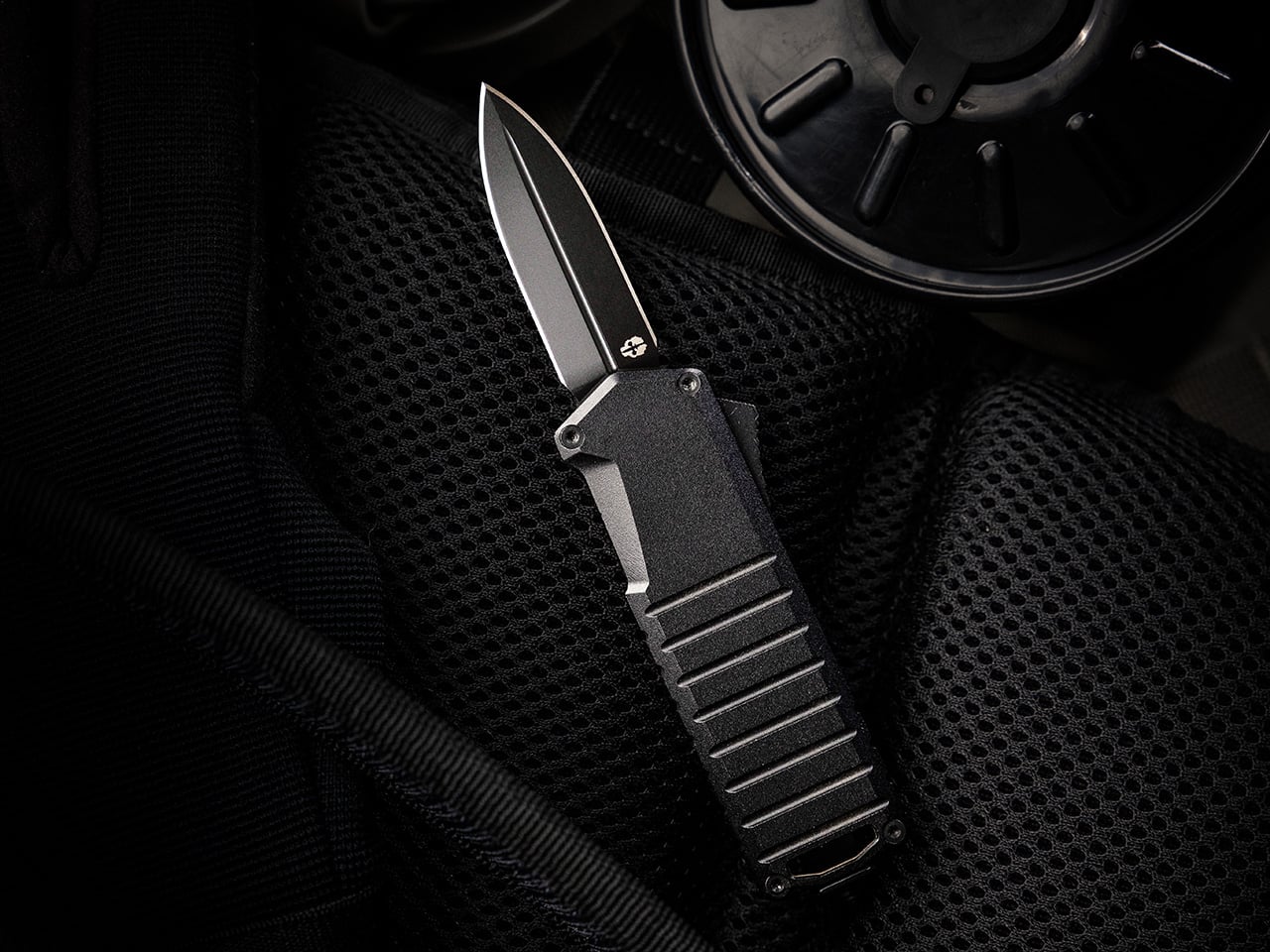
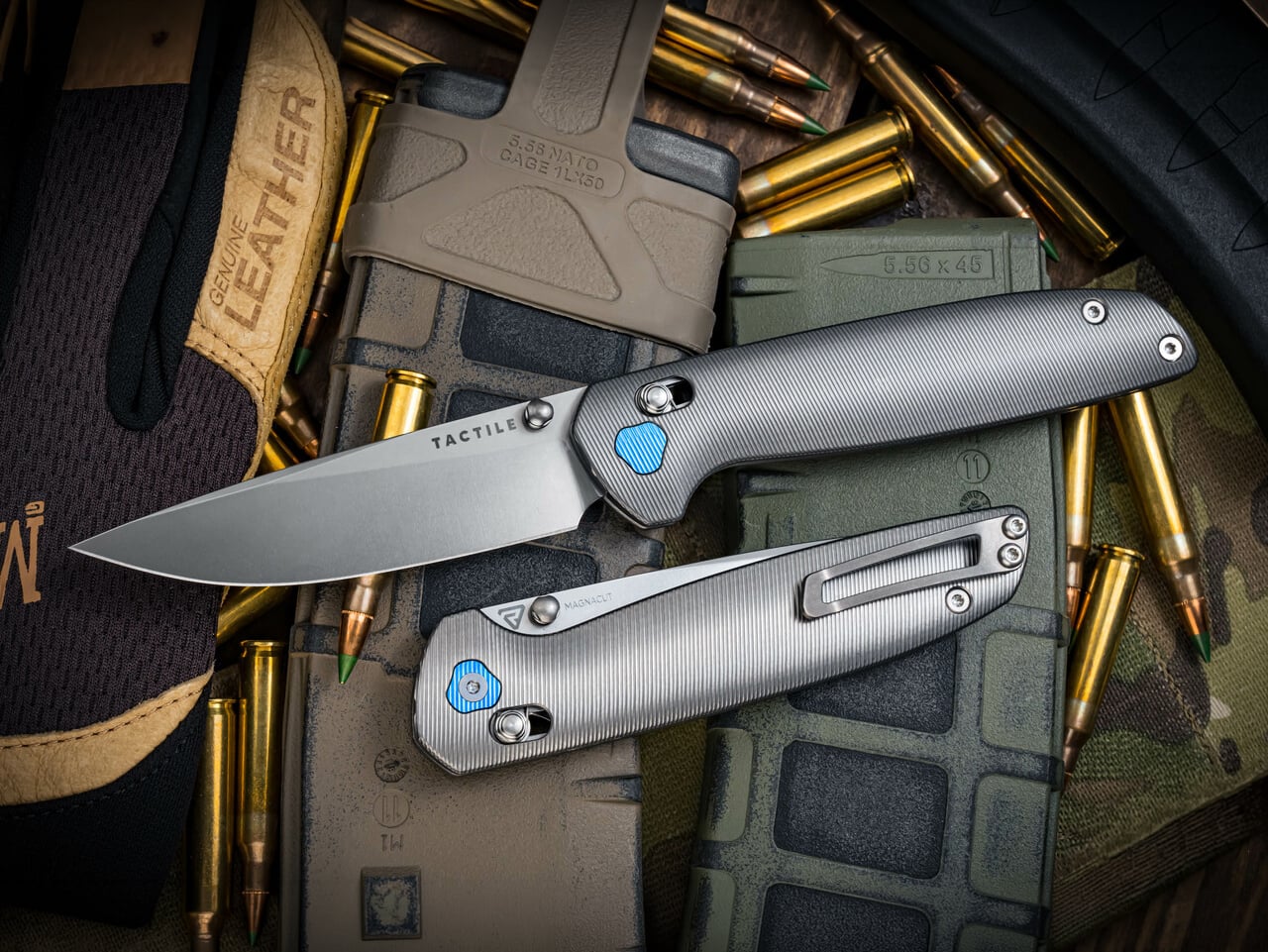
Named after the world’s most fearless animal, the Honey Badger, the A2 Badger from Tekto has quite a reputation to live up to… and let’s be honest, it does. It’s tiny yet ridiculously capable, with a 1.85-inch OTF blade on the front that deploys as soon as you hit the switch on the handle, and a glass-breaker on the end that makes the A2 Badger a formidable EDC literally from head to toe!

OTF knives are a little different from your standard folding blades; they’re spring-loaded switchblades that shoot straight out from the front of the handle. It’s a thrill to watch and even better when you realize just how functional that quick deployment can be. Whether you’re a tactical aficionado or just someone who appreciates a well-designed knife, the A2 Badger could be your new favorite.

Designer: Tekto

Click Here to Buy Now: $118.99 $139.99 (15% off, use coupon code “A2YANKO”). Hurry, deal ends in 48-hours! Also, get free FedEx 2 day shipping.

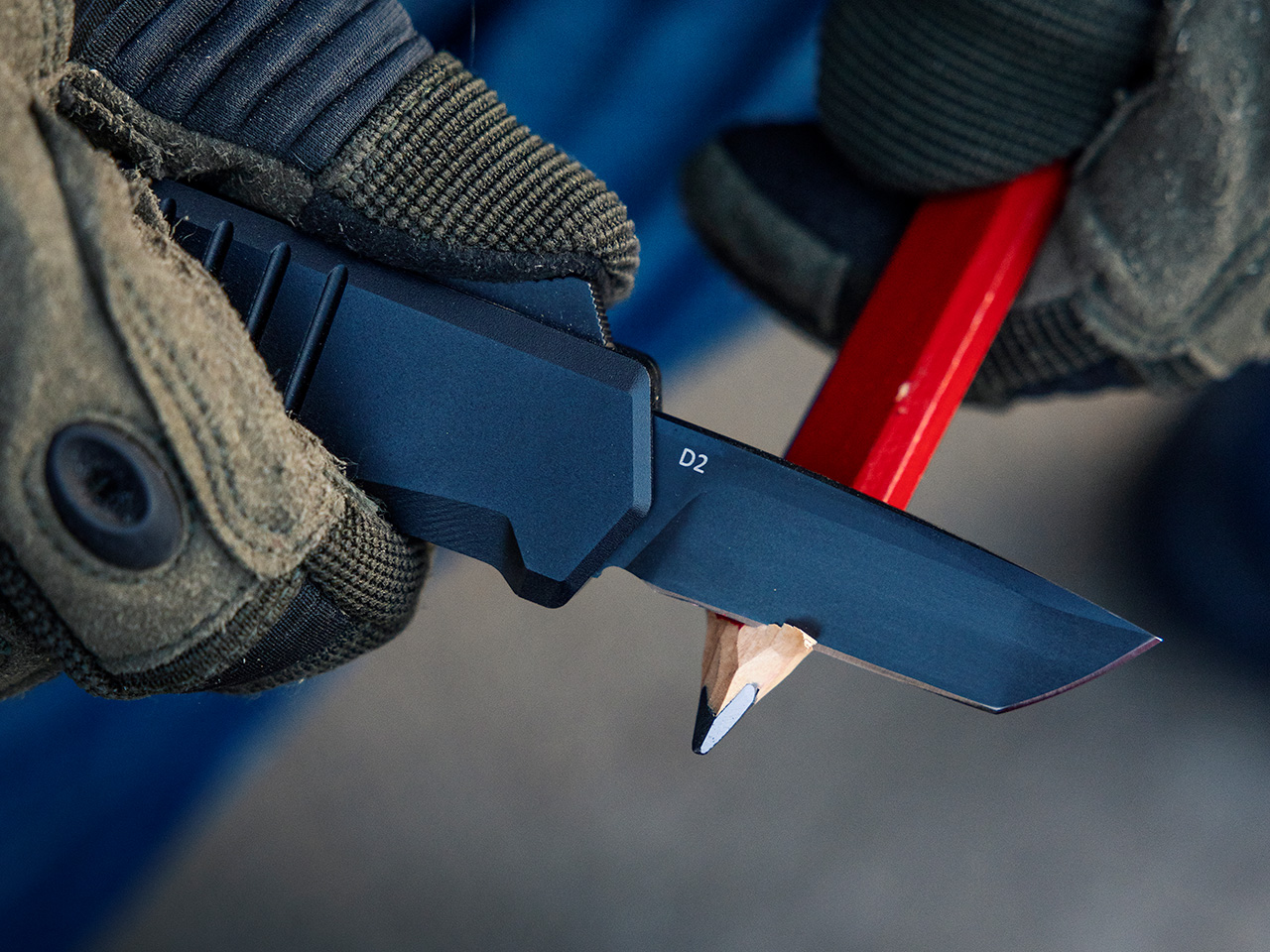
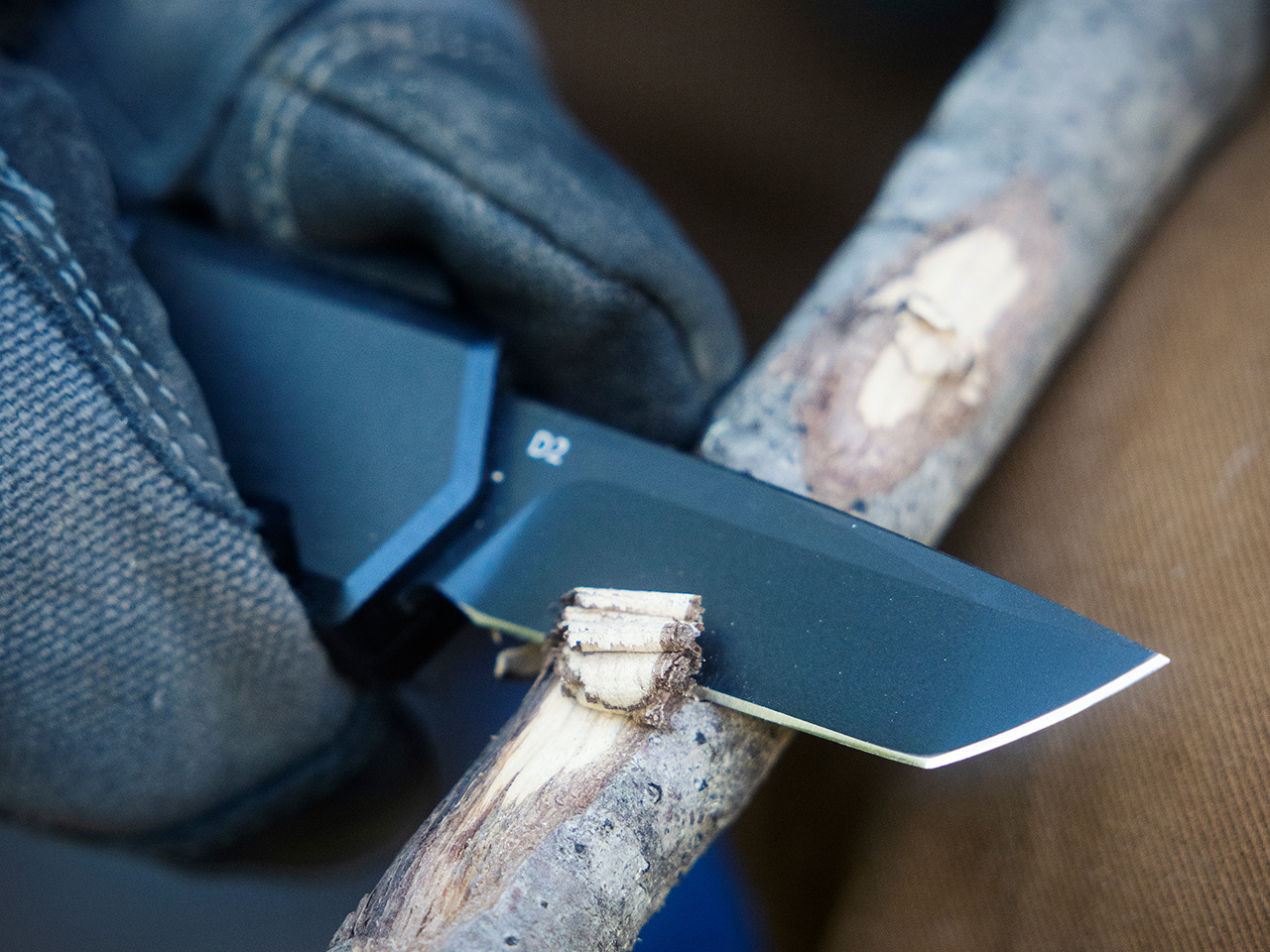
At first glance, you wouldn’t expect much from a knife that measures just 5.26 inches when open. But don’t let the size fool you. The A2 Badger packs a 1.85-inch tanto-style blade made from titanium-coated D2 steel. This isn’t your average pocket knife. The tanto blade’s angular tip is engineered for strength, perfect for piercing tasks or cutting through tough materials. And because it’s coated in titanium, the blade offers added durability and resistance to wear and tear. It’s the kind of material you want on your side when you’re deep into an outdoor adventure or facing a split-second emergency.

The A2 Badger button boasts an exceptional grip, ensuring maximum grip and control in any situation.

With its compact and lightweight design, the A2 Badger is both easy to store and transport, making it a popular choice among outdoor enthusiasts and those with limited space.

Featuring an oversized lanyard hole, this knife design accommodates a wider range of attachment options, including larger cords and paracords.

The A2 Badger doesn’t just stop at being sharp; it’s thoughtful in its design, too. The oversized lanyard hole is a small detail, but one that makes a big difference. You can easily thread larger cords or paracords through it, making the knife more accessible when you’re in challenging environments. Speaking of environments, the 6061 aluminum handle is lightweight yet durable, designed to withstand the kind of rugged conditions that would send a lesser knife packing. Plus, there’s a button lock mechanism in place that ensures the blade stays secure, whether you’re opening or closing it, so you can count on the knife when it matters most.

But what makes the A2 Badger stand out isn’t just its functionality—it’s how easily it fits into your life. At a featherlight 2.18 ounces and just 3.3 inches small when closed, this is Tekto’s smallest OTF knife (even tinier than their A5 Spry Mini). Yet, its size is deceptive; this little tool is nimble, quick to deploy, and engineered for ambidextrous use. A pocket clip can be attached on either side of the handle, making it perfect for left or right-handed users. Plus, at the end of the handle is a glass-breaker tip that can be used to shatter through even laminated and reinforced glass panels – perfect for an emergency escape (especially when paired with the D2 blade for cutting through seatbelts). It’s an ideal everyday carry tool, whether you’re heading into the great outdoors, running errands around town, or even protecting yourself in an emergency.

For those who like options, Tekto delivers. The A2 Badger comes in three grip colors—Black, Desert, and OD Green—so you can match it with your style or other gear. Whether you’re a seasoned outdoorsman, a first responder, or just someone who values great design, the A2 Badger proves that sometimes, the best things really do come in small packages.

Click Here to Buy Now: $118.99 $139.99 (15% off, use coupon code “A2YANKO”). Hurry, deal ends in 48-hours! Also, get free FedEx 2 day shipping.

The post The Ultimate Tactical EDC Upgrade: Tekto’s A2 Badger OTF Knife Packs a Punch first appeared on Yanko Design.
These are 6 Best Everyday Shoes for Busy Moms: Comfortable All-Day Wear

With so much to do, finding the right pair of everyday shoes that are comfortable to wear all day, every day, can be quite the challenge, perhaps even more daunting than swaddling a 3-day-old newborn. With so much to do, comfort is essential. Whether it’s standing in the kitchen preparing meals, walking around the grocery store, or chasing after little ones at the park, moms need shoes that provide all-day comfort and support. The last thing they need is to be slowed down by sore feet or uncomfortable footwear.
Moms, with their unwavering dedication to their families, deserve nothing but the best. From managing household chores to shuttling kids to various activities, moms navigate parenthood with boundless energy and love. To support them in their daily endeavors, we’ve carefully selected six pairs of shoes, highly rated and tested, to provide the comfort and support they deserve. Busy moms need shoes that can keep up with their crazy lives! With roles ranging from caretaker to chauffeur to professional multitasker, moms need footwear that seamlessly transitions from casual to formal settings. Whether dashing to the store or attending impromptu meetings, versatile shoes are a lifeline for moms on the go. Additionally, durability is crucial, ensuring shoes withstand the rigors of daily wear and tear. From spills to scuffs, moms need footwear that endures the demands of their hectic schedules. Lastly, style is not to be overlooked. While comfort and durability are vital, moms also seek shoes that reflect their personal style and boost their confidence as they navigate the joys and challenges of motherhood.

Best Shoes to Wear, Stand, and Walk All Day in 2024

HOKA Clifton 9

The Hoka Clifton 9 offers a significant upgrade in comfort and design, making it an excellent choice for those who spend long periods on their feet or cover great distances. With an increased stack height for better underfoot protection and a lighter build than its predecessor, this shoe is tailored for both sustained comfort and improved performance. It’s particularly suitable for walking and running, providing ample room with wide-size options available.

Designer: HOKA

Key advantages of the HOKA Clifton 9 include:

  • Versatile comfort and stability make it ideal for a variety of running distances and daily wear. Known for its cushioned feel, the Clifton 9 builds on the success of its predecessors by incorporating a more responsive and comfortable midsole.
  • Enhanced features include a new midsole with increased stack height for better cushioning and a new breathable mesh knit upper, enhancing both comfort and performance.
  • Lightweight and responsive remains the same despite additional cushioning, the Clifton 9 is lighter than the Clifton 8, enhancing its appeal as a shoe that doesn’t sacrifice responsiveness or comfort for the sake of lightness.

HOKA Clifton 9

  • Fit and comfort kicks in quickly after the initial wear, where the upper quickly adapts to provide a more comfortable fit. The inclusion of a gusseted tongue helps secure the foot and enhances overall support.
  • Durability and design stays true to its reputation for durability, paired with a stylish design that appeals to both seasoned runners and casual wearers. Its build quality ensures it can handle daily mileage with ease.

HOKA Clifton 9

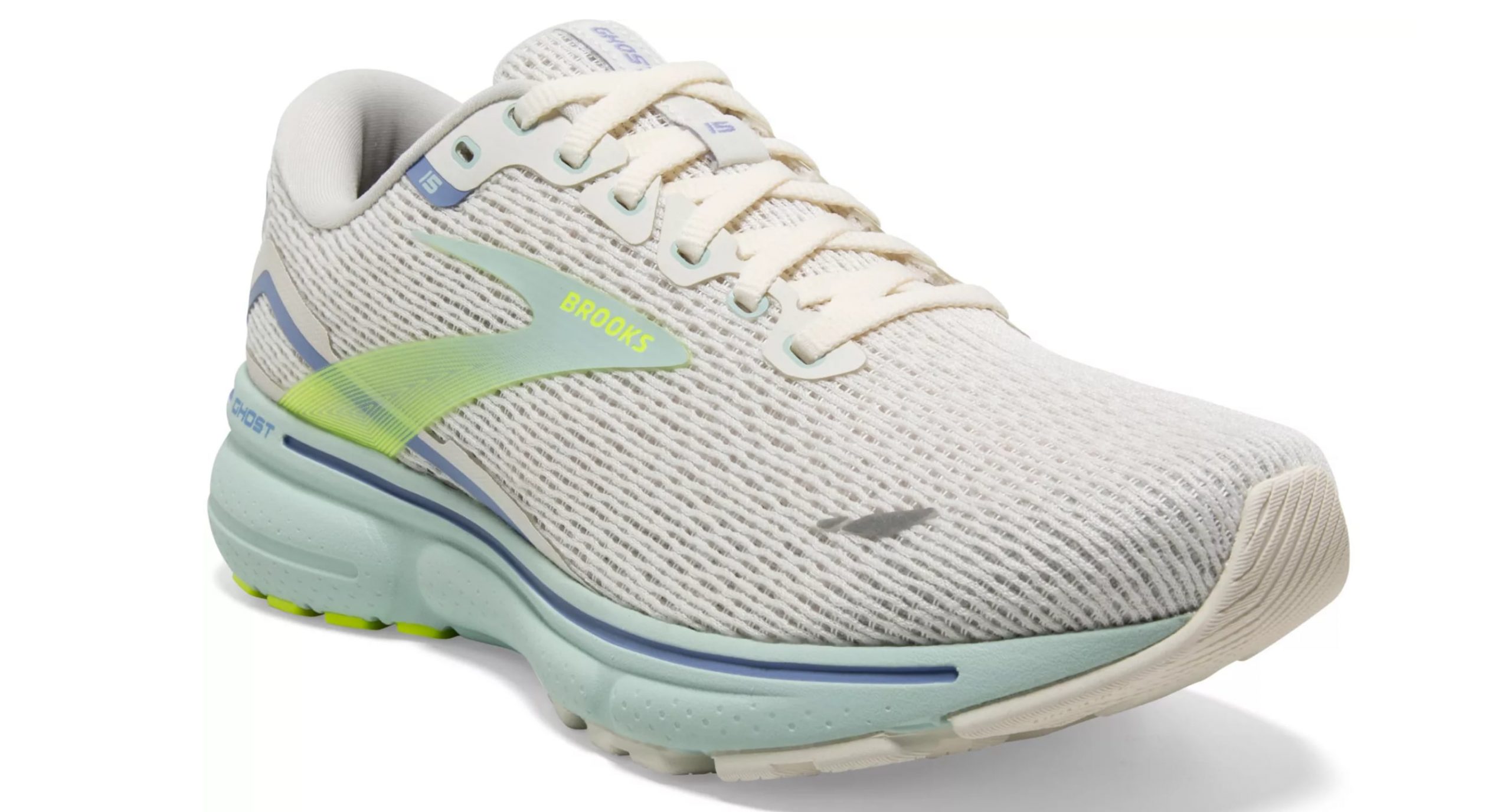
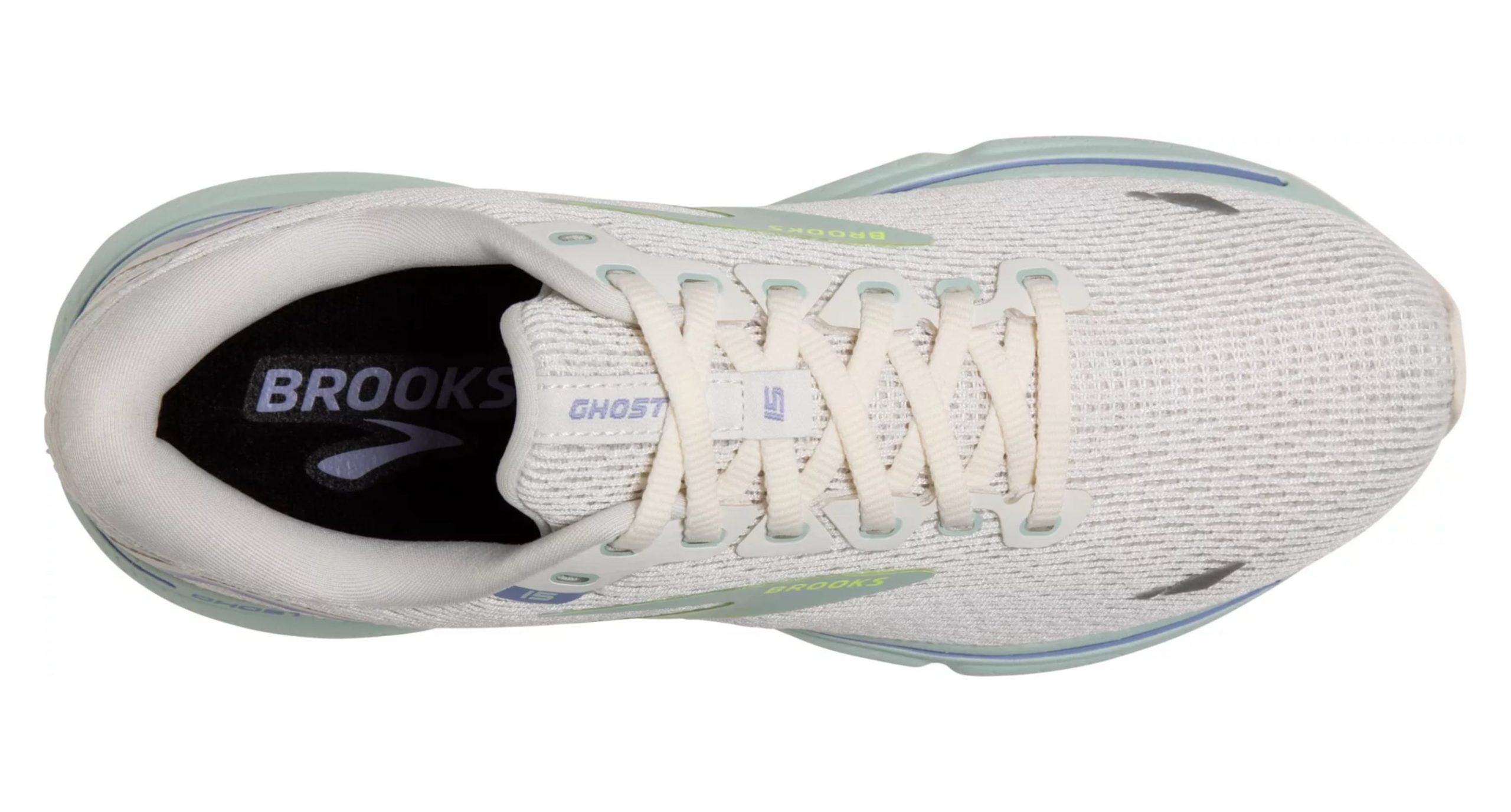
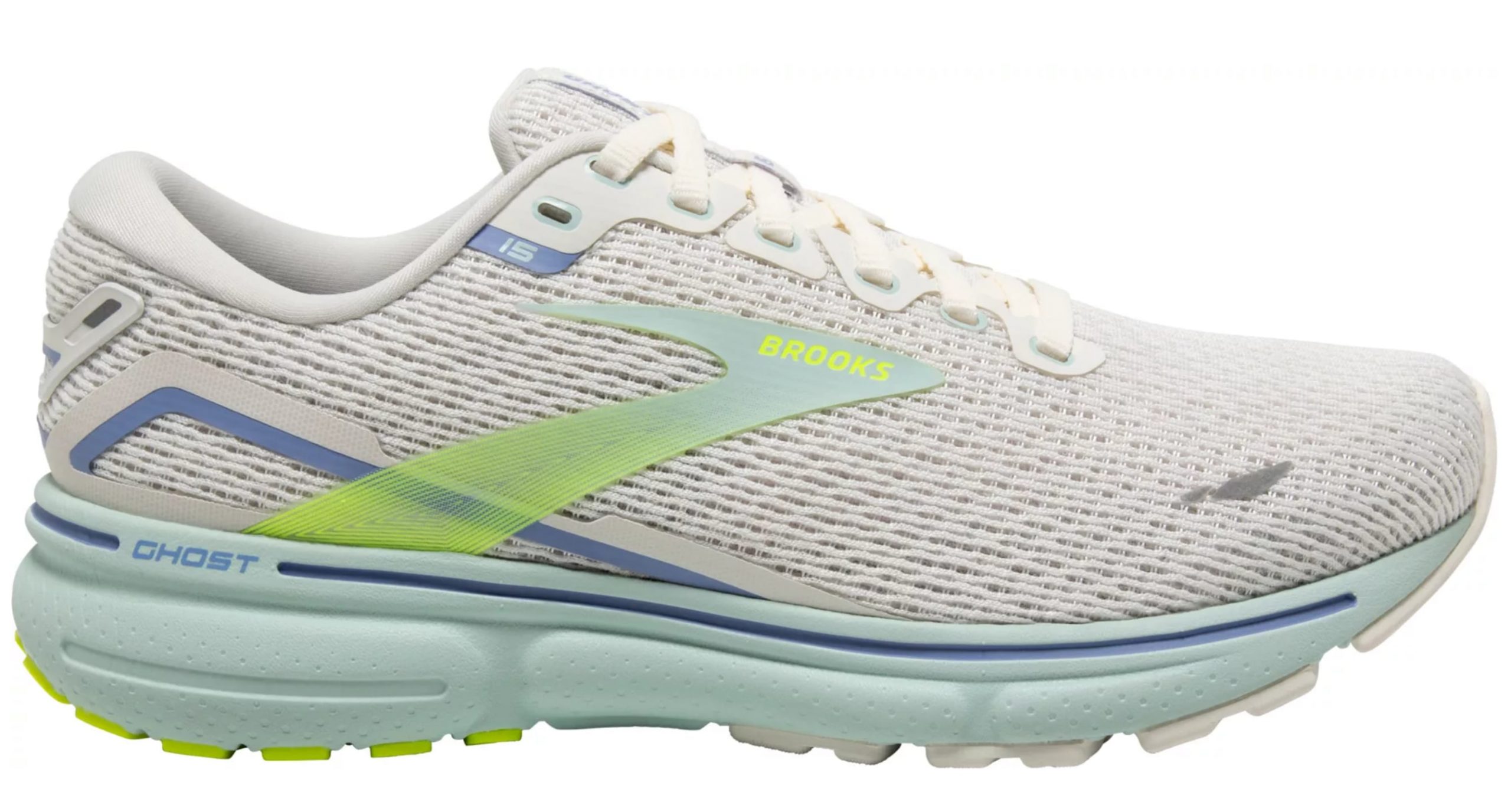
Brooks Ghost 15 Neutral Running Shoes

The Brooks Ghost 15 excels as a dependable, cushioned trainer ideal for everyday running. Its updates emphasize both performance and environmental responsibility, appealing to a broad spectrum of runners. Whether for short jogs or longer training sessions, the Ghost 15 delivers consistent comfort and support, solidifying its status as a favored choice among both new and seasoned runners. If you’re in the market for a reliable and sustainable running shoe, the Ghost 15 is a compelling option, offering good value for its price point.

Ghost 15 Neutral Running Shoes

Designer: Brooks

Key advantages of the Brooks Ghost 15 include:

  • Enhanced cushioning features the new DNA LOFT v2 cushioning in the midsole, which is lighter and softer, providing superior comfort for all-day wear.
  • Breathable support air mesh upper ensures breathability and comfort, reinforced with 3D Fit Print for structured support throughout the day.
  • Smooth transitions are equipped with a Segmented Crash Pad on the outsole for smooth, seamless transitions from heel to toe, which is ideal for prolonged standing or walking.
  • Eco-conscious materials composed of 71% recycled materials in the tongue and 89% in the vamp mesh, making it a great choice for environmentally conscious users.

  • Wide fit options available in a variety of widths (Men’s 2E, 4E / Women’s D), ensuring a comfortable fit for a broader range of foot sizes.
  • Reflective details strips of reflective material enhance visibility, adding an element of safety for those wearing the shoes from dawn till dusk.
  • Durable design built to withstand up to approximately 400 miles of wear, making it a durable option for daily use.

Ghost 15 Neutral Running Shoes

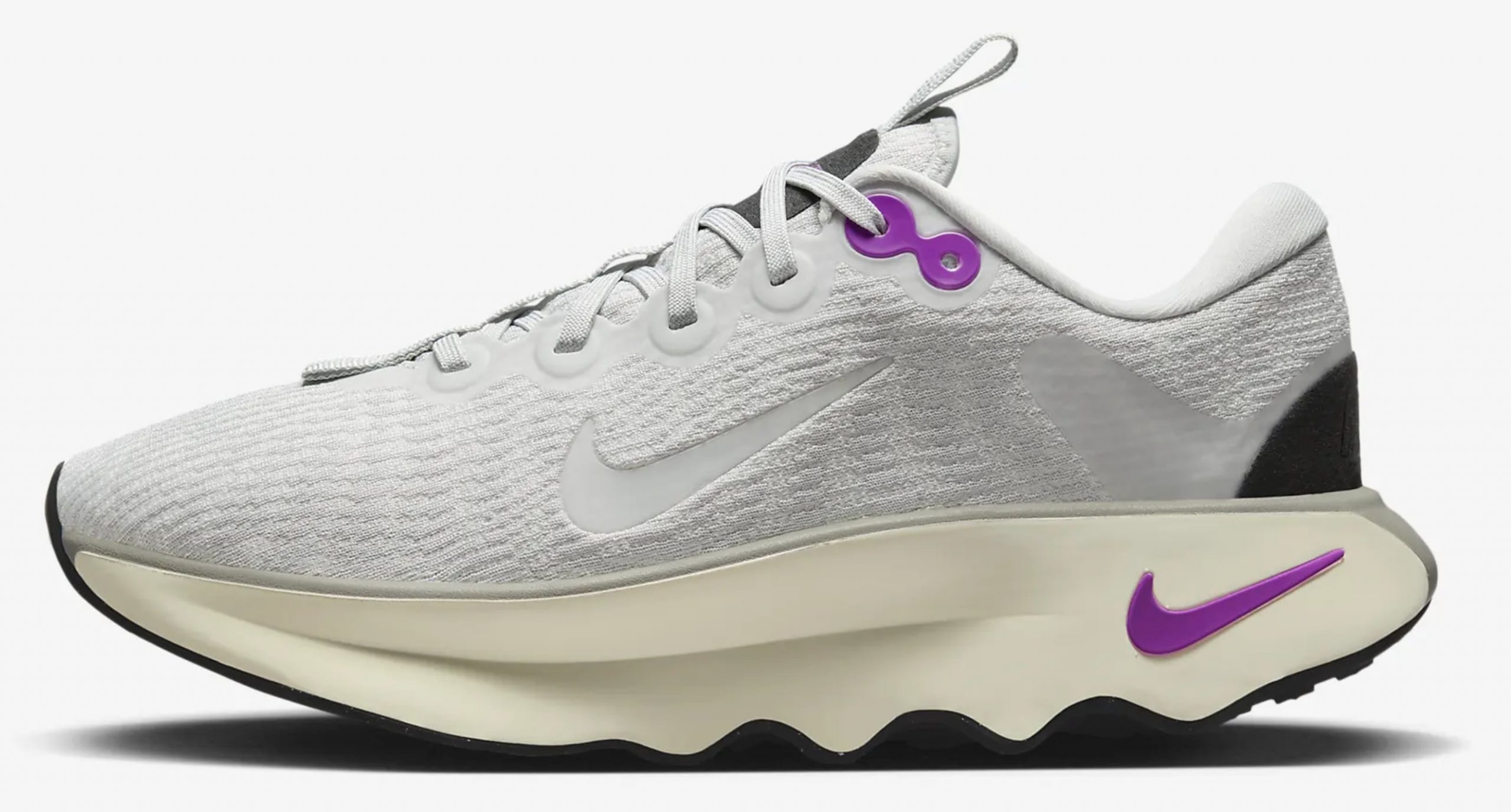
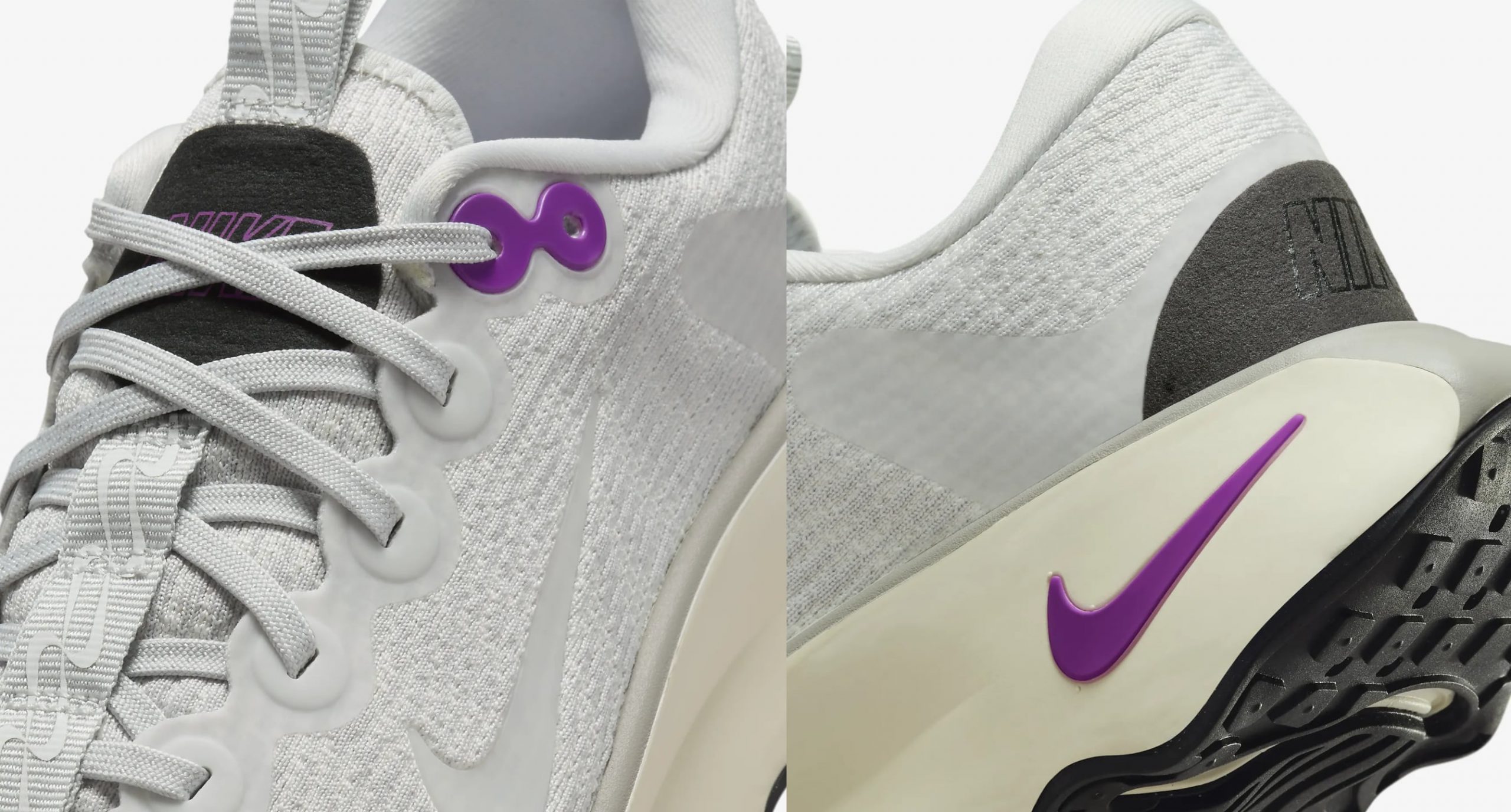
Nike Motiva

The Nike Motiva sets a new benchmark for walking shoes with its innovative features and superior comfort. Its unique rocker, combined with plush cushioning and a robust build, makes it an ideal choice for those seeking a versatile walking shoe that transitions smoothly into light jogging. The Motiva’s supportive and spacious design ensures comfort and performance throughout the day, making it an excellent choice for dynamic individuals.

Nike Motiva

Designer: Nike

Key advantages of the Nike Motiva walking shoes include:

  • Innovative rocker design stands out with its pronounced rocker design, enhancing natural walking motion and promoting fluid transitions from heel to toe, which is perfect for extended wear.
  • Exceptional cushioning is made with an exceptionally soft sole, offering luxurious cushioning that provides comfort with every step you take.
  • Durable and breathable upper part of the shoe’s designed to resist wear and tear while maintaining breathability, ensuring long-lasting comfort and durability.

  • Wide and stable base is constructed with a broad base that provides stability for both walking and occasional jogging, adapting effortlessly to a variety of daily activities.
  • Robust grip outsole is made for durability and excellent traction, making the Motiva reliable on different terrains, including urban concrete.
  • Generous fit breaks from the typical Nike mold with a wider and more forgiving fit, making it suitable for individuals with broader feet.

Nike Motiva

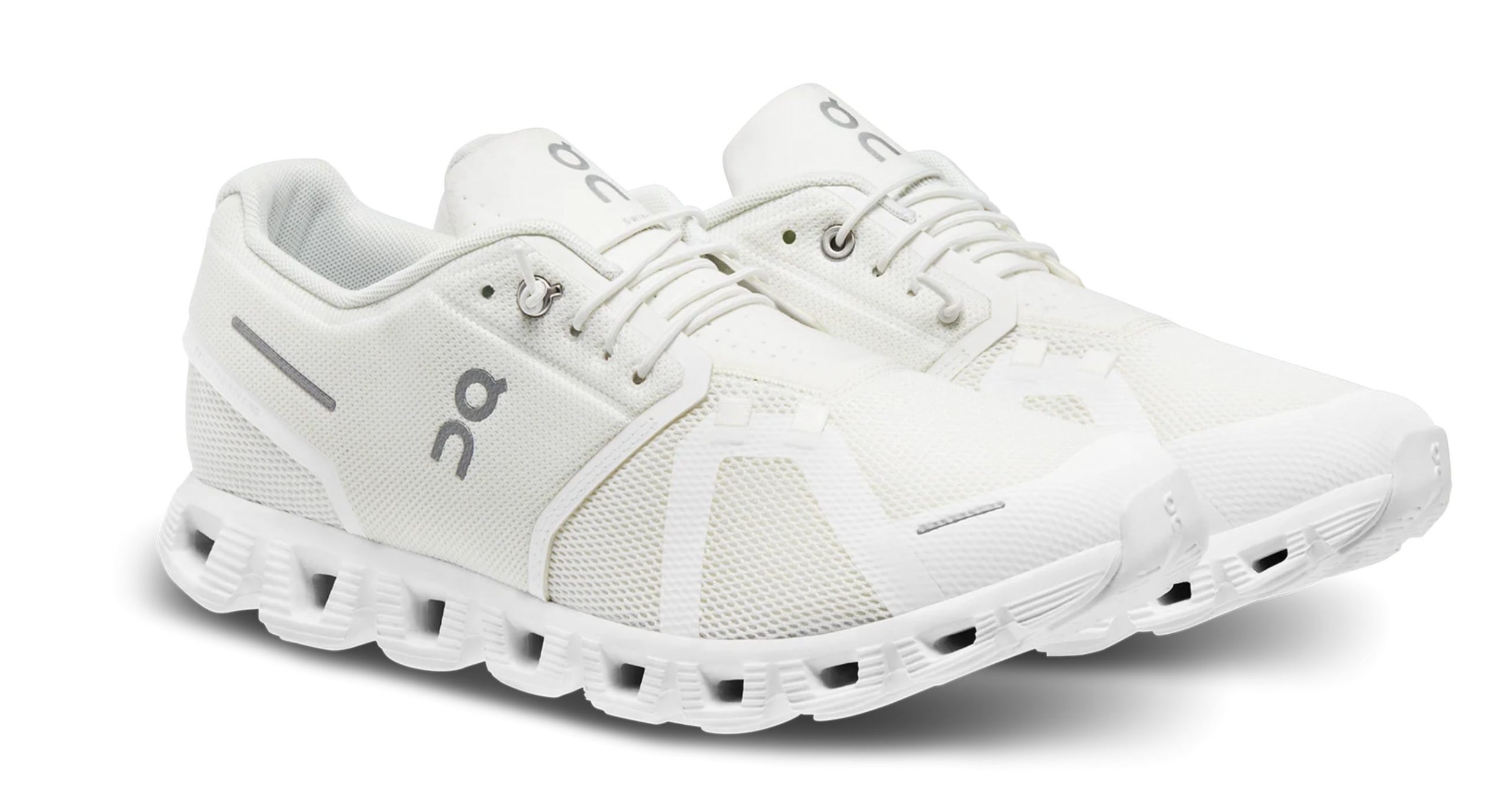
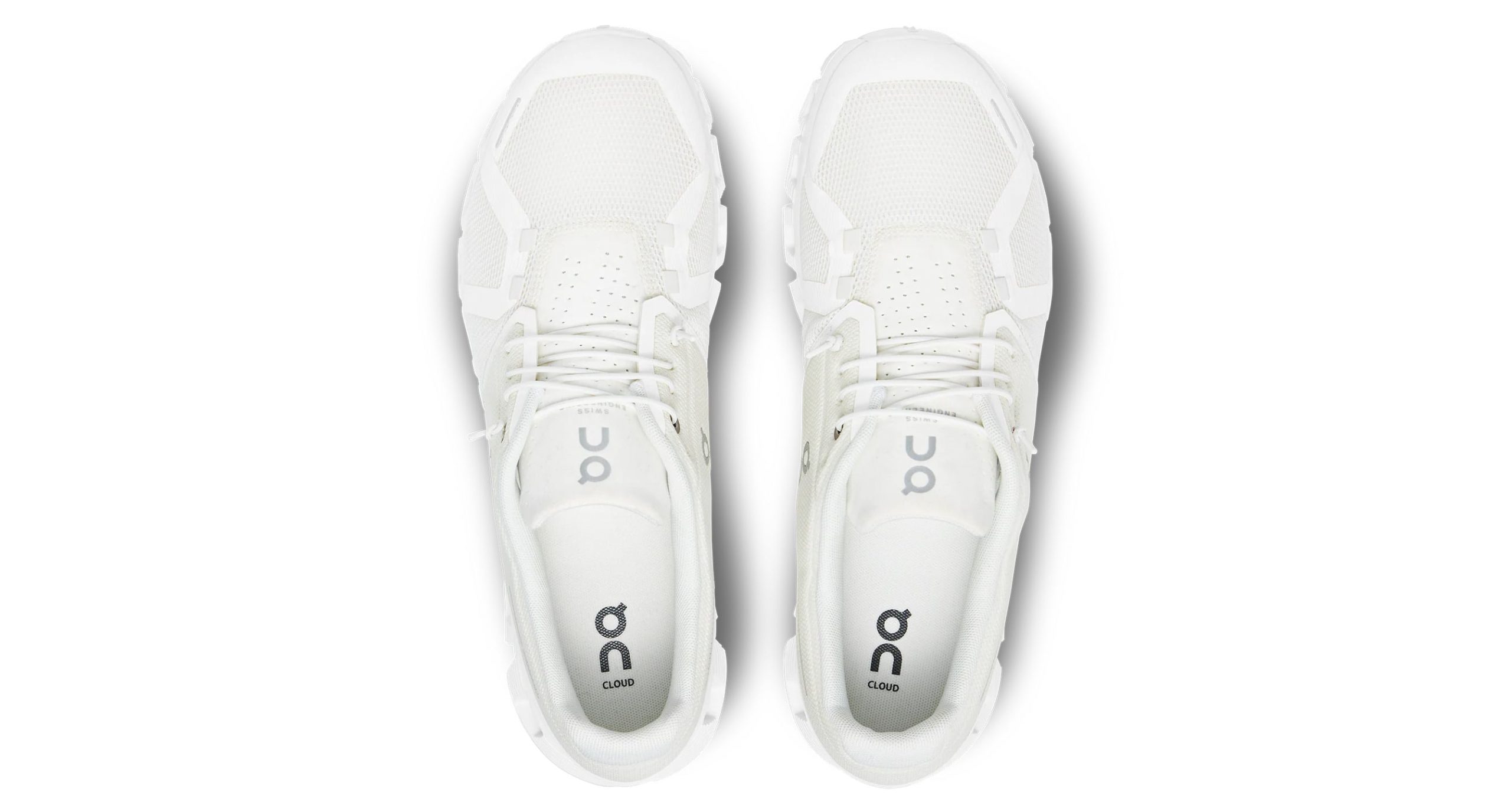
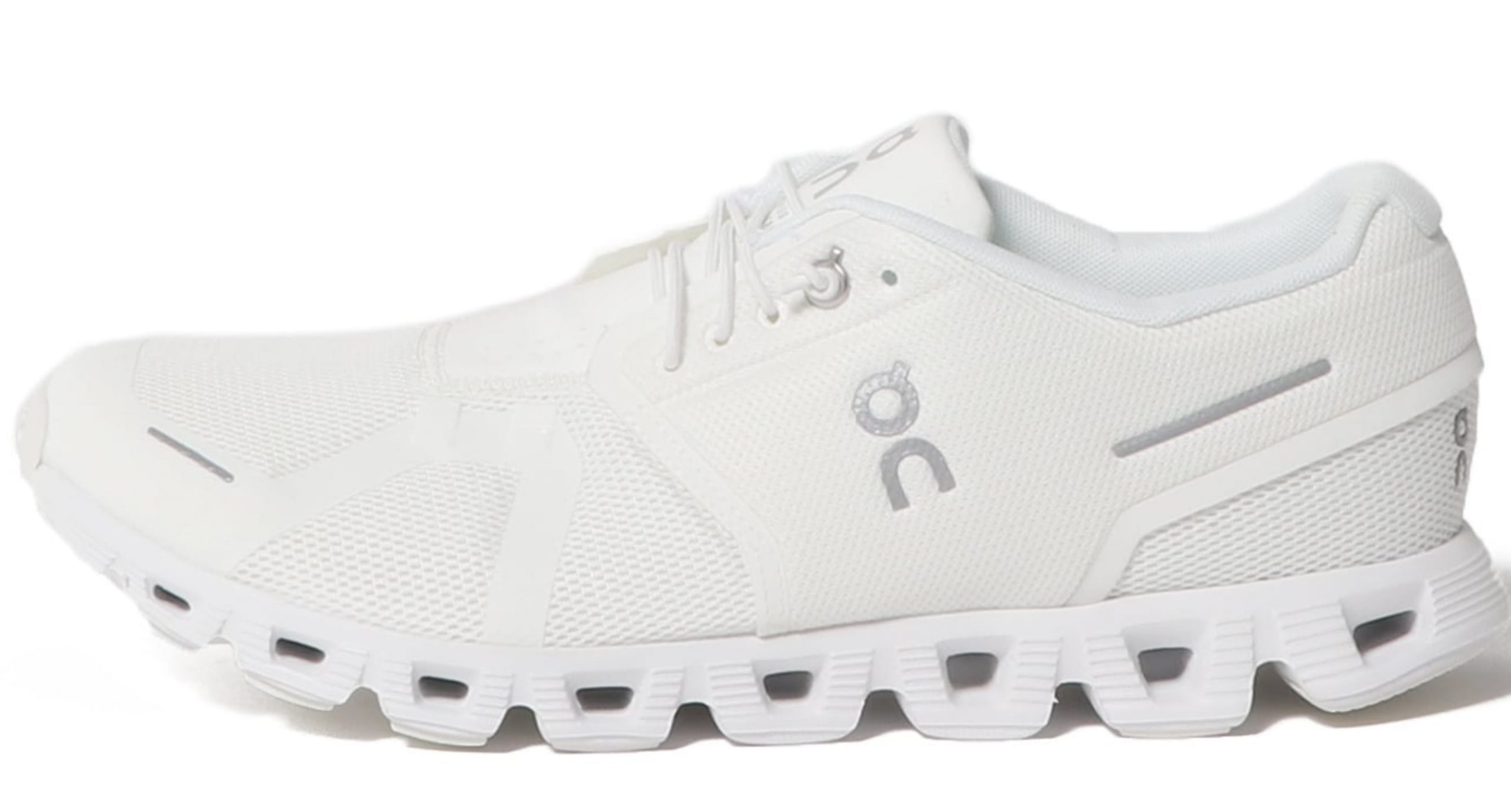
On Cloud 5

The On Cloud 5 is a notable choice in the lifestyle category, providing a mix of comfort, style, and sustainability. It’s a versatile shoe that easily goes from casual wear to light running, supported by On’s unique cloud technology for top-notch comfort. Whether for work or leisure, the On Cloud 5 promises to keep you moving comfortably with its soft cushioning and stylish design, showing why it remains a popular choice year after year.

On Cloud 5

Designer: On Cloud

Key advantages of the On Cloud 5 include:

  • Versatile design celebrated for its versatility, the On Cloud 5 effortlessly adapts from a casual lifestyle sneaker to a light running shoe. Its intelligent speed lacing system ensures a snug fit, making it easy to slip on and off, which is ideal for an active, on-the-go lifestyle.
  • Superior comfort thanks to the latest generation of On’s cloud technology, the On Cloud 5 provides exceptional comfort and cushioning. This shoe is designed to support and enhance your natural gait, making it perfect for all-day wear, from morning commutes to evening jogs.
  • Stylish and functional feature a sleek, urban aesthetic that fits well with any wardrobe. It combines Swiss design flair with practical features like a breathable and protective engineered mesh upper.

On Cloud 5

  • Sustainable construction because the On Cloud 5 incorporates 44% recycled materials in its design, making it an environmentally friendly choice for eco-conscious consumers.
  • Enhanced durability thanks to a durable outsole that provides reliable traction and stability on various surfaces, making it a dependable choice for daily wear.

On Cloud 5

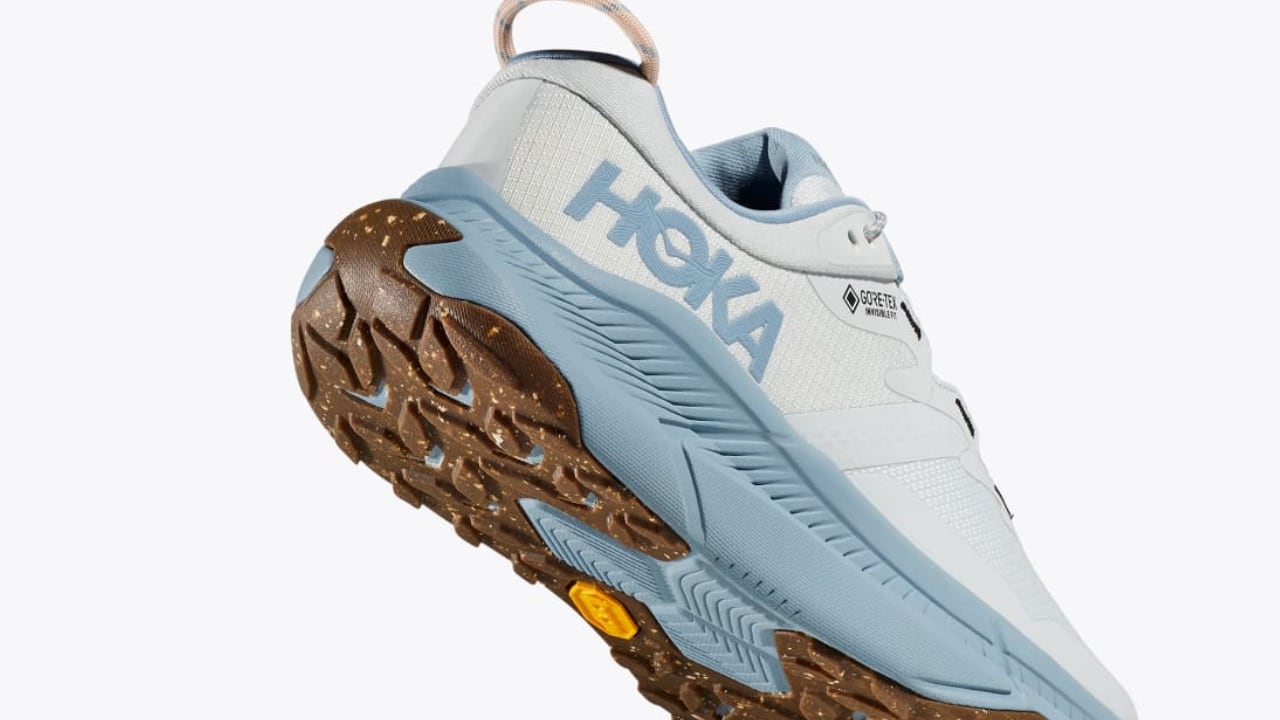
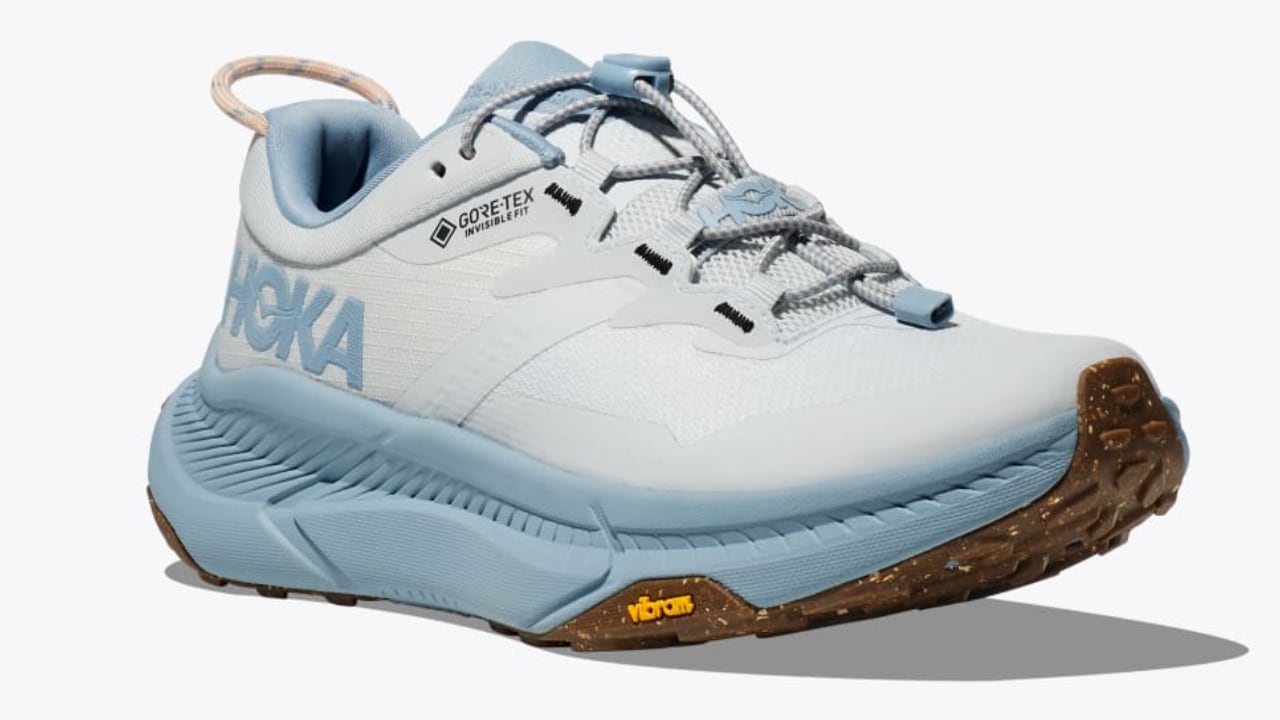
HOKA Transport

The Hoka Transport is an excellent choice for those looking for a versatile shoe that can handle daily wear, casual outings, and light hikes. It offers the perfect blend of lifestyle appeal and performance with its protective features, comfort, and a strong focus on sustainability. Whether you’re walking around town, hitting gentle trails, or simply looking for a comfortable and stylish shoe that doesn’t scream “running,” the Transport is designed to meet a variety of needs. Its thoughtful design and durable construction make it a smart investment for those seeking both comfort and style in their daily footwear.

Designer: HOKA

Key advantages of the Hoka Transport include:

  • Versatile design is marketed as a crossover shoe, blending daily wear, lifestyle, and light hiking capabilities. It is designed to bring the typical Hoka comfort into a package that’s less focused on running, making it a great choice for those who want comfort without the running shoe aesthetic.
  • Comfort and support thanks to its extreme comfort, the Transport provides just the right amount of cushioning without being too soft, which helps conserve energy even after a full day on your feet. The shoe’s design incorporates a toe guard and a strong focus on sustainability, including a midsole made from 30% sugarcane EVA and a Vibram® N-OIL outsole with 90% petrol-free components.
  • Durable and protective material constructed from rip-stop Cordura and featuring a low-profile but grippy Vibram outsole, the Transport is built to last and is suitable for various settings, from city streets to light trails.

  • Ease of use includes elastic laces, along with a regular lace option, and a pull tab at the back, which makes the shoe easy to slip on and off, providing convenience for the wearer.
  • Reflective and Eco-Friendly material includes 360-degree reflective details for enhanced visibility and is made from materials that emphasize Hoka’s commitment to sustainability.

HOKA Transport

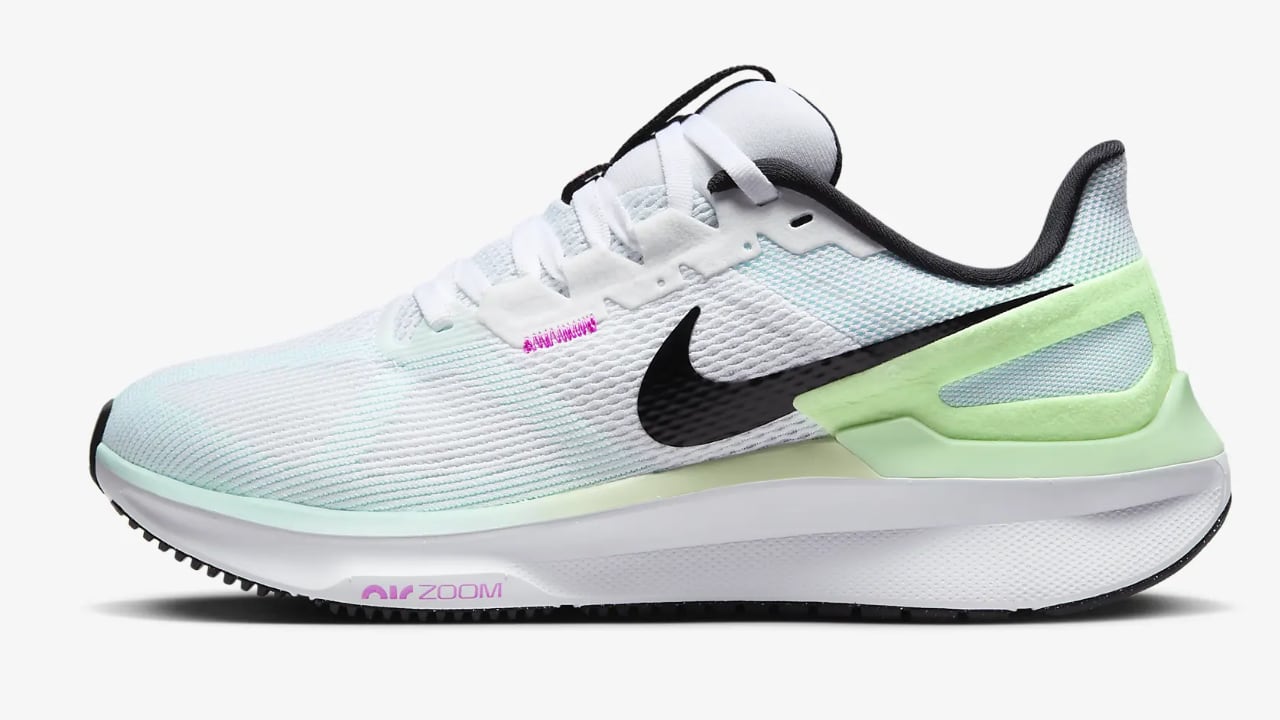
Nike Air Zoom Structure 25

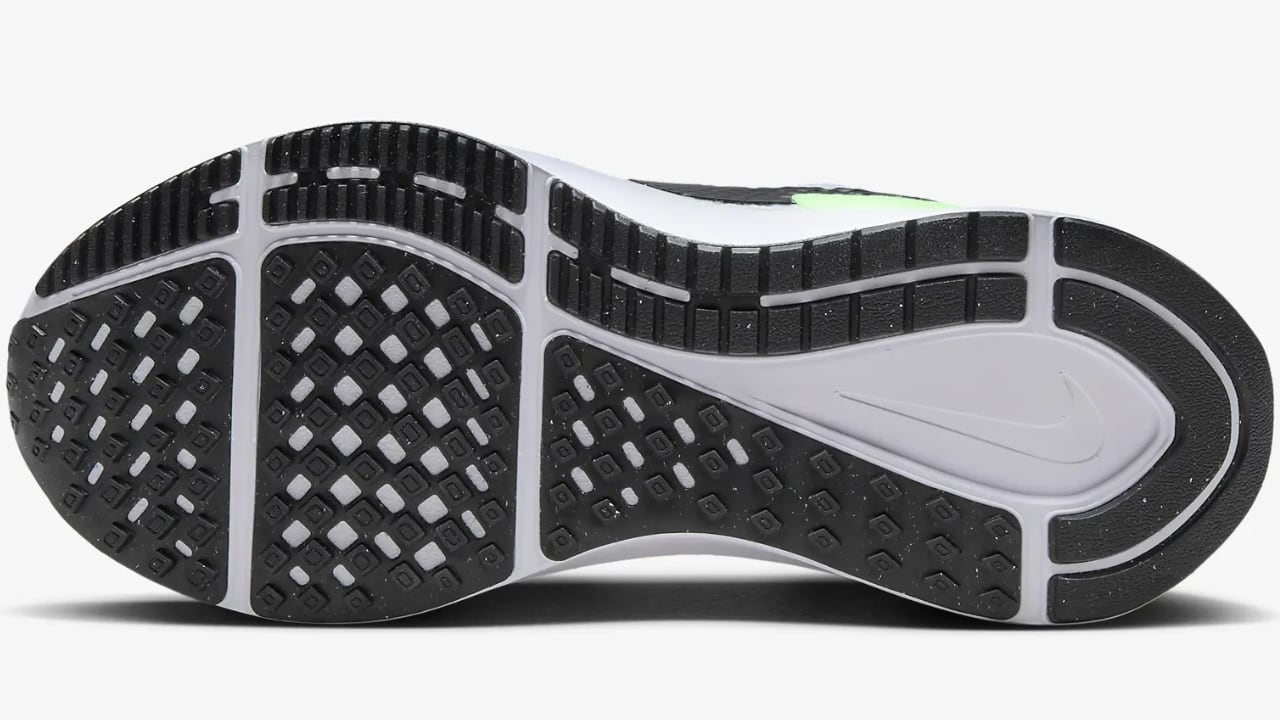
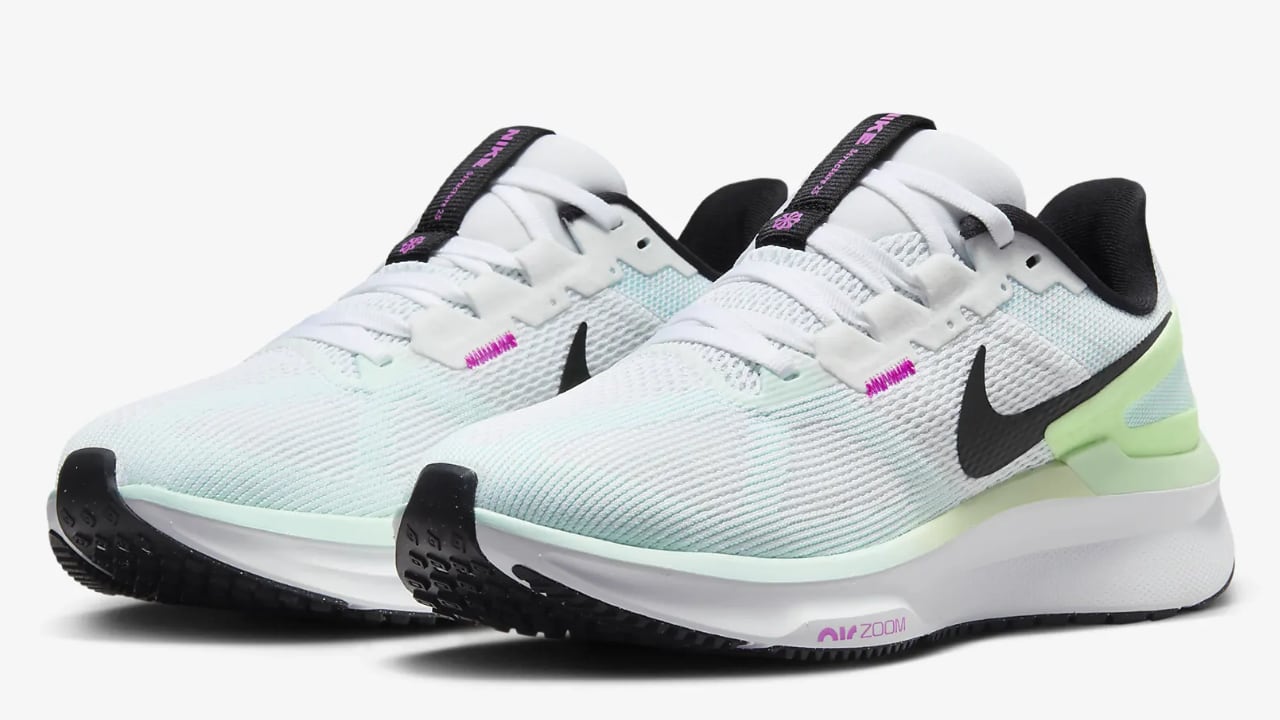
The Nike Structure 25 revitalizes its series with advanced stability and a dynamic, responsive feel. This shoe is an excellent choice for moms who need dependable footwear capable of keeping pace with their busy lifestyles. It combines enhanced comfort and targeted support, ideal for extended daily wear, whether it’s running errands, chasing kids at the park, or a casual jog. The shoe’s classic yet updated design integrates seamlessly with both athletic and casual attire, making it a versatile addition to any wardrobe. The Structure 25’s durability and thoughtful design ensure long-lasting performance and comfort, embodying a perfect balance between traditional reliability and modern innovation.

Nike Air Zoom Structure 25

Designer: Nike

Key advantages of the Nike Air Zoom Structure 25 include:

  • Versatile stability characterizes the Nike Structure 25, which has transitioned from a traditional stability shoe into one that balances stable, neutral, and mild stability features. Engineered for daily mileage, it provides a firmer and more responsive ride, complemented by a classic lugged outsole and enhanced guidance features.
  • Comfort and fit deliver a snug-to-normal fit characteristic of Nike’s designs, offering a slightly retro aesthetic. It features a classic fit that comfortably accommodates a wide range of foot shapes. Enhanced support is provided through strategic design elements such as a heel clip and a substantial midfoot sidewall.

Nike Air Zoom Structure 25

  • Durable and supportive material made from durable materials and designed for long-term use, the Structure 25 features a robust outsole that offers good traction and durability across various terrains.
  • Enhanced features for stability thanks to a heel clip and firmer ride to guide the foot without being intrusive, suitable for runners who appreciate a blend of traditional and modern stability mechanics.
  • Weight and Responsiveness are due to a slight reduction in weight from previous versions. While remaining on the heavier side, this design choice emphasizes durability over speed. This design choice makes it ideal for daily training and extended wear rather than quick-paced activities.

Nike Air Zoom Structure 25

The post These are 6 Best Everyday Shoes for Busy Moms: Comfortable All-Day Wear first appeared on Yanko Design.