Wired vs wireless speakers: What are the pros and cons?
Wired and wireless speakers each offer different trade-offs, advantages and disadvantages. Plus, what audio you put through them has a big effect.
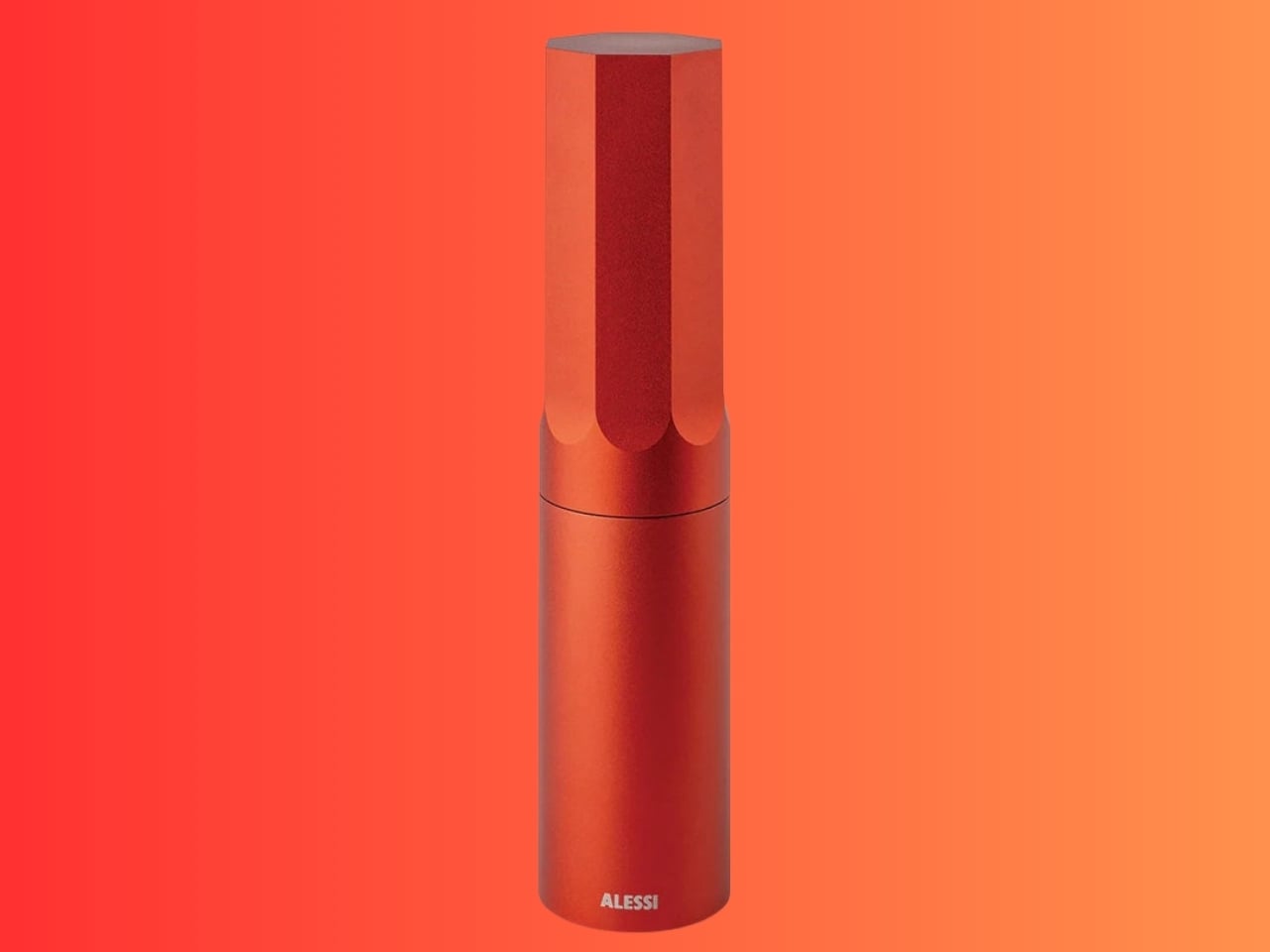
Pick up almost any pepper mill in an average kitchen drawer and you’ll notice the same small, dumb problem: you have to guess which part twists. Is it the top? The bottom? Do you squeeze and turn, or hold still and crank? Manufacturers have spent decades solving how a grinder crushes peppercorns and almost no time solving how a hand is supposed to hold the thing in the first place.
Konstantin Grcic’s new KG01 for Alessi fixes exactly that, and it does it with a trick so simple you wonder why it took this long. The body starts as a smooth cylinder up top, then shifts into an eight-sided, octagonal shape lower down. Your fingers find that transition instinctively. The shape itself tells you where to grip and where to twist, no instructions, no fumbling, no accidentally spinning the wrong half and dumping salt across the table. That’s the kind of design problem I find genuinely satisfying to see solved, because it’s invisible until someone points it out, and then it’s all you notice. A grinder’s form has to communicate its function without a single word of explanation, and Grcic clearly took that as a personal challenge rather than a footnote.
Designer: Konstantin Grcic for Alessi
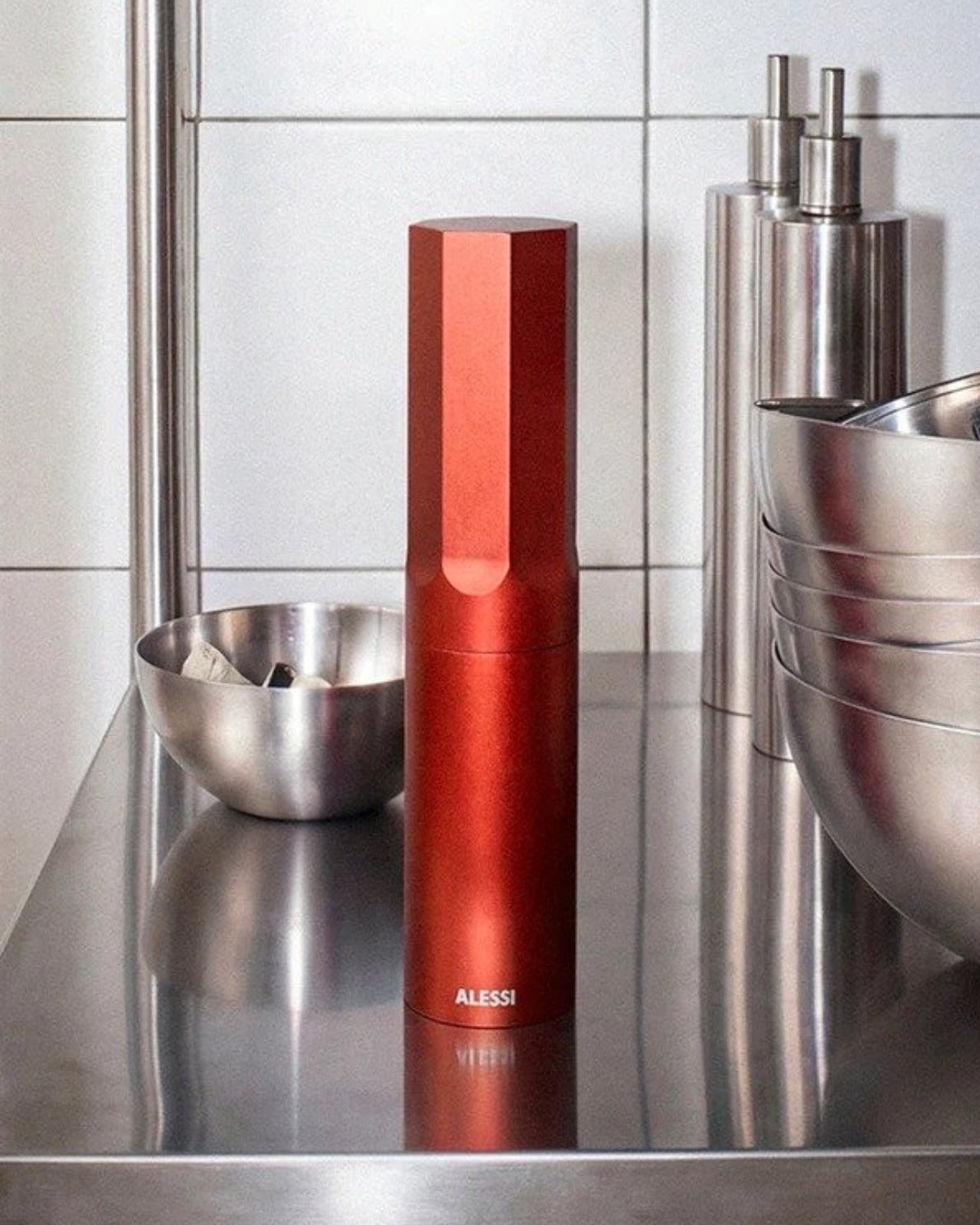
Grcic isn’t chasing novelty for its own sake here, either. He trained as a cabinetmaker before studying at the Royal College of Art in London, and his Berlin studio has spent decades making objects that lean industrial without feeling cold. That background shows up in the KG01. It’s machined from a solid block of aluminum, sandblasted for a matte, slightly grippy texture, and finished with an anodized coat that keeps it from looking like shop equipment that wandered onto your dinner table. Alessi describes it as standing “upright and emblematic like a king on a chessboard,” which sounds like marketing copy until you actually see it next to a wine glass and realize the comparison is fair.
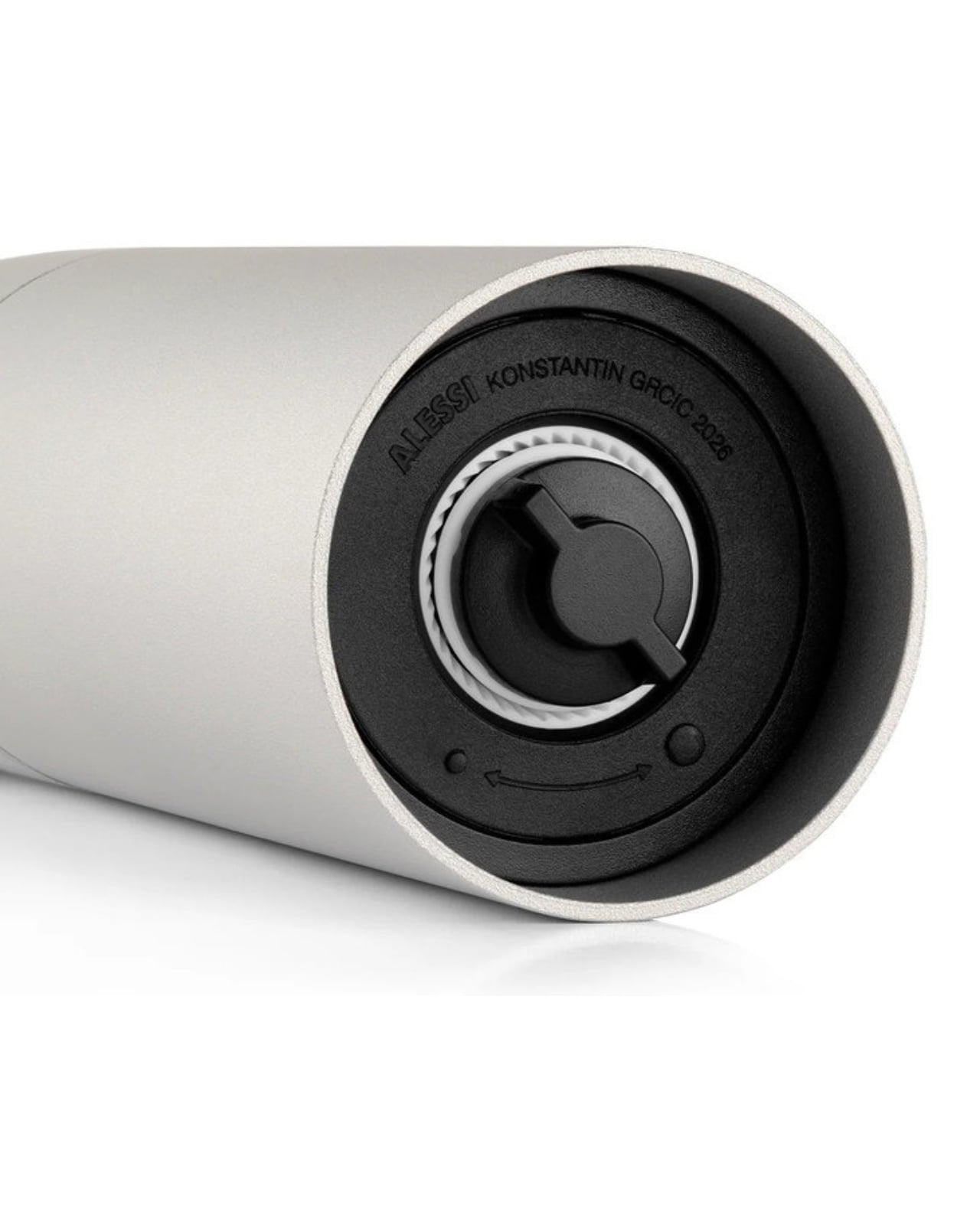

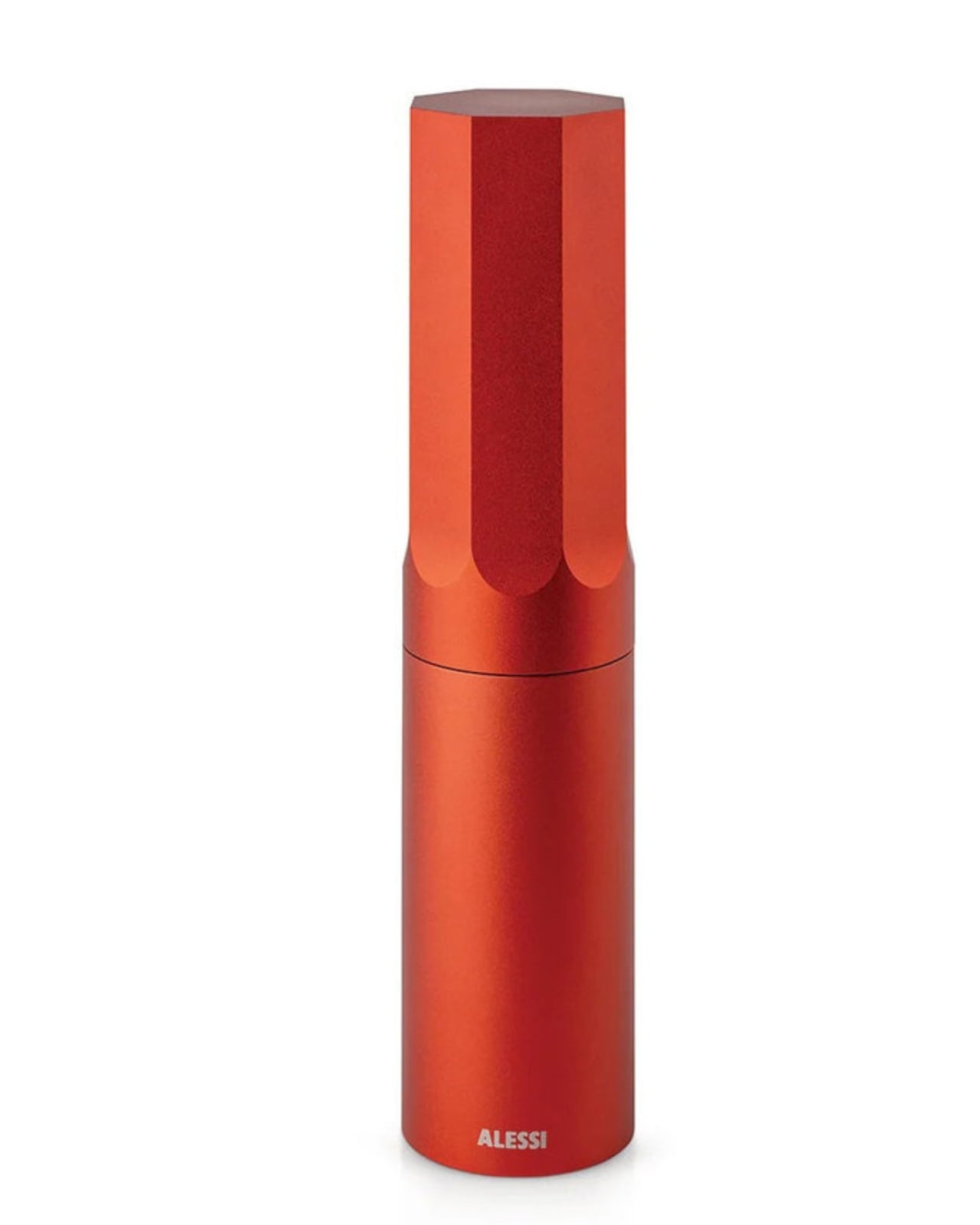
Inside, there’s an adjustable ceramic grinding mechanism built to handle peppercorns, coarse salt, and dry spices, and you can dial the coarseness from fine to chunky by twisting a setting at the base. At roughly 8.5 inches tall, it has real presence on a table without tipping into novelty-object territory. It comes in raw aluminum, a dark grey finish, and a red version that reads more like a piece of hardware than a kitchen accessory, in the best way.
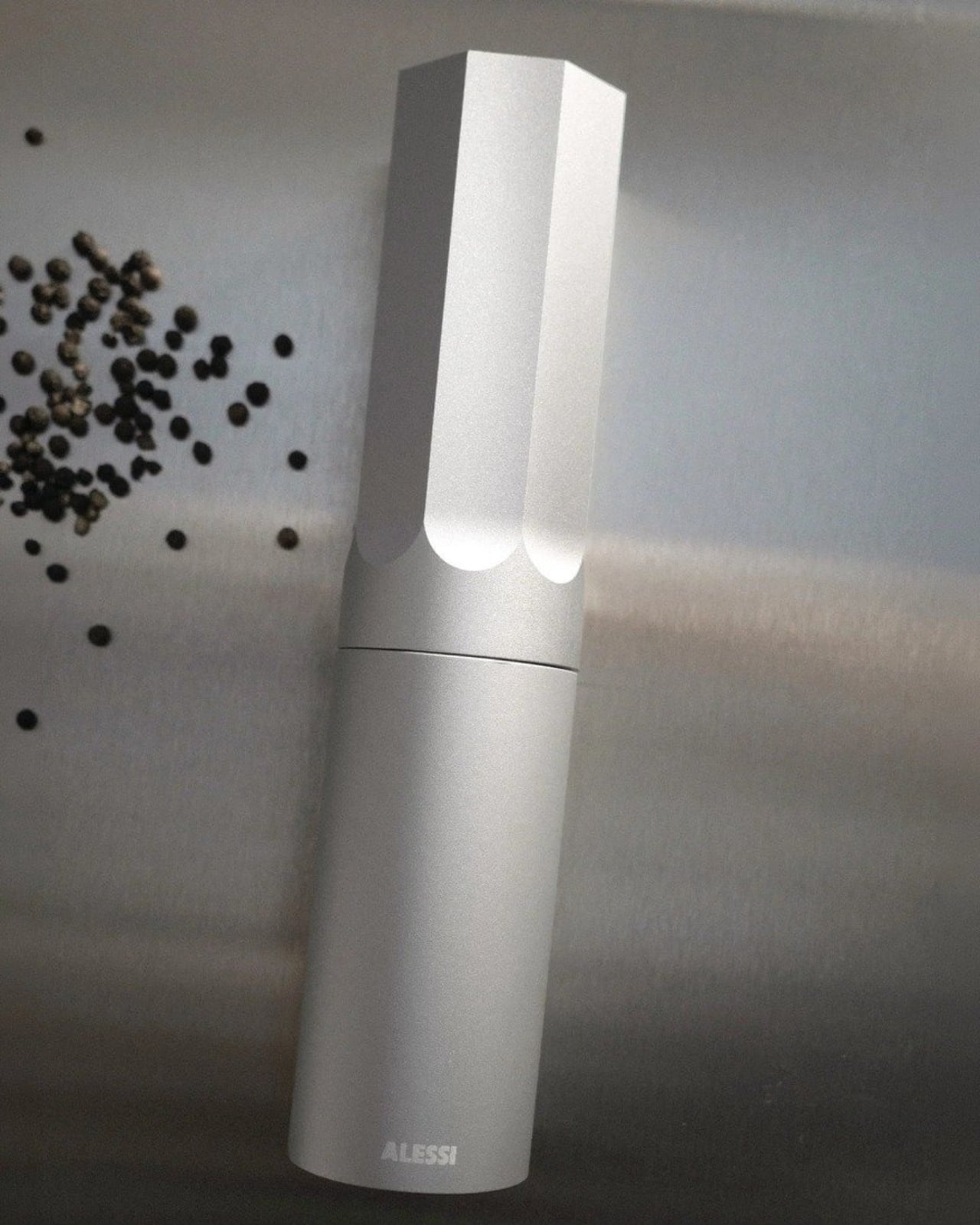
None of this is revolutionary in the sense of new technology. Grinders have used ceramic mechanisms for years, and adjustable coarseness isn’t new either. What’s actually different is the confidence of the shape. So much tableware today tries to disappear, all soft curves and neutral tones designed to offend no one and be remembered by no one. The KG01 refuses that approach entirely. It looks like a tool, reads like a sculpture, and somehow manages to be more comfortable to use than the friendlier-looking mills it’s replacing.
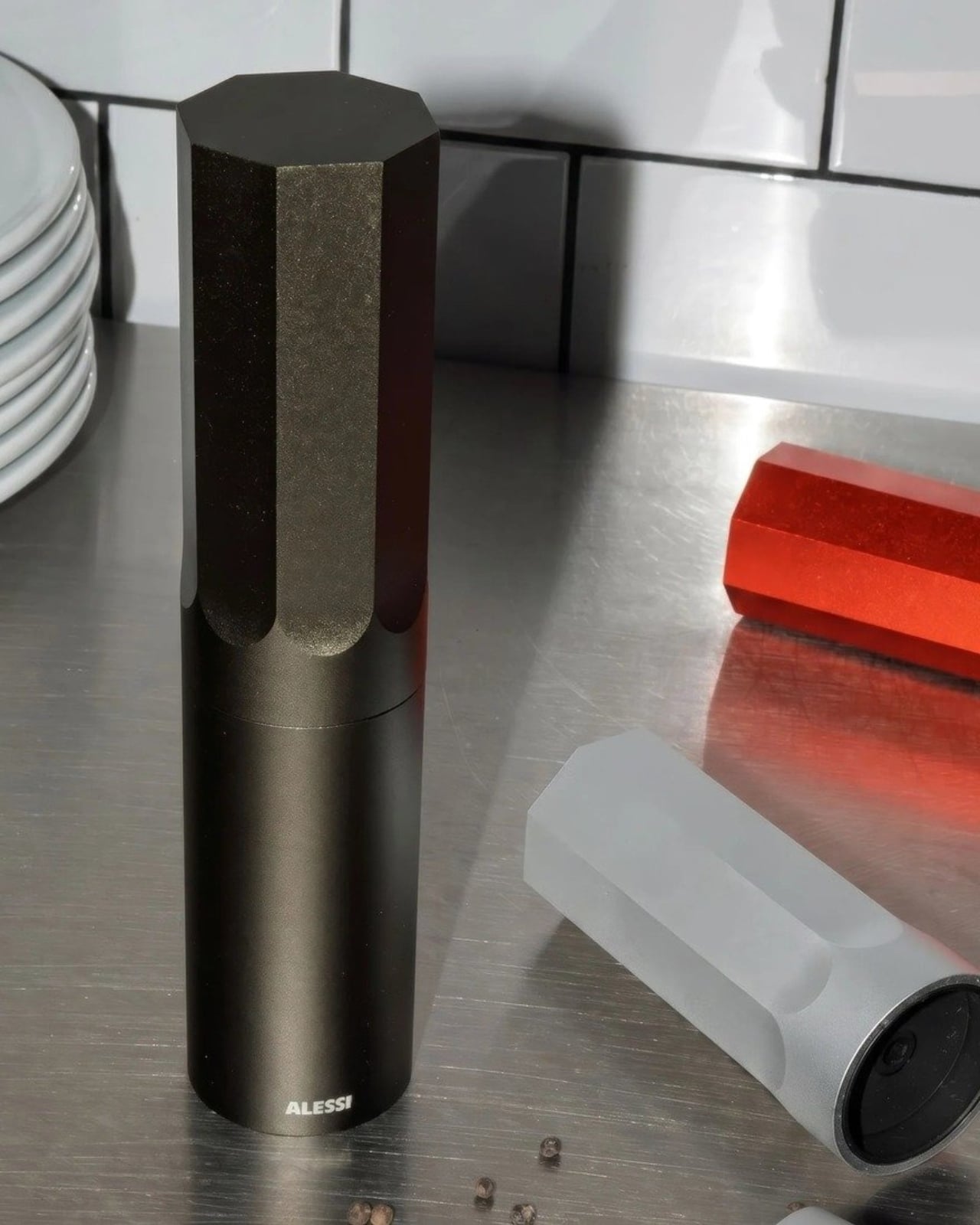
At $175, it’s priced like the design object it is rather than the kitchen gadget it also happens to be, and that’s worth being upfront about. This isn’t an impulse buy next to the register at a home goods store. It’s closer to the kind of piece you put on a wedding registry or buy yourself after walking past it at a design shop and thinking about it for a week straight. Alessi has built an entire business on that exact instinct, turning everyday objects into things people want to display, and the KG01 fits comfortably into that lineage.
What sticks with me isn’t the price or even the aluminum. It’s the fact that a company still bothers to ask a well-known designer to rethink something as small as where your hand goes on a pepper mill. Most of the objects we touch every day were never designed with that kind of attention. The KG01 was, and you can feel it the first time you pick it up and just know what to do.
The post Finally, a Pepper Grinder Your Hands Actually Understand first appeared on Yanko Design.

Ford Bronco has earned its reputation for being one of the most rugged, mid-size 4×4 SUVs designed for outdoor adventures. Now, it’s changing that image for the first time in years to be more of a ride for everyday adventurers than one to leave the highway behind and take on the tough terrain. The new iteration is called the Bronco Basecamp and is the first electrified Bronco ever.
Of course, the change is not in the name alone. The overall idea of the vehicle has changed. So, this is not the usual Bronco you know. It’s a little more contemporary and thoughtful, with the same five-seater all-wheel drivetrain. It is created in China through Ford’s partnership with Jiangling Motors.
Designer: Ford

The electric Bronco Basecamp combines large batteries, multiple electric motors, and electronics to make it a convenient adventure-ready SUV. The Basecamp, unlike the body-on-frame chassis of the regular Bronco, is built on a unibody chassis, and comes with an extended-range electrified powertrain. The SUV is headed first for release in Australia and New Zealand, but there is no word on if and when it will make it stateside.


As mentioned, the Basecamp comes with an extended-range electric vehicle (EREV). Ford calls it a super-hybrid powertrain, which is nothing but a hybrid of electric and gas running the SUV. There is a 49-kWh battery onboard, which feeds two electric motors located alongside the gas engine. While the exact word on the kind of range we can expect from the Basecamp is not out at the time of writing, Ford does hint at a driving range of 800-900 kilometres on its website.
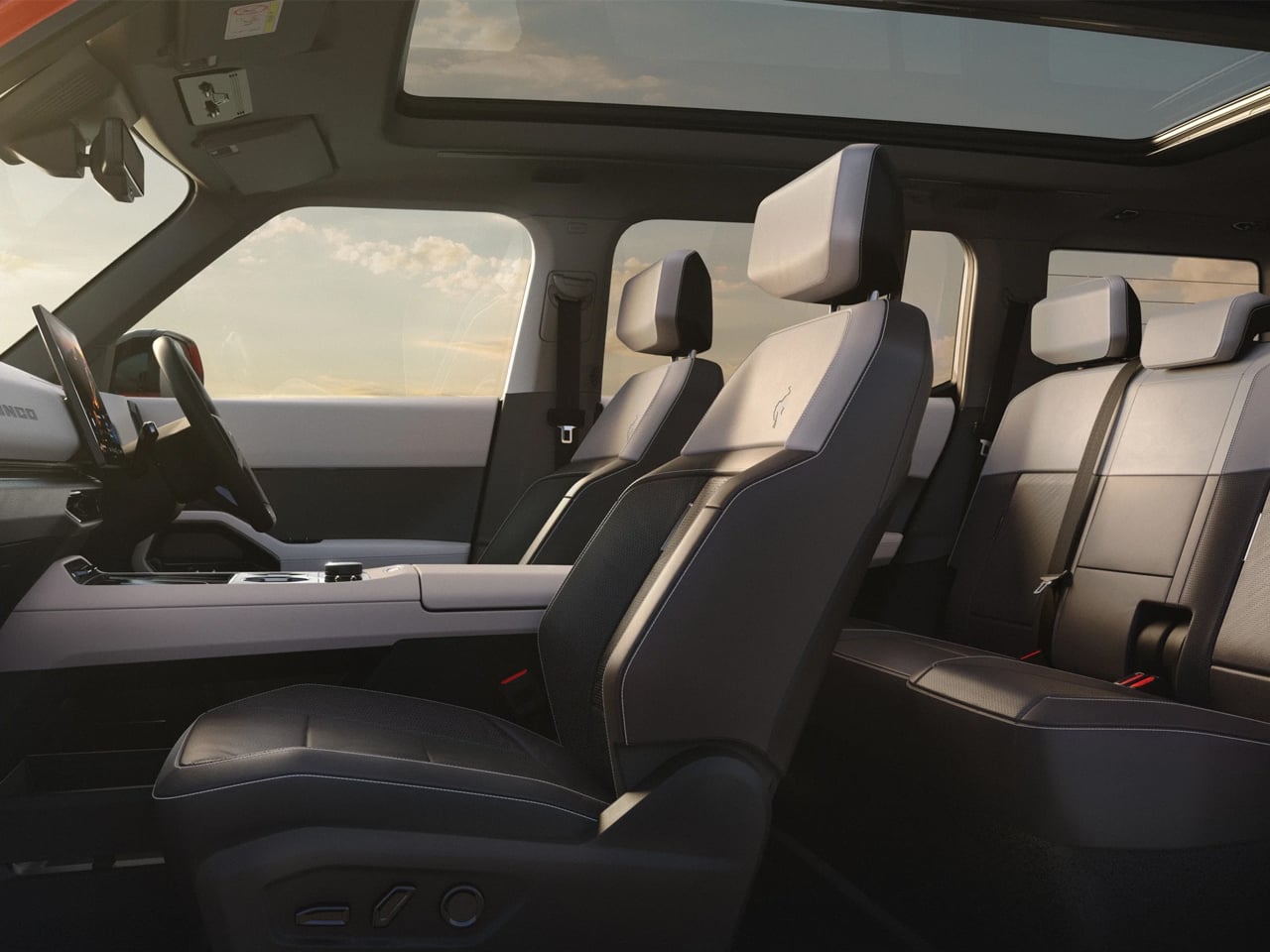
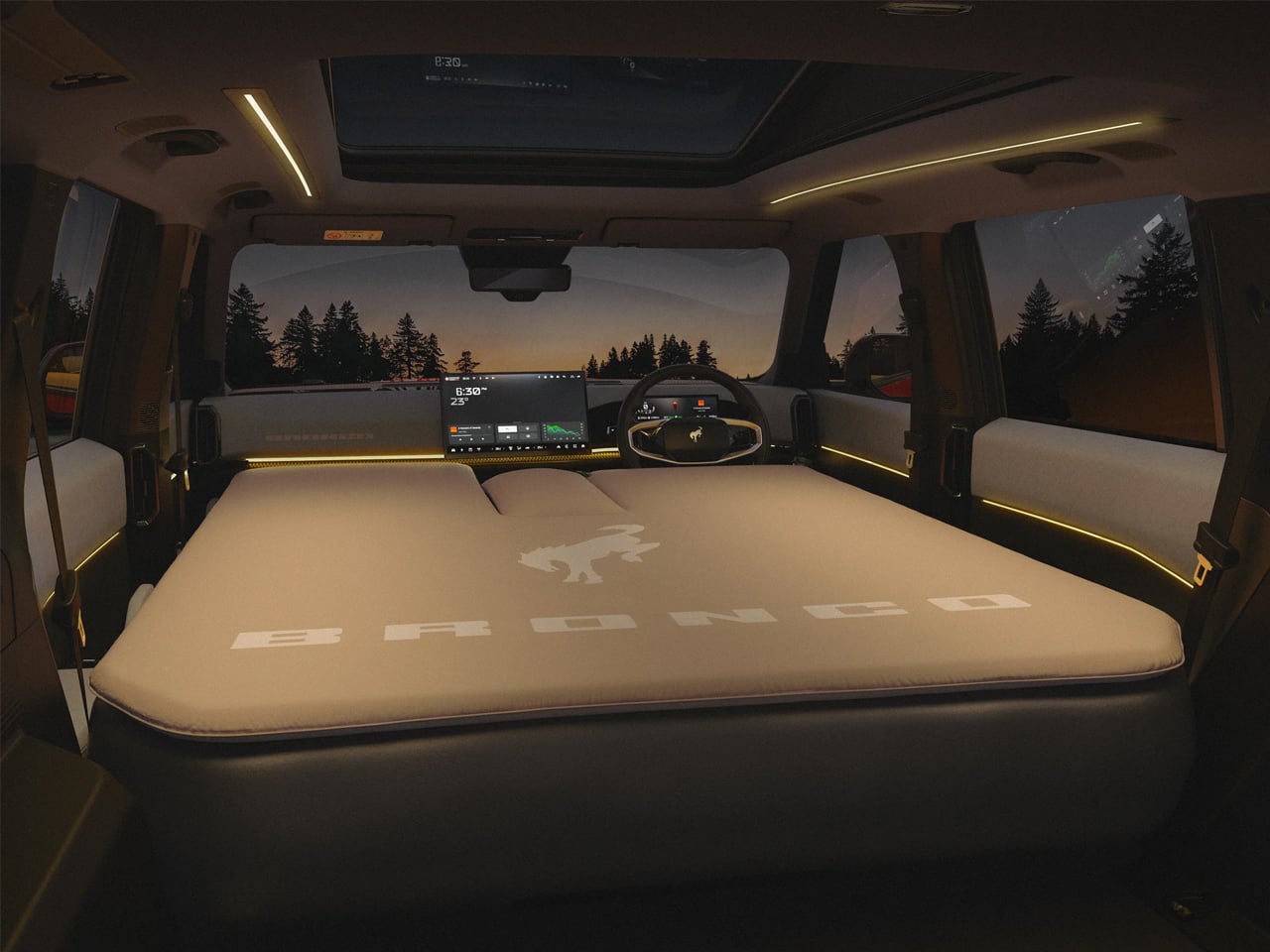
It also suggests that the Bronco from China is designed for camping where your please. To that accord, the Basecamp comes with a transforming cabin where the front and rear seats fold to make a comfortable sleeping space. You place the provided inflatable mattress, and you’re good to retire for the day. The flagship Outer Banks model also arrives with a motorized pop-up roof that deploys at the touch of a button to offer more headroom and ventilation when you’re living inside the Basecamp.

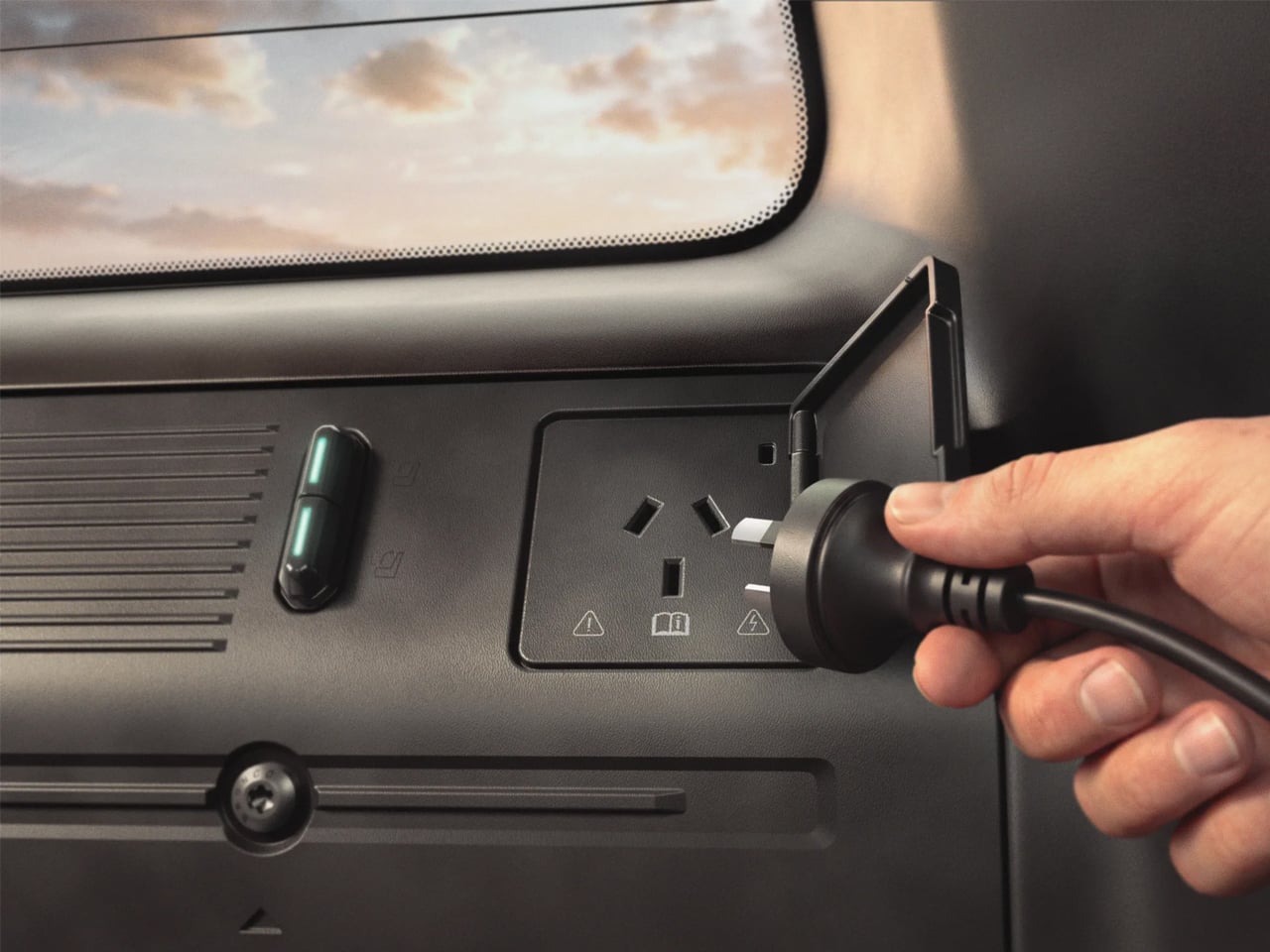
The same model also features an interior with a 7.5L warm/cool storage console to heat and cool day-trip drinks and food, while its rear swing gate doubles as a table. Ford also provides the Basecamp with a 6.6kW battery to run it off-grid. The battery can power cooktops, kettles, lights and your gadgets at the camp.
The Ford Bronco Basecamp is expected in Australia and New Zealand in 2027. Ford remains tight-lipped about the pricing at this time, but notes that I will be “sharing specifications, pricing, variants and availability timelines closer to vehicle arrivals from mid-2027.”


The post Ford Bronco Basecamp turns iconic 4×4 into electric adventure SUV you can sleep and camp in first appeared on Yanko Design.


Apple’s Mac mini is a 127 by 127 by 50mm aluminum square, and the PC industry has spent 2026 rebuilding that square with different logos on top. ASUS’s ExpertCenter PN55 measures 130 by 130 by 34mm. Geekom’s A9 Max sits at 135 by 132 by 46mm. Japan’s Links LC3501 shrinks it to 100 by 100 by 34mm. Dell skipped the mini entirely and went for the Mac Studio, giving the XPS RTX Spark Desktop a dark gray boxy body with a removable lid underneath for the SSD. At this point nobody is even pretending.
The convergence gets funnier at the expensive end. Every RTX Spark mini PC shown at Computex 2026, from Dell, Lenovo, ASUS and MSI, turned up with four USB-C ports, one HDMI and 10Gb Ethernet in a near-identical gray box. ServeTheHome, which photographed all four on the show floor, reckoned Nvidia is keeping a heavy hand on the steering wheel and enforcing design requirements on its partners. Apple arrived at this shape through integration, drawing an enclosure around a chip it designed itself. Everyone else arrived by consensus, or possibly by memo. Same silhouette, wildly different reason for existing.
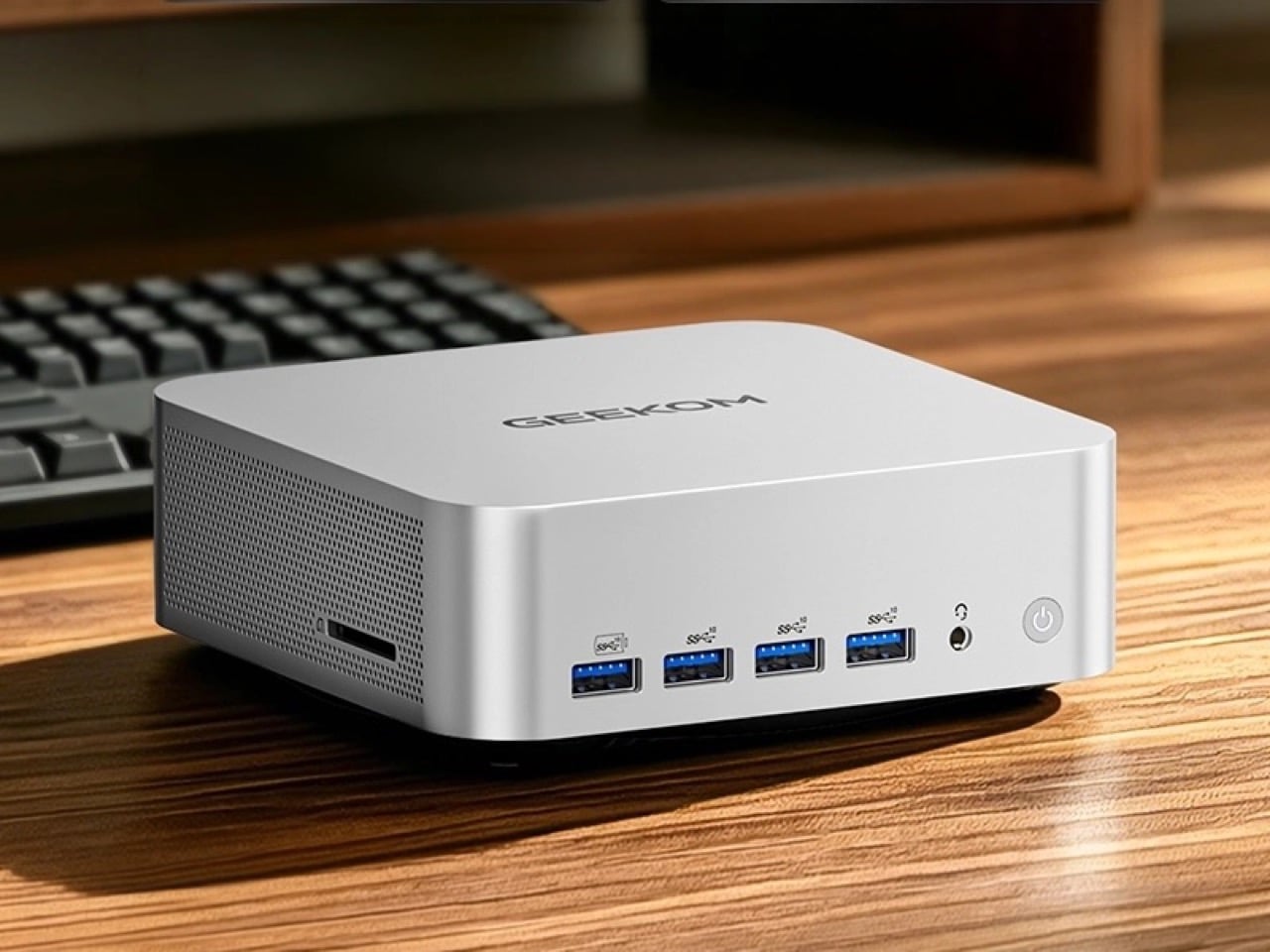
Geekom’s A9 Max lands at 135 by 132 by 46mm, which puts it within 8mm of the Mac mini on every axis, close enough that the tape measure tells its own story. The chassis is full metal with softly radiused corners and a flat top plate, carrying the visual weight along with the footprint, that sense of a machined block rather than a molded shell. Inside is AMD’s Ryzen AI 9 HX 370 with Radeon 890M graphics, up to 128GB of DDR5 across two SODIMM slots and a pair of PCIe Gen 4 NVMe slots, for around $1,000. Geekom has spent years positioning itself as the answer to Intel’s NUC line, which died in 2023 and left the reference shape unclaimed. Somebody was always going to pick it up.
The limits show up under load rather than on the spec sheet. Testers found the 890M and the memory ceiling holding back heavier creative work, and the fans announcing themselves during video editing, which is the cost of working inside Apple’s volume without Apple’s thermal budget. One review measured an NPU benchmark score less than half what the identical processor managed in a rival machine, a gap Geekom later traced to a UEFI bug and patched. Apple ships one firmware for one board while Geekom ships many, and that difference surfaces in software long before it surfaces in the aluminum. The metalwork is excellent, and the chassis is the part of this machine that needed no revision at all.
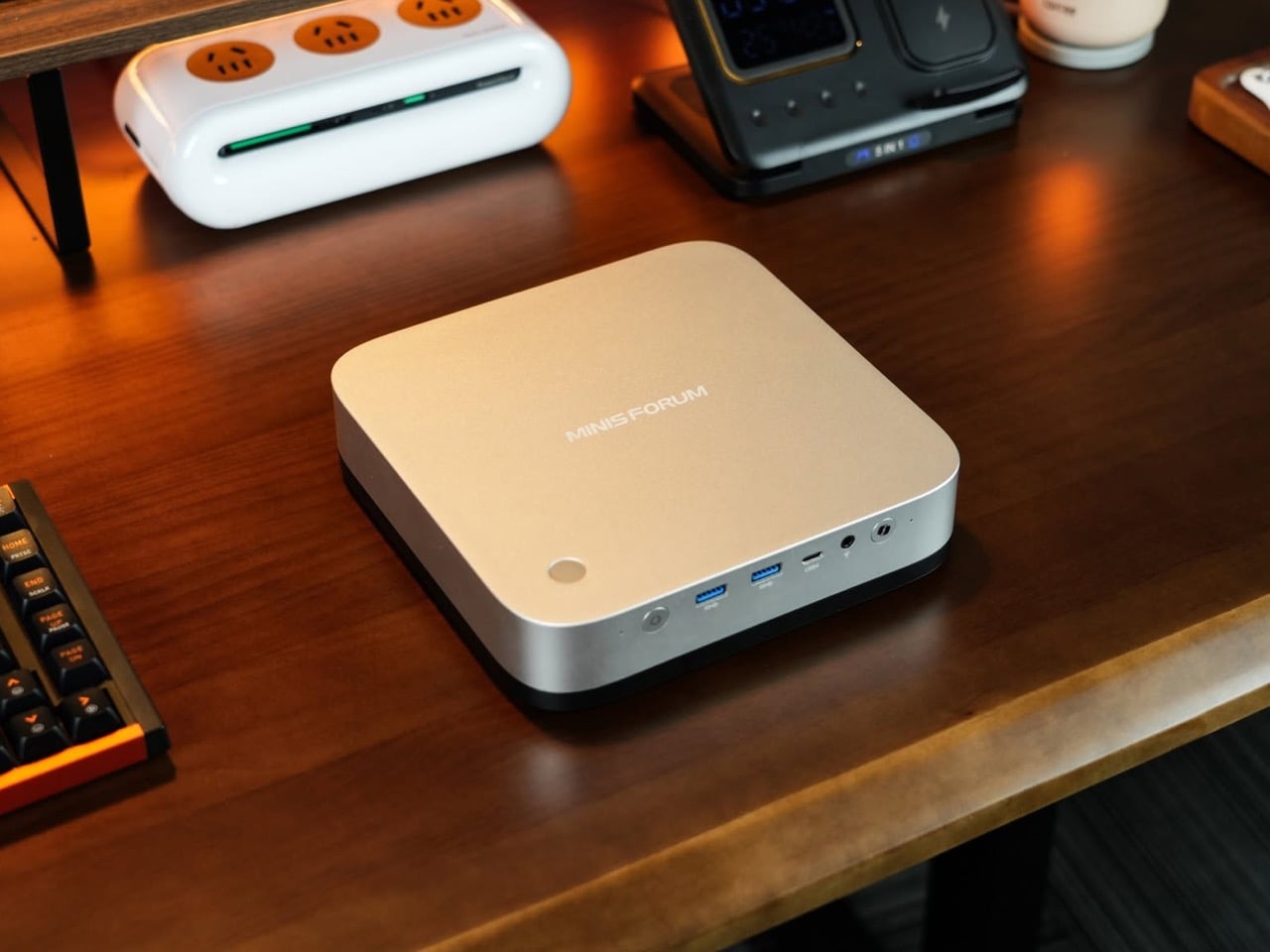
Minisforum built the AI X1 Pro around everything Apple leaves out, and the case swelled accordingly. You get three M.2 slots, dual 2.5GbE, two USB4 ports, Wi-Fi 7, an internal 135W power supply instead of a laptop brick, and an OCuLink connector for hanging a desktop GPU off the side. Configurations run from a Ryzen 7 H 255 up to the Ryzen AI 9 HX 470, with sale pricing landing between $899 and $1,369 depending on memory and storage. The workmanship sits clearly above the class average, with properly machined surfaces rather than the painted-over castings this price bracket usually delivers. It is the most capable machine in this roundup and the least contained.
Reviewers logged what that ambition costs, noting that the swollen footprint makes it a harder sell against the M4 Mac mini, that it runs loud, and that the Wi-Fi needed attention out of the box. Every port is volume, every volume is airflow, and airflow is noise, which is the chain of consequences Apple sidestepped by declining to offer any of this in the first place. The AI X1 Pro is the honest version of the trade, and it tells you in cubic centimeters exactly what expandability costs. Anyone who has priced an external GPU enclosure knows OCuLink is the cheapest route to real graphics performance in a small box. You simply cannot have it inside a 127mm square.
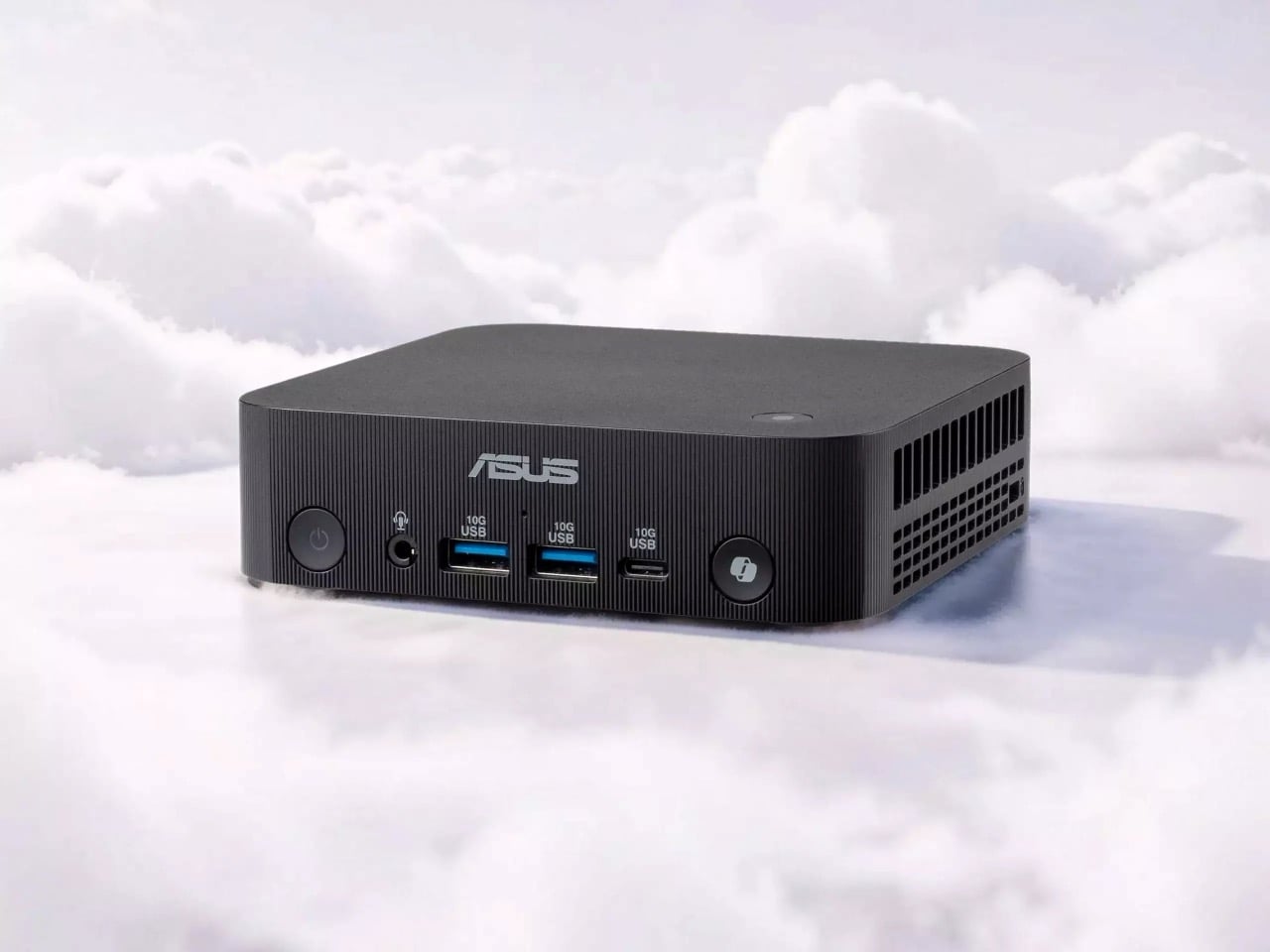
ASUS measures the ExpertCenter PN55 at 130 by 130 by 34mm and 0.6kg, which is three millimeters off the Mac mini’s footprint in both directions and a full 16mm slimmer. The aluminum chassis carries finely etched lines across the top that run off the edge and resolve into the rear cooling vents, a detail doing real work by turning a functional grille into a graphic element. Inside is a Ryzen AI 400 Series processor with an NPU rated up to 55 TOPS, up to 96GB of DDR5, six USB ports and dual LAN, enough to drive four 4K displays. ASUS validated the whole thing to MIL-STD-810H for round-the-clock operation, which matters for the signage and kiosk deployments this line actually sells into. It was announced at CES 2026 and started shipping in Q2.
ASUS inherited the entire NUC program from Intel in 2023, which gives it more historical claim to the small desktop than anyone except Apple, and the PN55 still reads like a Mac mini that got a job in IT. Its own idea is the chassis mechanism, a hinged lever that pops the machine open for RAM and storage swaps without a single tool. That is a direct answer to Apple, whose 2024 redesign sealed the enclosure and turned memory into a decision you make once and live with for five years. An IT manager buying two hundred of these cares more about that lever than about anything else on the spec sheet. The footprint is borrowed; the service model is entirely its own.
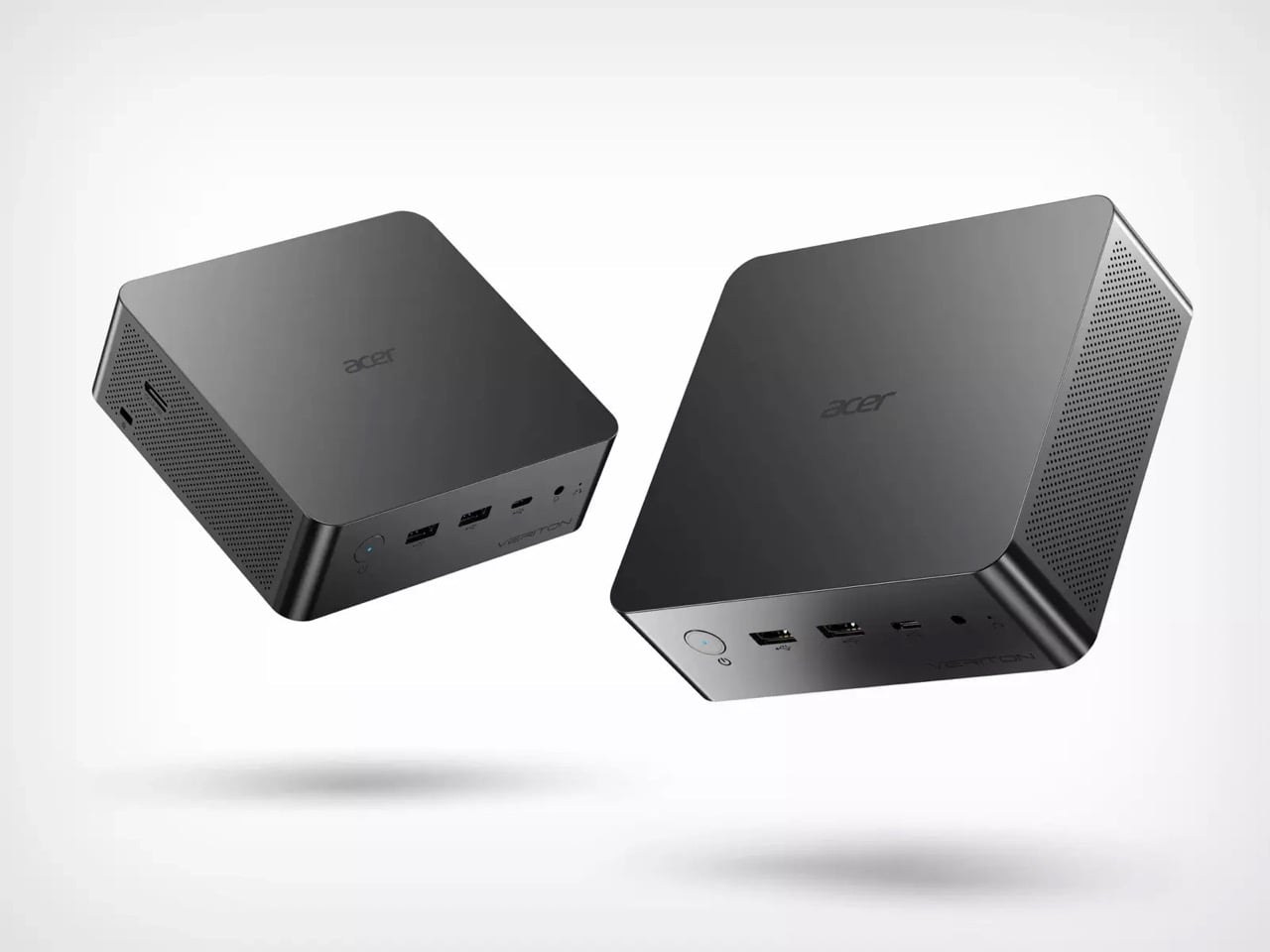
Acer announced the Veriton RI110 at IFA in Berlin on September 2, making it the newest arrival in this convergence by a matter of days. The chassis measures 138.5 by 131.3 by 52.1mm and weighs 630 grams, so it sits 11mm wider than a Mac mini, 2mm taller, and marginally lighter at 1.39 pounds against Apple’s 1.5. Acer calls it a mini workstation, which is a lot of syllables for a box the size of a sandwich. Inside is Intel’s Core Ultra X7 358H with Arc B390 graphics, up to 96GB of dual-channel LPDDR5X and up to 4TB of PCIe Gen 4 storage, with 10GbE and 2.5GbE both fitted. Acer claims it will run AI models of up to 120 billion parameters locally.
Soldered LPDDR5X sets the ceiling here, because memory is fixed at the moment of purchase and stays fixed for the life of the machine, the same bargain Apple asks you to make. The OCuLink port is the counterweight, a PCIe 4.0 x4 link rated at 64Gbps that lets you hang a full desktop graphics card off the back, which is the most un-Apple gesture available in this form factor. That 120 billion parameter figure deserves a squint, since fitting a model that size into 96GB requires aggressive quantization Acer has not specified anywhere in its materials. North America gets it in Q4 2026, EMEA in Q1 2027, and no price has been announced. It is a Mac mini with a hole drilled in the back.
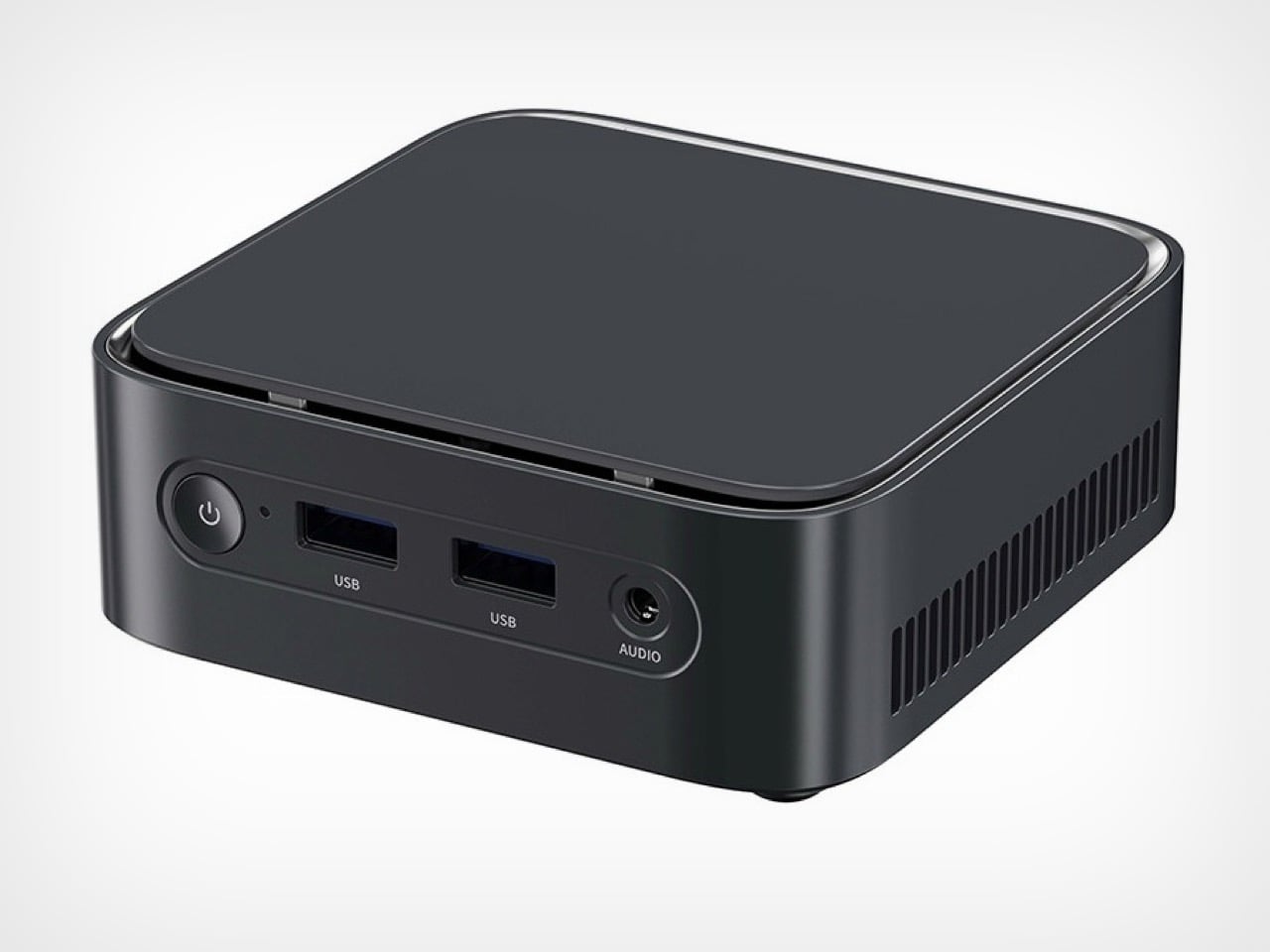
The Links LC3501 is 100 by 100 by 34mm, weighs 260 grams, and runs a four-core Ryzen 5 3501U that AMD shipped on the Zen+ architecture back in 2019. Scaling the square down to a 10cm footprint works visually, because the proportions hold and the thing reads as a deliberate object rather than a shrunken one. Japanese distributor Links sells it for ¥58,800 with 8GB of DDR4 and ¥64,800 with 16GB, roughly $367 and $404, with a 256GB SATA SSD and Windows 11 Pro preinstalled. It shipped in mid-September 2026 and is not coming to the US, so treat this one as evidence rather than as a purchase. The chip inside is seven years old and the case could not care less.
Putting a 2019 processor in a 2026 enclosure reads oddly until you look at where DRAM and NAND prices have gone, at which point the arithmetic makes sense. What the machine exposes is that the silicon has become the variable and the shape has become the constant. A 100mm footprint at 34mm tall is a genuinely lovely object, smaller than the Mac mini in every dimension, and the shape is doing considerably more of the work here than the hardware. Designers have a name for this moment, when a form outlives the constraints that produced it and carries on as pure style. The LC3501 is that moment, on sale now, for $367.
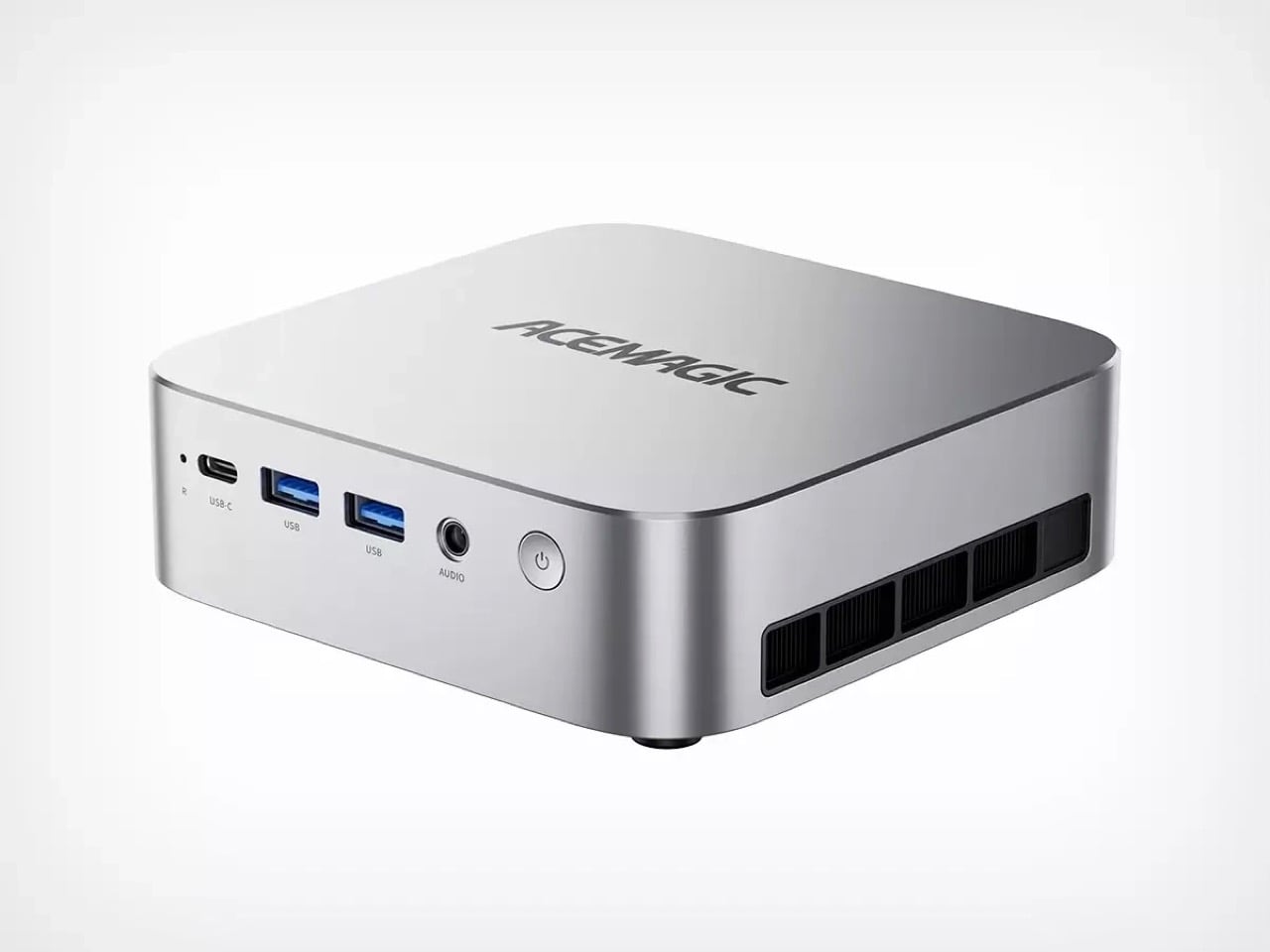
AceMagic’s F2A measures 148 by 120 by 39mm in an all-plastic case, running a Core Ultra 5 125H or Core Ultra 7 155H with Intel Arc graphics, 32GB of DDR5 and a 1TB SSD for under $600. The proportions are a rectangle rather than a square, which changes the read entirely, because a square sits on a desk as an object and a rectangle sits there as a component. Plastic shifts it further, since much of the visual argument of this form factor rests on appearing to be a solid machined block. Wi-Fi 7 and 2.5Gb Ethernet are both fitted, there is a spare M.2 slot, and the ports are sensibly split across front and back. For the silicon on offer, the price is fair.
The port list is where the budget becomes visible, with no USB4 or Thunderbolt anywhere and every USB-A connector capped at 5Gbit/s. Dual fans get loud under sustained load, with no button or software toggle to bring them down. A plastic shell radiates far less heat than machined aluminum, so the fans work harder to compensate, which is a material decision producing an acoustic outcome. Apple’s aluminum enclosure functions as a heatsink that also happens to be a housing, and that double duty is the expensive part of this form factor. The outline is the cheap thing to reproduce. The substrate is not.
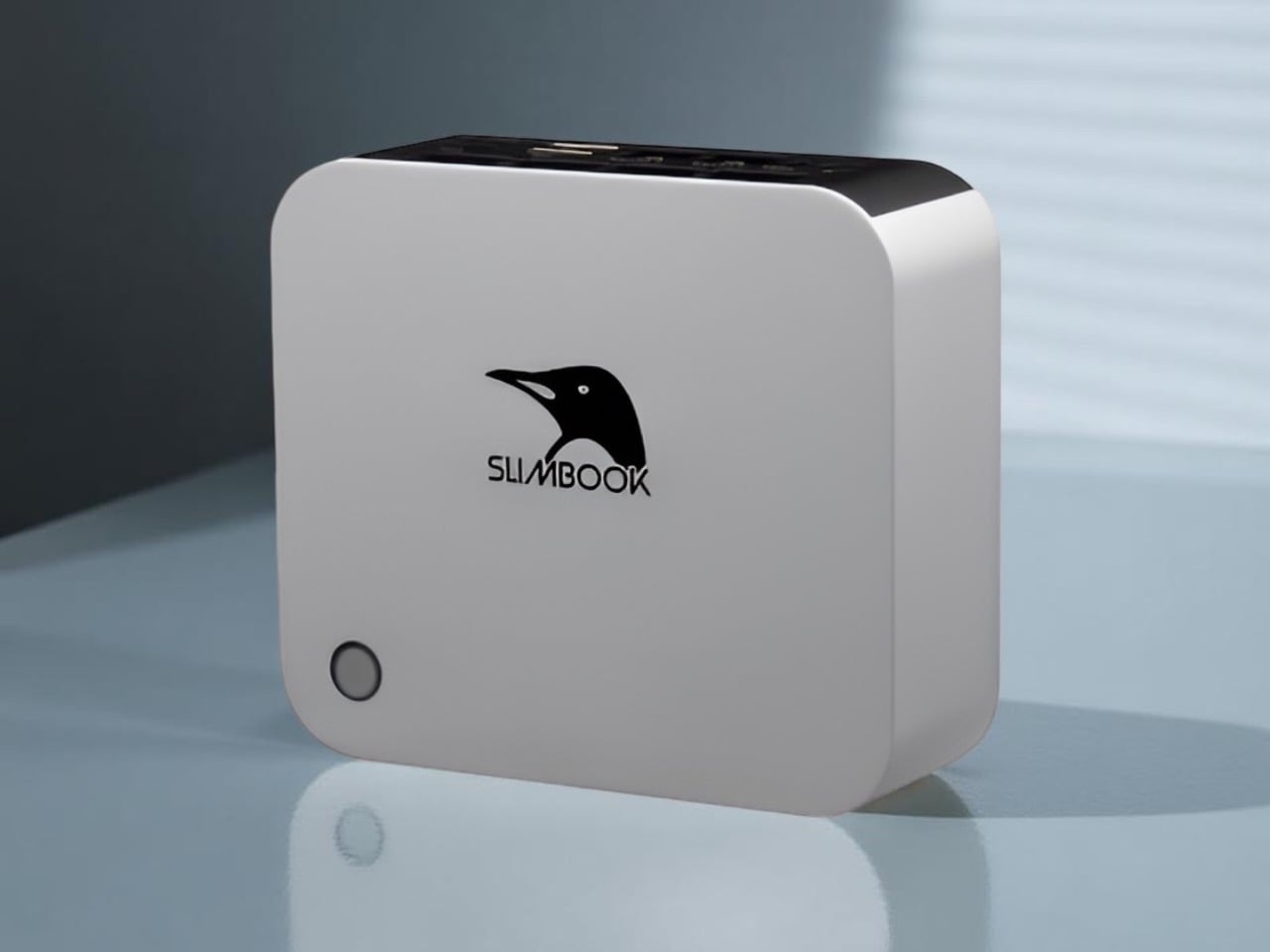
Spanish builder Slimbook ships the ONE at 158 by 130 by 58mm in silver aluminum and black plastic, which is about as close to Cupertino as a color pairing can get without sharing a supplier. Configurations run to a Ryzen 7 H 255 or the Ryzen AI 9 HX 370, with up to 128GB of RAM and up to 16TB of SSD storage, plus OCuLink, dual 2.5GbE, Wi-Fi 7 and USB4. Pricing starts at 649 € for the Hawk Point model, roughly $760, rising to 949 € for the Strix Point version. The order page is the real product here, because Slimbook preloads Ubuntu, Debian, Fedora or Linux Mint for free and charges extra for Windows. There is no US retail presence, so buying one means ordering from Spain.
Putting a silver aluminum square on a desk and booting KDE Plasma on it is a small act of comedy, and Slimbook knows exactly what it is doing. The company built its identity on selling Apple-grade hardware to people who actively prefer Apple’s software stay out of it, which turns the shared shape into an argument rather than an accident. Its own spec sheet at one point listed the machine as 5.5mm tall, a decimal point slip that would have made this the thinnest desktop computer ever built. The real number is 58mm, which is 8mm taller than a Mac mini and precisely what fitting OCuLink inside costs you. Small Linux vendors rarely get the metalwork this right.
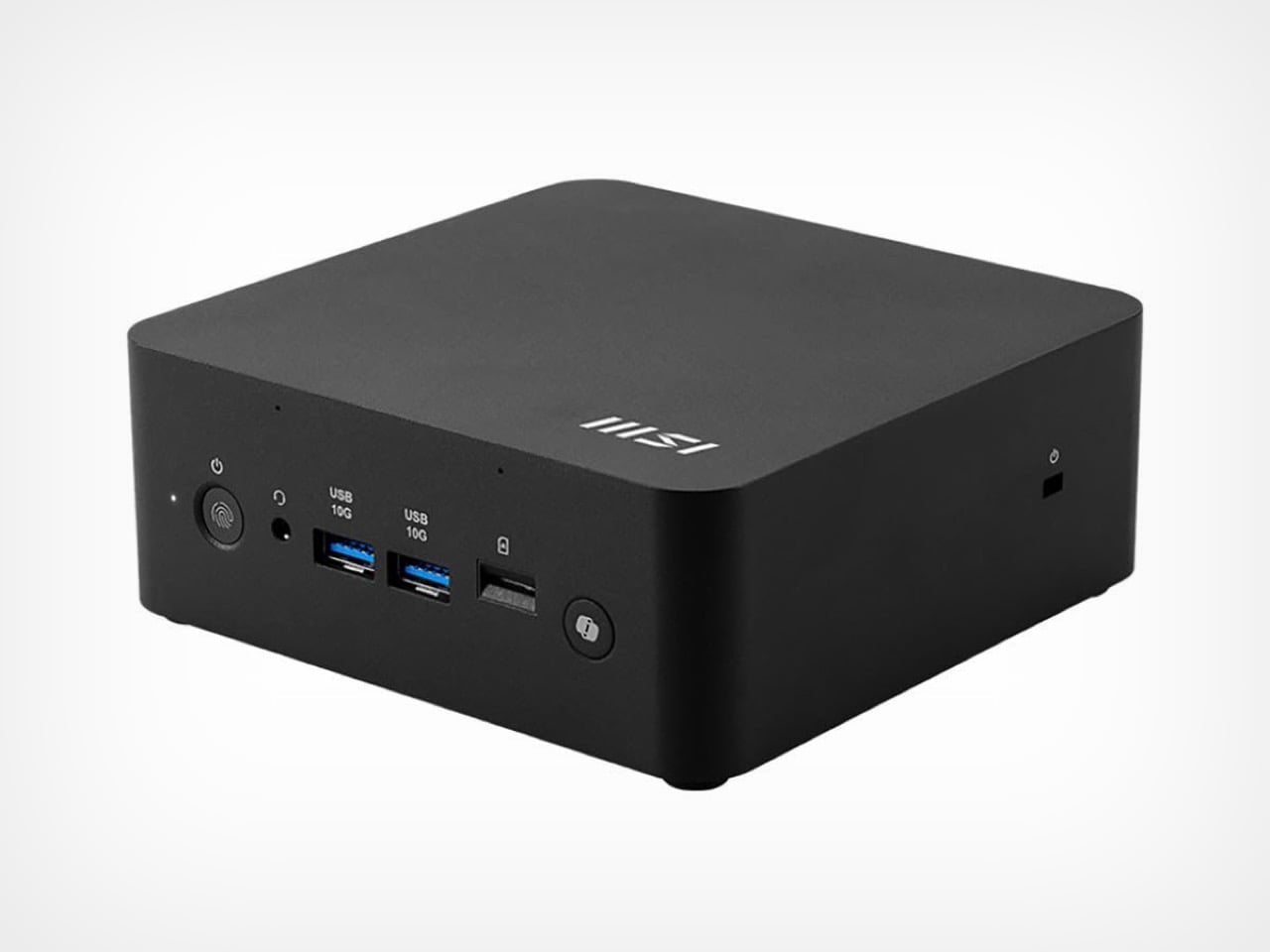
MSI has been building this box since 2015. The original Cubi arrived with a Broadwell chip, curved edges and a choice of black or white, nine years before Apple’s square settled into its current proportions. The current model is the Cubi NUC AI+ 3MG, announced at CES 2026 and shipping from May 1, measuring 119.6 by 115.2 by 37.5mm for a total volume of half a liter. That makes it smaller than the Mac mini on every single axis, which is an engineering result rather than a marketing one. Inside is an Intel Panther Lake chip up to the 16-core Core Ultra 9 386H, 32GB of DDR5, dual Thunderbolt 4, dual 2.5G LAN and Wi-Fi 7.
Matte black plastic and a fingerprint sensor set into the power button are the tells that this was drawn for an IT deployment rather than a display shelf, the finish flat and light-absorbing where anodized aluminum would catch an edge highlight. The compactness and the tool-free access to RAM and storage are the wins. The $1,999 price of a loaded configuration and the Xe3 integrated graphics are the limits, with barebones units starting at $569 for anyone supplying their own memory and storage. There is no USB-A connector anywhere on the rear panel, which anybody running a wired keyboard will notice on day one. MSI builds the chassis from post-consumer recycled plastics and ships it in FSC-certified packaging.
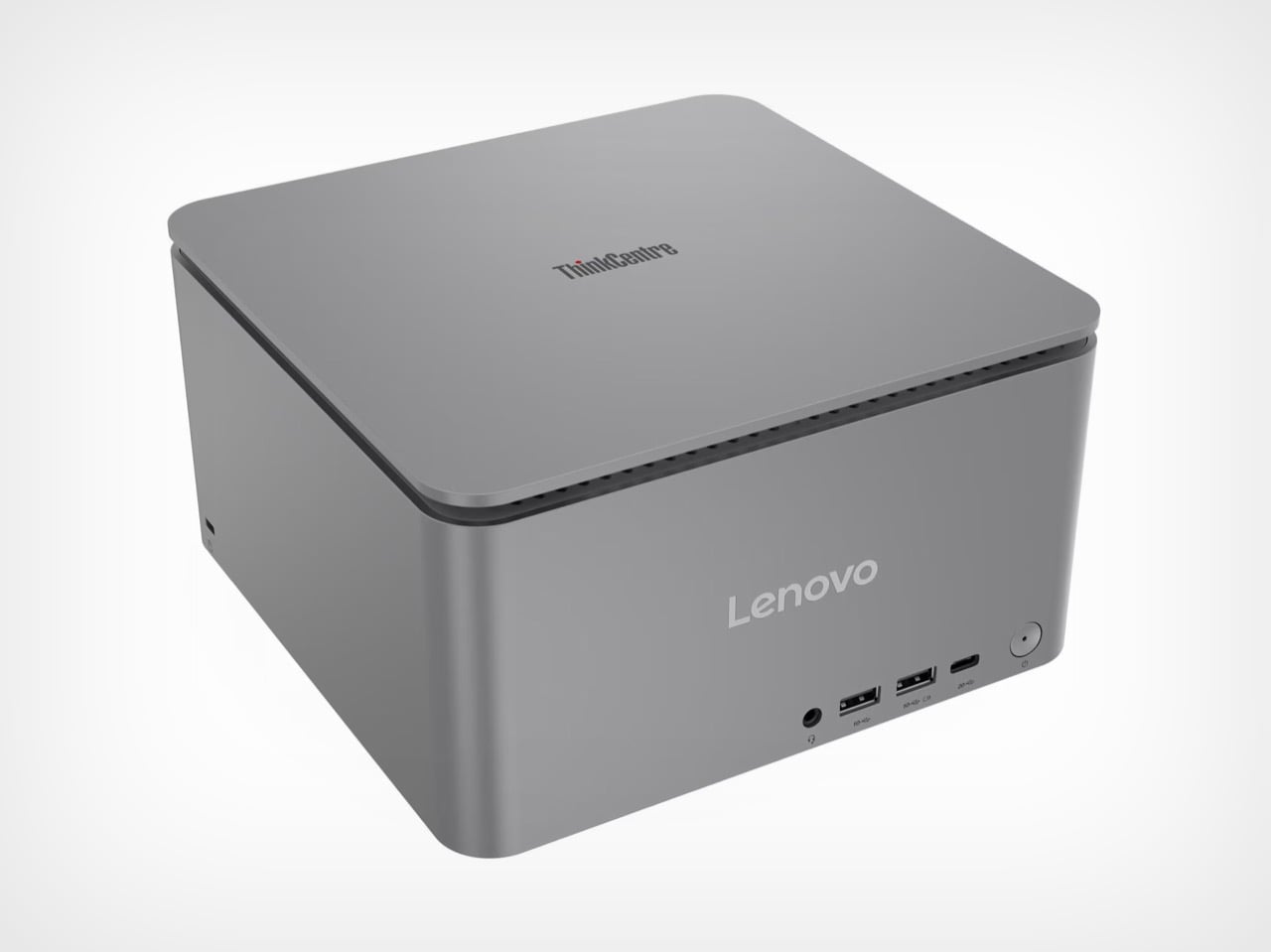
Lenovo aimed one product further up the Apple lineup here, because the ThinkCentre neo Ultra Gen 2 is chasing the Mac Studio, and the aim is uncomfortably good. It measures 195 by 191 by 108mm against the Mac Studio’s 197 by 197 by 95mm, landing within 6mm of Apple’s footprint on both axes and standing 13mm taller, which is roughly the height of a graphics card getting its own way. Inside that 3.6-liter box sits a full desktop GeForce RTX 5060 with 8GB of GDDR7, an Intel Core Ultra 9 285 vPro, 64GB of DDR5, three PCIe 4.0 M.2 slots and a 350W internal power supply rated at 92% efficiency. Thunderbolt 4 and HDMI 2.1 are both present. It weighs 8.2 pounds, or roughly five Mac minis.
Stuffing a desktop-class graphics card into Mac Studio proportions is the one thing Apple has never attempted, and it is the entire reason this machine exists. The chassis leaves room to swap the graphics card, the storage and the memory, making it the most serviceable object in this roundup by a distance, and the vents running down its flanks are doing considerably more visible work than Apple’s concealed underside intake. The costs are a 12-month warranty, no memory card reader of any kind, and pricing that has turned volatile, with one UK buyer paying £1,510 in late 2025 for a configuration listing above £3,400 by February. Configurations run from $1,919 to $2,409, which is Mac Studio money for Mac Studio dimensions. The square is the marketing; the RTX 5060 is the argument.
The post The Mac mini Form Factor is So Perfect, Literally Everyone is Copying It first appeared on Yanko Design.