The Clicks co-founder explains who its tiny Communicator phone is for

Clicks is an apologetically gadgety company, making gear that feels charmingly out-of-place in a world where almost every smartphone out there is an all-screen slab. That was obviously two years ago when the company first revealed its keyboard case that brought tactile typing to the iPhone and eventually other Android devices. Rather than that being a one-off curiosity, the company had two new announcements at CES 2026: a magnetic keyboard accessory that also doubles as a battery bank and small, squat mobile phone with a keyboard. And while there isn’t a working prototype of the Clicks Communicator available for the press to see, I got to check out the new Power Keyboard talk with Clicks co-founder and former BlackBerry marketing director Jeff Gadway about where he thinks his products fit into the smartphone world.

At first glance, the $79 Power Keyboard feels like a big improvement over the original Clicks Keyboard case. It magnetically attaches to any phone with Qi2 and connects over Bluetooth. The keyboard itself is similar to the original Clicks keyboard, but there’s a dedicated number row which is a nice improvement. But the thing that really caught my eye was its old-school slider form factor. When closed, the Power Keyboard sits on the back of your phone like a thick wireless battery pack — but it satisfyingly slides up to reveal the keyboard like the Palm Pre or BlackBerry Torch smartphones of old.
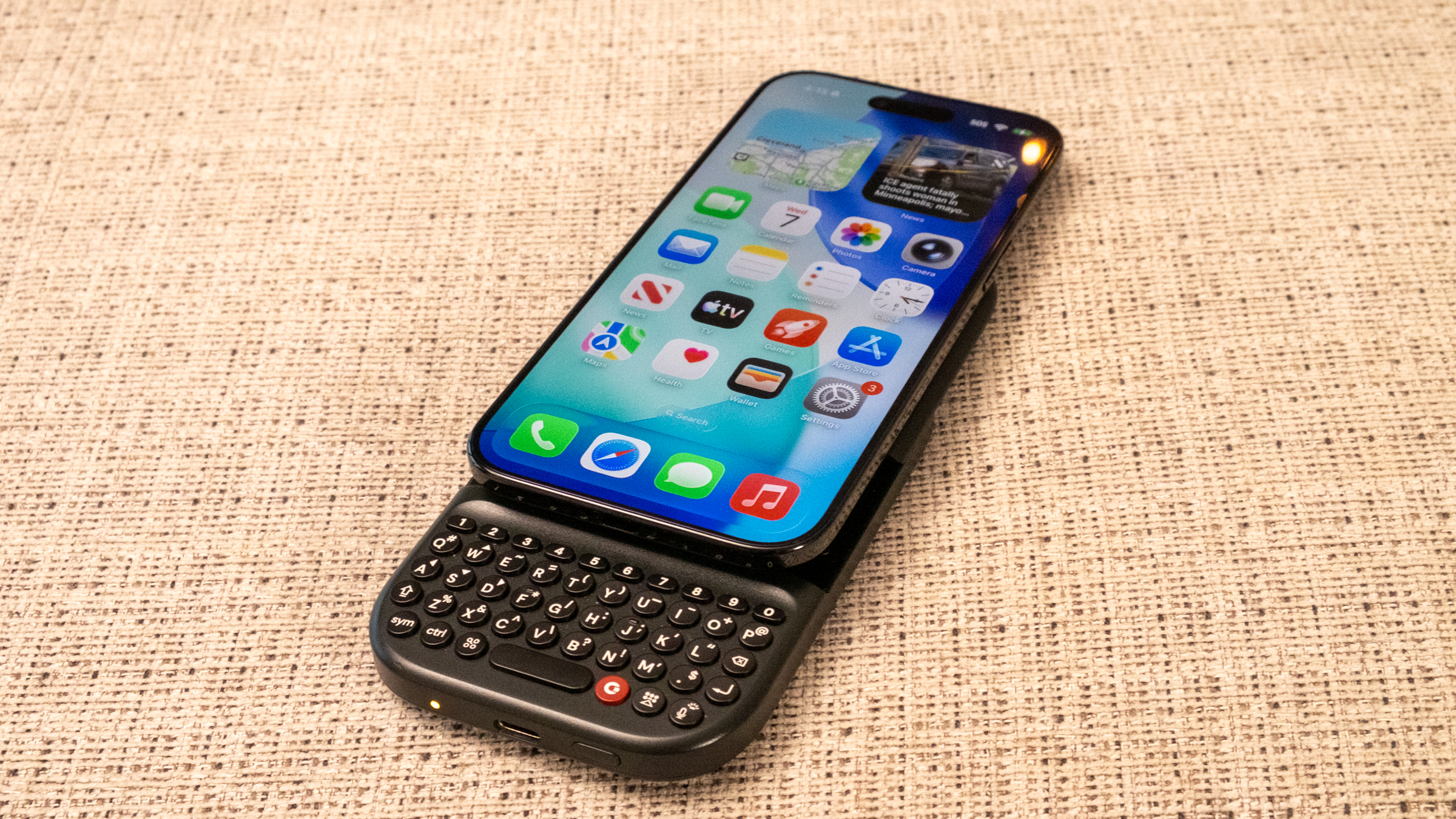
The magnetic, sliding Clicks Power Keyboard.
Nathan Ingraham for Engadget

The Power Keyboard’s last trick is that it can charge your phone up when attached. The battery itself isn’t huge, so you’re not going to fully recharge a modern smartphone. But it’s still a nice addition for if you need some power in a pinch. You can also set it up so it doesn’t charge your phone and instead uses all the battery to power the keyboard; in that situation, the keyboard will last weeks without a charge. Or you can designate a percentage that can only be used by the keyboard — for example, if the battery pack’s charge drops below 20 percent, it’ll stop charging your phone and instead save that power for the keyboard.
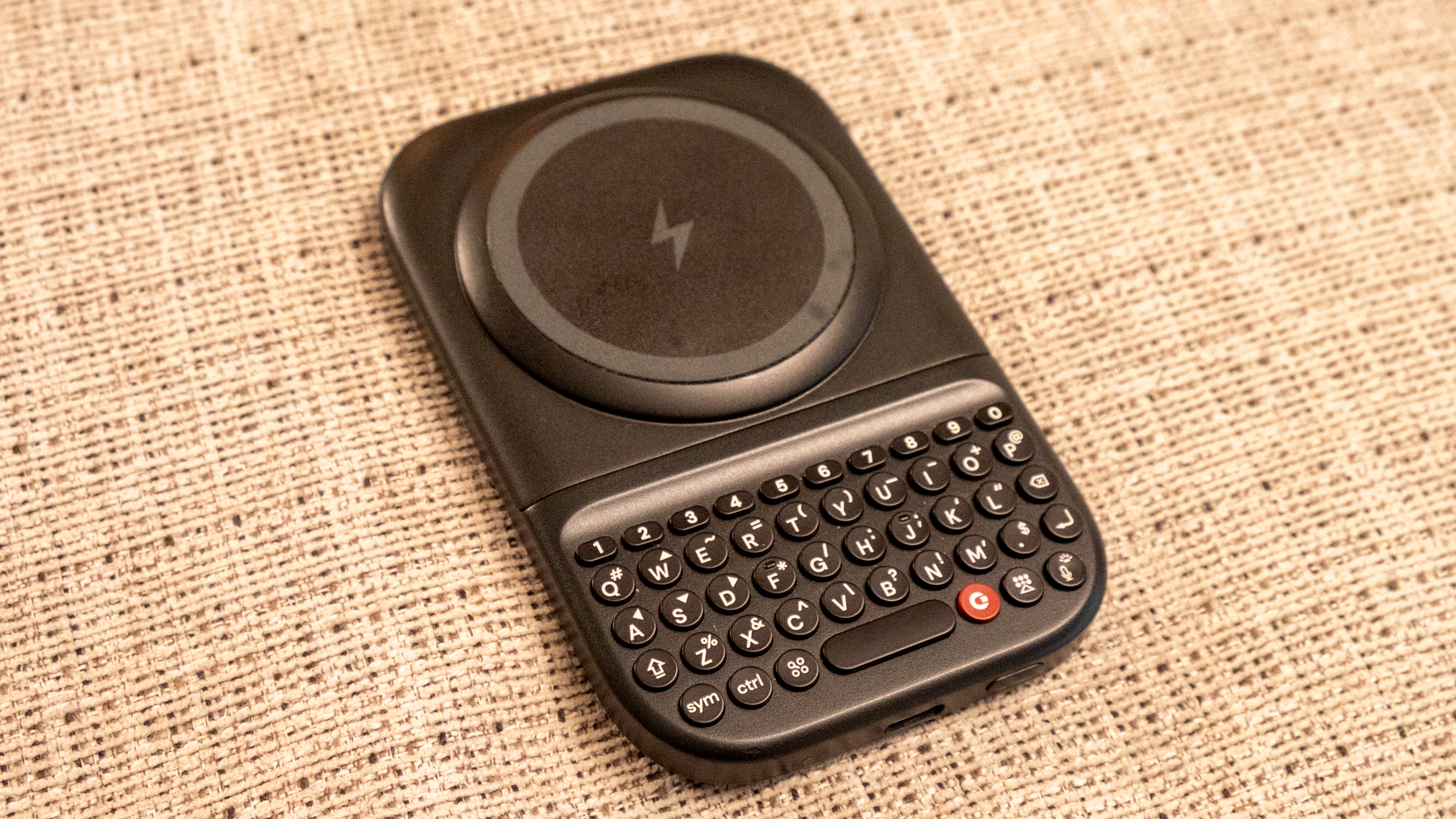
The Clicks Power Keyboard, without a phone attached.
Nathan Ingraham for Engadget

As someone who has never owned a smartphone with a keyboard, I can’t say how good the Clicks keyboard actually is — there would be a definite learning curve before I got comfortable with it. It certainly feels tiny to me, but if you just type on and trust autocorrect you should get the hang of it before too long. Whether the benefits of using a physical keyboard matter are up to you to decide. It’s nice seeing a bigger screen unobstructed by the virtual keyboard, but I feel far too set in my touchscreen ways to consider switching it up. But some people just loved their keyboards, and for them this gadget might hit the spot.

The Clicks Communicator is the more unexpected of the two new devices the comapny is working on, but without a working demo model I can’t render any judgement about how it will actually work. When it was announced, Clicks specifically said they were targeting people who used multiple devices, a demographic that I wasn’t fully convinced was large enough to justify the Communicator’s existence. But Gadway assured me the company had done plenty of research before moving into the hardware production phase.

“You've got people who are mandated to carry a second device for corporate deploy. Then you've got people who are small business owners and want to have a separate phone for their small business,” he said. “In markets like Europe, there's a requirement for employers to give people the option to have a separate device and create more separation. You've got travelers who want a second SIM, and then you've got this growing cohort of digital detox, digital minimalism, digital well-being people.” None of those segments might be huge on its own, but add it all up and the Clicks team felt like they had a decent opportunity.
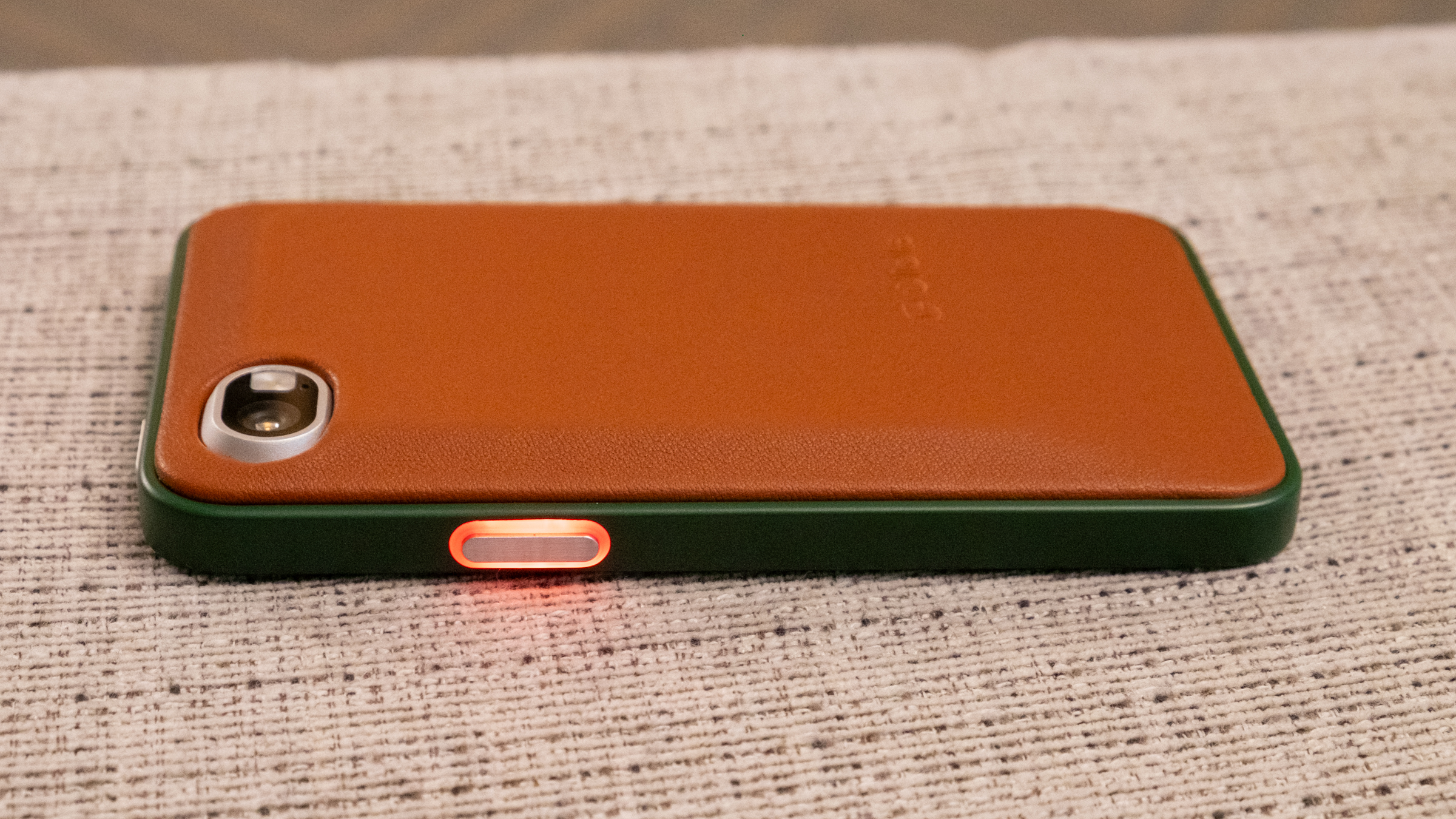
The Clicks Communicator has an LED Light on its side button that you can customize for different notifications.
Nathan Ingraham for Engadget

The other half of the thought process was making the Communicator different from an iPhone or Pixel — instead of having two essentially identical devices, Clicks wanted to make the Communicator with a distinct focus. “Our thought process was that complementary devices in tech are on the rise,’ Gadway said. “You wear an Oura Ring and you wear a smart watch; you carry an e-reader for reading and a tablet for content consumption. So why shouldn't your second phone be better at certain things than your first phone instead of just being a straight duplicate?”

That’s where the squarish, 4-inch touchscreen, keyboard and custom implementation of the Niagara Android launcher, which is a list-based UI rather than a grid of apps. The custom Clicks implementation of it focuses on your messaging apps and quickly triaging through new items (hence the Communicator name). The keyboard itself is touch sensitive and can be swiped across to navigate and take actions on what you see. But the Communicator is just an Android phone at heart which means you can install any apps that you find essential — though its form factor changes what it is best used for. “You can download whatever apps you want, but we've optimized it to be better at specific things,” Gadway said. “So, you know, do you want to watch letterboxed TikTok videos on this? Probably not. You could, but it's not the thing you're going to reach for to do that. But we're not going to give you a product that restricts what you can do.”

The good thing about being a smaller hardware maker is that Clicks doesn’t need to sell millions of these — they’re just interested in offering an alternative for people who might enjoy it, just as they’ve done with their keyboard accessories. Of course, the Communicator is a bigger investment; it’s up for pre-order now for $399 (that’s Pixel 9a territory, for comparison). Once it launches in the second half of the year, we’ll find out if it can find its audience.

This article originally appeared on Engadget at https://www.engadget.com/mobile/the-clicks-co-founder-explains-who-its-tiny-communicator-phone-is-for-170000501.html?src=rss

You can get a four-pack of Samsung SmartTag 2 trackers for just $45

Samsung SmartTag 2 trackers are back on sale if you're willing to pick up a bundle. Woot has a four-pack down to just $45, which undercuts the previous all-time low we’ve seen on Amazon ($55) by $10. That's a discount of 55 percent from the retail price of $100. It's a compelling opportunity to stock up if you're already in Samsung's ecosystem.

We named the SmartTag 2 the best Bluetooth tracker for Samsung devices. The companion SmartThings Find app is easy to use, showing locations on a Google Maps-based interface. Much like Apple's Find My network, the location of a SmartTag is pinpointed using nearby Samsung phones. While nothing can beat the sheer size of Apple's tracking infrastructure given the number of iPhones in the US, it still worked well in our tests.

The SmartTag 2's design is more practical than some competitors since the oblong fob has a built-in hole that lets you easily attach your keys without buying an extra accessory. It’s IP67 rated for water and dust resistance, and uses a replaceable battery that Samsung says offers about 16 months of juice. The volume on the tag is pretty loud and users can select from multiple ringtones. Additionally, a double-squeeze of the SmartTag 2 will ping your handset, something you can't do with an AirTag.

The tracking is not quite as precise as Apple's AirTag, but it's a solid option for Samsung users looking to keep track of their things and can be scooped up at a bargain price.

Follow @EngadgetDeals on X for the latest tech deals and buying advice.

This article originally appeared on Engadget at https://www.engadget.com/deals/you-can-get-a-four-pack-of-samsung-smarttag-2-trackers-for-just-45-173936230.html?src=rss

Motorola just announced a foldable phone to rival Samsung and Google at CES

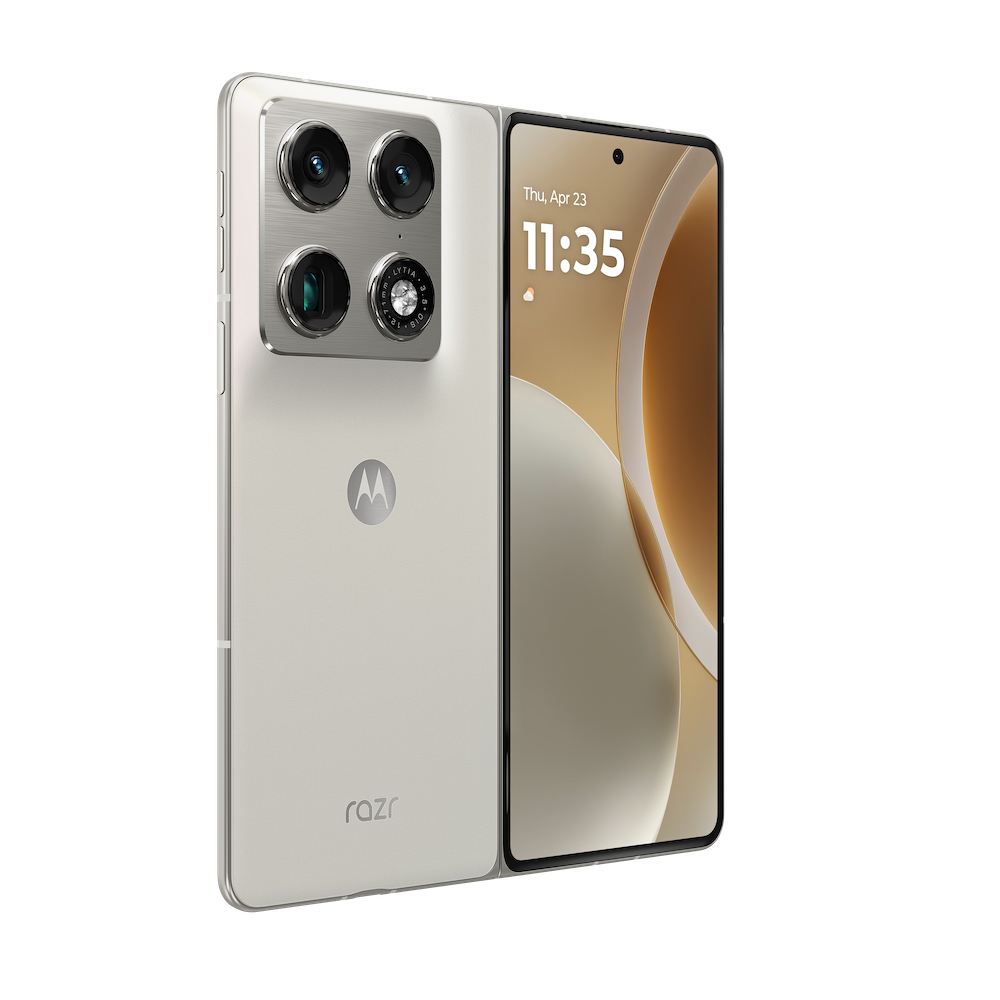
Samsung and Google have new competition in the foldable space. At CES 2026, Motorola unveiled its first side-foldable smartphone: the Razr Fold. The handheld sports an impressive 6.6-inch external screen and an 8.1-inch flexible main display. Motorola hasn’t provided dimensions yet, so we don’t know how thick it is yet or how it compares to other foldables in that respect.

We do know, however, that it'll include support for the Moto Pen Ultra stylus. This is actually a fairly big deal, as Samsung dropped the feature for the Z Fold 7. Modern foldables basically double as tablets, so a stylus is always appreciated.

A phone.
A phone.
Motorola

There's a robust camera system here, with a 50MP Sony sensor, a 50MP ultra-wide/macro, a 50MP telephoto, a 32MP external selfie lens and a 20MP internal camera. It also offers the ability to record in Dolby Vision.

The Razr Fold will be available in blue and white. We don't have any information regarding internal specs, pricing or availability. Motorola says that "more specifications will be shared in the coming months."

It's worth noting that while this is the company's first side-folding camera, Motorola has always made top-folding phones. After all, that's what a flip phone is. The company continues to refine this basic idea with its standard Razr line of midrange top-folding smartphones.

This article originally appeared on Engadget at https://www.engadget.com/mobile/smartphones/motorola-just-announced-a-foldable-phone-to-rival-samsung-and-google-at-ces-010015323.html?src=rss

Lenovo goes sci-fi with its wild XD Rollable Concept at CES 2026

Lenovo has experimented more with laptops featuring rollable displays than pretty much any other PC maker and at CES 2026 it’s keeping that trend going with the XD Rollable Concept.

Equipped with a 180-degree Gorilla Glass Victus 2 cover, the XD Rollable concept features a very futuristic design. However, underneath, it has the same basic engineering as last year’s ThinkBook Plus Gen 6. That means with the touch of a button, its 13.3-inch flexible OLED display can expand to 16 inches, which gives you around 50 percent extra screen space in just a few seconds. The main difference with Lenovo’s latest concept is that instead of hiding the unused section of its rollable display underneath its keyboard, the XD’s panel wraps up and over its lid to create a “world-facing” display around back. This allows people sitting on the other side of the laptop to see content, with the laptop capable of mirroring elements from its main display or using that space as a small secondary monitor. 

Now I will admit that after seeing the XD Rollable in person, its design does feel a bit gimmicky. Even though Lenovo’s space-themed animation that appears when the laptop’s display extends is pretty slick, I’m not sure how helpful that world-facing display really is. In normal use, you can’t even see it because it’s on the other side of the lid and while I suppose you could utilize that area for meetings or presentations, I think most people would be much better off simply connecting the notebook to a dedicated secondary monitor or projector. 

That said, I do like that contrary to the ThinkBook Plus Gen 6, by exposing the unused part of the XD Rollable’s display when it’s not extended, you get a little bit of extra value out of it. At the very least, it beats stashing the rest of the panel underneath the keyboard where it won’t be seen at all. On top of that, I like the look of having no bezel along the top of the display and you can even use touch controls on the edge of the display to control widgets or expand its flexible screen. Interestingly, the coolest part about the XD Rollable might not even be its screen, but the motors and rails that Lenovo uses to extend its display, which are easily seen beneath its glass design.

Meanwhile, the rest of the XD Rollable is very down to earth with it featuring a comfy keyboard and a decent-sized touchpad. The main downsides are that its glass lid makes the concept a bit heavier than a more traditional 13-inch notebook and you only get two USB-C ports. But considering that Lenovo isn’t planning to put this thing into production, that lack of connectivity or info regarding its specs shouldn’t come as a big surprise.


This article originally appeared on Engadget at https://www.engadget.com/computing/laptops/lenovo-goes-sci-fi-with-its-wild-xd-rollable-concept-at-ces-2026-010000817.html?src=rss

Motorola expands its Moto Things lineup with a new Bluetooth tracker, stylus and smartwatch

After kicking off its Moto Things accessory line with wireless earbuds, a Bluetooth tracker and a cheap smartwatch in 2024, Motorola is doubling down. At CES 2026, the company is announcing a sequel to its tracker, the Moto Tag 2, a stylus for its new folding phone, the Moto Pen Ultra and a more premium smartwatch called the Moto Watch.

The Moto Watch has a 47mm round face with a stainless steel crown and an aluminum frame. The smartwatch comes with a PANTONE "Volcanic Ash" silicone band, but is designed to support third-party 22mm bands, too, which greatly expands its customization options. Motorola says the watch can get up to 13 days of battery life normally or seven days with its always-on display enabled, and also features a built-in speaker and microphone for hands-free controls and audio notifications. The Moto Watch is meant to be fairly durable, as well, with Gorilla Glass 3 front glass and IP68 water and dust resistance.

The actual fitness features of the watch are powered by Motorola's new partner Polar, a company with its own line of fitness trackers and smartwatches. The Moto Watch lets users log their calorie consumption throughout the day, track their workouts and activity levels (with a daily Activity Goal and Activity Score) and monitor their sleep. The watch also has built-in dual-frequency GPS for tracking runs, bike rides and hikes.

A hand holding a Moto Pen Ultra writing on a Razr Fold.
Motorola

While Samsung dropped S Pen stylus support on its latest version of the Galaxy Z Fold 7 (one of many ways the company got the foldable so thin), Motorola is embracing styluses on its new Razr Fold. The Moto Pen Ultra comes with a charging case and supports things like palm rejection and tilt sensitivity for more accurate strokes. The Moto Pen Ultra can also be used with Google's Circle to Search and new AI-powered software features like "Sketch to Image," which converts hand-drawn sketches into detailed images.

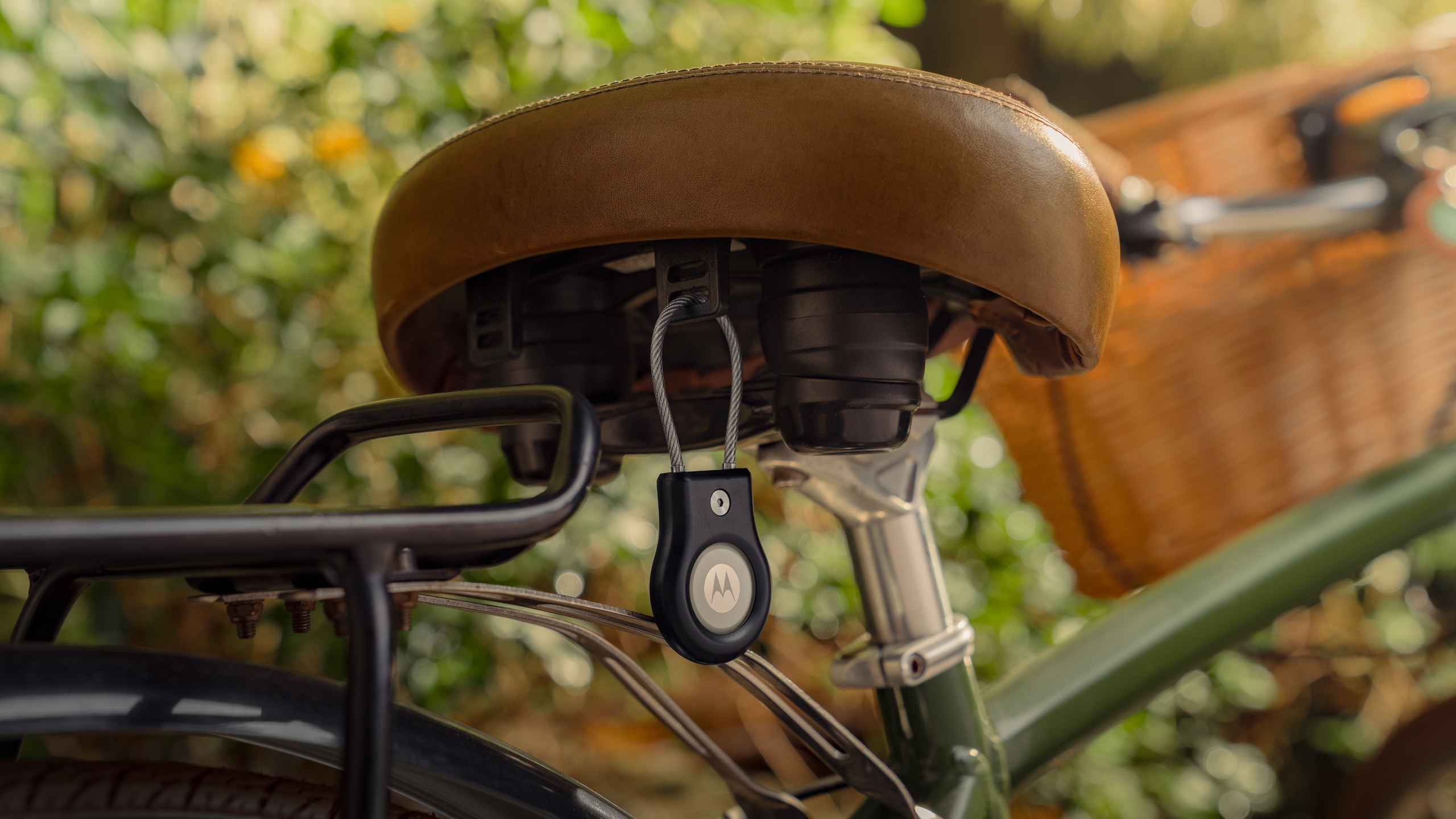
A bike seat with a Moto Tag 2 attached to it.
Motorola

The Moto Tag 2 builds on the original Moto Tag with a longer battery life and better durability. The Moto Tag 2 is IP68-rated and now gets over 500 days of battery life in comparison to the original Tag's year-long battery. As before, the Bluetooth tracker connects to Google's Find Hub network and Motorola says the tracker's ultra-wideband (UWB) antenna and support for Bluetooth Channel Sounding can help users determine the exact distance they are from their tracked object. You can also press the button on the Moto Tag 2 to ring your phone if it's missing, or customize the Tag to act as a camera shutter button.

Motorola hasn't shared pricing details for any of its new Moto Things accessories, though it has provided a release date for at least one. The Moto Watch will be available on January 22 from the company's website. The Moto Tag 2 and Moto Pen Ultra, meanwhile, will both be available in North America "in the coming months."

This article originally appeared on Engadget at https://www.engadget.com/mobile/smartphones/motorola-expands-its-moto-things-lineup-with-a-new-bluetooth-tracker-stylus-and-smartwatch-010000669.html?src=rss

Another look at OhSnap’s MCON, a magnetic game controller for your phone

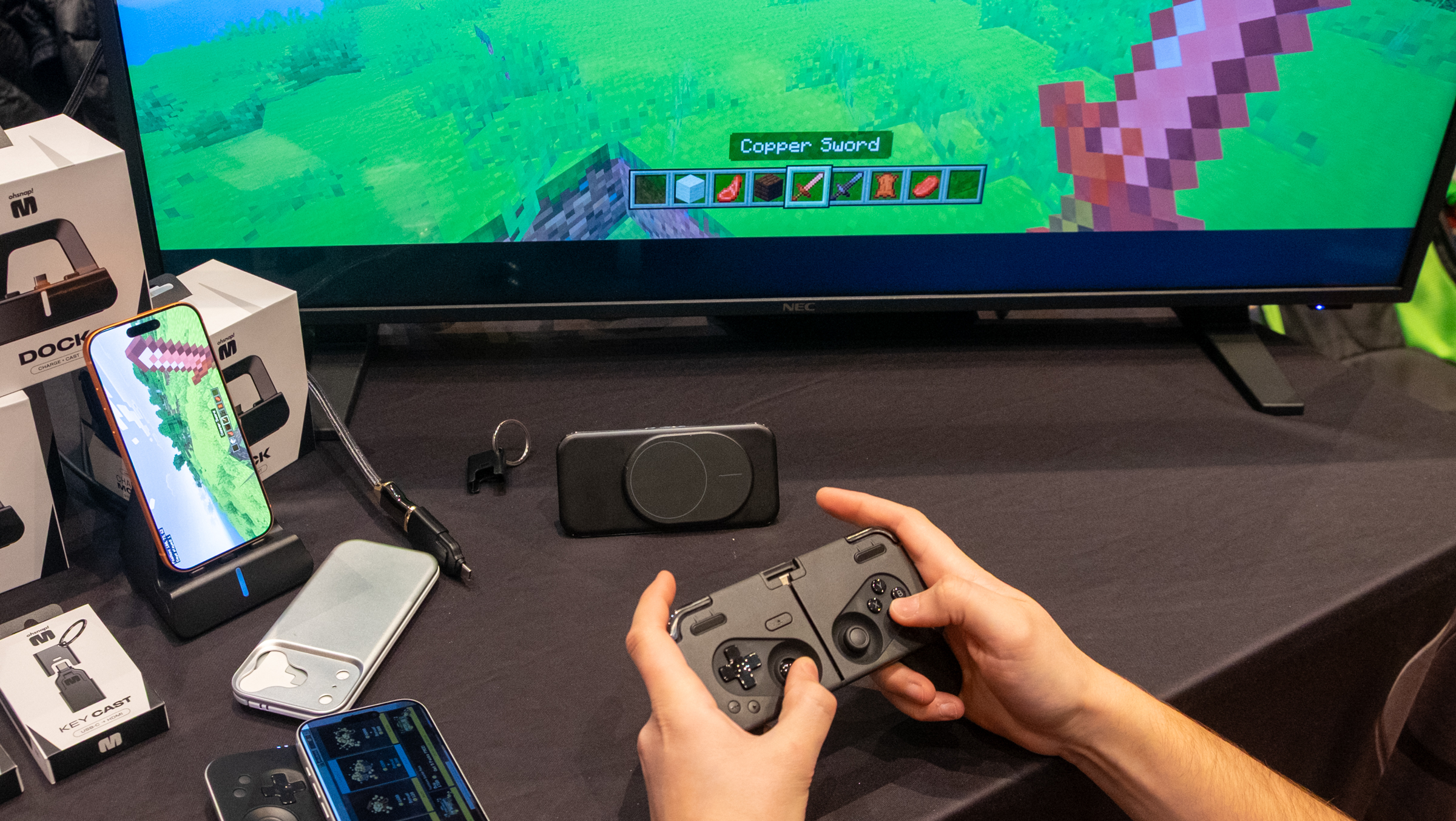
OhSnap won our hearts (and a best of CES award) last year with the MCON, its tiny Bluetooth game pad that magnetically connects to your phone. At the time, we tried a pre-production unit, but in the year since the MCON has been finalized and went on sale last month. I just got a chance to try the final version here at CES, and just a quick demo was enough to convince me that OhSnap has made some solid refinements over the last year.

Just as we saw last year, the MCON attaches magnetically to an iPhone or any compatible Android phone (the company also includes a magnetic ring in the box for Androids that don’t have Qi2 yet). It has the full array of controls, including four face buttons, a D-pad, two joysticks and index finger buttons and full bumpers. It’s just sleeker and feels more solid than last year’s prototype, and while mounting your makes it feel a bit top-heavy, it’s not awkward enough to cause real issues when playuing (at least that’s how I felt after my brief demo).

The controller also has grips that unfold to help balance things, and the plate that attaches your phone to the controller has a kickstand. So if you want to drop your phone down on a tray table on a plane and play just holding the controller, feel free. All in all, the MCON feels like a flexible and high-quality device that’s probably worth the $150 OhSnap asks for it.

The MCON dock connects your phone to your TV for full-screen gameplay.
Nathan Ingraham for Engadget

The company also has some new accessories to show off. There’s a $70 TV dock that powers your phone and outputs video from USB-C to HDMI. You could use this dock with any Bluetooth controller hooked up to your mobile phone, not just the MCON. There’s also a tiny $30 adapter you can put on your keychain that has a USB-C plug that goes into your phone; plug an HDMI cable into the other end and you can broadcast your games to a TV anywhere you go and play them with a controller.

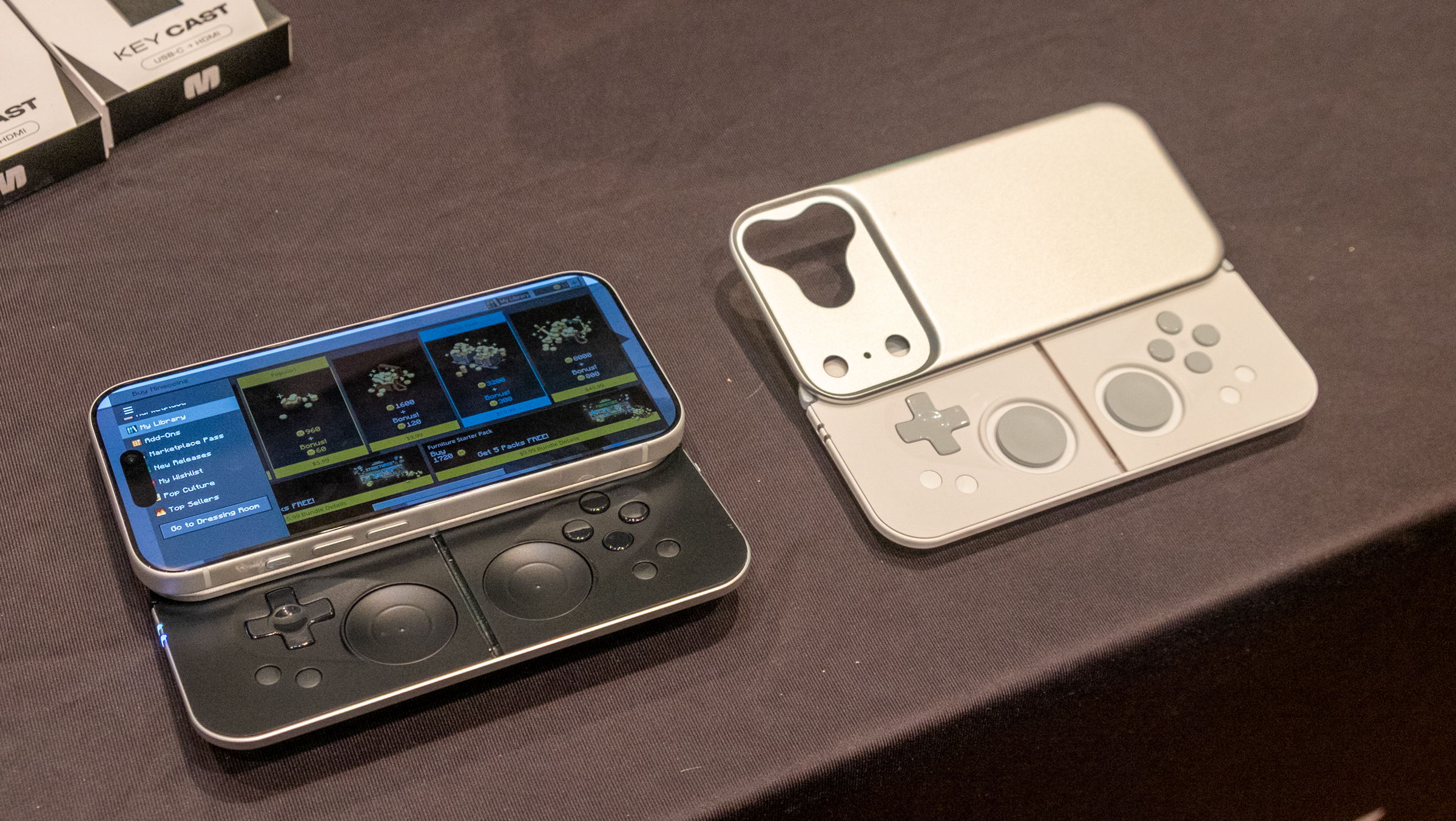
It’s a pretty clever and comprehensive set of products, and while there are tons of mobile game controllers, the OhSnap feels like one of the more portable and sleek options out there. OhSnap is working on something even slimmer, though. The company showed off two new prototype controllers, the MCON Lite and MCON Slim.

OhSnap is working on two new MCON controller that are more compact than the original.
Nathan Ingraham for Engadget

As the names suggest, they’re both more compact than the original model. The Lite uses concave joypads rather than full sticks, and the Slim makes things even smaller by using concave touch pads. Your’e not going to get quite the same quality experience with those as you would with the bigger version, but they are noticeably thinner; OhSnap says they’ll be cheaper, too. The MCON Lite is scheduled to arrive this summer, while the Slim should launch in the fall (around the same time as the iPhone 18).

This article originally appeared on Engadget at https://www.engadget.com/gaming/another-look-at-ohsnaps-mcon-a-magnetic-game-controller-for-your-phone-042424092.html?src=rss

Anker unveils a new lineup of chargers, docks and accessories at CES 2026

Anker dove into CES 2026 with a slew of announcements that bring new chargers and accessories under its umbrella. The new accessories include improved visual interfaces, faster Qi2 wireless charging and “upgraded ecosystems” that support the latest iPhones. Some of the latest devices are even available to buy right now.

First up is the Anker Nano Charger with smart display, which features a tiny screen, 180-degree foldable prongs and provides up to 45W of power. The plug can identify the exact iPhone model connected and then deliver the right amount of power for your phone. Anker says the Nano uses three-stage power delivery and a "Care Mode" that the company claims keeps batteries cooler than some competing 45W chargers. It arrives in late January 2026 and will retail for $40.

For fans of wireless charging stations, the Anker Prime Wireless Charging Station offers a 3-in-1 solution for iPhone, Apple Watch and AirPods. It uses a "AirCool" system for "faster, safer performance" and offers up to 25W of Qi2 wireless power. The design is also foldable for compact travel. It's set for release in Q1 2026 and will retail for $150.

The company debuted a clamp-on 10-in-1 Nano Power Strip with 70W of output and built-in surge protection. It sports two USB-C ports, two USB-A ports and six AC outlets. The Nano Power Strip is getting a late January release, and it will sell for $70.

Anker also unveiled a 13-in-1 Nano Docking Station. This serves as an all-in-one hub with support for up to three displays (with 4K resolution supported on a single display), up to 100W of upstream charging and 10 Gbps of data transfer between connected devices. It also features a removable 6-in-1 hub with SD and microSD card readers, a USB-A port and a 5 Gbps USB-C port. The Nano Docking Station is available now and retails for $150.

This article originally appeared on Engadget at https://www.engadget.com/computing/accessories/anker-unveils-a-new-lineup-of-chargers-docks-and-accessories-at-ces-2026-160021025.html?src=rss

The Apple Watch Series 11 is on sale for a record-low price

The Apple Watch Series 11 is on sale for the lowest price we've ever seen. You can pick up the smartwatch for $299, which is 25 percent off its regular price, a discount of $100. Discounts tend to increase as we get closer to September, when the next generation of Apple Watch is typically announced.

The Series 11 is our best overall smartwatch pick, and we gave it a score of 90 out of 100 in our hands-on review. We were impressed with the battery life, which lasted longer than the 24 hours it's rated for in our testing. We also liked how lightweight and thin the watch is. The 9.7mm thick case on the Series 11 ties the Series 10 for the thinnest Apple Watch so far.

Fitness and health tracking are the main appeals of an Apple Watch, and the Series 11 introduces sleep tracking and hypertension notifications. The sleep tracking was comfortable thanks to the watch's small form factor. The watch also added a new wrist flick gesture that lets you dismiss notifications, end calls and silence alarms or timers.

The GPS + cellular model of the Series 11 is also $100 off, and it's the first Apple Watch to support 5G networks. It's not too often you see an Apple product for 25 percent off its retail price, so if you were in the market for a smart watch, and especially if you are an iPhone user, it's worth checking out.

Follow @EngadgetDeals on X for the latest tech deals and buying advice.

This article originally appeared on Engadget at https://www.engadget.com/deals/the-apple-watch-series-11-is-on-sale-for-a-record-low-price-154609244.html?src=rss

Apple’s latest 25W MagSafe charger is on sale for $30

If you want a wireless charger for your iPhone and prefer to stick with Apple, Amazon has a sale that may pique your interest. The retailer is selling the one meter Apple Magsafe charger for $30, saving you $10 off the regular price, while also selling the two meter model for $40 ($10 off).

If you have an iPhone 16, iPhone 17 or iPhone Air, this cable can charge your device at 25W as long as it's connected to a 30W power adapter on the other end. While you'll need a more recent iPhone to get the fastest MagSafe charging speeds, the charger can wirelessly top up the battery of any iPhone from the last eight years (iPhone 8 and later). With older iPhones, the charging speed tops out at 15W. The cable works with AirPods wireless charging cases too — it's certified for Qi2.2 and Qi charging.

The MagSafe charger is one of our favorite iPhone accessories, and would pair quite nicely with your new iPhone if you're picking up one of the latest models. If you're on the fence about that, be sure to check out our reviews of the iPhone 17, iPhone Pro/Pro Max and iPhone Air.

Follow @EngadgetDeals on X for the latest tech deals and buying advice.

This article originally appeared on Engadget at https://www.engadget.com/deals/apples-latest-25w-magsafe-charger-is-on-sale-for-30-141707297.html?src=rss

8BitDo is unveiling a new mobile gaming pad at CES

Gaming peripheral company 8BitDo is teasing a new smartphone gaming pad that seems aimed exclusively at portrait-mode gamers. In a post on X, the company says the 8BitDo FlipPad will debut in the summer of 2026 and will be compatible with iOS and Android devices. It also mentions the peripheral is "officially supported by Apple."

The post doesn't give too much away, as the company will be premiering the FlipPad at CES this week. A short, rendered video shows that the mobile gaming peripheral connects via USB-C, and then flips upward on a hinge to lay flat against the bottom portion of a user's phone screen. In the rendering, we can see a directional pad, purple ABXY buttons, select, start buttons and six more unlabeled buttons.

8BitDo makes a lot of gaming controllers, including retro-inspired ones like the NES40 collection celebrating the 40 year anniversary of Nintendo's NES. The company also makes arcade controllers, a "Pro" controller compatible with Switch, PC, SteamOS, Apple and Android devices, and many others.

This article originally appeared on Engadget at https://www.engadget.com/gaming/8bitdo-is-unveiling-a-new-mobile-gaming-pad-at-ces-134555603.html?src=rss