Most people don’t carry a flashlight, which is something they only realize when they’re already crammed under a sink, squinting at a fuse box, or trying to read a label in a poorly lit corner of a garage. Cylindrical lights are bulky, they roll off surfaces, and they feel overbuilt for the kind of everyday moments where you just need a quick, reliable beam. So they get left at home, and your phone flashlight ends up doing all the work.
The Wedge SL is a USB-C rechargeable inspection light with a sleek, modern design built to actually stay in a pocket. The ultra-thin unibody construction puts the dimensions closer to a pen than a flashlight, 5.65 inches long, 0.28 inches thick, and about 1.14 oz light, which means it doesn’t fight for space with keys and a wallet. A stainless steel injection-molded pocket clip also lets it ride on a shirt pocket or tool pouch without bouncing around.
One-handed operation was clearly part of the brief. The tail switch handles momentary or constant-on use, so one hand can hold a panel, a wire bundle, or an awkward hatch while the other hand aims the light exactly where it needs to go. TEN-TAP programmable switch lets users choose whether constant-on defaults to High or Low intensity, which means the light can match your habits rather than forcing you to cycle through modes every time you switch on.
For an inspection light, the available modes are spot on, pardon the pun. Constant-on High runs at 100 lumens for 1.75 hours, Low drops to 50 lumens for 3.5 hours, and THRO (Temporarily Heightened Regulated Output) mode pushes 500 lumens with an 80m beam when you need maximum brightness fast. THRO is activated by a 3-second press, which keeps it from firing accidentally during sustained work while still making it quick to trigger when a tight space needs a real burst of light.
The battery side holds up well. USB-C charging and a four-level LED battery status indicator with charge alerts mean you always know roughly how much is left, without deciphering blink codes. A full charge takes about four hours. The field serviceable, user-replaceable lithium polymer battery is also worth calling out, since many rechargeable lights eventually become e-waste once the cell degrades inside a sealed body.
Durability gets the same careful treatment, as the extruded aluminum alloy case comes with a Type II MIL-Spec anodized finish. The lens is also unbreakable acrylic, and the light is IPX4-rated with 1m impact resistance testing. A bite boot is also included, which lets you grip it with your teeth during two-handed work without scratching the finish or the inside of your mouth.
The Streamlight Wedge SL earns pocket space by being thin, predictable, and quick to operate instead of trying to be a tactical statement piece. A flashlight that’s actually on you is always going to matter more than one that performs better on a spec sheet but gets left on the workbench because it’s too big to bother carrying every day.
Valentine’s Day has passed, the chocolates are gone, and the roses have wilted. Now comes the best part: treating yourself to something that actually lasts. EDC gear represents the perfect post-holiday indulgence, offering daily utility wrapped in exceptional design. These aren’t fleeting romantic gestures but permanent companions that earn their place in your pocket every single day.
The beauty of everyday carry items lies in their silent reliability. They don’t demand attention until the moment you need them, then deliver with satisfying precision. From titanium blades that disappear into your keychain to coffee grinders built like mountaineering equipment, these seven designs prove that the best gifts are the ones you use constantly. They blend form and function so seamlessly that reaching for them becomes second nature, elevating ordinary moments into small victories of preparedness.
1. ScytheBlade: Titanium Mini Knife with Maximum Impact
The ScytheBlade takes inspiration from the most iconic blade profile in mythology and shrinks it down to EDC proportions. That distinctive curved design mirrors the Grim Reaper’s scythe, creating a blade shape that resembles a tiger claw when scaled to pocket size. The comparison isn’t just aesthetic; curved blades generate cutting power that straight edges can’t match. Wrapped in a robust titanium body, this tiny folder delivers cutting performance that makes you forget its diminutive dimensions. The design speaks to anyone who appreciates tools that punch above their weight class.
At 46mm when deployed, the ScytheBlade ranks among the smallest folding knives available, yet durability remains uncompromised. The titanium construction provides exceptional strength while keeping weight at just 8 grams, making it virtually unnoticeable on your keychain until duty calls. Titanium brings natural corrosion resistance and that satisfying heft that cheaper metals can’t replicate. Forget constant maintenance; this blade survives daily carry without demanding your attention. The engineering focuses entirely on reliability, creating a tool that disappears into your routine while remaining ready for anything.
What We Like
The curved blade profile generates superior cutting leverage compared to straight designs.
Titanium construction eliminates corrosion worries while maintaining incredible strength.
At 8 grams, you’ll forget you’re carrying it until you actually need a blade.
The 46mm length strikes the perfect balance between capability and true pocket-friendly dimensions.
What We Dislike
The ultra-compact size may prove challenging for users with larger hands during extended cutting tasks.
Limited blade length restricts applications compared to full-sized folders.
This tactical flashlight rejects mediocrity at first glance. BlackoutBeam pairs a devastating 2300-lumen output with industrial design language that looks equally appropriate clipped to tactical gear or resting on a minimalist desk. The 0.2-second response time eliminates the frustrating delay that plagues lesser lights, delivering illumination the instant your thumb finds the switch. Waterproof aluminum construction handles weather, impacts, and the chaotic reality of everyday carry without complaint. Whether you’re building an emergency kit or just want reliable light on demand, BlackoutBeam delivers without looking like you raided a military surplus store.
That 2300-lumen maximum throws light 300 meters, cutting through darkness with clinical efficiency. Need to illuminate a trail, light up a room during a power failure, or check suspicious sounds outside? The beam reaches exactly where you need it. Instant-on performance means no warm-up lag, making it ideal for situations where hesitation isn’t an option. The IP68 rating ensures water and dust stay outside where they belong, even during submersion. Durable aluminum construction shrugs off drops and rough handling while maintaining a profile that doesn’t add bulk to your bag. This represents serious capability without the weight penalty.
The 2300-lumen output with 300-meter throw provides professional-grade illumination when needed.
Instant 0.2-second response time eliminates delays during emergencies or urgent situations.
IP68 waterproof rating handles submersion and harsh weather without failure.
Industrial aluminum construction balances serious durability with reasonable weight and size.
What We Dislike
Maximum brightness drains batteries quickly during extended use.
The tactical aesthetic may feel too aggressive for users seeking more subtle EDC options.
3. Smith Blade: 21 Tools in Titanium Package
The Smith Blade represents the evolution of pocket multi-tools beyond the bulky designs that dominated previous generations. Twenty-one genuinely useful functions are packed into a frame weighing just 95 grams, making it lighter than the aging competitors it replaces. Modern materials drive this transformation: Ti-6Al-4V titanium alloys and M390 blade steel deliver professional performance in a slimmer profile. This tool speaks to makers, parents, and anyone expected to solve problems on the spot. Household repairs, camping trips, impromptu fixes when nobody else has the right tool—the Smith Blade handles them all.
The engineering focuses on real-world utility instead of feature bloat. You get tools that actually matter: drivers, pliers, blades, and openers rather than gadgets nobody uses. The design acknowledges that modern problems require modern solutions, whether you’re playing family IT support, swapping light switches, or handling trail repairs miles from civilization. At 95 grams, it carries easier than traditional multi-tools while delivering comparable capability. The titanium and M390 steel construction ensures it survives years of use without the corrosion or blade degradation that plagues cheaper options. This represents thoughtful engineering for people who actually use their tools daily.
What We Like
Twenty-one functional tools cover most situations without forcing compromises or dead weight.
Modern titanium and M390 steel construction outlasts traditional materials while weighing significantly less.
The 95-gram weight makes it genuinely pocketable for all-day carry.
Sleeker profile compared to legacy multi-tools fits modern EDC preferences better.
What We Dislike
The learning curve for accessing all 21 tools may frustrate users during the initial weeks.
Price point sits higher than basic multi-tools, though materials justify the investment.
4. VSSL Java G25: The Coffee Grinder Built for Adventures
The VSSL Java G25 transforms coffee grinding from tedious necessity into a tactile ritual. This manual grinder brings VSSL’s survival equipment philosophy to your morning routine, applying the same obsessive engineering that makes their gear kits nearly indestructible. Utility never compromises aesthetics here; the G25 looks like high-end outdoor equipment because it essentially is. Constructed from 6061 machined aircraft-grade aluminum and 304 food-grade stainless steel, this grinder handles abuse, whether it’s sitting on granite countertops or actual granite mountainsides. The sleek black cylindrical form factor radiates a modern gear aesthetic while remaining compact and ergonomic.
The grinding experience elevates beyond basic function into something genuinely enjoyable. Many grinders overwhelm users with complicated dials and fifty different settings that require engineering degrees to understand. The G25 makes the learning curve feel like part of the adventure, a welcome challenge rather than a frustrating obstacle. The manual operation provides satisfying tactile feedback, connecting you directly to the process in ways electric grinders never achieve. Built to withstand serious use, the materials ensure it survives camping trips, road adventures, and daily kitchen duty without degradation. This represents gear you want to display, a piece that sparks conversations and makes you actually look forward to grinding beans.
What We Like
Aircraft-grade aluminum and stainless steel construction survives both outdoor adventures and kitchen use.
The manual operation creates an engaging, tactile ritual that improves the coffee experience.
Sleek cylindrical design looks equally at home on countertops or clipped to backpacks.
Simplified approach to grind settings makes the learning curve enjoyable rather than frustrating.
What We Dislike
Manual grinding requires more time and effort compared to electric alternatives.
The premium materials and construction command a higher price than basic grinders.
5. Gerber Shard: Elegant Restraint in Keychain Form
Sometimes the best design eliminates everything except what matters. The Gerber Shard proves this philosophy by integrating seven essential functions into a keychain-friendly package that prioritizes airline safety and everyday utility over feature bloat. Titanium nitride coating provides serious corrosion resistance while maintaining a professional appearance that works anywhere, from corporate offices to construction sites. This tool succeeds through disciplined focus on tasks you actually encounter daily rather than hypothetical situations that never materialize.
The Shard dedicates engineering attention to pry bars, flathead drivers, and bottle openers—the tools that prove useful constantly. Unnecessary features are eliminated, creating a tool that feels substantial despite compact dimensions. The design recognizes that most EDC challenges don’t require twenty functions; they require the right five or six executed flawlessly. Airline-safe construction ensures it travels with you anywhere without triggering security concerns. Gerber backs this fundamental engineering with a limited lifetime warranty, signaling genuine confidence in durability. The result is a keychain tool that disappears until needed, then delivers exactly what the situation demands without fumbling through features you don’t need.
Titanium nitride coating resists corrosion while maintaining a professional appearance across environments.
Airline-safe construction allows travel without security complications.
A limited lifetime warranty demonstrates the manufacturer’s confidence in engineering quality.
What We Dislike
A limited function count may leave users wanting more capability in certain situations.
The compact size, while keychain-friendly, reduces leverage for demanding pry or driver applications.
6. 8-in-1 EDC Scissors: Toolbox in Your Palm
Who decided multi-functional tools need bulk to deliver utility? These 8-in-1 scissors demolish that assumption by fitting an entire toolbox into something that rests comfortably in your palm. The simple yet handsome design integrates scissors, a knife, a lid opener, a can opener, a cap opener, a bottle opener, a shell splitter, and a degasser into a compact 13cm package. Innovation here comes through thoughtful integration rather than complicated mechanisms. The oxidation film treatment adds rust resistance while creating that distinctive black finish that elevates the aesthetic beyond basic utility gear.
The palm-sized dimensions mean you actually carry it rather than leaving it in a drawer because it’s too large. Traditional multi-tools fail when they’re inconvenient to transport; capability means nothing if the tool stays home. At roughly five inches, these scissors slip into pockets, bags, or glove compartments without creating bulk or weight penalties. The eight integrated functions cover most daily scenarios without forcing you to carry dedicated tools for each task. Opening packages, bottles, cans, or handling food prep becomes possible anywhere. The design acknowledges that modern life requires adaptability, delivering solutions that match our mobile, unpredictable routines rather than expecting us to plan every scenario.
Eight integrated functions eliminate the need for multiple dedicated tools in daily carry.
Compact 13cm design actually fits in pockets without creating uncomfortable bulk.
Oxidation film treatment prevents rust while adding an attractive black finish.
Palm-sized proportions ensure you’ll actually carry it instead of leaving it at home.
What We Dislike
Individual functions may not match the performance of dedicated single-purpose tools.
The scissors mechanism requires regular cleaning to maintain smooth operation.
7. Audacious Concept x URBAN Tool XS: Art Meets Function
The Audacious Concept x URBAN Tool XS with Chaos Seigaiha pattern represents what happens when two companies obsessed with quality and innovation collaborate. This limited-edition pocket screwdriver doesn’t just look stunning; it works brilliantly for daily tasks that demand precision. The Chaos Seigaiha pattern adorning the titanium body draws inspiration from traditional Japanese wave motifs, creating visual interest that goes beyond surface decoration. Those intricate milled patterns add tactile grip, making the tool more comfortable and secure during use. Beauty and function merge seamlessly here.
Titanium construction ensures the XS Screwdriver remains lightweight yet extremely durable, capable of withstanding years of use without weighing down your pocket or keychain. The collaboration between Audacious Concept and URBAN EDC brings together complementary strengths: artistic vision meets technical precision. The result is a tool that feels equally at home displayed as a design object or deployed for actual work. The limited-edition status adds collectibility, though the real value lies in daily utility. Premium materials and thoughtful engineering create something you’ll reach for constantly, whether you’re adjusting glasses, tightening cabinet hardware, or handling the countless small tasks that require a quality screwdriver.
What We Like
The Chaos Seigaiha pattern provides both striking aesthetics and functional tactile grip.
Titanium construction balances impressive durability with genuinely lightweight pocket carry.
Limited-edition collaboration brings together artistic design and technical EDC expertise.
The compact size makes it perfect for keychain carry without sacrificing functionality.
What We Dislike
Limited-edition status and premium materials create a higher price point than basic screwdrivers.
The compact size limits torque application for stubborn or larger fasteners.
Treat Yourself Right
Valentine’s Day celebrates fleeting romance, but EDC gear celebrates something more lasting: daily preparedness wrapped in exceptional design. These seven tools represent investments in yourself, purchases justified by constant use rather than occasional sentiment. Each piece earns its place through reliable performance and thoughtful engineering that respects both your pocket space and your aesthetic standards. They transform everyday challenges into moments where you’re simply ready.
The best part about post-Valentine’s shopping? You know exactly what you want and need. No guessing, no disappointing compromises, just tools that genuinely improve your daily experience. Whether you choose titanium blades, tactical lighting, or coffee grinders built like survival gear, you’re investing in items that deliver satisfaction every single time you reach for them. These designs prove that treating yourself can be the most practical decision you make all year.
Carrying a three-inch blade shouldn’t feel like a compromise, yet most compact EDC knives sacrifice either ergonomics or capability to hit that sweet spot. Vosteed’s Kroc takes a different path. The design starts with a sheepsfoot blade that maximizes cutting edge while maintaining a sub-three-inch profile, then wraps it in a handle that somehow feels full-sized despite the knife’s 7-inch overall length. The result reads less like a miniaturized version of something bigger and more like a knife that was always meant to be exactly this size.
What makes the Kroc particularly interesting is how Vosteed translated this concept across nine different configurations without losing the plot. Whether you’re looking at the $69 G10 versions or the $129 aluminum models with premium S35VN steel, the silhouette remains consistent. The eye-shaped thumbhole, dual finger choils, and ceramic bearing deployment stay intact across every colorway. It’s a rare example of a knife collection that offers genuine material and budget flexibility while maintaining complete design coherence. Your pocket crocodile can be subdued ocean micarta or loud purple-and-yellow G10, but it’s unmistakably the same species.
The sheepsfoot blade design with that 2.99-inch cutting edge with the flat spine gives you a blade profile that excels at controlled cuts while eliminating the stabby tip that makes carrying folders feel legally questionable in certain jurisdictions. The 1.18-inch blade width means you’re getting actual spine height here, which translates to structural rigidity when you’re bearing down on tougher materials. Vosteed ground it flat rather than going with a hollow grind, so the edge geometry stays aggressive without feeling fragile. This blade shape works beautifully for food prep, box breaking, rope cutting, anything where you need precision over penetration. The gentle belly curve keeps slicing tasks smooth instead of forcing you into that annoying push-cut motion that flatter edges demand.
Deployment happens two ways, and both actually work instead of one being an afterthought. The eye-shaped thumbhole sits right where your thumb naturally lands, sized generously enough that deployment feels effortless whether you’re opening it traditionally or doing that satisfying middle-finger flick. The front flipper gives you a second option that’s equally smooth thanks to ceramic ball bearings doing the heavy lifting. The top liner lock mechanism is where Vosteed continues to separate itself from the usual liner lock crowd. You get a recessed, textured button that keeps your fingers completely away from the blade path when closing, combining the security of a traditional liner lock with the safety and ease of a button release. It’s genuinely one of the better locking systems in this price range, maybe any price range.
Handle ergonomics make or break compact knives, and the Kroc gets this right in ways that should be obvious but somehow aren’t. The grip flows from the pivot down to a slightly widened tail section, creating natural indexing points for your hand without aggressive jimping or finger grooves that only work one way. Those dual oversized finger choils let you choke up on the blade when you need control or settle back for regular grip positions. The recessed, skeletonized liners keep the overall weight at 3.38 ounces while the jimped aluminum backspacer adds texture where you actually need it. At 4.02 inches closed, it disappears in a pocket but fills your hand when deployed. That’s the entire game with knives this size.
The nine-knife collection splits into two distinct tiers that share everything except materials. The G10 models (A1805 through A1809) run full G10 scales in various colorways, 14C28N blades, and hit that $69 price point. The aluminum versions (A1801 through A1804) feature aluminum handles with inlay options including ocean micarta, topo G10, and carbon fiber, S35VN steel, and retail for $129. Color options range from understated (satin gray with ocean micarta) to attention-seeking (purple and yellow G10), but the core design language stays locked in across every variant. You’re choosing aesthetic preference and steel quality, not compromising on anything fundamental.
At $69 for the G10 versions and $129 for the aluminum models, Vosteed positioned the Kroc exactly where it creates maximum disruption. The budget tier delivers ceramic bearings, 14C28N steel, and that top liner lock for less than you’d pay for significantly less knife from bigger brands. The premium tier competes directly with knives costing $150 to $200 while undercutting them by $20 to $70. That pricing strategy only works if the knife actually delivers, and based on how Vosteed’s been executing lately, they’ve earned the benefit of the doubt. The Kroc looks like a knife that understands its assignment and then overdelivers on the details that matter.
You technically own the right tools: a knife in a bag pocket, a small driver in a drawer, a keychain gadget somewhere under receipts. But when something needs cutting or tightening, the moment passes while you are still searching. The real problem isn’t capability but access, and the tools you actually use are the ones that live where your hand already goes instead of being buried at the bottom of a pack.
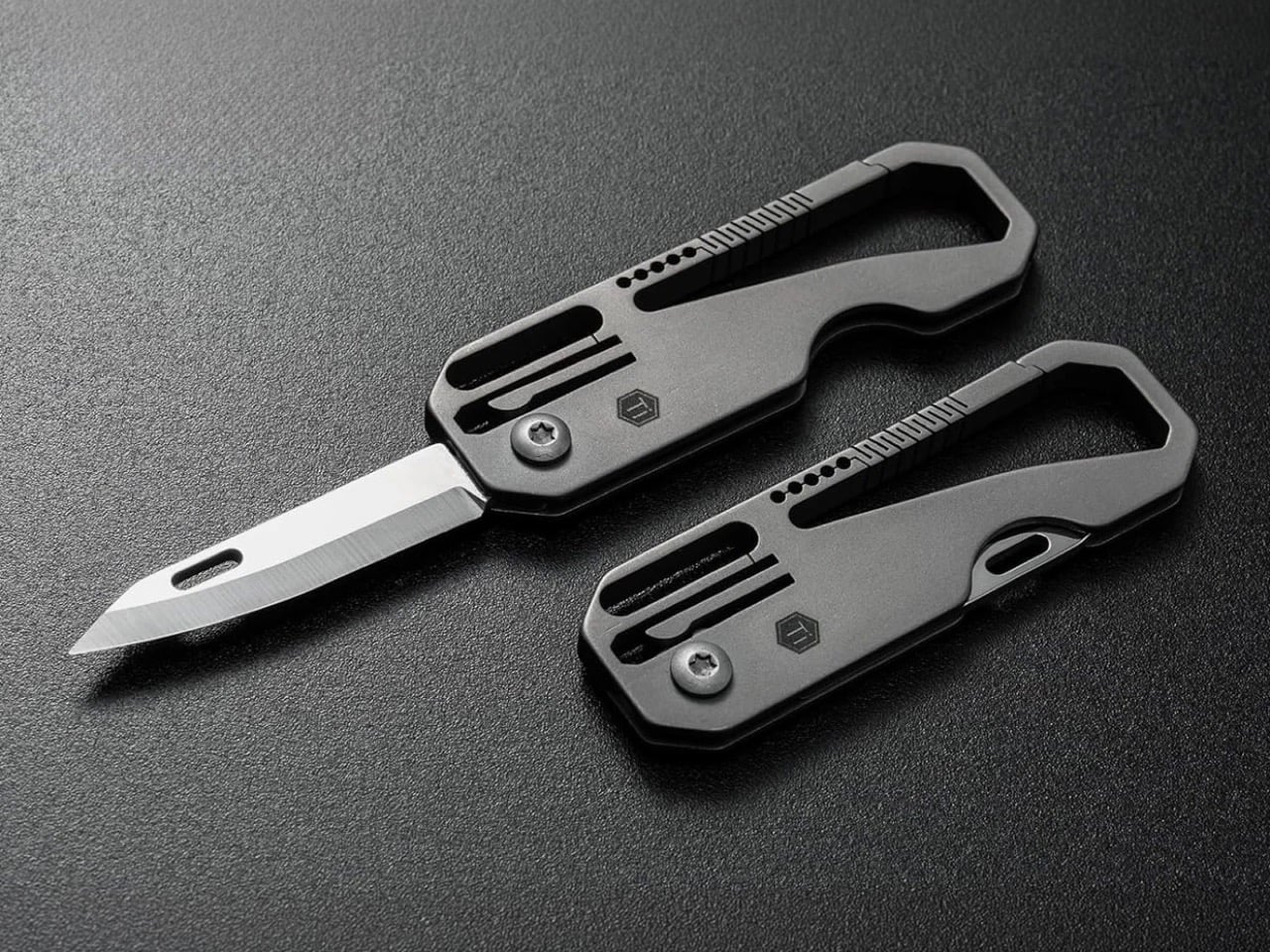
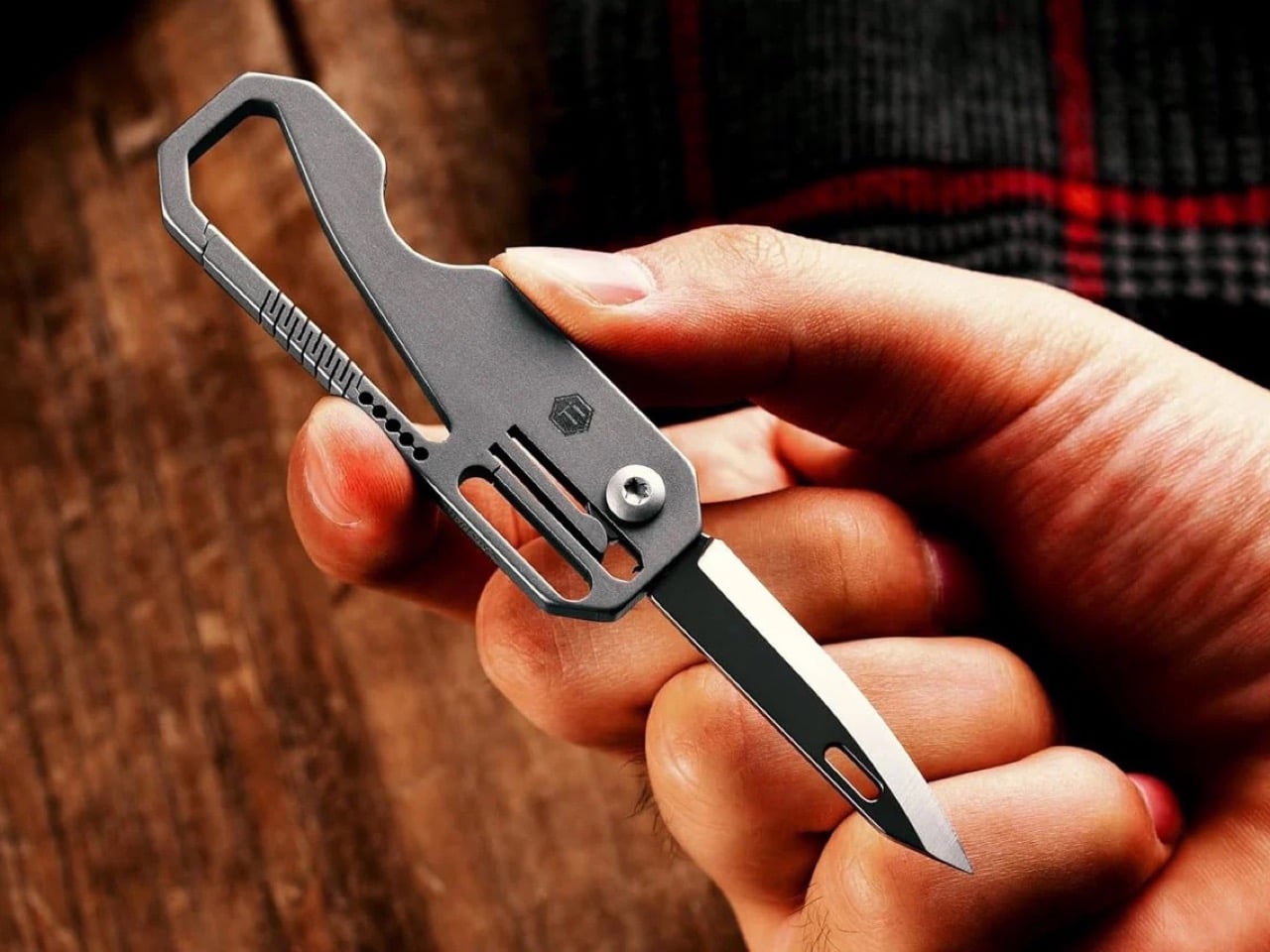
Edrin is a titanium carabiner-first knife that treats the clip, not the blade, as the starting point. It is a compact 6-in-1 tool built around a GR5 titanium frame with an integrated carabiner, a separate D-ring for keys, and a folding D2 blade tucked into the side. The goal is simple: it stays clipped to your belt loop, pack strap, or pocket edge all day, instead of disappearing into a bag.
The body is CNC-machined from Grade 5 titanium, which keeps weight down to around 1.54oz while staying rigid and corrosion-resistant. Carbon fiber inlays add grip and a bit of contrast without bulk. At about 3.29 inches long and just over half an inch thick, it feels more like a small piece of industrial jewelry than a lump of hardware, which makes it easier to justify keeping it on you every day.
The blade is a compact D2 steel folder designed for control rather than drama. It opens with either hand, locks in place with a dedicated mechanism, and is meant for the kind of cutting you actually do: opening boxes, trimming cord, slicing tape, or cutting a loose thread. High-hardness D2 holds an edge well, so you are not constantly babying it, and the short length keeps it precise.
The magnetic 4mm bit driver is built into the frame, with a slot that stores the bit under strong magnets so it does not rattle or fall out. Day after day, it is the same little jobs: a loose screw on a tripod, a battery cover that needs a quarter turn, a handle that is starting to wobble. Having a bit driver literally hanging off your belt means those fixes happen in the moment instead of becoming another mental note.
The bottle opener and nail puller are integrated into the skeleton of the carabiner, so popping a cap or lifting a small nail does not require digging for another tool. The emergency glass breaker sits quietly at one end, a hardened point that you hope never to use but that is always there if a car window or barrier needs to go in a hurry. Best of all, none of these functions adds much size.
Six tiny tritium slots are machined into the body, ready for optional vials that glow on their own without batteries or charging. In a dark car, a tent, or a hallway, that steady, low-level glow makes it easier to find the tool and orient it without fumbling for a flashlight. It is a small detail, but it reinforces the idea that Edrin is meant to be found and used quickly.
A tool like this quietly changes your routine. Instead of asking whether you should bring a knife or a multi-tool, you clip one titanium carabiner to your usual spot and forget about it until something needs cutting, opening, adjusting, or breaking. The combination of GR5 titanium, carbon fiber, D2 steel, magnets, and tritium sounds overbuilt for a 3.29-inch object, but that is exactly what makes it feel like a small, reliable anchor in a pocket full of temporary things that change every season.
Your wrist might be the most underutilized piece of real estate you own. Most smartwatches promise everything at your fingertips, tracking steps and heart rate while delivering notifications in real time. But what happens when you need to fix something physical, tighten an actual screw, or open a stubborn bottle? That digital magic suddenly feels pretty limited. Remember that bonkers Smartlet concept from CES that tried cramming an Apple Watch AND a Rolex on your wrist? Weird execution, brilliant insight. The watch strap has serious potential as a wrist-borne utility belt, and Woods Design seems to have cracked the code with something actually wearable.
The TiLink is a 24-in-1 titanium bracelet that doubles as a watch strap, creating this interesting yin-yang of capabilities. Compatibility spans across all watches with lug widths between 18-26mm, which means the TiLink can attach to the Apple Watch as well as Garmin, Samsung, Google Pixel, and analog watches. One side tracks your biometrics and messages, the other has screwdrivers, wrenches, a magnifier, and a fire starter machined from aerospace-grade titanium. Full transparency: you’re probably not getting through airport security without some explaining, and this definitely isn’t for minimalists. But for EDC enthusiasts who love flaunting their gear, or anyone who believes in being prepared for whatever life throws at them, this bracelet does something clever. Instead of just holding your device, the strap itself becomes the utility belt, merging analog preparedness with digital functionality in one surprisingly balanced package.
Woods Design chose GR5 titanium, the aerospace-grade stuff that shows up in aircraft components and surgical implants. The entire bracelet weighs just 138.8 grams despite packing 24 tools across 230.5mm of length. That’s lighter than most steel watches while being significantly stronger and completely corrosion-resistant. Every link gets CNC-machined for precision, which means tight tolerances and smooth articulation that stays consistent over time. The 35mm width sounds chunky on paper but makes sense once you see how the tools integrate into each module. Your Apple Watch will become obsolete e-waste in five years while this thing keeps working indefinitely.
Three flathead screwdriver sizes (SL3, SL4, SL5) integrate directly into the bracelet structure, covering everything from eyeglass screws to home appliance panels. Hex bit holders accept both 4mm precision bits and 6.35mm standard bits, giving you genuine versatility instead of that fake multi-tool marketing where one size supposedly handles everything. The 4mm bit extension bar reaches recessed screws in tight positions without needing adapters or workarounds. You can swap bits on the fly, choosing configurations based on what you actually need that day. Eyeglass adjustments, toy repairs, electronics tinkering, small hardware fixes, all the annoying little tasks that require tools you never have handy.
An adjustable wrench covers M4 to M8 nuts and bolts, replacing an entire wrench set with one modular link. Traditional hex wrenches deliver solid torque but disappear into drawers and take up pocket space. Mini versions fit on keychains but lack leverage and get lost in couch cushions within days. This integration gives you proper wrench functionality without the carry hassle. The spoke wrench includes three sizes (3.6mm, 3.9mm, 4.4mm) for common spoke nipples, which tells me they actually consulted cyclists during design. Roadside wheel truing without carrying a separate tool bag changes the calculation for anyone who rides regularly and has dealt with wonky spokes mid-ride.
A built-in magnifier handles small text, component inspection, or marking verification without pulling out your phone and fumbling with zoom controls. The eternal pen requires zero refills, won’t leak ink all over your stuff, and stays permanently attached so it can’t vanish. I’m honestly uncertain how often I’d write with a bracelet pen, but jotting quick notes or reminders beats typing on a phone screen when your hands are already busy. The double-hole survival whistle produces louder, sharper sound than standard single-hole designs, making it effective for emergencies, signaling in crowds, or outdoor scenarios. Being permanently integrated means you can’t lose it, unlike those keychain whistles that fall off within a week.
Fire starting capability feels niche for urban carry but makes perfect sense for actual preparedness. The striker produces sparks without fuel or batteries, and a rubber o-ring seals the compartment against moisture. For camping, hiking, emergency kits, or survival situations, having a fire starter that physically cannot run out of fuel beats carrying lighters or matches. For everyday city life, you’ll probably never use it. Here’s where the modular design earns its keep: remove the links you don’t need, keep what you actually use. The bracelet adapts to your reality instead of forcing you to carry someone else’s idea of essential tools.
A nail file smooths rough edges or tidies nails when needed. Wire gauge holes measure five common sizes (3.5mm, 3mm, 2.5mm, 2mm, 1.5mm) accurately without needing dedicated calipers. The bottle opener works exactly as expected, which sounds mundane until you need one and realize your entire keychain, wallet, and pockets contain zero bottle-opening capability. These small inclusions prevent those specific frustrating moments where you’re almost prepared but missing one crucial thing. They fill the gaps between major tools without adding bulk or complexity.
Two optional modules extend the system further. A liquid compass uses premium white mineral oil for smooth operation and minimal temperature sensitivity, staying functional across a wide range of conditions. Sliding it off the bracelet and placing it on the ground eliminates magnetic interference from other tools, giving you accurate readings. When GPS satellites become unreliable or your phone battery dies at the worst possible moment, having mechanical directional finding matters. Tritium tube slots (1.5mm x 6mm) accept glow inserts that work continuously for 25 years without batteries, charging, or external light exposure. That’s legitimate low-light visibility plus understated aesthetic appeal for people who appreciate functional details.
Apple Watch connectors transform the entire premise. Any Apple Watch model attaches and locks securely into place without extra tools or complicated procedures. This creates a genuine hybrid: your watch handles notifications, fitness tracking, payments, and connectivity while your band contains physical tools for fixing actual things. Digital and analog utility coexist on the same wrist, each handling what it does best. When you need to check your heart rate and tighten a loose screw within the same five minutes, having both capabilities right there makes a surprising amount of sense. That being said, the Watch integration isn’t mandatory – you can still wear the TiLink as a regular bracelet too, keeping your smartwatch unencumbered by these massive new responsibilities.
Each link connects and disconnects cleanly for tool-free size adjustment. Add links for a looser fit, remove them for tighter wear, customize tool selection while you’re at it. The precision machining ensures every link articulates smoothly and maintains consistent tolerances, which matters for something rubbing against your wrist all day. You’re essentially building a custom toolkit that also happens to be a watch band, selecting exactly the modules you’ll actually use instead of carrying a pre-configured set that includes stuff you’ll never touch.
As with every EDC, this watch strap has a time and place, and I’m not entirely sure if wearing this universally would work (the same way carrying a Swiss Army Knife everywhere is a tad risky). For example, airport security will absolutely flag this. TSA agents see a metal bracelet with integrated tools and fire-starting capability, they’re pulling you aside for additional screening. Office environments, malls, and public transit systems might consider it too tactical depending on where you live. But for EDC enthusiasts, makers, cyclists, outdoor types, or anyone who regularly encounters small problems requiring tools, wrist-mounted organization beats pocket clutter or carrying bags just for gear. Woods Design built something that respects both form and function, achieving a balance that’s surprisingly rare in products that usually sacrifice one for the other.
Pricing starts at $179 for early backers, hitting $199 at standard retail for the titanium version. Quality titanium watch bands that do nothing except hold your watch regularly cost $150 to $300, so you’re paying a comparable rate for the band itself while getting 24 integrated tools as a bonus. An aluminum version exists at $89 for people who want the functionality without premium material costs. Individual modules run $19 each if you prefer building your configuration gradually or testing the concept before committing to a full bracelet. Single modules come with paracord so you can wear them immediately as standalone pieces.
Before glowing screens and silicon chips, engineers used slide rules to design skyscrapers and send people to the Moon. Calculation meant moving a physical object, not tapping an app, and there was a certain clarity in that, a feeling that your hands and brain were in the same loop. Some of that intelligence at the fingertips is worth bringing back in a world that defaults to calculators for everything, even quick conversions.
Titaner’s Tisolver is a 3-in-1 titanium calculating ring ruler that sits at the intersection of tool, instrument, and jewelry. It measures curves and straight lines, converts between metric and imperial, and calculates square area, all in a GR5 titanium body you can wear or clip to your gear. The company calls it a bridge between the physical and mathematical worlds, a way to put slide-rule logic back into something you can roll across a table.
Tisolver uses a high-strength magnetic lock to give a clear tactile and audible click every time the ring completes a full 10cm rotation. The equation is simple: the number of clicks times ten plus the current reading in the HUD window equals the total length. You can roll it along a cable, a curved edge, or a piece of leather, count clicks, glance once, and know the measurement without juggling a straight ruler and a flexible tape.
Side A has a 10cm metric scale and a 4-inch imperial scale laser-etched on the same ring. You snap Tisolver to zero with the magnetic feedback, align the HUD window’s red line with the metric value you care about, and the imperial equivalent sits under the same line. For longer numbers, you borrow a classic slide-rule trick, shifting the decimal, aligning at 4.2 instead of 42, reading the imperial, then shifting back, all without opening a phone.
Side B keeps a 10cm outer scale but replaces the inner ring with a square-area scale. When you roll and then align the red line with a side length, say 5cm, the inner scale shows 25, the area of a square with that side. Designers, leather crafters, and DIY people can measure one edge of a panel and instantly see coverage instead of doing mental multiplication. Flip the ring, and the same alignment also shows the imperial length.
The dual-locking traction system uses a soft rubber O-ring on the outside and hidden reverse anti-slip teeth on the inside that bite into the rubber, so the ring grips greasy workbenches or wet glass without slipping. The quarter-arc PMMA HUD window with a red reference line acts like a tiny scope, improving readability and protecting the finely etched scales. GR5 titanium, with a fine blasted matte finish, keeps the body light, corrosion-resistant, and warm in the hand.
The Titaner Tisolver lives on a lanyard around your neck, on a keychain, or clipped to a backpack, ready whenever a measurement or conversion pops up. When you are stuck on a problem or waiting for a render, the magnetic click becomes a small mechanical meditation, a way to keep your hands busy while your brain turns things over. The ring rolls, clicks, and resets, and that rhythm helps ease tension without needing a screen or app to distract you.
A titanium ring that measures, converts, and calculates without a single pixel in sight feels like a satisfying little rebellion against the reflex of reaching for a phone every time you need a number. For people who like tools that think with them, not just for them, the Titaner Tisolver quietly earns its place on your chest or in your pocket, turning quick math and measurement into something you can touch, hear, and rely on.
Your phone’s flashlight works fine until you’re elbow-deep in a car engine bay or fumbling with tent poles in the dark. Then you realize the limitation: you need both hands free, you need the light exactly where you’re working, and you need it to stay there without propping your $1,200 device against something greasy or precarious. The NanoB10 from Gadget On lives in that gap between “good enough” and “actually useful.”
This 3cm titanium flashlight attaches magnetically to your watch strap and rotates 360 degrees once mounted. Nine lighting modes cover everything from finding your keys to emergency signaling, while the dual-magnet system means it sticks to any metal surface at the angle you actually need. The whole package weighs about 24 grams and charges via USB-C. Sometimes the best tool isn’t the most powerful one in your house, it’s the one that’s already on your wrist when you need it.
24 grams puts this roughly in the same territory as a couple of quarters or precisely 2 AirTags, which means it disappears until you remember it’s there. Anything heavier starts pulling on your watch strap in ways that make you constantly aware something’s hanging off your wrist, which defeats the whole point of EDC gear that’s supposed to integrate into your daily carry without becoming a burden. The dimensions work out to 30mm x 27mm x 13mm, slightly larger than a nickel but thinner than you’d expect given what’s packed inside. Gadget On clearly spent time solving the density problem, cramming a 60mAh rechargeable battery, nine distinct LED modes, and two separate magnet systems into a volume that fits comfortably on a NATO strap without looking like you strapped a bottle cap to your wrist.
Two separate magnets handle different mounting scenarios, and the separation between them solves a problem most magnetic lights never address. One magnet lives in the body itself, letting you slap the flashlight directly onto any ferrous metal surface like a car hood, tool chest, or steel beam. The second magnet sits in the detachable clip, and this is where the 360-degree rotation becomes useful rather than just a spec sheet number. You dock the flashlight onto the clip magnetically, then spin it to whatever angle you need while the clip itself stays fixed to your watch strap, shirt pocket, or backpack strap. You’re no longer stuck with whatever angle the metal surface happens to be at, which is the usual limitation of magnetic work lights that just stick flat against whatever you attach them to.
Most keychain lights give you one brightness level and maybe a strobe if you’re lucky. The NanoB10 delivers four white LED modes at 1 lumen for night-light use, 35 lumens for low tasks, 100 lumens for medium work, and 200 lumens when you need actual throw. Add a white strobe for emergencies, two red LED modes at 2W and 3W for preserving night vision, a red SOS mode, and a 3W UV light at 365nm that’s actually useful for spotting fluid leaks or checking security features. Runtime on the 1-lumen night-light mode hits 15 hours, which becomes relevant when you’re trying to navigate a dark campsite without waking everyone up or need sustained low-level light for reading maps without killing the battery. The 200-lumen high mode obviously drains faster, but you’re using that in short bursts anyway.
Grade 5 titanium costs more than aluminum or plastic alternatives, but you can drop this thing, step on it, or leave it rattling around in a toolbox without worrying about cracked housings or stripped threads. IPX6 water resistance covers rain and splashes but stops short of submersion, which feels like the right tradeoff for something this compact. You’re not taking this diving, but you can use it in a downpour without killing it. The stonewashed titanium finish looks substantially better than the polished options in my opinion, though that’s entirely subjective. What’s objective is that titanium doesn’t corrode, doesn’t scratch as easily as aluminum, and develops a patina over time that actually improves the appearance rather than making it look beat up.
GADGET ON debuted the NanoB9 just last year, and managed to gather consumer feedback and knock out their next variant in just months. The base got redesigned for better magnetic hold and stability, machining tolerances tightened up across the body, and they added three more finish options based on user feedback from the previous version. That’s smart evolution because the core concept already worked, it just needed polish. The one-button control includes mode memory, so the light turns on to whatever setting you used last instead of forcing you to cycle through all nine modes every single time you need the flashlight. That small detail prevents the kind of annoying behavior that makes people abandon multi-mode lights entirely.
USB-C charging completes a full cycle in approximately 30 minutes, which aligns with the small 60mAh battery capacity. You’re trading extended runtime for size, but the math works when you consider that 15 hours on low gets you through most realistic use cases before you’re near a USB port again. The charging port sits under a small rubber cover to maintain the IPX6 rating, which adds one more thing to keep track of but beats the alternative of a corroded port that stops working after six months of exposure. The cover is tethered to the body, so at least you won’t lose it immediately.
The NanoB10 comes in five finish options: Wave (blue anodized with wave pattern), Matrix (green anodized), Stone (stonewashed bare titanium), Desert (gold anodized), and Slate (natural titanium). Pricing starts at £54 for the Stone or Slate single-color versions and £66 for the anodized color options, which translates to roughly $70-85 USD depending on current exchange rates. Shipping is estimated to begin in June 2026, with the flashlight and magnetic clip sold as separate items so you can add extra mounting options if needed.
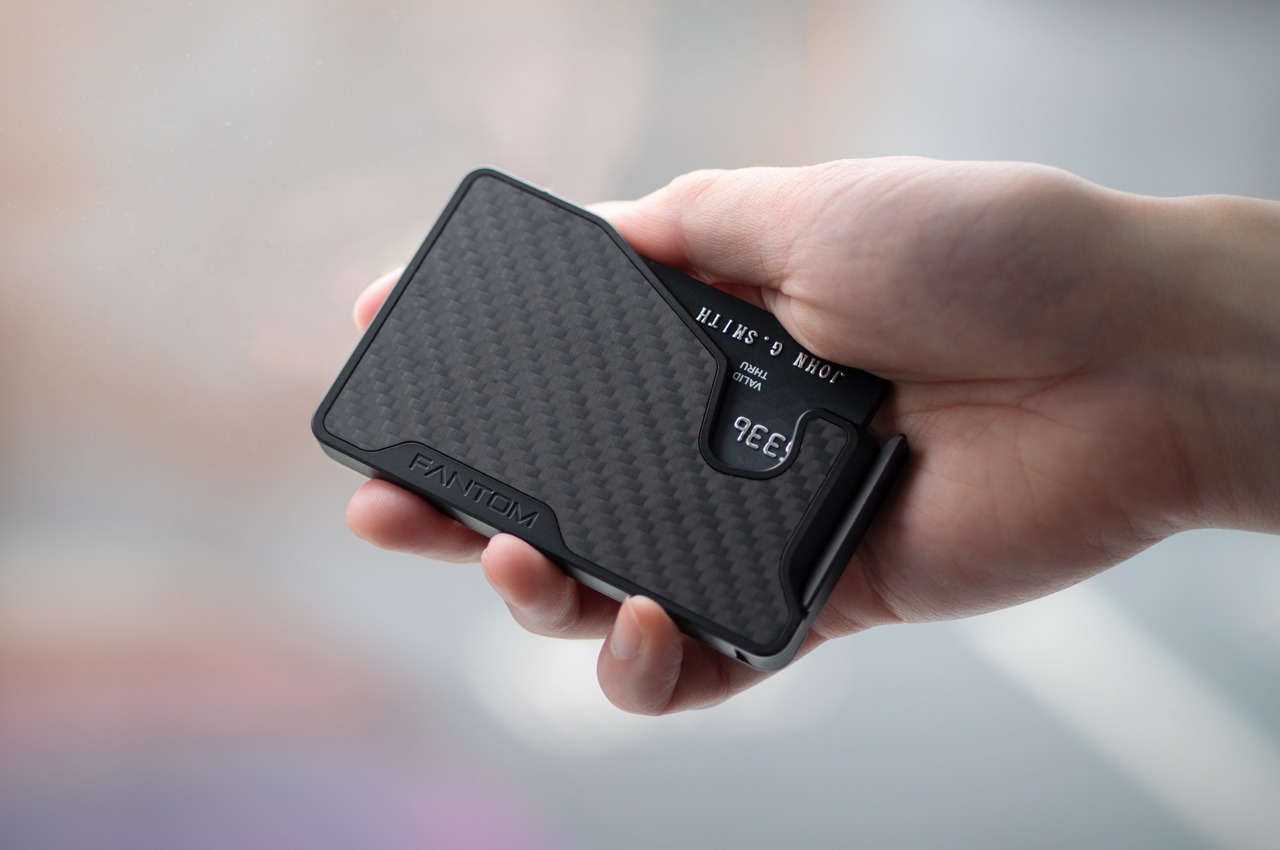
Minimalist wallets tend to look great on Instagram but hold eight cards at best, chew through pockets with sharp edges, and turn every checkout into a card-shuffling performance where you spill half your stack on the counter. A lot of people try them, then quietly go back to bifolds because capacity, comfort, and access never quite line up with the promise of slimming down your everyday carry.
PROOF Wallet is a vertical, wrap-around design that keeps the metal front but softens everything else. The Founder model pairs an aerospace-grade aluminum plate with top-grain leather and a wide elastic strap, aiming for something that still feels slim but looks more like a compact card case than a tactical gadget. It is pitched as a minimalist wallet built for professionals, which mostly means it does not scream EDC the way most metal wallets do.
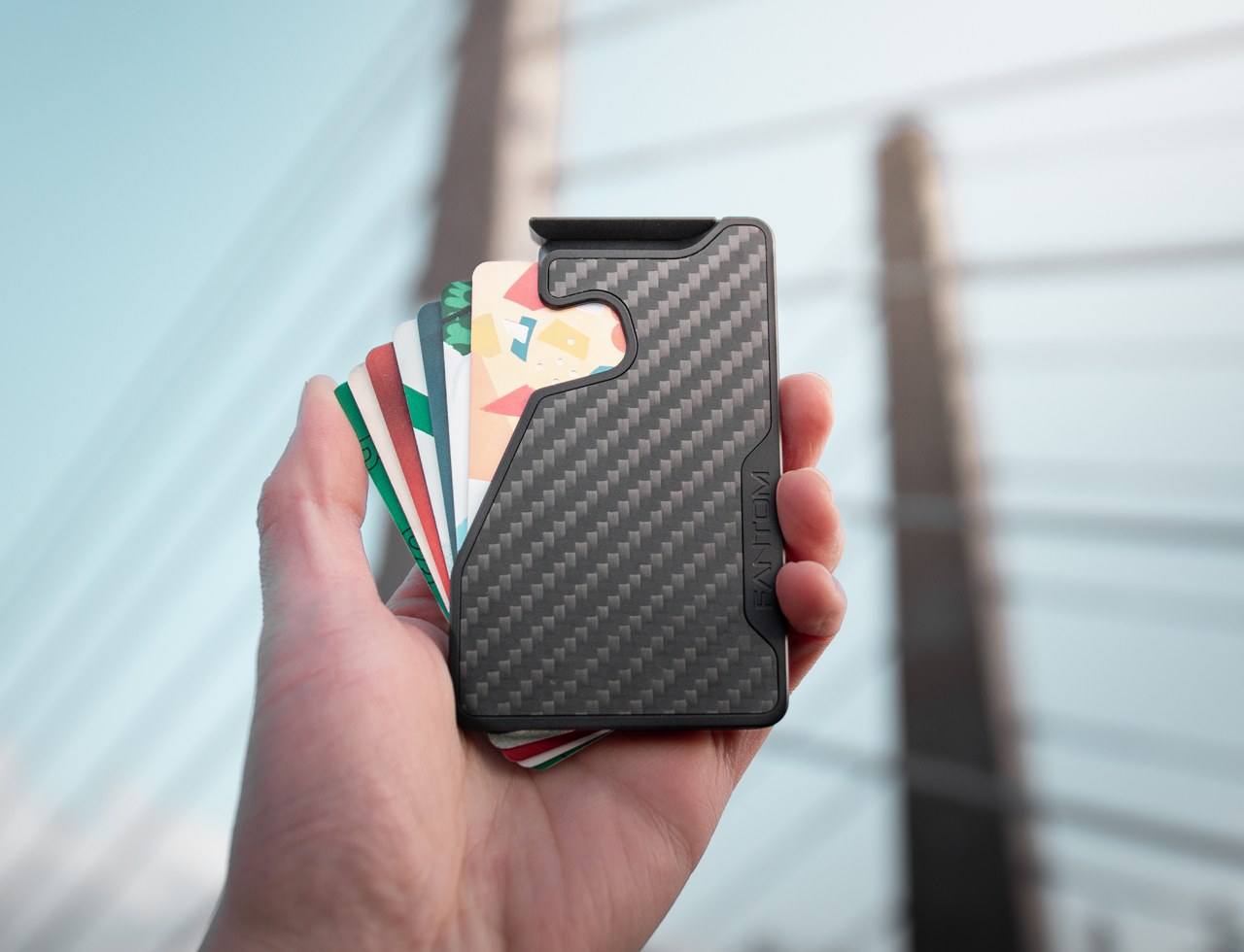
PROOF leans into capacity instead of pretending you only carry six cards. The wallet is rated for anywhere from one to twenty-five cards plus cash, with the elastic strap compressing the stack and the leather wrap keeping everything from splaying out. The footprint stays at roughly 2.25 by 3.75 inches, whether you carry three cards or a full deck; thickness simply grows from a few millimeters to about an inch as you add more.
Paying at a bar or toll booth, you tug the leather-topped pull tab, and your cards rise in a neat stack instead of forcing you to pinch and pry them out. The strap runs behind the cards, so one pull fans them up for selection, then they slide back down when done. It is a small mechanical tweak that quietly fixes the nail-breaking ritual of many metal wallets, where you need two hands and patience.
The back has a wide elastic strap that holds double-folded bills flat against the leather. You can stash up to twenty notes without adding clips or flaps, and the rounded aluminum corners and leather bumper keep the whole thing from feeling like a sharp brick in your pocket. It is still rigid, but it has been sanded down for actual daily carry instead of just looking good in product photos.
The security angle covers both physical and digital. The aluminum front plate and internal RFID-blocking layers encapsulate the card stack, guarding against bending and contactless skimming. For people who travel or commute through crowded spaces, that combination of hard shell and digital shielding is part of the appeal, especially when it does not require a bulky bifold that defeats the point of going slim.
PROOF backs this with an almost overconfident UNRIVALED Guarantee, the promise to replace the wallet if you damage or even lose it, supported by a real lifetime warranty and twelve-month return window. That attitude underlines who this is aimed at: people who like the idea of a slim, front-pocket wallet but refuse to give up capacity, comfort, or a more polished look just to chase minimalism for its own sake.
The Pockitrod multitool is a compelling take on this idea, using its pen-like form as the foundation for a deeply modular system. Its main body, machined from 6061-T4 aluminum, has a hex shape for better grip when used as a driver, a subtle but practical detail. The tool is organized around a central driver assembly housed within the handle, while additional modules such as , a box opener with interchangeable 20CV steel tips, an inkless writing implement and a magnetic-base LED flashlight can be threaded on as extensions. In doing so, it respects the classic pen form factor while fundamentally expanding its purpose. Subtle etched measurement markings along the body function as a built-in ruler, with a zero-reference aligned to the edge for more practical, real-world measuring.
What really makes this system work is the execution of the modular connections. Each component threads together, secured by precision-fitted O-rings that provide a smooth, friction-based fit. This is a critical detail because it prevents the tool from feeling like a wobbly collection of parts in use, maintaining a cohesive and solid feel in hand.. The anodized finish on the aluminum body adds wear and corrosion resistance, so it should hold up to being tossed in a pocket with keys. At 170mm long and weighing just 50 grams, it maintains that pen-like portability while feeling substantial enough for actual work.
Designer: Clinton Brassington (Converge Multi-Tools)
What really makes this system work is the execution of the modular connections. Each component threads together, secured by precision-fitted O-rings that provide a smooth, friction-based fit. This is a critical detail because it prevents the tool from feeling like a wobbly collection of parts in use, maintaining a cohesive and solid feel in hand.. The anodized finish on the aluminum body adds wear and corrosion resistance, so it should hold up to being tossed in a pocket with keys. At 170mm long and weighing just 50 grams, it maintains that pen-like portability while feeling substantial enough for actual work.
At its core, the Pockitrod is built around a solid driver system, with an integrated stylus and a concealed precision screwdriver tip for working with small fasteners. The main 1/4″ hex driver features a spring-loaded locking mechanism to keep the bit holder firmly engaged with the handle, eliminating the play that plagues many compact multitools, and comes fitted with a 6150 CRV PH2 bit. The Pockitrod also includes a mini 1/4″ driver for reaching into tight spaces. Both drivers accept standard ¼” bits, with the mini driver housing an internal spare, a long-shank SL3 bit for accessing deep recessed or hard-to-reach fasteners. It’s a thoughtful detail for anyone who frequently switches between tasks without wanting to carry extra loose bits.
Beyond the drivers, the tool selection is pure EDC perfection. The inkless writing tip, made from a graphite compound, is a practical choice that will never dry out or leak, and it’s paired with a conductive fiber stylus tip for touchscreen use. For cutting tasks, the box opener module uses replaceable tips made from 20CV steel, a high-end choice known for excellent edge retention. Converge offers several tip styles, including a bladeless version for safety, a standard utility tip, and a scraper, which adds a layer of compliance for different workplace regulations.
The utility is further expanded by a detachable LED flashlight module. It’s a compact LED light intended for close-range task lighting, ideal for quick inspections or low-light work. The clever part is its magnetic base, which allows it to be used independently as a small work light. It can also be mounted to the main tool’s pocket clip for a 90-degree beam or attached to the magnetic tip and clipped to a hat brim for a makeshift headlamp. This kind of multi-use design shows a deep understanding of how people actually use their tools in the field.
Speaking of magnetism, the N52 grade magnetic tip is surprisingly strong, with a lift capacity of up to 1kg under ideal conditions. That’s more than enough to retrieve a dropped set of keys or hold a handful of screws at the ready while you work. The whole system is designed to be reconfigured on the fly. Modules can be rearranged, swapped, or left behind depending on the task or environment, with shared compatibility across the main tool and the included Keychain Companion. This companion is a compact, threaded extension of the system, featuring a quick-disconnect loop and allowing select components to be carried, combined, or repurposed independently for more minimalist setups.
This entire package comes from Converge Multi-Tools, an outfit based in Australia.Launch pricing is expected to start around $99 USD for a complete system, which includes the main tool, the keychain companion, and a set of alternative tips. Worldwide shipping is included, starting around June 2026.
The 58mm Swiss Army Knife has occupied pockets for over a century with the same basic formula: red plastic scales, a handful of tools, and a design language that never needed to change. Victorinox perfected compact utility decades ago, and the format became so synonymous with everyday carry that entire generations never questioned whether it could evolve. But that permanence also created a constraint. Once you chose your tool configuration, you were locked in. Swapping scales meant glue, risk, or permanent modification.
Keyport’s Versa58 system breaks that constraint without breaking the knife. The platform introduces a snap-on interface that attaches to any 58mm SAK’s existing rivets, transforming fixed scales into swappable modules. Add a rechargeable LED light, a mini pen, a USB-C flash drive, or a deep-carry pocket clip in seconds. Remove them just as fast. The knife stays intact, the heritage remains untouched, but the capabilities expand in ways the original designers never imagined. It’s modularity meeting tradition, and somehow both sides win.
The core of this entire system is a deceptively simple piece of spring steel. This patent-pending interface plate is the result of a full year of development and seven complete revisions, a process that speaks to the engineering challenge involved. The plate is engineered to flex just enough to click securely onto the mushroom-shaped rivets that hold a standard SAK together, the same ones hidden beneath the factory scales. The design had to be robust enough to handle repeated attachment cycles without loosening, yet gentle enough to avoid damaging the knife’s frame. It’s a tool-free, glue-free, and completely reversible process that takes seconds. This single component unlocks the entire platform.
Versa58 operates in two distinct universes. The first is as a direct upgrade to your existing Victorinox. You pop off the original scales and snap on the Versa58 modules you need for the day. The second universe is completely independent of the knife. Using a magnetic connector system called MagMount, any two modules can be attached to each other to create standalone tools. This dual functionality means you can either enhance the classic SAK you already own or build an entirely new, minimalist multi-tool from scratch. The system offers a level of flexibility that the 58mm format has never seen before.
The MagMount system is absolute genius, using three tuned neodymium magnets to create a crisp, satisfying connection. This allows for the quick assembly of pocketable rigs or keychain tools. You could, for instance, snap the flashlight module to the pen module for a compact, non-knife tool perfect for travel or restrictive environments. The magnetic pull is tuned for a secure hold while still allowing for smooth rotation and easy reconfiguration. It also introduces an addictive fidget factor, turning the act of customizing your carry into something tactile and engaging. It’s a smart design that expands the ecosystem beyond the knife itself.
Among the first wave of modules, the Clip Scale is likely to be the most celebrated. Machined from either 6061 aluminum or Grade 5 titanium, it finally adds a clean, low-profile pocket clip to the 58mm SAK. This has been a common request in the EDC community for years. Crucially, the clip is designed to be reversible and does not interfere with the knife’s keyring, a flaw seen in some aftermarket solutions. It’s paired with a V Scale for the front, which includes a multi-use slot designed to hold the original SAK’s toothpick or tweezers, ensuring you don’t lose core functionality.
The Pocket Flare module brings modern illumination to the platform. It’s a compact, USB-C rechargeable light with a beam tuned for close-range tasks. It offers three modes: a 3-lumen low beam with a 12-hour runtime, a 43-lumen high beam that runs for two hours, and a 45-lumen side light that acts as a lamp to brighten a small area. Because it uses the MagMount interface, you can also snap it onto any metal surface for hands-free lighting, which is incredibly useful for repairs or finding something in a dark tent.
Keyport also developed modules that bridge the analog and digital worlds. The Pen Module features a precision mini pen with a premium German Troika refill, offering a smooth writing experience without any rattle. For digital needs, there is a streamlined USB-C 3.0 flash drive module available in 64GB and 256GB capacities. This flip-out drive seamlessly integrates secure, portable storage into your pocket setup for documents, media, or backups. These additions transform the classic pocket knife into a tool that feels much more relevant to modern daily life.
Perhaps the most forward-thinking aspect of the Versa58 platform is its openness. Keyport will be selling standalone interface plates, inviting makers, modders, and machinists to design their own compatible modules. This opens the door for a community-driven ecosystem of custom tools built on the Versa58 standard. It’s a canvas for creativity, allowing anyone with an idea to contribute to the platform. This move could give the system incredible longevity and a range of options far beyond what Keyport could develop on its own.
Keyport has already outlined a roadmap for future modules, showing a long-term commitment to the system. Upcoming additions being explored include a Bluetooth locator, an NFC module for digital access or automation, a craft blade for precision cuts, and even a minimalist carrier for a Bic lighter. The plan is to build Versa58 into a comprehensive platform, not just a single product release. Backer feedback from the initial campaign will help shape which of these new tools get prioritized, making early adopters part of the development process.
The Versa58 system is available for backing on Kickstarter, with special pricing tiers for early supporters. The campaign offers several bundles, including the foundational Origin Bundle with the core scales starting at $39 and the more comprehensive Apex Bundle that adds the Pocket Flare module starting at $77. All modules and scales are available in either machined 6061 aluminum or the more premium Grade 5 titanium. The Versa58 ships globally starting August 2026.