It's pretty easy to use. Women riders will see an option for Women Drivers when requesting a trip, and this also works when making a reservation in advance. Users can also make a preference for a woman driver in the settings app, though this doesn't guarantee anything and depends on the driver pool.
The feature works in much the same way for drivers. Women drivers will be able to request trips with women riders via the settings.
Uber isn't the only rideshare company trying to make half of the world's population a bit safer during trips. Lyft has been expanding its own take on the feature, which it also recently took nationwide.
This article originally appeared on Engadget at https://www.engadget.com/apps/uber-expands-its-program-that-helps-pair-women-riders-and-drivers-184832010.html?src=rss
Samsung just announced that 120 games will be playable via its Odyssey 3D Hub platform by the end of the year. This is the platform that provides content for glasses-free 3D monitors like recent Odyssey displays.
The company made this claim at GDC 2026, while also noting that the platform currently offers around 60 playable titles. Samsung has only announced a couple of games headed to the platform this year, which include Cronos: The New Dawn and Hell is Us. These are both solid third-person action games that originally came out last year.
The collection already includes several notable games, including Stellar Blade, Lies of P and Psychonauts 2, among others. It's good to know the library continues to grow, proving that there might still be some life left in 3D display technology after all.
We came away impressed with the technology when we gave it a go last year. We even said that if "3D had been like this all along, people would be much more receptive." The games look great and the displays include head tracking so users don't have to constantly struggle to find the one sweet spot (I'm looking at you, Nintendo 3DS.)
Samsung has quietly been adding to its lineup of glasses-free 3D displays. There are several models to choose from nowadays, with screen sizes up to 32-inches.
This article originally appeared on Engadget at https://www.engadget.com/gaming/samsung-promises-120-games-will-be-playable-via-its-glasses-free-3d-monitor-tech-by-the-end-of-the-year-180102470.html?src=rss
EA axed an undisclosed number of employees across the game studios behind the Battlefield franchise. As first reported by IGN, EA told affected employees that the layoffs were part of a "realignment" across the Battlefield studios, which include Dice, Criterion, Ripple Effect and Motive Studios. When asked about the report, an EA spokesperson said in a statement that "we’ve made select changes within our Battlefield organization to better align our teams around what matters most to our community."
IGN reported that all the involved studios will remain operational, but the layoffs will affect multiple offices. The shake-up may come as a surprise to staffers, especially after Battlefield 6 racked up more than seven million copies sold in the first three days following its release in October. EA even called the latest Battlefield title the "best-selling shooter title of 2025" in its third quarter report for FY26, which disclosed the company's net revenue of more than $1.9 billion for the quarter.
"Battlefield remains one of our biggest priorities, and we’re continuing to invest in the franchise, guided by player feedback and insights from Battlefield Labs," an EA spokesperson also said in a statement.
Despite being one of EA's most popular franchises, Battlefield isn't the only one to suffer staffing cuts. Full Circle, the developer behind the skate. that's also owned by EA, also announced layoffs and "restructuring" in February. However, EA isn't the only company in the industry to look at downsizing its personnel. Ubisoft said it was planning to get rid of up to 200 jobs in its Paris office earlier this year and Microsoft announced it would cut thousands of jobs, including within its Gaming division, in July.
This article originally appeared on Engadget at https://www.engadget.com/gaming/ea-laid-off-staffers-across-battlefield-studios-to-better-align-its-teams-173617672.html?src=rss
Look at the phones announced this year, like those revealed at MWC 2026 last week, and you will notice something. They are all faster, thinner, and shinier than last year’s models, and yet none of them feel particularly surprising. Cameras gained another sensor. Bezels shrank another millimeter. Battery life improved by an amount that is technically measurable but practically indistinguishable from the model before. The industry has gotten so good at making phones incrementally better that it has almost forgotten to ask whether they could be genuinely different.
That is where concept phones come in. Not all of them are practical, and not all of them will ship. But the five designs here do something that the latest Galaxy or iPhone cannot: they make you pause and reconsider what a phone actually is, and what it could be if the people designing it were not also worrying about carrier approvals, supply chains, and quarterly earnings. Some are functional prototypes shown on actual show floors. Others exist purely as design arguments. All of them are worth thinking about.
TECNO Magnetic Modular System
Phones have been getting thinner for years, which sounds like progress until you think about what got traded away in the process. Removable batteries went first, then expandable storage, then headphone jacks. Every feature that required physical complexity was quietly dropped in the name of a slimmer profile. TECNO’s Magnetic Modular System, shown at MWC 2026, challenges that logic directly. Rather than cramming every possible capability into a single fixed body, it keeps the phone lean by design and lets you snap on what you need, when you actually need it.
Designer: TECNO
The system works through a magnetic interconnection technology that attaches hardware modules directly to the phone. Telephoto lenses, action cameras, additional battery packs, and over a dozen other components can be added or removed in seconds. The core argument is straightforward: a phone that tries to do everything is permanently weighed down by everything it carries. A phone that adapts to the moment is only as heavy as today demands. Whether TECNO can pull off what Google’s Project Ara could not is another matter, but the design thinking here is at least pointed at the right problem.
What we liked
The base phone stays slim and fully usable on its own, so you’re not carrying the bulk of a photography rig on days when all you really need is a phone.
The modular suite covers a wide enough range of options to be genuinely practical, from camera upgrades to battery expansion, rather than limiting you to a couple of cosmetic add-ons.
What we disliked
Using the system to its full potential requires thinking ahead. If you leave the telephoto module at home, the hiking trail is not going to wait for you to go back and get it.
The smaller modules seem like prime candidates for disappearing to the bottom of a bag, while the larger ones can add considerable bulk when stacked, which rather defeats the point of keeping the base phone slim.
HONOR Alpha Robot Phone
Most phones sit on a desk and wait. The HONOR Alpha does not. Demonstrated as a functional prototype at MWC 2026, this is a phone with a 4DoF gimbal system inside the camera bump, built around what HONOR describes as the industry’s smallest micro motor. Three-axis mechanical stabilization runs alongside an AI tracking engine, and a double-tap locks onto any subject, following it through movement, obstructions, and sudden changes in direction. The person who used to carry a separate DJI Osmo just to get steady footage now has a reasonable question to ask.
Designer: HONOR
The gimbal also does something harder to categorize. HONOR designed it to express what they call embodied AI interaction, meaning the phone physically responds to its environment. It nods during video calls. It reframes itself to keep you centered without being asked. It moves when music plays through its speakers. Phones have had personalities before, mostly through notification lights and ringtones. The Alpha just happens to have something closer to a neck.
What we liked
Giving AI a physical presence, rather than just a voice or a chat window, makes the technology feel more tangible and less like a background service you forgot was running.
The built-in gimbal meaningfully expands what the main camera can do without requiring any extra gear, turning a stationary device into something closer to an autonomous one-person film crew.
What we disliked
Motorized components inside a device that gets dropped, sat on, and shoved into pockets will eventually wear down. A gimbal mechanism that fails out of warranty is a discouraging prospect.
The behavioral features, nodding, swaying, tracking your face, are the kind of thing that feels charming in a demo and potentially exhausting at 7 AM when all you want to do is check your messages.
iFROG RS1
Every phone released this year is a tall rectangle, some taller than others. The iFROG RS1, shown at MWC 2026, is a square, which already makes it unusual before you get to the part where it twists open. Built around a 3.4-inch square display, the RS1 has a rotating lower section that reveals one of two things depending on the variant you’re looking at: a full QWERTY keyboard with raised, tactile keycaps, or a gamepad with a D-pad, a four-button cluster, and Select and Start. No price and no release date were announced at MWC, because the hardware itself is the pitch.
Designer: iFROG
The keyboard variant has a clear and underserved audience. The people who have quietly resented touchscreen typing for fifteen years are not a small group, and the Unihertz Titan has been proving that niche quietly for a while. The gamepad version is a stranger and arguably more interesting proposition. Running Android with physical controls in a square body draws instant comparisons to the Motorola Flipout, a 2010 Android phone that did something structurally similar and was adored by a small crowd before being largely ignored by everyone else.
What we liked
The rotating mechanism keeps the phone genuinely compact in normal use, so the keyboard or game controls are there when you want them and completely invisible when you don’t.
Adding physical input without making the phone permanently thicker or wider is a trade-off very few devices have come close to solving, and the RS1 at least makes a credible attempt.
What we disliked
Modern software is built almost entirely around tall, vertical screens, so the square format creates real friction with apps, video, and content that all assume a rectangular display.
Choosing between the keyboard and gamepad variants at the point of purchase is a long-term commitment. If your priorities shift, or you simply want both, you are looking at two separate phones.
TECNO POVA Neon
Some phones try to solve a problem, but the POVA Neon honestly isn’t that kind of phone. TECNO’s other MWC 2026 concept uses ionized inert gas lighting, the same technology that gives neon signs their glow, to create a branching luminescent effect on the back panel that sits somewhere between a lightning bolt and a circuit trace. TECNO is not claiming this makes the phone faster or the camera better. The claim is simpler and more honest: a phone’s back doesn’t have to be an inert sheet of glass waiting to collect fingerprints.
Designer: TECNO
As design statements go, that one is actually worth taking seriously. Most phone backs are the most visible surface on a device that billions of people carry every day, and they’re almost universally empty. The POVA Neon asks what happens when that surface does something. The answer here is that it glows, which is not practical and doesn’t need to be. Concept work isn’t obligated to be practical. It’s obligated to make you look at a familiar object differently, and a phone that pulses with light like a neon sign in a diner window at least does that.
What we liked
Treating the back panel as a dynamic surface rather than a passive sheet of glass is a genuinely fresh direction, and using ionized gas to do it is unlike anything else currently on the market.
As a concept, it opens up real questions about how materials and lighting could make phone design more expressive without requiring any changes to the screen whatsoever.
What we disliked
Ionized gas channels in a device that flexes under grip pressure, absorbs impacts, and hits the floor on a semi-regular basis seem like they would not survive the lifespan of the phone itself.
A protective case, which most people use, would cover the entire back panel and make the concept completely invisible. It is a design that fundamentally cannot coexist with the most basic act of protecting your phone.
Pixel Dynamics iPhone Fold Concept
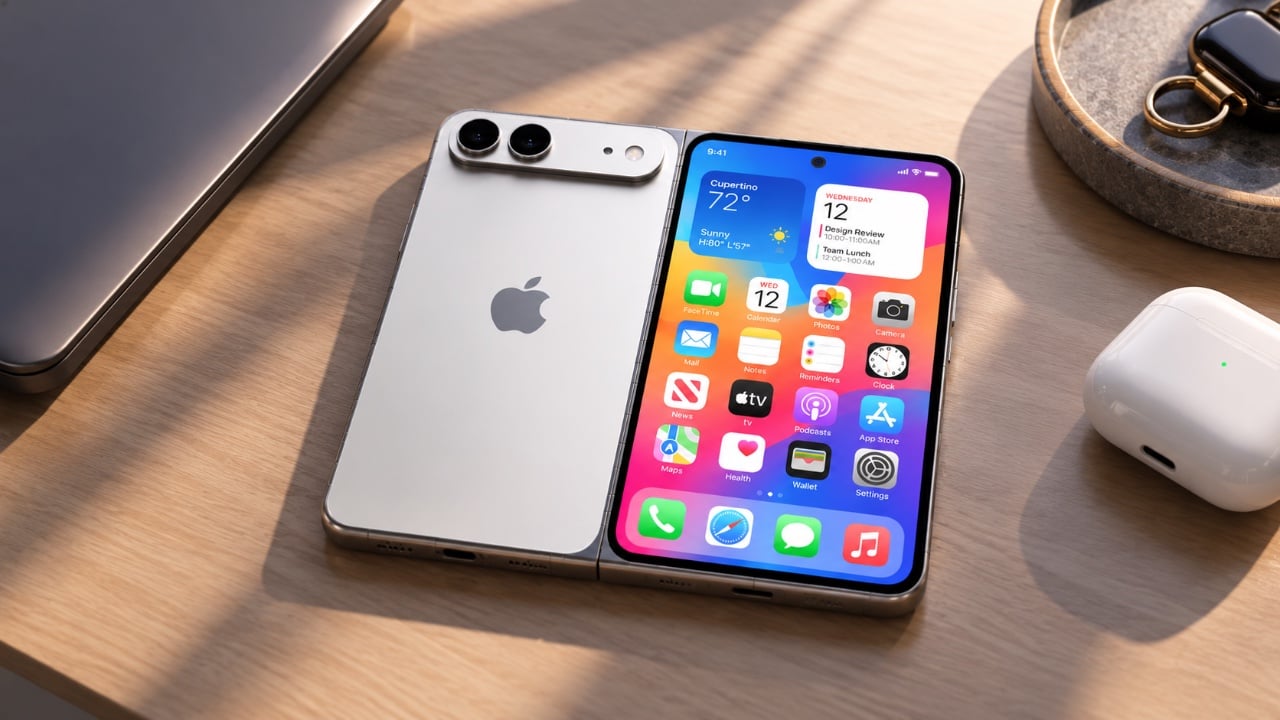
Foldable phones keep running into the same set of problems. The phone has to fold, which means the screen has to fold, which means the screen eventually creases at the hinge line, the hinge develops resistance over time, and the finished device ends up thicker than either of the two things it’s trying to be. Pixel Dynamic’s iPhone Fold concept approaches the whole premise from a different direction. Keep the iPhone exactly as it is. Add a separate foldable screen to the back.
The main iPhone body stays rigid and conventional. A thin, flexible secondary display sits raised on a platform above the rear panel, and when needed, it unfolds outward to create a larger, roughly square tablet surface. The phone itself does not flex, leaving the primary display completely untouched. In daily use, it feels and functions like a normal iPhone, because it essentially is one. That said, the raised platform adds thickness, wireless charging is probably absent, and using the camera while the secondary screen is unfolded becomes nearly impossible since it sits directly over the lenses. Apple almost certainly will never endorse the design, but as a thought experiment about whether a foldable screen and a foldable phone actually need to be the same thing, it’s one of the more original answers anyone has put forward.
What we liked
Treating the foldable display as a separate, discrete component rather than the phone’s primary structural element is unconventional thinking, and it raises genuinely interesting questions about repairability and modular design.
The concept challenges the assumption that a foldable phone has to mean a folding device, which is exactly the kind of first-principles questioning that occasionally turns into something the industry actually builds five years later.
What we disliked
Getting a raised foldable display to sit flush, function reliably through daily use, and survive the realities of a pocket likely puts this well outside what current manufacturing can deliver.
Apple’s tendency to design through subtraction rather than addition makes this particular execution, with its visible raised platform and external folding mechanism, almost impossible to imagine coming from Cupertino in any recognizable form.
Workers at Heart Machine, the independent studio behind Hyper Light Drifter and Solar Ash, have formed a union with Communications Workers of America (CWA) Local 9003. The wall-to-wall unit covers all 13 frontline employees at the studio, which voluntarily recognized the union in February after a supermajority of eligible workers voted for the measure.
The organizing effort follows a rough stretch at Heart Machine, after the studio laid off employees in November 2024, then announced in October 2025 that it would end development on its early access title Hyper Light Breaker and cut further staff.
"I decided to get involved in organizing my studio because I've seen so many peers in the industry stand up to protect the craft we all care so deeply about. Watching that momentum grow made me realize that if we love this work, we have to protect it, especially now," said Steph Aligbe, a gameplay tools engineer at the studio.
Heart Machine joining the CWA extends the union's gaming footprint even further. The union counts thousands of employees at Microsoft subsidiaries among its members, as well as staff at EA, Id Software and others. CWA also runs the United Videogame Workers, a direct-join union that launched in 2025, allowing individual game workers in the US and Canada to sign up on their own without elections or employer consent. Large gaming studios like Ubisoft have been undergoing a seemingly endless string of layoffs, and workers are increasingly demanding to have their voices heard.
This article originally appeared on Engadget at https://www.engadget.com/gaming/hyper-light-drifter-studio-workers-form-union-after-rounds-of-layoffs-165828565.html?src=rss
Anthropic has filed a lawsuit to prevent the Pentagon from adding the company it a national security blocklist. This comes days after the Department of Defense sent a letter to Anthropic confirming the company was labeled a supply chain risk; at the time CEO Dario Amodei had all but guaranteed Anthropic would fight back with legal action.
The lawsuit claims the designation is unlawful and violated free speech and due process rights. “These actions are unprecedented and unlawful. The Constitution does not allow the government to wield its enormous power to punish a company for its protected speech," Anthropic said in a statement published by Reuters.
Engadget received the following statement from an Anthropic spokesperson:
“Seeking judicial review does not change our longstanding commitment to harnessing AI to protect our national security, but this is a necessary step to protect our business, our customers, and our partners. We will continue to pursue every path toward resolution, including dialogue with the government.”
The lawsuit characterizes the government’s actions as an “unprecedented and unlawful [...] campaign of retaliation.” It goes on to say that “the Constitution does not allow the government to wield its enormous power to punish a company for its protected speech. No federal statute authorizes the actions taken here."
Today’s legal action comes after several weeks of back-and-forth between the AI company and the government. In late February, news broke that the Department of Defense and Defense Secretary Pete Hegseth were pressuring Anthropic to remove certain safeguards from its AI systems, but Amodei made it clear the company would refuse to allow its model to be used for mass surveillance or development of autonomous weapons.
On the February 27 deadline, Amodei refused to budge, leading Hegseth to threaten the company with the supply chain risk designation; he also said the US government would cancel its $200 million contract with the company. The same day, President Trump ordered all federal agencies to cease using Anthropic as well. Despite all this, according to the lawsuit, Anthropic had agreed to “collaborate with the Department on an orderly transition to another AI provider willing to meet its demands.”
Anthropic rival OpenAI stepped into this chaos and quickly made a deal with the Department of Defense. At the time, OpenAI CEO Sam Altman said that two of OpenAI’s most important safety principles are “prohibitions on domestic mass surveillance and human responsibility for the use of force, including for autonomous weapon systems” — the same issues that got Anthropic in hot water. OpenAI then doubled down on the surveillance issue, writing into its contract that “the AI system shall not be intentionally used for domestic surveillance of U.S. persons and nationals.”
Depsite this, OpenAI’s head of robotics hardware resigned from the company this weekend in response to the Defense Department deal. Caitlin Kalinowski wrote on X that “surveillance of Americans without judicial oversight and lethal autonomy without human authorization are lines that deserved more deliberation than they got.”
This article originally appeared on Engadget at https://www.engadget.com/ai/anthropic-sues-us-government-over-supply-chain-risk-designation-152838128.html?src=rss
Anthropic has filed a lawsuit to prevent the Pentagon from adding the company it a national security blocklist. This comes days after the Department of Defense sent a letter to Anthropic confirming the company was labeled a supply chain risk; at the time CEO Dario Amodei had all but guaranteed Anthropic would fight back with legal action.
The lawsuit claims the designation is unlawful and violated free speech and due process rights. “These actions are unprecedented and unlawful. The Constitution does not allow the government to wield its enormous power to punish a company for its protected speech," Anthropic said in a statement published by Reuters.
Engadget received the following statement from an Anthropic spokesperson:
“Seeking judicial review does not change our longstanding commitment to harnessing AI to protect our national security, but this is a necessary step to protect our business, our customers, and our partners. We will continue to pursue every path toward resolution, including dialogue with the government.”
The lawsuit characterizes the government’s actions as an “unprecedented and unlawful [...] campaign of retaliation.” It goes on to say that “the Constitution does not allow the government to wield its enormous power to punish a company for its protected speech. No federal statute authorizes the actions taken here."
Today’s legal action comes after several weeks of back-and-forth between the AI company and the government. In late February, news broke that the Department of Defense and Defense Secretary Pete Hegseth were pressuring Anthropic to remove certain safeguards from its AI systems, but Amodei made it clear the company would refuse to allow its model to be used for mass surveillance or development of autonomous weapons.
On the February 27 deadline, Amodei refused to budge, leading Hegseth to threaten the company with the supply chain risk designation; he also said the US government would cancel its $200 million contract with the company. The same day, President Trump ordered all federal agencies to cease using Anthropic as well. Despite all this, according to the lawsuit, Anthropic had agreed to “collaborate with the Department on an orderly transition to another AI provider willing to meet its demands.”
Anthropic rival OpenAI stepped into this chaos and quickly made a deal with the Department of Defense. At the time, OpenAI CEO Sam Altman said that two of OpenAI’s most important safety principles are “prohibitions on domestic mass surveillance and human responsibility for the use of force, including for autonomous weapon systems” — the same issues that got Anthropic in hot water. OpenAI then doubled down on the surveillance issue, writing into its contract that “the AI system shall not be intentionally used for domestic surveillance of U.S. persons and nationals.”
Depsite this, OpenAI’s head of robotics hardware resigned from the company this weekend in response to the Defense Department deal. Caitlin Kalinowski wrote on X that “surveillance of Americans without judicial oversight and lethal autonomy without human authorization are lines that deserved more deliberation than they got.”
This article originally appeared on Engadget at https://www.engadget.com/ai/anthropic-sues-us-government-over-supply-chain-risk-designation-152838128.html?src=rss
To keep Ticketmaster, Live Nation is going to have to make some major changes. As first reported byPolitico, Live Nation reached a settlement with the Department of Justice in its antitrust case that accused the live entertainment giant of monopolistic practices. Live Nation will reportedly pay at least $200 million in damages to states that were part of the lawsuit filed in May 2024, but avoid selling off Ticketmaster.
Live Nation will also be required to make a few changes to its business practices. According to NBC News, Ticketmaster, a subsidiary of Live Nation, will be required to create a "standalone ticketing system" that allows third-party competitors like SeatGeek and Eventbrite to sell tickets on.
The settlement aims to loosen some of Live Nation's control over venues as well. 13 amphitheaters that Live Nation previously had exclusive booking arrangements with will move to an open booking model which will let other promotors book at the venues. The company is also prohibited from retaliating against venues that choose another ticket seller over Ticketmaster.
The settlement comes less than a week after the case went to trial. While the matter may be concluded with the Justice Department, many of the states' attorneys general who were part of the lawsuit will be continuing their legal action separately.
"The settlement recently announced with the U.S. Department of Justice fails to address the monopoly at the center of this case and would benefit Live Nation at the expense of consumers," New York State Attorney General Letitia James wrote in a press release. "We will continue our lawsuit to protect consumers and restore fair competition to the live entertainment industry." 26 other attorneys general signed onto continuing the lawsuit with James.
Update, March 10, 2026, 11:37AM ET: This story was updated to clarify that Live Nation moved to an open booking model with 13 venues that it previously had exclusive booking rights with. Those venues were not owned by Live Nation.
This article originally appeared on Engadget at https://www.engadget.com/entertainment/music/live-nation-settlement-avoids-breakup-with-ticketmaster-155031214.html?src=rss
To keep Ticketmaster, Live Nation is going to have to make some major changes. As first reported byPolitico, Live Nation reached a settlement with the Department of Justice in its antitrust case that accused the live entertainment giant of monopolistic practices. Live Nation will reportedly pay at least $200 million in damages to states that were part of the lawsuit filed in May 2024, but avoid selling off Ticketmaster.
Live Nation will also be required to make a few changes to its business practices. According to NBC News, Ticketmaster, a subsidiary of Live Nation, will be required to create a "standalone ticketing system" that allows third-party competitors like SeatGeek and Eventbrite to sell tickets on.
The settlement aims to loosen some of Live Nation's control over venues as well. According to NBC News, the company will have to divest up to 13 amphitheaters and be prohibited from retaliating against venues that choose another ticket seller over Ticketmaster.
The settlement comes less than a week after the case went to trial. While the matter may be concluded with the Justice Department, many of the states' attorneys general who were part of the lawsuit will be continuing their legal action separately.
"The settlement recently announced with the U.S. Department of Justice fails to address the monopoly at the center of this case and would benefit Live Nation at the expense of consumers," New York State Attorney General Letitia James wrote in a press release. "We will continue our lawsuit to protect consumers and restore fair competition to the live entertainment industry." 26 other attorneys general signed onto continuing the lawsuit with James.
This article originally appeared on Engadget at https://www.engadget.com/entertainment/music/live-nation-settlement-avoids-breakup-with-ticketmaster-155031214.html?src=rss
OnePlus has recently redefined what it means to “never settle” with its OnePlus 13 and 13T smartphones. Now, the company is back in the spotlight amid rumors of another device that appears similar in design but is expected to come with a more capable approach.
Over the past week, the OEM has faced growing speculation and anticipation surrounding the possible launch of this new smartphone. And now it seems OnePlus is openly teasing the device, sharing its images that reveal two new colorways along with details about the phone’s design and the layout of its camera array.
In the images that were shared on Weibo, a Chinese microblogging website, the upcoming phone is revealed in green and brown colors, but with a design that seems very much inspired by the 13T. The phone in question is the OnePlus 15T, which is showing up in its real self – ahead of a launch – for the first time. Most of what we have been able to know about the handset in the recent past has been by way of speculations and hearsay only.
Now, for the first time, we are getting an official update about how the OnePlus 15T will look and the color options you should be able to get. When it comes to looks, from the available pictures, the 15T appears very similar to the 13T. Phone could have a similar 6.32-inch AMOLED display and a rounded off design with a slim bezel, and as seen, would come in new green and brown colorways.
On the reverse side, the phone reveals a dual rear camera housed within a rounded square module toward the top left corner of the phone. Inside the camera housing are the two rear sensors and an LED flash. A setup which – like the design – is similar to that of the predecessor in the same size segment. With the design and new colors, the revealed images also show that the new phone will get a matte finish on the rear panel.
According to the other details already confirmed, the OnePlus 15T will feature a slim bezel and rounded corners for a comfortable grip and usage. Arriving with an AMOLED display only 6.32 inches in size and an upgraded periscope telephoto camera alongside the 3.5x optical zoom, the OnePlus 15T, despite its compact size, gets some high-end features. The phone is likely to draw power from a Snapdragon 8 Elite Gen 5 SoC with 16GB of RAM. It will feature up to an IP69K rating, making the handset capable of handling dust, water dips, and high-pressure water sprays with equal confidence.
Before you consider size and durability as top facets of the OnePlus 15T, just spare a thought for its 7,500mAh battery, rumored to support 100W wired and 50W wireless fast-charging. OnePlus 15T is likely to launch in China later this month, and that’s really when we will have the definite details about the phone. Before that, most of it was only rumors!