Valerion VisionMaster Max projector review: Near-perfect image quality comes at a price

After a widely hyped and successful Kickstarter campaign, Valerion’s 4K VisionMaster Max laser projector has finally arrived. It’s the company’s new flagship model in the VisionMaster series, offering better image quality and more convenience than its other models. However, it’s quite expensive and has some stiff competition from Anker’s Nebula X1 and XGIMI’s Horizon 20 Max.

I was eager to see how it compared to those models and if it delivers on Valerion’s promise of “pure cinema.” It does offer better image quality, but the difference isn’t quite enough to justify the big jump in price for most users.

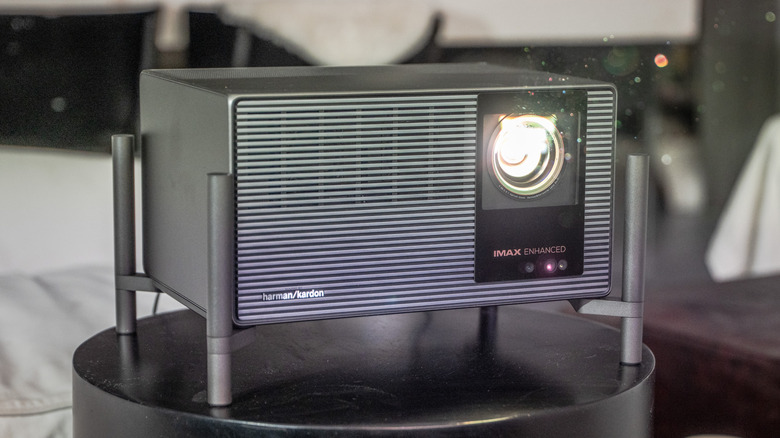
The VisionMaster Max has a classy squarish design with a glossy black finish up front and chrome fins on the side that house two 12W speakers. It’s smaller and fit my decor better than Nebula’s tall, plasticky X1, though to be fair the latter is also designed for outdoor use. The VisionMaster Max has a similar form factor to XGIMI’s Horizon 20 Max, but that model pivots on its stand, while the Valerion uses a kickstand-like support.

For setup, the VisionMaster Max is quite flexible. It comes with a 0.9-1.5x optical zoom, so it can be installed between 7.8 and 13 feet away for a 120-inch screen size, which covers a wide range of scenarios. It also features a +/- 105 percent vertical shift option that helps you get an optically perfect screen fit without moving the projector or employing digital “keystone” adjustments that affect picture quality.

If that still doesn’t work, you can swap out the included lens with a long-throw 0.9-2.0:1 option once it becomes available. The company has even promised an anamorphic lens for users with CinemaScope screens. Both of those items will be available for purchase separately with the prices yet to be disclosed.

Valerion VisionMaster Max rear panel
Steve Dent for Engadget

For my space, I placed the VisionMaster Max on a table about 12 feet from my 120-inch screen and centered it horizontally as there’s no horizontal shift option (it can also be ceiling mounted, of course). Then, I went into the auto-alignment setting, made sure that the projected image was larger than my screen and hit “start alignment” to get a perfect fit to my screen. Though it lacks a motorized lens gimbal like the Nebula X1, the lens shift option provides the same flexibility, so setup was just as easy.

For inputs, the VisionMaster Max comes with three HDMI 2.1 ports, including one with eARC for a sound bar, along with S/PDIF optical and 3.5mm audio outputs. Impressively, it includes a gigabit ethernet connection so you can either hardwire it to the internet or connect via Wi-Fi.

The VisionMaster Max lacks liquid cooling like the Nebula X1, but Valerion claims a similar fan noise level of 28db. When I compared them side by side, it was only a touch louder than the X1 and not at all bothersome.

Google TV is built in for streaming and projector control via the high-quality, partially backlit remote. It provides a large library of apps via Google Play along with a familiar interface. You get certified versions of Netflix, YouTube, Prime Video, Disney+, Max and others, plus Chromecast and AirPlay support, and Google Assistant for voice control. With 4GB of RAM and 128GB of ROM, the software felt a bit more responsive than Google TV on the Nebula X1.

Valerion ImageMaster Max image quality
Steve Dent for Engadget

The VisionMaster Max has a number of features designed to optimize image quality. It’s one of the few consumer projectors with a dynamic iris and a feature called Enhanced Black Level (EBL) for improved contrast. It uses an RGB triple-laser light source (rated for 25,000 hours) paired with a 0.47-inch DLP chip that projects 1080p natively or 4K video via pixel shifting. This same chip is used on almost every consumer-level 4K projector, but XGIMI’s upcoming Titan Noir Max projector will pack a much larger 0.78-inch DMD chip that should deliver a sharper picture.

The VisionMaster Max also supports every HDR format, including Dolby Vision and Samsung’s HDR10+, along with Valerion’s own tone-mapping HDR setting. You can choose from seven picture modes for SDR, eight for HDR, three for Dolby Vision and four for HDR10+. The projector handled most HDR content well, though it occasionally lost detail in extra-bright shots. However, that can largely be fixed using the extensive manual color controls.

With all those features, the VisionMaster Max can output 4K 60 fps video at up to 3,500 ANSI lumens with a 50,000:1 contrast ratio, easily besting its main rivals. On top of that, it promises an impressive 110 percent of the Rec.2020 HDR color spectrum, with a delta E (color accuracy) value of less than 0.8 straight out of the box (any delta E less than 2 is undetectable by the human eye). Another key feature is reduction of the rainbow effect that can occur with DLP projectors.

After some fine-tuning that’s typically required with new projectors, I was highly impressed with the image quality. Brightness was high enough in “standard” mode to watch content like sports or TV shows without lowering the blinds, and can be increased if you don’t mind compromising color accuracy.

When used in ideal conditions like a darkened room, the VisionMaster Max’s image quality is the best of any projector I’ve tested to date. In Filmmaker mode (with the EBL setting enabled), contrast levels are outstanding, with true blacks showing in dark-lit scenes instead of the washed-out greys seen on most projectors. However, I kept the EBL mode at the minimum setting as I noticed it caused some color shifting at the other levels. Dynamic iris projectors can cause excessive “pumping” or sudden changes in light levels, but after adjusting the iris to a medium setting, I saw no signs of that.

Valerion VisionMaster Max image quality
The famously dark Game of Thrones Night King battle scene was easy to see on the VisionMaster Max.
Steve Dent for Engadget

Color accuracy is outstanding straight out of the box both in HDR and non-HDR modes, particularly, again in Filmmaker mode. Visually, I couldn’t detect any anomalies when looking at color bars or other charts, though my Calibrite Color Checker told me that the gamut of hues was slightly less than what Valerion claims (under 100 percent of BT.2020).

Still, the Max’s high color accuracy allowed me to see TV series and movies exactly as the filmmakers intended for a range of HDR and non-HDR movies including White Lotus season 3, Once Upon a Time in Hollywood, Andor and Dune 2. The projector’s excellent dynamic range and contrast revealed shadow details in Game of Thrones’ Night King battle, which has famously dark scenes that are difficult to see on some TVs.

I have a slight amount of sensitivity to the “rainbow” effect, but the RBE Reduction feature effectively eliminated that visual artifact for me. However, it also introduced a slight amount of noise, so I disabled it. The feature might be a godsend for some users who are particularly susceptible, but it still needs a bit more refinement.

Of all the luxury projectors I’ve tested to date, the VisionMaster Max is the best for gaming — even compared to some dedicated models. It delivers latency as low as 4ms and a refresh rate up to 240Hz at 1080p, and 15ms for 4K at 60Hz. I tested a couple of PC titles including Cyberpunk 2077 and Hollow Knight: Silksong and found them to be as responsive as I’ve seen on any TV, but with far more immersion thanks to the huge, bright and color-accurate image.

Valerion VisionMaster Max 4K projector
Steve Dent for Engadget

You can output audio via the S/PDIF optical output, 3.5mm headphone jack, HDMI 2.1 ports and even USB 3.0 Type A ports. The built-in 12W stereo speakers work well and are fairly loud, so you can use them in a pinch. However, since it supports both DTS:X and Dolby Atmos, you’ll ideally want to connect it to a nice home theater audio system with support for at least 5.1 surround sound.

In comparison, the Nebula X1 doesn’t have Dolby Atmos support, but it does give you the option to purchase and easily connect stereo Bluetooth speakers at a relatively cheap price. For around the same cost as the Valerion Max, Anker is also offering the Nebula X1 Pro that comes with a giant outdoor sound system and does support Dolby Atmos.

The Valerion VisionMaster Max is a highly capable indoor projector that offers the best image quality I’ve seen thanks to the dynamic iris and Enhanced Black Level features. However, it’s also a lot more expensive than rival models at $5,000. It’s pretty hard to justify that extra money, unless you’re really fussy about picture accuracy and gaming performance, or need other features like the 1Gbps ethernet port.

Most buyers would be better off spending a lot less on Valerion’s own $2,699 VisionMaster Pro2, Anker’s $2,999 Nebula X1 or the $2,999 XGIMI Horizon 20 Max. Again, the difference in picture quality is too slight to justify the huge price jump to the VisionMaster Max. You might also want to wait to see how much XGIMI’s incoming Titan Noir Max 4K costs, as it also offers a dynamic iris but has a much bigger DLP chip.

This article originally appeared on Engadget at https://www.engadget.com/home/home-theater/valerion-visionmaster-max-projector-review-near-perfect-image-quality-comes-at-a-price-140045939.html?src=rss

FTC finalizes GM punishment over driver data sharing scandal

After reaching a proposed settlement last year, the FTC has banned General Motors from sharing specific consumer data with third parties, TechCrunch reported. The finalized order wraps up one of the more egregious cases of a corporation collecting its customers' data and then using it against them. 

Two years ago, the New York Times report released a report detailing how GM's OnStar "Smart Driver" program collected and sold detailed geolocation and driving behavior data to third parties, including data brokers. Those brokers in turn sold the data to insurance providers, which jacked up the rates for some drivers based on the data. "It felt like a betrayal," said a Chevy Bolt owner that saw his insurance rise by 21 percent based on the data. "They’re taking information that I didn’t realize was going to be shared and screwing with our insurance."

According to the terms of the settlement, GM is barred from sharing specific user data with consumer reporting agencies for a five year period. The automaker is also required to request user permission before collecting, using or sharing vehicle data with any third party. It must do that when a consumer purchases a car at a dealership, with the customer asked in person whether they agree or not with the data collection, GM said. 

Some of the settlement is moot as GM stopped its Smart Driver program for all brands in April 2024. The company unenrolled all customers and stopped its third-party relationship with LexisNexis and Verisk, the brokers that sold driver data to insurance companies. 

GM faced other actions over the data collection, including lawsuits from Texas, Nebraska and other states. "Our investigation revealed that General Motors has engaged in egregious business practices that violated Texans’ privacy and broke the law. We will hold them accountable," said Texas AG Ken Paxton at the time. 

In a statement to TechCrunch, GM said: "The Federal Trade Commission has formally approved the agreement reached last year with General Motors to address concerns. As vehicle connectivity becomes increasingly integral to the driving experience, GM remains committed to protecting customer privacy, maintaining trust, and ensuring customers have a clear understanding of our practices." 

This article originally appeared on Engadget at https://www.engadget.com/transportation/ftc-finalizes-gm-punishment-over-driver-data-sharing-scandal-130012313.html?src=rss

Bandcamp prohibits music made ‘wholly or in substantial part’ by AI

Bandcamp has addressed the AI slop problem vexing musicians and their fans of late. The company is banning any music or audio on its platform that is "wholly or in substantial part" made by generative AI, according to its blog. It also clarified that the use of AI tools to impersonate other artists or styles is “strictly prohibited” by policies already in place.

Any music suspected to be AI generated may be removed by the Bandcamp team and the company is giving users reporting tools to flag such content. "We believe that the human connection found through music is a vital part of our society and culture, and that music is much more than a product to be consumed," the company wrote.

The announcement makes Bandcamp one of the first music platforms to offer a clear policy on the use of AI tech. AI-generated music (aka “slop”) has increasingly been invading music-streaming platforms, with Deezer for one recently saying that 50,000 AI-generated songs are uploaded to the app daily, or around 34 percent of its music. 

Platforms have been relatively slow to act against this trend. Spotify has taken some baby steps on the matter, having recently promised to develop an industry standard for AI disclosure in music credits and debut an impersonation policy. For its part, Deezer said it remains the only streaming platform to sign a global statement on AI artist training signed by numerous actors and songwriters. 

Bandcamp has a solid track record for artist support, having recently unveiled Bandcamp Fridays, a day that it gives 100 percent of streaming revenue to artists. That led to over $120 million going directly to musicians, and the company plans to continue that policy in 2026.

This article originally appeared on Engadget at https://www.engadget.com/entertainment/streaming/bandcamp-prohibits-music-made-wholly-or-in-substantial-part-by-ai-130050593.html?src=rss

Tesla’s Full Self-Driving is switching to a subscription-only service

Tesla will stop selling its $8,000 Full Self-Driving (FSD) option and make it strictly a monthly subscription service after February 14, CEO Elon Musk announced on his X platform. Musk didn't reveal the price or why he's making the switch, though FSD is already available by subscription for $99 per month or $999 per year. 

The shift could be advantageous for buyers, particularly if they decide to dump their new Tesla or trade it in. It will also allow prospective owners to hedge their bets, as Tesla has overpromised on the feature since it was first announced. 

Full Self-Driving has never done what the name suggests as humans must constantly supervise the system and frequently take control. Because of that, it's more of a "driver assist" system and doesn't even qualify as Level 3 self-driving (conditional automation), let alone as a truly autonomous Level 4 or Level 5 category. Musk has been touting self-driving capabilities on Tesla vehicles since 2015, promising at the time "complete autonomy" by 2018. 

Branding for the system as "Autopilot" and "Full Self-Driving" has been called out as false advertising by consumer watchdogs and government for years, but so far, regulators have yet to take action. A California judge recently ruled that Tesla used "deceptive language to market Autopilot and recommended suspending Tesla's sales in the state for 30 days. However, the company has 90 days to comply and could still avoid punishment.  

This article originally appeared on Engadget at https://www.engadget.com/transportation/evs/teslas-full-self-driving-is-switching-to-a-subscription-only-service-120053137.html?src=rss

Anker’s Solix E10 battery backup can power your entire house in a blackout

Anker is going up against Tesla in the home battery backup segment with Solix E10 that promises "whole-home backup" at an affordable price. The system delivers enough power to handle heavy-duty air conditioners and other high-power appliances in the event of a blackout. It also claims that the E10 supports DIY-friendly installation thanks to the stackable, plug-and-play design. 

Each Anker Solix E10 unit can deliver up to 37.2kW of surge power and stacking two boosts that to 66kW. It also comes with a "turbo output" mode that can output 10kW per unit for 90 minutes maximum. That level of power, along with the minimal 20ms auto-switch time (from grid to battery), means you may not even notice if the power grid goes down. 

Anker Solix E10
Anker

For large installations, you can stack up to three E10 units to boost power to 90kWh, enough to provide whole home backup for up to 15 days (average US consumption is 30kWh per day so that might be stretching it). If that's not enough, you can add Anker's tri-fuel Solix Smart Generator 5500 that runs on gasoline, propane or natural gas and charges the E10 batteries via DC for maximum efficiency. The E10 can also handle up to 9kW of input from solar panels, or 27kW with three units. 

Anker's Solix E10 can be purchased with several optional components. The Power Dock allows auto switching from grid power in the even of an outage in 20 milliseconds, while the Smart Inlet Box provides a manual switchover option. The latter lets you charge the E10 batteries from the grid with existing solar systems to save money. 

In the event of a wild storm, units are weatherproof thanks to the all-metal enclosures and can be operated in temperatures ranging from -4 to 131 degrees Fahrenheit.

As for pricing, the Solix E10 costs $4,299 by itself, $4,599 with the Smart Inlet Box, $5,799 with the Solix Power Dock and $7,399 with the Solix Power Dock and Smart Generator. Adding an extra E10 unit would boost the latter price to around $10,000. However, Anker claims lower installation costs for the Solix E10 than Tesla and other manufacturers due to its modular nature and says it's so intuitive that some buyers could do a DIY installation. The Solix E10 is now available for pre-order.

This article originally appeared on Engadget at https://www.engadget.com/home/ankers-solix-e10-battery-backup-can-power-your-entire-house-in-a-blackout-143040115.html?src=rss

Tesla launches a seven-seat version of the 2026 Model Y

Tesla's 2026 Model Y is now available on the company's site and it comes with a new (and old) option: a seven-seat version via a third row. The extra seating costs $2,500 and is only available if you order the Premium All-Wheel-Drive Long Range model. Tesla first teased the option last year via an email to prospective buyers with the promise of "seating for up to seven and enough room for everyone's gear," Electrek reported at the time. 

The new seats appear to be designed mainly for children as they don't offer much legroom, according to images on Tesla's configurator. Tesla notes that the seven-seat interior "features fold-flat second-row and third-row seats," though it's not clear if those seats fold down electrically like the second row. 

Tesla's 2026 Model Y launches with a new third row
Tesla

Tesla is facing increased competition, especially in the crossover/SUV category, and saw another sales decline last quarter. The company previously sold a seven-seat version of the Model Y in the US for a short time before it was refreshed early last year. Since then, though, it has only been available with five seats. Tesla launched a six-seat "Model YL" version in China in August 2025 with a six-inch wheelbase extension that the US model lacks. Elon Musk said that model would come to the US market in late 2026 or maybe "never." 

Otherwise, changes to the Model Y lineup are minor and confined to the Premium version. Those include a 20-inch dark-grey "Helix" "wheel option, a new black headliner, a bigger, higher-resolution 16-inch display and darker rear badging. 

This article originally appeared on Engadget at https://www.engadget.com/transportation/evs/tesla-launches-a-seven-seat-version-of-the-2026-model-y-130039385.html?src=rss

Meta closes 550,000 accounts to comply with Australia’s kids social media ban

To comply with Australia's under-16 social media ban, Meta said on Medium that it has shut down nearly 550,00 accounts. That number includes 330,000 Instagram, 173,000 Facebook and 40,000 Threads accounts deemed to belong to children. "Ongoing compliance with the law will be a multi-layered process that we will continue to refine, though our concerns about determining age online without an industry standard remain," the company wrote. 

Australia's minimum age social media ban, the first of its kind in the world for a democracy, went into effect on December 10. The ten platforms affected, including Facebook, Instagram, TikTok, Snapchat, X, Reddit and Twitch, must bar underage users or face a fine of up to $AUD 49.5 million ($33 million). Platforms are using a variety of means to determine age, including age inference based on activity and selfies.

Some of those platforms aren't taking the ban lying down. Reddit, which launched a lawsuit against the Australian government, argued that it shouldn't have been included in the ban since it isn't a social media site, while adding that it comes with some "serious privacy and political expression issues" for users.

Meta also expressed its opposition to the ban, citing a number of factors. It says taking social media out of the hands of teens can isolate them from getting support from online communities, and that the ban is only driving them to "less regulated parts of the internet." It also sites inconsistent age verification methods and a lack of interest in compliance from teens and parents. 

However, the fact that Meta has removed almost 550,000 accounts just a month after the ban took affect shows that it is also affecting the company's bottom line. And Meta doesn't have a sterling record when it comes to teen safety, having previously downplayed the frequency of harm to children. 

This article originally appeared on Engadget at https://www.engadget.com/social-media/meta-closes-550000-accounts-to-comply-with-australias-kids-social-media-ban-130041356.html?src=rss

Kia’s budget EV2 arrives with up to 240 miles of range

Kia has unveiled its new entry level electric vehicle, the EV2. The boxy model strongly resembles the company's Soul (Kia did make an electric Soul at one point) and has very similar dimensions, though it's slightly shorter in height and length. It's not exactly a range monster and will charge a bit slower than the competition. The EV2 launched at the Brussels Motor Show and the company said it has no plans for US availability at this point. 

The EV2 uses Kia/Hyundai's E-GMP platform and slots into the bottom of its EV lineup as an "entry point to electric mobility," according to the automaker. Though nearly the same size, it certainly looks nicer than the dowdy Soul and has more room inside. Competition-wise, it's going up against Volvo's EX30 and may cost about the same, though Kia has yet to divulge pricing. 

Kia's budget EV2 arrives with up to 240 miles of range
Kia

The EV2 will be offered with two battery options: a 42kWh battery with 197 miles of WLTP range (likely around 170 miles by EPA standards) and 61kWh with 278 miles of WLPT range (around 240 EPA miles). That's not a lot, especially compared to the 261 mile EPA max range of the EX30 — so Kia's pricing for the EV2 will be key. As for charging speeds, Kia says the EV2 will charge from 10 to 80 percent in about 30 minutes — a bit slower than the 69 kWh EX30. Like other Kia vehicles, the EV2 supports vehicle-to-grid and vehicle-to-load (V2L/V2G) charging. 

Kia calls the vehicle's interior a "Picnic Box" as a way to describe the small but useful space. Kia says its "comparable to larger vehicles" in terms of space, with generous rear legroom and rear cargo capacity up to 403 liters. It will come in four- and five-seat versions. 

Kia's budget EV2 arrives with up to 240 miles of range
Kia

As for tech inside, it offers a generous screen setup, with a 12.3-inch instrument cluster, 12.3-inch infotainment screen and a 5-inch climate display. Ambient lighting in the cabin syncs up with specific vehicle functions. At the same time, it offers a fully array of manual controls climate, volume control and more. It comes with multiple USB-C ports (three up front) that support up to 100W charging.

The company has yet to reveal performance figures other than range. Production is set to start in Q1, so deliveries should commence in Europe and other regions later in the year. It doesn't look like the EV2 will arrive stateside any time soon, though, as the company said it "has not announced plans for the US market." 

This article originally appeared on Engadget at https://www.engadget.com/transportation/evs/kias-budget-ev2-arrives-with-up-to-240-miles-of-range-130038144.html?src=rss

Nintendo reveals its first Switch 2 Joy-Con color variant

Nintendo has unveiled the first color variants for the Switch 2 Joy-Cons in light purple and light green, set to arrive on February 12 alongside Mario Tennis Fever. The new controllers are now on pre-order for $100 and include matching wrist-straps. 

Other than the colorway, these are standard Joy-Con 2 controllers with motion controls and HD rumble, along with the C Button for GameChat and the mouse controls for compatible games. However, you may have noticed something weird about them — the colors are on the inner rails, so you'll barely be able to see them when the Joy-Con 2s are connected to a Switch 2 console, except around the thumbsticks. By contrast, previous Joy-Con color variants covered the entire shell. The new Switch 2 Joy-Con colors also clash with the light blue and orange strips on the inner left and right of the console.

Along with the new Joy-Con 2 controllers, Nintendo released a lengthy game-play video for Mario Tennis Fever, also set to arrive on February 12th. It details some of the key gameplay features, like "fever shots," the ice racket and moves like slides and dives. 

This article originally appeared on Engadget at https://www.engadget.com/gaming/nintendo/nintendo-reveals-its-first-switch-2-joy-con-color-variant-142725414.html?src=rss

Volvo’s EX60 electric crossover promises 400 miles of EPA range

Ahead of a launch later this month, Volvo has teased some impressive details about its upcoming electric crossover. The EX60, which slots between the EX40 and EX90, will offer an EPA range of 400 miles, beating all other Volvos and most EVs in general. It will also be the first Volvo car to use a megacasting process designed to reduce weight and boost manufacturing efficiency. 

"With our new electric vehicle architecture, we directly address the main worries that customers have when considering a switch to a fully electric car," said Volvo CTO Anders Bell. "The result is class-leading range and fast charging speeds, marking the end of range anxiety." 

Volvo EX60 Electric crossover
Volvo

Volvo considered that main worry to be range anxiety, so it focused on maximizing endurance to the largest extent possible. Key to that is Volvo's advanced SPA3 EV architecture, which integrates the battery directly into the structure of the car with cell-to-body technology. Volvo also developed its e-motors in-house to improve efficiency and reduce weight. 

The company also made the EX60 fast to charge with an 800-volt electrical system and support for up to 400kW fast charging, letting you add up to 168 miles of range in just 10 minutes. New lighter materials and lower heat generation aid in that, "meaning the EX60 can add over 100 miles or range in just a few minutes," Volvo wrote on its blog. 

Volvo EX60 Electric crossover
Volvo

The megacasting, meanwhile, helped Volvo replace hundreds of smaller parts with a single, high-precision casting to reduce weight. The Volvo EX60 will be revealed on January 21, 2026 at a livestream on Volvo's website

This article originally appeared on Engadget at https://www.engadget.com/transportation/evs/volvos-ex60-electric-crossover-promises-400-miles-of-epa-range-130008964.html?src=rss