The Trump Administration has signed deals with two major energy companies to abandon their respective offshore wind farms, with both firms agreeing to invest in oil and gas projects instead.
The separate agreements were detailed in a press release from the Interior Department, which named Bluepoint Wind and Golden State Wind as the companies that have voluntarily agreed to end their current leases for a combined $885 million. Both firms have also said they don’t intend to pursue any new offshore wind projects in the US going forward.
Bluepoint Wind is an early-stages wind farm located off the coast of New Jersey and New York, while Golden State Wind, which is similarly in its infancy, is off California’s central coast. The government will provide dollar-for-dollar reimbursements of what each lease cost when they were agreed under the Biden administration, which Interior Secretary Doug Burgum said were "only viable when propped up by massive taxpayer subsidies."
Global Infrastructure Partners (GIP), which co-owns Bluepoint Wind with Ocean Winds, will invest up to $765 million into a liquefied natural gas (LNG) facility in the US. Ocean Winds is also one half of the 50/50 partnership that owns Golden State Wind, which will recover approximately $120 million in lease fees after investing in further oil and gas projects along the Gulf Coast.
The deals are similar in structure to the one the Trump administration agreed last month with French energy giant TotalEnergies, reaffirming the government’s seemingly unwavering commitment to outright rejecting clean energy in favor of doubling down on fossil fuels. Meanwhile, the accuracy of President Trump’s claims about climate change and the cost of renewable energy continues to be challenged.
This article originally appeared on Engadget at https://www.engadget.com/science/trump-administration-is-paying-more-companies-to-abandon-offshore-wind-projects-150216769.html?src=rss
Looks like we won't get to hear the powerful hum of an all-electric Lamborghini on the streets anytime soon. According to a report from The Sunday Times, Lamborghini has abandoned making a production version of the Lanzador EV concept, which was expected to hit the market in 2029.
Stephen Winkelmann, chairman and CEO of Lamborghini, told The Sunday Times that there was "close to zero" interest from its customer base for battery-powered EVs. Winkelmann also revealed that the verdict to kill off the Lanzador was made late last year, but this is the first public confirmation of the decision after Lamborghini's grand reveal of the EV concept in August 2023. The automaker's CEO told The Sunday Times that "EVs, in their current form, struggle to deliver this specific emotional connection," adding that the lack of noise could have played a part in failing to attract customers.
Instead, Lamborghini will replace the Lanzador with another plug-in hybrid electric vehicle, like its Reveulto and Urus. With this change, Lamborghini's entire lineup will be hybrid EVs by 2030, with Winkelmann confirming that the company would continue making internal combustion engines "for as long as possible." Still, the CEO hinted to The Sunday Times that Lamborghini could pursue another all-electric car in the future, but "only when the time is right."
This article originally appeared on Engadget at https://www.engadget.com/transportation/evs/lamborghini-ditches-plans-for-its-all-electric-supercar-due-to-close-to-zero-buyer-interest-173441263.html?src=rss
Two Elon Musk companies are reportedly planning to merge. On Thursday, Reutersreported that SpaceX and xAI are holding merger talks ahead of a planned IPO. Part of their plan is to launch AI data centers into space (but unfortunately, only as far as Earth's orbit).
Last week, it was reported that Musk planned to take SpaceX public despite having once said it wouldn’t happen until the company had a presence on Mars. Now, the IPO could happen as early as this year. Shares of xAI would reportedly be exchanged for shares in SpaceX under the merger. Reuters reports that two entities were set up in Nevada on January 21 to facilitate the deal.
The latest idea Musk is pitching is blasting AI data centers off into space. At last week's gathering of the rich and powerful in Davos, Switzerland, he said, "The lowest cost place to put AI will be in space. And that will be true within two years, maybe three at the latest." The idea is that data centers in orbit could harness solar power and reduce cooling costs. However, industry analysts and executives consider it a risky bet, questioning whether the savings would warrant the massive investment. If or when the AI bubble bursts, the plan could go down in flames — if not literally, then figuratively.
This article originally appeared on Engadget at https://www.engadget.com/big-tech/elon-musks-spacex-and-xai-are-reportedly-holding-merger-talks-211740150.html?src=rss
Anker is going up against Tesla in the home battery backup segment with Solix E10 that promises "whole-home backup" at an affordable price. The system delivers enough power to handle heavy-duty air conditioners and other high-power appliances in the event of a blackout. It also claims that the E10 supports DIY-friendly installation thanks to the stackable, plug-and-play design.
Each Anker Solix E10 unit can deliver up to 37.2kW of surge power and stacking two boosts that to 66kW. It also comes with a "turbo output" mode that can output 10kW per unit for 90 minutes maximum. That level of power, along with the minimal 20ms auto-switch time (from grid to battery), means you may not even notice if the power grid goes down.
Anker
For large installations, you can stack up to three E10 units to boost power to 90kWh, enough to provide whole home backup for up to 15 days (average US consumption is 30kWh per day so that might be stretching it). If that's not enough, you can add Anker's tri-fuel Solix Smart Generator 5500 that runs on gasoline, propane or natural gas and charges the E10 batteries via DC for maximum efficiency. The E10 can also handle up to 9kW of input from solar panels, or 27kW with three units.
Anker's Solix E10 can be purchased with several optional components. The Power Dock allows auto switching from grid power in the even of an outage in 20 milliseconds, while the Smart Inlet Box provides a manual switchover option. The latter lets you charge the E10 batteries from the grid with existing solar systems to save money.
In the event of a wild storm, units are weatherproof thanks to the all-metal enclosures and can be operated in temperatures ranging from -4 to 131 degrees Fahrenheit.
As for pricing, the Solix E10 costs $4,299 by itself, $4,599 with the Smart Inlet Box, $5,799 with the Solix Power Dock and $7,399 with the Solix Power Dock and Smart Generator. Adding an extra E10 unit would boost the latter price to around $10,000. However, Anker claims lower installation costs for the Solix E10 than Tesla and other manufacturers due to its modular nature and says it's so intuitive that some buyers could do a DIY installation. The Solix E10 is now available for pre-order.
This article originally appeared on Engadget at https://www.engadget.com/home/ankers-solix-e10-battery-backup-can-power-your-entire-house-in-a-blackout-143040115.html?src=rss
Every third booth at CES showed off some new AI product or other. If you wanted to find a robotic lawn mower, throw a rock. Humanoid robots, smart locks and super thin TVs were everywhere. But if you went looking for sustainability products, you’re going to have to hunt a bit.
Last year, the Sustainability section at the Las Vegas Convention Center had 20 booths. This year, there were 38, but that’s in part due to the combination of the energy and sustainability categories. So exhibitors like South Korea’s largest electric utility company, a nuclear power company from the same country and lots of battery manufacturers. There was also an AI data platform booth in the section that had nothing to do with sustainability as far as I can tell. Guess the organizers just ran out of room for all the AI.
Within the sustainability section, and at other CES venues, I found a few encouraging displays of sustainable products — organizations and devices that were trying to address the multitude of problems the world is facing when it comes to energy production, climate and pollution.
But none of it quite achieved Engadget’s best of CES status this year. Some of what we saw was utility-scale, some wasn’t quite ready for consumer consumption and other stuff was too niche or had too many caveats to make the list. I won’t go so far as to say sustainability is dead at CES, because that sends me into dark downward spirals, but it’s getting sparse out there, friends.
Here are the companies I saw that had promise and innovative ideas. And gosh darn it, at least these guys are trying.
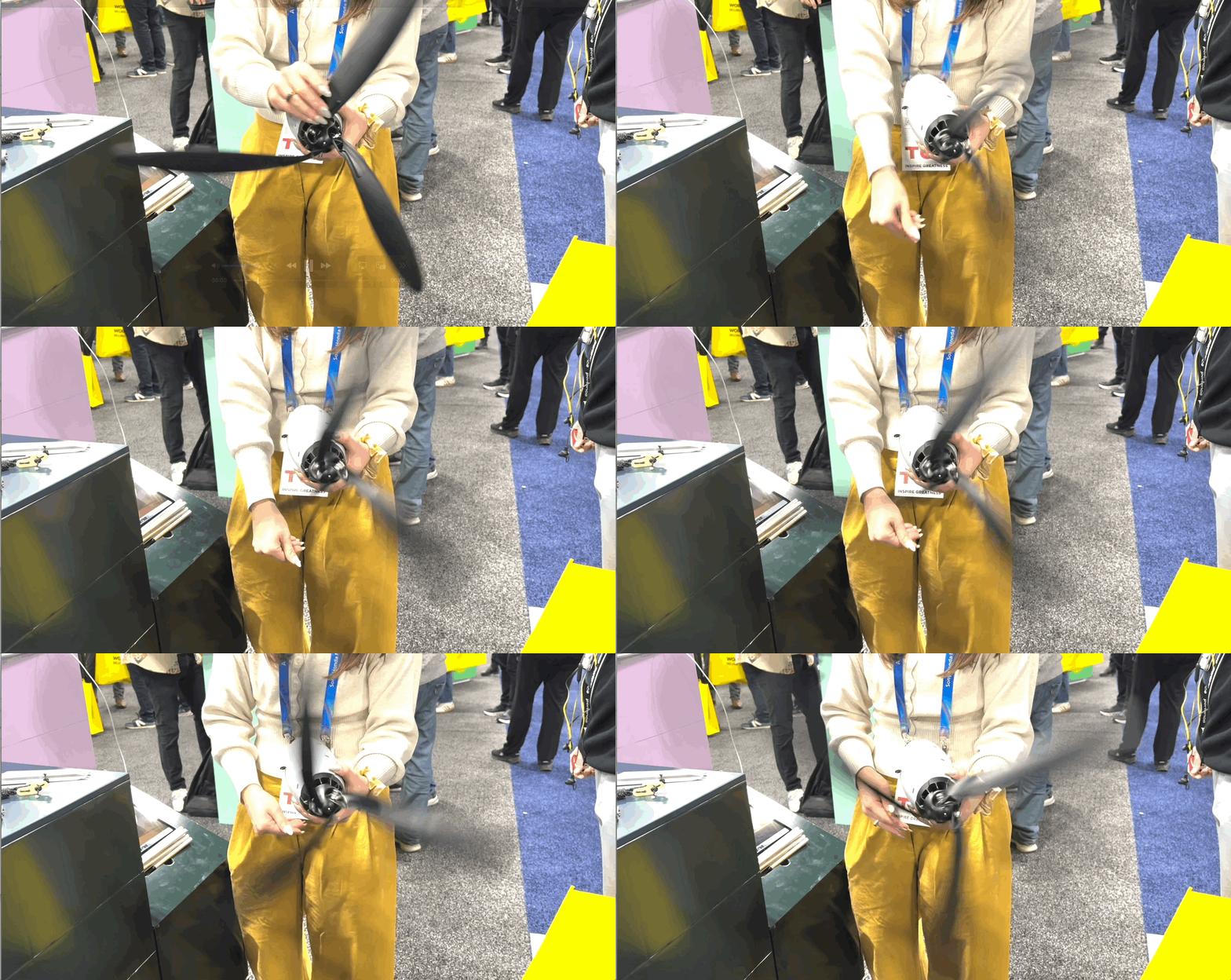
Shine Turbine 2.0
Spinning the Shine 2.0 wind turbine
Amy Skorheim for Engadget
This little guy could be a precursor to some serious personal wind power generation. That’s where the company is heading. For now, the Shine 2.0 can use as little as a light breeze to start generating power to charge your smartphones, laptops or even a power station. The whole unit weighs three pounds and sets up in around two minutes. The second generation model can output up to 75 watts and the company is working on a third version that goes up to 100 watts for even more substantial energy production.
Flint batteries break down by 70 percent in four weeks in a compost pile.
Amy Skorheim for Engadget
When I approached Flint’s booth, the rep told me the company made cellulose batteries. And I thought, like paper-wrapped batteries? Nope. The chemicals inside the batteries are made from cellulose. They have a solvent-free, lithium-free, PFAS-free chemistry and break down by 70 percent in four weeks in a composting environment. They use the same basic architecture as a lithium-ion cell, with an anode, cathode and separator with ion transfers between the two. As of now, Flint is focused on partnering with manufacturers, and consumer products are on the horizon.
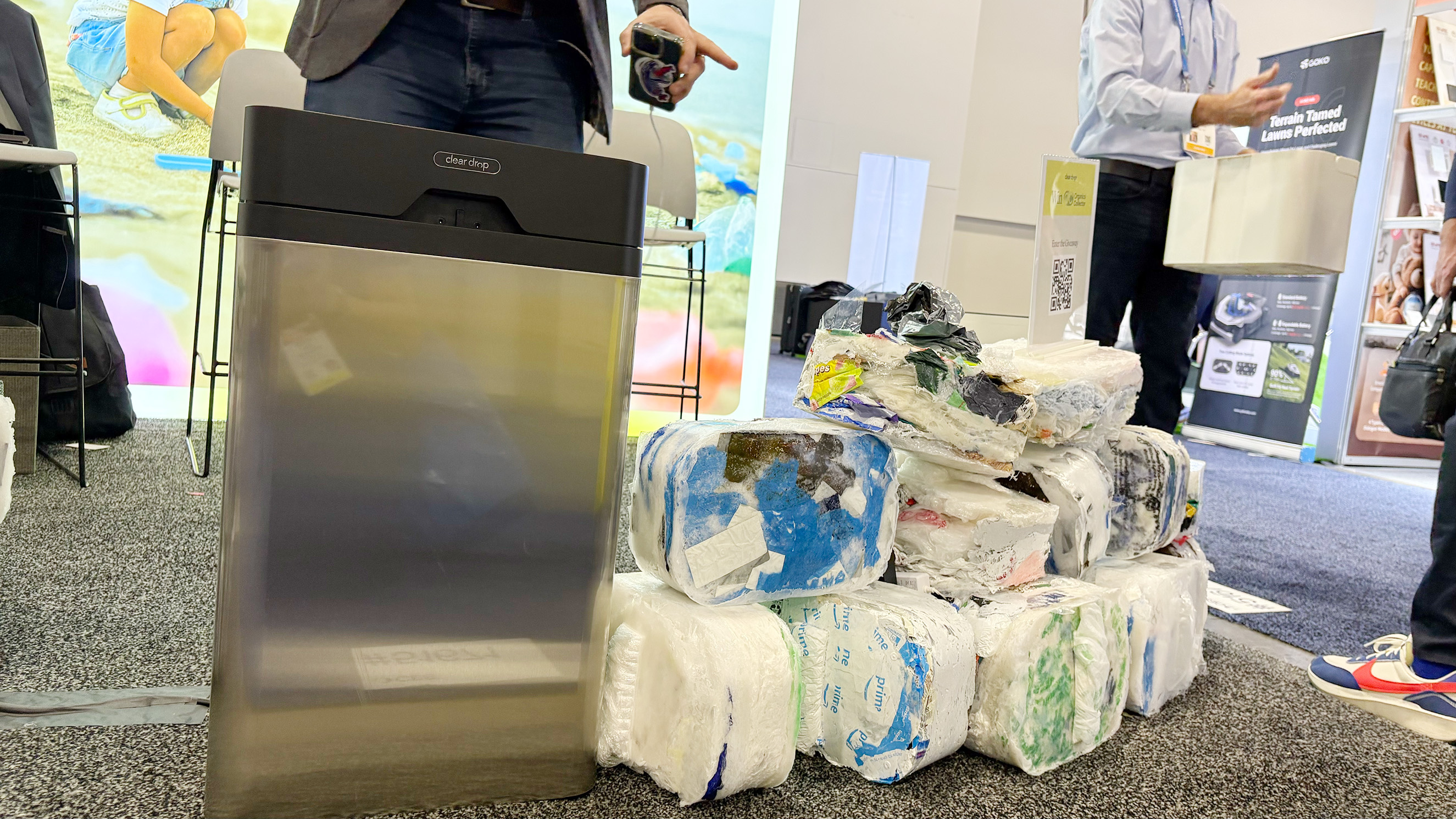
The Clear Drop soft plastics compactor next to a pile of the bricks it produces.
Amy Skorheim for Engadget
The Clear Drop is a soft plastics compactor that creates eight by twelve by four-inch bricks out of hundreds of grocery bags, bubble wrap, ziplocks and plastic packaging. One brick is equivalent to a 30-pound trash bag-worth of bags. Once the brick is created, it can be shipped to one of Clear Drop’s partner facilities in a pre-paid USPS shipping envelope. They currently work with a few US-based recycling facilities and hope to one day create an infrastructure to include municipal recycling.
From what I’ve learned at the show, perovskite is the hottest thing in solar right now. It’s a mineral compound that’s been used to create more efficient solar panels. Some so sensitive to light that just indoor illumination is enough to create usable energy. Alpha Power by CPTI creates lightweight, flexible perovskite solar panels that can conform to multiple surfaces. Again, this is a company that’s partnering with manufacturers, so look for panels built into your laptop to charge it under the glare of your too-harsh office lights.
3D models of buildings using Green Vigor technology.
Amy Skorheim for Engadget
Down in the lower levels of the Venetian Expo at CES I found Green Vigor in the Hong Kong pavilion. This small company has two solutions to create energy for buildings by harnessing the potential energy from existing systems. HydroVigor generates power from water systems. So every time someone washes their hands or flushes a toilet in a building, the roof-top system generates a bit of power. CoolVigor uses the same principles to harness energy from HVAC systems. HydroVigor is currently in use in many buildings in Singapore and Hong Kong and they’re working to expand to more buildings globally.
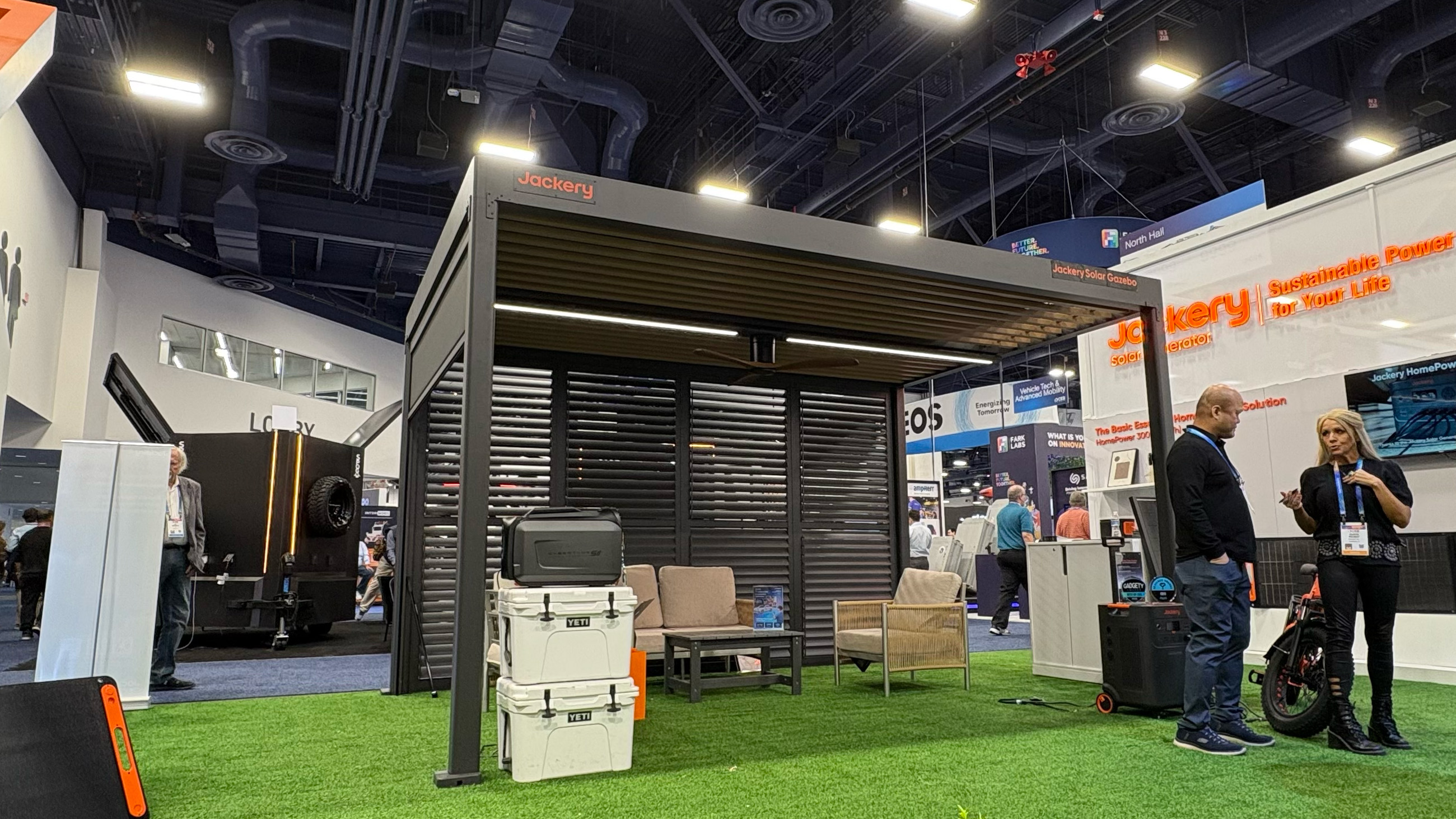
This outdoor hangout spot can produce up to 10kWh of power on a given day. It’s a modular design that lets you choose louvered walls, sunshades, lights and fans when you order it and the solar panels are so strong that a full-sized human Jackery rep was able to stand on a sample panel in front of me and nothing cracked (though the company officially rates it at 20 pounds of snow per square foot). You can use the power directly, tie it into your home system, feed it into the grid or hook it up to one of Jackery’s many power stations to save the power for later. The gazebo costs $12,000 and will ship in mid-2026.
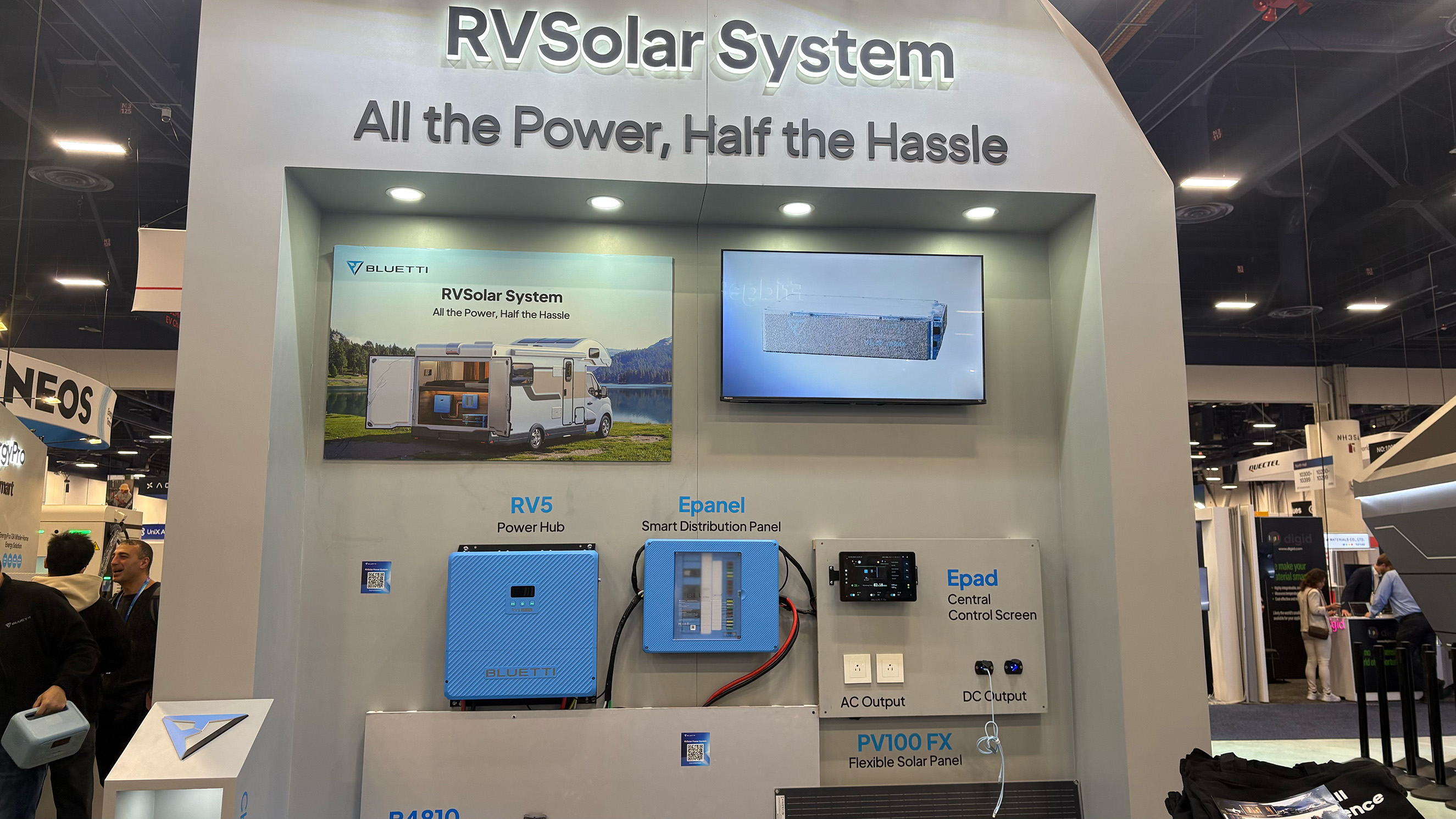
Bluetti, like Jackery, is known for its vast lineup of portable and fixed power stations and batteries. This year, it brought a new power station made with bio-based plastic as well as a DIY system for adding solar power to your existing RV.
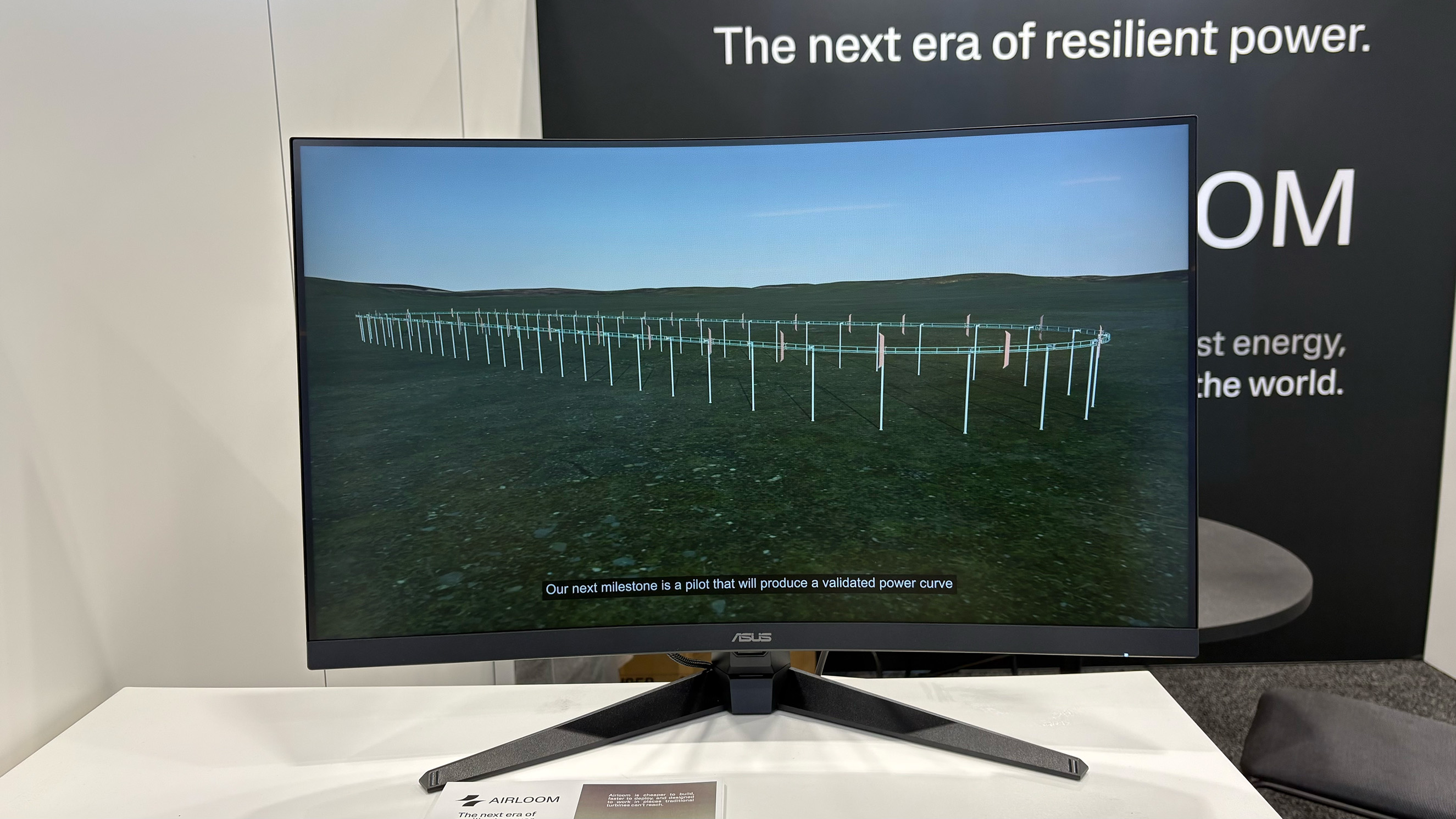
Airloom's roller coaster-like wind power generator for data centers.
Amy Skorheim for Engadget
Engadget’s Anna Washenko does a great job of explaining the tech behind Airloom. In short it’s a roller coaster for wind that’s comprised of 40 percent less mass than a standard wind turbine and uses 42 percent fewer parts and 96 percent fewer unique parts. That makes it faster to deploy and cheaper to instal. I can also be sited in more places. Again, this is a utility-scale solution, geared towards data centers and their insatiable need for energy to power Very Important AI Things.
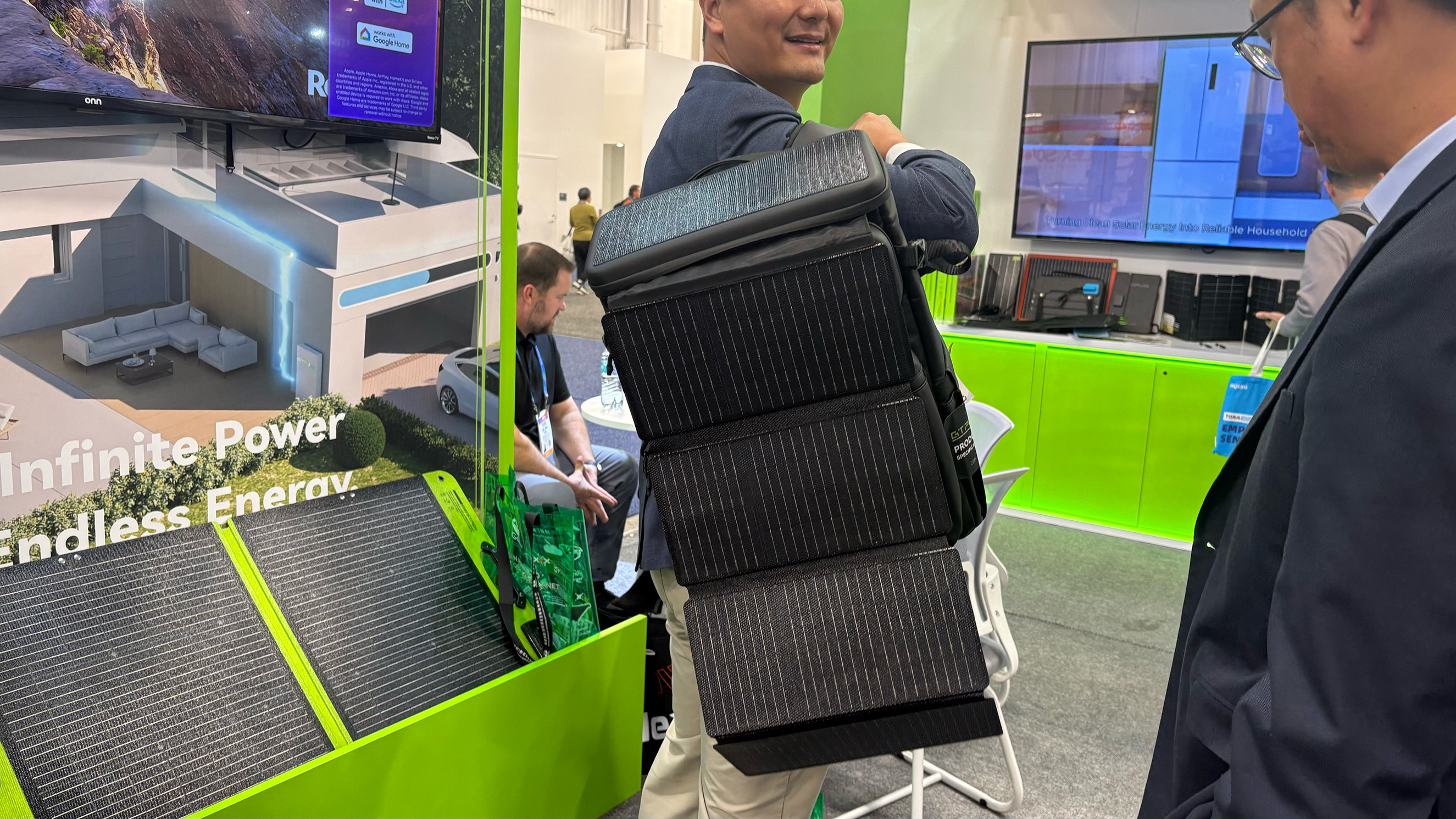
Gaotu had a range of solar products in various formats.
Amy Skorheim for Engadget
If you are looking for a solar-powered anything, hit up Gaotu. At the company’s booth, I saw hats, a fishing chair, a backpack, a sunbrella and a car roof-top enclosure that unfurls to charge up your Tesla. The Shenzhen-based company has been in business for 18 years and plans to just keep sticking solar panels on anything it can.
The single largest booth in the CES sustainability section was Segway. This year, the company showed off two new e-bikes, which our own Dan Cooper covered. This one here is the Muxi, a cargo bike with an easily swappable battery, an optional passenger seat with foot pegs and an optional middle basket. Plus a beverage cup holder.
If we don’t all fall into the ocean before then, perhaps CES 2027 will have a stronger showing of sustainability tech. In the meantime, I’ll take a modicum of comfort in these few brave organizations still dedicated to keeping us afloat.
This article originally appeared on Engadget at https://www.engadget.com/science/ces-so-very-big-so-little-sustainability-tech-180000648.html?src=rss
I’ve always wondered what it would be like to own a plug-in hybrid, and recently, fate handed me that opportunity. On a recent trip to Vancouver, I rented a 2024 Toyota Prius Prime for nearly two months — the ideal scenario to try out North America’s most popular PHEV.
My experience with the Prius Prime
Previously, the words "Prius" and "sexy" were rarely used in the same sentence. However, I think the wedge-shaped Prius Prime introduced for 2023is much sexier than its frumpy predecessors. The sleek shape also pierces the wind better to improve efficiency. It’s lower to the ground than before, though, which can make entry tough for taller or older people.
I was comfortable in the Prius Prime once seated, even though the materials and options aren’t quite as luxurious as other PHEVs sold in the US. On two 10-hour highway drives from Vancouver up to northern Canada I never felt sore (or cold) in the well-bolstered, heated seats. However, visibility wasn’t the greatest due to the low seating position and thick front pillars that occasionally blocked my view of traffic.
Steve Dent for Engadget
With its wraparound dash and 8-inch touchscreen, the interior is reasonably high-tech but not to the standard of some EVs I’ve tried recently. It came with wireless CarPlay and Android Auto support that gave me seamless streaming entertainment on long highway stretches. The driver safety features (lanekeeping, adaptive cruise, automatic braking and more) also boosted my confidence in Vancouver’s gnarly traffic. The Prius Prime doesn’t offer true one-pedal implementation, but it has a mode that’s close to that.
With a two-liter 150 HP gas motor and 161 HP electric motor (net 220 HP combined), the 2024 (fifth generation) Prius Prime has a whopping 100 more horsepower than the previous model. The electric drivetrain is supplied by a 13.6kWh battery (10.9kWH usable) that takes four hours to charge at 240 volts, or double that with 120-volt household electricity. That means you can juice it fully overnight, but it doesn’t have DC fast-charging for speedy power-ups on longer trips. The EPA electric range is 44 miles, 19 more than the fourth-gen Prius.
It accelerated surprisingly well (from 0 to 60mph in 6.7 seconds) and was agile, but had a fair amount of body roll since it’s not designed for the race track. Still, considering the Prius’s reputation as a staid hippie econobox, the new model was downright sporty. I enjoyed driving in the all-electric mode much more than the hybrid mode, though — it was quieter and smoother, with lower noise levels and vibration.
So, how far was I able to drive on that electric motor alone? On the highway at about 65 MPH, I eked out 30 miles and just over 40 miles in the city. On one trip, I drove from the city center to a suburb 30 miles away and made it there and partially back on a full charge. On another voyage, I was able to drive back and forth between the east- and west-most points of Vancouver (13 miles) — a typical commute for many city-dwellers — with about a quarter charge to spare.
Steve Dent for Engadget
With consistent charging, my fuel consumption over a two week period (averaging 25 miles per day) was about a quarter of a tank or around $7.50. In terms of electricity, I used nearly 70.5kWh during that time at $.085/kWh, for a total of $6. All told, I spent $13.50 for gas and electricity over 350 miles of mixed driving, so the Prius Prime was clearly cheap to operate.
For longer trips, it’s still as inexpensive as it gets for a gasoline-powered vehicle, thanks to the efficient ICE motor and hybrid system that’s among the best in the industry. With a full battery charge and tank, I set out on a 547-mile drive and travelled 470 miles before stopping for gas, with a quarter tank to spare. That fill-up cost around $25.
The true savings and the problem with plug-in hybrids
The timing for my test of this car was ideal. In October, I spotted a European study concluding that PHEVs aren’t as economical as expected over a large sample size. Engadget’s article about that stirred up some passion among owners and potential buyers, so I wanted to compare my experience with points in the study.
First, let’s see if a PHEV is worth the extra money compared to a regular hybrid. My calculations are for the average US buyer and don’t take state or federal clean air rebates into account.
When I chose to rent a "compact" car, Avis assigned me a mid-range Prius Prime XSE — a model that lists at $37,320 but typically sells for $34,590, according to Edmunds. That suited me well as it only lacked a few features of the high-end XSE Premium, notably the larger 13.2-inch infotainment display and solar roof option. A fully equipped 2026 XSE Premium model with those features costs $41,665.
Steve Dent for Engadget
Since Toyota also makes a regular hybrid Prius, that vehicle offers an ideal comparison. The equivalent Prius XTE model has a list price of $31,995 in a similar configuration, making it $5,325 cheaper than the Prius Prime XSE.
The average US driver covers 13,662 miles per year and gasoline currently has a median $3 per gallon price. Over that distance, a non-PHEV Prius driver could expect to burn 273 gallons at 50 MPG (EPA combined) in a year, spending $819 on fuel.
A Prius Prime driver, on the other hand, would use 70 to 85 percent less fuel by current EPA or WLPT estimates. If we generously take the high end of those numbers at 85 percent, that cuts fuel costs to $160. That would require using about 2,500 kWh of electricity, though, so at an average US price of $0.18/kWh, that amounts to $450, for a total of $610 (gas plus electricity). That means you’d save just $209 in a year, or $2,090.00 over 10 years — not enough to justify the extra price. (Fuel and electricity prices, usage and other factors vary by region and can have a big impact on those figures.)
It could be even worse than that, according to a European automotive thinktank called Transport & Environment (T&E). After gathering real-world OBFCM data from 800,000 vehicles, they determined that PHEVs only run in all-electric mode 27 percent of the time, rather than 84 percent as estimated by Europe’s WLPT standard. As a result, plug-in hybrids in Europe emit five times more emissions and cost users €500 ($586) more per year than previously thought. Those figures are likely similar in the US.
Steve Dent for Engadget
How could regulators be so wrong about this key data? The first, obvious reason is that they underestimated how often people charge their vehicles. With their relatively short range, plug-in hybrids often need a full charge to get through the day in electric-only mode — but many people aren’t doing that.
Why? One reason may be a lack of easy charger access away from home. I found them to be difficult to find and use, often requiring a sign-up or app rather than just letting me tap a credit card (I’m looking at you, ChargePoint, Flo and Switch Energy). It can also be more expensive than just buying gasoline, since many companies charge triple or more the market rate for electricity. Another factor is that drivers of company or fleet PHEVs charge their vehicles less often than private owners.
There's one additional and especially pernicious reason: The ICE engine often kicks in when PHEVs are supposedly running in all-electric mode, particularly with heavier sedans or SUVs. That’s because the electric motors alone aren’t powerful enough for maneuvers like passing.
Larger batteries can boost all-electric usage, but only to a point. Beyond 45 miles of range, emissions actually increase. The reason is simple: "Long-range PHEVs are the heaviest in the dataset, averaging 28 percent more mass and 33 percent more engine power than the group just below," T&E wrote.
Steve Dent for Engadget
Overall, I enjoyed my time with the Prius Prime and found it to be fun, practical and cheap to drive. It’s the most economical PHEV because it has excellent electric range and enough power that the ICE engine rarely needs to kick in. At the same time, it offers the highest EPA mileage rating of any non-EV sold in North America. If I were in the market for a new vehicle, the Prius Prime would be high on my list.
However, I also learned that PHEVs aren’t reducing emissions or saving buyers as much as regulators and manufacturers have promised. Governments are to blame for much of that, as they overestimated all-electric use in PHEVs and failed to support the charging infrastructure needed to make them practical.
Responsibility also falls to automakers and buyers. Consumers want SUVs, but manufacturers aren’t making the electric motors in PHEVs powerful enough to run all the time in EV mode or offering fast DC charging. At the same time, drivers are failing to charge their vehicles consistently. Until those issues are solved, in my experience plug-in hybrids are a poor substitute for EVs in terms of emissions and a less economical choice than regular hybrids.
This article originally appeared on Engadget at https://www.engadget.com/transportation/toyotas-prius-prime-saved-me-gas-money-but-probably-not-the-environment-133027378.html?src=rss
You may be surprised to learn electricity only accounts for 21 percent of the world’s energy consumption. Fossil fuels and the rest all play their part to make the world go around, but their role is likely to diminish no matter what happens. The International Energy Agency believes electricity’s share of global energy consumption is going to double in the next decade alone. You all know the causes: Electrification, EVs, data centers and AI mean the planet needs to dramatically increase its power generation, transmission and storage capacity. It’s a shame, then, that the world is nowhere near ready to satisfy such an outrageous surge in demand.
Re-learning to love the atom
The US has certainly spent the year opening doors to dramatically increase domestic energy production. Part of that has to give the signal that the US will embrace nuclear power in ways it hasn’t for generations. This January, an executive order titled Unleashing American Energy included an instruction for the government to eliminate rules and regulations related to power generation. Its primary focus was to destroy environmental regulations limiting the extraction of oil, natural gas and coal, but also to remove roadblocks to the construction of new nuclear plants. Then, in May, a subsequent order declared a desire to ensure the deployment of “advanced nuclear technologies.”
As the driving force behind the AI push, big tech has made some high profile moves to buy up extra generation capacity. Meta signed a 20-year deal with Constellation to own the output of the Clinton Power Station, preserving the 1.1GW facility once its state tax credit expires next year. Microsoft has its own 20-year deal with Constellation to own the power generated by reactor 1 at Three Mile Island, now renamed the Crane Clean Energy Center. On November 18, that project was also given the backing of the Department of Energy which authorized a $1 billion loan. But even without the backing of big tech, other mothballed reactors are being restarted, like the Palisades plant in Michigan. Earlier this year, the Department of Energy handed out a $1.52 billion loan to get the facility, capable of generating 800MW, back up and running.
Big tech is also betting on the future of nuclear power, signing deals with a number of startups looking to build out a new generation of reactors. Google, for instance, has backed Kairos Power and its plan to build a series of small, modular reactors. Amazon, meanwhile, invested in X-Energy and has published plans for its own buildout in Washington State.
It’s not just the US that is learning to fall back in love with nuclear power, as the rest of the world is also building out new capacity. The World Nuclear Association says there are 70 reactors currently under construction across 15 countries. Russia, India, Argentina, Turkey, South Korea, Japan, and Brazil, to name just a few, are all working on new reactors.
China on its own is presently building 33 reactors and, as Nuclear Business Platform reported earlier this year, greenlit a further 10 this April. That same report adds that China’s policy of producing multiple reactors at a time has seen costs crater. It says that while the UK’s two new reactors at Hinkley Point will cost in excess of $60 billion, each of these new reactors will cost $2.7 billion.
Bridging the nuclear gap
coal handling in a port
Indigo Division via Getty Images
Building a nuclear reactor is not a swift process, and construction of a facility can take the better part of a decade. You can add on a few more years if you include the necessary procedural steps that need to be undertaken before a single piece of concrete is poured. Consequently, any major shift in the US’ power generation fleet will be measured in generations, rather than years. It’s a concern that, for all of the attention nuclear power is getting, it’s merely a smokescreen for a renewed push for fossil fuel extraction.
After all, one major casualty from the Big, Beautiful Bill was the eradication of subsidies for the US’ solar industry. As we reported back in July, the act has kicked the legs out from domestic solar panel manufacturing, handing renewable energy dominance to China. This goes hand in hand with the US Department of Energy setting up a $625 million funding stream to revive America’s coal industry and recommission old power plants. Or that it is also awarding contracts to grow America’s strategic petroleum reserve.
Back in September, Energy Secretary Chris Wright made the implausible claim to BBC News that fossil fuel extraction was nothing to worry about as fusion power would be on the grid in the next decade. Wright, himself the former CEO of fracking company Liberty Energy, was taken to task by a number of climate experts for publishing a report riddled with “misleading or fundamentally incorrect” assertions. Similarly, on November 20, the Department of Energy reshuffled its org chart to eliminate several departments responsible for renewable energy and energy efficiency while forming the Office of Fusion.
Solar’s unstoppable rise
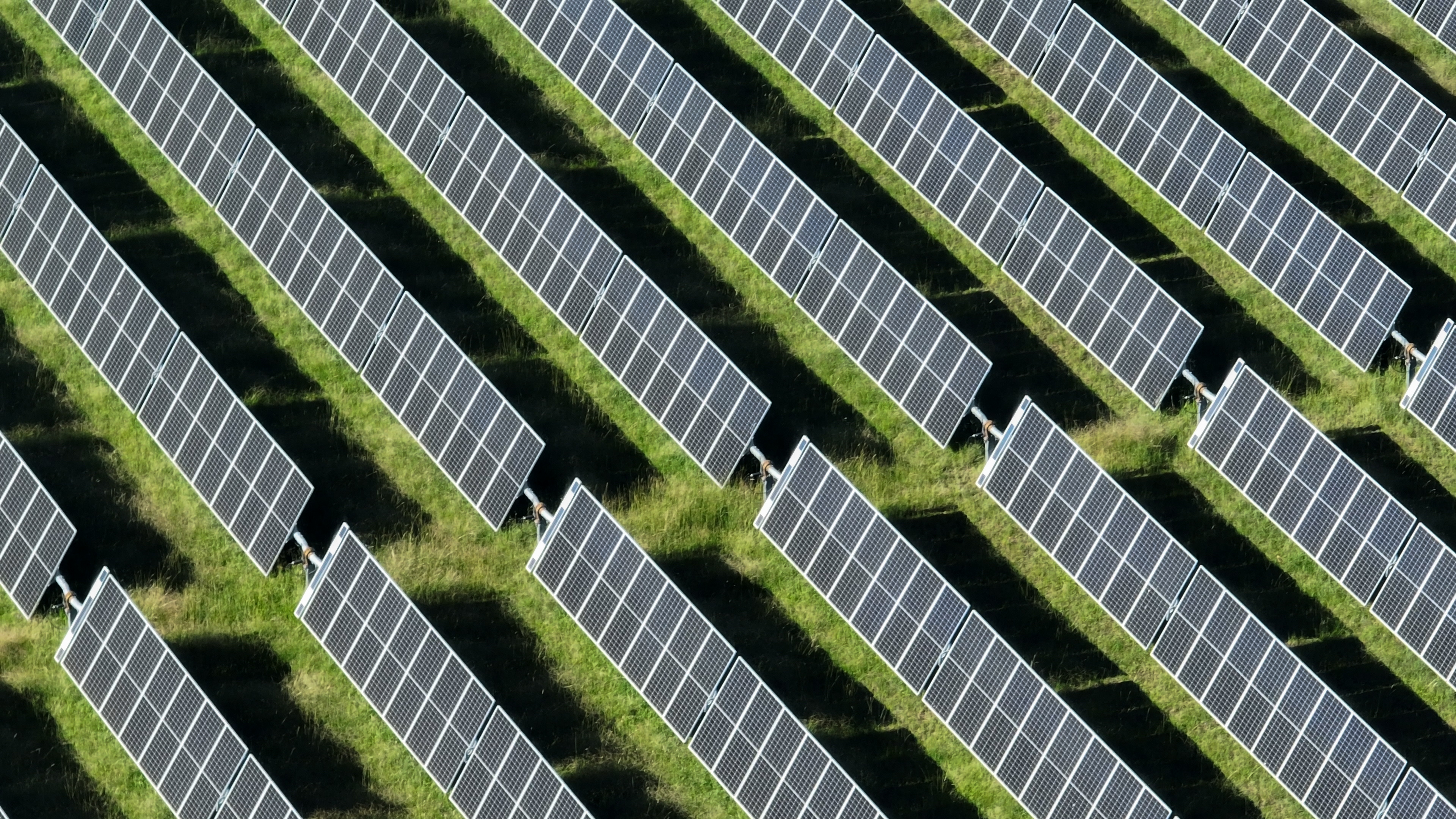
This stunning aerial view captures an array of solar panels arranged in neat, parallel rows across the landscape. From above, the panels shimmer under the bright sunlight, creating a striking contrast against the natural terrain below. The organized rows of solar panels stretch across acres of land, symbolizing the growing global shift toward renewable energy. The grid-like pattern highlights the efficiency and scale of modern solar farms, contributing to sustainable energy production.This high-resolution image showcases the incredible reach and potential of solar power as a clean, renewable energy source. Whether situated in rural fields, expansive deserts, or atop rooftops, these solar panels represent a major step toward reducing carbon footprints and combating climate change. The solar farm's orderly rows and reflective surfaces create a visually appealing scene, demonstrating both technological innovation and environmental responsibility.
Diane Keough via Getty Images
The US may have kneecapped its domestic solar industry, but it may not be enough to defeat renewables’ momentum. In October, the International Energy Agency projected renewable energy will grow by 4.6 TW by 2030 — a figure equal to the combined generation capacity of China, the EU and Japan combined. 77 percent of that figure is expected to come from solar power alone, despite the loss of subsidies in the US and less favorable circumstances in China.
The domestic US forecast has been revised downward significantly as a consequence of its policy choices. But despite this, the obvious benefits of solar power haven’t gone away even if the price may be higher than it was at the start of the year. It remains the fastest and cheapest way to add new power in many countries, and can be installed on a grid or individual basis. Not to mention its utility in remote areas with poor generation resources, where it can reduce dependency on fossil fuels. This year, clean energy think-tank Ember reported on the growth of solar power in the last decade, and how it went from adding just one percent of global power generation in 2015 to 8.8 percent in the first half of 2025.
“AI demand for electricity is the macro driver of US made solar,” said Rob Gardner, VP at the Solar Manufacturers for America Coalition. “AI investments can’t deliver expected returns without quickly deployed power, and US solar is the fastest and cheapest to deploy,” he said. Gardner cited a recent FERC forecast which predicts that 92.6GW of solar will come online between now and July 2028.
The dream of fusion
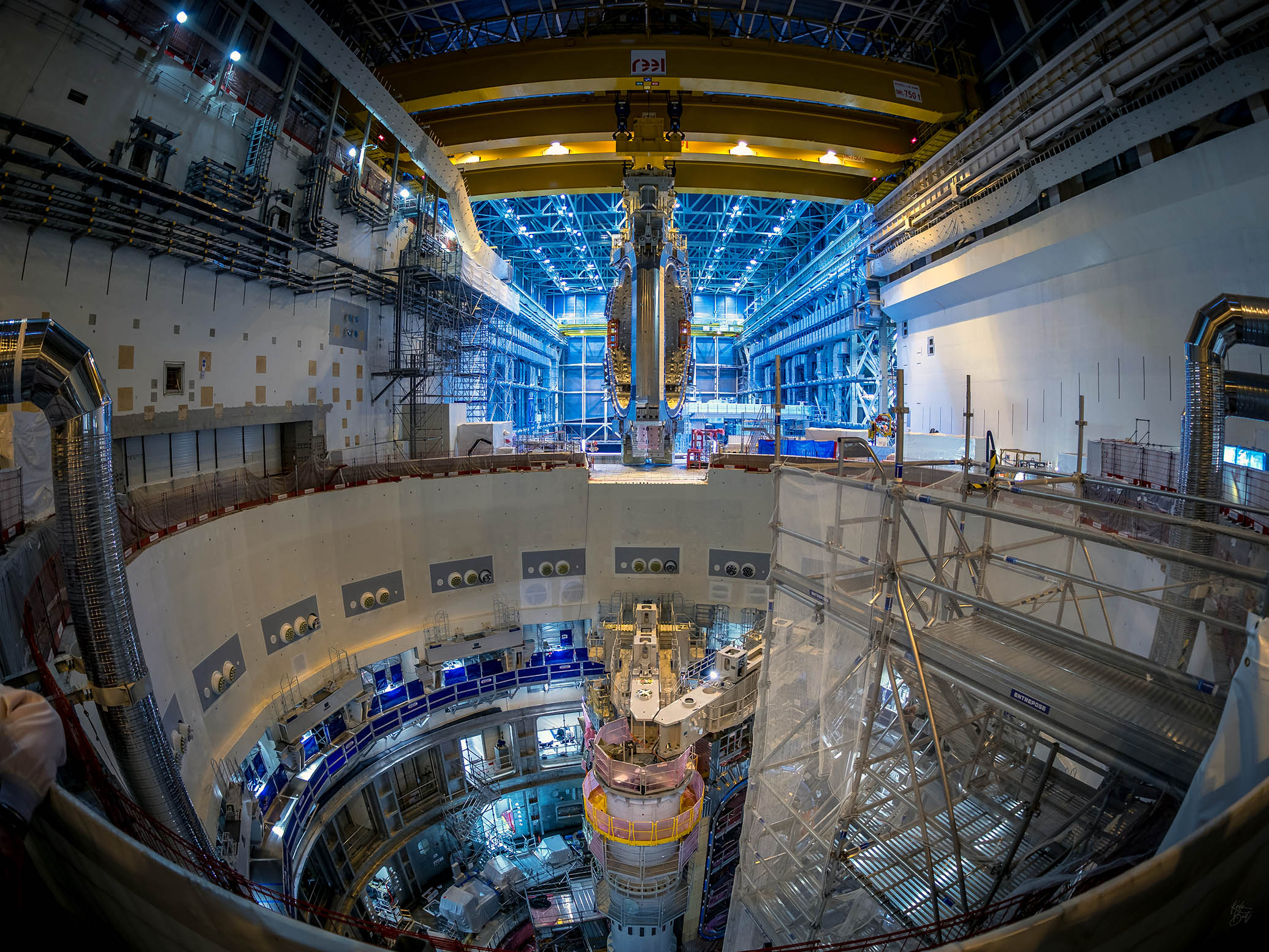
Construction inside the reactor of ITER.
ITER
The US is pinning a lot of its hopes on fusion power to wipe away the debt of our fossil fuel past. Earlier this year, the Department of Energy released a roadmap to get fusion out of the lab and into the world. It wants to coordinate the remaining resources of the federal government to close the fusion world’s “critical science, materials and technology gaps.” In the next three years, officials have been tasked with designing facilities for reactors and developing sources of fuel. Within the next decade, it’s hoped the government will be able to offer large-scale fuel cycle plants to help private sector plants start operations.
If fusion power can be harnessed, it has many of the same upsides as nuclear fission with a lot fewer downsides. If nuclear fission harnesses the energy released when an atom is broken apart, then fusion harnesses the energy released when two smaller atoms are smashed together to create a larger one. It harnesses the same principle as you’ll find inside our sun: Superheated hydrogen atoms fusing to create helium. And while nuclear fusion requires radioactive material, we can source deuterium and tritium from water and lithium.
ITER (International Thermonuclear Experimental Reactor) is a giant experimental fusion reactor under construction in France which, when operational, will be the world’s largest. It is backed by a coalition of nations, including the US, EU and China, and has the aim of both generating power and developing the technologies necessary to make Fusion a reality. The organization claims that there is enough of both materials available on the planet to run fusion plants for at least a thousand years, if not longer. There are also a raft of safety benefits, as there’s no creation of the sort of long-lived and dangerous waste associated with nuclear power, no risk of a meltdown, and its raw materials can’t be used to make weapons.
But while fusion is entirely possible, and on paper could be the salve to all of the world’s energy ills, it’s not yet a reality. There are a large number of engineering challenges sitting between us and a viable commercial reactor. The shift that has happened this year is that fusion is now being treated as a “strategic national priority,” according to the International Atomic Energy Agency. More than 160 fusion facilities are operational worldwide, each one looking to explore ways of solving the hard problems standing between us and limitless power.
But as well as ITER, there are other major nations working to build out their own fusion capacity. The biggest would likely be China’s Experimental Advanced Superconducting Tokamak (EAST) which has already set a record for energy generation. At the start of this year, it was able to produce a steady state for 1,066 seconds.
But what we are seeing now, which may offer some degree of hope, is the surge in interest from the private sector. Companies like Commonwealth Fusion, Type One Energy, Helion and Pacific Fusion are all working on their own fusion facilities. These projects have received billions in funding, but it’s likely all will need time to work out if their approaches are viable.
Stuart White is a spokesperson for Tokamak Energy, a British-Japanese startup spun out from the UK’s Atomic Energy Authority which is developing its own fusion technologies. In 2022, the company’s own reactor was able to reach a plasma temperature of 100 million degrees celsius. “It’s an incredible achievement but that isn’t going to power homes around the UK or anywhere,” he said. White believes the fusion world will spend the next decade “scaling up,” projects to find the right pathway to building commercial reactors. He cited national programs, like the UK’s STEP which is targeted to begin working in 2040, while the US’ plan for the mid-2030s he feels is “aggressive.”
White also explained that, as equally important as solving the key physics issues, is building out the supply chain to actually make the equipment. He cited the importance of manufacturing in Japan and China to produce the hardware necessary to build fusion reactors. And that this process, while time consuming now, will help accelerate the eventual development of the technology down the line. White added that another positive sign is that regulators aren’t likely to want to scrutinize fusion reactors with the same intensity as they do nuclear reactors. That will both speed up the construction of new facilities and reduce costs when they do eventually enter service.
What’s clear, however, is that Fusion is not going to be able to swoop in and decarbonize the world’s energy needs in the sort of time scale it’s likely to be required. (White said it is likely to arrive in time to complement other clean sources of energy over the next half century, rather than so quickly that every other power station gets mothballed instantly.) Consequently, the government of the world must keep prioritizing the rollout of renewables rather than hoping that fusion will simply bail everyone out in the next decade.
This article originally appeared on Engadget at https://www.engadget.com/science/in-2025-ai-and-evs-gave-the-us-an-insatiable-hunger-for-power-133000673.html?src=rss
EV maker Polestar has announced that it's bringing bi-directional charging — the ability for an electric car to be tapped as a battery for your home or the grid — to Polestar 3 owners who live in California. The feature is one of several ways EV owners can save money with their electric car, by either using less energy overall, or receiving credits for providing their excess power to the grid.
Polestar's bi-directional charging feature uses direct current, according to the company, and enables "V2H functionality for Polestar 3 customers on the 400 Volt electrical architecture." Polestar is offering the feature in partnership with home energy company dcbel, who helps administer a California Energy Commission program for installing "home energy stations" that can manage multiple clean energy sources in residential homes, including EVs with bi-directional charging. Polestar claims that using dcbel's Ara system, customers can "reduce charging costs by up to $1,300 per year and use their car as an energy backup during blackouts for up to 10 days."
The ability to send excess charge from an EV battery back into your home was originally a major selling point of Ford's F-150 Lighting. Bi-directional charging has also shown up on GM's EV lineup and the third-generation Nissan Leaf. Polestar says it'll continue the development of the bi-directional charging capabilities of its cars and "plans to introduce a wider offer in the future." While this partnership is the first time the EV maker is offering the charging feature in the US, Polestar already offers bi-directional charging to customers in Germany via a home charger it developed with Zaptec.
If you live in California and own a Polestar 3, you can apply for rebates on a home energy station at dcbel's website so you can try the feature for yourself.
This article originally appeared on Engadget at https://www.engadget.com/transportation/evs/polestar-evs-can-power-your-home-in-california-220215757.html?src=rss
General Motors announced that it will cut more than 1,700 manufacturing jobs in reaction to changes in the electric vehicle market. "In response to slower near-term EV adoption and an evolving regulatory environment, General Motors is realigning EV capacity," the company said in a statement reported by CNBC. "Despite these changes, GM remains committed to our US manufacturing footprint, and we believe our investments and dedication to flexible operations will make GM more resilient and capable of leading through change."
The layoffs are primarily happening at a Michigan plant that builds GM's EVs and at an Ultium Cells battery cell plant in Ohio. The company is also "temporarily" laying off 700 at an Ultium Cells plant in Tennessee.
The regulatory issues in question are likely the $7,500 federal tax rebate that had previously been granted to EV purchases, which expired earlier this year under the "Big Beautiful Bill" that made things a lot less pretty for many environmentally-focused programs and industries. But GM had also said earlier this month that it would sunset much of its hydrogen fuel cell R&D in order to place more focus on batteries, charging tech and EVs, so announcing layoffs in those very areas is a rough move.
This article originally appeared on Engadget at https://www.engadget.com/gm-will-cut-more-than-1700-jobs-in-ev-and-battery-manufacturing-200814378.html?src=rss
Hydrogen-powered vehicles haven’t really caught on as an alternative means of eco-friendly transportation. Hyundai, however, hopes to fix that with a bigger investment in the technology and its newest hydrogen-powered concept SUV called the Initium.
Hyundai announced it plans to start production on the hydrogen SUV in the first half of next year. The Initium can run approximately 404 miles on a single refueling and can also run on electric power as a backup that can be recharged from a household electricity supply. The vehicle will also make its public debut at the LA Auto Show and Auto Guangzhou in China next month. It’s not yet confirmed where the cars will be available when they go on sale so a US launch isn’t guaranteed.
The Initium may just be a concept car for now but Hyundai seems committed to bringing its newest hydrogen car to drivers quickly, even if the fuel source hasn’t made nearly as many strides towards widespread acceptance as electric options. The South Korean carmaker is planning on investing $4 billion to develop its hydrogen vehicle technology and infrastructure to meet its complete carbon neutrality goal by 2045 with cars like the Initium and the electric Ioniq 5 unveiled last year.
Hydrogen may be an efficient alternative to gasoline but it still has a ways to go to be competitive with electric vehicles (and that’s without acknowledging the continued prevalence of gasoline-powered cars). There are only 59 hydrogen charging stations in the US with most of them in California, according to the US Department of Energy. There are only a handful of carmakers who still offer a hydrogen powered option including Hyundai (the Nexo SUV) and Toyota (the Mirari). Honda used to offer a hydrogen car with The Clarity but it ended production in 2021, according to Car & Driver.
This article originally appeared on Engadget at https://www.engadget.com/transportation/evs/hyundai-reveals-its-newest-hydrogen-powered-vehicle-the-initium-192235417.html?src=rss