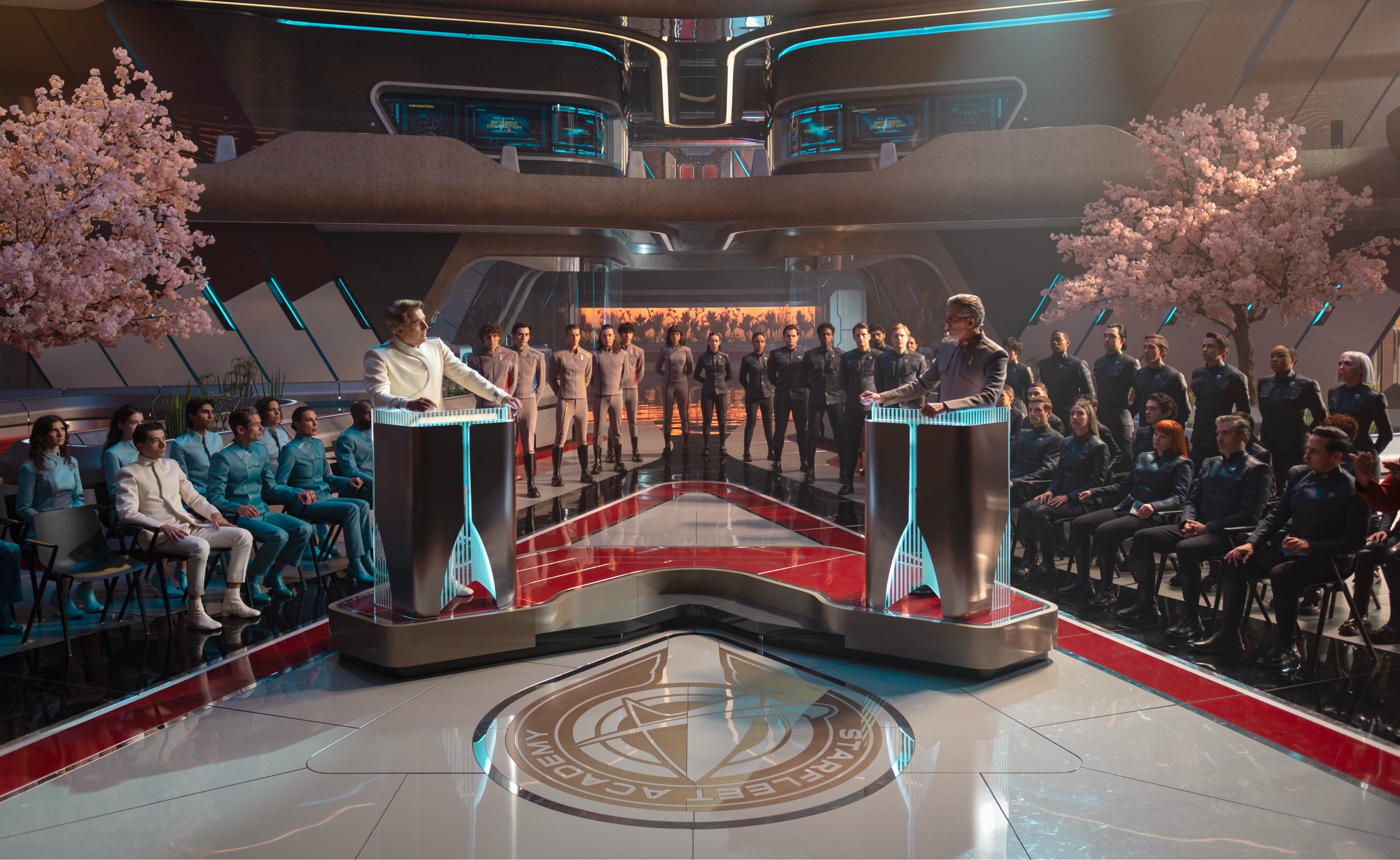
Star Trek: Starfleet Academy deftly balances teen drama with intergalactic intrigue

Star Trek is in a weird place right now. Less than three years ago we were living in a golden age with five shows on the air, all with different styles and intended audiences.  But the universe rapidly contracted, with Picard ending while four other shows were cut short. Strange New Worlds still has another two seasons left, sure, but even that final season got truncated. As it stands, there’s only one project with a firm future right now, and that’s a brand-new show, Starfleet Academy, premiering January 15 on Paramount+.

How this show is received could very well determine the future of Star Trek. That’s a lot to put on it, but there’s something very appropriate given the subject matter. Starfleet Academy takes place in the 32nd century, 900 years after the adventures of James T. Kirk and company, and it takes place at the titular academy, meaning its principal cast is a collection of teens representing the next generation of Starfleet officers. That focus on a younger cadre has led to fans online derisively calling the series “CW Trek” without seeing a single episode. 

As Starfleet Academy is technically a Discovery spinoff, it picks up some of that series’ traits. The sleek, shiny sets are back, as well as a few plot threads originally set up in Discovery. The most notable is the collapse of the United Federation of Planets and the rebuilding of both the Federation and Starfleet. In fact, the series picks up on that as early as its second episode, with the Academy hosting a delegation from a once stalwart Federation planet that’s now gone isolationist. 

Scenes from Star Trek: Starfleet Academy
John Medland/Paramount+

While many complaints about the series have focused on how what fans wanted was an academy show set during the 24th century (the time of The Next Generation, Deep Space Nine, et al.), this particular episode plot works precisely because of the distant future in which it is set. In a fully-functioning galactic democracy like the United Federation of Planets, there’s no logical reason for the average 18-year-old college freshman to be involved in interplanetary diplomacy. But in the 32nd century, the Federation is a lot scrappier and the individuals involved might be asked to wear many hats. It’s a lot like an early-stage tech startup.

The setting also lets the show be a little more creative with its cast: where TNG featured the first Klingon in Starfleet (Worf), 900 years of progress have created a Starfleet where no one bats an eye when a Klingon cadet like Jay-Den Kraag (played by Karim Diané) shows up to study science. There’s also a holographic cadet, Sam, who is the first of her kind to attend the academy (and she’s super excited to do so). A few new species are present as well: Darem Reymi (George Hawkins) is a Khionian and Genesis Lythe (Bella Shepard) is a Dar-Sha, both aliens making their debut in the Star Trek universe.

The cast of Star Trek: Starfleet Academy
John Medland/Paramount+

However, the show does still lean on some Trek stalwarts, and it’s these characters that have gotten the most chatter from fans. Mary Weisman as Sylvia Tilly was originally slated for the cast, and there was even a backdoor pilot-esque episode of Discovery to tie her in to the new show, but she’s no longer a regular and is nowhere to be seen in the first two episodes. Instead, we have Jett Reno (played by the wonderful Tig Notaro) as supporting cast, and Admiral Vance (Oded Fehr) appearing in a few episodes. And old school fans have been abuzz by the inclusion of The Doctor, who first appeared on Voyager (and later Prodigy). As a hologram, he’s practically immortal so his presence doesn’t need any convoluted explanation, and after 800 years he’s still the same gregarious blowhard (and it’s delightful).

They’re joined by new characters like Lara Thok, a part Klingon, part Jem’Hadar security officer and a Lanthanite chancellor, Nahla Ake, played by Academy Award Winner Holly Hunter. And Hunter isn’t even the only Oscar winner on the cast, with a major villain, Nus Braka, being portrayed by Paul Giamatti.

It’s a stellar cast, and the show’s sets certainly rise up to meet the challenge. Like in the shows of old, a good portion of Starfleet Academy is clearly shot on location, though not in the familiar water reclamation plant that was used back during the TNG and DS9 era. This time it’s all being shot in Ontario, with the outdoor scenes in particular being filmed in Waterloo. Regardless of where it’s shot, it looks enough like sunny California to work. 

Scenes from Star Trek: Starfleet Academy
John Medland/Paramount+

The indoor scenes, shot at Toronto’s Pinewood Studios, have a pleasant convention center quality to them, with lots of wide hallways and large windows in contrast to Discovery’s cramped ship corridors. The hallways are full of students and teachers going to and fro, including some from species that would normally be off-limits to a show with a limited budget. But here robots and strange aliens roam freely in the background. The CGI can’t have been cheap.

And that’s ultimately my biggest question about Starfleet Academy. Exactly how much is this costing Paramount? So much of it is being shot on real sets instead of green screens, established actors like Hunter and Giamatti couldn’t have been cheap, and plentiful CG points to a robust special effects budget. Though Paramount doesn’t release official numbers, estimates have put an average episode of Strange New Worlds at $10 million, so it figures that Starfleet Academy is probably more than that, with some online estimates as high as $20 million per episode. 

With 10 episodes scheduled, that’s on par with a major motion picture budget but without the promise of blockbuster box office returns. No wonder Paramount has been doing so much cost-cutting, which includes axing every other Star Trek show.

That said, Starfleet Academy is carrying a lot on its shoulders. Just as the success or failure of its class of Starfleet cadets will determine the future of Starfleet and the Federation, the success of the show may even affect whether this era of Star Trek continues. As a Star Trek fan, this can be nerve-wracking; no one wants the franchise to go dormant again. But Starfleet Academy has so far shown itself to be up to the challenge.


This article originally appeared on Engadget at https://www.engadget.com/entertainment/star-trek-starfleet-academy-deftly-balances-teen-drama-with-intergalactic-intrigue-170253808.html?src=rss

Fortnite Festival tries to bring back the heyday of music gaming

Between Fortnite’s propensity for big-name concerts and Epic’s purchase of Harmonix two years ago, the inclusion of some kind of music-making feature in the game was inevitable. What Epic is releasing today is actually far grander: an entirely new mode called Fortnite Festival, a social space where players can team up to perform their favorite songs or jam together on new mixes.

There are two options, or stages, for users to play in the new mode. The main stage, or championship stage, is basically the Rock Band experience recreated inside Fortnite. You’ll form a band with friends and choose a song to perform. Then you play the song using the standard music game format where notes slide down vertical bars, hitting the correct button when the note reaches the bottom. Players can, of course, hear the song as they play it, which can be embarrassing if you’re not that good. Each performer earns points, which in turn leads to XP and character progression in the greater Fortnite ecosystem.

While the main stage may be old-hat to anyone present during the zenith of music games in the 2000s, the jam stage draws from Harmonix’s more recent (and less popular) mixing titles, Dropmix and Fuser. While both of those games had competitive modes, they were a lot more fun as music-making toys, where players could just throw different parts of popular songs together and see what comes out. Jamming in Fortnite Festival is pretty much that, but collaborative.

Fortnite Festival
Epic Games

When you first drop into a jam, your avatar will be standing in a virtual world full of stages, clubs and green spaces. It has an amusement park-like feel, similar to Disney World’s long-gone Pleasure Island. Despite the world’s appearance, you don’t have to climb on stage to play music, you can start jamming wherever you want by pulling up the emote wheel. The actions here have been replaced with song options. Just pick a song and instrument, and your character will start playing. It’s not the entire song, but rather one particular piece of it. To assemble something more complete, you need to collaborate with other players.

Jamming with other players is incredibly easy. All you need to do is walk up to someone who’s already playing (helpfully indicated by a wavy circle) and activate your own emote wheel. The system will automatically mix the two songs together no matter the genre or style. You want to add the vocals from The Killers’ “Mr. Brightside” to the synth from “Gangnam Style?” Go right ahead, and don’t be surprised when someone else drops in the beat from The Weeknd’s “Blinding Lights.”

Instruments can be swapped out on the fly, and the key and tempo can also be tweaked to make a slow song fast or vice versa. There’s a lot of room for creativity here, as well as cacophony as the levels fill up.

While Fortnite Festival draws heavily on Dropmix and Fuser it has one key advantage over those two titles, one that could lead to success where its predecessors failed: it’s free. All three of the new Fortnite modes will be free, but Festival is a standout since it relies so heavily on licensed music. One huge barrier to entry for music games has always been the additional costs, especially the song packs. $2 for your favorite Nirvana or Bad Bunny tracks might not seem like much at first, but it adds up, and any online cost can be insurmountable to a kid without a credit card. The fact that this is a music game that anyone can download for free on their computer, console or mobile device without being bombarded with ads means it has the potential to make music games popular again.

This article originally appeared on Engadget at https://www.engadget.com/fortnite-festival-tries-to-bring-back-the-heyday-of-music-gaming-153624729.html?src=rss

Fortnite aims at the survival-builder crown with its new Lego mode

Remember when Fortnite was just a battle royale game? After six years of storylines, concerts and even Olympic events, Fortnite has grown beyond its roots into a general catch-all social space. And Epic Games isn’t going back, expanding the Fortnite experience even further with three new modes announced at its Big Bang Event this weekend: a racing game, a social music experience and, most importantly to kids, a Lego-themed survival builder that launches today.

If “Lego-themed survival builder” sounds suspiciously like Minecraft to you, you’re not wrong. Minecraft itself has been burdened with comparisons to Lego since its release over a decade ago; this is just the Lego company returning the favor. There’s a survival mode, where your little Lego minifig explores a verdant landscape punching trees and rocks to gather supplies for building. There are skeletons that wander around at night and will attack if they spot you. Various animals wander around that can provide resources: If you pet a chicken it will produce an egg, though I accidentally punched it first and got nothing as every other chicken proceeded to avoid me for the rest of the day.

Once you get into it, though, the comparisons fall away. The procedurally-generated landscape is realistically rendered thanks to the power of Epic’s Unreal Engine, with natural-looking trees covered in individual leaves and blades of grass that blow in the wind. Punching or chopping natural features is what turns them into Lego elements. It’s weird, almost like you’re colonizing the real world by turning it into a Lego one. It’s also huge, about 20 times the size of the battle royale island.

Once you’ve obtained the materials, building is rather simple. There’s a list of building plans, and your character adorably holds a Lego tile with blueprints on it while you’re in the construction mode. Players get a handful of essential recipes to start like a campfire to keep warm and a shack for shelter, and they can earn more as they play and level up. The game will helpfully sketch a ghostly outline of where each component goes, asking the player to slide and lock it into place. There’s no place for error or major creativity in the basic survival mode — that’s what the sandbox is for. There, all of the building plans will already be unlocked, leaving players free to let their imaginations go wild.

There’s plenty here for Lego devotees, as Epic has scanned around 10,000 different Lego elements for use in the game. All of your favorite pieces should be present, and the company plans to add more in the coming months (there are over 30,000 unique Lego elements total). As this is an official collaboration with the company, many of the graphical assets were received directly from Lego, and only “legal” builds will be allowed (as opposed to “illegal” builds, which refer to Lego configurations that in the real world, may stress or break pieces). Hardcore Lego aficionados will definitely appreciate the attention to detail.

LEGO X Fortnite
Epic Games

And Epic would certainly like to see more Lego fans playing Fortnite, especially kids. Though it started life as a violence-oriented game, the title has evolved into a gathering space where kids sign on just to socialize with friends. The Lego feature, along with the two other modes Epic announced over the weekend — Fortnite Festival and Rocket Racing — are Epic’s way of facilitating that by providing activities that are more than just running around and shooting. By eschewing the violent elements (as well as controversial practices like loot boxes), Epic also hopes to make Fortnite more palatable to parents.

Lego Fortnite, similarly to Minecraft, lets you customize the challenges you'll face in your world. You can toggle gameplay basics like enemies, hunger, temperate damage, stamina and so on, along with some more advanced features. The mode supports up to eight players in a party, and you can delegate seven of your friends as "key holders" to your world, allowing them to access and edit it when you're not around. Each player can have eight worlds saved to their profile. 

As for existing Fortnite players, they’re free to continue playing as they always have and completely ignore the new modes – the only difference they’ll see is that the main menu has been expanded a bit to accommodate the new options. But, if they do decide to try out the Lego mode, they’ll find plenty that’s familiar, as over 1,200 skin options have already been translated into minifigs, and there are 100 emotes for your character to perform. Players will still earn XP, which will go into their overall stats, as opposed to remaining walled within the Lego mode. Cosmetic elements can be used between modes as well and, when you tab between options in the in-game locker, it will tell you what modes each skin is compatible with.

As this is Fortnite, all of the new modes will be free-to-play, including the Lego survival builder. Epic hopes this will bring new players in, though it remains to be seen whether it can draw significant market share from Minecraft. Existing players will see the new option pop up today (December 7), with the other modes set to follow this week.

This article originally appeared on Engadget at https://www.engadget.com/fortnite-aims-at-the-survival-builder-crown-with-its-new-lego-mode-151433897.html?src=rss

Fortnite aims at the survival-builder crown with its new Lego mode

Remember when Fortnite was just a battle royale game? After six years of storylines, concerts and even Olympic events, Fortnite has grown beyond its roots into a general catch-all social space. And Epic Games isn’t going back, expanding the Fortnite experience even further with three new modes announced at its Big Bang Event this weekend: a racing game, a social music experience and, most importantly to kids, a Lego-themed survival builder that launches today.

If “Lego-themed survival builder” sounds suspiciously like Minecraft to you, you’re not wrong. Minecraft itself has been burdened with comparisons to Lego since its release over a decade ago; this is just the Lego company returning the favor. There’s a survival mode, where your little Lego minifig explores a verdant landscape punching trees and rocks to gather supplies for building. There are skeletons that wander around at night and will attack if they spot you. Various animals wander around that can provide resources: If you pet a chicken it will produce an egg, though I accidentally punched it first and got nothing as every other chicken proceeded to avoid me for the rest of the day.

Once you get into it, though, the comparisons fall away. The procedurally-generated landscape is realistically rendered thanks to the power of Epic’s Unreal Engine, with natural-looking trees covered in individual leaves and blades of grass that blow in the wind. Punching or chopping natural features is what turns them into Lego elements. It’s weird, almost like you’re colonizing the real world by turning it into a Lego one. It’s also huge, about 20 times the size of the battle royale island.

Once you’ve obtained the materials, building is rather simple. There’s a list of building plans, and your character adorably holds a Lego tile with blueprints on it while you’re in the construction mode. Players get a handful of essential recipes to start like a campfire to keep warm and a shack for shelter, and they can earn more as they play and level up. The game will helpfully sketch a ghostly outline of where each component goes, asking the player to slide and lock it into place. There’s no place for error or major creativity in the basic survival mode — that’s what the sandbox is for. There, all of the building plans will already be unlocked, leaving players free to let their imaginations go wild.

There’s plenty here for Lego devotees, as Epic has scanned around 10,000 different Lego elements for use in the game. All of your favorite pieces should be present, and the company plans to add more in the coming months (there are over 30,000 unique Lego elements total). As this is an official collaboration with the company, many of the graphical assets were received directly from Lego, and only “legal” builds will be allowed (as opposed to “illegal” builds, which refer to Lego configurations that in the real world, may stress or break pieces). Hardcore Lego aficionados will definitely appreciate the attention to detail.

LEGO X Fortnite
Epic Games

And Epic would certainly like to see more Lego fans playing Fortnite, especially kids. Though it started life as a violence-oriented game, the title has evolved into a gathering space where kids sign on just to socialize with friends. The Lego feature, along with the two other modes Epic announced over the weekend — Fortnite Festival and Rocket Racing — are Epic’s way of facilitating that by providing activities that are more than just running around and shooting. By eschewing the violent elements (as well as controversial practices like loot boxes), Epic also hopes to make Fortnite more palatable to parents.

Lego Fortnite, similarly to Minecraft, lets you customize the challenges you'll face in your world. You can toggle gameplay basics like enemies, hunger, temperate damage, stamina and so on, along with some more advanced features. The mode supports up to eight players in a party, and you can delegate seven of your friends as "key holders" to your world, allowing them to access and edit it when you're not around. Each player can have eight worlds saved to their profile. 

As for existing Fortnite players, they’re free to continue playing as they always have and completely ignore the new modes – the only difference they’ll see is that the main menu has been expanded a bit to accommodate the new options. But, if they do decide to try out the Lego mode, they’ll find plenty that’s familiar, as over 1,200 skin options have already been translated into minifigs, and there are 100 emotes for your character to perform. Players will still earn XP, which will go into their overall stats, as opposed to remaining walled within the Lego mode. Cosmetic elements can be used between modes as well and, when you tab between options in the in-game locker, it will tell you what modes each skin is compatible with.

As this is Fortnite, all of the new modes will be free-to-play, including the Lego survival builder. Epic hopes this will bring new players in, though it remains to be seen whether it can draw significant market share from Minecraft. Existing players will see the new option pop up today (December 7), with the other modes set to follow this week.

This article originally appeared on Engadget at https://www.engadget.com/fortnite-aims-at-the-survival-builder-crown-with-its-new-lego-mode-151433897.html?src=rss

The 12 best tech toys for kids in 2024

We’re all having a bit of a budget crunch this year, but the good news is that when it’s time to bestow presents on the young ones (or young at heart), you don’t have to break the bank. This list of our favorite tech, science and design toys is stacked with items under $100, with plenty of reuse packed in so the fun can extend far beyond the holiday season.

Check out the rest of our gift ideas here.

This article originally appeared on Engadget at https://www.engadget.com/best-tech-toys-for-kids-140038520.html?src=rss

The 13 best tech toys for kids in 2025

We know it’s been a pretty crazy year that’s got you wondering how exactly you’re going to make the holiday season extra special, especially for the kids in your life. The good news is that the toy industry is just as creative as ever, and this year’s crop of hot tech toys is filled with plenty of surprise and delight, all at affordable prices. We’ve picked some of our favorites under $100, ones that will not only thrill right out of the box, but keep the kids entertained for months to come.

Check out the rest of our gift ideas here.

This article originally appeared on Engadget at https://www.engadget.com/the-13-best-tech-toys-for-kids-in-2025-140038849.html?src=rss