NASA finally has a leader, but its future is no more certain

After a rudderless year and an exodus of around 4,000 employees due to Trump administration cuts, NASA got what may be its first piece of good news recently. On December 17, the Senate confirmed billionaire Jared Isaacman as the agency's new administrator. He now holds the power to rehabilitate a battered engine of scientific research, or steer it towards even more disruption. 

Considering the caliber of President Trump's other appointees, Isaacman is probably the best candidate for the job. Outside of being a successful entrepreneur, he has flown fighter jets and been to space twice as part of the Inspiration4 and Polaris Dawn private missions. One of those flights saw him complete the first commercial space walk, and travel farther from Earth than any human since the end of the Apollo program.   

"Perfect is the enemy of the good. Isaacman checks a lot of boxes," says Keith Cowing, a former NASA employee and the founder of NASA Watch, a blog dedicated to the agency. "He's passed every requirement to fly in a spacecraft that American astronauts at NASA are required to pass. He also went out of his way to have a diverse crew, and shove as much science as he could in those missions." 

And yet if you're a NASA employee or just someone who cares about the agency's work, there are still plenty of reasons to be concerned for its future. When Trump first nominated Isaacman in the spring, the billionaire wrote a 62-page document detailing his vision for NASA. In November, Politico obtained a copy of that plan, titled Project Athena.

To some insiders, Project Athena painted a picture of someone who, at least at the time when it was written, fundamentally misunderstood how NASA works and how scientific discovery is funded in the US and elsewhere. It also suggests Isaacman may be more open to Trump's NASA agenda than would appear at first glance.   

When asked about the plan by Politico, one former NASA official characterized it as "bizarre and careless." Another called it “presumptuous," given many of the proposed changes to the agency's structure would require Congressional approval. In one section, Isaacman recommended taking “NASA out of the taxpayer funded climate science business and [leaving] it for academia to determine.” In another section, he promised to evaluate the “relevance and ongoing necessity” of every agency center, particularly NASA's iconic Jet Propulsion Laboratory, saying the facility and others must increase the “output and time to science KPI.” 

A lot has changed since Isaacman first wrote that document. It came before the workforce cuts, before the future of Goddard Space Flight Center became uncertain and before Trump surprised everyone by renominating Isaacman. But during his Senate testimony earlier this month, the billionaire said “I do stand behind everything in the document, even though it was written seven months ago. I think it was all directionally correct.”  

He did appear to distance himself from some viewpoints expressed in or inferred by Project Athena, however. Isaacman stated that “anything suggesting that I am anti-science or want to outsource that responsibility is simply untrue.” He also came out against the administration's plan to cut NASA's science budget nearly in half, claiming the proposals would not lead to "an optimal outcome."

One thing is clear, Isaacman is not your typical bureaucrat. "One of the pitfalls of some prior NASA administrators has been that they've shown too much reverence for the internal processes and bureaucratic structure of the agency to the detriment of decision-making and performance," said Casey Drier, chief of space policy at The Planetary Society, a nonprofit that advocates for the exploration and study of space. "Isaacman has positioned himself as the opposite of that. Clearly, that's something that could lead to a lot of political and congressional challenges if taken too far."   

Even if Isaacman doesn't follow through on any of the proposals made in Project Athena, there's only so much a NASA administrator — even one sympathetic to civil servants working under them — can do. 

"Once a budget request goes out publicly, everyone in the administration has to defend it. Anything he does will have to be internal and private," Drier explains. "He never explicitly criticized the administration during his hearing. He's also coming relatively late in the budget process."    

A lot of NASA's future will depend on the White House Office of Management and Budget (OMB), which is responsible for implementing the president's agenda across the executive branch. As a direct result of guidance the OMB issued over the summer, NASA awarded 25 percent fewer new grants in 2025 than it did on average between 2020 and 2024.   

"The OMB has added layers of requirements that scientists now have to go through to spend the money they've already been allocated. The administration has worked against its own stated goals of efficiency," Drier said. "Isaacman can't solve that himself. He can't tell the OMB what to do. That's going to be a serious challenge." 

Looming over everything is the fact NASA still does not have a full-year budget for 2026. Congress has until January 30 to fund NASA and the rest of the federal government before the short-term funding bill it passed on November 12 runs out. "On paper, the official policy of the administration is still to terminate a third of NASA's scientific capability," Drier points out.

There are reasons to be cautiously optimistic. Publicly, both the House and Senate have come out against Trump's funding cuts. And some science missions that were slated to be cancelled, such as OSIRIS-APEX, have been approved for another full year of operations.   

What NASA needs now is someone who will, as Drier puts it, "vigorously advocate" for the agency in whatever way they can. It remains to be seen if that's Jared Isaacman.

This article originally appeared on Engadget at https://www.engadget.com/science/space/nasa-finally-has-a-leader-but-its-future-is-no-more-certain-201109072.html?src=rss
The best PS5 accessories for 2026

Sony's latest console may be a few years old at this point, but it's still got plenty to offer — including some of the best games of this generation. Whether you just got a new PS5 or PS5 Pro, or you've had yours for a little while, you may want to give it a refresh of sorts by investing in some new accessories. Luckily, there are tons to choose from. These are the best PS5 accessories we've come across, plus some of the best games you should try out if you haven't already.

This article originally appeared on Engadget at https://www.engadget.com/gaming/playstation/best-playstation-5-accessories-140018902.html?src=rss

The best SSDs in 2026

Upgrading to a good SSD can make your computer feel brand new again. Apps open faster, files move in a blink and even older machines start to feel a lot more responsive. It is one of the easiest ways to breathe life into a laptop or desktop without replacing the whole system, and the performance boost is something you notice right away.

There are plenty of SSDs to choose from, though, and the naming alone can be confusing if you are not already familiar with the specs. Some drives are built for simple upgrades, while others offer speeds that benefit creators or gamers. To help you sort through it, we tested a wide mix of options and pulled together the best SSDs you can buy right now.

I’ve either tested or personally use daily every storage drive recommended on this list. Out of our top picks, I bought four with my own money after doing about a dozen hours of research. Separately, Engadget Senior Reporter Jeff Dunn has also tested a handful of our recommendations, including the Crucial X9 Pro listed above.

The most affordable way to add fast storage space to a computer is with a 2.5-inch SATA drive. It’s also one of the easiest if you don’t want to worry about compatibility since almost every computer made in the last two decades will include a motherboard with Serial ATA connections. For that reason, the best SATA SSDs are an excellent choice if you want to extend the life of an older PC build. Installation is straightforward, too. Once you’ve secured the internal SSD in a drive cage, all you need to do is to connect it to your motherboard and power supply.

The one downside of SATA drives is that, in terms of responsiveness, they’re slower than their high-performance NVMe counterparts, with SATA III limiting data transfers to 600MB/s. But even the slowest SSD will be significantly faster than the best mechanical drives. And with high-capacity, 1TB SATA SSDs costing about $100, they’re a good bulk-storage option.

If your PC is newer, there’s a good chance it includes space for one or more M.2 SSDs. The form factor represents your ticket to the fastest SSDs on the market, but the tricky part is navigating all the different standards and specs involved.

M.2 drives can feature either a SATA or PCIe connection. SSDs with the latter are known as Non-Volatile Memory or NVMe drives and are significantly faster than their SATA counterparts, with Gen3 models offering sequential write speeds of up to 3,000MB/s. These drives rely on NVMe NAND technology for their superior performance and durability. You can get twice the performance with a Gen4 SSD, but you’ll need a motherboard and processor that supports the standard.

If you’re running an AMD system, that means at least a Ryzen 3000 or 5000 CPU and an X570 or B550 motherboard. With Intel, meanwhile, you’ll need at least an 11th or 12th Gen processor and a Z490, Z590 or Z690 motherboard. Keep in mind that Gen4 SSDs typically cost more than their Gen3 counterparts as well.

More expensive still are the latest Gen5 models, which offer sequential read speeds of up to 16,000MB/s. However, even if your computer supports the standard, you’re better off buying a more affordable Gen4 or Gen3 drive. At the moment, very few games and applications can take advantage of Gen3 NVMe speeds, let alone Gen4 and Gen5 speeds. What’s more, Gen5 NVMe drives can run hot, which can lead to performance and longevity issues. Your money is better spent on other components, like upgrading your GPU, for now.

As for why you would buy an M.2 SATA drive over a similarly specced 2.5-inch drive, it comes down to ease of installation. You add M.2 storage to your computer by installing the SSD directly onto the motherboard. That may sound intimidating, but in practice the process involves a single screw that you first remove to connect the drive to your computer and then retighten to secure the SSD in place. As an added bonus, there aren’t any wires involved, making cable management easier.

Note that you can install a SATA M.2 SSD into an M.2 slot with a PCIe connection, but you can’t insert an NVMe M.2 SSD into a M.2 slot with a SATA connection. Unless you want to continue using an old M.2 drive, there’s little reason to take advantage of that feature. Speaking of backward compatibility, it’s also possible to use a Gen4 drive through a PCIe 3 connection, but you won’t get any of the speed benefits of the faster NVMe.

One last thing to consider is that M.2 drives come in different physical sizes. From shortest to longest, the common options are 2230, 2242, 2260, 2280 and 22110. (The first two numbers represent width in millimeters and the latter denote the length.) For the most part, you don’t have to worry about that since 2280 is the default for many motherboards and manufacturers. Some boards can accommodate more than one size of NVMe SSD thanks to multiple standoffs. That said, check your computer’s documentation or firmware before buying a drive to ensure you’re picking up a compatible size.

If you’re buying a replacement SSD for the Steam Deck or Steam Deck OLED, things are less complicated. For Valve’s handheld, you will need a 2230 size NVMe. Simple. If you don’t want to open your Steam Deck, it’s also possible to expand its storage by installing a microSD card. Engadget has a separate guide dedicated to SD card storage, so check that out for additional buying advice.

I alluded to this earlier, but the best buying advice I can offer is don’t get too caught up about being on the bleeding edge of storage tech. The sequential read and write speeds you see manufacturers list on their drives are theoretical and real-world performance benchmark tests vary less than you think.

If your budget forces you to choose between a 1TB Gen3 NVMe and a 512GB Gen4 model, go for the higher-capacity one. From a practical standpoint, the worst thing you can do is buy a type of SSD that’s too small for needs. Drives can slow dramatically as they approach capacity, and you will probably end up purchasing one with a higher gigabyte capacity in the future.

Portable SSDs are a somewhat different beast to their internal siblings. While read and write speeds are important, they are almost secondary to how an external drive connects to your PC. You won’t get the most out of a model like the SanDisk Extreme Pro V2 without a USB 3.2 Gen 2 x 2 connection. Even among newer PCs, that’s something of a premium feature. For that reason, most people are best off buying a portable drive with a USB 3.2 Gen 2 or Thunderbolt connection. The former offers transfer speeds of up to 10Gbps. The best external hard drives also allow you to transfer data from your Windows PC to a Mac, or other device, if compatible. Be sure to consider this beforehand if you plan to use your portable drive across multiple devices.

Additionally, if you plan to take your drive on trips and commutes, it’s worthwhile to buy a model with IP-certified water and dust proofing. Some companies like Samsung offer rugged versions of their most popular drives, including the Samsung SSD T7 Shield, with a high endurance rating. For additional peace of mind, 256-bit AES hardware encryption will help prevent someone from accessing your data if you ever lose or misplace your external SSD.

Some of the same features contribute to a great thumbstick drive. Our favorite picks for best budget external SSD models feature USB 3.0 connections and some form of hardware encryption.

Seagate Storage Expansion
Seagate

If PC gaming isn’t your thing and you own an Xbox Series X|S or PS5, outfitting your fancy new console with the fastest possible storage is far more straightforward than doing the same on PC. With a Series X or Series S, your options are limited to options from Seagate and Western Digital. The former offers 512GB, 1TB and 2TB models, with the most affordable starting at a not-so-trivial $90. Western Digital’s Expansion Cards are less expensive, with pricing starting at $80 for the 512GB model. The good news is that both options are frequently on sale. Your best bet is to set an alert for the model you want by using a price tracker like CamelCamelCamel.

With Sony’s PlayStation 5, upgrading the console’s internal storage is slightly more involved. Instead of employing a proprietary solution, the PS5 uses NVMe storage. Thankfully, there aren’t as many potential configurations as you would find on a PC. Engadget maintains a comprehensive guide to the best SSDs for PS5; in short, your best bet is a high-capacity Gen4 drive with a built-in heatsink. Check out that guide for a full list of gaming SSD recommendations, but for a quick go-to, consider the Corsair MP600 Pro LPX I recommend above. It meets all the memory specifications for Sony’s latest console and you won’t run into any clearance issues with the heatsink. Corsair offers 500GB, 1TB, 2TB, 4TB and 8TB versions of the drive. Expect to pay about $110 for the 1TB variant and about $200 for 2TB.

For those still playing on a previous generation console, you can get slightly faster game load times from a PlayStation 4 by swapping the included hard drive to a 2.5-inch SSD, but going out of your way to do so probably isn’t worth it at this point and you’re better off saving your money for one of the new consoles and updating your operating system instead.

There is no one size fits all rule for SSDs, but we generally recommend getting at least a 1TB SSD if you’re looking to upgrade PC or game console storage, or looking to add an external drive to your toolkit. A 1TB drive will be plenty for most people who need extra storage space for photos, documents and programs. If you’re a hardcore gamer, you may want to invest in even more storage considering many high-profile titles today can take up a ton of space.

The short answer is that it depends on what you need your drive for. In general, SSDs are faster and more efficient than HDDs, but HDDs are usually cheaper. We recommend springing for an SSD for most use cases today — upgrading a PC, saving important photos and documents, storing games long term, etc. But if you’re focused on getting the most amount of extra space possible (and sticking to a budget), an HDD could be a good option for you.

Getting a bigger SSD doesn’t always translate into a faster drive overall. A bigger SSD will provide a higher storage capacity, which means more space for storing digital files and programs. To understand how fast an SSD will be, you’ll want to look at its read/write speeds: read speeds measure how fast a drive can access information, while write speeds measure how fast the drive can save information. Most SSDs list their approximate read/write speeds in their specs, so be sure to check out those numbers before you make a purchase.

This article originally appeared on Engadget at https://www.engadget.com/computing/accessories/best-ssds-140014262.html?src=rss

Meetup’s new mobile app is designed to make it easier to meet people IRL

If you're like me, it's probably been a hot minute since you’ve used or even thought of Meetup. Predating both Facebook and Twitter, the website, which was designed to help people organize in-person events, has changed hands a handful of times in recent years. 

In 2017, founder Scott Heiferman sold it to WeWork, which offloaded it a few years later before declaring bankruptcy in 2023. As of 2024, Bending Spoons, the Italian tech company that's probably best known for buying Evernote in 2022, has been running Meetup. 

In the aftermath of the pandemic, the platform has seen something of resurgence. As of late 2025, Gen Z and young Millennials make up 40 percent of Meetup's active user base and represent its most engaged group of users. This year, the app has also seen a 20 percent year-over-year increase in new registrations. Going into 2026, Bending Spoons is hoping to build on that momentum with a redesign of Meetup's mobile app. 

The new interface, which starts rolling out today, brings the Android and iOS app inline with Meetup's recently redesigned website. Across the application, users can expect updated fonts, new more colorful icons and better spacing. The goal of the redesign is to make the app "vibrant, fun and more modern than before," says Chiara Vivaldi, Meetup's product lead. She adds the redesigned app retains all the key features found in the previous version, while making those easier to find. For instance, users can access their profile and groups directly from the homepage of the app.  

Beyond making Meetup feel more modern, Bending Spoon is using the redesign to cement the groundwork for a series of improvements it plans to roll out in the coming months. 

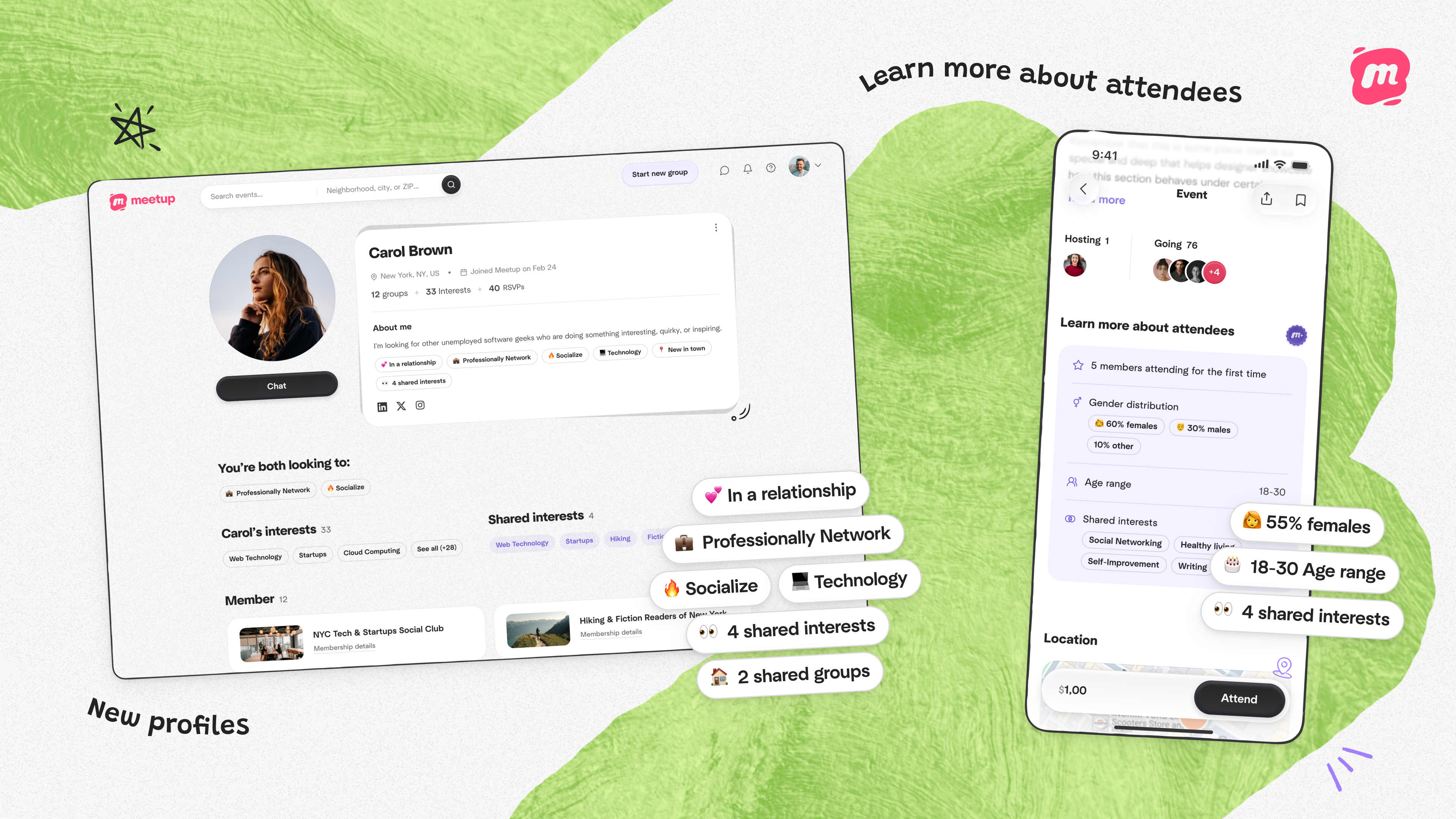
Soon, Meetup users will be able to see a breakdown of the people who have signed up for an event.
Bending Spoons

According to Vivaldi, one major priority is to give people, particularly women, more confidence to attend the events that are listed on Meetup. When you navigate to an event page in the new app, you'll see a broad gender and age breakdown of the users who have signed up to be there. Additionally, new and richer user profiles allow people to get a better sense of who exactly they might meet if they decide to go. Bending Spoons is also introducing a new Super Organizer badge it plans to award to the platform's top event planners. It's designed to signal to users that the person who put together the event takes community building seriously. 

Taken together, Vivaldi says these features are designed to reduce the friction of attending events where you might not know anyone, and they're something the company plans to build on in the future. 

At the same time, Bending Spoons plans to make it easier for organizers to use Meetup. Starting early next year, the company will unify Meetup's two disparate apps — right now, the company maintains separate ones for members and organizers. Vivaldi says organizers can expect the unified app to include all of the features they depend on, alongside a handful of enhancements. For instance, Vivaldi’s team is working to make QR-based ticketing the norm for check-ins and attendance tracking. She says the move to a single app is informed by the fact that 75 percent of Meetup's organizers got their start as a member. 

"[Organizers] are part of the community. They want to be in the action, and so having them within the same app is conducive to that. They can jump into conversations, look at other events, making it all feel a bit more organic," Vivaldi said. In the meantime, if it’s been since you’ve used Meetup, you can download the redesigned app from the App and Google Play stores.

This article originally appeared on Engadget at https://www.engadget.com/mobile/meetups-new-mobile-app-is-designed-to-make-it-easier-to-meet-people-irl-150000920.html?src=rss

Google’s Gemini 3 Flash model outperforms GPT-5.2 in some benchmarks

Almost exactly a month after the debut of Gemini 3 Pro in November, Google has begun rolling out the more efficient Flash version of its latest AI model. According to the company, the new system offers similar "pro-grade" reasoning performance as its flagship model at a fraction of the cost, making it ideal for everyday use. 

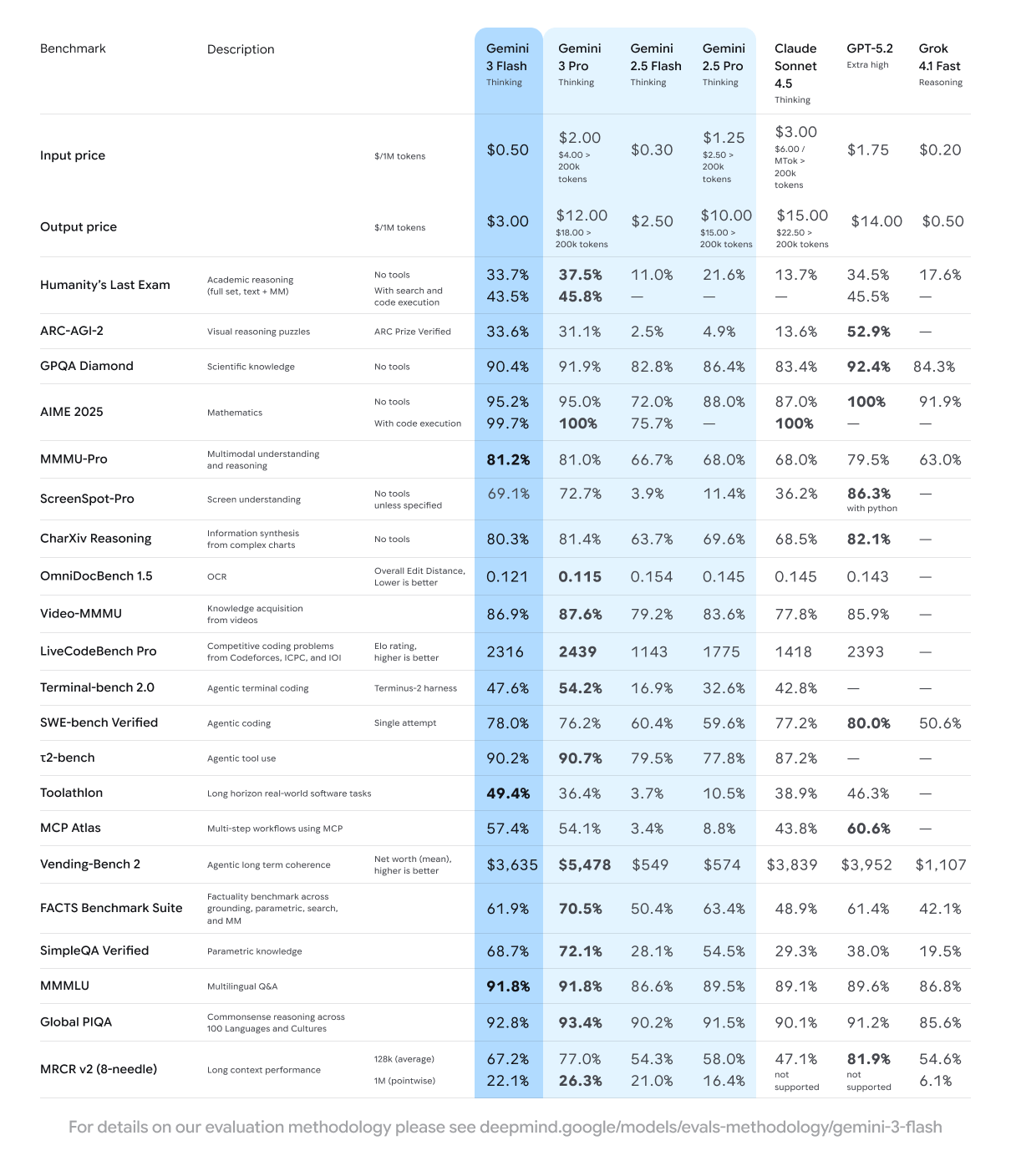
In benchmarks, the new system performed significantly better than Google's previous generation models, including Gemini 2.5 Pro. More notably, in Google’s testing it managed to trade blows with GPT-5.2, the model OpenAI rushed out to counter Gemini 3 Pro. 

A table comparing Gemini 3 Flash's performance across a variety of AI benchmarks.
Google

For example, in the tough Humanity's Last Exam suite, Gemini 3 Flash scored less than a percentage point worse than GPT-5.2 when neither model had access to tools like web search. In a handful of other benchmarks, Google's more efficient system even managed to outperform OpenAI's latest. For instance, in MMMU-Pro, a benchmark designed to test a model's multimodal understanding and reasoning, it edged out GPT-5.2 with a result of 81.2 percent compared to 79.5 percent. Of course, benchmarks only tell a partial story; we'll have to see what people think once both systems are broadly available. Still, the fact Gemini 3 Flash is even close to GPT-5.2, and the "Extra High" reasoning mode at that, is a worrying sign for OpenAI.   

As with Gemini 3 Pro, Google is rolling out the new model to both the Gemini App and AI Mode in Search where it will be the default model for both services. "That means all of our Gemini users globally will get access to the Gemini 3 experience at no cost, giving their everyday tasks a major upgrade," Google explains. While on the subject of AI Mode, it's now possible to access Nano Banana Pro, Google's latest image generator, directly from the chatbot. Provided you live in the US, select "Thinking with 3 Pro," followed by "Create Images Pro" from the model picker.

This article originally appeared on Engadget at https://www.engadget.com/ai/googles-gemini-3-flash-model-outperforms-gpt-52-in-some-benchmarks-160000000.html?src=rss

OnePlus 15R review: A 165Hz display and big battery for $700

I know what you're thinking, didn't OnePlus release a new phone just last month? It did. A little over five weeks after the announcement of the OP15, the company is back with the OnePlus 15R, a more affordable version of its new flagship that starts at $700 (or $200 less than its sibling). Off the top, this will be a shorter review because most of what I said about the OnePlus 15 also applies to the OP15R. It's a great phone that asks you to make one pretty significant compromise. 

Design and display

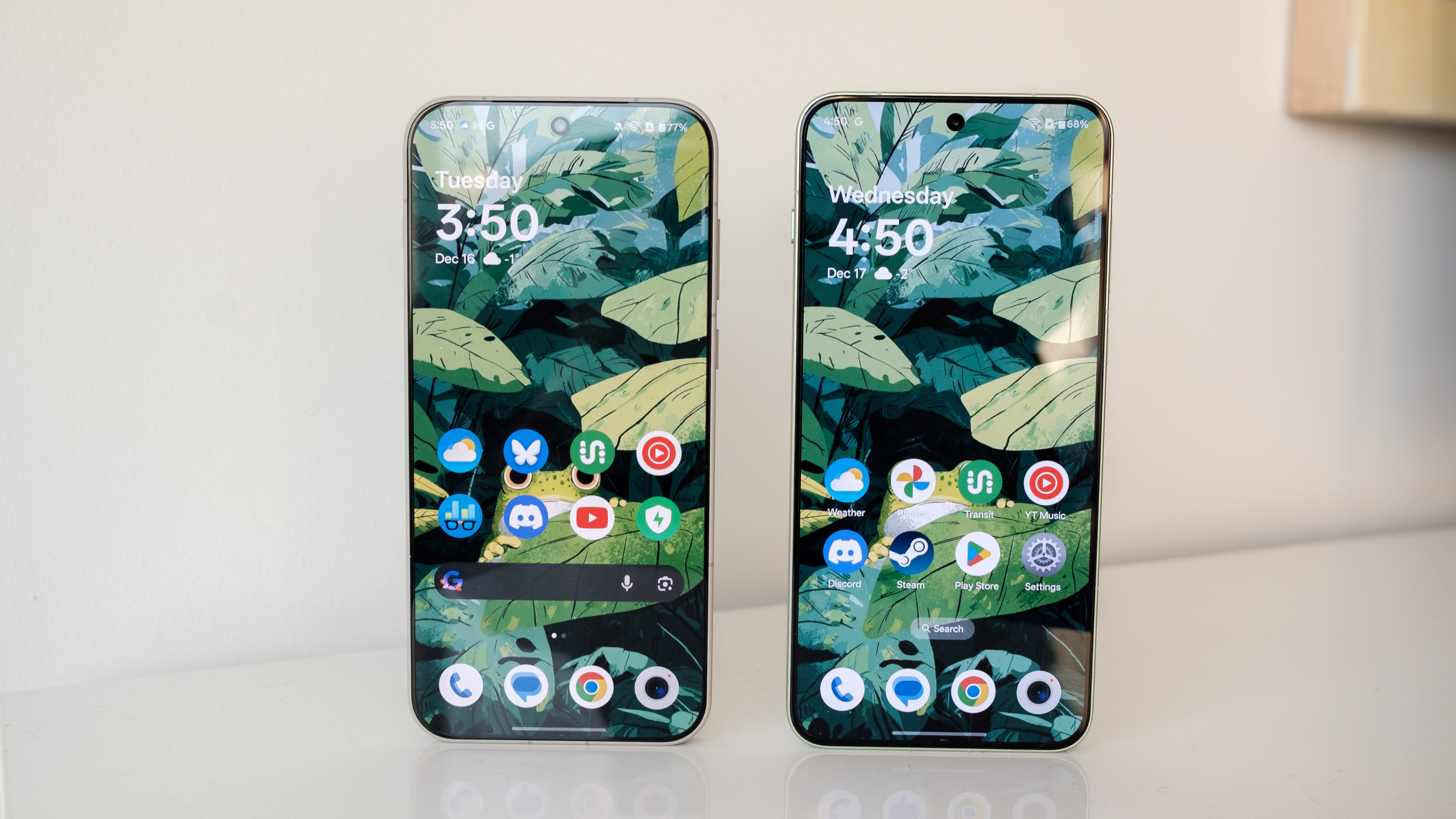
The OnePlus 15R's screen is slightly cooler than that of the OnePlus 15.
Igor Bonifacic for Engadget

Like the OnePlus 15, the 15R looks like the OnePlus 13s and 13T, a pair of smaller, 6.32-inch phones the company released in India and China this past spring. I said the design of the OP15 was boring and derivative of the iPhone 16 Pro. The 15R has done nothing to change that opinion. With one fewer camera, the OP15R doesn't look much different from the iPhone 12 I've been hanging on to since 2020. 

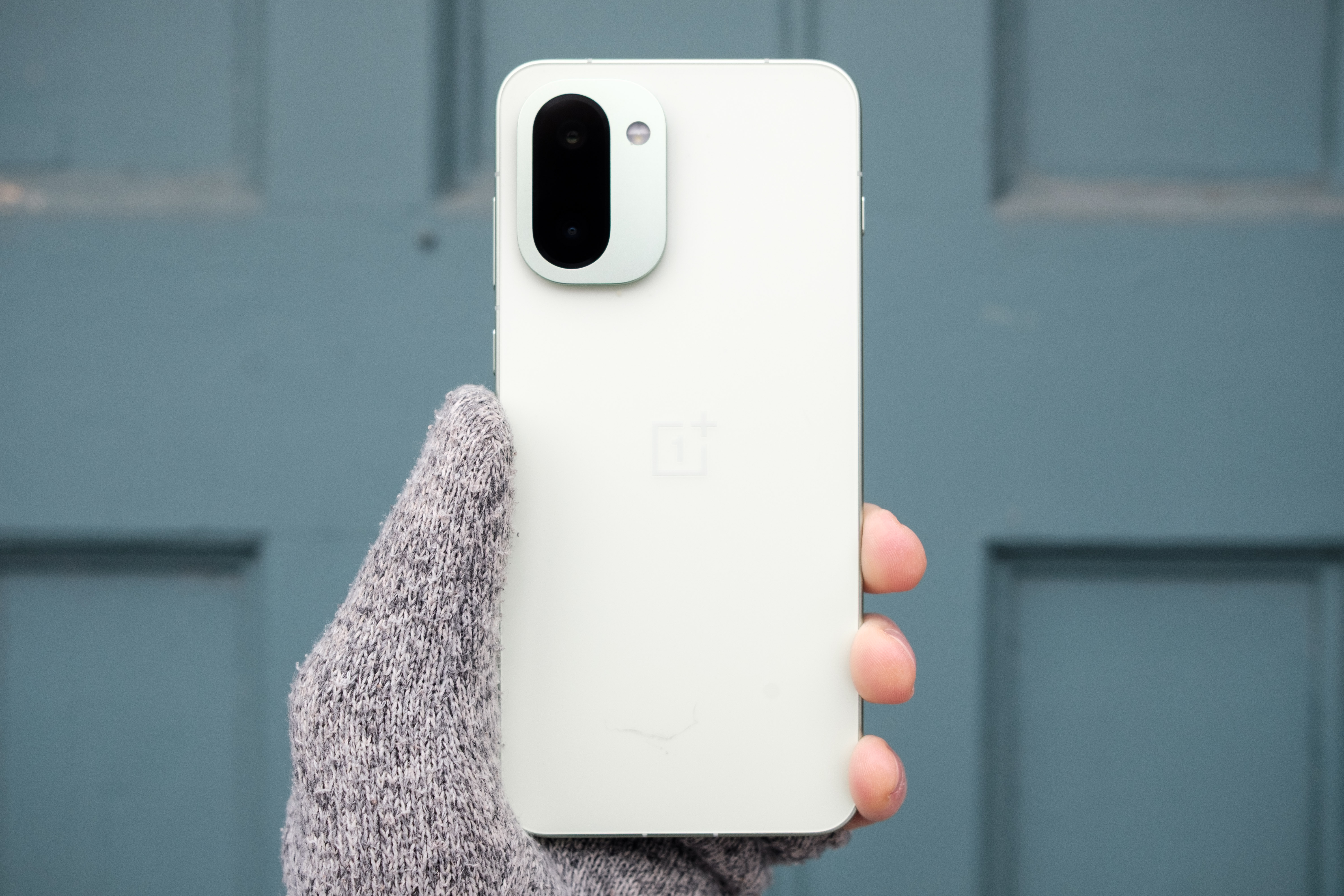
That said, I'm more fond of the 15R's mint breeze color (the phone is also available in charcoal black) than the sand storm shade of my OP15. We're big fans of minty phones here at Engadget, and OnePlus has gone with a particularly pleasing hue of the color with its new phone. With the redesign, OnePlus has also improved the phone's waterproofing, bringing it in line with the OP15. The new handset is IP69K-certified against moisture and dust, meaning it can withstand heated water shot at it at pressure. Like the OP15, the 15R trades OnePlus' old Alert Slider for a new Plus Key. It functions like the iPhone's Action button, allowing you to add a shortcut for a favorite feature. For example, you can configure it to open the camera app or act as a do not disturb toggle, among a few other options.  

One departure from the OP15 is that the 15R has a larger 6.83-inch display, making it slightly taller than its sibling. OnePlus is marketing this as one reason buyers might pick the 15R over the OP15, but holding the phones side by side, there's not much difference between the two. They're both big, and you'll either like that or won't.

On top of being big, the 15R's screen can refresh at a fast 165Hz in games. The two displays are also comparable in terms of resolution and brightness; both can push 1,800 nits of brightness. One difference I noticed is the OnePlus 15 has a warmer panel, even when the two phones are set to the same colorspace. I've reached out to OnePlus to find what might be causing the disparity, but for now it may be due to a quality control issue or oversight in the company's software.  

One last thing, OnePlus has upgraded the 15R to add an ultrasonic fingerprint sensor beneath the screen. This is placed in a nice spot toward the bottom third of the display, and it's fast and accurate.   

Performance and battery

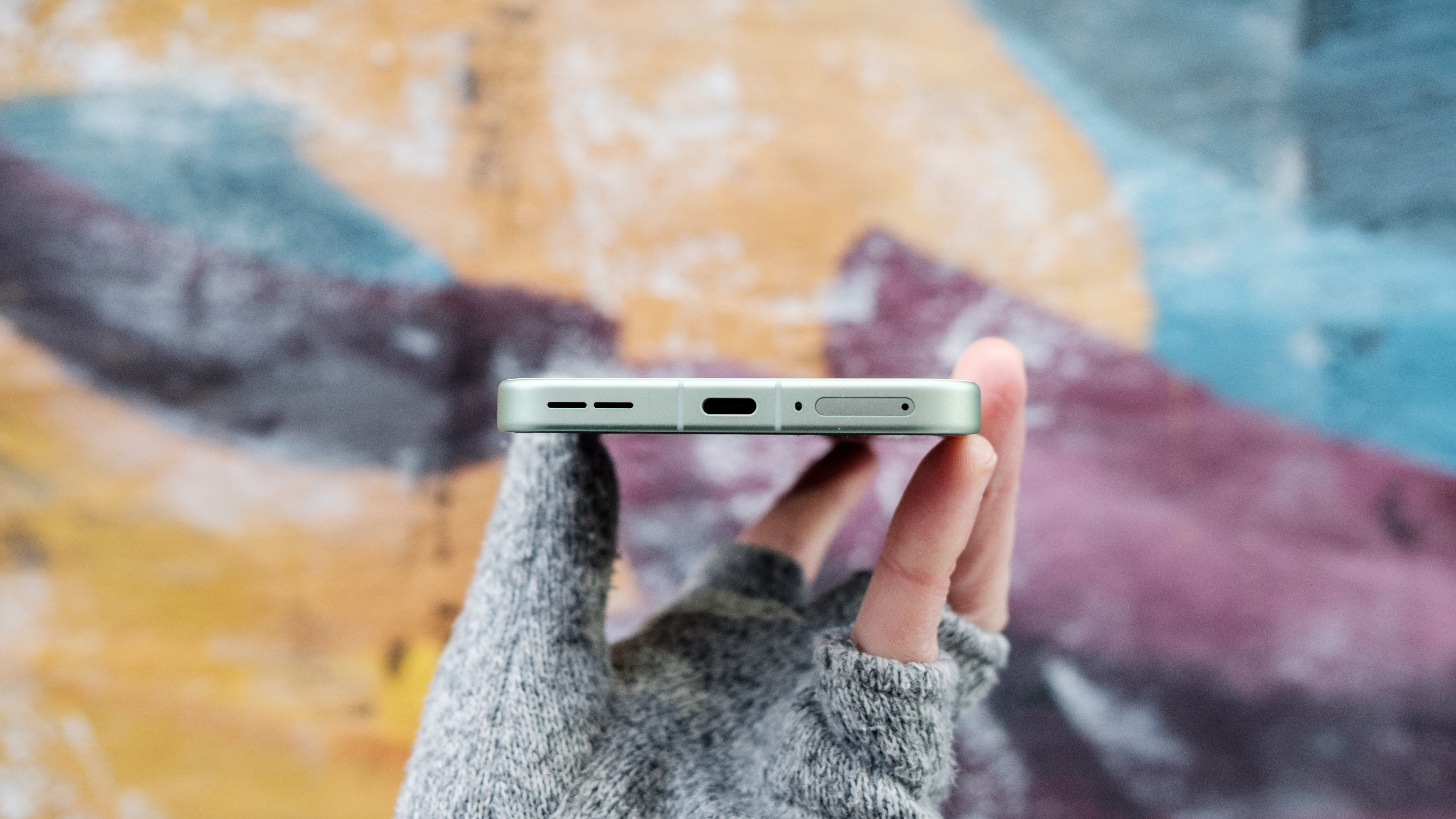
The OnePlus 15R is also slightly thinner than the OnePlus 15.
Igor Bonifacic for Engadget

The OnePlus 15R is the first phone in North America to arrive with Qualcomm's latest Snapdragon 8 Gen 5 chipset. Not to be confused with the Snapdragon Gen 5 Elite in the OP15, this new chipset is similar to Qualcomm's flagship system-on-a-chip but has a weaker CPU and GPU. This is reflected in benchmarks like Geekbench 6 where the OP15 handily outperforms the OP15R. It's not even close, either, with the OP15 delivering standout single- and multi-core scores of 3,773 and 11,293, while the 15R put up more modest results of 2,857 and 9,512. 

From that perspective, you're losing a fair amount of performance, but real-world use tells a different story. Outside of the handful of games such as Call of Duty: Mobile and PUBG that support the OP15 and 15R's 165Hz displays, the Snapdragon 8 Gen 5 offers more than enough muscle for the majority of applications. Even for most games (like the ones I like to play, including Diablo Immortal and League of Legends: Wild Rift), the Snapdragon 8 Gen 5 is a great match. 

OnePlus also hasn't skimped on the 15R's other internal components. You're still getting 12GB of LPDDR5X Ultra RAM and 256GB of UFS 4.1 storage. That's the same configuration as the base model of the OP15. This translates to a phone that doesn't miss a beat when switching between apps and loading files like images and videos.  

The 15R has a slightly bigger battery, coming in at 7,400mAh, up from 7,300mAh on the OP15. In practice, the two phones offer the same amount of battery life. Putting them through both Engadget's video rundown test, they both ran for 38 hours before their batteries died (which makes sense given the OP15R has a bigger screen). Like the OP15, the 15R comes with the OnePlus 55W SUPERVOOC charger in the box. The adapter can get the 15R from dead to 100 percent in less than an hour. If you hate charging your phone, the 15R makes that process as painless as possible, with a battery that both lasts long and won't be at the outlet for hours.            

Cameras

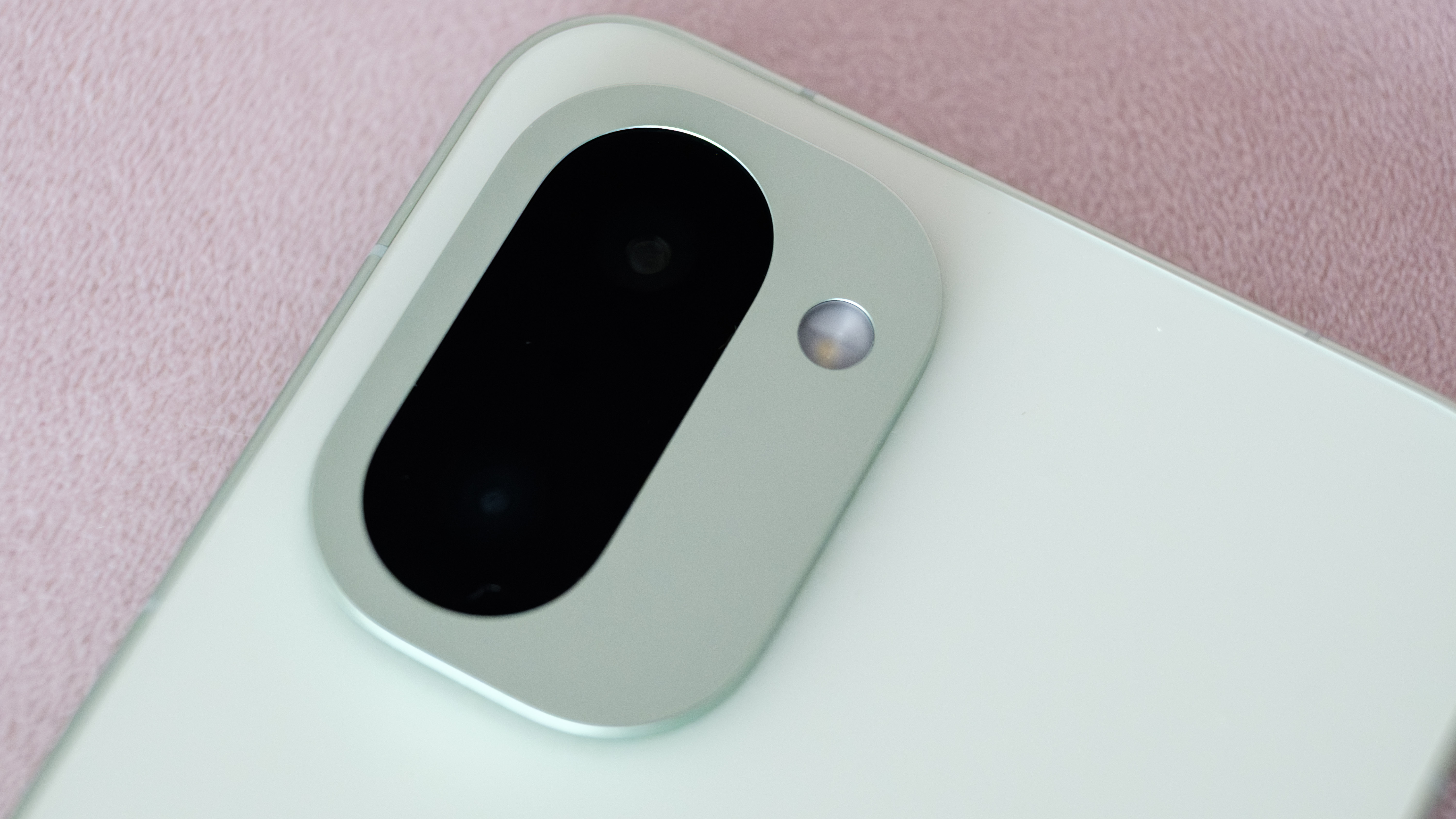
A closeup of the OnePlus 15R's camera module.
Igor Bonifacic for Engadget

By this point you're probably wondering what OnePlus cut from the OP15 to make the 15R more affordable. The answer — quite literally — is an entire camera. The new phone is missing a telephoto camera, something you could find on its predecessor, the OnePlus 13R. And as far as I can tell, the two remaining cameras use the same 50-megapixel and 8MP sensors OnePlus shipped on last year's model. The company also hasn't upgraded the glass on either camera. That leaves the selfie camera as the only area to see some change in the form of a sharper 32MP sensor and the addition of autofocus.       

Unfortunately, none of the 15R's cameras stand out. As a whole, they suffer from the same set of problems that plague the OnePlus 15's cameras. They're fine out on a sunny day, but as soon as the light becomes a bit challenging, the 15R struggles with shadow details, resulting in muddy pictures. The more I've used both the OP15 and 15R, the more I've come to the conclusion that OnePlus needs to go back to the drawing board with its new Detail Max Engine. It feels like it's holding back what should, at least on paper, be solid hardware.

Software

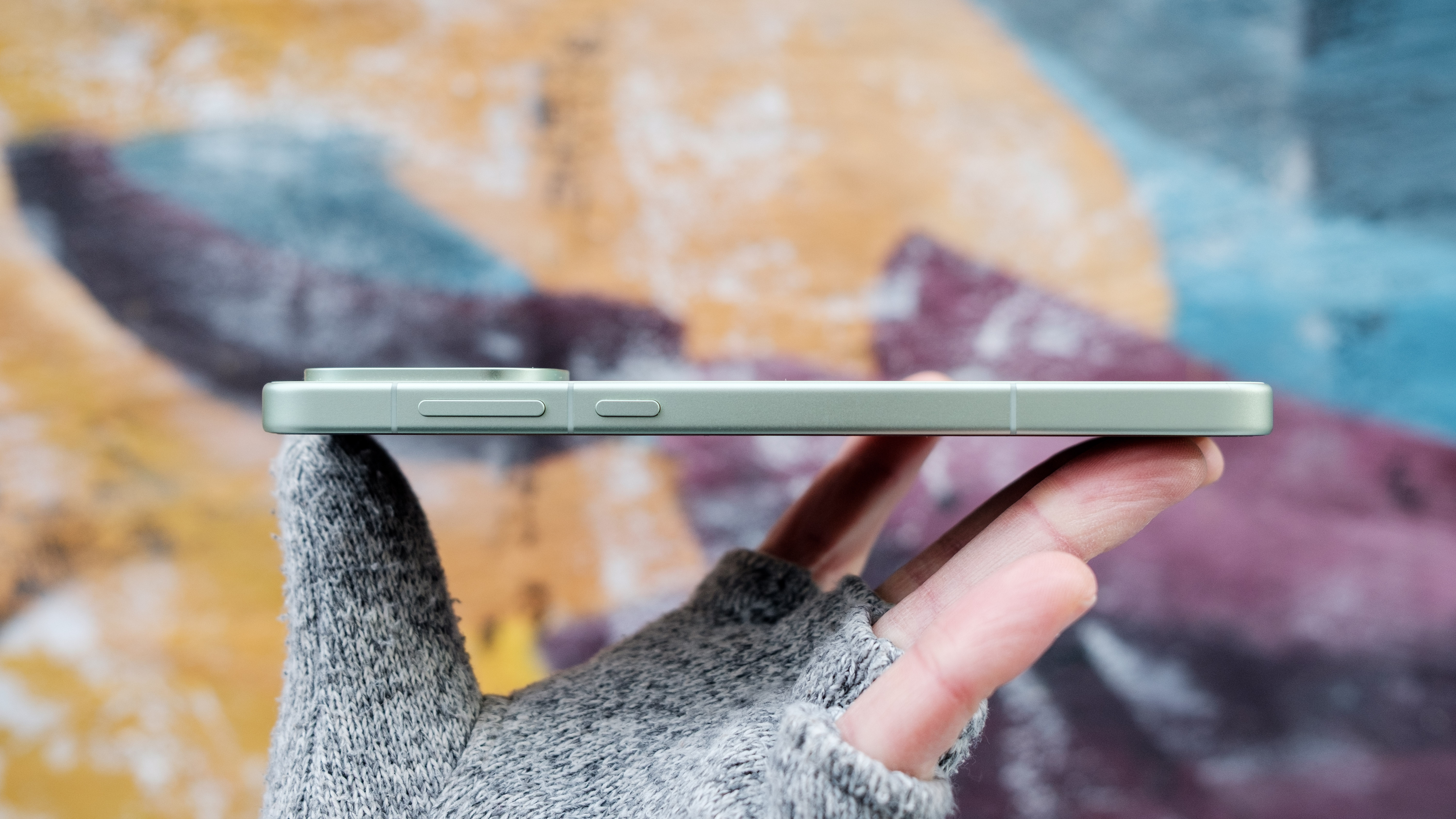
Despite it's large size, the OnePlus 15R isn't too heavy.
Igor Bonifacic for Engadget

There's not much to say here other than the 15R ships with OxygenOS 16, just like the OP15. OnePlus has also promised to support the 15R for the same amount of time as the OP15: four years with software updates and six years with security patches. That's a shorter window than Google and Samsung, both of which promise seven years on all their latest phones. It's hopefully something that OnePlus decides to change starting with the OnePlus 16. The reason I bring that up is that the company’s version of Android is one I like a lot. OxygenOS is slick, with animations that highlight the speed of the 15R's processor and display. The fact the phone comes with the latest version of OxygenOS means you also get access to all of the company's newest AI features, including its Mind Space hub where you can save screenshots and notes for an on-device model to transcribe and summarize.    

 Wrap-up

The OnePlus 15R comes in a lovely mint color.
Igor Bonifacic for Engadget

In short, the OnePlus 15R is the phone for people who don't care about photos and videos. That's the same conclusion I came to with the OP15. If you're a OnePlus fan, the 15R excels in all the areas you would expect the company's devices to make a good showing: performance, battery life and display responsiveness. Given I wasn't too impressed with the OP15's camera, I would actually recommend the 15R over that model. For $200 off the starting price of the OP15, you're getting a device that has almost all of the same strengths of its more expensive sibling.  

Compared to other phones in its price range, such as the Pixel 10 and Galaxy S25 FE, the 15R is not as well-rounded, and can't compete with those devices in camera quality, but you're getting much better performance, battery life and a display they can't match.  

This article originally appeared on Engadget at https://www.engadget.com/mobile/smartphones/oneplus-15r-review-a-165hz-display-and-big-battery-for-700-150000340.html?src=rss

ChatGPT image generation is now faster and better at following tweaks

Following the release of GPT-5.2 last week, OpenAI has begun rolling out a new image generation model. The company says the updated ChatGPT Images is four times faster than its predecessor. If you're a frequent ChatGPT user, you'll know it can sometimes take a while for OpenAI's servers to create images, particularly during peak times and if you're not paying for ChatGPT Plus. In that respect, any improvement in speed is welcome.

The new version is also better at following instructions, including when you want to edit something the new model just generated. You can ask the system to add, subtract, combine, blend and even transpose elements. At the same time, OpenAI says the update offers better text rendering. That's something many image models have traditionally struggled with, but according to the company, the new ChatGPT Images is capable of handling denser and smaller text. As part of the today's model update, OpenAI is additionally adding a dedicated Images section to the ChatGPT sidebar. Here you'll find preset filters and prompts you can look to for inspiration. 

A portrait of Sam Altman, in the style of Johannes Vermeer's Girl with a Pearl Earring.
OpenAI

The new ChatGPT Images arrives just as Nano Banana Pro is responsible for a surge in Gemini usage. In October, Google said its chatbot had 650 million users, up from 450 million just a few months earlier in July. Nano Banana Pro has proven so popular, the company recently limited free users to just two image generations per day. For OpenAI, a strong response to Nano Banana Pro probably wasn't as important as ensuring it came out swinging against Gemini 3 Pro, but ChatGPT Images is a big part of why there are 800 million ChatGPT users.    

"We believe we’re still at the beginning of what image generation can enable," OpenAI said. "Today’s update is a meaningful step forward with more to come, from finer-grained edits to richer, more detailed outputs across languages."

OpenAI is rolling out the new ChatGPT Images to all users starting today. If you're one of those people who miss GPT-4o, you'll be happy to learn you can continue to use the older version of the tool through a custom GPT.  

This article originally appeared on Engadget at https://www.engadget.com/ai/chatgpt-image-generation-is-now-faster-and-better-at-following-tweaks-180000750.html?src=rss

Trump orders creation of litigation task force to challenge state AI laws

On Thursday evening, President Donald Trump signed an executive order calling for a single, nationwide regulatory framework governing artificial intelligence at the expense of the ability of different states to regulate the nascent technology. “To win, United States AI companies must be free to innovate without cumbersome regulation,” the order states. “But excessive State regulation thwarts this imperative.”

As was expected after a draft of the order leaked earlier this week, the centerpiece of the document is an “AI Litigation Task Force whose sole responsibility shall be to challenge state AI laws inconsistent” with the president’s policy vision. US Attorney General Pam Bondi has 30 days to create the task force, which shall meet regularly with the White House’s AI and crypto czar, David Sacks.

As laid out in the president’s AI Action Plan from July, the administration will also limit states with “onerous” AI laws from accessing federal funding. Specifically, the secretary of commerce will target funding available under the Broadband Equity Access and Deployment (BEAD) Program, a $42.5 billion effort to expand high-speed internet access in rural communities.

Advocacy groups were quick to criticize the president’s order. “This executive order is designed to chill state-level action to provide oversight and accountability for the developers and deployers of AI systems, while doing nothing to address the real and documented harms these systems create,” Alexandra Givens, president and CEO of the Center for Democracy and Technology, said in a statement provided to Engadget. “States that take steps to protect their residents from such harms should not be subject to threats of legal attacks; nor should the administration punish rural Americans by threatening to withhold funding for the broadband services that could connect them to AI in the first place.”

It’s worth noting President Trump’s previous attempts to curb the ability of states to regulate AI as they see fit has proven unpopular across the political spectrum. As part of his One Big Beautiful Bill, the president attempted to impose a 10-year moratorium on state-level AI regulation. That clause was eventually removed from the legislation in a decisive 99-1 vote by the Senate.

This article originally appeared on Engadget at https://www.engadget.com/ai/trump-orders-creation-of-litigation-task-force-to-challenge-state-ai-laws-022657022.html?src=rss

Disney’s deal with OpenAI is about controlling the future of copyright

This morning Disney and OpenAI announced a three-year licensing agreement: Starting in 2026, ChatGPT and Sora can generate images and videos incorporating Disney IP, including more than 200 characters from the company's stable of Star Wars, Pixar and Marvel brands. To say these companies make for strange bedfellows is an understatement.  

The agreement brings together two parties with very different public stances on copyright. Before OpenAI released Sora, the company reportedly notified studios and talent agencies they would need to opt out of having their work appear in the new app. The company later backtracked on this stance. Before that, OpenAI admitted, in a regulatory filing, it would be "impossible to train today's leading AI models without using copyrighted materials." 

By contrast, Disney takes copyright law very seriously. In fact, you could argue no other company has done more to shape US copyright law than Disney. For example, there's the Sonny Bono Copyright Term Extension Act, which is more derisively known as the Mickey Mouse Protection Act. The law effectively froze the advancement of the public domain in the United States, with Disney being the greatest beneficiary. It was only last year that the company's copyright for Steamboat Willie expired, 95 years after Walt Disney first created the iconic cartoon.

On the face of it, it's unclear OpenAI is getting much value out of the deal. As part of the pact, Disney will host a "curated" selection of Sora-generated videos on its streaming platform Disney+, legitimizing the medium of AI-generated video in a way it hasn't been before, but it would appear Disney has the option to spotlight as much or little of it as it sees fit.

Additionally, the $1 billion Disney agreed to invest in OpenAI is a drop in the ocean for a company that's expected to burn through more cash in five years than Uber, Tesla, Amazon and Spotify did combined before they became profitable. If anything, the addition of Disney characters is likely to make operating ChatGPT and Sora more expensive for OpenAI; the company will now need to pay a licensing fee on top of the cost of running its servers to generate images and videos. At this stage, it's also hard to put a value on Disney's pledge to use OpenAI's APIs. The company has said those tools will "enable new products, tools and experiences," including some found inside of Disney+, but beyond that it hasn't shared specifics.

Bob Iger might be feckless, but he's not stupid. Sometime this week or soon after, President Trump is expected to sign an executive order that makes good on part of his AI Action Plan from July. Specifically, the president has promised to fight against "burdensome" state-level regulation of AI. According to CNN, a recent draft of Trump's order calls for the creation of an AI Litigation Task Force to challenge and preempt state AI laws in favor of the president's own more lax regulatory regime. 

It's unclear how successful the administration will be in that effort, but clearly Disney is thinking ahead. It's banking on the fact that this time it won't be able to count on the federal government to shape copyright law in its interest, so instead it's making a deal with an industry pushing the boundaries of intellectual property rights as we know them. More importantly, it has partnered with the one AI company it can actually leverage. 

As I argued in a recent piece, OpenAI is in a far different and more precarious position now than it was at the end of 2022 following the release of ChatGPT. The company is just one AI provider in a sea of competition, and you can't even argue its models are the best, based either on benchmarks or user feedback. Moreover, OpenAI has yet to turn a profit, and has adopted an extremely risky investment strategy. In recent months it has signed more than $1.4 trillion worth of infrastructure deals, hoping to outmuscle the competition that's already beating it through scale.  

It's not an accident Disney sent a cease-and-desist letter to Google a day before its agreement with OpenAI became public. OpenAI might be the most valuable private company in the world, but Alphabet, Google's parent company, is worth more than $3 trillion. In any negotiations between the two, at best Disney would be on equal footing, and certainly not in a position where it could demand some amount of control over Google's AI projects. 

And yet by accounts it won exactly that from OpenAI. According to Axios, the deal gives Disney a fair amount of control over how its intellectual property is used. The two will form a joint steering committee designed to monitor the content users create on ChatGPT and Sora. As you surf the web today, you'll likely see a lot of opinions on how this legitimizes AI video. And while that's true, far more important is the fact Disney has secured a seat at the table to decide how the technology evolves over the coming years. 

Much like with news publishers, OpenAI and other chatbots concerns took a stance of begging forgiveness rather than asking permission towards copyright. It seems to have paid off. Most of the highest-profile news organizations have signed licensing deals to at least be paid a little rather than be ripped off until reaching an uncertain verdict in court. Disney seems to be signalling that the same speculation rush is about to begin for audiovisual licensing, and it may have already secured the most favorable terms. 

This article originally appeared on Engadget at https://www.engadget.com/ai/disneys-deal-with-openai-is-about-controlling-the-future-of-copyright-213009504.html?src=rss

OpenAI releases GPT-5.2 to take on Google and Anthropic

OpenAI's "code red" response to Google's Gemini 3 Pro has arrived. On the same day the company announced a Sora licensing pact with Disney, it took the wraps off GPT-5.2. OpenAI is touting the new model as its best yet for real-world, professional use. “It’s better at creating spreadsheets, building presentations, writing code, perceiving images, understanding long contexts, using tools, and handling complex, multi-step projects,” said OpenAI.

In a series of 10 benchmarks highlighted by OpenAI, GPT-5.2 Thinking, the most advanced version of the model, outperformed its GPT-5.1 counterpart, sometimes by a significant margin. For example, in AIME 2025, a test that involves 30 challenging mathematics problems, the model earned a perfect 100 percent score, beating out GPT-5.1’s already state-of-the-art score of 94 perfect. It also achieved that feat without turning to tools like web search. Meanwhile, in ARC-AGI-1, a benchmark that tests an AI system’s ability to reason abstractly like a human being would, the new system beat GPT-5.1’s score by more than 10 percentage points.

OpenAI says GPT-5.2 Thinking is better at answering questions factually, with the company finding it produces errors 30 percent less frequently. “For professionals, this means fewer mistakes when using the model for research, writing, analysis, and decision support — making the model more dependable for everyday knowledge work,” the company said.

The new model should be better in conversation too. Of the version of the system most users are likely to encounter, OpenAI says “GPT‑5.2 Instant is a fast, capable workhorse for everyday work and learning, with clear improvements in info-seeking questions, how-tos and walk-throughs, technical writing, and translation, building on the warmer conversational tone introduced in GPT‑5.1 Instant.“

While it's probably overstating things to suggest this is a make or break release for OpenAI, it is fair to say the company does have a lot riding on GPT 5.2. Its big release of 2025, GPT-5, didn't meet expectations. Users complained of a system that generated surprisingly dumb answers and had a boring personality. The disappointment with GPT-5 was such that people began demanding OpenAI bring back GPT-4o.      

Then came Gemini 3 Pro — which jumped to the top of LMArena, a website where humans rate outputs from AI systems to vote on the best one. Following Google's announcement, Sam Altman reportedly called for a "code red" effort to improve ChatGPT. Before today, the company's previous model, GPT-5.1, was ranked sixth on LMArena, with systems from Anthropic and Elon Musk's xAI occupying the spots between OpenAI between Google. 

For a company that recently signed more than $1.4 trillion worth of infrastructure deals in a bid to outscale the competition, that was not a good position for OpenAI to be in. In his memo to staff, Altman said GPT-5.2 would be the equal of Gemini 3 Pro. With the new system rolling out now, we'll see whether that's true, and what it might mean for the company if it can't at least match Google's best.     

OpenAI is offering three different versions of GPT-5.2: Instant, Thinking and Pro. All three models will be first available to users on the company’s paid plans. Notably, the company plans to keep GPT-5.1 around, at least for a little while. Paid users can continue to use the older model for the next three months by selecting it from the legacy models section.

This article originally appeared on Engadget at https://www.engadget.com/ai/openai-releases-gpt-52-to-take-on-google-and-anthropic-185029007.html?src=rss