Apple is planning some big hardware drops for early 2024, according to Bloomberg’s Mark Gurman. In the Power On newsletter, Gurman predicts the company will release the next generation of iPad Pro and iPad Air in March — each of which is expected to come in two sizes — and the new M3-powered MacBook Air. The Mac Studio and Mac Pro will likely be much later to the M3 party; Gurman writes that Apple won’t have these ready for release until at least the end of 2024, and they could even slip into 2025.
With the release of its new iPads, Apple is planning to make clearer distinctions between the models so the choices are less confusing for consumers, according to Gurman. The iPad Pro is expected to get Apple’s new M3 chip, an OLED display and come in two sizes: 11 and 13 inches. Apple will also release a new Magic Keyboard just for the Pro, Gurman says. The iPad Air, on the other hand, will come in a 10.9-inch version and a new 12.9-inch option, and use the M2 chip. The changes should make the differences between the high-end, midrange and standard iPads more obvious so people can more easily decide what fits their needs.
As for the M3 MacBook Air, Gurman says it’ll also likely come in March, in the usual 13- and 15-inch configurations. At that time, Apple may also kill off the 2020 M1 MacBook Air. Its higher-end models, the Mac Studio and Mac Pro, will be last to get the M3 upgrade.
This article originally appeared on Engadget at https://www.engadget.com/apple-may-release-m3-macbook-air-in-march-and-refine-its-ipad-lineup-with-new-ipad-pro-and-ipad-air-205425798.html?src=rss
Apple is planning some big hardware drops for early 2024, according to Bloomberg’s Mark Gurman. In the Power On newsletter, Gurman predicts the company will release the next generation of iPad Pro and iPad Air in March — each of which is expected to come in two sizes — and the new M3-powered MacBook Air. The Mac Studio and Mac Pro will likely be much later to the M3 party; Gurman writes that Apple won’t have these ready for release until at least the end of 2024, and they could even slip into 2025.
With the release of its new iPads, Apple is planning to make clearer distinctions between the models so the choices are less confusing for consumers, according to Gurman. The iPad Pro is expected to get Apple’s new M3 chip, an OLED display and come in two sizes: 11 and 13 inches. Apple will also release a new Magic Keyboard just for the Pro, Gurman says. The iPad Air, on the other hand, will come in a 10.9-inch version and a new 12.9-inch option, and use the M2 chip. The changes should make the differences between the high-end, midrange and standard iPads more obvious so people can more easily decide what fits their needs.
As for the M3 MacBook Air, Gurman says it’ll also likely come in March, in the usual 13- and 15-inch configurations. At that time, Apple may also kill off the 2020 M1 MacBook Air. Its higher-end models, the Mac Studio and Mac Pro, will be last to get the M3 upgrade.
This article originally appeared on Engadget at https://www.engadget.com/apple-may-release-m3-macbook-air-in-march-and-refine-its-ipad-lineup-with-new-ipad-pro-and-ipad-air-205425798.html?src=rss
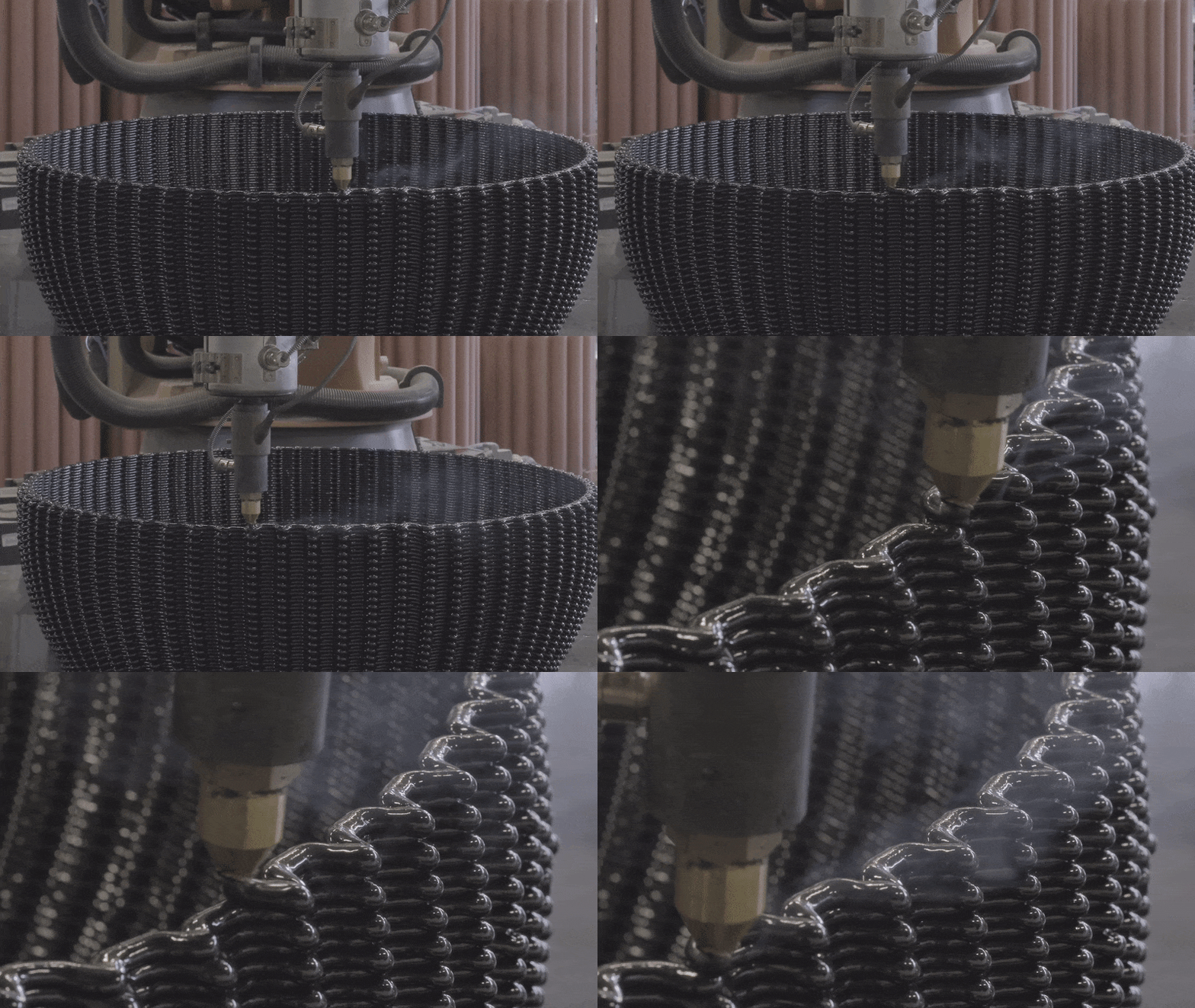
In an era where environmental sustainability is at the forefront of technological innovation, Lenovo, a global technology powerhouse, has taken a bold step towards repurposing electronic waste (e-waste) plastics through a groundbreaking collaboration with Aectual, a leader in industrial 3D printing. The result? 3D-printed furniture, that not only captivates with its design but also carries a powerful message about the possibilities of circularity and responsible consumption.
Lenovo’s annual Tech World event, a hub for discussions on the frontiers of AI, became the stage for a unique fusion of technology and sustainability. Attendees found themselves seated on low, padded stools adorned with red tops reminiscent of Lenovo’s iconic TrackPoint. Little did they know that beneath the comfortable exterior lay a story of transformation – the poufs were crafted from recycled e-waste plastics derived from a mix of devices.
The collaboration between Lenovo and Aectual extends beyond the mere recycling of e-waste plastics. Aectual, a Netherlands-based leader in 3D printing for architecture and interior design, joined forces with Lenovo to bring the concepts of asset recovery and circularity to life. This partnership showcases a commitment to innovation that goes beyond conventional boundaries.
Claudia Contreras, Executive Director of Global Sustainability Services at Lenovo, expressed her excitement about discovering new ways to deliver on Lenovo’s commitment to sustainability. The partnership with Aectual exemplifies an inventive and ambitious approach to repurposing e-waste plastics into 3D-printed event furniture.
Lenovo’s collaboration with Aectual is not just about creating aesthetically pleasing furniture; it is a testament to the company’s dedication to meaningful innovation. Hedwig Heinsman, co-founder, and Creative Director at Aectual emphasized the shared commitment to sustainability, with a focus on giving recovered materials a new life and creating surprising, environmentally friendly products.
Aectual’s 3D printing process prioritizes circularity by allowing the recovery of products after use. The material can be shredded and reused in new 3D-printed products up to seven times. This commitment to circular design aligns seamlessly with Lenovo’s broader sustainability goals.
The poufs at Lenovo Tech World are just a small example of the recycling possibilities enabled by solutions like Lenovo’s Asset Recovery Services (ARS). This end-to-end solution minimizes e-waste through secure device lifecycle management. Since 2005, Lenovo has processed nearly 800 million pounds of Lenovo-owned and customer-returned computer equipment, showcasing a comprehensive approach to responsible e-waste management.
Lenovo and Aectual’s collaboration serves as a beacon for sustainable practices within the tech industry. As the world grapples with the environmental impact of electronic waste, this partnership demonstrates that innovation and environmental responsibility can go hand in hand. With Lenovo’s commitment to reaching net-zero greenhouse gas emissions by 2050, this collaboration is a tangible example of the company’s dedication to a greener future.
The 3D-printed furniture showcased at Lenovo Tech World is more than just a comfortable seat; it is a symbol of transformation and innovation. By breathing new life into e-waste plastics, Lenovo and Aectual are paving the way for a future where technology and sustainability coexist harmoniously. As the world continues to seek solutions to the challenges posed by electronic waste, this collaboration sets a precedent for responsible and forward-thinking practices in the tech industry.
Apple’s third-generation AirPods are back down to their record-low Black Friday price. The discount on Amazon shaves $30 off the AirPods’ normal price of $170, making them just $140 right now. Given that this is the lowest we’ve seen these AirPods go for, they’re likely to sell out. Amazon is also running a deal on Apple’s second-generation AirPods Pro, or the latest version of the Pro earbuds, which are down to $200. The 20 percent discount isn’t the lowest they’ve ever dropped, but it’s still $50 off the usual price and only $10 more than the all-time low.
The third-generation AirPods were released in 2021 and completely refreshed the design. Apple shortened the stem, making the regular buds look more like the AirPods Pro, and tweaked the fit to make them more comfortable to wear. They’re lighter and angled in a way that’s meant to better hug the ear and deliver sound more effectively. In our review, we gave the third-gen AirPods a score of 88.
Apple’s third-generation AirPods also brought durability improvements to the non-Pro model. These AirPods and the charging case are IPX4 rated for water and sweat resistance, which is especially helpful for anyone using them during workouts. They feature Apple’s H1 chip, offering Adaptive EQ — which Apple says “automatically tunes music to your ears” — and spatial audio for more immersive listening. The AirPods also support fast pairing, and automatic switching between Apple devices. There’s also easy, hands-free access to Siri using the “Hey Siri” command.
The third-gen AirPods also have better battery life than earlier models. On their own, the earbuds last about six hours before needing to be charged again, and up to 30 hours with the charging case. In Engadget’s tests, we found the AirPods’ battery could actually be pushed to seven hours. They offer quick charging too, with about an hour of battery life after just five minutes in the MagSafe case.
This article originally appeared on Engadget at https://www.engadget.com/apples-third-generation-airpods-are-back-on-sale-for-140-174333053.html?src=rss
Apple’s third-generation AirPods are back down to their record-low Black Friday price. The discount on Amazon shaves $30 off the AirPods’ normal price of $170, making them just $140 right now. Given that this is the lowest we’ve seen these AirPods go for, they’re likely to sell out. Amazon is also running a deal on Apple’s second-generation AirPods Pro, or the latest version of the Pro earbuds, which are down to $200. The 20 percent discount isn’t the lowest they’ve ever dropped, but it’s still $50 off the usual price and only $10 more than the all-time low.
The third-generation AirPods were released in 2021 and completely refreshed the design. Apple shortened the stem, making the regular buds look more like the AirPods Pro, and tweaked the fit to make them more comfortable to wear. They’re lighter and angled in a way that’s meant to better hug the ear and deliver sound more effectively. In our review, we gave the third-gen AirPods a score of 88.
Apple’s third-generation AirPods also brought durability improvements to the non-Pro model. These AirPods and the charging case are IPX4 rated for water and sweat resistance, which is especially helpful for anyone using them during workouts. They feature Apple’s H1 chip, offering Adaptive EQ — which Apple says “automatically tunes music to your ears” — and spatial audio for more immersive listening. The AirPods also support fast pairing, and automatic switching between Apple devices. There’s also easy, hands-free access to Siri using the “Hey Siri” command.
The third-gen AirPods also have better battery life than earlier models. On their own, the earbuds last about six hours before needing to be charged again, and up to 30 hours with the charging case. In Engadget’s tests, we found the AirPods’ battery could actually be pushed to seven hours. They offer quick charging too, with about an hour of battery life after just five minutes in the MagSafe case.
This article originally appeared on Engadget at https://www.engadget.com/apples-third-generation-airpods-are-back-on-sale-for-140-174333053.html?src=rss
The brainchild of Redditor ancienteuphoria, this Eye of Sauron Christmas tree topper is the perfect decoration for terrifying your children into being good for the remainder of the year. Remember, kids, Sauron is always watching! Be good, or he’ll feed you to his orcs.
The topper features an illuminated Eye of Sauron atop the pinnacle of Barad-dûr Tower, which projects a moving, fiery sky onto the ceiling above. Honestly, I feel like the color scheme really works for the Christmas season. It’s like a roaring fire but on your ceiling. Just be sure to close the curtains before turning it on or neighbors will call the fire department.
My Christmas tree topper? It’s a dog angel my wife bought from a rescue organization to remember one of our dogs who passed. She was a good dog. The dogs we have now? Little monsters. They would totally fit right in with Sauron’s army, because there’s no question they would destroy the entirety of Middle Earth just for a treat.
Alex Jones is back on X five years after then-Twitter made the decision to permanently ban him and his show, Infowars, for violating the site’s policy on “abusive behavior.” Elon Musk — who last year said he wouldn’t unban Jones because of the conspiracy theorist’s insistence on calling the Sandy Hook massacre a hoax — created a poll on X over the weekend asking users to vote on whether Jones should be reinstated.
The poll closed with a majority vote for “Yes.” As of Sunday, Jones’ personal account was once again active, and already retweeting Andrew Tate.
Jones is well known for pushing disturbing conspiracy theories, which in some cases have led to real world harm. He was sued by the families of Sandy Hook victims, who won close to $1.5 billion in legal judgments after testifying in court that they’d been harassed and sent death threats by his followers. But after Jones appeared on Tucker Carlson’s show on X last week, the conversation about his ban was reignited.
Responding to one user after the poll closed, Musk wrote, “I vehemently disagree with what he said about Sandy Hook, but are we a platform that believes in freedom of speech or are we not? That is what it comes down to in the end. If the people vote him back on, this will be bad for X financially, but principles matter more than money.” The decision comes at a time when X is rapidly losing advertisers because of hate speech on the platform, some of which Musk himself has elevated. Walmart, Apple, IBM and Disney, among others, have recently pulled their ads from X.
This article originally appeared on Engadget at https://www.engadget.com/alex-jones-and-his-conspiracy-theories-are-allowed-back-on-x-160419044.html?src=rss
Alex Jones is back on X five years after then-Twitter made the decision to permanently ban him and his show, Infowars, for violating the site’s policy on “abusive behavior.” Elon Musk — who last year said he wouldn’t unban Jones because of the conspiracy theorist’s insistence on calling the Sandy Hook massacre a hoax — created a poll on X over the weekend asking users to vote on whether Jones should be reinstated.
The poll closed with a majority vote for “Yes.” As of Sunday, Jones’ personal account was once again active, and already retweeting Andrew Tate.
Jones is well known for pushing disturbing conspiracy theories, which in some cases have led to real world harm. He was sued by the families of Sandy Hook victims, who won close to $1.5 billion in legal judgments after testifying in court that they’d been harassed and sent death threats by his followers. But after Jones appeared on Tucker Carlson’s show on X last week, the conversation about his ban was reignited.
Responding to one user after the poll closed, Musk wrote, “I vehemently disagree with what he said about Sandy Hook, but are we a platform that believes in freedom of speech or are we not? That is what it comes down to in the end. If the people vote him back on, this will be bad for X financially, but principles matter more than money.” The decision comes at a time when X is rapidly losing advertisers because of hate speech on the platform, some of which Musk himself has elevated. Walmart, Apple, IBM and Disney, among others, have recently pulled their ads from X.
This article originally appeared on Engadget at https://www.engadget.com/alex-jones-and-his-conspiracy-theories-are-allowed-back-on-x-160419044.html?src=rss
And why should only terrestrial workers be exploited? Elon Musk has long talked of his plans to colonize Mars through his company SpaceX and those plans don't happen without a sizeable — and in this case, notably captive — workforce on hand. The same Elon Musk who spent $44 billion to run a ubiquitous social media site into the ground, whose brain computer interface company can't stop killing monkeys and whose automotive company can't stop killing pedestrians, wants to construct entire settlements wholly reliant on his company's largesse and logistics train. Are we really going to trust the mercurial CEO with people's literal air supplies?
One of the first things to know about company towns is that companies don’t appear to want to be in charge of housing. In our experience, people often think housing was an actively pursued control tactic, but if you look at the available data and the oral histories, companies often seem downright reluctant to supply housing at all. In Dr. Price Fishback’s economic analysis of coal towns in early-twentieth-century Appalachia, Soft Coal, Hard Choices, he found that companies able to have a third party supply housing typically did. This is hard to square with the idea that housing was built specifically with sinister intentions.
There are also good theoretical reasons to explain why companies build housing and rent it out to workers. Suppose Elon Musk is building the space city Muskow. Having wisely consulted the nearest available Weinersmith, he decides he shouldn’t own employee housing due to something or other about the risks of power imbalance. He looks to hire builders, but immediately runs into a problem: very few companies are available for construction on Mars. Let’s consider the simple case where only one company is willing to do it.
Well, guess what. That company now has monopoly power. They can raise home prices or lower home quality, making Muskow less attractive to potential workers. Musk can now only improve the situation by paying workers more, costing him money while lining the pockets of the housing provider.
If he wants to avoid this, Musk’s ideal option is to attract more building companies, so they can compete with each other. If that’s not possible, as was often the case in remote company towns, then the only alternative is to build the housing himself. This works, but the tradeoff is that he’s now managing housing in addition to focusing on his core business. He’s also acquired a lot of control over his employees. None of this setup requires Musk to be a power-hungry bastard — all it requires is that he needs to attract workers to a place where there’s zero competition for housing construction.
Historically, where things get more worrisome is in rental agreements, which often tied housing to employment. Even these can partially be explained as rational choices a non- evil bastard might non- evilly make. Workers in mines were often temporary. Mines were temporary, too, existing only until the resources were no longer profitable. This made homeownership a less compelling prospect for a worker. Why? Two reasons. First, if a town may suddenly fold in fifteen years because a copper mine stops being profitable, buying a house is a bad investment. Second, if you own a home, it’s hard for you to leave. This is a problem because threatening to leave is a classic way to enhance your bargaining position as a worker.
Once you have people whose housing is tied to their job, the potential for abuse is enormous — especially during strikes. Rental agreements were often tied to employment, and so striking or even having an injury could mean the loss of your home. When your boss is also your landlord, their ability to threaten you and your family is tremendous, and indeed narrative accounts refer to eviction of families with children by force. If employees either owned their homes or had more secure rental agreements, power would have run the other way. They could have struck for better wages or conditions and occupied those homes to make it harder for their employer to bring in replacements.
It may be tempting to see this as a purely capitalist problem, but very similar results occurred in Soviet monotown housing. Employees tended to get reasonably nice company-town housing; if they lost their jobs, they had to go to the local Soviet, which provided far worse accommodations. As one author put it, “Thus, housing became the method of controlling workers par excellence.” This suggests that there’s a deep structural dynamic here — when your employer owns your housing, they’re apt to use it against you at some point.
In space, you can’t kick people out of their houses unless you’re prepared to kill them or pay for a pricey trip home. On Mars, orbital mechanics may preclude the trip even if you’re able to afford it. In arguing with space-settlement geeks, housing concerns are often set up as binaries — “Look, they’re not going to kill the employees, so they’ll have to treat them well.” In fact, there’s a spectrum of bastardry available. A company-town boss on Mars could provide lower-quality food, reduce floor space, restrict the flow of beet wine, deny you access to the pregnodrome. They could also tune your atmosphere. We found one account by a British submariner, in which he claimed to adjust the balance of oxygen to carbon dioxide depending on whether he wanted people more lethargic or more active. Whether it’ll be worth the risk of pissing off employees who cost, at least, millions to deliver to the settlement is harder to say.
This overall logic — companies must supply amenities, therefore companies acquire power — repeats across contexts in company towns. To attract skilled employees who may have families, the company must supply housing, yes, but they also must supply other regular town stuff — shopping, entertainment, festivals, sanitation, roads, bridges, municipal planning, schools, temples, churches. When one company controls shopping, they set the prices and they know what you buy. When they control entertainment and worship, they have power over employee speech and behavior. When they control schools, they have power over what is taught. When they control the hospitals, they control who gets health care, and how much.
Even if the company does a decent job on all these fronts, there may still be resistance, basically because people don’t love having so much of their lives controlled by one entity. Fishback argued that company towns, for all their issues, were not as bad as their reputation. In theorizing why, he suggested one problem you might call the omni-antagonist effect. Think about what groups you’re most likely to be angry at during any given moment of adult life. Landlord? Home-repair company? Local stores? Utility companies? Your homeowners association? Local governance? Health-care service? Chances are you’re mad at someone on this list even as you read this book. Now, imagine all are merged into a single entity that is also your boss.
In space, as usual, things are worse: the infrastructure and utility people aren’t just keeping the toilet and electricity running; they’re deciding how much CO2 is in your air and controlling transportation in and out of town. Even if the company is not evil, it’s going to be hard to keep good relations, even at the best of times.
And it will not always be the best of times.
When Company Towns Go Bad
Unionization attempts on September 3, 1921, reporting on the then ongoing miners strike in West Virginia, the Associated Press released the following bulletin:
Sub district President Blizzard of the United Mine Workers . . . says five airplanes sent up from Logan county dropped bombs manufactured of gaspipe and high explosives over the miners’ land, but that no one was injured. One of the bombs, he reports, fell between two women who were standing in a yard, but it failed to explode.
“Failed to explode” is better than the alternative, but well, it’s the thought that counts.
Most strikes were not accompanied by attempted war crimes, but that particular strike, which was part of early-twentieth-century America’s aptly named Coal Wars, happened during a situation associated with increased danger — unionization attempts.
Looked at in strictly economic terms, this isn’t so surprising. From the company’s perspective, beyond unionization lies a huge unknown. Formerly direct decisions will have to run through a new and potentially antagonistic committee. The company will have less flexibility about wages and layoffs in case of an economic downturn. They may become less competitive with a nonunion entity. They may have to renegotiate every single employee contract.
Whether or not a union would be good per se in a space settlement, given how costly and hazardous any kind of strife would be, you may want to begin your space settlement with some sort of collective bargaining entity purely to avoid a dangerous transition. A union would also reduce some of the power imbalance by giving workers the ability to act collectively in their own interest. However, this may not happen in reality if the major space capitalists of today are the space company-town bosses of the future—both Elon Musk and Jeff Bezos kept their companies ununionized while CEOs.
Economic Chaos
Another basic problem here is that company towns, being generally oriented around a single good, are extremely vulnerable to economic randomness. Several scholars have noted that company towns tend to be less prone to strife when they have fatter margins. It’s no coincidence that the pipe-bomb incident above came about during a serious drop in the price of coal early in the twentieth century. Price drops and general bad economic conditions can mean renegotiations of contracts in an environment where the company fears for its survival. Things can get nasty.
If Muskow makes its money on tourism, it might lose out when Apple opens a slightly cooler Mars resort two lava tubes over. Or there could be another Great Depression on Earth, limiting the desire for costly space vacations. So what’s a space CEO to do? In terrestrial company towns, if a Great Depression shows up, one option is for the town to just fold. It’s not a fun option, but at least there’s a train out of town or a chance to hitchhike. Mars has a once-every-two-years launch window.* Even a trip to Earth from the Moon requires a 380,000-kilometer shot in a rocket, which will likely never be cheap.
The biggest rockets on the drawing board today could perhaps transport a hundred people at a time. Even for a settlement of only ten thousand people, that’s a lot of transport infrastructure in case the town needs to be evacuated. Throw in that, at least right now, we don’t even know if people born and raised on the Moon or Mars can physiologically handle coming “back” to Earth, and, well, things get interesting.
The result is that there is a huge ethical onus on whoever’s setting this thing up. Not just to have a huge reserve of funding and supplies and transportation, so that people can be saved or evacuated if need be, but also to do the science in advance to determine if it’s even possible to bring home people born in partial Earth gravity.
There is some precedent for governments being willing to prop up company towns. Many old Soviet monotowns now receive economic aid from the Russian government. We should note, however, that keeping a small Russian village on life support will be a lot cheaper than maintaining an armada of megarockets for supplies and transportation.
This article originally appeared on Engadget at https://www.engadget.com/hitting-the-books-a-city-on-mars-kelly-and-zach-weinersmith-penguin-153023805.html?src=rss
And why should only terrestrial workers be exploited? Elon Musk has long talked of his plans to colonize Mars through his company SpaceX and those plans don't happen without a sizeable — and in this case, notably captive — workforce on hand. The same Elon Musk who spent $44 billion to run a ubiquitous social media site into the ground, whose brain computer interface company can't stop killing monkeys and whose automotive company can't stop killing pedestrians, wants to construct entire settlements wholly reliant on his company's largesse and logistics train. Are we really going to trust the mercurial CEO with people's literal air supplies?
One of the first things to know about company towns is that companies don’t appear to want to be in charge of housing. In our experience, people often think housing was an actively pursued control tactic, but if you look at the available data and the oral histories, companies often seem downright reluctant to supply housing at all. In Dr. Price Fishback’s economic analysis of coal towns in early-twentieth-century Appalachia, Soft Coal, Hard Choices, he found that companies able to have a third party supply housing typically did. This is hard to square with the idea that housing was built specifically with sinister intentions.
There are also good theoretical reasons to explain why companies build housing and rent it out to workers. Suppose Elon Musk is building the space city Muskow. Having wisely consulted the nearest available Weinersmith, he decides he shouldn’t own employee housing due to something or other about the risks of power imbalance. He looks to hire builders, but immediately runs into a problem: very few companies are available for construction on Mars. Let’s consider the simple case where only one company is willing to do it.
Well, guess what. That company now has monopoly power. They can raise home prices or lower home quality, making Muskow less attractive to potential workers. Musk can now only improve the situation by paying workers more, costing him money while lining the pockets of the housing provider.
If he wants to avoid this, Musk’s ideal option is to attract more building companies, so they can compete with each other. If that’s not possible, as was often the case in remote company towns, then the only alternative is to build the housing himself. This works, but the tradeoff is that he’s now managing housing in addition to focusing on his core business. He’s also acquired a lot of control over his employees. None of this setup requires Musk to be a power-hungry bastard — all it requires is that he needs to attract workers to a place where there’s zero competition for housing construction.
Historically, where things get more worrisome is in rental agreements, which often tied housing to employment. Even these can partially be explained as rational choices a non- evil bastard might non- evilly make. Workers in mines were often temporary. Mines were temporary, too, existing only until the resources were no longer profitable. This made homeownership a less compelling prospect for a worker. Why? Two reasons. First, if a town may suddenly fold in fifteen years because a copper mine stops being profitable, buying a house is a bad investment. Second, if you own a home, it’s hard for you to leave. This is a problem because threatening to leave is a classic way to enhance your bargaining position as a worker.
Once you have people whose housing is tied to their job, the potential for abuse is enormous — especially during strikes. Rental agreements were often tied to employment, and so striking or even having an injury could mean the loss of your home. When your boss is also your landlord, their ability to threaten you and your family is tremendous, and indeed narrative accounts refer to eviction of families with children by force. If employees either owned their homes or had more secure rental agreements, power would have run the other way. They could have struck for better wages or conditions and occupied those homes to make it harder for their employer to bring in replacements.
It may be tempting to see this as a purely capitalist problem, but very similar results occurred in Soviet monotown housing. Employees tended to get reasonably nice company-town housing; if they lost their jobs, they had to go to the local Soviet, which provided far worse accommodations. As one author put it, “Thus, housing became the method of controlling workers par excellence.” This suggests that there’s a deep structural dynamic here — when your employer owns your housing, they’re apt to use it against you at some point.
In space, you can’t kick people out of their houses unless you’re prepared to kill them or pay for a pricey trip home. On Mars, orbital mechanics may preclude the trip even if you’re able to afford it. In arguing with space-settlement geeks, housing concerns are often set up as binaries — “Look, they’re not going to kill the employees, so they’ll have to treat them well.” In fact, there’s a spectrum of bastardry available. A company-town boss on Mars could provide lower-quality food, reduce floor space, restrict the flow of beet wine, deny you access to the pregnodrome. They could also tune your atmosphere. We found one account by a British submariner, in which he claimed to adjust the balance of oxygen to carbon dioxide depending on whether he wanted people more lethargic or more active. Whether it’ll be worth the risk of pissing off employees who cost, at least, millions to deliver to the settlement is harder to say.
This overall logic — companies must supply amenities, therefore companies acquire power — repeats across contexts in company towns. To attract skilled employees who may have families, the company must supply housing, yes, but they also must supply other regular town stuff — shopping, entertainment, festivals, sanitation, roads, bridges, municipal planning, schools, temples, churches. When one company controls shopping, they set the prices and they know what you buy. When they control entertainment and worship, they have power over employee speech and behavior. When they control schools, they have power over what is taught. When they control the hospitals, they control who gets health care, and how much.
Even if the company does a decent job on all these fronts, there may still be resistance, basically because people don’t love having so much of their lives controlled by one entity. Fishback argued that company towns, for all their issues, were not as bad as their reputation. In theorizing why, he suggested one problem you might call the omni-antagonist effect. Think about what groups you’re most likely to be angry at during any given moment of adult life. Landlord? Home-repair company? Local stores? Utility companies? Your homeowners association? Local governance? Health-care service? Chances are you’re mad at someone on this list even as you read this book. Now, imagine all are merged into a single entity that is also your boss.
In space, as usual, things are worse: the infrastructure and utility people aren’t just keeping the toilet and electricity running; they’re deciding how much CO2 is in your air and controlling transportation in and out of town. Even if the company is not evil, it’s going to be hard to keep good relations, even at the best of times.
And it will not always be the best of times.
When Company Towns Go Bad
Unionization attempts on September 3, 1921, reporting on the then ongoing miners strike in West Virginia, the Associated Press released the following bulletin:
Sub district President Blizzard of the United Mine Workers . . . says five airplanes sent up from Logan county dropped bombs manufactured of gaspipe and high explosives over the miners’ land, but that no one was injured. One of the bombs, he reports, fell between two women who were standing in a yard, but it failed to explode.
“Failed to explode” is better than the alternative, but well, it’s the thought that counts.
Most strikes were not accompanied by attempted war crimes, but that particular strike, which was part of early-twentieth-century America’s aptly named Coal Wars, happened during a situation associated with increased danger — unionization attempts.
Looked at in strictly economic terms, this isn’t so surprising. From the company’s perspective, beyond unionization lies a huge unknown. Formerly direct decisions will have to run through a new and potentially antagonistic committee. The company will have less flexibility about wages and layoffs in case of an economic downturn. They may become less competitive with a nonunion entity. They may have to renegotiate every single employee contract.
Whether or not a union would be good per se in a space settlement, given how costly and hazardous any kind of strife would be, you may want to begin your space settlement with some sort of collective bargaining entity purely to avoid a dangerous transition. A union would also reduce some of the power imbalance by giving workers the ability to act collectively in their own interest. However, this may not happen in reality if the major space capitalists of today are the space company-town bosses of the future—both Elon Musk and Jeff Bezos kept their companies ununionized while CEOs.
Economic Chaos
Another basic problem here is that company towns, being generally oriented around a single good, are extremely vulnerable to economic randomness. Several scholars have noted that company towns tend to be less prone to strife when they have fatter margins. It’s no coincidence that the pipe-bomb incident above came about during a serious drop in the price of coal early in the twentieth century. Price drops and general bad economic conditions can mean renegotiations of contracts in an environment where the company fears for its survival. Things can get nasty.
If Muskow makes its money on tourism, it might lose out when Apple opens a slightly cooler Mars resort two lava tubes over. Or there could be another Great Depression on Earth, limiting the desire for costly space vacations. So what’s a space CEO to do? In terrestrial company towns, if a Great Depression shows up, one option is for the town to just fold. It’s not a fun option, but at least there’s a train out of town or a chance to hitchhike. Mars has a once-every-two-years launch window.* Even a trip to Earth from the Moon requires a 380,000-kilometer shot in a rocket, which will likely never be cheap.
The biggest rockets on the drawing board today could perhaps transport a hundred people at a time. Even for a settlement of only ten thousand people, that’s a lot of transport infrastructure in case the town needs to be evacuated. Throw in that, at least right now, we don’t even know if people born and raised on the Moon or Mars can physiologically handle coming “back” to Earth, and, well, things get interesting.
The result is that there is a huge ethical onus on whoever’s setting this thing up. Not just to have a huge reserve of funding and supplies and transportation, so that people can be saved or evacuated if need be, but also to do the science in advance to determine if it’s even possible to bring home people born in partial Earth gravity.
There is some precedent for governments being willing to prop up company towns. Many old Soviet monotowns now receive economic aid from the Russian government. We should note, however, that keeping a small Russian village on life support will be a lot cheaper than maintaining an armada of megarockets for supplies and transportation.
This article originally appeared on Engadget at https://www.engadget.com/hitting-the-books-a-city-on-mars-kelly-and-zach-weinersmith-penguin-153023805.html?src=rss