If you love Pokémon and electronic dance music, the Pokémon Company made the perfect event for you. As part of Pokémon’s 30th anniversary festivities, the company is holding EDM concert experiences called “Pokémon Night Out” in Los Angeles and London. American DJ Marshmello, known for wearing a marshmallow-like mask on stage, will be headlining the events, with Australian DJ Alison Wonderland as a supporting act. The experiences will feature custom sets and Pokémon-inspired visual storytelling.
The events will be open to fans 16-years-old and up. It will be held at the Intuit Dome in Los Angeles on October 24, 2026, and at the O2 arena in London on November 10. You can get tickets for both concerts starting on April 18 at 10AM Pacific time for the Los Angeles concert and at 10AM British time for the London experience.
In addition to holding EDM concerts, Nintendo and the Pokémon Company re-released the Game Boy Advance remakes of Pokémon Red and Blue on Nintendo Switch Online for the franchise’s 30th anniversary. They also released a Game Boy-shaped portable Pokémon jukebox, little music players that can be loaded witha different melody or sound effect from the original games' soundtracks.
This article originally appeared on Engadget at https://www.engadget.com/gaming/nintendo/you-can-attend-pokemon-edm-shows-in-los-angeles-and-london-120405128.html?src=rss
If you were looking for the worst AI project announced so far this week, try Meta. According to a Financial Times report, the company is developing its own Mark Zuckerberg AI, training it on Zuckerberg’s mannerisms, tone and publicly available statements. AKA, the good stuff. (Will it smoke meats?)
The company has reportedly been working for some time on creating photorealistic, 3D-animated AI characters that can manage interactions. However, it now appears to be focusing on this Zuckerberg AI character, which would interact with employees in his stead. Yeesh. Remember when the Meta boss introduced legs to the metaverse? Hopefully, a backbone is in the works soon.
Dozens of civil rights organizations have written a letter to Meta CEO Mark Zuckerberg warning of the dangers posed by adding facial recognition technology to the company’s smart glasses. More than 70 groups have urged Zuckerberg to abandon plans to incorporate the tech on the grounds that it would empower stalkers, sexual predators and other bad actors. They also want the company to disclose past or ongoing discussions with federal law enforcement agencies, including ICE, about the use of Meta smart glasses and other wearables, according to a report by Wired.
Adding to the grossness of all this, according to The New York Times, Meta issued an internal memo last year suggesting it could roll out this technology “during a dynamic political environment where many civil society groups that we would expect to attack us would have their resources focused on other concerns.” In short, attempting to add the feature when pushback would be limited or unfocused. The coalition called this “vile behavior” that looks to take advantage of “rising authoritarianism.”
Xbox’s new chief exec, Asha Sharma, reportedly wrote in a memo to employees that the current pricing of the Game Pass subscription service might be too high. According to the note, seen by The Verge: “Short term, Game Pass has become too expensive for players, so we need a better value equation.”
Microsoft raised the price of Game Pass twice in 15 months, and many Xbox exclusives have made their way to rival PlayStation. Game Pass continues to add games: the April update adds indies like Hades 2 and Double Fine-project Kiln alongside Call of Duty: Modern Warfare. The Verge reports the addition of the CoD franchise might have contributed to Game Pass price increases, as in the past, buying the game at retail value was less favorable than a one-month subscription.
It’s a real connected-story edition of TMA today. Bloomberg reports Apple could reveal its smart glasses by the end of this year, and it’s already testing four eyewear styles. Apple is reportedly mulling over a large rectangular frame comparable to Ray-Ban Wayfarers, a slimmer rectangular design, like the one Apple CEO Tim Cook wears, as well as an oval or circular frame in large and small iterations. Apple is also working on a selection of colors.
Apple’s upcoming smart glasses will compete directly with the second-gen Ray-Ban Meta model. While similar, Apple might be differentiating its design with “vertically oriented oval lenses with surrounding lights,” according to the report. Apple’s upcoming product will capture photos and videos but is meant to play better with iPhones, so users can take advantage of Apple’s ecosystem for editing, sharing and more.
An R-rated animated film adaptation of Bloodborne is currently being developed by Sony, according to Variety. Sony Pictures Entertainment Motion Picture Group held a presentation at CinemaCon, where the division’s president said that the adaptation will be “very true” to the violent and graphic nature of the game. Bloodborne was created by Japanese studio FromSoftware and was published by Sony back in 2015. The critically acclaimed title is an RPG in the style of Dark Souls, featuring heavy blood splatters during combat and other body horror elements. Its director, Hidetaka Miyazaki, said his biggest inspiration for the game was HP Lovecraft’s works.
Bloomberg had reported in February that Bluepoint Games, the now-defunct Sony studio behind many PlayStation remakes, wanted to work on a new version of the classic Gothic horror RPG for modern consoles. However, FromSoftware blocked the project. Miyazaki reportedly wanted to work on the remake himself. Despite being too busy to do it, he said during an interview that he "doesn't want anyone else to touch it."
The Bloodborne film adaptation will be co-produced by PlayStation Productions, Lyrical Animation and Seán McLoughlin, a gaming YouTube known by his pseudonym jacksepticeye. It seems to be early stages at this point, and Variety doesn’t have a target release date for it yet.
This article originally appeared on Engadget at https://www.engadget.com/gaming/sony-is-developing-a-bloodborne-animated-film-adaptation-110421866.html?src=rss
Many creators have already switched from Adobe Premiere to DaVinci Resolve, and now the developer, Blackmagic Design, is going after Lightroom and Photoshop. The Australian company just unveiled DaVinci Resolve 21 in beta at the NAB 2026 broadcast convention with a brand new page called Photo designed to let you do things like crop and color-correct still images. At the same time, the new version introduces video AI tools that can age a subject or reshape their facial features.
DaVinci Resolve has always let you edit photos as clips on a video timeline, but now it's greatly simplified with the Photo page. You can import and manage photographs, including RAW files from Canon, Fujifilm, Nikon and Sony, directly into the new page. Then, you adjust them using the node-based Color page that offers similar and arguably even more powerful tools than Adobe's Lightroom.
Just as with video, the Color page includes primary color correction, curves, qualifiers and power windows (along with noise reduction, sharpening and more). However, Resolve's node-based workflow really shines for photo editing. You can add nodes in series or parallel to build complex grades, then save them to apply to other images or an entire photo album. You can also reframe and crop images at their original source resolution and aspect ratio, without affecting the original image quality.
Steve Dent for Engadget
The LightBox view lets you see an entire album with grades applied. "Select any image and grade it live while seeing the results update across the whole collection in real time. Filter by graded, ungraded, star rating, flag and clip color," Blackmagic Design explains in a press release. Albums, meanwhile, let you build collections like you do in Lightroom. Those also appear as timelines in the Color, Cut and Edit pages for easy access.
For pro photographers, the Color page includes camera controls that let you tether a Sony or Canon camera to Resolve for live image capture, while adjusting settings like ISO, exposure and white balance. You can save capture presets to "lock in a consistent look before customers shoot," according to Blackmagic.
Other Resolve tools also work with the Photo page, like the AI Magic Mask that lets you make one click selections of an object or person. It's also possible to do advanced VFX on still photos using Resolve's Fusion page, or add OpenFX or FusionFX filters directly on the Photo page. Finally, you can collaborate with others using Blackmagic Cloud, though that does require a paid subscription.
I briefly tested the Photo and Color tools and, as someone who's admittedly familiar with DaVinci Resolve, I found it easy to grasp. It's simple to import and organize images (easier than Lightroom in my opinion) and is as powerful as Lightroom's Develop page for most adjustments, though I really missed the latter's "Clarity" tool. The node based workflow is powerful, and Resolve makes it easier to apply adjustments to multiple images. When you're ready to export, that's done through a special photo-only version of the "Export" page and is relatively intuitive as well. Whether or not I'll cancel my Photoshop/Lightroom subscription remains to be seen, however.
Blackmagic Design
On top of the Photo page, Blackmagic Design introduced a number of new features for video and VFX as well. Among the most interesting are a series of AI tools for facial adjustments. The AI Face Age Transformer tools lets you analyze a face, enter the subject's age and adjust the age offset slider to add things like wrinkles and facial fullness. You can also change the way a subject looks through the AI Face Reshaper tool that lets you adjust the eyes, nose, mouth, eyebrows and overall face shape. Plus, you get an AI Blemish Removal feature that reduces the appearance of superficial skin imperfections like acne, discoloration and large pores, while retaining the skin's natural texture.
Another tool that will no doubt be popular is AI UltraSharpen that can upscale video "to make previously unusable footage sharp in higher resolutions," according to the company. It can also be used to improve slight focus errors. Meanwhile, the AI Motion Deblur fixes slightly blurred images, making it particularly useful for slow motion and freeze frame shots.
Other key new upgrades, to name just a few, include the ability to edit Fusion effects from within the Cut and Edit pages, the addition of the Krokodove library of compositing tools and new immersive VR tools for delivery to platforms like Meta Quest and YouTube VR. Most of the new features are available in Blackmagic Design's free version of DaVinci Resolve, though a couple of tools (AI Magic Mask and Film Look Creator) are only available with the paid, $295 DaVinci Resolve Studio version. A complete list of new features is here and you can download the free and paid versions here.
This article originally appeared on Engadget at https://www.engadget.com/apps/blackmagics-davinci-resolve-21-takes-on-adobe-lightroom-with-a-new-photo-page-053034084.html?src=rss
Xbox's new chief exec, Asha Sharma, has only been in charge for a few months but things already seem like they might be changing for the better. Or at the very least, they might be getting cheaper. The Verge reported that the new Xbox CEO wrote a memo to employees addressing the current pricing of the Game Pass subscription service.
"Game Pass is central to gaming value on Xbox. It’s also clear that the current model isn’t the final one," Sharma allegedly said. "Short term, Game Pass has become too expensive for players, so we need a better value equation. Long term, we will evolve Game Pass into a more flexible system which will take time to test and learn around."
After Microsoft upped the price for Game Pass twice within 15 months, many of us certainly felt that the service had gotten too costly to keep. Xbox is still offering a wide range of titles on Game Pass; the April update is adding indies like Hades 2 and new Double Fine project Kiln alongside AAA hits like the remake of Call of Duty: Modern Warfare. The Verge's sources suggested that the addition of the CoD franchise might have been a factor in some of the Game Pass price increases, since Microsoft would lose out on revenue by making the latest entries in the series available under the subscription.
It's too early to say whether this memo from Sharma means Xbox is on the brink of a resurgence. And there are changes the company could make, like adding ever more complicated tiers, that would further hamper interest and uptake of Game Pass. But acknowledging the problem, even internally, is refreshing to see after so many baffling moves from Xbox in recent years.
This article originally appeared on Engadget at https://www.engadget.com/gaming/xbox/xbox-ceo-called-game-pass-too-expensive-for-players-in-a-leaked-memo-194749597.html?src=rss
Xbox's new chief exec, Asha Sharma, has only been in charge for a few months but things already seem like they might be changing for the better. Or at the very least, they might be getting cheaper. The Verge reported that the new Xbox CEO wrote a memo to employees addressing the current pricing of the Game Pass subscription service.
"Game Pass is central to gaming value on Xbox. It’s also clear that the current model isn’t the final one," Sharma allegedly said. "Short term, Game Pass has become too expensive for players, so we need a better value equation. Long term, we will evolve Game Pass into a more flexible system which will take time to test and learn around."
After Microsoft upped the price for Game Pass twice within 15 months, many of us certainly felt that the service had gotten too costly to keep. Xbox is still offering a wide range of titles on Game Pass; the April update is adding indies like Hades 2 and new Double Fine project Kiln alongside AAA hits like the remake of Call of Duty: Modern Warfare. The Verge's sources suggested that the addition of the CoD franchise might have been a factor in some of the Game Pass price increases, since Microsoft would lose out on revenue by making the latest entries in the series available under the subscription.
It's too early to say whether this memo from Sharma means Xbox is on the brink of a resurgence. And there are changes the company could make, like adding ever more complicated tiers, that would further hamper interest and uptake of Game Pass. But acknowledging the problem, even internally, is refreshing to see after so many baffling moves from Xbox in recent years.
This article originally appeared on Engadget at https://www.engadget.com/gaming/xbox/xbox-ceo-called-game-pass-too-expensive-for-players-in-a-leaked-memo-194749597.html?src=rss
If you're a Warhammer fan of a certain age, some of these may be formative experiences for you. I know they are for me. I can't count how many hours I spent playing Chaos Gate when I first discovered 40K at the age of 10. Yes, it was an XCOM clone, but by that point I didn't know about the MicroProse original, and Space Marines were cool.
Years later and as a Tau collector at the time, I also loved Fire Warrior, even if it wasn't the most polished or deep first-person shooter. I haven't played the other five games included in today's announcement, but I've heard Warhammer: Shadow of the Horned Rat and Warhammer 40K: Rites of War are pretty good if you're into the setting or, in the latter case, a fan of the Eldar.
To celebrate the re-release of these old gems, Games Workshop is running a Classics sale on Steam, with discounts on all 19 re-releases. Plus, you can get discounts on some more recent releases, including the excellent Dawn of War – Definitive Edition and Dawn of War 2 – Anniversary Edition. If you're new to the Warhammer 40K universe, and would rather avoid a plastic addiction, one of those would be my first port of call, along with the excellent Space Marine 2.
This article originally appeared on Engadget at https://www.engadget.com/gaming/pc/games-workshop-brings-seven-classic-warhammer-games-to-steam-for-the-first-time-185432304.html?src=rss
Dozens of civil rights organizations have written a letter to Meta CEO Mark Zuckerberg to warn of the dangers in bringing facial recognition technology to the company's smart glasses. More than 70 groups have banded together to form a coalition to urge Zuckerberg to abandon plans to incorporate the tech, on the grounds that it would empower stalkers, sexual predators and other bad actors.
This coalition includes organizations like the ACLU, the Electronic Privacy Information Center, Fight for the Future, Access Now and many others. The letter isn't asking for safeguards. These groups want the feature to be completely eliminated, stating the idea behind facial recognition of this type is so dangerous that it “cannot be resolved through product design changes, opt-out mechanisms or incremental safeguards." This tracks, as there would be no real way for bystanders to know or consent to being identified.
"People should be able to move through their daily lives without fear that stalkers, scammers, abusers, federal agents and activists across the political spectrum are silently and invisibly verifying their identities and potentially matching their names to a wealth of readily available data about their habits, hobbies, relationships, health and behaviors," the letter states.
The organizations have urged Meta to disclose any known instances of its wearables being used for stalking, harassment or domestic violence. They also want the company to disclose past or ongoing discussions with federal law enforcement agencies, including ICE, about the use of Meta smart glasses and other wearables, according to a report by Wired.
There is certainly some cause for worry here. According to the New York Times, Meta issued an internal memo last year that suggested it could roll out this technology "during a dynamic political environment where many civil society groups that we would expect to attack us would have their resources focused on other concerns." That's corporate speak for "we'll do it when nobody is watching." The coalition called this "vile behavior" that looks to take advantage of "rising authoritarianism."
NEW: Meta plans to add facial recognition to its smart glasses as soon as this year, according to a new report from The New York Times. The feature, internally known as “Name Tag,” would allow smart glasses wearers to identify people and get information about them through Meta’s… pic.twitter.com/et7PO9JGW5
The technology in question is apparently called Name Tag, for obvious reasons. It uses AI to pull up information about people in a field of view to smart glasses displays. That's about as dystopian as it gets.
The company has reportedly been working on two versions of the toolset. There's one that would only identify people that are currently connected to a Meta platform and another that would identify anyone with a public account on a service like Instagram. It doesn't look like there's any way, as of yet, to use this tech to identify strangers on the street who don't have a Meta account of any kind. In other words, the company should expect a wave of cancellations if this rolls out.
In an emailed statement, a Meta spokesperson told Engadget: "Our competitors offer this type of facial recognition product, we do not. If we were to release such a feature, we would take a very thoughtful approach before rolling anything out."
Public outcry has gotten Meta to back off from facial recognition in the past. The company ended Facebook's photo-tagging system in 2021 after pushback from civil liberties groups and years of costly litigation. Meta paid out billions of dollars to settle biometric privacy lawsuits in Illinois and Texas and another $5 billion to the FTC for a separate privacy case partially tied to facial recognition software.
Update, April 13 2026, 4:45PM ET: This story was updated after publish with comment from Meta.
This article originally appeared on Engadget at https://www.engadget.com/big-tech/meta-warned-by-dozens-of-organizations-that-facial-recognition-on-its-smart-glasses-would-empower-predators-185000998.html?src=rss
There are plenty of retro gaming handhelds on the market, but Anbernic is introducing one that offers a unique spin on the square shape. The retro gaming handheld maker revealed the RG Rotate on its YouTube channel, showing off a 1:1 display that swivels out much like the T-Mobile Sidekick of yore.
Anbernic often drip feeds details of its upcoming products over time, but so far, we know that the RG Rotate will run on Android, feature an aluminum alloy frame and come in Polar Black and Aurora Silver. Anbernic's video detailed that the handheld will have a "proprietary ultra-thin alloy hinge" that went through "high-durability testing." While the handheld maker has experience with other hinges as seen with its RG DS and RG 34XXSP, the RG Rotate's hinge mechanism could prove to be a new engineering challenge.
As for the rest of the build, Anbernic is adding swappable L2 and R2 buttons that allow users to adjust the height of the shoulder buttons. From the video, the RG Rotate might only be built with a single USB-C port, which has irked a few fans hoping for an audio jack. Anbernic hasn't announced pricing for the RG Rotate yet, but it'll likely be much cheaper than more premium options from Ayn or Retroid.
This article originally appeared on Engadget at https://www.engadget.com/gaming/retro-handheld-maker-anbernics-latest-device-has-a-swiveling-display-174705958.html?src=rss
Over the past couple of years, Google has found ways to stuff Gemini in nearly every app and service it offers. Whether it's Gmail with its AI inbox or Chrome with its chat sidebar, Gemini is now inescapable inside of Workspace. I don't know about you, but I don't need an AI to tell me how to write a =SUM equation in Sheets or an outline for a first draft. Most of the time, I find Gemini is a distraction. If you feel the same way, this how-to is for you.
How to remove Gemini from your personal Workspace account
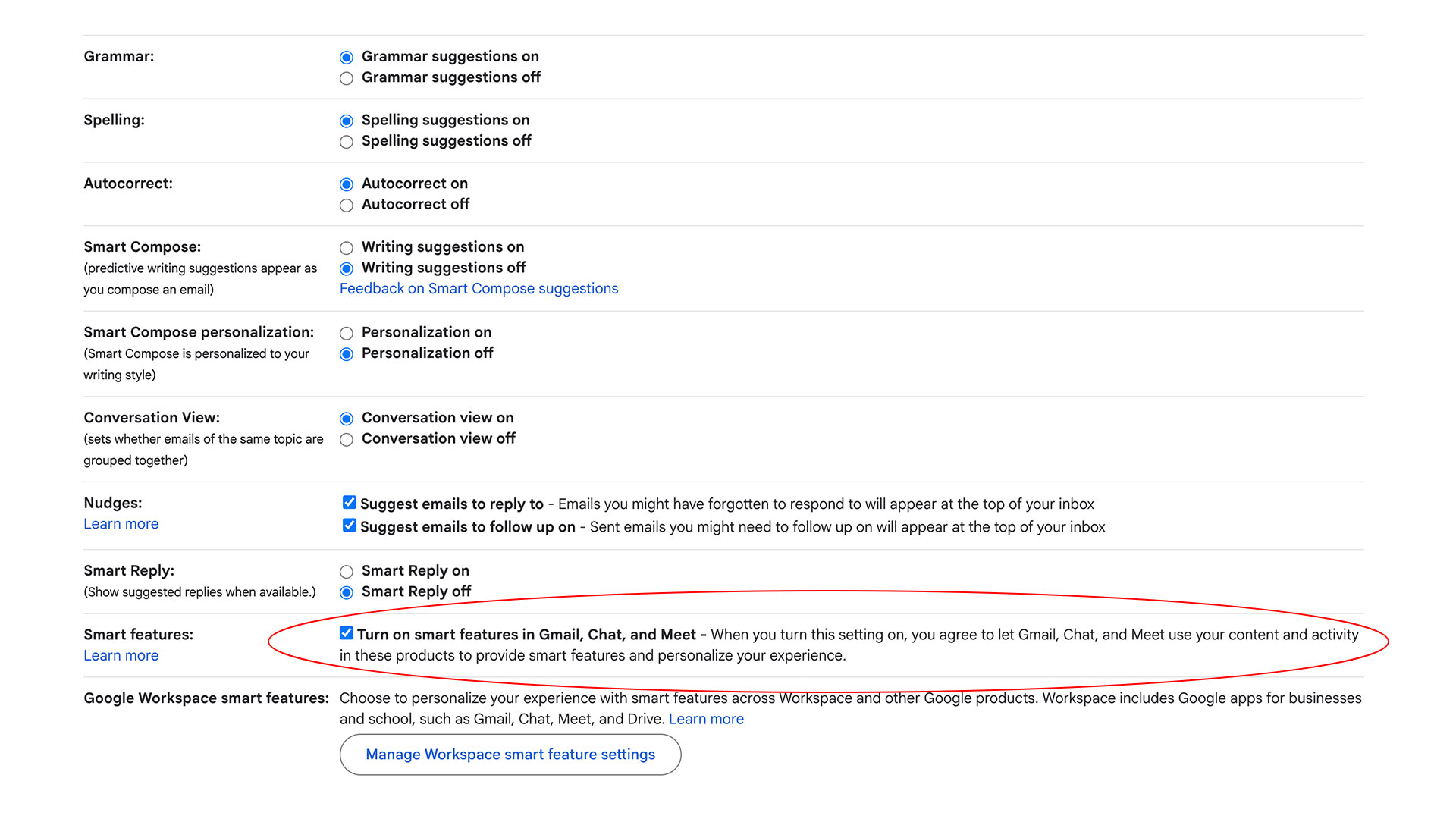
From the "General" tab of Gmail's settings menu, look for the Smart features checkbox.
Igor Bonifacic for Engadget
To turn Gemini off, you will need to disable two separate sets of options. The first set covers a set of features, including smart compose, that are shared across Gmail, Chat and Meet — so if you turn them off in one app, they won't be available in any of the three. All of this is most easily done through Gmail's web client.
In Gmail, tap the cog icon.
Select See all settings.
Under the General tab, scroll down to find Smart features.
Disable Turn on smart features in Gmail, Chat, and Meet.
In Japan, Switzerland, the United Kingdom or European Economic Area, smart features are turned off by default.
Next, turn your attention to Workspace.
In Gmail, tap the cog icon.
Select See all settings.
Under the General tab, scroll down and click Manage Workspace smart feature settings.
Toggle off smart features in Google Workspace and Smart features in other Google products.
A word of warning: completely disabling smart features in Google Workspace turns off not only Gemini integration but also access to basic capabilities like spelling and grammar corrections. You'll also lose features that have been Google staples for years. In Gmail, for example, the app will stop sorting incoming emails by priority, a notification at the top of the screen informing you that smart features are required for inbox categorization. Whatever Google's motivation for this state of affairs, it's a design decision that actively discourages users from disabling Gemini integration.
Disabling Gemini in Google Workspace will also turn off other features.
Igor Bonifacic for Engadget
If you want to rid yourself of Gemini but would still like to use some of the other features the company offers through Gmail and its other apps, I recommend leaving the first set of smart features on while disabling the Workspace-specific ones. You can also opt to turn off some of the features included in the first group, while leaving others on. Below is a list of those features, with a brief overview of the less self-explanatory ones.
Grammar
Spelling
Autocorrect
Smart Compose — as you write an email, Gmail will generate predictive writing suggestions
Smart Compose personalization — as you write, Gmail will tailor Smart Compose suggestions to your writing style
Nudges — Gmail will generate notifications prompting you to respond or follow up on unanswered emails
Smart Reply — Gmail will generate suggestions on how to respond to an email
Package tracking — Google will display shipping updates inside of Gmail
Desktop notifications — Yes, for some reason you need the power of AI to get notifications on your PC
Unfortunately, Google doesn't offer this same level of granular control when it comes to smart features inside of Workspace. For instance, if you turn off Gemini in Docs, Calendar won't automatically display events from Gmail. Again, Google really wants to dissuade you from disabling Gemini.
How to remove Gemini from your professional Workspace account
If your workplace uses Google Workspace, all of the above options should be present in Gmail's settings menu, and you can follow the same steps to turn off most of the smart features Google offers. Unfortunately, the second part of the process does nothing. You will still see Gemini in Docs, Sheets and elsewhere, even with smart features in Workspace turned off. Only your admin can completely turn off Gemini for you.
This article originally appeared on Engadget at https://www.engadget.com/ai/how-to-de-gemini-your-google-apps-170000462.html?src=rss