In August, Google announced that it will implement a new safety feature that would require developers to verify their identities if they want Android users to be able to sideload their apps. Now, the company has started inviting developers that distribute exclusively outside of the Play Store to the early access of the identity verification feature in Android Developer Console. Google has also revealed in the same announcement that despite its new rule, it will give experienced users the option to sideload even unverified apps on their Android devices.
The company said it received feedback from developers and power users who want to retain the ability to download unverified apps. That is why it’s now building “a new advanced flow that allows experienced users to accept the risks of installing software that isn't verified.” Google didn’t delve into how it designed the feature and how it will determine if someone is a “power user,” but it’s already gathering feedback about it and will share more details in the coming months. It did say that it designed the flow to ensure users aren’t duped into bypassing safety checks by scammers, including showing them clear warnings about the risks involved.
As Google explained in its announcement, one common attack in Asia involves scammers calling victims and making them download malware disguised as legitimate applications. They pretend to be employees from a bank, warning victims that their account has been compromised and instructing them to sideload an app to secure their funds. The scammers would also pressure their targets to ignore security warnings while they’re sideloading the application. The malware in the bad actors’ app will then steal the victim’s login and intercept two-factor codes needed to access their bank account.
“While we have advanced safeguards and protections to detect and take down bad apps, without verification, bad actors can spin up new harmful apps instantly,” Google said. “It becomes an endless game of whack-a-mole. Verification changes the math by forcing them to use a real identity to distribute malware, making attacks significantly harder and more costly to scale.” It’s still early days for Google’s developer verification requirement, however, and it won’t be rolling out widely until late 2026.
This article originally appeared on Engadget at https://www.engadget.com/apps/google-will-allow-experienced-users-to-sideload-unverified-android-apps-130000130.html?src=rss
Even with its US future in limbo, DJI keeps releasing impressive drones. Its latest is the Neo 2, an inexpensive, lightweight model aimed at creators and hobbyists. It’s an upgraded version of the Neo, an immensely popular drone both in the US and elsewhere. The new model is equally safe and easy to fly thanks to the shrouded props, palm takeoff and voice control.
DJI didn’t just tack on a number and call it a day, though. The Neo 2 is loaded with new features like LiDAR obstacle detection, improved video quality and longer battery life — all at only a slightly higher price. In fact, a couple of the new features can’t even be found on high-end DJI drones.
The original Neo wasn’t perfect; the propellers on that model emitted a banshee-like scream. The lack of obstacle detection and short battery life also wasn’t ideal. Has the company solved these problems on the new model? Mostly, yes — and it’s now a nearly perfect personal drone.
Design
Though the Neo 2 has the same 6.5-inch square size and friendly appearance as before, there are some important differences. A new LiDAR sensor beside the camera is designed to detect forward obstacles, and is a surprising inclusion for such an affordable drone. On the left front is a small display — a first for a DJI drone — that shows the current shot mode (follow, dronie, etc.).
The gimbal has also been upgraded and can now rotate instead of just tilt. That means the camera will stay level when the drone banks, with no ugly cropping or reduced resolution that I occasionally saw when doing extreme maneuvers with the Neo.
The Neo 2 has three buttons on the side (rather than just one on top as before), along with two new omnidirectional sensors. On top of helping the Neo 2 avoid obstacles, these improve stability in featureless or non-GPS environments like indoors and over water.
Finally, if you buy a Neo 2 with the optional RC-2 or RC-N3 controller, it includes a removable Digital Transceiver with a pair of antennae. Those components give it a butterfly-like appearance and could affect long term durability. However, making them an add-on gave DJI a way to make the basic (non-controller) version as inexpensive as possible.
With all those changes, the Neo 2 is a bit heavier at 5.6 ounces (160 grams) with the Digital Transceiver, compared to 4.8 ounces (135 grams) for the Neo. That’s still easily small enough to slide in a bag and light enough (under 250 grams) that you won’t need to register your drone with the authorities.
Features
Gesture control is a major new Neo 2 feature not found on other DJI drones. It lets you fly with surprising precision, if you don’t mind looking a little silly. To do so, wave a hand up, down or sideways to climb and bank, move two hands apart or together to make it approach or move away (think pinch-to-zoom in the air), clench a fist to stop it and hold out your palm to land. Gestures can be used in combination with other fly modes so you get the exact shot you want.
Steve Dent for Engadget
Along with the ability to wave your hands, the Neo 2 offers other ways to fly like palm takeoff. After selecting the flight mode (shown on the new display and audibly announced), you can launch the Neo 2 from your hand by pressing the takeoff button or using voice control. It will then execute the chosen mode, fly back to you and land on your outstretched palm.
Smartphone control (not seen on other DJI drones) is available for manual flight. Wi-Fi range has been extended by ten times to 546 yards, compared to 55 yards for the Neo. However, for that range you need a clear signal path with no obstacles between you and the drone. For more precise flight and longer range (up to 6 miles), the Neo 2 supports RC-N2, RC-N3 or RC-2 controllers. And FPV (first person) flying is still an option when using DJI’s Goggles N3 or Goggles 3, paired with the RC Motion 3 or FPV Remote Controller 3.
The Neo 3’s Quickshots repertoire has also been updated. A fun new mode is the “Hitchcock zoom.” When activated, the drone backs away while zooming in at the same time, creating a trippy perspective effect you might’ve seen in Vertigo and Jaws. Again, this feature is unique to the Neo 2 in DJI’s lineup.
Other key functions include compatibility with DJI’s microphones, including the Mic 2, Mic 3 and Mic Mini. Since the Neo 2 is quieter than the Neo (more on that shortly), noise cancelling requirements are reduced so audio quality is improved. Onboard storage has also been upgraded to 49GB (up from 22GB), letting you record up to 175 minutes of 4K video. At the same time, DJI more than doubled the Wi-Fi transfer speed to 80MB/s.
Performance
The Neo 2 now has omni sensors and LiDAR for obstacle protectoin
Steve Dent for Engadget
The Neo 2 retains the Neo’s toughness and protection, but it can now fly around obstacles instead of just plowing through them thanks to the LiDAR and sensors. To test that, I used it to follow subjects around trees, buildings and other obstacles. The aim was to see not only how well it avoided crashes in all directions, but to observe how smoothly it tracked while doing so.
To start, I engaged the ActiveTrack follow feature and used the Trace mode “steering wheel’ to follow subjects from the front, sides and back. When flying forward, the Neo 2 avoided most obstacles using its LiDAR, while swooping cinematically around trees and branches. It occasionally failed to detect small twigs and leaves, but unlike open-prop DJI drones, it usually flew through them without incident. With just two omni sensors, the Neo 2 is less adept at avoiding obstacles to the sides and rear, however. So if you’re using it to vlog while walking or biking, it’s best to make sure there’s nothing in the way.
With a top speed of just 18 mph, the original Neo was so slow that it could barely track a bike. Luckily, the Neo 2 is much faster with speeds up to 27 mph in follow mode and even has a special “Bicycle Tracking” mode. I tested that on an e-bike and the drone easily kept up with me while easily avoiding obstacles in the forward direction. Again, you need to be extra careful when it’s flying backwards or sideways.
The Neo 2 is as agile as ever, so the extra velocity makes it a better FPV drone as well. While wearing the Goggles N3, I was able to enjoy that sensation of extra speed as it swooped around obstacles. That, plus the low price, makes it a good first drone for anyone looking to get into FPV flying.
I likened the Neo’s prop noise to a banshee howl, but the Neo 2 is maybe a… banshee purr. Both the decibel level and pitch are now tolerable, even indoors. I flew it around at a fairly loud party and hardly anyone noticed; it also didn’t draw much attention in a public park. The only negative is it’s a high-pitched sound, a noise that carries even across high altitudes.
Video quality
DJI's Neo 2 now offers 4K at up to 100 fps
Steve Dent for Engadget
With a new 12MP, 1/2-inch sensor camera, video quality is excellent for this price range. The Neo 2 now supports 4K at up to 60 fps or 100 fps in slo-mo mode. On the previous model, it was just 30 fps. The Neo 2 also has an f/2.0 iris to let in more light compared to the previous f/2.8. With those updates, the drone offers sharper and more color-accurate video and photos than the Neo.
There are of course some sacrifices at this price. The small sensor means the Neo 2 has mediocre low-light capability, with pronounced grain at the maximum ISO 12,800 rating that’s even noticeable at ISO 3,200. Unlike the $400 Flip, the Neo 2 has no 10-bit D-LogM capability, so over- or underexposed video is hard to correct.
With those issues, video and photos from the Neo 2 aren't quite good enough for professional work. However, it’s excellent for social media users, hobbyists and content creators, delivering smartphone-quality aerial shots.
Wrap-up
DJI has yet to reveal availability or pricing of the Neo 2 in the US (or whether it will come here at all) due to a looming December 23 ban. If it does arrive, it will effectively have no competition at its price point, which I expect to be around $250. The HoverAir X1 is the only name brand alternative, but costs twice as much. That model offers solid follow-me capabilities for activities like biking and hiking. Feature-wise, though, it pales in comparison to the Neo 2, with inferior video quality, battery life, range and obstacle detection.
DJI’s Neo 2 is not just the best personal drone; it's the best tech product I’ve seen in a while, period. It retains everything I liked about the Neo, especially the ease of use and safety features. On top of that, it adds a host of useful functions like obstacle protection and, thank goodness, lower noise levels. With all that, the Neo 2 performs that rare trick of doing much more than I expected — for a lot less money.
This article originally appeared on Engadget at https://www.engadget.com/cameras/dji-neo-2-review-the-best-budget-drone-is-now-even-better-120026045.html?src=rss
Withings announced that its multi-function medical device BeamO has received clearance from the FDA. BeamO contains sensors to perform an electrocardiogram, a stethoscope and a thermometer. The company claims all three tests can be completed in less than a minute. It is now available for purchase and will retail for $250.
The company unveiled BeamO at CES 2024. It's being positioned as a tool for telehealth, with a companion app that can send results to medical professionals. Withings is also offering a Cardio Check-Up service as part of its health subscription, where results from BeamO can be reviewed remotely by cardiologists who will deliver a cardiac health assessment to the device owner within 24 hours.
Withings is the name behind several intriguing (and occasionally strange) home health and smart tech items, including a smartwatch, a highly futuristic bathroom scale and a toilet-mounted computer for urine analysis.
This article originally appeared on Engadget at https://www.engadget.com/home/smart-home/withings-has-received-fda-clearance-for-medical-multiscopebeamo-110000186.html?src=rss
Sometimes, the best features in a new operating system aren't the flashy ones that get broadcast during a keynote. They're subtle improvements that naturally fit into how you use your device and just make the experience better. One of those appears to be coming in the next macOS update. The dev beta of Tahoe 26.2 includes a feature that essentially lets your computer screen function as a ring light during a video call.
It's called Edge Light and it illuminates a rectangular band around the edge of the screen. Apple's Neural Engine will also position the light based on where it detects your face in the video frame. There are some controls for making the light warmer or cooler, and it can be set to turn on automatically once the brightness in your environment dims. Edge Light doesn't cover the top menu bar, and it will also move out of the way if the cursor hovers over it so that you can still use your laptop normally while on a call.
Edge Light will only be available on MacBooks from after 2024 that are running on Apple's Silicon. It may not be a true replacement for a ring light, but it's probably a step up from opening a bunch of blank Google Docs to try and illuminate yourself for a last-minute meeting.
This article originally appeared on Engadget at https://www.engadget.com/computing/the-next-macos-update-can-turn-your-screen-into-a-ring-light-234410504.html?src=rss
IBM has introduced two different quantum chips that it believes could help demonstrate "quantum advantage," or the ability for a quantum computer to solve a problem faster than a classical computer, by the end of 2026. The new chips, Nighthawk and Loon, should help do that by taking different approaches to connecting qubits in a quantum computer, producing fewer errors and supporting more complex computations.
Of the two new chips, IBM Quantum Nighthawk is the one the company believes it can iterate on to produce quantum advantage. By the end of 2025, the version of Nighthawk IBM will provide to its partners will have "120 qubits linked together with 218 next-generation tunable couplers" arranged in a square lattice to connect with their neighbors. IBM claims this will allow Nighthawk to "execute circuits with 30 percent more complexity" while maintaining lower error rates. It'll also let it handle more demanding computational problems "that require up to 5,000 two-qubit gates," the company says.
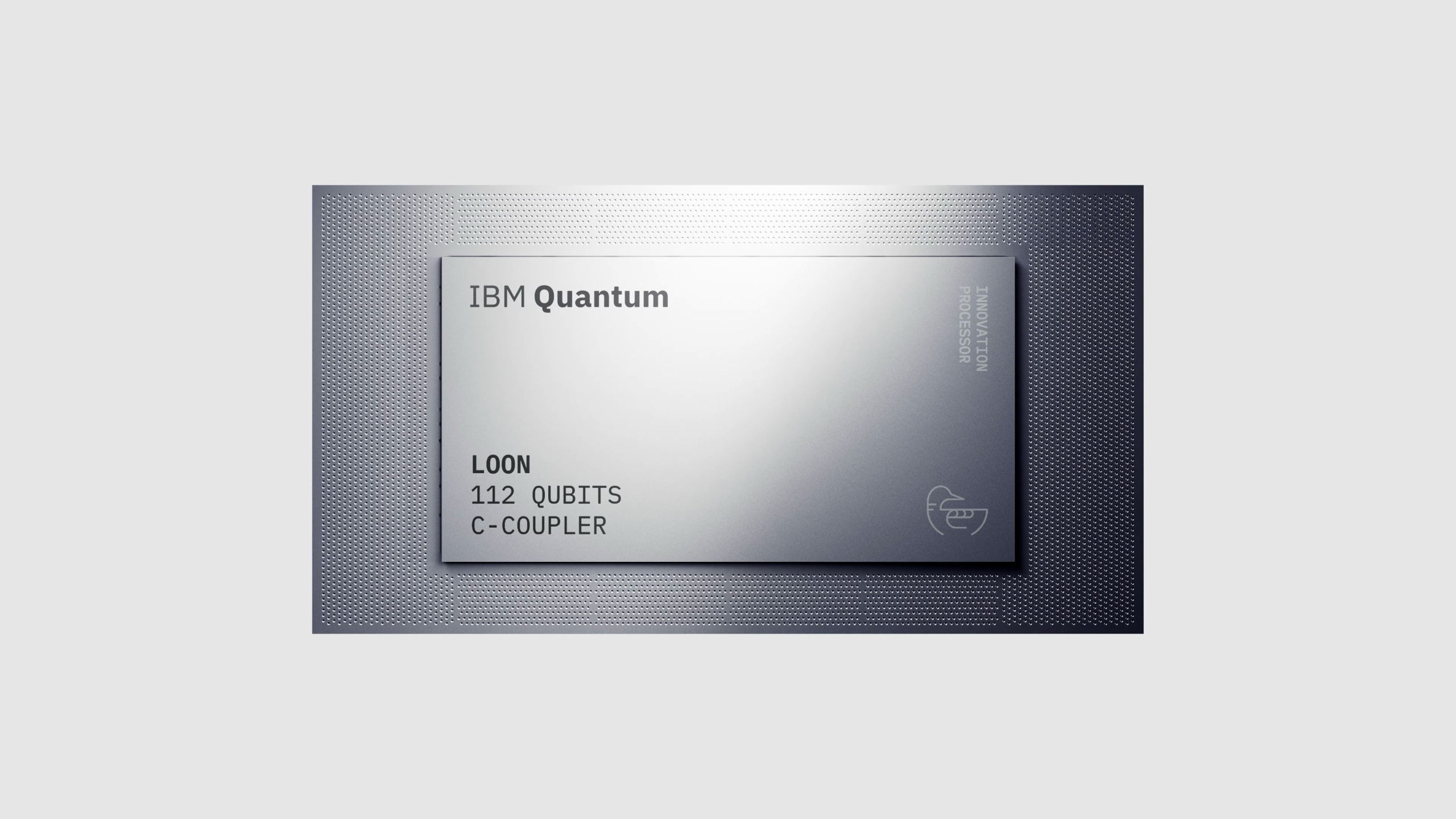
The IBM Quantum Loon chip.
IBM
IBM Quantum Loon is the more experimental of the two chips, connecting qubits not just horizontally on the chip, but vertically, too, New Scientist writes. Whichever chip proves to be more useful, the added connectivity options allows for fewer errors and more complex computations, which could lead to new real-world applications for quantum computers.
To pair with its new chips, IBM says it's also contributing to a new community-led quantum advantage tracker backed by Algorithmiq, researchers from the Flatiron Institute and BlueQubit. The tracker "supports three experiments for quantum advantage across observable estimation, variational problems, and problems with efficient classical verification," IBM says, and the company has invited the wider research community to contribute to it.
As New Scientist notes, IBM's approach is different from competitors like Google because it's focused on connecting qubits together in smaller groups. Google introduced its Willow chip in 2024 as being theoretically capable of demonstrating quantum advantage. A year later in 2025, the company announced its "Quantum Echoes" algorithm for Willow, "the first-ever verifiable quantum advantage running the out-of-order time correlator (OTOC) algorithm."
This article originally appeared on Engadget at https://www.engadget.com/science/ibm-announces-nighthawk-and-loon-quantum-chips-213603769.html?src=rss
The Rogue Prince of Persia is coming to Switch and Switch 2 consoles on December 16. The game was in early access for around a year before being officially released for PC and consoles back in August.
This version has been "optimized for handheld and hybrid play" and includes all content from the original release. That means players will be able access a wide variety of biomes, weapons and secrets.
This is a unique take on the Prince of Persia franchise, bringing parkour-style movement and combat to the roguelike genre. It's a fun and frenetic experience that calls to mind another sidescrolling roguelike, Dead Cells. This game was actually co-developed by Evil Empire, the company behind Dead Cells.
This is a digital release, but collectors have something to look forward to. The Rogue Prince of Persia is getting a deluxe physical release on April 10 for Switch, Switch 2 and PS5.
This physical version ships with a game key card, a double-sided poster and a set of cards depicting scenes from the game. When flipped, the cards join together to make up a portion of the title's world map. Incidentally, there's no physical version coming for Xbox Series X/S, despite already being available to download.
This article originally appeared on Engadget at https://www.engadget.com/gaming/nintendo/the-rogue-prince-of-persia-hits-switch-and-switch-2-on-december-16-194828522.html?src=rss
Sony has revealed the list of November additions to its PlayStation Plus Game Catalog for those on the Extra and Premium tiers of the subscription service. It’s a pretty darn good slate of games this time around, headlined by the return of the PS4 and PS5 versions of Grand Theft Auto V to the service.
It’s at least the third time GTA V has been part of the Game Catalog — it was in the lineup twice last year. Developer Rockstar Games, which is currently facing accusations of union busting, is set to release Grand Theft Auto VIin November 2026. If you have yet to play GTA V or haven’t dipped in since the PS3/Xbox 360 era, this could be a decent way for you to pass some time until the next entry arrives.
Pacific Drive (PS5) joined the Game Pass library when it hit Xbox last month and it’s headed to Sony’s subscription service as well. This is a nifty looking run-based survival game that sees you driving around a post-apocalyptic version of the Pacific Northwest in search of parts to upgrade your station wagon.
Still Wakes the Deep (PS5), a narrative horror game from Dear Esther studio The Chinese Room, is also coming to the PS Plus catalog this month. It pits you against terrifying creatures while you’re trapped on an oil rig in the North Sea. Engadget senior editor Jessica Conditt called this one a “modern horror classic.”
The tremendously silly and rude Thank Goodness You’re Here!, tactical multiplayer shooter Insurgency: Sandstorm and racing games Monster Jam Showdown and MotoGP 25 will be available to PS Plus Extra and Premium subscribers on both PS4 and PS5 later this month. First-person puzzle game The Talos Principle IIwill only be on PS5.
PS Plus Premium members get one extra game this month. An emulated version of PS2 game Tomb Raider: Anniversary will be playable on PS4 and PS5 for the first time.
All of these will join the PS Plus Game Catalog on November 18. In the meantime, all PS Plus members can claim the monthly games for November, which are Stray, EA Sports WRC 24 and Totally Accurate Battle Simulator. You have until December 1 to add those to your backlog library.
This article originally appeared on Engadget at https://www.engadget.com/gaming/playstation/ps-plus-game-catalog-additions-for-november-include-gta-5-pacific-drive-and-still-wakes-the-deep-194029093.html?src=rss
Apple Arcade has a fairly stacked winter, as the platform is adding some standout titles on December 4. Arcade titles are playable on iPhone, iPad, Mac, Apple TV and Apple Vision Pro.
First up, there's Cult of the Lamb Arcade Edition. This is a port of the incredibly addictive roguelike/town sim hybrid thingamajig, with some new features exclusive to Arcade subscribers. This version includes new follower forms, decorations and outfits. It also includes all existing content updates, though Apple hasn't announced if it would be getting forthcoming content updates.
For the uninitiated, Cult of the Lamb is two games in one. There's a top-down action component and a base builder, with each mechanic interacting in unique and often hilarious ways. Yes, you can feed your cult members poop, if that's your bag.
The iconic PowerWash Simulator also releases for Apple Arcade next month. This game seems like a great fit for Apple's service, given the zen-like mechanic of washing down grime. The sequel came out last month for other platforms. If you're a clean freak, this is the game for you.
Apple is dropping a sequel to SpongeBob Patty Pursuit. The Arcade original SpongeBob Patty Pursuit 2 casts players as both the titular SpongeBob and Plankton in a sidescrolling adventure. The first one was fairly well-reviewed.
Subway Surfers+ and Naruto: Ultimate Ninja Storm+ will also be available on December 4. Finally, a new Apple Vision Pro game is coming to Arcade this week. Glassbreakers: Champions of Moss will be available on the platform from November 13. This is an AR-based tactics RPG.
This article originally appeared on Engadget at https://www.engadget.com/gaming/apple-arcade-is-adding-powerwash-simulator-and-cult-of-the-lamb-next-month-190647480.html?src=rss
Valve made a triumphant return to the hardware market with the Steam Deck and its OLED-toting counterpart, and now it’s having another crack at virtual reality with the Steam Frame. The Steam Frame is the long-rumored headset from Valve that had previously been codenamed "Deckard."
The company also announced a new Steam controller and PC called the Steam Machine. All three devices are coming in early 2026. Valve is holding off on announcing pricing and exact availability of the new hardware. There are Steam Frame dev kits available for developers.
Valve says the Steam Frame is a wireless, "streaming-first" headset and you can hop into your games as soon as you pop it on. It supports both VR and flatscreen games. The company made a plug-and-play 6GHz wireless adapter that you slot into your PC (or Steam Machine). It has a dual-radio setup to help minimize interference, with one radio dedicated to streaming audio and visuals to the headset, and the other for Wi-Fi.
A standalone VR headset
But you don't need a PC to play games on the Steam Frame. As with Meta Quest headsets, it can run games as a standalone device.
The headset has a Snapdragon 8 Gen 3 chipset, 16GB of RAM and up to 1TB of built-in UFS storage. There's a microSD card slot, along with support for Wi-Fi 7 and Bluetooth 5.3. Of course, the headset is powered by SteamOS. As with the Steam Deck and Steam Machine, there'll be a Steam Frame verified program, so you can see at a glance which games will run on the Steam Frame in standalone mode.
What's more, the Steam Frame will support Android games. It seems Valve is hoping that developers who made games and VR experiences for Android-based headsets (such as the Meta Quest lineup) will bring them to Steam.
The Steam Frame runs on a rechargeable 21.6Wh Li-ion battery. There's one USB-C 2.0 port at the back that you'll use for both charging and data transfers. You can recharge the battery at a rate of up to 45W. It's unclear how long the Steam Frame's battery will run on a charge.
The battery is positioned on the rear of the headstrap. So you won't necessarily need to have an external battery pack that's attached to the system by an annoying cable. It'll be possible to swap the standard headstrap (into which the audio drivers are integrated) for a different option, perhaps one with a larger battery.
Even with the battery built into the headstrap, Valve says the Steam Frame weighs just under a pound at 440 grams. The core module — the front part — is 185 grams (6.5oz) and the headstrap weighs 245 grams (8.6 ounces).
Image optimization tech
The Steam Frame has an optimization feature called Foveated Streaming. Valve says this uses low-latency eye-tracking (powered by two internal cameras) to optimize the detail in the image wherever your eyes are looking. The company claims it can offer a "10x improvement in image quality and effective bandwidth." Foveated Streaming is said to work for every game in your Steam library.
The headset has dual 2160 x 2160 LCD panels with refresh rates of up to 144Hz, a field of view of up to 110 degrees and an IPD target range of 60mm to 70mm. Valve added that "thin and light custom pancake lenses provide edge-to-edge sharpness and a large eye box." The company says the maximum width for eye glasses is 140mm.
As for audio, the Steam Frame has dual stereo speakers on each side with support for high-fidelity audio. Valve says the speakers on each side are "oriented in opposite directions to cancel out vibrations," which can impact the tracking system.
Speaking of which, the headset has four high-res monochrome cameras for controller and headset tracking — the Steam Frame uses inside-out tracking. Valve says there are infrared LEDs on the outside of the device that can help support tracking in dark environments. There's monochrome passthrough support too.
Valve
Steam Frame controllers
Naturally, you'll need a way to play all of the games, so the headset comes with a pair of Steam Frame controllers. The headset tracks the positions of the controllers for VR games, with full 6-DOF tracking and IMU support. They have a split gamepad format with a D-pad, thumbsticks, ABXY buttons, triggers and bumpers. They're designed to work with your entire Steam library, and they certainly look a bit more intuitive than the PlayStation VR2 controllers.
Rather than going down the Hall effect route, Valve opted for magnetic thumbsticks, which support capacitive finger tracking. Each controller is said to run for around 40 hours before you'll have to swap out the AA battery that powers it. If you'd rather play games on the Steam Frame with the new Steam Controller, you'll absolutely be able to do that.
The Steam Frame is far from Valve's first VR headset. It released the Valve Index in 2019, and previously worked with HTC on its Vive headsets, which were initially consumer VR products before HTC shifted its focus to business and enterprise.
While none of Valve’s previous PC-focused headsets had the mainstream impact of Meta’s Quest lineup or arguably even PlayStation VR (which by all accounts is still an active platform, not that Sony’s release calendar backs it up), the company is responsible for what is probably the medium’s greatest-ever game in Half-Life: Alyx. And with SteamOS on the Steam Deck being such a hit that other companies are practically begging Valve to let them put it in their own rival handhelds, it’s easy to imagine the Steam Frame becoming a serious rival to the Meta Quest.
This article originally appeared on Engadget at https://www.engadget.com/ar-vr/valves-steam-frame-vr-headset-is-finally-official-and-its-coming-in-2026-181909387.html?src=rss
Valve is making another run at offering a console-style experience in your living room. The company has announced a new Steam Machine and Steam Controller that let you play PC games on your TV in the same way the Steam Deck lets you play them on the go. Better yet, it’s planning to release them both in early 2026.
The Steam Machine works like a console, but is technically a compact PC running Linux-based SteamOS. The boxy device features a customizable front plate and LED light strip, with a USB-A port and a microSD card slot available up front, and DisplayPort 1.4, HDMI 2.0 and ethernet ports on the back. Inside, the Steam Machine is powered by what Valve describes as a “semi-custom AMD Zen 4” CPU and a “semi-Custom AMD RDNA3 ” GPU with “16GB DDR5 + 8GB GDDR6 VRAM” and either 512GB or 2TB of SSD storage.
Valve says the Steam Machine has “roughly six times the horsepower” of the Steam Deck, and is capable of supporting 4K gaming at 60 FPS with FSR. Interestingly, Valve is also pitching the device as a way to stream more demanding games to your Steam Deck, the Steam Frame VR headset the company also announced today or any device running Steam Link.
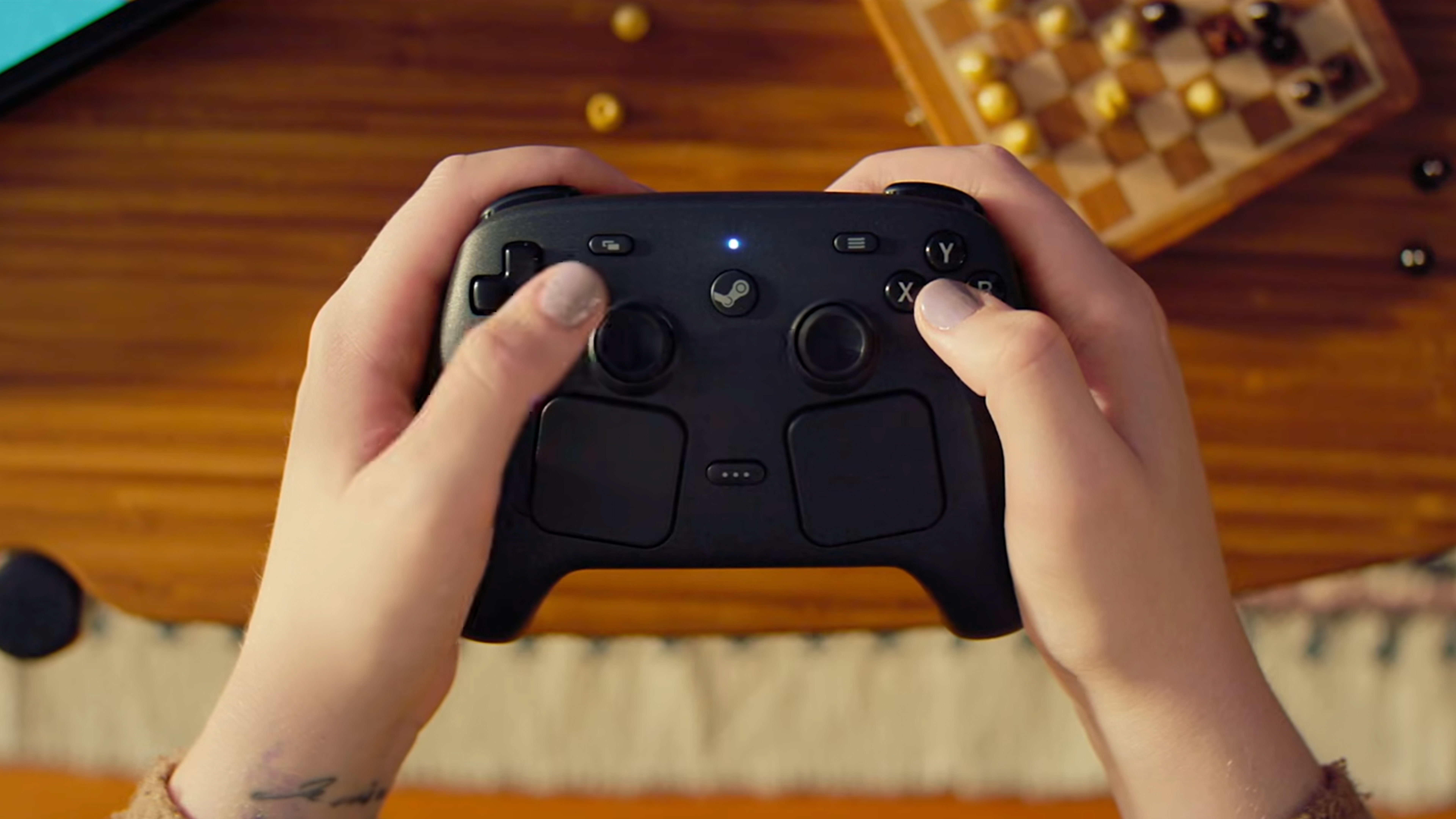
Someone holding the new Steam Controller, with trackpads visible.
Valve
While you could use the Steam Machine with a traditional Bluetooth controller, Valve has created its own solution. The new Steam Controller puts all of the various control methods of the Steam Deck into a wireless controller. That includes sticks, face buttons, grip buttons, triggers and bumpers, but also trackpads for mouse controls and gyro controls, too. The Steam Controller works over both Bluetooth or a wired connection, and Valve is also including a charging dongle that doubles as a wireless transmitter for the fastest possible connection.
Like the original Steam Controller, your input method can be individually customized for each game, and profiles can be shared. Valve also says the new controller will work with any device that runs Steam, including the Steam Deck, Steam Machine and Steam Frame.
Missing from Valve’s announcement is any kind of official price. Early hands-ons with both the Steam Machine and Steam Controller suggest Valve wants the devices to be competitively priced with equivalent PCs and game controllers. Given the extra power and features, though, it seems like they might not be as much of a deal as the $400 Steam Deck was at launch.
This article originally appeared on Engadget at https://www.engadget.com/gaming/pc/valve-announces-new-steam-machine-and-steam-controller-182836847.html?src=rss