The second-gen Apple HomePod is down to $285 in a rare sale

The latest Apple HomePod speaker is on sale for $285 at B&H Photo, which is $14 less than buying from Apple directly. This isn't the largest cash discount we've seen, and Apple previously bundled the device with a $50 gift card during Black Friday. But deals of any kind on the home speaker have been uncommon since it arrived in early 2023, so this modest drop still represents the lowest price we've seen in the last few months. The discount applies to both the black and white versions of the speaker.

We gave the second-generation HomePod a score of 84 in our review last year. It'll make the most sense if you're a particularly dedicated Apple user who prioritizes audio quality. It still works easily with other Apple devices and services, from iPhones to Apple TVs to Apple Music, and we generally find it to sound richer and clearer than competing smart speakers from Amazon and Google. As a smart home device, it's compatible with Matter and Thread on top of Apple's own HomeKit protocol, so you can use it to control a growing range of security cameras, thermostats, plugs and other smart home accessories. It also has built-in temperature and humidity sensors, and its included mics do well to pick out your voice through noise.

To be clear, this is still a pricey and relatively niche device. Speakers like the Sonos Five and Sonos Era 300 cost more but offer louder and more dynamic sound quality, while the Sonos Era 100 may be a better value if you want to conserve a little more cash. Apple's own HomePod Mini has nearly all of the same smart home features if that's your main concern, while Google Assistant and Alexa users should still look to Google's Nest Audio or an Amazon Echo device. The HomePod has its own issues, too: Siri isn't the most capable voice assistant, there's no Bluetooth audio, you can't customize its EQ and you need a workaround to control Spotify via voice. Rumors of a touchscreen-enabled HomePod have also floated around over the past year. All that said, if you're all-in on Apple, this is a decent chance to save on the company's highest-end home speaker.

Follow @EngadgetDeals on Twitter and subscribe to the Engadget Deals newsletter for the latest tech deals and buying advice.

This article originally appeared on Engadget at https://www.engadget.com/the-second-gen-apple-homepod-is-down-to-285-in-a-rare-sale-153431326.html?src=rss
The Morning After: ‘Nanosphere’ paint could reduce a plane’s CO2 emissions

Every gram counts in commercial flight. Material scientists from Kobe University have discovered “nanospheres” that are near-invisible silicone crystals. The particles can reflect light thanks to very large and efficient scattering, research published in the ACS Applied Nano Matter journal details. The result could mean covering a surface in vibrant color while only adding 10 percent of the weight of painting an aircraft for the same effect.

Minoru and Hiroshi’s discovery focuses on structural rather than pigment color to exhibit and maintain hues. The former absorbs wavelengths while reflecting those the human eye picks up. Structural colors, on the other hand, are intense and bright as light interacts with micro- and nanostructures. While the headline commercial benefits are for planes, the paint could have many more uses simply for its brightness.

— Mat Smith

The biggest stories you might have missed

The Odysseus has become the first US spacecraft to land on the moon in 50 years

The 8Bitdo Ultimate C controller is on sale for $25 today only

Google’s sign-in and sign-up pages have a new look

Sony is working on official PC support for the PS VR2

​​You can get these reports delivered daily direct to your inbox. Subscribe right here!

Final Fantasy 7 Rebirth review

The open-world tour.

TMA
Engadget

Final Fantasy 7 Rebirth takes the characters and world reintroduced with Remake and does a better job at scaling it all up. Instead of playing in a single metropolis, Midgar, this time, it’s a world tour. There’s also an expanded roster of playable characters, almost doubling Remake’s total, each with a unique play style, once again. But does Aerith survive?

Continue reading.

Xiaomi 14 Ultra combines a 1-inch camera sensor with 4 AI imaging models

It also supports satellite calling and texting.

The Xiaomi 14 Ultra is the latest Leica-branded smartphone, featuring a second-gen one-inch camera sensor. Xiaomi is finally catching up with the competition by picking up Sony’s newest mobile camera sensor, the LYT-900. The Xiaomi 14 Ultra has a slight edge on rival phones with the same sensor, with its faster main variable aperture at up to f/1.63, beating the Oppo Find X7 Ultra’s f/1.8 — on paper, at least.

Continue reading.

Framework’s new sub-$500 modular laptop has no RAM, storage or OS

Pick the parts you want and install them yourself.

Framework is selling its cheapest modular laptop. It has dropped the price of its B-stock Factory Seconds systems (which are built with excess parts and new components). As such, it’s now offering a Framework Laptop 13 barebones configuration for under $500 for the very first time. The 13-inch machine comes with an 11th-gen Intel Core i7 processor with Iris Xe graphics. So the CPU should be sufficient for most basic tasks and some moderate gaming. However, you’ll need to add RAM, storage, a power supply, an operating system and (probably) even a Wi-Fi card.

Continue reading.

This article originally appeared on Engadget at https://www.engadget.com/the-morning-after-nanosphere-paint-could-reduce-a-planes-co2-emissions-121433976.html?src=rss

Google Pay app is shutting down in the US later this year

Google Pay was largely replaced by Google Wallet back in 2022, but it has still been operating in several countries, including the US. Now, the search giant has announced that the standalone Pay app will be discontinued stateside on June 4, 2024 in a push to simplify its payment methods. After that, it will only be available in Singapore and India due to the "unique needs in those countries," Google wrote in a blog. 

As part of the deprecation, Google will be removing peer-to-peer (P2P) payments, managing your balance and "find offers and deals." For the latter, it recommends using the new deals destination on Search. Users will still be able to transfer their Google Pay (GPay) balance to a bank account after June 4, 2024 using the Google Pay website.

Google Wallet has now largely replaced GPay, with five times as many users in 180 countries, the company said. That's because it can handle more than just payments — on top of credit and debit cards, it stores transport passes, state IDs, driver's licenses, virtual car keys and more. Google Pay, the service, will still be available through Google Wallet.

Google's payment system has been a mess over the years. It started off as Google Wallet, which was launched in 2011. At the time, it was a tap-to-pay system that came out years ahead of Apple Pay (2014), supported by Mastercard and retailers like Macy's. 

Meanwhile, Android Pay came out in 2015, then that was integrated with Google Wallet in 2018 and rebranded as Google Pay. In addition, the company originally had a Google Wallet card (killed in 2016) that was effectively a prepaid debit card usable with any retailers that accepted Mastercard. Now everything is back under the Google Wallet umbrella — unless the company changes its mind again. 

Correction, February 23, 2024, 10:30AM ET: This post has been updated to clarify that only the standalone Google Pay app is shutting down in the US, not the actual service. It will still be available through Google Wallet moving forward. 

This article originally appeared on Engadget at https://www.engadget.com/google-pay-is-shutting-down-in-the-us-later-this-year-105720968.html?src=rss

The latest experimental Threads features let you save drafts and take photos in-app

Meta is currently testing a couple of capabilities for Threads, which Instagram head Adam Mosseri describes as some of the "most requested" features for the social network. One of these experimental features is the ability to save drafts. Users will be easily able to save a post they've typed as a draft that they can edit and publish later by swiping down on their mobile device's display. When there's a draft saved, the app's menu at the bottom of the screen highlights the post icon. At the moment, though, they can only save one draft, and it's unclear if Meta has plans to give users the ability to save more. 

In addition to drafts, Meta is also testing an in-app camera. It opens the mobile phone's camera from within Threads itself, so that users can more easily share photos and videos from their phone. Meta chief Mark Zuckerberg made a post on the service with a photo he says was taken with the new in-app camera the company is testing. 

Meta told us that these are initial tests for the experimental features, which means they could undergo a lot of changes before they get a wide release, and are only available for a small number of people. Over the past month, Meta also started testing a bookmarking feature for Threads that allows users to save posts they can refer to later. The company is experimenting with its version of trending topics on Threads, as well, along with the ability to make cross-posts between Threads and Facebook. 

This article originally appeared on Engadget at https://www.engadget.com/the-latest-experimental-threads-features-let-you-save-drafts-and-take-photos-in-app-094535111.html?src=rss

Pansonic’s powerful Lumix S5 II is $800 off with a prime lens

Panasonic's powerful full-frame mirrorless camera, the S5 II, is on sale at Amazon and B&H Photo Video at the lowest price we've seen yet. You can grab one with an 85mm f/1.8 prime lens for as little as $1,796, a savings of $800 over buying both separately — effectively giving you a discount on the camera and a free lens to boot. 

As I wrote in my review, the 24-megapixel S5 II was already a great value at $2,000 thanks mainly to its strength as a vlogging camera. It's the company's first model with a phase-detect autofocus system that eliminates the wobble and other issues of past models. 

Panasonic also brought over its new, more powerful stabilization system from the GH6. And it has the video features you'd expect on a Panasonic camera, like 10-bit log capture up to 6K, monitoring tools and advanced audio features. With the generous manual controls and excellent ergonomics, it's an easy camera to use. It also comes with a nice 3.68-million dot EVF and sharp rear display that full articulates for vlogging. 

For photos, it's reasonably fast and great in low light, thanks to the dual native ISO system. Other features include dual high-speed SD card slots and solid battery life, particularly for video. The main downside is noticeable rolling shutter, but that shouldn't be a dealbreaker for most users — particularly at that price.

Follow @EngadgetDeals on Twitter and subscribe to the Engadget Deals newsletter for the latest tech deals and buying advice.

This article originally appeared on Engadget at https://www.engadget.com/pansonics-powerful-lumix-s5-ii-is-800-off-with-a-prime-lens-084816863.html?src=rss

Microsoft is giving Windows Photos a boost with a generative AI-powered eraser

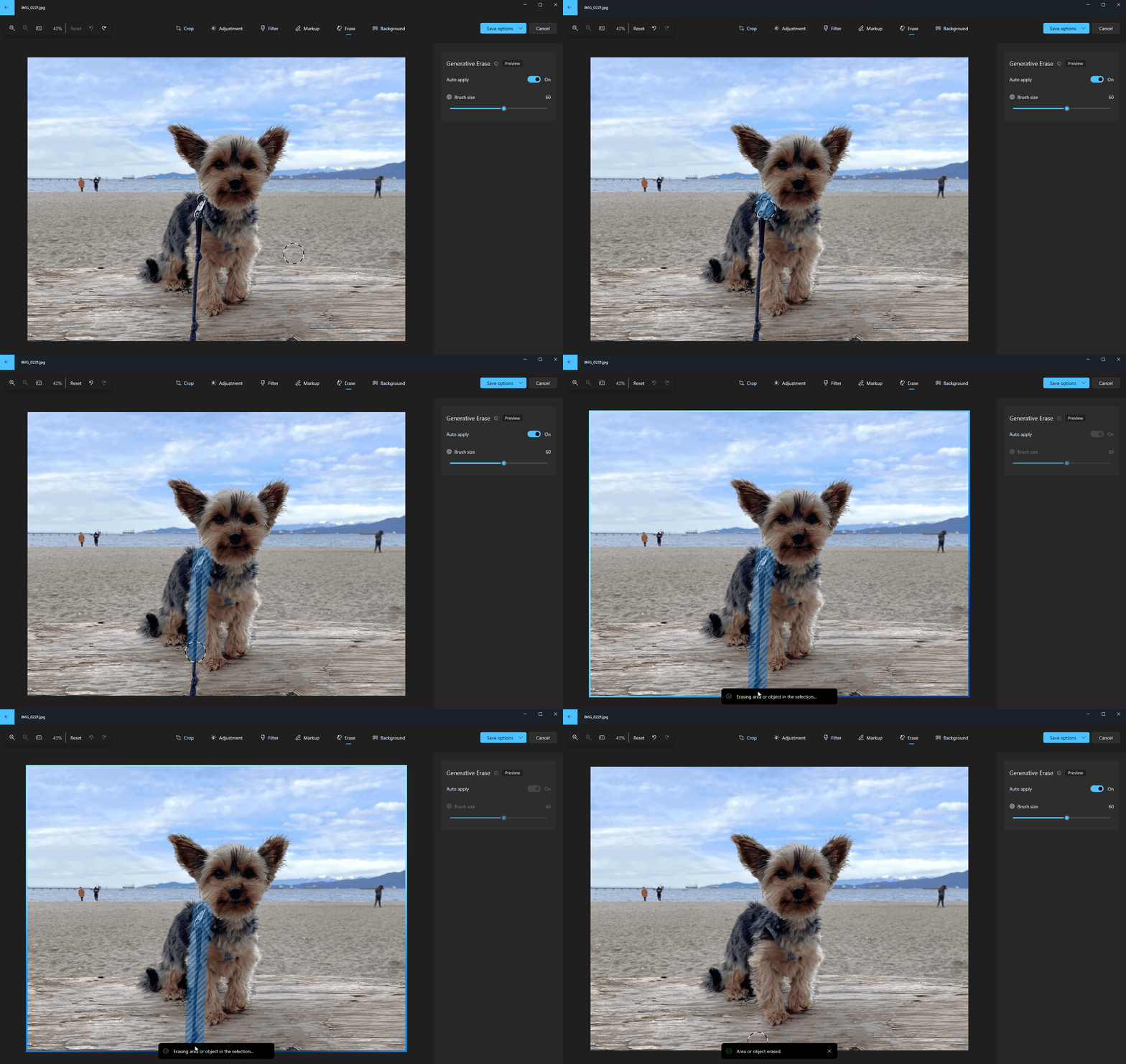
Microsoft has announced a generative-AI powered eraser for pictures, which gives you an easy way of removing unwanted elements from your photos. Windows Photos has long had a Spot Fix tool that can remove parts of an image for you, but the company says Generative erase is an enhanced version of the feature. Apparently, this newer tool can create "more seamless and realistic" results even when large objects, such as bystanders or clutter in the background, are removed from an image. 

If you'll recall, both Google and Samsung have their own versions of AI eraser tools on their mobile devices. Google's used to be exclusively available on newer Pixel phones until it was rolled out to older models. Microsoft's version, however, gives you access to an AI-powered photo eraser on your desktop or laptop computer. You only need to fire up the image editor in Photos to start using the feature. Simply choose the Erase option and then use the brush to create a mask over the elements you want to remove. You can even adjust the brush size to make it easier to select thinner or thicker objects, and you can also choose to highlight more than one element before erasing them all.

At the moment, though, access to Generative erase is pretty limited. It hasn't been released widely yet, and you can only use it if you're a Windows Insider through the Photos app on Windows 10 and Windows 11 for Arm64 devices.

Photo of a dog against a beach background.
Microsoft
undefinedThis article originally appeared on Engadget at https://www.engadget.com/microsoft-is-giving-windows-photos-a-boost-with-a-generative-ai-powered-eraser-061851854.html?src=rss

Stable Diffusion 3 is a new AI image generator that won’t mess up text in pictures, its makers claim

Stability AI, the startup behind Stable Diffusion, the tool that uses generative AI to create images from text prompts, revealed Stable Diffusion 3, a next-generation model, on Thursday. Stability AI claimed that the new model, which isn’t widely available yet, improves image quality, works better with prompts containing multiple subjects, and can more accurate text as part of the generated image, something that previous Stable Diffusion models weren’t great at.

Stability AI CEO Emad Mosque posted some examples of this on X.


The announcement comes days after Stability AI’s largest rival, OpenAI, unveiled Sora, a brand new AI model capable of generating nearly-realistic, high-definition videos from simple text prompts. Sora, which isn’t available to the general public yet either, sparked concerns about its potential to create realistic-looking fake footage. OpenAI said it's working with experts in misinformation and hateful content to test the tool before making it widely available.Stability AI said it’s doing the same. “[We] have taken and continue to take reasonable steps to prevent the misuse of Stable Diffusion 3 by bad actors,” the company wrote in a blog post on its website. “By continually collaborating with researchers, experts, and our community, we expect to innovate further with integrity as we approach the model’s public release.”

It’s not clear when Stable Diffusion 3 will be released to the public, but until then, anyone interested can join a waitlist.

This article originally appeared on Engadget at https://www.engadget.com/stable-diffusion-3-is-a-new-ai-image-generator-that-wont-mess-up-text-in-pictures-its-makers-claim-233751335.html?src=rss

Chrome’s latest experimental AI feature can help you write

Google has added an experimental generative AI feature to its browser with the launch of Chrome M122. The new AI tool is called "Help me write," because it can literally help you write more descriptive sentences or even full paragraphs from a short prompt. Google says the tool uses its Gemini models to understand the context of the web page you're on so that it could generate appropriate suggestions. If you're on a review page, for instance, it can give you a suggestion that reads like a review instead of a sales copy.

A screenshot of Google's new AI tool for Chrome called
Google

In one of Google's examples, the tool was able to spit out a decent description of what the person was selling with a prompt that simply read: "moving to a smaller place selling air fryer for 50 bucks." The tool suggested a full paragraph that was able to better communicate the user's message. "I'm moving to a smaller place and won't have room for my air fryer. It's in good condition and works great. I'm selling it for $50. Please contact me if you're interested," the suggestion read. 

In another example, the user asked the tool to write them a request to return a defective bike helmet and to communicate that the product developed a crack, which isn't mentioned in the product warranty. As you can see in Google's examples, you can change the length and tone of the suggestion if the first thing the writing aid comes up with isn't good enough to serve your needs. Once you're done, you can click the Replace button to switch your prompt with the suggested writeup.

A screenshot showing an example of how Chrome's new Help me Write AI tool works.
Google

To activate the experimental tool, you have to go into Settings in Chrome's three-dot drop-down menu. There, you can find the Experimental AI page where you can activate "Help me write." To use the feature, just highlight the text you want to rewrite and then right-click on it to summon the "Help me write" box. Take note that it's only available for Chrome browsers on Macs and Windows PCs in the US at the moment. It can also only understand prompts and write suggestions in the English language. 

Google first announced the arrival of the writing tool back in January, when it revealed that it was going to start integrating AI features into its Chrome browser. In addition to "Help me write," Google said that it's also giving the browser an AI-powered tab organizer and the ability the generate customized themes. 

This article originally appeared on Engadget at https://www.engadget.com/chromes-latest-experimental-ai-feature-can-help-you-write-170014645.html?src=rss

The 8Bitdo Ultimate C controller is on sale for $25 today only

8Bitdo makes some of the best third-party game controllers around, and one of them is now on sale for close to a record low price. The Ultimate C controller has dropped from $30 to $25.49 today only as it's an Amazon lightning deal. It’s only a few cents more than the lowest price we’ve seen for the peripheral to date.

The Ultimate C is compatible with a wide range of devices and platforms, including Windows PC, Steam Deck, Android and Raspberry Pi. It's a cheaper version of some of 8BitDo's other peripherals. 

It doesn't rely on Bluetooth or a 2.5GHz connection. Instead, the Ultimate C connects to your gaming system via a 2.4GHz USB dongle. 8BitDo was also able to reduce costs by opting for a charging cable instead of a dock and removing the profile toggle seen in pricier models. There's no support for 8BitDo's Ultimate customization software either, but the firmware is upgradable.

The tradeoffs may just be worthwhile for an inexpensive gamepad from a well-known peripheral maker. The controller will run for up to 25 hours on a single charge, according to 8Bitdo, and there's support for asymmetrical rumble when playing games on Windows (where you can plug-and-play via a wired connection as well). The field green and lilac purple colorways are quite fetching too.

Follow @EngadgetDeals on Twitter and subscribe to the Engadget Deals newsletter for the latest tech deals and buying advice.

This article originally appeared on Engadget at https://www.engadget.com/the-8bitdo-ultimate-c-controller-is-on-sale-for-25-today-only-160914390.html?src=rss

Sony is working on official PC support for the PS VR2

Sony is looking to make its latest PlayStation virtual reality headset more useful by allowing folks to run PC games on it. The company said that it's "currently testing the ability for PS VR2 players to access additional games on PC to offer even more game variety in addition to the PS VR2 titles available through PS5." Sony hopes to roll out PC support for PS VR2 later this year and said to stay tuned for more updates.

Official PC support is something many enthusiasts have been hoping for, since the PS VR2 is, for the most part, a great virtual reality headset. Modders have been working on ways to make the device work with the likes of SteamVR, but official support will make things much easier. 

Despite Sony announcing PC support plans in a blog post detailing some of the titles that are on the way to PS VR2 on PS5, it's hard to argue that the headset has an especially strong library of games as things stand. Sony itself has only released three VR experiences for the platform since it debuted a year ago. In fact, the company has not announced any future first-party games for PS VR2. The lack of backward compatibility with PS VR titles limits the current headset's library too. 

Some notable developers also have cold feet about making PS VR2 versions of their projects. The eponymous studio behind popular VR social space Rec Room says porting the game to PS VR2 would be too expensive.

So, enabling folks to more easily use PS VR2 for virtual reality experiences on PC is a smart idea. They'll be able to tap into a wider selection of games, including big hitters like Half Life: Alyx, on a headset that has excellent dual OLED displays. That could help Sony shift more PS VR2 units. It also gives Sony more of a reason to release Horizon: Call of the Mountain on PC so that the entire Horizon series is available on that platform.

Meanwhile, if Sony enables virtual desktop support, there's the possibility that PS VR2 users will be able to access Xbox Cloud Gaming through a web browser. Wouldn't that be something?

This article originally appeared on Engadget at https://www.engadget.com/sony-is-working-on-official-pc-support-for-the-ps-vr2-150632224.html?src=rss