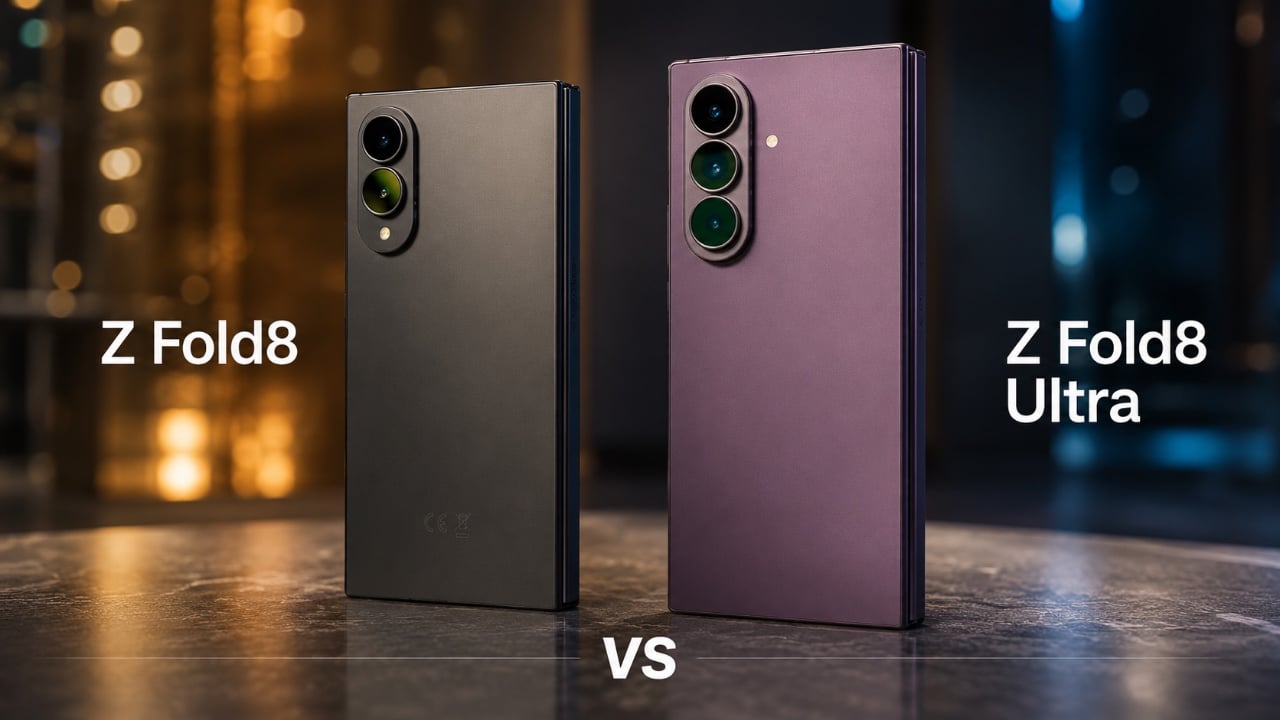
Samsung has introduced its latest advancement in smartphone technology: the Galaxy Z Rollable. This innovative device, based on a recently revealed patent, showcases rollable display technology, marking a potential evolution in smartphone design. By moving beyond foldable devices, Samsung aims to deliver a slimmer, more versatile smartphone that combines innovative technology with practical usability. The […]
Sony’s PlayStation 5 is facing a series of challenges that could reshape its standing in the gaming industry. As highlighted by YouTuber RGT 85 below, issues such as the underperformance of key investments like the $3.6 billion Bungie acquisition and the lukewarm reception of Housemarque’s latest title, Soros, have raised concerns about Sony’s current strategy. […]
Apple’s iOS 26.5 update has officially launched, bringing promises of improved performance and stability. However, the update’s impact varies significantly depending on the device you’re using. While the iPhone 17 Pro Max reaps the most benefits, older models like the iPhone 16 series face challenges, particularly with battery performance. In the video below, iDeviceHelp explores […]
The spring inside a conventional keychain carabiner is arguably the least-considered component in everyday carry, a tiny coiled wire doing the same job it has done for decades, prone to fatigue, deformation, and eventual failure at the exact moment reliability matters most. Titaner has rebuilt it from physics up. The Matrix replaces that metal spring entirely with precision-aligned neodymium magnets operating in controlled repulsion, generating gate-return force that doesn’t degrade with use. The brand rates the system at one million presses with zero rebound loss, a number that makes the lifespan of any conventional spring look fairly modest by comparison.
That magnetic spring delivers an incredibly smooth linear damping feel, a soft yet decisive rebound that Titaner describes as strangely addictive. It serves as the foundation for a more ambitious system: a three-level locking architecture where the number of active mechanical defenses is something the user controls. Six models span the lineup, ranging from a single-level autolock all the way to Constant Locking configurations with a physically deadlocked release button and the XYZ Tri-Axial Lock restricting gate movement across all three spatial axes simultaneously.
The magnetic spring structure is the invisible upgrade that takes the carabiner to an entirely new level. Where a coiled metal spring cycles between tension and compression thousands of times until molecular fatigue sets in, neodymium magnets generate repulsion force without any physical wear. The spring action remains consistent across the entire lifespan, which means the 500th press feels identical to the 500,000th. Titaner machines precision cavities into the titanium body to house the magnets, aligning their poles to create controlled repulsion that mimics the spring behavior but with a smoother damping curve. The tactile feedback on every gate release has a fidget-toy quality to it, a satisfying snap that makes you want to open and close the thing for no reason at all.
When the gate closes, the XYZ Tri-Axial Lock engages across all three spatial axes simultaneously. Traditional carabiner clips allow some degree of lateral wiggle or vertical play once the gate latches, a small but perceptible looseness that undermines the sense of security. Titaner’s lock structure eliminates that movement entirely by restricting the gate along the X, Y, and Z axes the instant it seats into the closed position. The entire assembly goes rigid, transforming from a hinged mechanism into what feels like a single monolithic piece of titanium. The lock structure is passive, meaning it happens automatically without user input, but the result is immediately noticeable the first time you handle a closed Matrix unit.
The three-level security system builds on that foundation by adding optional layers of defense. Level 1 is the magnetic spring autolock alone, best suited for quick daily access where speed matters and the risk of accidental release is minimal. Level 2 introduces a toggle switch positioned over the release mechanism, adding an active physical barrier that prevents accidental actuation. You slide the toggle to expose the release, press to open the gate, and let the toggle return to its locked position. Level 3 takes it further by physically deadlocking the release button itself. The mechanism retains the first two defense lines while introducing a third barrier that requires deliberate mechanical input before the release will respond at all. Even with Level 3 engaged, the sequence to open the gate takes under one second once you internalize the logic, which means maximum security without a meaningful sacrifice in access time.
Six models distribute across four series, each with a different mechanical philosophy and form factor. The S-Series is the most compact, designed for minimalist carry with a slim profile and a rotating release mechanism. The G-Series adopts a more geometric stance, with hard angles and a question-mark form factor that deviates from the traditional D-shaped carabiner. The N-Series carries the Tritium slot, a dedicated cavity machined into the body to hold a self-illuminating tritium vial that glows for over 25 years in complete darkness without batteries or charging. The L-Series is the entry point and the only model of the spring system that ingeniously achieves locking by utilizing the elasticity of metals and structural design.
Every piece starts as a solid block of GR5 titanium, the aerospace-grade alloy that delivers comparable strength to steel at roughly half the weight. Titaner machines each component on high-end CNC equipment, chamfering every edge to eliminate the sharp surfaces that shred pocket linings or catch on fabric. The finished pieces range from 12.3 grams for the L1 up to 26 grams for the G3, putting even the most feature-loaded variant comfortably within daily carry territory. GR5 titanium resists corrosion, rust, and bacterial growth, which means sweat, rain, and salty air have no meaningful effect on the material over time. The alloy is also hypoallergenic and non-toxic, qualities that matter less for a keychain than for something worn against skin but add to the overall sense of considered engineering.
Two surface finishes are available. The Micro-Blasted finish is a raw industrial matte that shows the machined titanium in its natural state, with superior fingerprint resistance and a soft tactile feel. The DLC Black finish applies a Diamond-Like Carbon coating over the titanium, adding extreme scratch resistance and an anti-reflective tactical aesthetic that photographs darker and more aggressive. Both finishes hold up to years of daily pocket carry without meaningful wear, though the DLC coating provides an additional layer of surface hardness for users who prioritize durability above all else.
Every Matrix keychain ships with a 32mm stainless steel quick-install key ring. The ring can be pried open by hand to slide a key directly onto the coil without the usual fingernail-destroying process of threading keys around a traditional split ring. Once the key is seated, the ring snaps closed and holds with enough tension to secure the key indefinitely.
The Matrix lineup is available now, with pricing spanning from $29 for the L1-2026 (the entry-level model with a traditional spring) up to $129 for the G3-2026 in DLC Black. The campaign includes optional add-ons such as Tritium vials, titanium toothpicks, and upgraded DLC finishes. Shipping is estimated to start in September 2026.
There’s a word in Danish, ‘træ’, that means three things at once: tree, timber, and three. It’s a fitting name for a building that refuses to be just one thing. Designed by Lendager and completed in Aarhus’ former industrial South Harbour, TRÆ stands 78 meters tall across three interconnected volumes, earning its place as Denmark’s tallest timber tower and the world’s first upcycle timber tower.
The ambition behind it is disarmingly simple: prove that a tower can be built from waste and wood without sacrificing safety, economy, or quality. What makes TRÆ remarkable isn’t just the height, it’s the conviction. The building operates within two material ecosystems simultaneously: the biogenic and the circular. Mass timber columns, cross bracing, and CLT floor slabs form the primary structure, with low-carbon concrete used only in the cores for fire safety and stability. Everything else is drawn from what already exists.
The façades are the project’s most striking argument. Salvaged aluminium sheets, arranged to evoke the texture of birch bark, mottled, imperfect, alive, clad the exterior in industrial leftovers that feel entirely intentional. Retired wind turbine blades, repurposed as solar shading, line the building’s south-facing elevations. A comparative analysis showed their estimated carbon footprint to be 27 times lower than conventional aluminium solar screens. The math is compelling. The aesthetic is better.
Measured against a conventional concrete benchmark, TRÆ achieved a 26 percent reduction in CO₂ emissions, 21 percent from the timber-led design and 5 percent from integrated reused materials. It’s a number that reshapes the conversation around tower construction, a typology long associated with emissions-heavy concrete and steel. The project doesn’t chase certification checklists. Instead, it follows a value-driven framework that prioritises measurable outcomes from the ground up.
The social dimension is just as deliberate. TRÆ houses a volunteer initiative providing daily meals to families in need, and involves homeless people in the building’s upkeep, folding existing social realities directly into the life of the building. An undulating pedestrian bridge, starting at street level, snakes upward to connect TRÆ to Aarhus’ new highline, threading the tower into the city rather than above it.
The Aarhus Architecture Awards jury awarded TRÆ Best Building in 2025, noting that it “does not necessarily adhere to a classic architectural or beauty ideal” but stands as “an energetic reckoning with well-tested solutions and zero-error culture.” That’s exactly the point. TRÆ isn’t trying to be perfect. It’s trying to be right.
The transformable furniture category has an ugliness problem.The transformable furniture category has an ugliness problem. Murphy beds wear their utilitarian origins on their sleeve, all exposed hinges and wall-mounted hardware that reads less like furniture and more like a filing system for humans. Sofa beds announce their dual nature through the awkward geometry of frames that can never quite commit to either function they serve. The mechanical logic of most convertible furniture sits right on the surface, visible and apologetic, because the joinery required to make an object shapeshift tends to be industrial in a way that no amount of upholstery can fully absorb. Jonah Rappaport’s Silhouette, a convertible chair that just won at the A’ Design Award 2025-2026, treats that ugliness as the actual design problem, not a side effect of solving a functional one.
What Rappaport made instead looks, depending on the configuration, like a piece of abstract calligraphy that somebody decided to sit in. The layered Baltic birch plywood builds into looping, scroll-like curves that read as pure formal composition regardless of which of the three configurations the chair currently occupies, armchair, lounge chair, or chaise longue. Nothing about the silhouette suggests mechanism, utility, or compromise. The transformation is structural rather than additive: the headrest and legrest rotate to swap between suspended cushion supports and load-bearing legs, with concealed locking components in the base securing each position. Rappaport conceived and fabricated the entire object across four months at Yale’s wood and metal shops, and the finish, a true black stain under clear polyurethane, gives the whole assembly the visual unity of something carved rather than constructed.
Designer: Jonah Rappaport
Most convertible furniture relies on added hardware, external pivots, visible bolts, upholstered-over frames, precisely because the transformation logic lives outside the primary structure. Silhouette inverts that entirely. The same components that suspend the headrest and legrest in chaise mode rotate down to become the front and rear legs in armchair mode, meaning the chair’s structural geometry reorganizes around a single fluid movement with no auxiliary parts changing state. Concealed locking mechanisms within the base guide and secure each position, and the adjustable armrests and infinitely variable backrest handle the postural transitions in between, from fully reclined to fully upright, without requiring any tools or external hardware whatsoever.
Wood components were laser-cut, hand-routed, sanded, and stained. Custom sheet metal parts were manually threaded, welded, and finished by hand. Every moving connection is metal to metal, with no glue or permanent bonds between joints, meaning the entire object can be fully disassembled, repaired, and reassembled without degrading the wood. That repairability is a quiet but serious design statement in a furniture market that treats most objects as disposable on a ten-year horizon. The chair measures 545mm by 900mm by 860mm in armchair configuration and extends to 1,400mm in chaise mode, dimensions that keep it residential without being precious about space.
Rappaport is Montreal-born, Yale-trained, and currently a designer at ASH NYC, a Brooklyn-based studio known for residential and hospitality interiors with a strong material sensibility. Silhouette reads as entirely consistent with that context, the kind of object a serious interior practice would specify for a client who wants furniture with genuine formal presence and no tolerance for the visual noise that convertible pieces usually bring into a room. The A’ Design Award recognition in Furniture Design positions it alongside professionally produced work from established studios, which is notable given that this began as a graduate thesis project built entirely within a school workshop. IP filings across the UK, EU, Canada, and the United States suggest a production version is a serious near-term possibility, and you can follow the project at jonahrappaport.com/chair.
LEGO has built some genuinely spectacular ships over the years. The 9,090-piece Titanic stretches over 135 centimeters and splits into three sections to reveal a grand staircase and working pistons. The Endurance, released in 2024, faithfully recreates Shackleton’s Antarctic vessel down to its ten sails and functioning rudder. The Imperial Flagship, the Black Seas Barracuda, the Black Pearl, the Maersk container ship. It is, taken together, an impressive maritime catalog. It is also, without exception, a catalog that looks entirely westward. Every ship in it comes from European or American history, and that particular blind spot has persisted across four decades of LEGO ship building.
Kyosset’s LEGO Ideas submission makes a pointed and timely case for correcting that. The Traditional Chinese Junk is a vessel that sailed the South China Sea for over 2,000 years, predating every Western ship in LEGO’s catalog by centuries, and it has never once appeared as an official set. Kyosset’s MOC (My Own Creation) addresses that gap with real ambition: a Fujian trading junk in commanding crimson and black, running between 3,300 and 4,900 pieces depending on sail construction, with a fully rigged five-sail layout, three below-deck cargo holds, a hidden captain’s cabin inside the stern hull, and a UCS-style display plaque that signals clearly what kind of display piece this wants to be.
Designer: Kyosset
The build’s inspiration came directly from walking Hong Kong’s waterfront, where three working junks still sail Victoria Harbour for tourism, their crimson batten sails moving against one of the world’s most extraordinary skylines. That firsthand reference shows in the model’s proportions and palette. The deep red and black color scheme is historically grounded, pulling from the lacquered timbers and dyed sails of Fujian merchant vessels, and it photographs beautifully from every angle. The hull shape is convincing too, with curved and angled pieces suggesting the junk’s rounded, cargo-heavy belly, and a dark red underbelly peeking through near the keel that gives the whole thing genuine visual depth. A string of tiny red paper lanterns runs along the main deck railing, gold-tipped and properly scaled, and the water buoys hanging from the hull sides are the kind of period-accurate touch that separates a good ship MOC from a great one.
The sail construction is where things get genuinely interesting from a building standpoint. Kyosset offers two configurations: 3,300 pieces using cloth sails, or 4,900 pieces if you build the sails entirely from LEGO plates and tiles. The brick-built version uses a staggered plate pattern to simulate the woven texture of traditional batten sails, with black rods at regular intervals replicating the bamboo battens that made junk sails so aerodynamically effective. The cloth version is the builder’s own preference for authenticity, and honestly, looking at the images, both approaches have a strong case. The brick sails have a satisfying density and graphic quality that the cloth version trades for historical accuracy. My favorite detail, though, is neither. It’s the deck cargo. Open crates hold jade pieces in soft green, gold ingots, and ceramic jars. Loose on the deck sit lobsters and crabs in brick-red and orange, scattered with the casual realism of a working merchant vessel that just came into port. It is such a specific, considered choice, and it makes the whole thing feel lived-in rather than decorative.
Below deck, three recessed cargo holds sit beneath the main deck level, and the captain’s cabin is tucked entirely inside the stern hull beneath a pair of curved red roof pieces that read convincingly as traditional Chinese architecture. It is a surprisingly intimate space for a model at this scale, and the fact that it is hidden rather than displayed is a neat piece of design restraint.
LEGO’s annual Lunar New Year sets have demonstrated clearly that there is a substantial, enthusiastic audience for Chinese cultural themes in brick form. A display-scale historical ship in that same tradition, sitting comfortably in the same size and price bracket as The Endurance, feels like an obvious next step for the catalog. Kyosset’s junk currently sits at around 355 supporters on LEGO Ideas, well short of the 10,000-vote threshold required for official LEGO review. If you want to see this particular gap in the catalog filled, head to the LEGO Ideas page and cast your vote.
The blobject had its moment, and then the world decided sharp edges were more serious. Hartmut Esslinger’s organic curves gave way to chamfered aluminum rectangles, and for about fifteen years, consumer electronics collectively agreed that softness was frivolous. The pendulum is swinging back, and the evidence is showing up in the least glamorous product category imaginable: the power bank. Ugreen’s new PB610 arrives in a silver-bodied, organically rounded form that feels less like a charging accessory and more like a smooth river stone that happens to have a USB-C port. At 199 yuan (roughly $29), it is making a quiet but confident case that the blobject revival is real, and it is coming for your bag.
The PB610 is a 10,000mAh, 45W power bank with a built-in braided USB-C cable, a 1.47-inch smart display, and a design language that Ugreen is calling “Mini” in its marketing materials. The silver aluminum finish and the aggressively rounded corners give it a density that render photography cannot fully capture. The red braided cable loops through the top like a vascular element growing out of the device, functioning simultaneously as a carrying strap and the single most visually decisive design choice on the whole product. Ugreen has made charging accessories before, but the PB610 feels like the first time they have treated the object itself as the message.
Designer: Ugreen
A 1.47-inch screen sits inside a pill-shaped recess that reads as a void pressed into the form rather than a component bolted onto it, and it pulls off the trick of feeling simultaneously purposeful and playful. In its default mode it surfaces real-time data: output wattage, battery temperature, remaining charge percentage, and overall battery health. Connect the PB610 to Ugreen’s companion app via Bluetooth and you can push custom images or personal graphics to the screen instead, a minor feature in functional terms but a significant one in design terms. Letting the owner author the face of the object is a very deliberate softening of the boundary between tool and personal accessory.
The hardware underneath is genuinely solid for the price point. Two 5,000mAh cylindrical 21700 steel-shell cells handle the capacity, and an NTC temperature-control chip monitors heat levels continuously to keep charging safe at sustained wattages. The port configuration runs two USB-C outputs and one USB-A: the built-in cable and the standard port both cap at 45W, while the USB-A tops out at 22.5W. Ugreen claims the 45W output delivers a 65% charge to an iPhone 17 Pro Max in thirty minutes, with comparable numbers for current Huawei and Xiaomi flagships. Three devices can charge simultaneously, though the total 45W ceiling gets divided across active ports, so managing expectations on simultaneous high-wattage draws is fair.
At 109 x 58.5 x 25.5mm and 239 grams, the PB610 sits in a physically unremarkable footprint for its capacity class, and that is precisely the point. The design work is not trying to achieve a new size record or a new wattage record. It is trying to make a mundane carry object feel considered, even covetable. The PB610 launches in China on May 26, with global availability expected to follow given Ugreen’s established international distribution. At $29, the only real question is whether the rest of the category is paying attention.