Bluesky revamps its moderation and reporting tools with transparency in mind

Bluesky is looking to make its moderation and reporting systems more transparent as part of its efforts to forge a healthier social media ecosystem than some of the alternatives out there. The platform's userbase has doubled in size to 40 million over the past year, and with more users come more instances of toxicity and other types of harmful content. Bluesky is also subject to more regulatory requirements in certain jurisdictions. The team has been working to address those factors, and changes to the moderation system should help.

The platform is revamping how it enforces and tracks violations of its policies. In the latest version of the Bluesky app, the system for reporting posts now includes more granular options with specific options to flag content related to things like false information about elections, human trafficking and bullying. "This granularity helps our moderation systems and teams act faster and with greater precision," the Bluesky team wrote in a blog post. "It also allows for more accurate tracking of trends and harms across the network."

Rather than tracking community guidelines violations across individual policies as it did in the past, Bluesky will automatically track everything in a single system. As part of that, the platform will provide users clearer information about enforcement actions. Starting in the coming weeks, users whose accounts are actioned will learn which policy they violated, the severity level of their violation and how many times they’ve broken the rules. They'll also be notified as to the length and end date of any suspension, as well as how close they are to more severe penalties being applied to their account for repeated violations. There are appeals processes for both post takedowns and account suspensions.

Looking ahead, Bluesky plans to add a moderation inbox to the app rather than dealing with moderation decisions by email. The team says this will improve transparency and enable it to send a higher volume of notifications to users.

"These updates are part of our broader work on community health," the team wrote. "Our goal is to ensure consistent, fair enforcement that holds repeat violators accountable while serving our growing community as we continue to scale."

There are some other changes in the latest version of the app. The team says that a redesign makes the "who can reply" settings easier to use, including the option to save your selection as the default for future posts. There's also a dark mode app icon available. 

This article originally appeared on Engadget at https://www.engadget.com/social-media/bluesky-revamps-its-moderation-and-reporting-tools-with-transparency-in-mind-193629692.html?src=rss

Tesla receives ride-hailing approval in Arizona

Tesla has received a permit to operate its ride-hailing service in Arizona. But don't get too excited, as this is far from the level 4 autonomy that CEO Elon Musk envisions for the company's robotaxis. The certification requires a human to sit in the front seat to supervise the ride. Tesla's operations in Austin and California have the same requirement.

Reuters reported that Tesla applied for the permit on November 13 and received approval on Monday. In September, the automaker received certification to begin testing autonomous vehicles (also with a safety monitor) in Arizona. The new permit allows those vehicles to start carrying paying passengers.

In Tesla's quarterly earnings call last month, Elon Musk said the company's "robotaxis" would operate in eight to 10 metro areas by the end of 2025. However, that term is used loosely. For now, the service is far from the kind of "robot chauffeur" you'd get in a Waymo. Think a plain old Uber, except the driver or safety operator is using a version of Tesla's full self-driving software, which has been the subject of numerous safety complaints.

This article originally appeared on Engadget at https://www.engadget.com/transportation/tesla-receives-ride-hailing-approval-in-arizona-192756065.html?src=rss

Google Maps will use AI to predict if EV chargers will be available on arrival

Google is rolling out an update to Maps that brings some new tools to the table, including the ability to check on EV charger availability. The app already showed the location of EV chargers, but not if they were available or not. In other words, it was entirely possible to roll up to a charging station only to find a line of EVs waiting for juice.

The tool in action.
Google

The updated tool will soon show "how many chargers will likely be available upon your arrival." This uses a combination of AI wizardry and real-time charger availability to predict how many chargers are likely to be open and ready for use at a particular point in time. Google says this will help users "avoid lines and save time." The charger tracker drops next week, but only via Android Auto and cars with Google built-in.

The Explore tab has gotten a revamp, making it easier to find curated lists from local influencers and companies like OpenTable. All you have to do is swipe up to see "trending and popular restaurants, activities and sights near you." The updated Explore tab rolls out this month globally on both Android and iOS.

The company is also stuffing more Gemini into Maps because it's 2025 and that's the way things are done now. The AI chatbot will be able to whip up "know before you go" tips before visiting restaurants, hotels, concert venues and other locations of interest. Google says Gemini will be like "having a knowledgeable guide show you the way." We'll have to see how that works out in real life. This AI-powered tips feature is already available for many users in the US on Android and iOS.

Finally, reviewers can now change their display names when providing feedback to local businesses. Google says this can be used to review nearby shops with names like "Eager Elf" or "Julia Loves Sweets." Despite the user name change, it'll still be your Google account making the remark, so keep things polite.

This is just the latest update for Google Maps. The app is adding live lane guidance for Polestar 4 owners and is also coming to Garmin smartwatches.

This article originally appeared on Engadget at https://www.engadget.com/apps/google-maps-will-use-ai-to-predict-if-ev-chargers-will-be-available-on-arrival-191808879.html?src=rss

Amazon adds AI-generated video recaps for select Prime Video shows

If the idea of a custom-made "previously on" video for every show you watch is attractive to you, Amazon is taking steps to make it happen. The company has announced that it'll now include AI-generated "Video Recaps" for select series on Prime Video so it's easier to hop back into a show after taking a break. The feature expands on text-based X-Ray Recaps the company started experimenting with in 2024, and the Kindle Recaps it already offers for some series sold through the Kindle Store.

Amazon's Video Recaps combine clips, synchronized narration, select dialogue, music and sound effects into a short video that refreshes you on the characters and plot of a show. You can access the recaps through a new Recaps button on a show's page. Clicking it will either pull up a text-based X-Ray Recap or a Video Recap, depending on what Amazon's generated. At least for now, if you're interested in seeing a Video Recap for yourself, Amazon says the feature is available in beta for Fallout, Tom Clancy's Jack Ryan, Upload, Bosch and The Rig.

Recaps are essentially a repackaged version of the summarizing skill that companies have decided AI excels at. Amazon's Video Recaps are decidedly more complex than an email summary, but the basic premise is the same. Adding the feature to media apps and devices, as Amazon and Spotify have done, seems like low-hanging fruit that other companies will pursue. 

AI-generated recaps aren't without their detractors, though. Many indie authors were against Kindle Recaps because of their potential to misrepresent the plots and characters of books. The same possibility could theoretically exist for Video Recaps, as well.

This article originally appeared on Engadget at https://www.engadget.com/entertainment/streaming/amazon-adds-ai-generated-video-recaps-for-select-prime-video-shows-190758346.html?src=rss

OMEGA’s Ceramic Gambit: How the Seamaster Planet Ocean Challenges Rolex’s Design Dominance

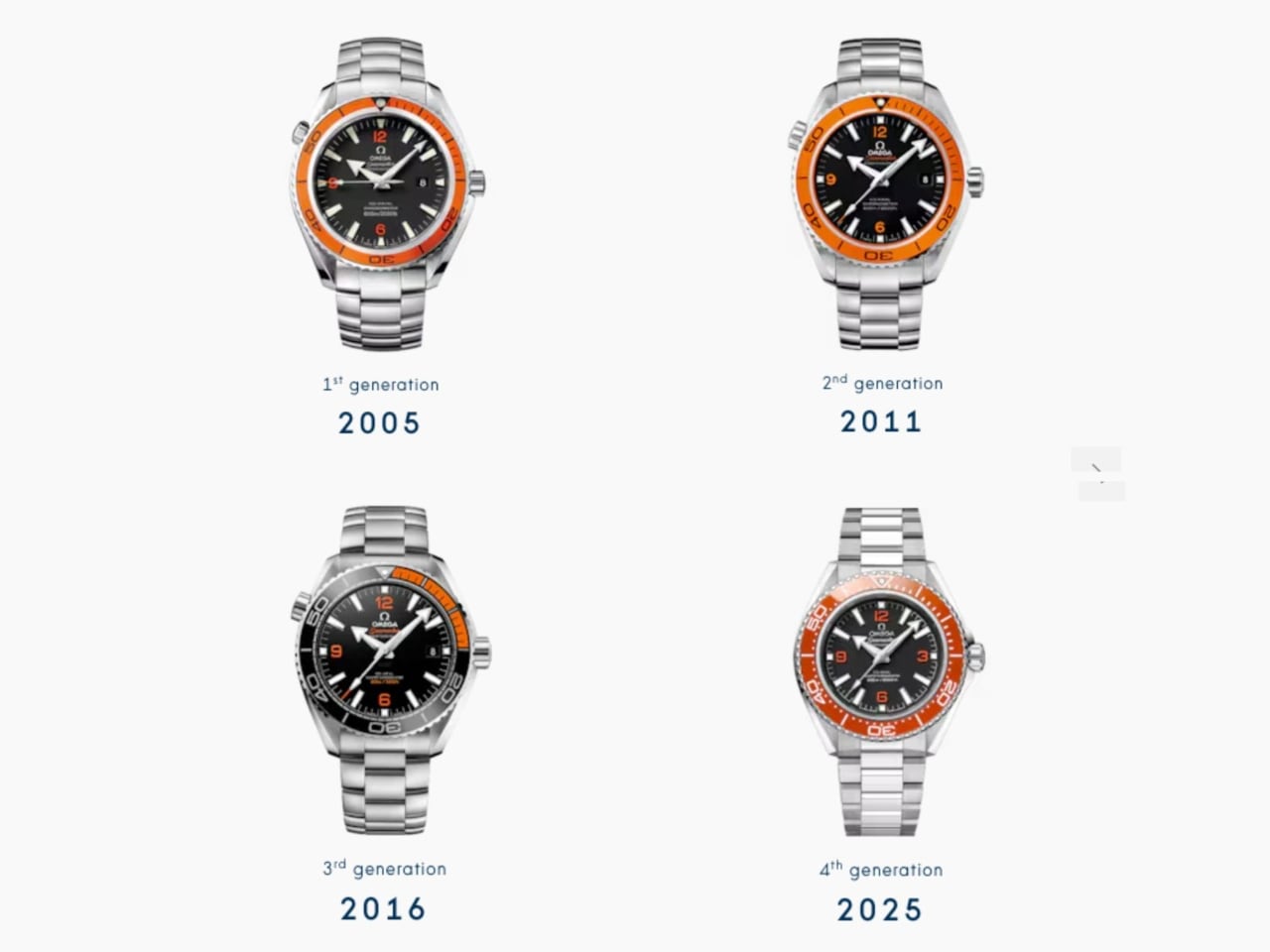
Twenty years after launching the Planet Ocean, OMEGA just made the boldest design move in luxury dive watches: bringing back orange ceramic at full production scale. Not as a limited edition. Not as a boutique exclusive. As a core offering that positions this collection directly alongside Rolex’s Submariner in the everyday luxury category.

Designer: OMEGA

This is the design story of how OMEGA spent years perfecting a single color, reworked an entire case architecture, and created three distinct visual personalities that finally give the Planet Ocean the design refinement it always deserved.

The Orange Ceramic Challenge

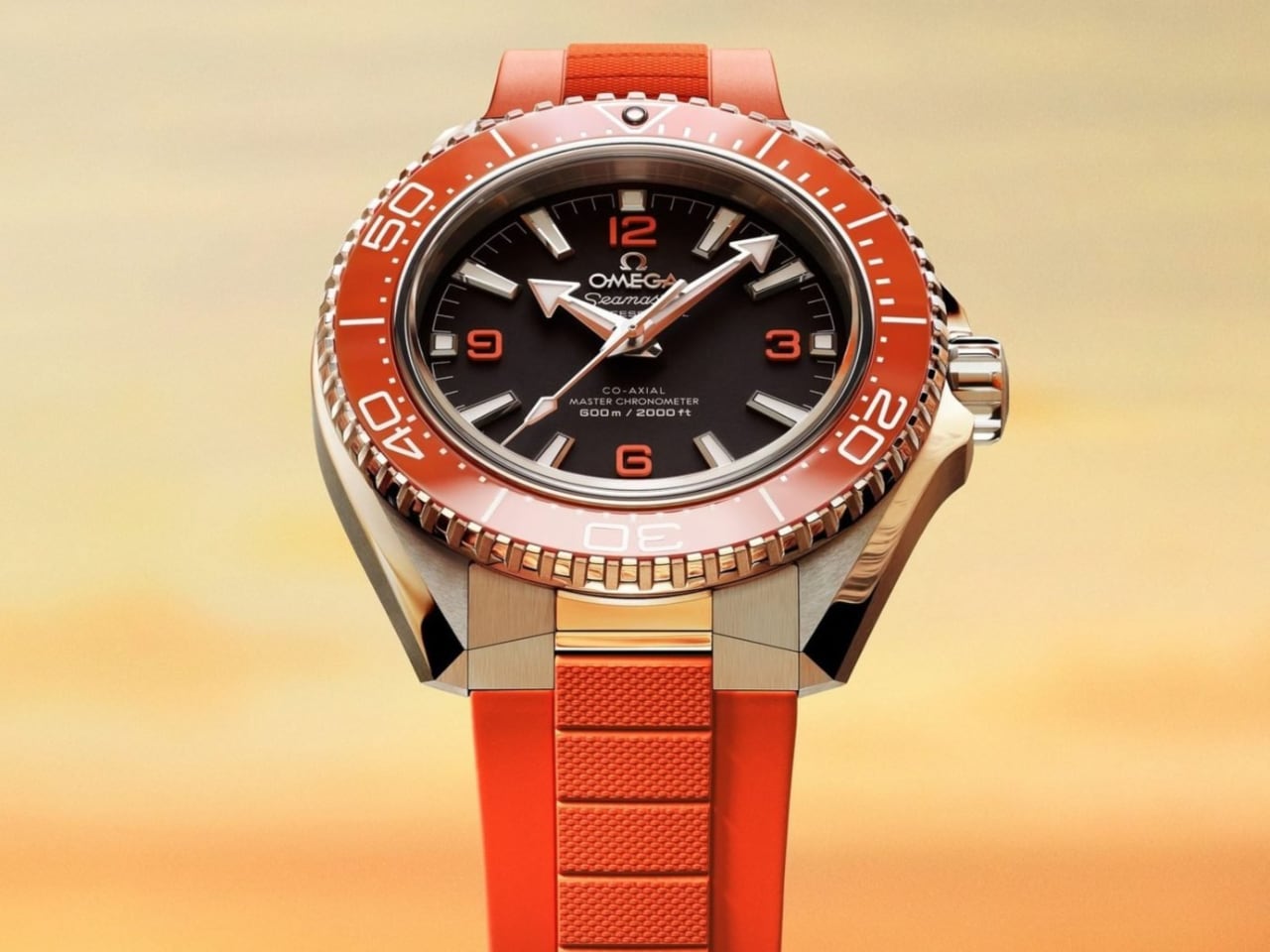
Let’s address the headline design achievement first. OMEGA’s new orange ceramic bezel represents years of Swiss atelier development to perfect a hue that most brands avoid entirely. The reason? Orange ceramic is notoriously difficult to execute without looking like cheap plastic film.
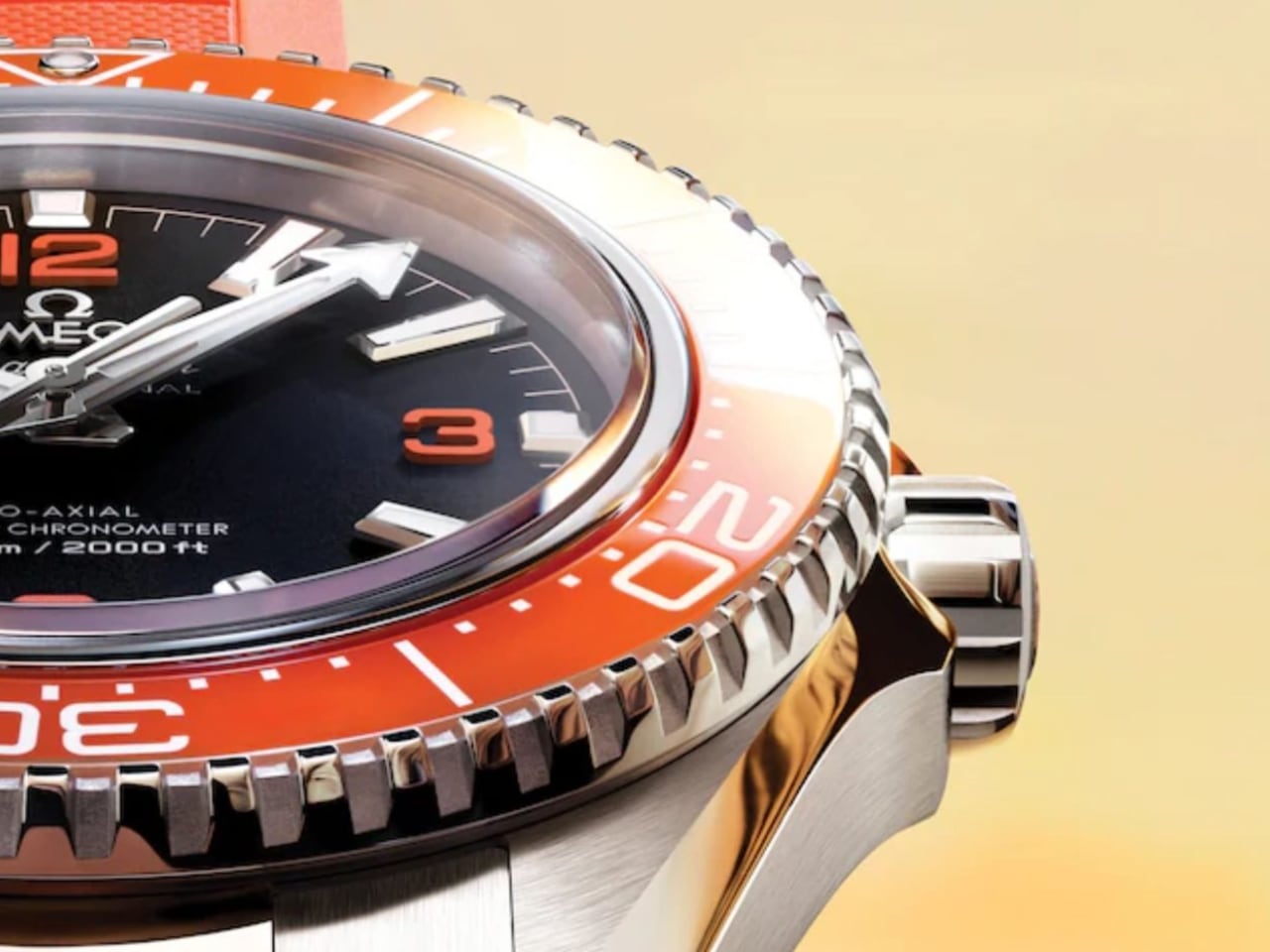
The chemistry of ceramic materials resists certain wavelengths. Getting that specific orange tone, the one that references the 1957 Seamaster 300 heritage pieces, requires precise control over sintering temperatures and material composition. OMEGA clearly cracked the formula. The result hits like a flare on the wrist: bold, bright, and unmistakably intentional.

The orange accents aren’t arbitrary nostalgia. The 1957 Seamaster 300 pieces carried orange through the hands, indices, and bezel. Those cues resurfaced in the very first Planet Ocean models in 2005, giving the watch its early cult status. Twenty years later, OMEGA had the confidence to bring that color back at impressive scale.
This represents thoughtful heritage integration. Rather than creating a vintage reissue or limited anniversary piece, OMEGA wove that 1957 DNA into a thoroughly modern design. The matte dial finish, the arrowhead hands, the white enamel bezel scales: these are pure Planet Ocean signatures, simply executed with contemporary precision.

What makes this move significant isn’t just the technical achievement. It’s the scale. Bringing this level of material complexity to a core production model, not a limited run, signals confidence in the design direction. OMEGA is betting that luxury watch buyers want personality and heritage, not just another black bezel diver.

Three Personalities, One Refined Architecture

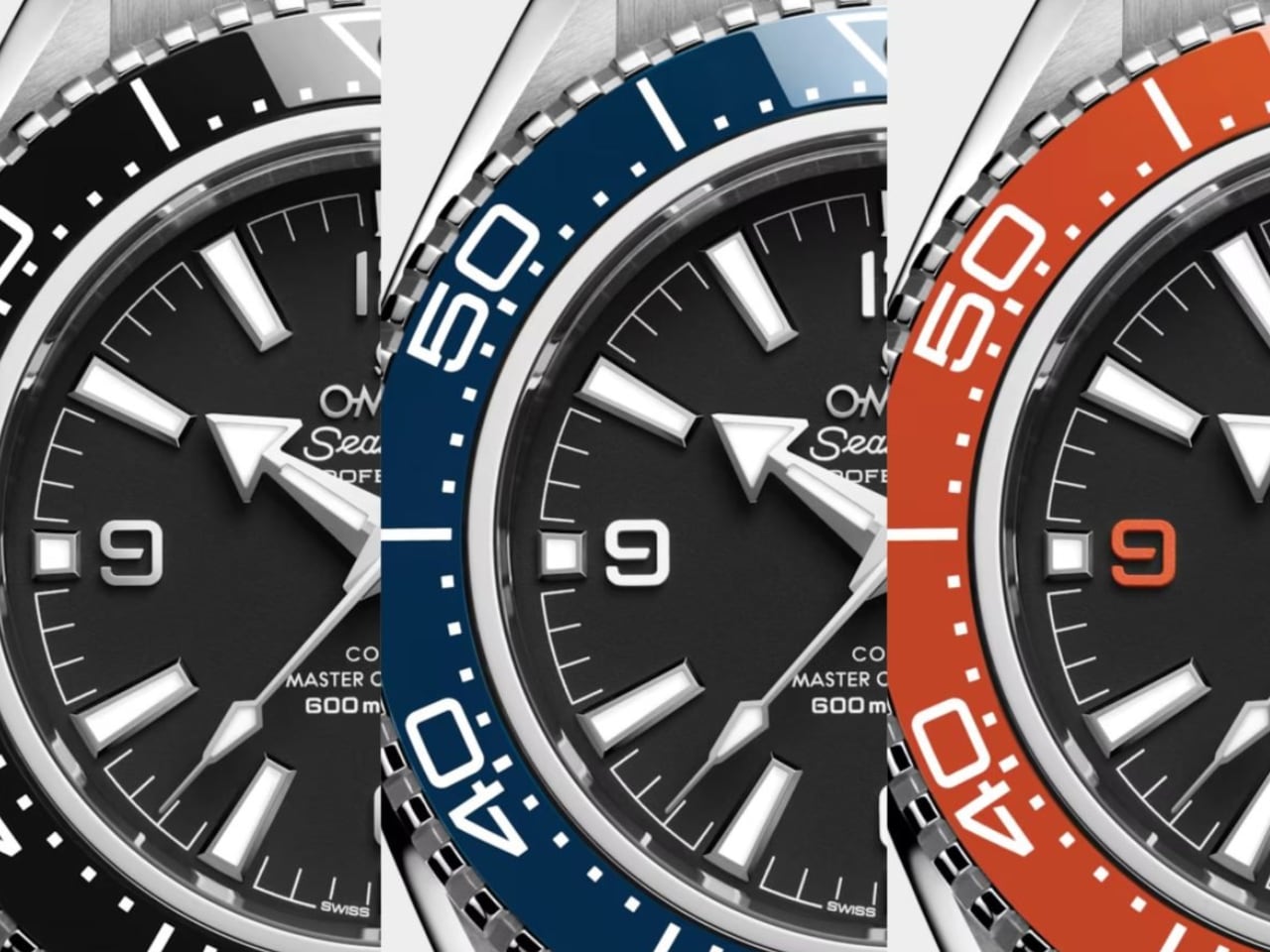
The collection splits into three distinct visual identities, each serving different aesthetic preferences while sharing the same dramatically reworked case.
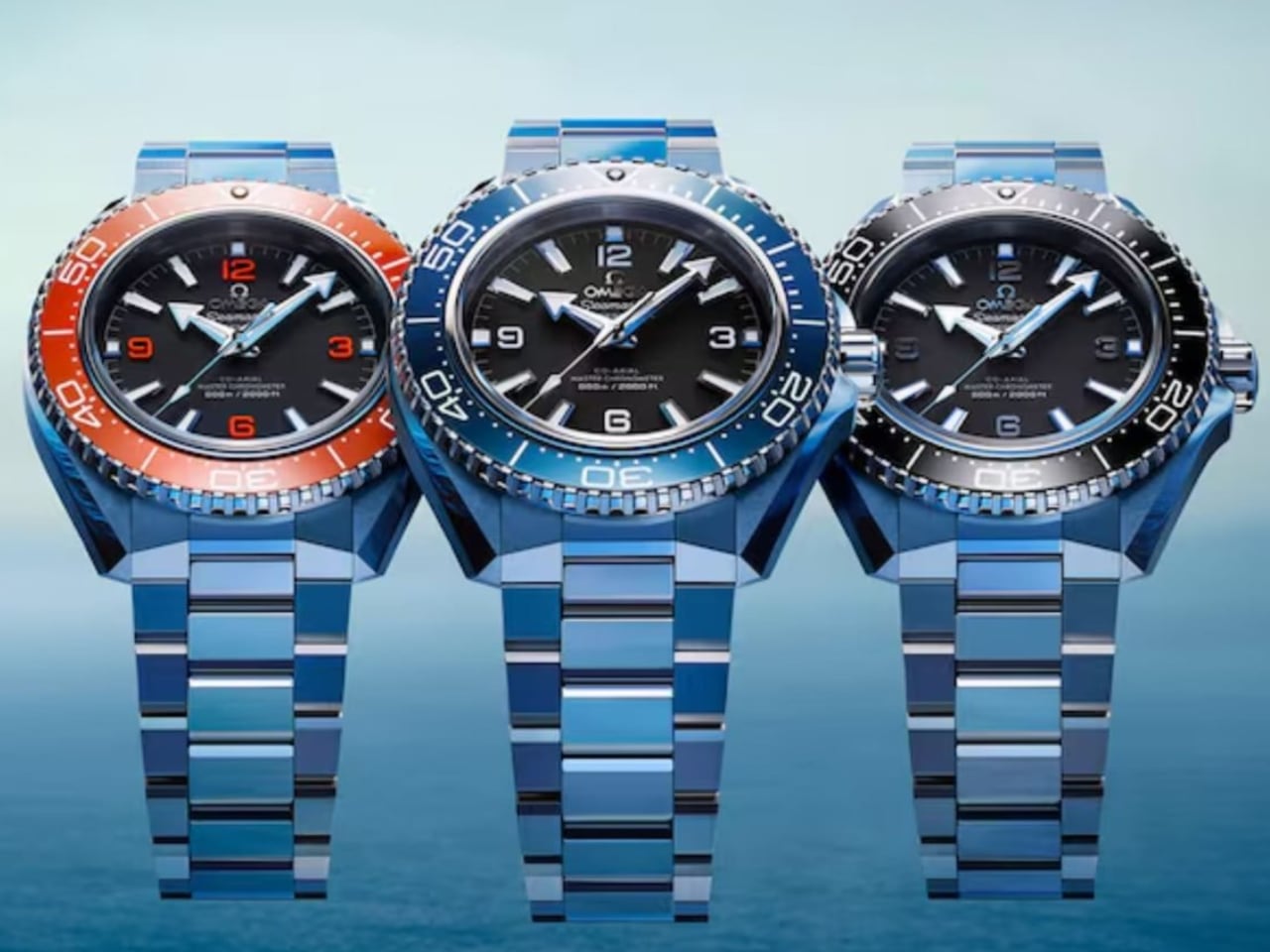
The black variant is the purist’s pick. Matte black dial, rhodium-plated numerals, white enamel bezel scale. This feels closest to the original professional dive watch brief, the option for someone who thinks color belongs in galleries rather than on expensive timepieces. It’s the no-nonsense tool watch executed with Swiss precision.

The blue edition becomes the everyday option, what I’d call The Bond Watch. That ceramic bezel catches light differently than the matte black version, creating visual interest that works equally well at Bondi brunch or a business dinner. Paired with the steel bracelet, it has that elevated everyday look. Swap to the blue rubber strap, and it transforms into something more pragmatic yet still effortlessly appealing.

Then there’s the orange variant, designed for people who want their Planet Ocean to make a statement while keeping it classy. This is where that years-long ceramic development pays off aesthetically. The bezel doesn’t just add color; it fundamentally changes the watch’s visual weight and presence. Doxa pioneered orange bezels in the 20th century for pure underwater legibility. OMEGA’s move here is for aesthetics, and it’s paid off completely.

The Case Evolution

Beneath those three color personalities sits a more subtle but equally important design refinement: the case architecture itself.

The new Planet Ocean case is sharper and more angular than the outgoing generation. You can see it in the lug transitions and the crown guard geometry. But here’s where OMEGA’s design team showed restraint: they made the watch sit flatter on the wrist by reworking the sapphire crystal profile.
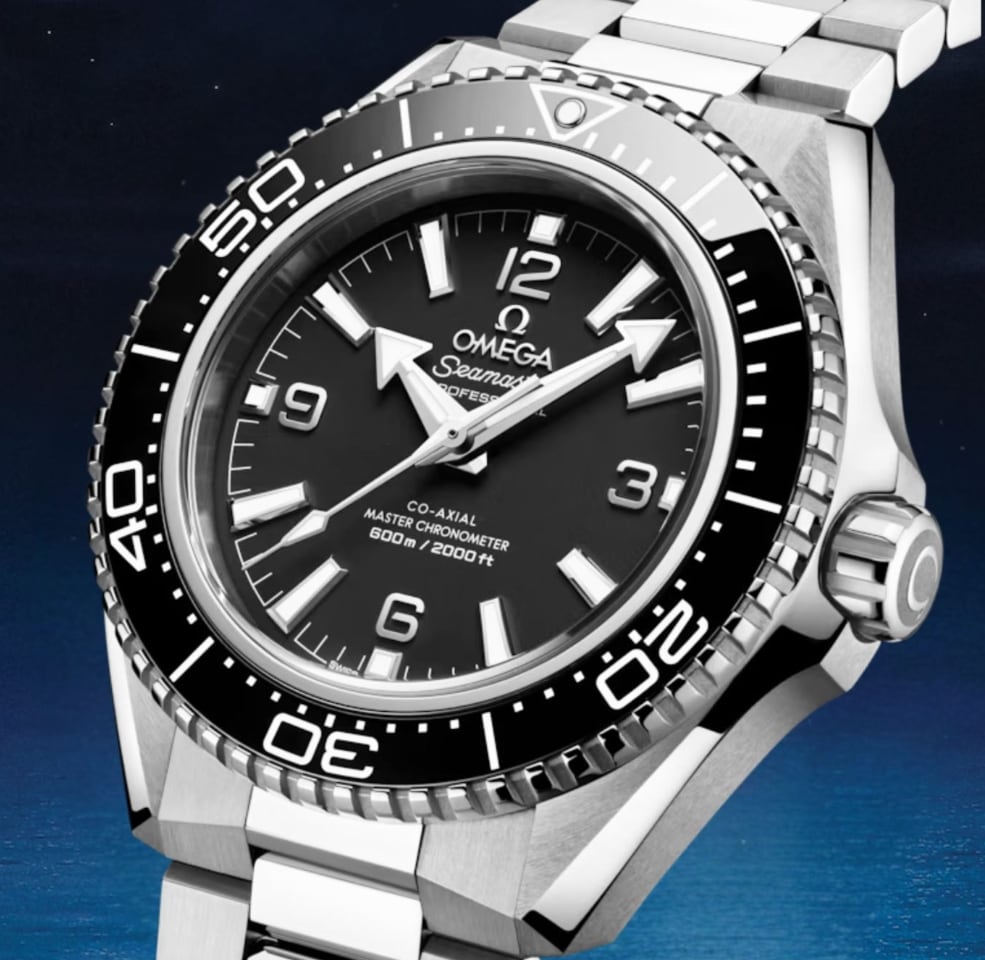
That’s a crucial detail. Dive watches often suffer from excessive height, creating awkward wrist presence and limited shirt-cuff clearance. By addressing the crystal geometry, OMEGA created the most refined Planet Ocean silhouette to date. The 42mm diameter stays manageable, but the flatter profile changes how the watch wears entirely.
The Grade 5 titanium caseback contributes to this refinement. Titanium is NASA’s preferred material for a reason: exceptional strength-to-weight ratio and resistance to environmental extremes. For a watch rated to 600 meters, that caseback choice represents functional design thinking, not just material showcase.

Why This Design Matters

Glen Powell wearing the orange variant and Aaron Taylor-Johnson stepping into the blue and black references signals OMEGA’s positioning strategy. These aren’t just ambassador choices; they’re design communication. Powell can sell a high-visibility ceramic bezel with charm. Taylor-Johnson, as a 007 frontrunner, anchors the collection with leading-man polish.

The message? This Planet Ocean generation positions directly against Rolex’s Submariner in design sophistication, material innovation, and everyday luxury appeal. Not through imitation, but through distinct visual personality. Where the Submariner trades on timeless restraint, the Planet Ocean offers choice. Three distinct design directions, bold material decisions, and heritage integration that feels earned rather than borrowed.

For a brand of OMEGA’s scale to bring back orange ceramic as a core offering, not a boutique exclusive or limited run, reveals where luxury dive watch design is heading. Buyers want options beyond black and blue. They want material innovation that’s visible and meaningful. They want heritage that informs design rather than constraining it.

This Planet Ocean looks tougher. It wears better. It feels more resolved. The sharper case, the flatter profile, the perfected orange ceramic: these represent two decades of learning what worked and what needed refinement.

OMEGA didn’t just update the Planet Ocean. They gave it three distinct personalities, perfected a notoriously difficult material, and created the design refinement this collection always deserved. Twenty years after launch, this is the Planet Ocean that challenges Rolex’s design dominance with confidence and craft.

The post OMEGA’s Ceramic Gambit: How the Seamaster Planet Ocean Challenges Rolex’s Design Dominance first appeared on Yanko Design.

Black Friday SSD deals include up to $250 off recommended internal and portable SSDs, microSD cards and more

As is the case with most tech products, Black Friday is a decent chance to pick up any storage gear you’ve been eyeing. If you have a PC, PS5, gaming handheld or any other gadget that could use some extra space, we’re weeding out the junk and rounding up the best Black Friday SSD deals and other storage discounts you can still get right now. It's not the most plentiful time for SSD deals more generally these days, but we're still seeing a handful of discounts on well-reviewed internal drives, portable SSDs and microSD cards. We'll update this post as we find more offers that are worth your time.

Samsung Pro Plus (1TB, 2-pack) for $136 at Best Buy ($104 off MSRP): The Pro Plus is the runner-up pick in our guide to the best microSD cards. On its own, it’s not worth buying over the faster Lexar Professional Silver Plus when both are available for the same price — which is the case right now — but this bundle deal that packages two 1TB cards together for $68 apiece is much more appealing if you need space for multiple devices. Just add two to your cart or click the “special offers” link on Best Buy’s product page to see the discount at checkout. If you need another card, you can also grab a three-pack for $204. For reference, the previous low for an individual 1TB Pro Plus card is $70.

Lexar Play Pro (256GB) microSD Express card for $49 at Amazon ($11 off): The only reason to buy a super-fast (but pricey) microSD Express card is to expand the storage of a Nintendo Switch 2, which requires the newer format. In our guide to the best Switch 2 microSD cards, we found each model we tested to perform similarly in actual games, so your best bet is to buy whichever one you can find in stock at the lowest price. Nintendo has already announced that Samsung’s 256GB Express card will be available for “$20 off MSRP” on November 30, which should bring it down to $40. 

If you can wait to pounce on that offer, you should. But if you can’t for some reason, or if that discount quickly sells out, this is only $2 more than the best price we’ve seen for Lexar’s equivalent model. The 1TB version is also worth noting at $186; that's not an all-time low, but it's the best price we can find for a microSD Express card with that much capacity right now.

SanDisk microSD Express Card (256GB) for $60 at Amazon ($8 off): Like the offers above, this discount matches the best price we’ve seen for SanDisk’s 256GB microSD Express card. Again, there isn’t much point in grabbing it as long as cheaper options are in stock, though this is technically the fastest all-around model we’ve tested when it comes to transferring games to and from the Switch 2’s built-in storage. (Within games, however, the difference is still minimal.) We’ll note it here just in case the other Express models completely sell out. Also at B&H.

SK Hynix Platinum P51 (1TB) PCIe 5.0 SSD for $110 at Newegg ($60 off): Most people don’t have to pay extra for the top-tier performance of a PCIe 5.0 SSD like the Platinum P51, but if you need something for more intense workloads or just want the comfort of owning a more futureproof SSD, reviews around the web suggest this is one of the better options available. Just make sure you have a compatible motherboard and CPU first. This offer ties the lowest price yet for the 1TB model. Use the code BFEFE96 to get the full discount at checkout.

Crucial T705 (2TB) PCIe 5.0 SSD for $160 at B&H ($39 off): If you need a bit more space from a PCIe 5.0 drive, the Crucial T705 is a slightly older but still highly rated alternative with blazing-fast speeds. This discount comes within $10 of the 2TB version’s all-time low. 

Crucial T710 (2TB) PCIe 5.0 SSD with heatsink for $190 at B&H ($130 off): The T710 is Crucial’s successor to the T705. Most reviews suggest it isn’t a massive leap over the older version in real-world performance, but it’s generally quicker, and it’s a more noticeable improvement in terms of power efficiency. If you’re willing to spend a little bit extra, this is the best price we've tracked for the 2TB model with a heatsink, which isn't 100 percent essential for everyone but helps minimize thermal throttling all the same. It’s usually retailed for $250 in recent months. Also at Best Buy.

Samsung SSD 9100 Pro (8TB) PCIe 5.0 SSD with heatsink for $750 at B&H ($270 off): Yes, we realize this is a ton to spend on a new SSD, but if you’re in the niche that wants a PCIe 5.0 drive with as much capacity as possible, it ties the lowest price we’ve tracked for the 8TB variant of Samsung’s top-end model. Most reviews say that the 9100 Pro is outpaced by the WD Black SN8100 at the enthusiast end of the market, but it’s still competitive, and the 8TB version of that WD drive is priced $250 higher as of this writing. Most other direct rivals, meanwhile, aren’t yet available with this much space. 

Crucial P310 (2TB) M.2 2230 SSD for $130 at Amazon ($111 off): The P310 is a small-size SSD you can slot in certain thin and light notebooks or gaming handhelds like the Steam Deck. It uses cheaper QLC memory, not the faster and more durable TLC, but most reviews say it performs well for what it is. This discount is a few bucks above the largest drop to date for the 2TB model, but it’s still about $20 off the drive’s usual street price. Also at B&H.

Seagate Storage Expansion Card for Xbox (2TB) for $200 at Amazon ($30 off): Annoying as it is, the only way to fully add storage to an Xbox Series X or Series S is to use a proprietary expansion card. Only two of those exist, and they’re both expensive compared to traditional SSDs. Still, they’re dead simple to set up, and this Seagate model holds up well compared to the consoles’ internal storage. While this deal for the 2TB version isn’t an all-time low, it’s about $20 off the card’s usual going rate over the last few months. The 4TB variant is also discounted at $380 — that’s a ton to spend on one of these things, but it does match the lowest price we’ve tracked for that particular model. Also at Best Buy and Walmart.

This article originally appeared on Engadget at https://www.engadget.com/deals/black-friday-ssd-deals-include-up-to-250-off-recommended-internal-and-portable-ssds-microsd-cards-and-more-175429476.html?src=rss

Disney fails in initial bid to halt Sling TV’s short-term streaming passes

Sling TV has won the first stage of a legal battle with Disney over the short-term passes that the streaming service introduced in August. The Dish Network-owned platform started offering daily ($5), weekend ($10) and weekly ($15) passes for its Sling Orange plan, which costs $46 on a monthly basis. 

Disney owns several channels that are offered through Sling TV platforms, including multiple ESPN channels and the Disney Channel. It did not take too kindly to the new offerings — Disney promptly filed a lawsuit over the short-term live TV passes, as well as an emergency request to halt them. As reported by Cord Cutters, US District Judge Arun Subramanian dismissed the latter motion after determining Disney failed to demonstrate "it would suffer irreparable harm" without the court's immediate intervention.

“Disney hasn’t shown it has lost customers due to the passes,” Judge Subramanian wrote in an 11-page ruling, per The Verge. “The networks are being distributed in the same platform, in the same manner, that they always have, but to a broader array of Sling customers.”

A viewer might not want to sign up to a streaming service for an entire month if they only want to watch a single game (say, a winner-take-all soccer match in which a team scores three utterly sensational goals to take their country to the men’s World Cup for the first time in 28 years). However, Disney asserted that, under its agreement with Sling TV, the platform can only offer access to its channels to traditional subscribers. Under Disney's interpretation, those are consumers who have recurring monthly subscriptions.

Judge Subramanian disagreed, pointing out that the contract defines a subscriber as “a person intentionally authorized by Dish to receive any level of video programming service or package of programming networks via the Sling Platform.” The judge added that, as far as a "subscriber" goes, "there’s no minimum subscription length or other terms specified" and the term refers to anyone who is entitled to receive “any level of video programming service or package of programming networks.” Judge Subramanian argued that this "broad definition clearly covers users of the passes at issue in this case." 

Disney also claimed that the short-term passes would pull consumers away from its own standalone ESPN streaming service. The company offered up evidence to that end, but Judge Subramanian wrote that the documentation "doesn’t show that the passes siphon customers from ESPN Unlimited.” The judge added that, "if the passes do siphon customers from ESPN Unlimited, Disney hasn’t shown that those losses would not be quantifiable."

While the short-term passes remain in place for now (with Sling TV offering $1 per day passes until November 30 to celebrate this initial victory), the breach-of-contract lawsuit Disney has filed will move forward. Judge Subramanian also pointed out that the current agreement between the two sides runs out within the next 12 months and they're set to start renegotiating terms soon. So, if Disney wants to prohibit the short-term passes or have its networks excluded from them, it can try to hash that out in contract talks.

This article originally appeared on Engadget at https://www.engadget.com/entertainment/streaming/disney-fails-in-initial-bid-to-halt-sling-tvs-short-term-streaming-passes-175000436.html?src=rss

AMD will preview its Redstone upscaling tech on December 10

The AI upscaling upgrade for AMD graphics cards is nearly here. On Tuesday, AMD said it will reveal FSR "Redstone," its answer to NVIDIA's DLSS, on December 10.

Upscaling tech has been a big sticking point in comparisons between NVIDIA and AMD GPUs. Despite big improvements in FSR 5, NVIDIA's DLSS still outperforms AMD's tech in most metrics. AMD hopes Redstone will close the gap.

The company hasn't yet gone into great detail about the tech. But we know Redstone offers more than just better ML-powered upscaling. It also has improved AI frame generation, ray regeneration and radiance caching. (PC Gamer notes that Call of Duty: Black Ops 7 already has Redstone’s ray regeneration portion built in.)

Naturally, AMD is marketing it as a selling point of its RDNA 4-series GPUs. The company's latest cards, like the Radeon RX 9070 series, are already the strongest the company has made in years. If AMD can master this tech, then its budget cards, like the already potent 9060 XT, could grow much more appealing.

This article originally appeared on Engadget at https://www.engadget.com/gaming/pc/amd-will-preview-its-redstone-upscaling-tech-on-december-10-174507324.html?src=rss

Hypixel Studios shows off new Hytale footage the day after it brought the game back to life

Hypixel Studios just dropped a massive new gameplay video for the upcoming adventure Hytale, which features over 15 minutes of footage. This comes just a day after the company brought the game back to life by buying the rights back from Riot. In other words, this new footage is quite the flex.

It's worth noting that this isn't a AAA-style trailer. It's barely edited live footage from the game that was "recorded in a single morning and put together" by Hypixel co-founder Simon Collins-Laflamme. The developer says there are no "bells and whistles" included with this footage, as it features "just the game as it is." The description goes on to call the video "raw and broken, but still beautiful."

Hypixel says that this footage uses the original legacy engine which dates back to 2018. It's also running on a four-year-old build. Collins-Laflamme wrote that it was important to "release raw footage today so we can break the curse once and for all."

As for that curse, Hytale was recently canceled by Riot Games after nearly a decade of development. Just a few months later, the company managed to purchase the rights and get the game back on track. It also rehired around 30 staffers. The developer says "there's a long road ahead, but early access is coming soon." We don't have a date on that early access build, but we sure do like the word "soon."

For the uninitiated, Hytale is a fun-looking adventure game that looks like an open world take on Minecraft. Today's footage highlights some of the game's action and RPG mechanics, with a harrowing look at nighttime gameplay.

This article originally appeared on Engadget at https://www.engadget.com/gaming/pc/hypixel-studios-shows-off-new-hytale-footage-the-day-after-it-brought-the-game-back-to-life-173159607.html?src=rss

iOS 26.2 – 10 Awesome NEW Features to Try

iOS 26.2 – 10 Awesome NEW Features to Try

Apple’s iOS 26.2 update is set to introduce a range of features designed to enhance your iPhone’s usability, personalization, and overall functionality. Scheduled for release on December 8, 2025, this update focuses on improving accessibility, streamlining daily interactions, and boosting productivity. With a mix of practical tools and creative enhancements, iOS 26.2 promises to deliver […]

The post iOS 26.2 – 10 Awesome NEW Features to Try appeared first on Geeky Gadgets.

Posted in Uncategorized