For those who will never tire of the words of Ursula K. Le Guin, a special treat is on the way. The esteemed late author's blog, which she started in 2010 at the age of 81, is being rereleased as a podcast, In Your Spare Time. Le Guin's blog ran until 2017, and a book collecting a selection of those posts was published that year. But, the podcast will include everything: essays, poems and "even the ones that are mostly cat pictures," according to the announcement. The first episode will be released April 8 on Apple Podcasts, Spotify and other platforms.
From Le Guin's official Instagram account, which is managed by her estate:
We always wanted to hear a version of the blog that includes every single post, even the ones that are mostly cat pictures. So for the next two years and change, we'll release an episode every Wednesday. Each episode features a different reader of Ursula's text, and each reader adds their own thoughts—about their relationship with Ursula and her work, or about the specific topic of the post, or whatever catches their fancy.
You can listen to a trailer here ahead of the first episode's release this week. Post zero, "A Note at the Beginning," will be read by David Mitchell.
This article originally appeared on Engadget at https://www.engadget.com/entertainment/ursula-k-le-guins-blog-has-been-turned-into-a-podcast-193257106.html?src=rss
We got to share in a rare moment of collective awe this week as four astronauts blasted off toward the moon, beginning a 10-day journey that will take them farther from Earth than any humans have traveled in the last 50 years. It'll still be a little while before they reach their destination — the Orion spacecraft is expected to loop around the moon on Monday — but they've already seen some pretty incredible stuff on the way there. Here's the latest on the Artemis II mission, and other interesting science stories from this week.
Artemis II crosses the halfway point
After years of planning, NASA astronauts Reid Wiseman, Victor Glover and Christina Koch, along with Canadian Space Agency (CSA) astronaut Jeremy Hansen, are finally on their way to the moon for the Artemis II mission. This test flight is a crucial step in NASA's plans to send humans to the surface of the moon again for the first time since Apollo 17, and the high-stakes launch went off without a hitch on Wednesday.
The Artemis II crew is now more than halfway to the moon, according to NASA. When Orion reaches the moon on April 6, the astronauts will have a six-hour window of opportunity to observe the partially lit lunar far side, which can't be seen from Earth. If you're curious about where exactly the astronauts are at any given moment, you can track the mission by visiting NASA's Artemis Real-Time Orbit website. And, if you just want to see what space looks like from Orion, here's a livestream from outside the capsule. The moon is now in view!
The crew did experience some technical difficulties after leaving the ground, though all were resolved fairly quickly. Early Thursday morning, Wiseman contacted mission control to troubleshoot some issues with a Surface Pro he was attempting to use, noting, "I have two Microsoft Outlooks and neither one of those are working." Relatable. The Artemis II crew was also greeted by a malfunctioning toilet not long into the flight, and astronaut Koch had to work with the ground team to figure out a fix — which they thankfully were able to do. In a livestream later, the astronaut joked that she is now a space plumber.
Small issues aside, the Artemis II mission is off to a pretty amazing start. The Orion spacecraft completed its translunar injection burn on Thursday, officially taking it out of Earth orbit and putting it on its way to the moon. Commander Wiseman shared some pictures of the view from Orion's windows afterward, and they are breathtaking. In one unbelievably crisp shot of Earth, you can even see two auroras. And there's plenty more observations to come.
Students discover a nearly pristine ancient star
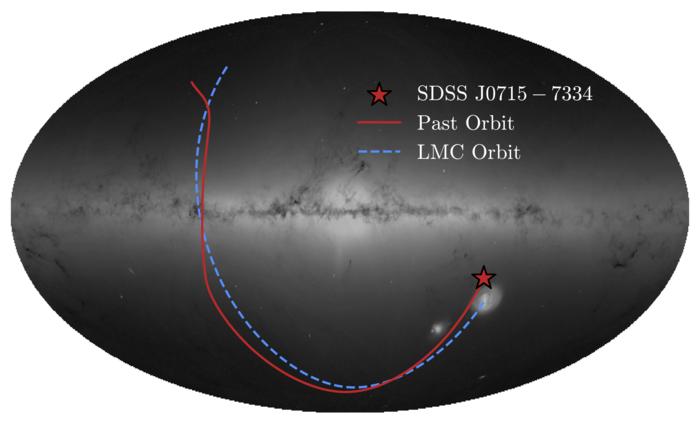
Using data from the Sloan Digital Sky Survey (SDSS), a group of undergraduate students at the University of Chicago has discovered what's thought to be one of the oldest stars ever observed. Their analysis indicates that the star, called SDSSJ0715-7334, was born in the nearby Large Magellanic Cloud billions of years ago before eventually making its way to the Milky Way.
Vedant Chandra and the SDSS collaboration Background ESA/Gaia image, A. Moitinho, A. F. Silva, M. Barros, C. Barata, University of Lisbon; H. Savietto, Fork Research
The star was one of 77 that the students selected for closer observation after poring through the SDSS data in their "Field Course in Astrophysics” class, which is led by Professor Alex Ji, the deputy Project Scientist for SDSS-V. SDSS-V is an ongoing all-sky survey that's mapping the Milky Way. After creating their list, they set out to observe the stars during a field trip to Carnegie Science’s Las Campanas Observatory in Chile, and honed in on SDSSJ0715-7334 on day two. The team found it's made mostly of hydrogen and helium, with very little carbon and iron. In the paper published in the journalNature Astronomy, the researchers note that this composition could be the product of a primordial supernova.
"This ancient immigrant gives us an unprecedented look at conditions in the early universe,” said Ji in a statement. Ji added, “The star has so little carbon that it suggests an early sprinkling of cosmic dust is responsible for making it. This formation pathway has only been seen once before.”
Before you go, be sure to check these stories out too:
This article originally appeared on Engadget at https://www.engadget.com/science/space/the-latest-on-the-artemis-ii-mission-to-the-moon-and-more-science-stories-160000539.html?src=rss
For April Fools' Day, the developer ofLook Outside released an update that added a new option to your interactions with NPCs: kissing. Instead of just fighting or talking to enemies and surviving neighbors in the cursed apartment building, you could give 'em a smooch. Their dialogue and sprites were updated accordingly, too. Cue stammering eldritch horrors with bright red blushing cheeks. April Fools' Day is (thankfully) over now, but there's good news for anyone who has been enjoying the lovefest or didn't get a chance to try it. Developer Francis Coulombe has built in a way for players to access "smooch mode" going forward.
"If you started a game on April 1st and kissed the wounded neighbor, that save file is now permanently in smooch mode!" Coulombe posted on social media. "You can also activate smooch mode on a new save file by naming Sam 'Casanova'." I immediately started a new save to confirm and, yes, doing this does indeed allow you to go on a kissing spree. While you can't smooch every single person/abomination you'll run into, you sure can kiss a lot of them.
Want to kiss the Rat King? Go wild. Pierre? Yup. That weird bug guy in the basement who eats bandages? Unfortunately yes, he's kissable too. This truly is the game that keeps on giving. We're apparently getting a real, non-silly update in the near-future as well, soLook Outsidefans are eatin' good. Now, please excuse me while I get back to my Kiss Everyone (except Lyle) run.
This article originally appeared on Engadget at https://www.engadget.com/gaming/look-outsides-april-1-update-that-let-you-kiss-enemies-is-now-a-permanent-smooch-mode-223746232.html?src=rss
A new trailer has given us our best look yet at the upcoming The Ghost in the Shell anime. While it might not tell us all that much about the direction the show will go in plot-wise, it sure is aesthetically pleasing, with a throwback art style that looks a lot more like the original manga than we've seen with other adaptations. The series will be released on Prime Video this July.
The Ghost in the Shell is being produced by Science Saru. The studio hasn't revealed much about its story, only noting that it's based on Masamune Shirow's manga, so it isn't entirely clear yet how closely it will follow the source material. The franchise has certainly seen its fair share of questionableadaptations over the years. But, this glimpse at the art style seems like a promising indicator. An exact release date hasn't yet been announced, but July isn't too far away now.
This article originally appeared on Engadget at https://www.engadget.com/entertainment/streaming/watch-the-trailer-for-science-sarus-ghost-in-the-shell-anime-series-210147477.html?src=rss
The first crewed mission of NASA's Artemis moon program may take off in a matter of days, with a launch window that opens on April 1, and as preparations are underway for that, the space agency is refocusing its plan to establish a human presence on the moon. NASA announced major changes to its approach for moon landings that are expected to play out over the coming years, including axing its plan to build an orbiting station called Gateway. Read on to learn more about the agency’s new vision for the moon, along with other interesting science stories from this week.
Gateway out, moon base in
Just a few weeks after overhauling its Artemis program, NASA this week announced even more changes to its plans for putting astronauts back on the moon. Most notably, the space agency is abandoning the lunar Gateway project, which was intended to be the first ever space station orbiting the moon. Gateway, an international collaboration, wasn't just going to support exploration of the lunar surface, but deep space missions too. But the writing has been on the wall for some time; in the Trump administration's proposed budget cuts last May, Gateway was among the programs selected for the chopping block. Now, NASA is officially putting it on "pause" and plans to build a $20 billion moon base instead.
“NASA is committed to achieving the near‑impossible once again, to return to the moon before the end of President Trump’s term, build a moon base, establish an enduring presence, and do the other things needed to ensure American leadership in space," NASA Administrator Jared Isaacman said at the agency's Ignition event on Tuesday.
There are three phases to the moon base plan, according to NASA: first using contractors to send rovers and instruments to the moon through the Commercial Lunar Payload Services (CLPS) program; next establishing "semi-habitable infrastructure," with astronauts on the ground and collaboration with other space agencies; and finally adding "heavier infrastructure" to support long-term stays on the lunar surface, including the Italian Space Agency's Multi-purpose Habitats and the Canadian Space Agency's Lunar Utility Vehicle. NASA says it's aiming to start this plan off with crewed moon landings every six months following the Artemis V mission, which is currently planned for 2028.
Comet 41P pulls a reverse card
A study published this week in The Astronomical Journal describes what's said to be the first observation of a comet reversing its spin. Observations taken several months apart in 2017 show the comet 41P/Tuttle-Giacobini-Kresák starting to spin more slowly after making a close flyby of the sun, before picking up speed again by December of that year. Its spin period, measured using NASA’s Neil Gehrels Swift Observatory, was about 46-60 hours in May 2017, but later observations by the Hubble Space Telescope showed it was just 14 hours, according to NASA. The researchers say what likely happened is that the heat from the sun caused the comet's ice to sublimate, sending gases spewing off its sides.
“Jets of gas streaming off the surface can act like small thrusters,” author David Jewitt of the University of California at Los Angeles, said in a statement. “If those jets are unevenly distributed, they can dramatically change how a comet, especially a small one, rotates.” Jewitt compares it to pushing a merry-go-round. “If it’s turning in one direction, and then you push against that, you can slow it and reverse it.”
Comet 41P is thought to have come from the Kuiper Belt and passes through the inner solar system every 5.4 years. It's small, with a nucleus of just around .6 miles, and the researchers found it's become less active over recent years, indicating that there are changes taking place on the surface. While it's thought to have been in this orbit for about 1,500 years, it now appears to be rapidly evolving, and the rotational changes — which could cause structural instability if it continues — could mark the beginning of the end for it. “I expect this nucleus will very quickly self-destruct,” said Jewitt.
Saturn in a new light
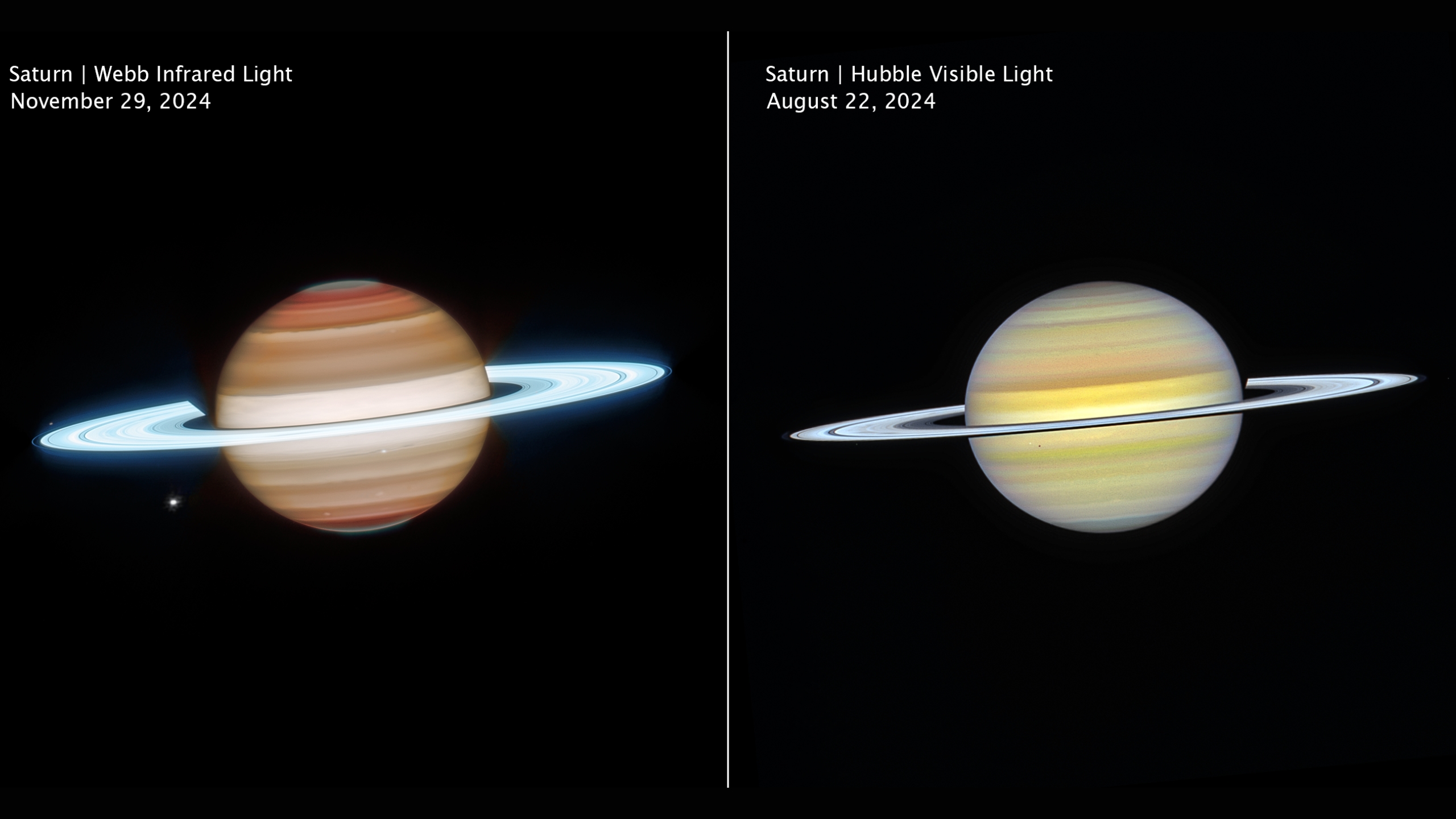
A side-by-side-comparison of photos captured of Saturn from the Webb telescope and the Hubble telescope.
NASA/ESA/CSA
Stunning images of Saturn released this week by NASA, ESA and CSA provide a more detailed look at the many layers of the ringed planet's "busy" atmosphere. The images, which show storms, clouds at different depths, Saturn's "ribbon wave" jet stream and so much more were taken by the Hubble Space Telescope and the James Webb Space Telescope in 2024. Read more about it here.
This article originally appeared on Engadget at https://www.engadget.com/science/space/nasa-pauses-its-lunar-gateway-plan-a-comet-reverses-its-spin-and-more-science-news-160000163.html?src=rss
Need something new for your reading list? Here are two titles we think are worth checking out. This week, we've got Andy Weir's Project Hail Mary and The Thing on the Doorstep, an H.P. Lovecraft adaptation for Image Comics.
This article originally appeared on Engadget at https://www.engadget.com/entertainment/what-to-read-this-weekend-revisiting-project-hail-mary-and-the-thing-on-the-doorstep-190000250.html?src=rss
Remember when Japan sent a spacecraft to an asteroid 180 million miles away to scoop some dirt off the surface? Six years on from its arrival to Earth, that sample has yielded some insights about what may have seeded life on our planet. Read on to learn more about the latest findings, and other science news we found interesting this week.
DNA ingredients on Ryugu
In 2020, a capsule from the Japanese space probe Hayabusa2 returned to Earth with samples collected from the surface of asteroid Ryugu, and scientists have spent the subsequent years analyzing those materials for clues about the conditions that existed in the early solar system. This week, researchers from Japan reported an exciting discovery: the Ryugu samples contain the five building blocks of DNA and RNA. The findings, coupled with those from other recent studies, could put us closer to understanding how the ingredients for life first made it to Earth billions of years ago.
The study, published in the journal Nature Astronomy, found the nucleobases adenine, guanine, cytosine, thymine and uracil — all of which were also found in samples gathered from a different asteroid, Bennu, last year, and before that in meteorites dubbed Murchison and Orgueil. This suggests these nucleobases were widespread in the early solar system, and supports the hypothesis that carbonaceous asteroids like Ryugu and Bennu transported them to Earth, the authors explain in the paper. Ammonia was discovered in the samples as well, which may play a role in how these nucleobases formed.
The discovery of these building blocks "does not mean that life existed on Ryugu," Toshiki Koga, the study's lead author from the Japan Agency for Marine-Earth Science and Technology, told AFP. "Instead, their presence indicates that primitive asteroids could produce and preserve molecules that are important for the chemistry related to the origin of life."
Bacteria collaborate to eat plastic waste
Researchers in Germany have identified a trio of bacteria that can digest a common plastic additive, but only when working together. The study published in the journal Frontiers in Microbiologyfound that a "consortium" of bacterial strains (two from species in the genus Pseudomonas and one from Microbacterium)was able to break down several phthalate esters (PAEs), which are often used to make plastic materials more flexible. These chemicals are increasingly finding their way into the environment as plastic pollution grows, and research suggests they can have harmful effects on human health and that of wildlife.
The team focused on microbes that could be found right at home in their own lab, taking a sample of biofilm that had formed on the polyurethane tubing of a bioreactor. This sample was then incubated in a growth medium containing the PAE diethyl phthalate (DEP) as the main source of carbon and energy. They eventually ended up with a stable culture of bacteria that could break down DEP, as long as the DEP concentration didn't exceed 888 milligrams per liter, according to a press release. The consortium could gobble up all the DEP in 24 hours at 30 degrees C. It was also able to grow on the PAEs dimethyl phthalate, dipropyl phthalate and dibutyl phthalate.
The researchers identified the bacteria in the consortium through DNA sequencing, but found that they were not individually able to tackle the PAEs, suggesting they break down the chemicals through a "cooperative process" known as cross-feeding. The consortium could make for another tool in the pollution-fighting toolbox, with potential to help break down PAEs in contaminated areas or speed up the degradation of plastics that contain PAEs by making them more brittle. "This approach may also be effective in treating industrial plastic waste streams," they note.
Hubble witnesses a breakup
Newly released images from the Hubble Space Telescope show the unexpected breakup of Comet C/2025 K1 (ATLAS) — Comet K1, for short — as it made its way out of the solar system back in November. A team of researchers that initially set out to observe a different comet ended up switching targets due to technical issues, only to catch Comet K1 right after it started crumbling. Hubble captured three 20-second images between November 8 and November 10 2025, the first of which the team estimates was about eight days after the fragmenting started. During the observation period, one of the comet's smaller pieces began to break up too. Talk about being in the right place at the right time.
"Never before has Hubble caught a fragmenting comet this close to when it actually fell apart," said John Noonan, a research professor in the Department of Physics at Auburn University, in a statement. "Most of the time, it’s a few weeks to a month later. And in this case, we were able to see it just days after." You can read more about the rare sighting here.
Before you go, be sure to check these stories out too:
This article originally appeared on Engadget at https://www.engadget.com/science/dna-building-blocks-on-asteroid-ryugu-bacteria-that-eat-plastic-waste-and-more-science-news-150000975.html?src=rss
A month after Seedance 2.0's launch in China sparked cease-and-desist letters from Disneyand Paramount Skydance over its use of copyrighted materials, its developer ByteDance has reportedly hit pause on the release of the AI video tool in other regions. According to The Information, which spoke to two anonymous sources with knowledge of the matter, ByteDance has suspended Seedance 2.0's global rollout. Engadget has reached out to ByteDance for comment and will update this story if we hear back with more information.
Seedance 2.0 caught heat from Hollywood studios almost immediately upon its release, after user-generated videos including a viral AI clip of Brad Pitt fighting Tom Cruise sparked concerns that copyrighted works were used in training the model. In February, ByteDance told the BBC that it is "taking steps to strengthen current safeguards as we work to prevent the unauthorised use of intellectual property and likeness by users." It's unclear when exactly ByteDance planned to release the tool more widely.
This article originally appeared on Engadget at https://www.engadget.com/ai/bytedance-has-reportedly-suspended-the-global-rollout-of-its-new-ai-video-generator-212326112.html?src=rss
Need something new for your reading list? This week, we recommend A.D. Sui's The Iron Garden Sutra, a meditative horror sci-fi/fantasy and murder mystery.
I don't typically gravitate toward locked room mysteries, but the description of this book ticked all the right boxes to win me over: "a death monk and a team of researchers trapped onboard a spaceship of the dead encounter something beyond human understanding." It has all the makings of a compelling murder mystery, which is fine on its own, but thanks to the philosophical musings of its main character, Vessel Iris, and a setting that almost demands existential contemplation, it becomes something much deeper.
Vessel Iris is a monk some time in the far future whose mission is to perform funeral rites for the dead so their souls may reach their ultimate destination, according to the beliefs of his religion, the Starlit Order. "Vessels" like Iris share their mind with an AI companion, which creates a really interesting dynamic for the reader, as there is a constant dialogue going on between the two from the start (carrying a tone that sometimes verges on "old married couple," which I quite enjoyed). Iris shows up to an ancient ship called the Counsel of Nicaea expecting to perform his duties for the long-deceased on board and instead finds himself facing a group of researchers who are very much not dead — and a jumbled mess of bones from the hundreds of bodies they disturbed by moving, which he'll have to sort in order to properly bless.
Despite being a ghost ship in most respects, it turns out the Nicaea is alive with vegetation and gardens that would have once supported the humans that lived there. And, there's seemingly something else, as Iris' AI begins to pick up strange pings from a presence on the ship, and one by one the team of researchers starts getting picked off. As everything unravels, Iris begins to question his faith and his purpose.
This was such a great read, and I was excited to learn it's the first in a two-book series, The Cosmic Wheel series. Fans of horror sci-fi/sci-fantasy should definitely check this one out.
This article originally appeared on Engadget at https://www.engadget.com/entertainment/what-to-read-this-weekend-locked-in-with-the-iron-garden-sutra-172342019.html?src=rss
When NASA crashed a spacecraft into the asteroid moonlet Dimorphos in 2022, it altered both Dimorphos' orbit around its parent asteroid, Didymos, and the two objects' orbit around the sun, according to new research. NASA's Jet Propulsion Laboratory (JPL) said in a press release that this "marks the first time a human-made object has measurably altered the path of a celestial body around the Sun." It's a promising result as scientists work to find a feasible method of defending Earth from hazardous space objects.
The Double Asteroid Redirection Test (DART) mission was designed to demonstrate one possible way of deflecting such an object, targeting the non-threatening moonlet Dimorphos, which is about 560 feet wide. NASA quickly declared it a success after its initial analysis showed the planned collision shortened Dimorphos' orbit around Didymos, the larger of the two objects in the binary asteroid system. In a follow-up study published in 2024, a team at NASA's JPL reported that Dimorphos' orbital period had been trimmed by about 33 minutes, as its path was nudged roughly 120 feet closer to Didymos than before. The latest study now indicates that the whole binary system was affected, not just Dimorphos.
Didymos and Dimorphos have a 770-day orbital period around the sun, which lead author Rahil Makadia said has been changed by "about 11.7 microns per second, or 1.7 inches per hour." That might not sound like much, but according to Makadia, “Over time, such a small change in an asteroid’s motion can make the difference between a hazardous object hitting or missing our planet.”
This article originally appeared on Engadget at https://www.engadget.com/science/space/nasas-dart-spacecraft-changed-a-binary-asteroids-orbit-around-the-sun-in-a-first-for-a-human-made-object-210529924.html?src=rss