As winter truly draws near, there are few things better than spending a chill night at home watching your favorite shows. There are lots of Black Friday streaming deals available this year to make doing that a bit more affordable.
One of the best comes courtesy of a $58 discount on an annual Starz subscription. Right now, you can pay just $1 a month for an entire year of watching Outlander — or one of the other great titles available. the only catch is that you have to pay the entire $12 upfront.
If you're not sure about Starz, you can test the waters by paying $3 monthly, down from $11. However, this 73 percent discount is only available for your first three months and then goes back up to full price. Basically, if you're at all interested, it's only an extra $3 for an extra nine months if you pay annually.
If Starz isn't for you, check out some of the other great streaming deals available for Black Friday. There's discounts like six months of Apple TV for only $36 or $96 off one year of a Disney+ and Hulu bundle. We've also found amazing Black Friday tech deals from brands like Sony, LEGO and 1Password.
Disney+ Hulu bundle — $60 for one year: The Disney+ and Hulu (with ads) bundle is on sale for $5 per month for one year (for a total of $60) through December 1. New and eligible returning subscribers can take advantage of this deal, and considering the bundle typically costs $13 per month, this deal represents more than a 50 percent discount on the standard monthly price.
Apple TV+ — 6 months for $36: Apple TV+ is offering six months of access for only $36 for Black Friday, which comes out to a discounted price of $6 per month for the six-month period. The deal is live now for new and eligible returning subscribers and runs through December 1, giving you a chance to stream shows like Silo, The Morning Show and For All Mankind for less. The biggest caveat to the deal is that you must subscribe directly through Apple and not through a third-party service.
HBO Max — one year for $36: HBO Max's Black Friday deal gives subscribers one year streaming for $36 through December 1. This Black Friday streaming deal is on the ad-supported option, which normally goes for $11 per month. With this discount, you're getting it for $3 per month for one year. You can sign up via HBO Max's website or, if you're a Prime Video subscriber already, via that service as an add-on.
Sling TV Orange — day pass for only $1: Sling TV launched Day Passes earlier this year, giving users one-day access to a variety of its packages. This deal cuts $4 off the normal price of a day pass for Sling Orange. With that, you get unlimited access for 24 hours to Orange's more than 30 channels that includes ESPN, CNN, TBS and others.
Paramount+ — two months of Essential or Premium for $6: This Black Friday deal brings the monthly price of either Paramount+ tier down to just $6 for two months, or $3 per month. The obvious better deal is on the Premium plan, which typically costs $13 per month.
This article originally appeared on Engadget at https://www.engadget.com/deals/black-friday-streaming-deals-drop-one-year-of-starz-down-to-just-12-143804639.html?src=rss
The following contains mild spoilers for The Hitchhikers’ Guide to the Galaxy.
Following its birth as a 1978 BBC Radio sitcom through its many and varied adaptations, Douglas Adams’ The Hitchhikers’ Guide to the Galaxy has become an enduring part of our culture. Despite the fact its satire centers on the anxieties of Britain at the tail end of the ‘70s, its unique wit and surrealism have brought it worldwide fame. It is a rite of passage for at least one subset of British teens and their anglophile cousins, as well as a tech culture shibboleth that has embedded itself in the broader culture. Now, it has been reborn as a live immersive theatre production at London’s Riverside Studios that preserves the series most singular quality: Its messiness.
Given it started as a half-hour radio comedy, Hitchhikers’ plot is surreal, episodic and prone to (what appear to be) digressions. But the broad shape of each version of the story sees Arthur Dent waking up to discover bulldozers about to demolish his home to make way for a new highway. He is distracted from his protest by his friend Ford, who reveals he is not an out-of-work actor, but an alien researcher for a book called The Hitchhikers’ Guide to the Galaxy. Minutes later, the Earth itself is demolished to make way for a new interstellar highway, but Ford and Arthur hitchhike onto one of the ships demolishing the planet.
The “book” itself is in fact a small tablet containing a Wikipedia-style trove of knowledge that acts as the series’ narrator. Still wearing his pajamas, Arthur is dragged across the universe in various adventures which culminate in meeting a group of multi-dimensional aliens looking to discover the ultimate meaning of life, the universe, and everything. Subsequent radio series and novels take the same characters forward, backward and sideways with diminishing returns. Adams’ love of the long shaggy dog joke means that the ultimate question and the ultimate answer is… “What do you get if you multiply six by nine?” “Forty-Two.” (God’s final message to his creation is a similar tale, revealed as “We apologise for the inconvenience.”)
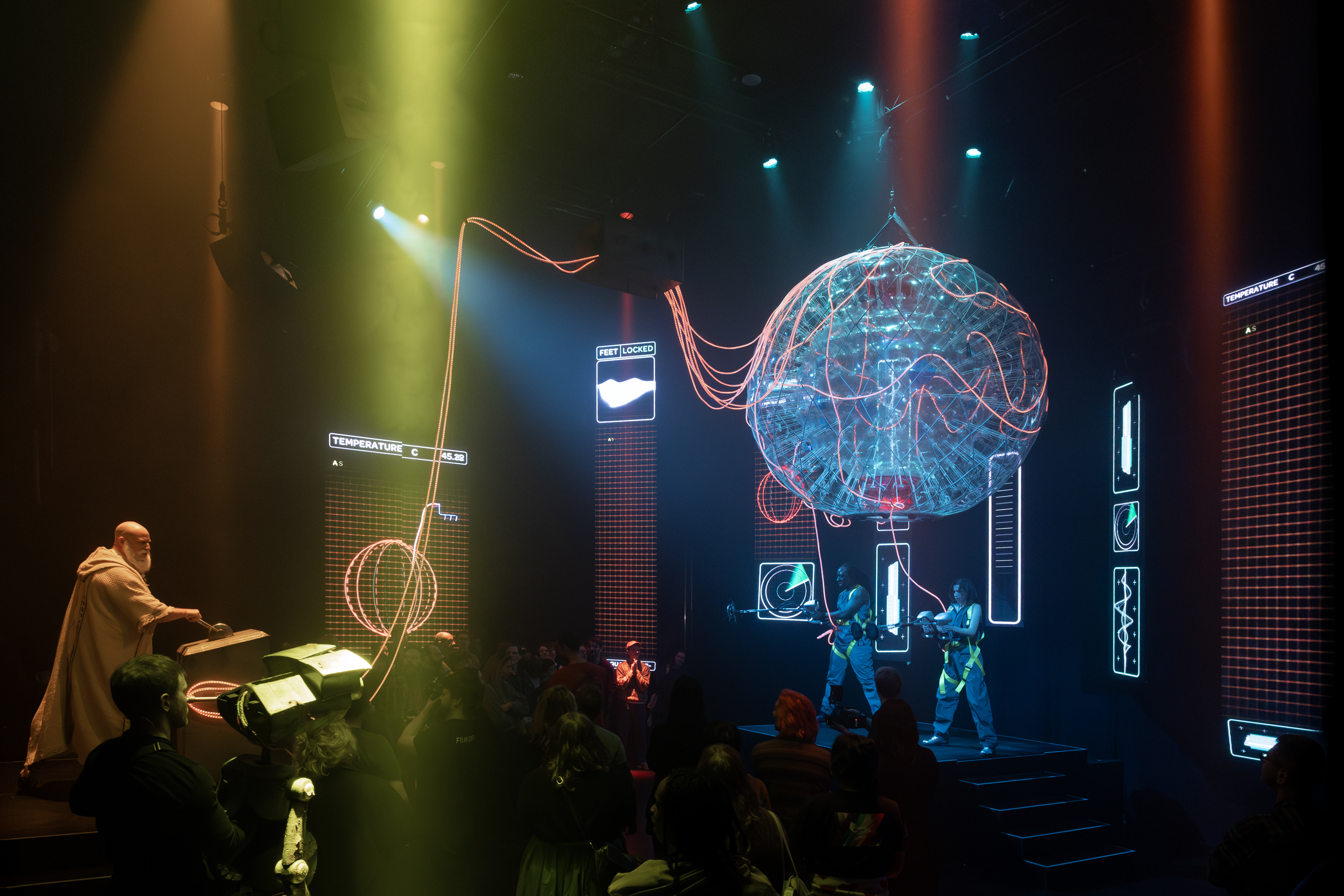
Image of the Vogon Cargo Hold, one of the immersive sets.
Jason Ardizzone West / Hitchhikers Live
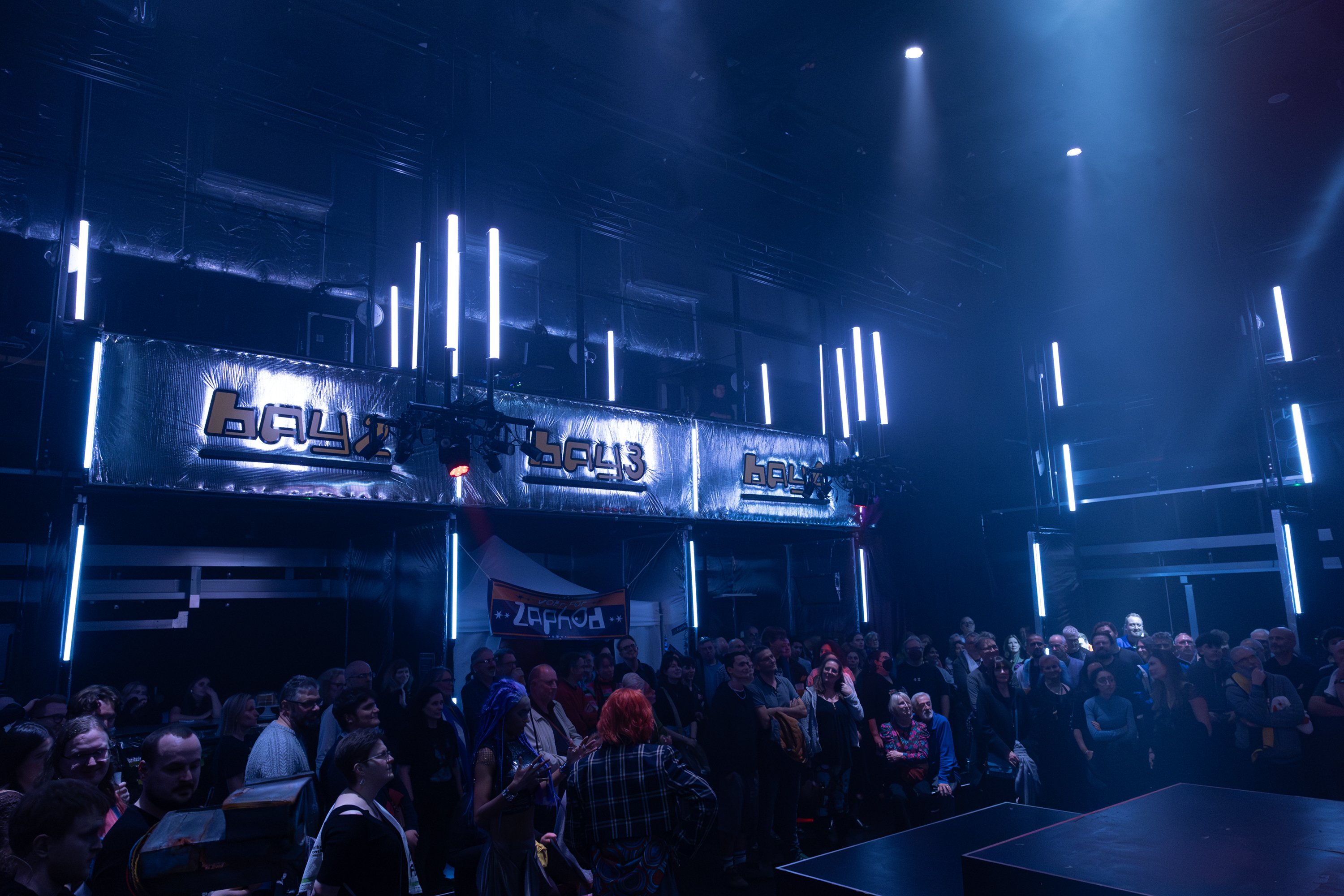
Each adaptation is twisted and turned to suit its new format, so there’s only a handful of essentials. Arthur, Ford, The Book, 42 and the Eagles’ Journey of the Sorcerer (the chorus of which is the theme) are the only mainstays. It should come as no surprise then that generous liberties have been taken here to compress the sprawling journey narrative into a format suitable for a live immersive theatre show. [If you’re unfamiliar, rather than sit and watch the action unfold on a stage, you’re instead walking around an environment with the story taking place in front of you. You can even engage with the actors directly at points, although only if you want to.] Here, you’ll be loitering in the bar of the Horse and Groom pub, the cargo hold of the Heart of Gold, the… cargo hold of the Vogon destructor ship and the factory floor at Magrathea.
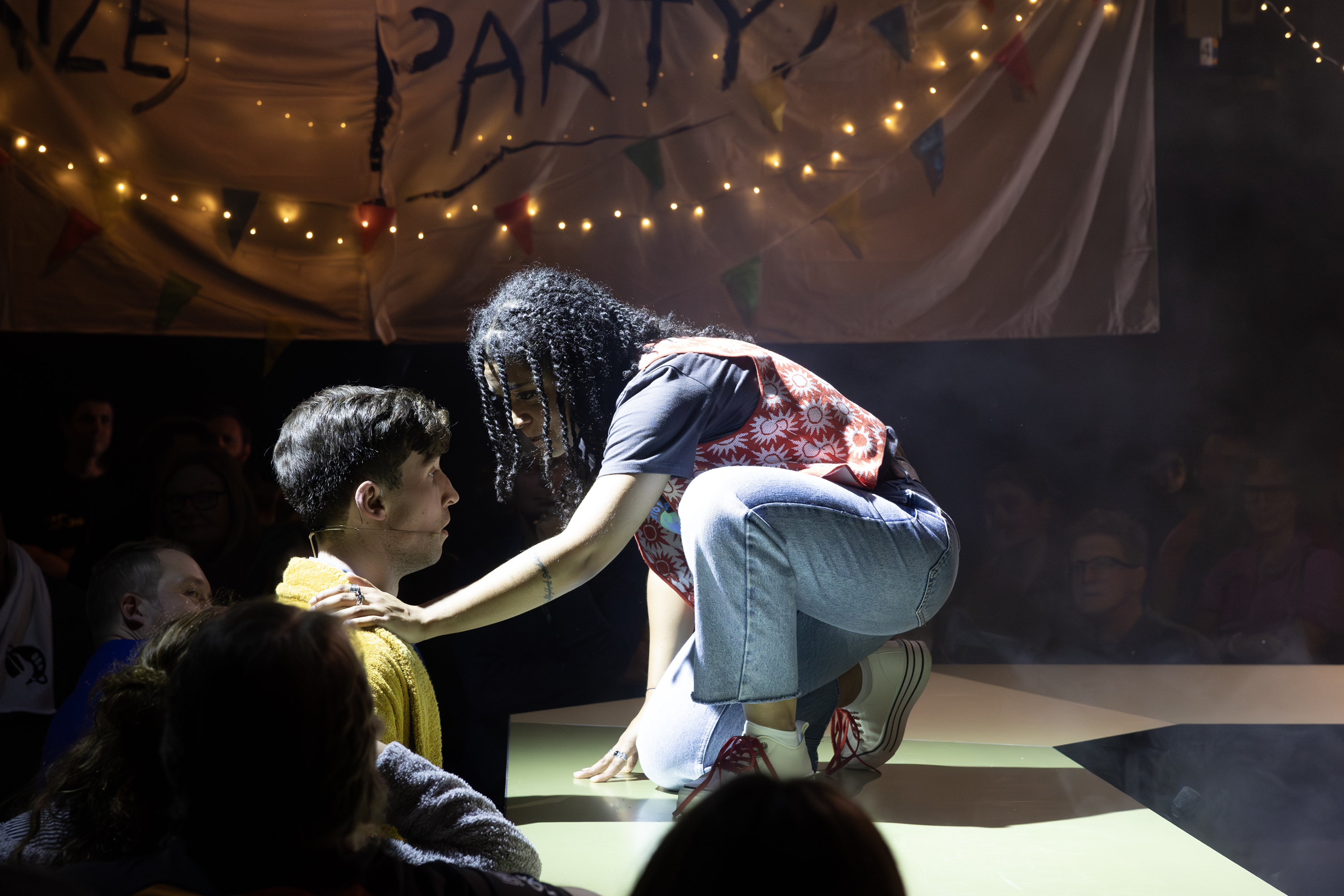
Fenchurch and Arthur lock eyes at the Horse and Groom.
Jason Ardizzone West / Hitchhikers Live
To try and impose some degree of conventional narrative on the story, Hitchhiker’s Live takes the beats of the first story (in all its forms) and the romance from the fourth novel, So Long, and Thanks for All the Fish. We spend most of our time with Ford (Oliver Britten), while Arthur (Robert Thompson) flits in and out of the narrative as part of his universe-spanning quest to reunite with his beloved Fenchurch (Kat Johns-Burke). We get to spend a little time with Zaphod Beeblebrox (Lee V-G) and Slartibartfast (Richard Costello), while (one form of) Trisha McMillan (Lenora Crichlow) only appears as a recorded voice identified with a photo that looks a lot like a publicity shot fromAvenue 5rather than one taken fresh for this show.
Slartibartfast (Richard Costello) holds court on the factory floor of Magrathea.
Jason Ardizzone West / Hitchhikers Live
Hitchhikers’ digressive surrealism means it struggles against the limits imposed upon it by any and every medium it’s ever been made into. As someone who grew up with the novel version, I see that as definitive, but even the later works struggled to remain on the page. At times, the immersive theatre format works to the story’s detriment, meaning you’re likely to miss a beat or two if you’re not able to sprint to every corner of each scene. For instance, there were so many audience members gathering around the Jatravartids area that I thought I’d check out the emptier areas first. Which was a mistake, as Humma Kavula then engaged in a big song and dance number center stage that I’d missed the buildup for. Similarly, I didn’t even realize that the show featured Wowbagger the Infinitely Prolonged (Tom Bowen) until I read the cast list while writing this review.
The abbreviated nature of the storyline means you’re often missing not just the connective tissue but even a lot of the meat from the original. Some of the emotional weight of the set pieces feels unearned because the makers have elided a lot of the necessary everything. When you get to the big finish, it’s hard not to wish we’d seen some of the effort one character has made beyond their hair growing out to mark the passage of time. The more I watched the show, and its many musical numbers, the more I wished its creators had simply made a more traditional stage musical. It would have made for a smoother, more cohesive show, especially given the source material’s thematic and narrative complexity.
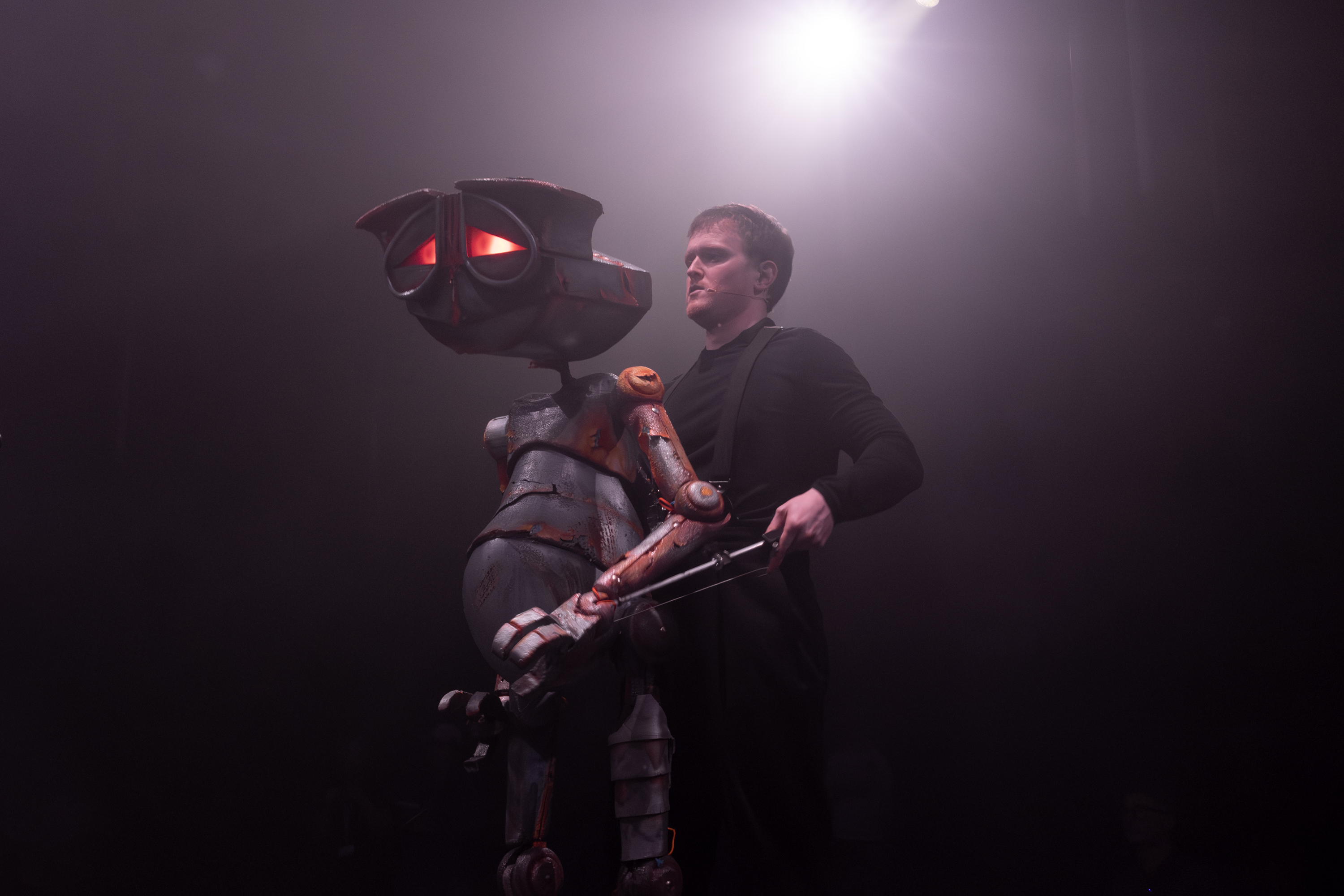
Marvin the Paranoid Android (Andrew Evans) is feeling very depressed.
Jason Ardizzone West / Hitchhikers Live
The immersive format does have its strengths, including the ability to pepper the set with little visual jokes. The Vogon Complaints Office is packed full of gags hidden in boxes and filing cabinets, as are the little references on the screens in the Horse and Groom set. But best of all is any and all time you get to spend with Marvin the Paranoid Android (Andrew Evans), a masterful mix of design, acting and puppetry. Rather than cram Evans into a suit, the actor has the beautiful Marvin puppet on a chest harness, giving it a fluidity of motion and expressiveness that previous versions could only dream of. It helps, too, that Marvin’s perpetual misery beautifully undercuts the more saccharine parts of the story.
I also need to heap praise upon the guide segments, both in their animation style and for Tamsin Grieg’s narration. I’d say Grieg (Black Books, Episodes) is the true heir to original voice Peter Jones’ crown, bringing a perfect blend of voice-of-God exposition and dry undercutting. In fact, you’ll struggle to find a bad element in the whole production, especially in the well-choreographed set pieces where the cast acts against pre-recorded footage. It’s a technical marvel in several ways and it is obvious that every person involved in its creation is operating with a bottomless pit of love for the source material and Adams. It’s just that all of those elements don’t quite cohere enough to push the show from good and entertaining through to being a must-see.
Consequently, I’d say if you’re local to London and are even vaguely familiar with Adams’ work, you should go and enjoy yourself. But I might warn Adams devotees from further afield they may find the production underwhelming if they’re making a big trip to go and see it. Like every other Hitchhikers’ adaptation, it’s a mess, but then the messiness has always been at least half the point.
This article originally appeared on Engadget at https://www.engadget.com/entertainment/the-hitchhikers-guide-to-the-galaxy-live-is-an-enjoyable-mess-140000853.html?src=rss
Netflix has crashed for what seemed to be thousands of viewers after the first four episodes of Stranger Things season 5 went live for streaming. Downdetector started getting an unusual number of outage reports at around 10 minutes before 8PM Eastern time, when the episodes were scheduled to hit the service. The numbers climbed up to almost 14,000 before they went down over the next few minutes.
According to Entertainment Weekly, affected viewers were getting an NSEZ-403 error, which means their accounts couldn’t connect to Netflix. They were seeing “Something went wrong” and “Sorry, we're having trouble with your request” messages on their screens. For the NSEZ-403 error, in particular, Netflix advises switching to a different device. It’s worth nothing that the show’s creator previously said that Netflix increased its bandwidth by 30 percent to avoid a crash for the season premier. The company has told Engadget that some members briefly experienced an issue streaming on TVs, but that service has been restored for all accounts within 5 minutes.
In season 5 of Stranger Things, the Hawkins gang is set to face Vecna one last time. After these first four episodes, Netflix is dropping three more on December 25 and then the finale itself on December 31.
Update, Nov. 26, 2025, 10:56PM ET: This story and its headline have been updated to include the information Netflix shared with Engadget.
This article originally appeared on Engadget at https://www.engadget.com/entertainment/streaming/netflix-went-down-for-some-viewers-after-stranger-things-premiered-025540635.html?src=rss
Indie studio Santa Ragione said it is at risk of shutting down as its latest project won't be available on Steam, which is by far the biggest storefront for PC games and a key point of sale for many developers. Horses, a first-person horror game that blends gameplay and live-action sequences, is about a college student who spends a summer working on a farm. However, the farm’s “horses” are actually naked human adults who are wearing horse masks. It’s clear from the trailer that this is a game for grownups.
"We reviewed the game back in 2023. At that time, the developer indicated with their release date in Steamworks that they planned to release a few months later. Based on content in the store page, we told the developer we would need to review the build itself. This happens sometimes if content on the store page causes concern that the game itself might not fall within our guidelines,” Valve told PC Gamer. “After our team played through the build and reviewed the content, we gave the developer feedback about why we couldn’t ship the game on Steam, consistent with our onboarding rules and guidelines. A short while later the developer asked us to reconsider the review, and our internal content review team discussed that extensively and communicated to the developer our final decision that we were not going to ship the game on Steam."
Santa Ragione wrote in an FAQ that it's "committed to producing challenging, adult storytelling. Horses uses grotesque, subversive imagery to confront power, faith, and violence. We reject subjective obscenity standards and believe this kind of moralizing censorship evokes a darker past in which vague notions of 'decency' were used to silence artists. Games are an artistic medium and lawful works for adults should remain accessible. We respect players enough to present the game as intended and to let adults choose what to play; lawful works should not be made unreachable by a monopolistic storefront’s opaque decisions."
This particular ban precedes the recent censorship of adult-oriented games at the behest of payment processors. Santa Ragione wanted to create a Steam store page for Horses back in 2023 to help build interest. The studio says Valve wanted to see a playable build of the game before it would approve a Coming Soon page. The game was nowhere close to being finished, so Santa Ragione scrambled to put together a playable version of the game with “tons of placeholders.”
According to an email from Valve that the developer shared, it banned Horses from the storefront over "content that appears, in our judgment, to depict sexual conduct involving a minor." Santa Ragione said Valve didn't provide more detailed reasons for rejecting the game. Valve noted that it wouldn't accept further submissions of Horses, "even with modifications."
The developer claimed that it spent the next two years trying to change Valve's mind, but the company repeatedly pointed it to Steam’s general guidelines and rejected its “requests for review and appeal." Santa Ragione does have a plausible theory as to why Valve blocked the game from Steam, however. The studio wrote in the FAQ that:
All characters in the game are clearly older than 20 years old, as communicated by their appearance and through dialogue and documents that you will encounter in the game. We think the ban may have been triggered during the initial Steam submission by an incomplete scene on day six, in which a man and his young daughter visit the farm.
The daughter wants to ride one of the horses (in the game the 'horses' are humans wearing a horse mask) and gets to pick which one. What followed was an interactive dialogue sequence where the player is leading, by a lead as if they were a horse, a naked adult woman with a young girl on her shoulders. The scene is not sexual in any way, but it is possible that the juxtaposition is what triggered the flag.
We have since changed the character in the scene to be a twenty-something woman, both to avoid the juxtaposition and more importantly because the dialogue delivered in that scene, which deals with the societal structure in the world of Horses, works much better when delivered by an older character.
As a result of the Steam ban, Santa Ragione claimed it will be “very difficult“ to recoup its investment on Horses, which it claims is “not pornographic”. It spent around $100,000 on the game’s development.
The studio initially put $50,000 of its own money into Horses after signing a deal with the game's creator, Andrea Lucco Borlera. It hoped to cover those costs with sales of its last game, Saturnalia, but that didn't perform nearly as well as the studio hoped. Horses was slated to be featured in a bundle, but that fell apart around the same time as Valve rejected the game. Santa Ragione said the Steam ban made it practically impossible for it to find an external publisher or partner, so it ultimately raised funds from friends in order to complete the game. As such, the studio claimed it is now "in a completely unsustainable financial situation unless the game somehow recoups its development costs."
Santa Ragione still plans to support Horses for at least another six months after release. It has set aside funds to cover the costs of fixing bugs and adding quality-of-life changes. But barring Horses finding success on non-Steam storefronts, that may be the studio’s last activity.
"I don't want to make a final decision before seeing how the game does on launch. But if things go the way that I expect them to go, then I think [studio's closure] is inevitable,” Santa Ragione co-founder Pietro Righi Riva told GamesIndustry.biz. "All the money we'll earn is gonna go to the author and to the people who have offered money to finish the project. So there will likely be no money left to make a new [game]... Unless a miracle happens and Horses does very well."
This article originally appeared on Engadget at https://www.engadget.com/gaming/an-indie-studio-says-its-at-risk-of-closure-after-valve-banned-its-game-from-steam-210047830.html?src=rss
Character.ai has introduced Stories, its first format that was specifically created to “enhance [teens’] experience,” on the same day the company removed their ability to engage with its chatbots. Stories works similarly to choose-your-own-adventure apps that offer interactive visual novels users can play. The company describes Stories as a “visual, narrative-first format.” Players can choose two to three characters, pick a genre and then write their own premise or auto-generate one. From there, users can steer the story with their decisions on every branching path. That means they can keep replaying the game for different outcomes based on the paths they choose.
While the Stories experience is a lot more customizable than the typical visual novel app, it still doesn’t offer the same open-ended, back-and-forth conversations Character.ai’s chatbots do. The narrative will be guided by the AI, though the company promises that players will be asked to make choices frequently.
AI companies are under scrutiny from authorities, who are pushing them to put safeguards in place to protect younger users. Character.ai announced in October that it was going to ban users under 18 from accessing its open-ended bots. The company has also introduced a new age-check tool to ensure users will only be able to access experiences appropriate for them. In addition, the company is facing a wrongful death lawsuit involving the suicide of a teenage girl in Florida. Her family alleged that the girl confided in one of the website’s chatbots about feeling suicidal, but it did not point her towards any resources or report it to authorities.
This article originally appeared on Engadget at https://www.engadget.com/ai/characterai-launches-guided-stories-format-after-banning-teens-from-its-chatbots-133000131.html?src=rss
Following its licensing deal with Udio, Warner Music Group (WMG) has also reached an agreement with Suno that will let the platform license its artists' music and likenesses, and end the music company's ongoing litigation. WMG was previously one of several record labels suing Udio and Suno for allegedly infringing on copyrighted works at a "massive scale."
As part of the agreement, "artists and songwriters will have full control over whether and how their names, images, likenesses, voices, and compositions are used in new AI-generated music," WMG explains in its press release for the announcement. WMG doesn't spell out how that will work for musicians impacted by the deal, but it does appear that participation will be opt-in, rather than anything being shared by default. This mirrors the opt-in structure of the company's Udio deal.
"AI becomes pro-artist when it adheres to our principles: committing to licensed models, reflecting the value of music on and off platform, and providing artists and songwriters with an opt-in for the use of their name, image, likeness, voice and compositions in new AI songs," WMG CEO Robert Kyncl says.
Suno will also make adjustments to its AI music platform, possibly as a condition of the new partnership. WMG says Suno is launching "new, more advanced and licensed models" in 2026, after which its current models will be deprecated. The company will also limit music downloads to paid accounts. "In the future, songs made on the free tier will not be downloadable and will instead be playable and shareable. Paid tier users will have limited monthly download caps with the ability to pay for more downloads," WMG says.
In an odd wrinkle to the partnership, Suno is also acquiring WMG's Songkick concert discovery platform. The company plans to continue running it, and WMG claims that "the combination of Suno and Songkick will create new potential to deepen the artist-fan connection." An app for finding nearby concerts doesn't totally square with Suno's existing music creation tools, but maybe it suggests the company is interested in offering more social features down the road.
Prior to this agreement, Suno openly admitted to using "essentially all music files of reasonable quality that are accessible on the open internet" to train its AI model, under the auspices of fair use. That seems like a pretty blatant admission of copyright infringement, but apparently Warner Music Group is happier with the deals it struck than what it could have won through its lawsuit. The company is reportedly one of several music groups looking to strike a similar deal with YouTube.
This article originally appeared on Engadget at https://www.engadget.com/entertainment/music/warner-music-drops-lawsuit-against-ai-music-platform-suno-in-exchange-for-licensing-agreement-224619025.html?src=rss
OpenAI has announced that it's changing how ChatGPT's Voice mode works on the web and inside the company's app. As part of an update, you can interact with ChatGPT Voice directly within your ongoing chat, letting you see a transcript of your conversation with OpenAI's AI model, along with visuals that demonstrate whatever ChatGPT is talking about.
You can start a voice chat just by tapping or clicking on the "waveform" icon next to ChatGPT's text field. Rather than launching into the original orb-filled interface the feature launched as, voice chats now happen in-line with whatever you were previously discussing. In the demo video OpenAI shared alongside the announcement, ChatGPT was able to display a transcript of the conversation, followed by a map listing popular bakeries and photos of pastries sold at Tartine. OpenAI says that if you prefer the original Voice interface, you can switch back to it by toggling on Separate mode under the Voice Mode section of ChatGPT's Settings.
You can now use ChatGPT Voice right inside chat—no separate mode needed.
You can talk, watch answers appear, review earlier messages, and see visuals like images or maps in real time.
Combining visuals and voice responses together is a natural extension of the multimodal nature of ChatGPT. You can already prompt OpenAI's model with your voice and an image or video, it makes sense that voice responses from ChatGPT should have the same level of detail. Google has explored similar methods for making Gemini Live more expressive during conversations, including letting the AI highlight specific parts of a live video with overlays. This OpenAI feature isn't quite reactive in the same way, but it could make a voice conversation with ChatGPT more informative.
This article originally appeared on Engadget at https://www.engadget.com/ai/now-you-can-use-chatgpt-voice-without-leaving-your-chat-195000538.html?src=rss
The upcoming Multiplayer Online Battle Arena (MOBA) game Spellcasters Chronicles will be available to play as a closed beta starting on December 4 until December 8. This is the first closed beta weekend for the free-to-play game and the first online play test, as it was originally announced just a couple of months back.
Spellcasters Chronicles is being developed by Quantic Dream and looks like the company's attempt to compete with big-time MOBAs like League of Legends and Dota. This is a fairly strange title for Quantic Dream, given that the studio is primarily known for narrative games that rely heavily on player choice. The company has been behind games like Heavy Rain and Detroit: Become Human.
In other words, the 3 vs. 3 MOBA with a third-person perspective is an odd duck and we have no idea how it'll play. Luckily, we'll know a whole lot more next weekend. The closed beta takes place on Steam and grants access to six player classes, each with unique abilities. These classes "can summon creatures, cast spells and take fight to command the arena." There's a class called "Swamp Witch" that I'd very much like to play as.
The beta will also unveil a new arena called The Mausoleum and introduce the game's deck-building component. The arena battles will last 25 minutes, with teams being tasked to capture altars to gain enemy territory.
This is just the first closed beta for Spellcasters Chronicles. The developer promises a second beta early next year. That next one will introduce new character classes, arenas, spells and summons.
As for Quantic Dream, it's still developing Star Wars: Eclipse. However, we haven't heard a blip about it in years.
This article originally appeared on Engadget at https://www.engadget.com/gaming/pc/you-can-try-quantic-dreams-upcoming-moba-during-a-closed-beta-next-week-194038411.html?src=rss
As streaming platforms continue to raise their prices, Paramount+ is offering a more budget-friendly way to catch up on shows and live sports with a Black Friday streaming deal. Thanks to this new deal, you’ll be able to get two months of access for $3 per month, or a total of only $6. The deal applies to both the Essential and Premium plans, letting new users try out the service without committing to a full subscription.
Paramount+ continues to expand its catalog with a mix of current CBS shows, exclusive originals, classic TV and live sports. The service is available in two main tiers: Essential, which includes ads, and Premium, which removes most of them and adds a few key extras like 4K streaming, offline downloads and live CBS access. Both tiers include select Showtime programming, giving subscribers a taste of the premium network’s lineup.
The Essential plan provides access to more than 40,000 episodes and movies, along with live coverage of the NFL on CBS and UEFA Champions League matches. It supports up to three simultaneous streams, making it a practical choice for households that share accounts. The Premium plan builds on that by offering ad-free on-demand viewing (with exceptions for live broadcasts), higher-quality playback and the option to watch CBS live in participating regions.
Paramount+’s growing library combines new releases with well-known favorites, offering titles from across CBS, MTV, Nickelodeon and Comedy Central. Sports fans get live coverage of key events, while movie watchers can find recent cinema releases from Paramount Pictures joining the lineup throughout the year. The inclusion of Showtime series in both plans adds another layer of variety, with dramas and documentaries available alongside the core Paramount+ content.
If you’re keeping an eye on subscription costs, an offer like this is a practical way to test the service without paying full price. It also gives you time to see whether the Essential plan’s ad-supported setup or the Premium tier’s extras are worth the difference.
If you’ve been watching your streaming spend as prices go up elsewhere, this deal from Paramount+ offers a well-balanced opportunity to experience both plan levels at a lower cost. Paramount+ is one of the best streaming services thanks to its vast selection of original shows like Star Trek: Discovery, Ink Master and Frasier. If you’re ready to stream big shows and live events without a heavy commitment this Cyber Monday offer is one to keep in mind.
Disney+ Hulu bundle — $60 for one year: The Disney+ and Hulu (with ads) bundle is on sale for $5 per month for one year (for a total of $60) through December 1. New and eligible returning subscribers can take advantage of this deal, and considering the bundle typically costs $13 per month, this deal represents more than a 50 percent discount on the standard monthly price.
Apple TV+ — 6 months for $36: Apple TV+ is offering six months of access for only $36 for Black Friday, which comes out to a discounted price of $6 per month for the six-month period. The deal is live now for new and eligible returning subscribers and runs through December 1, giving you a chance to stream shows like Silo, The Morning Show and For All Mankind for less. The biggest caveat to the deal is that you must subscribe directly through Apple and not through a third-party service.
HBO Max — one year for $36: HBO Max's Black Friday deal gives subscribers one year streaming for $36 through December 1. This Black Friday streaming deal is on the ad-supported option, which normally goes for $11 per month. With this discount, you're getting it for $3 per month for one year. You can sign up via HBO Max's website or, if you're a Prime Video subscriber already, via that service as an add-on.
Sling TV Orange — day pass for only $1: Sling TV launched Day Passes earlier this year, giving users one-day access to a variety of its packages. This deal cuts $4 off the normal price of a day pass for Sling Orange. With that, you get unlimited access for 24 hours to Orange's more than 30 channels that includes ESPN, CNN, TBS and others.
This article originally appeared on Engadget at https://www.engadget.com/deals/the-paramount-black-friday-deal-is-still-available-get-either-the-essential-or-premium-plan-for-only-3-per-month-for-two-months-183036215.html?src=rss
The number of video game franchises not being adapted for TV must surely now be nearing the single-figure mark, and we’ve known for a little while that a Far Cry show is on the way too. Ubisoft has now confirmed previous leaks that Alien: Earth’s Noah Hawley and It’s Always Sunny in Philadelphia creator Rob Mac will helm an anthology show based on its long-running FPS series. FX is making it and it will stream on Hulu in the US.
Every Far Cry game is a standalone experience with no obvious narrative links between them (even if a quick Google tells you that hasn’t stopped series devotees from looking for them anyway). Likewise, the plan for the Far Cry TV show is that each season will feature new characters and a new setting.
"What I love about the Far Cry game franchise is it's an anthology. Each game is a variation of a theme, the same way each season of Fargo is a variation on a theme," said Hawley in a press release. "To create a big action show that can change from year to year, while always exploring the nature of humanity through this complex and chaotic lens is a dream come true. I'm excited to partner with Rob and bring our shared irreverent, ambitious sensibility to the screen."
This technically isn’t the first time Far Cry has gotten the TV treatment. The 2013 "Blood Dragon" expansion for Far Cry 3 was the inspiration for Netflix’s 2023 adult animated series, Captain Laserhawk: A Blood Dragon Remix. However, while that show featured plenty of enjoyably chaotic action sequences and deep cut Ubisoft cameos that ensure you’ll never look at Rayman the same way again, there wasn’t much that was obviously Far Cry about it.
Earlier this month, The Hollywood Reporter reported that Noah Hawley had signed a multi-year deal with Disney that will see him produce shows for a number of the corporation’s networks, including Hulu. As well as the Far Cry adaption, the Fargo creator will be heading up the second season of Alien: Earth, which will reportedly go into production in London in 2026.
As for Ubisoft, raising the profile of its various franchises — notably even the ones that haven't had a new game for years — through TV seems to be an ongoing strategy for the French publisher. Back in the summer, Netflix finally greenlit an Assassin's Creed show, five years after penning a deal with Ubisoft, while the long-awaited animated Splinter Cell show started streaming in October and was well received by critics.
The most recent Far Cry game was 2021’s Far Cry 6, which starred Giancarlo Esposito as the dictator Aston Castillo.
This article originally appeared on Engadget at https://www.engadget.com/entertainment/streaming/fx-orders-a-far-cry-tv-show-from-alien-earth-creator-noah-hawley-and-rob-mac-154654744.html?src=rss