With over 155 million sold, Nintendo’s Switch is officially the company’s biggest console hit ever. It’s been a long road to surpassing the DS, which reached 154 million consoles over its seven-year lifespan. The Switch, meanwhile, is a year shy of its 10-year anniversary.
We’ve seen the original console, the non-hybrid Lite and the OLED versions of the Switch over the decade, but despite being replaced by Switch 2, the original is still selling at a strong pace: 1.36 million units in Q3. Just think how many Joy-Cons it sold/replaced?
Next goal: try to be the best-selling console of all time. Currently, that’s the PlayStation 2.
Moltbook is a “digital petri dish,” a Reddit-style forum populated entirely by AI agents that post, follow and even gossip about their owners in dedicated submolts. Built using vibe coding, it’s a surreal experiment in autonomous socialization — though there’s no shortage of user-data security flaws. Is Moltbook a profound look at the dead internet theory or just a very loud AI echo chamber? Or something in the middle? Karissa explains it all. (Sorry, Karissa.)
Nintendo’s worst-selling console was probably the Virtual Boy. It sold less than 800,000 units, with only 22 games in Japan and 14 in North America. And it didn’t even have the guts to launch in Europe or Australia.
But Nintendo doesn’t care. It’s brought the Virtual Boy back, baby, as an add-on for the Switch 2, in all its red monochrome ’90s-tech glory. And we finally got to test it.
It even includes the original bipod, which you use to prop it up and lean into it. Yes, you still can’t just wear the thing like modern VR headsets. The Switch 2 console, sans Joy-Cons, then slides in, acting as display, battery and processor.
It seems more of a historical nod than anything else. This is pretty much 30-year-old VR tech, as-is. But… I still want one as a gaming objet d’art. A hundred bucks is a fair chunk of change for that, though. Read on for our full impressions.
Google posted a teaser video revealing its new entry-level smartphone, the Pixel 10a, in a lovely lilac colorway. We don’t know much more, however. You can see it’s another dual-camera Pixel, with that same flush body — which I like. (How does that already seem retro?)
Leaks suggest a 6.3-inch display and a large 5,100 mAh battery. It otherwise looks and seems like the Pixel 9a, although Google promises that there’s “more in store.” Last year’s A-series launched at $500 — will this land at a similar price? You can pre-order the Pixel 10a on February 18.
AMD CEO Lisa Su revealed on the company’s latest earnings call that Microsoft’s development of an Xbox with a semi-custom SOC from AMD is “progressing well to support a launch in 2027.” Maybe Microsoft can chase that best-selling console crown too?
This article originally appeared on Engadget at https://www.engadget.com/general/the-morning-after-the-switch-is-officially-nintendos-most-popular-console-ever-121500738.html?src=rss
When we say that NordVPN is a good VPN that's not quite great, it's important to put that in perspective. Building a good VPN is hard, as evidenced by all the shovelware VPNs flooding the market. NordVPN may not be perfect, but it's easily top-five caliber and excels in certain use cases.
First, the bad: NordVPN's apps could all stand to undergo a little more quality control, with elements distracting from other elements and inconsistent designs from platform to platform. At least one of its FAQ pages directly contradicts itself. And while all the server locations could unblock Netflix, the one in Nigeria still showed U.S. content, indicating that our real location might have leaked.
However, there's a lot of good to balance that out. Speeds are fantastic and we saw no other hint of any kind of leak. Its server network is expansive and not overly reliant on virtual locations. The vast majority of servers are ideal for unblocking foreign websites. The real draw, though, is the extra features, including the innovative and flexible Meshnet, plus a malware blocker that acts more like a full antivirus and forward-looking quantum resistant encryption.
Editor's note (9/24/25): We've overhauled our VPN coverage to provide more detailed, actionable buying advice. Going forward, we'll continue to update both our best VPN list and individual reviews (like this one) as circumstances change. Most recently, we added official scores to all of our VPN reviews.Check out how we test VPNs to learn more about the new standards we're using.
Check out a summary of our NordVPN review in the table below.
Category
Notes
Installation and UI
Connections happen quickly and features are easy to use on all platforms
UI sometimes gets in the way; map screens can be clunky and apps come with unnecessary notifications
Surprisingly, the best UI may be in the browser extension
Speed
Extremely fast download speeds with only a 6.4-percent average drop
Good latencies on nearby servers, but farther ones have some lag
Fast upload speeds, but losses spiked in a few locations
Security
Uses acceptable protocols with uncracked encryption
NordWhisper obfuscated protocol recently implemented on Windows, Android and Linux
No DNS, WebRTC or IPv6 leaks on five test servers
Pricing
Best plan is the 2-year Basic for $81.36, or $3.39 per month
Basic gives you the complete VPN
If you get a multi-year plan, be sure to manually renew in order to keep the promotional rates
Bundles
Plus tier adds advanced malware protection and NordPass password manager
Complete plan adds NordLocker cloud storage
Prime tier adds ID theft protection and insurance features
Privacy policy
NordVPN does not log user activity on the VPN, a policy backed up by several third-party audits
However, it does log potentially identifiable device information unless you opt out in settings
Some concerning liberties taken in the overall Nord policy, but no documented malfeasance
Virtual location change
Four out of five test servers unblocked Netflix three times running, including virtual India location
Location in Nigeria got into Netflix, but didn't change available titles
Server network
153 server locations in 117 countries and territories
Server network is about 40 percent virtual, including all locations in Africa
Features
Extra servers grant additional privacy (double VPN, Onion over VPN, obfuscation) or specific optimizations (P2P, dedicated IP)
Threat Protection blocks dangerous domains and the Pro upgrade has some antivirus capability
Dark Web Monitor reports to you when any sensitive information has appeared on clandestine leak sites
Presets let you activate several settings with one click
Post-quantum encryption is nice, but not necessary yet
Kill switch is a useful safety feature on all apps
Split tunneling by app on Windows and Android, and by URL on browser extensions
Customer support
Written FAQs, live chat and email support
Live chat connected to an expert human within a minute
FAQs are poorly organized and contain some conflicts, but well-written on average
Background check
NordVPN is headquartered in Panama, while its parent company Nord Security is based in the Netherlands
2018 theft of public keys was a mistake, but NordVPN did almost everything right in response
Claims of law enforcement collaboration are overblown — NordVPN will comply with requests, but that doesn't mean they'll have information to provide
Installing, configuring and using NordVPN
NordVPN's biggest strengths are its speeds and the range of options it puts at your fingertips. User experience is important, but it's not quite as front-and-center as it is with ExpressVPN and Proton VPN. Here's how the apps run on all the major platforms.
Windows
The Windows app is the first instance of NordVPN's UI being not bad enough to complain about, but not good enough to be considered excellent. The initial connection process is a little slow, and it's far easier to connect than it is to disconnect (click the power button while connected to shut the VPN off). The map takes up space that would have been better allocated to the server list.
Sam Chapman for Engadget
The minor problems continue in the settings list, which makes the mistake of not keeping all its tabs visible in the window — if you open one, you have to click back to the main menu to reach another page. The pages themselves are easy to use; it's just a bit clunkier than it could have been.
Mac
Setup is swift and easy on Mac, but the full NordVPN interface is a little awkward. The vast majority of the main window is taken up by a large map, which is mostly useless. There's no way to zoom out to see the whole world, and you can't choose between servers in each country unless you zoom way in. The server list on the left-hand side is almost always more useful.
Sam Chapman for Engadget
The preferences panel is better. All the tabs come with clear explanations of their function, and are laid out so the menu is always visible, unlike the Windows app. The gear icon at the bottom includes its own set of tabs that encompass most of the common functions, including changing your VPN protocol, activating the kill switch and setting the VPN to automatically connect on untrusted networks.
Android
NordVPN on mobile can be described in much the same way as its desktop apps: generally great, occasionally getting in its own way. On Android, the map screen is much more helpful. It's expandable to the entire world and allows you to choose between servers within a country. On the other hand, the important settings are buried in the Profile tab, and the app notifies you about your "security score" to pressure you into activating certain settings.
Sam Chapman for Engadget
To find the general settings page on Android, tap the bottom-right Profile tab and scroll down. Except for Threat Protection, which has its own tab on the main window, every feature is located here. It's probably necessary to keep the main app from getting cluttered, but still mildly frustrating.
iOS
The NordVPN iOS app resembles a compressed version of the macOS client, for better or worse. As with Android, most of its features are in the bottom-right Profile tab. It works well most of the time, but often feels slightly cumbersome. There's a bit too much on the screen, and a bit too much of the stuff has nothing to do with the VPN's core function.
Sam Chapman for Engadget
As an example, you can't log into your account within the app — you have to load your Nord account page in a web browser. Forced app switching is a design choice that truly needs to die. That said, VPN connections happen quickly. If you tend to simply leave your VPN active, you probably won't notice any of this stuff.
Browser extensions
Most VPN browser extensions consist of the same features on a smaller scale, and NordVPN's — on Chrome, Firefox and Edge — are no exception. They are important for one reason, though: they're the only way to split tunnels by URL and the only split tunneling at all on macOS and iOS. Despite being more compact, they're also easy to use, making for an excellent quick-start VPN solution.
Sam Chapman for Engadget
NordVPN speed test
All VPNs slow down your average browsing speeds by adding extra steps into the connection process. When we test speed, we're looking for the VPN to drag as little as possible on your unprotected speeds. Download speed will be the most important stat for most users, since that determines how fast web pages load and how quickly videos can buffer.
Latency is important for live connections like video chats, games and live streaming. Latency increases with distance — in the test below, data packets were sent to the remote server, then back to our home network. Upload speeds likewise influence your live two-way communications and are also vital for torrenting. Let's see how NordVPN performs on all three metrics.
Server location
Latency (ms)
Increase factor
Download speed (Mbps)
Percentage drop
Upload speed (Mbps)
Percentage drop
Unprotected (Portland, OR, USA)
22
--
59.20
--
5.86
--
Seattle, WA, USA (Fastest)
44
2x
57.21
3.4
5.62
4.1
New York, NY, USA
177
8x
56.90
3.9
5.60
4.4
Stockholm, Sweden
371
16.9x
55.94
5.5
5.63
3.9
Istanbul, Turkey
411
18.7x
53.02
10.4
5.78
5.9
Hong Kong
350
15.9x
56.18
5.1
5.72
2.4
Johannesburg, South Africa
602
27.4x
53.26
10.0
5.67
3.3
Average
326
14.8x
55.42
6.4
5.54
4.0
To summarize: NordVPN's download speeds are the fastest we've seen and its upload speeds and latency tie with the best. Downloads only dropped by an average of 6.4 percent across the globe and readings were mostly consistent — the servers in question performed much the same in each test. We even threw in Turkey and South Africa, two locations that commonly cause problems, but NordVPN still kept the drop to 10 percent.
Sam Chapman for Engadget
Latency is more a product of physical distance than VPN infrastructure, but you can still see differences between services. When tested on a similar range of locations, ExpressVPN and Proton VPN both kept average latencies under 300 ms. NordVPN's average came out to 326 milliseconds, though we should note that its latency increased less than Proton's on the closest server.
Upload speeds declined an average of four percent, but there were a few anomalously high readings in Istanbul that skewed those numbers up. Without that location, NordVPN's upload rates would also have been the industry's current best.
NordVPN security test
No matter how well-built a VPN looks from the outside, there are several ways its security can fail. The most common problems are outdated protocols with weak encryption, failing to block IPv6 traffic or inadvertent leaks from sending DNS requests outside the encrypted tunnel. We'll start by looking for those common leak sources, then check whether NordVPN's encryption might be failing in less traceable ways.
VPN protocols
A VPN protocol is a set of rules used to get data quickly and safely from your device to a VPN server and back, even while that data is encrypted. Different protocols are connected with different encryption algorithms and can impact the speed, security and stability of your connection.
When testing VPN security, the first step is to see if it's using any protocols like PPTP that are outdated and crackable, or homebrewed protocols with unclear security. NordVPN users have four options for protocols: OpenVPN, IKEv2 (not available on Mac or iOS), NordLynx and NordWhisper (available on Windows, Android and Linux only).
Sam Chapman for Engadget
OpenVPN and IKEv2 are both standard protocols you'll find on most VPN providers. Both use various strengths of the Advanced Encryption Standard (AES), with OpenVPN defaulting to AES-256 and IKEv2 to AES-128. OpenVPN can be set to UDP (faster but less stable) or TCP (more reliable but slower). So far, so secure.
NordLynx is unique to NordVPN, but it's not that far off the beaten track — it's just WireGuard with extra security. WireGuard normally works by saving a stable IP address for each connection, which raises the very slight risk of exposing a user. NordLynx adds a second layer of abstraction that means those stable addresses are never revealed. Since NordVPN strongly recommends it for most situations, we used it for all our tests in this review.
Finally, there's NordWhisper, a new protocol introduced in early 2025 that disguises your VPN traffic as normal web traffic to evade blanket web blocks. It's likely to be slower than the other protocols, so don't use it unless everything else has been blocked. We also don't recommend counting on it too much in general — large-scale censorship technology, like the Great Firewall of China, tends to rely on blocklists of known VPN servers, whose identity NordWhisper can't disguise.
Leak test
Our first order of business was to check five test servers to see if they leaked our real IP address — staying away from the ones in the speed test in order to get as comprehensive a picture of NordVPN's security as possible. With help from ipleak.net, we found all five to be free of the three major types of leaks.
DNS leaks occur when a VPN sends DNS requests (in short, how your browser knows which websites to show you) outside its encrypted tunnel. By default, NordVPN uses its own private DNS servers, which our tests showed to effectively prevent leaks.
WebRTC leaks are caused by real-time communication protocols sending information outside the VPN, which may reveal your real IP address. NordVPN is consistently successful at keeping WebRTC inside the tunnel, but you can have your browser block it if you're still worried.
IPv6 leaks happen when a VPN only blocks IPv4 traffic and lets v6 through. NordVPN automatically blocks IPv6 traffic while it's active, so an IPv6 leak is all but impossible.
Sam Chapman for Engadget
Although that's all great news, it is still possible for leaks to occur without a clear explanation, so we ran one final test on NordVPN.
Encryption test
Wireshark is a program that captures detailed images of information sent over a device's internet connection. Even though our tests showed NordVPN to be free of leaks, we wanted to inspect it at the most granular level. Using WireShark, we recorded the traffic sent to an unencrypted HTTP site, before and after connecting to each NordVPN test server.
Every server showed the same pattern: readable plaintext before, encrypted ciphertext after. If there is a security flaw remaining in NordVPN, it's unlikely to be relevant to the overwhelming majority of users.
How much does NordVPN cost?
NordVPN's pricing structure looks convoluted at first, but it's much simpler than it appears. A Basic subscription gets you full VPN functionality, and all the other tiers just add more features. If all you need is a VPN, you only need to concern yourself with the left side of the table below.
The best deal for a Basic NordVPN subscription, which lets you connect to NordVPN with up to 10 devices at once, costs $81.36 for two years when you pay upfront ($3.39 per month). One year of the same plan costs $59.88 in advance ($4.99 per month) or $12.99 for one month at a time. The table below shows the complete cost; for more information on plans above Basic, see "side apps and bundles" in the next section.
Plan
1-month cost
1-year cost
2-year cost
Basic
$12.99
$59.88 ($4.99/month)
$81.36 ($3.39/month)
Plus
$13.99
$71.88 ($5.99/month)
$105.36 ($4.39/month)
Complete
$14.99
$83.88 ($6.99/month)
$129.36 ($5.39/month)
Prime
$17.99
$107.88 ($8.99/month)
$177.36 ($7.39/month)
The longer plans save money, but be careful: if you let them expire, you'll automatically renew at the more expensive one-year plan. Enough customers claim to have been auto-renewed at the higher rate that they've launched a class-action lawsuit against NordVPN, accusing the company of deceptive pricing practices and making renewals too difficult to cancel. A NordVPN PR rep said they could not comment on ongoing legal action, "other than to state that we are and always have been very clear about the recurring nature of our services." No court date has been set so far.
That said, there's a fairly straightforward workaround in the meantime: To prevent the auto renewal, log out of your NordVPN account, then sign up for a discounted plan again using the same email. As long as you do this before your subscription expires, your new account should link to your old one, keeping you subscribed at the introductory rate.
Free trials and refunds
Every NordVPN plan comes with a 30-day money-back guarantee. If you cancel and request a refund before 30 days are up, you'll get the full cost back. The only way to try it for free without paying is to get the app on Android, where there's a seven-day trial through the Google Play Store.
NordVPN side apps and bundles
NordVPN is part of a larger family of Nord Security products, which you can save money on if you need more than one. We won't review all of them here, but for reference, here's everything you'll get from the higher subscription tiers.
Basic: VPN on 10 devices, specialty servers, DNS ad-blocking, Meshnet
Plus: All Basic features, plus malware scanning, extra scam blocking, tracker blocking, NordPass password manager, data breach scanner
Complete: All Plus features, along with 1TB of NordLocker encrypted cloud storage
Prime: All Complete features, plus NordProtect features like dark web monitoring, credit monitoring, ID theft insurance and extortion insurance
Another tier called Ultra includes a subscription to Incogni, a data removal service run by Nord's partner Surfshark. The Ultra bundle is only available in certain countries, since NordVPN is still testing it; users outside the test countries can still add Incogni service at checkout. There also used to be a NordVPN family plan, but it seems to have been eliminated after Nord expanded the devices per subscription to 10.
You can get a dedicated IP address on NordVPN to ensure you have the same IP every time you connect. This lets you configure remote firewalls to let you through while you're connected to the VPN. A dedicated IP costs $8.99 per month, $70.68 for a year ($5.89 per month) or $100.56 for two years ($4.19 per month).
The NordVPN pricing page lists access to a Saily eSIM plan as a perk, though mysteriously, none of the existing plans seem to include it yet. A lot of VPNs are expanding into the eSIM space, so this may change soon.
Close-reading NordVPN's privacy policy
A VPN privacy policy isn't just empty words — it's a contract between the provider and its users. If a service openly defied its own policy, it could be sued for false advertising. VPNs tend to sneak loopholes into their privacy policies instead of flouting them outright; these loopholes can shed light on how the provider actually views your privacy.
This policy applies to all Nord Security apps. It's impossible to create an account without a valid email address, but you can use a separate email masking service to make that anonymous. The policy also explicitly says that your email address will be added to a marketing mailing list, though you can opt out. Irritating, but not a privacy risk in itself.
We're more concerned about the later statement that it may process data without the user's consent "under the legal basis of our or third parties' legitimate interest." This clause covers some cases we'd agree are legitimate, such as identifying people who launch cyberattacks from NordVPN servers. But Nord also considers it "legitimate interest" to process your personal data "to improve or maintain our services and provide new products and features."
Reached for comment, a NordVPN representative said that using personal data in this way "generally involves aggregated, depersonalized or technical information." That's somewhat reassuring, but the "generally" leaves a bit too much wiggle room. Ideally, we'd prefer that personal data exist wholly in the "consent only" section.
The section on sharing your data with third parties only lists "some of" the service providers who may receive your information. Among these are Google Analytics, which is known to store personal data on U.S. servers — all of which are potential security risks in the age of DOGE. Other unnamed "third parties" are involved in targeting ads at users of Nord websites.
The NordVPN representative said that "since some partners, such as payment processors, can vary by region or specific service and may change over time depending on our operational needs, we do not publish a fixed list." They added that all third parties are "contractually required to handle personal data in accordance with applicable laws and industry standards."
We aren't using this to condemn Nord; many of these practices are fairly standard in the VPN industry. But it's important to know about all the potential leakage points before trusting your deepest secrets to any company.
NordVPN specific policies
The NordVPN privacy policy doesn't add much atop the general Nord notice. It does track session activity connected to your username to make sure you're staying within the 10-device limit, but it automatically deletes these logs 15 minutes after you disconnect. The logs also don't include your IP address or the addresses of VPN servers you used.
Sam Chapman for Engadget
The only real problem we found is that NordVPN apps collect information about your activity on the app by default. This doesn't include information about your browsing habits, but it does include unique traits that could conceivably be used for "device fingerprinting" — in which a third party can deduce a user's identity through clues about their device. You can turn this off in the General settings.
A NordVPN spokesperson told us that the data collected is "not personally identifiable," and that the company takes "deliberate steps to strip out anything that could be linked back to a specific person." This presumably means the data is aggregated so it only shows general trends, not any one device's activity. That's a lot less risky, but we still recommend switching the setting off.
Third-party privacy audits
NordVPN has passed five independent audits of its privacy policy so far, most recently from Deloitte in late 2024. Annoyingly, you can only read the entire report by logging into a Nord account, but it at least doesn't have to be a paid account.
The audit found that NordVPN was following its own no-logs policy. Specifically, the Deloitte Lithuania investigators concluded that "the configuration of IT systems and management of the supporting IT operations is properly prepared, in all material respects in accordance with the NordVPN's description set out in the Appendix I." (Appendix I of the report is identical to NordVPN's privacy policy.)
Can NordVPN change your virtual location?
You'll be most interested in this section if you mainly use a VPN to change their location for streaming. To see if NordVPN could unlock new streaming libraries, we picked a new batch of five test servers, then logged onto Netflix. Since Netflix tries to block all VPN servers to prevent copyright issues, our first question was whether we'd get through at all.
Our second question: would connecting to a NordVPN server actually change what Netflix library we saw? It should, given that NordVPN seems leak-proof, but thoroughness demands we check anyway. Here's what we found.
Server location
Netflix unblocked?
Content changed?
Canada
Yes
Yes
Argentina
Yes
Yes
Germany
Yes
Yes
India
Yes
Yes
Nigeria
Yes
No
Four out of five locations worked perfectly. On a Canadian server, we were able to stream Star Trek: The Next Generation, which left American Netflix years ago. The Argentine server gave us access to something called Pasion de Gavilanes, which we'd never heard of but sounds great.
Sam Chapman for Engadget
The only problem was Nigeria. We tested it several times, connected to multiple different Nigerian locations, but saw our American Netflix library every time. We then ran a leak test on Nigeria, which wasn't one of our security test locations, and found it to be working normally. It's hard to say what happened, especially since the Nigeria server doesn't appear to be virtual, but we can confirm that it wasn't working.
Investigating NordVPN's server network
NordVPN has servers in 153 cities in 117 countries. Out of all total options, 62 are virtual locations (about 40 percent), where the server is really located somewhere else. This makes it possible to get servers into more places, but depending on your actual location relative to the server, it may perform differently than you expect.
Sam Chapman for Engadget
Virtual locations have allowed NordVPN's server network to grow quite extensive, with lots more locations in South America, Africa and Asia than the industry standard. Check out the distribution in the table.
Region
Countries and territories with servers
Total server locations
Total virtual server locations
North America
15
36
12
South America
10
10
6
Europe
48
57
11
Africa
10
10
10
Middle East
7
7
4
Asia
24
26
18
Oceania
3
7
1
Total
117
153
62 (40.5 percent)
The relatively low proportion of virtual locations (nearly identical to that of ExpressVPN) is a good sign, as it means NordVPN has been growing its server network thoughtfully. Some VPNs — looking at you, HMA — inflate their server lists as a marketing point without seriously considering what it takes to maintain such a large network. That thankfully doesn't seem to be the case here.
Extra features of NordVPN
Here's everything you get with a NordVPN app other than the VPN itself. There's a lot going on here, so we'll limit ourselves to a sketch of each feature.
Specialty servers
As soon as you load NordVPN, you'll see a list of special servers near the top of the right-hand column. We'll go over each of them in order.
Dedicated IP: As discussed in the bundles section, a dedicated IP address costs extra. With this, you'll always connect with the same IP, which is private to you alone. It may be worth the price if you find yourself getting asked for CAPTCHAs a lot more while connected to NordVPN — though for what it's worth, that didn't happen to us.
Double VPN: This sends your connection through a second VPN server before it reaches your ISP. The second server is your apparent location. There are 10 endpoints to choose from. As you might imagine, your internet will run slower with two VPN servers in the mix, so only use this if you seriously need security.
Obfuscated servers: These are only available on OpenVPN. Obfuscation can help you get around firewalls that seek out and block VPN traffic. If you can't get online with NordVPN when you're on a certain network, obfuscated servers might work.
Onion Over VPN: After encrypting your data as normal, these servers send it through several nodes of the Tor network, granting you the total anonymity of onion routing while keeping you safe from malicious relays. It's available in two locations, Netherlands and Switzerland, and — like double VPN — is best used only when you need the utmost privacy.
P2P: NordVPN only allows torrenting on its peer-to-peer servers, but fortunately, it's got P2P servers in 114 countries — only three fewer than it has in total. NordVPN keeps your download and upload speeds very fast on average, so you shouldn't have trouble torrenting from any location.
Meshnet
Meshnet is NordVPN's most unique and exciting feature by a long shot. By logging into the same NordVPN account on multiple devices, you can connect those devices directly through a NordLynx tunnel without needing a NordVPN server in between.
Sam Chapman for Engadget
Essentially, you're using your own devices as VPN servers — obviously not great for privacy, but amazing for accessing web services in other countries. While two devices are connected, you can transfer files between them through the NordLynx tunnel. You can even invite friends and use their devices.
Threat Protection
NordVPN has two levels of antivirus: Threat Protection and Threat Protection Pro. The former is a simple DNS filter that stops your browsing from loading unsafe web pages while NordVPN is active. It's the highest level available on Android, iOS and Linux, or on any Basic subscription.
Sam Chapman for Engadget
Threat Protection Pro, which Plus subscribers or higher can set up on Windows and Mac, can work even when you aren't connected to a NordVPN server. It acts more like a standalone antivirus by scanning downloaded files for malware, and can even block trackers. Basic Threat Protection (without Pro) can block some trackers by filtering out domains known to use them, but doesn't block the trackers directly.
Dark Web Monitor
While active, Dark Web Monitor continually searches known data breach dump sites on the dark web and notifies you if it ever finds your account email address. If you get that notification, change any passwords associated with the address. With a Prime subscription, you can also have it search for your phone number, social security number or other financial information.
Presets
Presets let you set up one-click VPN connections with a desired group of settings, a lot like Proton VPN's Profiles. NordVPN comes pre-loaded with presets that optimize for "Downloads," "Speed" and "Browsing," which sounds to us like the same thing three times.
More usefully, you can create presets for particular countries, then add website shortcuts that will appear once you've connected. You could, for example, set one that connects to a specific location, then add a shortcut to a streaming site available in that location.
Post-Quantum encryption
Experts widely believe that quantum computers will eventually make our current encryption algorithms obsolete, but there's almost no consensus on when that will actually happen — except that it hasn't happened yet. Knowing that, NordVPN's "post-quantum encryption" feature comes across as a bit premature, but it's reassuring that someone is thinking about it.
Having said that, we don't recommend using post-quantum encryption yet. It works by layering one of the known quantum-proof encryption standards on top of a standard NordLynx session, which makes your VPN connection slower and more erratic. Until we can verify a real quantum cyberattack, post-quantum encryption is a needless precaution.
Kill switch
A kill switch cuts off your internet the instant you lose your connection to a NordVPN server. This protects you in case a server unexpectedly fails, and as a side benefit, prevents you from connecting to any fake VPN servers. You should keep the kill switch on at all times.
Split tunneling
Split tunneling is available on NordVPN's Windows and Android apps (and Android TV by extension), along with its browser extensions. On Windows and Android, it splits by app: you can determine which apps get online through the VPN and which go unprotected. The browser extensions let you split by URL, so the VPN only protects certain sites.
NordVPN customer support options
NordVPN's apps link directly to its online help center. As always, we went in with a specific question in mind: whether the basic level of Threat Protection could block trackers, and if so, what kind. We found the categories on the written support page difficult to parse, especially the troubleshooting section — would the average user appreciate the difference between "app issues," "connection issues" and "errors"?
We correctly guessed that our question would be under "Using NordVPN -> Features," but the introductory article on Threat Protection and Threat Protection Pro was buried at the bottom of the list. Unfortunately, that made things more confusing, as this article says that Threat Protection (not Pro) both does and doesn't block trackers. In NordVPN's favor, however, using the search bar brought us instantly back to that article without any confusion.
The live support experience
Using NordVPN's live chat was a smooth and reassuring experience. From the time we decided to ask directly, it took us less than a minute to connect with a real person, who quickly cleared up the confusion and promised to update the confusing support page (we'll check back to see if they actually do).
Sam Chapman for Engadget
One other option is an email support form, which can be found both on the website and in the help sections of NordVPN apps. This is best for complex problems that require screenshots to explain, and promises a response within 24 hours.
NordVPN background check
NordVPN was founded in 2012. Launching with its desktop apps, it moved to iOS and Android in 2016, then added apps for browser extensions and smart TVs. Its developer, Nord Security, has no parent company, and its history is relatively uncontroversial. We've documented two notable incidents below, plus more about Nord Security's operations.
Headquarters and ownership
Nord Security was founded in Lithuania, and maintains offices there. Although Nord Security is registered in Amsterdam, NordVPN operates under a separate license in Panama, which makes any data requests subject to Panama's courts.
Finland server breach
The first serious incident in NordVPN's history began in March 2018, when unidentified hackers managed to steal three private keys from one of Nord's data centers in Finland. Researchers didn't notice the leak until October 2019, well after the stolen keys had expired, but NordVPN's encryption was still technically vulnerable for several months.
We say "technically," because it was really only the outer layer of encryption — and even if they'd broken through it all, the hackers would only have seen browsing activity, not usernames, passwords or anything else sensitive. If anything, NordVPN's response actually makes us trust it more. It ended its relationship with the contractor who ran the Finnish data center and revamped its policies to eliminate the kind of negligence that led to the breach.
Arguably, its only real error was not immediately disclosing the breach. NordVPN learned about the leak and started addressing it in May 2018, but the news didn't break until more than a year later. That timing probably made it look more suspicious than any actual mishandling did.
Law enforcement compliance
Another minor controversy erupted in 2022, when PCMag and other outlets reported that NordVPN had edited its website to say that it would comply with data requests from law enforcement. NordVPN responded with a new post that said nothing had changed: their policy was always to comply with lawful requests, which — provided the requests were lawfully submitted through a Panamanian court — is literally their only option.
We're inclined to agree. VPNs are legal companies. They wouldn't last long if they openly declared their intent to break the law. The key is that when law enforcement comes calling, there shouldn't be anything to show them, as with the Turkish seizure of ExpressVPN. That's why verifiable no-logging policies are so important.
Final verdict
NordVPN is a great service on its own merits. It only suffers from having to be compared with the likes of ExpressVPN and Proton VPN. For example, its P2P servers are good for torrenting, but not as useful without Proton's port forwarding. It's fast, but speed tests fluctuated just a little more than Express.
NordVPN's extra features are the best reason to pick it over its rivals. With Meshnet, you can theoretically set up a VPN connection anywhere in the world, and no other VPN has anything close to Meshnet's file transfer powers. Threat Protection Pro is also great if you can get it, adding file scanning to bolster the typical approach of just blocking suspicious DNS addresses. Specialty servers round out the offering, with double VPN maintaining good speeds with extra safety and Onion over VPN being among the safest ways to use Tor.
This article originally appeared on Engadget at https://www.engadget.com/cybersecurity/vpn/nordvpn-review-2025-innovative-features-a-few-missteps-163000578.html?src=rss
X is experimenting with a new way for AI to write Community Notes. The company is testing a new "collaborative notes" feature that allows human writers to request an AI-written Community Note.
It's not the first time the platform has experimented with AI in Community Notes. The company started a pilot program last year to allow developers to create dedicated AI note writers. X’s Keith Coleman tells me that AI writers are “prolific” and that one has contributed more than 1,000 notes that were rates as helpful by other contributors. But the latest experiment sounds like a more streamlined process.
According to the company, when an existing Community Note contributor requests a note on a post, the request "now also kicks off creation of a Collaborative Note." Contributors can then rate the note or suggest improvements. "Collaborative Notes can update over time as suggestions and ratings come in," X says. "When considering an update, the system reviews new input from contributors to make the note as helpful as possible, then decides whether the new version is a meaningful improvement."
The idea: when you request a note, AI drafts one — then the community refines it together through ratings and suggestions. You can watch it get better in real time.
According to Coleman, who oversees Community Notes, the AI writer for collaborative notes will be Grok. That would be in-line with how a lot of X users currently invoke the AI on threads with replies like "@grok is this true?" But Coleman says that “if it works well, it could make sense to bring the suggestion-feedback loop to the AI note writer API as well.”
Community Notes has often been criticized for moving too slowly so adding AI into the mix could help speed up the process of getting notes published. Cleman also noted that the update also provides "a new way to make models smarter in the process (continuous learning from community feedback)." On the other hand, we don't have to look very far to find examples of Grok losing touch with reality or worse.
According to X, only Community Note Contributors with a "top writer" status will be able to initiate a collaborative note to start, though it expects to expand availability "over time."
Update, February 5, 2026, 2:42PM PT: This post was updated to reflect additional information from X’s Keith Coleman.
This article originally appeared on Engadget at https://www.engadget.com/social-media/xs-latest-community-notes-experiment-allows-ai-to-write-the-first-draft-210605597.html?src=rss
The Steam Machine is back from the dead. Not as a Valve-supported program for manufacturers to create living room PCs, but instead as a home console sibling to the Steam Deck. Valve introduced its second attempt at ruling the living room in a surprise hardware announcement in November 2025, and paired the new Steam Machine with a new Steam Controller and a wireless VR headset it calls the Steam Frame. Since the announcement, as is often the case with Valve, some details remain elusive, however.
While we wait for the release of the company's new hardware lineup in 2026, and more information straight from the horse's mouth, here's everything we know about the hardware, software and price of the Steam Machine, so far.
What's the Steam Machine's hardware like?
Valve
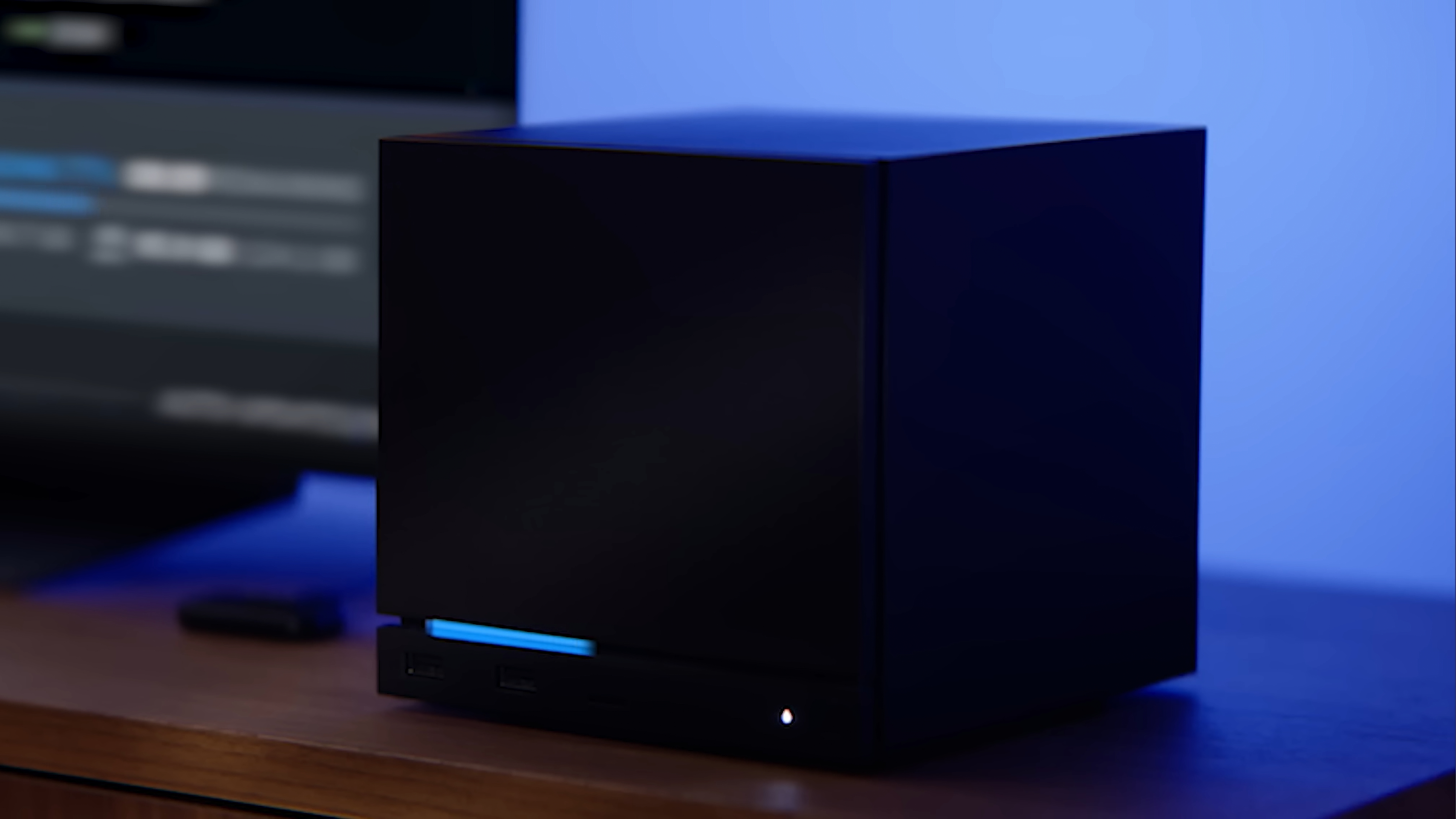
Like the Steam Deck, the Steam Machine is utilitarian and bespoke. The PC is a black, 5.98 x 6.39 x 6.14 inch (152 x 162.4 x 156mm) box, with ports and a grille for a fan in the back and a removable faceplate and customizable LED light strip in the front. Inside, Valve says the Steam Machine features a "semi-custom" AMD Zen 4 CPU with six cores and up to 4.8GHz clock speeds, and a "semi-custom" RDNA3 AMD GPU, along with 16GB DDR RAM, 8GB GDDR6 VRAM and either 512GB or 2TB of storage.
While these specs make the Steam Machine more powerful than the aging Steam Deck (which shipped in 2022 with its own custom AMD chip) Valve has been careful not to oversell the capabilities of the box. In a blog post, the company said that "the majority of Steam titles play great at 4K 60FPS" using AMD's FidelityFX Super Resolution (FSR) frame generation and upscaling technology, but some titles require more upscaling than others, and it "may be preferable to play at a lower framerate with [variable refresh rate] to maintain a 1080p internal resolution."
In a hands-on preview of the Steam Machine, Digital Foundry expressed concern with what Valve's claims and the device's stated specs could mean for future performance. "The decision to opt for 8GB of GDDR6 memory has been proven to be a limiting factor on many modern mainstream triple-A games and falls short of the maximum VRAM pools and memory bandwidth available on both Xbox Series X and base PS5," Digital Foundry writes.
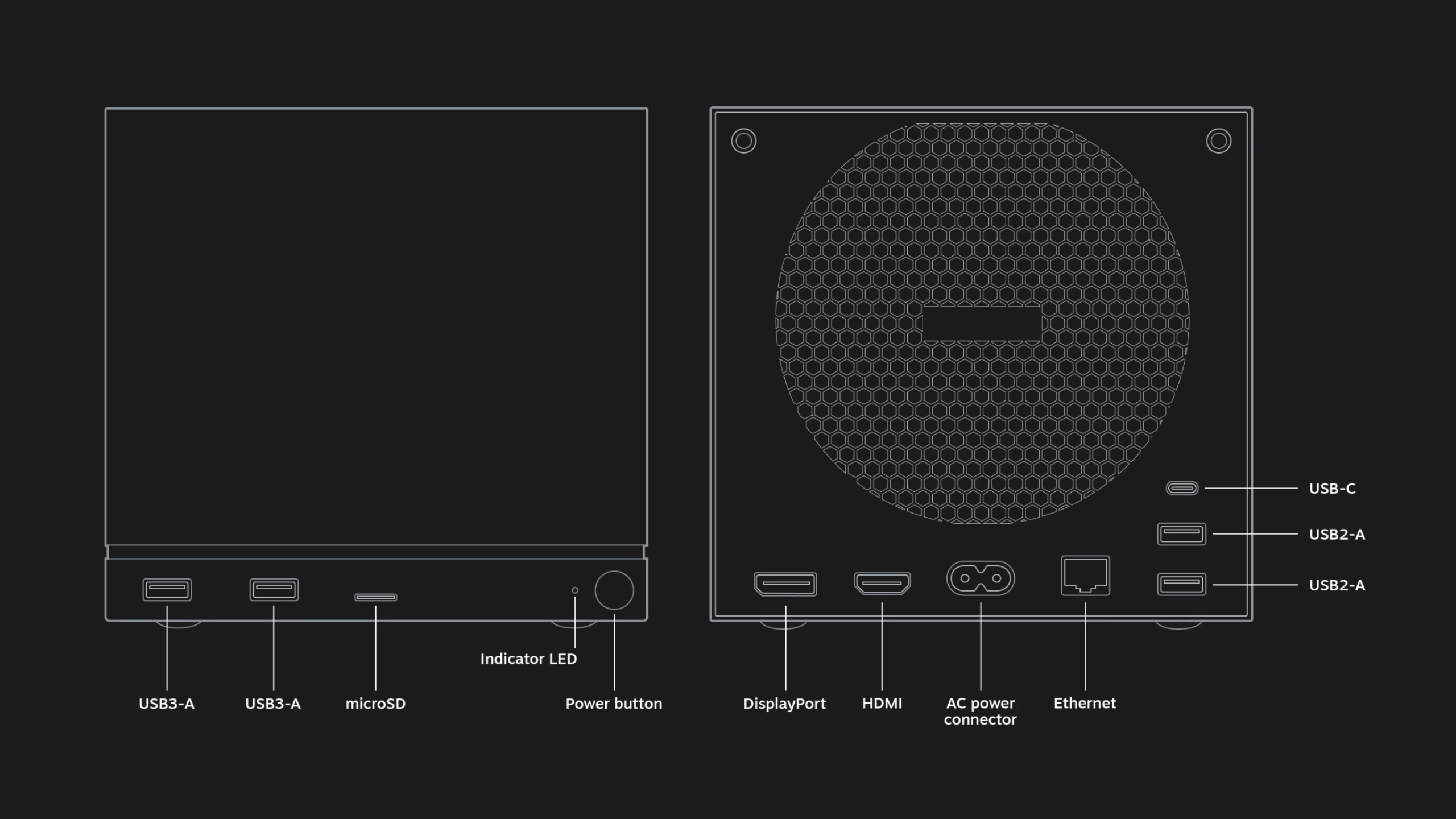
The Steam Machine supports Bluetooth 5.3, Wi-Fi 6E and includes an integrated 2.4GHz adapter for the new Steam Controller. In terms of port selection, there's DisplayPort 1.4 and HDMI 2.0 inputs for connecting the box to external monitors and TVs, four USB-A ports (divided between two USB 2.0 ports and two USB 3.2 Gen 1 ports) and one USB-C port on the back.
Engadget will have to try out the Steam Machine to really know what it's capable of, but there's nothing to suggest it couldn't be as flexible as the Steam Deck, especially with more power to play with.
What games will be able to run on the Steam Machine?
Valve
Any game that runs on SteamOS, Valve's Linux-based operating system, will run on the Steam Machine, provided the device's technical specs will support it. For games running natively on Linux, the Steam Machine will download the Linux version. For Windows games and everything else, it'll be able to use Steam's built-in Proton compatibility layer to translate games to Linux, just like the Steam Deck does.
Proton is developed by both Valve and CodeWeavers, the team behind the macOS compatibility app CrossOver. Valve's compatibility layer translates a game's API calls and other software features into something Linux understands, essentially tricking the game into thinking it's running on Windows when it isn't. Proton has worked remarkably well so far, in some cases helping some PC games run more efficiently on Linux than they do on Windows, but it does have some limitations. Because some anti-cheat software doesn't support Linux, many competitive multiplayer games aren't playable on SteamOS. Valve hopes the Steam Machine will help change that.
"While [the] Steam Machine also requires dev participation to enable anti-cheat, we think the incentives for enabling anti-cheat on Machine to be higher than on Deck as we expect more people to play multiplayer games on it," Valve told Eurogamer. "Ultimately we hope that the launch of Machine will change the equation around anti-cheat support and increase its support."
To help users find what games work well on the Steam Machine, Valve plans to expand its program for verifying games on the Steam Deck to include the Steam Machine and Steam Frame. Valve looks at things like controller support, the default resolution of the game, whether or not it requires a separate launcher and whether the game and its middleware work with Proton to determine a game's rating. Then the company sorts games into four categories: Verified (where the game works with Steam hardware at launch), Playable (where a user might have to make modifications to run smoothly), Unplayable (where some or all of the game doesn't function) and Unknown.
Valve
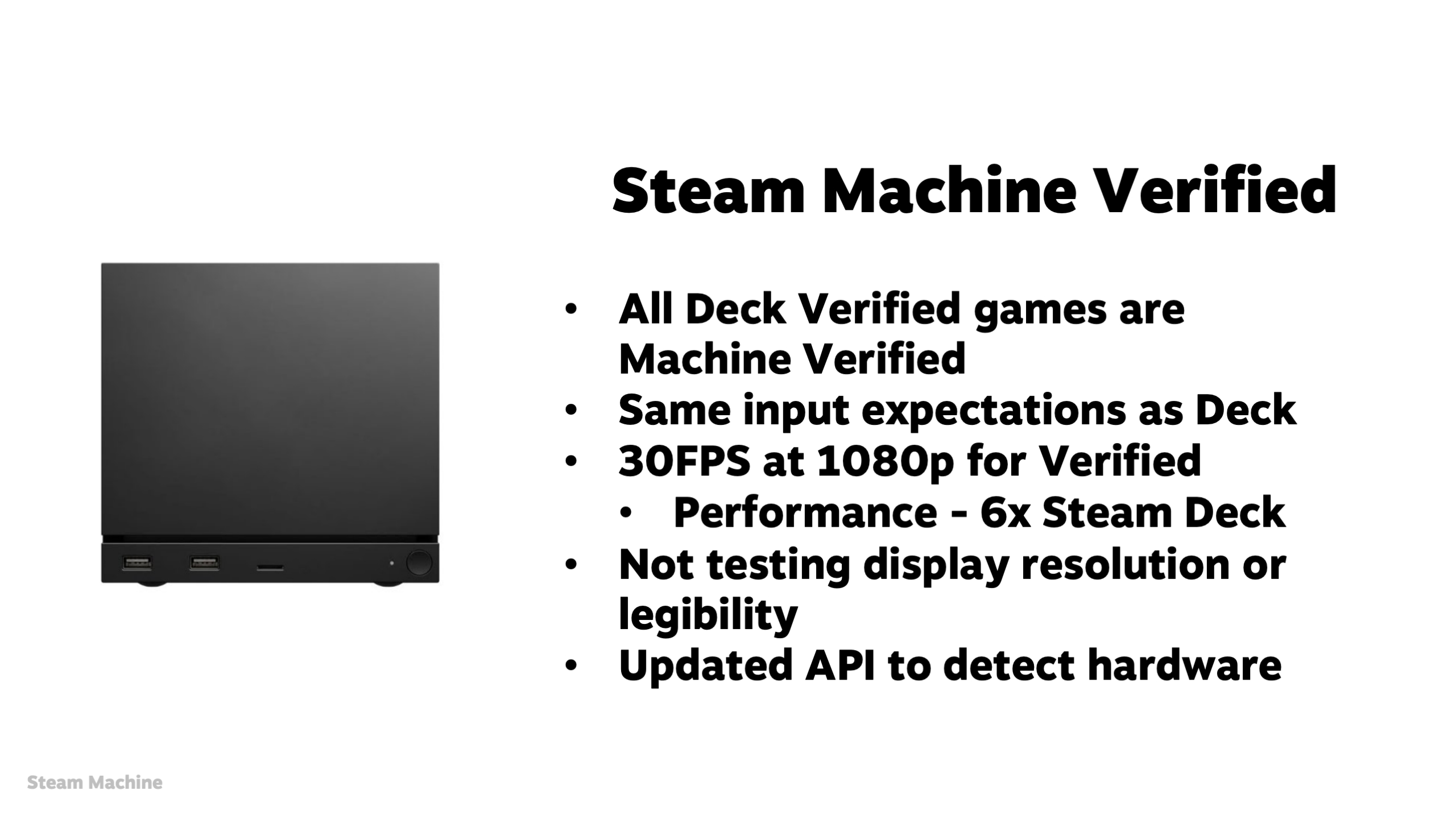
According to an announcement Valve sent to developers in November 2025, games that were Verified for the Steam Deck will automatically be verified for the Steam Machine. In a presentation at GDC 2026, the company also shared that Steam Machine Verified games will be expected to support the same input methods as the Steam Deck and run at 1080p at 30fps at a minimum. Unlike the company’s handheld, Valve won’t require developers to support specific display resolutions or meet legibility requirements to be Steam Machine Verified, though, because the Steam Machine is more likely to be connected to larger displays. That means a game could be marked as Playable on the Steam Deck due to its small text, but Verified on the Steam Machine.
Valve’s system is helpful, but far from definitive — some Unplayable games are in fact playable on the Steam Deck — which is why online, community-run databases like ProtonDB fill in the gaps with more granular information.
How much will the Steam Machine cost and when will it launch?
Valve
Valve hasn't announced a price or a release date for the Steam Machine or any of its new hardware, beyond affirming its new hardware will ship in 2026. In terms of price, however, the company has suggested it might not be a deal in quite the same way the $399 Steam Deck LCD was. Valve designer Pierre-Loup Griffais told The Verge that the "Steam Machine’s pricing is comparable to a PC with similar specs" and that its price would be "positioned closer to the entry level of the PC space" but be "very competitive with what you a PC you could build yourself from parts."
That means the Steam Machine will likely cost more than the $499 PS5, and that the rising costs of memory could make it even more expensive. Valve has already publicly admitted that memory and storage shortages are affecting its plans. In February, the company said that it was delaying the launch of its hardware (though it still hopes to ship in the first half of 2026) and rethinking pricing, particularly around the Steam Machine and Steam Frame, because of the "limited availability and growing prices" of critical components like RAM.
The changes Framework had to make to the pricing of the Framework Desktop are an illustrative example of the position Valve is in. Framework pitched its compact desktop PC as being great for gaming, with an AMD Ryzen AI Max chip (originally meant for gaming laptops) and a minimum of 32GB of RAM that lets it run games at 1440p. The company originally sold the base configuration of the Framework Desktop for $1,099, but announced in January 2026 that it would now cost $1,139 due to the rising cost of RAM. The price situation got even worse for configurations with more RAM. A Framework Desktop with 128GB of RAM now costs $2,459.
The blame for rising costs lies squarely with the AI industry, whose demand for RAM has led to the collapse of consumer RAM brands and a dearth of true deals on the in-demand component. At this point, PC makers have no solution to the problem other than riding the shortage out and raising prices. Valve clearly isn't immune to those same issues.
That doesn't rule out the company offering its Linux PC at multiple different price points, or in some kind of bundle deal with multiple pieces of new Steam hardware. But it does mean that the Steam Machine will likely be priced like a premium device. Same for the Steam Controller and Steam Frame. In the case of the Frame, UploadVR reports that Valve wants to sell the headset for less than the $1,000 Valve Index, but that doesn't mean it won't be significantly more expensive than the $300 Meta Quest 3S.
What accessories will work with the Steam Machine?
Valve
The Steam Machine is designed to work with a variety of different Bluetooth controllers and other wireless accessories, and also whatever you can plug into its multiple USB-A ports and single USB-C port. With a built-in 2.4GHz Steam Controller dongle inside the Steam Machine, Valve's controller should be an ideal option for controlling games, particularly because of its multiple input options, like touchpads and gyroscopes. Support for Steam Link, Valve's tech for streaming PC games over local wireless, means you can also send games from a Steam Machine to the Steam Deck, Steam Frame or the Steam Link app and play them there.
Update, March 11, 4:40PM ET: Updated headline and added details on Valve’s Steam Machine Verified program.
This article originally appeared on Engadget at https://www.engadget.com/gaming/pc/valves-steam-machine-launches-in-2026-everything-we-know-so-far-200458597.html?src=rss
If you haven't yet played Alan Wake 2, here's your chance to immerse yourself in its terrors for free. Prime members can play it this month on Amazon's Luna cloud gaming service at no additional charge.
The "fantastic" Alan Wake 2 oozes "psychedelic terror," as Engadget's Jessica Conditt put it in our review. The 2023 horror-survival game uses a dual-protagonist motif, alternating between the lost author Wake and the stoic FBI agent Saga Anderson. It "tells a twisted, serpentine story of paranormal murder, shifting realities and demonic possession, with two brooding investigators at its core." Not a bad way to sublimate the all-too-real horrors of life in 2026.
The Order of Giants DLC for Indiana Jones and the Great Circle also arrives on Luna this month. Ditto for Disney Universe, a knockoff of the Lego game franchise starring the Mouse's IP.
Setting Luna aside, Amazon also has downloadable PC games that Prime members can claim for free this month. Starting today, you can snag the Borderlands spinoff Tiny Tina's Wonderlands from the Epic Store. Later this month, you can also claim the highly rated strategy title Total War: Attila (Epic Store, Feb. 26).
This article originally appeared on Engadget at https://www.engadget.com/gaming/prime-members-can-play-alan-wake-2-for-free-on-luna-193509728.html?src=rss
Meta is developing a standalone app for Vibes, its feed of AI-generated videos, according to reports from TechCrunchand Platformer. Vibes was introduced as a feature in the Meta AI app in September 2025. Similar to OpenAI's Sora app, Vibes lets users prompt Meta AI to create TikTok-style vertical videos.
"Following the strong early traction of Vibes within Meta AI, we are testing a standalone app to build on that momentum," Meta said in a statement. "We’ve seen that users are increasingly leaning into the format to create, discover, and share AI-generated video with friends. This standalone app provides a dedicated home for that experience, offering people a more focused and immersive environment. We will look to expand the app further based on what we learn from the community."
Meta has yet to share specific numbers for how many people actually use Vibes, but the company does claim that Meta AI usage has continued to grow since Vibes launched. Breaking the feature out into its own app could allow Meta to add more functionality without cluttering the existing Meta AI app. The company believes AI-generated content will be the next big source of engagement on platforms, and said in an October 2025 earnings call that it planned to push more AI images and videos into its recommendation algorithm. A dedicated app for creating videos like Vibes could be one way Meta hopes to do that.
As Meta's main competitor in the burgeoning field of AI-first social media, OpenAI has continued to iterate on its Sora app, adding ways for characters and pets to cameo in videos, and signing a deal with Disney to allow users to generate content with Disney characters. Considering the company has licensed celebrity likenesses in the past, it doesn't seem impossible that Meta could pursue similar deals. Whatever happens, AI-generated videos appear like they'll be increasingly inescapable.
This article originally appeared on Engadget at https://www.engadget.com/ai/meta-is-giving-its-ai-slop-feed-an-app-of-its-own-192208200.html?src=rss
The upcoming science fiction film Project Hail Maryis getting a LEGO set. This is fascinating because LEGO typically makes sets based on long-standing franchises like Star Wars and Harry Potter. Project Hail Mary doesn't even hit theaters until March 20.
It's not an entirely new IP. The movie is based on a 2021 book written by Andy Weir, the same author behind The Martian. It's cool to see a LEGO set based on something more contemporary than its usual fare.
The 830-piece set looks pretty nifty. It includes a replica of The Hail Mary spaceship in all of its glory, complete with minifigures of teacher-turned-astronaut Ryland Grace and his ultra-cute alien buddy that the whole world will likely fall in love with once the film hits.
LEGO
The set also comes with a functional display stand and a crank that moves the components around to simulate centrifugal gravity. The minifigures can even be arranged to recreate an iconic scene from the book and, likely, the movie.
LEGO's Project Hail Mary set is available for preorder right now and costs $100. It ships on March 1, giving fans around 20 days to build it before the movie hits theaters.
The film involves a reluctant astronaut attempting to solve a mystery as to why the sun is dying. It stars Ryan Gosling and is directed by Phil Lord and Chris Miller, the duo behind the Spiderverse films and, incidentally, The LEGO Movie.
This article originally appeared on Engadget at https://www.engadget.com/entertainment/tv-movies/project-hail-mary-is-getting-its-own-lego-set-191106809.html?src=rss
The US Central Intelligence Agency is ending one of its popular services, The World Factbook. Over the decades, this reference has provided readers with information about different countries and communities around the world. The post from the CIA announcing the news didn't provide any information about why it will stop offering The World Factbook. The agency was subject to the same buyouts and job cuts that decimated much of the federal workforce in 2025, so maybe this type of public-facing tool is no longer a priority.
This reference guide was first published in 1962 as The National Basic Intelligence Factbook. That original tome was classified, but as other government departments began using it, an unclassified version for the public was released in 1971. It became a digital resource on the CIA website in 1997.
This article originally appeared on Engadget at https://www.engadget.com/big-tech/the-cia-stops-publishing-the-world-factbook-184419024.html?src=rss
Nintendo capped off today’s partner-focused Nintendo Direct with a flurry of Bethesda-related announcements, but arguably the most interesting game of the showcase appeared right at the start.
First announced at the beginning of the year, Orbitals is a two-player puzzle adventure game in which you and your co-op partner play as the intergalactic explorers Maki and Omura, on a mission to save their home in the stars from an incoming cosmic storm. Gameplay-wise, Orbitals looks like it’s at least partly inspired by the likes of It Takes Twoand Split Fiction, but really what really stands out here is the 90s anime-inspired visuals.
The game is absolutely dripping in style, and somehowlooks just as good in motion as it does in cutscenes. Describing it as a playable Saturday morning cartoon is getting into cliche territory, but Orbitalsreally nails its aesthetic.
It will be a tall order for any game like this to clear the impossibly high bar for creative co-op gameplay that Josef Fares’ Hazelight Studios has set in recent years, but Orbitals looks like it could be worth experiencing for its visuals alone.
Nintendo has managed to nab this one as a Switch 2 exclusive, which you can either play locally or online, and thanks to the console's GameShare feature, only one person needs to own the game for the latter.
Orbitals arrives at some point during summer 2026.
This article originally appeared on Engadget at https://www.engadget.com/gaming/nintendo/the-switch-2-exclusive-co-op-adventure-orbitals-launches-this-summer-180657892.html?src=rss
JLab just released a gigantic pair of headphones that doubles as a Bluetooth speaker. The Blue XL headphones are ridiculously oversized, making them headphones in name only. I don't even think Andre the Giant could've comfortably worn these suckers.
Unless you have a mythically large head, these are basically "headphone speakers." The idea is to drape them around your neck and stream tunes for all to hear. Though you could also pop them on a table or something. I prefer my Bluetooth speakers to be speaker-shaped, but maybe that's just me.
JLab
As for the internals, they feature 30W of power and two 2.5-inch drivers, along with two 2.5-inch radiators. This is obviously more power than what's demanded by headphones because, again, these are actually speakers. JLab says they'll get around 20 hours of use per charge, which is a decent metric.
There's another use case here. They could make a mighty fine accessory in a "person wearing comically oversized headphones" Halloween costume. The price is actually right for a gag gift. The Blue XL headphones cost $99. These were first announced at a recent college football game, but everyone assumed it was a joke because they were gold and the company said they cost $120,000.
This article originally appeared on Engadget at https://www.engadget.com/audio/jlabs-comically-oversized-headphones-are-not-an-april-fools-prank-174338833.html?src=rss