This Smart Charging Adapter Finally Flexes So Your Cables Don’t Have To

Charging phones and portable devices has become one of the most routine actions of modern life. From the moment we wake up to the time we go to sleep, our devices depend on reliable power. We charge at home, in offices, cafés, airports, hotels, libraries, and public transportation spaces. Despite how frequently charging occurs, the physical environments designed to support it often feel like an afterthought. Wall sockets are commonly placed low to the ground, behind furniture, under desks, or in narrow corners that were never designed with daily device use in mind.

As a result, charging cables are routinely forced into uncomfortable positions. They are bent sharply against walls, twisted sideways, or compressed between furniture and outlets. Over time, this repeated stress causes visible wear. The outer insulation begins to tear, internal wiring weakens, and charging reliability declines. Many users replace cables not because they stop working suddenly, but because gradual damage makes them unsafe or frustrating to use. This cycle creates unnecessary waste, financial cost, and ongoing inconvenience.

Designer: Berkan Sunayol
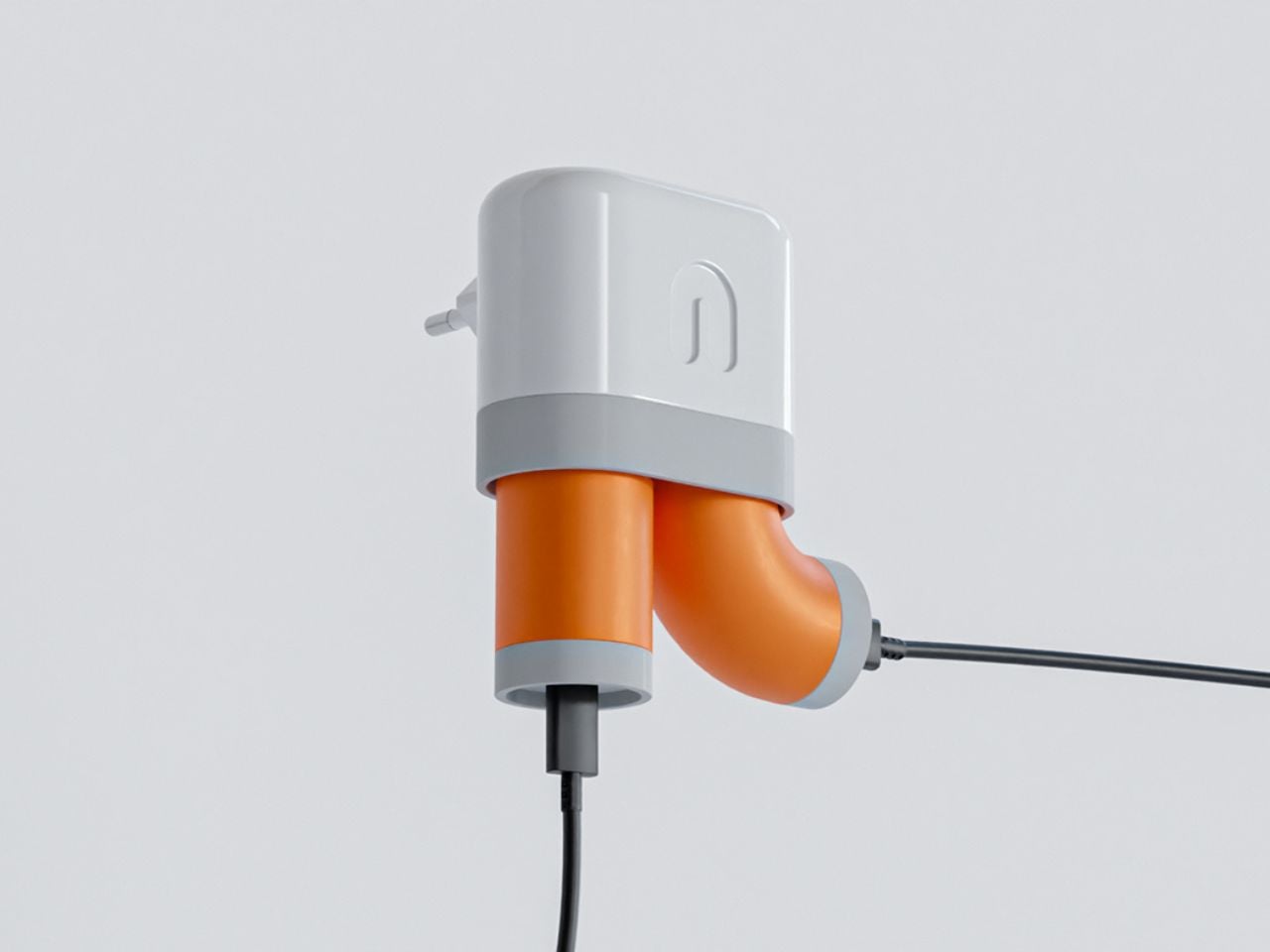
Beyond annoyance, damaged charging accessories raise genuine safety concerns. Continuous pressure on the adapter and cable can degrade electrical contact points, increasing the risk of overheating, inconsistent power delivery, or short circuits. In public and shared environments, where users may not notice early signs of damage, this becomes an overlooked safety issue.

Charging cables are intentionally designed to be flexible. They allow users to route them around objects, across surfaces, and through tight gaps. Charging adapters, however, remain rigid and stiff. This mismatch creates a critical point of failure. When a rigid adapter is plugged into an awkwardly placed socket, it locks the cable into a fixed angle. The cable is forced to bend sharply at the connector, which is often the weakest part of the entire system.

Over time, this rigidity undermines the durability of both the cable and the adapter. Despite widespread awareness of cable damage, most existing solutions focus on reinforcing the cable itself rather than addressing the adapter that causes the stress.

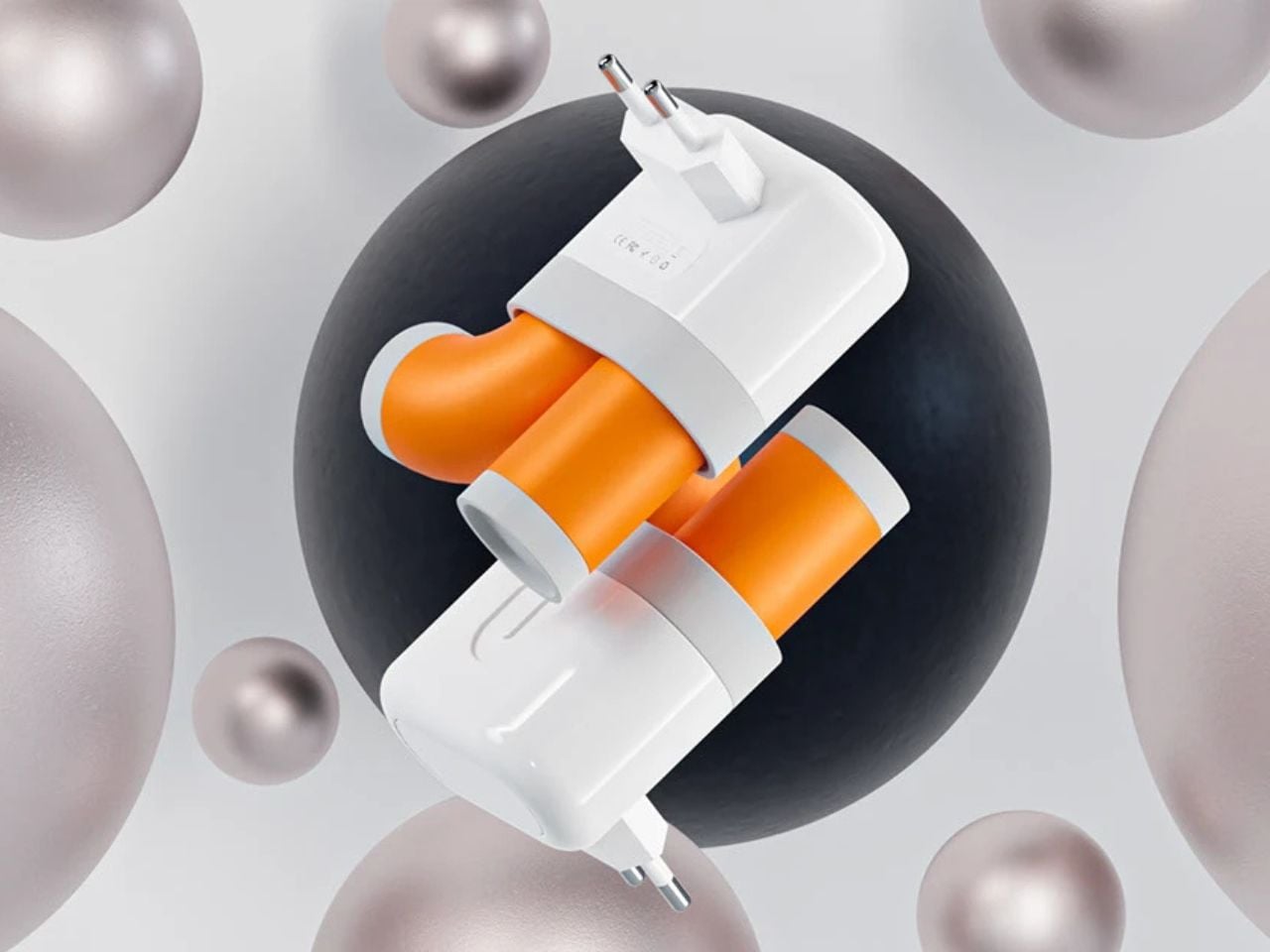
The Flexible Charge Adapter addresses this issue by rethinking the adapter as an adaptive component rather than a static block. A stretchable silicone structure is integrated into a specific section of the adapter, allowing controlled flexibility where it matters most. This design introduces a small but meaningful bend that aligns naturally with the direction of the cable.

In tight or awkward spaces, this flexibility reduces sharp angles, minimizes pressure at the connection point, and allows the cable to rest in a safer, more natural position. The adapter responds to real-world conditions instead of resisting them, helping preserve the integrity of the cable and the safety of the charging process.

In addition to improving durability and safety, the adapter also supports modern usage patterns. With two charging ports, users can charge multiple devices at the same time, even in confined environments. Phones, earbuds, power banks, and other accessories can be powered simultaneously without crowding the socket or straining cables.

The Flexible Charge Adapter demonstrates how thoughtful design can address everyday frustrations that are often overlooked. By introducing flexibility into a traditionally rigid object, it extends the life of charging accessories, reduces safety risks, and improves the overall charging experience. In a world where charging is constant and unavoidable, this design makes a simple act safer, smarter, and more sustainable.

The post This Smart Charging Adapter Finally Flexes So Your Cables Don’t Have To first appeared on Yanko Design.

This Smart Charging Adapter Finally Flexes So Your Cables Don’t Have To

Charging phones and portable devices has become one of the most routine actions of modern life. From the moment we wake up to the time we go to sleep, our devices depend on reliable power. We charge at home, in offices, cafés, airports, hotels, libraries, and public transportation spaces. Despite how frequently charging occurs, the physical environments designed to support it often feel like an afterthought. Wall sockets are commonly placed low to the ground, behind furniture, under desks, or in narrow corners that were never designed with daily device use in mind.

As a result, charging cables are routinely forced into uncomfortable positions. They are bent sharply against walls, twisted sideways, or compressed between furniture and outlets. Over time, this repeated stress causes visible wear. The outer insulation begins to tear, internal wiring weakens, and charging reliability declines. Many users replace cables not because they stop working suddenly, but because gradual damage makes them unsafe or frustrating to use. This cycle creates unnecessary waste, financial cost, and ongoing inconvenience.

Designer: Berkan Sunayol
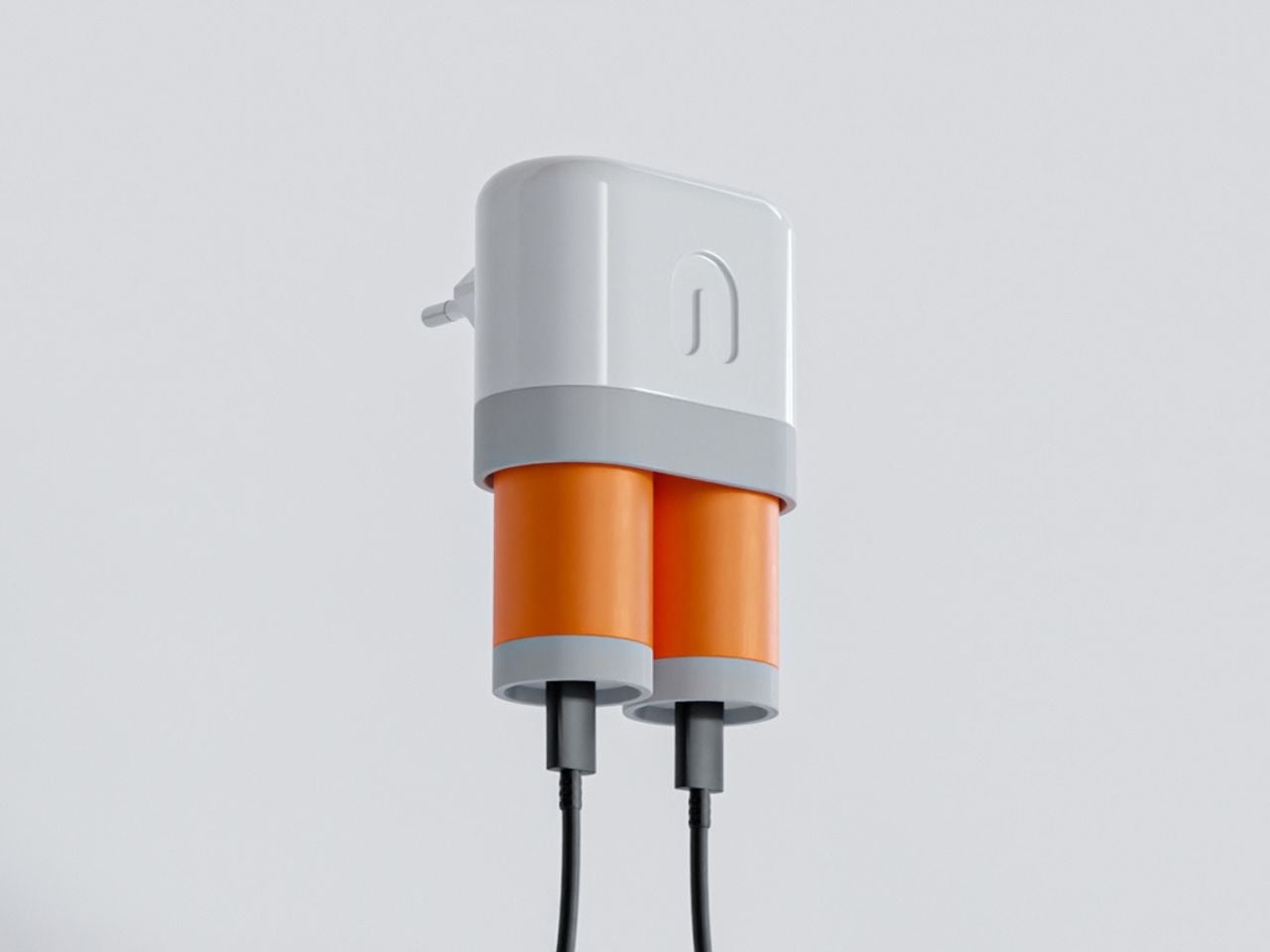
Beyond annoyance, damaged charging accessories raise genuine safety concerns. Continuous pressure on the adapter and cable can degrade electrical contact points, increasing the risk of overheating, inconsistent power delivery, or short circuits. In public and shared environments, where users may not notice early signs of damage, this becomes an overlooked safety issue.

Charging cables are intentionally designed to be flexible. They allow users to route them around objects, across surfaces, and through tight gaps. Charging adapters, however, remain rigid and stiff. This mismatch creates a critical point of failure. When a rigid adapter is plugged into an awkwardly placed socket, it locks the cable into a fixed angle. The cable is forced to bend sharply at the connector, which is often the weakest part of the entire system.
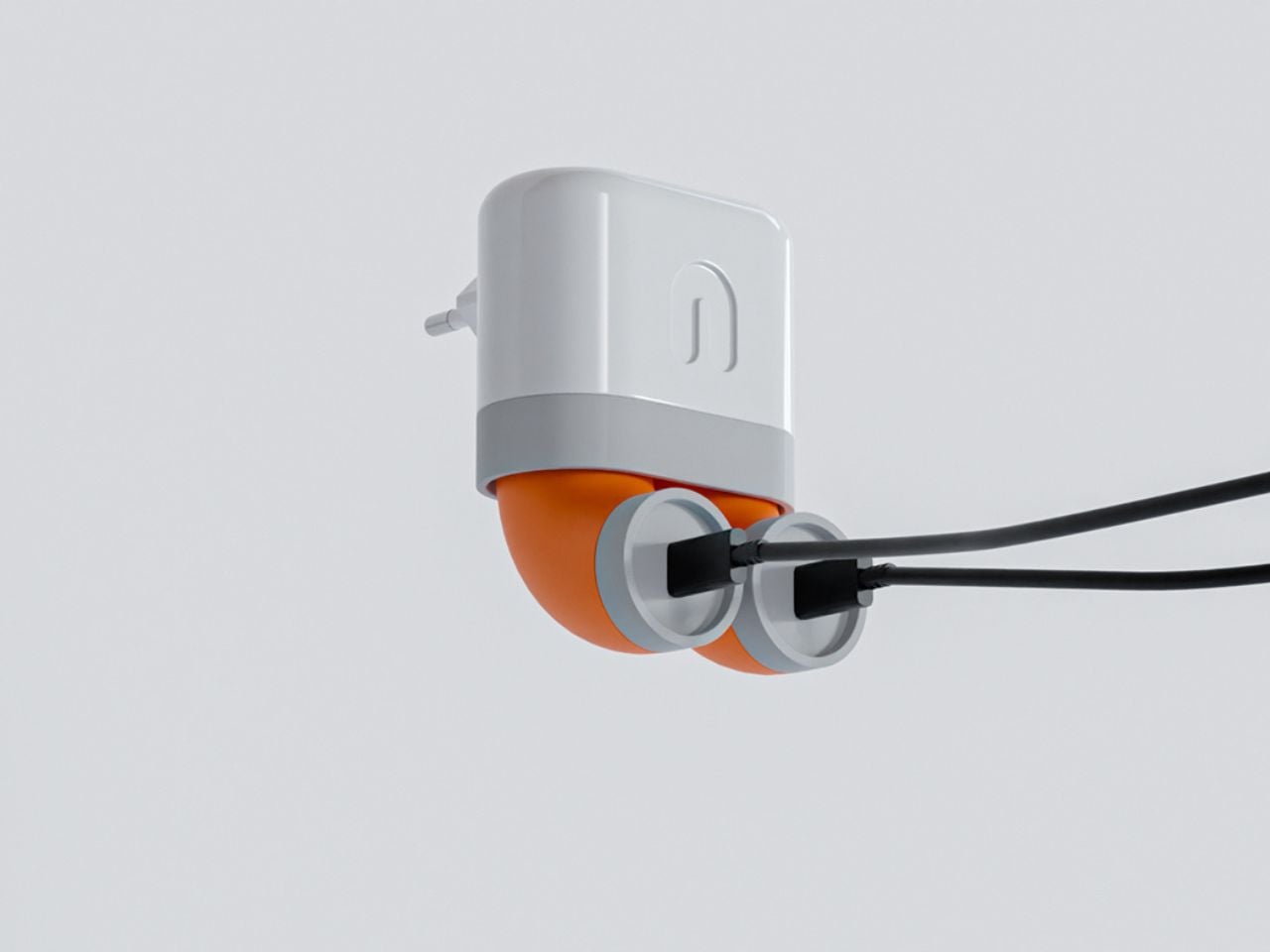
Over time, this rigidity undermines the durability of both the cable and the adapter. Despite widespread awareness of cable damage, most existing solutions focus on reinforcing the cable itself rather than addressing the adapter that causes the stress.

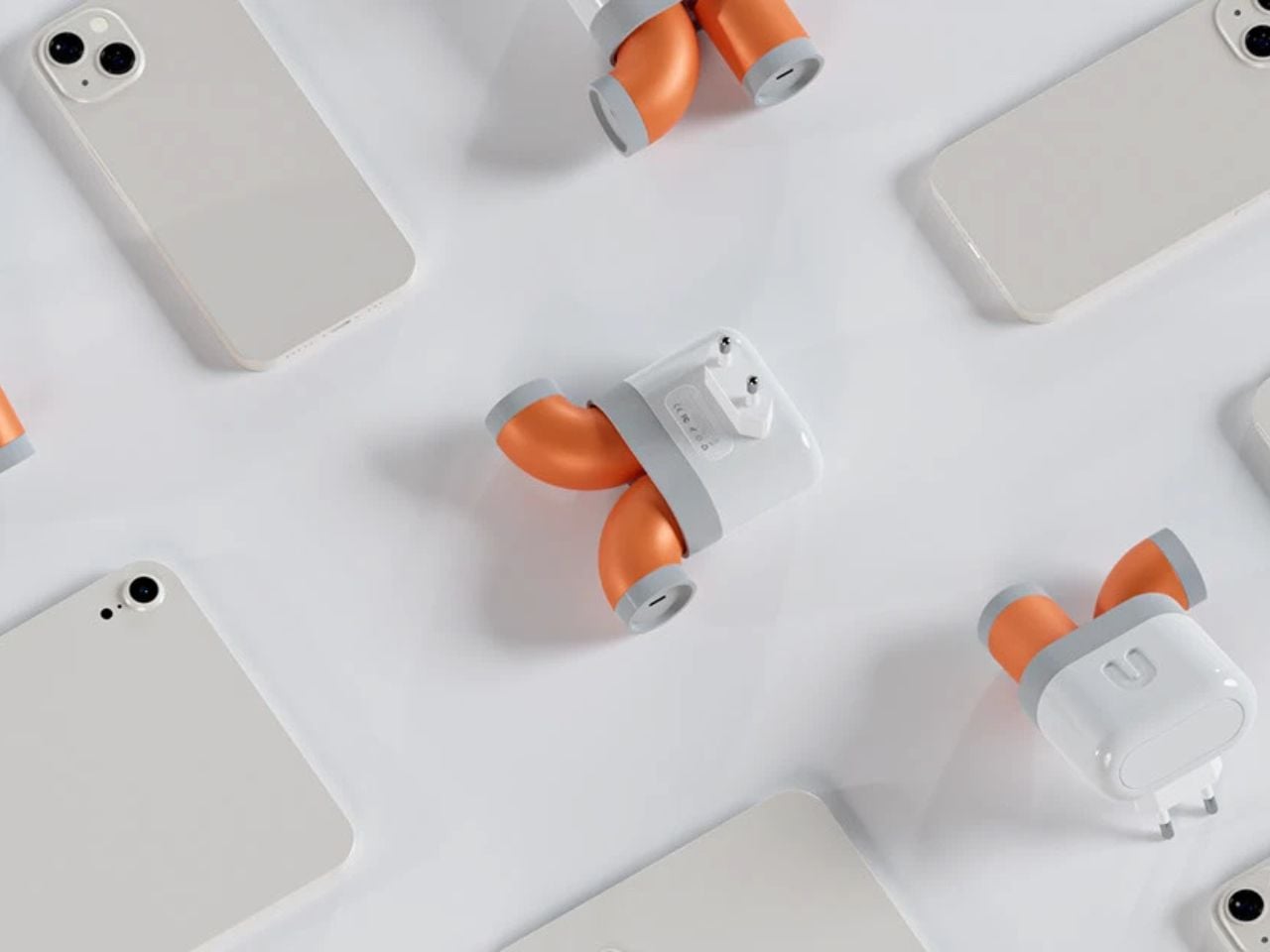
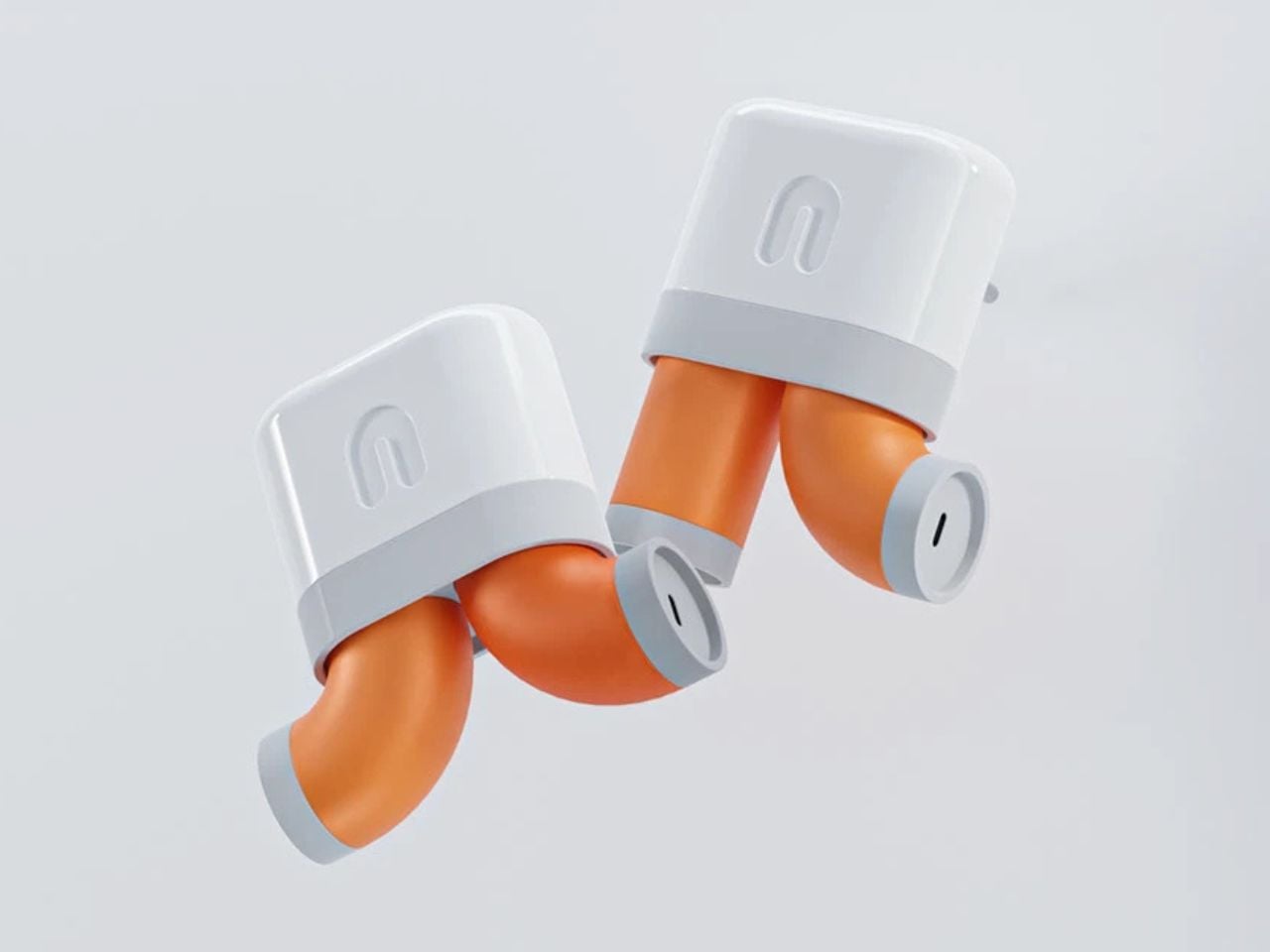
The Flexible Charge Adapter addresses this issue by rethinking the adapter as an adaptive component rather than a static block. A stretchable silicone structure is integrated into a specific section of the adapter, allowing controlled flexibility where it matters most. This design introduces a small but meaningful bend that aligns naturally with the direction of the cable.
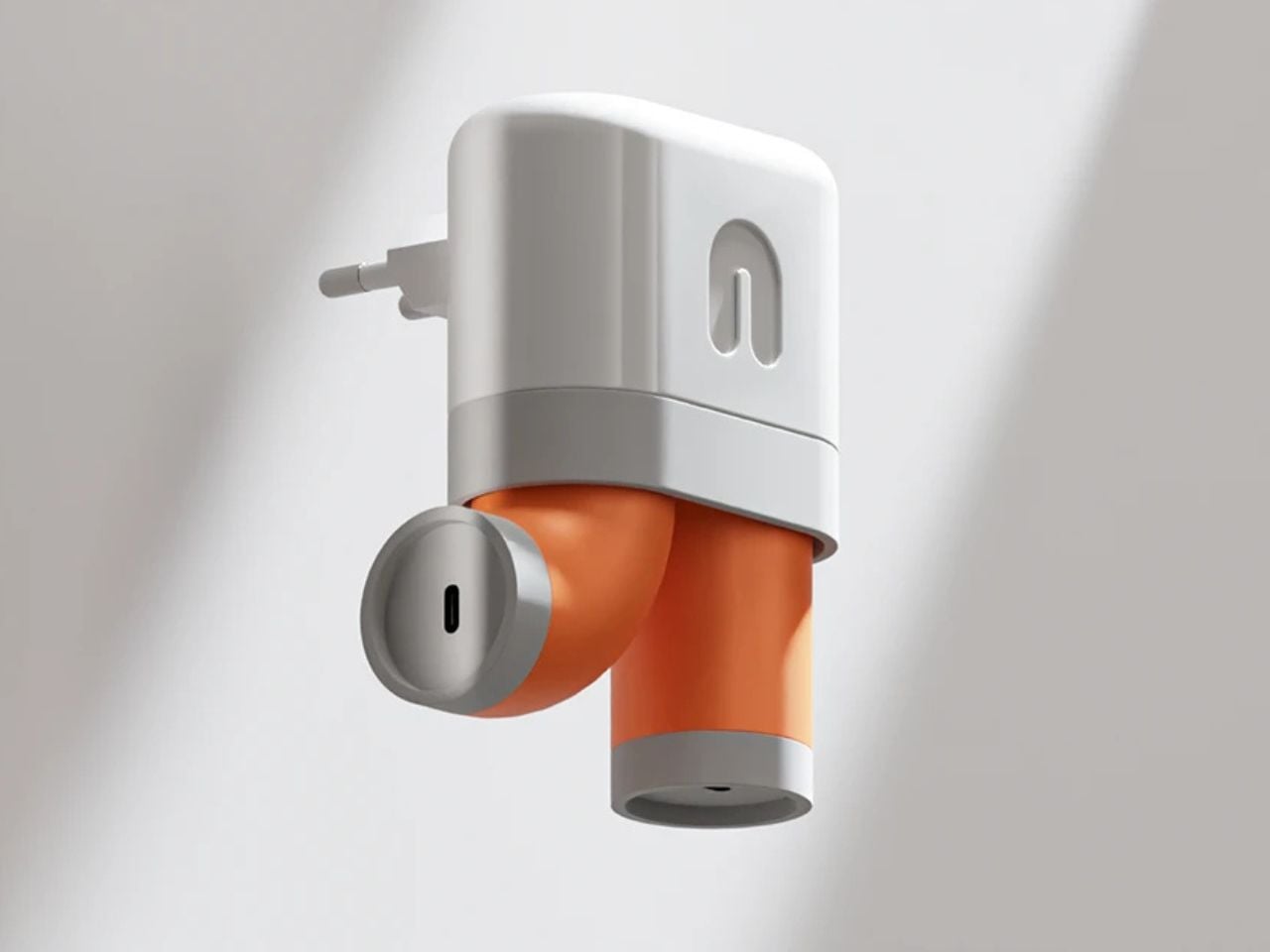
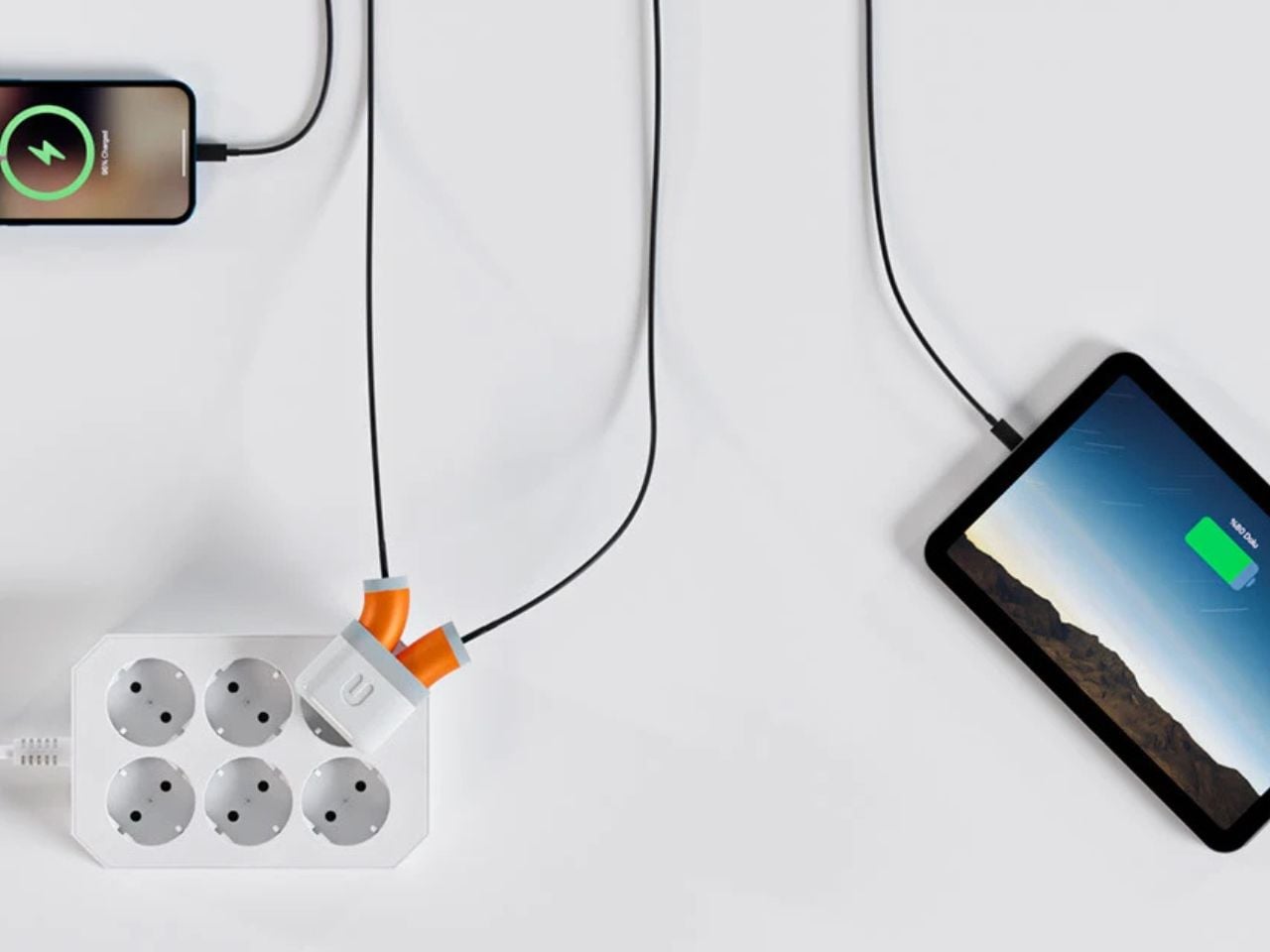
In tight or awkward spaces, this flexibility reduces sharp angles, minimizes pressure at the connection point, and allows the cable to rest in a safer, more natural position. The adapter responds to real-world conditions instead of resisting them, helping preserve the integrity of the cable and the safety of the charging process.

In addition to improving durability and safety, the adapter also supports modern usage patterns. With two charging ports, users can charge multiple devices at the same time, even in confined environments. Phones, earbuds, power banks, and other accessories can be powered simultaneously without crowding the socket or straining cables.

The Flexible Charge Adapter demonstrates how thoughtful design can address everyday frustrations that are often overlooked. By introducing flexibility into a traditionally rigid object, it extends the life of charging accessories, reduces safety risks, and improves the overall charging experience. In a world where charging is constant and unavoidable, this design makes a simple act safer, smarter, and more sustainable.
The post This Smart Charging Adapter Finally Flexes So Your Cables Don’t Have To first appeared on Yanko Design.
This Smart Charging Adapter Finally Flexes So Your Cables Don’t Have To

Charging phones and portable devices has become one of the most routine actions of modern life. From the moment we wake up to the time we go to sleep, our devices depend on reliable power. We charge at home, in offices, cafés, airports, hotels, libraries, and public transportation spaces. Despite how frequently charging occurs, the physical environments designed to support it often feel like an afterthought. Wall sockets are commonly placed low to the ground, behind furniture, under desks, or in narrow corners that were never designed with daily device use in mind.

As a result, charging cables are routinely forced into uncomfortable positions. They are bent sharply against walls, twisted sideways, or compressed between furniture and outlets. Over time, this repeated stress causes visible wear. The outer insulation begins to tear, internal wiring weakens, and charging reliability declines. Many users replace cables not because they stop working suddenly, but because gradual damage makes them unsafe or frustrating to use. This cycle creates unnecessary waste, financial cost, and ongoing inconvenience.

Designer: Berkan Sunayol

Beyond annoyance, damaged charging accessories raise genuine safety concerns. Continuous pressure on the adapter and cable can degrade electrical contact points, increasing the risk of overheating, inconsistent power delivery, or short circuits. In public and shared environments, where users may not notice early signs of damage, this becomes an overlooked safety issue.

Charging cables are intentionally designed to be flexible. They allow users to route them around objects, across surfaces, and through tight gaps. Charging adapters, however, remain rigid and stiff. This mismatch creates a critical point of failure. When a rigid adapter is plugged into an awkwardly placed socket, it locks the cable into a fixed angle. The cable is forced to bend sharply at the connector, which is often the weakest part of the entire system.

Over time, this rigidity undermines the durability of both the cable and the adapter. Despite widespread awareness of cable damage, most existing solutions focus on reinforcing the cable itself rather than addressing the adapter that causes the stress.

The Flexible Charge Adapter addresses this issue by rethinking the adapter as an adaptive component rather than a static block. A stretchable silicone structure is integrated into a specific section of the adapter, allowing controlled flexibility where it matters most. This design introduces a small but meaningful bend that aligns naturally with the direction of the cable.

In tight or awkward spaces, this flexibility reduces sharp angles, minimizes pressure at the connection point, and allows the cable to rest in a safer, more natural position. The adapter responds to real-world conditions instead of resisting them, helping preserve the integrity of the cable and the safety of the charging process.

In addition to improving durability and safety, the adapter also supports modern usage patterns. With two charging ports, users can charge multiple devices at the same time, even in confined environments. Phones, earbuds, power banks, and other accessories can be powered simultaneously without crowding the socket or straining cables.

The Flexible Charge Adapter demonstrates how thoughtful design can address everyday frustrations that are often overlooked. By introducing flexibility into a traditionally rigid object, it extends the life of charging accessories, reduces safety risks, and improves the overall charging experience. In a world where charging is constant and unavoidable, this design makes a simple act safer, smarter, and more sustainable.

The post This Smart Charging Adapter Finally Flexes So Your Cables Don’t Have To first appeared on Yanko Design.

People are uninstalling TikTok and downloading an indie competitor

TikTok's newly formed US entity is off to a very bumpy start. As the app continues to face technical issues affecting the recommendation algorithm, view counts and other features, TikTok is also seeing a wave of frustrated users uninstalling it, according to new data.

Analytics firm Sensor Tower, which tracks downloads and other app store-related metrics, told CNBC that there has been a 150 percent rise in uninstalls of the TikTok app in the United States compared with the last three months. An analyst at Sensor Tower told Engadget that TikTok's US daily active users (DAUs) have increased about 2 percent in the same time period, and are flat week-over-week. TikTok has blamed a power outage at a data center for “multiple bugs,” including those affecting view counts and load times. The company hasn't said when users can expect a fix.

At the same time, an independent app called UpScrolled has seen a surge in interest over the last few days. The app is currently the ninth most-downloaded app in the US App Store and the second most popular social app (Meta's Threads is currently in the number one spot for social apps). The app has also reached the top five in the UK and Australian app stores. In the United States, its sudden popularity seems to be closely tied to recent changes at TikTok. 

UpScrolled has seen 41,000 total downloads between Thursday (the day the US joint venture was formalized) and Saturday, according to estimates from App Figures. The app, which was first released last June, has been downloaded about 140,000 times between Apple and Google's app stores, according to App Figures. Prior to last Thursday, the app was averaging less than 500 downloads a day, according to the company. The rapid increase in downloads has apparently caused some issues for the company which asked users to "bear with us" on Monday.

Created by an Australian developer, UpScrolled looks a bit like Instagram. Users can share photos and shortform videos. The app defaults to a chronological "following" feed, though it does also recommend content to users. The app is "privately funded by its founder, Issam Hijazi, together with a small group of individual investors who share our mission and values," according to an FAQ on UpScrolled's website. It currently has no ads, though the company says it "probably" will in the future. 

This isn't the first time turmoil at TikTok has benefitted a previously little-known app. Chinese app RedNote briefly became the top app in the United States early last year as TikTok faced a potential ban. RedNote's popularity proved to be short-lived, though, as the 2025 TikTok "ban" ended up lasting only a couple of hours. 

But with new owners at TikTok and growing frustration over technical issues with the app, there could be an opportunity for a new shortform video service that's not controlled by a huge corporation. And that's what UpScrolled seems to be betting on. "Too often, users are left uncertain about whether their voices will be heard or quietly suppressed," the company writes on its website. "UpScrolled changes that by ensuring every post has a fair chance to be seen, creating an environment that is authentic, unfiltered, and equitable for all."

Update, January 26, 2026, 4:28PM PT: This post was updated to reflect the latest details from TikTok about the ongoing issues affecting the US version of the app.

This article originally appeared on Engadget at https://www.engadget.com/social-media/people-are-uninstalling-tiktok-and-downloading-an-indie-competitor-233345222.html?src=rss

This Leaf-Like Tool Turns Everyday Walks Into Small Acts of Care for Hidden Lives

We have all heard the phrases “Don’t litter.” “Stop global warming.” They appear on posters, billboards, campaigns, and packaging, repeated so often that they begin to blur into background noise. While the intention behind them is urgent and necessary, the language of sustainability has become heavy and exhausting. It often asks people to think at a global scale, to feel responsible for enormous systems that feel far beyond individual control. Over time, this can create distance instead of motivation. But what if sustainability did not begin with fixing the entire planet? What if it started with noticing the small lives right beneath our feet?

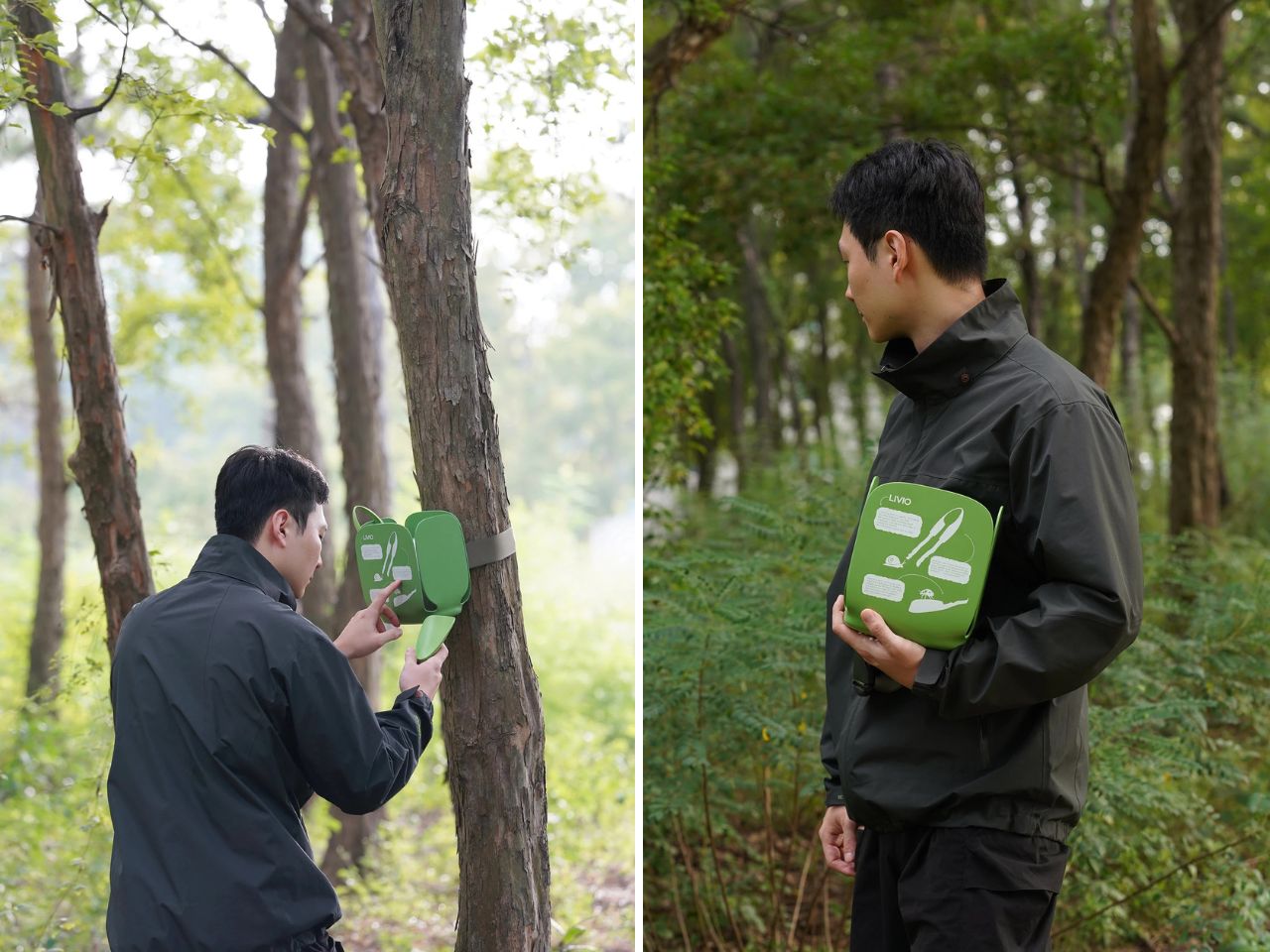
LIVIO is a project that reimagines sustainability through small, meaningful actions rooted in everyday experience. On walking trails, mountain paths, sidewalks, and parks, countless tiny creatures move through human spaces each day. Snails, insects, and other small beings navigate these environments quietly, often crossing paths with people who never notice them. It is not uncommon to find these creatures accidentally crushed by footsteps, bikes, or shoes. These moments are brief and easy to overlook, yet they represent lives lost simply because we were not paying attention.

Designer: Subin Kim

The goal of LIVIO is to protect those small lives and to make care feel possible for more people. While many individuals want to help, touching insects or snails directly can feel uncomfortable or even frightening. Fear, hesitation, or disgust often becomes a barrier between intention and action. LIVIO addresses this gap by offering a gentle and thoughtful tool that allows people to help without direct contact.

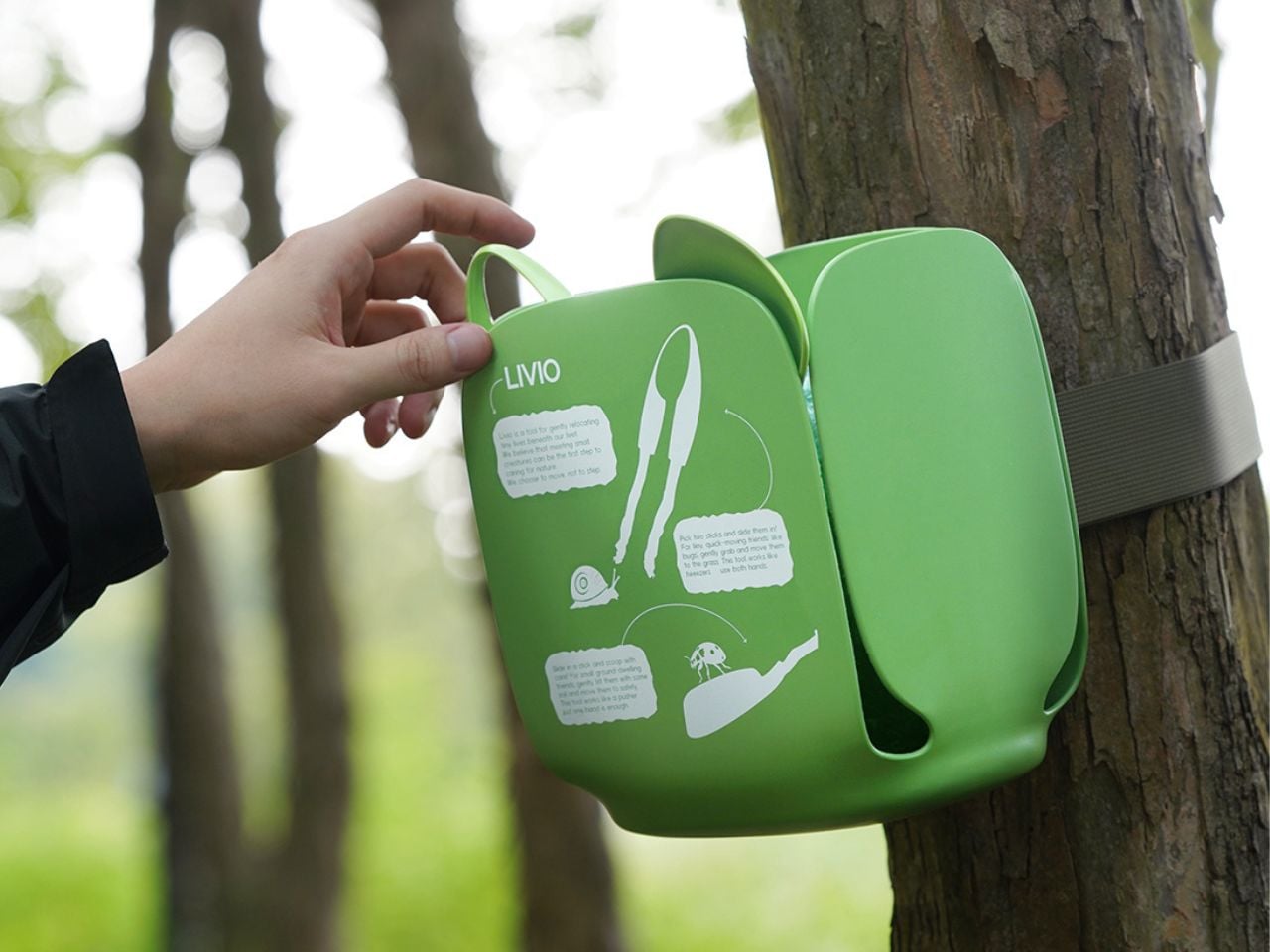
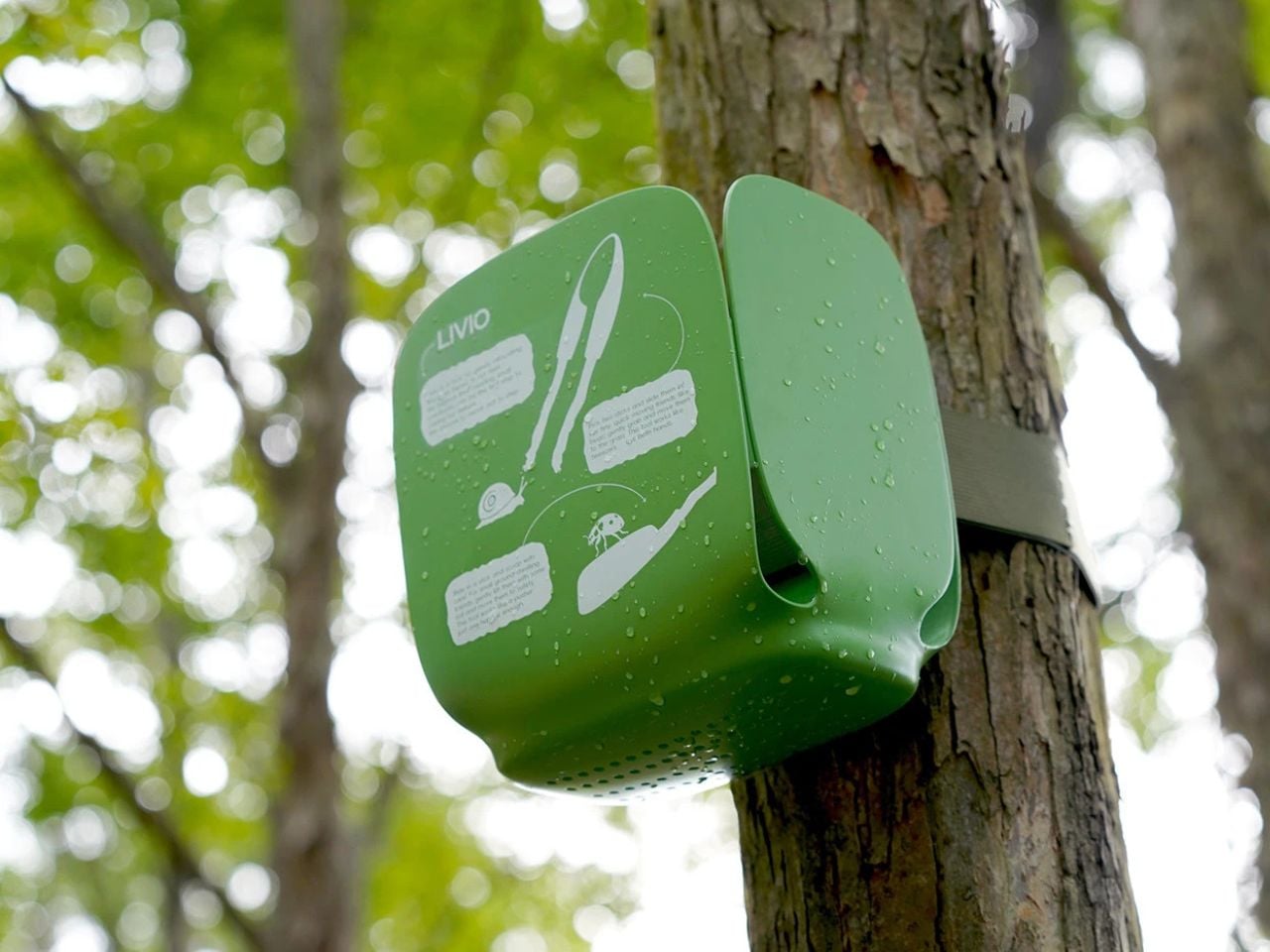
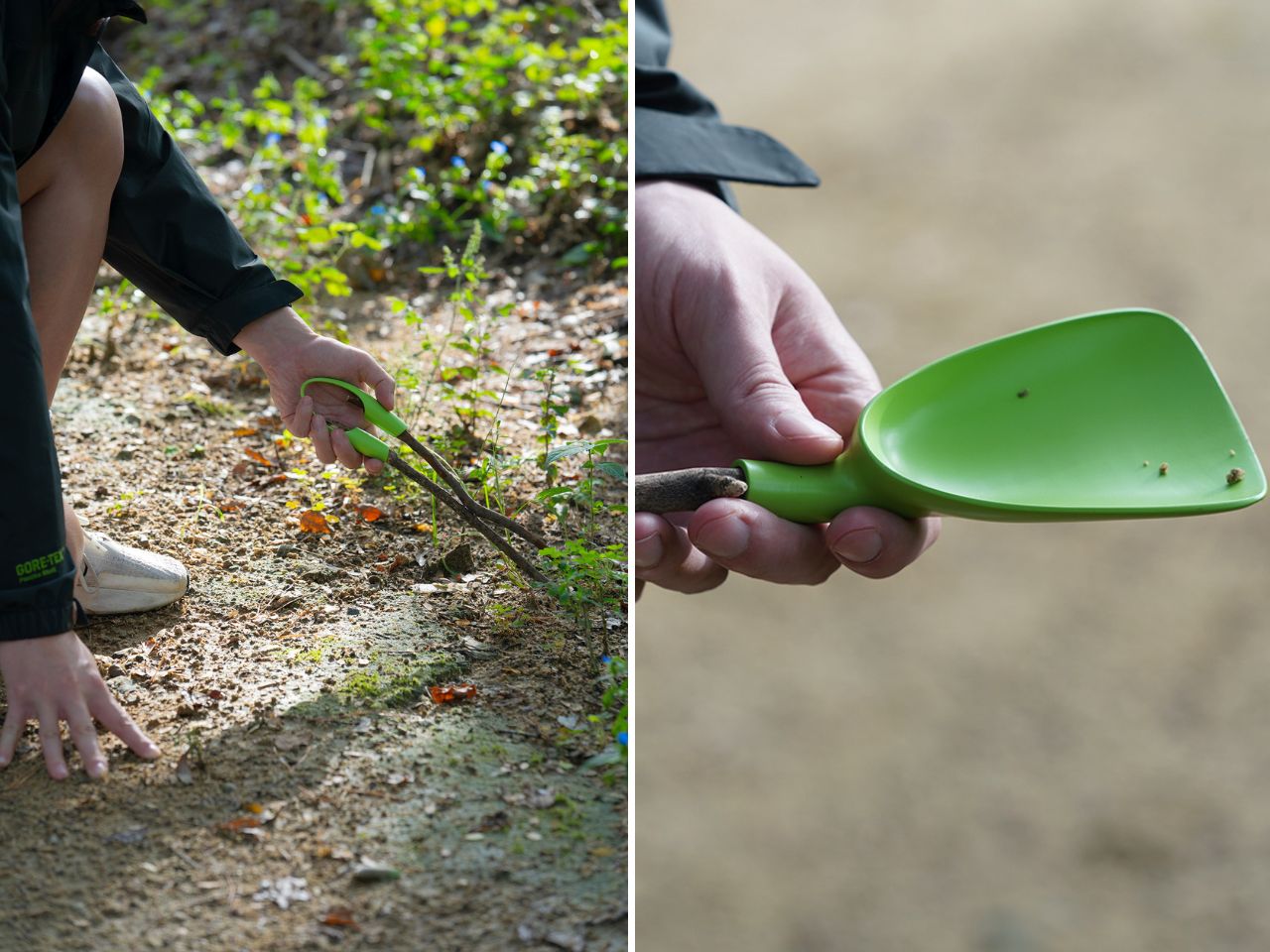
If you come across a small creature in crisis, LIVIO gives you a simple way to respond. The tool is designed to feel calm and intuitive rather than technical or intimidating. There are two tool types, each responding to different environmental conditions. In areas with little soil, the tongs allow careful and precise movement. In places where soil is present, the shovel tool lets users scoop the creature together with the surrounding ground, preserving its immediate habitat and reducing harm.

A defining aspect of LIVIO is how the tool is completed. Rather than being fully manufactured, it is finished using fallen branches found in nature. By reducing the amount of silicone used as its main material, the tool becomes even more environmentally conscious. The act of finding and attaching branches transforms the experience from simple use into participation. It encourages users to slow down, observe their surroundings, and engage physically with the environment. Sustainability becomes something playful and personal rather than distant or moralizing.

LIVIO also exists as a shared public resource. Tool stations can be installed on street trees, lamp posts, or along walking paths. Their leaf-like form blends naturally into the environment, making them feel like part of the landscape rather than an intrusion. These stations quietly invite curiosity and care, reminding people that small actions matter.

In the end, LIVIO suggests a different way to think about sustainability. Not as a burden, but as a series of small, human moments of attention and empathy. By protecting the smallest lives around us, sustainability becomes more real, more approachable, and even a little more joyful. Sometimes, meaningful change begins not with grand gestures, but with simply noticing what is right in front of us.

The post This Leaf-Like Tool Turns Everyday Walks Into Small Acts of Care for Hidden Lives first appeared on Yanko Design.
This Leaf-Like Tool Turns Everyday Walks Into Small Acts of Care for Hidden Lives

We have all heard the phrases “Don’t litter.” “Stop global warming.” They appear on posters, billboards, campaigns, and packaging, repeated so often that they begin to blur into background noise. While the intention behind them is urgent and necessary, the language of sustainability has become heavy and exhausting. It often asks people to think at a global scale, to feel responsible for enormous systems that feel far beyond individual control. Over time, this can create distance instead of motivation. But what if sustainability did not begin with fixing the entire planet? What if it started with noticing the small lives right beneath our feet?

LIVIO is a project that reimagines sustainability through small, meaningful actions rooted in everyday experience. On walking trails, mountain paths, sidewalks, and parks, countless tiny creatures move through human spaces each day. Snails, insects, and other small beings navigate these environments quietly, often crossing paths with people who never notice them. It is not uncommon to find these creatures accidentally crushed by footsteps, bikes, or shoes. These moments are brief and easy to overlook, yet they represent lives lost simply because we were not paying attention.

Designer: Subin Kim

The goal of LIVIO is to protect those small lives and to make care feel possible for more people. While many individuals want to help, touching insects or snails directly can feel uncomfortable or even frightening. Fear, hesitation, or disgust often becomes a barrier between intention and action. LIVIO addresses this gap by offering a gentle and thoughtful tool that allows people to help without direct contact.

If you come across a small creature in crisis, LIVIO gives you a simple way to respond. The tool is designed to feel calm and intuitive rather than technical or intimidating. There are two tool types, each responding to different environmental conditions. In areas with little soil, the tongs allow careful and precise movement. In places where soil is present, the shovel tool lets users scoop the creature together with the surrounding ground, preserving its immediate habitat and reducing harm.

A defining aspect of LIVIO is how the tool is completed. Rather than being fully manufactured, it is finished using fallen branches found in nature. By reducing the amount of silicone used as its main material, the tool becomes even more environmentally conscious. The act of finding and attaching branches transforms the experience from simple use into participation. It encourages users to slow down, observe their surroundings, and engage physically with the environment. Sustainability becomes something playful and personal rather than distant or moralizing.

LIVIO also exists as a shared public resource. Tool stations can be installed on street trees, lamp posts, or along walking paths. Their leaf-like form blends naturally into the environment, making them feel like part of the landscape rather than an intrusion. These stations quietly invite curiosity and care, reminding people that small actions matter.

In the end, LIVIO suggests a different way to think about sustainability. Not as a burden, but as a series of small, human moments of attention and empathy. By protecting the smallest lives around us, sustainability becomes more real, more approachable, and even a little more joyful. Sometimes, meaningful change begins not with grand gestures, but with simply noticing what is right in front of us.

The post This Leaf-Like Tool Turns Everyday Walks Into Small Acts of Care for Hidden Lives first appeared on Yanko Design.

Google agrees to $68 million settlement in voice assistant privacy lawsuit

Google has agreed to a $68 million settlement regarding claims that its voice assistant inappropriately spied on smartphone users. Plaintiffs claimed that the company’s Google Assistant platform began listening to them after it misheard conversations that sounded like its wake words. The suit argued that private information that Google Assistant shouldn't have heard was then used to deliver those individuals targeted ads. 

Reuters reported that Google denied wrongdoing in the suit, but according to court papers, the company agreed to a settlement in order to avoid the risk and costs of litigating the issue. The preliminary class action settlement was filed on Friday and now awaits approval from U.S. District Judge Beth Labson Freeman.

Google has been transitioning away from the Google Assistant platform in the past year, replacing it with its Gemini tool. Not that AI chatbots should be trusted as paragons of privacy either.

Apple faced a very similar allegations around its Siri voice assistant in 2019; that class-action suit ended in a $95 million settlement in January 2025. Not sure if a reward of $20 per device feels sufficient when these companies are accidentally overhearing deeply personal conversations and details, but that's how the justice system shakes out some times.

This article originally appeared on Engadget at https://www.engadget.com/big-tech/google-agrees-to-68-million-settlement-in-voice-assistant-privacy-lawsuit-222405727.html?src=rss

Meet The SP40 Restomod Speedster: The Minimalist Carbon Hot Rod Redefining Retro Car Design

The best custom builds do not just remix old ideas. They ask what those ideas would look like if they were born today, with access to current tools, materials, and manufacturing processes. The SP40 Restomod Speedster is that question answered in carbon and billet. It takes the stance and spirit of a 1930s streamliner, that long, low, purposeful shape built for speed rather than comfort, and reimagines it through the lens of modern coachbuilding. The body is a series of massive, unbroken surfaces. The cockpit is minimal and driver-focused. The whole thing looks like it was designed on a computer, then machined to tolerances measured in microns.

There is a specific audience for this kind of work. People who buy hand-wound watches even though their phones keep better time. People who collect midcentury furniture not because it is trendy, but because the joinery and proportions feel right. People who understand that restraint is harder than excess, and that the best designs are the ones where nothing feels arbitrary. The SP40 sits at the intersection of automotive history and contemporary craft. It is not trying to fool anyone into thinking it is from another era. It is trying to capture what made that era compelling, then execute it with the precision and materials available right now.

Designer: Iconic Auto Sports

You can see that precision in the bodywork, which is almost certainly a full carbon fiber monocoque. Look at the rear clamshell; getting a single piece of carbon that large to lay perfectly without waves or distortion is an engineering feat in itself. This is not kit-car fiberglass with a carbon wrap. This is structural, aerospace-grade material science applied to a shape that feels impossibly organic. The entire car probably weighs less than 950 kilograms, which fundamentally changes how it would drive. All the visible suspension components up front are likely CNC-milled from aluminum, with geometry dialed in using modern kinematic software. It is a level of finish that blurs the line between a car and a piece of kinetic sculpture.

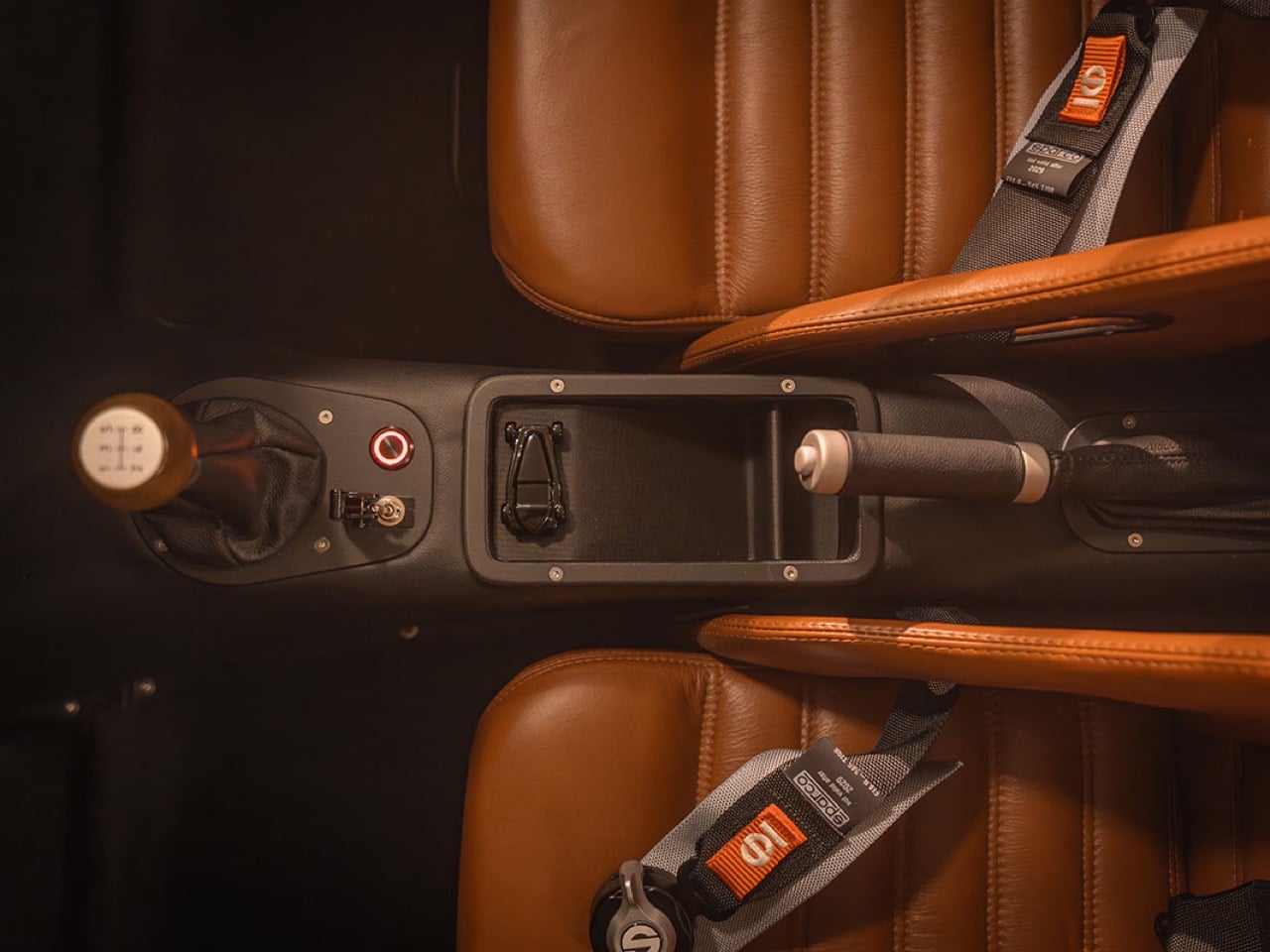
That philosophy carries right into the cockpit, which is a masterclass in tactile design. The gated manual shifter, with its wooden knob, is the centerpiece. It promises a mechanical, deliberate shifting action that modern paddle-shift systems simply cannot replicate. The dashboard is a simple plank of wood with classic analog gauges, a direct rejection of the screen-centric interiors that dominate the industry. Every control, from the toggle switches to the pull-handbrake, feels chosen for its physical feedback. It is a space designed for the act of driving, where your connection to the machine is through direct, mechanical inputs. The Sparco harnesses are not just for show; they are a clear signal of the car’s performance intent.

Underneath it all, the powertrain has to be something modern and potent. The side-exit exhaust and the big opening in the lower front grille point toward a forced-induction setup, probably a compact, high-revving V8. Something like a supercharged LT4 crate engine would provide around 650 horsepower with reliable, accessible torque, turning this lightweight chassis into an absolute weapon. Those wheels are a perfect metaphor for the whole project: they have the solid, functional look of vintage aero discs, but the turbine-like slots and two-tone finish are thoroughly contemporary. This car is a rolling thesis statement, arguing that technology’s best use is not to isolate the driver, but to perfect the analog connection we fell in love with in the first place.

The post Meet The SP40 Restomod Speedster: The Minimalist Carbon Hot Rod Redefining Retro Car Design first appeared on Yanko Design.

Google aims to take the sting out of scheduling meetings with a new Gemini feature

Google is rolling out a Gemini feature that could turn out to be pretty useful for many folks. It's a Google Calendar tool that can help figure out the best time to schedule a meeting, taking into account attendees' schedules. When creating a meeting, you can click the "Suggested times" option and Gemini will look at the availability that people have marked on their calendar and potential conflicts. You'll then be able to choose from a list of suggested time slots.

But the time you pick may not work for everyone. So if multiple people decline the meeting invite, you can reschedule by going to the event. You'll see a time when everyone is available and you can quickly update the invite.

There are a few catches here. Naturally, this will only work properly when meeting organizers have access to attendees' calendars. It's also limited to paid users who are on Google Workspace Business (Standard and Plus) and Enterprise (Standard and Plus) plans, as well as those with the Google AI Pro for Education add-on. The feature is available now on Rapid Release domains and it'll start rolling out to Scheduled Release domains on February 2.

This article originally appeared on Engadget at https://www.engadget.com/ai/google-aims-to-take-the-sting-out-of-scheduling-meetings-with-a-new-gemini-feature-204853761.html?src=rss

This AR Ski Helmet Finally Lets Rescuers Control Tech By Eye

Imagine being a ski patrol responder racing toward an injured skier on a freezing mountain. Your hands are gripping poles, your attention is split between the terrain and the emergency ahead, and your radio crackles with critical information. Now imagine if you could access maps, communicate with your team, and log vital data without ever touching a device. That’s exactly what the Argus AR Helmet promises to deliver.

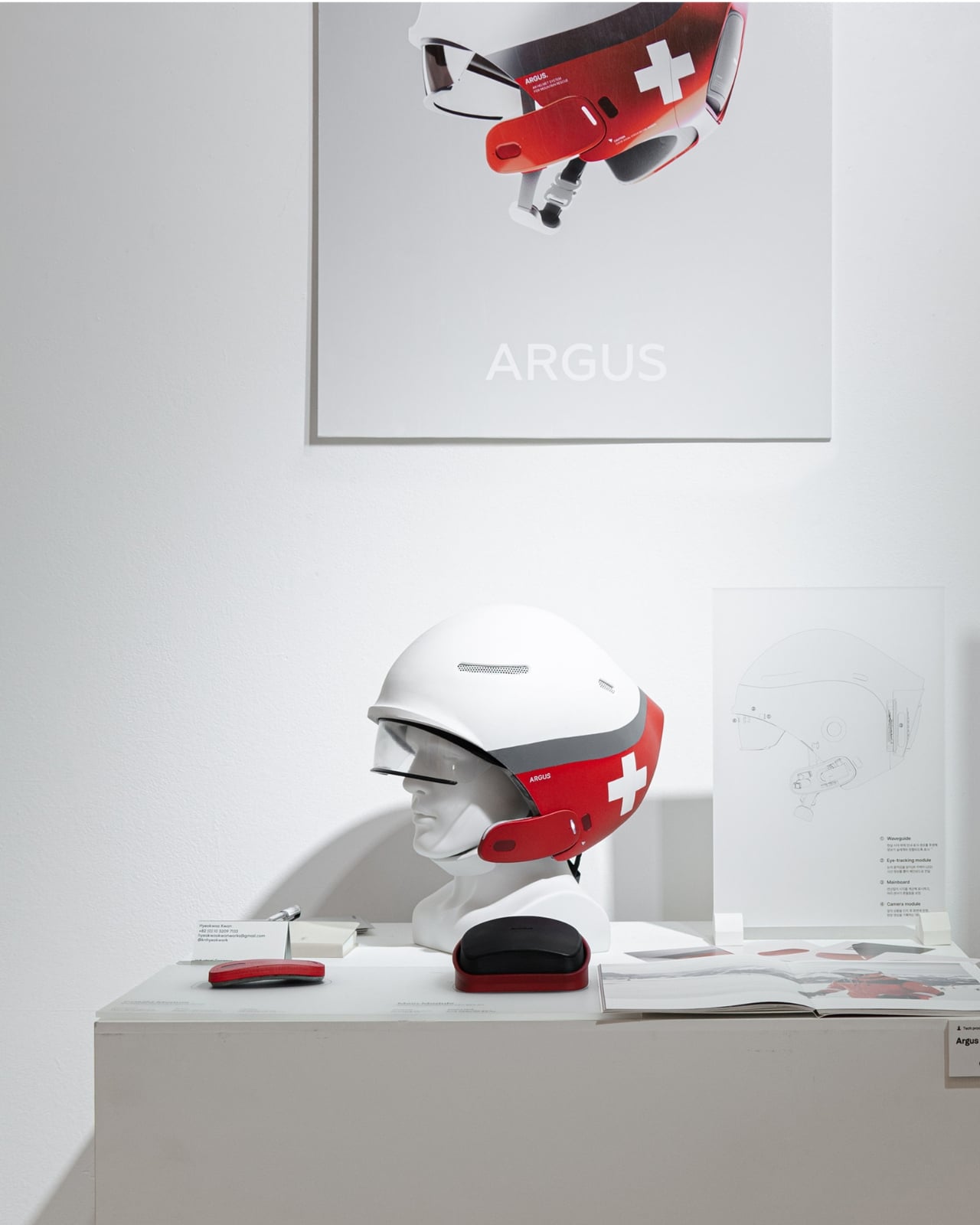
Designed by Hyeokwoo Kwon and Junho Park, Argus is a concept that reimagines what rescue technology can look like when you strip away everything unnecessary and focus on the moment that matters most. This isn’t just another gadget trying to cram features into a helmet. It’s a thoughtful response to a real problem: how do first responders stay connected and informed when their hands are literally full and seconds count?

Designers: Hyeokwoo Kwon and Junho Park

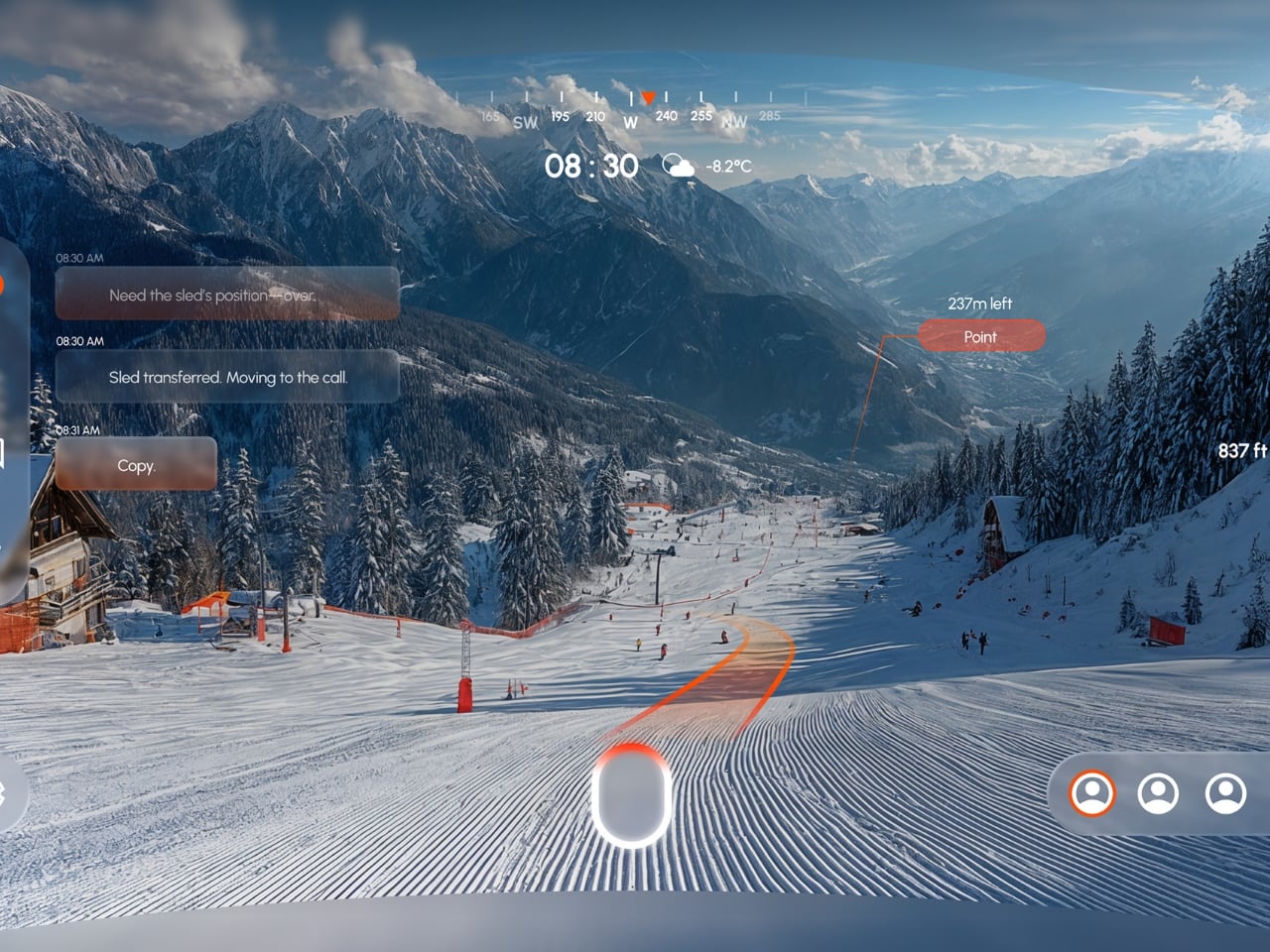
The helmet’s standout feature is its eye-tracking interface. Instead of fumbling with buttons or voice commands that get lost in howling wind, users control the AR display simply by looking at what they need. Want to view a map overlay of the ski area? Glance at the navigation icon. Need to send a message to base? Your eyes do the work. The system is built around the idea that in high-stress, time-critical situations, the fewer steps between thought and action, the better.

What makes this particularly clever is how it handles communication in one of the noisiest work environments imaginable. Mountains are loud. Wind, equipment, helicopters, and panicked voices create a constant wall of sound that makes radio communication frustrating at best and dangerous at worst. Argus addresses this with real-time conversation-to-text conversion. Spoken words are automatically transcribed and displayed on the visor, ensuring that critical information doesn’t get lost or misunderstood. In an emergency where “stop the area” versus “stop near the area” could mean completely different courses of action, that clarity is potentially lifesaving.

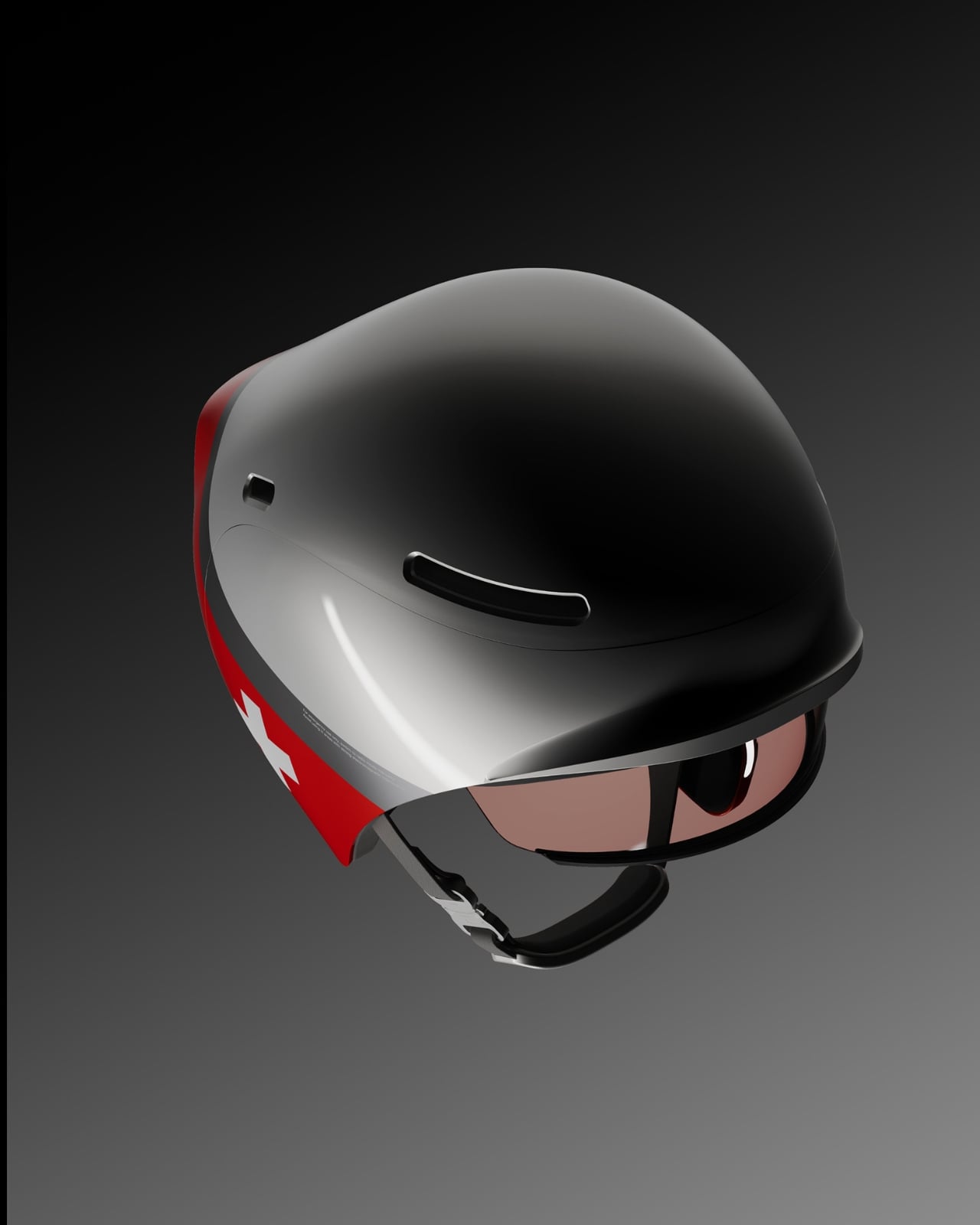
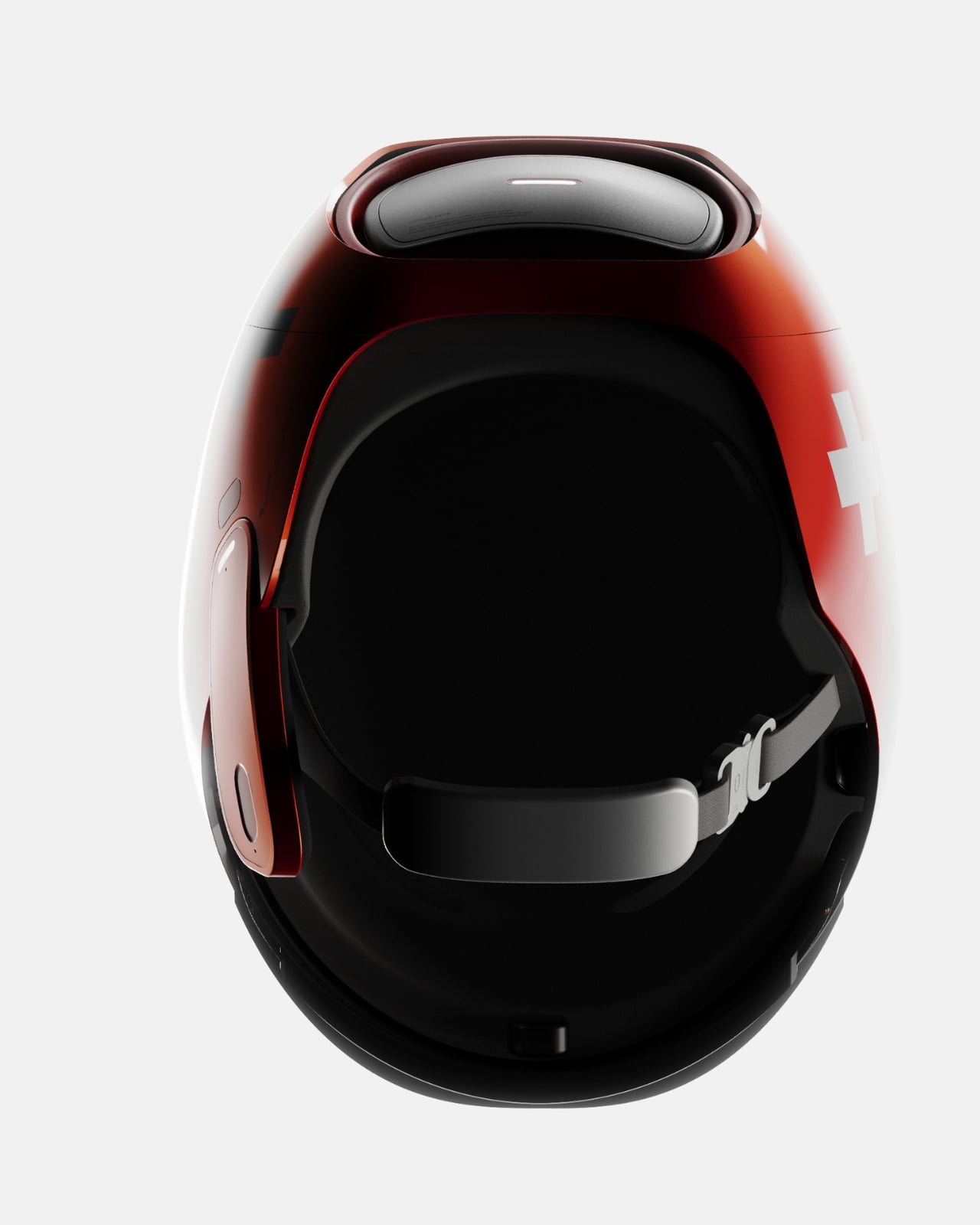
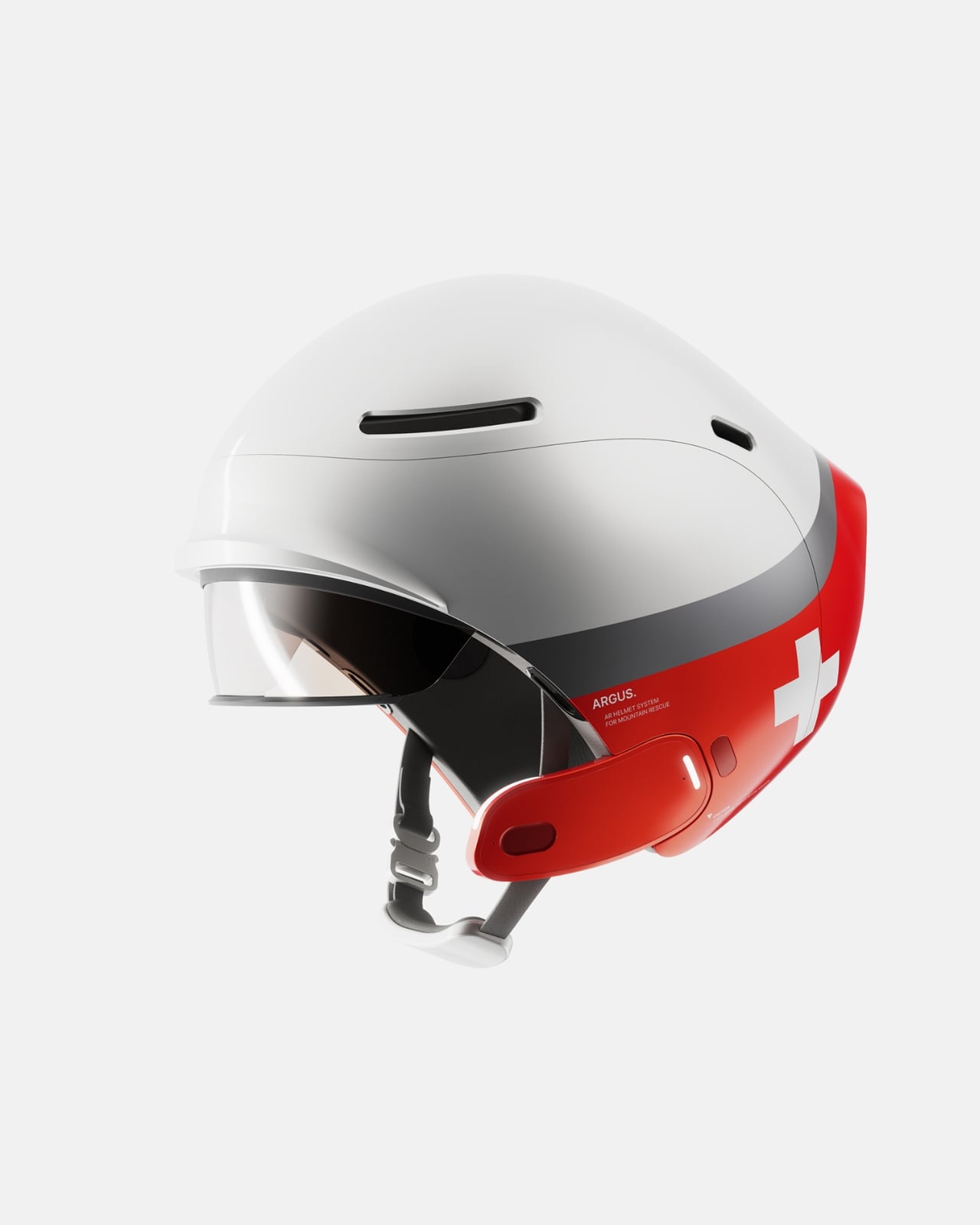
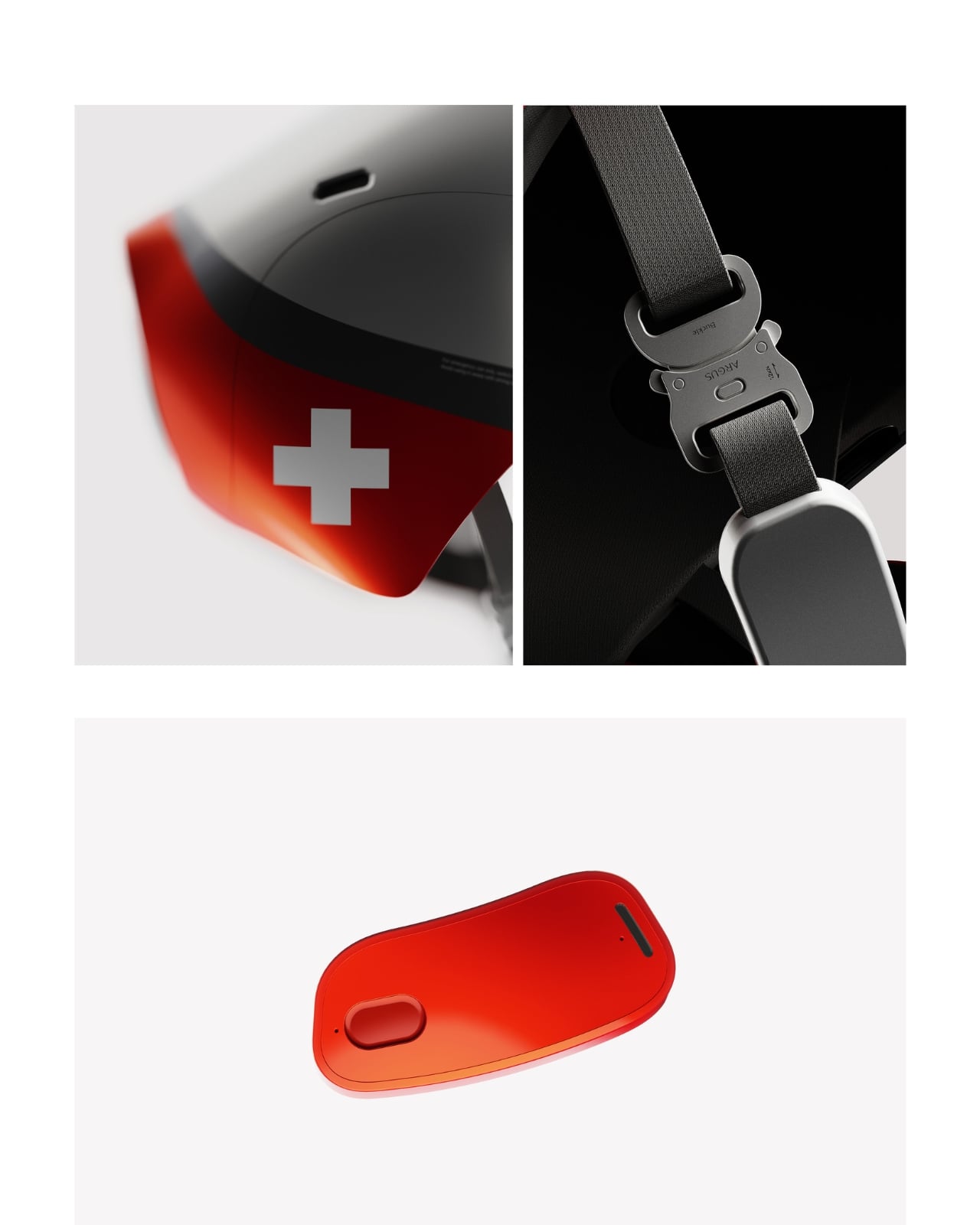
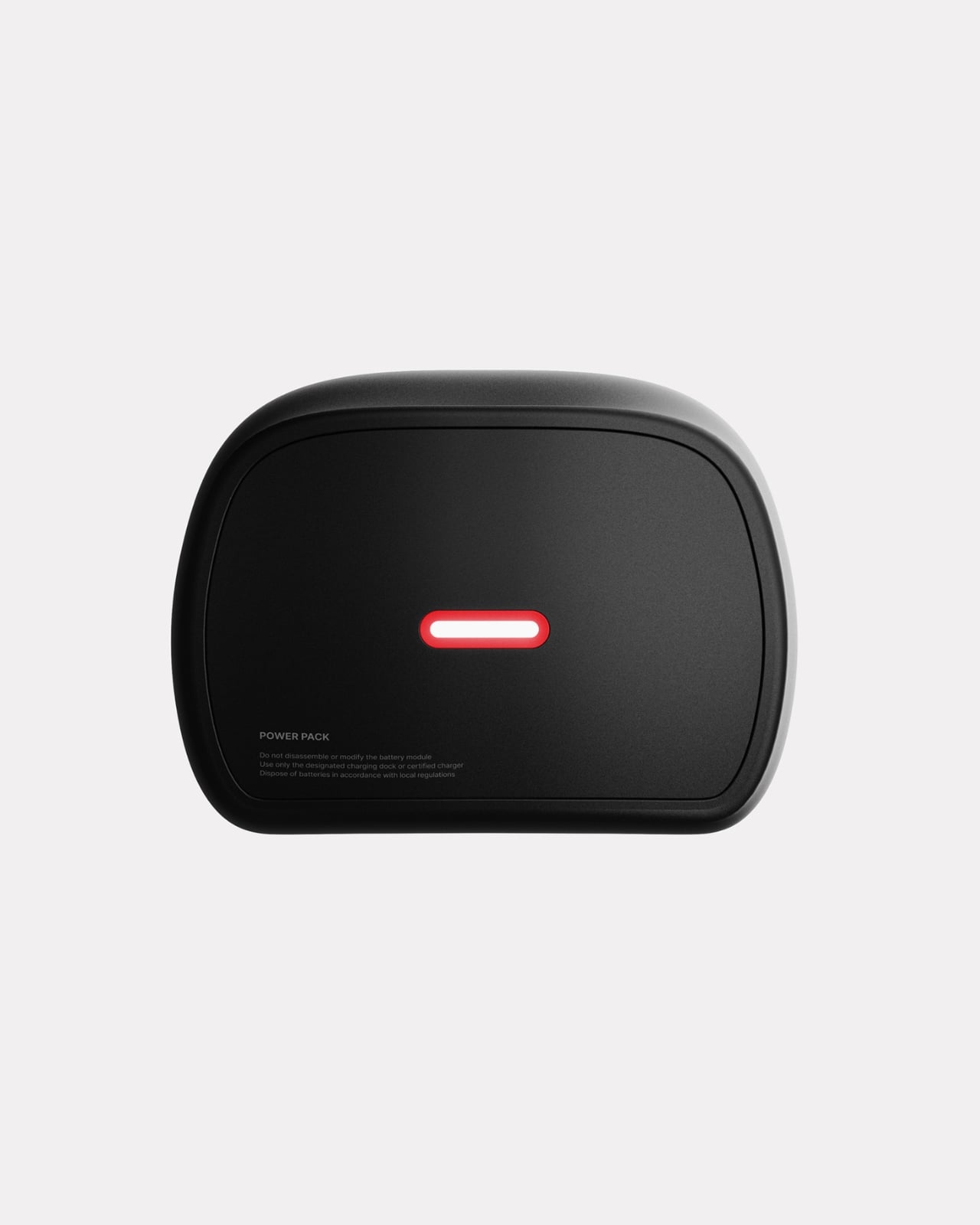
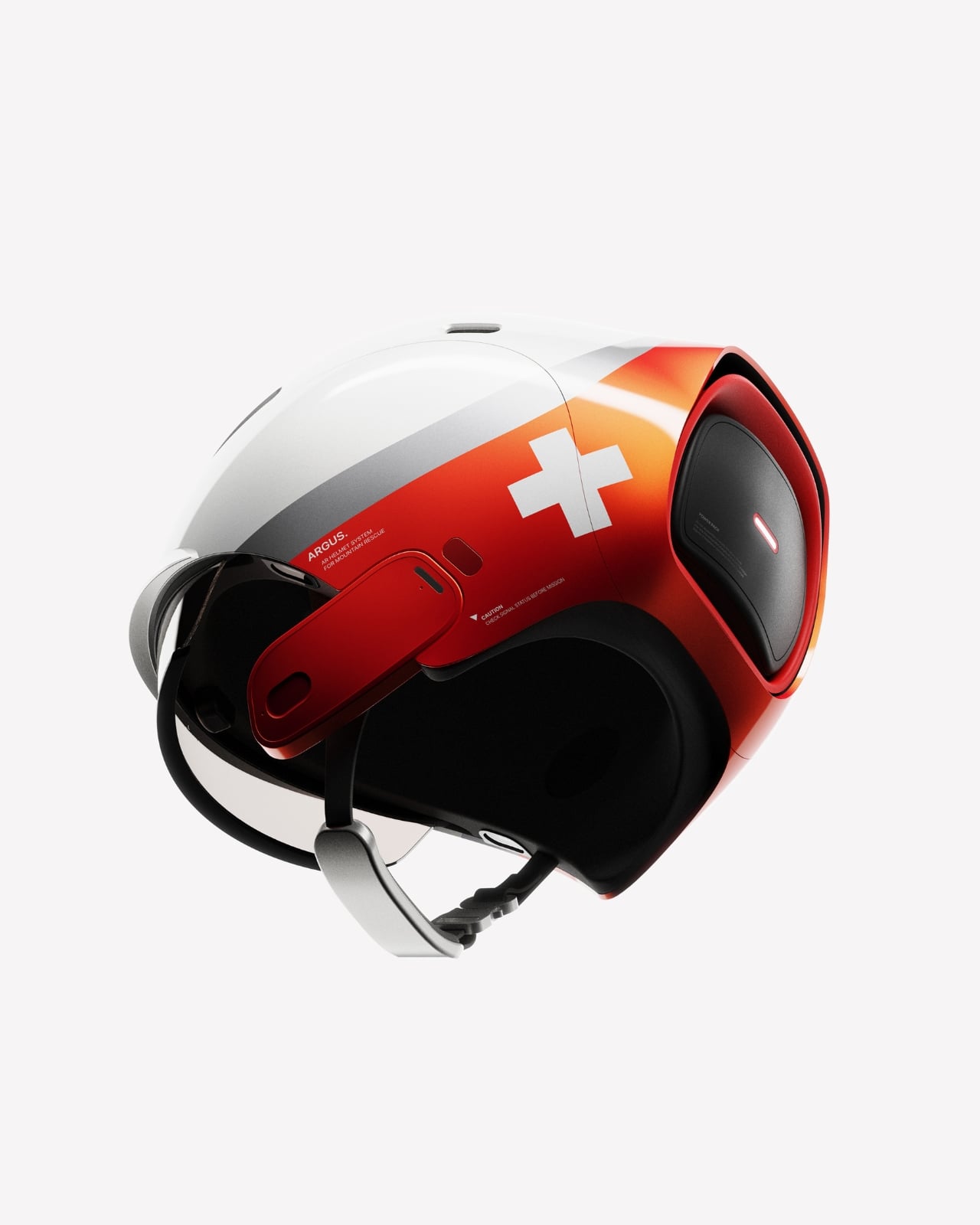
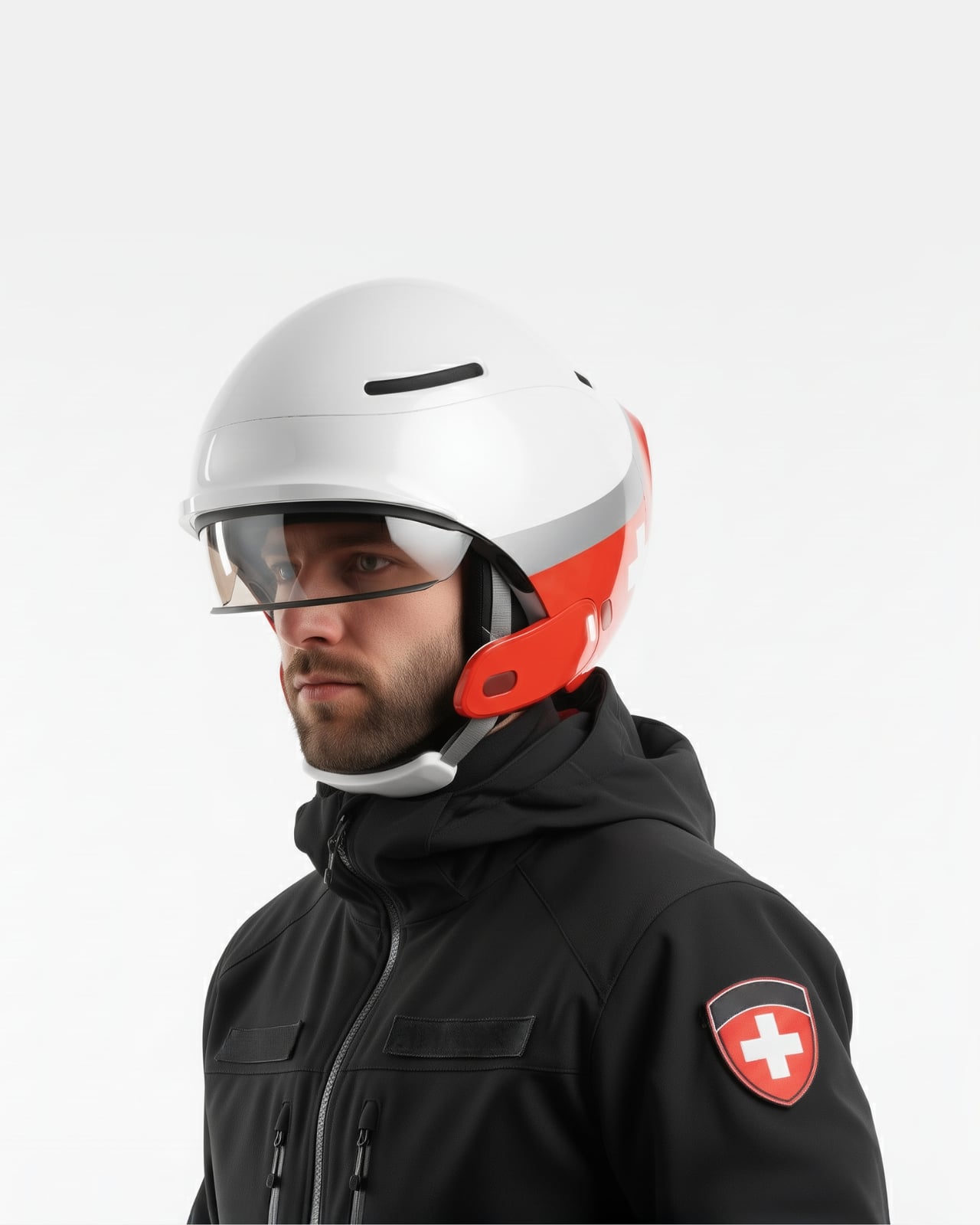
The design itself strikes a balance between futuristic and functional. The white shell with bold red accents and Swiss cross branding gives it a clean, authoritative look that fits naturally into the visual language of emergency services. The transparent visor integrates the AR display without creating the bulky, intrusive appearance that often plagues wearable tech. There’s a modularity to the system too, with a detachable power pack that ensures the helmet remains comfortable for long shifts while providing enough battery life to last through demanding rescue operations.

From a practical standpoint, Argus is designed to support ski patrol operations across experience levels. A rookie responder gets the same information overlay and guidance as a veteran, creating a more consistent standard of care. Route optimization, hazard warnings, victim location data, and communication logs all live within the user’s field of vision, accessible without breaking focus from the task at hand.

But beyond the specific use case of ski patrol, Argus represents something larger about where wearable technology is headed. We’re moving past the era of tech that demands our attention and toward interfaces that disappear into the background until we need them. Eye-tracking isn’t new, but applying it to life-or-death situations where gloves, weather, and adrenaline make traditional controls impractical shows how design thinking can solve problems that raw computing power can’t.

There’s also something refreshing about seeing concept design tackle unglamorous but essential work. We’re used to seeing AR prototypes aimed at gaming, shopping, or entertainment. Those have their place, but projects like Argus remind us that the most meaningful applications of emerging technology often happen in fields where people are doing difficult, dangerous work that most of us never see.

Will we see Argus helmets on mountains anytime soon? As a concept, it still needs to navigate the long road from design portfolio to production reality, including challenges around durability, battery life in extreme cold, and integration with existing rescue protocols. But as a vision of what’s possible when designers deeply understand the context they’re designing for, it’s compelling. It shows that the future of wearable tech might not be about adding more features, but about making the right information available at exactly the right moment, controlled by something as simple and intuitive as where you look.

The post This AR Ski Helmet Finally Lets Rescuers Control Tech By Eye first appeared on Yanko Design.