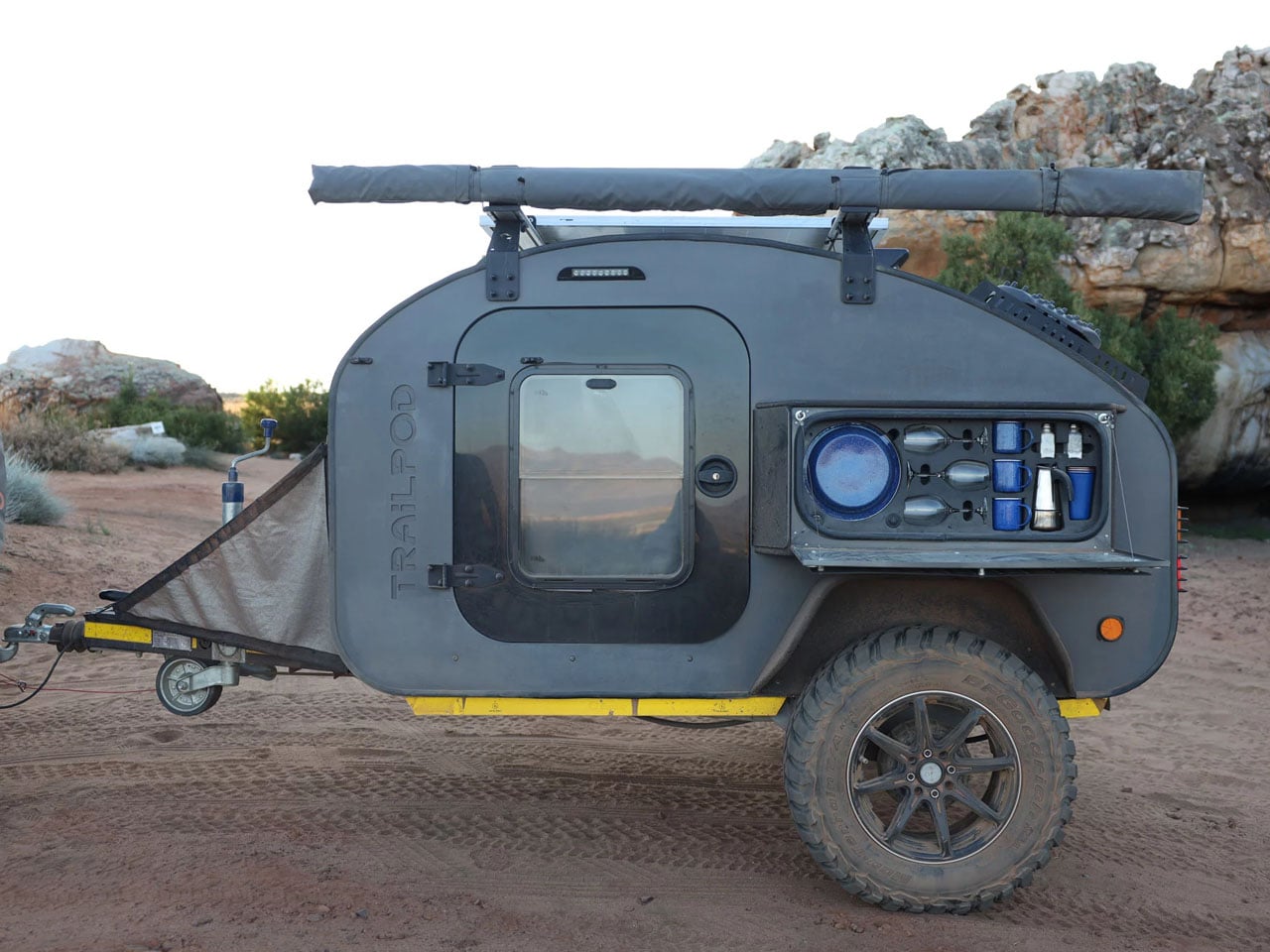
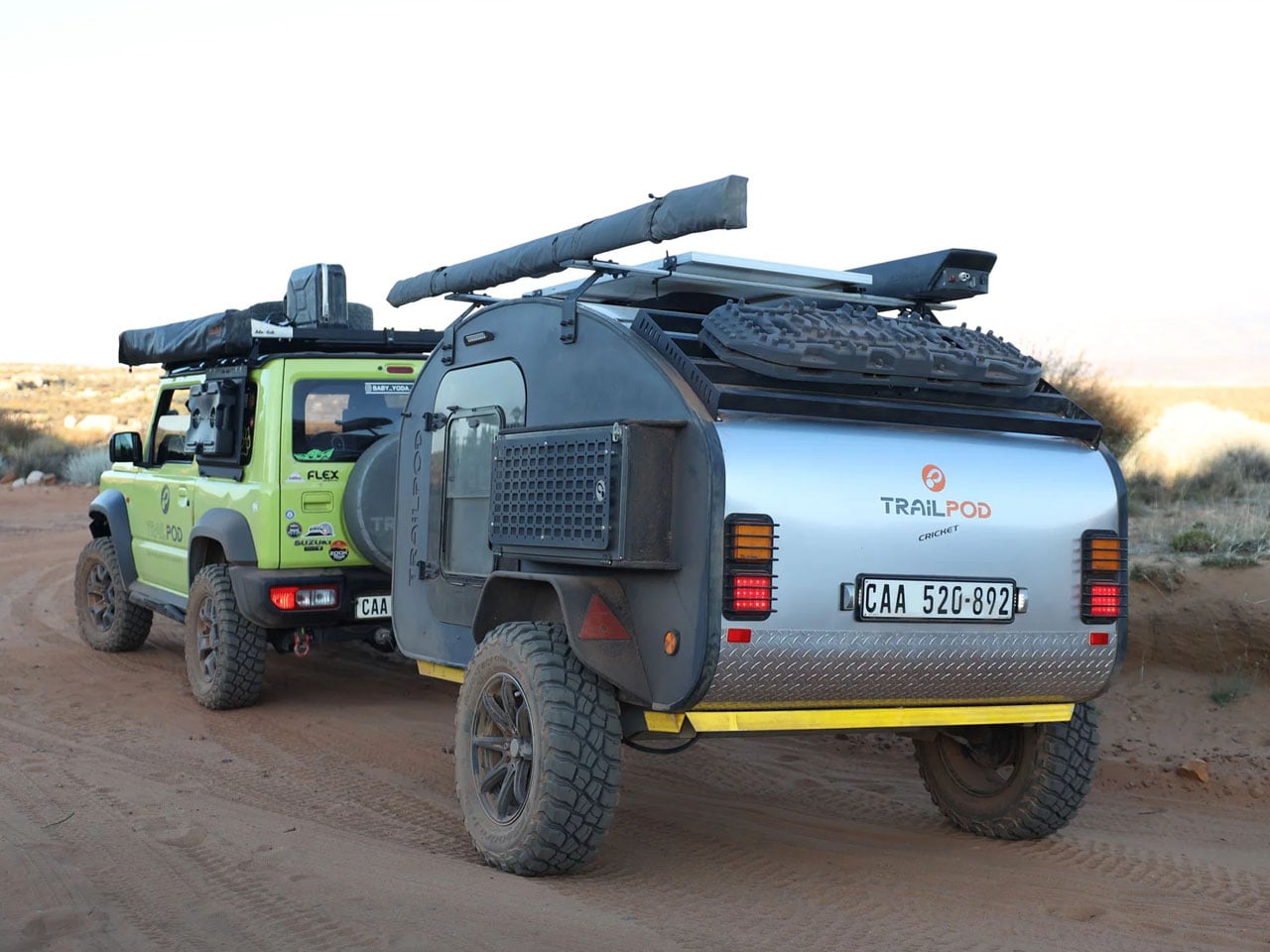
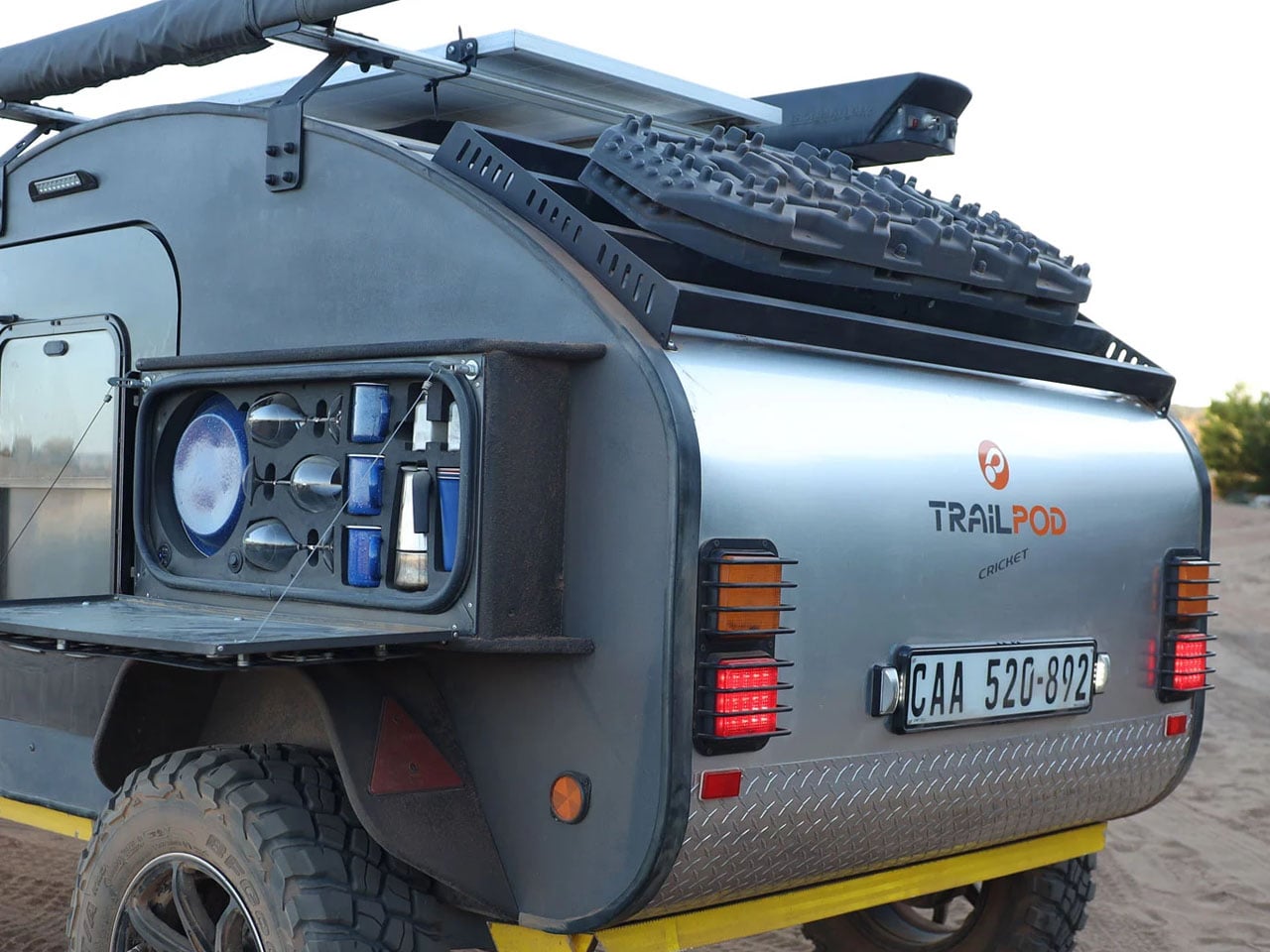
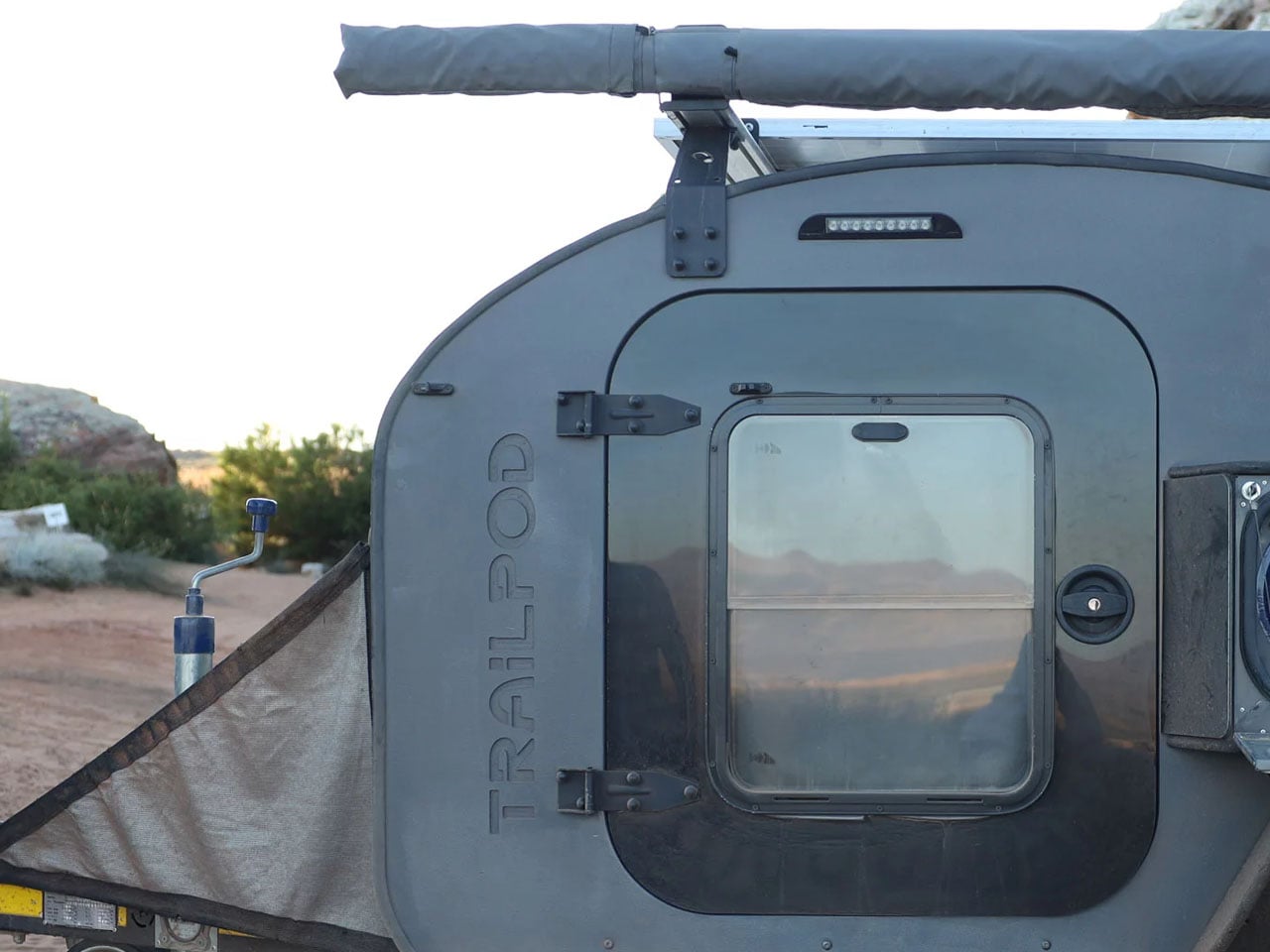
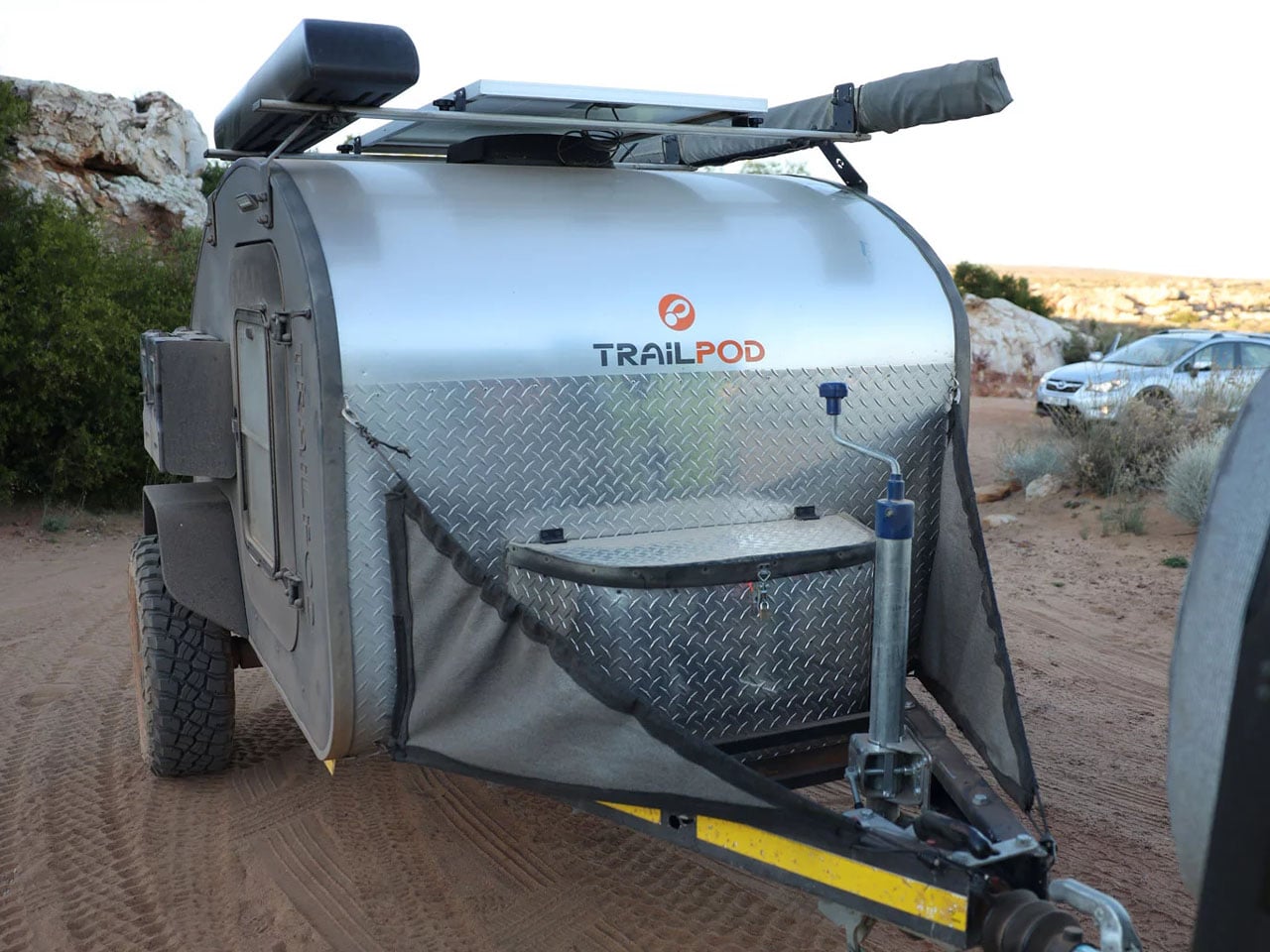
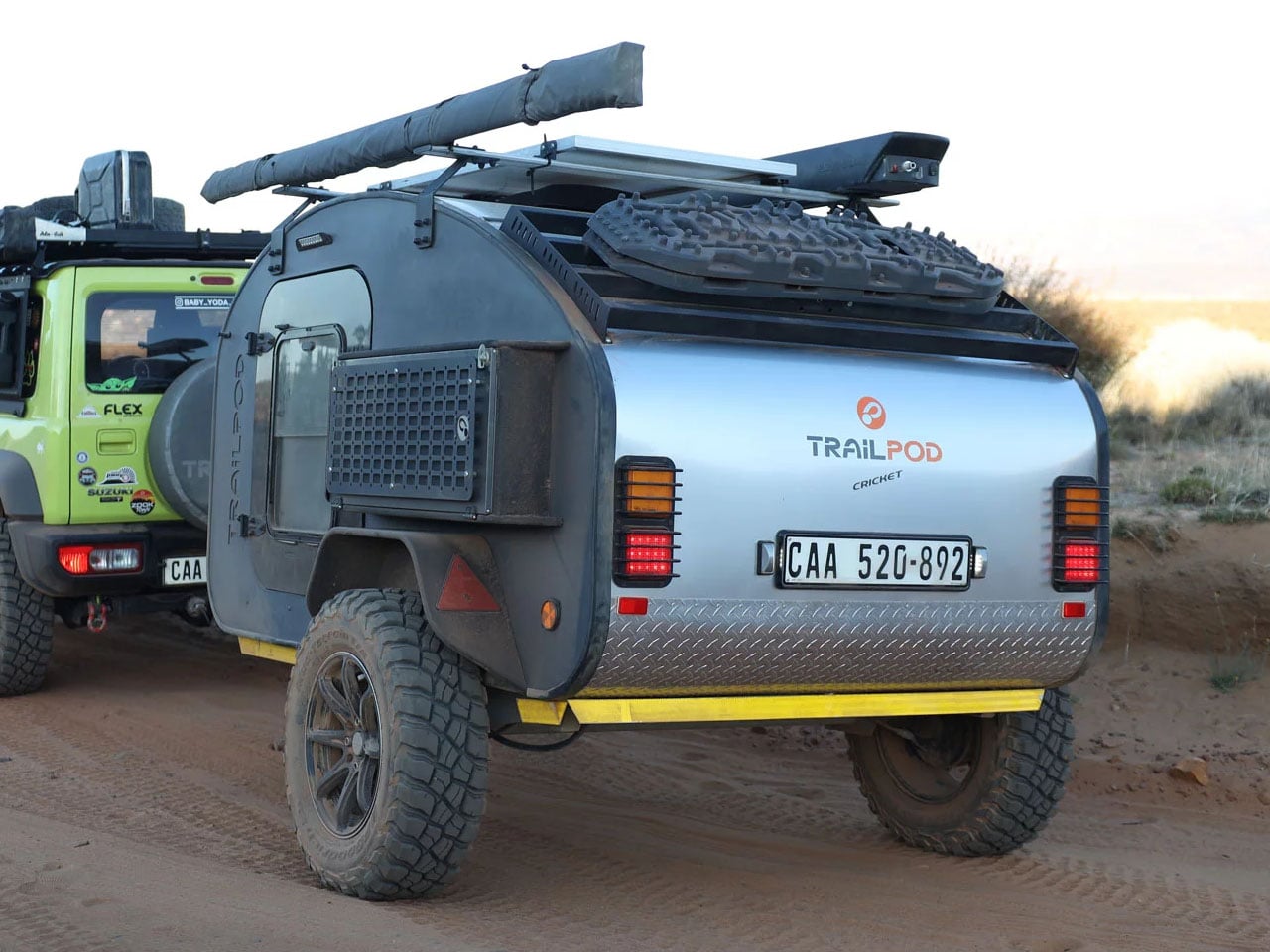
Like it’s the case with the other parts of the world; in South Africa too, teardrop campers are becoming adventurous but with a very contemporary approach and a high-ticket price. TrailPod, an outdoor adventure brand in Cape Town, is doing things differently to keep their generation of teardrop rigs closer to the good old past, while integrating features that make it completely modern and dependable.
TrailPod shares our love for adventure and is therefore providing bespoke 4×4 teardrop trailers, which are designed for off-roading, but have a very nostalgic appearance to them. These rigs are made from zero-wood composite construction and feature a suspension system ready to deal with all road types.
The TrailPod Cricket series teardrop trailers are therefore cut out for off-roading, but they are subtle, competitively priced, and retro-inspired. Staying true to the teardrop shape and style from the past, these are ideal for adventurers seeking a variety of camping options without breaking the bank. For this, the foam composite body trailers have an aluminum layering underneath, prioritizing durability and retro-aesthetics.
The Cricket series may be new, but the first Pod was made in a garage setting during the Covid-19 pandemic. The idea back then was to build a vintage-style teardrop, close in aesthetics to the ones built in the 1940s with aircraft aluminum and army jeep wheels. “Feeling a bit like Pinocchio’s Geppetto,” this rig was called Tintin. Over the years with tweaks and perfection, the Tintin prototype is now evolved into a fully-fledged TrailPod Cricket teardrop series, which people are loving for obvious reasons, which definitely starts with the woody construction that dates back to the teardrop’s earliest days. It looks woody, but as said, it features a foam-composite body and no wood is involved (so not roting, mold and corrosion at any moment of its lifetime).
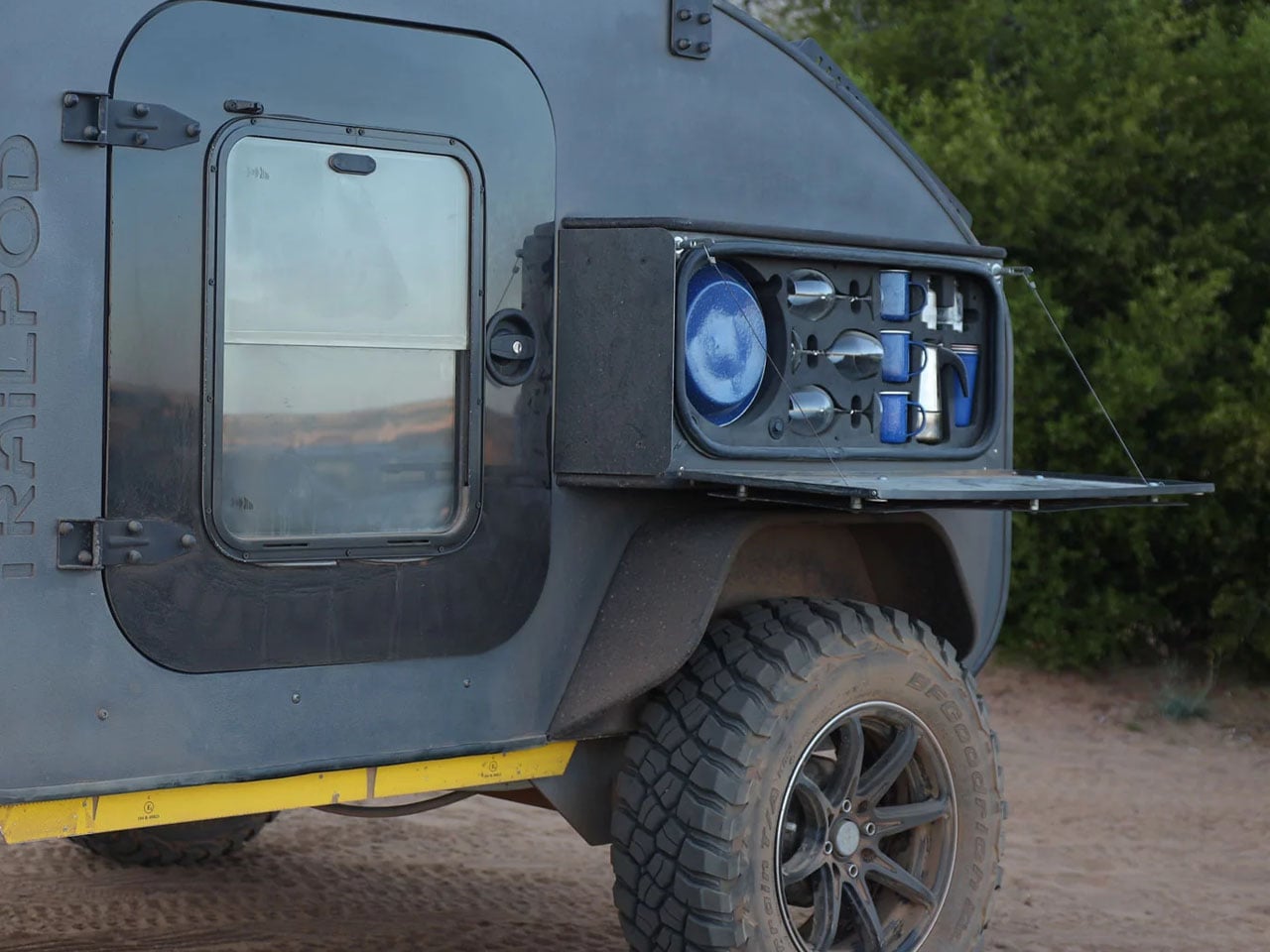
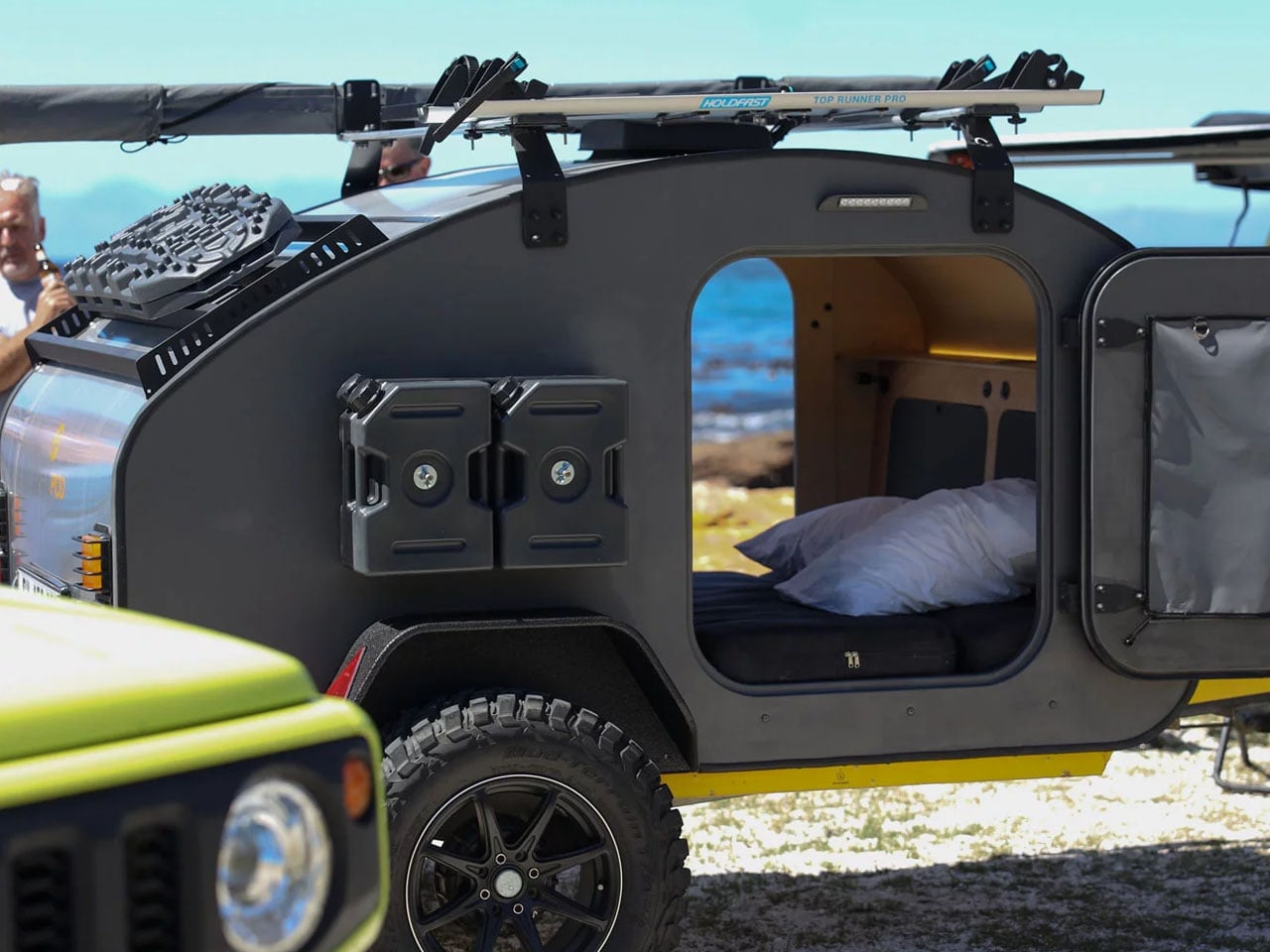
Tough laminate finish on the inside of the Cricket and thin aluminum cladding on the outside, which is overlaid with foam composite, make it a completely different teardrop option we have seen in recent memory. The comfortable and spacious interior of this trailer, which measures just 3.5 m long, is provided with a sleeping arrangement for two people, a small side-mounted kitchen, and cupboards for storage. Internal and external lighting are provided with energy by a 100-Ah lithium battery onboard and solar panels. Owing to its size and lightweight build, the TrailPod Cricket can be towed behind almost any vehicle.
Available in wide and extra-wide body options, Cricket can hold up to 200 kg on the roof when camped, so it’s possible to fit a rooftop tent on it. TrailPod has three teardrop variants in the Cricket series: Cricket, Cricket Lite, Cricket Max. While Lite is the smallest and cheekiest of the three, the TrailPod Cricket Max is the flagship model designed to go off-roading and ensure a prolonged off-grid stay. Its extra-wide body makes space for a double bed and a tailgate galley (a teardrop charm). Though TrailPods come in standard color options, they can be customized in a color of your choice, if you want.
The air taxi revolution has so far been imagined in miniature. Companies across Europe and the United States have poured billions into developing sleek, four to six seat electric aircraft designed to hop across congested cities. These nimble vehicles promise a new era of urban mobility, whisking passengers over traffic jams on short, efficient flights. The prevailing industry wisdom has been to start small, prove the technology, and then gradually scale up. This cautious, incremental approach has defined the first chapter of the eVTOL story, creating a landscape of compact, lightweight designs.
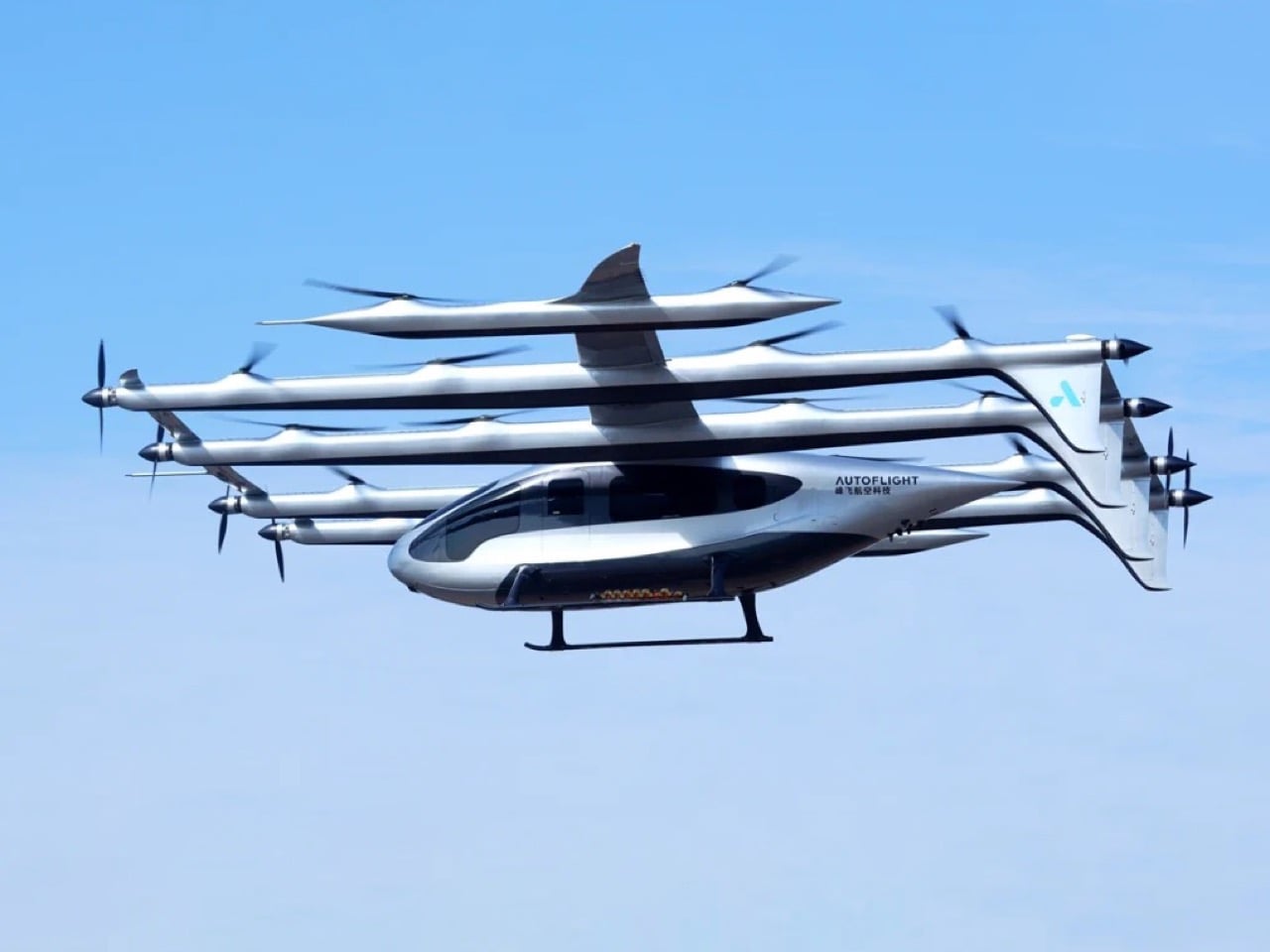
Then, Fengfei Aviation Technology decided to skip a few chapters. With the successful transition flight of its V5000 Sky Dragon, the company has introduced a heavyweight contender into a field of lightweights. This five ton aircraft is less of an air taxi and more of a sky bus, built to carry ten passengers or significant cargo loads. By achieving stable flight in a machine of this scale, Fengfei has fundamentally challenged the industry’s step by step consensus. The V5000 suggests that the future of electric aviation might arrive sooner, and in a much larger package, than anyone was expecting.
Designer: Fengfei Aviation Technology
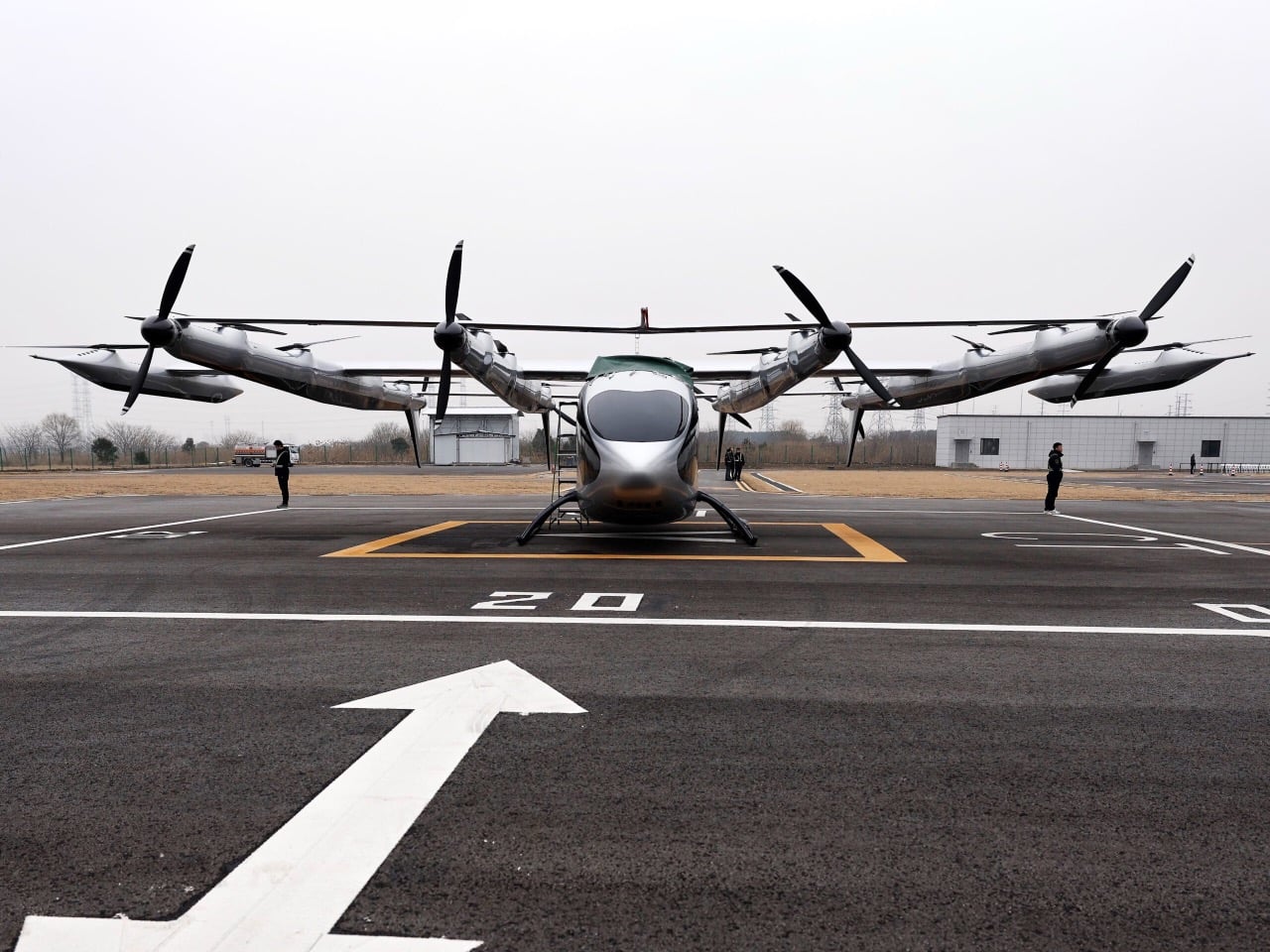
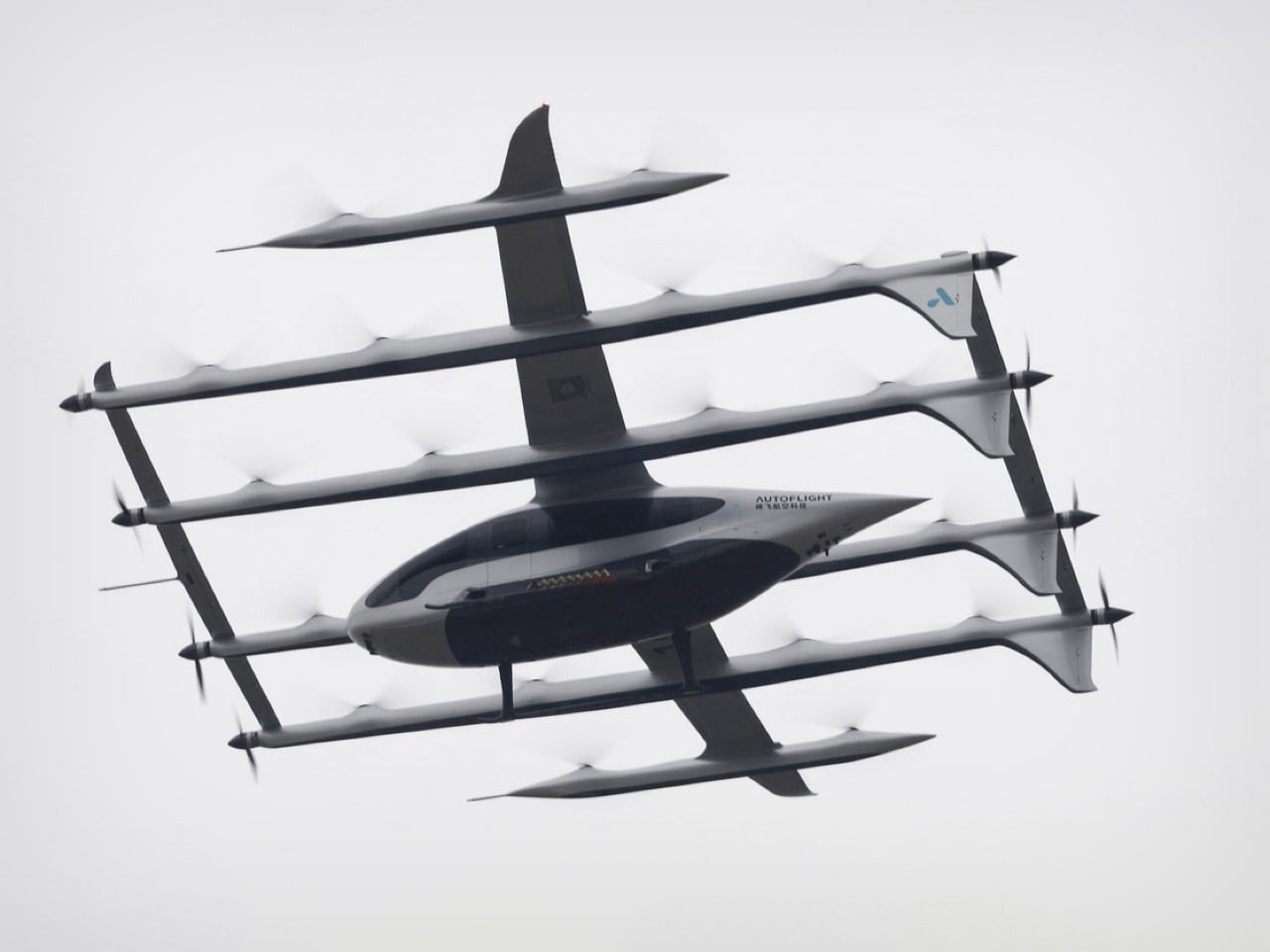
The design is dominated by stacked booms and a multitude of rotors, an architecture that prioritizes aerodynamics and redundancy over conventional aesthetics. This form-follows-function approach gives the airframe an honest, engineered quality. It avoids any attempt at flying car nostalgia, presenting itself as a purpose-built system for vertical lift and efficient forward flight. The fuselage is a smooth, automotive-like pod, but the wings tell the real story. Multiple rotor booms create layers that resemble a giant quadcopter stretched over a commuter plane frame. It looks precisely like what it is: a new class of aerial vehicle that doesn’t pretend to be anything else.
As a five ton class eVTOL, its ability to carry ten people or an equivalent cargo payload places it far beyond typical prototypes currently flying. The pure electric version has a stated range of 250 kilometers, sufficient for many inter-city routes. A hybrid variant extends that operational radius to 1,500 kilometers, enabling regional logistics and transport missions that were previously theoretical for electric aircraft. This leap in capacity and range fundamentally alters the economic models and potential use cases for operators. Suddenly routes that required traditional turboprop aircraft or simply didn’t exist become viable with vertical takeoff capability.
The V5000 executed a complete transition at the Kunshan test base, shifting from vertical takeoff to fixed-wing cruise and back to a vertical landing. For a five ton airframe, this proves the maturity of its flight control software, which must manage up to 20 lift motors and forward propulsion systems simultaneously. The stability required to navigate this transition phase cleanly is a core challenge in eVTOL development. Smaller prototypes have demonstrated wobbly, uncertain transitions. Achieving it at this scale, with this much mass and complexity, represents a substantial systems integration accomplishment. Any control hiccup in that flight regime becomes dramatically more consequential as weight increases.
The distributed electric propulsion, with its numerous motors spread across compound wings, means a single motor failure is a manageable event, not a catastrophic one. This design philosophy trades the mechanical complexity of traditional aircraft for the electronic complexity of advanced power management and flight control algorithms. The V5000 operates less like a conventional airframe and more like a distributed computer with wings, a direction indicative of modern EV platform design. Instead of gearboxes and mechanical shaft redundancy, you get software managing power distribution across independent electric motors in real time. The approach mirrors how automotive platforms evolved, leaning into electronics rather than adding mechanical safeguards.
Western competitors have largely treated the three ton plus category as a future goal, to be addressed after smaller air taxis gain regulatory approval and market acceptance. Joby, Lilium, and Archer are all focused on lighter machines designed for short urban hops. Nobody in that group has attempted a five ton airframe yet. Fengfei’s flight effectively bypasses that incremental roadmap, establishing a credible presence in the heavyweight class right now. It forces a strategic reconsideration for other players, proving that the technology for larger, more practical eVTOLs is viable today. The psychological shift matters as much as the technical one, reframing expectations about how quickly the sector can move toward serious payloads.
More transition flights will follow, along with envelope expansion testing and the inevitable slog through certification, particularly for its multi-motor and hybrid systems. The key development will be observing its initial commercial applications. Cargo operators, who can tolerate tighter operational constraints and don’t need passenger certifications, may adopt the platform first. Regional passenger services would follow, potentially redefining connectivity between cities and offering a direct alternative to ground-based infrastructure. The V5000 has shifted the eVTOL narrative from urban mobility experiments to the creation of genuine regional air networks, the kind that can move meaningful numbers of people and goods across distances that matter.
Five years after Jony Ive left Apple, and two years after Apple killed Project Titan, we finally know what the Apple Car’s interior *could* have looked like. It just happens to have a prancing horse on the steering wheel instead of a bitten apple.
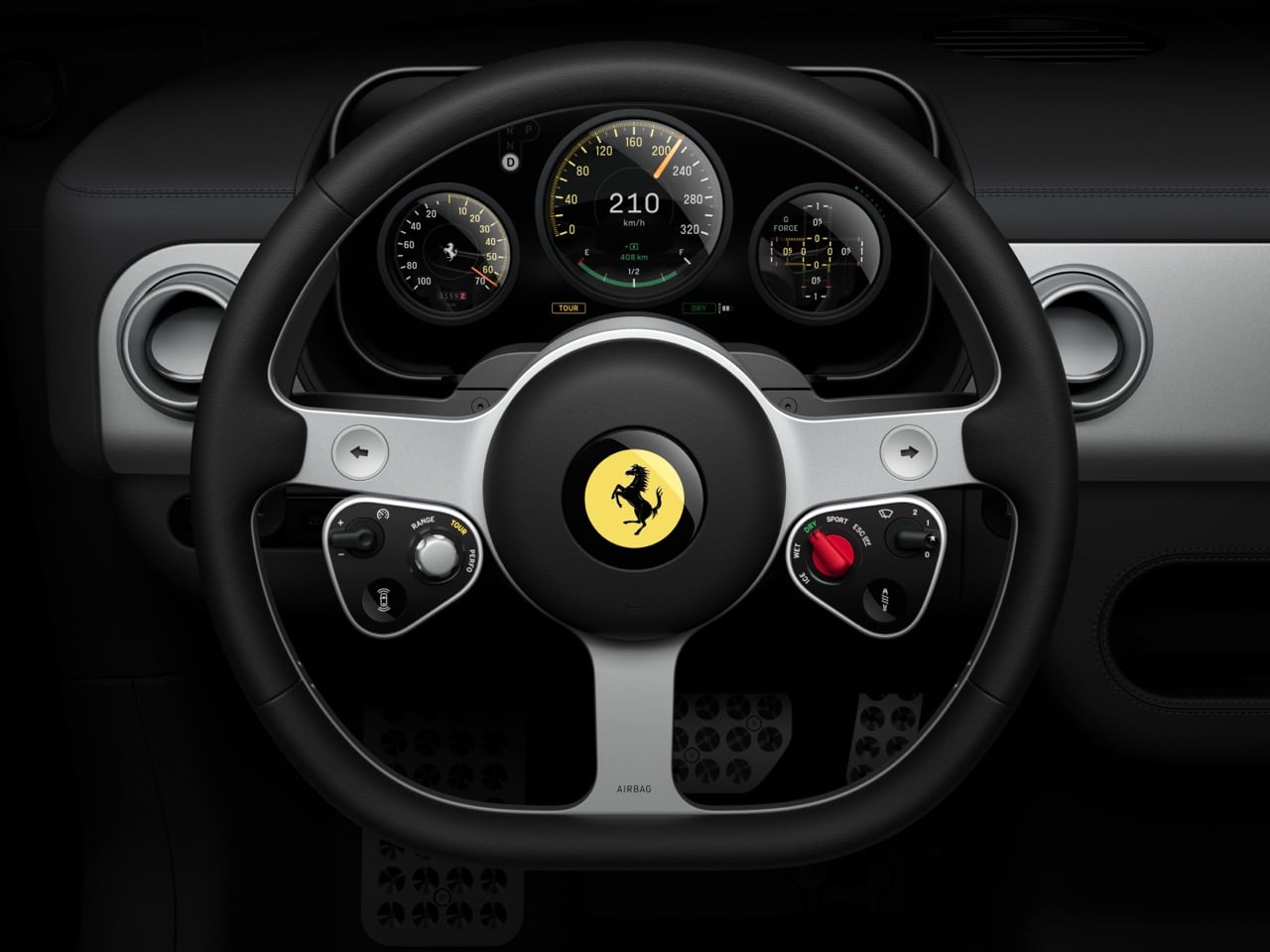
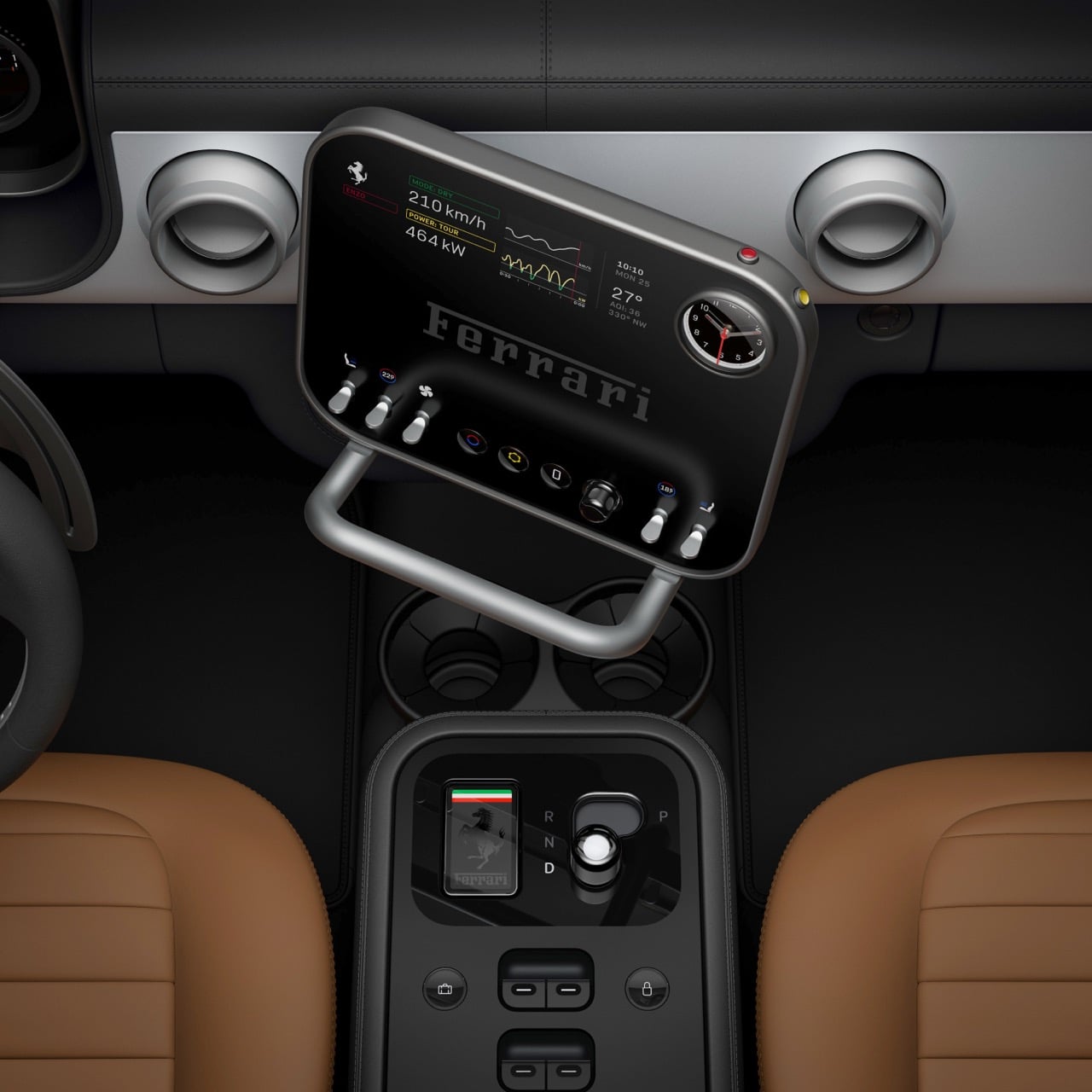
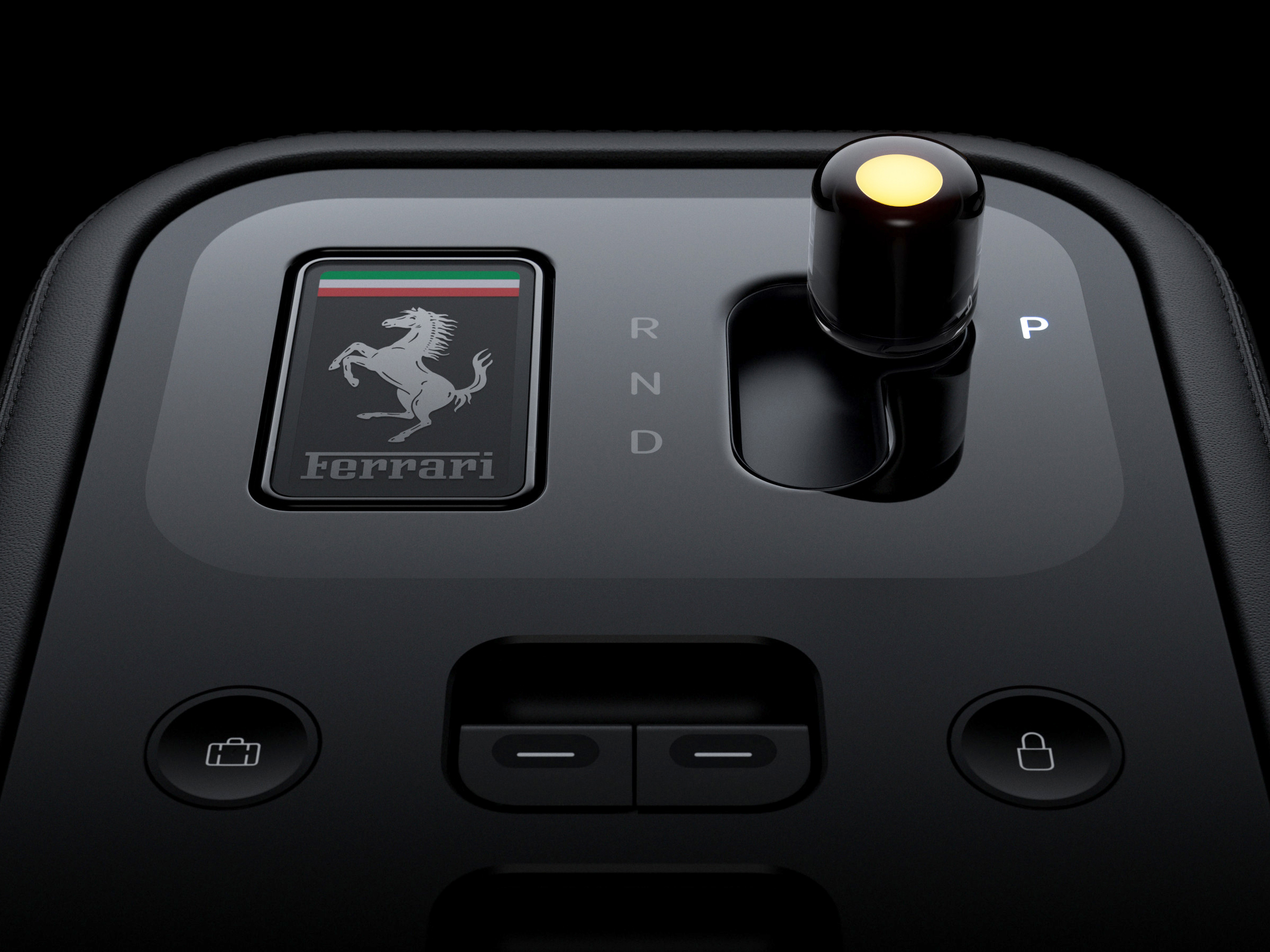
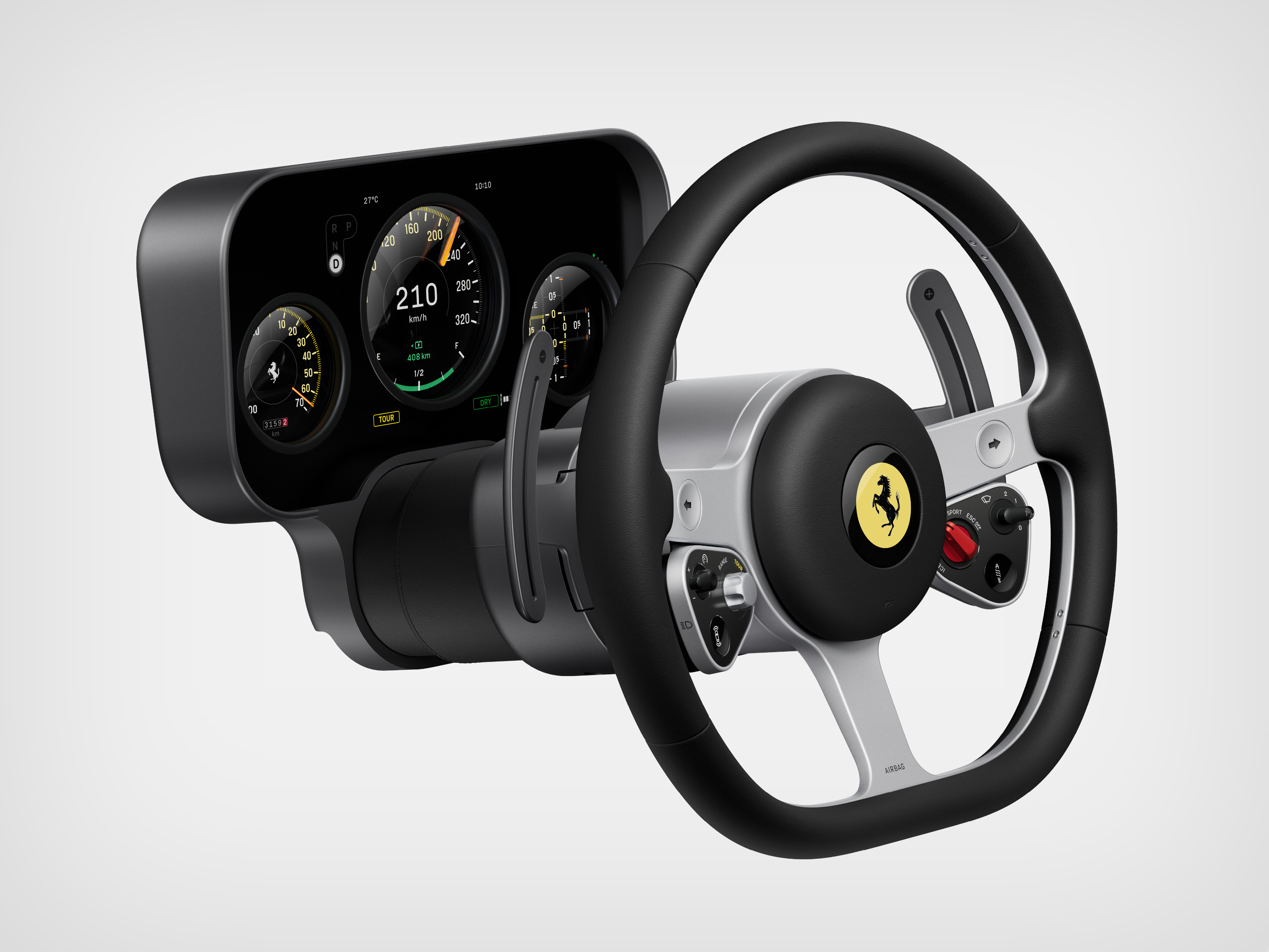
The Ferrari Luce, revealed last week in San Francisco, is a transplant of Apple’s design language into automotive form. Everything about this interior, from the E-ink key fob to the OLED dials to the obsessive material purity, carries the unmistakable signature of Apple’s design peak from 2015 to 2019, when Ive still occupied his Cupertino office and the car project remained alive.
The Apple DNA is Everywhere
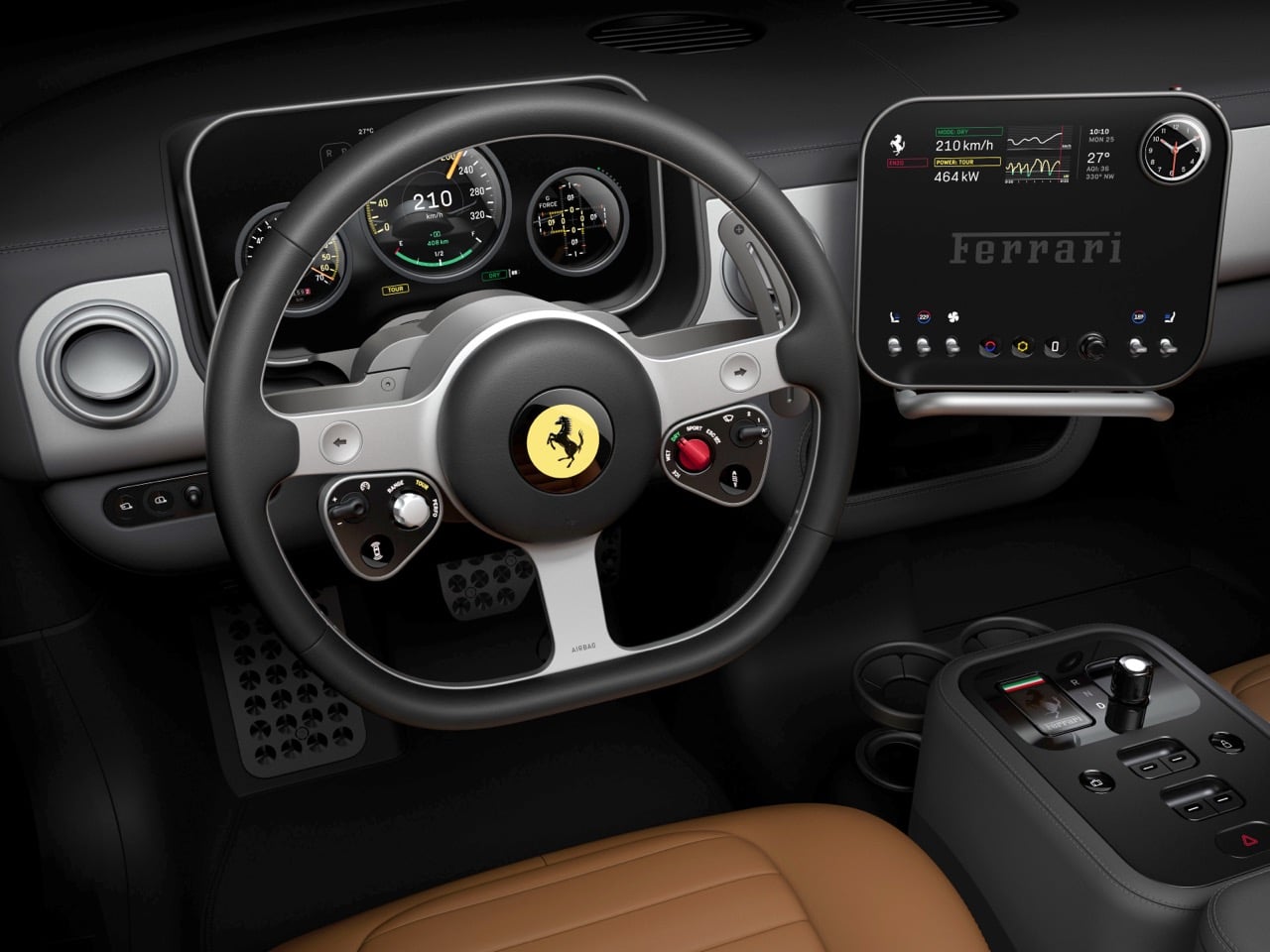
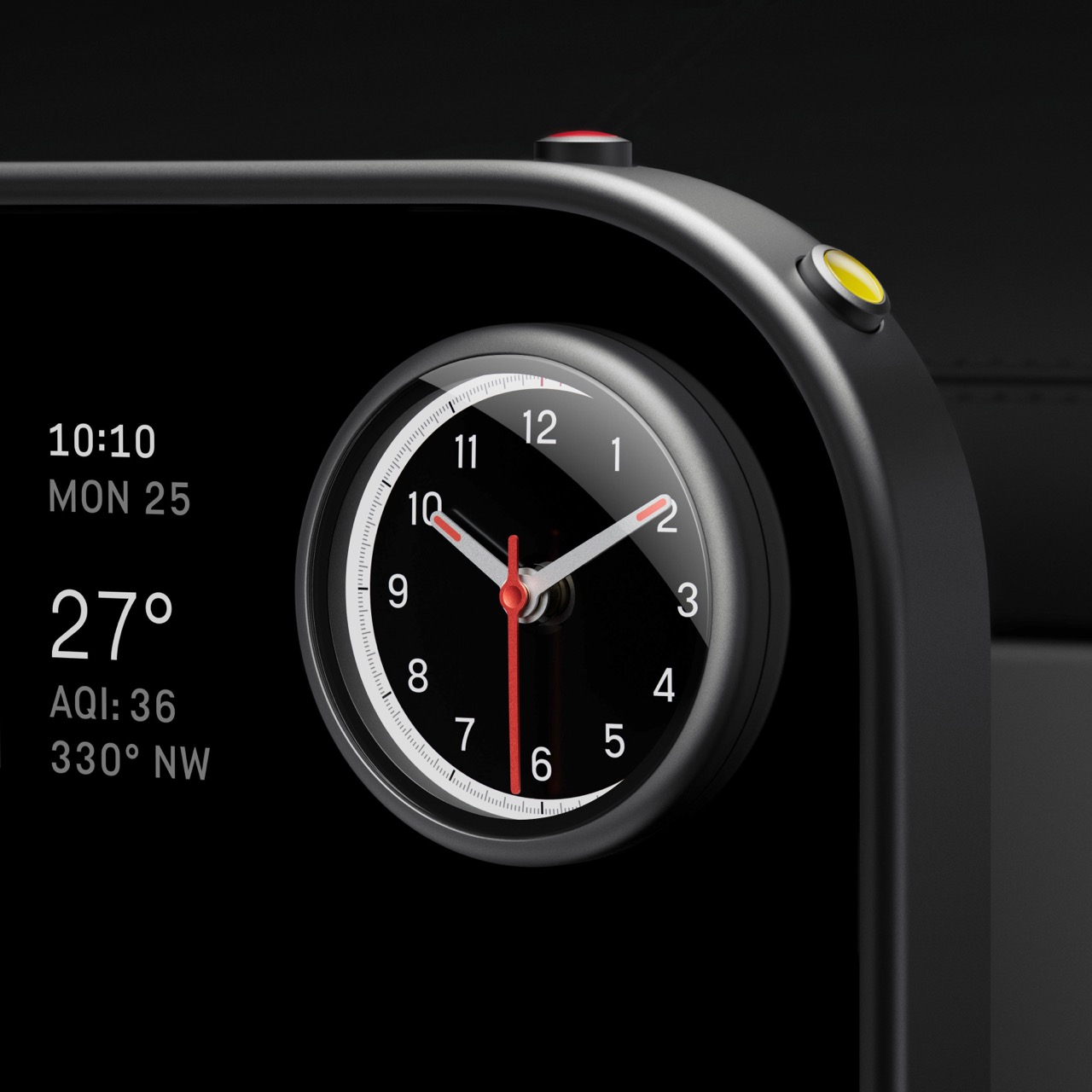
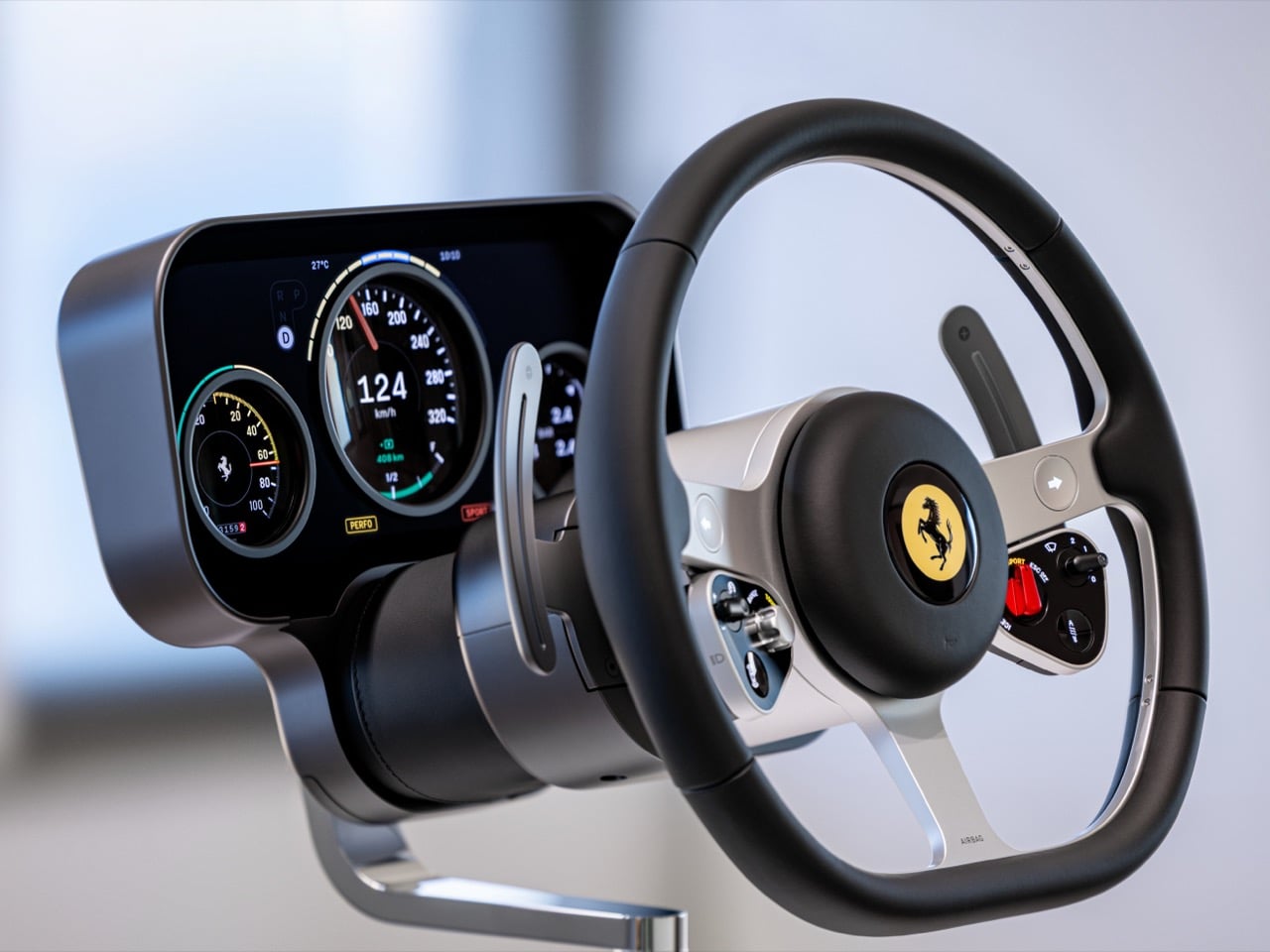
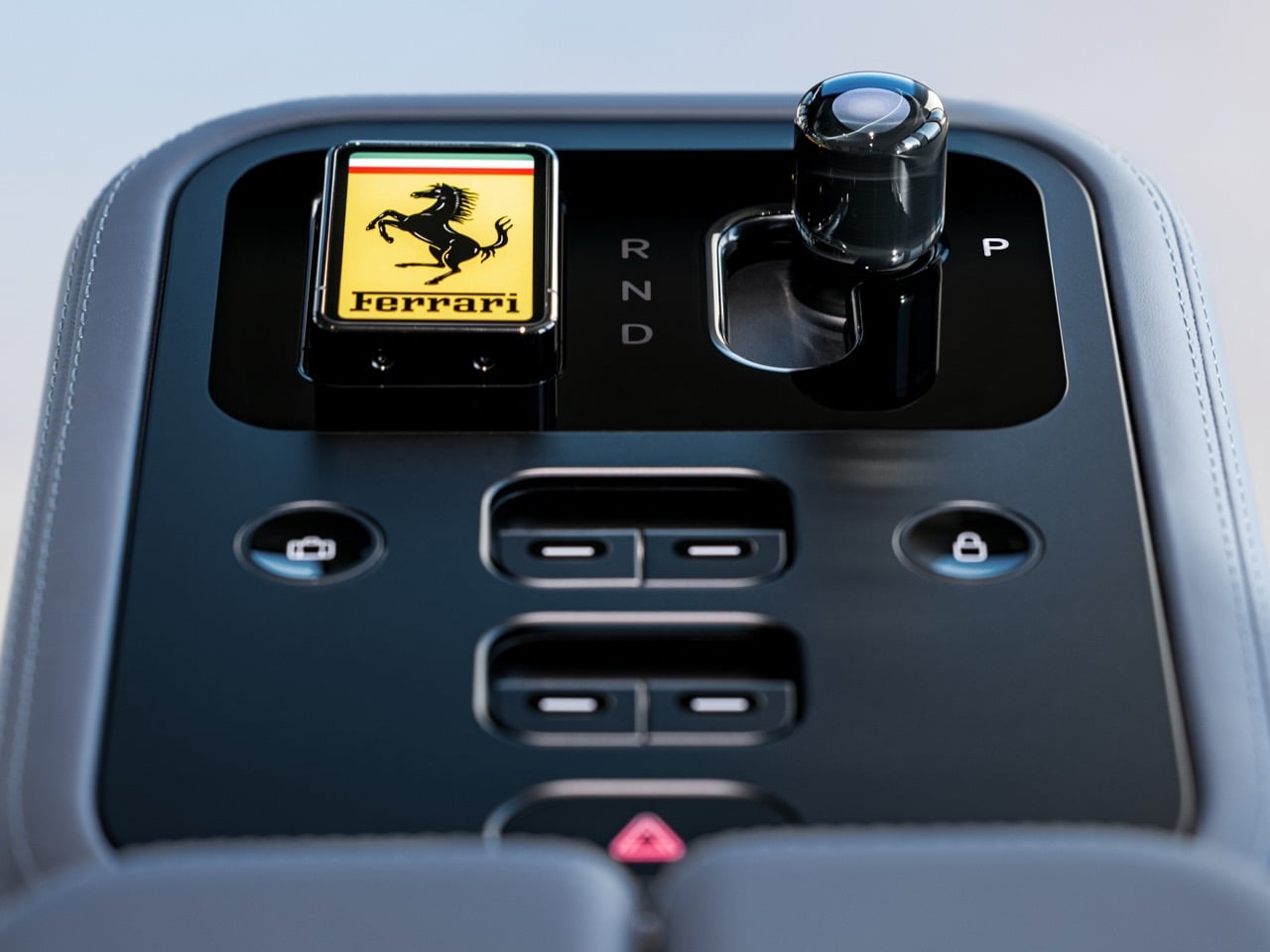
Walk through the components and the Apple DNA becomes impossible to ignore. The key fob magnetically docks into the center console and changes color via E-ink display. This is MagSafe technology meets Apple Watch complications, translated into a car key. The center screen features an analog clock that transforms into a chronograph and compass with the press of two buttons. Pull up any image of Apple Watch faces and the interaction model is identical.
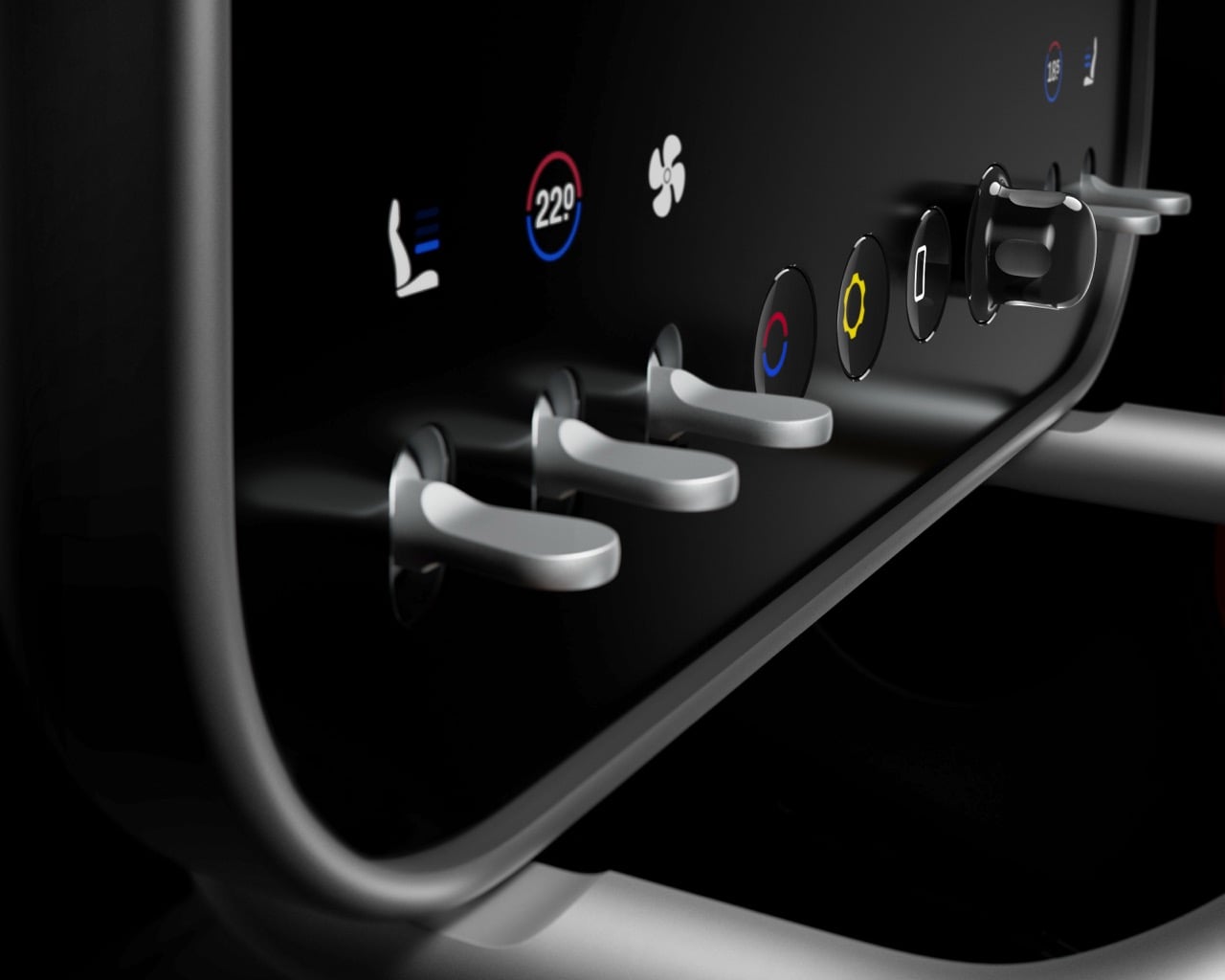
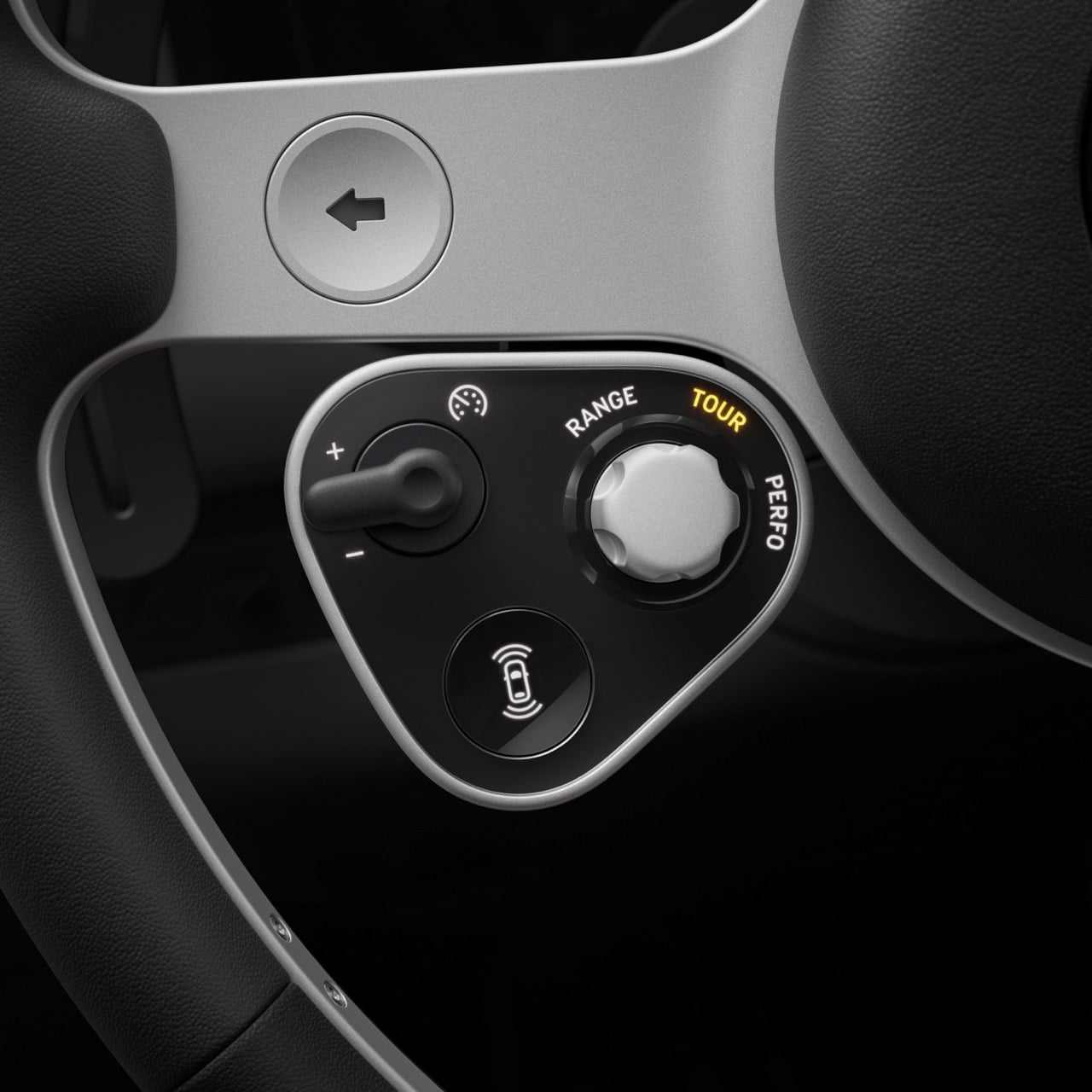
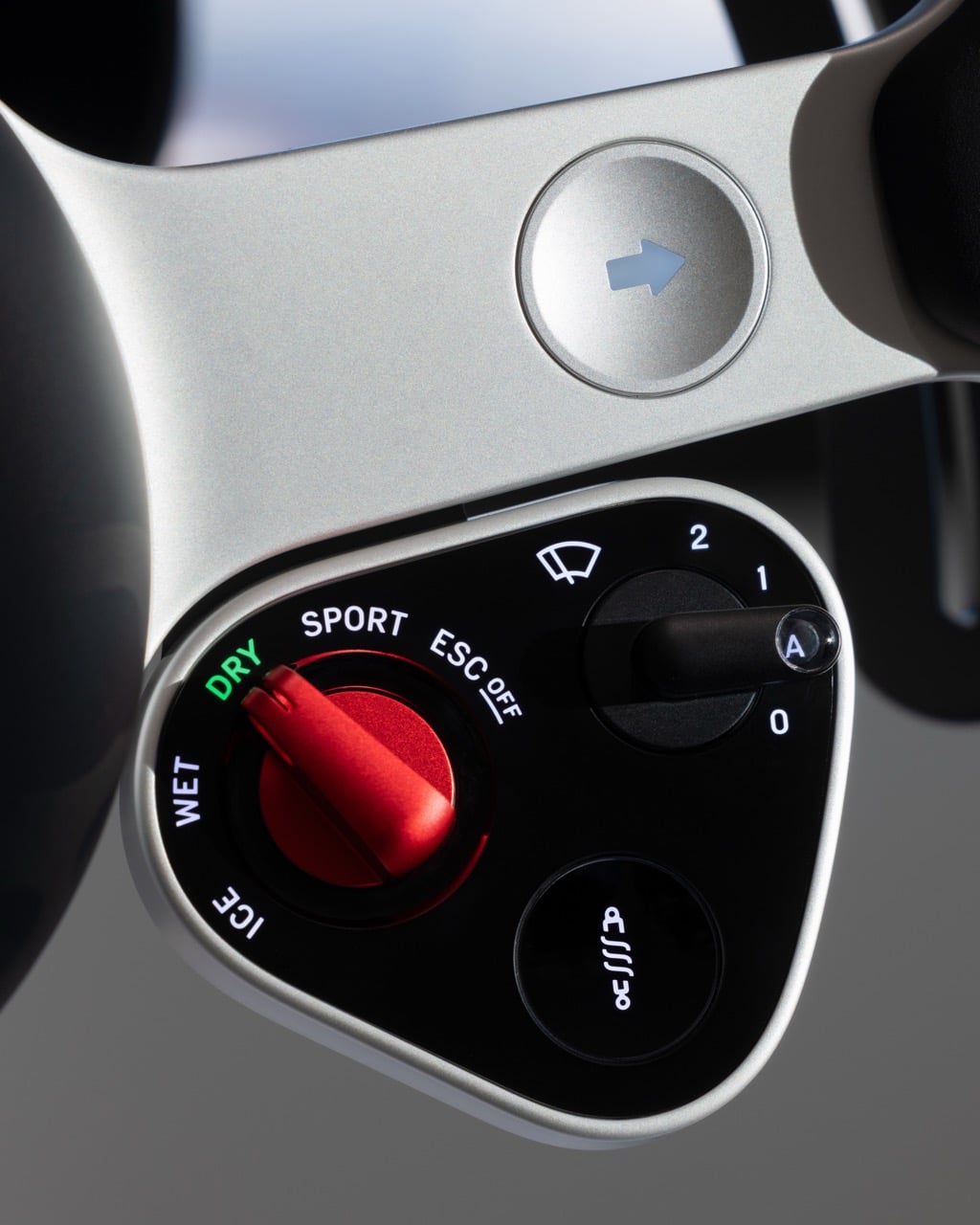
The toggle switches and knobs scattered throughout the cabin represent the physical interface philosophy Ive has been refining since the original iMac. The Digital Crown on the Apple Watch, the mute switch on the iPhone, the volume controls on the HomePod. These are the same careful considerations about how humans interact with objects through touch and rotation. The OLED binnacle behind the steering wheel uses a parallax effect to create depth perception, the same technology that made the iPhone X’s face recognition possible, now applied to gauge clusters.
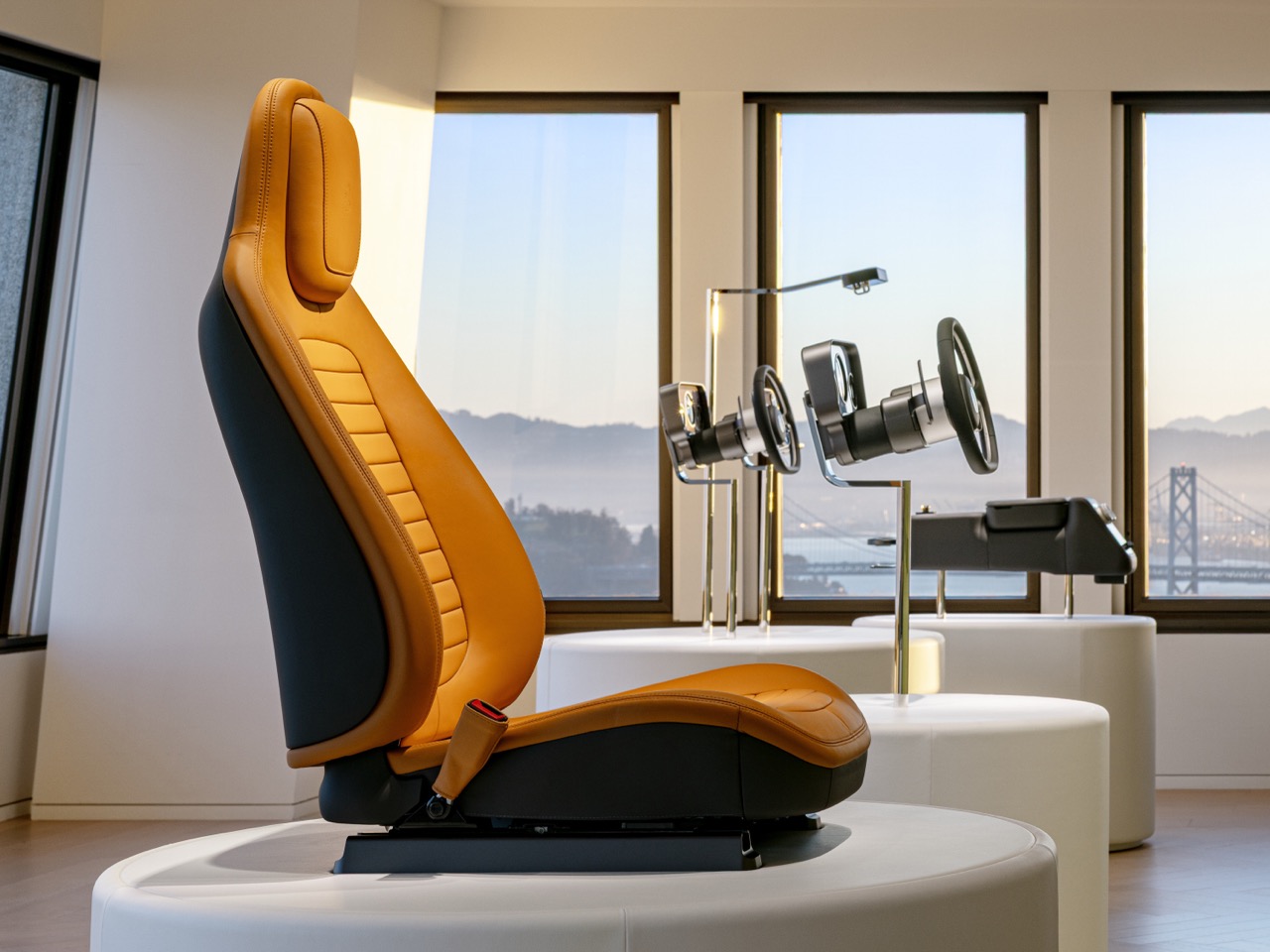
Then there’s the material palette: recycled aluminum with a microscopic anodized texture, Corning glass surfaces, leather in muted tan. This is the 2017 iPhone X material story. This is the unibody MacBook recipe. This is every premium Apple product from the past decade, reassembled into automotive architecture.
Wait, Is This the Same Jony Ive?
Consider what Ive said at the reveal: “It’s bizarre and lazy to assume the interface should be digital if the power source is electric.”
This is the man who killed the headphone jack. Who removed every port from the MacBook. Who spent twenty years eliminating physical buttons, physical connections, physical everything. And now he’s arguing that physical controls matter? That tactility is essential? That you can’t just solve everything with a touchscreen?
Maybe the context really does change everything. A phone lives in your pocket. You can look at it. A car moves at 200 kilometers per hour. Looking away kills people. Or maybe Ive has simply evolved. Perhaps LoveFrom represents a different philosophy than Apple did, one less concerned with relentless minimalism and more interested in appropriate solutions. Or perhaps this is who Ive always was, and Apple’s commercial pressures pushed him toward deletion when his instincts wanted refinement.
The Luce interior suggests that physical interfaces weren’t the enemy. Bad physical interfaces were. Give Ive the freedom to perfect a toggle switch, to make a dial that clicks with precision, to create a button that feels inevitable, and he’ll choose physical every time. The question is whether we’re seeing growth or contradiction.
The Timeline is ‘Interesting’
Apple started Project Titan in 2014. By 2016, Ive had become increasingly involved as the project shifted from full autonomy toward driver-focused experiences. He left Apple in 2019 but reportedly continued consulting on the car. In 2024, Apple abandoned the project entirely. During those years, Bloomberg reported that the Apple Car was supposed to feature premium materials, minimalist interiors, physical controls prioritized over touchscreens, and a “living room on wheels” concept.
Here’s what actually happened: Ive leaves Apple in 2019 and forms LoveFrom. Two years later, in 2021, Ferrari announces the partnership. That means conversations started immediately after his departure, possibly before. Ive spent a decade developing car interior concepts at a company with unlimited resources. Then he got to actually build one at a different company with unlimited resources and, crucially, manufacturing capability that Apple never developed.
My guess is Ferrari didn’t hire LoveFrom for an overhaul. They hired them for battle-tested thinking that never shipped.
Why Ferrari Said Yes
From Ferrari’s perspective, the logic is clear. They’ve never built an electric vehicle. Their customer base is deeply skeptical of electrification. They need to signal that the Luce represents something genuinely different, something beyond an electrified 296 GTB. So they hire the two most famous industrial designers on Earth, who happen to have spent years thinking about this exact problem at a different technology giant.
It’s outsourcing credibility as much as design. When people inevitably say “that doesn’t look like a Ferrari,” Ferrari can point to LoveFrom and say “well, exactly.” They’ve purchased permission to break from tradition by hiring people with no Ferrari tradition to break from. The prancing horse gives LoveFrom legitimacy in automotive circles. LoveFrom gives Ferrari legitimacy in technology circles. It’s a perfect exchange.
But the question remains: did Ferrari want Ive’s vision, or did they want Ive’s brand? Because what they received feels unmistakably like Apple-thinking while wearing a Ferrari cap.
The May Reveal Will Answer Everything
The real test arrives in May when Ferrari reveals the exterior. Right now we’ve only seen the interior, which is LoveFrom’s natural domain: screens, materials, ergonomics, spatial relationships. The exterior is different. It has to work in a Maranello showroom next to a 12Cilindri and an SF90. It has to look fast while standing still. It has to carry seventy-nine years of design language forward into an electric future.
Can Ive do that? Has he ever designed anything with that kind of visual aggression? His career has been defined by approachability, by objects that invite touch, by forms that recede rather than announce themselves. Ferraris don’t recede. They dominate spaces. They demand attention. If the exterior looks like an Apple product in May, then this really could be what the Apple Car might have become. If it looks genuinely Ferrari, then maybe LoveFrom understands they serve the brand rather than the reverse.
What This Tells Us About the Car That Never Was
The Luce interior reveals something bittersweet about the Apple Car that never was. This is the closest we’ll get to seeing what that vision might have looked like. But it also proves why Apple was probably right to kill the project. It took Ferrari, a company with seventy-nine years of automotive manufacturing experience, five years and presumably nine figures to turn Ive’s concepts into reality. And they still don’t know if customers will accept it. Imagine Apple attempting this from scratch, competing with Tesla on price, managing recalls and service networks and dealer relationships.
The Luce interior is stunning. It’s also a monument to why the Apple Car would have most likely been an operational nightmare, given that Apple isn’t an automotive company.
The irony is perfect: Jony Ive finally got to build his car. He just needed Ferrari to do the hard part.
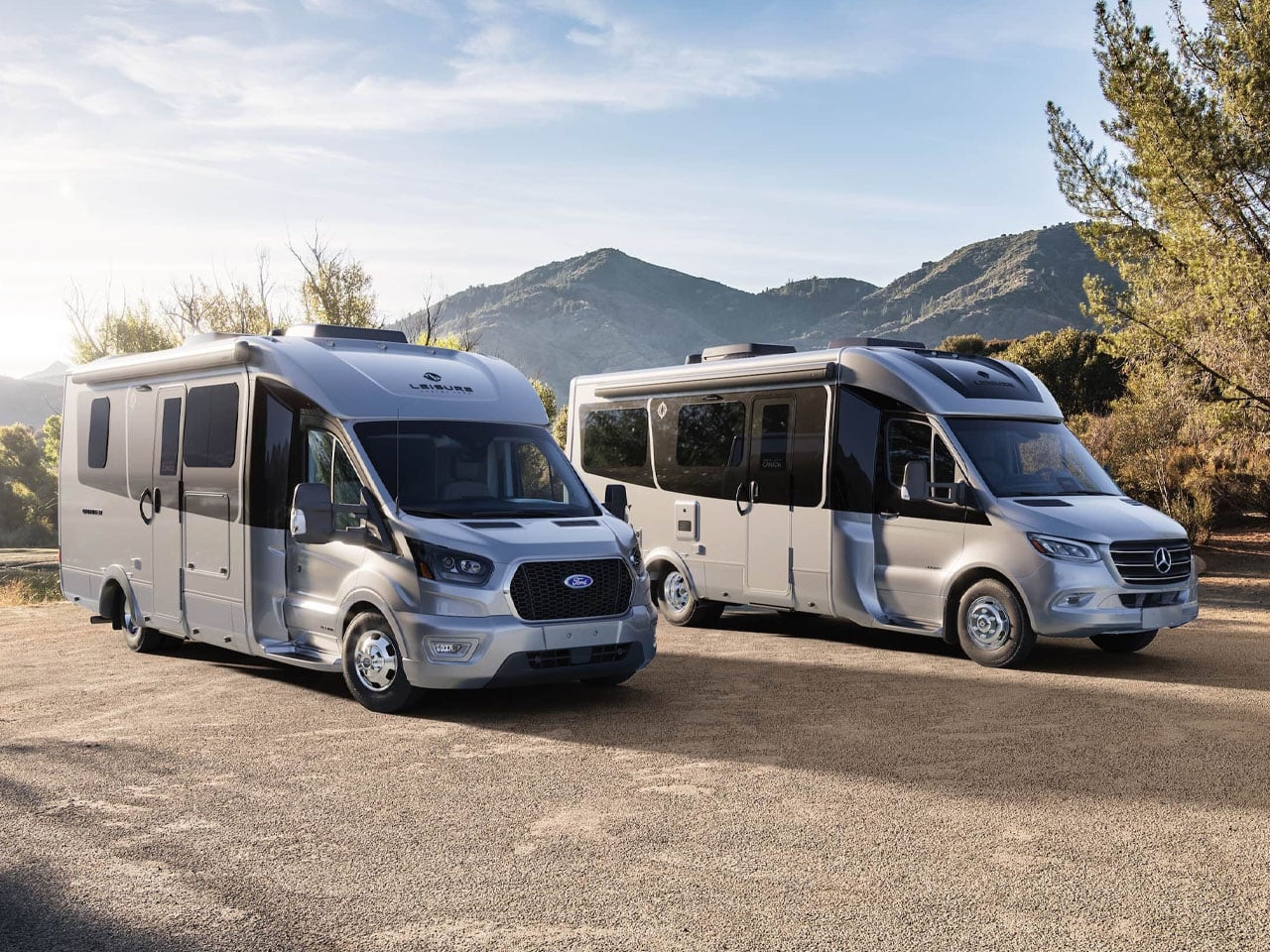
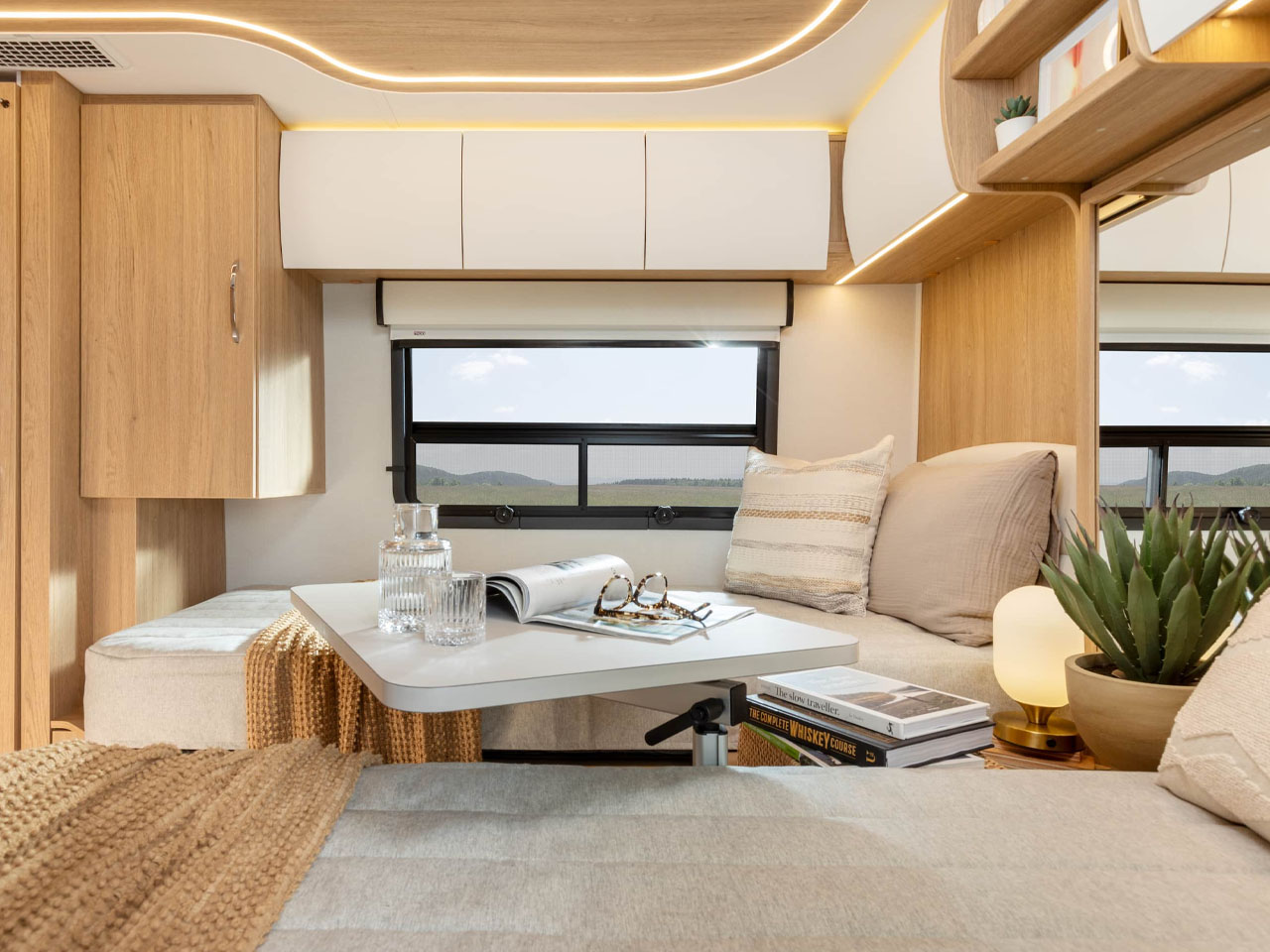
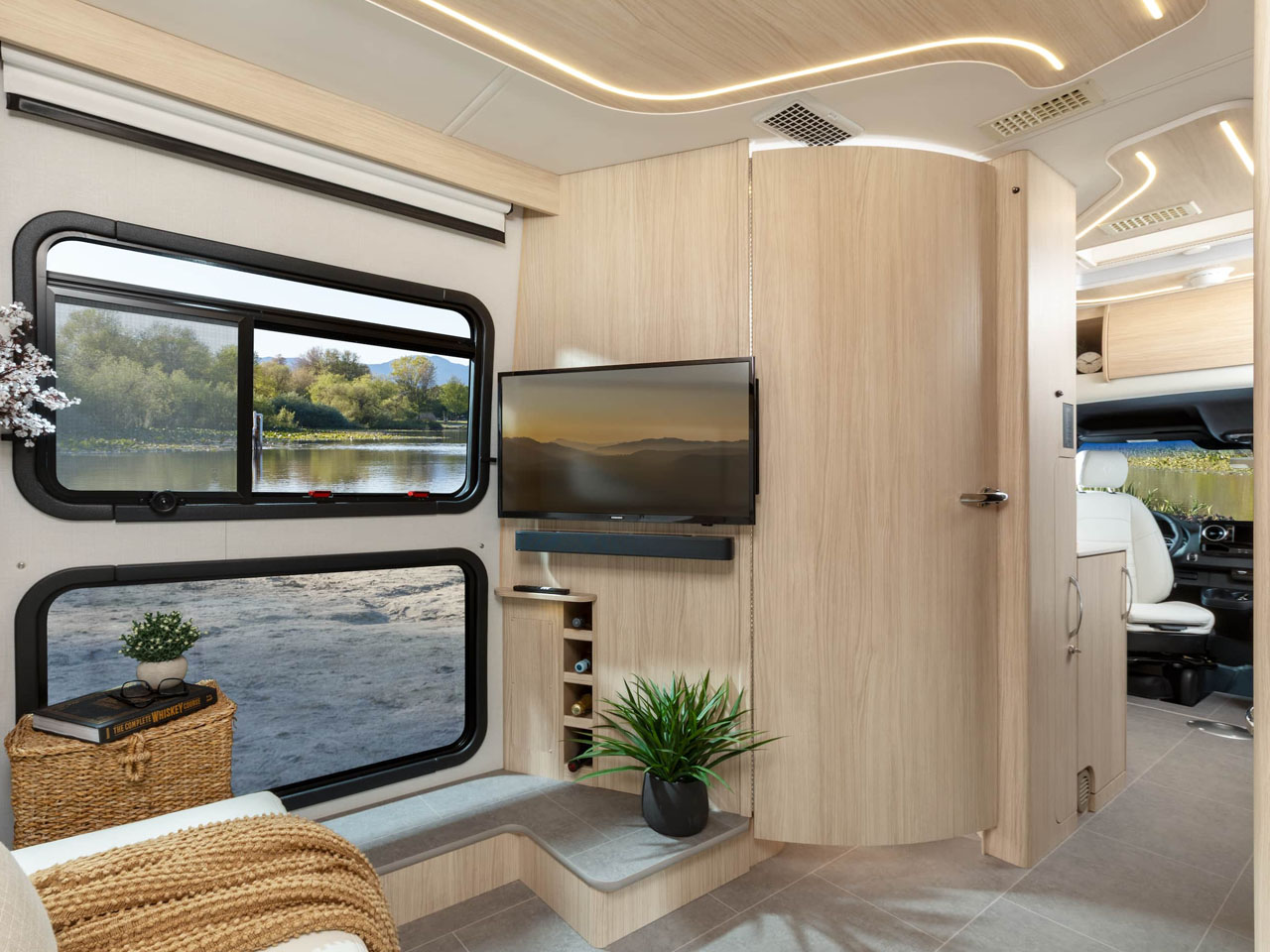
Ideal luxury motorhomes don’t fuss about your adventure gear and supplies. Their primary focus there is a premium small home on wheels that may cater to the rugged roads, but leaves you guessing when you reach the fathomed wilderness. Canadian RV company, Leisure Travel Vans, is changing this notion with the newly revealed Unity TBX series that has a spacious pass-through cabinet to carry along a great deal of equipment you may need in your time outside of your house.
So, whether you want to go biking, fishing, or surfing, with the TBX you can carry it with you. But the facility doesn’t come cheap; the motorhome is steeply priced at around $245,000 for its adventurous, all-wheel-drive (AWD) model. Yes, Leisure Travel Vans provides the TBX in two models: the TBX base model, which doesn’t have an AWD option and costs roughly $237,000, and the TBX all-wheel-drive variant.
Of course, the TBX is aligned with the notion of a toy hauler, but it doesn’t compromise on the space, luxury, or convenience of a motorhome you can desire. Unity TBX motorhome visions to provide a new alternative to all-weather, all-terrain adventure vans that keep you content and cozy, like in some more than basic hotel room.
For this, the Unity TBX is based on a Mercedes-Benz Sprinter 3500 and measures 25 ft (7.6 m) long. Within this form factor is the 1,727-liter defining pass-through garage you can use to carry mountain bikes, surfboards, skis, and other supplies you can possibly stock up in the space. It would just be a dull space without the 12- and 120-V outlets here that would allow you to charge electric bikes right within the motorhome. Anything that is not easy to stuff into the pass-through garage can be carried on the hitch, which provides an additional 5,000 lbs. of carrying capacity.
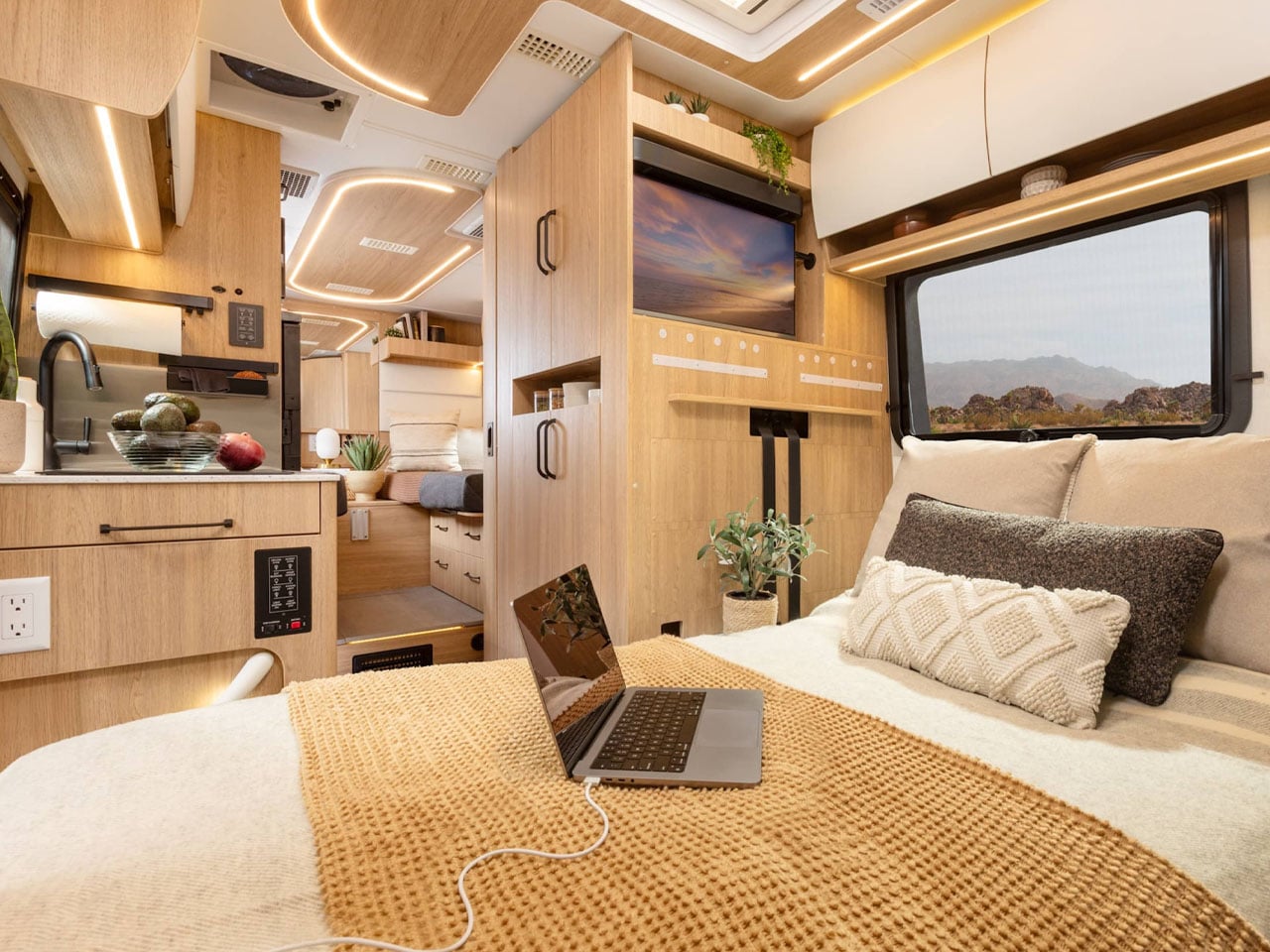
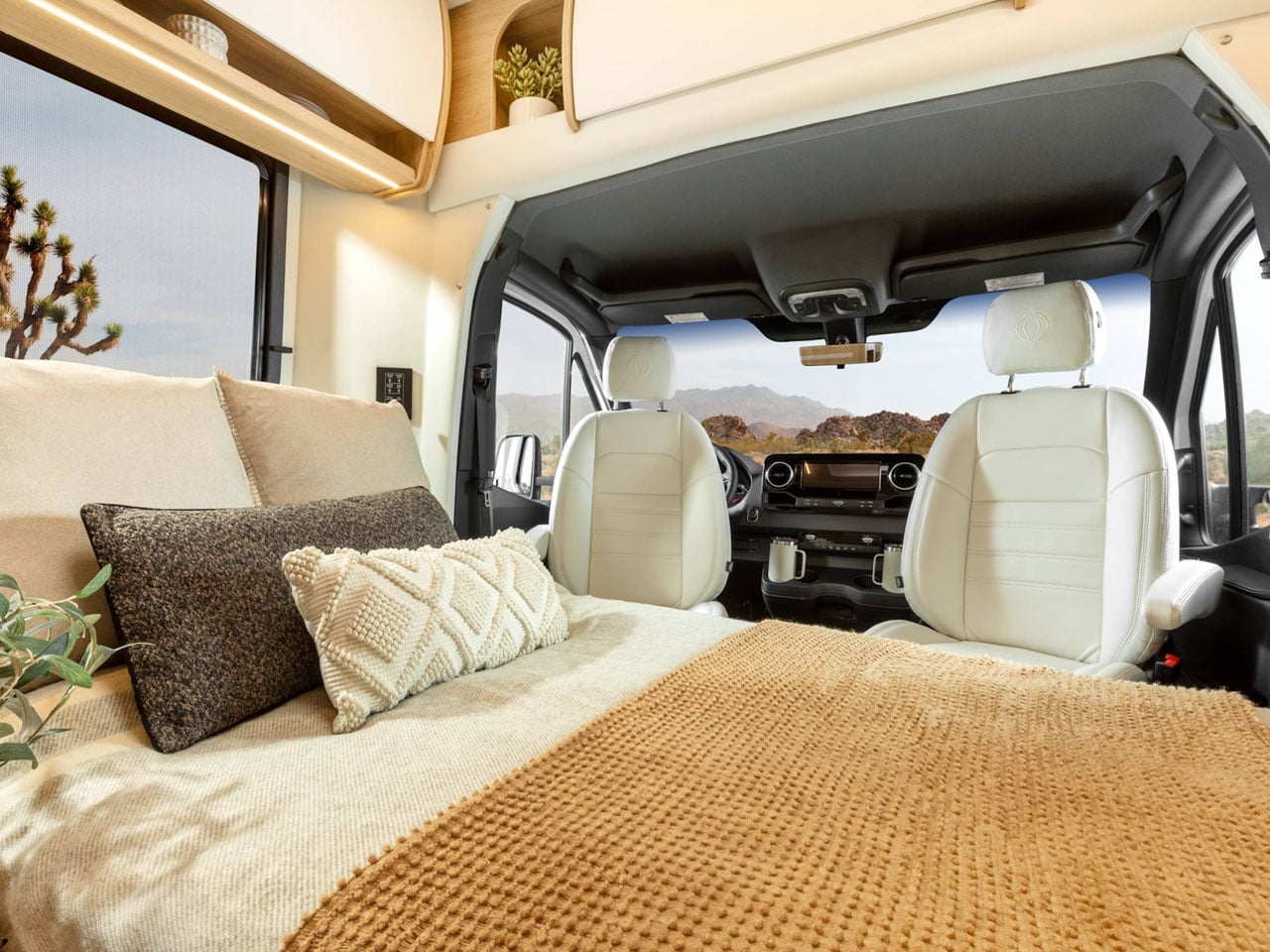
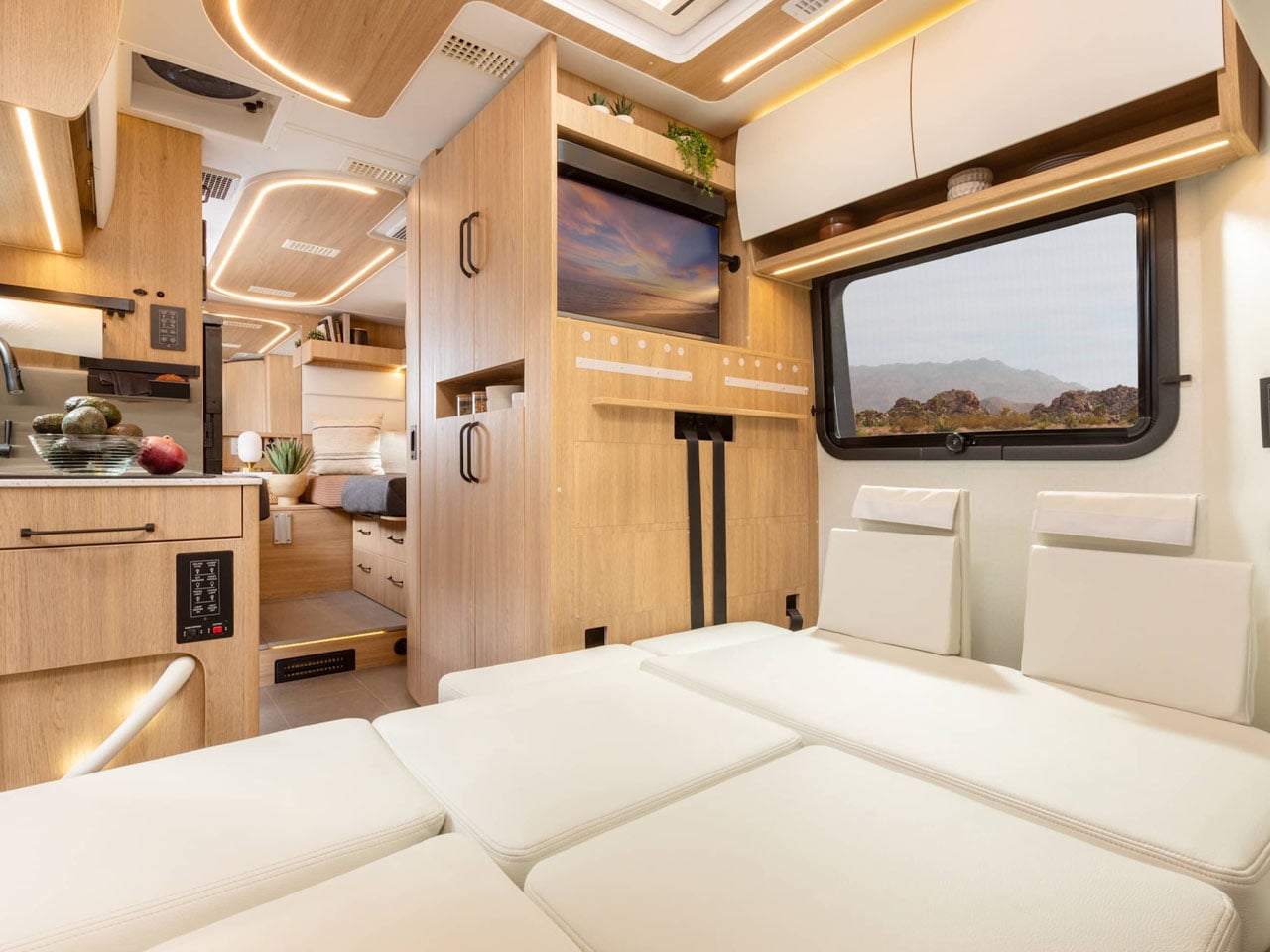
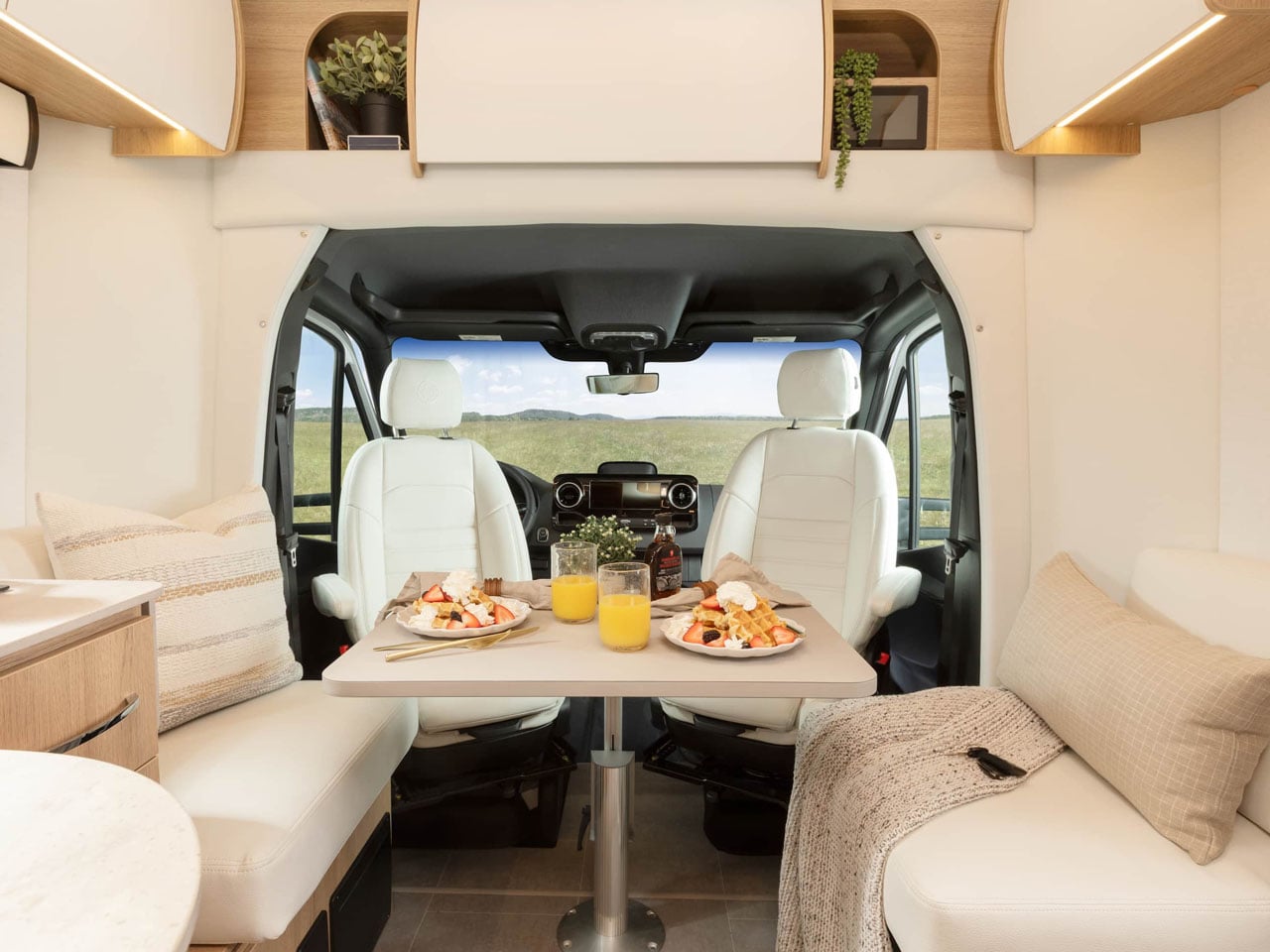
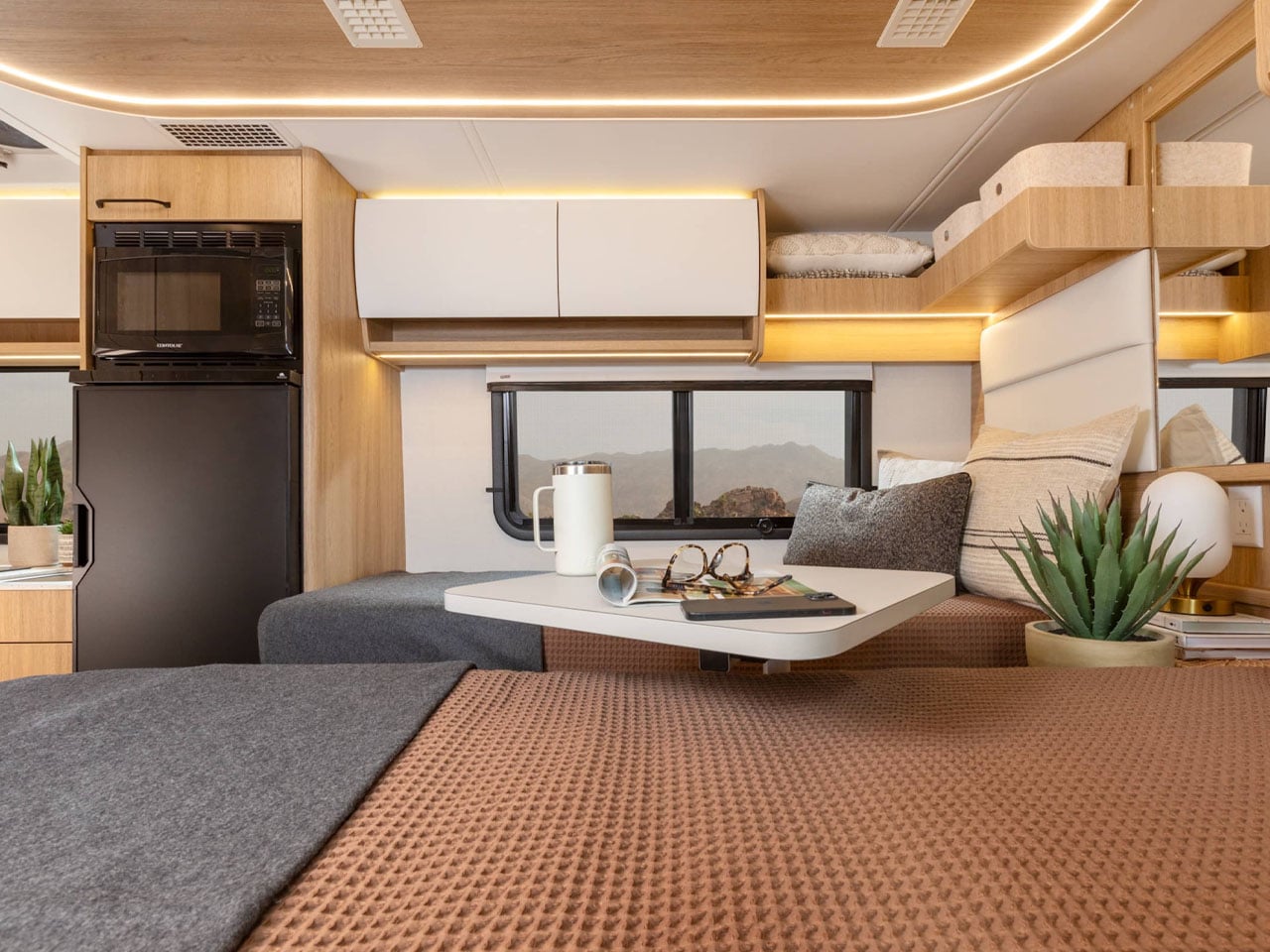
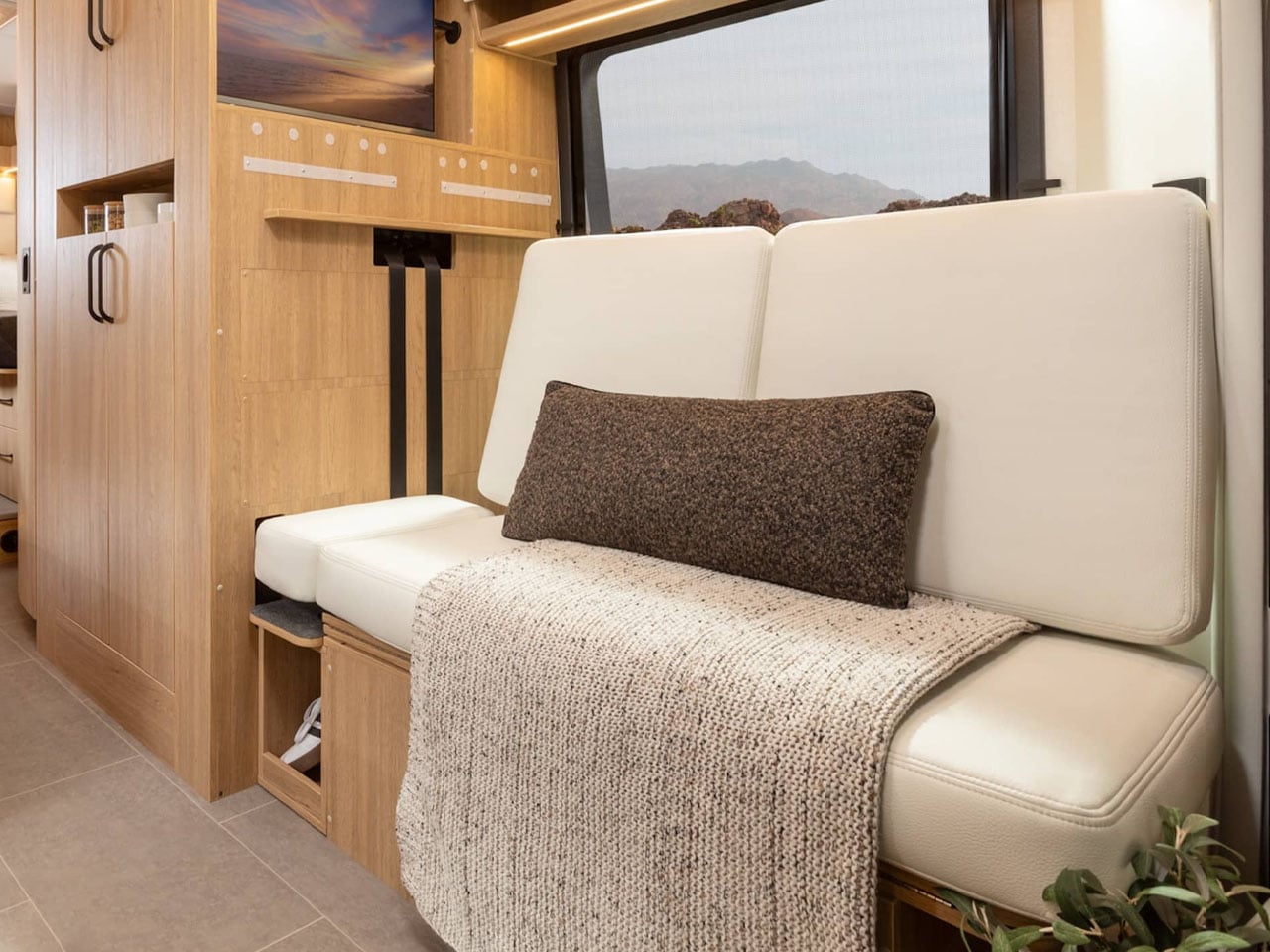
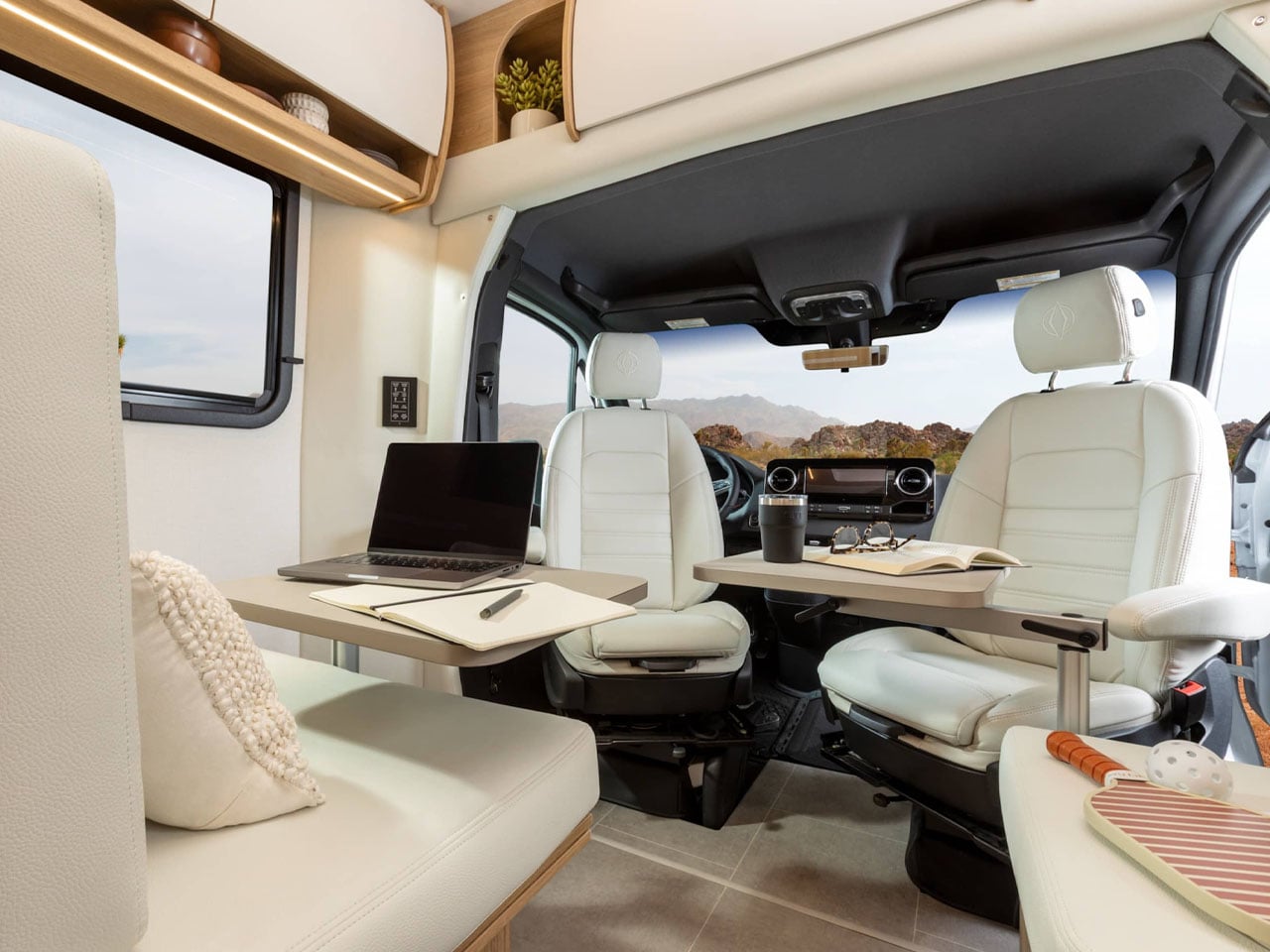
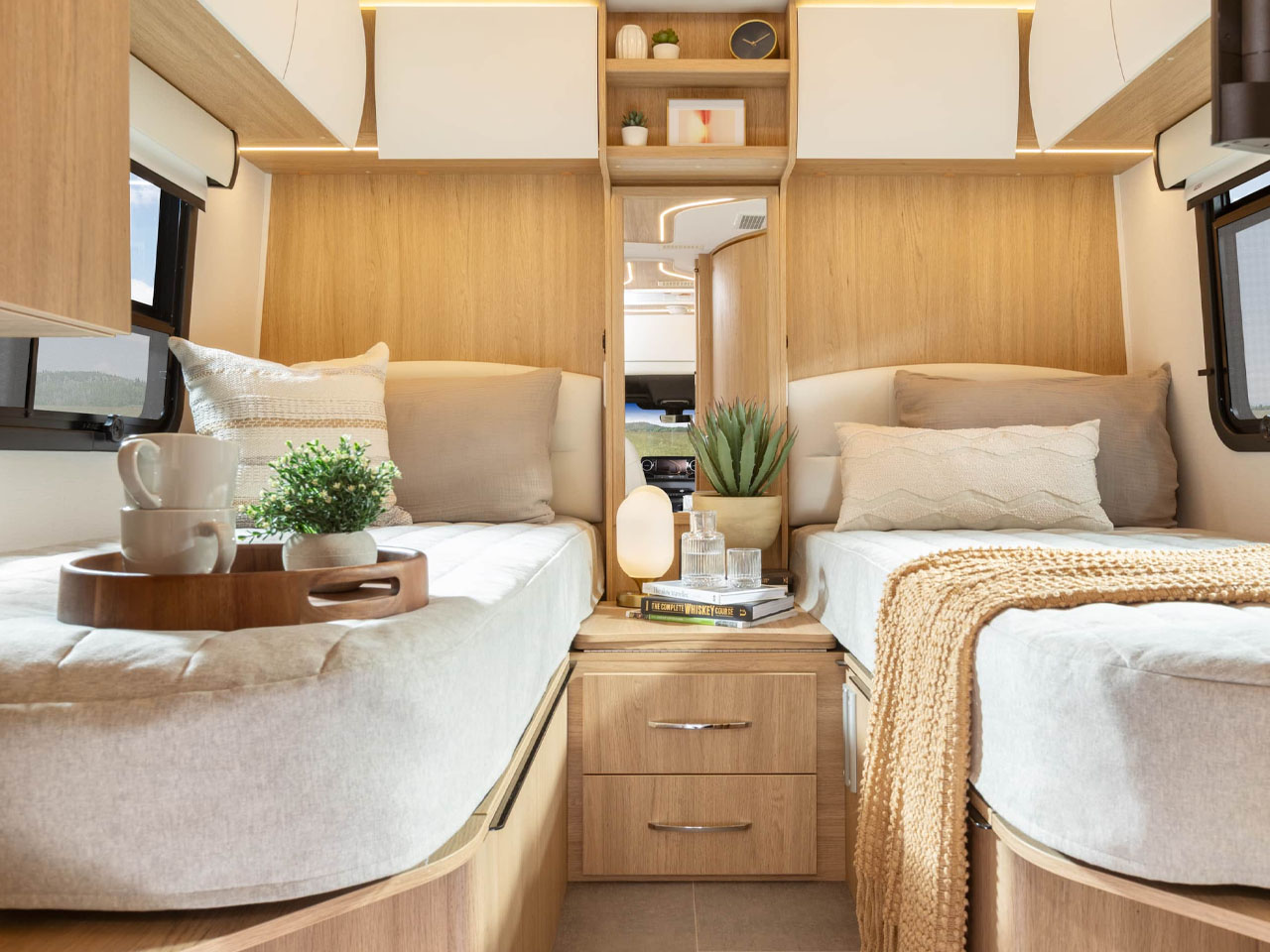
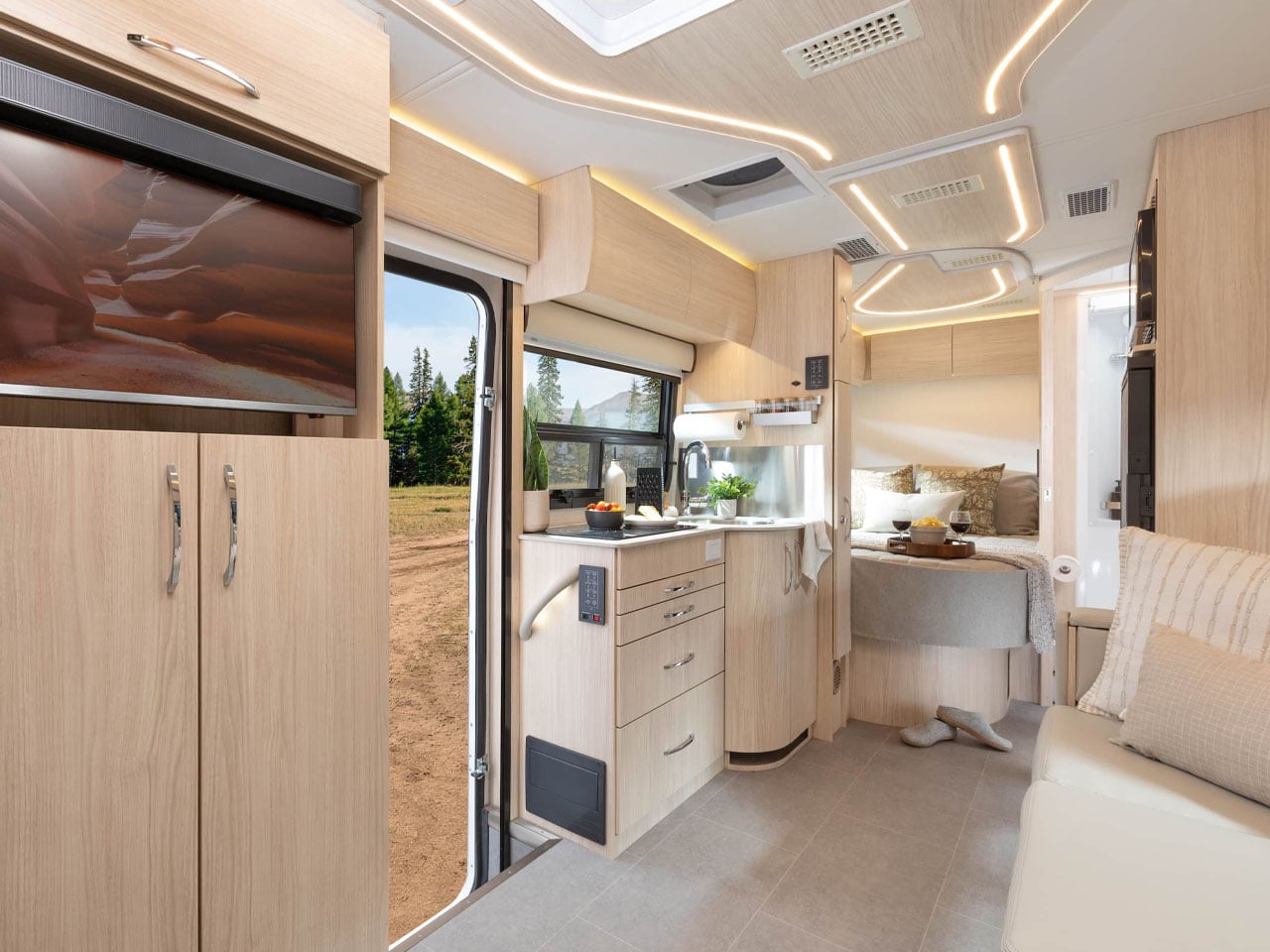
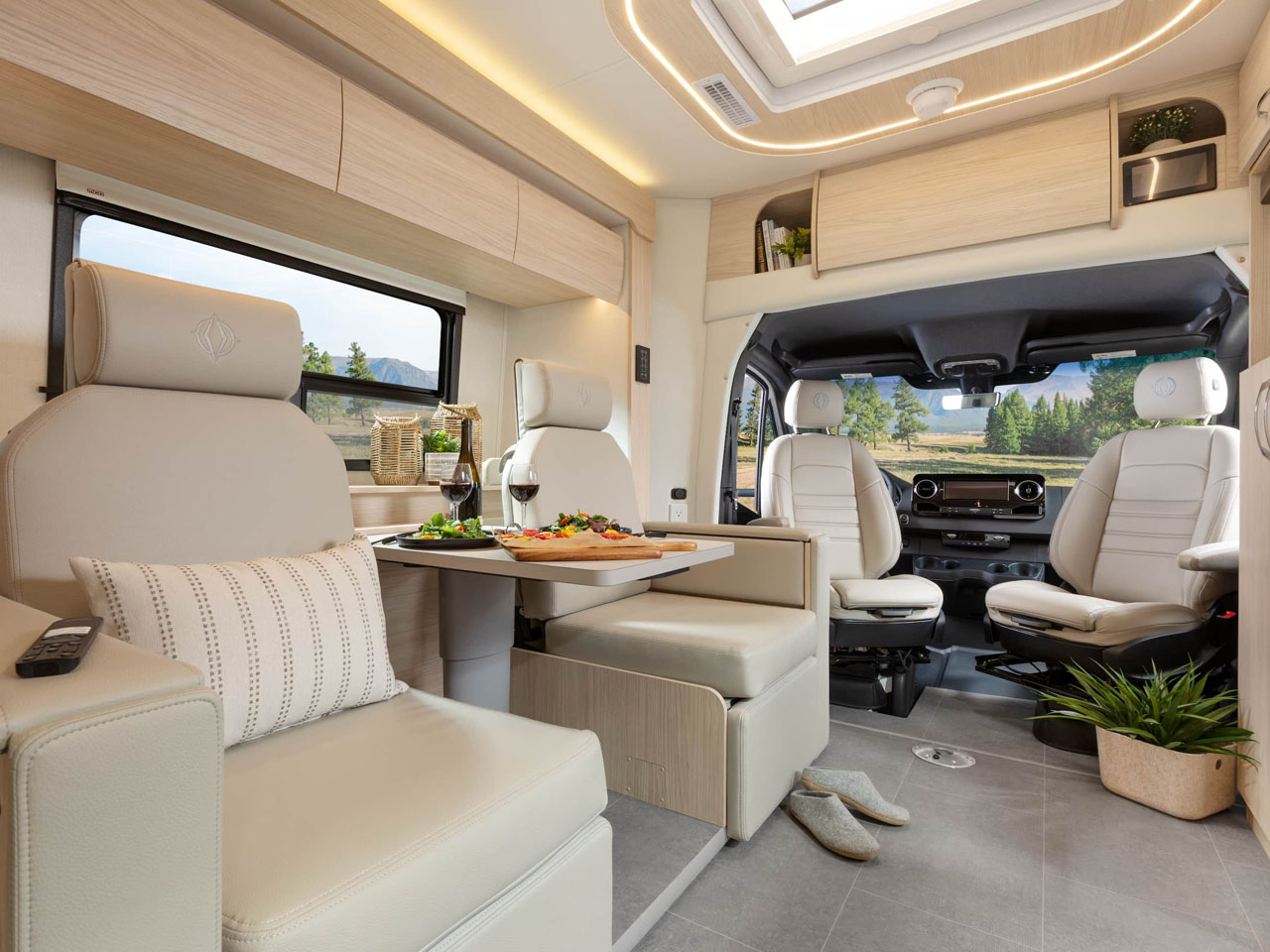
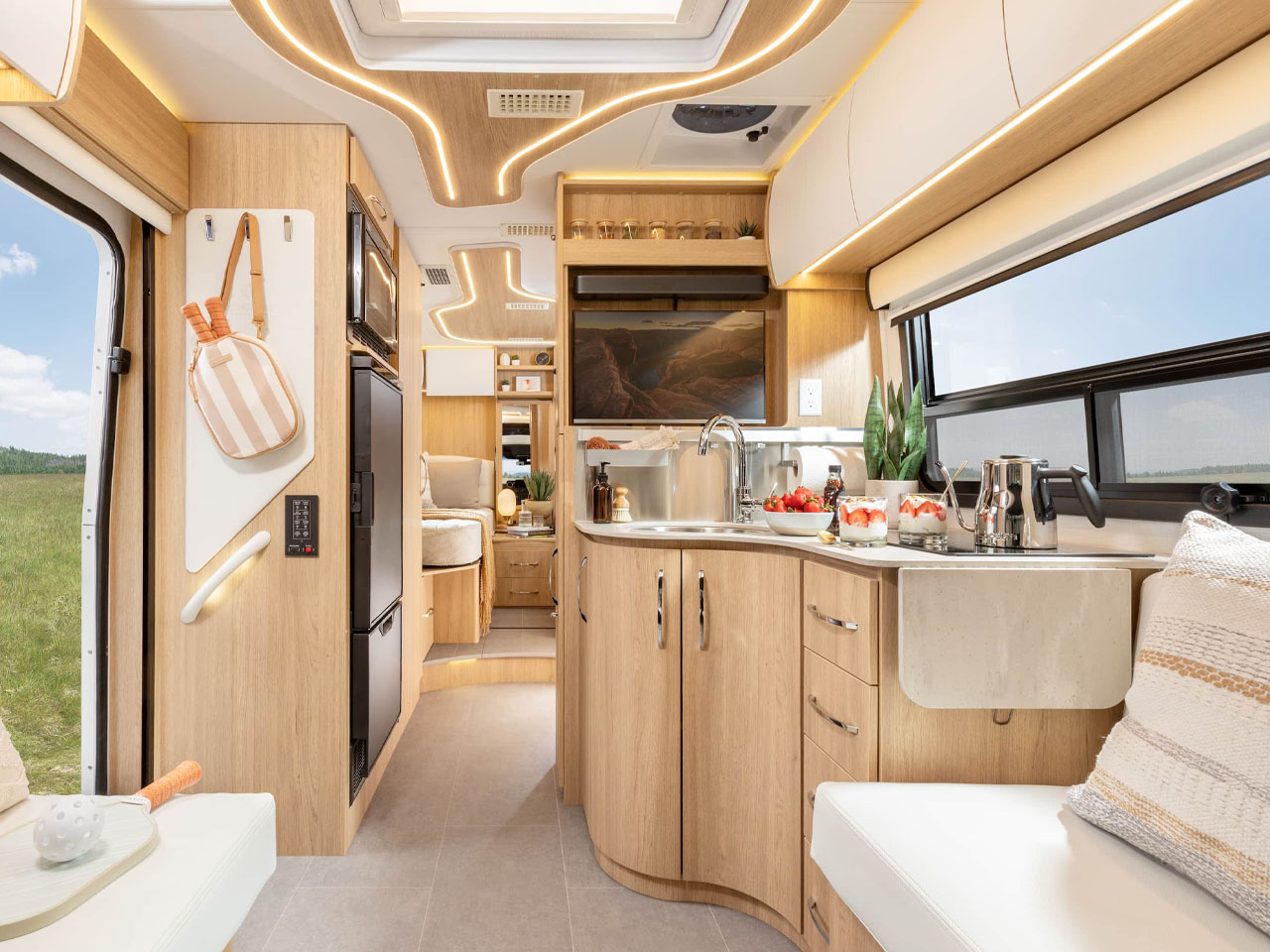
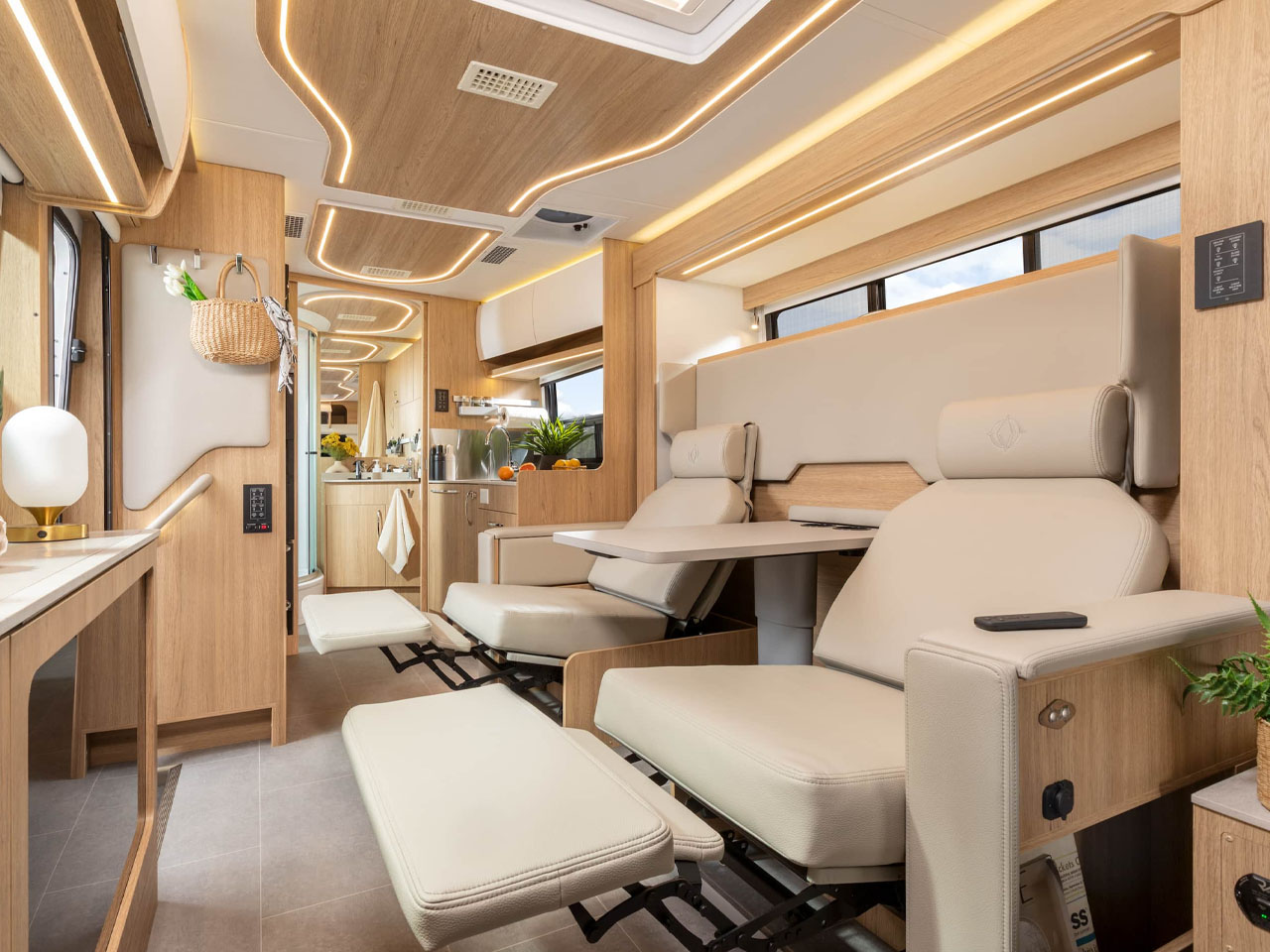
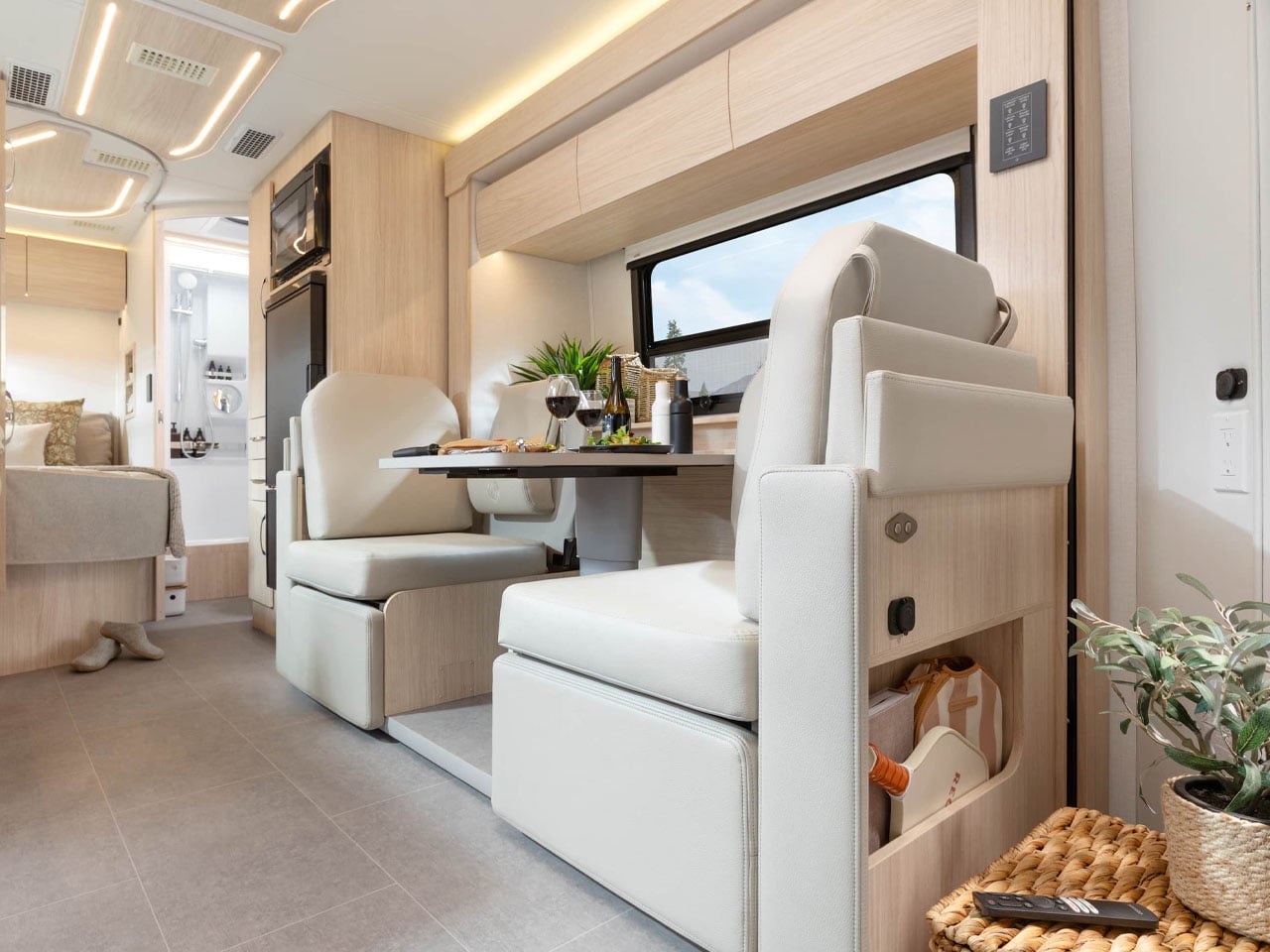
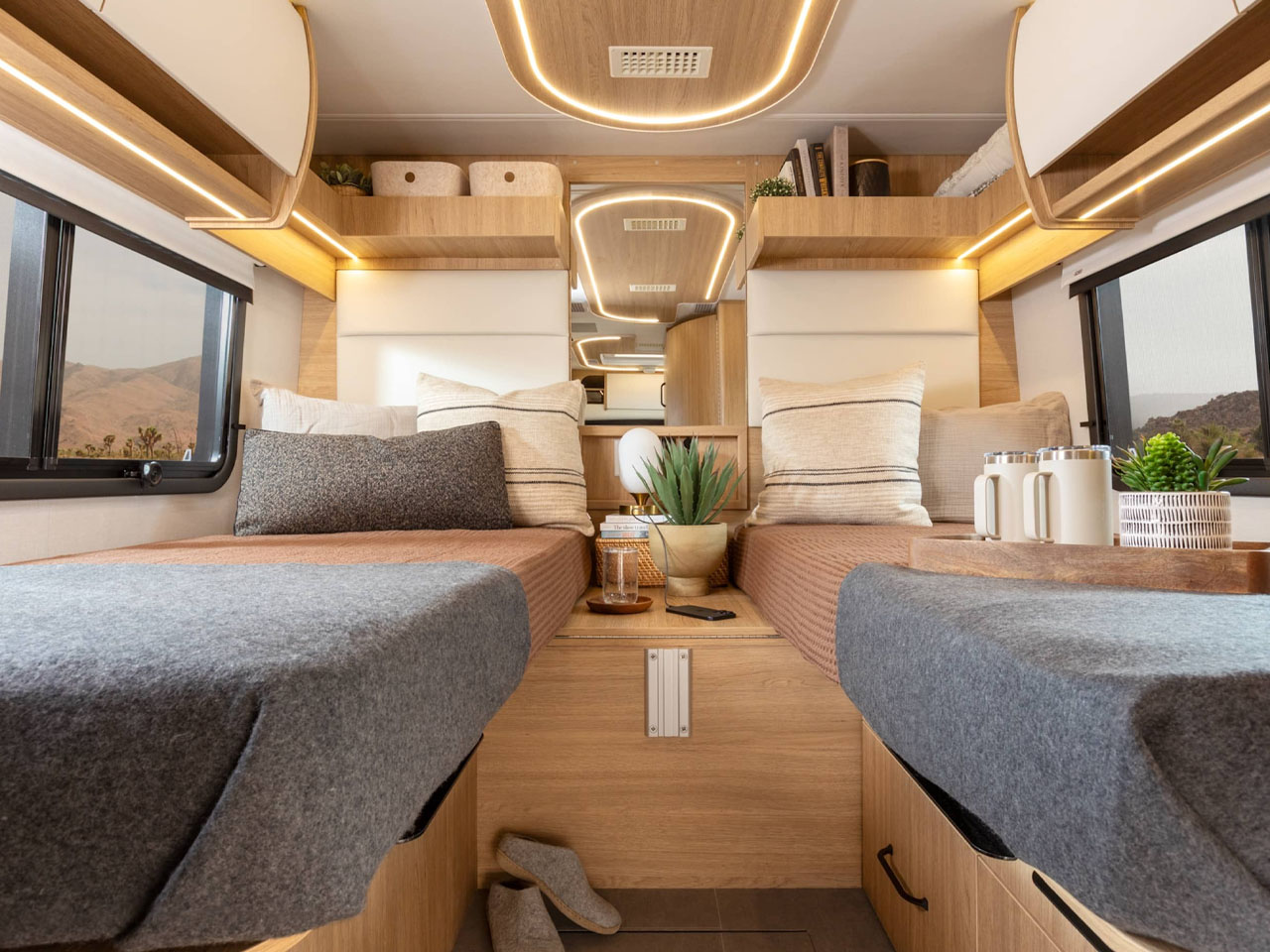
If you thought this was almost about it, the TBX series is a lot more than that. The 6.3 ft. high interior is provided with sleeping facilities for up to four people. At the far end of the bedroom is a twin bed featuring a nightstand in the middle. On the front of the motorhome is the versatile swivel lounge. It features a two-seat bench, which turns 90 to create a lounge space, and in tune with a third cushioned seat and the two swiveled cab seats, you have a nice lounge area with a set of Lagun tables for dining and working. The space easily folds and converts into a double bed.
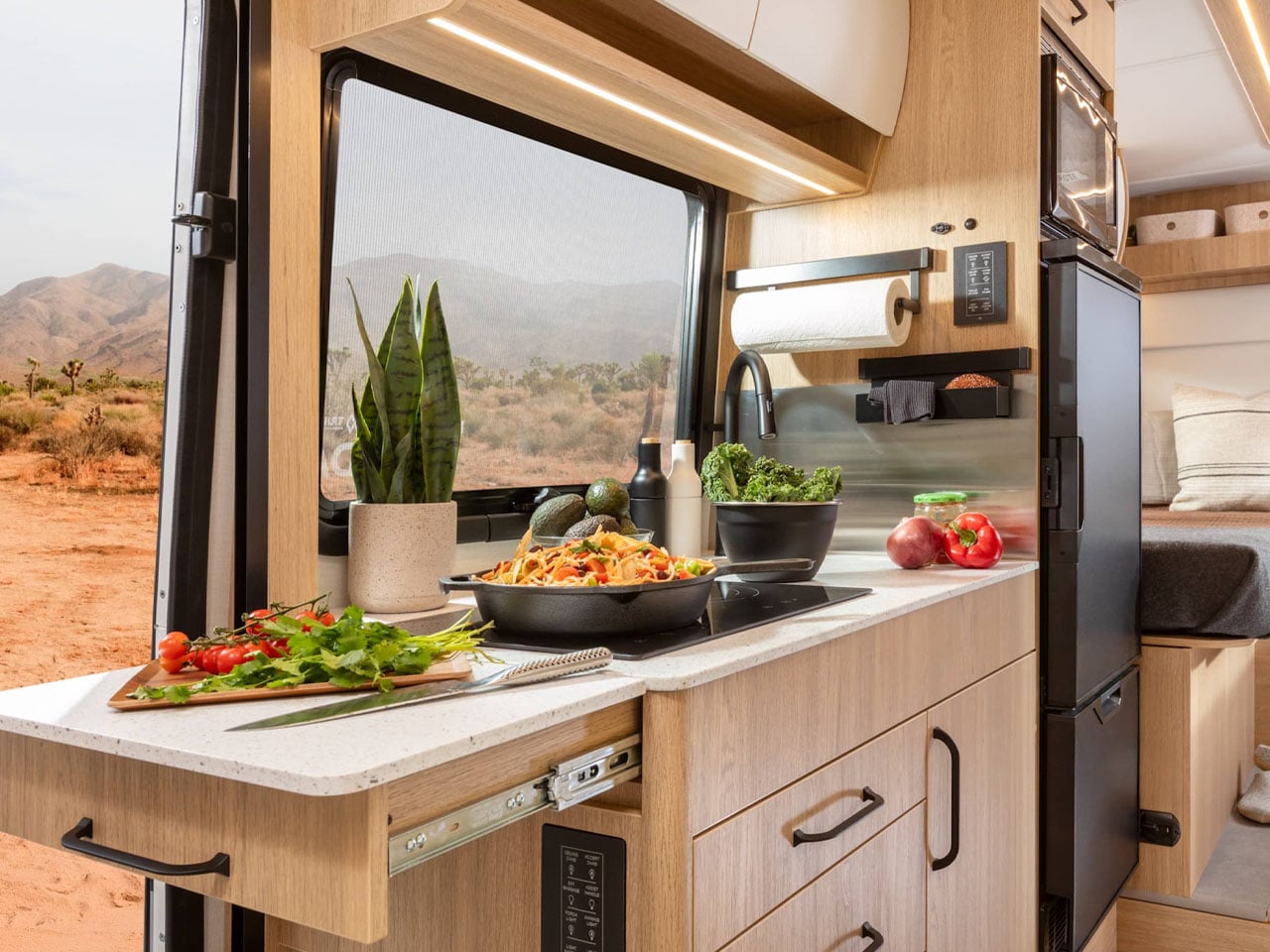
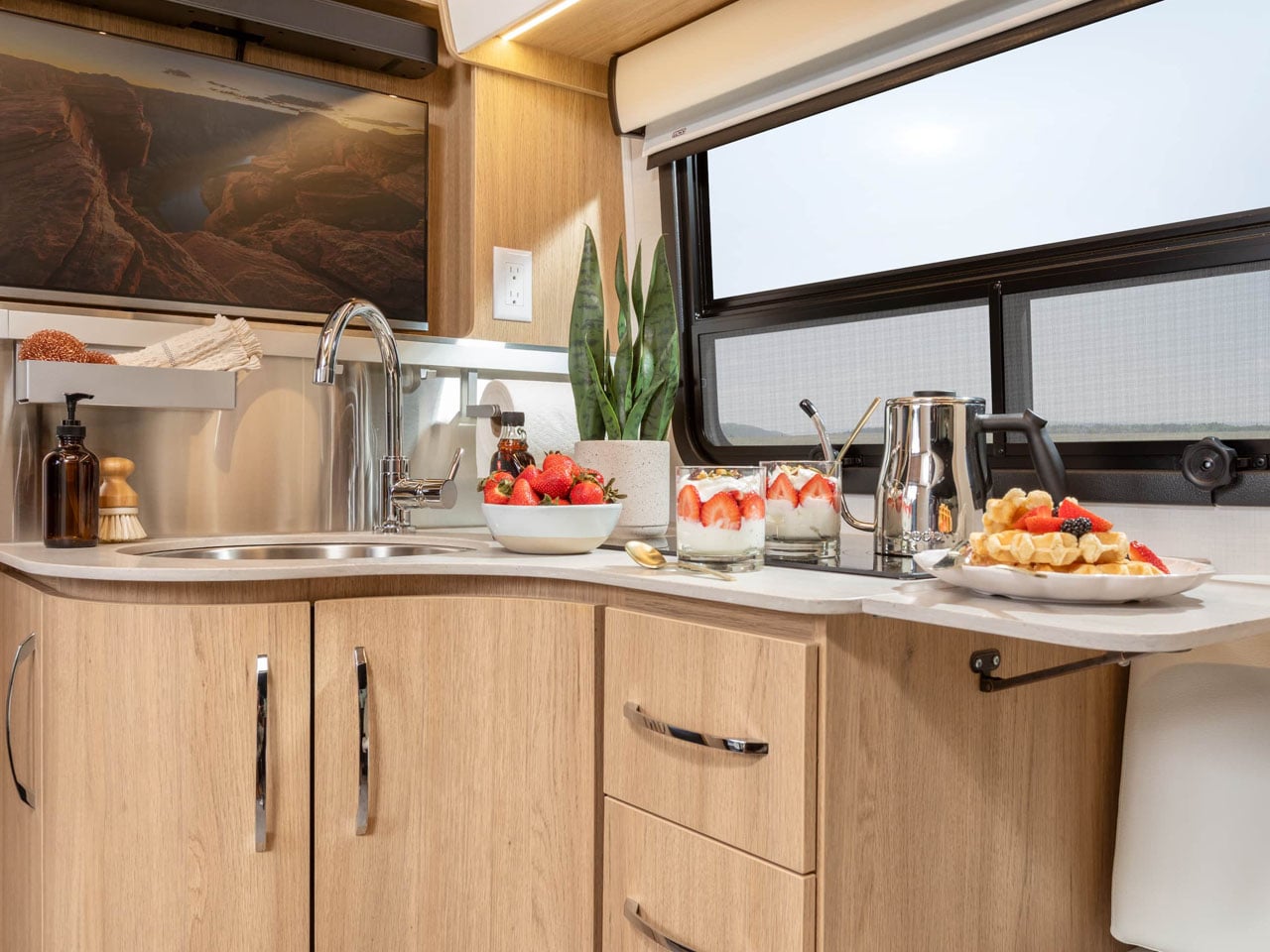
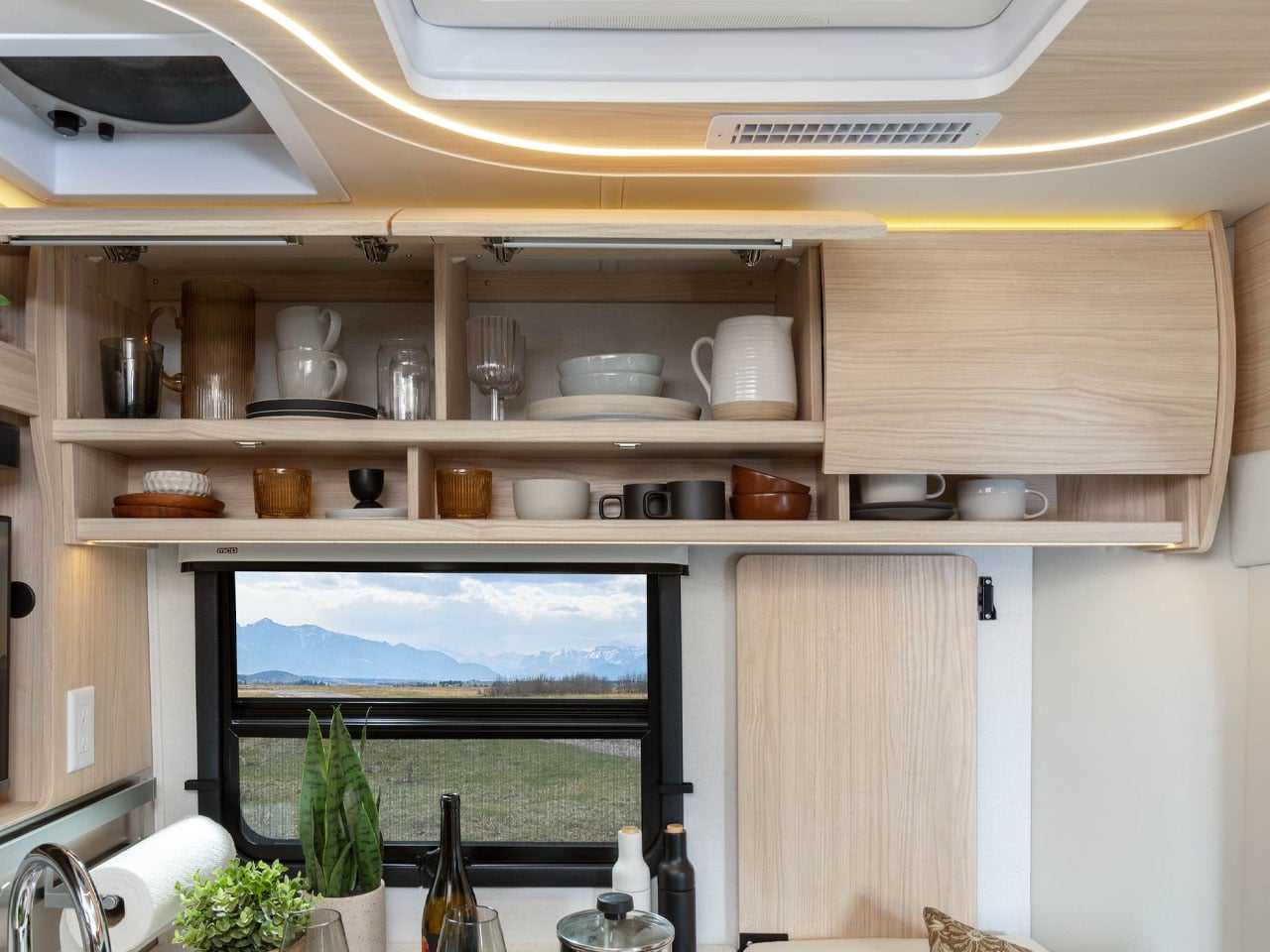
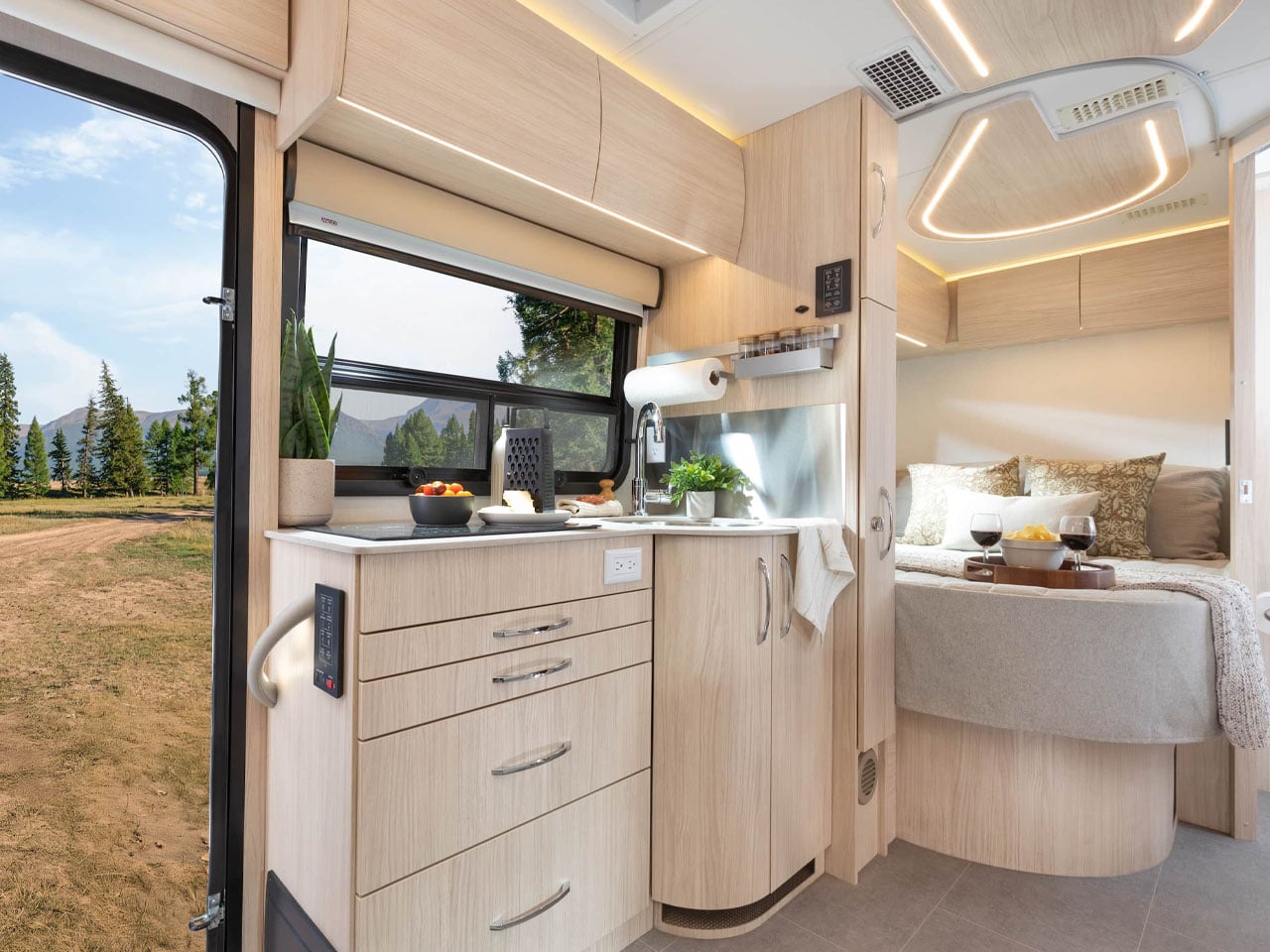
In the middle of this van home – on the driver’s side – is the bathroom with a shower, a wash basin, and a macerator toilet. Right in front of it is the kitchen, complete with a dual-burner induction cooktop, a sink, pull-out pantry, microwave, and double-door compressor fridge. Leisure Travel Vans has furnished the Utility TBX series with a capable off-road and all-season motorhome. It features a 270-Ah lithium battery, up to 400 watts of solar panels, and a 3,000-W inverter. Onboard, you have 151 liters of fresh water and 132.5 liters of gray water storage capacity. While the Truma Aventa Eco air conditioner takes care of the summer months, the same company’s VarioHeat furnace sees you through the winter in the TBX.
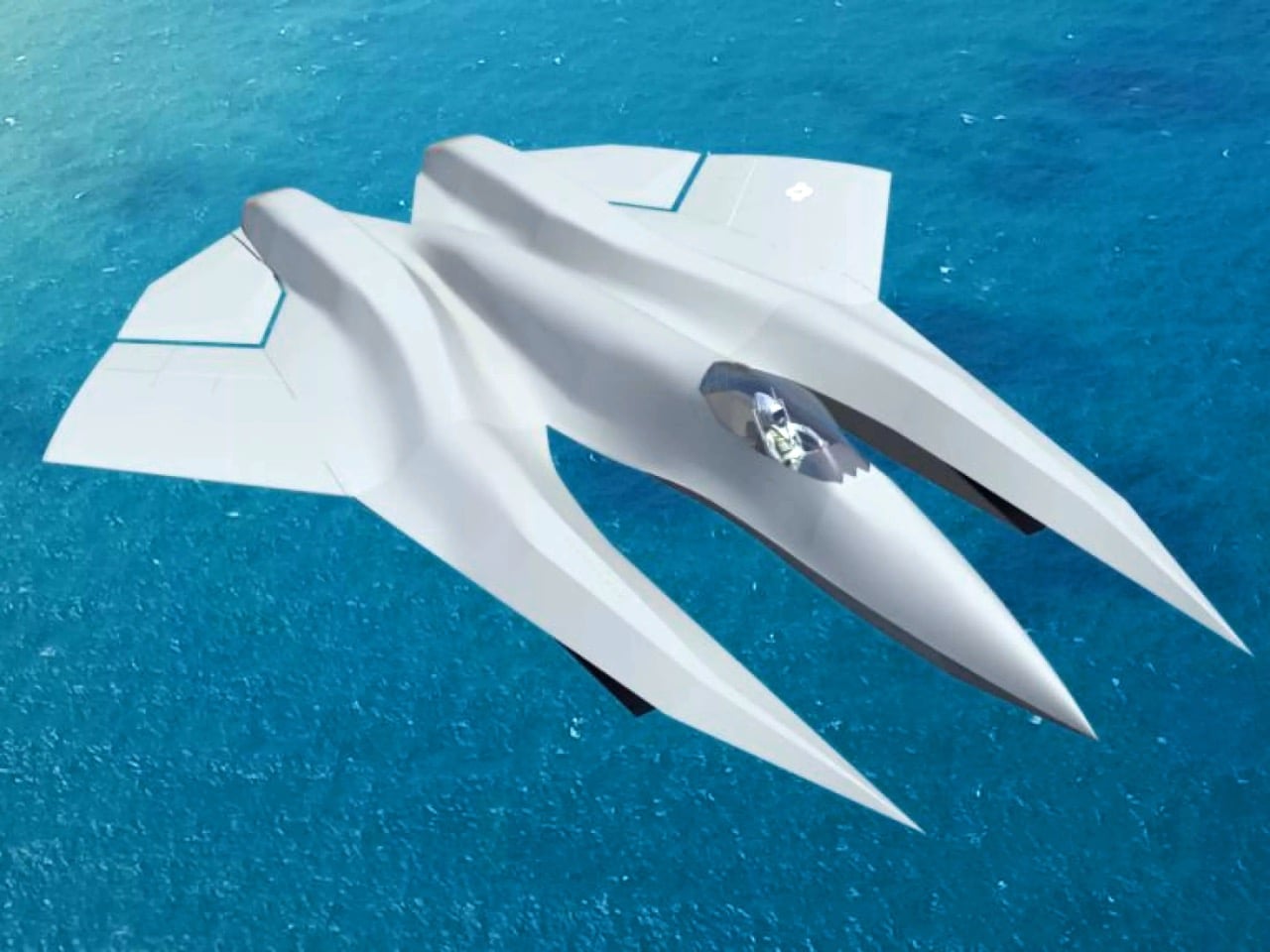
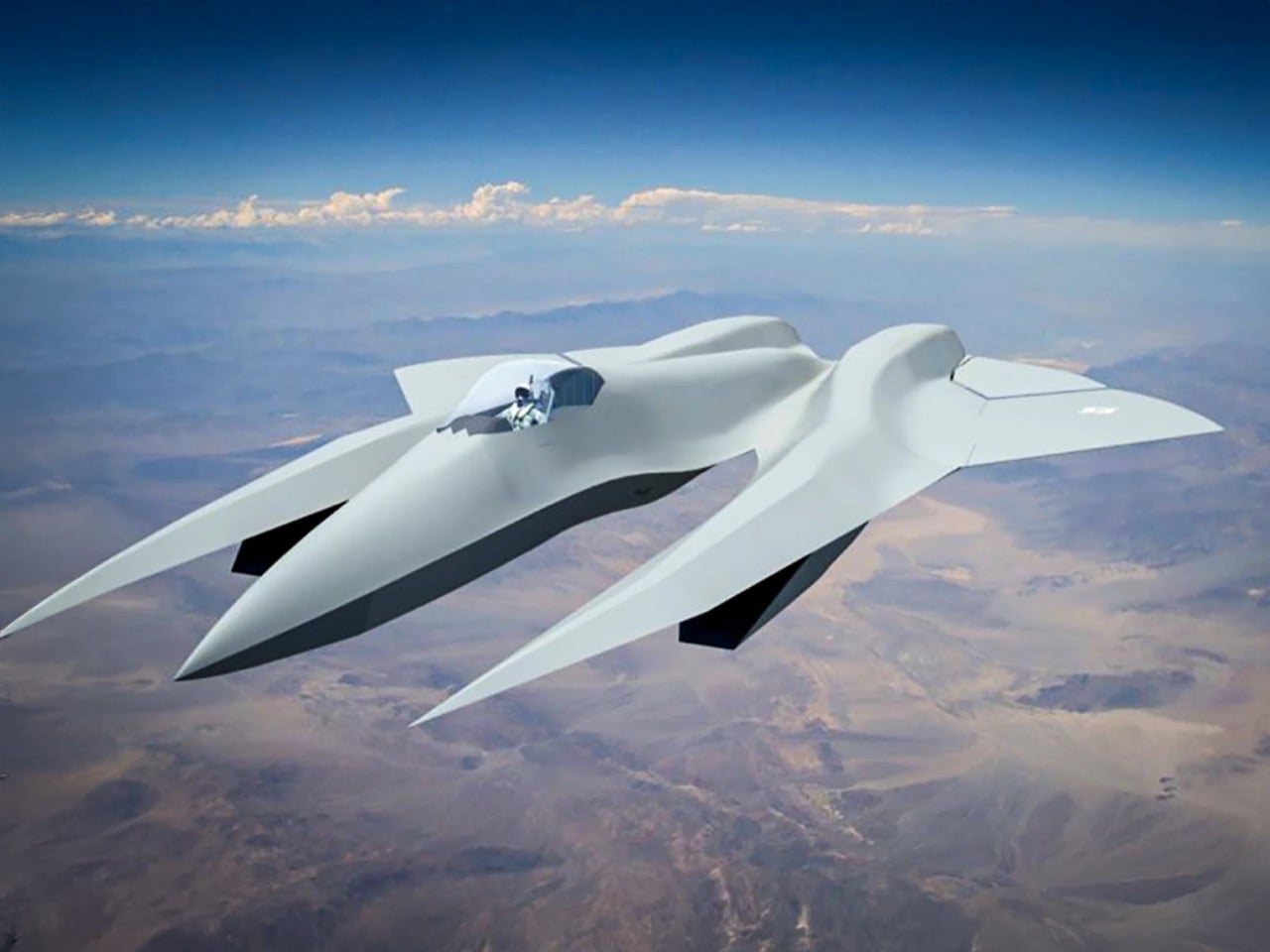
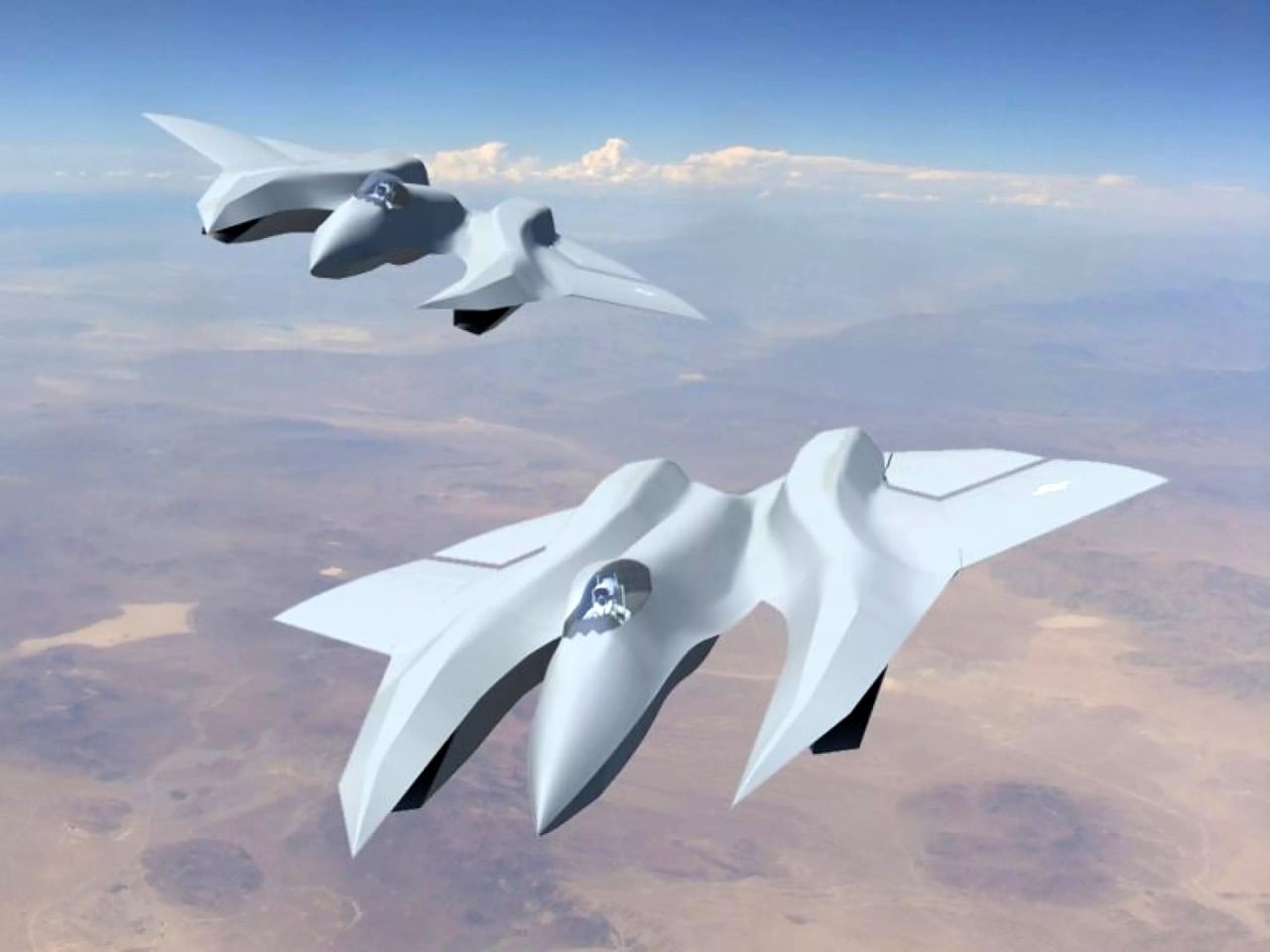
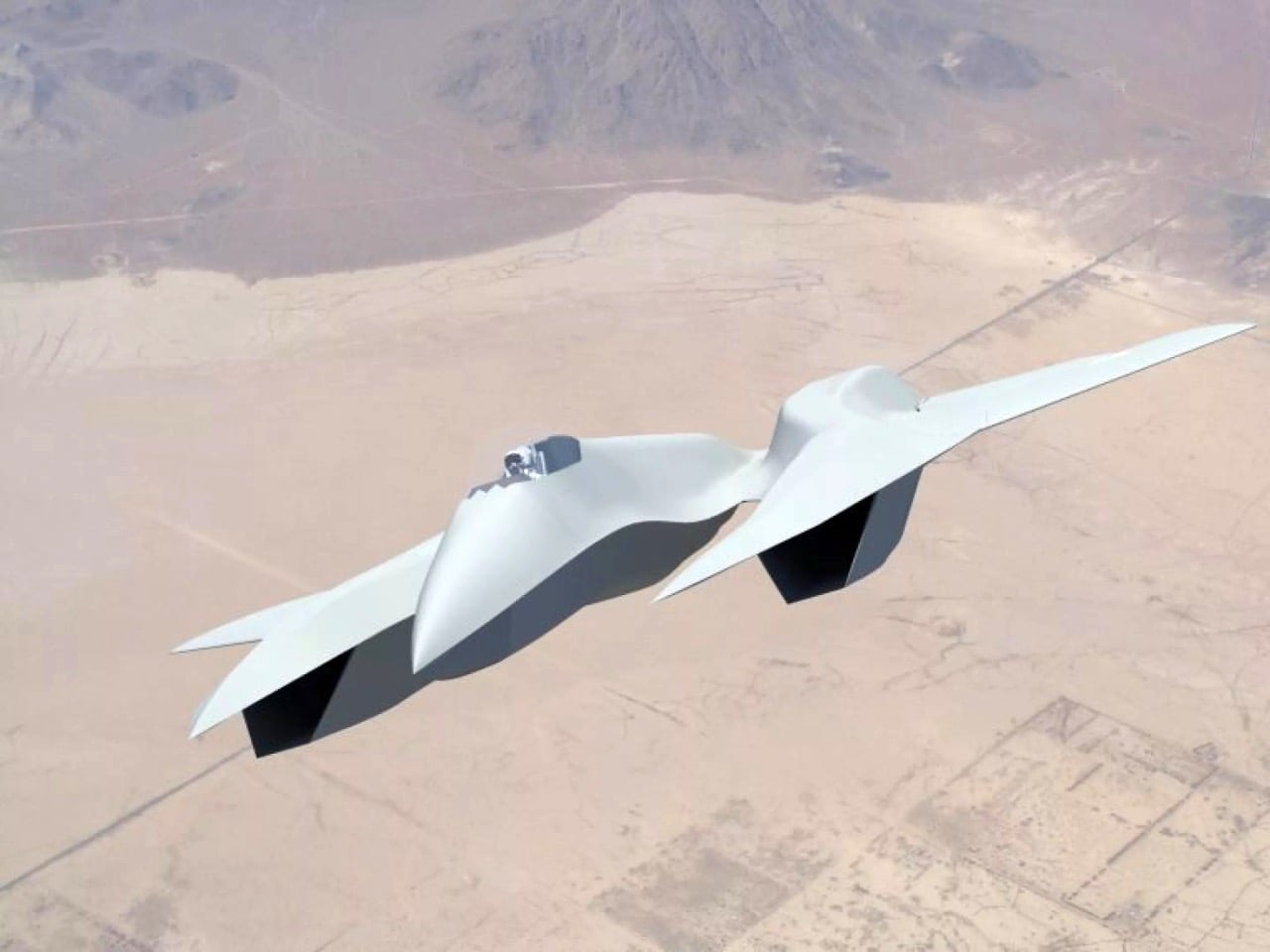
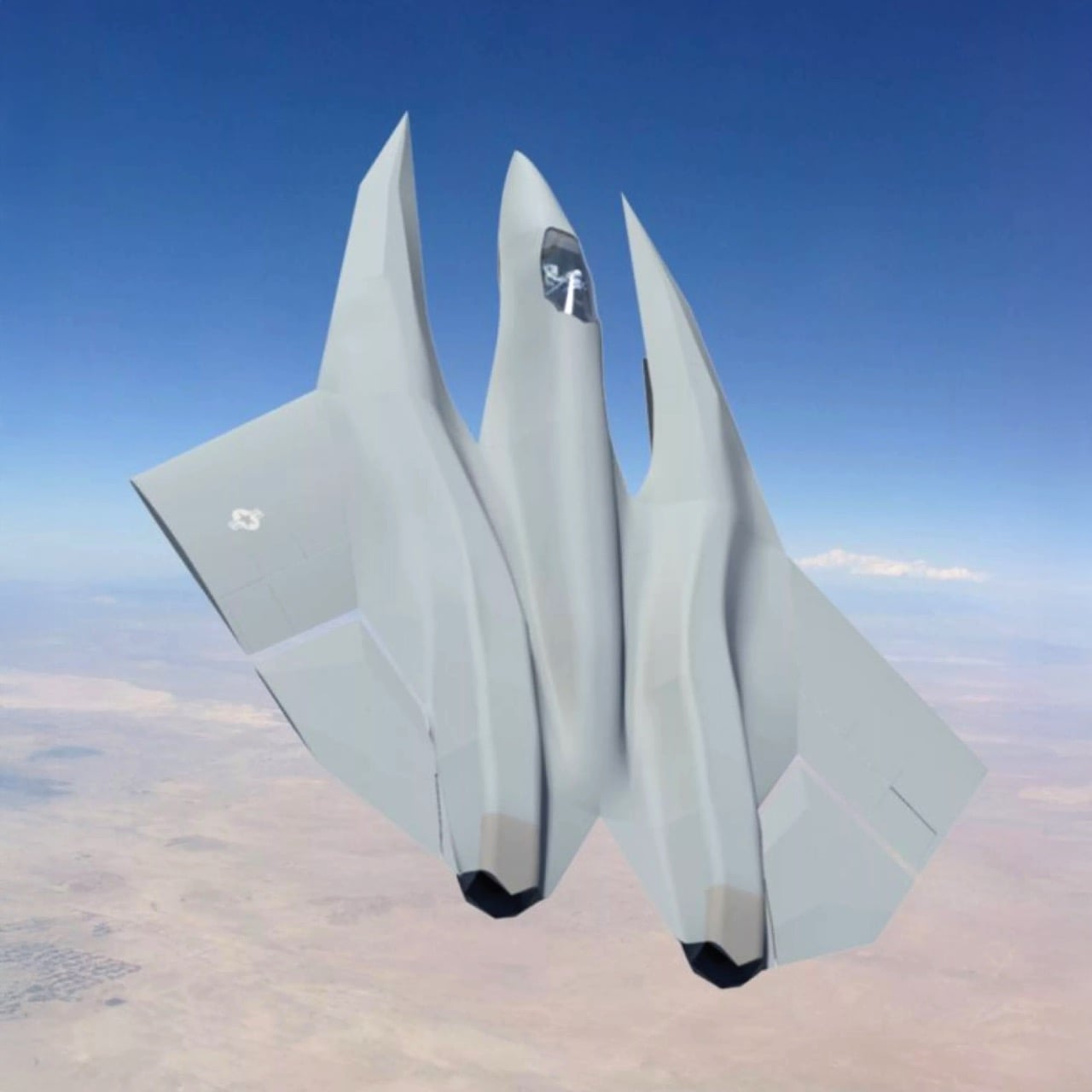
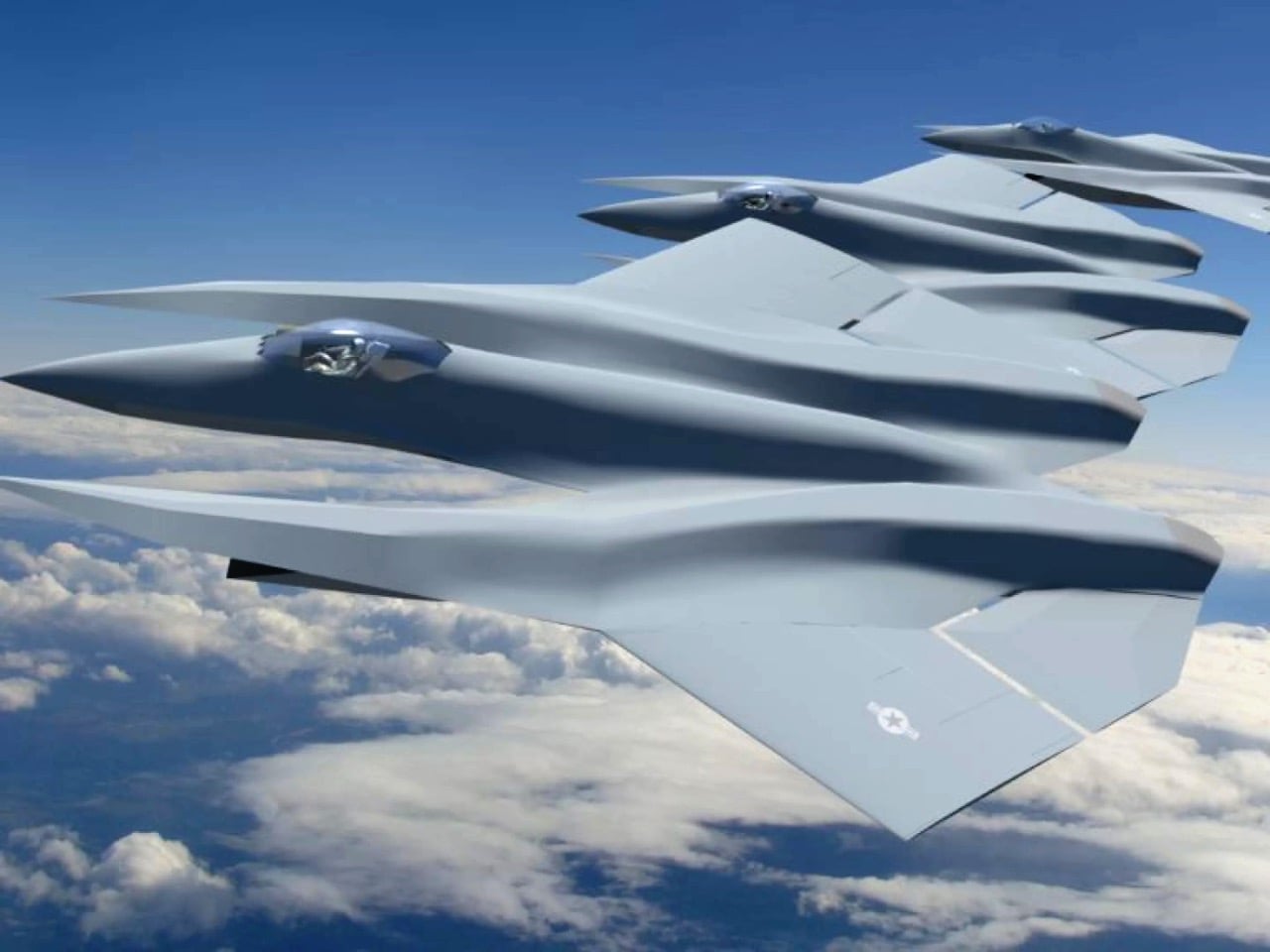
David versus Goliath stories captivate us, especially when David brings a slingshot that looks like alien technology. Enter Stavatti Aerospace, a 25-person firm from Niagara Falls taking on Boeing and Northrop Grumman for one of the most lucrative defense contracts in naval aviation. Their weapon of choice? The SM-39 Razor, a fighter design so visually striking it demands a double-take. The triple-fuselage “Batwing” configuration breaks from a century of conventional aircraft architecture, presenting a form that’s more science fiction than traditional aerospace engineering.
The radical design supposedly delivers Mach 4 speed, Mach 2.5 supercruise, and performance metrics that eclipse what defense industry titans are proposing. Stavatti built these ambitions on titanium foam construction and aerodynamic principles that challenge orthodox thinking about fighter design. The catch? Stavatti has never manufactured an actual aircraft. Since opening in 1994, the company has produced concepts, proposals, and computer-generated imagery. Nothing has left the ground. The SM-39 represents either visionary thinking waiting for its moment or the latest chapter in a long catalog of paper airplanes.
Designer: Stavatti Aerospace
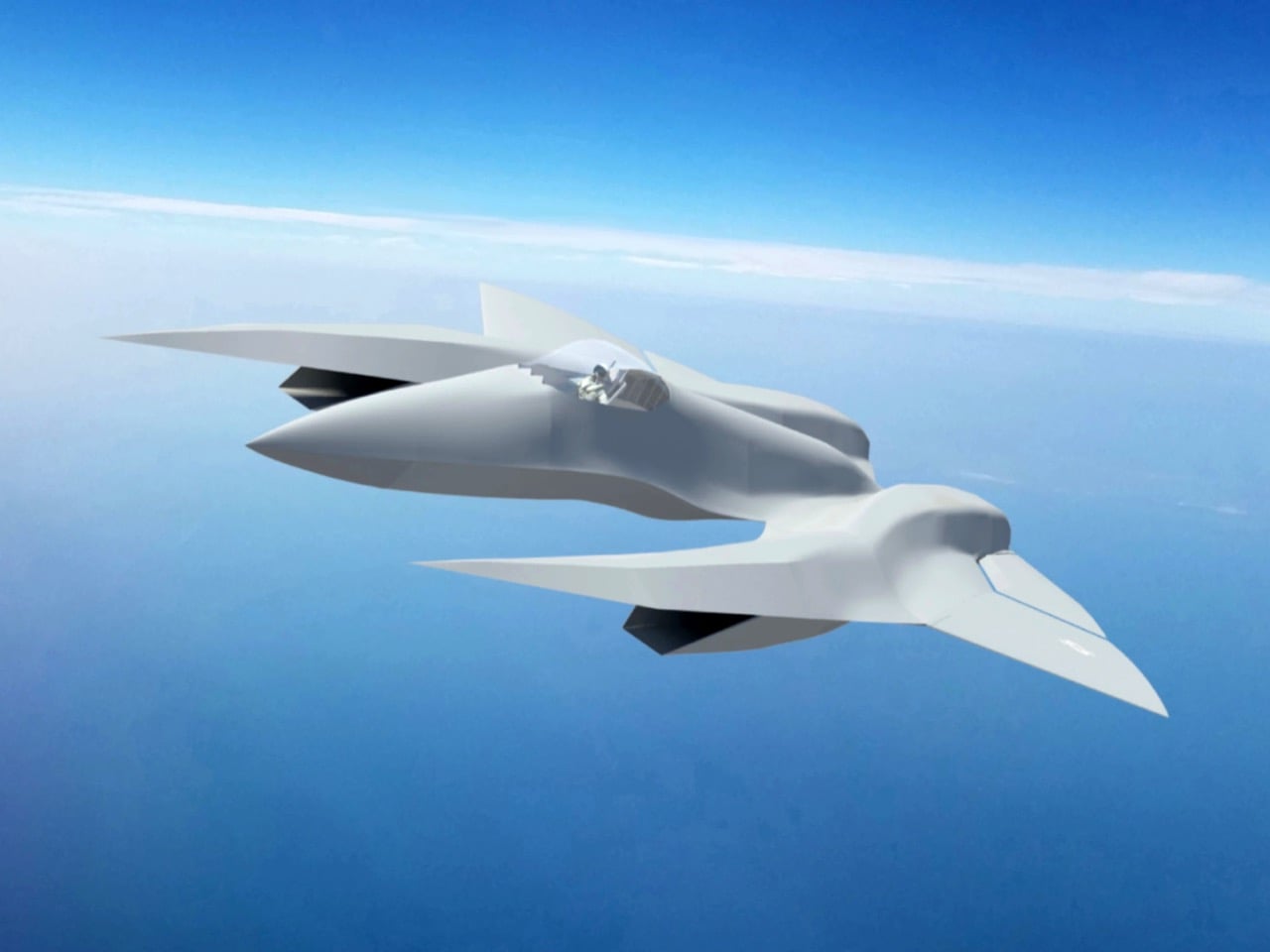
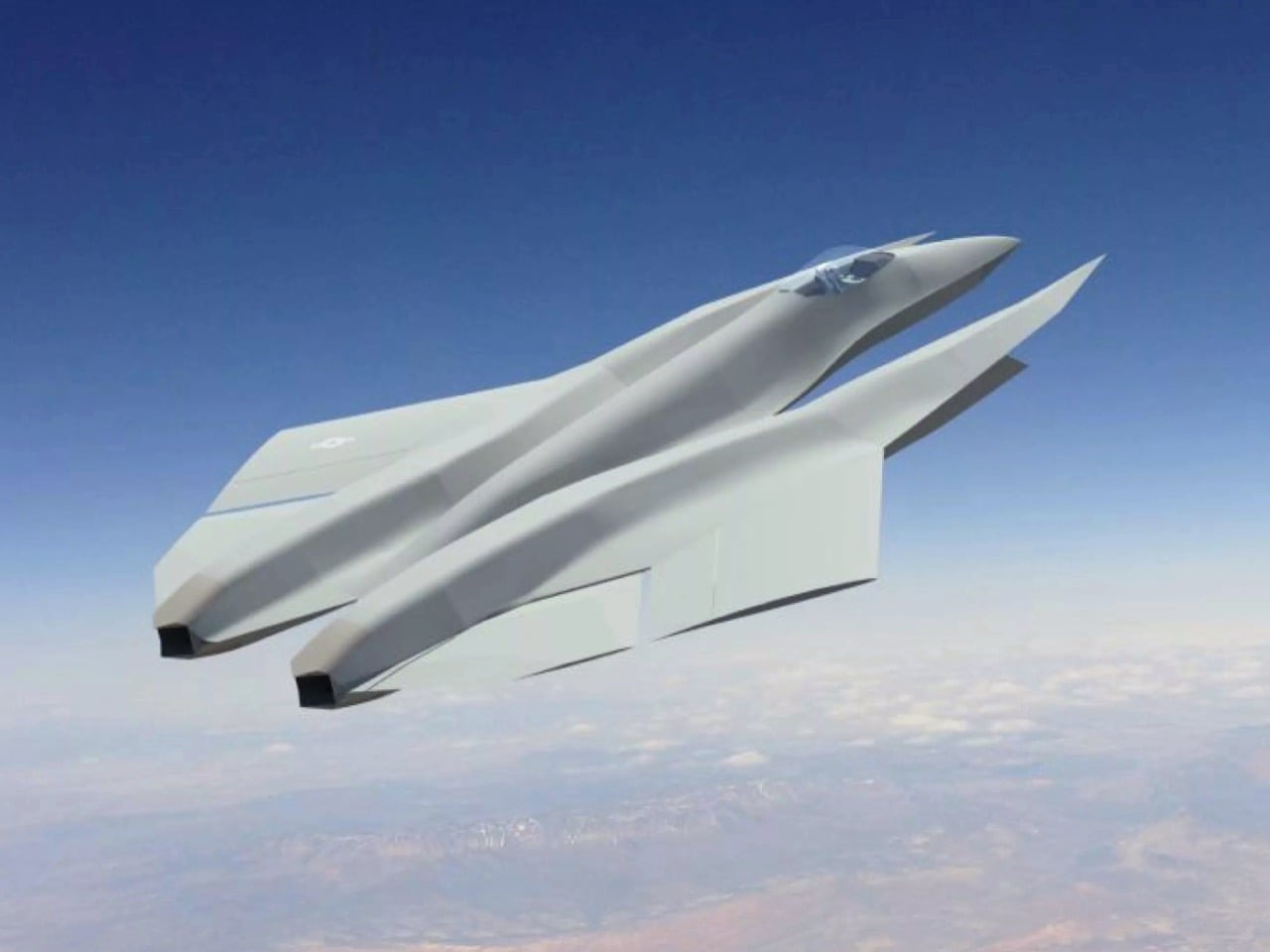
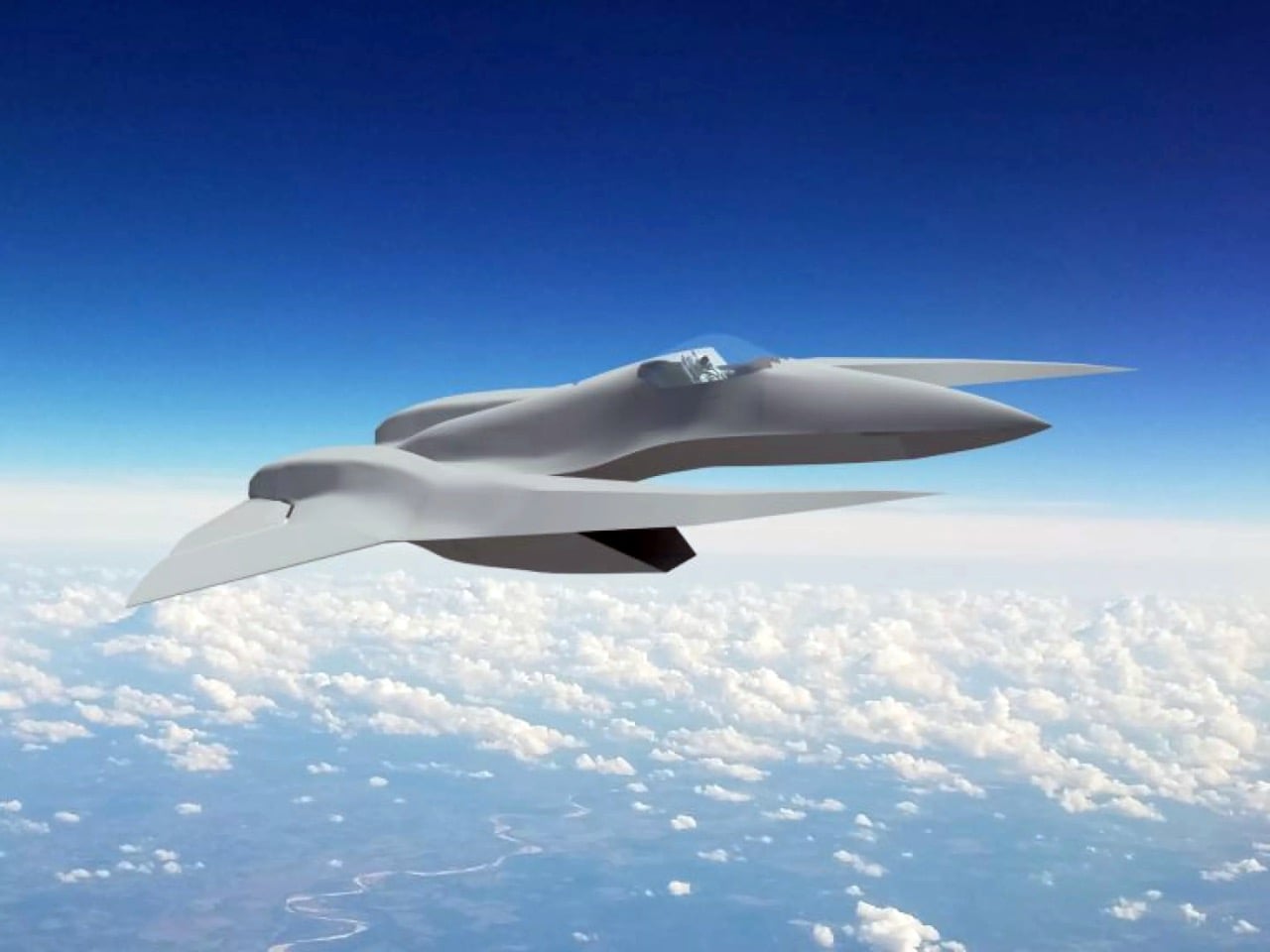
Three distinct fuselages merge into a blended wing body that genuinely resembles the vehicle Bruce Wayne keeps in his cave. The central section houses the cockpit while two outer nacelles sweep back at aggressive angles, each tapering to needle-sharp points. From above, the silhouette reads as pure menace. From the side, you see how the bodies integrate into the wing structure rather than sitting on top of it like conventional designs. Variable-camber technology supposedly lets the wing morph its shape for different flight regimes. Stavatti claims this delivers efficiency from carrier deck launches all the way through to near-hypersonic speeds.
Speaking of speeds, let’s talk about that Mach 4 claim. Current fifth-generation fighters top out around Mach 1.8 to 2.0. The SR-71 Blackbird, built with exotic materials and specialized engines for one specific purpose, hit Mach 3.3. Stavatti wants us to believe their turbofan-powered fighter will casually exceed that by nearly a full Mach number while also handling carrier operations, dogfighting, ground attack, and electronic warfare missions. The physics gets dicey here. At Mach 4, ram air temperature at the intake approaches 400 degrees Celsius. The skin heats up enough to glow on infrared sensors from a hundred miles away. Stealth becomes a joke when you’re essentially a flying torch broadcasting your position to every heat-seeking sensor in the battlespace.
Those elongated outer nacelles look sleek in CGI but imagine the torsional loads during a 9G turn. You’re talking about tremendous stress on the attachment points where they meet the central wing structure. Conventional aircraft concentrate mass along a single fuselage spine for good reason. Spreading things out multiplies the engineering challenges exponentially. Stavatti’s answer involves titanium foam, a material with impressive strength-to-weight ratios in theory. In practice, nobody has built a supersonic fighter from it because manufacturing consistent, reliable structural components at scale remains a massive hurdle.
The elephant in the room is just the money. Stavatti pulls in about $3 million annually, reportedly from venture capital, government incentives, and IP sales. That budget wouldn’t cover the coffee bill at Boeing’s fighter division. The company has zero prototypes, zero test flights, zero production experience. The Navy hasn’t even confirmed receiving their F/A-XX submission. Meanwhile, Boeing and Northrop Grumman have actual sixth-generation fighter programs with actual hardware being tested at actual classified facilities.
That being said, the SM-39 Razor does look absolutely fantastic. That counts for something in an industry where form follows function to an extreme degree. Wild unconventional designs sometimes break through. The Northrop flying wing became the B-2 Spirit. Skunk Works turned crazy ideas into the U-2 and SR-71. But those programs had serious funding, experienced teams, and institutional backing. Stavatti has renderings and ambition. Beautiful concepts deserve appreciation as thought experiments. Treating them as legitimate competitors requires suspending disbelief past the breaking point.
The world is gradually moving towards zero-emission vehicles that have sharper aesthetics and a modern appeal. That said, the appeal for classic cars is undeniable amongst enthusiasts who value the presence of gas-powered performance cars that bring the raw feel, fusing man and machine into one.
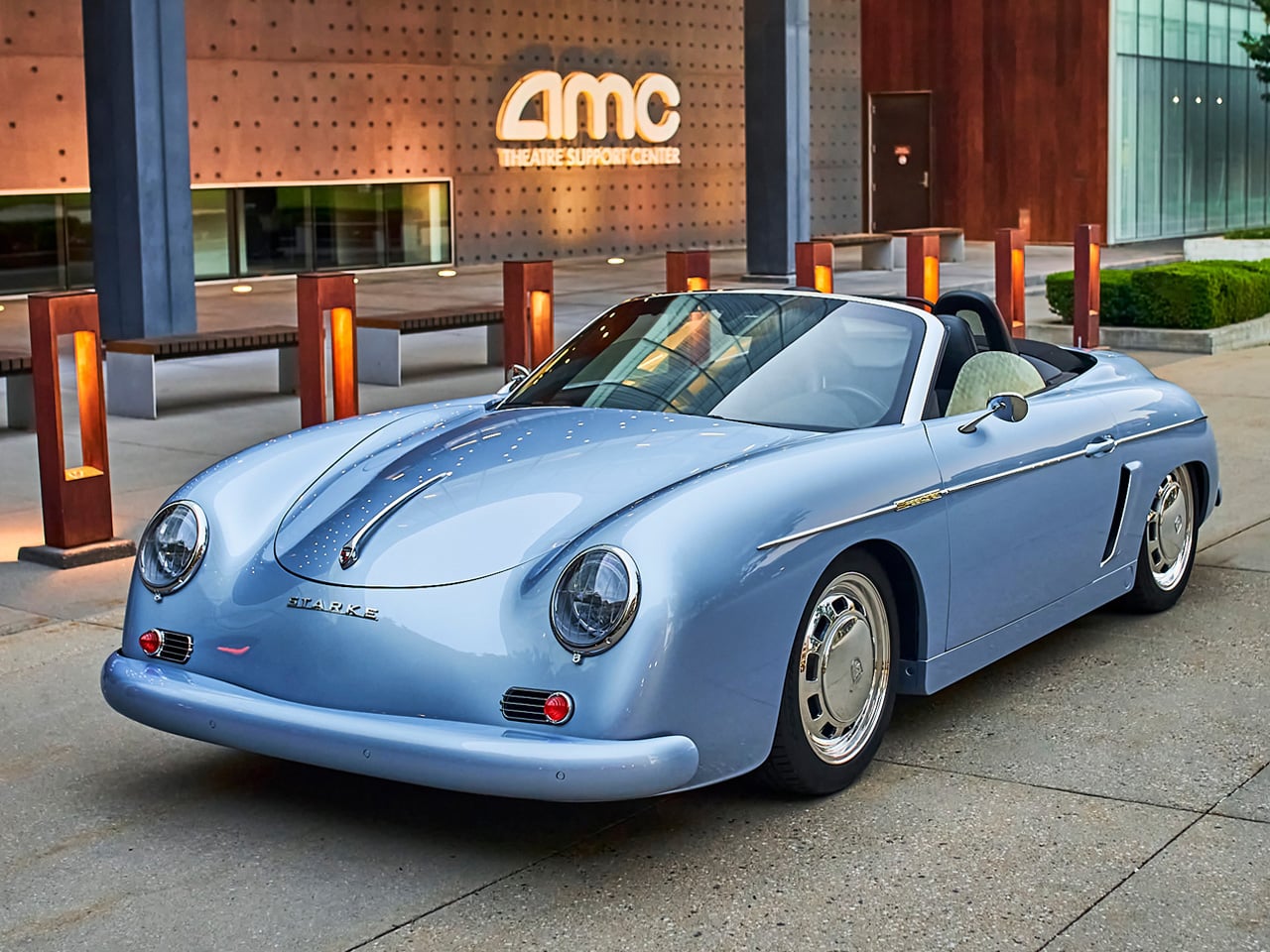
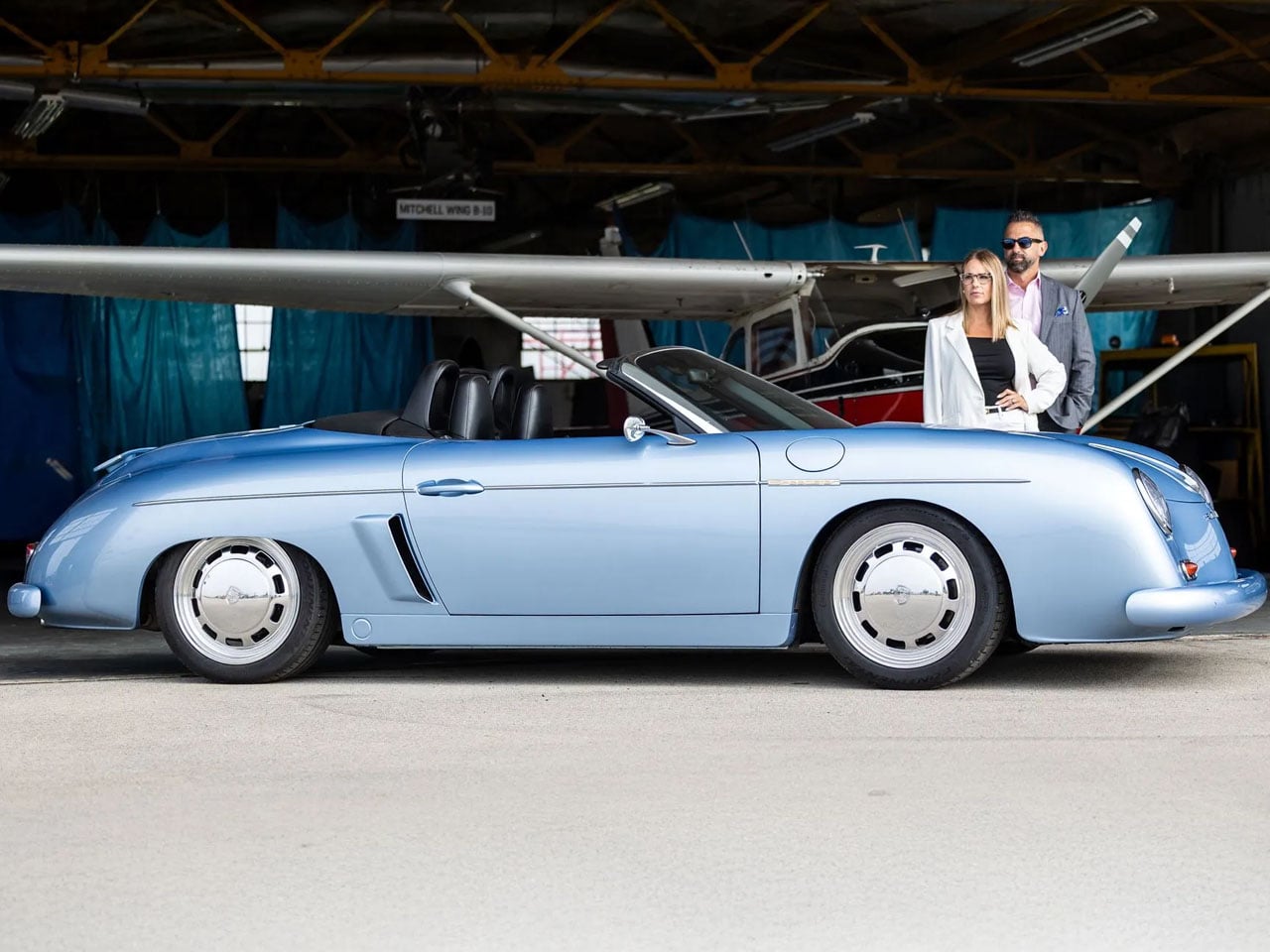
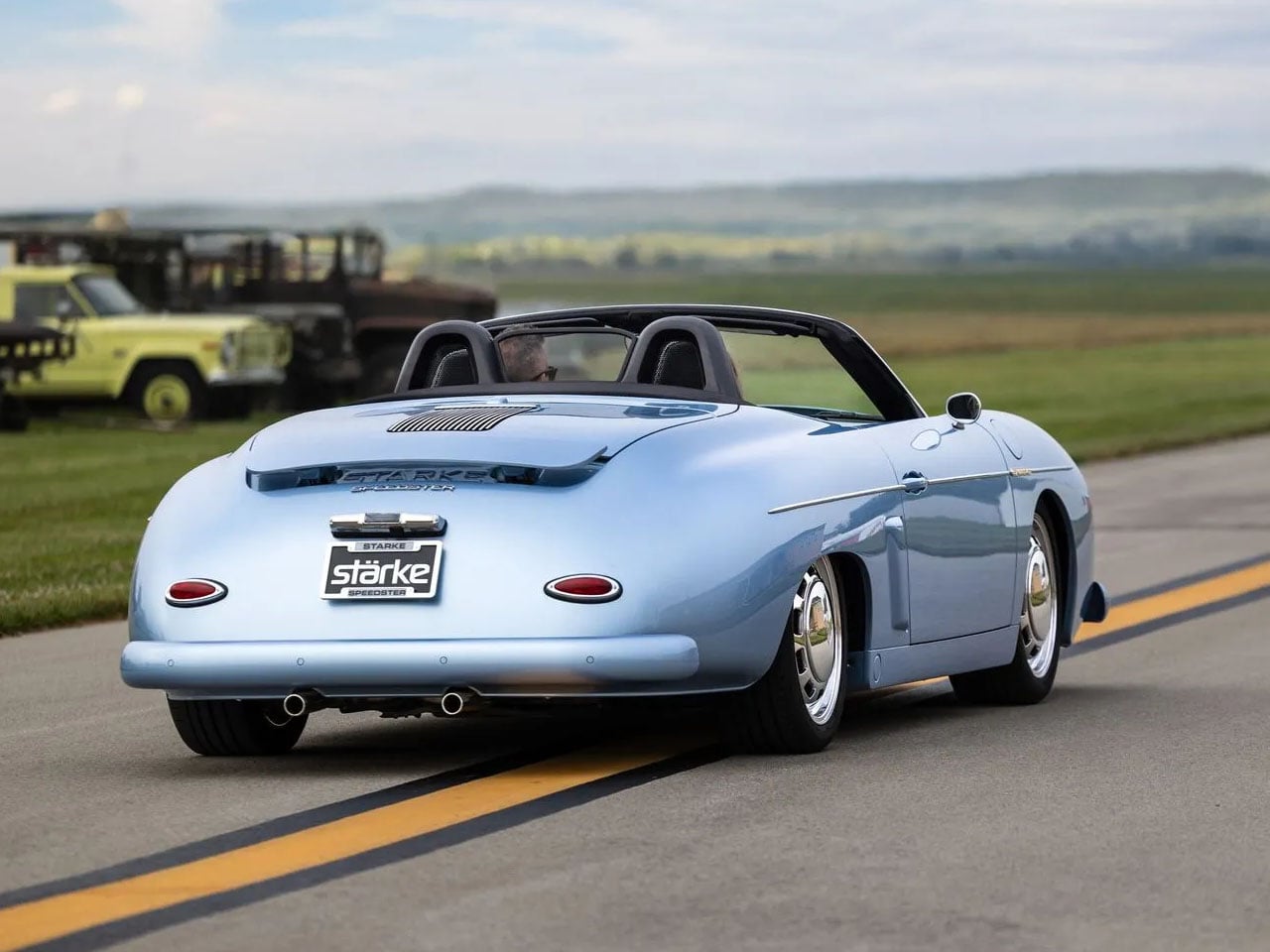
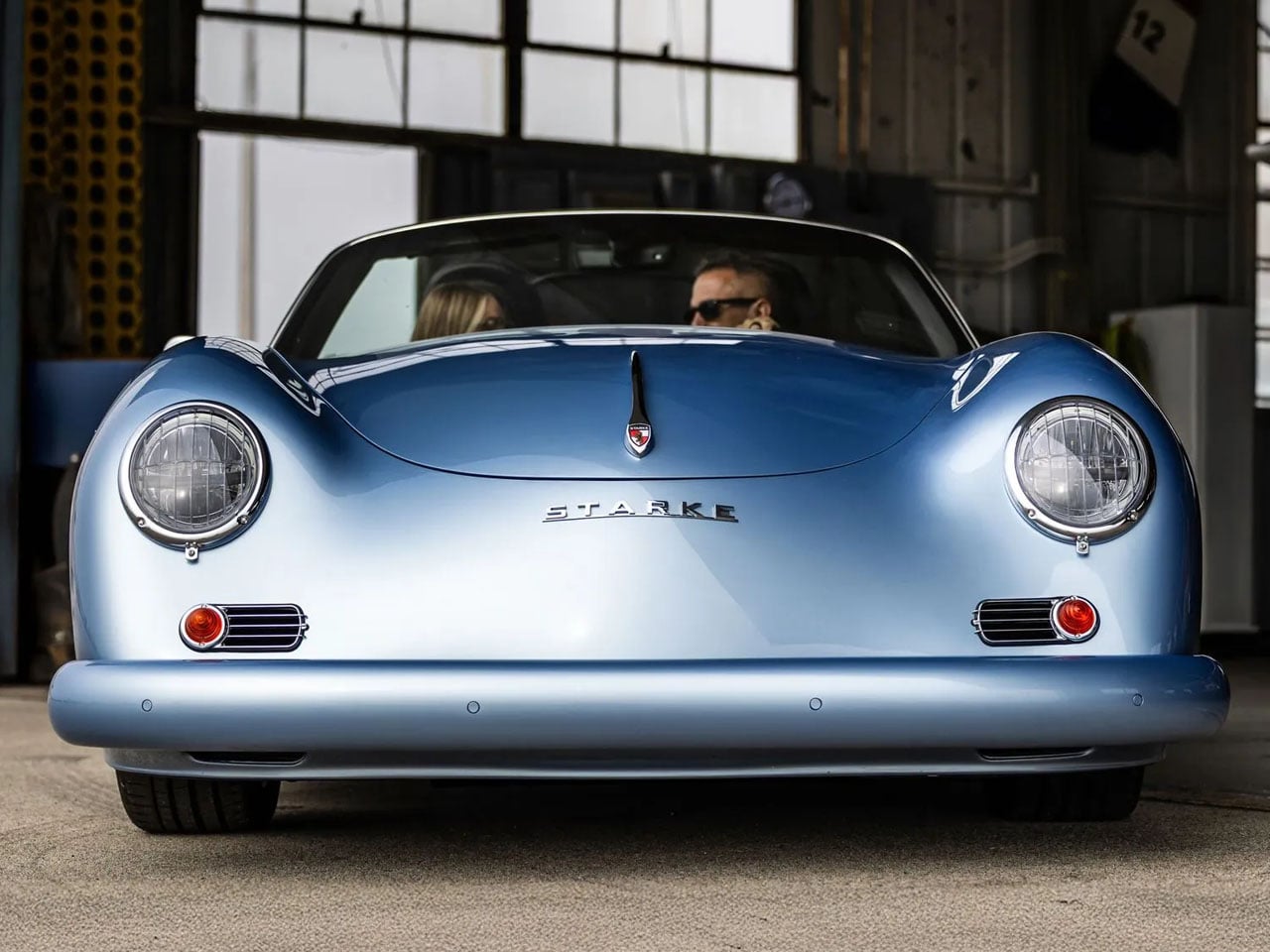
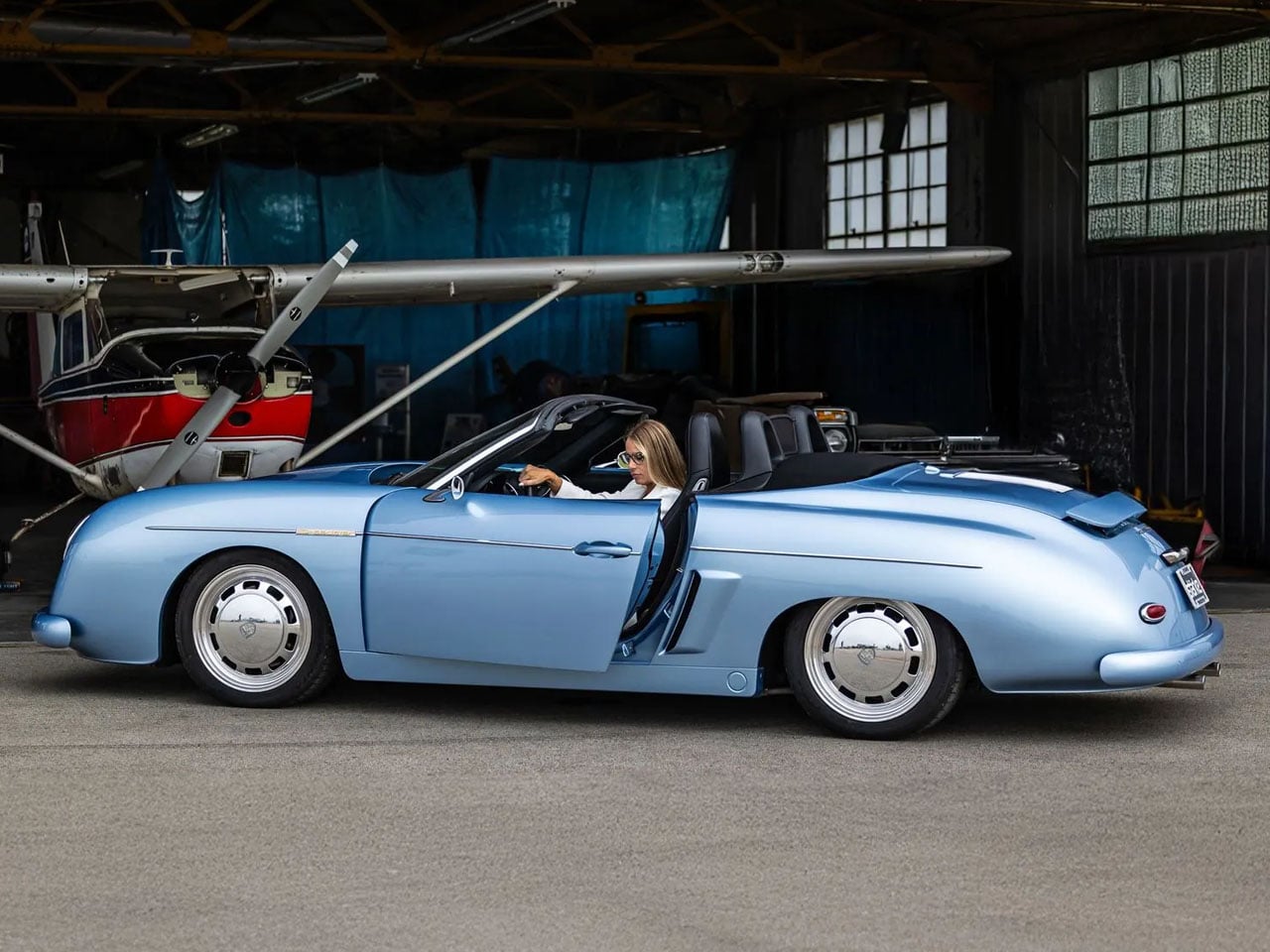
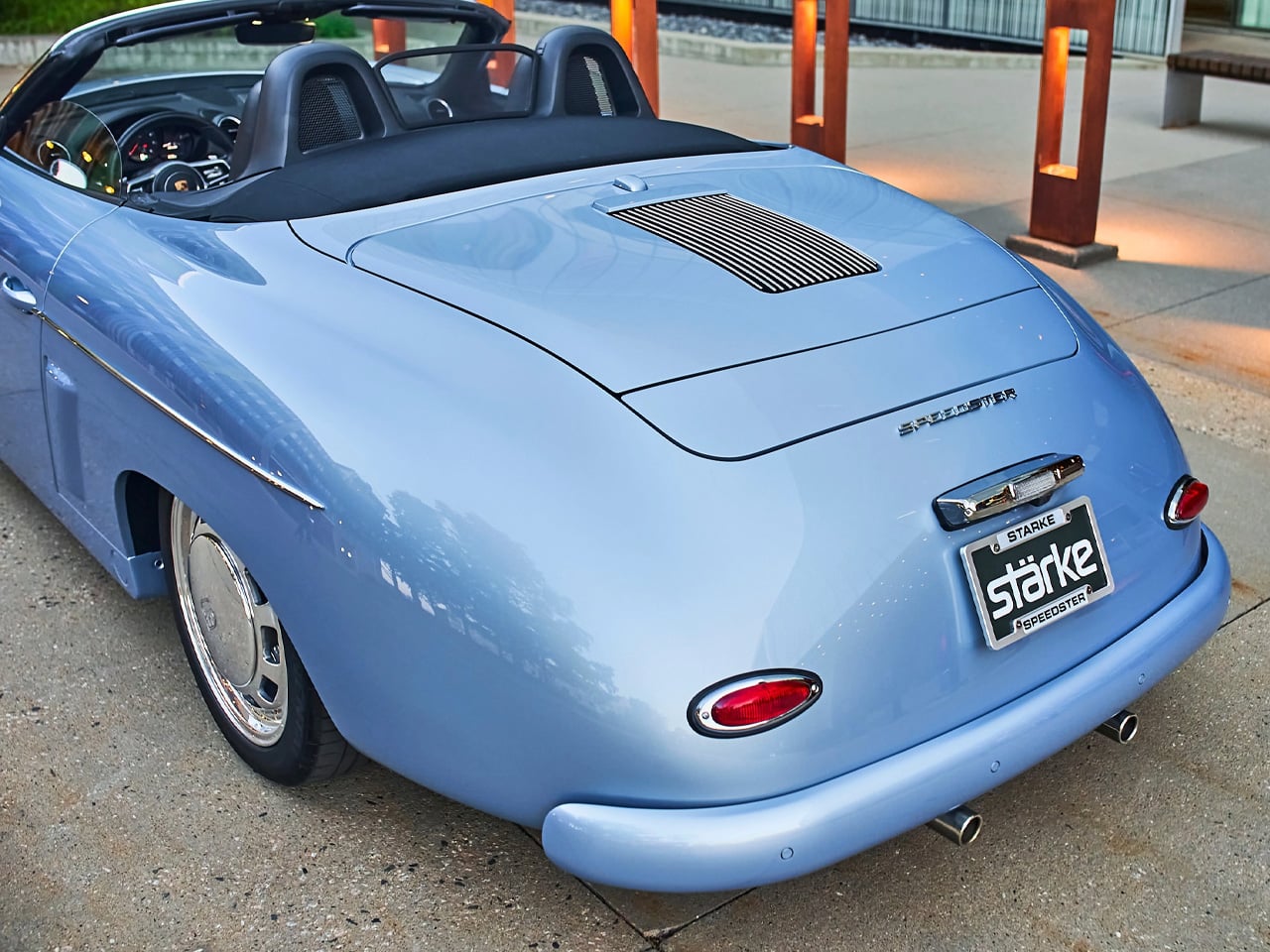
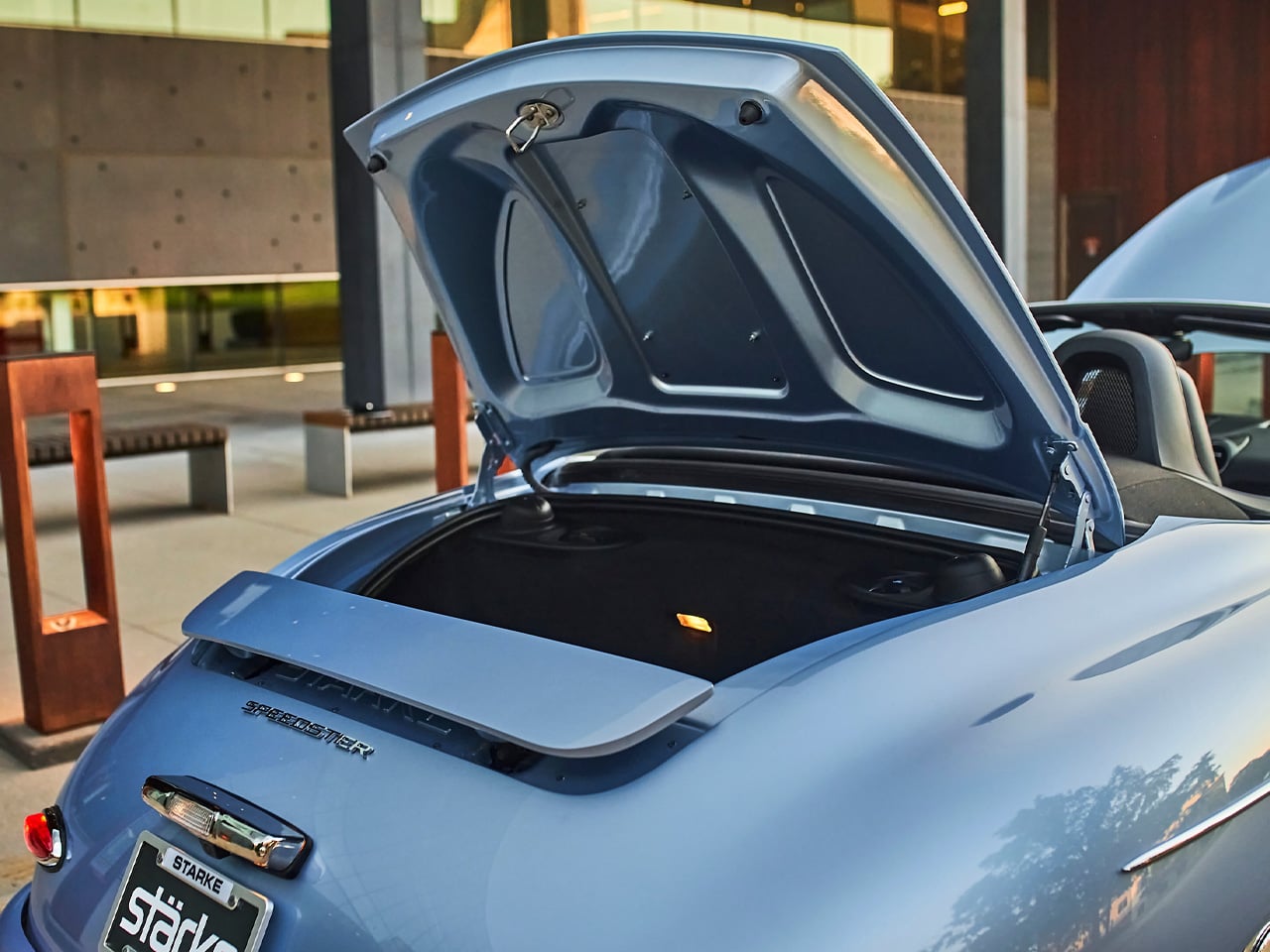
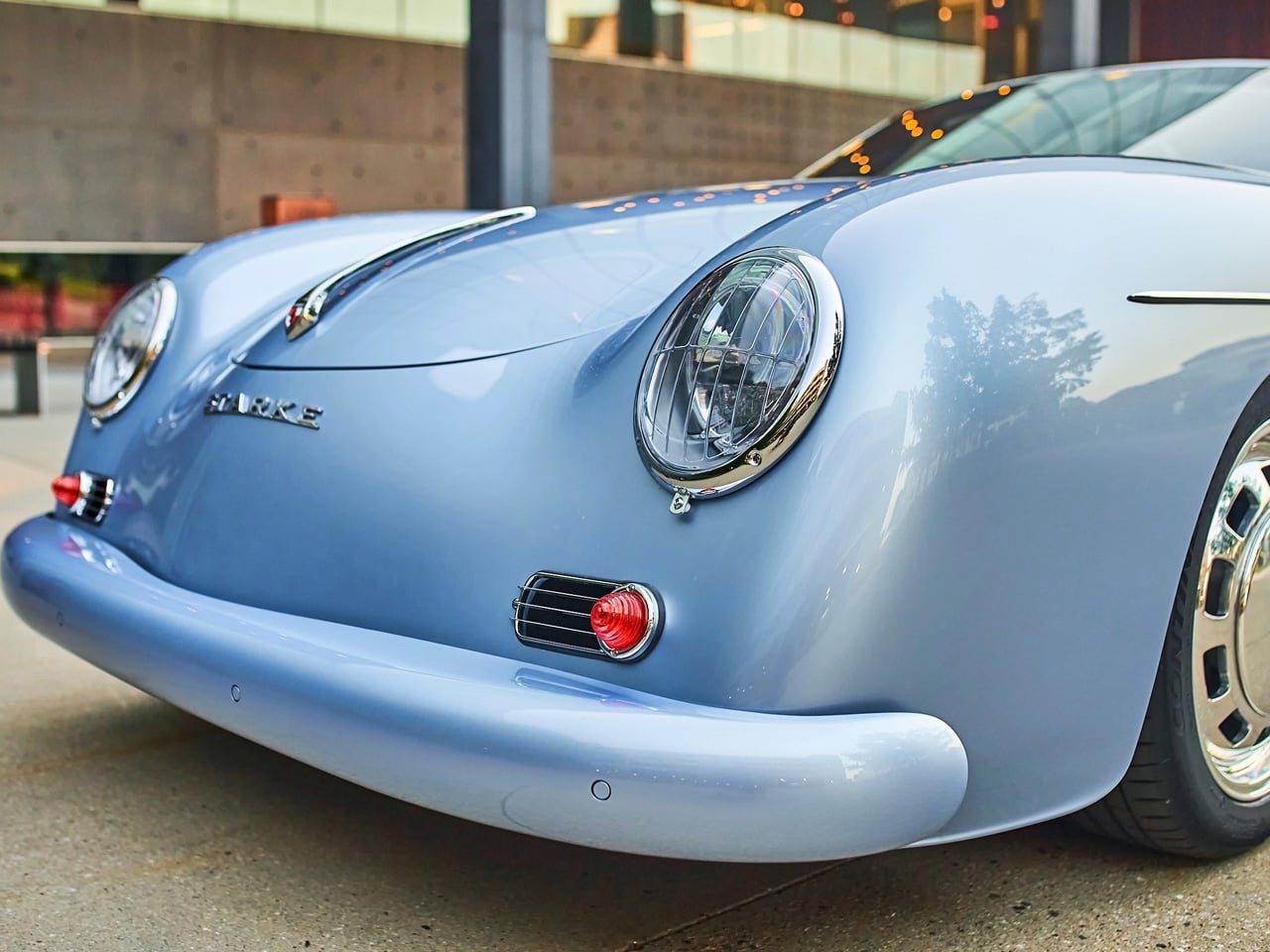
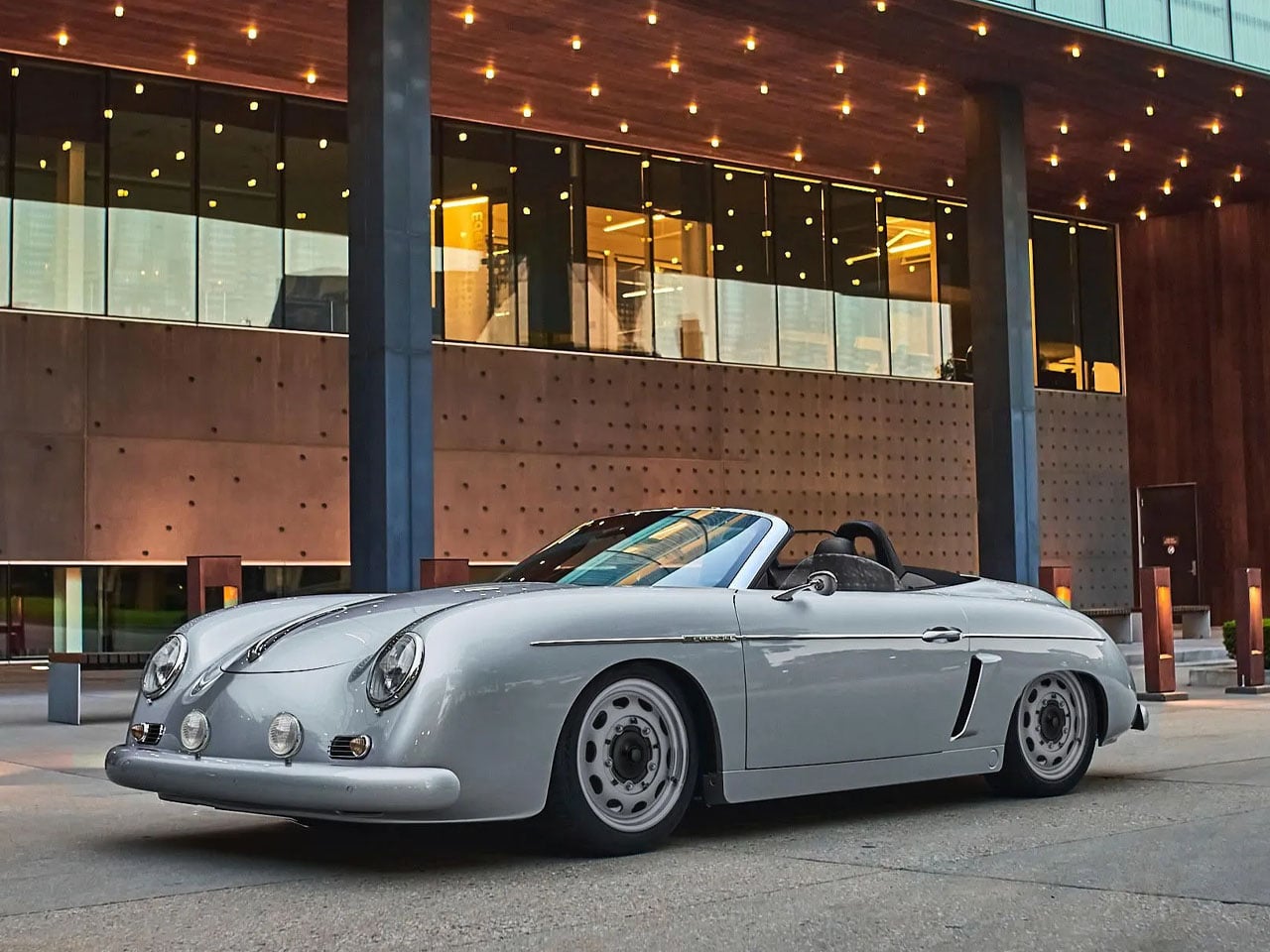
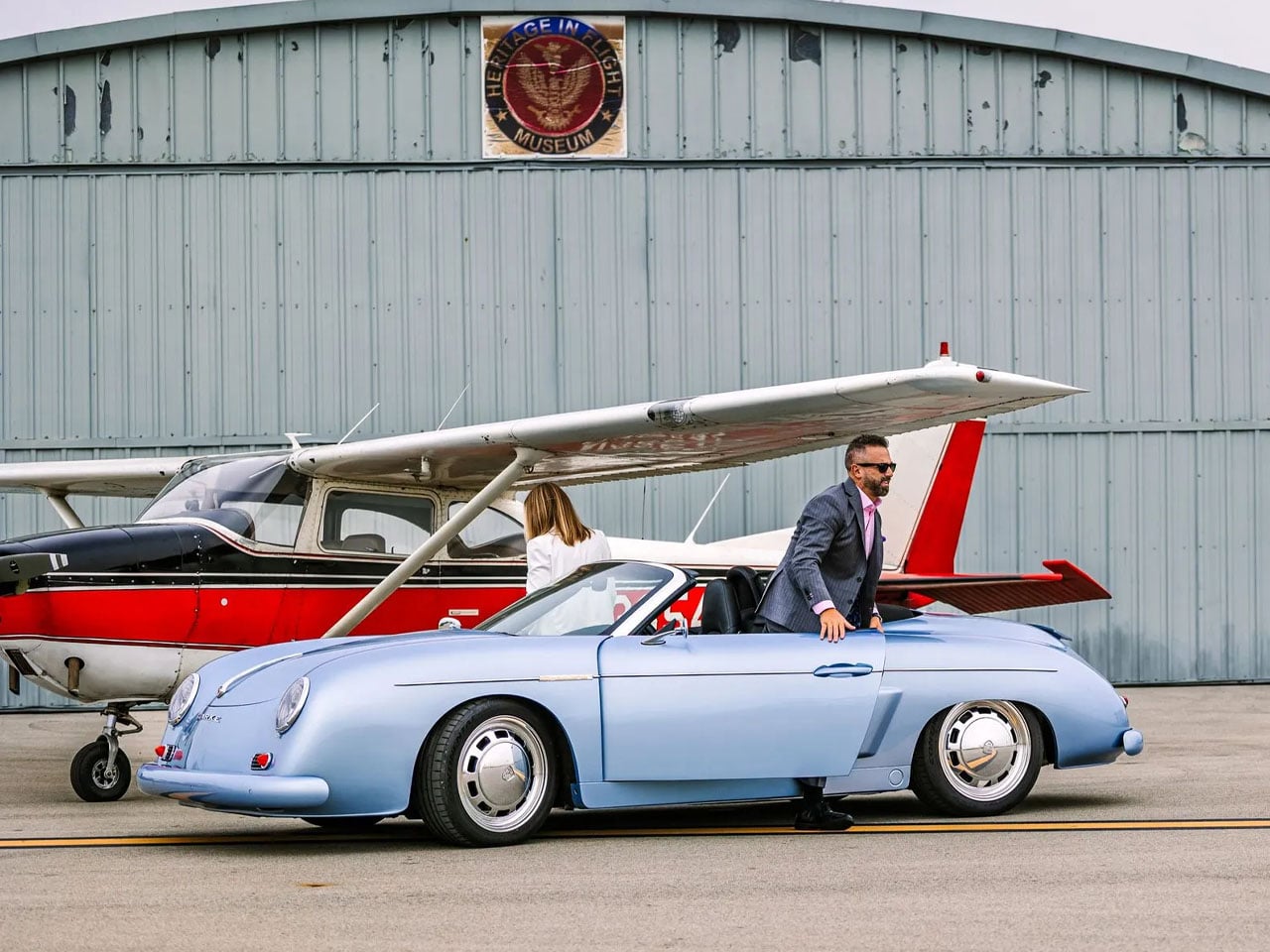
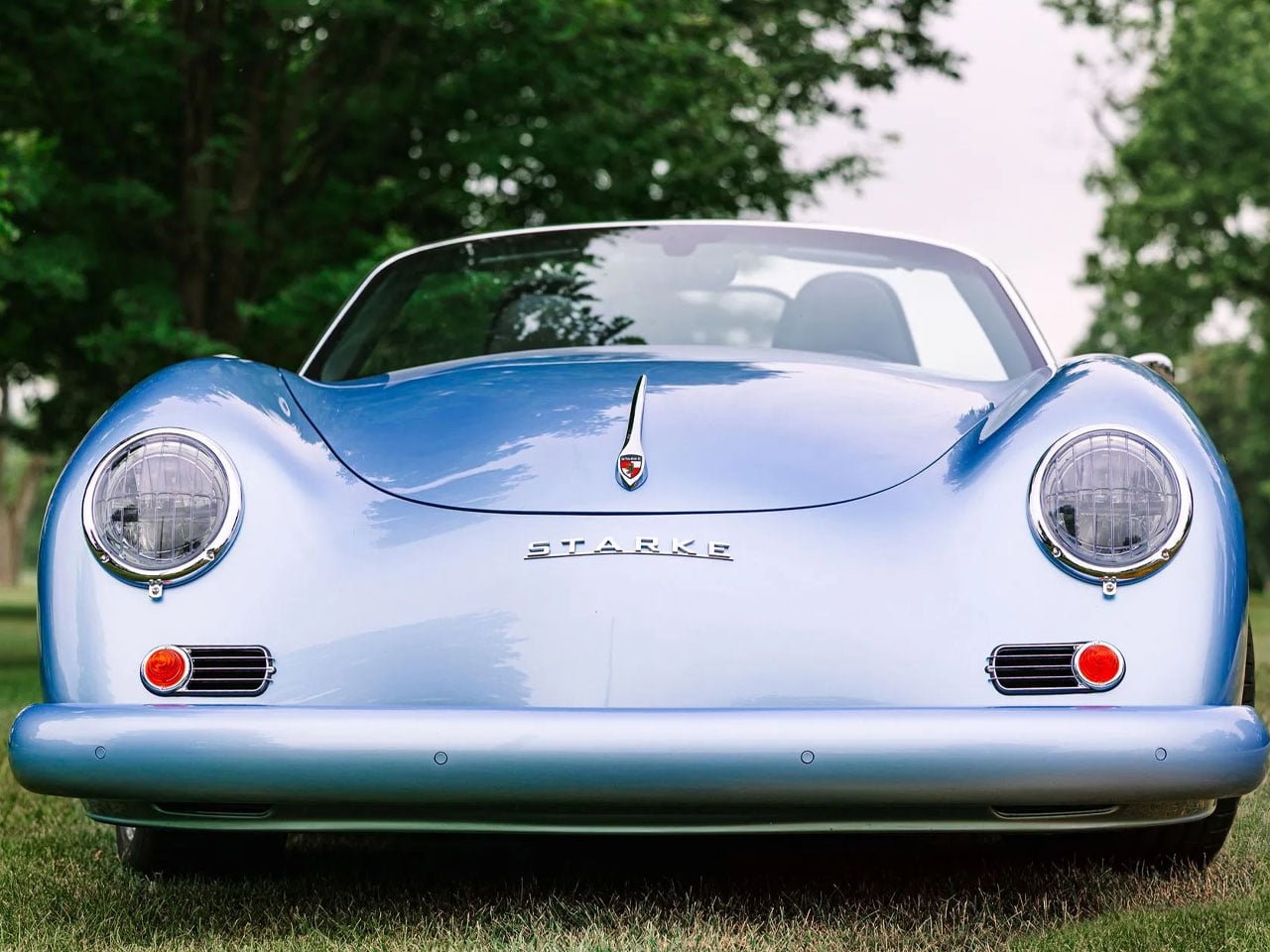
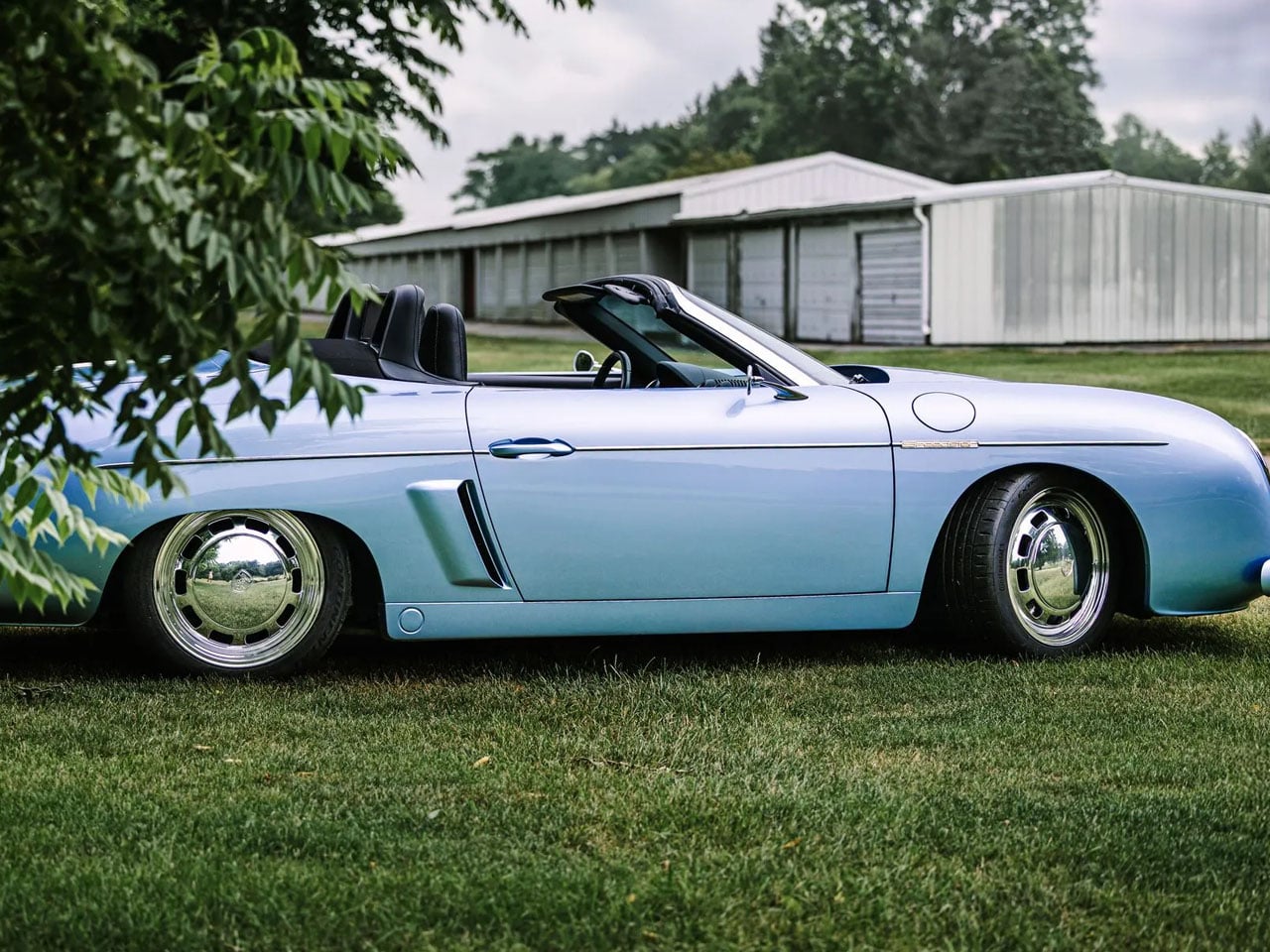
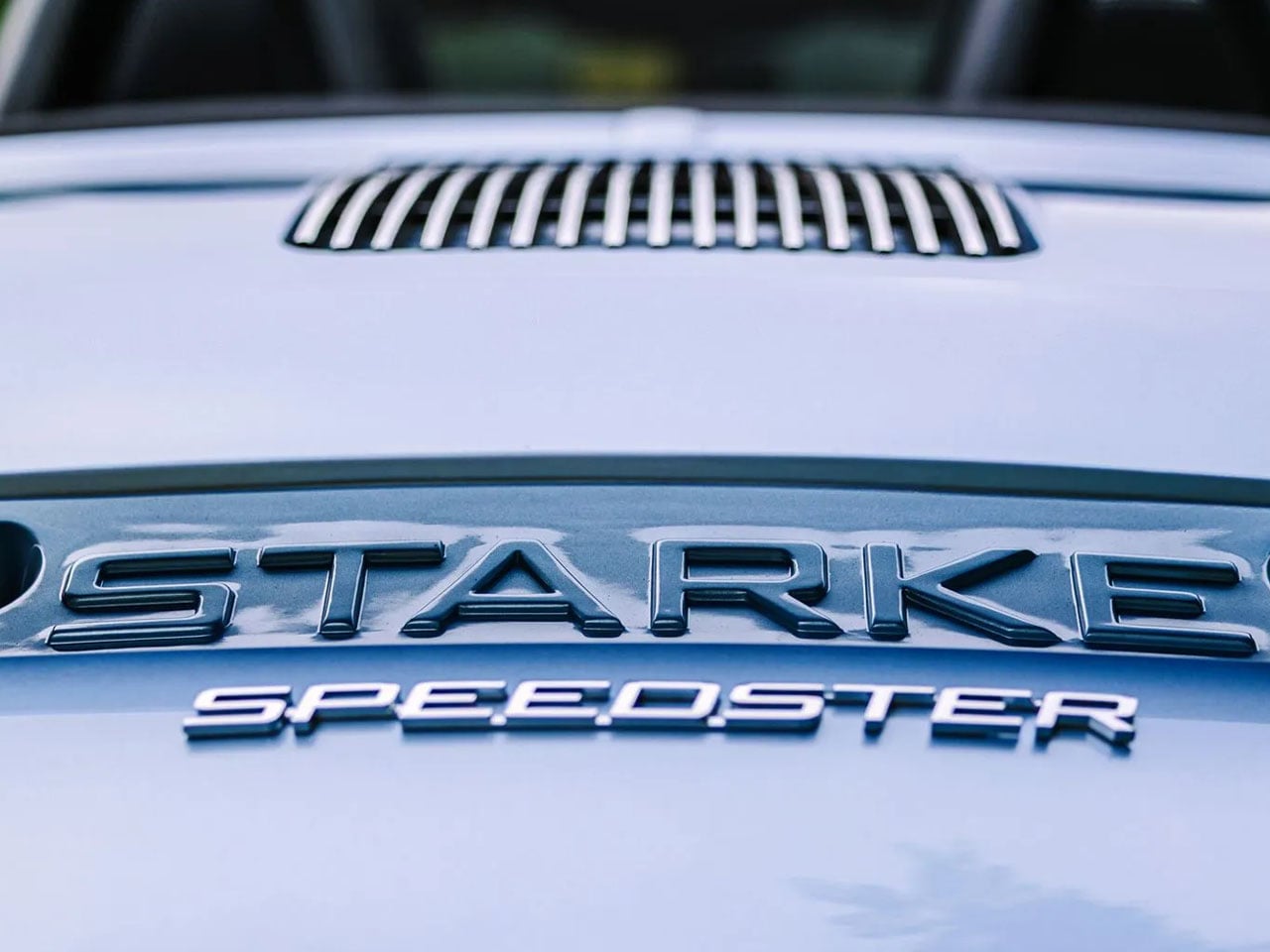
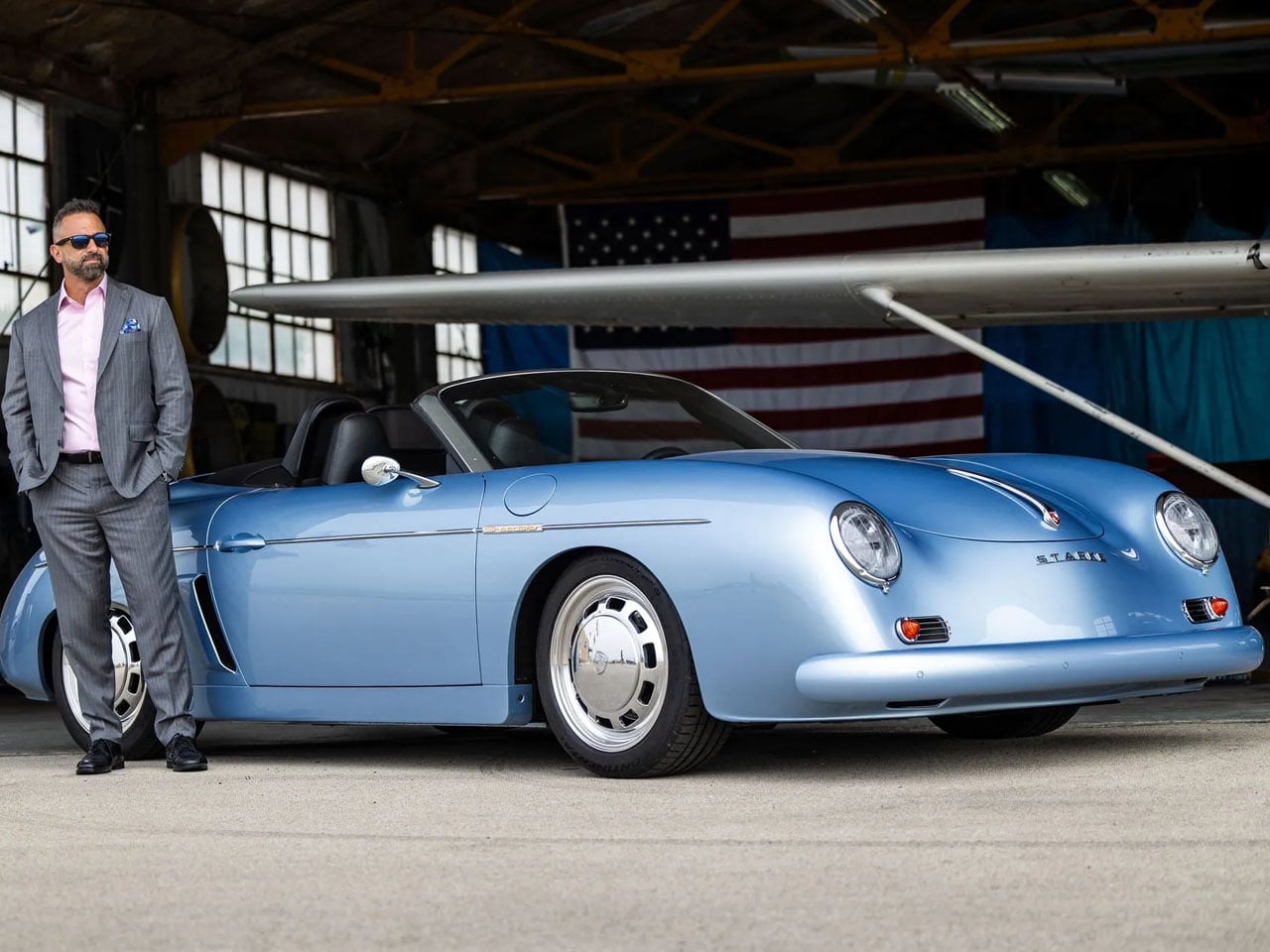
Stärke Motor Company didn’t want to create something that every other automaker is doing. Their ambition is to fuse classic performance four-wheeler vibes and modern features into a vehicle that is hard to miss on the streets. Meet the Gen 2 Speedster that looks like the Porsche 356 dupe (it actually is), albeit a little longer and having a lower ride height than the all-time classic.
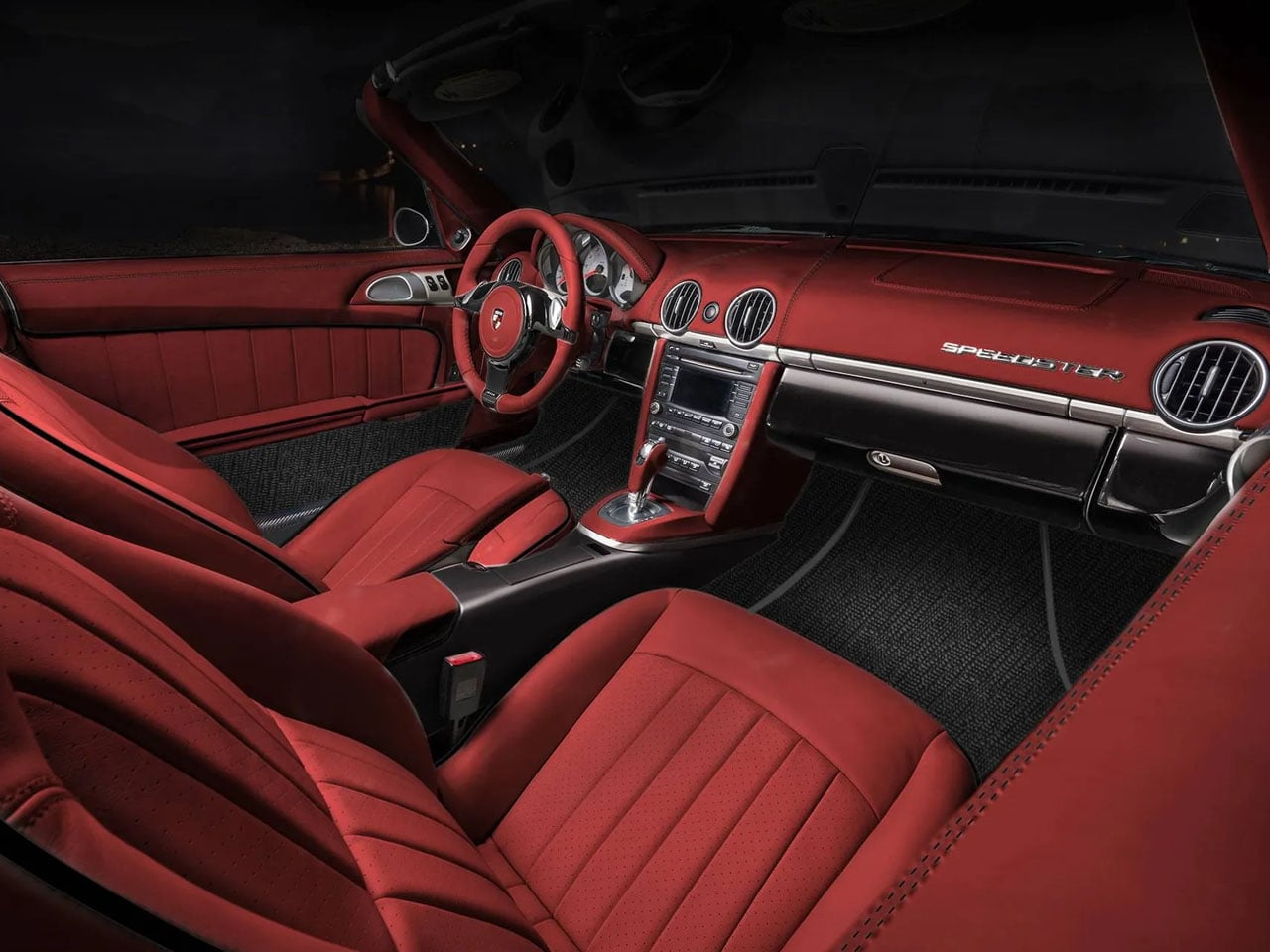
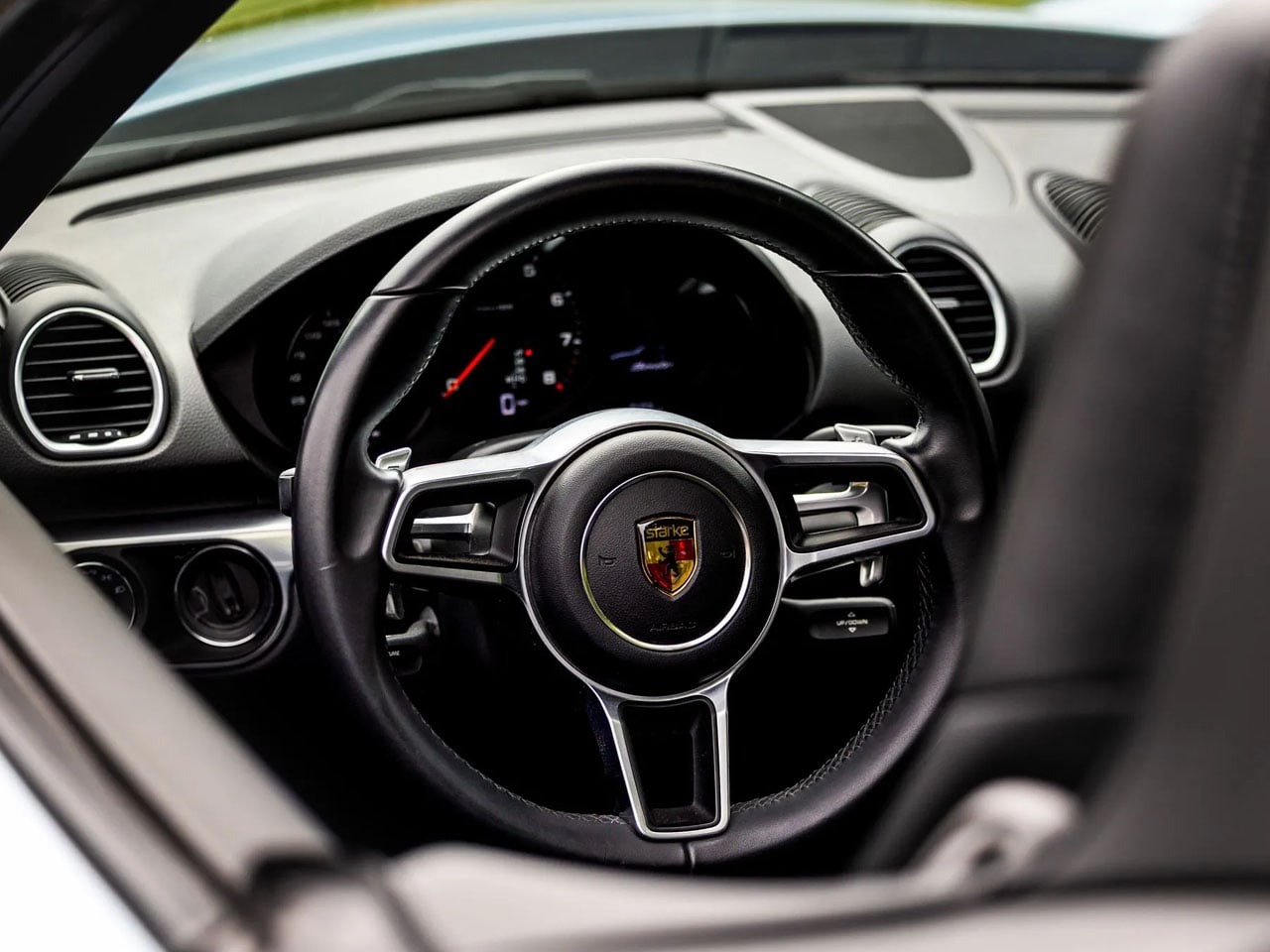
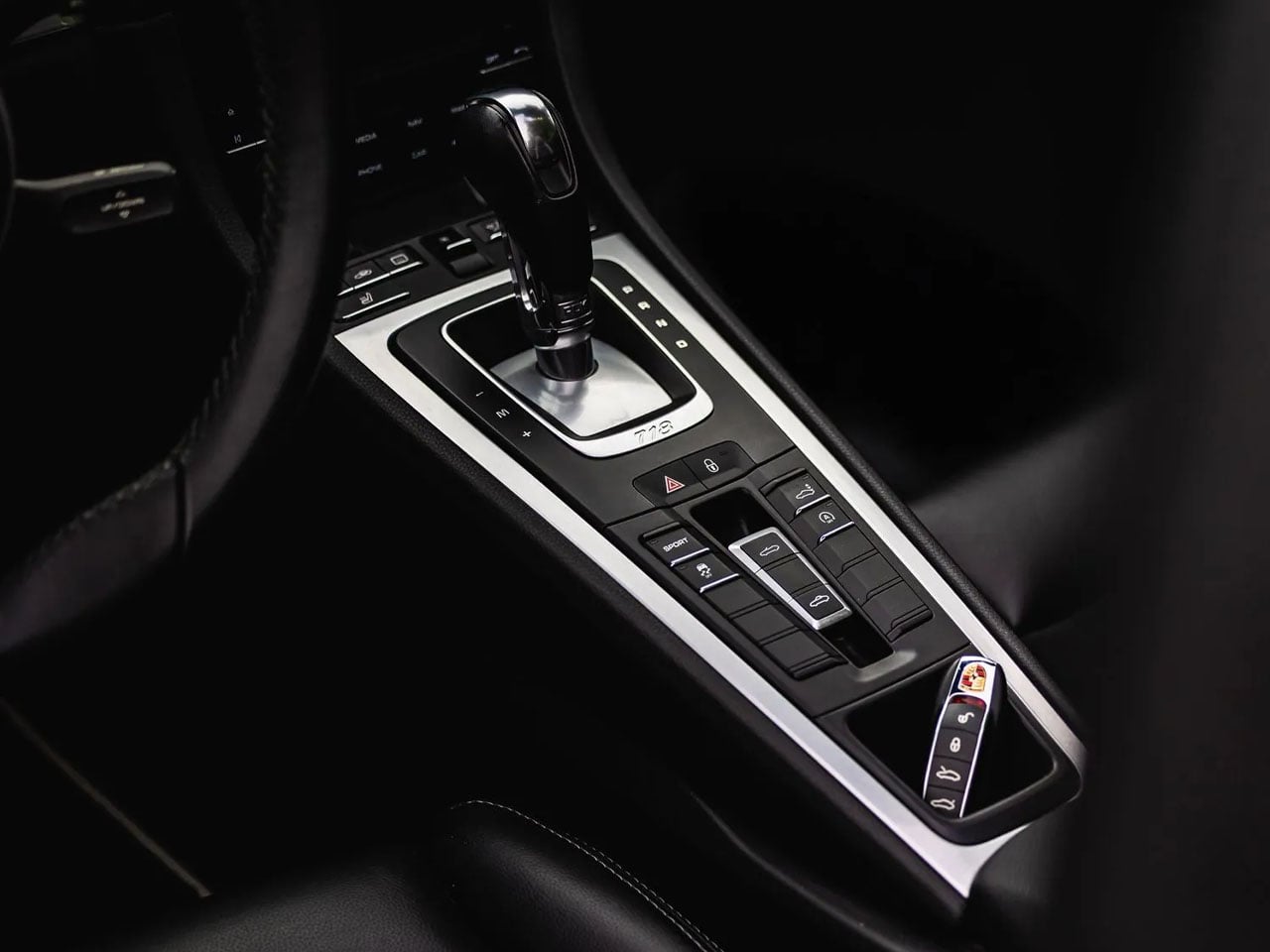
The retro-inspired roadster borrows the look of a 1950s classic while bringing the comfort and drivability of a modern Porsche into a hand-built car that time-travels. Infact the heart of the Gen 2 Speedster is a 2017+ Porsche 718 Boxster platform with the chassis of the original making up for the structure. The real magic happens with the custom-fit interiors and other body components that are 3D printed to fit the 718 chassis. The brain of this damsel is the optional turbocharged flat-fours, or the naturally aspirated 4.0L flat-six. Buyers can choose from a 6-speed manual, or a 7-speed PDK transmission.
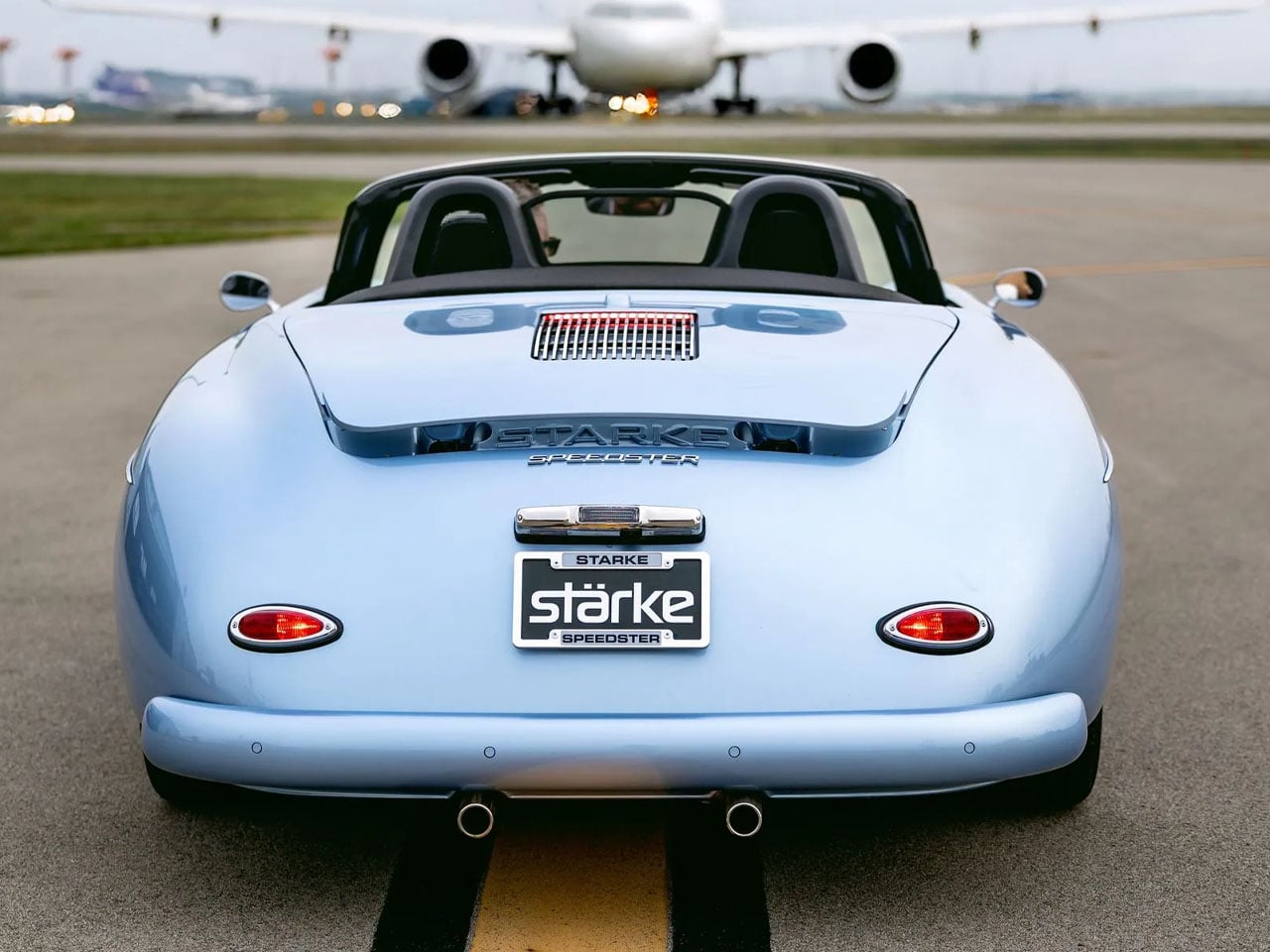
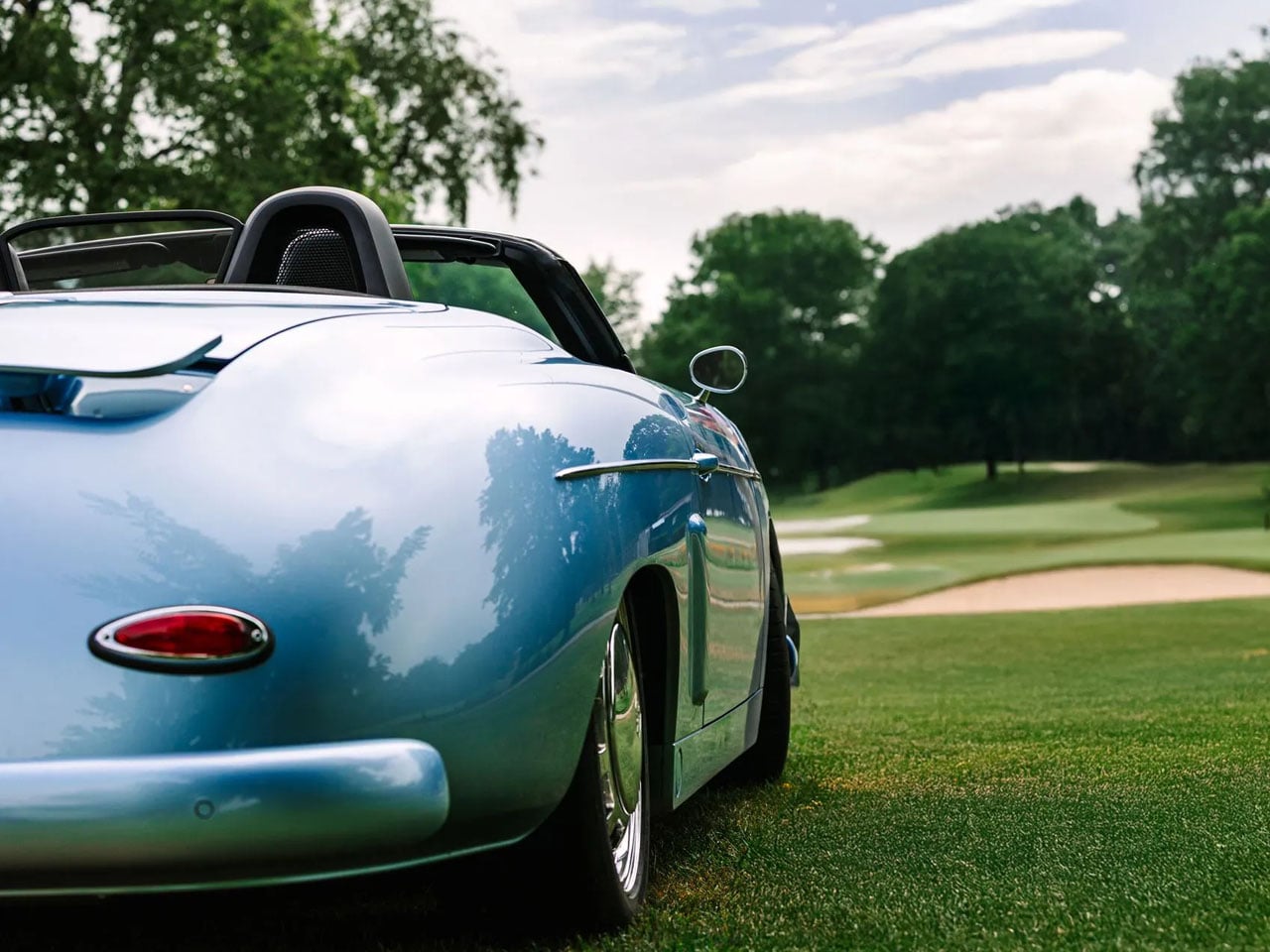
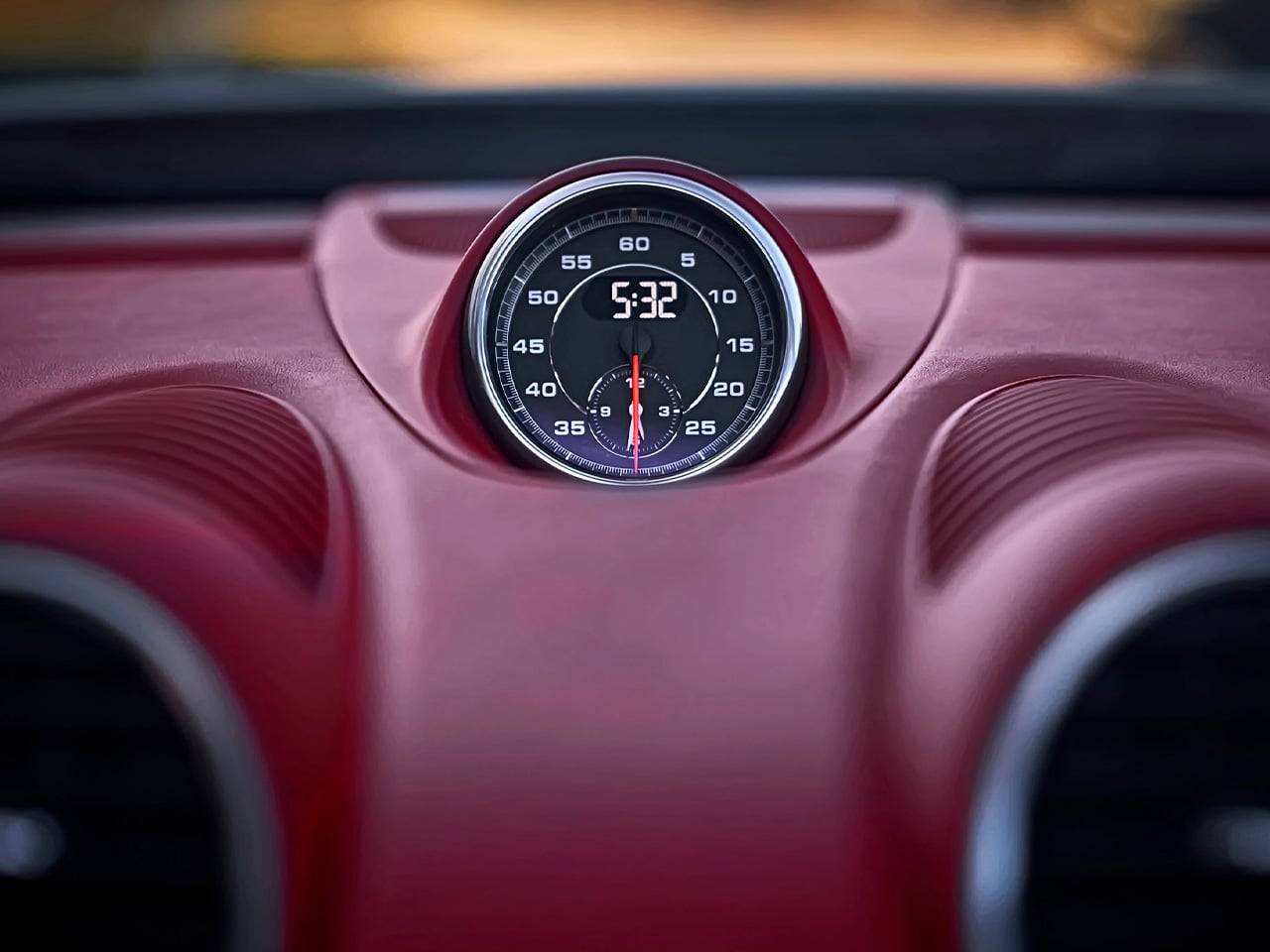
Gen 2 Speedster retains the old school vibe of the bumpers, round headlights, and oval taillights. The unadorned flanks fit right into the mix, and the low-profile tires lend the car a bit of chalk and cheese aesthetic. On the inside, creature comforts extend to the heated stitched steering wheel and seats, as well as a power soft top. The two-seater also comes with a modern touchscreen infotainment system and full-leather interior in 25 color variants. To keep up with the theme, flooring can be customized, too.
Given that the Gen 2 Speedster lives up to its bespoke aura, interested buyers can get the roadster done in their theme and liking. There is so much to choose from: the body paint, interior hues, choice of materials, or any other small detail that matters. Customization of that level does not guarantee a steep starting price tag of $135,000. However, if you bring your own Porsche 718, that slides down to $1189,000, which by no means is cheap either. Since the roadster will be hand-built, it will take a time of 6 months for delivery.
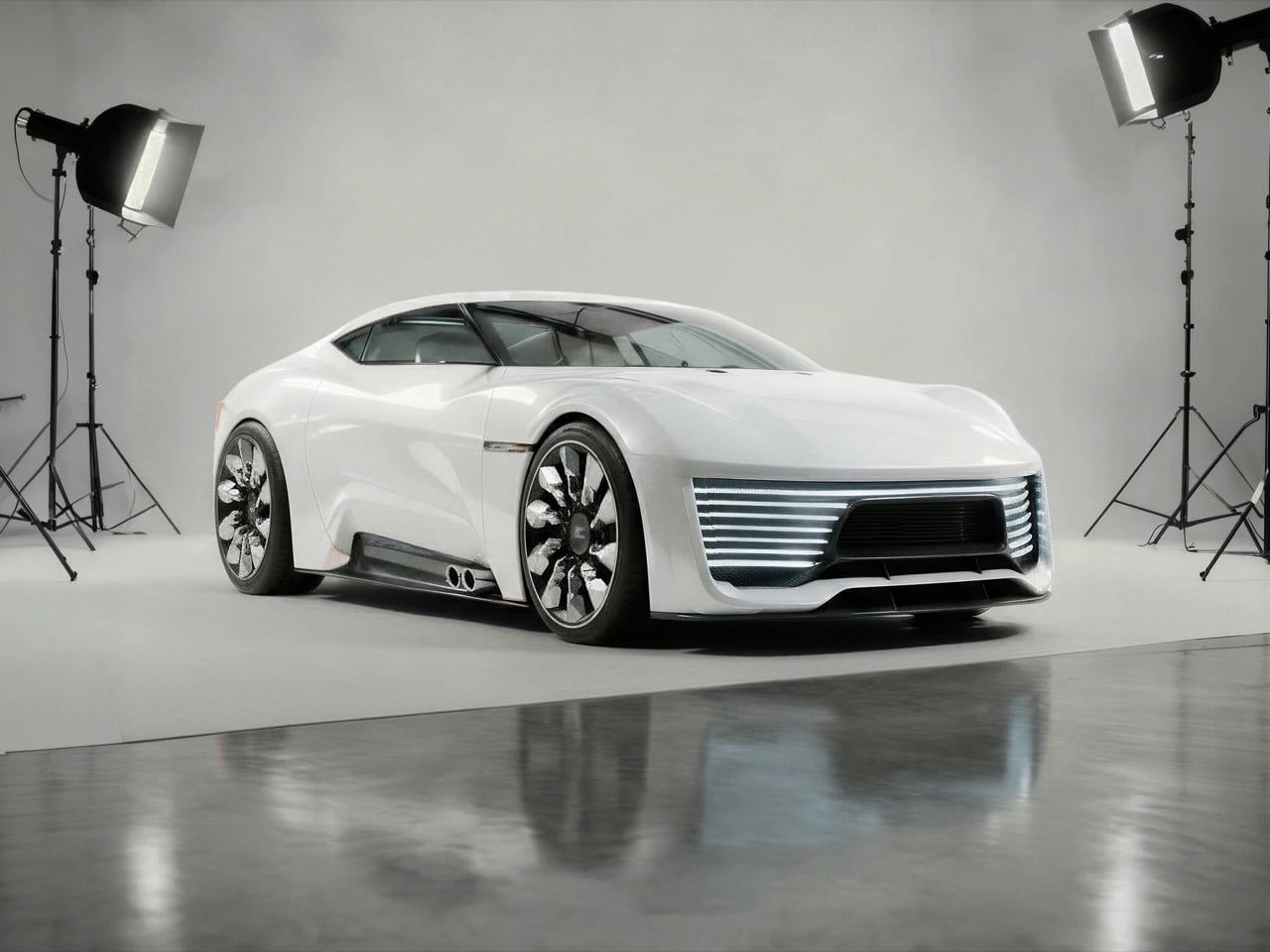
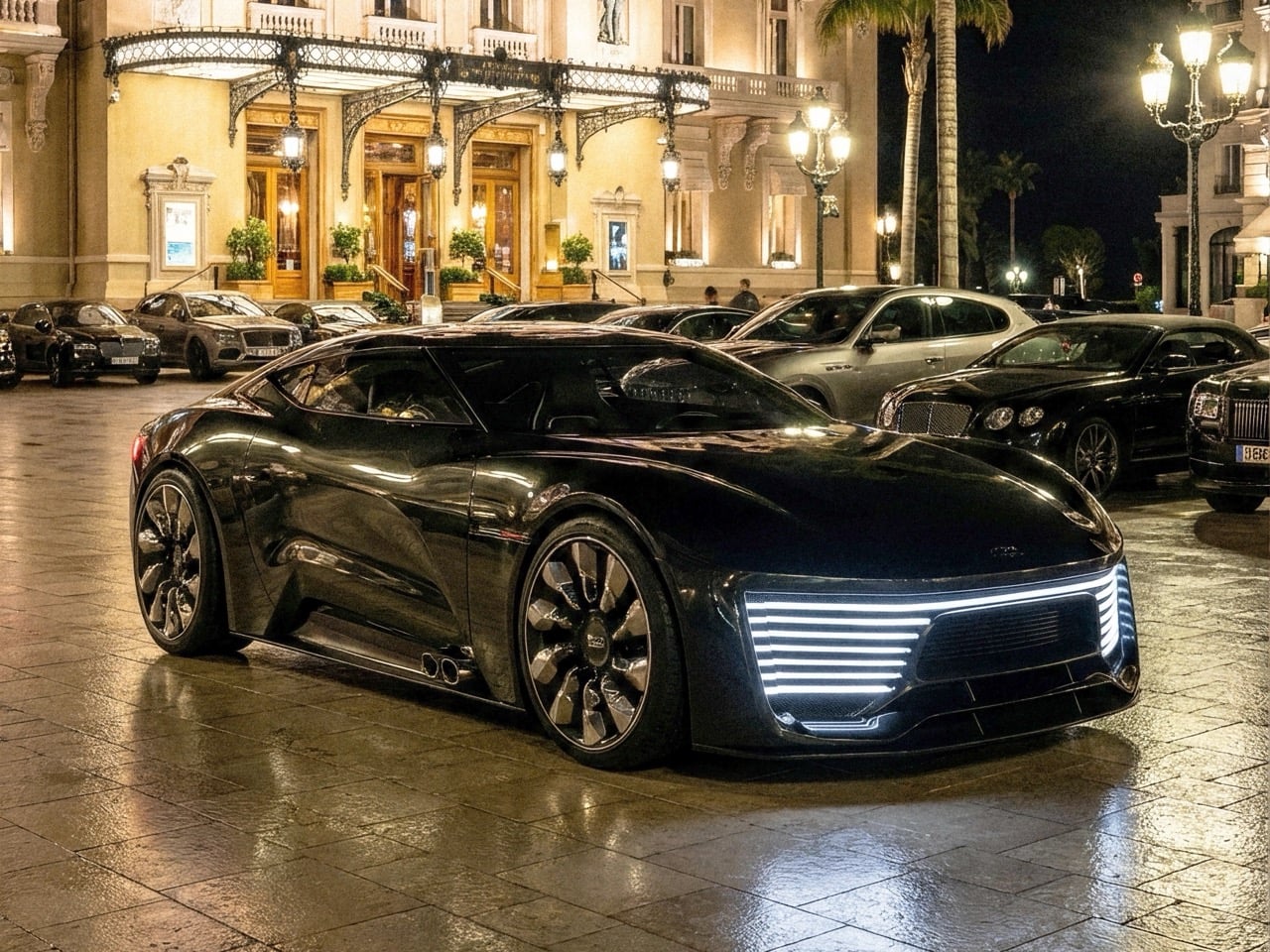
Modern luxury automotive design has developed a visual shorthand. Horizontal LED treatments. Fastback silhouettes. Minimalist interiors dominated by screens and ambient lighting. The AC Luxury GT by Alex Casabo takes this established vocabulary and speaks it fluently, proving that working within constraints doesn’t mean sacrificing identity.
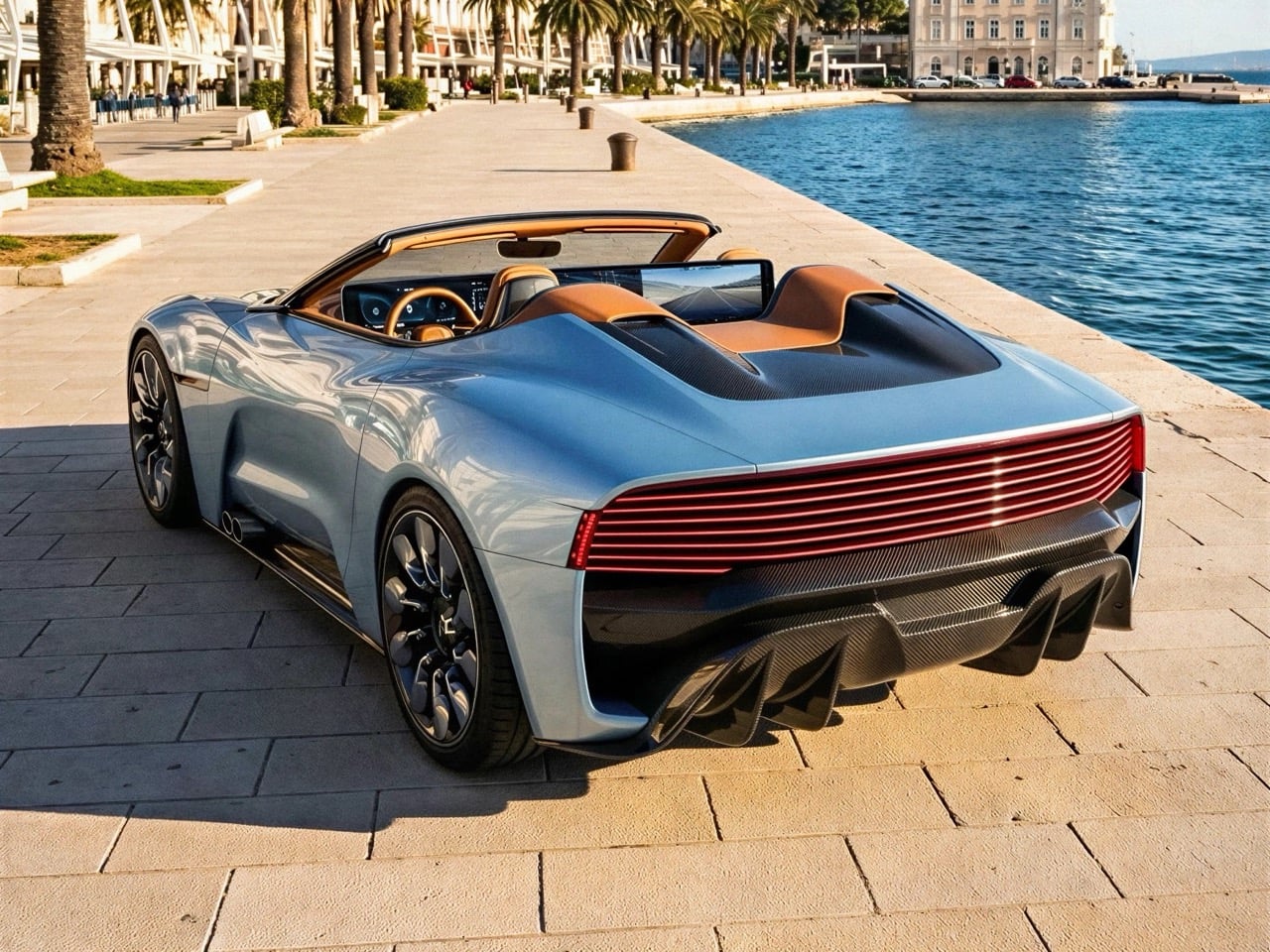
The car presents a masterclass in thematic consistency. Those layered horizontal light bars don’t just appear on the front fascia and disappear. They inform the wheel design, echo in the rear lighting, and establish a rhythmic visual language that unifies the entire form. It’s the kind of disciplined approach that separates thoughtful design from hasty pastiche. Rendered in both sterile studio environments and glamorous European backdrops, the AC Luxury GT maintains its composure. Some concepts need drama to convince you. This one relies on refinement.
Designer: Alex Casabo
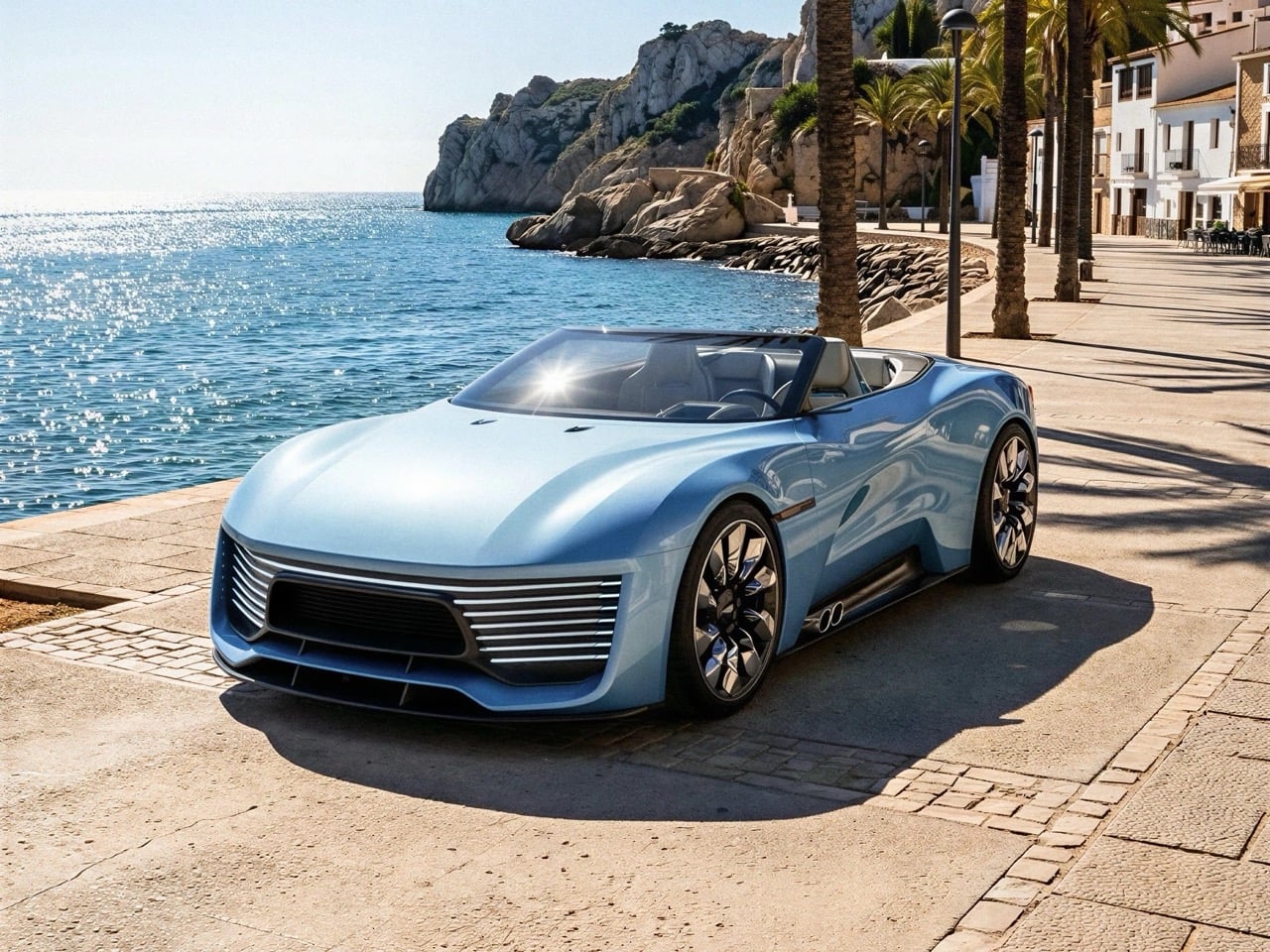
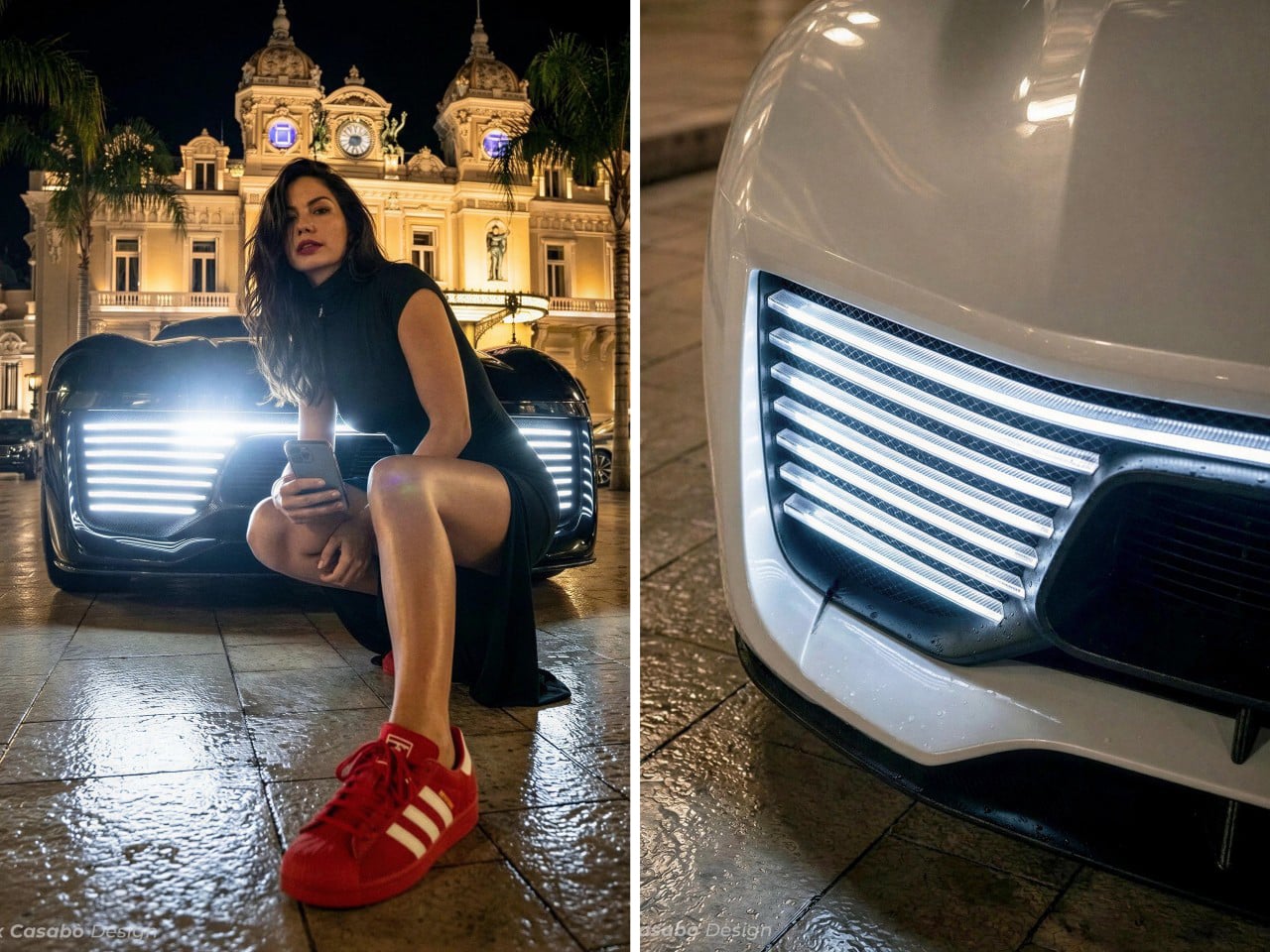
The front end borrows heavily from Lincoln’s recent concept work, particularly that Star concept’s grille treatment where horizontal lines create sculptural depth. But where Lincoln went full theatrical with their execution, Casabo dials it back just enough to feel plausible for 2027 production. The striated LED treatment works because it’s geometric without being fussy, creating genuine visual interest through light and shadow play rather than relying on complex surface modeling. Stand this next to a Hyundai Ioniq 5 and you’ll spot the parametric pixel influence immediately, but the AC Luxury GT translates that Korean confidence into something that reads distinctly more Western luxury.
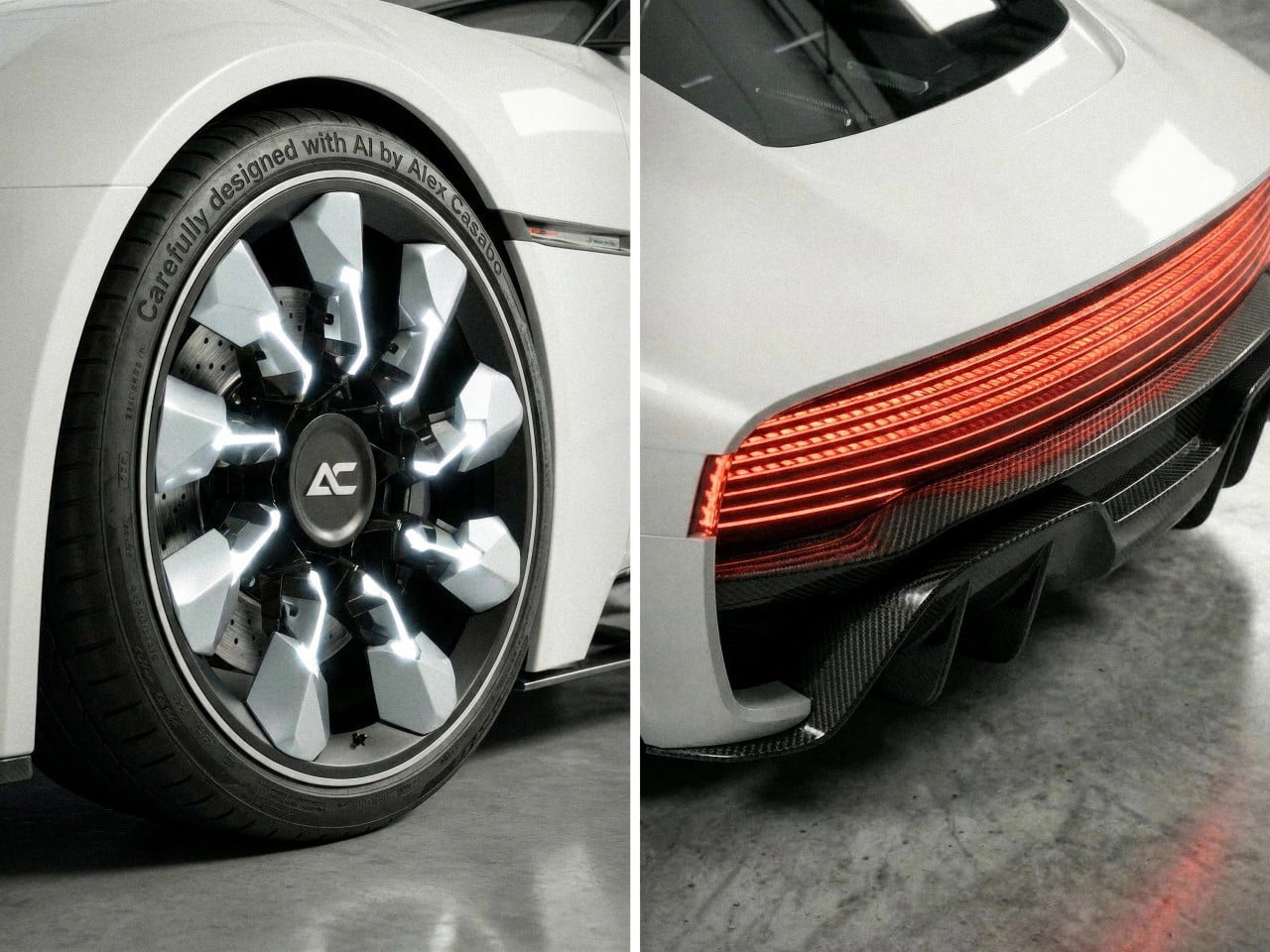
The wheels, however, are pure concept car audacity. Illuminated elements integrated into the spokes, geometric cutouts that would make any aerodynamicist nervous, and proportions that suggest this thing rolls on 22s minimum. They’re completely impractical for production and utterly perfect for their intended purpose. The “AC” logo on the steering wheel appears on the wheel centers too, maintaining brand consistency in a way that feels intentional rather than slapped on. You can almost hear the tire noise those open spoke designs would generate at highway speeds, but that’s tomorrow’s problem.
The fastback roofline creates a silhouette that splits the difference between grand tourer and luxury sedan. There’s cab-forward proportions here that suggest electric skateboard platform packaging, which makes sense given the visual language Casabo is working within. The rear haunches have just enough muscle to suggest performance credentials without veering into Dodge Challenger testosterone territory. Surface transitions are smooth, almost organic, letting the form speak through curvature rather than aggressive character lines. It’s a very 2020s approach to surfacing, this idea that restraint signals confidence.
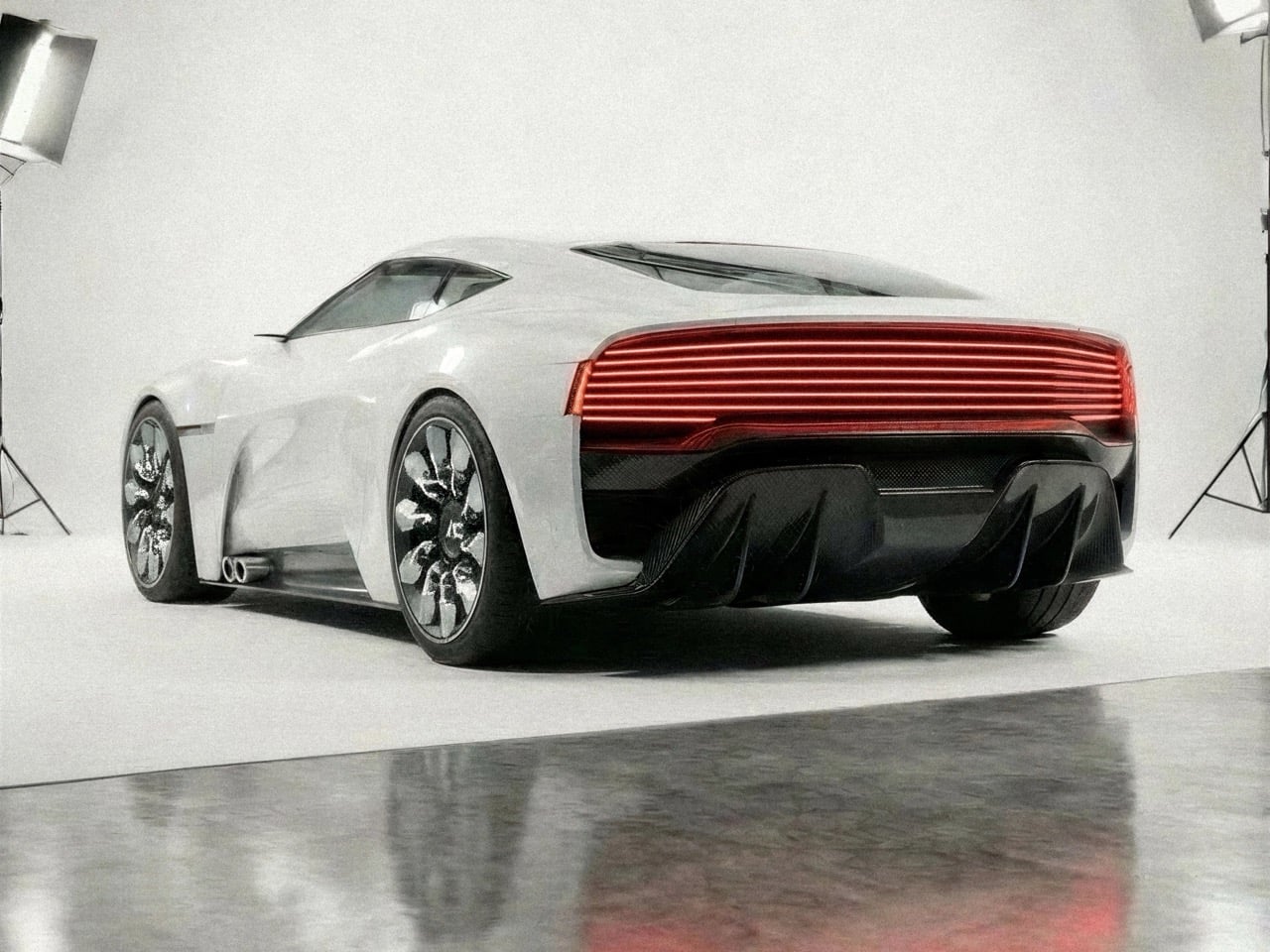
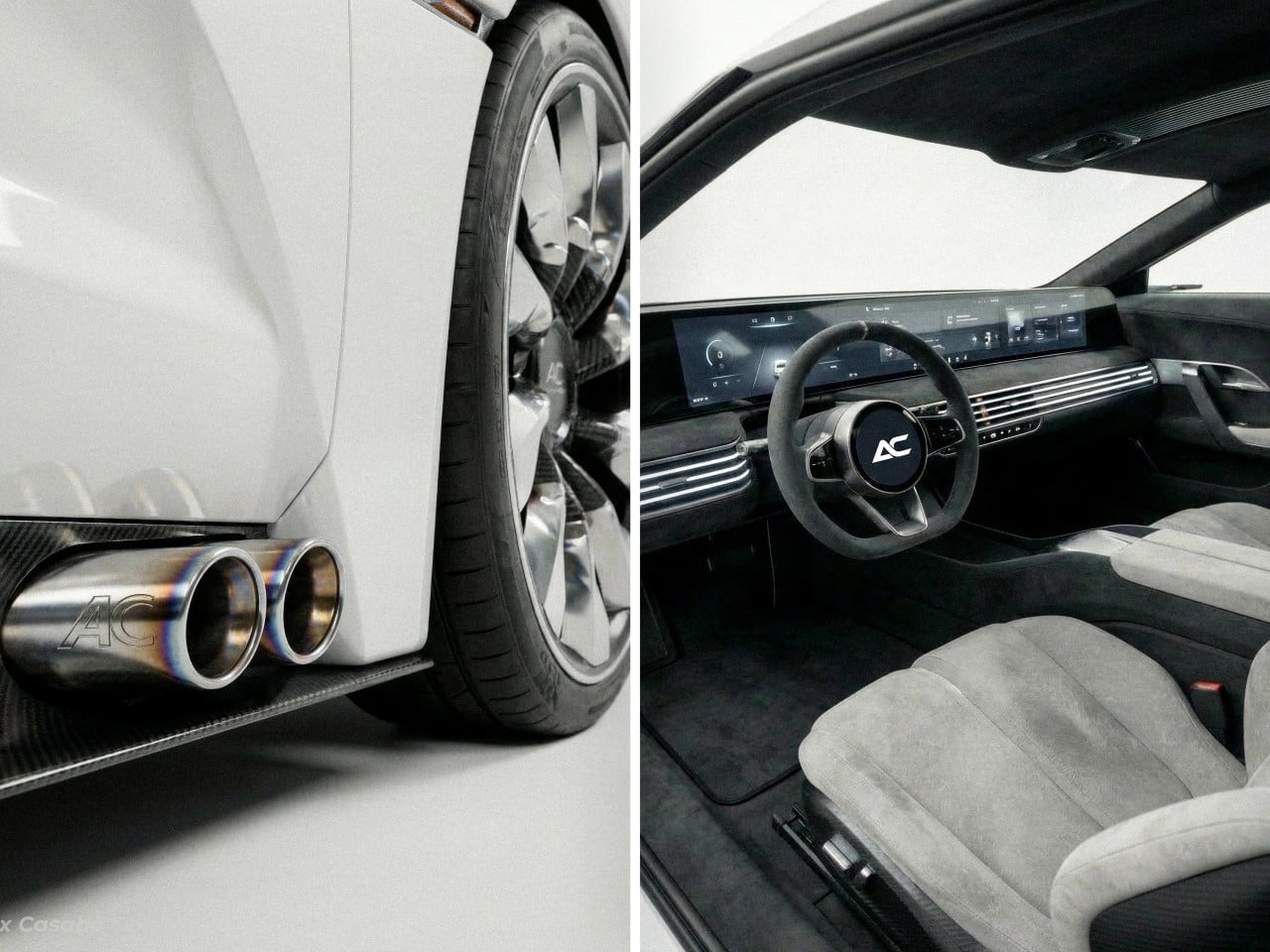
That rear lighting treatment deserves its own discussion. Full-width taillight bars have become the luxury car equivalent of a required signature, but the horizontal striations here give it actual depth and texture. The way light filters through those layers creates genuine visual complexity, transforming what could have been a generic LED strip into something with presence. Below it, that carbon fiber diffuser and quad exhaust setup (probably fake on an EV, but we’ll suspend disbelief) provides the performance visual cues that the rest of the design deliberately avoids. It’s the mullet principle applied to automotive design: serene luxury up top, track-ready aggression below.
The interior (or whatever we can see of it) follows the playbook established by Lucid and Mercedes with their EQ lineup. Horizontal dashboard architecture, integrated screen real estate that flows into the IP rather than bolting on as an afterthought, light materials that suggest Scandinavian serenity over German precision. The steering wheel is refreshingly simple, avoiding the temptation to festoon it with capacitive buttons and haptic zones. Sometimes a wheel should just be a wheel. What’s interesting is how the exterior’s horizontal theme continues inside through that dashboard treatment, maintaining design language consistency in a way that many concepts forget about entirely.
Casabo created this as an exploration of AI tools in the design workflow, using Midjourney, Vizcom, and Photoshop to iterate rapidly on forms and contexts. It shows. The quality of these renders, the variety of lighting conditions and environments, the speed at which a designer can now visualize ideas across multiple scenarios, that’s the real story here. The AC Luxury GT works as a design exercise precisely because the tools allowed for the kind of rapid refinement that traditionally required weeks of studio time.
Modern luxury automotive design has developed a visual shorthand. Horizontal LED treatments. Fastback silhouettes. Minimalist interiors dominated by screens and ambient lighting. The AC Luxury GT by Alex Casabo takes this established vocabulary and speaks it fluently, proving that working within constraints doesn’t mean sacrificing identity.
The car presents a masterclass in thematic consistency. Those layered horizontal light bars don’t just appear on the front fascia and disappear. They inform the wheel design, echo in the rear lighting, and establish a rhythmic visual language that unifies the entire form. It’s the kind of disciplined approach that separates thoughtful design from hasty pastiche. Rendered in both sterile studio environments and glamorous European backdrops, the AC Luxury GT maintains its composure. Some concepts need drama to convince you. This one relies on refinement.
Designer: Alex Casabo
The front end borrows heavily from Lincoln’s recent concept work, particularly that Star concept’s grille treatment where horizontal lines create sculptural depth. But where Lincoln went full theatrical with their execution, Casabo dials it back just enough to feel plausible for 2027 production. The striated LED treatment works because it’s geometric without being fussy, creating genuine visual interest through light and shadow play rather than relying on complex surface modeling. Stand this next to a Hyundai Ioniq 5 and you’ll spot the parametric pixel influence immediately, but the AC Luxury GT translates that Korean confidence into something that reads distinctly more Western luxury.
The wheels, however, are pure concept car audacity. Illuminated elements integrated into the spokes, geometric cutouts that would make any aerodynamicist nervous, and proportions that suggest this thing rolls on 22s minimum. They’re completely impractical for production and utterly perfect for their intended purpose. The “AC” logo on the steering wheel appears on the wheel centers too, maintaining brand consistency in a way that feels intentional rather than slapped on. You can almost hear the tire noise those open spoke designs would generate at highway speeds, but that’s tomorrow’s problem.
The fastback roofline creates a silhouette that splits the difference between grand tourer and luxury sedan. There’s cab-forward proportions here that suggest electric skateboard platform packaging, which makes sense given the visual language Casabo is working within. The rear haunches have just enough muscle to suggest performance credentials without veering into Dodge Challenger testosterone territory. Surface transitions are smooth, almost organic, letting the form speak through curvature rather than aggressive character lines. It’s a very 2020s approach to surfacing, this idea that restraint signals confidence.
That rear lighting treatment deserves its own discussion. Full-width taillight bars have become the luxury car equivalent of a required signature, but the horizontal striations here give it actual depth and texture. The way light filters through those layers creates genuine visual complexity, transforming what could have been a generic LED strip into something with presence. Below it, that carbon fiber diffuser and quad exhaust setup (probably fake on an EV, but we’ll suspend disbelief) provides the performance visual cues that the rest of the design deliberately avoids. It’s the mullet principle applied to automotive design: serene luxury up top, track-ready aggression below.
The interior (or whatever we can see of it) follows the playbook established by Lucid and Mercedes with their EQ lineup. Horizontal dashboard architecture, integrated screen real estate that flows into the IP rather than bolting on as an afterthought, light materials that suggest Scandinavian serenity over German precision. The steering wheel is refreshingly simple, avoiding the temptation to festoon it with capacitive buttons and haptic zones. Sometimes a wheel should just be a wheel. What’s interesting is how the exterior’s horizontal theme continues inside through that dashboard treatment, maintaining design language consistency in a way that many concepts forget about entirely.
Casabo created this as an exploration of AI tools in the design workflow, using Midjourney, Vizcom, and Photoshop to iterate rapidly on forms and contexts. It shows. The quality of these renders, the variety of lighting conditions and environments, the speed at which a designer can now visualize ideas across multiple scenarios, that’s the real story here. The AC Luxury GT works as a design exercise precisely because the tools allowed for the kind of rapid refinement that traditionally required weeks of studio time.
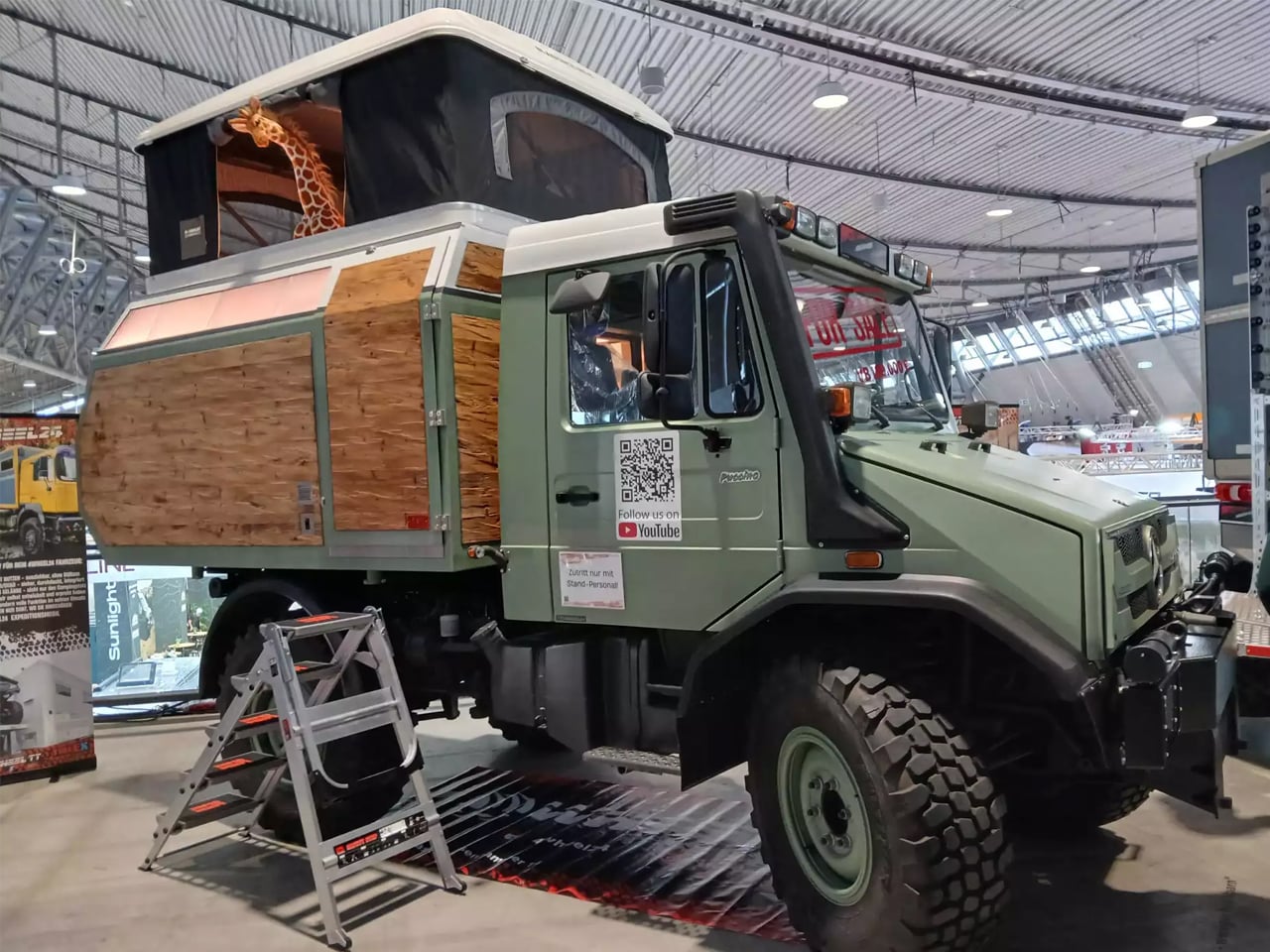
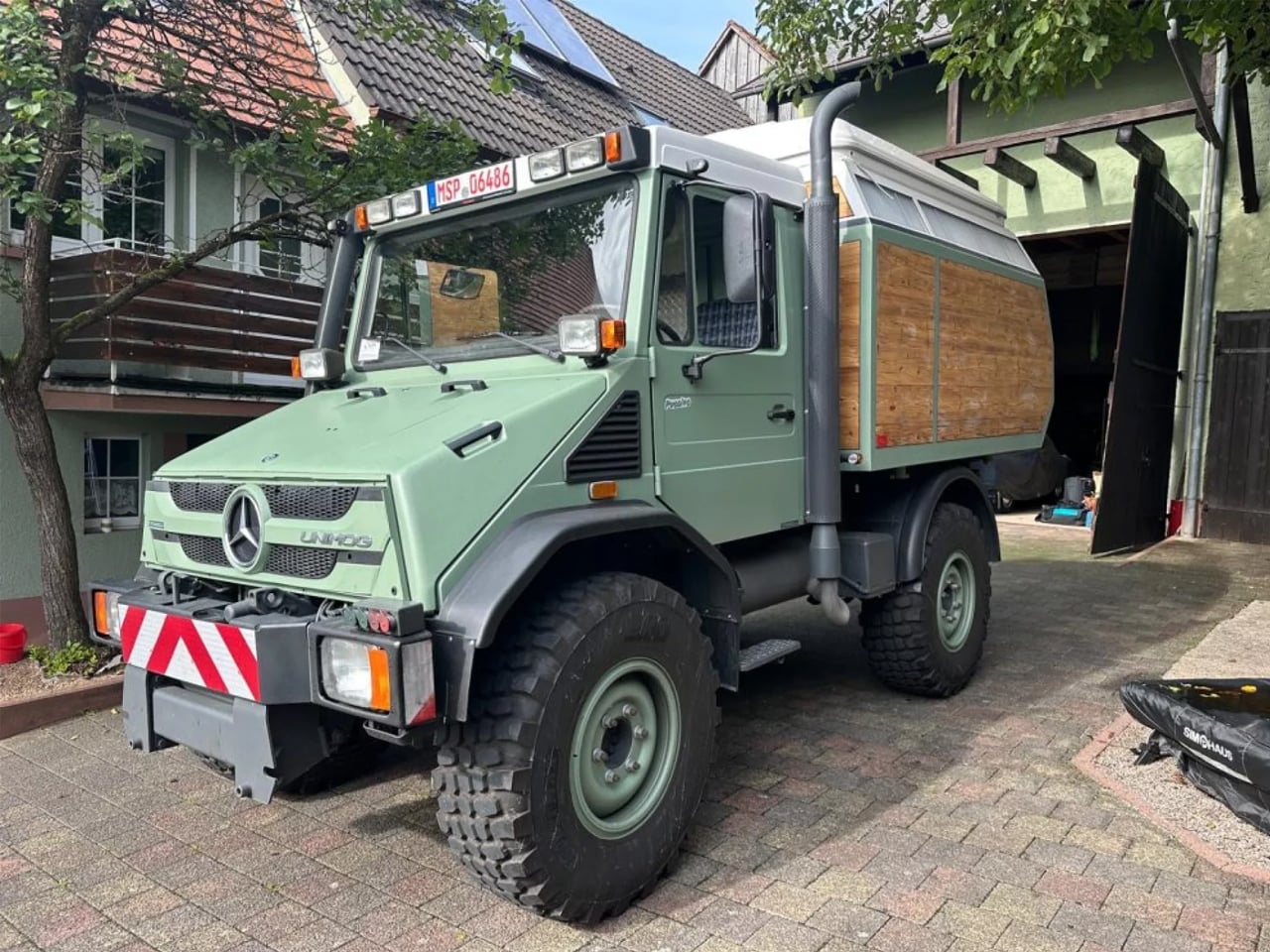
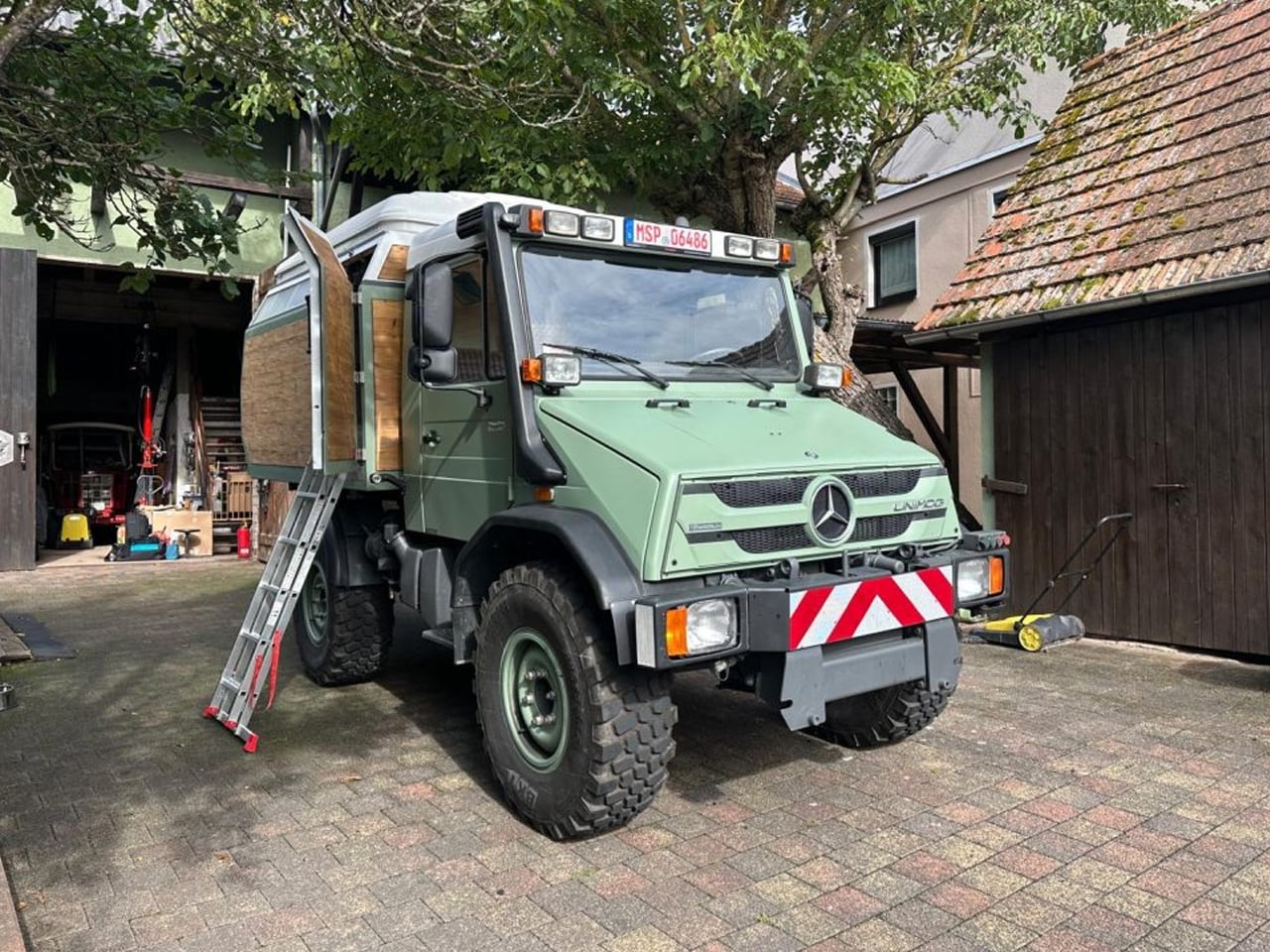
Mercedes-Benz Unimog has served as the base for many rugged expedition motorhomes in the past, and this is yet another instance where the multi-purpose, all-wheel-drive truck is part of an extreme off-roading RV called The Pucchino. Based on a Unimog U418, it is a compact, custom-built wooden cabin that features a steel frame and an electronically operated pop-up roof.
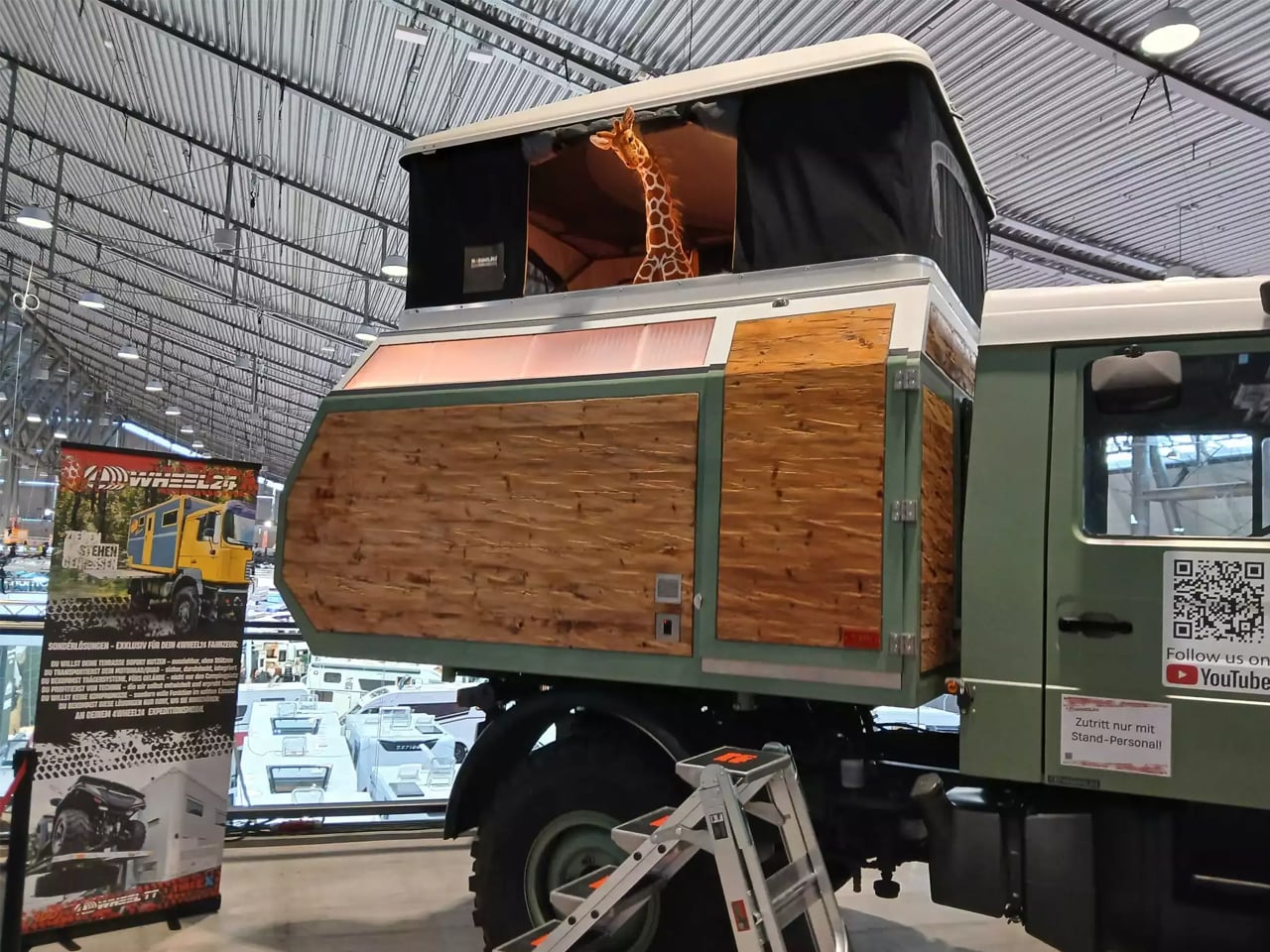
Choosing the ideal expedition RV for your requirements is a personal decision, generally made out of passion, consideration, and understanding. While there are many robust 4×4 trucks suitable for this purpose, the Unimog is by far a league apart. Sitting atop the Unimog U418, therefore, the Pucchino flaunts a robust wooden body and makes a bold statement. It is the brainchild of 4Wheel24 and arrives on a modest green colored truck, the color which extends down to the green wheel caps and matches with the pop-up roof shell and the interesting natural wooden body of the cabin.
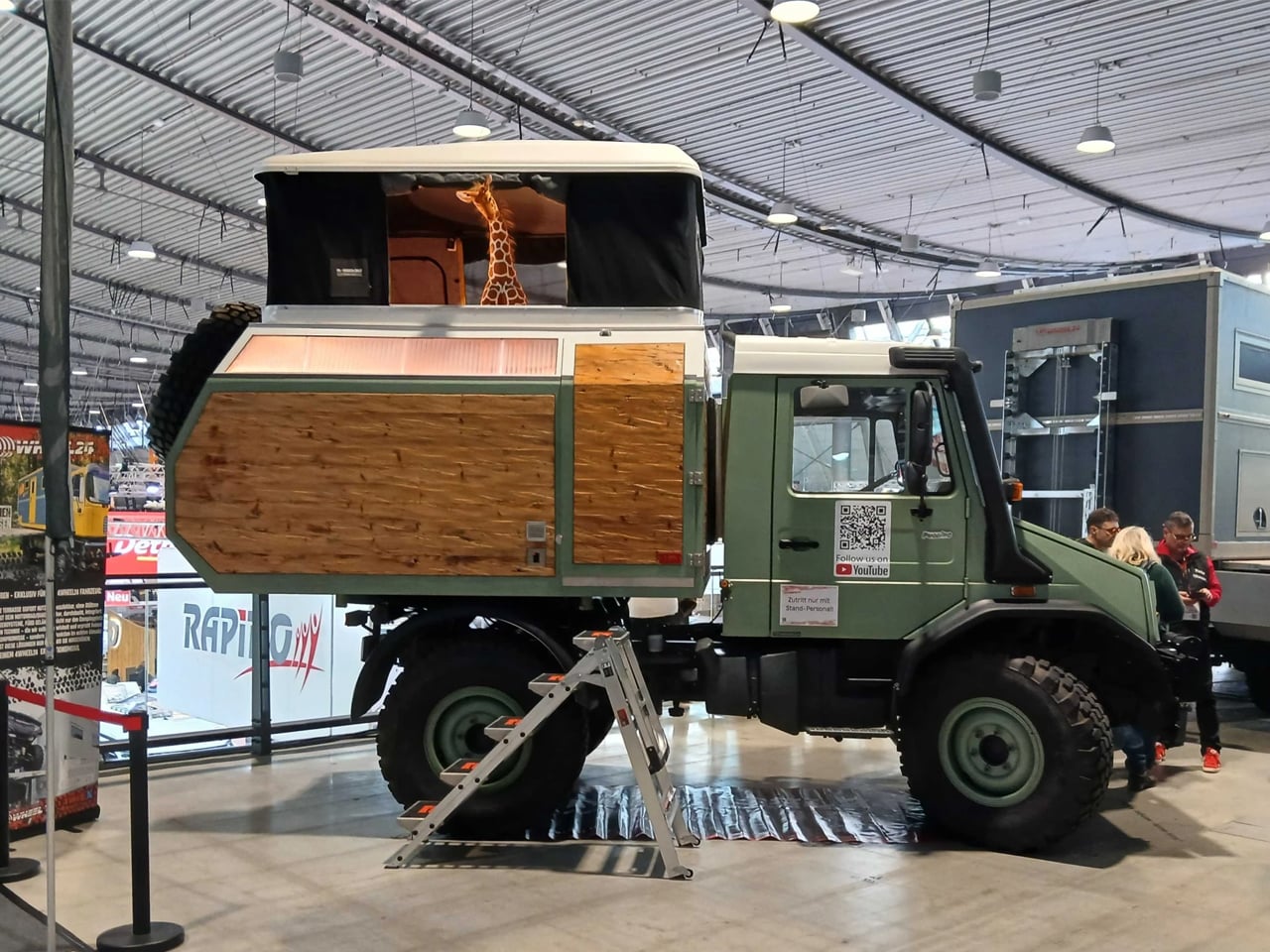
The truck-bed-sized cabin is an interesting creation, not just for its unique beer barrel-like form factor, but because of the various components it manages to stuff inside the very petite body. The roof-top tent definitely pops up to open the living space inside, but even without that, 4Wheel24 has pulled off a decent job with the Pucchino, designed to wade through Mother Earth’s most demanding roads.
The custom-built motorhome module for the 315-hp 4.2-liter turbo-diesel Mercedes-Benz Unimog U418 comes with a fully-integrated electric pop-up roof and a compact but fully functional living space inside. The roof opens up to a full conversion length of 2.7 m, and it comprises materials that make it a capable expedition companion with comfort and protection in all-weather conditions.
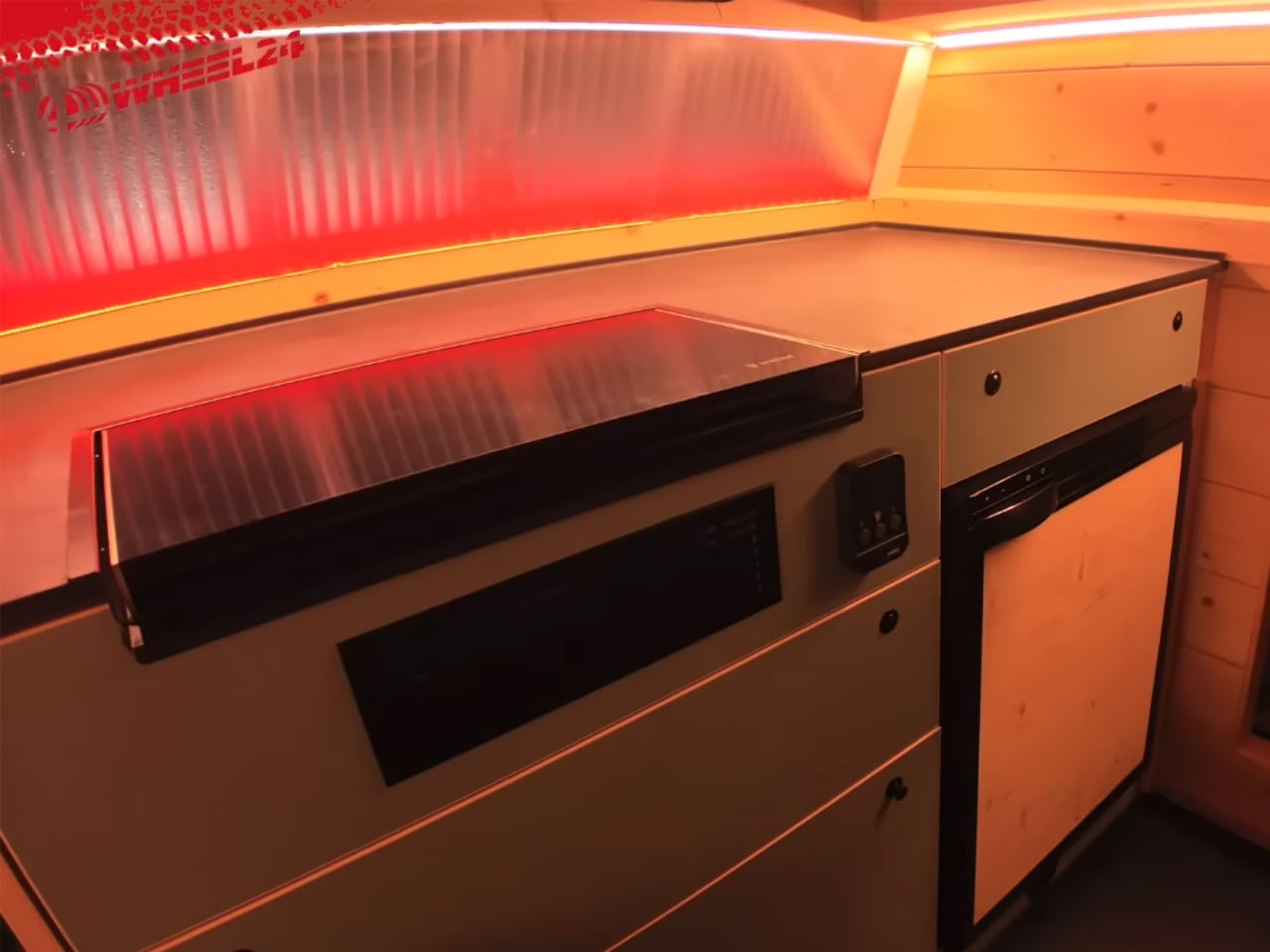
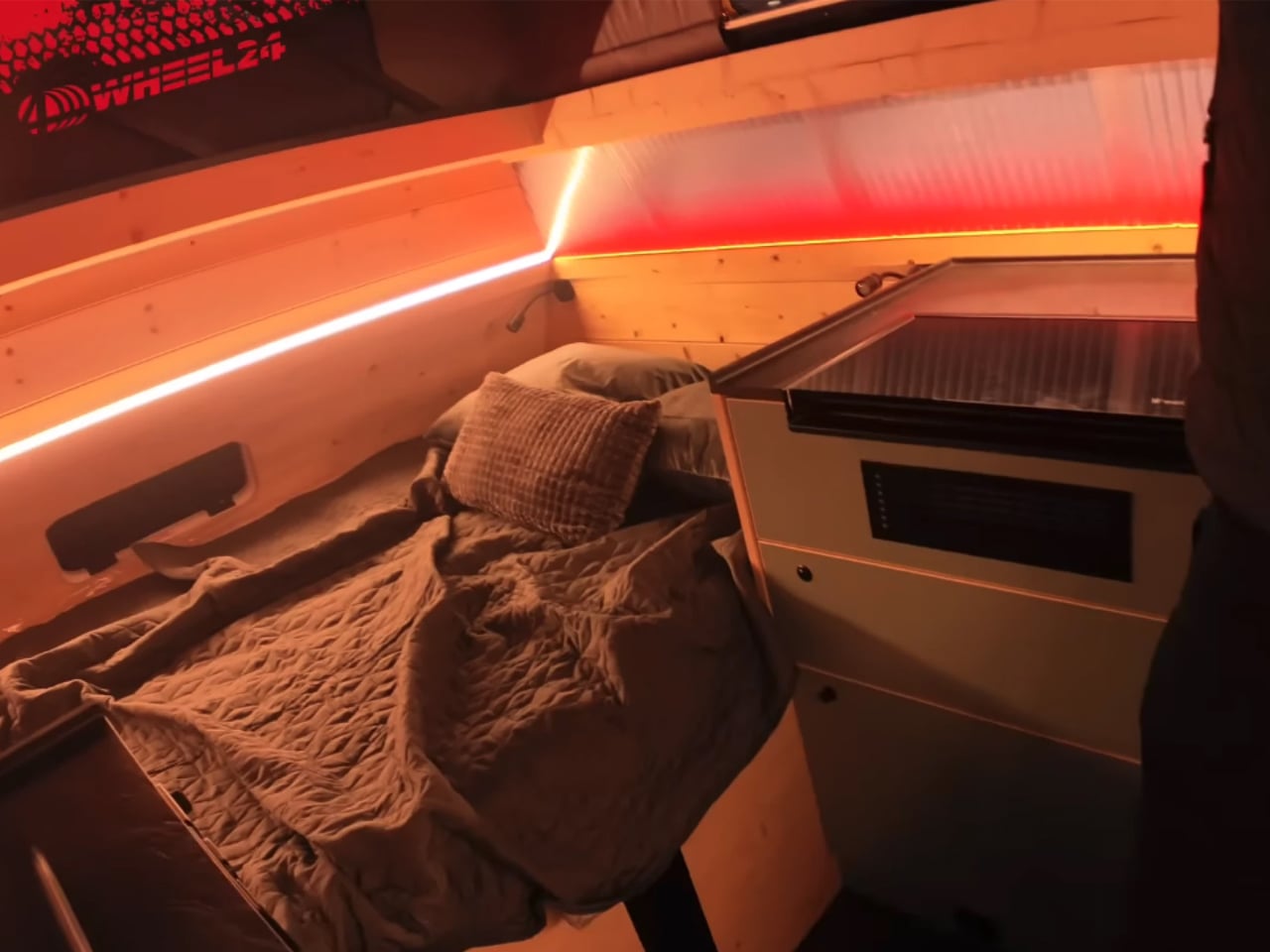
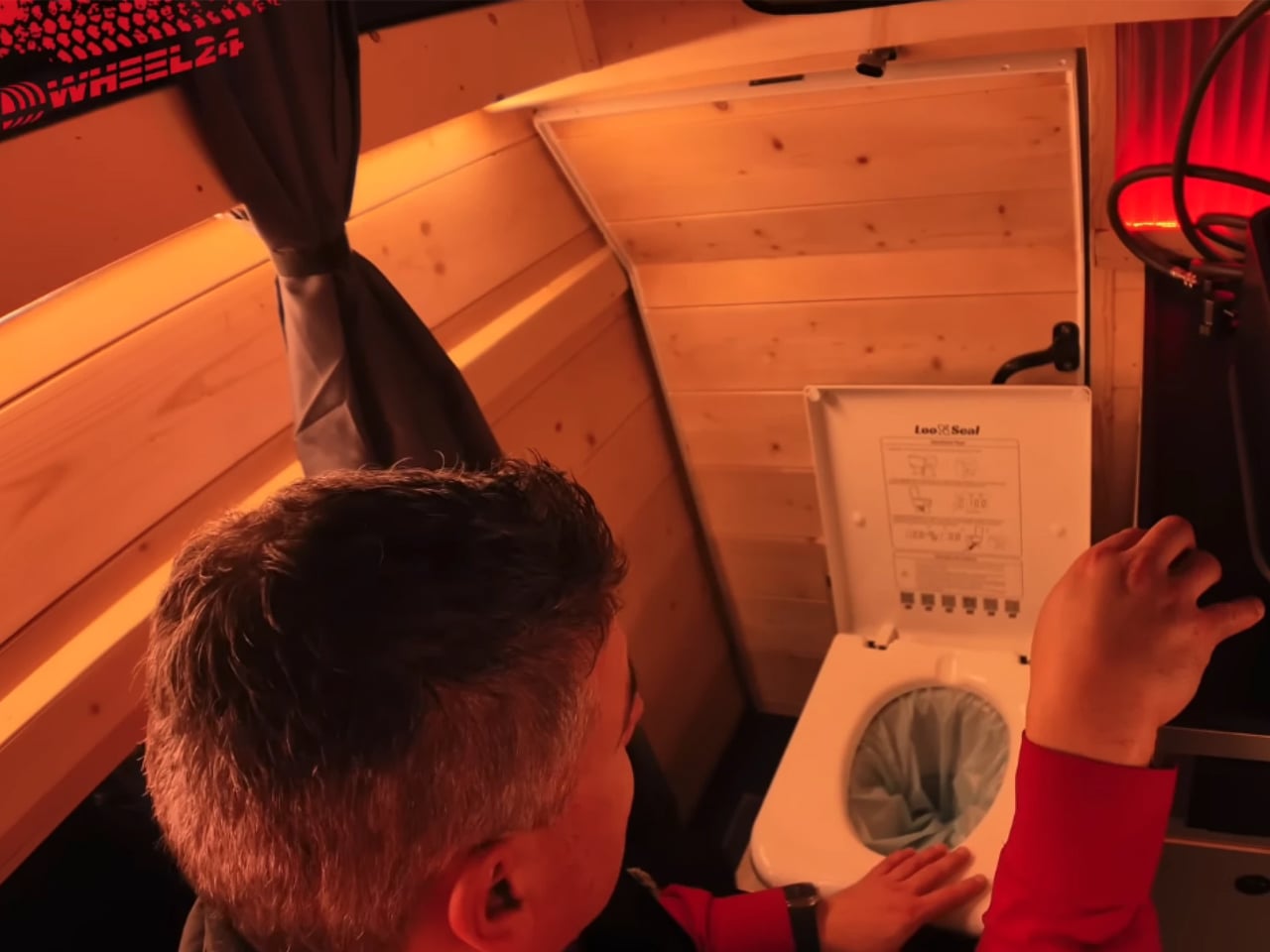
To ensure a low drive height for stability and minimize drag, the cabin’s interior height is kept to 1.20 meters. The entry into the rooftop tent is managed via a pull-out staircase. The chief living area in the cabin, measuring 2.6 x 2m, features a cooking area complete with a Wallas diesel hob, countertop, 60-L fridge, and sink, a double bed, and a washroom area furnished with a LooSeal Evo Sealed Toilet and shower.
The power needs onboard are handled by a 480-watt solar panel backing up energy in a 6.3 kWh lithium battery from Bluetti, and it also comes with an inverter. The cabin is provided with a 250L water tank, and in addition to the customization of the interior here, 4Wheel24 has also given the Unimog cab area an upgrade. The cab’s provided with heated seats and upgraded upholstery to match the wooden cabin. The ultra-compact, lightweight, and stable Pucchino is priced roughly around €189,000 (approx. $223,000).
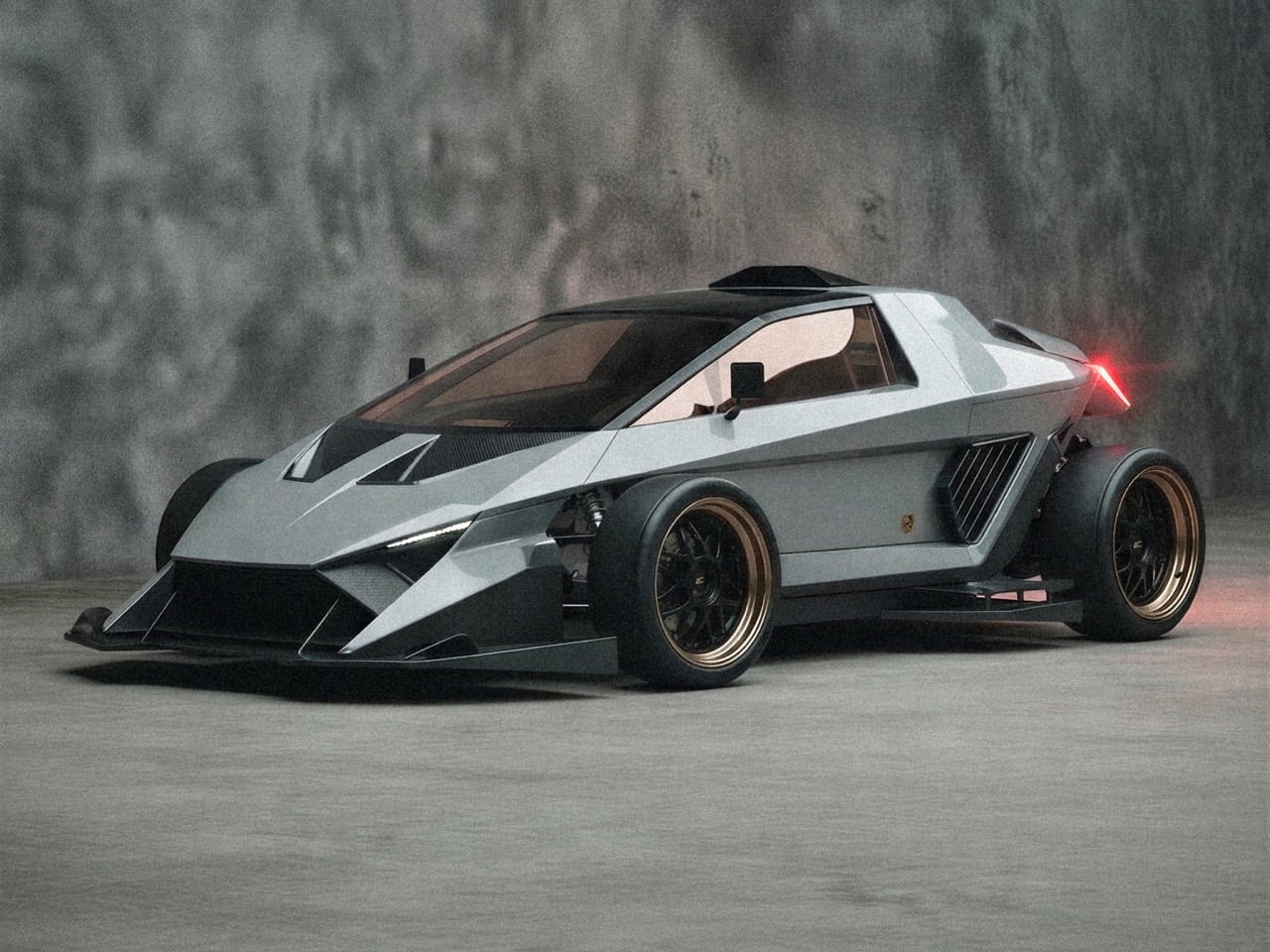
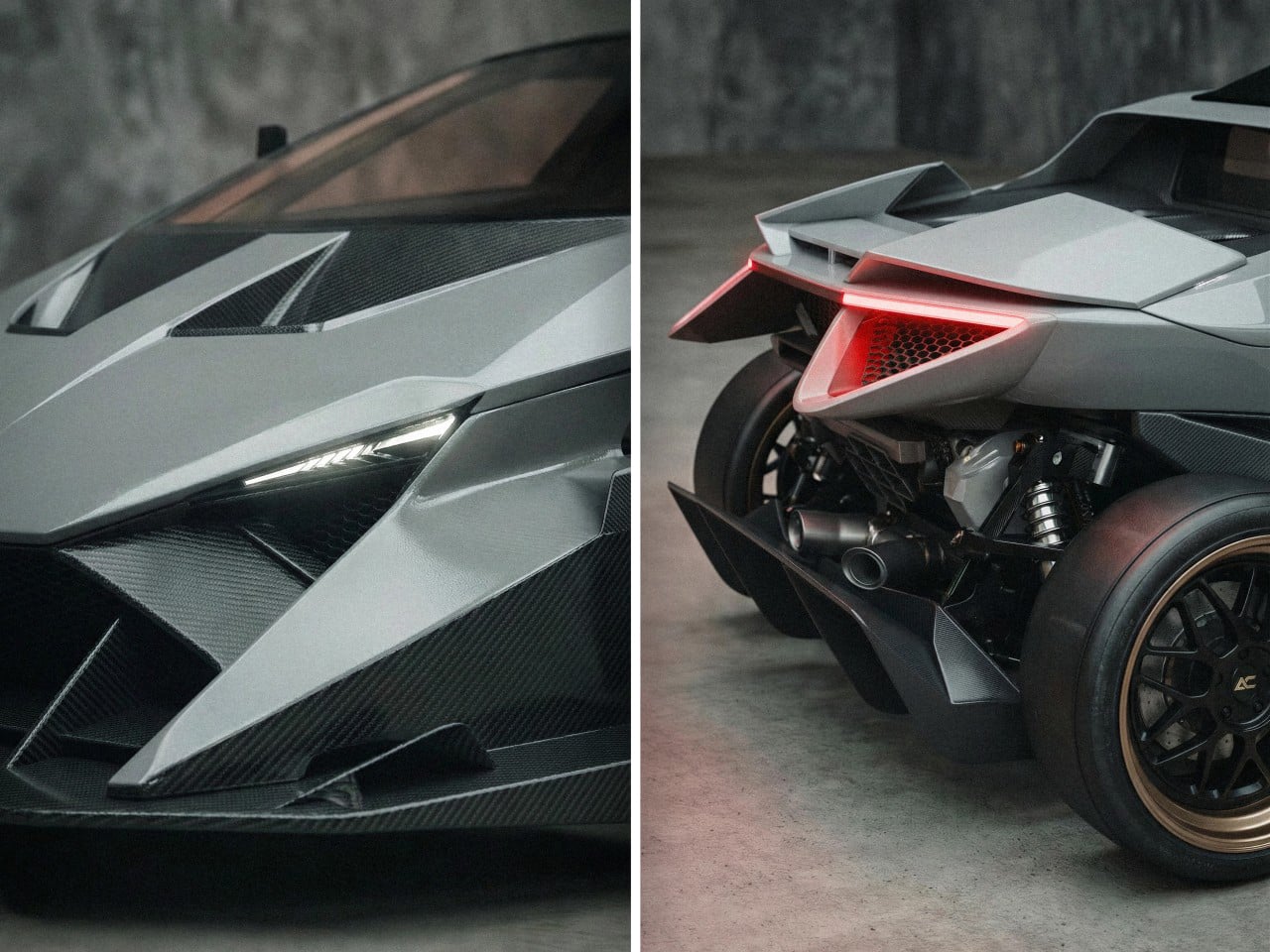
Someone decided the Lamborghini Countach needed to mate with a dune buggy and maybe a stealth fighter. Looking at Alex Casabo’s buggy concept, that’s not hyperbole or some lazy automotive journalism comparison. This thing genuinely looks like it crawled out of the wedge-era supercar playbook, did some thinking about what parts of “street legal” actually mattered, and concluded the answer was “none of them.”
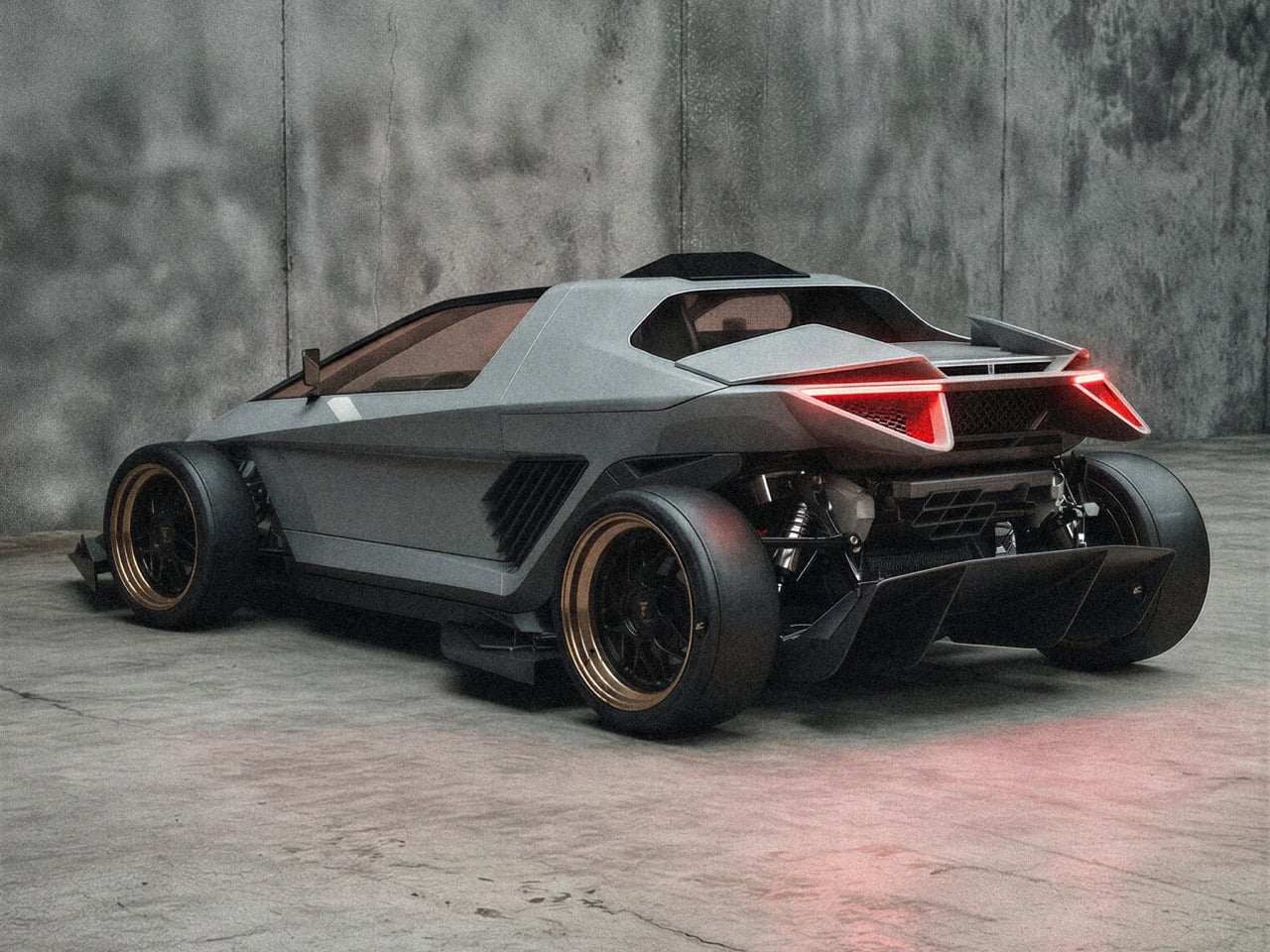
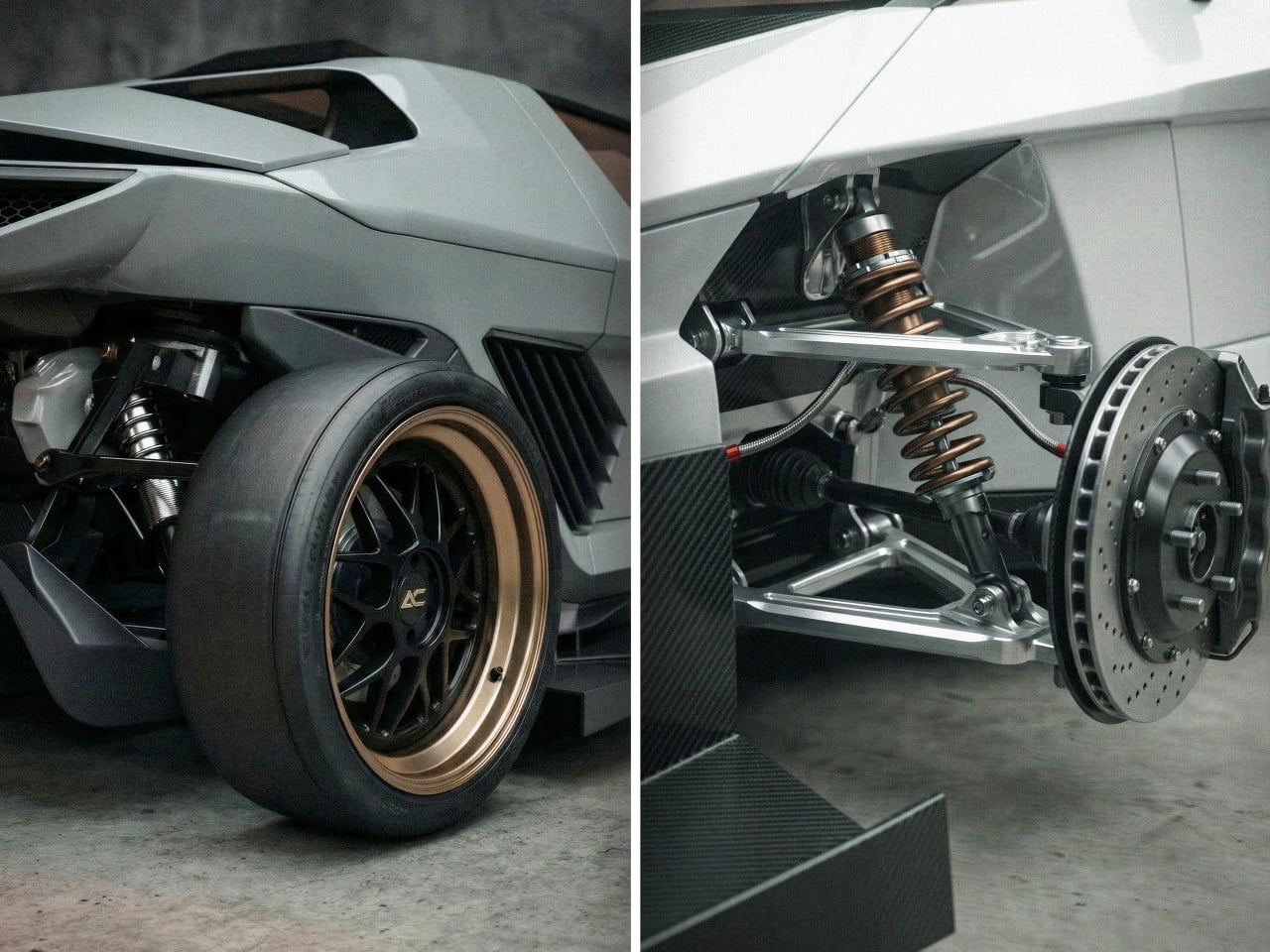
Most supercars maintain this pretense that yes, technically, you could drive this to the grocery store. Casabo’s design skips that entire conversation. The suspension geometry isn’t hidden behind sexy bodywork, it’s showcased like mechanical jewelry. Those bronze-finish wheels and exposed A-arms aren’t apologizing for being visible. This is a track toy that knows exactly what it is, and there’s something refreshing about a design that doesn’t hedge its bets.
Designer: Alex Casabo
The design language pulls directly from that late ’70s and early ’80s moment when Marcello Gandini was drawing supercars with a protractor and an apparent vendetta against curved lines. Every surface on this buggy looks like it was folded from sheet metal by someone who studied origami and decided subtlety was optional. The wedge profile, the angular body panels, the way the whole thing seems to be made of intersecting planes rather than flowing shapes. These are all callbacks to an era when automotive design was less about wind tunnel optimization and more about making something that looked impossibly fast while sitting still.
The AC Buggy, as Casabo calls it, combines the supercar aesthetic with the mechanical transparency of something like an Ariel Atom or a radical Group B rally car. Those exposed A-arms and coilovers aren’t there because the budget ran out before they could design proper body panels – they’re deliberate, turning functional components into visual elements. The bronze-finished wheels and visible hardware give the whole thing a motorsport-meets-military-prototype vibe that somehow works with the stealth fighter angles of the body. You can see the engineering, and that visibility becomes part of the appeal rather than something to hide.
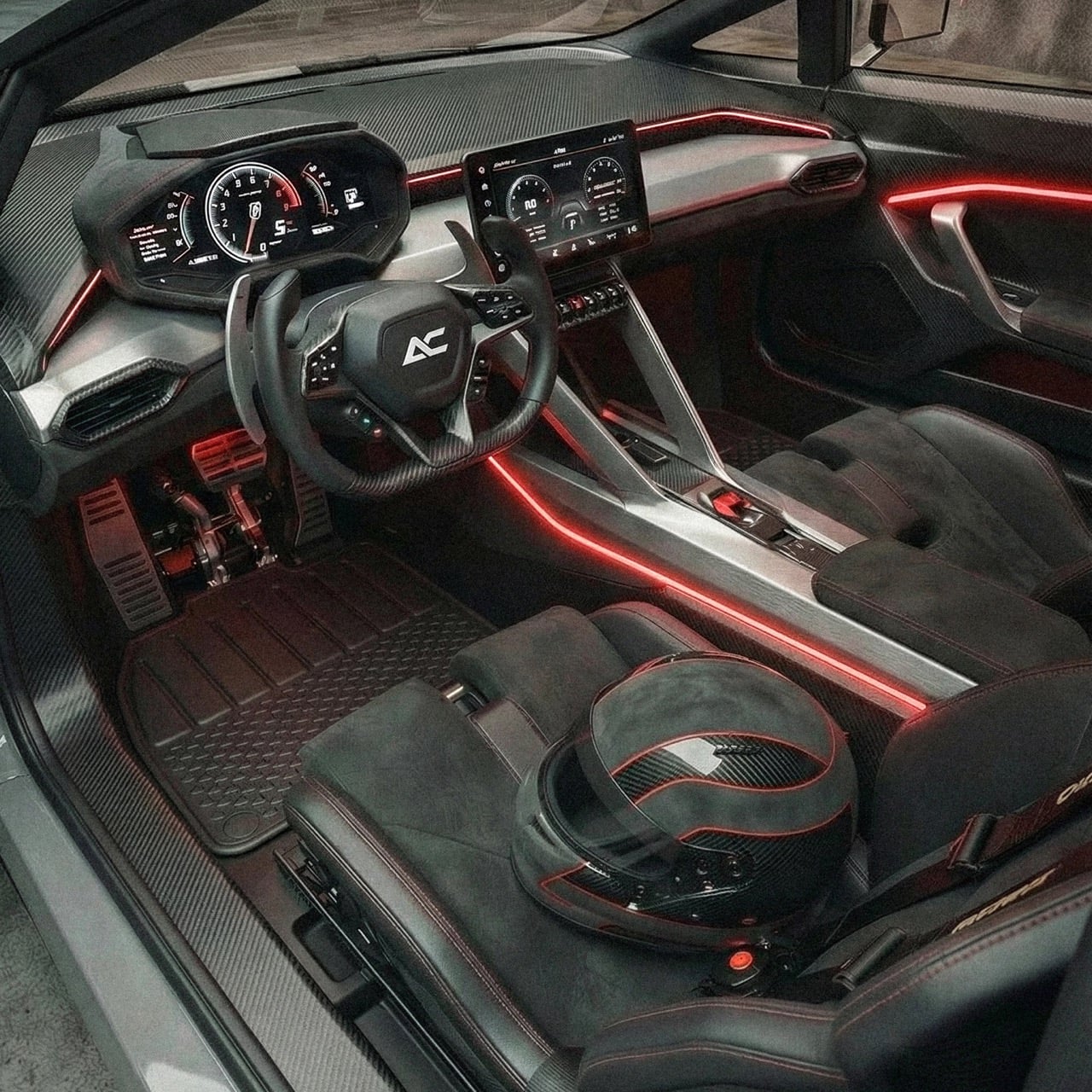
The interior follows the same path of aggressive minimalism wrapped in carbon fiber. Red accent lighting traces the cabin architecture, highlighting the angular dashboard and center console. There’s a center-mounted touchscreen flanked by what looks like a traditional instrument cluster on the driver’s side, creating this hybrid of digital and analog that mirrors the exterior’s blend of supercar drama and track-focused functionality. Toggle switches populate the lower console, the kind of tactile controls that suggest actual mechanical connections rather than electronic intermediaries. The seats are heavily bolstered with quilted inserts, held in place by a competition-style harness setup. Even the steering wheel gets the carbon treatment, with a squared-off bottom and integrated controls that keep your hands on the wheel rather than reaching for stalks or buttons.
The rear suspension setup shows off machined aluminum control arms and what look like properly specced coilovers with remote reservoirs. The drilled brake rotors are substantial, and the whole assembly sits exposed behind those distinctive geometric body panels with their triangular lighting elements. The taillights themselves use a honeycomb mesh pattern behind red-tinted lenses, continuing that angular aesthetic even in the smallest details. There’s an air intake vent on each rear quarter panel with horizontal slats, feeding what we can assume is some kind of powertrain tucked into that compact rear section.
The car was crafted entirely using a combination of design and AI tools as a part of Casabo’s explorations of integrating AI into the design workflow. Casabo lists his tools as Midjourney and Vizcom for the AI-enhanced ideation and CAD, along with Photoshop as a finisher to create the set of images. Whether this car is practical or not becomes irrelevant at this point, because Casabo’s vision is just to see how effectively AI can help enhance the creative process. Visually, it looks great on paper, although just seeing the output, I don’t think we’re too far from having an actual AI-generated concept car prototyped to life.