Gemini in Chrome is about to get a small but handy upgrade. Starting today, Google is rolling out a feature it calls Skills to Chrome on desktop. Skills allow you to save your favorite Gemini in Chrome prompts for quick access, thereby making it easier and faster to repeat certain tasks. For instance, Google suggests you could use one saved prompt to get Gemini to calculate how much protein there could be in a new recipe you found online. Another Skill can make it easier to do a side-by-side spec comparison of a few different products you're looking at across multiple tabs.
You can save prompts you want to use again directly from Gemini in Chrome's chat history. To use a saved prompt, type forward slash or click the plus button and select the Skill you want to use. To help people get started, Google is providing a set of ready-to-go prompts you can use to save time on common workflows or as a jumping off point for your own Skills. Skills you save are available on any version of Chrome for desktop where you're signed into your account, though for the time being, Google is only rolling out the feature to people who have their browser language set to US English.
Gemini in Chrome, like its other AI tools, has become a major area of focus for Google in recent months. At the start of the year, the company rolled out an update that saw the addition of a dedicated Gemini sidebar to Chrome and access to Nano Banana image generation directly from said sidebar. More recently, Google began rolling out Gemini in Chrome to users in Canada, India and New Zealand. As the high-stakes AI race countinues to heat up, expect more features in that vein, though we may still get more traditional enhancements — like vertical tabs — from time to time.
This article originally appeared on Engadget at https://www.engadget.com/ai/chrome-skills-let-you-save-your-favorite-gemini-prompts-for-easy-access-170000683.html?src=rss
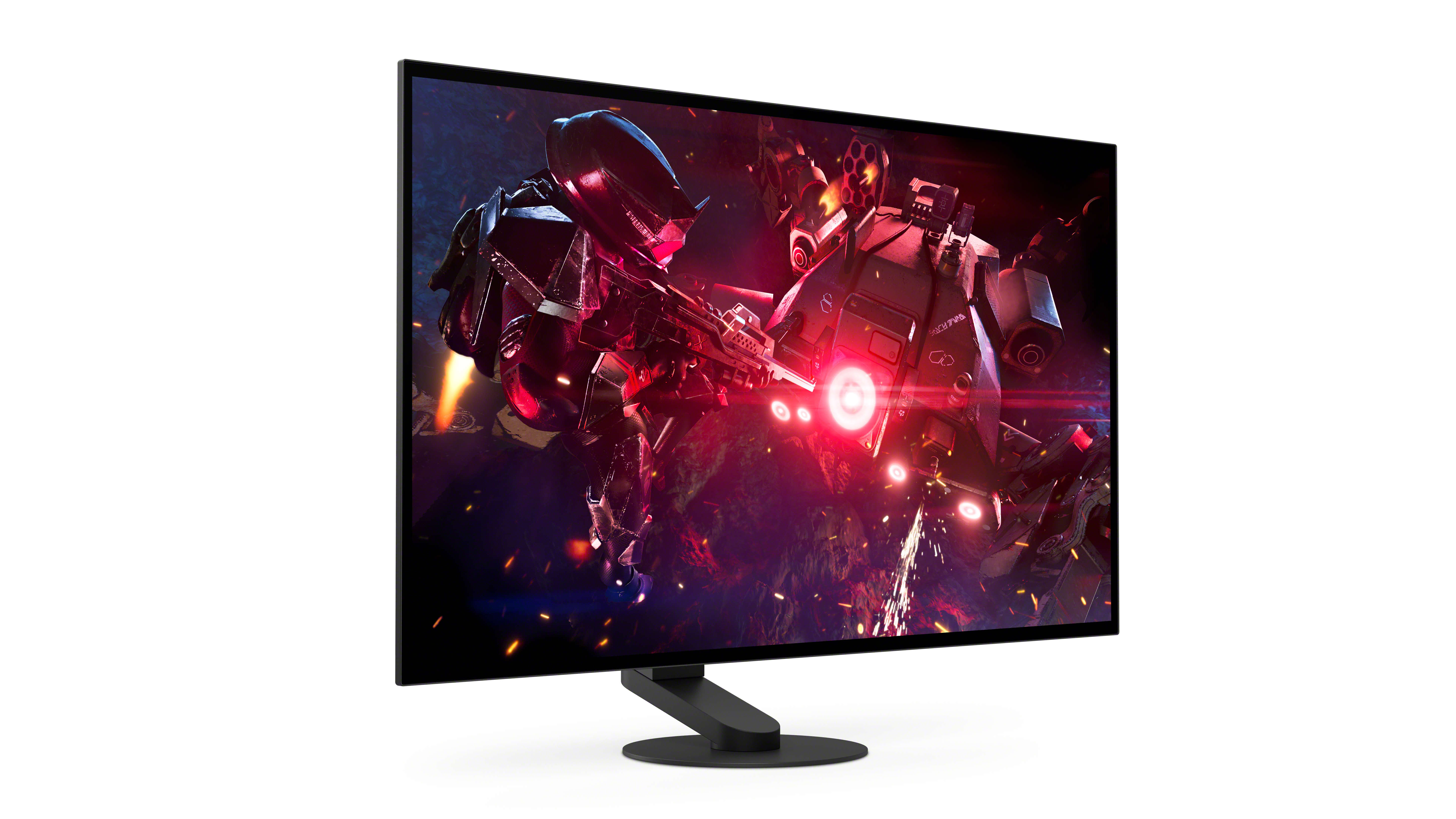
Super fast gaming displays have grown in popularity recently following the release of several new models back at CES. Now Sony is hopping on that bandwagon with its latest display featuring a tandem OLED panel from LG that offers the choice of either 540Hz or 720Hz refresh rates.
That said, priced at $1,100, the new 24.5-inch Sony Inzone M10S II is only for the most dedicated and deep-pocketed gamers. In normal use, the monitor offers a 540Hz refresh rate at QHD (2,560 x 1,440). However, in competitive situations where that still might not be enough, the display can go even faster by reducing its resolution to 720p while boosting its refresh rate all the way up to 720Hz. On top of that, to help make visuals clearer, Sony added a new Motion Blur Reduction algorithm with Black Frame Insertion that boosts brightness while still delivering a response rate of just 0.02ms.
Unfortunately, at $1,100, this thing is out of reach for most gamers.
Sony
Elsewhere, a new Super Anti-Glare film helps reduce reflections. The company also used feedback from pro gamers to create a stand with a smaller footprint and a wider range of tilt adjustability (from -5 to 35 degrees). For those worried about the panel's long-term performance, the Inzone M10S II comes with a three-year warranty and OLED protection features like a custom heat sink.
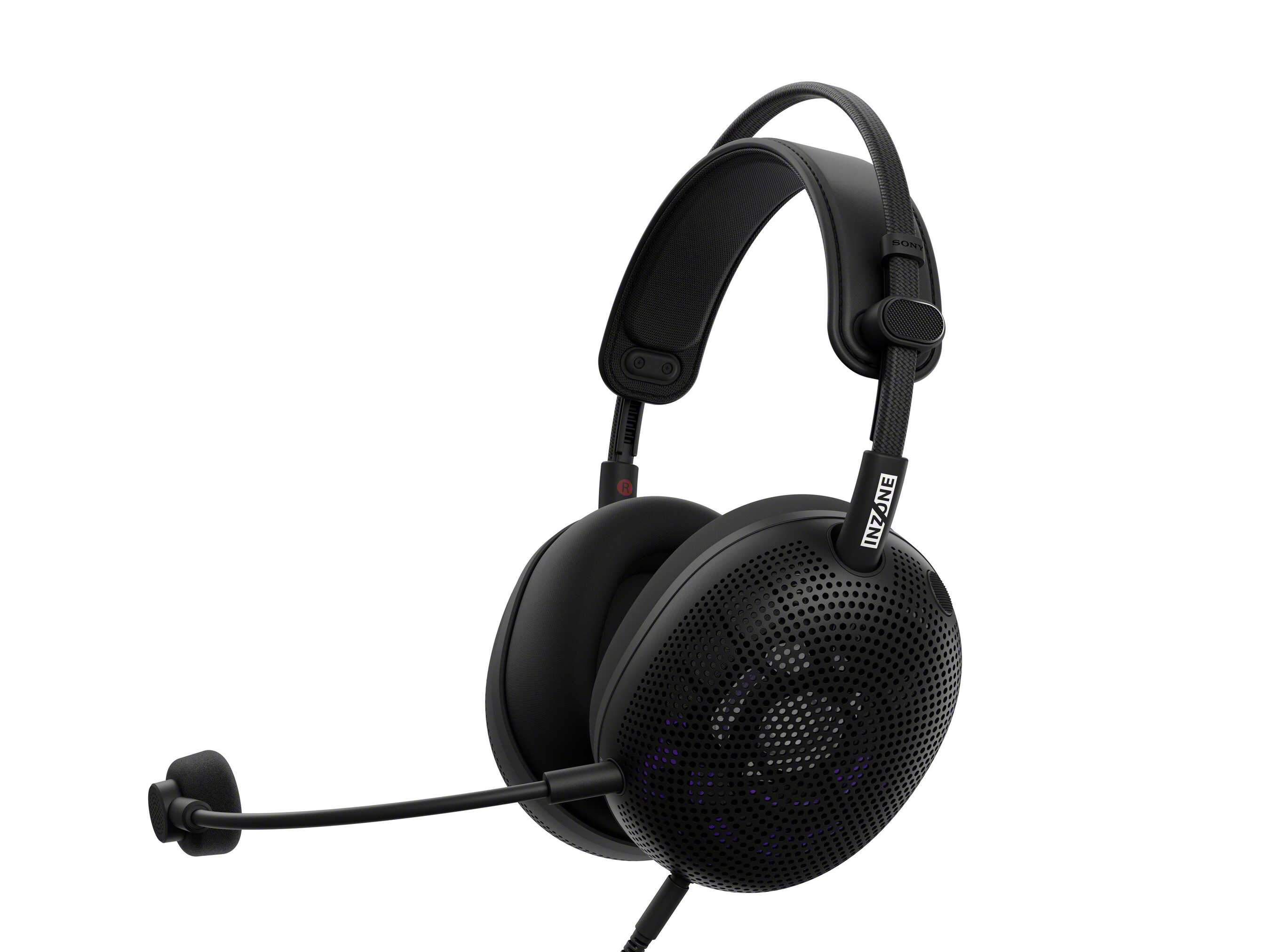
The new Inzone H6 Air are based on Sony's MDR-MV1 studio monitor headphones while costing half the price.
Sony
Aside from its new monitor, Sony is also releasing a pair of open-back wired headphones in the Inzone H6 Air. Priced at $200, they are based on the company's well-known studio monitor headphones — the MDR-MV1 — but with some additional tweaks for gaming. Not only is it really light at just 199 grams (not including its detachable cable and boom mic), it also features a dedicated RPG/Adventure profile designed to improve clarity and environmental details. The one caveat is that to access this mode, you need to use Sony's USB-C Audio box, which offers additional features like virtual 7.1 surround sound and support for 360-degree spatial audio.
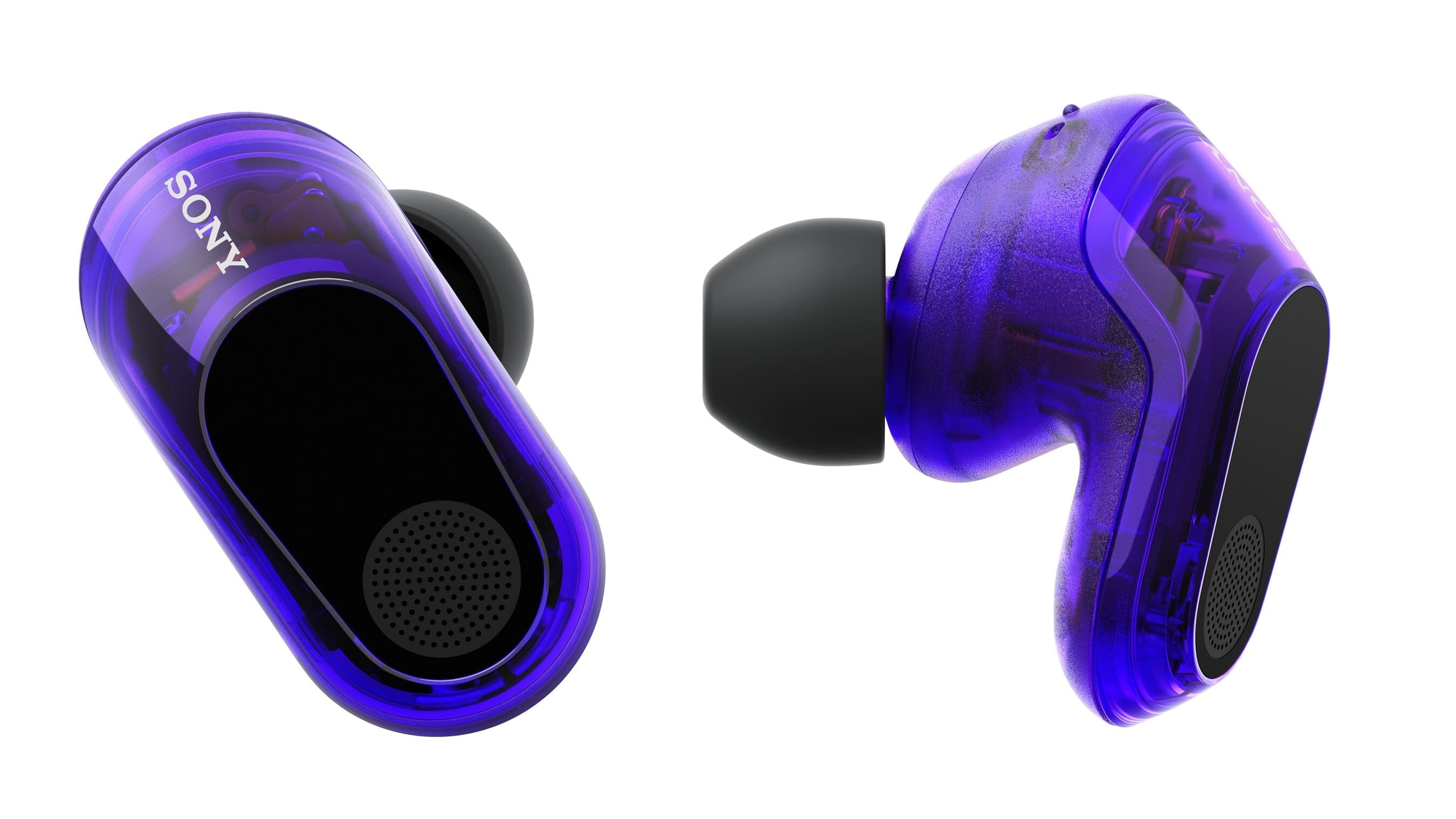
Atomic Purple, I mean Glass Purple, is always a good look.
All of Sony's new gadgets are available today, aside from the Inzone M10S II monitor, which is due out sometime later this year.
This article originally appeared on Engadget at https://www.engadget.com/gaming/pc/sony-inzones-latest-monitor-boasts-a-blazing-720hz-panel-for-competitive-gamers-165008263.html?src=rss
Samsung just released its lineup of Micro RGB TVs for 2026, and it includes models that start at 55 inches and go up to 85 inches. These 4K sets feature the company's Micro RGB display technology, which uses thousands of little red, green and blue LEDs to minimize color bleed and enable "expanded color with pinpoint accuracy."
The display is assisted by a new AI processor that has been specifically designed to calibrate the picture to bring out all of that gorgeous color. The company says this results in "stunningly sharp images with incredible detail." The processor also assists with motion smoothing, in addition to handling all of those smart TV apps.
These displays support HDR10+ Advanced, which is an updated standard co-developed by Samsung. This ensures genre-based optimization and enhanced brightness, among other features.
Samsung
The TVs are split into two lines. The R95H is the beefier of the two, with access to Samsung's anti-glare technology and a 165Hz refresh rate. The R85H tops out at 144Hz. All models include Dolby Atmos sound and the ability to pair up to five Samsung sound devices via its Q-Symphony technology.
They can also all access Samsung's Art Store, which is a platform that originally launched alongside the company's The Frame display. This lets subscribers choose from thousands of art pieces which will then be displayed on the screen when it's not being used to watch TV or play video games.
The R95H line starts at $3,200 for a 65-inch model, going all the way up to $6,500 for an 85-inch display. Samsung promises a 100-inch version is coming later this year. The R85H line is cheaper, starting at $1,600 for the 55-inch release and shooting up to $4,000 for the 85-inch model. The TVs are available right now, directly from Samsung and from retailers like Best Buy.
This article originally appeared on Engadget at https://www.engadget.com/home/home-theater/samsungs-new-micro-rgb-tvs-start-at-1600-for-a-55-inch-model-150023242.html?src=rss
Websites that act like a super-chatty colleague who just won't shut up and let you go when a conversation should be over are among the most annoying things on the internet. Google is now doing something about that scourge.
Picture the scene: you look up something on Google Search and — instead of relying on potentially hallucinating AI Overviews — you click through to an actual website for your information. But, when you try to leave the site by hitting the back button, your browser doesn’t immediately take you back to the previous webpage. Instead, the website first displays an "oh, while you're here..." page that suggests other content in which you may be interested in checking out or just a bunch of ads.
This shady move that some traffic-hungry websites have adopted is called "back button hijacking." No one in their right mind likes it, and nor does Google.
Under a new policy that 9to5Google spotted, Google will treat back button hijacking as an "explicit violation of the 'malicious practices' of spam policies" alongside the likes of malware. As such, it may punish websites that engage in such practices by treating them as spam and downranking them in search results.
"Back button hijacking interferes with the browser's functionality, breaks the expected user journey and results in user frustration," Chris Nelson, from the Google Search Quality team, wrote in the announcement. "People report feeling manipulated and eventually less willing to visit unfamiliar sites. As we've stated before, inserting deceptive or manipulative pages into a user's browser history has always been against our Google Search Essentials."
Google says it has seen an increase in back button hijacking and it’s great that the company is taking steps to combat it. Developers and website operators have until June 15 to make sure they aren't interfering "with a user's ability to navigate their browser history" by engaging in the practice. Google will start enforcing this policy then.
This article originally appeared on Engadget at https://www.engadget.com/general/google-search-tackles-sites-that-try-to-stop-you-from-leaving-when-you-hit-the-back-button-143302862.html?src=rss
OpenAI has acquired Hiro Finance, a startup that offers AI-powered financial planning tools. As first reported by TechCrunch, fiscal terms of the deal, which was announced on Monday, were not disclosed by OpenAI. However, all signs point this to being an acquhire, with Hiro founder Ethan Bloch writing on LinkedIn that the company's product would stop working on April 20. Users have until May 13 to migrate their data off of Hiro's servers before everything is deleted.
It's unclear if OpenAI plans to offer a dedicated financial planning tool in the mold of Hiro. At the start of the year, the company released Prism, a Claude Code-like app for scientific research that built on its acquisition of the startup behind Crixet. At the very least, it sounds like some of the expertise Hiro has built will make its way to OpenAI's chatbot. "For decades, personalized financial guidance has been too expensive, too generic, or too hard to access. ChatGPT is finally changing that," Bloch wrote on LinkedIn.
The deal is the second acquisition in only two weeks to be announced by OpenAI. At the start of the month, the company bought Technology Business Programming Network (TBPN), a media company known for its daily tech podcast. For a company that has by all indications a long and tough road ahead to profitability, it sure does seem OpenAI is spending a lot of time and money on startups that might not end being central to its core business, which in recent months has seen it target the coding market to edge out Anthropic.
This article originally appeared on Engadget at https://www.engadget.com/ai/openai-buys-its-second-startup-in-a-month-140550769.html?src=rss
OpenAI has acquired Hiro Finance, a startup that offers AI-powered financial planning tools. As first reported by TechCrunch, fiscal terms of the deal, which was announced on Monday, were not disclosed by OpenAI. However, all signs point this to being an acquhire, with Hiro founder Ethan Bloch writing on LinkedIn that the company's product would stop working on April 20. Users have until May 13 to migrate their data off of Hiro's servers before everything is deleted.
It's unclear if OpenAI plans to offer a dedicated financial planning tool in the mold of Hiro. At the start of the year, the company released Prism, a Claude Code-like app for scientific research that built on its acquisition of the startup behind Crixet. At the very least, it sounds like some of the expertise Hiro has built will make its way to OpenAI's chatbot. "For decades, personalized financial guidance has been too expensive, too generic, or too hard to access. ChatGPT is finally changing that," Bloch wrote on LinkedIn.
The deal is the second acquisition in only two weeks to be announced by OpenAI. At the start of the month, the company bought Technology Business Programming Network (TBPN), a media company known for its daily tech podcast. For a company that has by all indications a long and tough road ahead to profitability, it sure does seem OpenAI is spending a lot of time and money on startups that might not end being central to its core business, which in recent months has seen it target the coding market to edge out Anthropic.
This article originally appeared on Engadget at https://www.engadget.com/ai/openai-buys-its-second-startup-in-a-month-140550769.html?src=rss
Amazon has today announced it is merging with satellite internet provider Globalstar Inc. to bolster Leo, its Starlink rival. Globalstar isn’t a household name but you do know its work, as it provides Apple’s emergency satellite connectivity for compatible iPhones and Watches. In a statement, Amazon says the deal will grow Leo’s space-based footprint and enable direct-to-device service for its burgeoning satellite network.
An interesting wrinkle is Apple owns 20 percent of Globalstar, which it bought for $1.5 billion in 2024, but that didn’t get a mention. Instead, the release says Amazon and Apple have agreed Leo will “power satellite services for supported iPhone and Apple Watch models.” And that this support will continue as Leo’s network evolves, as well as collaborating “with Apple on future satellite services using Amazon Leo’s expanded satellite network.”
The release adds Leo’s direct-to-device service won’t start until 2028, and the deal itself isn’t expected to close until 2027. That is, of course, unless Amazon doesn’t placate the FCC into extending its deadline to get more satellites into orbit before July 2026. At present, the company needs to have 1,600 satellites in orbit by that deadline, but only expects to have around 700 actually up in the heavens and working by then.
This article originally appeared on Engadget at https://www.engadget.com/general/amazon-buys-the-satellite-internet-company-behind-apples-sos-system-130150744.html?src=rss
Amazon has today announced it is merging with satellite internet provider Globalstar Inc. to bolster Leo, its Starlink rival. Globalstar isn’t a household name but you do know its work, as it provides Apple’s emergency satellite connectivity for compatible iPhones and Watches. In a statement, Amazon says the deal will grow Leo’s space-based footprint and enable direct-to-device service for its burgeoning satellite network.
An interesting wrinkle is Apple owns 20 percent of Globalstar, which it bought for $1.5 billion in 2024, but that didn’t get a mention. Instead, the release says Amazon and Apple have agreed Leo will “power satellite services for supported iPhone and Apple Watch models.” And that this support will continue as Leo’s network evolves, as well as collaborating “with Apple on future satellite services using Amazon Leo’s expanded satellite network.”
The release adds Leo’s direct-to-device service won’t start until 2028, and the deal itself isn’t expected to close until 2027. That is, of course, unless Amazon doesn’t placate the FCC into extending its deadline to get more satellites into orbit before July 2026. At present, the company needs to have 1,600 satellites in orbit by that deadline, but only expects to have around 700 actually up in the heavens and working by then.
This article originally appeared on Engadget at https://www.engadget.com/general/amazon-buys-the-satellite-internet-company-behind-apples-sos-system-130150744.html?src=rss
GoPro has seen its action camera market share diminish due to strong competition from rivals like Insta360 and DJI of late. Now, the company is fighting back with a new line of flagship cameras called Mission 1, designed to greatly improve the video quality offered by its current Hero 13 camera. The company also introduced a new Wireless Mic system similar to DJI's Mic Mini, along with a point-and-shoot grip and other accessories.
"The combination of our new 50 megapixel one-inch sensor and ultra-efficient GP3 processor sets a new performance bar for compact cinema cameras, enabling resolutions, frame rates, low-light performance, runtimes and thermal capabilities never seen before in cameras this small," GoPro's senior VP Pablo Lema said in a statement.
Sample Photo from GoPro Mission 1 Pro action camera
GoPro
The new line includes three models: the Mission 1, Mission 1 Pro and Mission 1 Pro ILS. All have a one-inch 50-megapixel sensor, new GP3 processor and up to 8K video, but the Mission 1 Pro supports higher frame rates. The Mission 1 Pro ILS (interchangeable lens system) comes with a lens mount so you can use high-quality Micro Four Thirds lenses from the likes of Panasonic and OM System.
The Mission 1 has an updated lens design with a 159 degree native field of view, the widest in its category. It also features a new OLED rear display that's 14 percent larger than previous flagship GoPro cameras, along with bigger raised buttons for easier use with gloves and a removable lens hood to reduce glare and lens flare.
GoPro
The 50MP 1-inch sensor has large 1.6μm pixels at full resolution or 3.2μm fused pixels when it's in operating at 4K in quad-bayer mode. That allows for higher dynamic range up to 14 stops and improved low-light performance with "exceptional detail in the darkest of shadows while protecting highlight details," GoPro claims. That low-light performance is likely to be better in quad-bayer 4K mode than full resolution 8K, however.
Meanwhile, the new GP3 Processor offers a power-efficient 5nm design that allows "best-in-class resolutions, frame rates and image quality," the company says. Those resolutions include 8K at up to 60 fps for the Mission 1 Pro/Pro ILS models, 4K at up to 240 fps and 1080p at up to 960(!) fps. GoPro also offers 10-bit HLG/HDR and a 10-bit GP-Log2 mode to maximize dynamic range.
The Pro models support 4:3 open gate capture so you can easily reframe shots or export video for different platforms. The Mission 1, meanwhile, captures up to 8K 30 fps, 4K 120 fps and 1080p 480 fps video, along with 4K 120 fps open gate video. You can capture 50MP RAW stills at up to 60 fps burst speeds on all Mission 1 models.
GoPro
The lineup promises excellent battery life thanks to the new Enduro 2 battery, with three-plus hours of 4K 30p recording on a charge. You can use the Hero 13 batteries as well albeit with shorter recording times. The company is also promising faster charging speeds. Thermal performance is solid despite the small size, with 8K 60p capture possible for 37 minutes straight with no airflow, or 74 minutes with airflow (when riding a bike for instance). However, unlike recent rivals, the Mission 1 supports microSD storage but has no internal memory.
Like its DJI and Insta360 rivals, the Mission 1 cameras offer multiple intelligent capture modes, including subject tracking, Dive (underwater stabilization) and Low-Light, along with Slow-Mo, Lapse, Sport POV, Vlog and Open Gate. GoPro action cams generally have excellent stabilization, so it'll be interesting to see if the Mission 1 series continues that trend, especially in low-light conditions.
GoPro isn't skimping on audio either, as the Mission 1 models offer a four-mic system with 32-bit float along with stereo recording and wind noise reduction. You can connect wirelessly to compatible devices via Bluetooth 5.3 or wired mics over USB-C audio.
GoPro
The Mission 1 Pro ILS appears to be the first action camera with an interchangeable lens mount that's compatible with any Micro Four Thirds lenses and adapters. GoPro's HyperSmooth electronic video stabilization will work with any prime (non-fisheye) lens. It's "the world’s smallest, most rugged and versatile high-speed cinema camera at a fraction of the cost and size of comparable cameras," GoPro said. Most lenses will likely make the camera too heavy and awkward to attach to a helmet or body, but you could certainly mount it to a motorbike, car or other vehicle.
Along with the Mission 1 cameras, GoPro is introducing some new accessories. Key among those is the new Wireless Mic System designed for easy pairing with the Mission 1 cameras, along with DSLRs and smartphones. With a charging case and magnetic clips, it looks a lot like DJI's Mic Mini system and offers 24-bit/48kHz audio with Dynamic Noise Reduction, 150 meters of wireless range, 6.5 hours of run time, adjustable gain and a safety track mode.
GoPro
Other accessories include a Media Mod kit with a built-in multi-pattern mic and expanded I/O capability including 3.5mm mic and headphone ports, a micro HDMI port and a line-in port for timecode sync. GoPro is also offering a new Point-and-Shoot grip, M-Series ND Filters, a protective housing, a dual Enduro 2 battery charger, Volta battery grip and Light Mod 2 LED light. It's compatible with a GoPro subscription and Quick App, along with GoPro Labs that lets you unlock higher data rates (up to 300Mbps) and over 1,000 complex settings.
The new models will be available individually or in kits, including the Mission 1 Pro Creator Edition bundled with the Media Mod, Wireless Mic System and Volta battery grip. The Mission 1 Pro Ultimate Creator Edition includes those while adding GoPro's Fluid Pro AI gimbal and Light Mod 2. Pricing and availability will be announced at a later date.
This article originally appeared on Engadget at https://www.engadget.com/cameras/gopros-mission-1-offers-8k-60p-video-and-interchangeable-lenses-130018643.html?src=rss
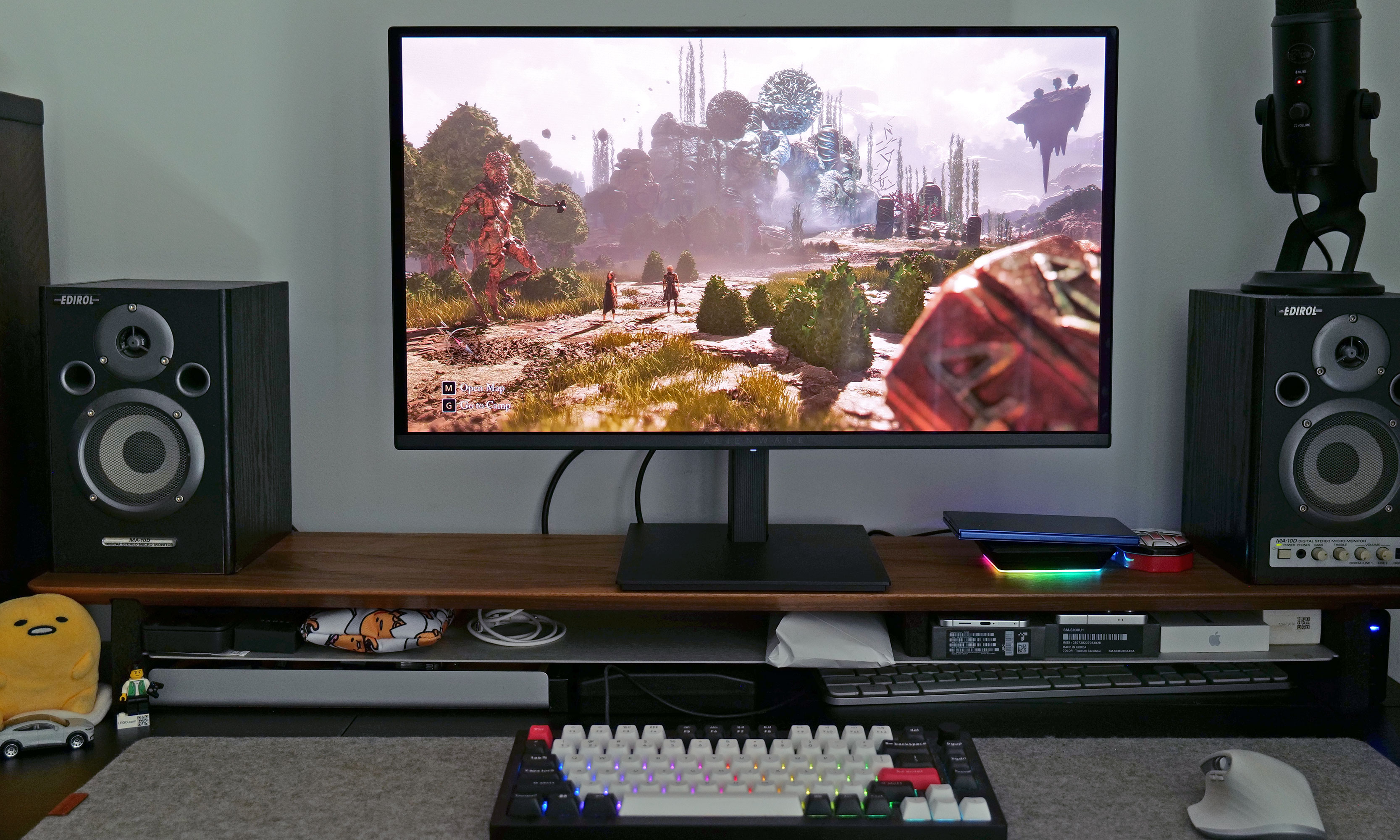
The price of nearly every type of gaming gadget has skyrocketed recently. RAMageddon has caused the cost of memory to double or triple in the last six months, with companies like HP saying that RAM now accounts for more than a third of a new PC’s bill of materials. Meanwhile, the Xbox Series S/X and the PS5 have gotten price hikes, and a similar bump for the Switch 2 is starting to look “inevitable.” Even mobile devices are not immune, with Samsung jacking up the cost of the Galaxy Z Fold 7 nine months after release. But with the $350 27-inch QD-OLED (AW2726DM), Alienware hasn’t just created a gaming display that’s an excellent value, it’s made a beacon of hope for anyone looking to upgrade their setup without emptying their bank account.
Design
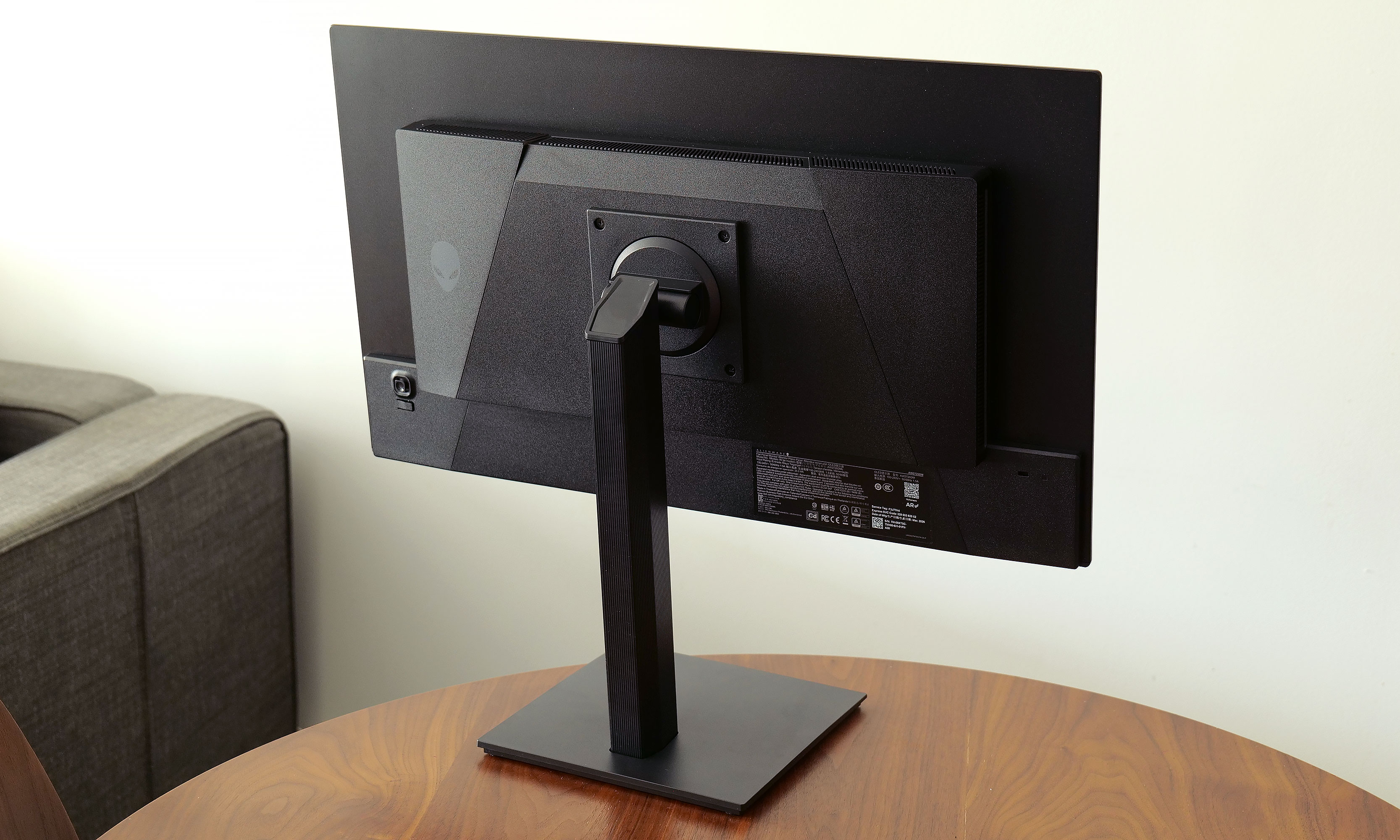
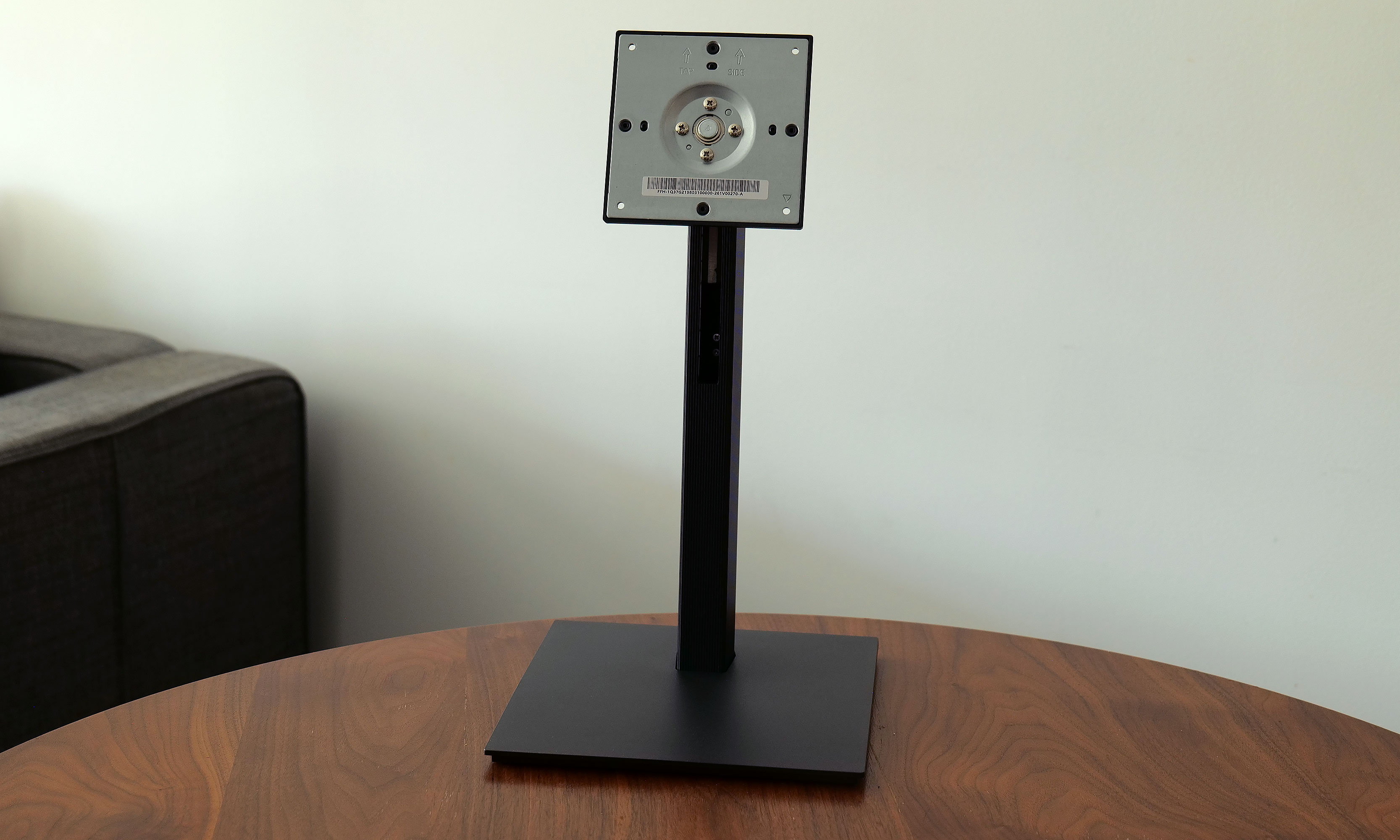
Unlike some of Alienware’s more expensive displays, the AW2726DM’s design couldn’t be simpler. It sits on a square 8.75-inch base that supports tilt, pivot and height adjustments. Though it does require a little assembly, everything you need comes in the box. Alienware’s monitor arm attaches via a captured thumb tab, while the monitor relies on four screws and a VESA mount that can be connected using the bundled Philips wrench. (Though if you have a proper screwdriver, that would be even better.) Setup only took me a few minutes and after arranging it properly on my desk, the monitor felt quite solid. The only potential drawback is that if you have limited desk space or you’re the kind of gamer that likes jamming your keyboard as close to your monitor as possible, Alienware’s stand might get in the way.
The back of the monitor has an easy-to-use joystick for controlling its on-screen settings menu.
Sam Rutherford
At around 4mm thick, the AW2726DM’s panel is exceedingly sleek, though naturally that expands a bit on the lower portion of the monitor where its ports are located. This brings us to one of the biggest differences between Alienware’s budget display and more premium options: limited connectivity. All you get here is two HDMI 2.1 jacks, one DisplayPort 1.4 slot and a 3.5mm plug for audio out. There’s no support for data transfer, power sharing or anything else. Heck, there isn’t even any RGB lighting, which feels weird on a product from Alienware. But given its price, I’m not upset. In fact, it’s actually kind of refreshing. Finally, there’s a handy control stick on the back of the display for navigating its on-screen menu.
Visuals
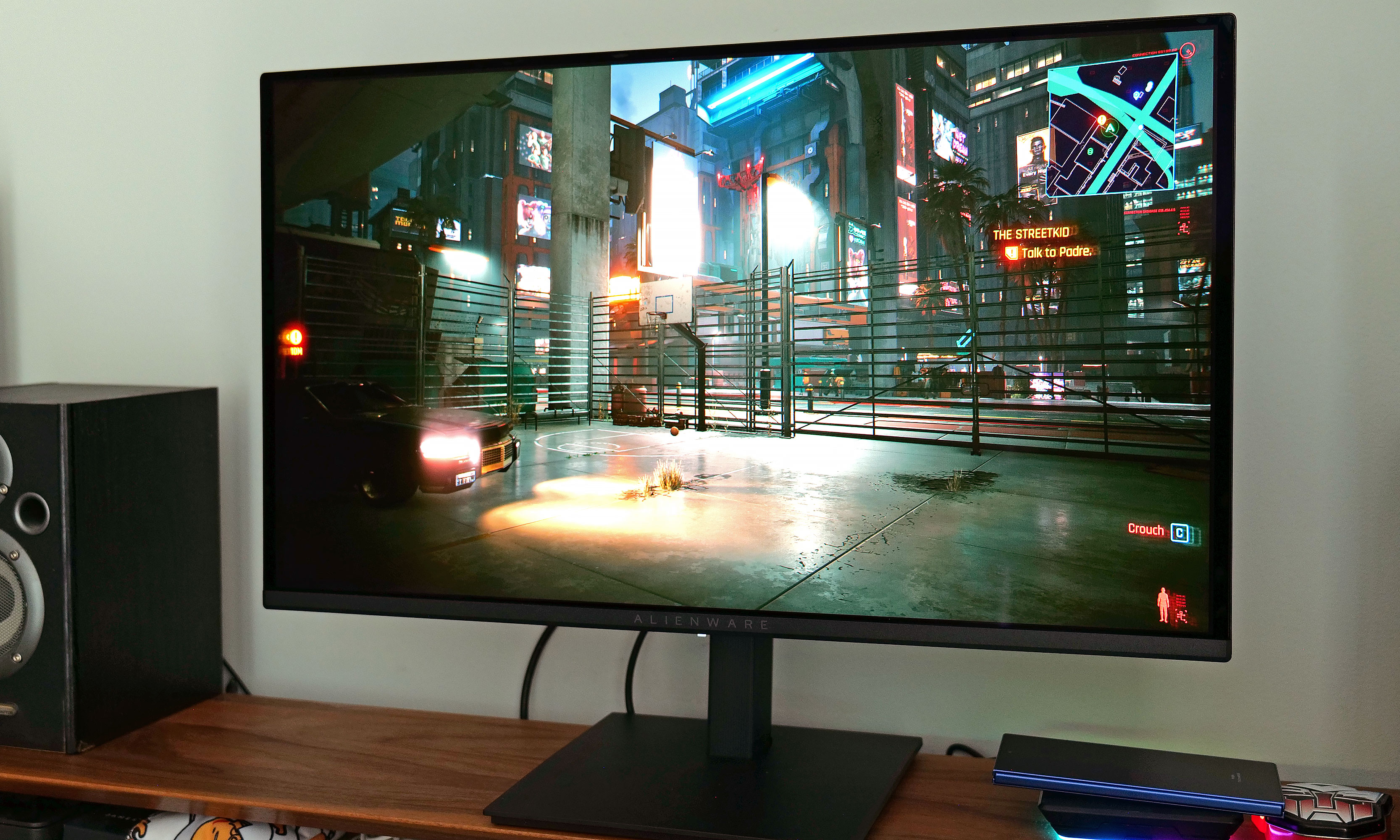
As long as it's not too sunny or bright, the AW2726DM delivers excellent visuals for the money.
Sam Rutherford for Engadget
The AW2726DM features a QD-OLED panel supplied by Samsung that comes with a QHD resolution (2,560 x 1,440) and up to a 240Hz refresh rate. Alienware supports VRR via AMD FreeSync Premium and VESA AdaptiveSync, though sadly there’s no native option for NVIDIA G-Sync. That means if you have a GPU from Team Green and want to take full advantage of the monitor’s potential, you’ll want to rely on that DisplayPort for optimal compatibility.
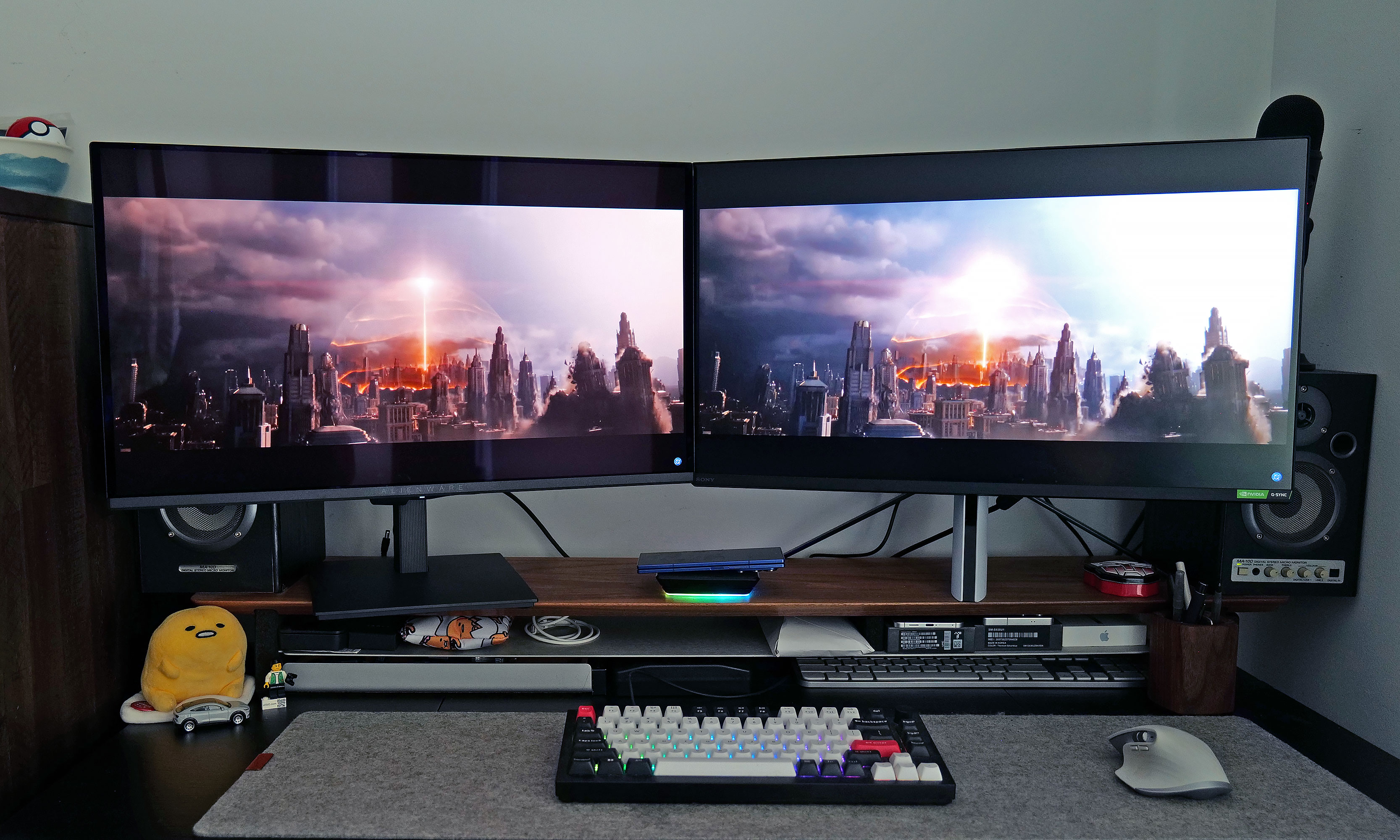
Regardless, for a $350 gaming display, the AW2726DM checks all the most important boxes and it looks fantastic. Alienware’s budget monitor showcases the strengths of OLED panels versus LCD, even when compared to Sony’s Inzone M9, which was a much more expensive monitor when it debuted back in 2022. Alienware offers richer colors (it covers 99 percent of DCI-P3), and thanks to its deep inky blacks, contrast is significantly better as well.
Here's a direct comparison between the AW2726DM and the Sony Inzone M9, the latter of which cost $900 when it came out in 2022.
Sam Rutherford for Engadget
The one big drawback is that, with a typical brightness of 200 nits, the AW2726DM is dimmer than more expensive rivals. That means the monitor doesn’t have fancy certifications for stuff like VESA True Black and instead relies heavily on general HDR10. Furthermore, Alienware chose a glossy (and quite reflective) finish that makes colors look even more saturated while improving perceived brightness. The one thing you need to watch out for is glare, especially if your PC or console lives in a room that gets a lot of sunlight. But if you’re like a lot of gamers that prefer to frag at night or in the dark, this may not be an issue.
Outside of gaming, there’s another shortcoming of the AW2726DM. Between its QHD resolution and the arrangement of Samsung’s QD-OLED subpixels, folks with good eyesight may notice a little fringing, especially when compared to higher-res 4K displays. This means some Word docs and web pages may not look quite as sharp as you’d like, but that’s a small price to pay for some of the best visuals you can get on a gaming monitor in this price range.
Warranty and care
The stand for the AW2726DM supports tilt, height adjustment and even pivoting all the way into portrait mode.
Sam Rutherford for Engadget
One of the major concerns about OLED displays when they first hit the market was the potential for burn-in, resulting in permanent damage to the panel from things like static UI elements staying on the screen too long. Thankfully, the AW2726DM comes with a three-year warranty that includes a clause covering burn-in, along with a free panel replacement in case there’s even a single bright pixel. Furthermore, Alienware uses a graphite film heatsink and an AI algorithm to prevent any sort of ghosting from appearing in the first place.
Wrap-up
Alienware also conveniently includes both HDMI and DisplayPort cables in the box, along with the required screws for mounting the panel to the stand.
Sam Rutherford for Engadget
The AW2726DM might not have all the fancy features you get on more expensive monitors, but it’s an excellent example of a no frills gadget done right. You get just enough ports, a straightforward design and a beautiful QD-OLED panel with a solid resolution and refresh rate — all for just $350. It would certainly be nice if it was a little brighter or if text looked a touch sharper, but those shortcomings are pretty easy to live with. For anyone looking to upgrade what might be arguably the second most important part of your gaming setup (your screen is your window into new worlds after all), this display is budget gold.
This article originally appeared on Engadget at https://www.engadget.com/gaming/pc/alienware-27-aw2726dm-qd-oled-monitor-review-a-budget-pc-gamers-new-best-friend-130000287.html?src=rss