
Why Xiaomi phones aren’t banned, but are rarely sold in the US
The Chinese company is allowed to sell its impressive phones in the States, but it doesn't. Here's why.

Somewhere in Washington state, a man named D.L. Byron recently bought a certified pre-owned Polestar 2. He did what most careful buyers do, researched the brand, appreciated the Scandinavian design, weighed the range and the reputation, and made a considered decision. Then, within days of that purchase, Polestar announced it would stop selling new vehicles in the United States from the 2027 model year onward, after the U.S. Department of Commerce denied the Swedish automaker authorization under the Connected Vehicle Rule. Byron’s reaction, reported by The Verge, was immediate and unambiguous. “It feels like we’re the ones left holding the bag, with no compensation for the sudden loss in market value on cars we just bought or leased.”
What Byron experienced is becoming the defining anxiety of the connected-car era. A modern EV purchase comes bundled with software ecosystems, service networks, regulatory standing, and brand-dependent resale value, all of which can shift dramatically on a government decision, a quarterly earnings report, or a geopolitical pressure point that the buyer had no awareness of on signing day. The car itself may run perfectly fine for years. The broader infrastructure that gives it value, the OTA updates, the service continuity, the dealer footprint, and the market confidence of potential used-car buyers, operates on forces that have very little to do with how capable the vehicle actually is. Polestar owners in the U.S. are learning this the hard way, watching resale anxiety arrive before the service network has missed a single appointment, and the lesson extends well beyond this brand and this moment.

The Connected Vehicle Rule, finalized by the Department of Commerce’s Bureau of Industry and Security, targets vehicles with a “sufficient nexus” to China or Russia, covering telematics, cameras, GPS, Bluetooth, cellular modules, and automated driving systems. The software restrictions kick in at model year 2027 with hardware restrictions following in 2030. Polestar’s problem was never where its cars were built. The Polestar 3 is assembled in South Carolina alongside Volvos from the same Zhejiang Geely Holding Group, yet local manufacturing provided no shield from the authorization denial. The rule targets ownership structure and software entanglement, and Polestar’s Geely-majority ownership, combined with its reliance on the Geely ecosystem, gave the Bureau its grounds. Volvo, operating as a separately listed entity with a decoupled software stack and a more established U.S. footprint, secured a waiver. Polestar did not.

Polestar CEO Michael Lohscheller positioned the retreat as forward strategy, noting that Europe accounts for the largest share of the brand’s sales, and the company’s messaging on owner support has been consistent: warranties honored, existing Polestar 2, 3, and 4 owners continuing to receive service, and remaining Polestar 3 and 4 inventory sold at an aggressive discount until stock runs out. The brand had warned as early as 2024 that the Connected Vehicle Rule could effectively block its U.S. sales, yet when the formal exit became official, it still landed hard for buyers who had only just signed their paperwork. Matthew Haiken, owner of Polestar Short Hills in New Jersey, captured the dealer position precisely: “At this point, I have to trust that Polestar will honor its warranty and service commitments. We deserve better. This is the first time that anyone has said, ‘Hey, this is not us. It’s outside our control. It’s the government.’ So we’re left very vulnerable.” The warranty is still valid on paper. Whether the used-car market reads the situation as generously is a separate question, and used-car buyers are rarely sentimental.

Buying a connected car in 2026 without evaluating the brand’s regulatory standing, software continuity, and commercial presence in your market is a gap that Polestar owners are now navigating in real time. Fisker’s collapse last year was the more total and immediate version of this lesson, and while Polestar’s situation is structurally different, the emotional experience for current owners is uncomfortably familiar. The Polestar 2, 3, and 4 are genuinely well-designed vehicles that many owners will hold onto for exactly that reason. But resale value is a market sentiment measure, and market sentiment on a brand that has exited your market corrects fast and waits for no one. Polestar’s predicament makes the broader case: every connected-car buyer should be stress-testing the brand’s software stack, regulatory profile, service infrastructure, and long-term commercial standing before they sign, and those variables matter as much as the range figure on the window sticker.
The post Polestar’s Sudden U.S. Exit Reveals the Hidden Risk of Buying a Connected Car first appeared on Yanko Design.

Samsung has officially unveiled its latest flagship device, the Galaxy Z Fold 8, a smartphone designed to push the boundaries of foldable technology. With a wider design, a slimmer profile, and innovative hardware, the Galaxy Z Fold 8 is poised to redefine what users expect from foldable devices. Scheduled for its grand debut at the […]
The post First Leaked Look at Samsung Galaxy Z Fold 8 Wide Impresses appeared first on Geeky Gadgets.

Garmin’s upcoming screen-free fitness tracker, CIRCA, appears to be nearing its debut, with mid-July 2026 emerging as a likely timeframe. Regulatory filings, including an FCC authorization secured on January 20, 2026 and a 180-day confidentiality request expiring on July 19, suggest that an announcement could align with this timeline. TechAvid explores how Garmin’s historical tendency […]
The post FCC Filings Suggest Garmin CIRQA May Launch Around July 19Th 2026 appeared first on Geeky Gadgets.


Most architecture competitions produce something sleek, serious, and slightly self-important. The Veggery is none of those things, and that’s precisely why it deserves your attention. Installed at the Barbican Estate’s St Giles Terrace in London, The Veggery is a temporary greenhouse pavilion designed by Studio Folk Architects and design-and-build studio Raskl. It was the winning entry to the “Seeds in the City” competition, organized by the Culture Mile Business Improvement District as part of the closing stretch of the 2026 London Festival of Architecture.
The brief asked designers to create a community-focused structure around food growing and sustainability. What came back was a hexagonal, domed greenhouse with a vaulted polytunnel roof, recycled water butts standing in as columns, and a one-metre-tall turnip finial sitting right at the top. Yes. A giant turnip. Perched at the apex of a greenhouse pavilion. On the Barbican Estate. I love it.
Designers: Studio Folk Architects and Raskl

The Barbican is one of those places that takes itself extremely seriously, and rightly so. Its brutalist architecture is globally revered, its arts centre is a cultural institution, and its residents are fiercely protective of its character. Dropping a whimsical garden folly into that context feels almost mischievous, except that Studio Folk Architects clearly thought very carefully about how to make it fit. The Veggery’s silhouette actually echoes the estate’s own barrel-vaulted roofscape, and its proportions nod to English landscape garden traditions. The turnip, though playful, is no accident. It roots the whole design in something very specific: the act of growing food, of getting dirt under your fingernails, of doing something tangible in a city that can feel relentlessly abstract.


The detail work is where it gets genuinely interesting. The patterns pressed into the structure’s surfaces weren’t generated by a computer or lifted from an archive. They came from giant paper collages made by students at the neighbouring City of London School for Girls during design workshops. That decision changes the whole feel of the pavilion. These are not decorative gestures by designers working behind a screen. They are marks made by actual people who live and study next to this space, which is exactly the kind of community integration that too many public design projects only claim to have.


Inside, the pavilion functions as a working greenhouse. Three bays of flexible shelving hold plants and potting benches, with a clear open area that can be used for talks, workshops, and events. The Barbican Horticultural Society, local residents, and school groups all contributed to the planting itself. The structure’s timber framing is also demountable and designed for easy disassembly. It is not precious about itself, which is refreshing given how many temporary pavilions seem more interested in Instagram than in actual use.


The £50,000 budget strikes me as modest for what they pulled off, and it shows what a clearly considered design brief and genuine collaboration between an architecture practice and a fabrication partner can achieve. Raskl’s hands-on, design-and-build approach seems to have kept the whole thing grounded in practicality without sacrificing ambition.
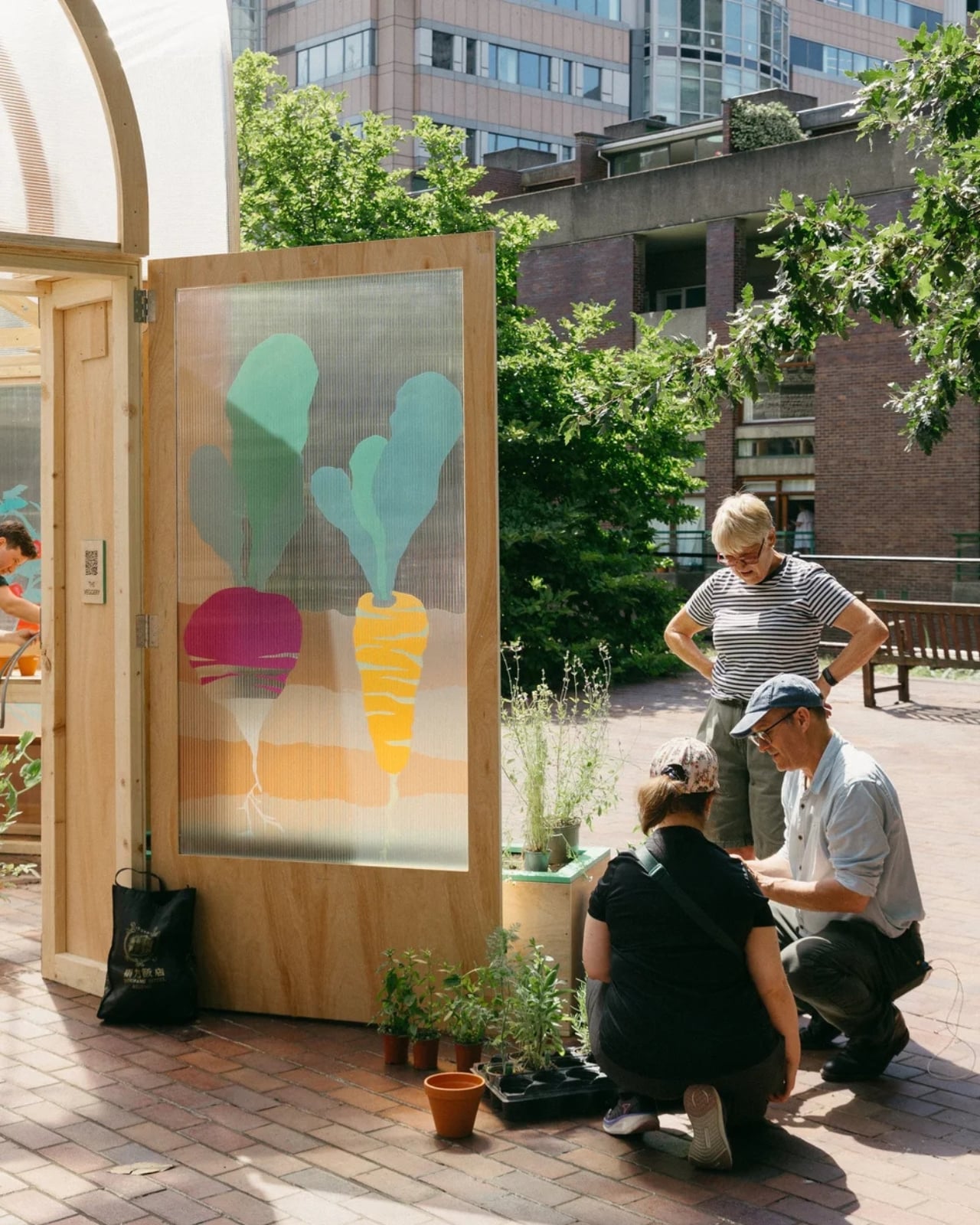

The theme of the 2026 London Festival of Architecture was “Belonging,” and The Veggery answers that prompt with more honesty than most. Belonging, at its most basic, means having somewhere to go that actually wants you there. Not to look at, not to photograph, but to use. A potting bench and a shelf of seedlings is not glamorous, but it is welcoming in a way that a lot of elevated design is not. The fact that the pavilion sits within one of London’s most architecturally celebrated estates makes that contrast land even harder.
The Veggery is only temporary, which feels like the one genuinely unfortunate thing about it. For now, it is open, free to visit, and growing things. Which is more than can be said for most of what wins design competitions.


The post A Turnip on Top: London’s Most Unexpected Design Win first appeared on Yanko Design.

The Samsung Galaxy Ring 2 is poised to make a significant impact on the wearable technology market. Combining advanced health monitoring features with a sleek, user-friendly design, this next-generation smart ring is expected to set new standards for functionality and comfort. Anticipated to launch in the latter half of 2027, potentially during Samsung’s Galaxy Unpacked […]
The post Samsung Galaxy Ring 2 Leaks: a Thinner Design with a Massive Battery Upgrade appeared first on Geeky Gadgets.

The XREAL XBX a01+ enters the extended reality (XR) market as a lightweight and budget-friendly option, weighing just 50–62 grams. Its design prioritizes portability and comfort, making it accessible for casual users. According to Kola, notable features include customizable 3D-printed faceplates and AI HDR support, which enhance visual quality. However, the lack of positional tracking […]
The post XREAL XBX A01+ XR Glasses Beats Air4 Pro with a Wider 50-Degree FOV appeared first on Geeky Gadgets.

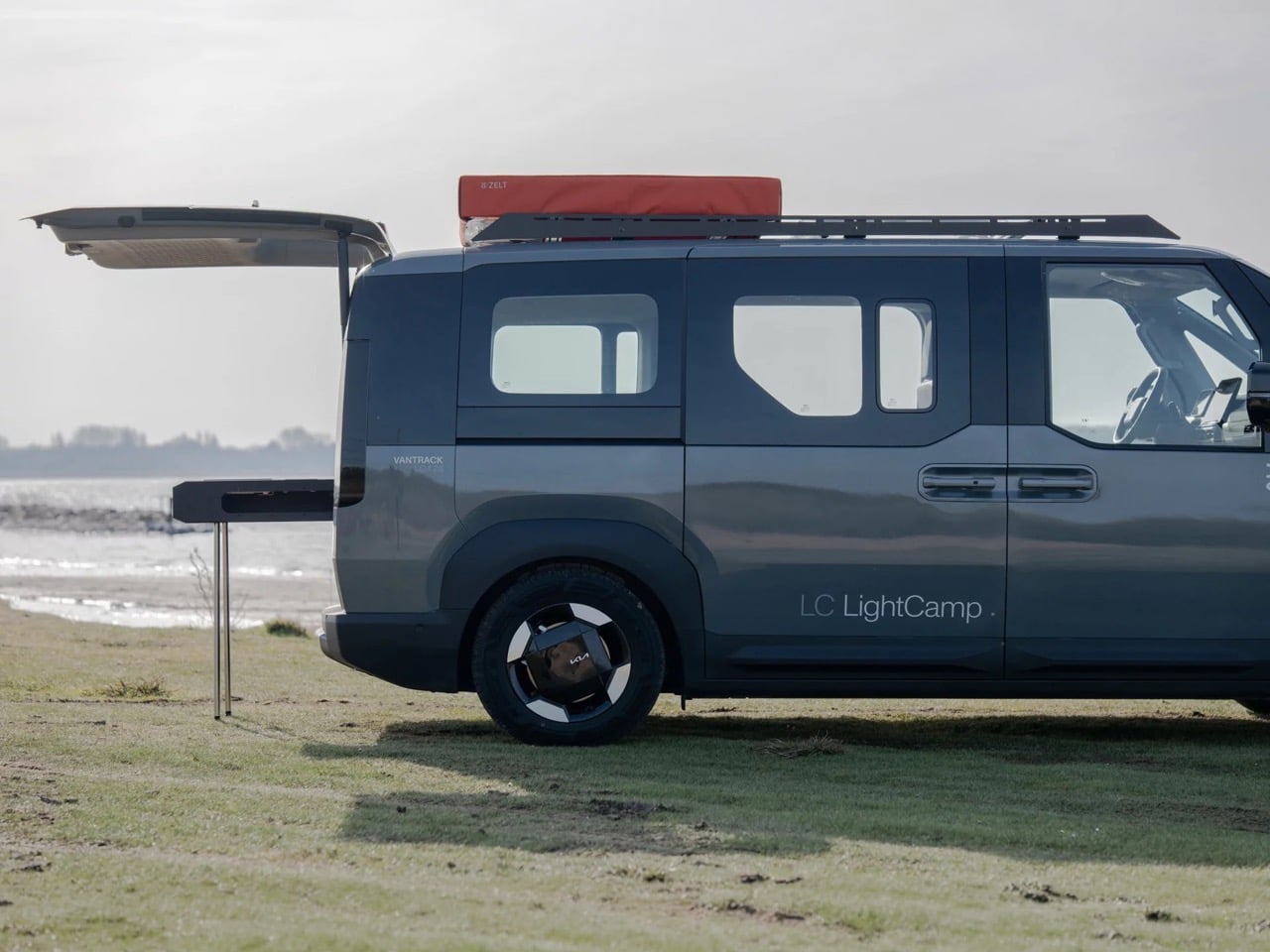
Camper conversions usually leave a mark. Cabinets get bolted in, headroom gets swallowed by a pop top roof, and the donor vehicle spends the rest of its life looking and feeling like a camper even when it is just running errands. Dutch outfit Vantrack decided that trade off did not have to be permanent, at least not for the Kia PV5 Passenger. Its Lightcamp package turns the compact electric van into a four person mini camper on Friday and hands it back as a stock e-MPV on Monday, with almost nothing left behind to prove the transformation happened.
The trick lies in how little of the kit actually stays attached. A slide out kitchen, an inflatable sleeping platform, and a rooftop tent all come off in minutes, leaving only a fixed skylight as evidence anything changed. Vantrack plans to reveal the production version in September at the Netherlands’ Camper Trade Fair, with complete conversions starting around €65,000 based on the PV5 Passenger Essential trim.
Designer: Vantrack

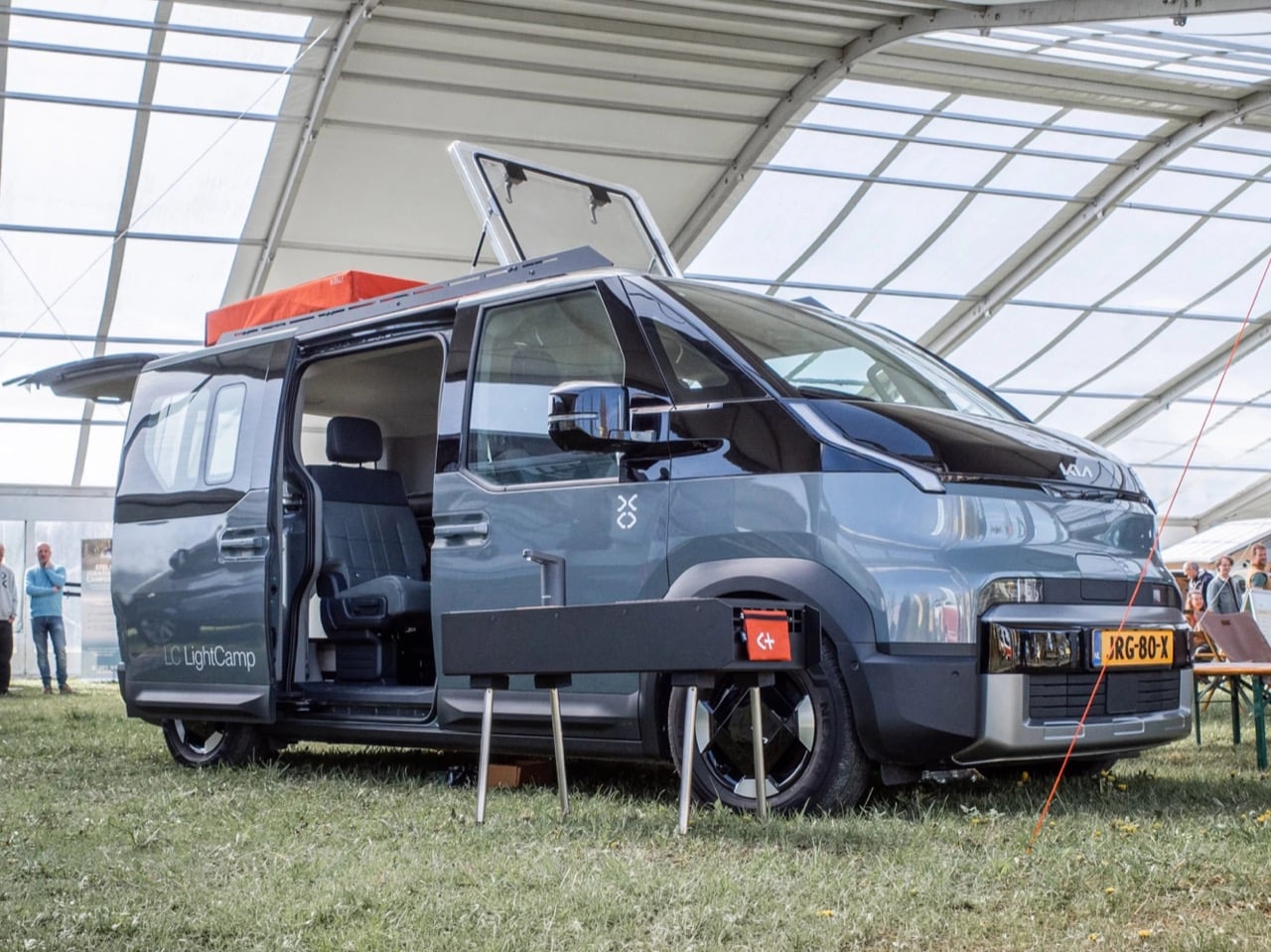
The exterior graphics set the tone before you even open a door. Large, neat lettering spells out “LC LightCamp” along the flank, paired with a stark X logo that reads more like a Scandinavian furniture brand than a typical outdoor equipment maker. That restraint suits the PV5 itself, a van whose crisp panel lines and boxy proportions already look like they were drawn with a ruler. The single splash of orange canvas on the roof, visible from a drone shot as clearly as from the ground, keeps the whole package from feeling clinical. It is minimalism doing actual work, not just decoration for a trade show floor.

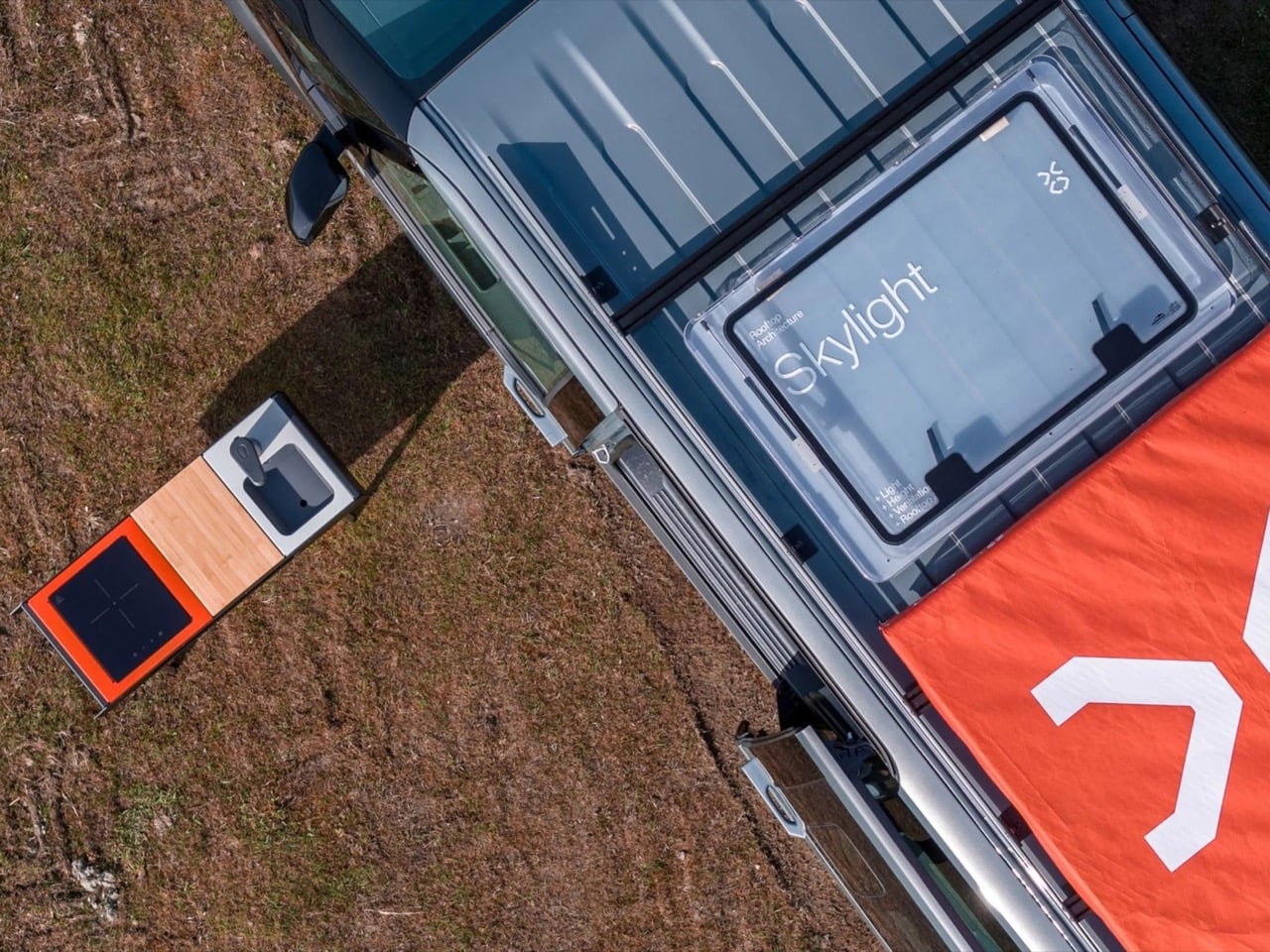
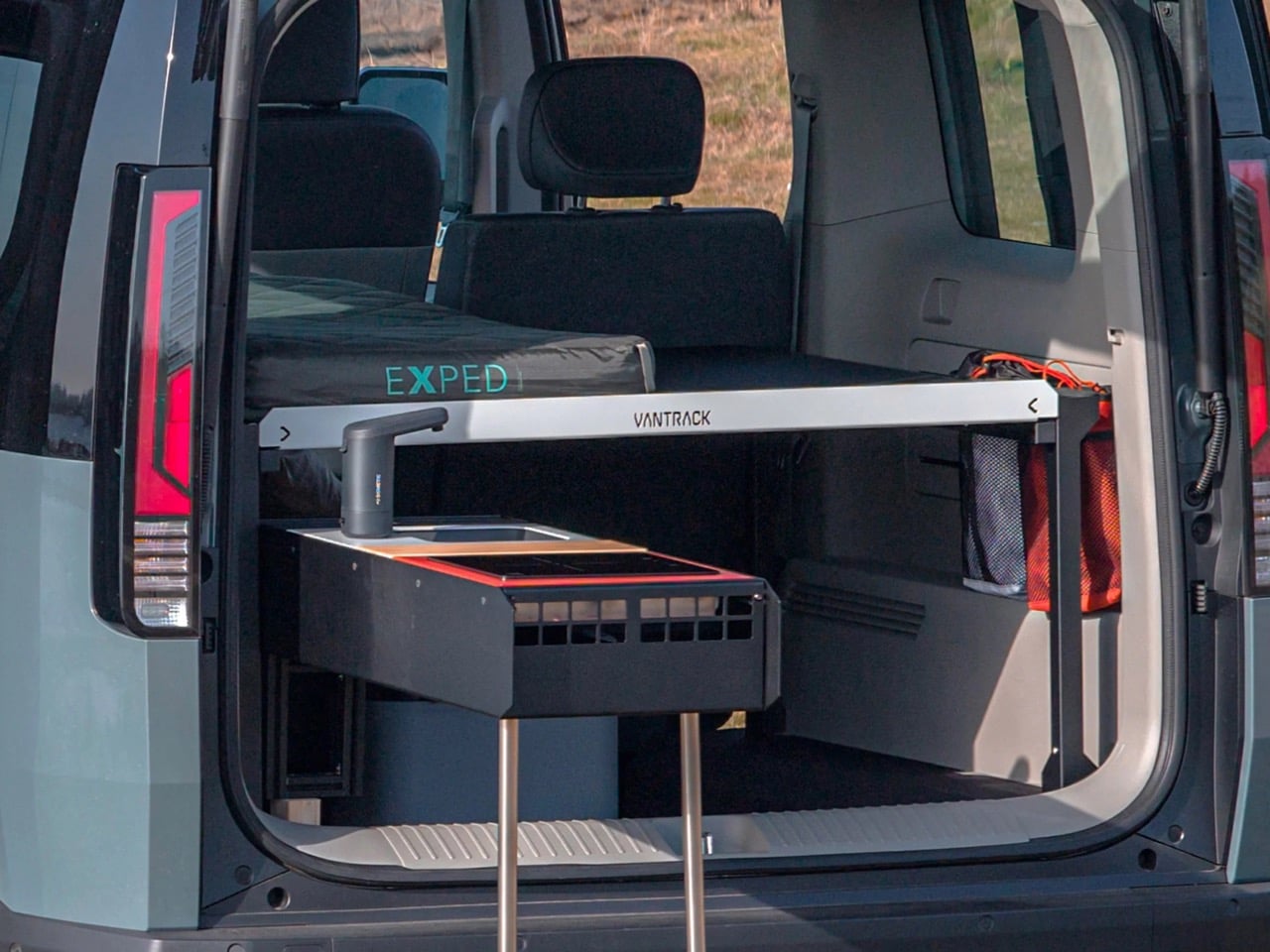
Vantrack’s real party trick sits at the tailgate. Instead of the thick, stacked foam mattress that most camper kits rely on, Lightcamp uses a slim pull out bed platform paired with two Exped Luxemat inflatable sleeping pads, each one rolling down to about 26 x 8 inches for storage underneath the platform itself. That frees up cargo space for gear rather than burying it under bedding. Below that platform rides the kitchen module, a compact unit with an induction cooktop, a bamboo cutting board, a small sink, and a Dometic Go faucet drawing from an 11-liter water canister. Slide it out on its own folding legs and it works as either a tailgate galley or a standalone cook station away from the van entirely.
Rather than fitting a heavy pop up roof, the company installed a fixed skylight that doubles as an access hatch into a rooftop tent it calls its Rooftop Architecture. The tent itself packs down small enough to sit on the rear of the roof rack, unfolding forward to create a two person sleeping area roughly 51 by 79 inches. That is lighter than a traditional pop top and, more importantly, it stays out of the way entirely when the tent gets pulled off for the off season. Vantrack has done similar rear cargo racks on its Volkswagen T6.1 builds, and Lightcamp borrows that same building block logic throughout.

None of this would matter much without a capable base vehicle underneath it. The PV5 Passenger’s Utility Mode lets owners tap the traction battery for climate control and V2L power while parked, running lights, a speaker, or a coffee maker without a separate leisure battery. Combined with a 256 mile WLTP range and 30 minute fast charging from 10 to 80 percent, the PV5 handles the drive to a campsite with more confidence than most dedicated camper vans manage on a full tank.

What makes Lightcamp worth watching is not any single component but the discipline behind leaving so much of it removable. Full pop top conversions commit an owner to a camper shaped life whether they are camping that week or not, while Vantrack’s kit lets the PV5 Passenger slide back into being an ordinary five seat van the moment the trip ends. Whether that modularity survives the jump from concept to the finished September reveal is the real question, but the underlying idea, that a camper should be something you deploy rather than something you permanently become, feels overdue.
The post This Kia PV5 Modular Camper Kit Disappears Completely When the Weekend Is Over first appeared on Yanko Design.

iOS 27 introduces a range of advanced customization tools, empowering users to create a sleek and immersive ultra-dark, liquid glass aesthetic for their iPhones. This guide provides a detailed walkthrough to help you achieve a cohesive and modern design that enhances both the visual appeal and functionality of your device. Whether you’re a tech enthusiast […]
The post How to Set Up iOS 27 Ultra Dark Mode and Liquid Glass appeared first on Geeky Gadgets.