LG is going to start selling a compact bipedal robot that can roll around your house freely. The AI-powered robot, which will debut at CES 2024 in Las Vegas, has a wide range of capabilities — from notifying you that you left the AC on while you're away to watching your pet while you're at work. Like stationary smart home aids, like Alexa or Apple HomePod, LG’s robot can also tell you the weather and remind you to take your medications on time.
The robot is powered by Qualcomm’s Robotics RB5 Platform, which entails a mix of hardware and software that run the bot’s AI program. Some of these include its ability to recognize faces and voices, process the emotions of those around it and engage in conversation. LG says the bot will be able to greet you at your door, analyze your emotions and play music to either boost your good mood or lull you to sleep. It can even “emote” by changing its posture thanks to its articulated leg joints. Although it's a cute feature, it might not have any practical use beyond making it approachable.
The robot is also equipped with a camera in its face, a speaker and various sensors throughout that give it the ability to navigate, speak and listen. It can also measure indoor air quality and temperature, however, it's unclear if it can actually be linked to a smart home system and control your thermostat. LG has not yet responded to comment on this and said the price of the robot will be announced at a later time.
Because the bot can move around freely, you can program it to look after your pets while you're gone and send your smartphone notifications “if any unusual activity is detected.” Using the same monitoring tools, the bot can act as a mobile “security guard” and send you notifications if there is movement in the house while you're away. Or more likely, just let you know you left the kitchen lights on.
We're reporting live from CES 2024 in Las Vegas from January 6-12. Keep up with all the latest news from the show here.
This article originally appeared on Engadget at https://www.engadget.com/lg-developed-a-two-legged-ai-powered-robot-that-can-watch-your-pets-for-you-192034931.html?src=rss
Arkane Lyon’s time-bending FPS Deathloop is free on PC for Amazon Prime members. You have until January 10 to download the game. Additionally, you’ll need to link an active Epic Games Store account, but Amazon has made it simple to do that right on the download page. This isn’t a rental. The game is yours to keep.
This isn’t the first time Amazon has given gamers a holiday treat. Last year, it was Dishonored 2, another Arkane classic. The company also tends to give away games to coincide with its Prime Day events.
As for Deathloop, it’s a fantastic title that marries the harried frenzy of a first person shooter with the intrigue of an old-school adventure title like Myst. We compared it to an escape room in our official review, and that pretty much sums it up. You’re trapped on an island in a Groundhog Day-esque time loop and have to figure a way out. The game’s filled with thoughtful puzzles and the combat is satisfying, which is no surprise coming from the folks behind Dishonored.
In other words, this is one of the most unique and flat-out fun releases of the current generation. It’s a steal at full price, so free is a no-brainer. Deathloop is also available on Game Pass, if that’s your bag. Developer Arkane is currently busy working on a game based on Marvel’s resident vampire hunter, Blade.
This article originally appeared on Engadget at https://www.engadget.com/deathloop-is-free-on-pc-for-amazon-prime-members-161153013.html?src=rss
It’s been a terrible year for game developers, but an amazing year for games. 2023 kicked off with a fantastic remake of Dead Space and the breakout success that was Pizza Tower, and by the end of the year we had dozens more games vying for our attention. There were some missteps along the way — if you'd asked me to predict this list a year ago, I would've mentioned both Redfall and Starfield — but overall it's been a packed year unusually low on disappointment.
We’ve never tried to name a single title as "the Game of the Year." Instead, it’s become a tradition to get the whole team together to talk about our individual favorites. So here are those games, presented in alphabetical order to avoid hurting any of our writers’ feelings. Feel free to sound off about what your favorites are in the comments; there are no wrong answers. Except maybe The Day Before.
Alan Wake 2
I rarely have time to finish games these days, but I devoured Alan Wake 2 in just a few weeks. For me and my limited gaming time, that felt miraculous.
I'll admit, I'm a mark for Remedy Entertainment. I've been following its work since the first Max Payne arrived on PCs in 2001, right as I was gearing up to head to college and building my first desktop PC. (It had a 1.3GHz AMD Athlon Thunderbird and an ATI All-in-Wonder Radeon GPU with a TV tuner. Yah, I was one of the cool kids on campus..)
Max Payne blew me away with its fluid slow-motion gunplay mechanics and immersive narrative. As a lifelong console gamer until then, it was a big step forward from something like Tomb Raider. Playing Alan Wake 2 brought me right back to my college days: Its storytelling is far more mature than Max Payne, but leagues more ambitious. I spent much of the game with a big stupid grin on my face, marveling at how the game balanced two different leads (Saga Anderson and Mr. Wake himself), an array of quirky characters, and some of the boldest gaming narrative choices in the last decade.
As Jessica Conditt said in her review, Alan Wake 2 works best when you're not in combat. I enjoyed chatting with the locals and digging up background details more than I did shooting a repetitive array of baddies. It also helped that I was playing it on LG's massive 49-inch UltraGear monitor, which at times made it feel like I was completely immersed in the game. It made the more idyllic environments in the Pacific Northwest seem all the more beautiful, while the scarier bits felt even more nightmarish. Get you a game that can do both.
Over two decades after I became a fan of the studio, I’m just as excited to see what Remedy is cooking next. It feels like college all over again. Maybe time really is a flat circle. Or maybe, as Alan Wake would say, it’s a spiral towards something greater, the accumulation of everything we’ve learned and all the mistakes we’ve made as we pursue the specter of perfection. Anyway, good game. — Devindra Hardawar, Senior Reporter
Armored Core 6
Elden Ring was my first foray into the FromSoftware universe since Chromehounds for the Xbox 360. Elden Ring is an all-timer and no more needs to be said about it, but coming off that I was a bit trepidatious about whether the developers could apply their learnings and innovations to something with a legacy like Armored Core. Silly me to ever doubt FromSoft, because they delivered a game worthy of their developer pedigree. While AC6 doesn’t feel like “Elden Ring with mechs" I'm honestly glad it doesn’t. The developers have done a masterful job of blending classic Armored Core depth, customization and combat with the scale, bombast and world-building they are known for.
Some of the bosses in this game felt impossible, like many of the best FromSoft bosses do, but as always there is a tweak to your gameplay style or strategy that can turn the tables in the end. The first actual boss fight with Balteus had me questioning if I was ever good at video games in the first place, and when I finally adjusted to beat him I had that same triumphant feeling of beating the best FromSoft bosses from games past. Something else less discussed, but still worthy of praise as well, is how FromSoft finds a way to make what is basically a radio play story feel important and impactful when mixed with the heavy action of the actual gameplay. In a game where you wouldn’t expect story or characters to have an impact, FromSoft does an excellent job making you care about its dystopian Mecha pilots and their handlers in a way I never expected.
AC6 is a game I couldn’t stop thinking about, and the one I probably felt the most fulfilled by following each session, after my heart rate dropped and my vice grip on the controller loosened. FromSoftware continues to prove that it's in a league of their own. — Justin Vachon, Lead Designer
Baldur’s Gate 3
The Game of the Year is my game of the year. I’ve dabbled with Dragon Age, spent a few nights trying to unravel 2002’s Neverwinter Nights, but Baldur’s Gate 3, while still unapologetically Dungeons and Dragons, smooths out the procedural part while still deciding the fates of heroes, villains and the world on the roll of a die. Plus modifiers.
The rules and numbers of D&D are all baked into BG3, but you can also just play it and let the rules take care of themselves. Even when I failed dice rolls (how things are decided in D&D games, pitting your character’s stats against “skill check” numbers), I was happy to see how this affected the story. Sure, you can save-scum (quicksave, fail, quickload and try again), but it eventually feels hollow when there are so many decisions to make.
I talked to a colleague about the game and he was leery about a game with so many options. He’d have to play, replay, choose different options, and feel short changed if he didn’t eke every plot twist of a game like BG3.
The game, the options, the side quests are all so dense with choices and branching paths that there are (almost) countless permutations, distractions and bad decisions to make. I found that oddly freeing. The game, divided into three parts, does block out parts of the world from act to act, but I never found that particularly limiting. In fact, it ensured I tied up the most exciting plot points or destinations before plowing further into the story.
Two tips: being evil is very much an option (as is a mid-game redemption arc) and be careful when you rest overnight, as that will tick the game’s internal clock over and could mess up your plans. Invaders, unsurprisingly, don’t wait. — Mat Smith, UK Bureau Chief
Cocoon
My day-to-day job is mostly behind the scenes, editing stories and scripts, dealing with technical issues and managing a fantastic group of reporters. All of which is to say I actually only have five bylines on the site this year. Two of them are about Cocoon — 40 percent, baby! It stands to reason, then, that it's my personal game of the year.
You can read my review of the game for some expanded thoughts, but here’s the summary, at least: Cocoon is a near-perfect puzzle game in which you play a bug and who has to jump between worlds to progress. It’s a laser-focused experience that only lets you play around with one or two mechanics at a time, but stretches each of its ideas to its natural conclusion. It's also dirt cheap and on Game Pass, so what do you have to lose? — Aaron Souppouris, Executive Editor
The Cosmic Wheel Sisterhood
The Cosmic Wheel Sisterhood is sexy, well-written and replayable, and it’s one of my favorite games of the year, from one of my favorite studios of all time. Deconstructeam is responsible for Gods Will Be Watching and The Red Strings Club, two vibrant titles about the limits of humanity and society, and The Cosmic Wheel Sisterhood brings these themes to a new plane.
The Cosmic Wheel Sisterhood is about building tarot decks, manipulating an election from afar, betraying a coven of witches, gaining power and seducing everyone. It’s bigger than anything Deconstructeam has ever made, with layered characters, branching narratives and strangely beautiful art. The witches, behemoths and otherworldly creatures in The Cosmic Wheel Sisterhood fill the game with life and interwoven relationships, while the deck-building mechanic is surprisingly dense and designed to encourage creativity. The game pulled me in and didn’t let go until it was done with me, and even still, I find myself happily returning to it. — Jessica Conditt, Senior Reporter
Dave the Diver
No matter if Dave the Diveris an indie game or not, it's still one heck of a good time. The pixel-soaked adventure breaks down into two main gameplay mechanics that shouldn’t mix at all, but somehow do. During the day you explore the sea, hiding from (or fighting) sharks and catching gobs of fish. At night, you run a sushi restaurant to sell those fish.
Each of these mechanics are completely different. When you’re under the water, it's exploration all the way, with mysteries around every reef and a constantly-shifting landscape. Running the restaurant is both a management sim, as you have to develop recipes and hire staff, and a fast-paced minigame that resembles the iconic arcade cabinet Tapper. This dichotomy is similar to another recent gem, Moonlighter. I loved Moonlighter, but Dave the Diver is even more addictive.
Both primary elements of the game are polished to a Nintendo-like sheen. In other words, it kept me up, night after night, as “one last run” turned into two and then three. But that’s just the beginning. As you progress through the occasionally hilarious story, Dave the Diver keeps adding new gameplay mechanics. Without giving too much away, there are mid-game additions that draw inspiration from Cooking Mama, Stardew Valley and others. Each of these elements are always a treat and never get in the way of the main gameplay loop. Also, you can hire a velociraptor as a server and Jason Vorhees as a sous chef. Good times. — Lawrence Bonk, Contributing Reporter
Dead Space
One of the best games of 2023 actually came out in 2008. The Dead Space remake landed in January and it stayed at the top of my GOTY list for the ensuing 11 months, slowly covering every other entry in globs of bile and blood. Developers at EA brought the terror and tension of the original Dead Space to modern platforms with thoughtful gameplay tweaks and a layer of visual polish, and in the process, they cemented the game’s reputation as an action-horror classic.
Dead Space spawned in an era of limitations. It was built for the Xbox 360 and PlayStation 3, consoles that were powerful, but still constrained in terms of processing power and graphics; they couldn’t support massive, open-world games filled with procedural generation and AI-powered encounters. Innovation at the time had to stem from a game’s mechanics, and Dead Space was the first action-horror blockbuster to remove the HUD and the power of a headshot, creating an immersive and terrifying combat rhythm.
The remake paid tribute to everything that made the original Dead Space a living legend. The USG Ishimura was cold and maze-like, with a few more mysteries added to its corridors, and some boss fights were updated to take advantage of high-fidelity mechanics, but it still felt like the Dead Space I remember. It felt better, even. In an age of living games and open-world blandness, the Dead Space remake showcased the supreme power of restraint in game design. — Jessica Conditt
Diablo II: Resurrected
Aside from the quick turnaround following the original, the wait time between new Diablo games is more than a decade. So to my surprise, in a year when we got Diablo IV, I found myself spending more time playing Diablo II: Resurrected. That's not to say that the latest entry is a failure, because despite a drop in players and cratering views on Twitch, Diablo IV’s story is the franchise’s best yet and Blizzard nailed the look and feel of the game. Unfortunately, despite having faced similar issues with Diablo III, its endgame still needs a lot of work. This is why in 2023 I’ve had much more fun playing Diablo II, or more accurately Diablo II: Resurrected.
Thanks to a superb graphical overhaul, the game looks how I remember it in my head instead of the chunky low-res textures it actually had back in 2001. But more importantly, Blizzard fixed a ton of annoying glitches from the original (like enemy mana drain being way too strong) while implementing a bunch of handy quality-of-life upgrades such as automatic gold pickup and the shared stash. But the thing I like the most is that, since it came out in 2021, Blizzard has expanded upon the core game with additional patches and balance changes that have injected new life into the game while preserving its spirit. This year, specs like elemental druid and martial arts assassin suddenly went from being underpowered niche playstyles to top-tier builds, essentially undoing 20 years of neglect. The addition of Sunder Charms also made a ton of single-element specs way more viable and the addition of Terror Zones turned item farming into less of a grind while increasing the challenge.
Sure, melee classes still need a bit of love (maybe recalculate how attack rating works or add some more AOE abilities) and the cadence of new content has ground to a halt in the run-up to and subsequent release of Diablo IV. But for an update to a two-decade-old game, Diablo II: Resurrected feels like a great homage to an all-time classic and a wonderful example of a remake done right. Now I’m just hoping Blizzard finds some time to finally finish Act IV or maybe even add a brand new chapter onto the best ARPG ever. — Sam Rutherford, Senior Reporter
F-Zero 99
Nintendo has carved out a little legacy of remixing gaming staples with its 99 (or 35) series, and F-Zero 99 is one of its most thoughtful battles royale yet. (I’d put it second behind Tetris 99.) From afar, it looks simple: the SNES arcade racer, but with 98 other people. But the addition of a persistent boost meter (which doubles as a health bar) and the ability to bank “Super Sparks” that you can spend to access a limited-time “Skyway” fundamentally changes how you play.
Do you throw caution to the wind, use more power this lap and try to hold on from the front? Do you hang back, try to increase your meter by knocking out other players and risk an insurmountable deficit? Where exactly on the track should you activate the Skyway? Winning still requires skill and track mastery — it’s F-Zero, after all — but there’s a new layer of strategy and resource management. What was once a sprint now becomes a horse race. You make more moment-to-moment decisions each time out. And decisions are what makes a game interesting.
All the other things that made F-Zero great 30 years ago still apply. The Mode 7 style. That iconic music. The distinction between the four supercars. The honest test of skill — this entry is a little more forgiving, but if you screw up, no Mario Kart shenanigans are going to come and save you. The course selection still has clear peaks and valleys, but F-Zero 99 doesn’t try to revise the past: It honors its source material, then makes considered changes that present it in a new light. In an industry that is constantly rehashing old ideas, that’s commendable. — Jeff Dunn, Senior Commerce Writer
Humanity
In Humanity, you play as a ghostly Shina Ibu who barks directions at a horde of humans to guide them toward a goal. That all seems simple enough, but like all great puzzle games, developer tha LTD plays around with the concept and keeps building on it until the very end. What starts as a fairly peaceful rumination about the controlled movement of humans soon segues into imaginative boss battles and mammoth lightsaber brawls.
There's a deeper story than you might expect from a game that's ostensibly about sheep herding mindless drones. What will stick with me from playing Humanity is a sense of optimism, an idealism that our species can achieve anything if we work together toward a common goal. That, and having the chance to take control of an adorable ethereal pup. — Kris Holt, Contributing Reporter
The Legend of Zelda: Tears of the Kingdom
The Legend of Zelda: Tears of the Kingdomis a perfect game blending exploration, action, adventure, combat and puzzle solving. It looks and sounds beautiful, with Hyrule a wonderful clockwork world you just want to spend your days hiking through without a care in the world. The title’s standout feature, Ultrahand, enables players to construct anything they can imagine to help get them through tricky puzzles. Its technological prowess, given the limited hardware it runs on, has made it the envy of the game development and player world. I started 2023 having never played a Zelda title, and by the end, I’d sunk about 1,000 hours combined into Breath of the Wild and Tears of the Kingdom.
I don’t think it’s unfair to say that the game is also a lot.
Nintendo’s more-is-more approach means the triple-digit play times are a bug as much as they are a feature. This goes hand-in-hand with the freedom you’re given, which lets you play the game any way you choose. The two extra environments may have headed off complaints that it was a glorified DLC, but you can feel the stretching. The Depths is little more than a repetitious traversal zone while the Sky Islands are five puzzles repeated over and over. The company has found the limit of what a coherent single player experience can be, and then just wandered beyond it.
And then there’s the grinding, which extends well beyond the usual gripes around weapons degradation. If you want to reach the end game, you’ll need more than a wooden sword and shield, which means endlessly beating the mid-size bosses. Plus, you’ll need to put a shift in down the mines Depths to gather enough Zoanite to make Autobuild worthwhile. I kept my Switch offline ever since Nintendo nerfed the easy duplication glitch because I don’t have enough hours in the day to play. In fact, I’d pay good money for a “Grown Adult” version of the game where it respects your time more than the existing version does.
While I’m moaning, I might as well add that I hate how Lynels and Ganondorf can destroy your Zonai weapons during combat. If you’re not a gifted sword-fighter, and you’ve never quite got your parrying skill perfect, then crafting robot weapons was a neat workaround. The game lets you pick your preferred way to succeed, except when it really matters, when it eliminates all but the most tedious. I don’t think, after spending so long getting everything else done, I can be bothered to go back and defeat Ganondorf despite pledging to do it before the end of the year.
Still, perfect game, 10/10. — Daniel Cooper, Senior Reporter
Mario Kart 8 Deluxe Booster Course Pass
Even though Mario Kart 8 Deluxewill be seven years old next April, we don’t need a new Mario Kart game. The title is still just as entertaining as it was brand new, thanks in large part to the massive expansion of new tracks Nintendo began dropping in March 2022. And while the waves have been slightly annoying, mostly due to the constant questions about their release dates from my nine year old, the steady cadence that wrapped up last month meant new challenges were arriving regularly for over a year.
The Booster Course Pass is well worth the money at $24.99. It’s less than a new game would cost and you get a new game’s worth of tracks (48) for that price. Not to mention added characters like Kamek, Petey Piranha, Diddy Kong and Peachette – all Steele family favorites. But for me, the best part is revisiting modernized versions of tracks from older Mario Kart games, the ones that endeared me to the series.
Rainbow Road from Wii is an all-time favorite and one course that I’ll go straight to when I only have a few minutes to play. Courses like Waluigi Pinball and Peach Gardens from DS are a lot more fun expanded to a big screen and I’ve enjoyed the road trip through major cities from Mario Kart Tour, a game I never played as karting on my phone didn’t really appeal to me. There are duds, of course, like Mario Circuit 3 from SNES that don't really translate as well to modern racing.
Maybe there will be a new game that flexes the muscle of the new Switch, but I’m not sure what there is to improve. I’d be perfectly happy to keep paying $25 every few years for a collection of new tracks, whether entirely new or inspired by the past, as this is a perfectly fine way to keep the game fresh for those of us who still really enjoy it. — Billy Steele, Senior Reporter
Marvel’s Spider-Man 2
Like a lot of recent PlayStation sequels, Spider-Man 2 takes everything that worked about the original game and gives us more. There’s more of New York City to explore, two characters that you can swap between at almost any time, more moves and suits and superpowers to take on the many enemies you’ll encounter throughout the adventure. It feels like the kind of game that easily could have gotten overstuffed and collapsed under the weight of what Insomniac Games was trying to pull off.
Fortunately, that didn’t happen, thanks in large part to some of the best mechanics in recent gaming. Swinging around the city remains an absolute delight, and the fluid fighting really makes you feel like a superhero. The new web wings give you another new way to navigate Manhattan and its boroughs, and getting your hands on the fabled symbiote suit opens up yet another new set of battle mechanics. Similarly, the open world map feels vibrant and alive, with tons to do when you’re ready to give the main story a break.
Naturally, the symbiote also takes center stage in the storytelling, as Kraven the hunter gives way to Venom throughout the game as the two main villains you’ll contend with. It makes sense to have two main baddies since there are two Spider-Men in this game, OG Peter Parker as well as his new protege Miles Morales. Each Spider-Man gets plenty of story development and heroic action sequences, and the roster of supporting characters has been fleshed out as well.
Ultimately, Spider-Man 2 is pretty easy to sum up. It’s just plain fun, with a great story, delightful mechanics and a wonderfully detailed NYC to explore. Whether or not you played the original game, it’s easy to get sucked right into this one and feel like a superhero. — Nathan Ingraham, Deputy News Editor
Moonstone Island
Moonstone Island asks the question, “what if Stardew Valley, but with Pokémon?” It’s the same kind of farming and dating sim you know and love, but with turn-based battles instead of manually swinging a pickaxe. Any creature you encounter can be captured and forced to fight in your stead, and there’s an element-based weakness mechanic pulled straight from Nintendo’s iconic pocket monsters.
They already had me with that Stardew meets Pokémon hook, but the developers didn’t stop there. This is a legitimate open world game with a large map that resembles the sky islands from The Legend of Zelda: Tears of the Kingdom. There are dozens upon dozens of these islands and I had an absolute blast sequence breaking my way to dangerous locations in the early parts of the game, only to have my butt handed to me by high-level monsters. That’s my jam, right there.
I also love the art style and, in particular, the NPCs. The romanceable characters here are top-tier and, in my opinion, more interesting than rival farming sims. I want to be friends with the blacksmith Ferra and town scientist Zed. However, my heart belongs to the punk rock herbalist Gaiana. If anyone messes with Gaiana, they are gonna get a visit from a trio of level 99 Pikachus, er, I mean Capacibees. — Lawrence Bonk
Not finishing games
Finish a videogame? In this attention economy?! I honestly couldn’t tell you the last time that I actually made it to a game’s end credits. For as much as I enjoy the PS5 games I buy, there’s inevitably some real-life commitment that draws me away from them, or an unconquerable in-game skill challenge that saps my interest. Doesn't matter if it’s an indie like the therapeutically smashy Dysmantle or a AAA adventure franchise like Horizon and Assassins Creed — don’t even get me started on Seikiro or Elden Ring — I will invariably get bored at some point before the final boss and wander off towards whatever new shiny title comes out next.
As such, my 2023 GOTY is a toss up between Armored Core 6 and Baldur’s Gate 3, having played roughly the first half of each (multiple times, in BG3’s case). Sure, one is a frantic shooter pitting players against superior armed forces in high speed mobile gun battles, and the other is an inclusive high fantasy dating sim wrapped in an epic adventure RPG. They both offer me an opportunity to tinker, futz, fiddle and otherwise experiment with the physical rules and social mores of the in-game universe without demanding I clear the endgame content first.
In this way, every game becomes a Choose-Your-Own-Adventure game (my absolute favorite genre growing up) and I get to assuage the FOMO anxiety I experience while playing titles with linear storylines. I’m not reverting to a previous save because I realize I messed up an earlier quest or accidentally closed off a storyline, I’m reloading just so I can figure out what all the other buttons and switches I didn’t push and pull also do. I find that freeing. There’s no pressure to “get it right,” only the opportunity to see what might happen.
Between AC6’s mission-based format and the ease at which I can manage save instances in BG3, I can load up any scenario I’ve played so far and try it again differently — maybe see how well an energy weapon-based loadout would work or what would happen if I fought with different companions or modified spell lists. Even though I know that there is a climactic endgame struggle (that the dev team worked really hard to produce) to get to and all the new game+ rewards that come with beating it, neither title really pressures me into getting there.
If I want to go off on a tangent and try my hand at pickpocketing an entire town, I absolutely can — then Groundhog Day the timeline back to before I started and do it all again, this time maybe wearing a different hat. Each gives me the flexibility to interact with their content as I have time and interest. — Andrew Tarantola, Senior Reporter
NYT Connections
New York Times
Wordle, the little word game that could, took over the first half of 2022. Every day, we had a new puzzle to look forward to — and potential bragging rights that would connect us with friends, family and strangers on the internet. Though Wordle fever subsided in 2023, my thirst for a daily word game remained. Yes, I could keep playing Wordle, but just one game wasn’t enough. Even as a subscriber and active user of the New York Times’ Games app, I needed more.
I didn’t want something as time-consuming as the full crossword each day, nor something as involved as getting to the Genius level on Spelling Bee. I wanted to be done in 5 minutes or less, which is why Wordle and the daily Mini crossword were perfect. In June, the New York Times introduced Connections, and it hit that sweet spot of being challenging enough to engage my brain but remaining casual enough that I didn’t need to derail my work day to finish it.
Connections’ mechanics are simple. Every day, you’re presented with sixteen tiles, each containing a word. You have to group those words into four sets of four based on what they have in common. And, like the app cautions, these categories are always more specific than “5-letter words” or “names” or “verbs.” At first, the game was straightforward and almost too easy. A few weeks in, though, and I’ve found the puzzles can get challenging, thanks to devious setups. For example, one time the grid included words like “Apple,” “Dell” and “Intel,” which tricked my tech-obsessed brain into thinking they were company brand names. It turned out that they belonged to other groups like “Synonyms for information” or “Fruit,” instead.
I would be remiss if I didn’t point out that Connections isn’t a unique idea that the New York Times thought up. Various iterations of a similar word game have existed before. Redditors pointed out its likeness to an app called Red Herring, while the host of a British television quiz show called Only Connect asked if the Times was aware “this has been a TV show in the UK since 2008?”
Sadly, though, if not for the Times adding Connections to its slate of word games, I would never have come across Red Herring. And because so many of the puzzles I play daily are in the NYT Games app, it’s much easier to check out all of them in the same place instead of installing a new app.
My daily routine now involves opening NYT Games, finishing Wordle, Connections, the Mini crossword, getting the Pangram on Spelling Bee and then bragging to anyone who will listen. That way, I feel like I’m giving my brain a bit of fun exercise before I drag my attention to my inbox or Slack for the real work of the day. — Cherlynn Low, Deputy Reviews Editor
Pizza Tower
The best “Nintendo platformer” of the year didn’t involve Mario, Kirby or Donkey Kong. It wasn’t even made by Nintendo. Instead, it stars a balding pizza chef named Peppino Spaghetti, and its development was led by a guy who goes by the pseudonym McPig. It’s called Pizza Tower — and while you could crudely describe it as “Wario Land 4 on cocaine,” it is one of the most refreshing and joyously creative games I’ve played in recent memory.
I waxed poetic about Pizza Towerin a write-up earlier this year, so go read that for a more complete picture. The big thing is that it understands how every platformer is fundamentally about movement. For a platformer to be fun, that movement needs to grab you from the off, then give you the space to explore where it could go. Mario games know this. Sonic games often forget that last part. Pizza Tower gets it right. Little Peppino dashes like a freight train teetering off the tracks, slamming through (not around) every enemy and obstacle in sight. You can Do Poorly, but you can’t die, so you have freedom to push the limits. It’s a constant kinetic thrill.
But it’s more than that. In that charming Nintendo way, every level in Pizza Tower presents new ideas, so it never gets stale. The music is incredible. The animation is both grotesque and immediately expressive. (How many other games look like this?) The boss fights actually respect you. The ending sequence might be the best I’ve played in a decade. It all makes for a game with a distinct sense of character and identity; it has clear inspirations, but it’s not pastiche. It is completely in tune with itself, both in aesthetics and design. And it’s fun as hell. — Jeff Dunn
Star Wars Jedi: Survivor
Jedi: Survivor is a game that the best sequels aspire to be. It improves on every single aspect of the original and pushes its systems to new heights while introducing many others that only enhance the base game. Like the greats of Mass Effect 2, Assassins Creed 2, Half-Life 2, Portal 2, Jedi: Survivor never stops upping the ante and pushing what a game like this can achieve.
In an age where there is far too much Star Wars content for any normal human to consume, from movies, TV, books, etc. Jedi: Survivor represents an experience you can hop into with only knowledge from Fallen Order at your disposal, and even that can be recapped for you in a nice short video within Jedi: Survivor itself. Your experience will only be further improved by a greater knowledge of the Star Wars landscape, new and old, but it isn’t a prerequisite to have a great time with this game.
The story of Cal Kestis and his group of rebels grows larger and makes the universe and world you inhabit feel big in a way the first game didn’t. The souls-like combat of the first game returns here and is improved upon in every conceivable way. The Jedi power fantasy that I’ve always dreamed about in Star Wars games has finally been realized within Jedi: Survivor. Many times I ended a fight in a flurry of saber swings and force powers and resolved feeling like I could conquer the world. There’s one sequence in particular involving a towering Imperial walker that is one of the most exhilarating and well-executed set piece moments in gaming since the days of Uncharted 2’s campaign. I had to put the controller down for 10 minutes after just to sit in awe and process what I had seen Respawn pull off.
At the core of Jedi: Survivor is a story and experience that feels more emotionally deep and original than Fallen Order did. Respawn hits their stride with this game from a writing and especially performance perspective that makes its best characters shine and its most impactful story moments hit that much harder. By the end, you’ll be pining for the conclusion to the trilogy in a way that few Star Wars properties have been able to elicit in years. — Justin Vachon
Super Mario Bros. Wonder
There are a few sure things when it comes to me and Mario games: I prefer 2D over 3D, and Super Mario World is my all-time favorite. As such, Super Mario Wonder was high on my list of games to try this year — the first new side-scrolling Mario game in over a decade. And while I really enjoyed the “new” Super Mario Bros. entries for the Wii and Wii U, those games were also a little too slavishly devoted to Mario’s past. Not so with Super Mario Wonder.
Between the entirely redesigned and more involved character animations (Mario grabbing his cap when he goes through a pipe is particularly cute) and wild level designs that feel entirely unique to the series, Super Mario Wonder feels like the first side-scrolling Mario game to really do something new in decades. That’s largely thanks to the Wonder flowers that twist every single stage into a psychedelic version of itself, but the level design is inspired even before you find that flower.
Nintendo also shook up the overall world map a bit, letting you pick your way through stages instead of putting you on a mostly linear path. And as you’re in the Flower Kingdom, not the familiar Mushroom Kingdom, there’s a lot more variety in the themes for each world. (No, world two isn’t the desert this time!) There are plenty of familiar enemies — what would a Mario game be without red and green Koopa Troopas? — but almost every level has a particular baddie that requires you to reshape your approach. And the badge system is a great take on the familiar power-ups, letting you choose a boost best suited to either the stage you’re on or the way you like to play the game. Also, Elephant Mario!
I feel like I’ve barely scratched the surface of what makes Super Mario Wonder work so well, but hopefully it’s sufficient to say that it’s Nintendo at its best and most creative. That’s something I didn’t expect to see in a Mario game again. I can see myself playing Wonder for the next 30 years or so, just like I’ve played Super Mario World for the last 30 years. — Nathan Ingraham
Tchia
Tchia was the right game at the right time for me. As I sailed toward the sunset on a makeshift raft with rousing music filling my ears, I was filled with a sense of calm that I’d been seeking for quite some time. That was my favorite moment of any game this year, but the rest of Tchia isn't exactly lacking.
You play as a young girl who scours a New Caledonia-inspired archipelago in search of her kidnapped father in this open-world exploration game. While titles like The Legend of Zelda: Tears of the Kingdom aim to push the boundaries of the genre, Tchia is content to stay in its lane, albeit with some mechanics that provide plenty of opportunity to play as you wish.
Tchia can transform into a variety of fauna and inanimate objects thanks to her soul jumping ability. After you unlock the ability to summon a bird, you can take to the skies from almost anywhere in mere seconds. Each animal you can jump into has an ability, such as dogs digging, sharks biting and birds, uh, pooping.
There's not much in the way of combat. The only enemies you'll encounter are monsters made of fabric, and you'll need to use elements such as fire to dispose of them. But I didn't have a problem with that. Tchia is far more about the notion of discovery than slashing away at countless baddies.
This seems like a perfect introduction to open-world adventures for younger gamers out there. While there are some fairly bleak plot points, Tchia is a real charmer. It's an ideal length too, as a playthrough will take between around six and eight hours unless you go hunting for all the secrets and collectibles. Or you decide to spend a few extra hours simply sailing around these beautiful islands. — Kris Holt
This article originally appeared on Engadget at https://www.engadget.com/engadgets-games-of-the-year-2023-150053925.html?src=rss
It's Christmas Eve Eve, so I've phoned in this week's TMA and shouted "Lost In Space!" to myself. What a time to be alive. I'm also stoking the flames of the console wars in 2023. Yes, Sony announced its sold 50 million PS5 consoles so far. Xbox doesn't offer its own official figures (because of this eventuality?) but analysts say, during this year, Sony outsold Microsoft consoles three to one.
There's also an outright ban on Apple Watches — at least the two newest models — over patent issues. Apple needs President Biden himselfto turn the ban around, but it doesn't look like he will before the ruling come into power.
We're wrapping up our year with a barrage of features and editorials on the year that was 2023. Want to know how X declined and declined and declined? How about the sudden pause on autonomous taxis and the many disasters in the last 12 months? Or how about a year of layoffs and acquisitions across a lot of gaming industry? There are more stories, of course, but you'll have to wait for next week to read those.
Like email more than video? Subscribe right here for daily reports, direct to your inbox.
This article originally appeared on Engadget at https://www.engadget.com/the-morning-after-the-apple-watch-ban-and-sony-seems-to-be-winning-the-console-war-140001621.html?src=rss
It's Christmas Eve Eve, so I've phoned in this week's TMA and shouted "Lost In Space!" to myself. What a time to be alive. I'm also stoking the flames of the console wars in 2023. Yes, Sony announced its sold 50 million PS5 consoles so far. Xbox doesn't offer its own official figures (because of this eventuality?) but analysts say, during this year, Sony outsold Microsoft consoles three to one.
There's also an outright ban on Apple Watches — at least the two newest models — over patent issues. Apple needs President Biden himselfto turn the ban around, but it doesn't look like he will before the ruling come into power.
We're wrapping up our year with a barrage of features and editorials on the year that was 2023. Want to know how X declined and declined and declined? How about the sudden pause on autonomous taxis and the many disasters in the last 12 months? Or how about a year of layoffs and acquisitions across a lot of gaming industry? There are more stories, of course, but you'll have to wait for next week to read those.
Like email more than video? Subscribe right here for daily reports, direct to your inbox.
This article originally appeared on Engadget at https://www.engadget.com/the-morning-after-the-apple-watch-ban-and-sony-seems-to-be-winning-the-console-war-140001621.html?src=rss
Insomniac Games has weighed in publicly for the first time since hackers leaked over 1.3 million of the publisher’s private files. The studio posted on X (Twitter) that it’s “saddened and angered” by the cyberattack, describing the internal aftermath as “extremely distressing.” Insomniac indirectly alluded to the publication of gameplay footage from an upcoming Wolverine game, assuring fans that “Marvel’s Wolverine continues as planned.”
The publisher began by thanking supportive fans, many of whom rallied around the hacking victim in the thread’s comments, before relaying the burden the cyberattack inflicted on its employees. “We’re both saddened and angered about the recent criminal cyberattack on our studio and the emotional toll it’s taken on our dev team,” the studio wrote. “We have focused inwardly for the last several days to support each other.”
Insomniac acknowledged some of the stolen content currently making the rounds on social media and the dark web. “We are aware that the stolen data includes personal information belonging to our employees, former employees, and independent contractors,” it posted. “It also includes early development details about Marvel’s Wolverine for PlayStation 5. We continue working quickly to determine what data was impacted.”
The Rhysida ransomware group took credit for the attack, claiming to have infiltrated Insomniac within 20 to 25 minutes, according to the group’s statement to cyberdaily.au. The hackers threatened to publish the stolen content if Insomniac, Sony or anyone else refused to pay its $2 million ransom. The group suggested that some data was sold, and the public dump allegedly comprised 98 percent of the complete set.
In addition to the Wolverine gameplay, the leak included files from Marvel’s Spider-Man 2, internal HR documents (including I-9 employment forms and termination docs), screenshots from Insomniac’s Slack channels and the contents of several employees’ PCs.
“This experience has been extremely distressing for us,” Insomniac wrote. “We want everyone to enjoy the games we develop as intended and as our players deserve.”
Insomniac alluded to its leaked protagonist to signal durability. “Like Logan...Insomniac is resilient,” the publisher posted. “Marvel’s Wolverine continues as planned. The game is in early production and will no doubt greatly evolve throughout development, as do all our plans.”
This article originally appeared on Engadget at https://www.engadget.com/insomniac-says-its-saddened-and-angered-by-massive-leak-of-13-million-files-172822264.html?src=rss
Insomniac Games has weighed in publicly for the first time since hackers leaked over 1.3 million of the publisher’s private files. The studio posted on X (Twitter) that it’s “saddened and angered” by the cyberattack, describing the internal aftermath as “extremely distressing.” Insomniac indirectly alluded to the publication of gameplay footage from an upcoming Wolverine game, assuring fans that “Marvel’s Wolverine continues as planned.”
The publisher began by thanking supportive fans, many of whom rallied around the hacking victim in the thread’s comments, before relaying the burden the cyberattack inflicted on its employees. “We’re both saddened and angered about the recent criminal cyberattack on our studio and the emotional toll it’s taken on our dev team,” the studio wrote. “We have focused inwardly for the last several days to support each other.”
Insomniac acknowledged some of the stolen content currently making the rounds on social media and the dark web. “We are aware that the stolen data includes personal information belonging to our employees, former employees, and independent contractors,” it posted. “It also includes early development details about Marvel’s Wolverine for PlayStation 5. We continue working quickly to determine what data was impacted.”
The Rhysida ransomware group took credit for the attack, claiming to have infiltrated Insomniac within 20 to 25 minutes, according to the group’s statement to cyberdaily.au. The hackers threatened to publish the stolen content if Insomniac, Sony or anyone else refused to pay its $2 million ransom. The group suggested that some data was sold, and the public dump allegedly comprised 98 percent of the complete set.
In addition to the Wolverine gameplay, the leak included files from Marvel’s Spider-Man 2, internal HR documents (including I-9 employment forms and termination docs), screenshots from Insomniac’s Slack channels and the contents of several employees’ PCs.
“This experience has been extremely distressing for us,” Insomniac wrote. “We want everyone to enjoy the games we develop as intended and as our players deserve.”
Insomniac alluded to its leaked protagonist to signal durability. “Like Logan...Insomniac is resilient,” the publisher posted. “Marvel’s Wolverine continues as planned. The game is in early production and will no doubt greatly evolve throughout development, as do all our plans.”
This article originally appeared on Engadget at https://www.engadget.com/insomniac-says-its-saddened-and-angered-by-massive-leak-of-13-million-files-172822264.html?src=rss
While it's a bit too late to receive most gifts in time for Christmas, there are still a handful of good gadget deals floating around if you're shopping for yourself. If you need a new laptop today, for instance, multiple configurations of the 13-inch MacBook Air are $200 off Apple's list price. The 15-inch Air, meanwhile, is available for as low as $999, a $300 discount. A bundle of Apple's AirTags is down to $79, while a pack of Tile trackers is down to $50. The Xbox Series X is still $150 off, and the major video game storefronts have kicked off their annual winter sales, with sweeping discounts across Steam, the Nintendo eShop, the PlayStation Store and the Microsoft Store. We're also seeing price drops on recommended gaming mice, wall chargers, wireless earbuds and more. Here are the best tech deals from this week that you can still get today.
A configuration of the 13.6-inch MacBook Air with an Apple M2 chip, 16GB of RAM and a 512GB SSD is down to $1,299 at B&H. That's $200 off Apple's list price. If you can live with less storage and memory, a variant with 8GB of RAM and a 256GB SSD is also $200 off at $899. A version of the 15.3-inch Air with the same specs, meanwhile, is $300 off and down to an all-time low of $999. The M2 MacBook Air is the top pick in our guide to the best laptops, and both models earned a score of 96 in their respective reviews.
That said, you should only grab one of these if you need a notebook right away, as a recent report fromBloomberg's Mark Gurman said that Apple plans to launch updated MacBook Airs in the coming months. If you absolutely can't wait, however, the current models remain supremely well-built and should perform well for everyday tasks for years to come.
If you want a more affordable desktop PC, the M2 Mac mini is also on sale for an all-time low of $479. That's about $30 off its usual street price, though, again, it's likely just a matter of time until we see a refresh with Apple's new M3 chip.
It's a great time to pick up a new video game, as Steam, Nintendo, PlayStation and Xbox have all kicked off their respective holiday sales. There are simply too many deals for us to list them all here, but one highlight is Baldur's Gate 3 for $54. That's only $6 off its usual price, but it's the first discount to date for the recent game of the year winner and recommendation in our guide to the best couch co-op games. The PS5 version of the RPG is also on sale for $63, another 10 percent discount.
There are hundreds more deals beyond those, so it's worth perusing the sales for yourself if you're looking to pad your backlog. (Use sites like Deku Deals and IsThereAnyDeal to ensure you're getting a good price.) All of these promos will run into 2024, so even if you don't want anything right now, you'll have time to apply any gift cards you may receive over the holidays. PC gamers should note that the Epic Games Store is still running its holiday sale, which includes a recurring 33 percent coupon that makes many games cheaper than they are on Steam and other storefronts.
The Apple AirTag is the top pick for iPhone owners in our Bluetooth tracker buying guide, as it can utilize Apple's giant Find My device network to locate lost items with impressive accuracy. Right now you can get a single AirTag for $24, which is $6 off Apple's list price, or a four-pack for $79, which is $20 off. The former is about $1 off the lowest price we've tracked; the latter is a deal we've seen for much of the past few weeks, but it still comes within $5 of its all-time low. Just be aware that you'll need an extra accessory or two if you want to attach an AirTag to a particular item, as it lacks any keyring holes or built-in adhesive. These deals are available at several retailers, including Amazon, Walmart and Best Buy.
Tile's trackers are among the better AirTag alternatives for Android users, and right now a four-pack that includes two Tile Mates, a Tile Slim and a Tile Sticker is down to a new low of $50. Normally, this bundle costs about $75. Tile's devices generally aren't as precise as AirTags, but its feature set is mostly similar and its crowd-finding network is still decently large. The varying designs here are more convenient, too — you can easily slip a Tile Slim into a wallet and attach a Tile Mate to a keyring without any third-party accessories. None of these devices have replaceable batteries, however, and Tile locks separation alerts (which let you know when you've travelled too far from a tracked item) behind a subscription fee.
The Xbox Series X is still $150 off and down to $350 at Best Buy, Walmart and Target, though the latter two may require in-store pickup. If those offers run dry, you can still get a bundle that pairs the console with the action-RPG Diablo IV for $50 more. While the console briefly dipped to $340 earlier this week, these are still nice entry points to Microsoft's highest-end game console, which can play many games at a steady 4K/60 fps. The hardware also includes a disc drive, unlike the lower-cost Xbox Series S. And while the Xbox library is a bit light on top-tier exclusives, it still includes a diverse range of games we like. There's a chance Microsoft launches an all-digital Series X refresh at some point in 2024, but the existing model is an easier buy at this price.
The Ultimate Ears Wonderboom 3 is down to $60 at Amazon and Target, which is a little more than $20 off the compact portable speaker's typical street price. To sweeten the deal, both retailers are throwing in $10 of store credit alongside the purchase. That'll come in the form of an e-gift card at Target, while Amazon says it'll apply the credit to your account 30 days after shipment. We recommend the Wonderboom 3 in our guide to the best portable Bluetooth speakers, praising its rugged, waterproof design and punchy-for-the-size sound quality. Battery life should last between 14 and 20 hours depending on how much you crank the volume.
The Razer Basilisk V3 is on sale for $40 at Amazon, Target and Best Buy, a $10 discount that matches the deal price we saw on Black Friday. This is the top pick in our gaming mouse buying guide. It's not especially light at 100 grams, but it performs reliably, and its sturdy, contoured shape should be comfortable for any grip type. It comes with 11 customizable buttons, and its scroll wheel is impressively versatile, as it can tilt left or right and utilize a free spin mode for faster scrolling. Though the design looks "gamer-y," its RGB lighting isn't overly aggressive, either.
The Anker 735 Charger is down to $30 at Amazon, which is about $10 off its typical street price. This is a fairly compact wall charger with two USB-C ports and a USB-A port. It can supply up to 65W of power, which is enough to refill many smartphones at full speed and charge some smaller laptops. If you need more juice, the Anker 736 Charger is a bit larger but can deliver up to 100W; that one is $15 off and down to $45 with an on-page coupon.
The Bose QuietComfort Ultra Earbuds are back on sale for $249 at several retailers, which isn't an all-time low but still takes $50 off the pair's usual going rate. It also ties the deal we saw on Black Friday. The QuietComfort Ultra Earbuds earned a score of 88 in our review this past September, and they're currently the "best for noise cancellation" pick in our wireless earbuds buying guide. If you just want the strongest active noise cancellation (ANC) possible in a true wireless form factor, they're better at muting the outside world than any earbuds we've tested. Their default sound goes heavy on the bass, which should please fans of hip-hop and EDM, but you can customize the EQ curve if needed. The design is on the larger side, however, and their battery life and call quality are just OK.
Sony's WF-1000XM5, the top pick in our guide, is currently available for a dollar less, though that discount has been available for most of the past two months. The WF-10000XM5 is still a more well-rounded option on the whole, but the QuietComfort Ultra Earbuds' ANC is more adept at muting low-end noises like the rumble of a plane or bus engine.
The Beats Fit Pro is the "best for workouts" pick in our wireless earbuds guide, and it's now on sale for $160 at Amazon, Walmart and others. We've seen this deal several times in the past year, but it's a decent $20 less than the pair's typical street price. The Fit Pro packs many of the Apple-friendly conveniences of the AirPods Pro — hands-free Siri, easy pairing and audio switching, spatial audio, etc. — in a sportier and more stable design. It sounds nice, too, plus it uses physical buttons instead of touch controls. That said, it lacks wireless charging, it can't connect to multiple devices simultaneously and its ANC can't really touch the better options on the market. We gave the Fit Pro a score of 87 in our review. A few other Beats models are also on sale, including the more basicStudio Buds for $80.
The 55-inch version of Hisense's U6K TV is back down to $350 at Amazon and Best Buy, tying the all-time low we saw around Black Friday. Normally, it retails for $50 to $100 more. Though we don't review TVs at Engadget, the U6K has receivedpositivereviewsfrom other sites we trust for delivering better-than-usual picture quality for a budget-level TV. It's one of the few sets in this price range to use mini-LED backlighting, quantum dots and full-array local dimming, which collectively improve its color volume and contrast performance. Reviews say it can't get as bright as more expensive models, so it won't be great for HDR content, and its image will wash out when viewed from an angle. It's also not ideal for gaming, as it's stuck at a basic 60Hz refresh rate and lacks HDMI 2.1 ports. But if you don't have tons of cash to burn, it should provide strong value.
If you're willing to pay a little extra and don't mind dropping down to a 48-inch TV, the LG A2 is also worth noting at its current price of $550 at Best Buy. This is another deal we've seen numerous times, but it ties the best price we've tracked. The A2 is LG's entry-level OLED TV from 2022, but simply being an OLED set means it produces superior contrast, bolder colors, wider viewing angles and smoother motion than most options in this price range. It can't get especially bright, so it's best suited away from glare, and like the U6K it lacks HDMI 2.1 features for gaming like VRR. Still, it should be a nice step-up option for smaller or secondary rooms.
The 8BitDo Ultimate Bluetooth Controller is on sale for $56 at Best Buy. That's a few bucks higher than the lowest price we've tracked but still $14 off the device's typical going rate. The Ultimate Bluetooth Controller is a comfortable and deeply customizable wireless gamepad for Switch and PC that we've highlighted before. The big advantage it has over most official controllers is its Hall effect joysticks, which use magnets to read inputs instead of contact-based potentiometers. That means it should be less susceptible to wear over time and avoid the dreaded “stick drift” we often see with traditional gamepads. An accurate d-pad, a nifty charging dock and a pair of customizable back buttons are all nice to have as well.
The latest Amazon Fire HD 10 tablet is on sale for $90, which is $10 more than the all-time low we saw on Black Friday but still $50 off its usual going rate. At this price, the Fire HD 10 is one of the better values for those who just want a cheap slate for media consumption. Its 10.1-inch 1080p display is decently sharp and bright, its battery lasts a solid 10-ish hours per charge and it performs fine for simple web browsing and video streaming. This model only comes with 32GB of storage, but you can expand that with a microSD card. Its matte plastic design is still a far cry from an iPad's build quality, and Amazon's Fire OS is still a bit of a mess, with lock-screen ads, a limited app store and a general tendency to push you toward the company's own services. But if you really can't spend more than $100 on a new tablet, the Fire HD 10 should be an acceptable compromise.
The 32-inch Samsung Smart Monitor M80C is back down to $400 at Amazon, B&H and other retailers. That's a roughly $100 discount and the best price we've seen outside of education-related special offers. This is one of the more versatile monitors on the market, as it comes with the Tizen platform you'd find on Samsung's smart TVs built-in. This allows the device to access various streaming services without having to connect to a PC. It's a decent 4K monitor in its own right, with a VA panel that delivers high contrast, though it's limited to a 60Hz refresh rate and will look washed out from an angle. You'd buy it for the extra functionality first: Apart from the built-in app support, it can function as a smart home hub, it supports Apple AirPlay and it works with both Alexa and Bixby. There are built-in speakers and a dedicated webcam as well.
This article originally appeared on Engadget at https://www.engadget.com/apples-macbook-air-m2-is-up-to-300-off-plus-the-rest-of-the-weeks-best-tech-deals-165034046.html?src=rss
While it's a bit too late to receive most gifts in time for Christmas, there are still a handful of good gadget deals floating around if you're shopping for yourself. If you need a new laptop today, for instance, multiple configurations of the 13-inch MacBook Air are $200 off Apple's list price. The 15-inch Air, meanwhile, is available for as low as $999, a $300 discount. A bundle of Apple's AirTags is down to $79, while a pack of Tile trackers is down to $50. The Xbox Series X is still $150 off, and the major video game storefronts have kicked off their annual winter sales, with sweeping discounts across Steam, the Nintendo eShop, the PlayStation Store and the Microsoft Store. We're also seeing price drops on recommended gaming mice, wall chargers, wireless earbuds and more. Here are the best tech deals from this week that you can still get today.
A configuration of the 13.6-inch MacBook Air with an Apple M2 chip, 16GB of RAM and a 512GB SSD is down to $1,299 at B&H. That's $200 off Apple's list price. If you can live with less storage and memory, a variant with 8GB of RAM and a 256GB SSD is also $200 off at $899. A version of the 15.3-inch Air with the same specs, meanwhile, is $300 off and down to an all-time low of $999. The M2 MacBook Air is the top pick in our guide to the best laptops, and both models earned a score of 96 in their respective reviews.
That said, you should only grab one of these if you need a notebook right away, as a recent report fromBloomberg's Mark Gurman said that Apple plans to launch updated MacBook Airs in the coming months. If you absolutely can't wait, however, the current models remain supremely well-built and should perform well for everyday tasks for years to come.
If you want a more affordable desktop PC, the M2 Mac mini is also on sale for an all-time low of $479. That's about $30 off its usual street price, though, again, it's likely just a matter of time until we see a refresh with Apple's new M3 chip.
It's a great time to pick up a new video game, as Steam, Nintendo, PlayStation and Xbox have all kicked off their respective holiday sales. There are simply too many deals for us to list them all here, but one highlight is Baldur's Gate 3 for $54. That's only $6 off its usual price, but it's the first discount to date for the recent game of the year winner and recommendation in our guide to the best couch co-op games. The PS5 version of the RPG is also on sale for $63, another 10 percent discount.
There are hundreds more deals beyond those, so it's worth perusing the sales for yourself if you're looking to pad your backlog. (Use sites like Deku Deals and IsThereAnyDeal to ensure you're getting a good price.) All of these promos will run into 2024, so even if you don't want anything right now, you'll have time to apply any gift cards you may receive over the holidays. PC gamers should note that the Epic Games Store is still running its holiday sale, which includes a recurring 33 percent coupon that makes many games cheaper than they are on Steam and other storefronts.
The Apple AirTag is the top pick for iPhone owners in our Bluetooth tracker buying guide, as it can utilize Apple's giant Find My device network to locate lost items with impressive accuracy. Right now you can get a single AirTag for $24, which is $6 off Apple's list price, or a four-pack for $79, which is $20 off. The former is about $1 off the lowest price we've tracked; the latter is a deal we've seen for much of the past few weeks, but it still comes within $5 of its all-time low. Just be aware that you'll need an extra accessory or two if you want to attach an AirTag to a particular item, as it lacks any keyring holes or built-in adhesive. These deals are available at several retailers, including Amazon, Walmart and Best Buy.
Tile's trackers are among the better AirTag alternatives for Android users, and right now a four-pack that includes two Tile Mates, a Tile Slim and a Tile Sticker is down to a new low of $50. Normally, this bundle costs about $75. Tile's devices generally aren't as precise as AirTags, but its feature set is mostly similar and its crowd-finding network is still decently large. The varying designs here are more convenient, too — you can easily slip a Tile Slim into a wallet and attach a Tile Mate to a keyring without any third-party accessories. None of these devices have replaceable batteries, however, and Tile locks separation alerts (which let you know when you've travelled too far from a tracked item) behind a subscription fee.
The Xbox Series X is still $150 off and down to $350 at Best Buy, Walmart and Target, though the latter two may require in-store pickup. If those offers run dry, you can still get a bundle that pairs the console with the action-RPG Diablo IV for $50 more. While the console briefly dipped to $340 earlier this week, these are still nice entry points to Microsoft's highest-end game console, which can play many games at a steady 4K/60 fps. The hardware also includes a disc drive, unlike the lower-cost Xbox Series S. And while the Xbox library is a bit light on top-tier exclusives, it still includes a diverse range of games we like. There's a chance Microsoft launches an all-digital Series X refresh at some point in 2024, but the existing model is an easier buy at this price.
The Ultimate Ears Wonderboom 3 is down to $60 at Amazon and Target, which is a little more than $20 off the compact portable speaker's typical street price. To sweeten the deal, both retailers are throwing in $10 of store credit alongside the purchase. That'll come in the form of an e-gift card at Target, while Amazon says it'll apply the credit to your account 30 days after shipment. We recommend the Wonderboom 3 in our guide to the best portable Bluetooth speakers, praising its rugged, waterproof design and punchy-for-the-size sound quality. Battery life should last between 14 and 20 hours depending on how much you crank the volume.
The Razer Basilisk V3 is on sale for $40 at Amazon, Target and Best Buy, a $10 discount that matches the deal price we saw on Black Friday. This is the top pick in our gaming mouse buying guide. It's not especially light at 100 grams, but it performs reliably, and its sturdy, contoured shape should be comfortable for any grip type. It comes with 11 customizable buttons, and its scroll wheel is impressively versatile, as it can tilt left or right and utilize a free spin mode for faster scrolling. Though the design looks "gamer-y," its RGB lighting isn't overly aggressive, either.
The Anker 735 Charger is down to $30 at Amazon, which is about $10 off its typical street price. This is a fairly compact wall charger with two USB-C ports and a USB-A port. It can supply up to 65W of power, which is enough to refill many smartphones at full speed and charge some smaller laptops. If you need more juice, the Anker 736 Charger is a bit larger but can deliver up to 100W; that one is $15 off and down to $45 with an on-page coupon.
The Bose QuietComfort Ultra Earbuds are back on sale for $249 at several retailers, which isn't an all-time low but still takes $50 off the pair's usual going rate. It also ties the deal we saw on Black Friday. The QuietComfort Ultra Earbuds earned a score of 88 in our review this past September, and they're currently the "best for noise cancellation" pick in our wireless earbuds buying guide. If you just want the strongest active noise cancellation (ANC) possible in a true wireless form factor, they're better at muting the outside world than any earbuds we've tested. Their default sound goes heavy on the bass, which should please fans of hip-hop and EDM, but you can customize the EQ curve if needed. The design is on the larger side, however, and their battery life and call quality are just OK.
Sony's WF-1000XM5, the top pick in our guide, is currently available for a dollar less, though that discount has been available for most of the past two months. The WF-10000XM5 is still a more well-rounded option on the whole, but the QuietComfort Ultra Earbuds' ANC is more adept at muting low-end noises like the rumble of a plane or bus engine.
The Beats Fit Pro is the "best for workouts" pick in our wireless earbuds guide, and it's now on sale for $160 at Amazon, Walmart and others. We've seen this deal several times in the past year, but it's a decent $20 less than the pair's typical street price. The Fit Pro packs many of the Apple-friendly conveniences of the AirPods Pro — hands-free Siri, easy pairing and audio switching, spatial audio, etc. — in a sportier and more stable design. It sounds nice, too, plus it uses physical buttons instead of touch controls. That said, it lacks wireless charging, it can't connect to multiple devices simultaneously and its ANC can't really touch the better options on the market. We gave the Fit Pro a score of 87 in our review. A few other Beats models are also on sale, including the more basicStudio Buds for $80.
The 55-inch version of Hisense's U6K TV is back down to $350 at Amazon and Best Buy, tying the all-time low we saw around Black Friday. Normally, it retails for $50 to $100 more. Though we don't review TVs at Engadget, the U6K has receivedpositivereviewsfrom other sites we trust for delivering better-than-usual picture quality for a budget-level TV. It's one of the few sets in this price range to use mini-LED backlighting, quantum dots and full-array local dimming, which collectively improve its color volume and contrast performance. Reviews say it can't get as bright as more expensive models, so it won't be great for HDR content, and its image will wash out when viewed from an angle. It's also not ideal for gaming, as it's stuck at a basic 60Hz refresh rate and lacks HDMI 2.1 ports. But if you don't have tons of cash to burn, it should provide strong value.
If you're willing to pay a little extra and don't mind dropping down to a 48-inch TV, the LG A2 is also worth noting at its current price of $550 at Best Buy. This is another deal we've seen numerous times, but it ties the best price we've tracked. The A2 is LG's entry-level OLED TV from 2022, but simply being an OLED set means it produces superior contrast, bolder colors, wider viewing angles and smoother motion than most options in this price range. It can't get especially bright, so it's best suited away from glare, and like the U6K it lacks HDMI 2.1 features for gaming like VRR. Still, it should be a nice step-up option for smaller or secondary rooms.
The 8BitDo Ultimate Bluetooth Controller is on sale for $56 at Best Buy. That's a few bucks higher than the lowest price we've tracked but still $14 off the device's typical going rate. The Ultimate Bluetooth Controller is a comfortable and deeply customizable wireless gamepad for Switch and PC that we've highlighted before. The big advantage it has over most official controllers is its Hall effect joysticks, which use magnets to read inputs instead of contact-based potentiometers. That means it should be less susceptible to wear over time and avoid the dreaded “stick drift” we often see with traditional gamepads. An accurate d-pad, a nifty charging dock and a pair of customizable back buttons are all nice to have as well.
The latest Amazon Fire HD 10 tablet is on sale for $90, which is $10 more than the all-time low we saw on Black Friday but still $50 off its usual going rate. At this price, the Fire HD 10 is one of the better values for those who just want a cheap slate for media consumption. Its 10.1-inch 1080p display is decently sharp and bright, its battery lasts a solid 10-ish hours per charge and it performs fine for simple web browsing and video streaming. This model only comes with 32GB of storage, but you can expand that with a microSD card. Its matte plastic design is still a far cry from an iPad's build quality, and Amazon's Fire OS is still a bit of a mess, with lock-screen ads, a limited app store and a general tendency to push you toward the company's own services. But if you really can't spend more than $100 on a new tablet, the Fire HD 10 should be an acceptable compromise.
The 32-inch Samsung Smart Monitor M80C is back down to $400 at Amazon, B&H and other retailers. That's a roughly $100 discount and the best price we've seen outside of education-related special offers. This is one of the more versatile monitors on the market, as it comes with the Tizen platform you'd find on Samsung's smart TVs built-in. This allows the device to access various streaming services without having to connect to a PC. It's a decent 4K monitor in its own right, with a VA panel that delivers high contrast, though it's limited to a 60Hz refresh rate and will look washed out from an angle. You'd buy it for the extra functionality first: Apart from the built-in app support, it can function as a smart home hub, it supports Apple AirPlay and it works with both Alexa and Bixby. There are built-in speakers and a dedicated webcam as well.
This article originally appeared on Engadget at https://www.engadget.com/apples-macbook-air-m2-is-up-to-300-off-plus-the-rest-of-the-weeks-best-tech-deals-165034046.html?src=rss
Handheld gaming systems aren’t niche anymore. Today’s devices range from compact devices built around retro emulation to full-fledged portable PCs capable of running modern AAA games. That variety is exciting, but it also makes shopping harder. The “best” gaming handheld now depends less on a single, standout device and more on how, where and what you want to play.
Some handhelds are designed for quick sessions and classic libraries, prioritizing simplicity, long battery life and pocketable designs. Others blur the line between console and PC, offering large screens, powerful chips and access to massive game libraries, often at the cost of size, price or endurance. There are even more experimental options that focus on unusual controls or intentionally limited experiences.
We’ve spent months testing and tracking the fast-moving handheld space to figure out which devices are actually worth your money right now. Whether you’re looking for a versatile all-rounder, a premium portable gaming PC or a dedicated machine for retro games, these are the gaming handhelds that stand out in an increasingly crowded field.
Editor’s note (11/7/25): A barrage of new mobile emulation handhelds have been announced since our last update, including two follow-ups to our current “best for most” pick (the Retroid Pocket 6 and the more marginally updated Retroid Pocket G2) and a new version of our “best overall” pick (the AYN Odin 3). Other competitors like Ayaneo’s KONKR Pocket Fit are also on the way, and there’s been a wave of new dual-screen models like the AYN Thor, Ayaneo Pocket DS and Anbernic RG DS. We think our current recommendations will still satisfy most shoppers, but since we’re still working to test most of these newer devices, we wanted to give a heads-up for anyone who wants the absolute latest. In the meantime, we’ve added testing notes on a few other emulation-focused handhelds as well as a couple new portable PCs like the ASUS ROG Xbox Ally X.
The new Nintendo Switch 2 is already more popular than any of the handhelds above, but we haven’t made it a formal pick in this guide since it exists in its own world. As one of the newest devices from the big three console manufacturers, most people aren’t choosing between it and the handheld PCs or emulation devices above. The main reason to buy a Switch 2 is to play new Nintendo games, and no other device can (legally) offer that. Likewise, the Switch 2 doesn’t even try to offer the flexibility of a Steam Deck, ROG Ally X or even the Retroid Pocket 5.
That said, the hardware itself is a significant upgrade over its predecessor, with dramatically improved performance, a sharper, faster and bigger 7.9-inch display, magnetic Joy-Con controllers and more storage. It’s a wholly more polished take on the Switch 1’s ideas.
Does that make it a must-buy right now? Unless you’re worried about a tariff-induced price hike — which may not be the most outlandish fear — not really. Donkey Kong Bananzais a joy, Mario Kart World is fun enough and playing Cyberpunk 2077 on a Nintendo console is kind of surreal, but the list of true must-plays that are exclusive to the Switch 2 is still limited. That’s OK — it’s only been a few months. But don’t feel like you must rush out and splash the cash today unless you have a serious case of Donkey Kong-inducedFOMO.
Other gaming handhelds we've tested
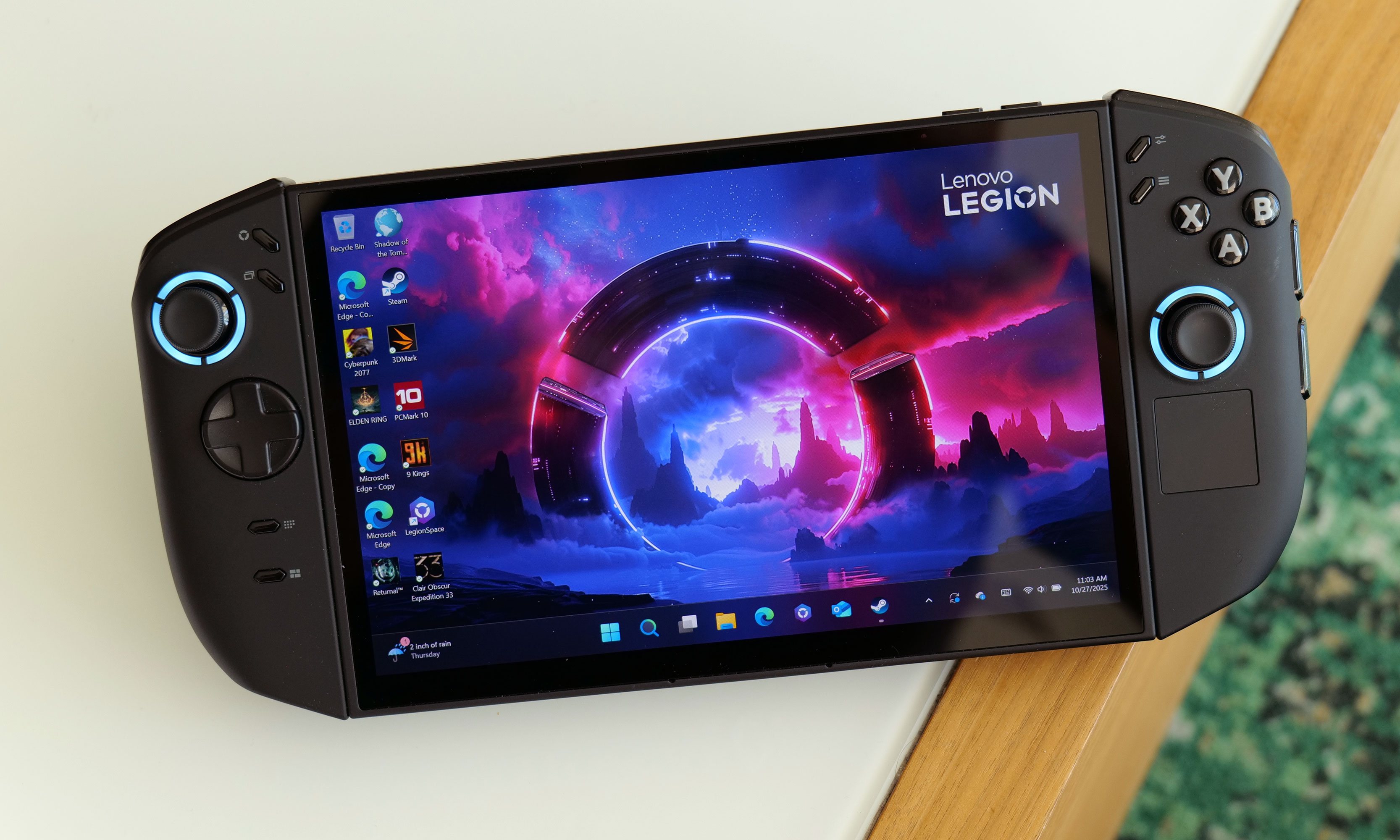
The Lenovo Legion Go 2.
Sam Rutherford for Engadget
Note: This is a selection of noteworthy gaming handhelds we’ve tested, not a comprehensive list of everything we've ever tried.
Lenovo Legion Go 2
The Lenovo Legion Go 2 is a capable alternative to the ROG Xbox Ally X with a mondo-sized 8.8-inch display. That screen is the main reason to consider it, as it’s a vivid OLED panel that supports VRR and has a 144Hz native refresh rate. Like the Switch, it also comes with detachable controllers — one of which includes a useful touchpad for navigating Windows — plus a built-in kickstand for tabletop play.
That said, it’s an absolute tank at just over two pounds, and we found it to perform a little worse than the Xbox Ally X at equal settings. It’s also even more expensive, starting at $1,100 and rising to $1,350 for a config with the same Ryzen Z2 Extreme chip. It’s a lovely device if you’ve got cash to burn — and to be fair, none of these Windows handhelds are for anyone looking for “value” — but the Xbox Ally X is a better buy for most.
The MSI Claw 8 AI+.
Sam Rutherford for Engadget
MSI Claw 8 AI+
The original MSI Claw was a flop, but the newer Claw 8 AI+ is much more appealing if you’re willing to pay for a larger and slightly more powerful alternative to the ASUS ROG Ally X. With its Intel Core Ultra 7-258V chip and 32GB of RAM, it typically pumped out 10 to 15 percent higher frame rates than last-gen models like the ROG Ally X and Lenovo Legion Go in our testing. (Another model is available with the Ryzen Z2 Extreme chip.) Battery life is relatively strong, while its 8-inch 120Hz IPS display is plenty bright and supports VRR. There are smooth Hall effect thumbsticks and triggers, two Thunderbolt 4 ports and a built-in fingerprint sensor beyond that.
The Claw’s main issue is its price: At $1,100 after recent price hikes, it’s hard to justify over the ROG Xbox Ally X, which is already too expensive for most people. ASUS' handheld is lighter and easier to grip on top of that — though the Claw is thinner — and its overhauled Xbox UI, while far from perfect, is still easier to get around than MSI’s Center M hub. There's a smaller 7-inch version of this handheld for $900 as well, but we haven’t tested that one.
The ModRetro Chromatic.
Jeff Dunn for Engadget
ModRetro Chromatic
The ModRetro Chromatic is a competitor to the Analogue Pocket that can similarly play actual Game Boy cartridges via FPGA. With its premium metal frame, loud speaker, tight d-pad and beautifully bright 2.56-inch display, it’s an impressive modernization of Nintendo’s classic handheld. ModRetro also publishes a number of games specifically for the device, including a pretty great version of Tetris that comes bundled in the box.
However, for many, its faithfulness to the original Game Boy probably goes too far: It requires three AA batteries for power, and unlike the Analogue Pocket it doesn’t support custom save states. It’s also designed for Game Boy and Game Boy Color games only; it can’t play any Game Boy Advance cartridges or games from other retro handhelds like Analogue’s device, nor does doesn’t support ROMs. For only $20 less than the Pocket, that makes it a tough sell, even if the hardware is arguably higher-quality.
There’s also the lethal, autonomous elephant in the room: ModRetro is founded by Palmer Luckey, the idiosyncratic entrepreneur behind the Oculus Rift who has gone on to form Anduril Industries, a defense contractor that makes drones, surveillance systems and other AI-powered military tech. He has also espousedpolitical views that many people — and this is the tamest way I can put this — may not be comfortable backing. We are not here to police where you can spend your money, and the Chromatic does much of what it wants to do well. Still, all of these handhelds are just so inessential, and no other option that we know of is as closely tied to an arms dealer.
The Lenovo Legion Go S.
Sam Rutherford for Engadget
Lenovo Legion Go S (Windows, Z2 Go chip)
The Windows 11 version of the Lenovo Legion Go S has the same relatively comfortable design and commendable 8-inch 120Hz display as the SteamOS model we highlight above. With the Z2 Go model we tested, though, its performance lags too far behind the ROG Ally X, Claw 8 AI+ and original Legion Go for something priced at $730. Windows is still clunky, too.
The Ayaneo Flip DS.
Photo by Jeff Dunn / Engadget
Ayaneo Flip DS
The Ayaneo Flip DS is a cool concept: a powerful Windows machine with a clamshell design and dual displays, sort of like a supercharged Nintendo DS. It feels sturdy, it performs roughly on par with the other Ryzen 7 7840U (or 8840U) handhelds in this guide, and its 7-inch top display is sharp, fast and bright. The second screen makes it a natural fit for emulating Wii U or 3DS games, but you could also, say, look up a guide or play a YouTube video without having to close whatever you’re playing.
Unfortunately, this is more of a neat idea than a fully thought-out product. The folding design means that the joysticks have to be short and recessed, while the face buttons and d-pad are uncomfortably flat. The whole thing is overly thick and heavy, plus it runs very hot. Battery life tops out around two hours, and actually managing two displays on a Windows handheld is about as clunky as you'd expect. With prices now starting above $1,100, the Flip DS is hard to recommend unless you’re (oddly) desperate for a handheld Wii U emulator. We're always happy to see more weird hardware, though.
The Ayaneo Kun.
Photo by James Trew / Engadget
Ayaneo Kun
The Ayaneo Kun is one of the more decadent Windows handhelds we’ve tested. With a sharp 8.4-inch display, a Ryzen 7 8840U chip, up to 64GB of RAM, up to 4TB of storage, a sizable 75Whr battery and a 54W max TDP, it’s both a capable gaming device and a feasible replacement for a desktop PC. But it now starts at a pricey $999, it’s huge and it suffers from the usual Windows-related issues. It also lacks VRR, and that Ryzen chip is no longer the latest and greatest. The Kun is still a fine device in a vacuum, but the ROG Xbox Ally X is a better buy. This is technically an older model for Ayaneo, too, as the company seems to launch a new handheld every other hour these days.
The Retroid Pocket Classic.
Jeff Dunn for Engadget
Retroid Pocket Classic
The Retroid Pocket Classic is another Game Boy-style vertical handheld in the vein of the Analogue Pocket, but like the other Retroid models we’ve highlighted, it’s an Android device designed to emulate games via ROM files, not genuine cartridges. (Naturally, it can also play native Android games.) It’s still far clunkier to set up and use as a result, and its overall design feels more toy-like than either the Pocket or ModRetro Chromatic.
But its Snapdragon G1 Gen 2 chip is easily powerful enough to play any classic handheld system (along with most other retro games that don’t require joystick controls), while its 3.9-inch OLED display is superbly bright, sharp and colorful. The battery can last more than 10 hours when emulating lower-power systems, and Retroid sells a version with six face buttons instead of the standard four if you want to play older Sega Genesis and Saturn games in particular. The Analogue Pocket is still more premium and rewarding to use, but if you want a similar form factor and can live with the typical quirks that come with a device like this, the Classic is a good value at $129. Of the many Game Boy-style handhelds out there that solely rely on software emulation, it’s the one we’d recommend first.
The Retroid Pocket Mini (bottom) and Retroid Pocket 5.
Jeff Dunn for Engadget
Retroid Pocket Mini
The Retroid Pocket Mini is essentially a smaller version of the Retroid Pocket 5. It runs on the same Snapdragon 865 chip and feels just as sturdy, but it has a smaller 3.92-inch display with a 4:3 aspect ratio. This makes it a more natural fit for older retro consoles, as you won’t get the black boxes you’d see on a 16:9 display like the one on the Pocket 5. If you mainly want to emulate systems like the SNES, Sega Genesis or Game Boy Color and don’t mind paying extra for a rich OLED display, it’s a good little device. But the tiny screen is limiting if you ever want to play newer games, and we wish there wasn't so much empty space around the display.
This device had also generated some controversy within the retro gaming community for having persistent issues with inaccurate shaders (and for the slapdash way Retroid handled the matter). The company replaced the original model with a "V2" iteration that addresses those concerns, however.
Retroid Pocket 4 Pro and Retroid Pocket 4
The 4.7-inch Retroid Pocket 4 Pro is the predecessor to the Pocket 5. Its performance isn’t significantly far off the newer model, so it remains a nice value if you’re determined to spend less than $200 on an emulation device. It misses out on the larger OLED display and more ergonomically-friendly design of its follow-up, however. The base Pocket 4 may also be worth a look if you want to stay under $150, but its weaker chip makes it less adept at emulating games from the PS2, GameCube and up.
The Miyoo Mini Plus (left) and TrimUI Brick.
Jeff Dunn for Engadget
Miyoo Mini Plus
The Miyoo Mini Plus is a highly affordable handheld with a well-built, Game Boy-style form factor that fits nicely with older games. Its 3.5-inch display pops for something in the $60 to $80 range, its battery lasts as long as it needs to and it can emulate consoles up to the original PlayStation without much issue. Its Linux-based software is extensively customizable, though it requires some tinkering to get it working optimally. Like many cheapo handhelds, it also lacks fast charging. Since it’s from a smaller Chinese firm and isn’t available at major retailers, it can also be difficult to actually buy. It's a nice choice if you want something more compact than the Retroid Pocket Classic, but that model's roomier design, more vibrant OLED panel and longer battery life makes it worth the extra cash for most people.
TrimUI Brick
The TrimUI Brick is another low-cost vertical handheld that’s surprisingly well-built for an $80-ish device, thanks to its brushed metal backplate and impressive 3.2-inch IPS display. It has a weaker chip than the Retroid Pocket Classic, but it can still emulate older handheld games just fine, and its tiny frame makes it much easier to actually fit in a pocket. That said, while it has a sharper and more vivid screen than the Miyoo Mini Plus (its closest rival), the face buttons, d-pad and especially back buttons are all stiffer, and its stock UI feels similarly bootleg. (Some of the icons for different systems in the game library: “GomeBuy,” “Fanicon,” and “PloyStotion.”) You can fix the latter with custom firmware, but Retroid’s interface is easier to grok by default, and its setup process is less annoying. Most people interested in this class of device will be happier paying up for the Pocket Classic instead.
The Anbernic RG35XX Plus.
Photo by Jeff Dunn / Engadget
Anbernic RG35XX Plus
The Anbernic RG35XX Plus is another wallet-friendly vertical handheld. For about the same price as the Miyoo Mini Plus, it offers a faster chipset, more RAM and a bigger battery alongside a similarly impressive design. Its stock OS is overly sloppy and cheap-looking, however, and while its stronger chip is appreciated, it's still far behind the Retroid Pocket Classic.
The Anbernic RG35XXSP.
Jeff Dunn for Engadget
Anbernic RG35XXSP
The Anbernic RG35XXSP is a variant of the RG35XX Plus based on the same internals, only it apes the clamshell form factor of the old Game Boy Advance SP. That’s a great design to rip off if you must pick one, and the hardware doesn’t feel nearly as cheap as its (pre-tariff) price tag of $60 or so would suggest. But the software issues noted above still apply (both here and with the many other devices in the same RGXX family). We’ve also seen severaluserreports of quality control issues with the RG35XXSP’s battery, which is automatically disqualifying.
Anbernic RG405M
The Anbernic RG405M is another 4:3 handheld with a 4-inch display and a pleasing metal frame. It's an OK alternative to the Retroid Pocket Mini if you want a little more screen space for less cash, but it’s slower, and it lacks the Mini’s OLED display. We find the Retroid’s grooved back to be comfier to hold over time as well. And again, Anbernic has paused handheld shipments to America as of this writing.
The PlayStation Portal.
Photo by Devindra Hardawar/Engadget
PlayStation Portal
The PlayStation Portal is an odd accessory that’s designed to stream games from a PlayStation 5. It lacks built-in apps, so it doesn’t support traditional emulation. Because it’s entirely dependent on the quality of your home Wi-Fi, we can’t guarantee how well it’ll actually perform. It doesn’t work with Bluetooth earbuds either.
The 8-inch display is fine and the DualSense-style controls are great, so PlayStation diehards who want a second screen for local PS5 streaming may see the appeal. Sony recently added the ability to stream a selection of games via the cloud, which is a step in the right direction, but you need an expensive PlayStation Plus Premium subscription to take advantage. In general, there’s little here that you can’t do with a smartphone and mobile game controller, so most people are better off saving their $200.
Logitech G Cloud
The Logitech G Cloud would’ve been a great Android pick when it launched if it cost about $150 less. Its 7-inch 1080p display is bright, vibrant and generally more pleasing to look at than the panel on the AYN Odin 2, its battery lasts a good 10 to 12 hours per charge and its design is comfy to hold for hours at a time. Alas, the G Cloud still tends to retail for $300, which is just too much when the Retroid Pocket 5 offers more power at a lower price.
What to know about the gaming handheld market
Jeff Dunn / Engadget
You can break down the gaming handheld market into three broad tiers. At the top, you have x86-based portable gaming PCs like the Steam Deck or ASUS ROG Xbox Ally X. These are the most powerful handhelds you can buy, as they seek to replicate the experience of a moderately specced gaming desktop. The Steam Deck runs on Linux, but most others use Windows. If you want to play modern, recently released PC games on the go (and need something stronger than a Switch), this is the type of device you’d get. They can also emulate the widest range of retro consoles. They’re typically the largest and most cumbersome devices to hold, however, and their battery life can be short. Naturally, they’re also the most expensive, costing anywhere from $400 to more than $1,000.
Further down on the price spectrum are "mobile handhelds" like the Logitech G Cloud or Retroid Pocket. These devices often run Android or Linux and can range from under $50 to $400-ish (before tariffs). They aren’t equipped to play modern console or PC titles, but they’re usually more compact than a portable PC, and you can still use them for mobile games and cloud streaming. While most are marketed toward those ends, many gamers actually buy them to emulate classic games through software like RetroArch. Getting emulators to work can be complicated, and accessing the BIOS and ROM files required to play games this way is legally murky. One lawsuit from Nintendo led to the shutdown of the most prominent Switch and 3DS emulators, for instance. (Engadget does not condone piracy.) Backing up files of games you already own for personal use only is considered more defensible, though, so for that a mobile handheld can be a more user- and wallet-friendly way to play the classics — provided you don’t want to just use your phone.
We’ll call the last tier “handhelds that do their own thing.” This is a catch-all for things like the Switch 2 or Playdate: portable devices that run heavily customized software and aim to provide a unique gaming experience. They aren’t necessarily ideal for emulation or playing the latest multiplatform titles; instead, they often have distinct game libraries. They might not have the widest appeal as a result (Switch excluded), but they’re often easier for less tech-literate folks to just pick up and use.
Recent updates
November 2025: The ASUS ROG Xbox Ally X replaces the older ROG Ally X as our new favorite Windows gaming handheld. We’ve also added testing notes on the Lenovo Legion Go 2, ModRetro Chromatic and a couple of emulation-based handhelds in the Retroid Pocket Classic and TrimUI Brick. We’re working to test several other recent releases for our next update, including updated versions of the Retroid Pocket 5 and AYN Odin 2.
August 2025: We’ve added the SteamOS version of the Lenovo Legion Go S as a new recommendation and updated our top Windows pick to reflect the upcoming release of ASUS’ and Microsoft’s ROG Xbox Ally devices, which will feature an overhauled Windows UI. We’ve also added a note on the recently released Nintendo Switch 2. We’ll include testing notes on the Retroid Pocket Classic, TrimUI Brick and ModRetro Chromatic in the near future. (Note: Yours truly went on paternity leave after our last update — apologies for the delay!)
May 2025: We’ve tested the Retroid Pocket Flip 2 and recommended it as an alternative to the Retroid Pocket 5. We’re also watching out for the first third-party devices that run SteamOS, starting with the new Lenovo Legion Go S, and the next ASUS ROG Ally device, which seems to be arriving soon based on recent leaks.
January 2025: We have a new top pick among emulation-focused handhelds: the Retroid Pocket 5. Beyond that, we’ve added notes on a few other devices we’ve tested, including the Retroid Pocket Mini and Anbernic RG35XXSP; lightly edited other blurbs to reflect changes in the market; and removed a couple write-ups for products that’ve been discontinued. We're also keeping an eye on new handhelds that’ve recently been announced or are strongly rumored to arrive in the near future, including devices from MSI and Lenovo.
August 2024: We’ve replaced the ASUS ROG Ally, our prior pick for the best Windows gaming handheld, with the new and improved ROG Ally X. We’ve also checked to make sure all availability and pricing details noted throughout the guide are accurate.
June 2024: We’ve updated this guide to ensure all of our recommendations are up to date, adding a note on ASUS’ upcoming ROG Ally X in the process. We’ve also included details on two new handhelds we’ve tested since our previous update: the MSI Claw and Ayaneo Flip DS. Staying on top of this market is a tall task, but we’re currently looking at recent noteworthy releases like the PSP-esque AYN Odin 2 Mini and the GBA-style Anbernic RG35XXSP as well.
This article originally appeared on Engadget at https://www.engadget.com/gaming/best-handheld-gaming-system-140018863.html?src=rss