Smart Concept #2 reimagines the iconic city car as a fashion-forward electric micro-mobility commuter

Smart has always had a knack for making the smallest cars feel like big ideas. The original two-seater wasn’t just about transportation; it was a statement about how little you actually need to move through a city. With the smart Concept #2, that philosophy doesn’t just return, it gets reinterpreted through a far more expressive, almost fashion-led lens.

At first glance, the proportions instantly take you back. The compact, upright stance, near non-existent overhangs, and wheels pushed right to the corners are all deliberate callbacks to the original Fortwo. But this isn’t nostalgia for the sake of it. The Concept #2 stretches to about 2.79 meters subtly growing to create a bit more usable interior space while remaining firmly in microcar territory.

Designer: Smart

What’s interesting is how smart has shifted the conversation from pure utility to identity. The brand calls it “Function becomes Fashion,” and it shows. The matte white and warm gold two-tone finish feels more like a wearable than a vehicle, while details like strap-inspired elements on the bumpers and door handles borrow cues from luxury accessories rather than traditional automotive design. There’s even a subtle influence of sneaker culture in the textures and tire patterns, turning what would otherwise be functional surfaces into design statements.

This shift matters because the original smart succeeded in cleverness but struggled to evolve emotionally. Concept #2 attempts to fix that by making the car feel personal. It’s less about squeezing into tight parking spots (though it still excels at that) and more about how the object itself fits into your lifestyle. Underneath the stylized surface is a thoroughly modern EV architecture. Built on Smart’s new Electric Compact Architecture, the concept is designed to deliver the kind of urban usability that today’s drivers expect. The projected range sits close to 186 miles, which is more than sufficient for daily city use, while DC fast charging from 10 to 80 percent takes under 20 minutes, essentially the time it takes to grab a coffee.

The packaging remains its strongest trick. The signature “wheels-at-the-corners” layout maximizes cabin space within that tiny footprint, while a tight 6.95-meter turning circle makes the car feel almost pivot-like in dense urban environments. It’s the kind of manoeuvrability that reminds you why cars like the original Fortwo made sense in the first place. There’s also a subtle shift in how the car integrates into daily life. Features like Vehicle-to-Load (V2L) hint at a future where even the smallest cars double as mobile power sources—useful for everything from charging devices to supporting outdoor activities.

The bigger picture is just as important. Since becoming a joint venture between Mercedes-Benz and Geely, Smart has moved upmarket with crossovers and SUVs. Concept #2 feels like a deliberate course correction, returning to the brand’s core idea, but doing so with a premium edge shaped by Mercedes-Benz design sensibilities. Set to evolve into a production model debuting at the Paris Motor Show in late 2026, the Concept #2 is less of a wild design exercise and more of a near-production preview. That makes its details (both practical and expressive) feel intentional rather than experimental.

The post Smart Concept #2 reimagines the iconic city car as a fashion-forward electric micro-mobility commuter first appeared on Yanko Design.

OpenAI’s Sam Altman apologizes for not reporting ChatGPT account of Tumbler Ridge suspect to police

Two months following the deadly shooting in Tumbler Ridge, British Columbia, OpenAI's Sam Altman has formally apologized for not informing police of the alarming ChatGPT conversations seen with the suspect's account. Before the incident, OpenAI banned the account belonging to the alleged shooter, Jesse Van Rootselaar, for violating its usage policy due to potential for real-world violence.

"I am deeply sorry that we did not alert law enforcement to the account that was banned in June," Altman wrote in the letter. "While I know words can never be enough, I believe an apology is necessary to recognize the harm and irreversible loss your community has suffered."

Altman noted in the letter, which was published in full by Tumbler RidgeLines, that he spoke with both Darryl Krakowa, Tumbler Ridge's mayor, and David Eby, the British Columbia premier, and agreed that a "public apology was necessary, but that time was also needed to respect the community as you grieved."

Eby, who also highlighted Altman's letter in his post on X, agreed that the "apology is necessary," but added that it was "grossly insufficient for the devastation done to the families of Tumbler Ridge." Moving ahead, Altman reaffirmed in the letter that OpenAI would "find ways to prevent tragedies like this in the future" and work with all levels of government to prevent something like this from happening again. Altman's latest commitment builds on the previous letter from OpenAI's vice president of global policy Ann O’Leary, who said the company would notify authorities if it finds "imminent and credible" threats in ChatGPT conversations.

This article originally appeared on Engadget at https://www.engadget.com/ai/openais-sam-altman-apologizes-for-not-reporting-chatgpt-account-of-tumbler-ridge-suspect-to-police-221400813.html?src=rss

OpenAI’s Sam Altman apologizes for not reporting ChatGPT account of Tumbler Ridge suspect to police

Two months following the deadly shooting in Tumbler Ridge, British Columbia, OpenAI's Sam Altman has formally apologized for not informing police of the alarming ChatGPT conversations seen with the suspect's account. Before the incident, OpenAI banned the account belonging to the alleged shooter, Jesse Van Rootselaar, for violating its usage policy due to potential for real-world violence.

"I am deeply sorry that we did not alert law enforcement to the account that was banned in June," Altman wrote in the letter. "While I know words can never be enough, I believe an apology is necessary to recognize the harm and irreversible loss your community has suffered."

Altman noted in the letter, which was published in full by Tumbler RidgeLines, that he spoke with both Darryl Krakowa, Tumbler Ridge's mayor, and David Eby, the British Columbia premier, and agreed that a "public apology was necessary, but that time was also needed to respect the community as you grieved."

Eby, who also highlighted Altman's letter in his post on X, agreed that the "apology is necessary," but added that it was "grossly insufficient for the devastation done to the families of Tumbler Ridge." Moving ahead, Altman reaffirmed in the letter that OpenAI would "find ways to prevent tragedies like this in the future" and work with all levels of government to prevent something like this from happening again. Altman's latest commitment builds on the previous letter from OpenAI's vice president of global policy Ann O’Leary, who said the company would notify authorities if it finds "imminent and credible" threats in ChatGPT conversations.

This article originally appeared on Engadget at https://www.engadget.com/ai/openais-sam-altman-apologizes-for-not-reporting-chatgpt-account-of-tumbler-ridge-suspect-to-police-221400813.html?src=rss

Oberhauser’s Balloon Is the Most Beautiful Lamp Made of Concrete

The first time I came across the Oberhauser Balloon, I genuinely thought I was looking at a sea creature. That rough, porous sphere covered in glowing craters looks less like a lamp and more like a bioluminescent organism that washed in from a very stylish ocean floor. It’s the kind of design that stops you mid-scroll and makes you question what you thought you knew about materials, about form, and about what outdoor lighting is even allowed to be.

The Balloon is the work of studiooberhauser, an outdoor luminaire available in three sizes: 30 cm, 70 cm, and 100 cm in diameter. That largest version, by the way, currently holds the distinction of being the largest known 3D-printed lamp made from cement. I’m not usually one to get swept up in record-breaking superlatives, but that one genuinely deserves a pause. A one-meter sphere of printed concrete that glows through dozens of organic apertures? That’s not just a lamp. That’s a landmark.

Designer: studiooberhauser

What makes this piece genuinely fascinating beyond its striking appearance is how it’s actually made. The Balloon is produced using a process called Selective Cement Activation, or SCA, also known as powder bed concrete 3D printing. In accessible terms, cement paste is selectively injected into a powder bed, building the form layer by layer without traditional formwork or molds. The result is that those complex, organic-looking cavities and curves covering its surface aren’t decorative appliqués or hand-carved afterthoughts. They’re structural possibilities that only exist because of this technology. Traditional concrete manufacturing simply wouldn’t allow it.

I think that distinction matters more than it might initially seem. The Balloon’s aesthetic doesn’t sit on top of its process like a skin. The process is the aesthetic. The granular, almost velvety texture visible across its surface is a direct physical record of how the material was constructed, layer by microscopic layer. You can’t fake that kind of authenticity, and it’s becoming rarer to find in objects that have been designed with both genuine rigor and intention. It gives the piece a raw, tactile quality that polished or lacquered surfaces can’t replicate, and it’s the reason the Balloon looks genuinely alive in a way that most contemporary lighting simply doesn’t.

The sustainability piece is also worth unpacking, not as a marketing checkbox but as a real material advantage. 3D concrete printing is inherently resource-efficient because material is deposited precisely where it’s needed, and nowhere else. No excess formwork, no significant waste, no bulky industrial molds destined for disposal. For an outdoor product built to weather years of sun, rain, and temperature swings, that kind of considered production feels right for this moment. We’re at a point in design culture where how something is made carries as much weight as how it looks, and the Balloon holds up on both counts.

The sizing range also gives it unexpected versatility. The 30 cm version reads as intimate and considered, the kind of piece you’d set along a garden path or beside a water feature on a small terrace. The 70 cm has enough presence to anchor a courtyard or frame an outdoor dining area. And the 100 cm version operates on an entirely different level. Looking at the photos of it glowing against an evening garden setting, it calls to mind the grounds of a boutique resort on the Amalfi Coast or a sculpture garden somewhere in the French countryside. It functions equally as a practical light source and as something you’d deliberately design an entire landscape around.

Concrete has been threading through design conversations for years, mostly as a signifier of industrial cool or minimalist restraint. The Balloon feels like the point where that material story evolves into something far more ambitious. It’s not concrete deployed for mood or aesthetic shorthand. It’s concrete pushed to do something it has never done before, shaped by a process that leaves its fingerprints all over the final form. And to me, that’s the clearest signal of where design is heading: not just making beautiful objects, but fundamentally rethinking what familiar materials are capable of from the ground up.

The post Oberhauser’s Balloon Is the Most Beautiful Lamp Made of Concrete first appeared on Yanko Design.

Oberhauser’s Balloon Is the Most Beautiful Lamp Made of Concrete

The first time I came across the Oberhauser Balloon, I genuinely thought I was looking at a sea creature. That rough, porous sphere covered in glowing craters looks less like a lamp and more like a bioluminescent organism that washed in from a very stylish ocean floor. It’s the kind of design that stops you mid-scroll and makes you question what you thought you knew about materials, about form, and about what outdoor lighting is even allowed to be.

The Balloon is the work of studiooberhauser, an outdoor luminaire available in three sizes: 30 cm, 70 cm, and 100 cm in diameter. That largest version, by the way, currently holds the distinction of being the largest known 3D-printed lamp made from cement. I’m not usually one to get swept up in record-breaking superlatives, but that one genuinely deserves a pause. A one-meter sphere of printed concrete that glows through dozens of organic apertures? That’s not just a lamp. That’s a landmark.

Designer: studiooberhauser

What makes this piece genuinely fascinating beyond its striking appearance is how it’s actually made. The Balloon is produced using a process called Selective Cement Activation, or SCA, also known as powder bed concrete 3D printing. In accessible terms, cement paste is selectively injected into a powder bed, building the form layer by layer without traditional formwork or molds. The result is that those complex, organic-looking cavities and curves covering its surface aren’t decorative appliqués or hand-carved afterthoughts. They’re structural possibilities that only exist because of this technology. Traditional concrete manufacturing simply wouldn’t allow it.

I think that distinction matters more than it might initially seem. The Balloon’s aesthetic doesn’t sit on top of its process like a skin. The process is the aesthetic. The granular, almost velvety texture visible across its surface is a direct physical record of how the material was constructed, layer by microscopic layer. You can’t fake that kind of authenticity, and it’s becoming rarer to find in objects that have been designed with both genuine rigor and intention. It gives the piece a raw, tactile quality that polished or lacquered surfaces can’t replicate, and it’s the reason the Balloon looks genuinely alive in a way that most contemporary lighting simply doesn’t.

The sustainability piece is also worth unpacking, not as a marketing checkbox but as a real material advantage. 3D concrete printing is inherently resource-efficient because material is deposited precisely where it’s needed, and nowhere else. No excess formwork, no significant waste, no bulky industrial molds destined for disposal. For an outdoor product built to weather years of sun, rain, and temperature swings, that kind of considered production feels right for this moment. We’re at a point in design culture where how something is made carries as much weight as how it looks, and the Balloon holds up on both counts.

The sizing range also gives it unexpected versatility. The 30 cm version reads as intimate and considered, the kind of piece you’d set along a garden path or beside a water feature on a small terrace. The 70 cm has enough presence to anchor a courtyard or frame an outdoor dining area. And the 100 cm version operates on an entirely different level. Looking at the photos of it glowing against an evening garden setting, it calls to mind the grounds of a boutique resort on the Amalfi Coast or a sculpture garden somewhere in the French countryside. It functions equally as a practical light source and as something you’d deliberately design an entire landscape around.

Concrete has been threading through design conversations for years, mostly as a signifier of industrial cool or minimalist restraint. The Balloon feels like the point where that material story evolves into something far more ambitious. It’s not concrete deployed for mood or aesthetic shorthand. It’s concrete pushed to do something it has never done before, shaped by a process that leaves its fingerprints all over the final form. And to me, that’s the clearest signal of where design is heading: not just making beautiful objects, but fundamentally rethinking what familiar materials are capable of from the ground up.

The post Oberhauser’s Balloon Is the Most Beautiful Lamp Made of Concrete first appeared on Yanko Design.

Oberhauser’s Balloon Is the Most Beautiful Lamp Made of Concrete

The first time I came across the Oberhauser Balloon, I genuinely thought I was looking at a sea creature. That rough, porous sphere covered in glowing craters looks less like a lamp and more like a bioluminescent organism that washed in from a very stylish ocean floor. It’s the kind of design that stops you mid-scroll and makes you question what you thought you knew about materials, about form, and about what outdoor lighting is even allowed to be.

The Balloon is the work of studiooberhauser, an outdoor luminaire available in three sizes: 30 cm, 70 cm, and 100 cm in diameter. That largest version, by the way, currently holds the distinction of being the largest known 3D-printed lamp made from cement. I’m not usually one to get swept up in record-breaking superlatives, but that one genuinely deserves a pause. A one-meter sphere of printed concrete that glows through dozens of organic apertures? That’s not just a lamp. That’s a landmark.

Designer: studiooberhauser

What makes this piece genuinely fascinating beyond its striking appearance is how it’s actually made. The Balloon is produced using a process called Selective Cement Activation, or SCA, also known as powder bed concrete 3D printing. In accessible terms, cement paste is selectively injected into a powder bed, building the form layer by layer without traditional formwork or molds. The result is that those complex, organic-looking cavities and curves covering its surface aren’t decorative appliqués or hand-carved afterthoughts. They’re structural possibilities that only exist because of this technology. Traditional concrete manufacturing simply wouldn’t allow it.

I think that distinction matters more than it might initially seem. The Balloon’s aesthetic doesn’t sit on top of its process like a skin. The process is the aesthetic. The granular, almost velvety texture visible across its surface is a direct physical record of how the material was constructed, layer by microscopic layer. You can’t fake that kind of authenticity, and it’s becoming rarer to find in objects that have been designed with both genuine rigor and intention. It gives the piece a raw, tactile quality that polished or lacquered surfaces can’t replicate, and it’s the reason the Balloon looks genuinely alive in a way that most contemporary lighting simply doesn’t.

The sustainability piece is also worth unpacking, not as a marketing checkbox but as a real material advantage. 3D concrete printing is inherently resource-efficient because material is deposited precisely where it’s needed, and nowhere else. No excess formwork, no significant waste, no bulky industrial molds destined for disposal. For an outdoor product built to weather years of sun, rain, and temperature swings, that kind of considered production feels right for this moment. We’re at a point in design culture where how something is made carries as much weight as how it looks, and the Balloon holds up on both counts.

The sizing range also gives it unexpected versatility. The 30 cm version reads as intimate and considered, the kind of piece you’d set along a garden path or beside a water feature on a small terrace. The 70 cm has enough presence to anchor a courtyard or frame an outdoor dining area. And the 100 cm version operates on an entirely different level. Looking at the photos of it glowing against an evening garden setting, it calls to mind the grounds of a boutique resort on the Amalfi Coast or a sculpture garden somewhere in the French countryside. It functions equally as a practical light source and as something you’d deliberately design an entire landscape around.

Concrete has been threading through design conversations for years, mostly as a signifier of industrial cool or minimalist restraint. The Balloon feels like the point where that material story evolves into something far more ambitious. It’s not concrete deployed for mood or aesthetic shorthand. It’s concrete pushed to do something it has never done before, shaped by a process that leaves its fingerprints all over the final form. And to me, that’s the clearest signal of where design is heading: not just making beautiful objects, but fundamentally rethinking what familiar materials are capable of from the ground up.

The post Oberhauser’s Balloon Is the Most Beautiful Lamp Made of Concrete first appeared on Yanko Design.
The Dog Bowl Designed to Keep Your Pet Guessing

Most slow feeders work exactly once. You put one down, your dog spends a week figuring it out, and then mealtime goes back to being a five-second vacuum session. If you’ve ever watched a dog inhale kibble like it’s a competitive sport, you already know the frustration. Not just the mess, but the genuine health concern behind it. Bloating, choking, poor digestion. It’s a real problem that a single maze-shaped bowl just doesn’t solve long-term.

That’s the gap that designer Kyung-seo Yoo set out to close with Sloddy, a slow-feeder dog bowl that recently earned recognition at the NY Design Awards. At first glance, it looks like another entry in the slow-feeder category. But spend a few minutes with the concept and it becomes clear that Yoo was thinking about a problem most products never get to: what happens after your dog figures it out.

Designer: Kyung-seo Yoo

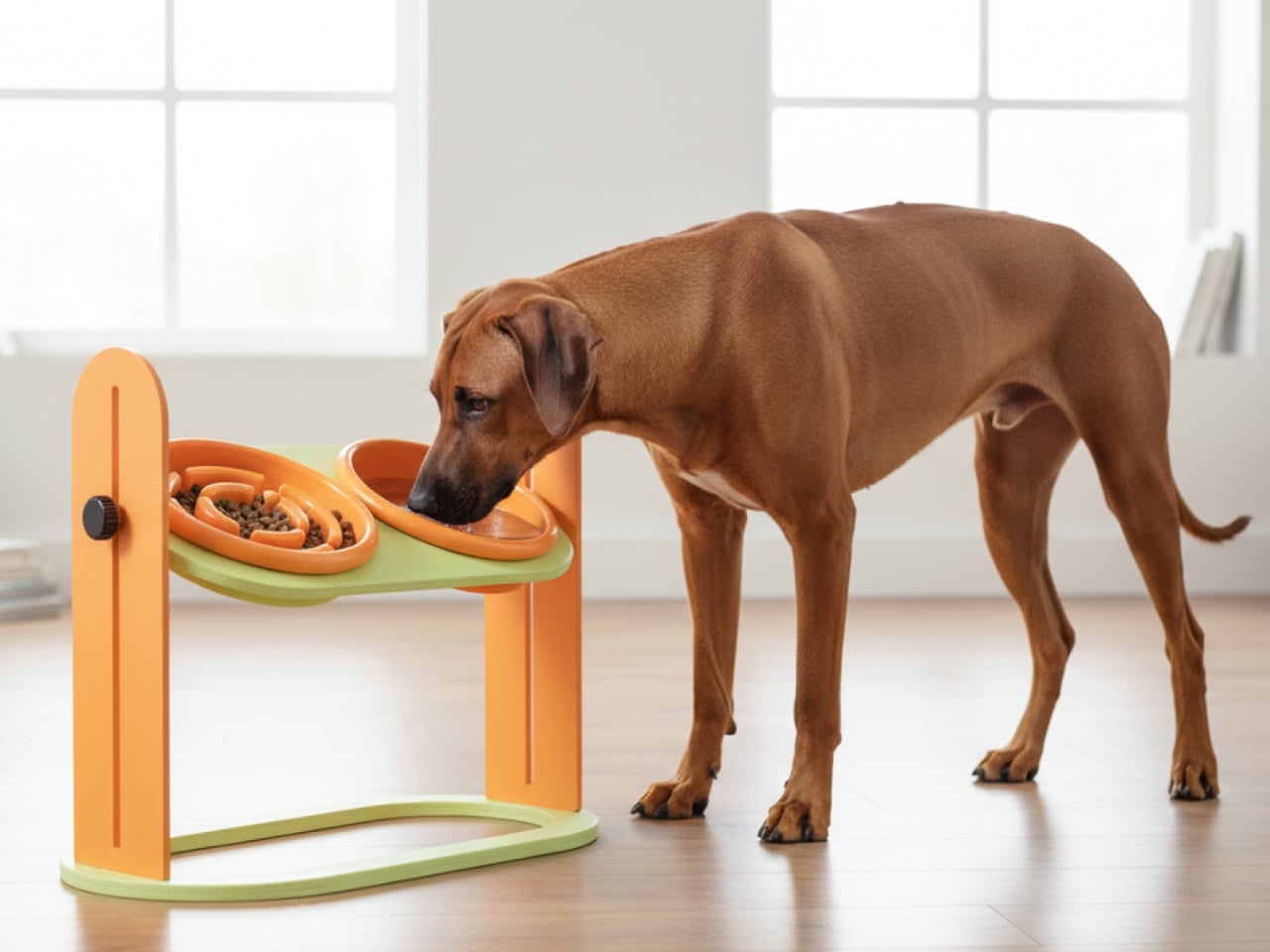
The core idea is clever and, once you hear it, sort of obvious in the best way. Instead of a single fixed insert with ridges and grooves your dog will eventually memorize, Sloddy comes with multiple interchangeable puzzle inserts at varying difficulty levels. Slow, slower, slowest. You swap them out as your dog adapts, which keeps the challenge fresh and the eating pace genuinely controlled over time. It’s the kind of design thinking that asks: what happens after the first week? Most pet products don’t bother with that question.

The modular system also makes cleaning considerably less annoying. Every component comes apart fully, which means no trapped food, no bacterial buildup in the corners you can’t quite reach. For anyone who has ever tried to scrub out a single-piece slow feeder and quietly given up halfway through, this alone is worth paying attention to. Hygiene in pet products is so often treated as an afterthought, and Sloddy clearly isn’t doing that.

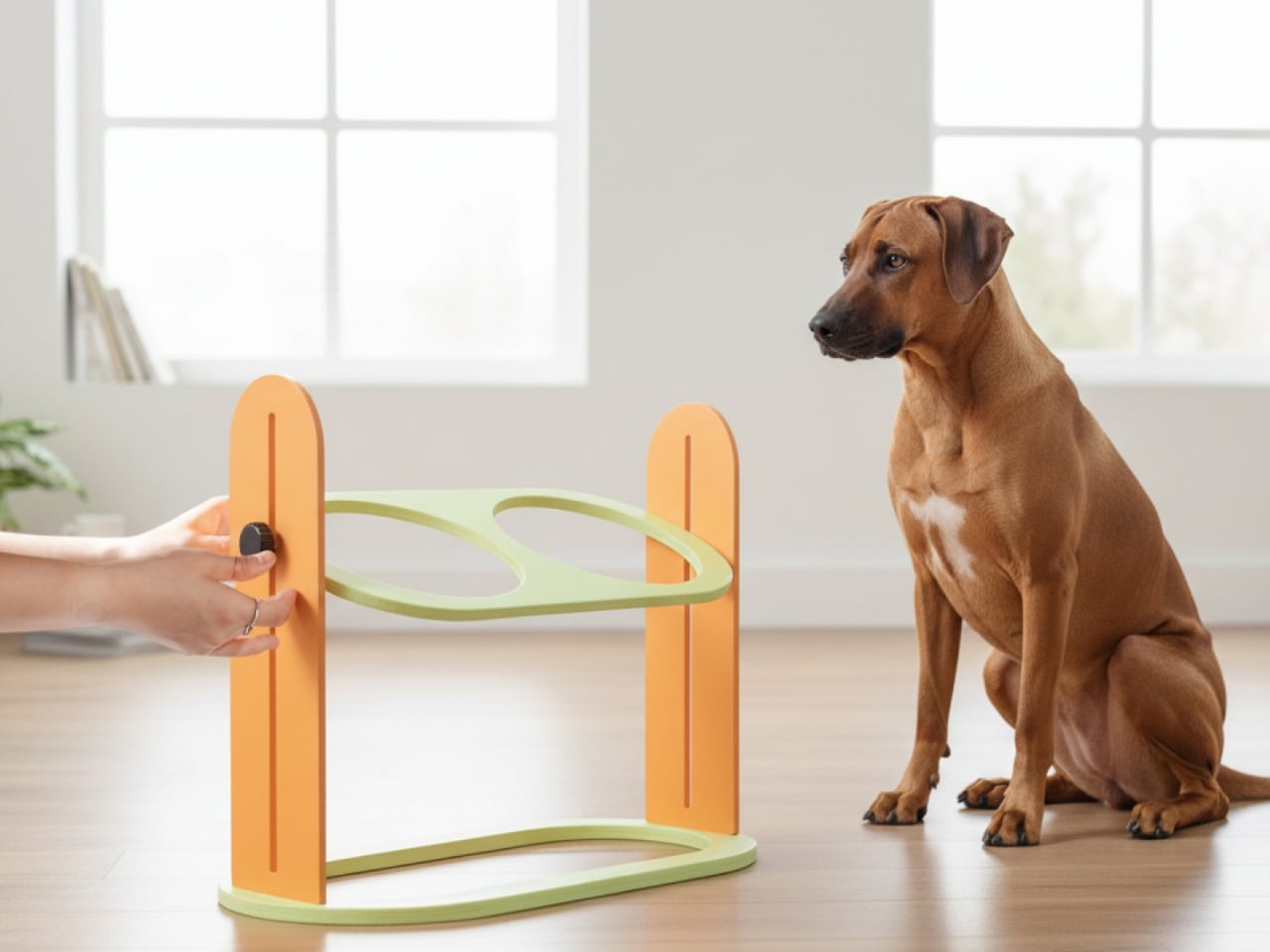
Then there’s the stand. An adjustable-height MDF wood stand lets you raise or lower the bowl to match your dog’s shoulder height, addressing a posture concern that many pet owners don’t even know they should be thinking about. Elevated feeding can ease strain on joints and improve digestion, especially for larger breeds. The fact that this is built into the design from the start, rather than sold separately as an add-on, feels like a genuine commitment to the product’s wellness promise rather than a feature that exists to justify a higher price point.

Visually, Sloddy is warm and friendly without being loud. The peachy-orange palette and the clean wooden stand wouldn’t look out of place in a considered home, and the packaging is recyclable cardboard that can be repurposed as a storage shelf for the inserts. That kind of detail matters. It says something about how a designer thinks, and Yoo clearly thought about the full experience, from the moment you open the box to the daily routine of setting up and cleaning up after your dog.

The materials are BPA-free, PVC-free, lead-free, and phthalate-free. That list is not small. Pet product safety standards are notoriously inconsistent across the market, and this kind of spec sheet tends to get buried in tiny font or skipped entirely. With Sloddy, it reads like a feature, not a footnote.

My honest take is that slow feeders as a category have been stuck in a design rut for years. They’re functional but rarely elegant, and almost none of them account for what happens once a dog learns the pattern. Sloddy approaches the problem differently, thinking about adaptability, longevity, and the full life of the product. Whether you have a rescue with food anxiety, a greedy golden retriever, or a senior dog managing digestive issues, the layered difficulty system means the bowl actually grows with your dog instead of becoming irrelevant to it.

The post The Dog Bowl Designed to Keep Your Pet Guessing first appeared on Yanko Design.
The Whistler Home That Looks Like It Fell From the Mountain

There are mountain homes, and then there is the Hadaway House. Perched on a northwest-facing slope in Whistler’s exclusive Sunridge neighbourhood, this 4,497-square-foot residence by Patkau Architects reads less like a chalet and more like a crystalline object that fell from the mountain itself — all sharp planes, acute angles, and glass that pulls the valley in from every direction.

The firm, best known locally for the nearby Audain Art Museum, pushed its own limits here. Principal John Patkau put it plainly: “We’ve done lots of geometrically complex projects, but this is the most three-dimensional that we have ever done.” It shows. The timber-clad exterior juts dramatically from the hillside, its steeply angled roof engineered not just for visual impact but for a very practical alpine reason — to shed snow. Form and function collapse into one another so completely that it’s hard to tell where the architecture ends and the landscape begins.

Designer: Patkau Architects

Inside, the home opens up in ways the exterior doesn’t telegraph. Soaring ceilings give the living spaces an almost civic scale, while expansive walls of glass frame panoramic views across Whistler Valley that shift with the light throughout the day. A glassy staircase rises to a catwalk above the main living area, adding a vertical drama that keeps the interior feeling animated. Glass sliders connect the living room to a large covered deck, making the boundary between inside and outside feel like a suggestion rather than a rule.

The three-bedroom, 4.5-bath layout sits on a 0.26-acre lot that sits moments from the mountain and minutes from Whistler Village — close enough to be convenient, private enough to feel removed from all of it. The Sunridge neighbourhood earns its reputation for discretion, and the house takes full advantage of that positioning. Thoughtfully designed indoor and outdoor spaces handle both intimate evenings and larger entertaining with equal ease; the refined finishes never compete with the architecture’s bolder gestures.

Completed in 2013, the house earned a Canadian Architect Award of Excellence, a recognition that has aged well. What was striking a decade ago feels, if anything, more relevant now — a period when alpine architecture is being rethought from the ground up, moving away from the rustic pastiche that dominated mountain design for so long.

The Hadaway House is currently listed at roughly $7.3 million USD by John Ryan Team at UNISON Real Estate Brokerages and Luxury Portfolio International. For a home of this architectural pedigree, in one of Canada’s most coveted mountain destinations, that number tells its own story.

The post The Whistler Home That Looks Like It Fell From the Mountain first appeared on Yanko Design.

NASA’s initial takeaways from the Artemis II mission, and more science stories

Now that Artemis II is all wrapped up, NASA has begun its post-game performance analyses of all the systems that worked together to get four astronauts safely to the moon and back earlier this month. In addition to taking humans farther than ever before, Artemis II served as a crucial test flight for upcoming crewed missions that are planned for as soon as 2027 and 2028, the latter being NASA's ambitious target for landing astronauts on the lunar surface. So far, the Orion spacecraft and the SLS rocket seem to have fared pretty well. 

NASA says its initial assessments of the crew capsule show its heat shield "performed as expected, with no unusual conditions identified," and it didn't exhibit as much char loss as seen in the uncrewed Artemis I test. (Navy divers snapped some really cool pictures of the heat shield underwater after splashdown, as seen below). Splashdown went according to plan, with Orion landing 2.9 miles from its targeted landing site, according to NASA, and its entry interface velocity "was within one mile-per-hour of predictions."

The heat shield from the Orion spacecraft as photographed underwater by divers after its splashdown
US Navy

NASA says the SLS rocket performed well, too. It still has tests to run, but, "At main engine cutoff, when the core stage’s RS-25 liquid engines shutdown, the spacecraft was traveling at over 18,000 miles per hour, achieving its insertion velocity for orbit, and executing a precise bullseye for its intended location," the space agency noted in a blog post.

One thing that we know did cause some issues, though, was the toilet system. Shortly after launch, the astronauts reported problems with the urine vent line, which mission specialist Christina Koch was able to troubleshoot with help from the ground crew. But, everyone would like to avoid that on the next mission, so NASA now has teams checking out the hardware and data to identify what went wrong and how to prevent it. 

The Artemis II astronauts have continued to share glimpses into their journey around the moon, and this week, the mission's commander, Reid Wiseman posted an incredible video of the Earth setting behind the moon, as seen from the Orion spacecraft. Humans haven't seen that phenomenon firsthand in over 50 years, since the last Apollo mission. Read more about that here

While ten days might not seem like that long of a time to be in space, it still does things to the body, and returning to Earth has been a bit of an adjustment for the crew. Astronaut Koch last week posted a video of herself struggling through a tandem walk exercise with her eyes closed, taken after her return to Earth. "When people live in microgravity, the systems in our body that have evolved to tell our brains how we’re moving, the vestibular organs, don’t work correctly," she explained in the caption. "Our brains learn to ignore those signals and so when we first get back to gravity, we are heavily reliant on our eyes to orient ourselves visually."


This article originally appeared on Engadget at https://www.engadget.com/science/nasas-initial-takeaways-from-the-artemis-ii-mission-and-more-science-stories-160000808.html?src=rss

Volocopter makes comeback with VoloXPro that combines proven design with New eVTOL tech

Volocopter has launched a new eVTOL (electric Vertical Take-off and Landing) multicopter called VoloXPro that has some new impetus but rides on tested configurations from the company’s previous design. The German aerospace firm envisions the VoloXPro to be used in a range of applications, with the air taxi sector being one of the primary job roles at launch.

Volocopter, launched in 2019, had a glorious initial run. It was one of the most celebrated flying taxi startups in Europe after the launch of VoloCity eVTOL aircraft. One of the pioneers of air mobility using eVTOL aircraft, Volocopter, however, had a rough phase and struggled with aerospace certification and revenue generation. It was, in fact, on the verge of insolvency before its buyout by China’s Wanfeng Auto Holding Group, the owners of Diamond Aircraft in March 2025. VoloXPro now marks the return from the ashes for the German eVTOL company.

Designer: Volocopter

VoloXPro is Volocopter’s first announcement after the €10 million takeover. This emission-neutral eVTOL, the company says is a low-noise platform, capable of being used in a range of applications and different use cases. Volocopter was reportedly working on this new aircraft, which has the potential to alter personal transportation, tourism and medical emergencies, throughout 2025.

Lunched now at the ongoing AERO Friedrichshafen show, in Germany, the new VoloXPro is an all-electric two-seat VTOL aircraft. It can cruise at a top speed of 70mph, drawing power from 18 rotor sets in a circular pylon over the cabin. The aircraft shares a few components with VoloCity air taxi introduced sometime in 2022. For instance, the two share the modular cabin design and the multirotor configuration.

With the common components, the company is trying to play it safe. It hopes that this approach will allow it to keep the price of the VoloXPro affordable, and that, it shall help fast track the multicopter’s path to aerospace certification, since the safety of the shared configurations is already proven in the earlier VoloCity design. Volocopter is hopeful of attaining the required certifications for VoloXPro by the end of 2026.

In addition to the shared approach, Volocopter is packing the new eVTOL aircraft with new technological additions and a range of cockpit layout options. The idea of the latter is to make the aircraft ready for a host of applications for both private individuals and group operators. As noted above, the VoloXPro is now a two-person craft, which the maker is targeting at flying clubs, schools, and aviation enthusiasts. We do not have the exact details about battery capacity, but we learned that the aircraft will have a 40 km range and the ability to carry up to 154 kg of payload. Its maximum take-off weight is 600 kg.

The post Volocopter makes comeback with VoloXPro that combines proven design with New eVTOL tech first appeared on Yanko Design.