Sony has sold 84.2 million PlayStation 5s since launch

It's been just over a year since Sony launched the updated PS5 Slim and PS5 Pro consoles, so how's that going given Sony's pessimistic outlook in May? Pretty well, judging by the company's latest earnings report. Sony sold more PlayStation 5s last quarter than it did a year ago (3.9 million compared to 3.8 million), boosting total PS5 sales to 84.2 million since launch. Sony also expects more revenue from its gaming (G&NS) division than it previously forecast. 

Back in May, Sony predicted a ¥100 billion ($700 million) hit to revenue in fiscal year 2025 due to tariffs, given that most of its sales occur in the US. Another key blow was the delay of Rockstar's Grand Theft Auto VI launch that was first pushed back to May 2026 and was recently delayed again until November 19, 2026. 

However, Sony now expects to sell more hardware than it thought and make ¥4.47 trillion in gaming revenue ($29 billion) for its full year ending March 31, 2026 — up ¥150 billion ($973 million) from its last forecast. That figure, would be slightly below its full year 2024 sales of ¥4.670 trillion ($30.3 billion), but it's still impressive for a nearly five year old console that has seen multiple price hikes. .

In terms of game sales, the main highlight was Ghost of Yotei, which sold 3.3 million units as of November 2, 2025, just a month after it launched. The company sold 6.3 million first-party games across PS5 and PS4 (up one million compared to last year) and 80.3 million games total. 

As for PlayStation Network, monthly active users hit 119 million, up 3 million from last year at this time. Sony doesn't break out PS Plus Premium subscribers, but that service just launched a new feature that lets you stream games you own over the cloud on the PlayStation Portal. 

This article originally appeared on Engadget at https://www.engadget.com/gaming/playstation/sony-has-sold-842-million-playstation-5s-since-launch-123004469.html?src=rss

Blizzard confirms it’s adding a virtual currency for World of Warcraft

Ahead of its 21st anniversary, World of Warcraft is dealing with some controversy around its latest update. Developer Blizzard has confirmed that WoW is introducing a new "Hearthsteel" housing-related virtual currency with its upcoming Midnight expansion, and users are worried that it could become a microtransaction trap on a game that already costs $15 a month to play. 

In its post, Blizzard said the aim of the new currency is to allow players to purchase "multiple items at once" while offering "financial protections" for the parties involved. "You may want a full set of chairs to place around a dining table, multiple place settings for your invited guest [or]... many candles," the company wrote. "Using an in-game currency can help make the process of obtaining many of these types of inexpensive items more efficient."

Blizzard clarified that players will be able to buy Hearthsteel with their Battle.net balance and in-game gold via WoW tokens. It will also keep the catalog of Hearthsteel items small relative to what you can earn through gameplay. "Housing items tied to core fantasies of a player's race or class, or that already exist in Azeroth, won't be sold in the shop," the blog post states. "Thematically important decor that players know and love will also not appear in the shop."

The Hearthsteel currency was first uncovered by dataminers, and now that Blizzard has confirmed it, players are concerned. "It's not even about the currency," said one WoW Reddit user. "It's about a large, dedicated portion of the player base crying out for years that we don't want the game to head this direction and here it is."

It's hard to look at the new currency and not think of Microsoft's recent edict to its Xbox division. Last month, the software giant reportedly implemented an "across-the-board goal" of 30 percent profit margins for its gaming division, which it internally called "accountability margins." That's a huge amount above Xbox’s own average in the last six years of between 10 and 20 percent.

This article originally appeared on Engadget at https://www.engadget.com/gaming/blizzard-confirms-its-adding-a-virtual-currency-for-world-of-warcraft-133007304.html?src=rss

Your next Heineken beer may be brewed with steam from a 100MWh heat battery

Brewing beer can be a highly polluting activity because gas boilers are normally used to create the enormous volumes of steam required for the process. Now, Heineken is teaming with a battery and electric company on a new solution at its Lisbon, Portugal brewery. They're building a 100MWh grid- and solar-powered heat battery that will generate the steam while reducing carbon emissions, Heineken announced

Heat batteries use materials like ceramics to store and then release heat, much as a regular battery stores and releases electricity. Heineken's brewery will employ a Rondo Heat Battery (RHB) built with refractory bricks that capture heat, then convert it to steam. When completed, it will be powered by onsite solar and renewable electricity from EDP and supply 7 MW of steam — enough to run the brewery 24 hours a day. When the system goes live in April 2027, it will be one of the largest heat battery systems in the beverage industry.

It's a significant milestone for the industry, as high temperature steam is one of the hardest things to produce with electricity. It's a key part of Heineken's goal to hit net zero carbon emissions by 2040 while also being a win for Portugal, which aims to reduce greenhouse gas pollution 55 percent by 2030. 

The system will be hands-off for Heineken, as EDP will take care of building and running it, and Rondo will supply the battery technology. "This project not only helps us reduce our reliance on conventional energy, it shows how practical innovation and strong partnerships can deliver meaningful improvements across our supply chain," said Heineken VP Magne Setnes.  

This article originally appeared on Engadget at https://www.engadget.com/general/your-next-heineken-beer-may-be-brewed-with-steam-from-a-100mwh-heat-battery-130045925.html?src=rss

Canon’s EOS R6 III arrives with 7K RAW video and 40 fps burst speeds

Canon just barged into the mid-range full-frame hybrid camera arena with a new entry. The 32.5MP EOS R6 III is a dramatic improvement over the EOS R6 II thanks to the higher resolution, faster shooting speeds and better video specs. However, it comes at a relatively high price and lacks a stacked or partially stacked sensor, unlike other cameras in this category. 

The new 32.5MP sensor provides a big boost in resolution compared to the R6 II's 24MP chip. At the same time, the R6 III offers higher shooting speeds of 40 fps in burst mode with the electronic shutter, or 12 fps with the mechanical or first-curtain shutter. It also supports 20 frames (a half second) of pre-shooting so you won't miss key moments for wildlife or sports shooting. 

Canon's EOS R6 III arrives with 40 fps burst speeds and 7K RAW video
Canon

The R6 III uses Canon's fast and dependable Dual Pixel AF system and comes with the company's latest AI tracking algorithms. It can operate in fairly dim conditions down to -6 EV and should be more responsive with Canon's latest Digic X processor, pending our review. It offers subject tracking for people, animals and vehicles, along with an Auto mode that will pick one of those automatically. It also borrowed the "Register People Priority" feature from the R5 II, which lets you keep focus locked on specific subjects that you've previously memorized. 

The biggest update for the R6 III, though, is with video. Thanks to the higher resolution sensor, it can now capture up to 7K 60 fps RAW light video, 7K 30 fps "open gate" video and 4K at up to 120 fps, all with Canon's C-Log2 and C-Log3 on tap. There's a dizzying array of other video formats available (12 pages worth in the specs), with HEVC S, AVC-S, RAW, RAW Light and others, at resolutions up to 7K. All the AF subject detection features are available (vehicles, animals and people), and Canon is typically among the best for video AF in terms of speed and accuracy. 

Canon's EOS R6 III arrives with 40 fps burst speeds and 7K RAW video
Canon

Nobody expects any radical design changes in a Canon camera (the company tried that with the EOS R and it really didn't work), so the R6 III kept the last model's tried and true form factor. That includes two adjustment dials on the top and one on the rear, along with a joystick, photo/video selector, mode dial and a good assortment of programmable buttons. 

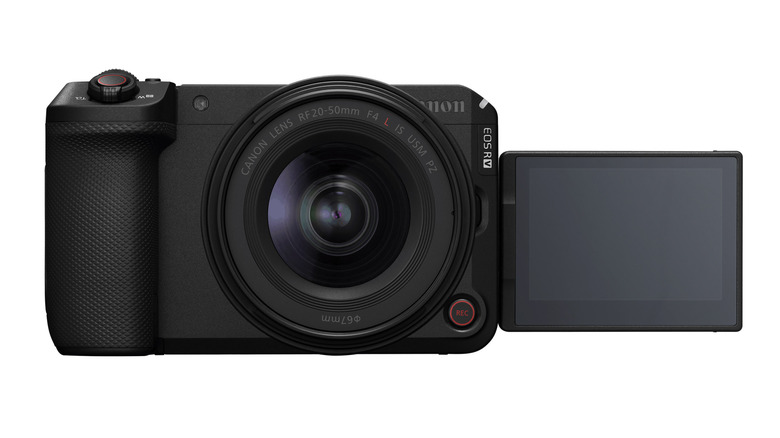
The rear display flips out as you'd expect for vlogging, but it doesn't tilt like Panasonic's S1 II — so it may obstruct the mic or headphone jacks, and isn't as useful for low-angle photo shooting. The viewfinder has 3.69 million dots of resolution as before, the same as Sony's A7 IV but less than Panasonic's slightly more expensive Lumix S1 II. One big change is the addition of a CFexpress card slot that allows RAW video capture and faster burst speeds, along with an SD UHS II slot. The battery is the same as the one for EOS R5 II and allows up to 390 shots (CIPA rating) with the viewfinder enabled. 

Canon's EOS R6 III arrives with 40 fps burst speeds and 7K RAW video
Canon

Other features include waveform monitoring that will be much appreciated by pros, plus new focus speed algorithms borrowed from Canon's cinema cameras that offer "natural, professional" behavior, the company wrote. Inputs include 3.5mm mic and headphone jacks, along with high-speed USB-C and a full-sized HDMI port. In-body stabilization has been boosted slight from 8 to 8.5 stops, matching the latest Panasonic models. 

Along with the EOS R6 III, Canon introduced some interesting new glass. The RF45mm F1.2 STM lens brings very high speeds and shallow depth of field to a much smaller and lighter .76 pound (346 gram) form factor — less than half the weight of Canon's RF 50mm f/1.2L USM lens. It's also shockingly cheap for an f/1.2 lens at $470

The Canon EOS R6 III arrives later this month for $2,799 (body only) or $4,049 with the RF24-105 F4 L IS USM lens. That's a bit more than the Nikon's $2,500 Z6 III, which has a partially stacked but lower-resolution 24MP sensor. Panasonic's S1 II also has a partially stacked 24MP but can shoot at up to 70 fps and costs $3,200. Finally, Sony's A7 IV has a similar 33MP sensor but lacks the RAW video features of the R6 III. 

This article originally appeared on Engadget at https://www.engadget.com/cameras/canons-eos-r6-iii-arrives-with-7k-raw-video-and-40-fps-burst-speeds-060035923.html?src=rss

Google contemplates putting giant AI installations in low-earth orbit

Putting AI in space may sound like a sci-fi nightmare, but Google is thinking about the idea with a research endeavor called Project Suncatcher. The idea is to put power-hungry data centers into orbit on solar-powered satellites, so they can be powered by unlimited, clean energy available 24 hours a day. That would mitigate the nastiest aspects of AI cloud computing, like the use of power plants that spew huge amounts of CO2 into the atmosphere. 

Project Suncatcher is a literal moonshot of the type that Google used to do more often. The search giant wants to put its AI chips, called Tensor Processing Units (TPUs), into orbit aboard solar panel-equipped satellites. “In the future, space may be the best place to scale AI compute,” wrote Google senior director Travis Beals. "In the right orbit, a solar panel can be up to 8 times more productive than on Earth, and produce power nearly continuously, reducing the need for batteries."

Suffice to say, the idea poses numerous challenges. That proximity to the sun would expose the TPUs to high levels of radiation that can rapidly degrade electronic components. However, Google has tested its current chips for radiation tolerance and said they'd be able to survive a five year mission without suffering permanent failures.  

Google Tensor Processing Unit
Google's Tensor Processing Unit
Google

Another challenge is the high-speed data links of "tens of terabits per second" and low latency required between satellites. Those speeds would be hard to achieve in space, as transmitting data at long distances requires exponentially more power than on Earth. To achieve that, Google said it may need to maneuver TPU-equipped satellites into tight formations, possibly within "kilometers or less" of each other. That would have the added benefit of reducing "station keeping" thrust maneuvers needed to keep the satellites in the right position. 

The determining factor, though, is money. Launching TPUs into space may not seem cost-efficient, but Google's analysis shows that doing so could be "roughly comparable" to data centers on Earth (in terms of power efficiency) by around the mid-2030s. 

While it's currently only a preliminary research paper, Google is planning to put Project Suncatcher through some initial trials. It has teamed with a company called Planet on a "learning mission" to launch a pair of prototype satellites into orbit by 2027. "This experiment will test how our models and TPU hardware operate in space and validate the use of optical inter-satellite links for distributed ML [machine learning] tasks," Google wrote. 

This article originally appeared on Engadget at https://www.engadget.com/ai/google-contemplates-putting-giant-ai-installations-in-low-earth-orbit-123025256.html?src=rss

DJI’s Osmo Mobile 8 gimbal adds pet tracking and Apple DockKit support

After launching it in China earlier, DJI has unveiled its flagship smartphone gimbal, the Osmo Mobile 8 in the US and elsewhere. The new model looks much like the Osmo Mobile 7P and has the same Multifunctional tracking module with a built-in light. However, it adds a bunch of useful new functionality including Apple DockKit support, 360-degree panning and pet tracking. 

The lack of Apple DockKit support was an issue with the Osmo Mobile 7P, as it made tracking yourself trickier with some apps. It also put DJI behind Insta360's Flow 2 Pro, which does support DockKit. That's no longer an issue with the Osmo Mobile 8, though. You can now do subject tracking within the native iPhone camera app or any of the 200-plus iOS applications compatible with DockKit.

At the same time, full tracking is available via the Multifunctional Module. That attaches to the side of its updated, more secure magnetic phone mount, letting you track yourself or other subjects automatically with any camera app. It includes a surprisingly powerful LED fill light and works as a receiver for DJI's wireless microphones, including the Mic Mini, Mic 2 and Mic 3. On top of humans, the module now supports dog and cat tracking as well. As before, it also supports gesture control. 

DJI's Osmo Mobile 8 gimbal adds pet tracking and Apple DockKit support
DJI

Another key feature is a pan axis that supports 360 degree horizontal rotation that no longer hits a stop as before. That means when you lock onto moving subjects with intelligent tracking, it'll keep following them even if they go all the way around the camera. The updated, more comfortable grip (and 0.8 pound weight) also makes it easier to take low angle shots, something that that will be handy when trying to follow your cat around. 

When using DJI's Mimo app, you also get access to DJI's advanced ActiveTrack 7.0.1 tracking tech. It comes with a feature called Dual Lens Boost 2 that uses your phones wide-angle and telephoto lenses to make sure a subject isn't lost, even if they move quickly or within a crowded scene. Another feature, Smart Capture, makes it easy to switch between subjects, even in complex environments, according to DJI. 

The OM8 uses DJI's latest three-axis stabilization tech to smooth even jarring movements without hurting quality like a smartphone can do. Other features include an integrated tripod, easy switching between front and rear cameras (along with the ability to flip the camera 180 degrees for rear camera selfies), an integrated tripod and a built-in extension rod. 

DJI's Osmo Mobile 8 gimbal is now available in Europe for 159 euros, but won't be sold on DJI's US site due to what DJI calls "evolving market conditions." However, it's now available on Amazon, B&H Photo Video and other third-party stores for $149. 

Update November 5 at 10:45 AM ET: The story has been updated with US availability and pricing. 

This article originally appeared on Engadget at https://www.engadget.com/cameras/djis-osmo-mobile-8-gimbal-adds-pet-tracking-and-apple-dockkit-support-120032512.html?src=rss

Why DJI drones might be banned in the US

Since being placed on a Department of Commerce entity list in 2020 over national security fears, China’s DJI has faced the threat of a US ban on its hyper-popular drones. After exhausting its appeals and losing a lawsuit last month, DJI products like the Mini 4 Pro, Avata 2 and Neo may disappear from US shelves starting December 23.

The situation could be even worse than initially expected. The FCC just gave itself the power to retroactively cut off products from companies on its “covered” list, including DJI. That gives the government the right to not just halt sales of future products, but enact rules preventing people from using drones they’ve already purchased.

DJI dominates the consumer US drone market, so a ban would be terrible news for hobbyists and creators, along with industrial and public safety operators. However, the government’s concerns about the company’s drones as potential spying tools are very real.

DJI, or Da-Jiang Innovations, is based in Shenzhen, China and introduced its ready-to-fly, now-iconic Phantom drone in 2013. It was $629 and offered a more user-friendly experience than other drones at the time, opening up aerial photography to creators and cinematographers.

DJI's new triple camera system offers a 28mm main camera, 70mm telephoto and a 168mm telephoto.
DJI Mavic 4 Pro
Steve Dent for Engadget

The company followed with increasingly sophisticated products like the Mavic Pro, Mini 3 Pro and Avata, along with larger commercial drones. It continued to expand its range with the small but powerful Air 3, Neo and Flip. As of 2020, DJI had an estimated 77 percent of the US drone market (which accounts for 40 percent of its sales), leaving rivals to fight for scraps.

Most observers attribute DJI’s dominance to its engineering-first culture. To give an idea of its technical progress, the latest 2025 Mavic 4 Pro can be flown from 25 miles away, compared to just 0.62 miles for the 2015 Phantom 3. Nearly every DJI drone feature, including video quality, battery life, range, tracking and obstacle detection, is superior to rivals.

By 2016, the company had caught the attention of US regulators concerned about Chinese camera-equipped drones flying over sensitive facilities. While no one has uncovered a smoking gun proving that DJI drones spy for China, they undoubtedly pose a potential national security risk. The Cybersecurity and Infrastructure Security Agency (CISA) laid out the dangers last year in a guidance sheet:

  • DJI is subject to China’s 2017 National Intelligence Law, which compels companies to cooperate with state intelligence services.

  • The 2021 Cyber Vulnerability Reporting Law requires Chinese-based companies to disclose cyber vulnerabilities to PRC authorities prior to any public disclosure, which could allow them to exploit such flaws before they’re publicly known.

  • UAS (unmanned aircraft system) devices controlled by smartphones provide a path for UAS data egress and storage, which could enable intelligence gathering on US critical infrastructure.

  • Updates controlled by Chinese entities could introduce unknown data collection and transmission capabilities without the user’s awareness.

  • When a UAS is incorporated into a network, the potential for data collection and transmission of sensitive imagery, surveying data and facility layouts increases.

Video quality on the Neo isn't as good as other DJI drones but for $200, most buyers will be very satisifed
Photo taken by a $200 DJI Neo drone
Steve Dent for Engadget

In 2017, DJI’s drones were banned from use by the US Army. Later that year, the Department of Homeland Security (DHS) issued a memo stating “with moderate confidence” that DJI’s drones were “providing US critical infrastructure and law enforcement data to the Chinese government.” The agency never provided any direct proof, however, and DJI denied it.

Then in 2020, DJI was added to the US Department of Commerce’s “entity list” over claims it “enabled wide-scale human rights abuses within China.” That meant the company could no longer buy parts or services from US manufacturers, like Amazon Web Services, Texas Instruments and Intel. In response, DJI said it was “disappointed” with the decision but customers could “continue to buy and use DJI products normally.”

A year later, however, it was placed on the Treasury department's "Chinese military-industrial complex companies" list for its alleged involvement in the surveillance of Uyghur Muslim people in China. That banned US citizens from investing in the company.

The US Department of Defense (DoD) piled on in October 2022, putting DJI on a list of “Chinese military companies” operating in the US. After the DoD refused DJI’s delisting petition in 2023, the company filed a lawsuit, arguing that it was “neither owned nor controlled by the Chinese military.” Nearly three years later, a court ruled against it, saying the DoD had substantial evidence that DJI contributed to the Chinese defense industry. DJI has since appealed that decision.

In September 2024, the US House of Representatives passed the Countering CCP Drones Act. Though still pending approval in the US Senate, the law would allow the FCC to block DJI’s drones from accessing US radio waves, effectively making them unusable here. DJI denounced the action as “inaccurate and unsubstantiated.” Later that month, US Customs and Border Protection was reportedly blocking some DJI drone imports under the Uyghur Forced Labor Prevention Act.

DJI Avata 2 review
Operating DJI's Avata 2
Steve Dent for Engadget

Near the end of last year, the US military’s annual defense spending bill (called the National Defense Authorization Act or NDAA) further boosted the possibility of a DJI ban. It required an “appropriate national security agency” to rule that a company’s products didn’t pose an “unacceptable risk” to US national security, lest it be placed on a covered list. The DoD offered DJI and other companies a year to obtain such a ruling.

Because of the DoD’s requirements, DJI paused US sales and distribution in retail channels, citing regulatory uncertainty. However, some drones that originally couldn’t be purchased in the US, like the Mavic 4 Pro, can now be found on retailers like Amazon and B&H Photo Video — albeit at inflated prices compared to other regions.

In March, DJI sent a formal letter to five national security agencies (DHS, DoD, FBI, NSA, and ODNI) requesting that any or all of them begin evaluating its products. In a June blog post, however, DJI stated that none of them had offered to perform such checks.

“If no agency steps forward and completes the review by the December 2025 deadline, the NDAA provision could trigger an automatic ban on DJI… simply because no agency chose to take on the work of reviewing our products,” the company said. DJI further explained that it was “ready” for such an audit.

Last week, the situation became potentially more dire for DJI. The FCC voted 3-0 to give itself the authority to ban devices and radio components previously approved for operation in the US. On top of the NDAA ban, the FCC would theoretically have the right to prevent DJI’s drones and other products from using US radio frequencies, effectively making them inoperable. The new regulations would also empower the FCC to bar any clones of products like the Mavic Air 3 created by alleged DJI shell companies like Anzu and Skyhigh Tech, as The Verge reported.

DJI Flip drone review: A folding, user-friendly marvel for content creators
The DJI Flip lightweight drone
Steve Dent for Engadget

The FCC did underline that it wasn’t planning to take away drones people have already purchased. “We emphasize that we are currently not requiring manufacturers to replace equipment in the hands of consumers,” it said in a fact sheet. “The continued use of such equipment… would remain authorized.”

The FCC would be required to undertake a “public interest analysis” for each product to be banned while giving “particular weight” to national security concerns. It would also be required to allow the public to comment during a minimum 30 day period, according to a fact sheet.

Here are scenarios that could arise before the December 23 deadline:

  1. DJI passes its audit. In the best case scenario, which looks unlikely at this point, DJI would pass its audit and not be added to the FCC’s covered list. The company could fully resume sales of new products, rather than being stuck in limbo as it is now, and existing drones would remain legal with full support.

  2. DJI receives another extension. If this happens, the status quo would remain. New drones like the Mavic 4 Pro may still be hard to purchase, but you would likely be able to buy previously approved products like the Mavic 3 Pro. Existing drones would remain legal with full support.

  3. The FCC blocks new DJI certifications. New drone sales would not be approved in the US. Existing drones would remain legal but possibly lose long-term support.

  4. DJI drones are placed on the covered list. All drone sales for both new and previous models would cease. Current drones would be allowed to operate but may lose updates and future support.

  5. DJI drones are banned retroactively. All DJI drone sales are banned and existing drones grounded or severely restricted. The FCC has said this won’t happen.

PRODUCTION - 13 May 2025, Rhineland-Palatinate, Bernkastel-Kues: A DJI Agras 50 drone flies over a vineyard near Bernkastel-Kues on the Moselle during the official presentation. It is the first drone of this size approved in Germany for plant protection in steep-slope viticulture. Photo: Harald Tittel/dpa (Photo by Harald Tittel/picture alliance via Getty Images)
DJI Agras 50 agricultural drone
picture alliance via Getty Images

DJI has reportedly spent over $17 million since 2016 on lobbying and launched the Drone Advocacy Alliance last year to enlist support from customers. It has some allies as well, like agricultural drone operators that formed a lobby last year. Law enforcement, search and rescue and other agencies have also expressed concerns about the higher costs, lower reliability and reduced performance of non-DJI drones.

However, US politicians are largely unsympathetic. Senator Rick Scott (R-FL) refused to even take meetings with DJI’s lobbyists, calling the company part of a “despicable government” that wants to “spy on us.” The same sentiment appears on the other side of the aisle. “I simply won’t stand by and accept that risk, which is why I’ll continue to support DJI being added to the list of banned telecom technology,” said Representative Frank Pallone Jr. (D-NJ).

So what’s liable to happen? Given the limited time left before the December 23 deadline, I believe the number three or four scenarios above are most likely: The FCC blocks new certifications and DJI drones are put on the covered list. DJI would then be forced to cease sales of new drones and possibly stop selling current models. Customers in the US would still be able to use their existing products, but may have trouble obtaining repairs and updates. If you’re a DJI drone owner in the states, you might want to formulate a contingency plan.

DJI may be resigned to that scenario as well, hoping that a ban will create enough customer outcry to stimulate political action in its favor. The company’s only other hope is that the US and China miraculously strike a trade deal that includes DJI. Given the anti-China sentiment in Washington, that looks unlikely — but then again, with Trump as president, anything is possible.

This article originally appeared on Engadget at https://www.engadget.com/cameras/why-dji-drones-might-be-banned-in-the-us-170030273.html?src=rss

Nintendo expects to sell way more Switch 2s than it thought

Nintendo has boosted its Switch 2 sales forecast for the current fiscal year, meaning it could top first year sales of the original Switch. The gaming giant expects to sell 19 million Switch 2s by March 31, 2026, up 26.7 percent from its original forecast of 15 million units. That follows a previous report that Nintendo had asked suppliers to build 25 million Switch 2s by the end of March next year.

In its second quarter ending September 30th, Nintendo sold 4.54 million Switch 2s and has moved 10.36 million units since launch. However, the company's Q3 sales through the holiday season can often double Q2 sales, as they did multiple times with the Switch. 

The original Switch sold 17.79 million units in its first 13 months, so the Switch 2 could exceed that over a shorter time frame. Nintendo reportedly requested a production boost as it believed the console will continue its torrid sales pace through the holiday season. It also expects to sell 4 million Switches for the fiscal year, down a touch from its previous forecast. 

Nintendo is optimistic about software too, projecting sales of 48 million units for Switch 2 by March 31, up 3 million from its earlier forecast. It also expects to sell 125 million Switch games (which can also be played on the Switch 2) for this fiscal year, rather than 105 million as it previously predicted. 

This quarter, the company moved 11.95 million Switch 2 games, with Mario Kart World and Donkey Kong Bonanza among the best sellers. Pokémon Legends: Z-A started shipping on October 16th, which could help lift game sales for Q3. 

With console and game sales ahead of expectations, Nintendo's earnings looked pretty rosy for its second fiscal quarter ended September 30th. The company saw 527.2 billion yen in revenue ($3.7 billion) and 102.9 billion yen in profit, both considerably higher than expected.

This article originally appeared on Engadget at https://www.engadget.com/gaming/nintendo/nintendo-expects-to-sell-way-more-switch-2s-than-it-thought-130048295.html?src=rss

Google Translate now offers Gemini-assisted translations

Google has started rolling out a new version of its Translate app with a feature that allows you to create more accurate Gemini AI-assisted translations, 9to5Google reported. The feature appears as an AI model picker at the top of the app, allowing you to choose between "Fast" and "Advanced" translations. It's appeared for some users on iOS but not Android to date, and the Advanced mode only translates between English and French, and English and Spanish.

To use the new model, simply click on the picker up top. That gives you a choice between "Fast" that "Optimizes for speed and efficiency," and "Advanced," that "specializes in accuracy using Gemini," according to the dialog box. 

Google Translate now offers Gemini-assisted translations
Engadget

To test this, I ran a passage from Moliere's French language play, Le Misanthrope: "Franchement, il est bon à mettre au cabinet; Vous vous êtes réglé sur de méchants modèles, Et vos expressions ne sont point naturelles." The result from "Fast" mode was nearly a word-for-word translation: "Frankly, he's fit for the closet; you've based yourself on bad models, and your expressions are not natural." That is not only inaccurate (it should be "Frankly, it's fit for the toilet") but also unclear.

Advanced mode, meanwhile, gave me an accurate take that better invoked the book's style: "Frankly, it's fit to be thrown in the toilet; You have based yourself on wretched models, And your expressions are not at all natural." The standalone Gemini app in Pro mode delivered nearly the same result, while adding context about the passage and how it fits in with the rest of the play. 

At the cost of some speed, Google Translate's new Advanced model appears to offer more accurate and contextual translations. If you really need to be sure that a translation is correct, however, it might be best to check Gemini directly, as it can also offer extra context. As always, though, remember that any AI can hallucinate and produce errors. 

This article originally appeared on Engadget at https://www.engadget.com/ai/google-translate-now-offers-gemini-assisted-translations-151008774.html?src=rss

The best projector for a home theater in 2026

To see a film the way the creators intended, you really need a projector. A good one can show a bright, sharp image up to 250 inches in size for an immersive experience that no TV can match — and usually at a much lower price. Plus, they’re great for immersive gaming with consoles and PCs.

Thanks to companies like Anker and Valerion, projectors are starting to be seen as a must-have item for cinephiles and outdoor party screenings alike. That means there are a wide variety of choices, ranging from classic ceiling-mounted models to battery-powered projectors you can take on a camping trick. You can also choose from dozens of ultra short throw (UST) models for a more TV-like installation.

But compared to TVs, projectors remain a bit more confusing for a majority of buyers. This guide will fill you in on important details to consider like brightness, type (classic, portable and ultra short throw) and other factors to help you choose the best model for your setup.

Some projectors are for serious cinephiles, projecting sharp 4K video with HDR brightness and hyper realistic colors to a large screen. Others are bright enough to replace your TV for sports or gaming, and some low-cost portable models can be set up for camping or outdoor fun. That’s why we’ve divided this guide into several categories to help you find the right one.

For a deep dive on projector technology check my previous explainer, but there are few key things to keep in mind. What will the projector mainly be used for? What type of room will it be used in? And how big of an image do you want? You’ll also see a variety of specifications that may be confusing, so here are a few to consider and what they mean.

Brightness is measured in ANSI lumens; the brighter the projector, typically the more expensive it will be. 1,500-2,500 lumens is good for darkened rooms, 3,000-4,000 lumens allows you to see with some ambient light and 4,000+ lumens is bright enough to use in direct sunlight. High contrast is important for detail, because projectors are more sensitive to things like ambient light and reflections.

Laser projectors offer the most brightness and they are entering the mainstream with models costing well under $2,000. Below that, you’re looking at projectors with bulbs. Aside from brightness, laser projectors have an advantage in that the light source lasts 10,000 hours or more, compared to 2,000 hours maximum for bulb projectors.

Digital light processing units (DLPs) used by Optoma, BenQ, LG and others allow bright 4K images. The negative is that they can produce a “rainbow” effect, or red/blue/green artifacts that affect some viewers more than others. LCDs are used mainly by Epson, but also Sony and Sanyo. Those are often brighter, more color accurate and don’t produce rainbow effects, but are also more expensive and susceptible to image degradation over time.

If you want a true 4K projector, beware: only expensive models have native 4K resolution (many movie theaters still use 2K projectors for various reasons). However, most DLP projectors and some LCD models can use pixel-shifting to attain 4K resolution.

Projectors can’t produce anywhere close to the amount of light required to qualify as true HDR. Rather, they use a technique called tone mapping to fit the entire HDR gamut into a lower brightness range. That said, many projectors can display millions of colors, with some models surpassing the color accuracy of TVs and monitors.

Classic projectors and screens can be mounted on the ceiling so they’re great if you have no floor space. They can also project a larger video for a truly cinematic experience. UST projectors mount on the floor right next to the screen so they can take the place of a TV. They don’t beam as big an image but are generally brighter, sharper and more expensive. For best results, they require special screens.

Elite Starling motorized screen
Elite Starling

Ceiling mounting requires some work and don’t forget to budget for a bracket and any necessary long cables, including extra power for a Google Chromecast or other streaming device. UST projectors require less labor, but getting the image perfectly square can still be surprisingly time-consuming. As for fan noise, some projectors (usually cheaper DLP models) generate more than others.

For more flexibility with location and image size, ceiling mounted projectors need a good zoom range. Lens shift, meanwhile, is used if the projector is mounted higher or lower relative to the screen than recommended by the manufacturer. Otherwise, you might have to use a "keystone correction" to digitally stretch part of the image, resulting in distortion or artifacts. Also, keystore correction may not work in gaming modes for some models.

If you’re interested in a projector for gaming, look up the refresh rate and input lag figures. Some projectors offer good numbers in that regard (240Hz and <20 ms, respectively), but others designed for home entertainment have very poor input lag and refresh rates at just 60 Hz. If it’s streaming you want, be sure to pick a model either with built-in Google TV or a bundled streaming dongle.

Should you project onto a wall, roll-down screen, fixed screen or ambient light rejecting (ALR) screen? The choice depends largely on the room and what kind of projector you have. Roll down screens take up no space as they’re ceiling mounted, fixed screens can be moved easily and ALR models are perfect in rooms with a lot of ambient light.

Yes, because higher resolution is more noticeable on larger screens, so 4K is particularly useful with projectors since they beam images up to 200 inches in size. That being said, brightness and contrast are more important.

Projectors can provide a more immersive experience thanks to the large screen, but they’re not necessarily “better.” Since you usually have to dim the lights with a projector, TVs are superior for everyday use.

Yes, 2000 lumens is easily bright enough, even with some ambient light in the room. However, the image will still be hard to see with the windows open on a bright day.

That depends on your budget and needs. If your budget is below $1,000, look for a 1080p projector with the best brightness and contrast. Between $1,000-$2,000, you’ll need to weigh whether brightness or 4K resolution is most important. Above that, choose the brightest 4K projector you can afford.

The best projectors in daylight are ultra short throw (UST) models, as they have the brightest and sharpest image. However, they generally cost more than $2,000.

Technically, you don’t need a screen to use a projector — any light-colored, smooth wall can work in a pinch. But if you want to get the most out of your projector, a screen can make a difference. Projector screens are designed to reflect light evenly and enhance contrast, so colors look more vibrant and the picture appears sharper. With a screen, you’ll notice darker blacks and brighter colors, which can give a real boost to your movie nights or gaming sessions. So while you can absolutely enjoy a projector without one, a screen can make the experience feel a bit more like your own personal theater.

It depends on how and where you plan to use it. If you want a projector you can easily move around, bring to friends’ houses or set up indoors or outdoors easily, a portable projector is a great choice. They’re usually smaller, lightweight and often have built-in speakers and batteries, making them convenient for on-the-go use.

On the other hand, if you’re looking for a more permanent setup for a home theater or living room, a home projector might be the way to go. Home projectors tend to be more powerful, with higher resolution and brightness, which gives you that crisp, cinema-quality experience. They’re ideal if you have a dedicated space and don’t mind leaving it set up in one spot.

This article originally appeared on Engadget at https://www.engadget.com/home/home-theater/best-projectors-123004354.html?src=rss