This guide is designed to show you how to keep your Apple Mac or MacBook well-maintained. A Mac or MacBook in top condition offers a delightful user experience, excelling in efficiency and handling tasks with remarkable speed. Its design, characterized by sleekness and style, complements its reliable performance – a hallmark of Apple’s commitment to […]
Imagine a tiny pocket PC that fits in the palm of your hand, yet packs enough power to fuel your most creative projects in electronics and programming. The M5Stick C Plus2 pocket PC is exactly that—a small but mighty tool that’s capturing the attention of developers and hobbyists alike. This latest iteration in the M5Stick […]
As well as the new Xiaomi Redmi Note 13 range of smartphones, Xiaomi also added a new smartwatch to its lineup with the launch of the Xiaomi Redmi Watch 4 and the device comes with a 1.97-inch AMOLED display. The new Redmi Watch 4 is equipped with a square ultra-large 1.97″ AMOLED display for a […]
This guide is designed to show you how to master any topic with the help of Google Bard. We live in an era where we are inundated with an overwhelming amount of information. In such a world, managing our time efficiently becomes increasingly critical. The challenge of acquiring new knowledge or mastering a novel topic […]
Motorola has launched a new Android smartphone, the Motorola Moto G34 5G and the handset is going to be available in the UK for £149.99. The device comes with a 6.5-inch display and it is powered by a Qualcomm Snapdragon 695 processor. The new moto g34 5G boasts a 6.5″ display with a 120Hz refresh […]
Back in 2021, Uber purchased Drizly for $1.1 billion shortly after it reported that its food delivery segment kept its losses manageable during the pandemic. Three years later, the company is shutting down the US-based alcohol delivery service, Axios has reported. Pierre-Dimitri Gore-Coty, Uber's SVP of delivery, told the publication that the company has decided to close the business and to focus on its "core Uber Eats strategy."
In SEC's announcement of the acquisition, Drizly was described as a service that "works with thousands of local merchants to provide consumers with an incredible selection of beer, wine, and spirits with competitive, transparent pricing." Uber integrated Drizly's offerings into its Eats app, but the alcohol delivery service maintained a separate application of its own.
"After three years of Drizly operating independently within the Uber family, we've decided to close the business and focus on our core Uber Eats strategy of helping consumers get almost anything — from food to groceries to alcohol — all on a single app," Gore-Coty said in a statement. "We're grateful to the Drizly team for their many contributions to the growth of the BevAlc delivery category as the original industry pioneer."
It's unclear if Drizly's cybersecurity issues played a role in Uber's decision. Drizly previously confirmed a data breach in 2020 that exposed the information of 2.5 million customers. After Uber's acquisition, the Federal Trade Commission found that Drizly CEO James Cory Rellas was alerted about the company's security issues way back in 2018. The agency determined that the delivery service failed to implement the proper safeguards to protect its users despite claiming it had done so and that its poor security practices made the data breach possible. It ordered Drizly to destroy any personal data it collected that had nothing to do with its services and to refrain from collecting them in the future. The FTC also required Rellas to implement information security programs at any company he joins or forms where he takes on the role as CEO. Either way, Drizly is gone, but Uber seems to intend to continue delivering alcohol to its customers.
This article originally appeared on Engadget at https://www.engadget.com/uber-shuts-down-alcohol-delivery-service-drizly-three-years-after-its-purchase-065818346.html?src=rss
Back in 2021, Uber purchased Drizly for $1.1 billion shortly after it reported that its food delivery segment kept its losses manageable during the pandemic. Three years later, the company is shutting down the US-based alcohol delivery service, Axios has reported. Pierre-Dimitri Gore-Coty, Uber's SVP of delivery, told the publication that the company has decided to close the business and to focus on its "core Uber Eats strategy."
In SEC's announcement of the acquisition, Drizly was described as a service that "works with thousands of local merchants to provide consumers with an incredible selection of beer, wine, and spirits with competitive, transparent pricing." Uber integrated Drizly's offerings into its Eats app, but the alcohol delivery service maintained a separate application of its own.
"After three years of Drizly operating independently within the Uber family, we've decided to close the business and focus on our core Uber Eats strategy of helping consumers get almost anything — from food to groceries to alcohol — all on a single app," Gore-Coty said in a statement. "We're grateful to the Drizly team for their many contributions to the growth of the BevAlc delivery category as the original industry pioneer."
It's unclear if Drizly's cybersecurity issues played a role in Uber's decision. Drizly previously confirmed a data breach in 2020 that exposed the information of 2.5 million customers. After Uber's acquisition, the Federal Trade Commission found that Drizly CEO James Cory Rellas was alerted about the company's security issues way back in 2018. The agency determined that the delivery service failed to implement the proper safeguards to protect its users despite claiming it had done so and that its poor security practices made the data breach possible. It ordered Drizly to destroy any personal data it collected that had nothing to do with its services and to refrain from collecting them in the future. The FTC also required Rellas to implement information security programs at any company he joins or forms where he takes on the role as CEO. Either way, Drizly is gone, but Uber seems to intend to continue delivering alcohol to its customers.
This article originally appeared on Engadget at https://www.engadget.com/uber-shuts-down-alcohol-delivery-service-drizly-three-years-after-its-purchase-065818346.html?src=rss
Are you an iPhone user keen on discovering new ways to use your device more efficiently? Look no further! A recent video guide has unveiled some hidden gems in the latest iPhone operating system updates that promise to enhance your user experience. The video below from iDCeveiceHelp shows us a range of useful hidden iPhone […]
3D scanning has traditionally been the domain of big production studios and companies because of the size of the equipment and their prohibitive costs. With the arrival of handheld scanners, however, the doors were thrown wide open for anyone in any field to make their own 3D models from real-world objects, whether it’s for fun, art, health, or profit.
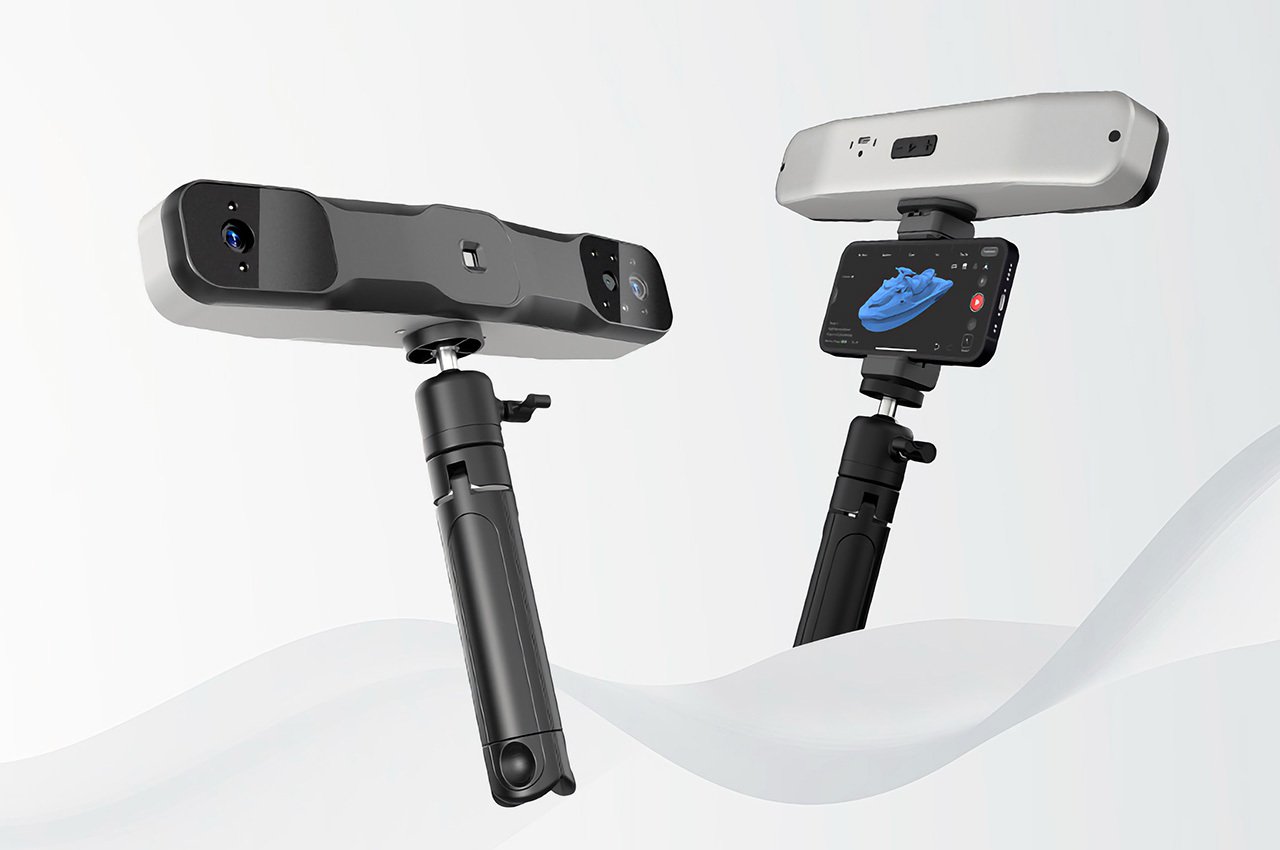
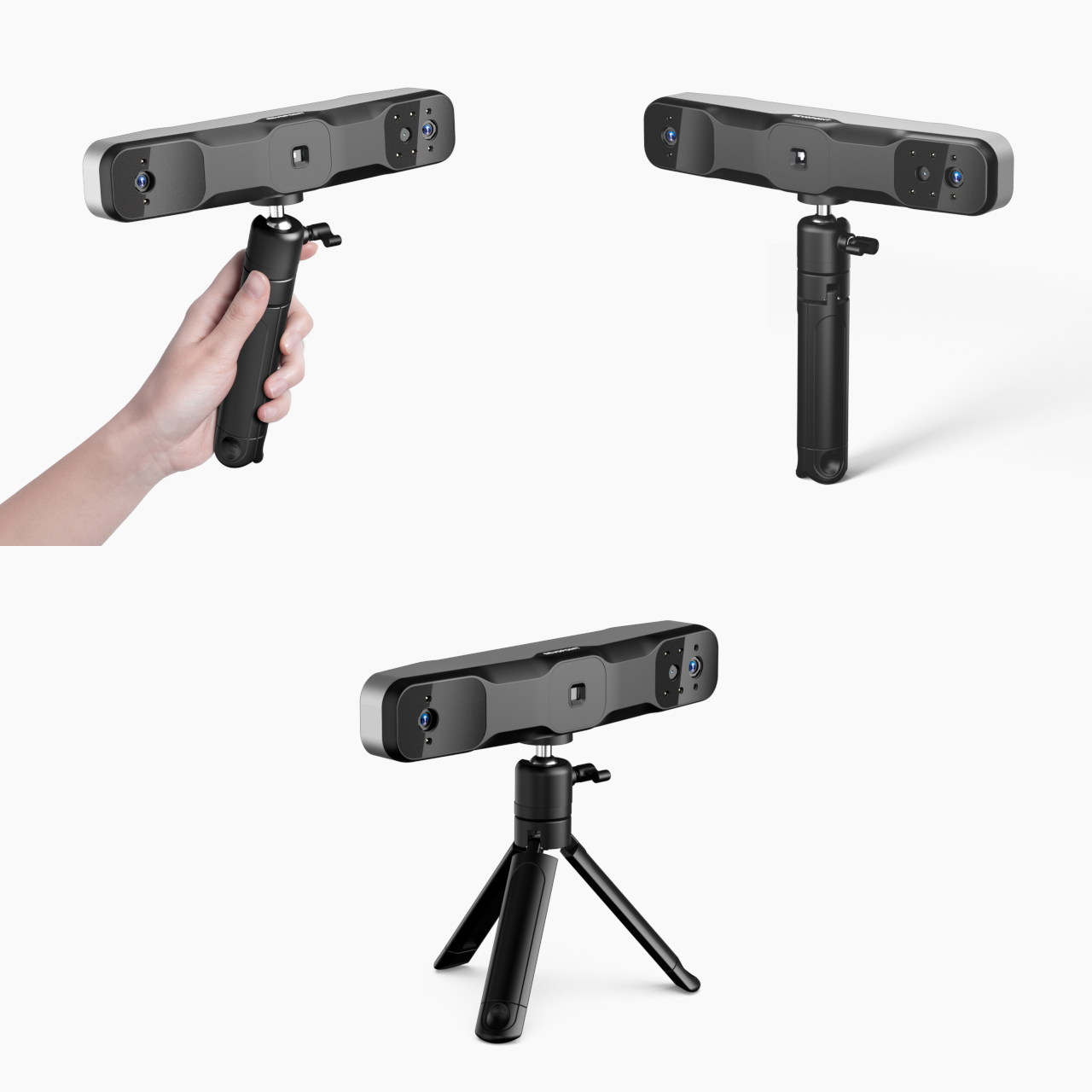
Typical handheld 3D scanners work great when working with small objects that are no larger than the device itself. Of course, real-world objects like car parts, whole vehicles, and even human bodies are quite big and push these smaller scanners to the limit. Enter the new Revopont RANGE 2, the latest in a line of lightweight but powerful 3D scanners designed to handle large objects without breaking a sweat, making sure that your creativity and productivity aren’t limited by the size of your model.
Revopoint RANGE 2 is a portable handheld dual depth camera structured infrared light 3D scanner designed for capturing large objects like furniture, people, and vehicles.
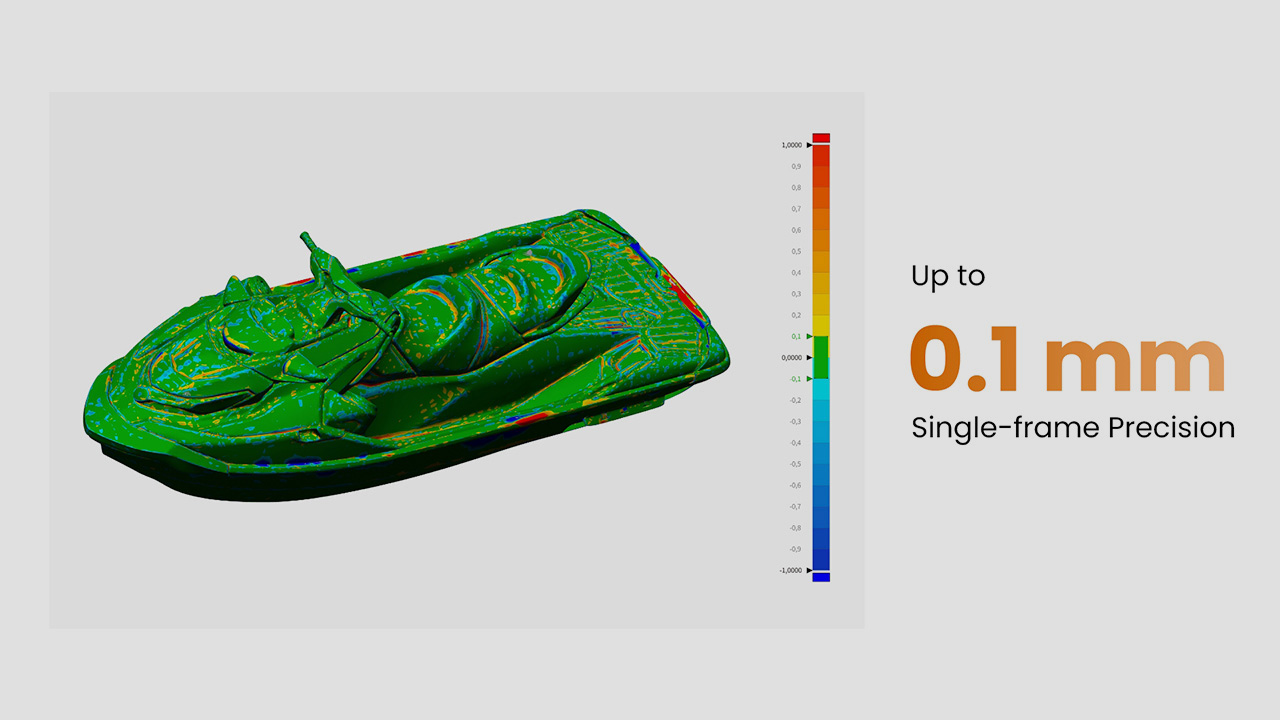
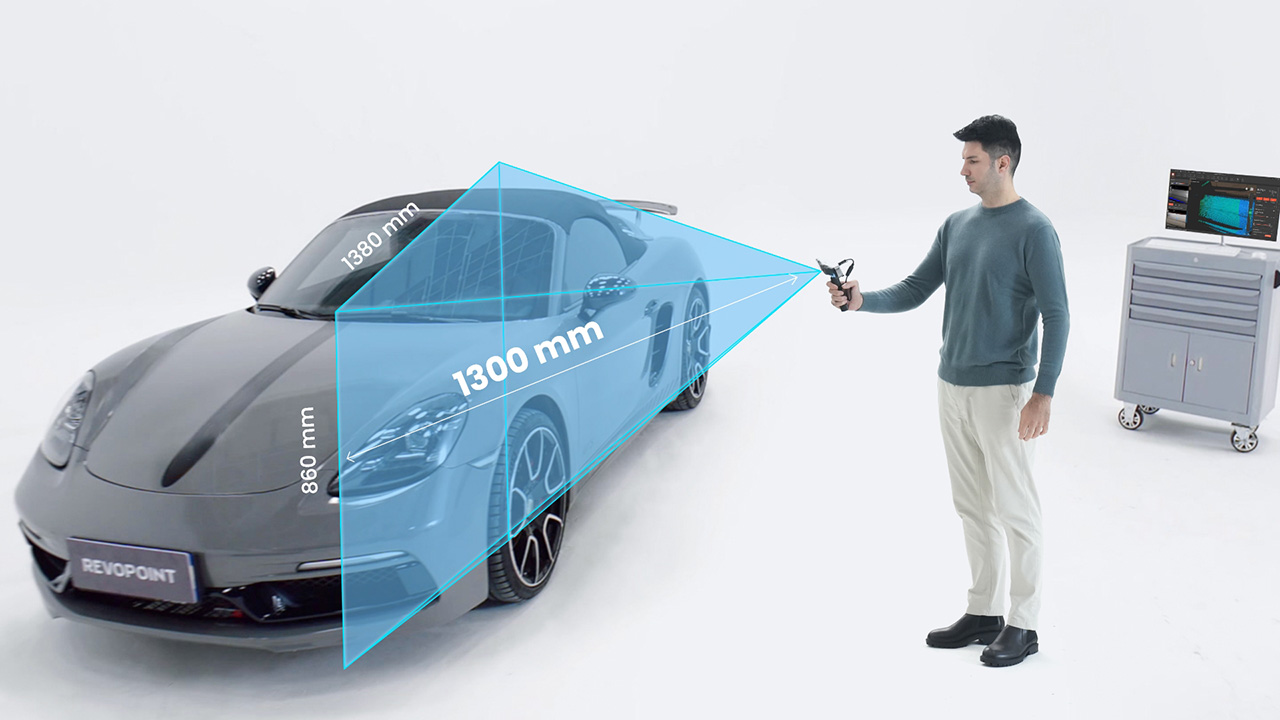
Because handheld 3D scanners work by guiding the depth cameras across and around the target, the devices need to be able to capture a great amount of detail with great depth quickly and steadily with accuracy and precision. That’s a rather tall order for a small device, especially one that is made to be accessible to both amateurs and pros alike, but Revopoint’s expertise really shines through with the upgrades that its RANGE 2 3D scanner packs in a compact and portable form. For example, thanks to new depth cameras that have double the sensor size, the Revopoint RANGE 2 can work on a distance ranging from 400 mm to 1,300 mm, a 60% increase that makes it even faster to capture large objects compared to the previous generation, and can scan an area up to 860 x 1380 mm in size.
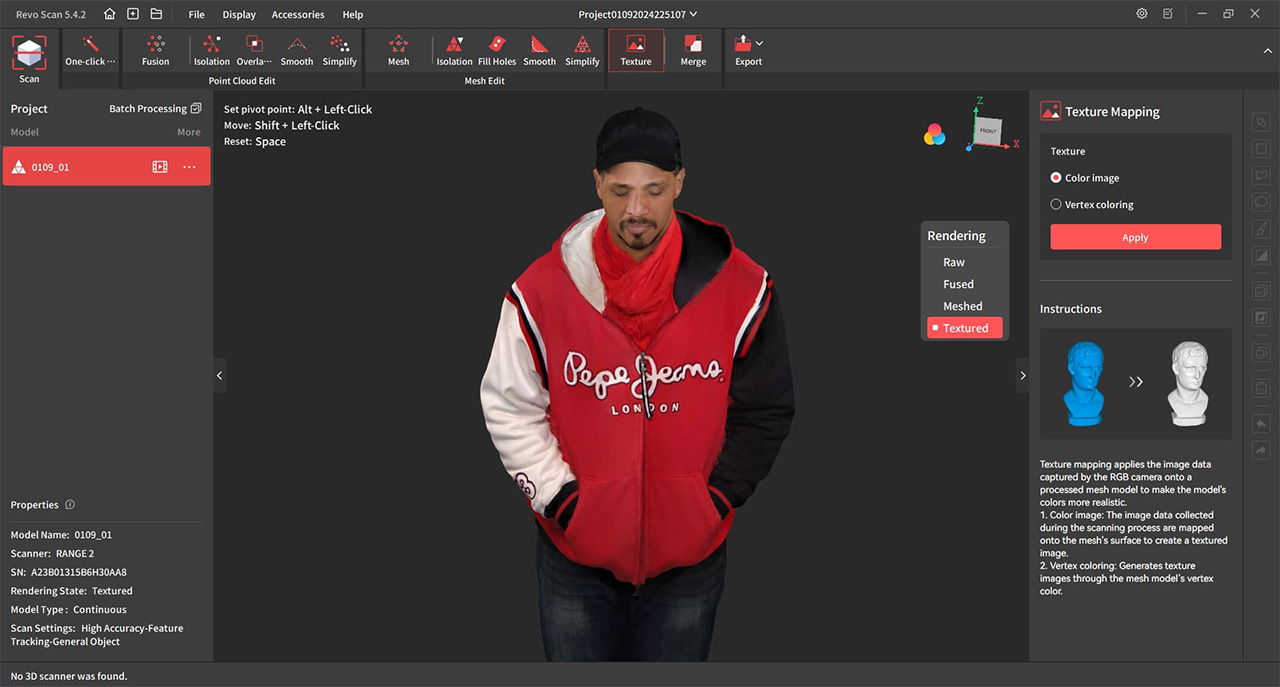
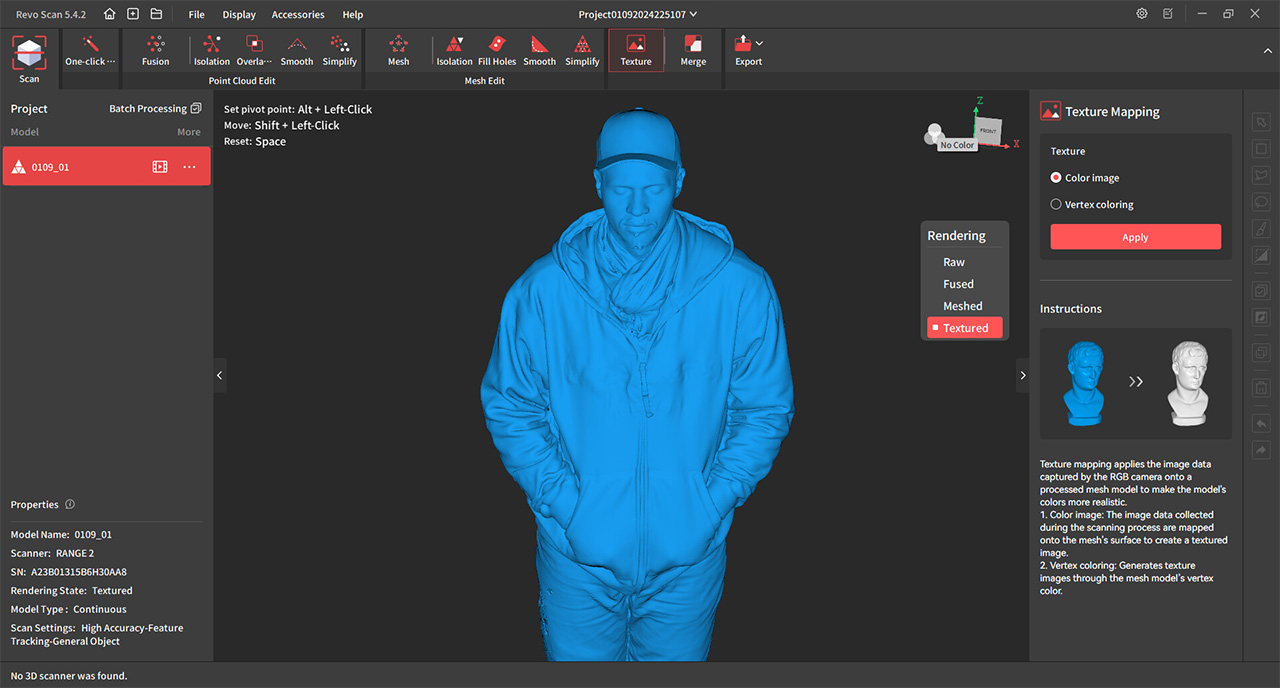
Scan of the body by Revopoint RANGE 2. Image credit: PUTV
Range isn’t the only thing that’s bigger and better on the RANGE 2, of course. Four flash LEDs banish shadows for a more uniform color capture, while an improved RGB camera with a bigger aperture is able to capture more color information, ensuring clear color capture with higher levels of detail for more accurate textures and realistic-looking 3D models. An upgraded tracking system utilizes the device’s built-in 9-axis IMU (Inertial Measuring Unit) to keep the scan steady even if your hands aren’t. Four Infrared LED fill lights also make it easier to recognize markers, resulting in more accurate frame stitching in marker mode.
Angel Candelabra scanned with Revopoint RANGE 2. Image credit: dfodaro
Thanks to these powerful features, the Revopoint RANGE 2 is even more versatile and as flexible as before. With Wi-Fi 6 and USB-C connections, you can be assured that transmitting critical data will be fast and stable. As before, the scanner is compatible with Windows, macOS, Android, and iOS devices, functioning in handheld mode or set on a stand in front of a turntable. And with the Revo Scan 5 software, the scanning process couldn’t be easier, especially with post-processing features, such as frame editing, hole filling, overlap detection, etc, to enhance your workflow.
With the Revopoint RANGE 2 3D scanner, you have a whole new world of large objects you will be able to scan. You can easily scan car or mechanical parts, offering a cost-effective and high-performance way to study them through reverse engineering or produce replacements. Archaeologists, scientists, and museum creators can now also digitize artifacts to preserve them for posterity or turn them into XR experiences. And, of course, artists and creators now have a portable yet powerful tool to bring their ideas to life. Scanning big objects for your big projects will no longer be a problem with the new and improved Revopoint RANGE 2!
As the US gears up for the 2024 presidential election, OpenAI shares its plans on suppressing misinformation related to elections worldwide, with a focus set on boosting the transparency around the origin of information. One such highlight is the use of cryptography — as standardized by the Coalition for Content Provenance and Authenticity — to encode the provenance of images generated by DALL-E 3. This will allow the platform to better detect AI-generated images using a provenance classifier, in order to help voters assess the reliability of certain content.
This approach is similar to, if not better than, DeepMind's SynthID for digitally watermark AI-generated images and audio, as part of Google's own election content strategy published last month. Meta's AI image generator also adds an invisible watermark to its content, though the company has yet to share its readiness on tackling election-related misinformation.
OpenAI says it will soon work with journalists, researchers and platforms for feedback on its provenance classifier. Along the same theme, ChatGPT users will start to see real-time news from around the world complete with attribution and links. They'll also be directed to CanIVote.org, the official online source on US voting, when they ask procedural questions like where to vote or how to vote.
Additionally, OpenAI reiterates its current policies on shutting down impersonation attempts in the form of deepfakes and chatbots, as well as content made to distort the voting process or to discourage people from voting. The company also forbids applications built for political campaigning, and when necessary, its new GPTs allow users to report potential violations.
OpenAI says learnings from these early measures, if successful at all (and that's a very big "if"), will help it roll out similar strategies across the globe. The firm will have more related announcements in the coming months.
This article originally appeared on Engadget at https://www.engadget.com/openai-lays-out-its-misinformation-strategy-ahead-of-2024-elections-022549912.html?src=rss