The Google Pixel Buds Pro scored an 87 in our review thanks to the addition of solid active noise cancellation (ANC), a punchy base, and reliable touch controls. This generation is the first to include ANC, which can be reason enough to consider an upgrade. The earbuds are a good choice for working out, too, as they offer IPX4 water resistance.
The Pixel Buds Pro also offer wireless charging and a quick-charge feature that juices the earbuds up to one hour of ANC listening in five minutes. Speaking of charging, Google's earbuds can hold 11 hours of charge and 31 in total with the case's boost.
However, there are a few aspects Google still needs to work on, such as spatial audio, which needs more support to function well. There's also the call quality, which is far from the clearest of all the earbuds on the market. But, at $61 off, these issues become less of a dealbreaker.
This article originally appeared on Engadget at https://www.engadget.com/the-google-pixel-buds-pro-drop-to-139-for-the-amazon-big-spring-sale-124850130.html?src=rss
Sam Altman, the CEO of OpenAI, recently shared his insights on the upcoming ChatGPT-5 model and its potential impact on various aspects of our lives. During his talk, Altman highlighted several key points regarding the development, expectations, and implications of this advanced conversational AI. One of the most exciting aspects of ChatGPT-5 is its expected […]
Steam is introducing a new way for your clan to play games together. The platform has announced Steam Families, a collection of game-sharing (and monitoring) features for parents and children currently available in beta. It takes the place of Steam Family Sharing and Steam Family View, rolling in some of their existing features alongside updates.
Each member of a Steam Family will have a section called "family library" in their games list where they can access shareable games. Ownership remains with the purchaser, but each new title bought will appear in the list. You can play another member's games even when they're online (as long as they're playing another game). Plus, you can save your own progress and achievements.
You can invite up to five other family members to your Steam Family account, with each member assigned the role of parent or child. Only adults can manage the account or implement parental controls, such as setting playtime limits (and reviewing requests for more), seeing playtime reports and choosing which games a child can play. Plus, they can control access to the Steam Store and chats.
Steam Families also streamlines the process of children getting parental approval to buy games (thus, ideally for Steam, making them more frequent). Children can now request an adult on the plan to pay for their shopping cart, which a parent can manage via email or phone by pressing approve or decline.
Steam Family is currently in beta and requires each member to join to participate. You can find the option to join under Interface and then choose Steam Family Beta in the Client Beta Participation dropdown menu.
This article originally appeared on Engadget at https://www.engadget.com/steam-families-puts-game-sharing-and-parental-controls-in-one-place-123016424.html?src=rss
Steam is introducing a new way for your clan to play games together. The platform has announced Steam Families, a collection of game-sharing (and monitoring) features for parents and children currently available in beta. It takes the place of Steam Family Sharing and Steam Family View, rolling in some of their existing features alongside updates.
Each member of a Steam Family will have a section called "family library" in their games list where they can access shareable games. Ownership remains with the purchaser, but each new title bought will appear in the list. You can play another member's games even when they're online (as long as they're playing another game). Plus, you can save your own progress and achievements.
You can invite up to five other family members to your Steam Family account, with each member assigned the role of parent or child. Only adults can manage the account or implement parental controls, such as setting playtime limits (and reviewing requests for more), seeing playtime reports and choosing which games a child can play. Plus, they can control access to the Steam Store and chats.
Steam Families also streamlines the process of children getting parental approval to buy games (thus, ideally for Steam, making them more frequent). Children can now request an adult on the plan to pay for their shopping cart, which a parent can manage via email or phone by pressing approve or decline.
Steam Family is currently in beta and requires each member to join to participate. You can find the option to join under Interface and then choose Steam Family Beta in the Client Beta Participation dropdown menu.
This article originally appeared on Engadget at https://www.engadget.com/steam-families-puts-game-sharing-and-parental-controls-in-one-place-123016424.html?src=rss
Apple is planning some big things for AI on the iPhone this year, iOS 18 and the iPhone 16 are expected to have a major focus on Artificial Intelligence, according to a recent report, Apple is in talks with Google to bring Google Gemini to the iPhone. This deal could be a game-changer. It’s all […]
Replacing a smartphone every two years is partially why billions of phones go into landfills each year. If stacked flat atop one another, that many handsets would reach farther than the ISS. But we’ve become accustomed to that 24-month time frame because wireless carriers often push an upgrade on biennial contracts, and many smaller phone makers only offer software support for two years. But now, with longer software commitments from major manufacturers, along with growing right-to-repair legislation, many newer phones can stay in our pockets for closer to seven trips around the sun. Here’s how you can extend the lifespan of your smartphone and avoid shelling out hundreds before it’s absolutely necessary.
How to make your smartphone last longer
Amy Skorheim for Engadget
Use a case
It’s a flashy move to carry a naked phone around, but the chances of a handset making it through a tumble go up dramatically when you employ extra protection. We recommend a few in our guide to iPhone cases. In my family, we’ve been happy with Mous cases. Though we’ve never subjected our phones to the brutality seen in the company’s ads, I can say that these cases have seen my partner’s aging Samsung Galaxy through some pretty gnarly spills and I credit the cases for getting my iPhone 11 to 2025 in working condition.
Take care of the built-in battery (or use a power bank)
Since a phone’s battery is often the first thing to show signs of age, it’s worth it to follow recommendations for extending its lifespan. Lithium-ion batteries don’t perform well in heat and you should avoid charging them if it’s hotter than 95 degrees — doing so can degrade the battery quickly and even cause them to malfunction. They’ll tolerate cold weather better, but can get sluggish when things get too chilly.
If you’re storing a phone for a while, it’s best to do so with the battery at half charge, rather than full or empty. In fact, Li-ion cells last longer when they spend less time being either completely discharged or full — that’s why battery optimization features in iPhones and Pixel phones delay overnight charging to 100 percent until about an hour before you typically grab your mobile. And while it’s sometimes necessary to charge a battery quickly, a slower charging method when speed isn’t critical will put less stress on the ionic components and help extend the cell’s life.
But over time, any battery will eventually wear down. And if you’re traveling, relying heavily on navigation or using the phone as a hotspot, you might need more juice to get through a day. We recommend many options in our best power banks guide but the battery I grab most often is the Anker Laptop Power Bank. It’s got built-in USB-C cables and delivers enough charge to give any device (including laptops, extra hours of life). But for something smaller, I like the reliability of Statik’s semi-solid state MagSafe battery.
If you really want to give your phone a new lease on life, a new internal battery could be the ticket. For Pixel phones, you can go through Google’s official channel for either a walk-in or mail-in repair, you can look for an authorized repair partner or you can pick the DIY route with iFixit’s Pixel repair kits and instructions.
For iPhones, you can start with Apple’s official page, go through Best Buy or other authorized third-parties, or try iFixit’s methods. Samsung also has an in-house option but both iFixit and Best Buy ended their repair relationships with Samsung in 2024. Depending where you go and the model of your phone, the price for a new battery and installation will likely run you between $60 and $150 — still far less than ditching your handset for something brand new.
Clean up your phone’s storage
Most advice on how to declutter your phone and make it run faster centers on one thing: freeing up space. Your phone’s OS will likely have suggestions for clearing up storage space, like automatically offloading unused apps or deleting year-old messages. You can also do things manually by deleting any apps you don’t use. Next, consider the photos and videos you’re storing locally and either opt to pay for cloud storage or transfer the files to a computer or an external backup device. You can also consider getting rid of any music and movies you may have downloaded for offline use, and deleting old messages and large attachments. A good rule is to keep your storage at around 80 percent capacity. Once you’ve deleted and transferred what you can, restart your phone to give it a chance to clear up its temporary memory.
Why you can (and should) extend the life of your smartphone
Photo by Sam Rutherford/Engadget
The e-waste stream grows each year and doesn't do great things for human or planetary health. Smartphone companies are offering better and more consistent trade-in deals, but even some electronic recycling has its faults. Simply hanging onto a device instead of opting for a new one is the most efficient way of cutting back on a phone's environmental impact — plus it'll save you money.
While every giant phone maker would like you to believe that upgrading annually is critical, it’s worth noting that new generations of phones often bear strong resemblance to the prior year’s model. Engadget editors see this time and again with the countless smartphones they review — there’s a new button, a few new AI tricks, but the technology generally doesn’t leap forward each year to create something wildly different than what came before.
With only minor hardware upgrades, the more exciting new features come via over-the-air software updates. Starting with the release of the Pixel 8 in 2023, Google promised security and software updates for a full seven years. So those who buy a Pixel 10 in 2026 could still be using the same phone in 2033. Samsung’s Galaxy S26 has the same length of promised support. Apple committed to five years of support to comply with EU regulations, but iPhones were already known for their extended support — when iOS 26 came out, support was cut for the iPhone XR and earlier, but that meant the 2018 models had enjoyed around seven years of updates from launch.
When Apple launched the iPhone 15, the company doubled its estimation for the handset’s battery life saying a handset should retain 80 percent of the original full charge after 1,000 cycles. And Apple said the placement of the larger battery in the iPhone 16 makes replacing it easier. Overall, battery technology has improved in capacity over the years, but longevity hasn’t gone up across the board, as a study by PhoneArena makes clear.
More advancements in battery life spans may be on the horizon particularly as the EV industry grows, which also relies on lithium-ion cells. For now, declining battery health is usually the most noticeable issue affecting older phones. In 2023, the European Council of the European Union adopted new guidelines for battery-powered devices, which includes a mandate to allow consumers to “easily remove and replace” batteries. That won’t go into effect until 2027, and there will be plenty of interpretation as to what “easily” means. But EU mandates are what made Apple finally ditch Lightning ports on iPhones in favor of USB-C, so this could eventually be a step towards (once again) having smartphones with swappable batteries.
Right-to-repair bills have been passed or introduced in all 50 states. Some of these laws have already gone into effect, and will require manufacturers to do things like providing repair tools and documentation, and selling components for a certain number of years after the last new model for higher priced devices.
Currently, a number of phones have decent repairability scores, according to the online repair community iFixit (The FairPhone 6 gets the highest marks.) Until more companies start making it easier to fix things ourselves, authorized repair is an option, while self-repair remains an option for the more industrious.
This article originally appeared on Engadget at https://www.engadget.com/mobile/smartphones/how-to-make-your-smartphone-last-longer-120014817.html?src=rss
Replacing a smartphone every two years is partially why billions of phones go into landfills each year. If stacked flat atop one another, that many handsets would reach farther than the ISS. But we’ve become accustomed to that 24-month time frame because wireless carriers often push an upgrade on biennial contracts, and many smaller phone makers only offer software support for two years. But now, with longer software commitments from major manufacturers, along with growing right-to-repair legislation, many newer phones can stay in our pockets for closer to seven trips around the sun. Here’s how you can extend the lifespan of your smartphone and avoid shelling out hundreds before it’s absolutely necessary.
How to make your smartphone last longer
Engadget
Use a case
It’s a flashy move to carry a naked phone around, but the chances of a handset making it through a tumble go up dramatically when you employ extra protection. We recommend a number of them in our guide to iPhone cases and in our eco-friendly phone cases guide. In my family, we’ve been happy with Mous cases. Though we’ve never subjected our phones to the brutality seen in the company’s ads, I can say that these cases have seen my partner’s aging Samsung Galaxy and my elderly iPhone through some pretty gnarly spills, sparing them from scratches or worse.
Take care of the built-in battery (or use a power bank)
Since a phone’s battery is often the first thing to show signs of age, it’s worth it to follow recommendations for extending its lifespan. Lithium-ion batteries don’t perform well in heat and you should avoid charging them if it’s hotter than 95 degrees — doing so can degrade the battery quickly and even cause them to malfunction. They’ll tolerate cold weather better, but can get sluggish when things get too chilly.
If you’re storing a phone for a while, it’s best to do so with the battery at half charge, rather than full or empty. In fact, Li-ion cells last longer when they spend less time being either completely discharged or full — that’s why battery optimization features in iPhones and Pixel phones delay overnight charging to 100 percent until about an hour before you typically grab your mobile. And while it’s sometimes necessary to charge a battery quickly, a slower charging method when speed isn’t critical will put less stress on the ionic components and help extend the cell’s life.
But over time, any battery will eventually wear down. The cell powering my iPhone 11 can make it through a typical day, but if I’m traveling, relying heavily on navigation or using the phone as a hotspot, it’ll need a top-off before bedtime. That’s easy if I’m home, but out in the world, a battery pack is an essential. I have a slew of them on hand after testing for our best power banks guide and the two I grab most often are the Otterbox Fast Charge, because it looks cool and has a good capacity, and the Nimble Champ Pro, because it’s crazy fast.
If you really want to give your phone a new lease on life, a new internal battery could be the ticket. For Pixel phones, you can go through Google’s official channel for either a walk-in or mail-in repair, or you can pick the DIY route with iFixit’s Pixel repair kits and instructions. For iPhones, you can start with Apple’s official page, go through Best Buy or other third-parties, or try iFixit’s methods. Samsung also has an in-house option, or you can try Best Buy or iFixit. Depending where you go and the model of your phone, the price for a new battery and installation will likely run you between $45 and $150 — still far less than ditching your handset for something brand new.
Clean up your phone’s storage
Most advice on how to declutter your phone and make it run faster centers on one thing: freeing up space. Your phone’s OS will likely have suggestions for clearing up storage space, like automatically offloading unused apps or deleting year-old messages. You can also do things manually by deleting any apps you don’t use. Next, consider the photos and videos you’re storing locally and either opt to pay for cloud storage or transfer the files to a computer or an external backup device. You can also consider getting rid of any music and movies you may have downloaded for offline use, and deleting old messages and large attachments. A good rule is to keep your storage at around 80 percent capacity. Once you’ve deleted and transferred what you can, restart your phone to give it a chance to clear up its temporary memory.
Why you can (and should) extend the life of your smartphone
Photo by Sam Rutherford/Engadget
The e-waste stream grows each year and doesn't do great things for human or planetary health. Smartphone companies are offering better and more consistent trade-in deals, but even some electronic recycling has its faults. Simply hanging onto a device instead of opting for a new one is the most efficient way of cutting back on a phone's environmental impact — plus it'll save you money.
While every giant phone maker would like you to believe that upgrading annually is critical, it’s worth noting that new generations of phones often bear strong resemblance to the prior year’s model. We called both the latest iPhone and Google Pixel the most significant updates in years, but prior to that, upgrading didn’t make muchsense. The latest Samsung Galaxy phone has a slew of new AI tricks, but physically, it’s not much different than the one that came before it.
With only minor hardware upgrades, the more exciting new features come via over-the-air software updates. When Google released the Pixel 8 last October, the company promised security and software updates for a full seven years. Samsung came out with the Galaxy S24 in January of this year and committed the same support for its handsets. Apple hasn’t made the same pledge, but when the launch of iOS 17 last year cut support for the iPhone 8 and iPhone X, both models had enjoyed around six years of updates from launch.
What Apple did announce is that the batteries in all four models of the iPhone 15 last twice as long as the company originally claimed. Originally, battery capacity was listed at 80 percent of the original full charge after 500 cycles. Now, that same capacity rate applies to 1,000 cycles. The improvement, Apple says, comes courtesy of advanced battery tech and better power management from the operating system. It’s true battery technology has improved in capacity over the years, but longevity hasn’t gone up across the board, as a study by PhoneArena makes clear.
More advancements in battery life spans may be on the horizon particularly as the EV industry grows, which also relies on lithium-ion cells. For now, declining battery health is usually the most noticeable issue affecting older phones. This year, the European Parliament voted for rules surrounding battery-powered devices and included a mandate to allow consumers to “easily remove and replace” batteries. That won’t go into effect until 2027, and there will be plenty of interpretation as to what “easily” means. But EU mandates are what made Apple finally ditch Lightning ports on iPhones in favor of USB-C, so this could eventually be a step towards (once again) having smartphones with swappable batteries.
Even in the US, legislation will soon compel companies to make repair a better option. Right-to-repair bills were passed last year in New York, Minnesota and other states. California has the strongest rule, and it even garnered Apple’s support. Once the law goes into effect in July, it will require companies to provide repair tools and documentation, and to sell components for seven years after the last new model is made for any device costing more than $100. Of course, the law didn’t say anything about prohibiting “parts pairing,” in which a device only works properly when repaired with official parts by a manufacturer-authorized repair center.
Currently, a number of phones have decent repairability scores, according to the online repair community iFixit (the FairPhone 5 gets the highest marks). After California’s law goes into effect, more models may become user-repairable, considering few manufacturers are likely to ignore the state’s nearly 40 million customers. In the meantime, authorized repair is an option, as is self-repair for the more industrious.
This article originally appeared on Engadget at https://www.engadget.com/how-to-make-your-smartphone-last-longer-120014817.html?src=rss
As much as I love spending time with my own cats, I’m honestly running out of ways to keep them entertained and prevent them from knocking down an item or two in my home, out of sheer boredom. If you’re pretty much in the same precarious situation as me and are always looking for new ways to keep your pet entertained, productive, and happy, then this collection of pet products promises to come to your rescue! From a modular pet-friendly sofa to a pet-friendly console – these product designs will take good care of your pet, and keep them active and content. You can take a little breather, while they wrestle around with these newfound fun products! These are the pet products you need in your home.
1. Quarter Sofa
Named the Quarter Sofa, this pet-friendly and modular sofa is made using wood and fabrics. It contains various modules in square and circular shapes. The multiple modules can be conveniently assembled and disassembled and shuffled around to create various fun configurations.
Why is it noteworthy?
The unique configurations that you can make using the modules serve as a playground for cats! They can move and jump around them, even allowing them to play together, if you have multiple cats.
What we like
The various modules can be arranged to accommodate different numbers of people
The little hollow spaces can be used to store and display items
What we dislike
The hollow spaces are difficult to access and clean, especially if your cat peeps or poops in them
2. PAWaii Wireless Pet Water Fountain
Called the PAWaii Wireless Pet Water Fountain, this device ensures that your pet is always properly hydrated, whether you’re at home to take care of them or not. This ensures that they have access to clean and filtered water, as it features an NSF-certified filter that reduces magnesium and calcium ions.
Why is it noteworthy?
The fountain features UV sterilization that kills the microorganisms and bacteria in the water. It features three modes for you to use, and you can even use them simultaneously. It has an inductive mode, a regular mode, and a manual mode.
What we like
Features a water-electricity separation design and an anti-slip silicone pad
What we dislike
It is a conceptual design, so we don’t know how well it will translate into a tangible product
3. Steady Walking Aid
Called the Steady Walking Aid, this seatbelt-inspired device not only offers vertical support to assist elderly dogs in their walks but also integrates cutting-edge technology for data analysis while also providing a holistic approach to the health and well-being of our canine friends.
Why is it noteworthy?
Steady has an innovative design inspired by the structure of a seatbelt. It is unlike traditional walking aids, and it provides a flexible range of motions that prioritize comfort, freedom of movement, and adaptability to different terrains for senior dogs.
What we like
Mimics the safety mechanisms of a seatbelt
What we dislike
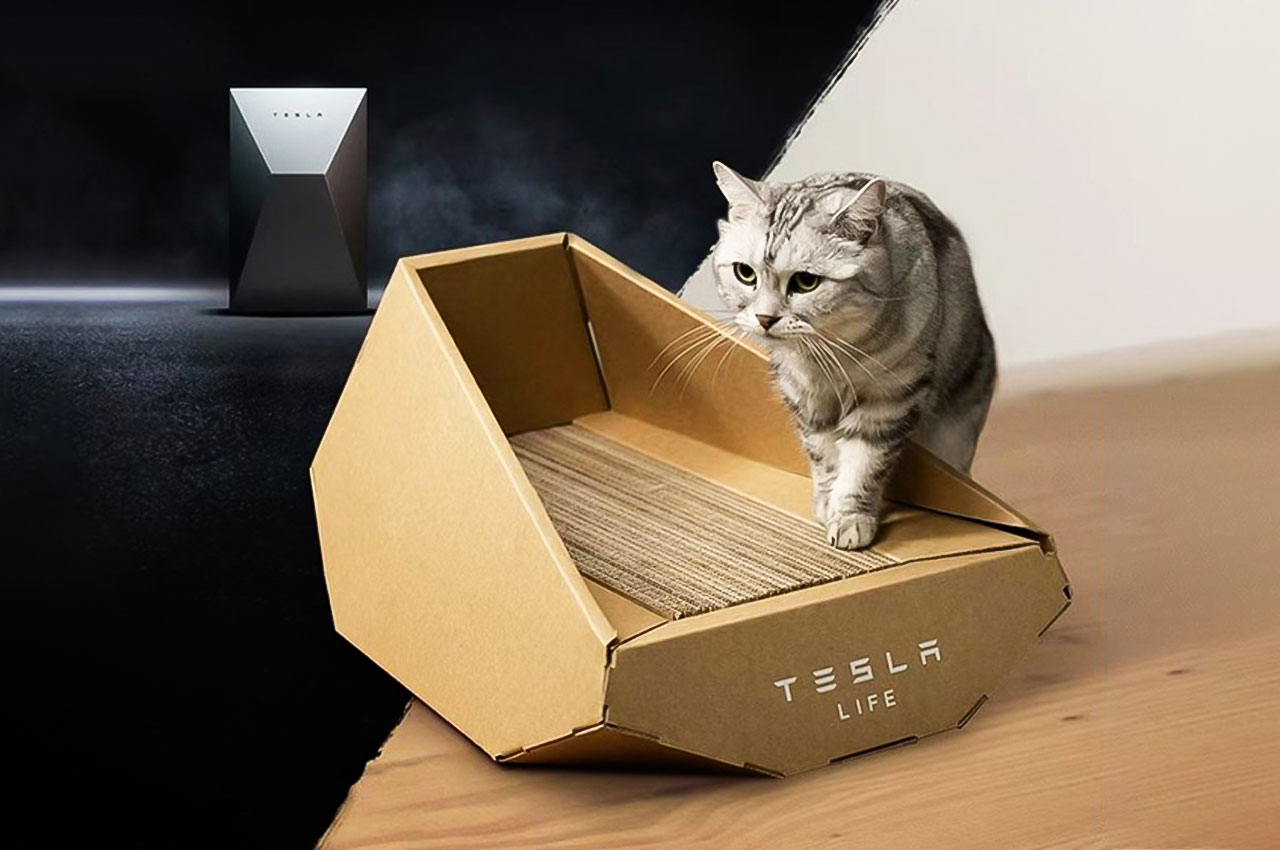
4. Tesla Cybertruck Corrugated Cat House
The $13 Tesla Cybertruck Corrugated Cat House is up for grabs on the Chinese version of the Tesla website. It took the internet by storm and got everyone wondering when and if Tesla is gonna step into the pet product industry.
Why is it noteworthy?
The cat tray is inspired by the angular shape of Tesla’s electric pickup truck. It has a unique futuristic shape and is embedded with thick corrugated paper.
What we like
Functions as a multifunctional space for your cat
The house can accommodate up to 15 kg, allowing it to house cats of various breeds and sizes
What we dislike
A simple cardboard box with nothing cyber-ish about it
The real functionality of the tray is still unknown
5. Choo Choo
Called the “Choo Choo” console, this pet-friendly furniture design is not just a piece of décor, it functions as a dedicated space for your pets. It has been precisely and meticulously crafted from natural materials like wood and cane wedding. It is designed to enrich the connection between humans and their cats.
Why is it noteworthy?
The Choo Choo console is a sleek and modern form of a bullet train. It exudes a sense of contemporary style, while also incorporating a sense of speed and efficiency. High-speed transportation has been successfully merged with the world of pet-friendly design.
What we like
Functions as a cozy and inviting space for cats to clean their paws, and nails comfortably
What we dislike
Bulky + space-consuming design
6. Mocats Multifunctional Cat Furniture
Called the Mocats Multifunctional Cat Furniture, this adorable furniture design allows indoor cats to have a taste of the outdoor world. It is shaped like a city skyline, and it allows cats to have their own apartments, buildings, and roofs to explore and conquer. It has a modular design that lets cat parents build out the perfect toy for their fur babies.
Why is it noteworthy?
The Mocats can be altered and expanded to keep furry friends engaged. The spaces are cat-scale, and they are built on the principles of growth and flexibility, allowing the pet’s furniture to evolve with them.
What we like
Takes the interaction between humans and cats to a whole new level
What we dislike
Scratching will quickly ruin the appearance
7. Maeve Pet Protection System
Dubbed the Maeve Pet Protection System, and designed by Tavo, this system allows you to harmoniously take your pet from your home to the car, and to the final location whether it is a dreaded vet appointment, or an adventure. The system includes a carrier and a vehicle base for the carrier.
Why is it noteworthy?
Tavo made use of the latest United Nations ECE child restraint standards to offer the highest degree of protection and safety. You can travel peacefully with your pet knowing they are safe and well-protected.
What we like
Offers your pet the ultimate safety and comfort while traveling
What we dislike
We’re not sure how easy to clean the system would be
8. ORo
Ogmen Robotics unveiled something super cool at CES 2024. It is an intelligent home robot that was designed from the ground up to be the “pawfect” guardian, playmate, and caretaker for your canine best friend. It looks like one of those robots on wheels that are intended for human use.
Why is it noteworthy?
ORo can provide physical, mental, and emotional stimulation through playful activities. It can help you keep track of the dog’s health, and even find out when they’re feeling anxious, and play some soothing music to help calm them down.
What we like
Help owners train their dogs through obedience games and virtual training services
What we dislike
Not sure how comfy dogs would feel with a robot, they could get aggressive or feel threatened
9. Wooffy Dog House
Named the Wooffy Dog House, this adorable and cozy dog house is designed to be a luxurious and comfortable haven for your pets, while also functioning as a well-designed piece of home decor for your home. It is the perfect little gift for your beloved doggos!
Why is it noteworthy?
The dog house is made from top-tier plywood, and it is equipped with transparent acrylic doors. It functions as a resting place for your doggo, and is the kind of furniture piece that perfectly merges with the rest of your home and home decor.
What we like
Modern contemporary design that makes a lovely statement without being too loud
Can be used for a wide range of breeds
What we dislike
Space-consuming design that looks difficult to move or shuffle around
10. Triangle Toy
Named the Triangle Toy, this unique and innovative pet toy keeps your furry friends entertained, while also functioning as a work of art. It is a one-of-a-kind pet toy, that provides a visual experience inspired by the beauty of nature.
Why is it noteworthy?
The Triangle Toy is a prime specimen of how pet products can actually be super creative! It serves as a canvas for the motifs of clouds, the sun, and the mountain. The triangular structure serves as the huge mountains, while the gentle flow of the clouds is signified as a rolling ball.
What we like
Provides a unique and creative twist to pet toys
What we dislike
Seems more like a decorative object than a pet toy
In the rapidly evolving world of artificial intelligence, a new player has emerged that promises to push the boundaries of what’s possible with language models. Grok-1, developed by XAi Labs, is an open-source large language model that boasts an impressive 314 billion parameters, making it one of the largest and most powerful models available today. […]
At NVIDIA GTC 2024 introduced a wealth of advancements in humanoid robotics including the introduction of Project Groot, a foundation model for humanoid robot learning, enabling robots to perform tasks by observing human demonstrations. Together with Isaac Lab, a robot learning application, was developed to train Groot using Omniverse Isaac Sim. Osmo, a new compute […]