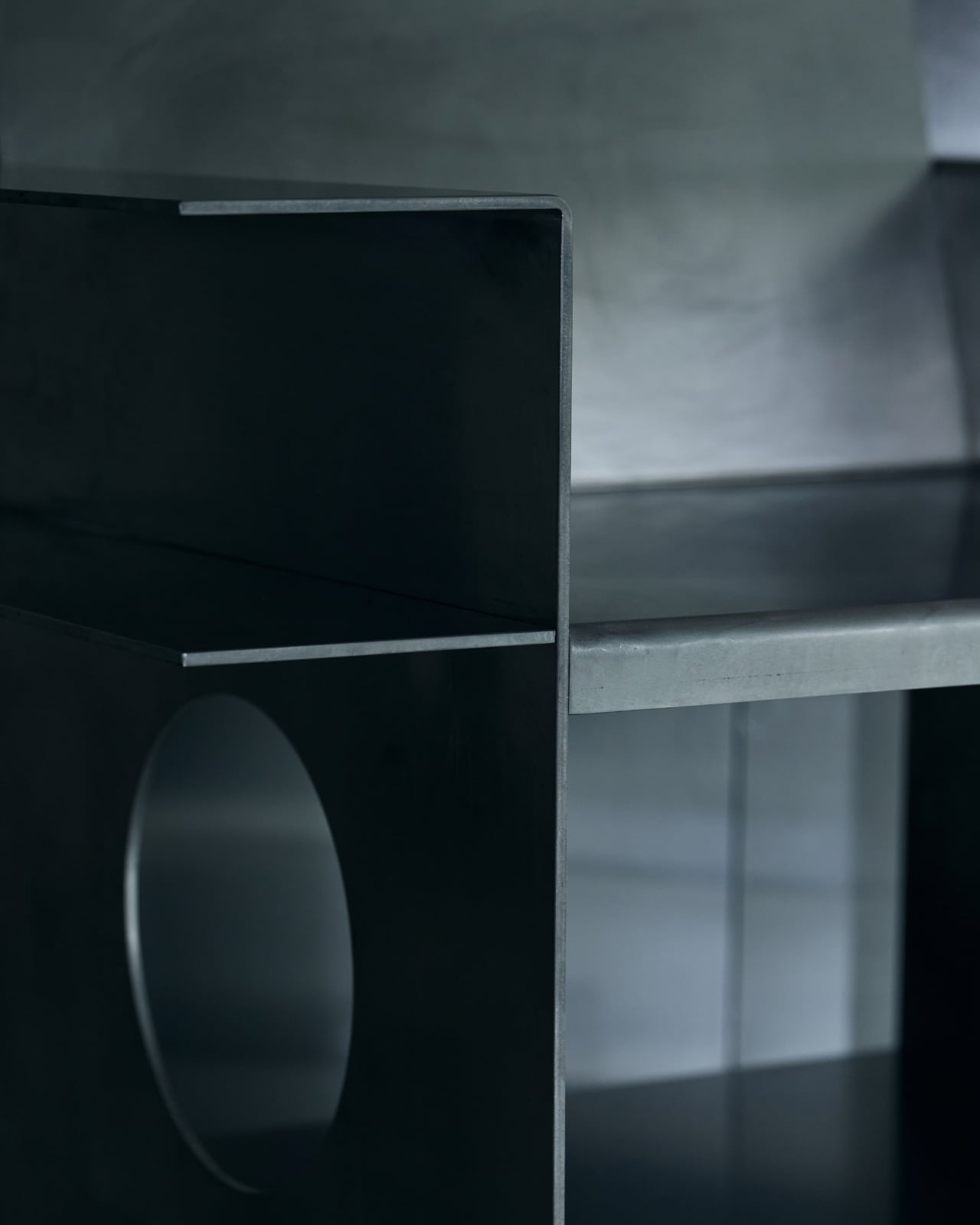
OFIS Rebuilt This 122sq.m. Post-War Home Without Losing Its Soul

Settled quietly within Naselje Murgle, one of Ljubljana’s most thoughtfully conceived residential neighborhoods, the House Under the Poplars is a 122-square-meter reconstruction and extension that speaks softly and means it. Completed in 2025 by OFIS Arhitekti, the project reads less as a statement of ambition and more as an act of architectural respect, a house that earns its place not by standing out but by understanding exactly where it stands.

Murgle was never meant to be remarkable in a conventional sense. Designed by Slovenian architects France and Marta Ivanšek and built through self-construction phases between 1965 and 1982, the settlement became a quietly radical model of ecological, human-scaled living long before sustainability entered the architectural vocabulary. Its distinctly Scandinavian character, shaped in part by the Ivanšeks’ time in Sweden, gave the neighborhood a collective identity rooted not in signature gestures but in shared, low-tech intelligence.

Designer: OFIS Arhitekti

Led by Rok Oman and Špela Videčnik, OFIS Arhitekti approached the project with the kind of cultural sensitivity that most renovations only gesture toward. The intent was never to impose a new architectural language onto an existing one but to refine and carefully elevate what was already there. The studio leaned into Murgle’s founding principles, treating them not as limitations but as the clearest possible brief for what this house needed to become.

The new glazed façade opens generously toward the garden, framing a mature birch tree with an ease that feels entirely uncontrived. Vertical timber slats line the side glazing, offering privacy to the main living space without cutting it off from the broader landscape. The covered atrium connects the primary bedroom and its ensuite bathroom to the rest of the house, creating a sequence of spaces that feel considered without ever feeling overcalculated.

Inside, timber cladding runs across the walls and ceiling in a move that unifies the interior and gives the whole house its warmth. A wine cellar sits beneath a glass floor panel in the living room, one of the project’s more unexpected gestures, and all the better for it. The rest of the program stays deliberately modest: a single additional bedroom suite and a small study, a reminder that restraint, when properly applied, is its own kind of luxury.

The House Under the Poplars does not try to reinvent Murgle. It tries to honor it, and in doing so, quietly sets a standard for what thoughtful, sensitive reconstruction can look like in a neighborhood that has always asked its residents to think beyond themselves. As a project, it resists easy categorization. It is not a restoration, not a reimagining, but something far more useful: a considered continuation of an idea that was already worth keeping.

The post OFIS Rebuilt This 122sq.m. Post-War Home Without Losing Its Soul first appeared on Yanko Design.

Mark Zuckerberg testifies in social media addiction trial that Meta just wants Instagram to be ‘useful’

Mark Zuckerberg took the stand Wednesday in a high-profile jury trial over social media addiction. In an appearance that was described by NBC News as "combative," the Facebook founder reportedly said that Meta's goal was to make Instagram "useful" not increase the time users are spending in the app. 

On the stand, Zuckerberg was questioned about a company document that said improving engagement was among "company goals," according to CNBC. But Zuckerberg claimed that the company had "made the conscious decision to move away from those goals, focusing instead on utility," according to The Associated Press. "If something is valuable, people will use it more because it’s useful to them,” he said. 

The trial stems from a lawsuit brought by a California woman identified as "KGM" in court documents. The now 20-year-old alleges that she was harmed as a child by addictive features in Instagram, YouTube, Snapchat and TikTok. TikTok and Snap opted to settle before the case went to trial. 

Zuckerberg was also asked about previous public statements, including his remarks on Joe Rogan's podcast last year that he can't be fired by Meta's board because he controls a majority of the voting power. According to The New York Times, Zuckerberg accused the plaintiffs' lawyer of "mischaracterizing" his past comments more than a dozen times.  

Zuckerberg's appearance in court also apparently prompted the judge to warn people in the courtroom not to record the proceedings using AI glasses. As CNBC notes, members of Zuckerberg's entourage were spotted wearing Meta's smart glasses as the CEO was escorted into the courthouse. It's unclear if anyone was actually using the glasses in court, but legal affairs journalist Meghann Cuniff reported that the judge was particularly concerned about the possibility of jurors being recorded or subjected to facial recognition. (Meta's smart glasses do not currently have native facial recognition abilities, but recent reports suggest the company is considering adding such features.)

The Los Angeles trial has been closely watched not just because it marked a rare in-court appearance for Zuckerberg. It's among the first of several cases where Meta will face allegations that its platforms have harmed children. In this case and in a separate proceeding in New Mexico, Meta's lawyers have cast doubt on the idea that social media should be considered a real addiction. Instagram chief Adam Mosseri previously testified in the same Los Angeles trial that Instagram isn't "clinically addictive."

This article originally appeared on Engadget at https://www.engadget.com/social-media/mark-zuckerberg-testifies-in-social-media-addiction-trial-that-meta-just-wants-instagram-to-be-useful-234332316.html?src=rss

Transformers-inspired Shapeshifting Machine Splits Into An Entire Road-Construction Robot Fleet

Road construction has a complexity problem. Getting a stretch of road built in a remote region, a disaster zone, or difficult terrain typically means coordinating multiple heavy machines, multiple skilled operators, and a logistical chain that can collapse at any point. Yan Zhang and Jialu Hou, two designers from Shandong University of Art and Design, spent several months in 2024 working on a concept that treats all of that complexity as a design challenge worth solving from scratch.

The result is PaveLink, an autonomous modular road-building system that arrives as a single articulated electric train and deploys into a coordinated fleet of AI-guided construction robots on site. One system. One delivery. A drone overhead, autonomous modules on the ground, and an intelligent command hub managing all of it in real time.

Designers: Yan Zhang and Jialu Hou

The truck head is a blocky, panoramic-windshield command center with a drone launch platform built right into the roof. When PaveLink reaches its target location, that drone lifts off first, ascending to map the terrain using aerial sensors and streaming data back to the cab in real time. The drone itself is worth a second look: shaped like a swept-back arrowhead with a multi-rotor configuration, it looks aggressive and purposeful in the air, matching the amber and gunmetal black palette of the ground units working below it.

Four distinct unit types detach from that spine: a front-loader with a wide scoop bucket, an excavator arm for breaking ground, a grader for leveling, and a heavy steel drum compactor for finishing the surface. On their own, each unit looks almost insectoid, riding on two or three fat rugged wheels with articulated limbs that flex and angle across uneven ground. Together, working in coordinated parallel, they turn what would normally require a crew of operators and days of staging into something that functions more like a synchronized performance.

All the modules stay tethered to the system via cables, which serve double duty as power lines and data channels. PaveLink runs fully electric, so there’s no diesel cloud hanging over the operation, and the continuous cable connection means the modules never need to stop and recharge independently. The drone keeps feeding updated terrain data overhead, flagging hazards and fine-tuning the AI’s workflow decisions as ground conditions change.

PaveLink is aimed squarely at the places traditional road construction struggles most: disaster-hit zones, remote regions with no skilled operators, and rugged terrain that conventional machinery can’t navigate efficiently. The modular autonomous approach answers all three problems at once. Fewer humans in harm’s way, fewer separate machines to transport in, and an AI coordination layer that adapts to whatever chaotic ground conditions it finds on arrival.

The post Transformers-inspired Shapeshifting Machine Splits Into An Entire Road-Construction Robot Fleet first appeared on Yanko Design.

Dyson announces the PencilWash wet floor cleaner

Last year Dyson introduced the PencilVac, which it immediately declared the "world’s slimmest vacuum cleaner." Presumably, then, the title of world’s slimmest wet floor cleaner goes to the newly unveiled PencilWash.

Promising a "lighter, slimmer and smaller solution to wet cleaning without compromising on hygiene," the PencilWash is designed to let you clean everywhere you need to with minimal hassle. Like the vacuum cleaner with which it shares the first part of its name, the handle measures just 1.5 inches in diameter from top to bottom, and the whole thing weighs little more than 2kg.

The ultra-thin design allows the cleaner to lie almost completely flat, allowing you to get into tight corners or under low furniture, where more traditionally bulky devices might struggle. Its slender proportions also make it easier to store if your home is on the smaller side.

Dyson says the PencilWash only applies fresh water to floors, and after swiftly eliminating spills and stains it should dry up pretty quickly. Its high-density microfiber roller is designed to tackle both wet and dry debris in one pass, and because it doesn’t have a traditional filter, you won’t have to worry about trapped dirt or lingering smells.

Above the power buttons there’s a screen displaying remaining battery level, and the handle can be slotted into a charging dock when not in use.

The Dyson PencilVac will cost $349, with a release date yet to be announced.

This article originally appeared on Engadget at https://www.engadget.com/home/dyson-announces-the-pencilwash-wet-floor-cleaner-230152299.html?src=rss

The Modular Cat Habitat That Turns Playful Curiosity Into Living Architecture

What if we designed homes the way cats would design them? Not human homes with a token scratching post in the corner but true spatial systems built around curiosity, vertical exploration, territorial comfort, and play. The N Plus Magic House begins precisely at that question, reframing pet furniture not as an accessory but as architecture scaled for feline psychology. Instead of treating a cat house as a static object, this project treats it as a living spatial framework, one that evolves alongside its inhabitant.

Today’s pet owners increasingly see their cats as emotional companions rather than animals that merely coexist in domestic space. That shift has quietly created a design problem. Traditional cat houses, even elaborate ones, tend to be fixed structures. They may be visually impressive, but they impose constraints on placement, adaptability, and long-term usability. The N Plus Magic House flips that paradigm by introducing modularity as its core philosophy. Rather than selling a finished form, it offers a system of standardized units that can be assembled, rearranged, expanded, or reduced as needed. The result is less like furniture and more like a customizable habitat kit.

Designer: Taizhou Hake Technology Co., Ltd

The genius of the design lies in its simplicity. Each module functions independently yet connects securely through precision-engineered connectors. Owners assemble structures by inserting panels into slots and stacking them like building blocks. No technical expertise, tools, or installation manuals are required. This intuitive construction method does something subtle but powerful. It turns pet care into participation. Instead of buying a finished object, users become co-designers of their cat’s environment. That interaction strengthens the emotional bond among the owner, the pet, and the space.

Material choices reinforce the system’s practicality. The structure combines impact-resistant PP resin, transparent PET panels for visibility, and carbon steel mesh for structural integrity. These materials balance durability with safety while allowing owners to monitor their pets without disturbing them. The manufacturing processes, such as injection molding and automatic wire welding, ensure consistency, precision, and reliability across units. Every element reflects careful alignment with feline behavior and safety requirements.

Behind the scenes, the development team approached the project with a research-driven mindset. They studied cats’ behavioral patterns, analyzed existing products on the market, and mapped owner expectations. One of the biggest technical challenges was maintaining structural stability while preserving modular flexibility. The solution was a custom connector engineered to withstand pressure and weight while preventing slippage. Its textured surface increases friction, ensuring modules remain firmly locked during use. This small component is arguably the system’s unsung hero. It transforms a playful concept into a reliable architectural structure.

Developed in Taizhou, Zhejiang Province, between July 2023 and November 2024 and later exhibited internationally, the N Plus Magic House represents a broader shift in product design thinking. It signals a move away from static ownership toward adaptive systems, objects that respond to changing needs over time. In a world where personalization defines modern consumer expectations, this approach feels less like a novelty and more like a glimpse into the future of domestic product design.

The post The Modular Cat Habitat That Turns Playful Curiosity Into Living Architecture first appeared on Yanko Design.

2026 Mercedes-Benz Marco Polo camper van arrives with smarter pop-up roof and luxury upgrades

Mercedes-Benz and Volkswagen have produced some of the best camper vans on the market, and they’ve long shared a common collaborator. Now, with Mercedes-Benz taking the complete production of its Marco Polo under its wings, Volkswagen and other competitors can expect some serious competition. The newly updated 2026 Marco Polo is the first new addition to Mercedes in-house van life portfolio and flaunts an interesting pop-up roof, which is its main talking point.

According to Mercedes-Benz press information, the body of the V-Class Marco Polo is built at the company’s Vans plant in Vitoria, Spain. The vehicle is then converted into a pop-up camper van at the Ludwigsfelde plant in Germany. The overall in-house production of the Marco Polo means it’s of the “highest quality standard” and that the company has complete control over every detail and pace at which it is produced.

Designer: Mercedes-Benz

Substantiating the fact, Sagree Sardien, head of sales & marketing Mercedes-Benz Vans said, it is a “Mercedes-Benz through and through,” which is designed to offer buyers a more sophisticated home on wheels. “A home that effortlessly combines travel and everyday life – while making a stylish statement,” he said.

To that accord, the Mercedes-Benz 2026 Marco Polo is a compact, luxury camper van featuring a pop-up roof, convertible downstairs seating, kitchen, and ambient lighting to uplift the mood when you’re inside the van. The major update from the 2024 model of the van is focused around the improvement to the lifting roof space. The double-skinned aluminum pop-top makes for an additional 4 inches of headroom and is provided with an ambient LED system that allows the space to feel lively and inviting.

Downstairs, the Marco Polo doesn’t make many changes. It comes equipped with a kitchen featuring double burner gas stove, a sink, mini fridge, and a swiveling bench that can easily facilitate dining and sleeping. During mealtime, you have a folding table that reaches out of the kitchen block, and during the night it folds up to make room for the convertible sofa to create a double bed.

MBAC infotainment suite is another interesting facet of the new Mercedes camper van. Sitting in the cockpit, the smart touchscreen can control the interior components like the vehicle’s upgraded eight-speaker audio system and pop-up roof lighting. The infotainment system also has instant control to pop-up roof. You can deploy or retract the lifting roof remotely, while also maintaining the temperature of the van home.

The new Marco Polo will be available to order soon, Mercedes notes. It also mentions in the press release that the launch of Marco Polo Horizon is also on the cards. This model shares similar features except for the built-in kitchen unit, making it suitable for weekend outings or short holidays only.

The post 2026 Mercedes-Benz Marco Polo camper van arrives with smarter pop-up roof and luxury upgrades first appeared on Yanko Design.

Gemini can now generate a 30-second approximation of what real music sounds like

Google has announced that using its newly incorporated Lyria 3 model, Gemini users will be able to generate 30-second music tracks based on a prompt, or remix an existing track to their liking. The new model builds on Gemini's pre-existing ability to generate text, images and video, and will also be available in YouTube's "Dream Track" feature, where it can be used to generate detailed backing tracks for Shorts.

Like some other music generation tools, prompting Gemini doesn't require a lot of detail to produce serviceable results. Google's example prompt is "a comical R&B slow jam about a sock finding their match," but after playing with Lyria 3, you can definitely get more granular about individual elements of a track — changing the tempo or the style of drumming, for example — if you want to. Outside of text, Gemini can also generate music based on a photo or video, and tracks can be paired with album art created by Google's Nano Banana image model.

Google says that Lyria 3 improves on its previous audio generation models in its ability to create more "realistic and musically complex" tracks, give prompters more control over individual components of a song and automatically generate lyrics. Gemini's outputs are limited to 30-second clips for now, but given how Google's promotional video shows off the feature, it's not hard to imagine those clips getting longer or the model getting incorporated into other apps, like Google Messages.

Like Gemini's other AI-generated outputs, songs made with Lyria 3 are also watermarked with Google's SynthID, so a Gemini clip can't as easily be passed off as a human one. Google started rolling out its SynthID Detector for identifying AI-generated content at Google I/O 2025. The sample tracks Google included alongside its announcement are convincing, but you might not need the company's tool to notice their machine-made qualities. The instrumental parts of Gemini’s clips often sound great, but the composition of the lyrics Lyria 3 produces sounds alternately corny and strange.

If you're curious to try Lyria 3 for yourself, Google says you can prompt tracks in Gemini starting today, provided you're 18 years or older and speak English, Spanish, German, French, Hindi, Japanese, Korean or Portuguese.

This article originally appeared on Engadget at https://www.engadget.com/ai/gemini-can-now-generate-a-30-second-approximation-of-what-real-music-sounds-like-204445903.html?src=rss

Google Released a New Pixel 10a and It’s Basically the Same Phone From Last Year

Google would like you to meet the Pixel 10A. It has a new name, new colors, and a press release that runs to several pages. It costs $499, which is exactly what the Pixel 9A cost. It weighs the same. It measures the same. It has the same cameras, the same battery, the same chip, and the same 6.3 inch display. There is a episode of The Office where Pam preoccupies Michael by presenting two identical photo printouts as a spot-the-difference puzzle. Google has essentially done that, except the printout costs five hundred dollars.

To be precise about what actually changed: the display is about 10% brighter, the glass protecting it moved from Gorilla Glass 3 to Gorilla Glass 7i, wired charging climbed from 23 watts to 30, and wireless charging went from 7.5 watts to 10. The camera bump, already barely perceptible on the 9A, is now completely flush. In some regions, satellite SOS is supported. That is the complete list. Google did not forget to send the rest of it.

Designer: Google

The Pixel 10 and Pixel 10 Pro both run on the Tensor G5. The Pixel 10A runs on the Tensor G4, the same chip from last year’s A-series, and the year before that in the Pixel 9 Pro. For years, buying the A-series meant getting the current flagship chip in a cheaper body. That was a genuinely good deal. Google has decided, apparently, that it was too good.

Best Take, Camera Coach, Call Screening, Clear Calling, Now Playing, Gemini as a built-in assistant, and seven years of updates add up to an experience that Android competitors at this price genuinely struggle to match. The Pixel ecosystem has real pull, and Google knows it. The 10A is banking on that pull being strong enough to carry a spec sheet that would embarrass a 2024 phone.

Google looked at the Pixel 9A, decided it had not been wrong about any of it, and shipped it again with brighter glass and a new colorway called Fog. In an industry that routinely invents problems to solve, there is something almost philosophical about a company that simply refuses to fix what it considers unbroken. The Pixel 10A does not have an identity crisis. It has its predecessor’s identity, and it is completely comfortable with that.

It will sell because the cameras are good, the battery lasts, the software support is unmatched at the price, and most people upgrading to it will be coming from something two or three generations older where the difference feels significant regardless of which Tensor chip is inside. Google understands its buyer perhaps better than its buyer understands the spec sheet. The Pixel 10A is a perfectly competent phone that knows exactly what it is. But also… this smartphone announcement could have been an email.

The post Google Released a New Pixel 10a and It’s Basically the Same Phone From Last Year first appeared on Yanko Design.

Cyberpunk platformer Replaced has once again been delayed

The long-awaited cyberpunk platformer Replaced just got hit with a short delay. The pixel-art game was supposed to come out on March 12, but will now be released on April 14. That's just a month, which isn't that big of a deal considering this game has been on our radar for five years.

Why the delay? Developer Sad Cat Studios notes that the game is "technically finished" but the team needs a few more weeks for polish. The company says it wants the day-one release to be "polished, stable and true to the vision" of the original concept. This is something to be commended, in my opinion, given the sad state of many game launches in recent years.

This is just the latest delay for the game. However, previous delays have been for a very good reason. The development team had to relocate from Belarus to Cyprus after Russia invaded Ukraine in 2022.

Replaced is an absolutely gorgeous-looking 2.5D platformer set in a dystopian alternative 1980s America. You play as an AI unwillingly trapped in a human body. There looks to be plenty of cinematic action, with a blurb promising a combination of "precise melee strikes with satisfying ranged attacks."

The game will be available for Xbox Series X/S, Xbox One and PC via Steam, Epic Games Store, GOG and the Microsoft Store. It'll also be a day-one Xbox Game Pass release.

This article originally appeared on Engadget at https://www.engadget.com/gaming/cyberpunk-platformer-replaced-has-once-again-been-delayed-190621246.html?src=rss

Forget Mindfulness Apps, This Desk Top Spins for 2 Minutes Instead

Screens are on all day, and hands tend to find something to do when focus slips. Pen clicking, phone picking, knuckle cracking, the nervous tics of modern desk work. Most “mindfulness” solutions are still apps, which is a bit ironic when the problem is too much screen time. There’s something to be said for a small mechanical object that gives your brain a reset without asking for any attention in return.

Amsterdam Dynamics’ ST-01 is a modular spinning top and tactile focus object built for desks, hands, and minds that rarely get a break. It’s intentionally simple but not single-purpose, offering multiple mechanical interactions with no correct sequence. You use one when you need it or work through all of them. No app, no setup, no instructions, just the object and whatever your hands feel like doing with it.

Designer: Antonio Lo Presti (Amsterdam Dynamics)

A gentle twist sets ST-01 rotating smoothly, and it’s engineered to keep going for over two minutes. That’s long enough to watch while thinking through a problem, waiting for a file to render, or cooling down after a difficult meeting. It functions as a visual anchor, something calm and physical in a field of notifications and browser tabs that all want something from you.

Pressing the top triggers a satisfying mechanical click with clear tactile feedback, the kind of repeatable, purposeful sensation that replaces the nervous habit of clicking pens or tapping a keyboard. Amsterdam Dynamics calls it “reset focus,” which is accurate if not exactly humble. The middle disc can also be flipped like a coin, adding a small decision-making tool and another texture to the interaction when you need a nudge in either direction.

Of course, there’s a modular construction underneath all of that. ST-01 is built from three parts that can be taken apart and snapped back together, held in alignment by two precisely positioned magnets. That magnetic core keeps the structure stable during spinning while making it easy to disassemble by hand. There’s also a built-in magnet that lets it stick to metal surfaces, which is either a neat trick or a genuinely useful parking spot depending on your desk.

CNC-machined, anodized aerospace-grade aluminum means it’s solid in the hand, balanced, and finished in a way you notice the first time you pick it up. Cheap fidget toys flex, squeak, and wear out quickly. ST-01 is designed to stay on the desk for a long time, with Amsterdam Dynamics framing it as “a beautiful object, made to last a lifetime” and something that can eventually be passed on.

That’s an unusual positioning for what is essentially a desk toy, but it fits the overall idea. ST-01 doesn’t ask for a lifestyle change, a daily streak, or a subscription. It just gives your hands a few repeatable interactions and a place to return when the work gets loud, which turns out to be the kind of quiet, mechanical company a desk actually needs.

The post Forget Mindfulness Apps, This Desk Top Spins for 2 Minutes Instead first appeared on Yanko Design.