Apple will introduce a new 12.9-inch iPad Air alongside the long-rumored OLED iPad Pro to kick off upgrades for its entire iPad lineup in 2024, according to analyst Ming-Chi Kuo. Updated versions of the iPad Air are expected to arrive in the beginning of the year, with the new iPad Pro models to follow by the second quarter.
Kuo predicts Apple will release a 10.9-inch iPad Air and, for the first time, a 12.9-inch model. While it’ll come in the Pro size, it isn’t likely to sport the Pro’s mini-LED display. But, Kuo says it will get the oxide backplane, which will make for better performance over the smaller model. As for the new iPad Pro, Kuo says there are two upcoming M3 models that will drop the mini-LED display for OLED and use the iPhone 15 Pro’s LTPO backplane.
The rest of the iPad lineup is due for upgrades as well, with both the 11th generation iPad and new iPad mini anticipated to arrive in the second half of 2024. It’s been over a year since Apple last released a new iPad.
This article originally appeared on Engadget at https://www.engadget.com/apples-ipad-refresh-next-year-could-bring-oled-ipad-pros-and-a-129-inch-ipad-air-193729591.html?src=rss
A new “Cybertruck Only” clause in Tesla’s purchase agreement stipulates that buyers cannot sell their new vehicle within the first year unless they have explicit permission from the automaker, or they may be sued. The company just updated its Motor Vehicle Order Agreement ahead of the first Cybertruck deliveries, which it said last month are on track for November 30.
Under the terms, which have been making the rounds on social media this weekend, Tesla states that it “may seek injunctive relief to prevent the transfer of title of the Vehicle” if buyers breach its resale provision, or it may “demand liquidated damages from you in the amount of $50,000 or the value received as consideration for the sale or transfer, whichever is greater.” The terms also warn that offending resellers could be barred from buying vehicles from Tesla in the future.
Tesla says it may grant exceptions to some people wishing to sell their Cybertruck within the first year, but they must get written consent. If the company does agree, it will either buy the car back at a reduced price — deducting $0.25 per mile driven, plus wear and tear, and the cost of any necessary repairs — or allow the owner to resell the truck to a third-party buyer. Tesla’s Cybertruck is only being released to a small number of select customers at first and won’t enter mass production until 2024, so naturally, the company is trying to get ahead of resellers looking to cash in on the vehicle’s rarity.
This article originally appeared on Engadget at https://www.engadget.com/tesla-fine-print-says-it-may-sue-cybertruck-resellers-for-50k-if-they-flip-it-too-soon-173137300.html?src=rss
The explosion of custom GPT AI models has only just begun and one such example is the creation of a Data Science custom GPT allowing you to learn more about the multidisciplinary field. That combines statistical analysis, data mining, machine learning, and big data analytics to extract insights and knowledge from structured and unstructured data. […]
Netflix is giving the Terminator franchise the anime treatment in a new series that’s set to hit the streaming platform “soon.” The company dropped the first teaser for Terminator: The Anime Seriesthis weekend during its Geeked Week event. Details so far are scant, but we do know it’ll be produced by Production IG, the Japanese animation studio behind the original Ghost in the Shell movie and spinoff TV series.
Terminator: The Anime Series will take us back to August 1997, when the Skynet AI becomes self-aware and turns against humans. While there is no information on the cast just yet, Varietyreports the series will feature entirely new characters.
Also on board as executive producers are Skydance and Project Power writer Mattson Tomlin, who will be the series’ writer and showrunner. Netflix hasn’t announced a release date yet or shown any preview scenes, so here’s hoping we get an expanded trailer soon. The Terminator franchise has had quite a few installments, not all of them good, but going back to the beginning could be just the refresh it needs.
This article originally appeared on Engadget at https://www.engadget.com/terminator-is-back-with-a-new-anime-series-coming-to-netflix-154925265.html?src=rss
The man made flood that miraculously saved our heroes at the end of O Brother Where Art Thou were an actual occurrence in the 19th and 20th century — and a fairly common one at that — as river valleys across the American West were dammed up and drowned out at the altar of economic progress and electrification. Such was the case with Washington State's Elwha river in the 1910s. Its dam provided the economic impetus to develop the Olympic Peninsula but also blocked off nearly 40 miles of river from the open ocean, preventing native salmon species from making their annual spawning trek. However, after decades of legal wrangling by the Lower Elwha Klallam Tribe, the biggest dams on the river today are the kind made by beavers.
In this week's Hitting the Books selection, Eat, Poop, Die: How Animals Make Our World, University of Vermont conservation biologist Joe Roman recounts how quickly nature can recover when a 108-foot tall migration barrier is removed from the local ecosystem. This excerpt discusses the naturalists and biologists who strive to understand how nutrients flow through the Pacific Northwest's food web, and the myriad ways it's impacted by migratory salmon. The book as a whole takes a fascinating look at how the most basic of biological functions (yup, poopin!) of even just a few species can potentially impact life in every corner of the planet.
When construction began in 1910, the Elwha Dam was designed to attract economic development to the Olympic Peninsula in Washington, supplying the growing community of Port Angeles with electric power. It was one of the first high-head dams in the region, with water moving more than a hundred yards from the reservoir to the river below. Before the dam was built, the river hosted ten anadromous fish runs. All five species of Pacific salmon — pink, chum, sockeye, Chinook, and coho — were found in the river, along with bull trout and steelhead. In a good year, hundreds of thousands of salmon ascended the Elwha to spawn. But the contractors never finished the promised fish ladders. As a result, the Elwha cut off most of the watershed from the ocean and 90 percent of migratory salmon habitat.
Thousands of dams block the rivers of the world, decimating fish populations and clogging nutrient arteries from sea to mountain spring. Some have fish ladders. Others ship fish across concrete walls. Many act as permanent barriers to migration for thousands of species.
By the 1980s, there was growing concern about the effect of the Elwha on native salmon. Populations had declined by 95 per cent, devastating local wildlife and Indigenous communities. River salmon are essential to the culture and economy of the Lower Elwha Klallam Tribe. In 1986, the tribe filed a motion through the Federal Energy Regulatory Commission to stop the relicensing of the Elwha Dam and the Glines Canyon Dam, an upstream impoundment that was even taller than the Elwha. By blocking salmon migration, the dams violated the 1855 Treaty of Point No Point, in which the Klallam ceded a vast amount of the Olympic Peninsula on the stipulation that they and all their descendants would have “the right of taking fish at usual and accustomed grounds.” The tribe partnered with environmental groups, including the Sierra Club and the Seattle Audubon Society, to pressure local and federal officials to remove the dams. In 1992, Congress passed the Elwha River Ecosystem and Fisheries Restoration Act, which authorized the dismantling of the Elwha and Glines Canyon Dams.
The demolition of the Elwha Dam was the largest dam-removal project in history; it cost $350 million and took about three years. Beginning in September 2011, coffer dams shunted water to one side as the Elwha Dam was decommissioned and destroyed. The Glines Canyon was more challenging. According to Pess, a “glorified jackhammer on a floating barge” was required to dismantle the two-hundred-foot impoundment. The barge didn’t work when the water got low, so new equipment was helicoptered in. By 2014, most of the dam had come down, but rockfall still blocked fish passage. It took another year of moving rocks and concrete before the fish had full access to the river.
The response of the fish was quick, satisfying, and sometimes surprising. Elwha River bull trout, landlocked for more than a century, started swimming back to the ocean. The Chinook salmon in the watershed increased from an average of about two thousand to four thousand. Many of the Chinook were descendants of hatchery fish, Pess told me over dinner at Nerka. “If ninety percent of your population prior to dam removal is from a hatchery, you can’t just assume that a totally natural population will show up right away.” Steelhead trout, which had been down to a few hundred, now numbered more than two thousand.
Within a few years, a larger mix of wild and local hatchery fish had moved back to the Elwha watershed. And the surrounding wildlife responded too. The American dipper, a river bird, fed on salmon eggs and insects infused with the new marine-derived nutrients. Their survival rates went up, and the females who had access to fish became healthier than those without. They started having multiple broods and didn’t have to travel so far for their food, a return, perhaps, to how life was before the dam. A study in nearby British Columbia showed that songbird abundance and diversity increased with the number of salmon. They weren’t eating the fish — in fact, they weren’t even present during salmon migration. But they were benefiting from the increase in insects and other invertebrates.
Just as exciting, the removal of the dams rekindled migratory patterns that had gone dormant. Pacific lamprey started traveling up the river to breed. Bull trout that had spent generations in the reservoir above the dam began migrating out to sea. Rainbow trout swam up and down the river for the first time in decades. Over the years, the river started to look almost natural as the sediments that had built up behind the dams washed downstream.
The success on the Elwha could be the start of something big, encouraging the removal of other aging dams. There are plans to remove the Enloe Dam, a fifty-four-foot concrete wall in northern Washington, which would open up two hundred miles of river habitat for steelhead and Chinook salmon. Critically endangered killer whales, downstream off the coast of the Pacific Northwest, would benefit from this boost in salmon, and as there are only seventy individuals remaining, they need every fish they can get.
The spring Chinook salmon run on the Klamath River in Northern California is down 98 percent since eight dams were constructed in the twentieth century. Coho salmon have also been in steep decline. In the next few years, four dams are scheduled to come down with the goal of restoring salmon migration. Farther north, the Snake River dams could be breached to save the endangered salmon of Washington State. If that happens, historic numbers of salmon could come back — along with the many species that depended on the energy and nutrients they carry upstream.
Other dams are going up in the West — dams of sticks and stones and mud. Beaver dams help salmon by creating new slow-water habitats, critical for juvenile salmon. In Washington, beaver ponds cool the streams, making them more productive for salmon. In Alaska, the ponds are warmer, and the salmon use them to help metabolize what they eat. Unlike the enormous concrete impoundments, designed for stability, beaver dams are dynamic, heterogeneous landscapes that salmon can easily travel through. Beavers eat, they build dams, they poop, they move on. We humans might want things to be stable, but Earth and its creatures are dynamic.
This article originally appeared on Engadget at https://www.engadget.com/hitting-the-books-eat-poop-die-joe-roman-hatchette-books-153032502.html?src=rss
Apple’s new M3 MacBook Pro range of laptops brings a significant advancement in computing technology, marking a new era for personal computing. The introduction of the M3, M3 Pro, and M3 Max chips within these devices is a leap forward, utilizing the industry’s first 3-nanometer technology. This groundbreaking move is not just about shrinking sizes; […]
If you have large business documents that you would like to analyze, quickly and efficiently without having to read every word. You can harness the power of artificial intelligence to answer questions about these documents locally on your personal laptop. Using PrivateGPT and LocalGPT you can securely and privately, quickly summarize, analyze and research large […]
If you use your Mac or MacBook to create tutorial videos or presentations, it is definitely worth your while to learn more about how to use the Apple Mac Presenter Overlay features. Created by Apple and available on macOS Sonoma and later versions for Macs with Apple silicon, this functional and user-friendly tool is designed […]
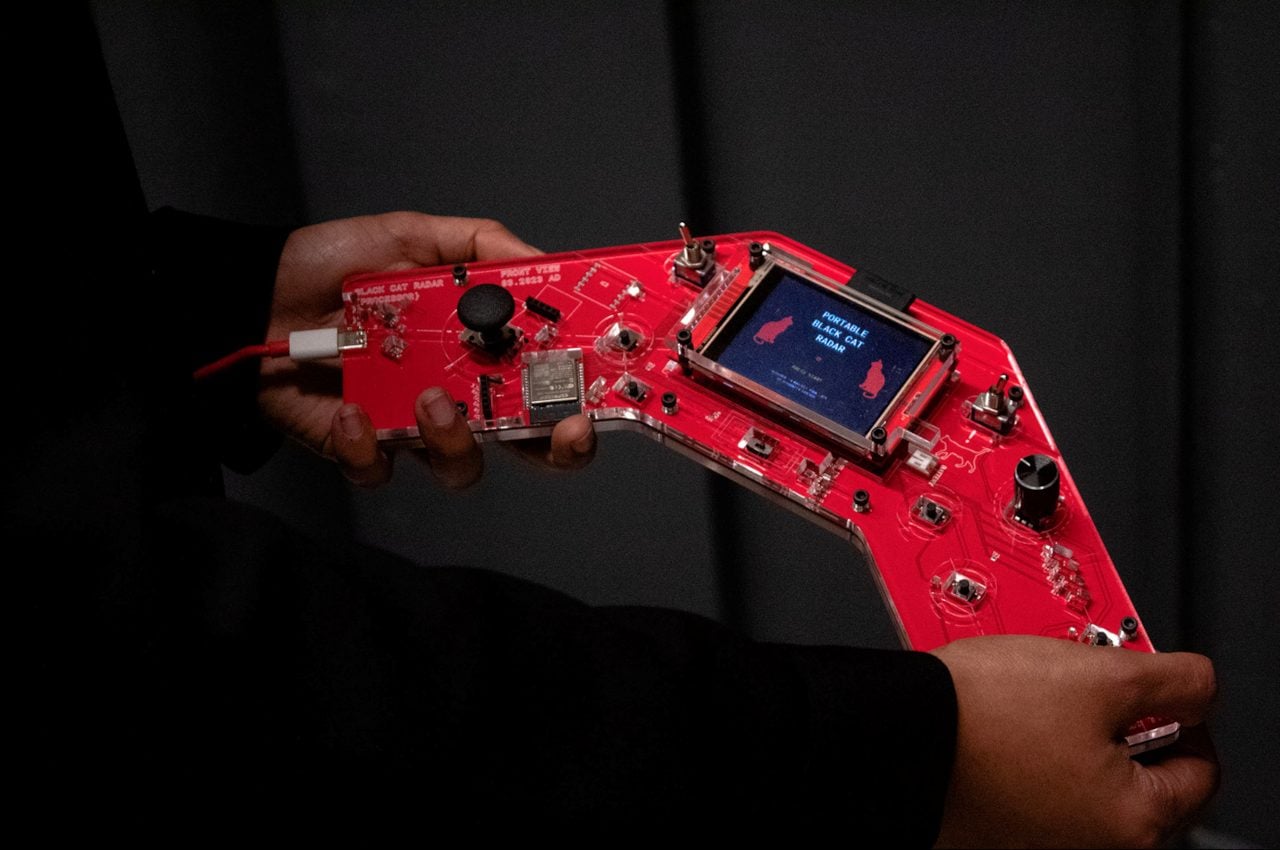
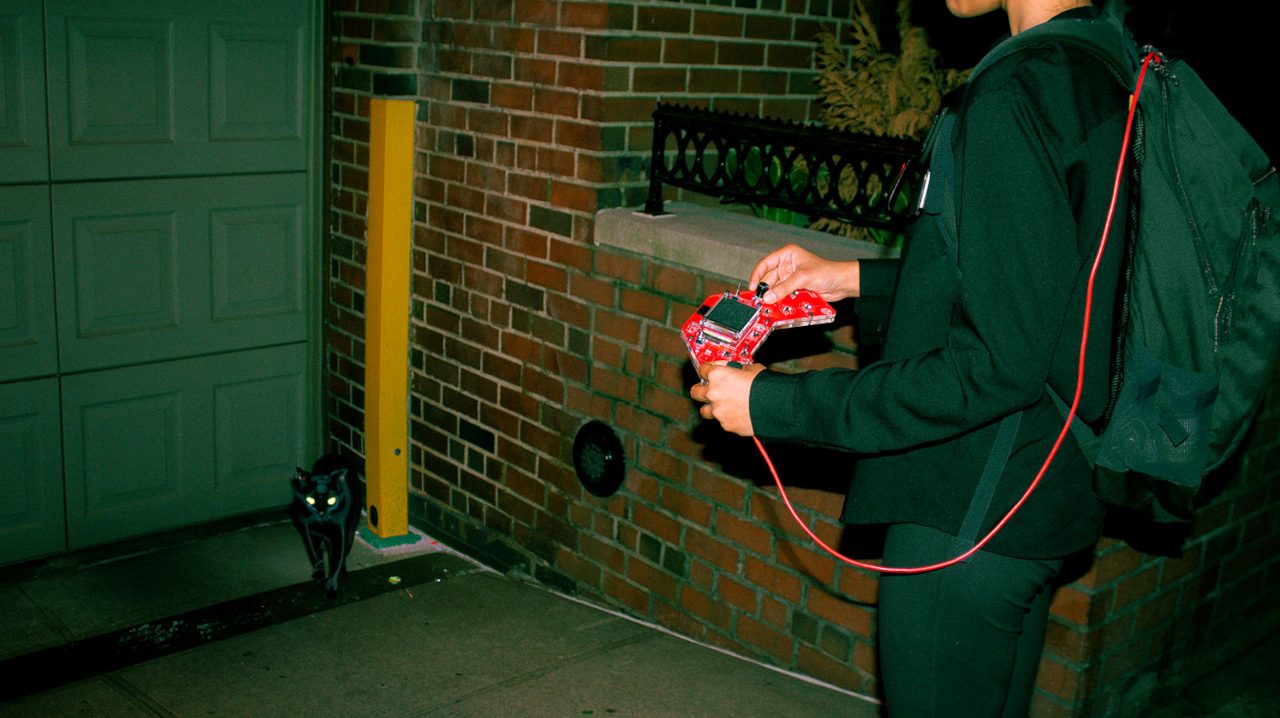
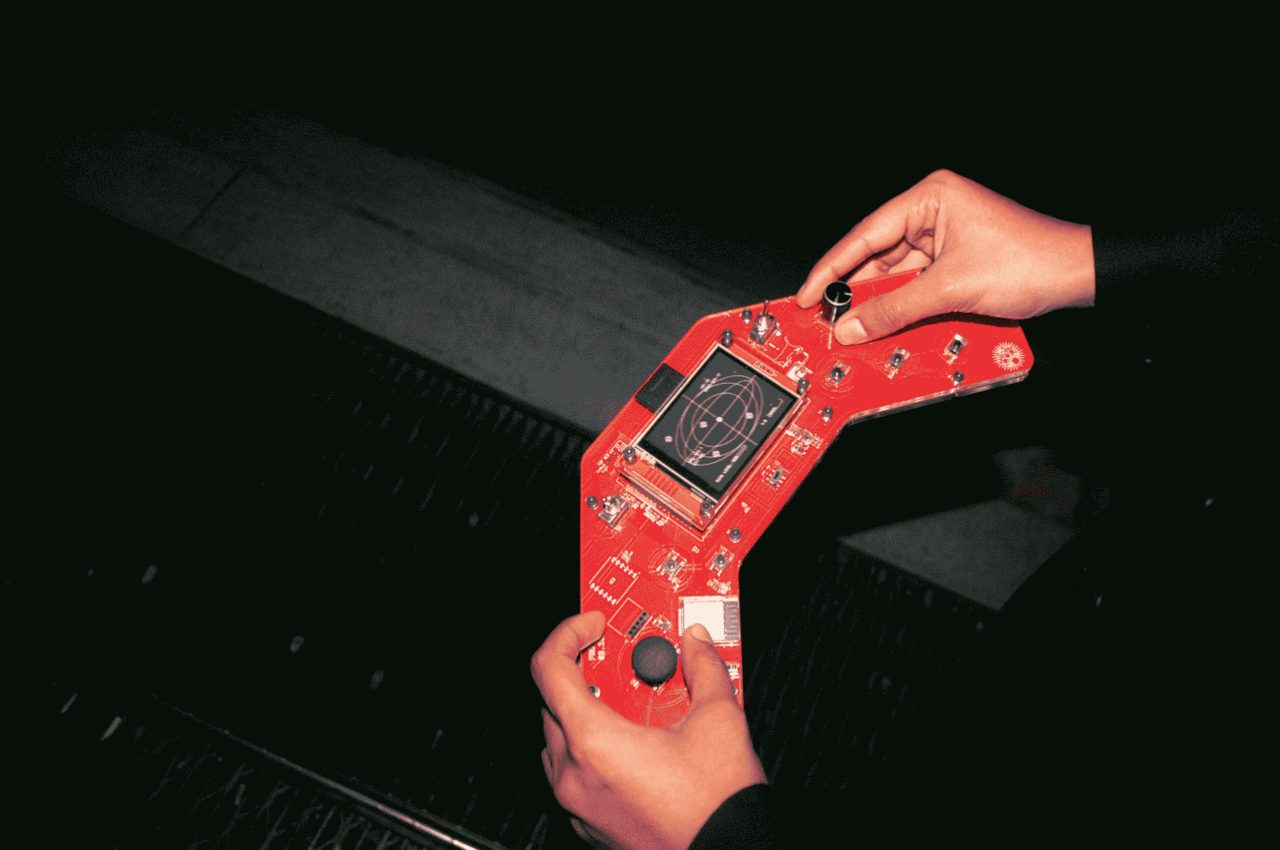
Who doesn’t love black cats? The answer: those of us who value our luck. It’s common knowledge amongst the superstitious that the presence of black cats can only precede a string of misfortunes… depending on where you live. Some cultures consider them good luck, whereas others disagree. Regardless of your opinion on the, shall I say, aetheric attunement of black cats, you’ll want to take a look at this clever hand-held radar created by Kinky Kashayam — a small team of industrial and creative designers based in New York City and Toronto. Called the “Portable Black Cat Radar,” or the “BCR” for short, this rather unusual project is part of a series of conceptual inventions the team has dubbed “Machines that Respond to Superstitions”.
According to Kinky Kashayam, “Many of us have encountered the ideology that crossing the path of a black cat will bring calculated misfortune. If only there were a machine that could show you all the black cats in your vicinity, so you could avoid crossing their paths and protect your luck.”
The parallel childhood experiences of the founders — who’d both developed their own thorough distrust of black cats for different, albeit similar reasons — formed the project’s innermost inspirations. Recalling the incidents of their youth to Yanko Design, black cats crossing their paths seemed the likeliest culprits behind a strange encounter at an airport and less-than-stellar grades on a final exam. Developing the Portable Black Cat Radar together has essentially become the Kinky Kashayam team’s way of reconnecting with their childhood imaginations while tinkering with advanced gadgetry — and, as unconventional as it may seem, this really does work like a radar of sorts.
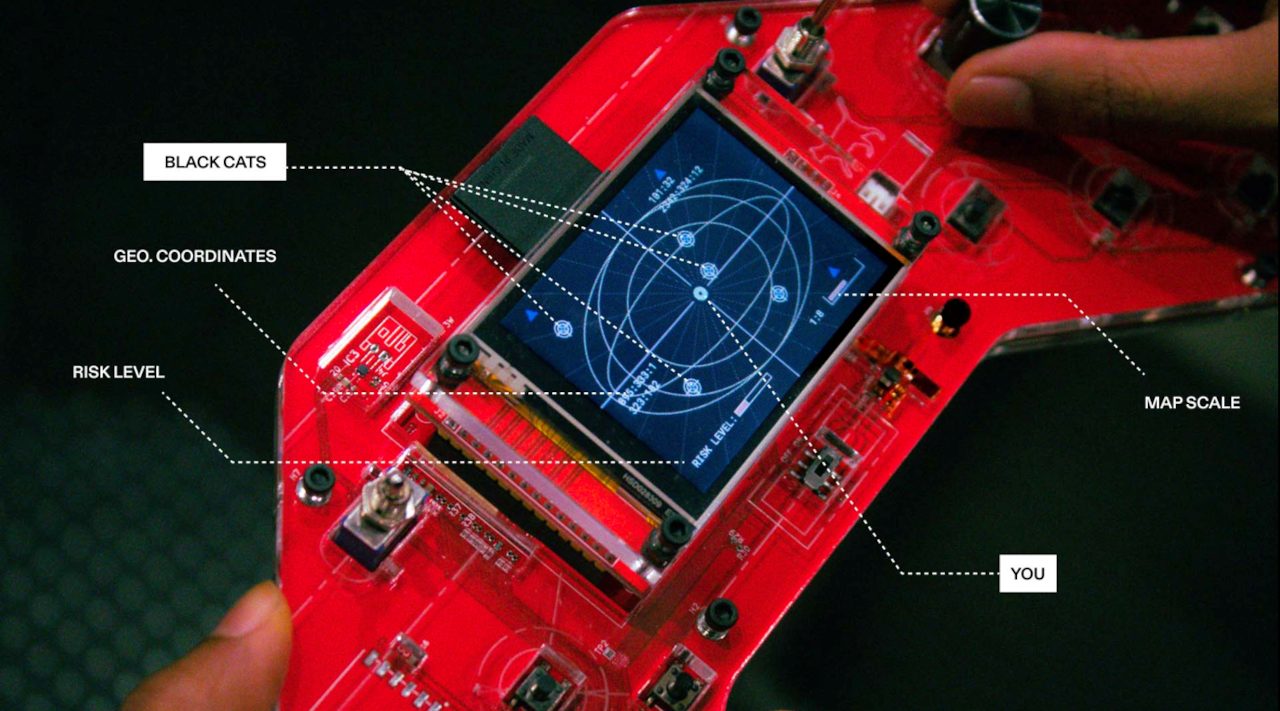
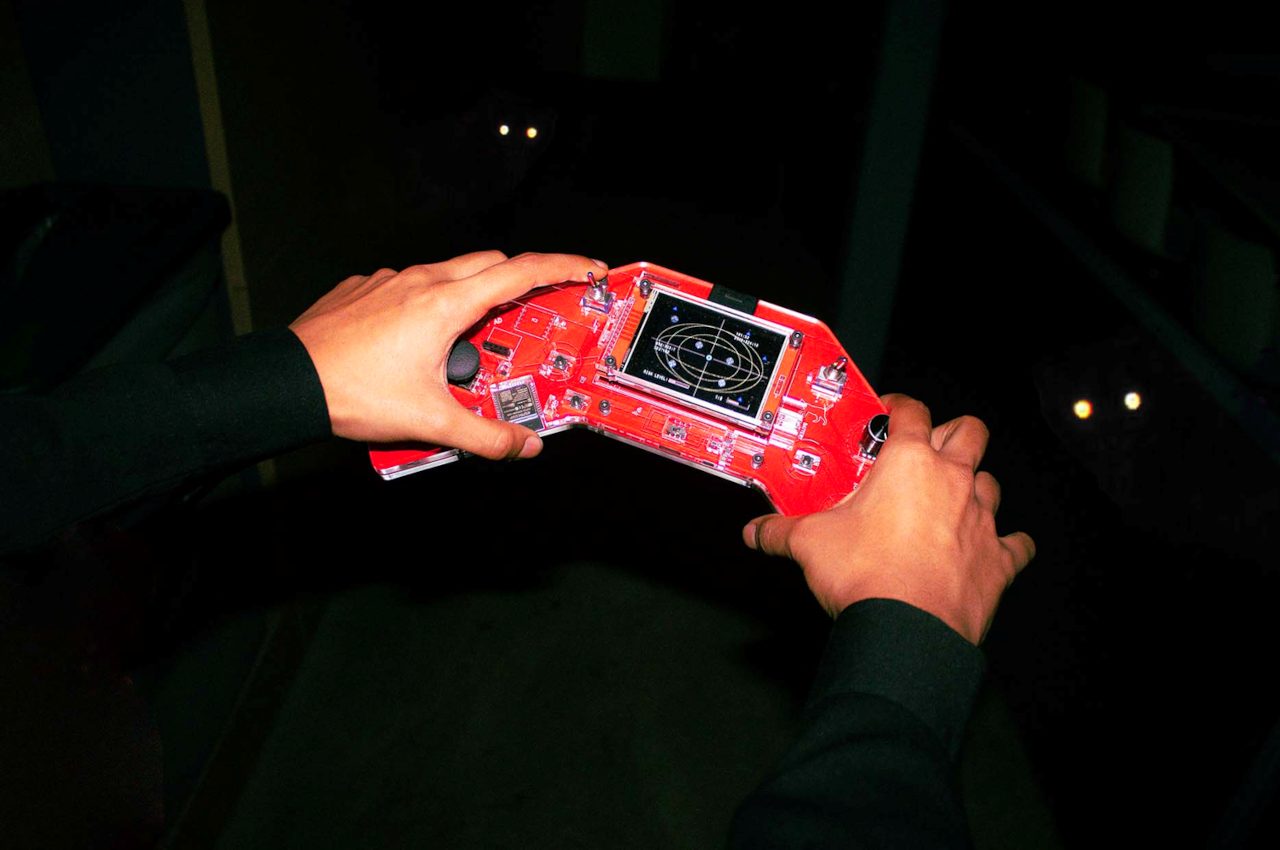
Indeed, the existing Portable Black Cat Radar prototype is packing some interesting stuff. Its custom-printed red circuit board is sandwiched between see-through acrylic plates, containing a GPS, gyroscope, and magnetometer. Those are all necessary to project the user onto a virtual map relying on real coordinates to feed it live information — in fact, the radar’s built-in software works much like a Niantic game, like Pokémon Go. The display on the center of the radar shows the user’s location while “fictional black cats” appear as encounters on the aforementioned virtual map, and it sounds like there’s a gameplay element behind the user’s choice to avoid or interact with them.
While there’s no production schedule in place yet, it sounds like this is due to change soon; a few devices could get produced and distributed through the studio’s social media channels. Whether or not a final model of the Portable Black Cat Radar will be able to truly detect any real black cats is another matter altogether, though it’s unlikely — unless, perhaps, the BCR is reconfigured to look for microchips or RFID tags.
If you have already been playing around creating your very own custom OpenAI GPTs to help streamline your daily tasks. You might be interested in moving onto the next stage and integrating your custom GPT’s into any website using the OpenAI Assistant API. This guide provides more insight into how you can create more complex […]