Google Gemini represents a significant advancement in the field of artificial intelligence, standing as an advanced large language model (LLM) that has positioned itself at the cutting edge of AI technology. With its impressive array of capabilities, Gemini has garnered considerable interest among developers, who find in it a valuable ally for streamlining their coding […]
AMD’s launch of the Ryzen PRO AI processors have been specifically designed for professional environments, integrate advanced artificial intelligence (AI) capabilities directly into the Ryzen PRO series. By combining the power of CPU, GPU, and a dedicated on-chip neural processing unit (NPU), AMD is delivering unparalleled performance, efficiency, and connectivity across both mobile and desktop […]
One of the advantages of people who can work remotely (digital marketers, writers, virtual assistants, etc) is that they can work from literally anywhere. As long as there’s internet and a power source for when their devices run out of juice eventually, these digital nomads have the freedom to set up shop wherever they are and to live in things like mobile homes. We’re seeing a lot of products and concepts targeting this segment and I for one am very interested to see these come to life.
Designer: Institute for Advanced Architecture of Catalonia (IAAC)
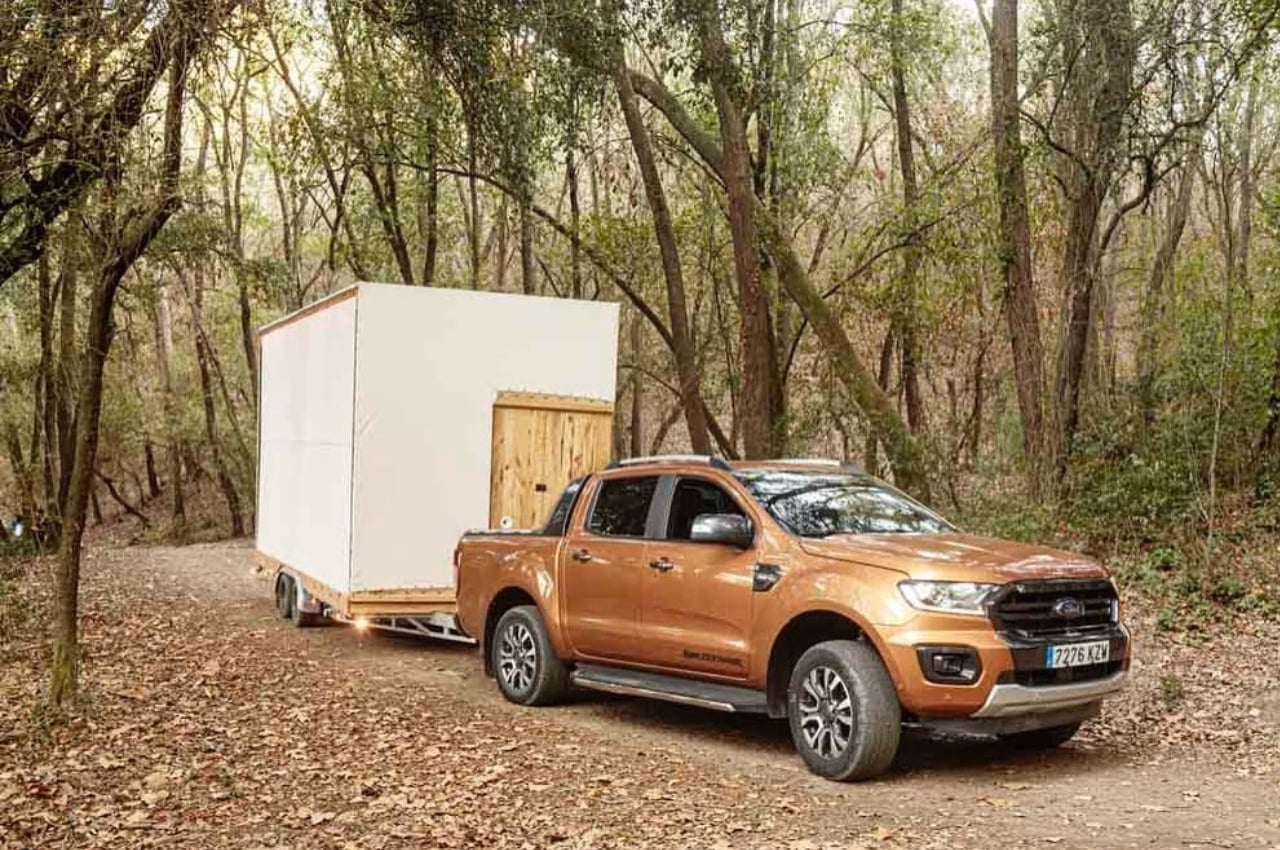
The Mobile Catalyst, nicknamed MOCA, was developed by masteral students from IAAC. Not only is it a perfect space for those that want to work while staying anywhere with a view but it is also an experiment into sustainable and self-sufficient habitat with a digital twist. It is basically a 5.4 meter long, 2.4 meter wide, and 3.6 meter high minimalist space that gives you the basic necessities of living. Its interior is made from dowel-laminated timber produced at the IAAC itself but sustainably harvested of course.
The front part of this mobile home has the basic amenities you would need to live in it like a kitchen, toilet and shower, and electric and water systems. In the middle and the back part is the space that can be turned into an office, a meeting area, a library, a recreation room, or even a space for small events. If you need privacy or partitions and also protection from different weather conditions, there are glass doors and a water-resistant cotton fabric that slides or folds with a pulley. There are also two beds on its “mezzanine” floor and you can reach it through a movable ladder.
And of course since MOCA is designed to be sustainable, you have three light-flexible mono-crystalline solar panels on the roof and LED strips as an interior lining. The house can run on its own for around 24 hours before it needs recharging. Water is also self-sufficient as the system stores, filters, and returns the shower water into reusable water. The entire mobile home is built with digital nomads in mind so they can live, work, and play anywhere they want, as long as the trailer can move and fit in that area.
As learning language models (LLMs) continue to advance, so do questions about how they can benefit society in areas such as the medical field. A recent study from the University of Cambridge's School of Clinical Medicine found that OpenAI's GPT-4 performed nearly as well in an ophthalmology assessment as experts in the field, the Financial Times first reported.
In the study, published in PLOS Digital Health, researchers tested the LLM, its predecessor GPT-3.5, Google's PaLM 2 and Meta's LLaMA with 87 multiple choice questions. Five expert ophthalmologists, three trainee ophthalmologists and two unspecialized junior doctors received the same mock exam. The questions came from a textbook for trialing trainees on everything from light sensitivity to lesions. The contents aren't publicly available, so the researchers believe LLMs couldn't have been trained on them previously. ChatGPT, equipped with GPT-4 or GPT-3.5, was given three chances to answer definitively or its response was marked as null.
GPT-4 scored higher than the trainees and junior doctors, getting 60 of the 87 questions right. While this was significantly higher than the junior doctors' average of 37 correct answers, it just beat out the three trainees' average of 59.7. While one expert ophthalmologist only answered 56 questions accurately, the five had an average score of 66.4 right answers, beating the machine. PaLM 2 scored a 49, and GPT-3.5 scored a 42. LLaMa scored the lowest at 28, falling below the junior doctors. Notably, these trials occurred in mid-2023.
While these results have potential benefits, there are also quite a few risks and concerns. Researchers noted that the study offered a limited number of questions, especially in certain categories, meaning the actual results might be varied. LLMs also have a tendency to "hallucinate" or make things up. That's one thing if its an irrelevant fact but claiming there's a cataract or cancer is another story. As is the case in many instances of LLM use, the systems also lack nuance, creating further opportunities for inaccuracy.
This article originally appeared on Engadget at https://www.engadget.com/gpt-4-performed-close-to-the-level-of-expert-doctors-in-eye-assessments-131517436.html?src=rss
In the dynamic world of smartphones, the new Vivo T3x makes a compelling case for those seeking a powerful device without breaking the bank. Boasting a sleek design and robust features, this model is designed to cater to tech enthusiasts looking for quality and performance. Let’s dive into what makes the Vivo T3x a notable […]
There are a frankly ridiculous number of Chromebooks on sale to choose from, but Google's Chromebook Plus initiative that launched last fall has gone a long way towards standardizing some key specs for ChromeOS devices. That in turn has made it a little easier to pick ones that'll provide a consistent quality experience without breaking the bank. Acer's latest Chromebook Plus 514, which the company just announced today, is a good example — at first glance, it looks like it checks most of the boxes I'm looking for when recommending a basic Chromebook that'll work for most people.
To make things confusing, Acer already sells a few Chromebook Plus 514 models; this one is the CB514-4HT and is priced at $399. Look for that SKU if you want to make sure you're getting the latest one. This laptop is powered by Intel's 13th-gen Core i3-N305 processor and pairs that with 8GB of RAM and 512GB of storage — that latter spec is a bit of surprise and is a lot more storage than I'd expect to see on a $400 Chromebook. To meet the required Chromebook Plus specs, this laptop includes a 1080p webcam with a privacy shutter. While the resolution is pretty solid, not all webcams are equal so we'll have to see how this one performs in real life.
Acer
The display is a 14-inch, 1080p touchscreen, so it's not quite as tall as the 1,920 x 1,200 screens that I've seen on a number of other Chromebook Plus laptops. But again, at the price I'm not going to complain too much. It has a decent selection of ports, too: two USB-C and USB-A slots along with a microSD card reader. I wouldn't have minded seeing HDMI here, as the USB-C ports could quickly be taken up by power and a monitor, but I just keep reminding myself this computer is only 400 bucks.
Acer says that this laptop will hit stores in early May, though the specific SKU we're talking about here should also be at Costco as early as next week. The company also says it'll have some other configurations available in the near future, though they didn't say what'll change. I wouldn't be surprised to see a model with less storage or perhaps no touchscreen, which could drive the price down even more. If so, this might be a great budget option. But even as is, you should get a pretty good laptop here for the price.
This article originally appeared on Engadget at https://www.engadget.com/acers-new-399-chromebook-plus-514-hits-the-mark-for-a-solid-budget-laptop-130058747.html?src=rss
We are living in a second golden age for console gaming. Active communities, open developer tools and easy distribution have given new life to many once-dead systems. If there's one company who deserves the most thanks for bringing a love for '80s and '90s cartridge-based console gaming back to the semi-mainstream, it's Analogue.
It started with the CMVS, an obsessive (and expensive) wood-grained reboot of the iconic Neo Geo. Then came the Analogue Nt in 2014, which brought easy, high-def NES gaming to our homes . In 2017, the Super Nt did the same for SNES gaming, then the Mega Sg for the Sega Genesis and, most recently, the Analogue Pocket, which supports everything from the Game Boy to the Neo Geo Pocket thanks to a series of adapters.
Analogue's latest is something different. While all those before have lived and died by their cartridge ports, the new Analogue Duo takes us to the next generation of gaming: optical. That's right, Analogue has entered the multimedia era with this love letter to one of Japan's most beloved consoles, a machine that barely made a dent elsewhere in the world.
That system is the TurboGrafx-16, known as the PC Engine in its home market of Japan. It launched there in 1987, beating the Sega Genesis to market by two years and the SNES by three. It rocketed to huge popularity, ultimately outselling Sega and keeping pace with Nintendo for much of its life. By the end of its run, its library offered nearly 700 games.
It didn't fare so well in the US. The TurboGrafx-16 didn't come here until 1989, arriving after the Genesis brought blast processing to the masses. Nintendo and Sega soon engaged in a marketing war of epic proportions. NEC's humble TurboGrafx-16 didn't stand a chance.
It didn't help that it wasn't really a 16-bit console. Though it offered support for 16-bit graphics, it only had an 8-bit internal processor, so it couldn't match the power of the competition. The add-on CD-ROM didn't help. Despite hitting the market years before the Sega CD, the Genesis add-on included an additional processor to deliver an early taste of 3D processing. The TurboGrafx drive was just that: an optical drive.
The system struggled in the US for a few more years before NEC pulled the plug in 1994. In Japan, new games hit the system all the way through 1999, meaning that even the most hardcore enthusiasts in the US missed out on the bulk of the PC Engine's best titles.
And, since the Analogue Duo can play imported games just as readily as local ones, it's a great excuse to dig deeper into that library.
Out of the box
Tim Stevens for Engadget
The Analogue Duo is a slender console that shares an aesthetic similar to the PC Engine Duo, which was released in the US as the TurboDuo. NEC's Duo integrated the CD-ROM peripheral into a single, sleek, unified device. But, the Analogue unit feels far nicer. Its plastic body feels sturdier than the brittle stuff used on consoles back in the '90s, and the bottom is even rubberized. In fact, the Duo feels more like a high-end piece of home theater equipment, whereas the TurboGrafx-16 feels like a 30-year-old toy.
Up front are two slots. On the left is where cartridge-based games go, either on HuCard or TurboChip, the two media formats NEC used over the years. On the right is the CD-ROM slot.
Output to your display is via the HDMI port on the back, but there's also a 3.5mm headphone jack with its own volume knob if you want some private listening. You'll also find a port on the side for wired controllers, but since this uses the smaller Japanese connector, not the larger American one, you'll need an adapter to use TurboGrafx-16 controllers.
Around the back is an SD card reader for firmware updates or the like, plus a USB-C port through which the system gets its power.
At the heart of the system is an Altera Cyclone V processor, a dual-core Arm Cortex field-programmable gate array (FPGA) chip that can be effectively coded to act like any other processor. It's that core which enables the Duo to emulate the PC Engine and all its derivatives over the years.
There's none of the lag and glitchy performance that you'll get when running ROMs through an emulator. This is as close as you're going to get to a modern reboot of the PC Engine, but with much cleaner output.
Output
Analogue
Whether you're playing domestic or imported games, everything will look stellar. As with previous Analogue releases, the Duo outputs a 1080p signal over HDMI, resulting in the absolute cleanest way to play your games on a modern digital display.
While there are ways to get an HDMI signal out of a TurboGrafx-16, ranging from RGB adapters that clip on the back to outputs soldered onto the system itself, even running through something like a scanline converter you're unlikely to ever get a signal this crisp and clean.
But for those who like to preserve a taste of the old school, Analogue includes a few different gameplay modes to deliver a CRT-like look and feel.
To be fair, even the greatest of games for this system don't offer much in terms of high-fidelity graphics compared to modern titles. But there are plenty well worth your time. Gate of Thunder is one of them, and it’s among the best side-view shooters, or shmups, ever to hit a console. The quality of games like this helped establish the PC Engine's success in Japan.
Castlevania: Rondo of Blood, though, is generally believed to be the single greatest title for the system. Released on CD-ROM in 1993, exclusively in the Japanese market, this is still ranked among the top Castlevania titles of them all.
It's damned good, and plays excellently on the Analogue Duo. Load times for this game and others are quite fast, and the drive isn't as noisy as many console CD-ROM add-ons were back in the day.
Gaming on the Analogue Duo
The Analogue Duo delivered flawless compatibility and playback for virtually every game I threw at it, with only one falling short: SCI: Special Criminal Investigation — which, thank goodness, has nothing to do with the CSI television series. SCI is the sequel to Chase H.Q., which was big in American arcades. Its unique mix of driving and shooting, as well as the inclusion of amazing period cars like the Nissan 300ZX Turbo made it a real favorite of mine. In fact, this was the first game I tried to play on the Duo.
So, imagine my horror when the Analogue system wouldn't play it or even recognize it. It just displayed a blank screen, much like what happens on a region-locked US TurboGrafx-16 console when trying to play a Japanese game. So, I went into the Duo's settings, explicitly changed the region to Japan, and the game played without issue.
This is the only game that the Duo failed to appropriately identify the region of, which is a minor annoyance at best that I'm sure will be fixed soon in one of Analogue's frequent updates.
Firmware updates are easily applied via the integrated SD-card reader, which is also where your save games for CD-based titles are stored. This makes them easy to back up or even edit. With the appropriate USB adapter, it's also possible to import your old save games.
Controllers
Tim Stevens for Engadget
If there's one fly in this ointment, it's the controllers. As usual, Analogue partnered with 8BitDo to provide peripherals for the Duo. The $24.99 gamepad is the standard offering, and while it looks good in photos, in the hand it's somewhat underwhelming.
For one thing, it feels just as light and flimsy as 8BitDo's other products, with buttons that rattle when you shake the thing. The controller doesn't even offer the same weight and solidity as the original TurboGrafx-16 controllers, which certainly aren't standouts themselves.
But the 8BitDo controllers have a major advantage: they're wireless. They pair quickly and easily with the Duo and work without lag. They also feature a dedicated home button to bring up the Analogue menu.
There is, though, one final kicker with the controllers: they charge over micro-USB. It's 2024, 8BitDo. Even Apple has moved to USB-C.
Wrap-up
I really enjoyed testing the Analogue Duo. It was an opportunity to play releases I hadn't dug out in years, and also to experience some games I hadn't yet tried, all rendered in immaculate detail.
That said, it's easy to see this as a very niche release for Analogue, a company whose obsessive fans are already far from mainstream. Software emulation is infinitely cheaper and still delivers great results, but those of us who love classic console gaming know that there's just something different about running it from the original media.
Whether that extra something is worth the extra cost is between you and your accountant. Despite being Analogue's most expensive release in years, and despite supporting a decidedly underappreciated console, the Analogue Duo is yet another excellent quality of life improvement for retro gamers and collectors. I can't imagine playing my HuCards any other way.
This article originally appeared on Engadget at https://www.engadget.com/analogue-duo-review-a-second-chance-for-an-underappreciated-console-130056763.html?src=rss
We are living in a second golden age for console gaming. Active communities, open developer tools and easy distribution have given new life to many once-dead systems. If there's one company who deserves the most thanks for bringing a love for '80s and '90s cartridge-based console gaming back to the semi-mainstream, it's Analogue.
It started with the CMVS, an obsessive (and expensive) wood-grained reboot of the iconic Neo Geo. Then came the Analogue Nt in 2014, which brought easy, high-def NES gaming to our homes . In 2017, the Super Nt did the same for SNES gaming, then the Mega Sg for the Sega Genesis and, most recently, the Analogue Pocket, which supports everything from the Game Boy to the Neo Geo Pocket thanks to a series of adapters.
Analogue's latest is something different. While all those before have lived and died by their cartridge ports, the new Analogue Duo takes us to the next generation of gaming: optical. That's right, Analogue has entered the multimedia era with this love letter to one of Japan's most beloved consoles, a machine that barely made a dent elsewhere in the world.
That system is the TurboGrafx-16, known as the PC Engine in its home market of Japan. It launched there in 1987, beating the Sega Genesis to market by two years and the SNES by three. It rocketed to huge popularity, ultimately outselling Sega and keeping pace with Nintendo for much of its life. By the end of its run, its library offered nearly 700 games.
It didn't fare so well in the US. The TurboGrafx-16 didn't come here until 1989, arriving after the Genesis brought blast processing to the masses. Nintendo and Sega soon engaged in a marketing war of epic proportions. NEC's humble TurboGrafx-16 didn't stand a chance.
It didn't help that it wasn't really a 16-bit console. Though it offered support for 16-bit graphics, it only had an 8-bit internal processor, so it couldn't match the power of the competition. The add-on CD-ROM didn't help. Despite hitting the market years before the Sega CD, the Genesis add-on included an additional processor to deliver an early taste of 3D processing. The TurboGrafx drive was just that: an optical drive.
The system struggled in the US for a few more years before NEC pulled the plug in 1994. In Japan, new games hit the system all the way through 1999, meaning that even the most hardcore enthusiasts in the US missed out on the bulk of the PC Engine's best titles.
And, since the Analogue Duo can play imported games just as readily as local ones, it's a great excuse to dig deeper into that library.
Out of the box
Tim Stevens for Engadget
The Analogue Duo is a slender console that shares an aesthetic similar to the PC Engine Duo, which was released in the US as the TurboDuo. NEC's Duo integrated the CD-ROM peripheral into a single, sleek, unified device. But, the Analogue unit feels far nicer. Its plastic body feels sturdier than the brittle stuff used on consoles back in the '90s, and the bottom is even rubberized. In fact, the Duo feels more like a high-end piece of home theater equipment, whereas the TurboGrafx-16 feels like a 30-year-old toy.
Up front are two slots. On the left is where cartridge-based games go, either on HuCard or TurboChip, the two media formats NEC used over the years. On the right is the CD-ROM slot.
Output to your display is via the HDMI port on the back, but there's also a 3.5mm headphone jack with its own volume knob if you want some private listening. You'll also find a port on the side for wired controllers, but since this uses the smaller Japanese connector, not the larger American one, you'll need an adapter to use TurboGrafx-16 controllers.
Around the back is an SD card reader for firmware updates or the like, plus a USB-C port through which the system gets its power.
At the heart of the system is an Altera Cyclone V processor, a dual-core Arm Cortex field-programmable gate array (FPGA) chip that can be effectively coded to act like any other processor. It's that core which enables the Duo to emulate the PC Engine and all its derivatives over the years.
There's none of the lag and glitchy performance that you'll get when running ROMs through an emulator. This is as close as you're going to get to a modern reboot of the PC Engine, but with much cleaner output.
Output
Analogue
Whether you're playing domestic or imported games, everything will look stellar. As with previous Analogue releases, the Duo outputs a 1080p signal over HDMI, resulting in the absolute cleanest way to play your games on a modern digital display.
While there are ways to get an HDMI signal out of a TurboGrafx-16, ranging from RGB adapters that clip on the back to outputs soldered onto the system itself, even running through something like a scanline converter you're unlikely to ever get a signal this crisp and clean.
But for those who like to preserve a taste of the old school, Analogue includes a few different gameplay modes to deliver a CRT-like look and feel.
To be fair, even the greatest of games for this system don't offer much in terms of high-fidelity graphics compared to modern titles. But there are plenty well worth your time. Gate of Thunder is one of them, and it’s among the best side-view shooters, or shmups, ever to hit a console. The quality of games like this helped establish the PC Engine's success in Japan.
Castlevania: Rondo of Blood, though, is generally believed to be the single greatest title for the system. Released on CD-ROM in 1993, exclusively in the Japanese market, this is still ranked among the top Castlevania titles of them all.
It's damned good, and plays excellently on the Analogue Duo. Load times for this game and others are quite fast, and the drive isn't as noisy as many console CD-ROM add-ons were back in the day.
Gaming on the Analogue Duo
The Analogue Duo delivered flawless compatibility and playback for virtually every game I threw at it, with only one falling short: SCI: Special Criminal Investigation — which, thank goodness, has nothing to do with the CSI television series. SCI is the sequel to Chase H.Q., which was big in American arcades. Its unique mix of driving and shooting, as well as the inclusion of amazing period cars like the Nissan 300ZX Turbo made it a real favorite of mine. In fact, this was the first game I tried to play on the Duo.
So, imagine my horror when the Analogue system wouldn't play it or even recognize it. It just displayed a blank screen, much like what happens on a region-locked US TurboGrafx-16 console when trying to play a Japanese game. So, I went into the Duo's settings, explicitly changed the region to Japan, and the game played without issue.
This is the only game that the Duo failed to appropriately identify the region of, which is a minor annoyance at best that I'm sure will be fixed soon in one of Analogue's frequent updates.
Firmware updates are easily applied via the integrated SD-card reader, which is also where your save games for CD-based titles are stored. This makes them easy to back up or even edit. With the appropriate USB adapter, it's also possible to import your old save games.
Controllers
Tim Stevens for Engadget
If there's one fly in this ointment, it's the controllers. As usual, Analogue partnered with 8BitDo to provide peripherals for the Duo. The $24.99 gamepad is the standard offering, and while it looks good in photos, in the hand it's somewhat underwhelming.
For one thing, it feels just as light and flimsy as 8BitDo's other products, with buttons that rattle when you shake the thing. The controller doesn't even offer the same weight and solidity as the original TurboGrafx-16 controllers, which certainly aren't standouts themselves.
But the 8BitDo controllers have a major advantage: they're wireless. They pair quickly and easily with the Duo and work without lag. They also feature a dedicated home button to bring up the Analogue menu.
There is, though, one final kicker with the controllers: they charge over micro-USB. It's 2024, 8BitDo. Even Apple has moved to USB-C.
Wrap-up
I really enjoyed testing the Analogue Duo. It was an opportunity to play releases I hadn't dug out in years, and also to experience some games I hadn't yet tried, all rendered in immaculate detail.
That said, it's easy to see this as a very niche release for Analogue, a company whose obsessive fans are already far from mainstream. Software emulation is infinitely cheaper and still delivers great results, but those of us who love classic console gaming know that there's just something different about running it from the original media.
Whether that extra something is worth the extra cost is between you and your accountant. Despite being Analogue's most expensive release in years, and despite supporting a decidedly underappreciated console, the Analogue Duo is yet another excellent quality of life improvement for retro gamers and collectors. I can't imagine playing my HuCards any other way.
This article originally appeared on Engadget at https://www.engadget.com/analogue-duo-review-a-second-chance-for-an-underappreciated-console-130056763.html?src=rss
DJI is entering the portable power station market in the US and Europe with the launch of the Power 1000 and Power 500 aimed at home users or road warriors. The devices (released in China at the end of last year) can be used to power small appliances or charge devices like laptops or drones, and work in concert with solar panels to provide power on the road.
The Power 1000 (13kg or 29 pounds) has a 1,024 Wh capacity and can output up to 2,200W — enough to run a home microwave oven for about 1.3 hours and a car refrigerator for 19 hours, or charge a drone up to 12 times. The Power 500 (7.3 kg or 16.3 pounds) delivers 512 Wh of capacity and 1,000W of output for half the price.
DJI
The larger version supports 1200W fast recharge or 600W standard recharging (540W and 270W for the smaller version). Both can be fast-charged in 70 minutes for a 100 percent battery or 50 minutes to an 80 percent charge. Along with standard AC plugs, both have a pair of USB-C PD output ports that support 140W/100W charging for the Power 1000/Power 500 — enough for most laptops.
The market is fairly saturated with such devices (Jackery, Bluetti, Anker, others), but DJI is pitching this as an ideal way to charge its drones and other products. Released in China in December, it was already available in the US at Amazon and elsewhere via the grey market.
The Power 1000 is now on sale for $1,000 at DJI's store, while the Power 500 costs $500. You can add a 120W Zignes solar panel for $299. For the latter, you'll need DJI's Power Solar Panel Adapter Module or DJI Power Car Power Outlet to SDC Power Cable.
This article originally appeared on Engadget at https://www.engadget.com/djis-new-backup-battery-can-power-small-appliances-charge-your-drone-130037610.html?src=rss
DJI is entering the portable power station market in the US and Europe with the launch of the Power 1000 and Power 500 aimed at home users or road warriors. The devices (released in China at the end of last year) can be used to power small appliances or charge devices like laptops or drones, and work in concert with solar panels to provide power on the road.
The Power 1000 (13kg or 29 pounds) has a 1,024 Wh capacity and can output up to 2,200W — enough to run a home microwave oven for about 1.3 hours and a car refrigerator for 19 hours, or charge a drone up to 12 times. The Power 500 (7.3 kg or 16.3 pounds) delivers 512 Wh of capacity and 1,000W of output for half the price.
DJI
The larger version supports 1200W fast recharge or 600W standard recharging (540W and 270W for the smaller version). Both can be fast-charged in 70 minutes for a 100 percent battery or 50 minutes to an 80 percent charge. Along with standard AC plugs, both have a pair of USB-C PD output ports that support 140W/100W charging for the Power 1000/Power 500 — enough for most laptops.
The market is fairly saturated with such devices (Jackery, Bluetti, Anker, others), but DJI is pitching this as an ideal way to charge its drones and other products. Released in China in December, it was already available in the US at Amazon and elsewhere via the grey market.
The Power 1000 is now on sale for $1,000 at DJI's store, while the Power 500 costs $500. You can add a 120W Zignes solar panel for $299. For the latter, you'll need DJI's Power Solar Panel Adapter Module or DJI Power Car Power Outlet to SDC Power Cable.
This article originally appeared on Engadget at https://www.engadget.com/djis-new-backup-battery-can-power-small-appliances-charge-your-drone-130037610.html?src=rss