Why Google chrome is always using so much RAM
Chrome is known for being a memory hog, but it may be more urban myth than reality. Here's how Google Chrome manages RAM.

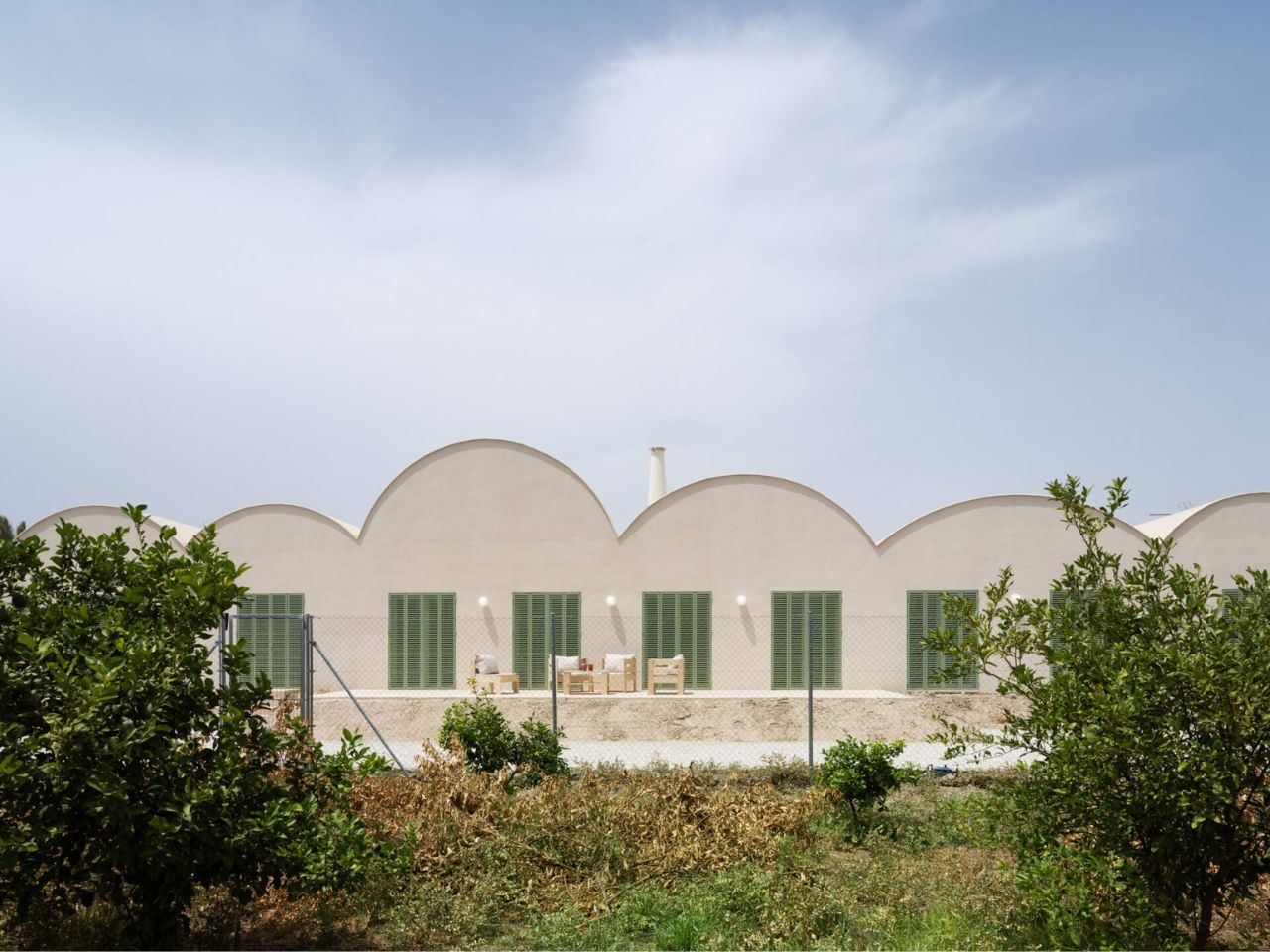
Some houses make their presence known through bold shapes, while others seem to grow naturally from the landscape. Casa Vereda, designed by L’Aura Ortín Architecture For Happiness, finds a balance between the two. Set in the Spanish countryside, the residence draws inspiration from regional construction traditions, agricultural heritage, and Mediterranean living. Its curved roofs, earthy materials, and distinctive green shutters give the home a contemporary identity that feels rooted in its surroundings.
The architecture is defined by a succession of curved rooflines that ripple across the long, low structure. Constructed using traditional Catalan vaulting techniques and handcrafted bricks, these sculptural forms reference a building method deeply embedded in Spanish architectural history. The exterior is finished in pale sprayed cork, creating a continuous texture across the walls and roof while helping regulate temperature and moisture.
Designer: L’Aura Ortín Architecture For Happiness
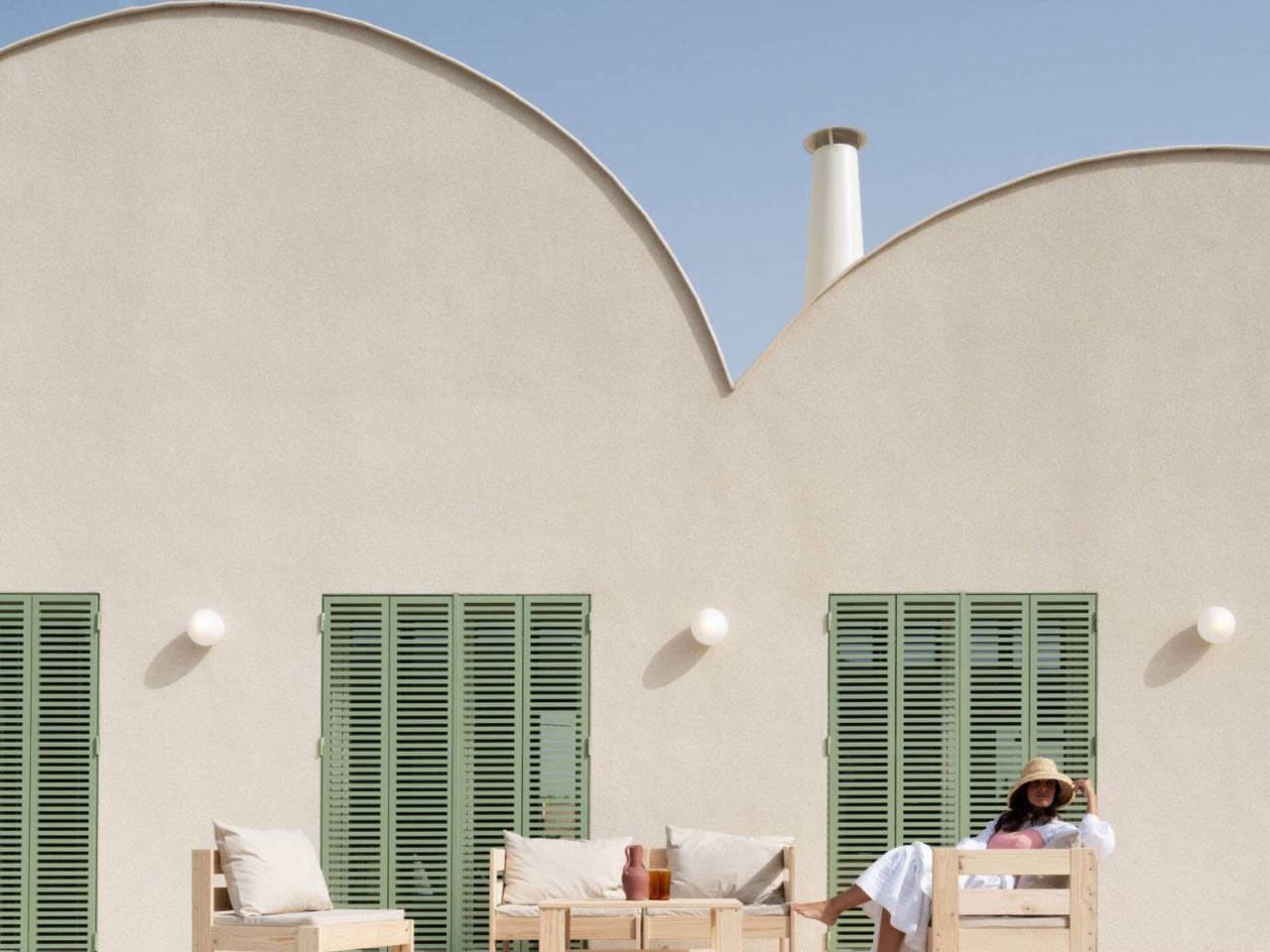
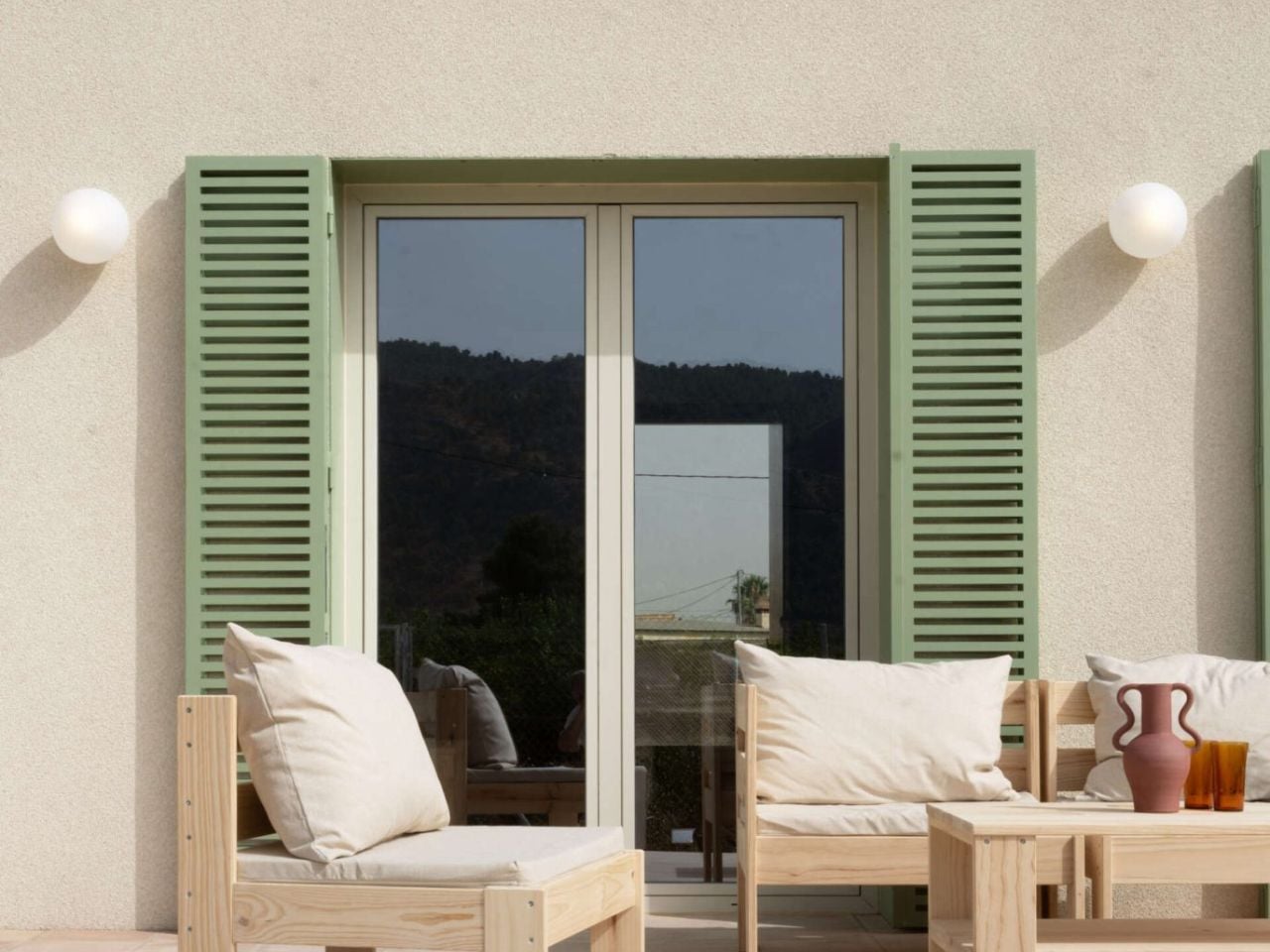
A row of tall, leaf green shutters adds a vibrant contrast to the neutral facade. Inspired by traditional Mallorcan designs, the shutters were custom-designed by the architects and made from powder-coated aluminum to provide shade, privacy, and security. Surrounded by vegetation, the house takes on an almost agricultural appearance, recalling the farm buildings and cultivated terraces that characterize the region.
Alongside the residence, a spacious patio paved with handcrafted terracotta tiles creates an inviting outdoor gathering space. The earthy flooring references the area’s agricultural heritage, while large glass doors connect the terrace directly to the interiors. Adjustable shutters help control sunlight throughout the day, making the transition between indoors and outdoors comfortable even during warmer months.
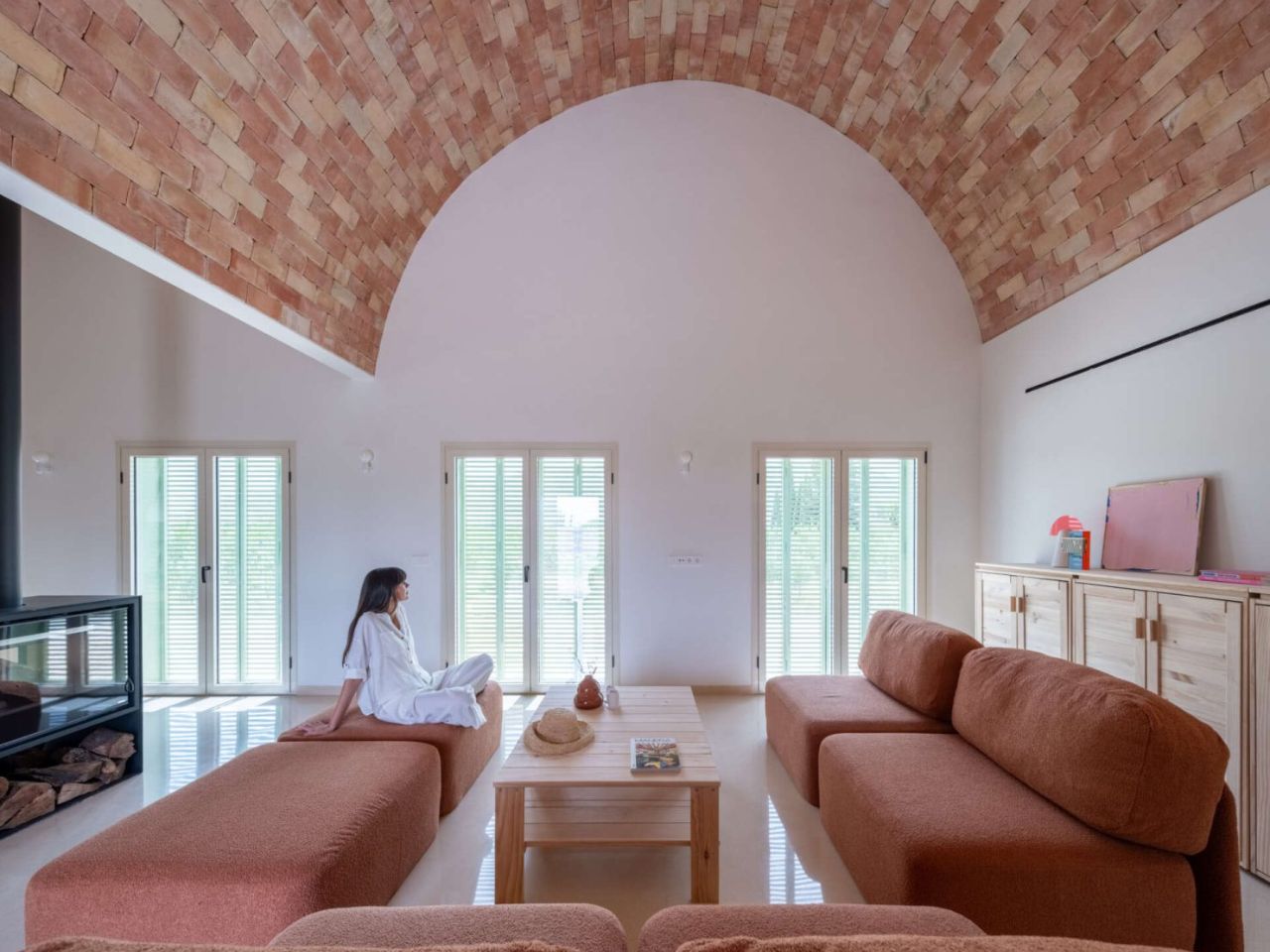
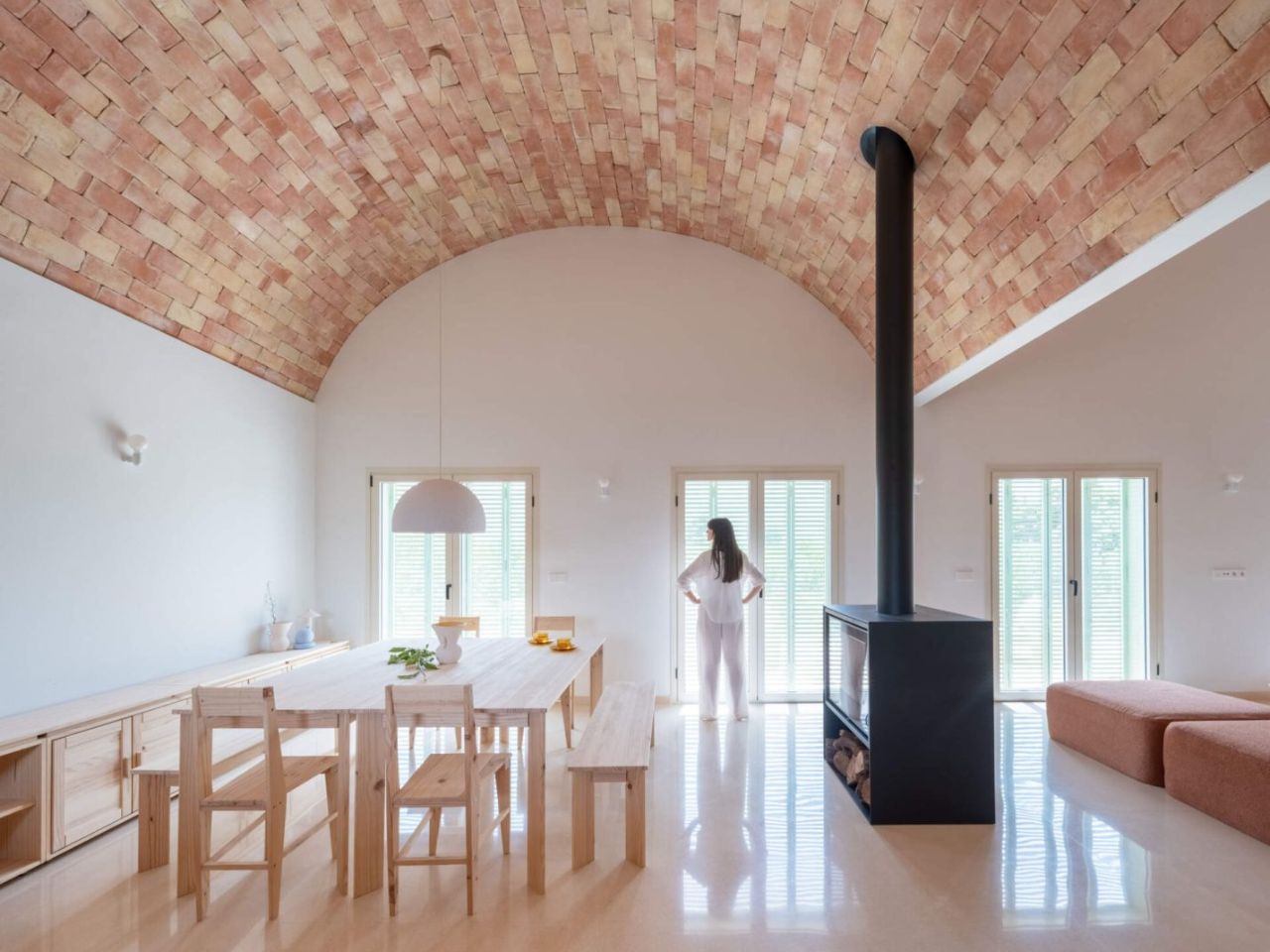
Inside, the living room unfolds beneath a dramatic Catalan vaulted ceiling made from handcrafted bricks in varying shades of terracotta, pink, and sandy beige. The exposed brick brings warmth and texture to the spacious interior, contrasting with smooth white walls and polished terrazzo flooring. Beyond its appearance, the terrazzo contributes to passive temperature regulation by absorbing warmth from the winter sun and staying cool during summer when the shutters are closed.
Modular sofas and ottomans upholstered in rust colored fabric form a comfortable seating arrangement around a simple pine coffee table. A freestanding black fireplace separates the lounge from the dining area without interrupting the open layout. Tall glass doors flood the space with daylight, while cherry-toned timber doors and pale wooden cabinets complete the warm material palette.
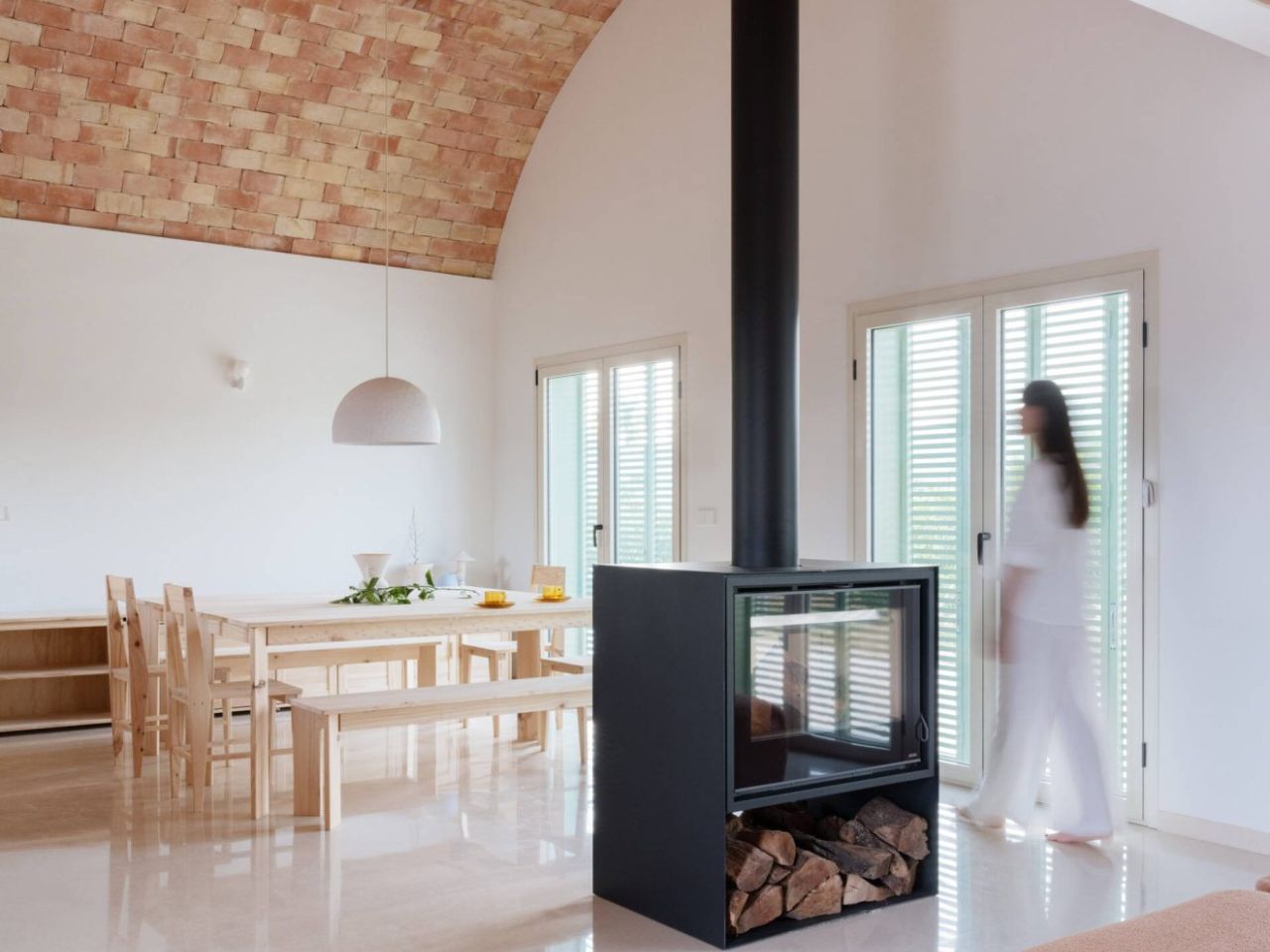
The adjoining dining area features a long, pale timber table paired with matching chairs and benches. A simple white dome pendant hangs overhead, while a low wooden sideboard provides storage along the wall. The exposed brick ceiling stretches across the space, adding character to an otherwise minimal setting.
Beside the dining room, the kitchen introduces richer tones through pine cabinetry lacquered in a cherry finish. The reddish wood contrasts with light colored countertops, while a long island provides additional workspace and casual seating with timber stools. Integrated appliances and streamlined cabinetry maintain a clean appearance, allowing the natural materials and vaulted ceiling to remain the focal points.
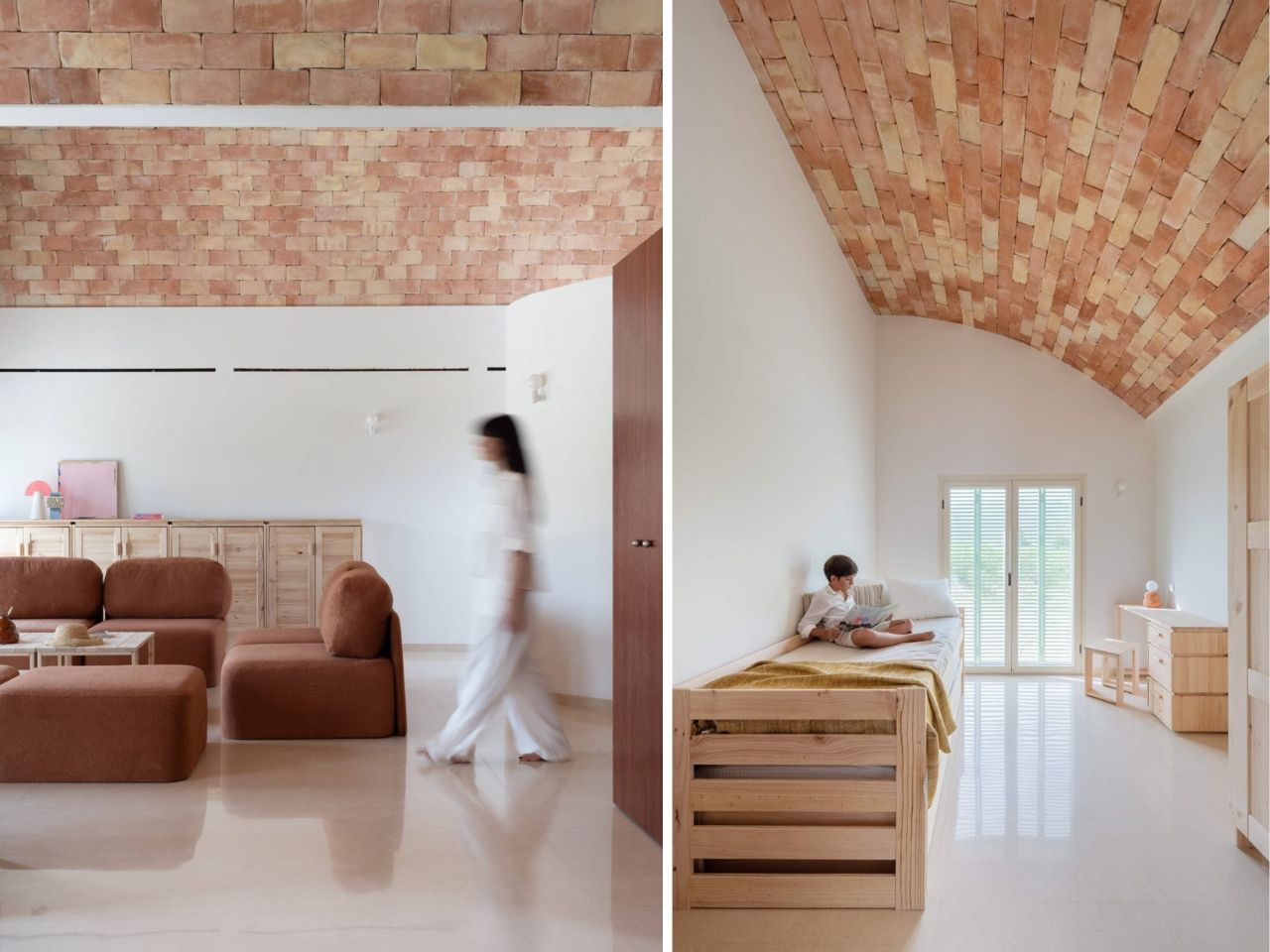
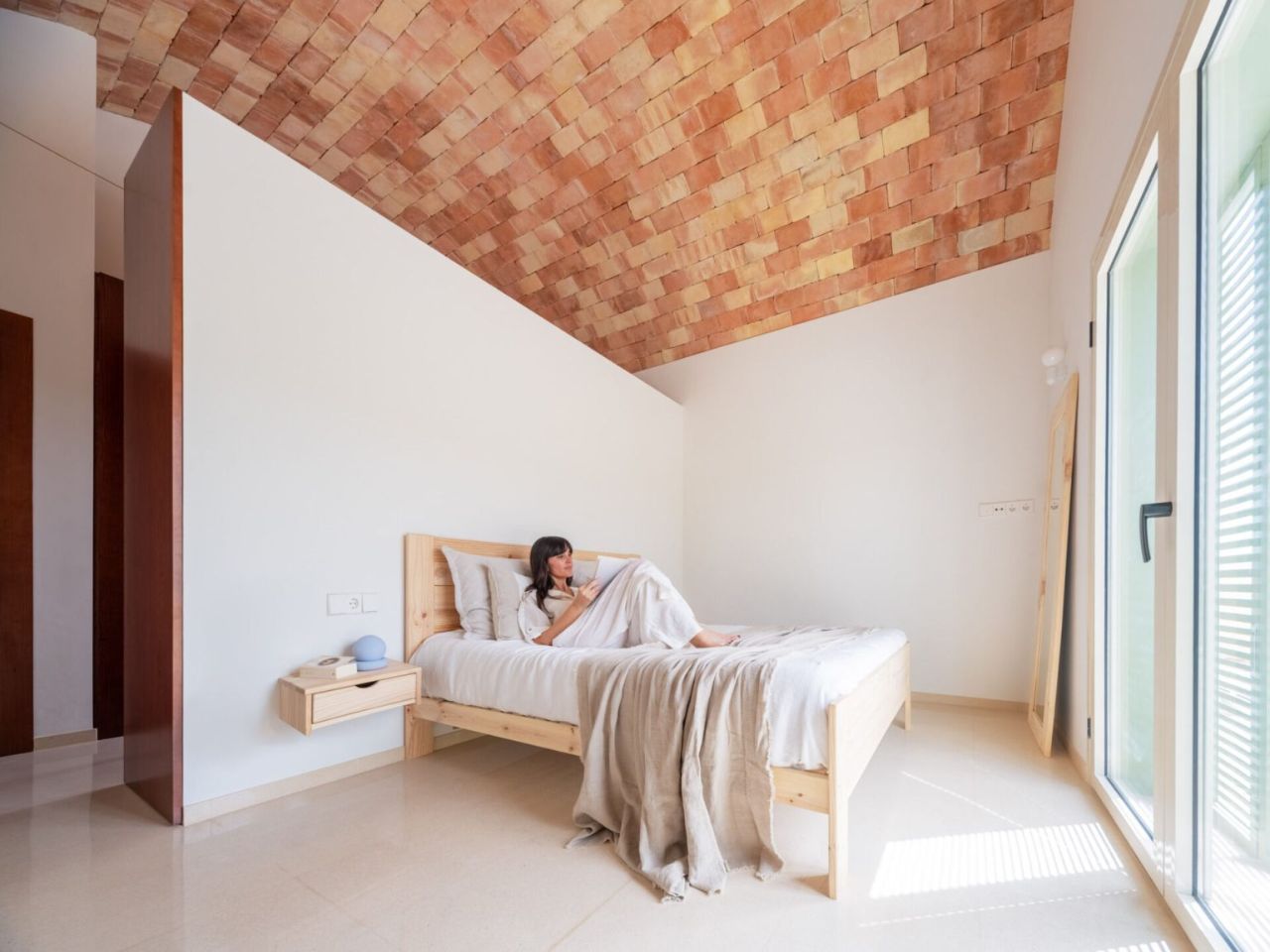
The bedrooms continue the home’s restrained aesthetic, with exposed brick vaults, white walls, pale terrazzo floors, and natural timber furniture. Unlike the communal areas, these rooms have lower ceilings that create a more intimate atmosphere while making them easier to heat and cool. In the main bedroom, a simple wooden bed is accompanied by a floating bedside table, neutral bedding, and a full-length mirror. The second bedroom features a single timber bed, a compact desk, and a matching wardrobe, with a mustard colored throw adding a subtle pop of color. Glass doors fitted with slatted shutters provide natural light and ventilation while allowing occupants to adjust privacy and shade.
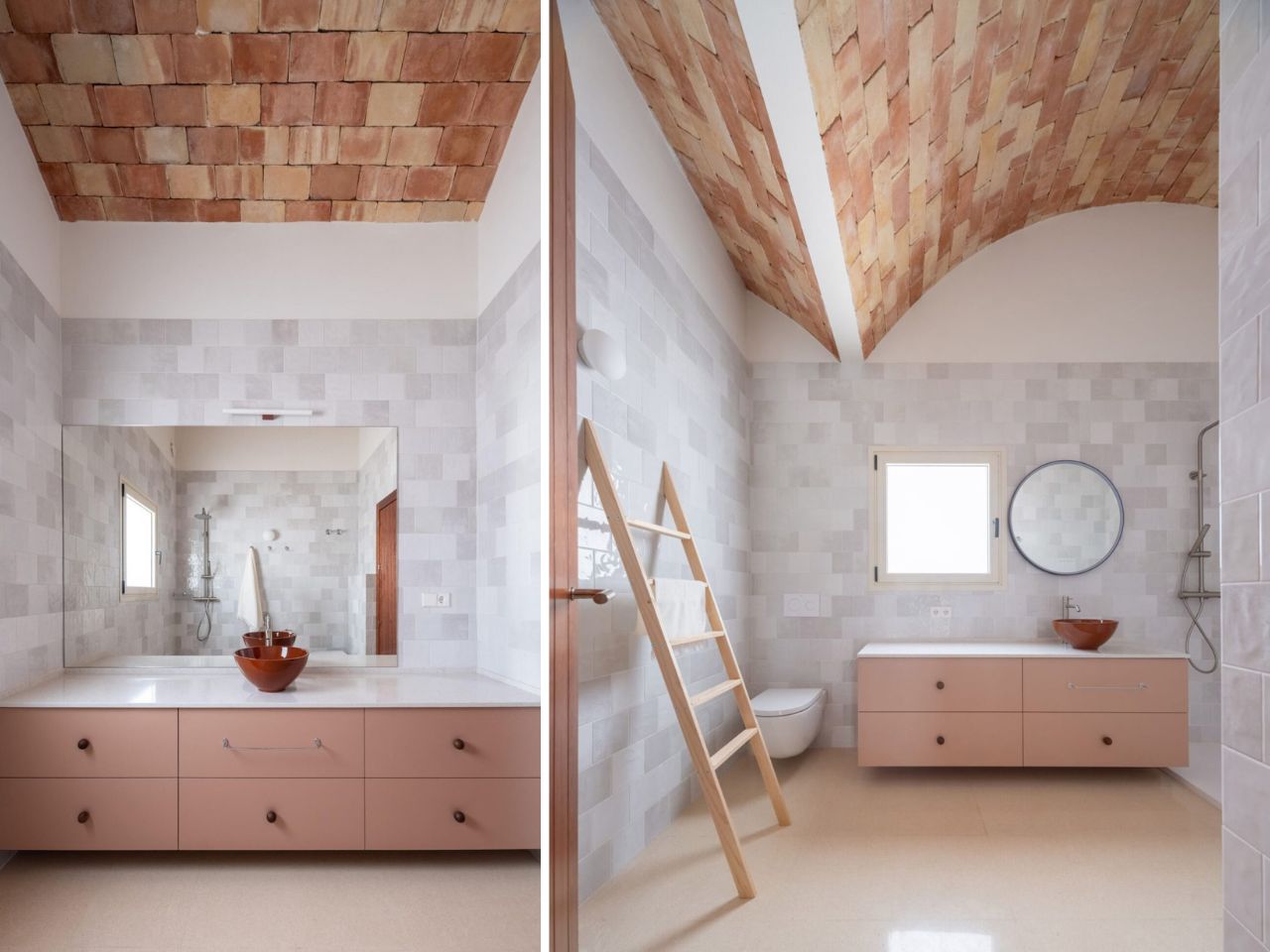
The bathrooms introduce a softer palette through pale gray rectangular wall tiles, warm pink cabinetry, and terracotta colored vessel sinks. One features a floating vanity with a white countertop and round mirror, while the other includes a wider vanity and a large rectangular mirror reflecting the walk-in shower opposite. Contemporary fixtures and minimal glass detailing keep the spaces open and bright, with exposed brick ceilings maintaining continuity throughout the interiors.
Architectural drawings reveal a long, single-story layout organized around everyday functionality. A two-car garage occupies one end, the open living, dining, and kitchen spaces form the center, and the bedrooms and bathrooms sit toward the opposite end. The communal spaces open directly onto the generous terrace, strengthening the home’s relationship with its garden and surroundings.
Casa Vereda finds its charm in the thoughtful reinterpretation of familiar architectural elements. The curved brick vaults, Mallorcan-inspired shutters, terracotta surfaces, and cork exterior serve practical purposes while giving the residence a distinctive identity. Through a careful balance of traditional craftsmanship, passive climate strategies, and contemporary interiors, L’Aura Ortín Architecture For Happiness has created a home that feels entirely at ease with its rural Mediterranean setting.
The post This Spanish Home Uses Curved Roofs and Cork Walls to Stay Naturally Cool first appeared on Yanko Design.

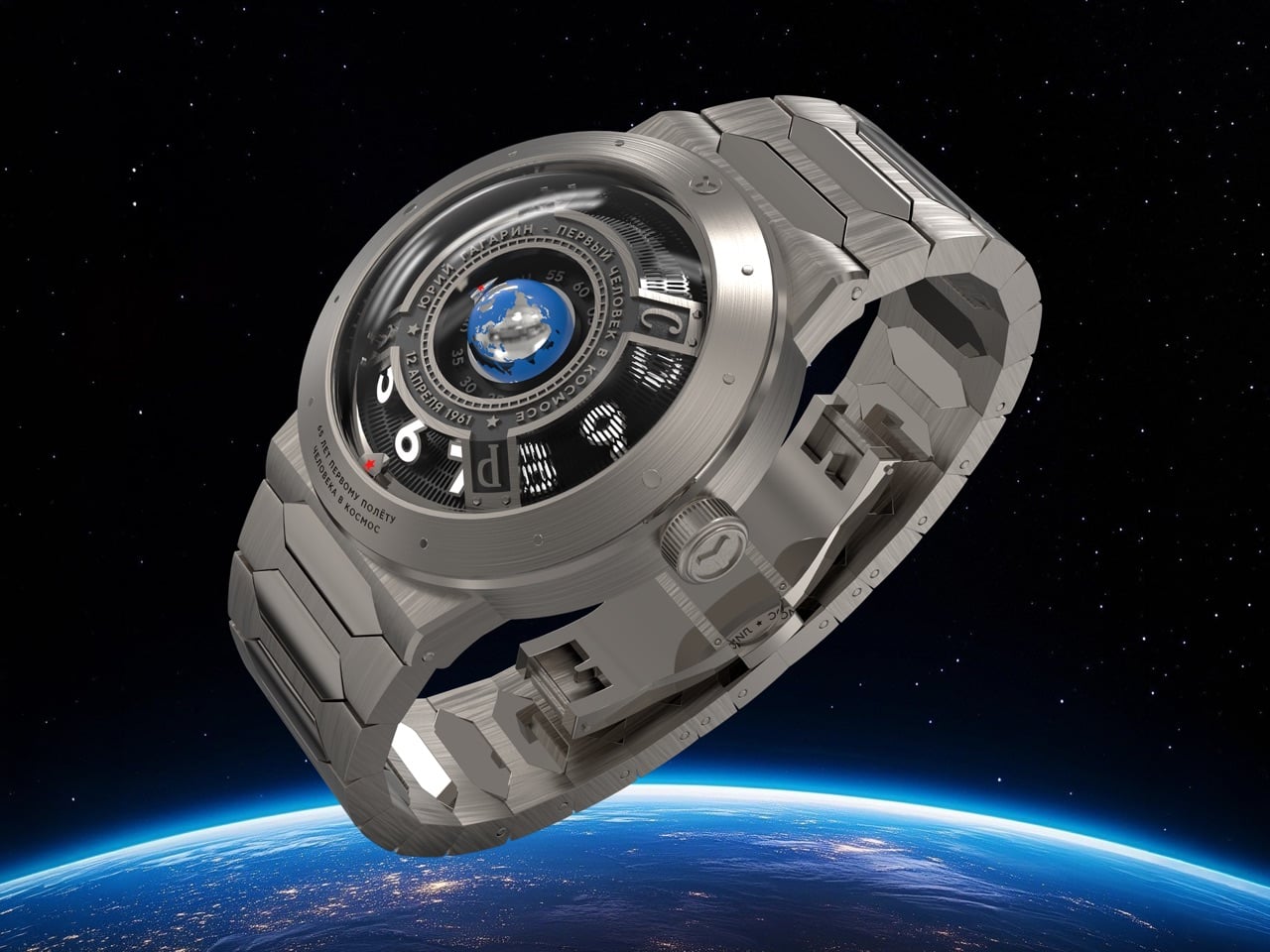
Ask any American watch nerd about space watches and you’ll hear one word within three seconds: Speedmaster. Moon landing, NASA certification, the whole legend. Meanwhile, eight years before Apollo 11, a Soviet pilot strapped on a standard-issue navigator’s watch and went around the planet first, and that story gets a fraction of the airtime. I love a Speedy as much as anyone. Still, the first human in orbit deserves a little more wrist love, and a Moscow designer just delivered some.
Alexey Yakushik’s Yuri Gagarin: First in Space is that delivery. His brand launched in 2025, and this is a big step up from its earlier releases on Vostok and Luch movements. The case is Grade 5 titanium, 45mm across (about 1.8 inches), with a domed sapphire crystal, a Miyota 8215 automatic sits under a custom module, and a rocket hand circles a blue Earth every hour. It collected two European Product Design Award wins this year. The run is 130 pieces, split between natural titanium and black PVD, at about $4,150 each, sold only through the brand’s Russian site.
Designer: Alexey Yakushik
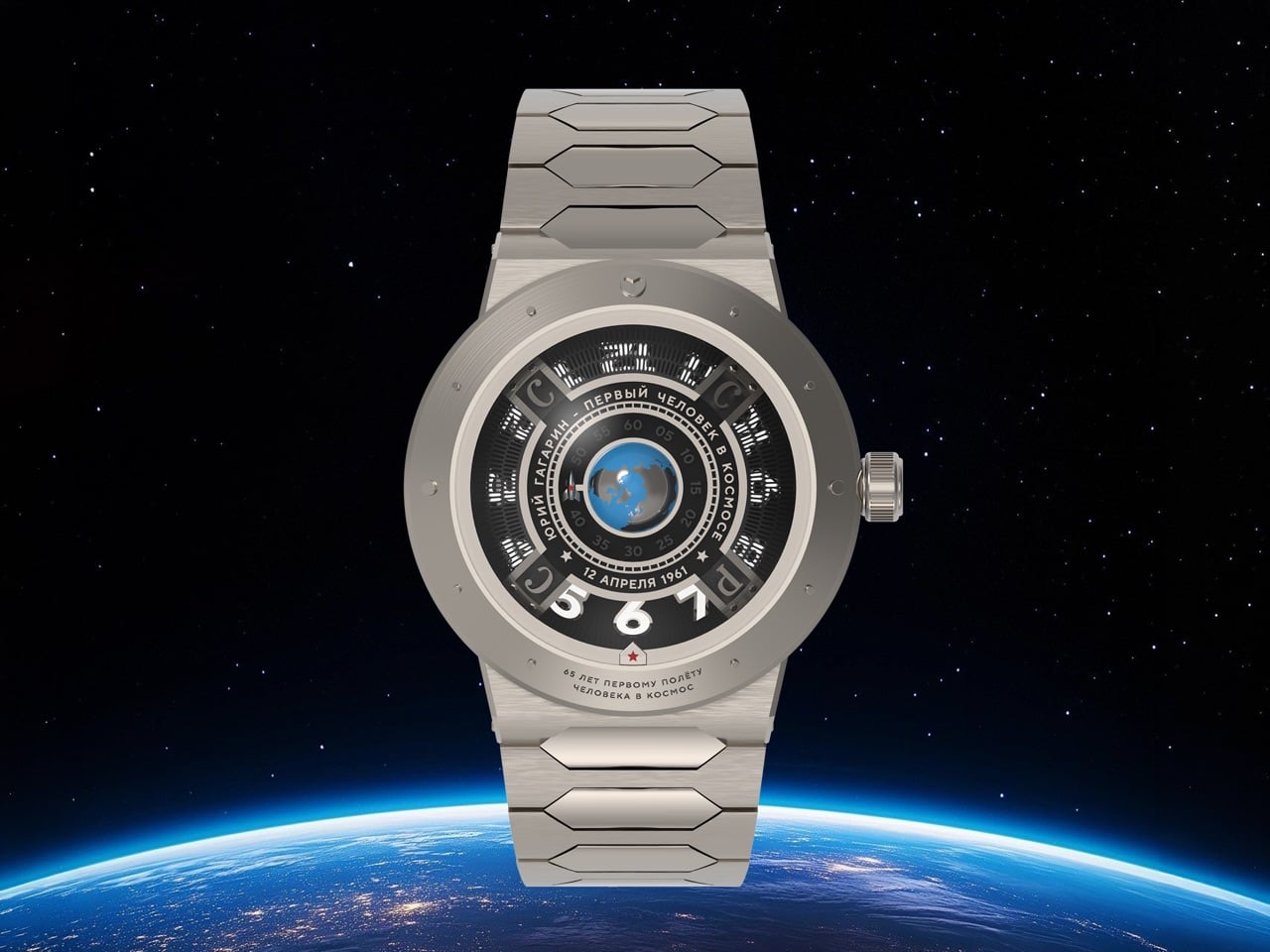
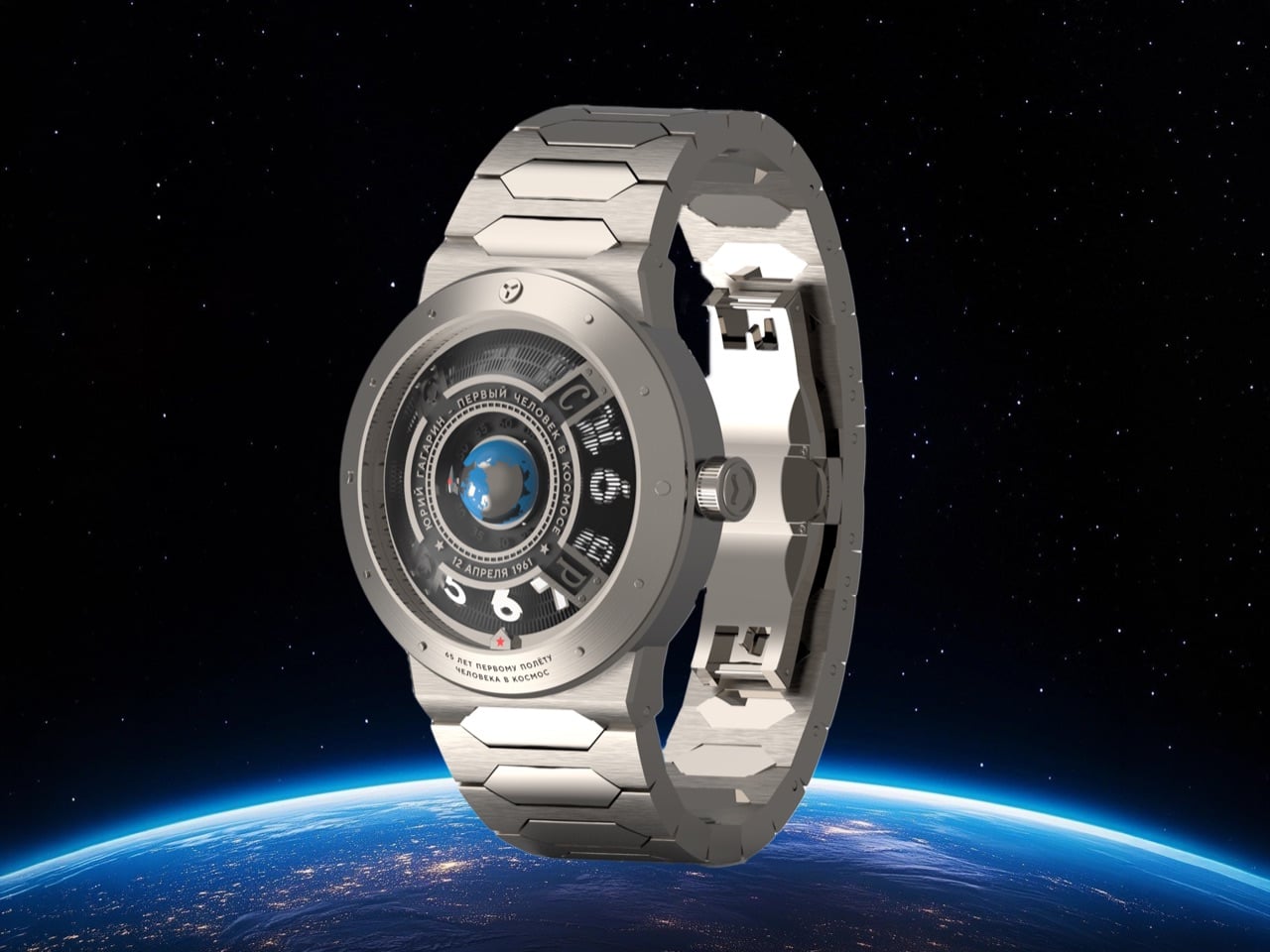
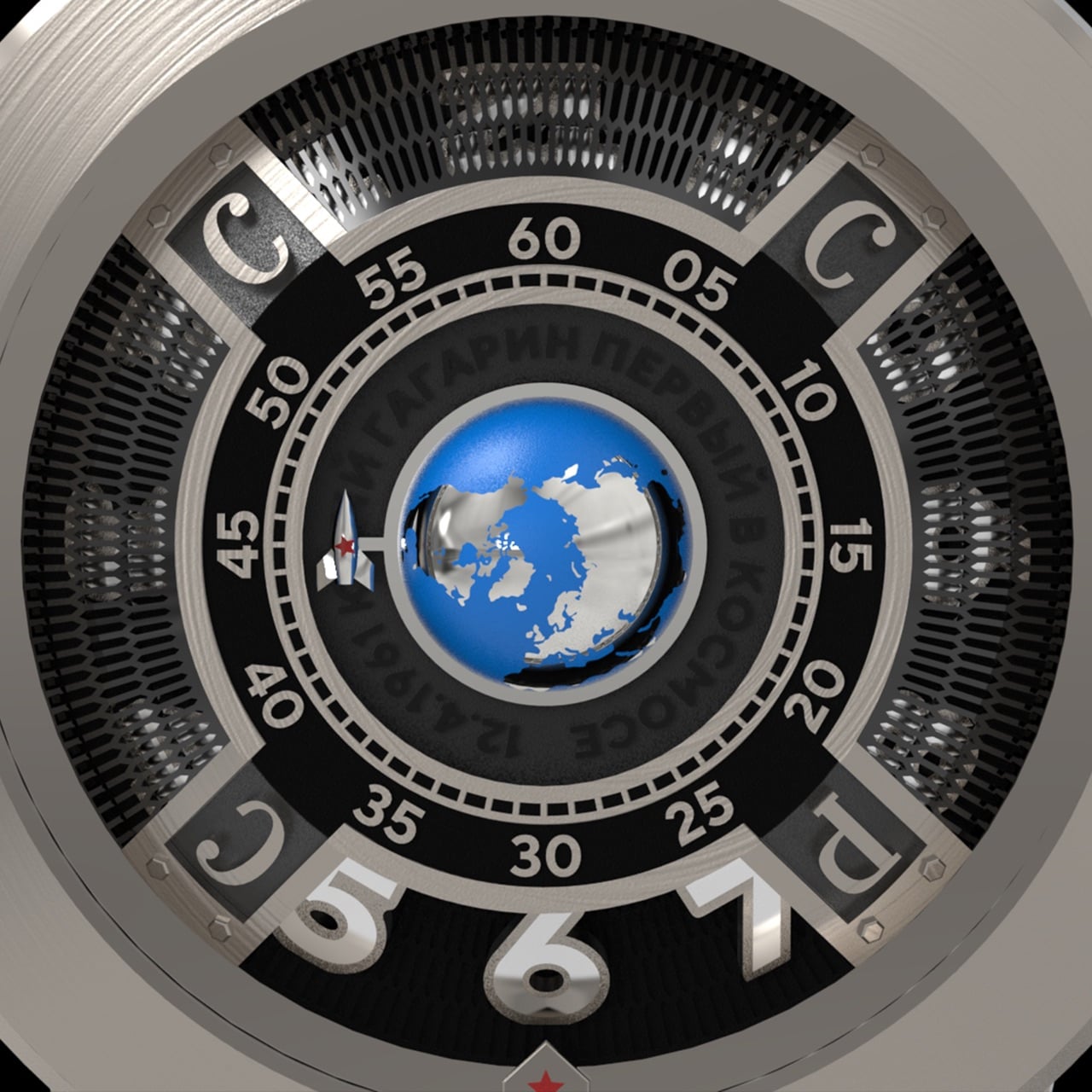
A polished blue Earth sits dead center of the dial, and a rocket-shaped minute hand laps it once an hour. Minute numerals ring the globe like a launch-control readout. Hours sit lower down as bold Arabic numerals, with a red marker picking out the current one. Four plates on the diagonals spell СССР in Cyrillic, which is about as subtle as a Soviet space poster should be. For the record, Vostok 1 took roughly 89 minutes to orbit the planet and the rocket does it in 60, but I won’t be filing a complaint about the pacing.
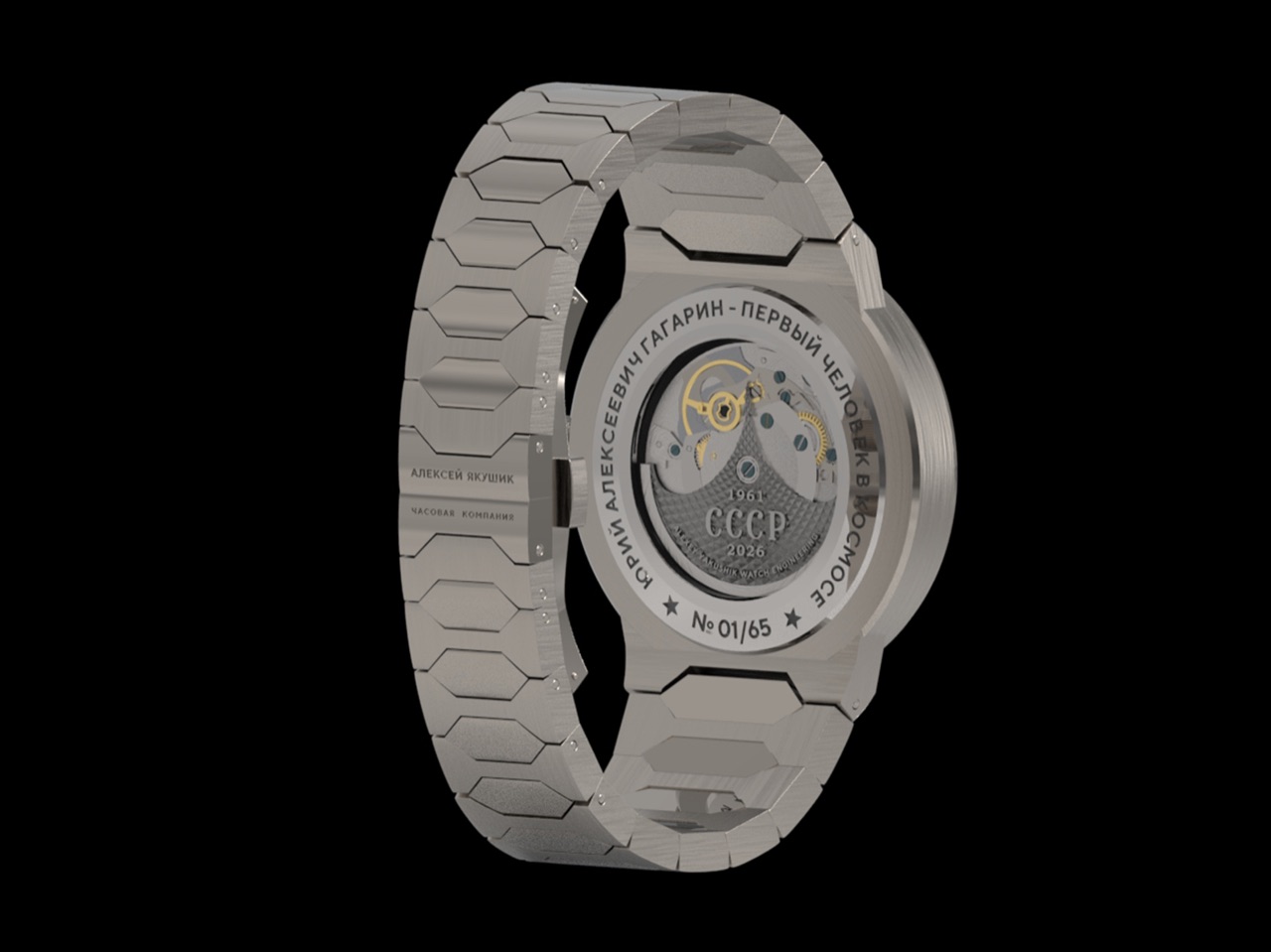
The case and the integrated bracelet are both Grade 5 titanium, the alloy aerospace engineers love because it is strong, light, and unbothered by most of what life throws at it. At 45mm the case is large on paper, though titanium weighs far less than steel, and the brand hasn’t published the weight or thickness. The domed sapphire crystal is 35mm across and bulges up over the globe like a capsule window, which is the whole porthole idea in one piece of glass. Water resistance is 100 meters, the lume is BGW9, and the links look faceted and angular in the renders. Nobody is mistaking it for a dress watch.

Underneath sits the Miyota 8215, a 21-jewel Japanese automatic workhorse that keeps time reliably and stays out of the dial’s way, with the brand’s AYW001.1 module built on top. The renders show a custom rotor stamped with 1961, СССР, and 2026, the sort of detail only the owner will ever see. Yuri Alekseyevich Gagarin’s full name wraps the sapphire caseback window, and every watch carries its own number, such as 01/65. Hiding a love letter on the back of a watch is a wearer-only flex, and I’m here for it. Nobody across the table will ever read it, which is exactly the point.
Yakushik says the project has the blessing of Gagarin’s daughters, Galina and Elena, along with Roscosmos support. It launched April 16, 2026, timed to the flight’s 65th anniversary, and the first piece went to the Moscow Museum of Cosmonautics. The European Product Design Award is a paid-entry Farmani Group competition that covers concepts and finished products, so read the two wins as a nod to the design and leave the horological verdict to others. At about $4,150, the money goes to the titanium, the bracelet, the dome, and the custom display more than the base caliber. Gagarin carried a 33mm brass tool into orbit, and sixty-five years later his flight has a 45mm titanium watch of its own.
The post This titanium watch turns Yuri Gagarin’s first orbit into a dial first appeared on Yanko Design.
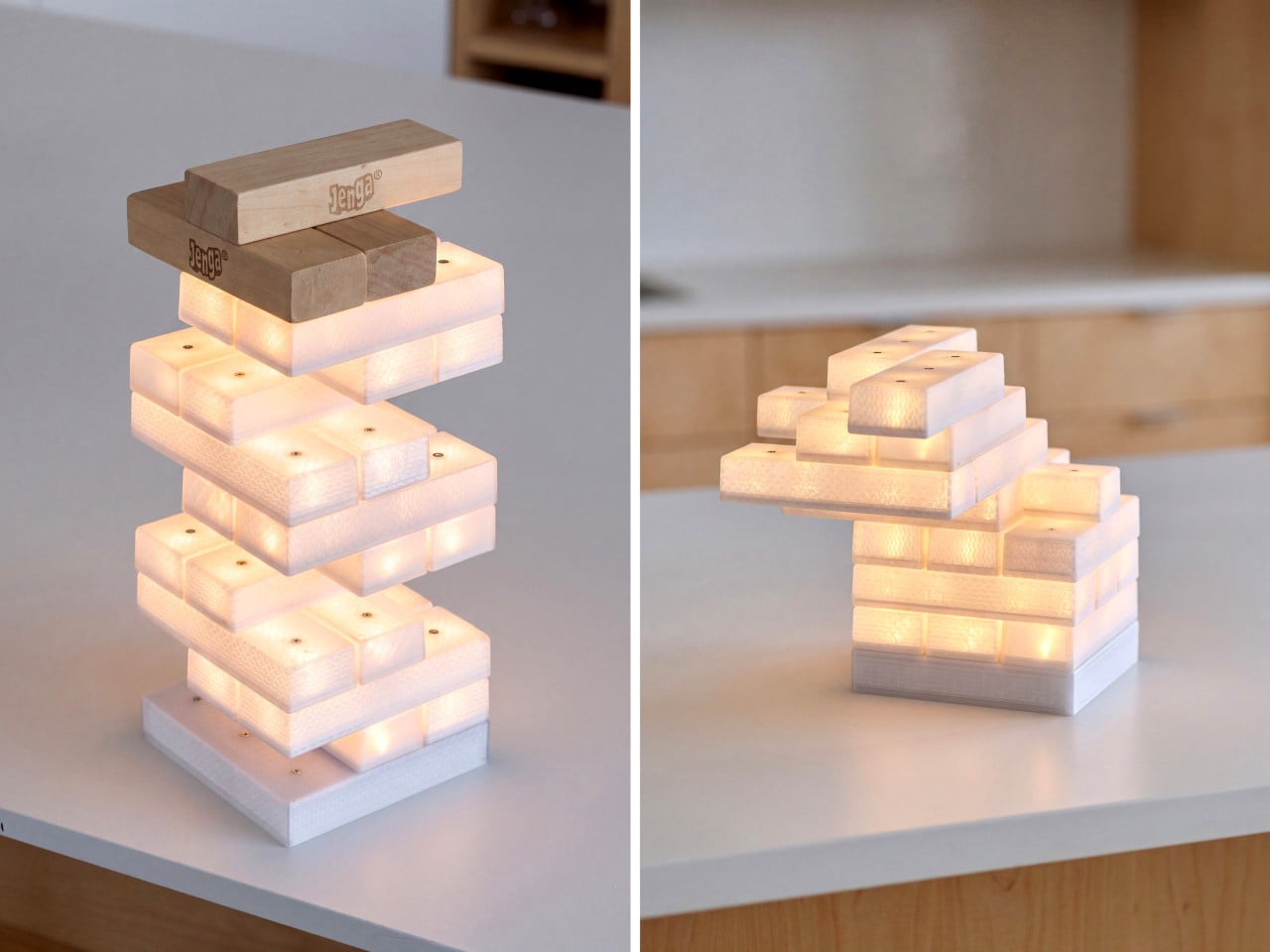
Give an architect a box of blocks and they’ll tell you it’s research. Toronto architecture studio PARTISANS took that excuse all the way and came out the other side with a lamp. The Jenga Light rebuilds the game’s famous rectangles in a translucent material that glows from inside. Set the blocks on a powered base and electricity travels upward through every point where one block rests on another. The path the weight takes is the same path the power takes. That one idea turns a party game about collapse into a lamp you build by hand, one glowing brick at a time.
Lead designer Alex Josephson and teammate Teddy Shropshire solved the fiddliest part of the problem with a component most people have never heard of. The blocks hide bridge rectifiers, tiny circuits that make polarity a non-issue. Flip a block, rotate it, or push it into a cantilever that looks like it’s daring gravity, and it still lights. The lamp won its category, Home Lighting: Lamps and Luminaires, at the 2026 European Product Design Award, an international competition that welcomes prototypes as well as finished designs. Pricing and availability haven’t been announced yet. Meanwhile, I’m trying to figure out how many blocks it takes to reach the ceiling.
Designers: Alex Josephson & Teddy Shropshire
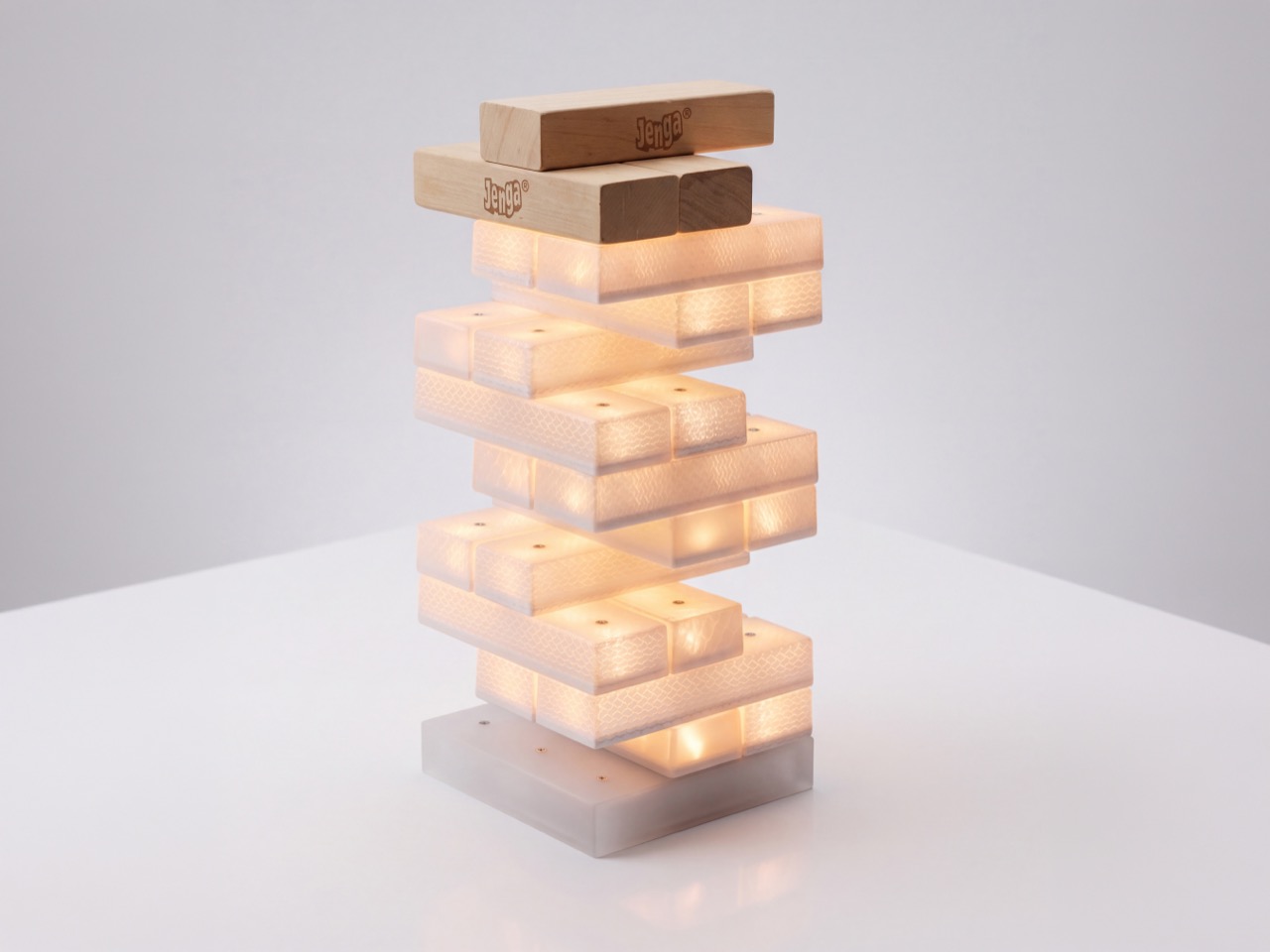
Every electrical connection has a positive side and a negative side, and most stacking lamps deal with that by forcing pieces to go one way. A bridge rectifier is four diodes arranged in a loop, and it sends current out the same way no matter which way it comes in. Tuck them inside the blocks and “upside down” stops meaning anything. A brick can sit flat, sit flipped, or spin around, and its LEDs get the right polarity every time. That one cheap part deletes every rule you’d otherwise have to learn before playing. It’s the electrical version of a USB-C plug, which also stopped caring which way you hold it.
Compare that with the Tetris lamp ThinkGeek sold around 2012, where a powered bottom piece fed light to the tetrominoes stacked above it and the interlocking shapes did the steering. Later patents for modular light kits went mechanical, adding magnets and contacts shaped to avoid short circuits when blocks meet at odd angles. LumiBlocks took the magnetic route too, pairing snap-together blocks with app control and RGBCW LEDs. PARTISANS skips magnets entirely, letting electronics handle orientation and gravity handle everything else. The result asks nothing of you except a steady hand. That also happens to be the only thing Jenga ever asked.
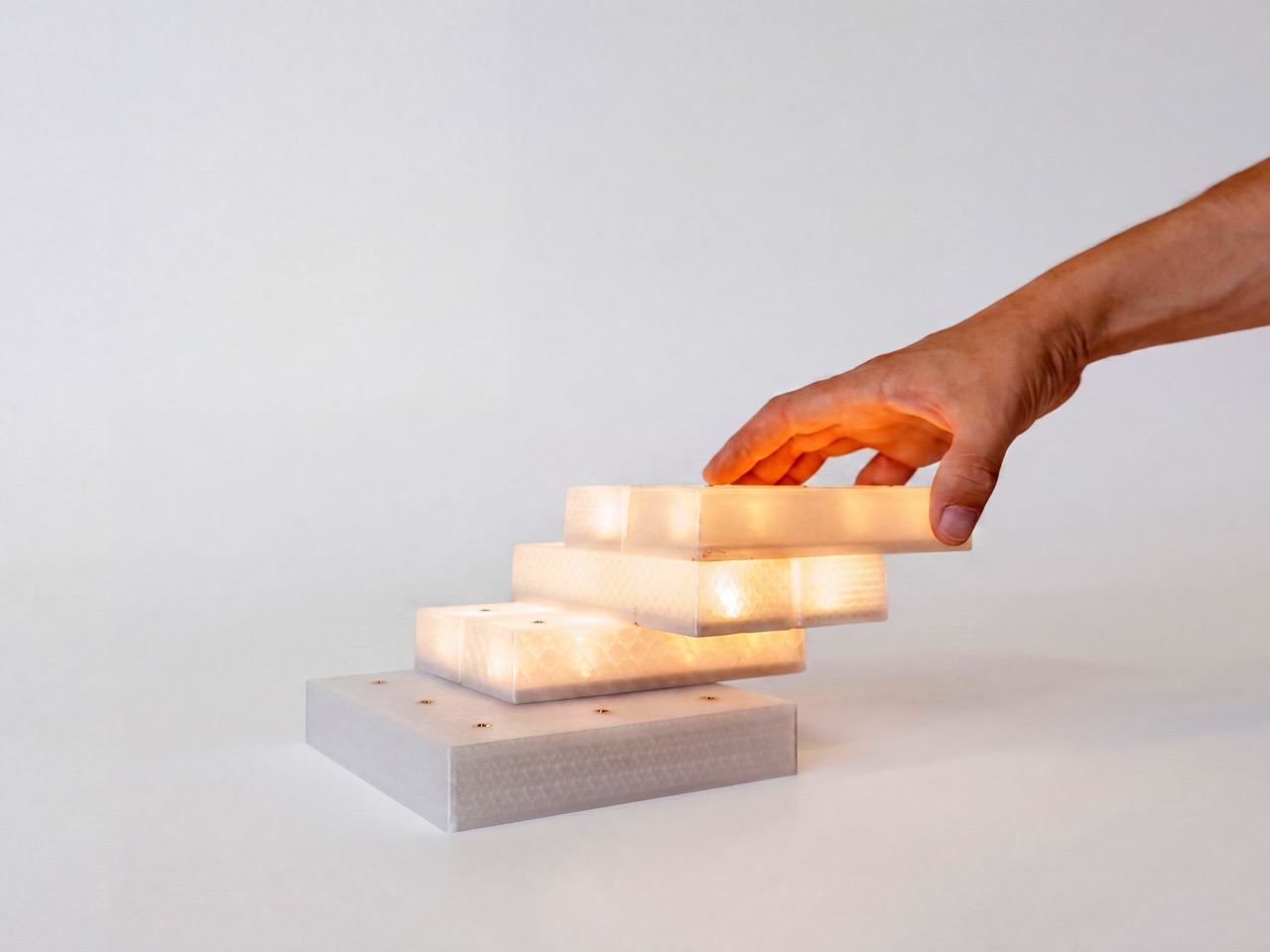
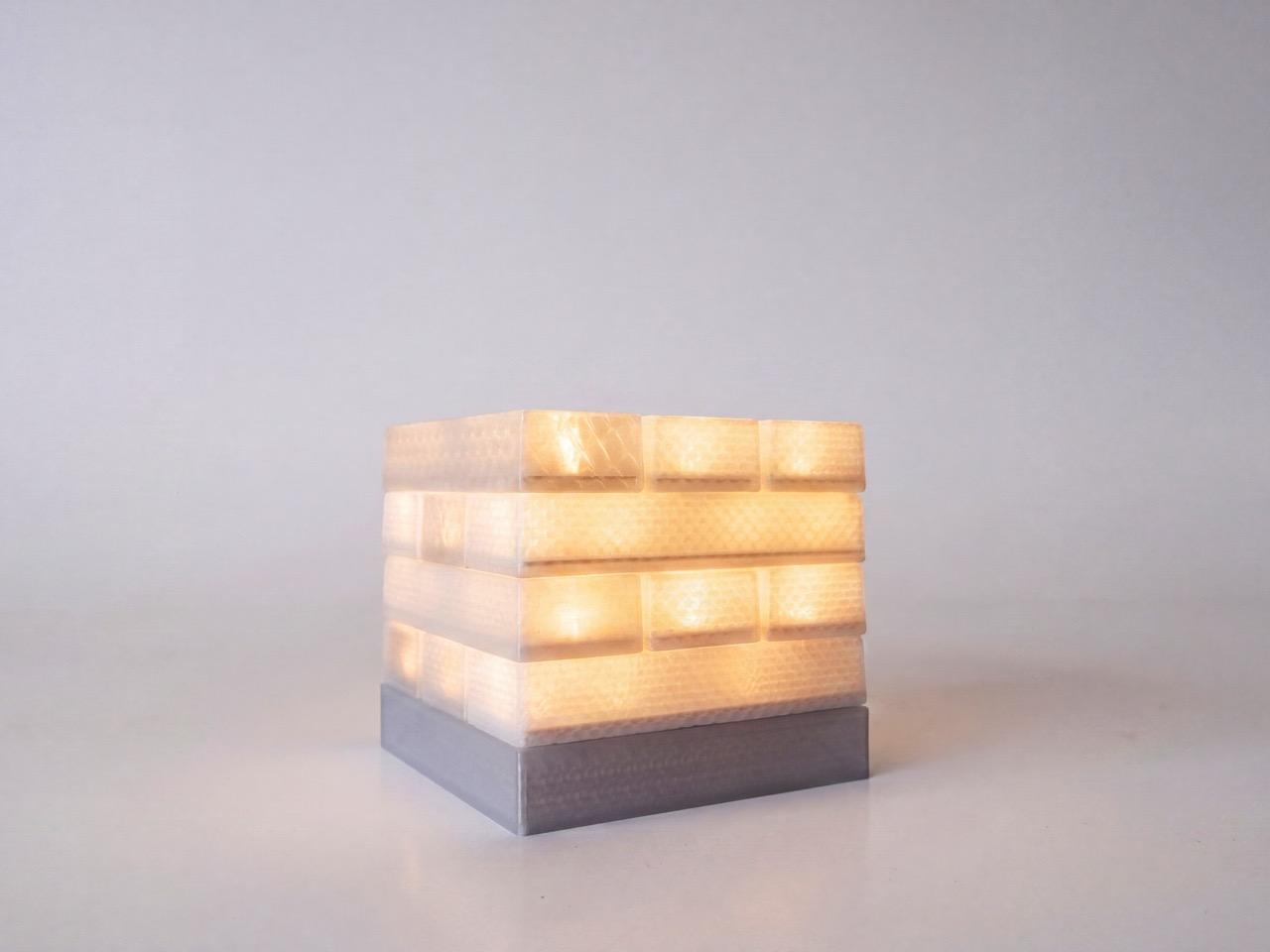
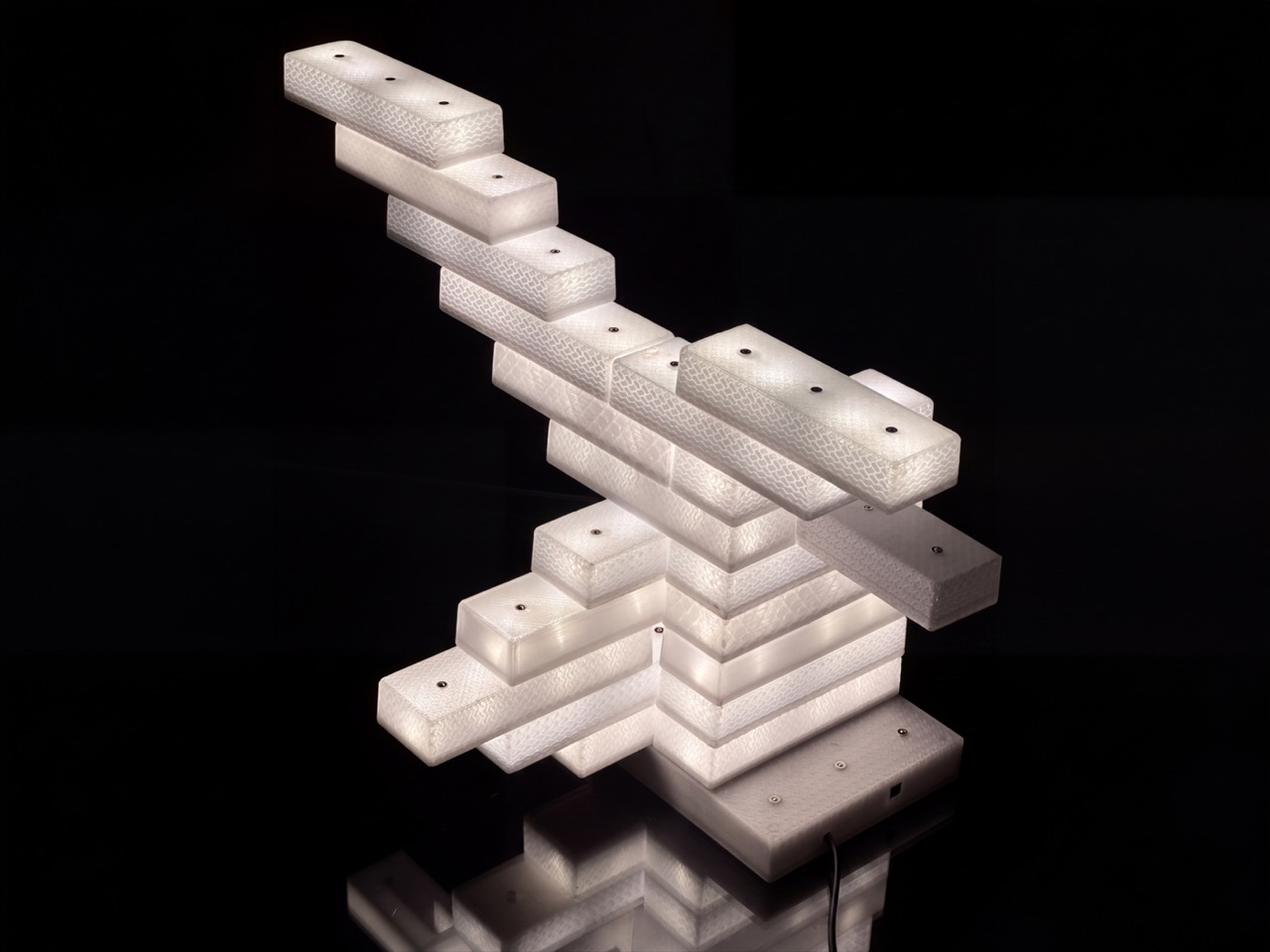
From the photos, the bricks appear 3D-printed in a translucent plastic, with visible layer lines and a wavy internal infill. Most designers would sand or hide that texture, but here it does the job of a lampshade. Light passes through the infill and paints a woven, scaly pattern across every face, so each block glows with a grain that frosted acrylic could never give you. The shots mostly show warm white light, with one hero image running cooler. PARTISANS hasn’t published brightness or color temperature figures yet. Stack enough bricks and the whole thing reads like a lantern built by someone who really loved masonry.
Small metal contacts dot the top of each block, three in a row on the long pieces, while the base carries more, plus a power cord and a small port on one side. Those dots likely form a grid that decides how far one block can overhang the next and still stay lit. They also mean you can’t play an actual round of Jenga on it, since shimmying a brick out of the middle of a tower will just disconnect the entire top half of the lamp. Think of it as Jenga-inspired, with the building half of the game kept and the pulling half retired. A bumped table can still flatten a ten-minute spiral, which is the most Jenga thing left about it.
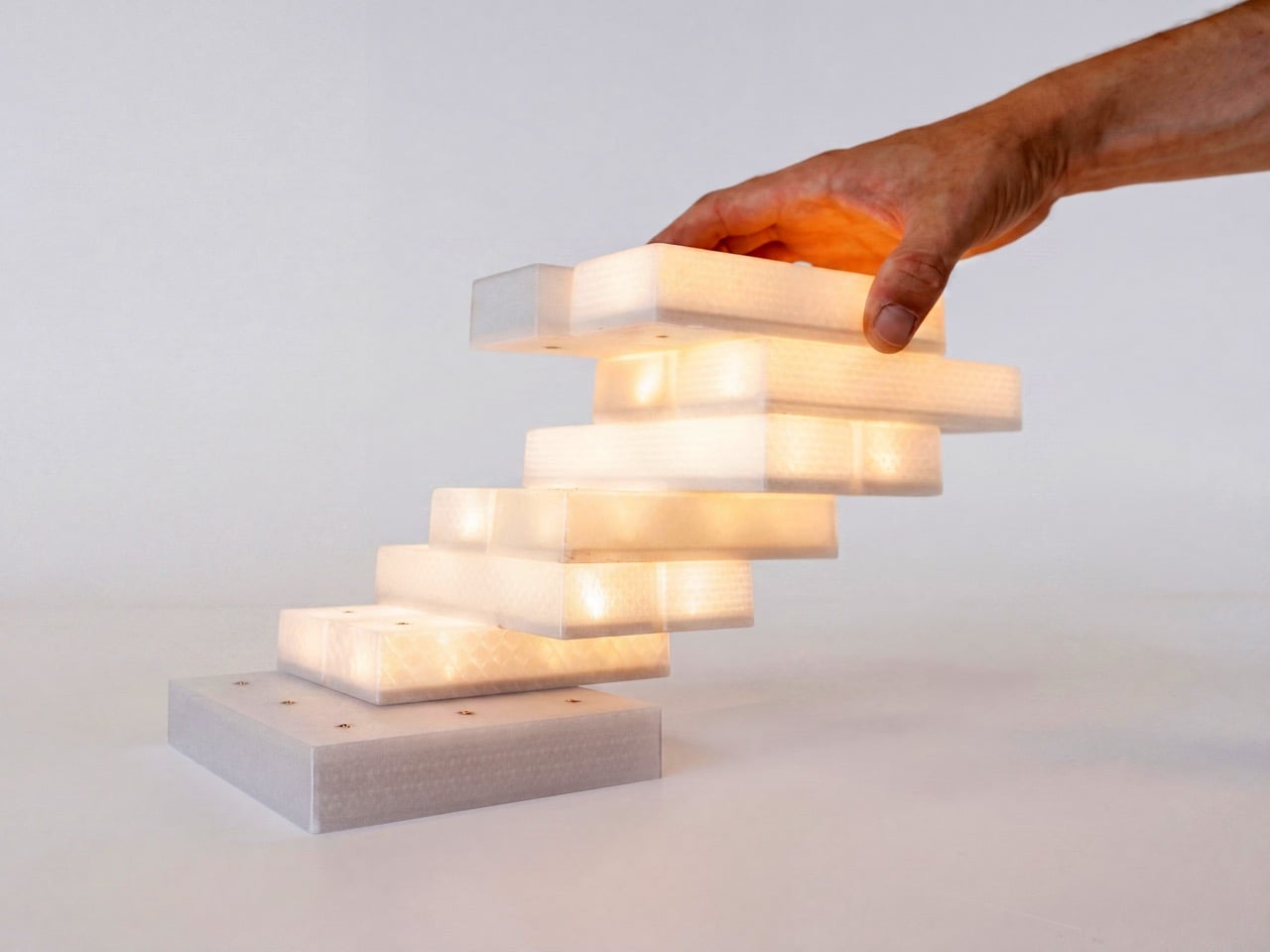
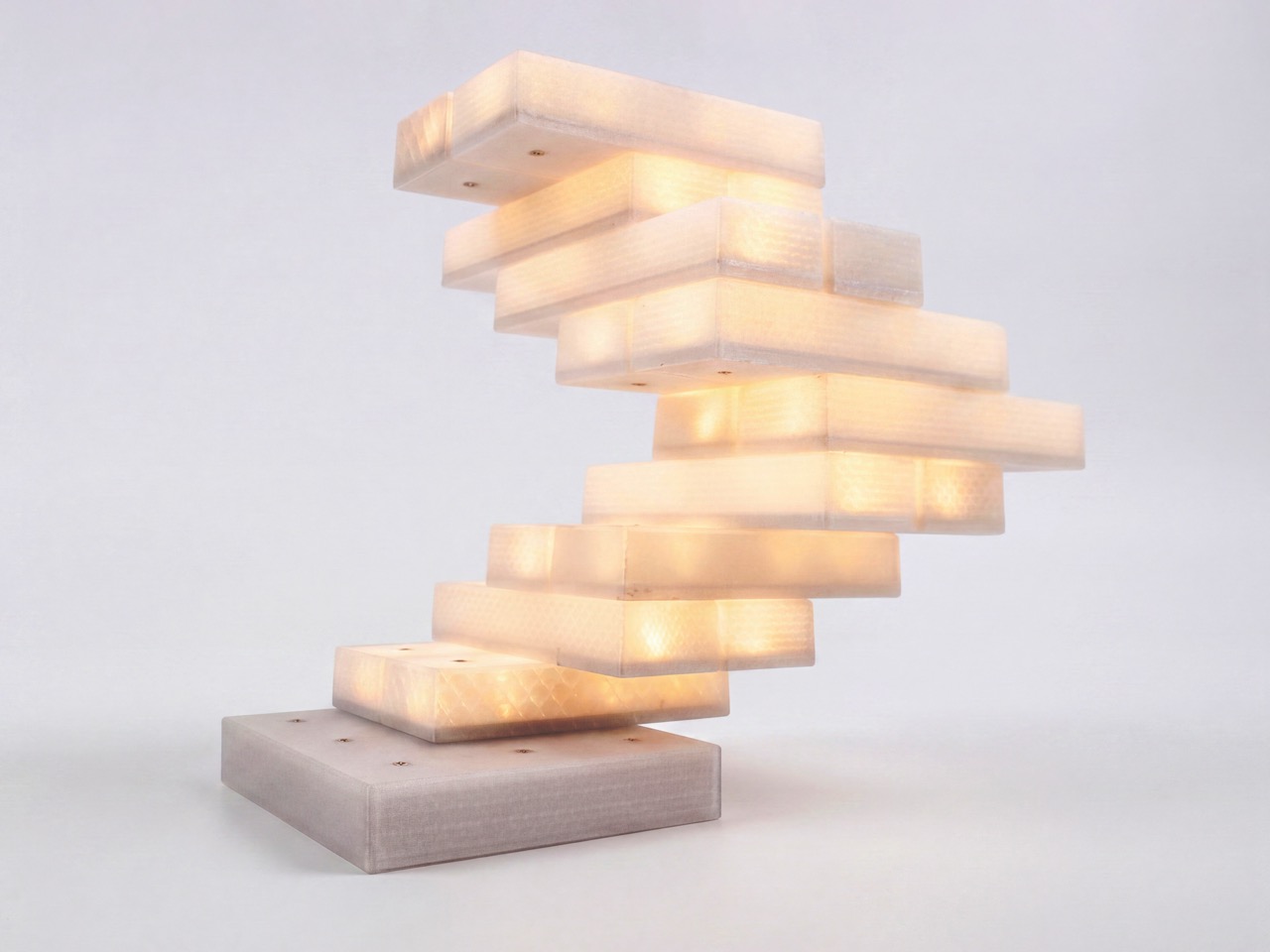
Jenga began as a family game Leslie Scott played with wooden blocks growing up in Ghana, and it launched at the London Toy Fair in 1983. Its real break came in 1986 at the Toronto Toy Fair, where Hasbro’s chairman reportedly decided he had to have it. Forty years later, a Toronto studio has turned the same stack into a table lamp. PARTISANS is mostly an architecture practice, best known for the cedar-lined Grotto Sauna on Georgian Bay, yet Josephson keeps drifting into lighting. His Gweilo lamps, made from hand-molded acrylic sheets, won the 2016 AZ Award for Best Lighting Installation.
Playful lighting has had a good run lately, from Analog lamps, which grew out of LEGO play and now sell at MoMA, to app-controlled magnetic blocks for desk setups. The Jenga Light skips apps and color modes and bets everything on the hands-on part. The European Product Design Award judges entries anonymously and accepts prototypes, so this win recognizes the idea and its engineering ahead of any retail launch. PARTISANS hasn’t announced pricing or a release date. Until it does, I’m staring at my old Jenga set and wondering how hard bridge rectifiers really are to solder.
The post This Jenga tower is also a lamp, and it lights up as you stack it first appeared on Yanko Design.