Perplexity has just released Personal Computer. The software, which is available starting today for Mac, builds on the multi-model orchestration capabilities the company debuted with Perplexity Computer at the end of February. Like Claude Cowork (and, as of today, OpenAI Codex too), it's a suite of computer use agents that can work with your files, apps, connectors and the web to complete complex and "even continuous workflows."
Perplexity suggests a few different use cases for Personal Computer, starting with the obvious. “You can ask Personal Computer to read your to-do list,” the company states. “In fact, you can ask it to DO your to-do list." It explains you can open the Notes app on your Mac, ask Personal Computer for help and the system will reason how to best assist you. In the process of tackling that task, it can work across all your files, as well as apps like Apple Messages. When needed, it will also employ multiple agents to complete a request. Like Anthropic did with Claude Cowork, Perplexity says you can also use its software to organize messy folders so files feature sensible names and there's an easy-to-understand structure to everything.
You can prompt Personal Computer with your voice, and you can even initiate and manage tasks from your phone. Perplexity says the app creates files in a secure sandbox, and any actions it takes are auditable and reversible. "A system that acts on your behalf needs to be useful and legible. It should feel like a team you manage, not a rogue employee with keys to your most important data," the company said.
Personal Computer for Mac is available starting today, beginning with Max subscribers. Perplexity said it would bring the app to its other users soon, prioritizing those who joined the waitlist for the experience.
This article originally appeared on Engadget at https://www.engadget.com/ai/perplexity-brings-its-personal-computer-ai-assistant-to-mac-202045969.html?src=rss
A Call of Duty movie is still happening, but don't hold your breath for it to hit screens any time soon. Today, the popular FPS' social media revealed that the movie's theatrical release date will be June 30, 2028.
A film adaptation of the game franchise was first revealed last year, and shortly after, we learned that Taylor Sheridan and Peter Berg would be serving as the producers. The duo, whose past credits include Friday Night Lights and Yellowstone, will also be co-writing the project under Berg's direction. We still haven't heard anything about the cast, or even what era of the long-running series will be depicted, so it seems like a safe bet that there's still a ways to go before this wraps. But CoD is nothing if not a money-maker, so reimagining it as a summer blockbuster seems pretty expected.
This article originally appeared on Engadget at https://www.engadget.com/entertainment/tv-movies/call-of-duty-movie-arrives-on-june-30-2028-200033481.html?src=rss
Blackmagic Camera is one of the more powerful third-party smartphone camera apps available and it's now even more useful for solo creators. Blackmagic Design just announced that the latest iOS version 3.3 now supports Apple Watch, letting you control the app and monitor video remotely from your wrist. It also includes ATEM camera control so you can use your iPhone as a live studio camera.
With the new Camera Apple Watch companion app, you can remotely control and monitor your iPhone from anywhere within Wi-Fi range. It lets you start and stop recording, control zoom and adjust settings like frame rate, shutter speed (angle), white balance and ISO with a tap. You can also see a view of your video for framing control, though a Watch screen is probably a bit too small to accurately check focus.
The Watch app will benefit solo creators who want to mount their iPhone on a tripod to record standup or vlogging activities. To set it up, you install the Watch app through your iPhone and it will automatically connect and sync to your device.
Use your iPhone as a broadcast camera? Sure, why not
Blackmagic Design
The other key feature is iPhone control from Blackmagic's ATEM Mini switcher used by streamers and broadcasters. To use it, you need the $420 Blackmagic Camera ProDock that gives your iPhone 17 Pro or iPhone 17 Pro Max an HDMI output, timecode, USB-C and other ports. Blackmagic Camera now lets you connect a single HDMI cable from the ProDock to an ATEM Mini switcher, then adjust settings, trigger recording, focus and zoom. It also offers a DaVinci primary color corrector so you can match and create digital film looks during live production.
Finally, Camera now supports Blackmagic's "Focus and Zoom Demand" controls (a knob and handle) designed for broadcast cameras. When those controls and an iPhone 17 Pro/Pro Max are connected via USB-C to a ProDock as shown above, you can zoom and focus Camera app video without taking your hands off the tripod handles. Together with the ATEM feature, it lets you use an iPhone as a full broadcast camera, which looks slightly weird but is pretty cool.
On top of those features, Blackmagic Design also added ProRes RAW stabilization and general bug fixes and improvements. Blackmagic Camera for iOS 3.3 is available now as a free download from the Apple App Store.
This article originally appeared on Engadget at https://www.engadget.com/apps/blackmagic-camera-for-ios-now-has-a-companion-watch-app-194529980.html?src=rss
Meta is starting to test a long-overdue facelift for Threads on web. The company's head of Threads Connor Hayes showed off a new look for the web version of Threads that finally adds direct messaging and makes it easier to navigate between multiple feeds.
The new layout adds a bunch of new shortcuts to the site's left rail, including saved posts, insights, activity, and the ability to move between different feeds. Those features have all been accessible on web before, but many were hard to find. For example, the only way to currently get to "insights" is to navigate to your own profile or save it as a "pinned" column. Most importantly, though, the update finally adds the Threads inbox, which has not been available to web users even though the feature was added to the app last June.
It's not clear when the new look will roll out, but Hayes said Meta has already started to test it and that the company will "be investing more here going forward." The last time the Threads website got a major update was last April, which added some basic functionality. But since then, Meta has focused much of its efforts on the Threads app, rather than the website. Some newer features, like disappearing "ghost posts," are able to be viewed on the web but can only be created in the app.
Speaking of the Threads app, the web updates come one day after Hayes previewed some tweaks to how replies look on mobile. With the change, replies under a post will be indented slightly to make it easier to follow conversations. That change is rolling out now on iOS and currently "testing" on Android.
This article originally appeared on Engadget at https://www.engadget.com/social-media/meta-is-giving-threads-on-web-a-redesign-that-finally-adds-direct-messages-192903284.html?src=rss
The European Commission has proposed new measures for Google aimed at bringing the tech giant's search business into compliance with the Digital Markets Act. In order to allow third-party online search engines to be competitive with Google, the EC has recommended that Google permit those services to access its treasure trove of search engine data. As it stands, the proposal would require Google to let rivals see data points "such as ranking, query, click and view data, on fair, reasonable and non-discriminatory terms."
"Data is a key input for online search and for developing new services, including AI," said Teresa Ribera, the Commission's executive vice-president for Clean, Just and Competitive Transition. "Access to this data should not be restricted in ways that could harm competition. In fast-moving markets, small changes can quickly have a big impact. We will not allow practices that risk closing markets or limiting choice."
European regulators have been using the Digital Markets Act to hammer at Google's dominant market position for several years. Beginning in March 2024, Google was required to be in compliance with the DMA and it did plan some changes in accordance with the legislation. A year later, though, the Commission levied preliminary charges against Google arguing that Google Search and the Play Store had not met their obligations for market competition. Google offered some possible adjustments to how search results are displayed in response, but it seems the regulator is going to keep fighting for more robust changes to Google's search business.
If you think all that sounds like something Google is unwilling and unlikely to do, you'd be correct. For starters, the actual requirements for Google could change in the coming months. The EC is accepting comments on the proposed measures through May 1, and Google's legal team is certain to have a lot of opinions to share. We've reached out to the company for a comment on these preliminary measures. A final, binding decision on Google's next steps is due by July 27, so we're expecting a lot of back-and-forth between the parties until that date.
Update, April 17 2026, 11:36AM ET: Reached for comment, Google's Senior Competition Counsel Clare Kelly told Engadget, "hundreds of millions of Europeans trust Google with their most sensitive searches — including private questions about their health, family, and finances — and the Commission’s proposal would force us to hand this data over to third parties, with dangerously ineffective privacy protections. We will continue to vigorously defend against this overreach, which far exceeds the DMA’s original mandate and jeopardizes people’s privacy and security."
This article originally appeared on Engadget at https://www.engadget.com/big-tech/the-european-commission-wants-google-to-share-search-engine-data-with-competitors-192709530.html?src=rss
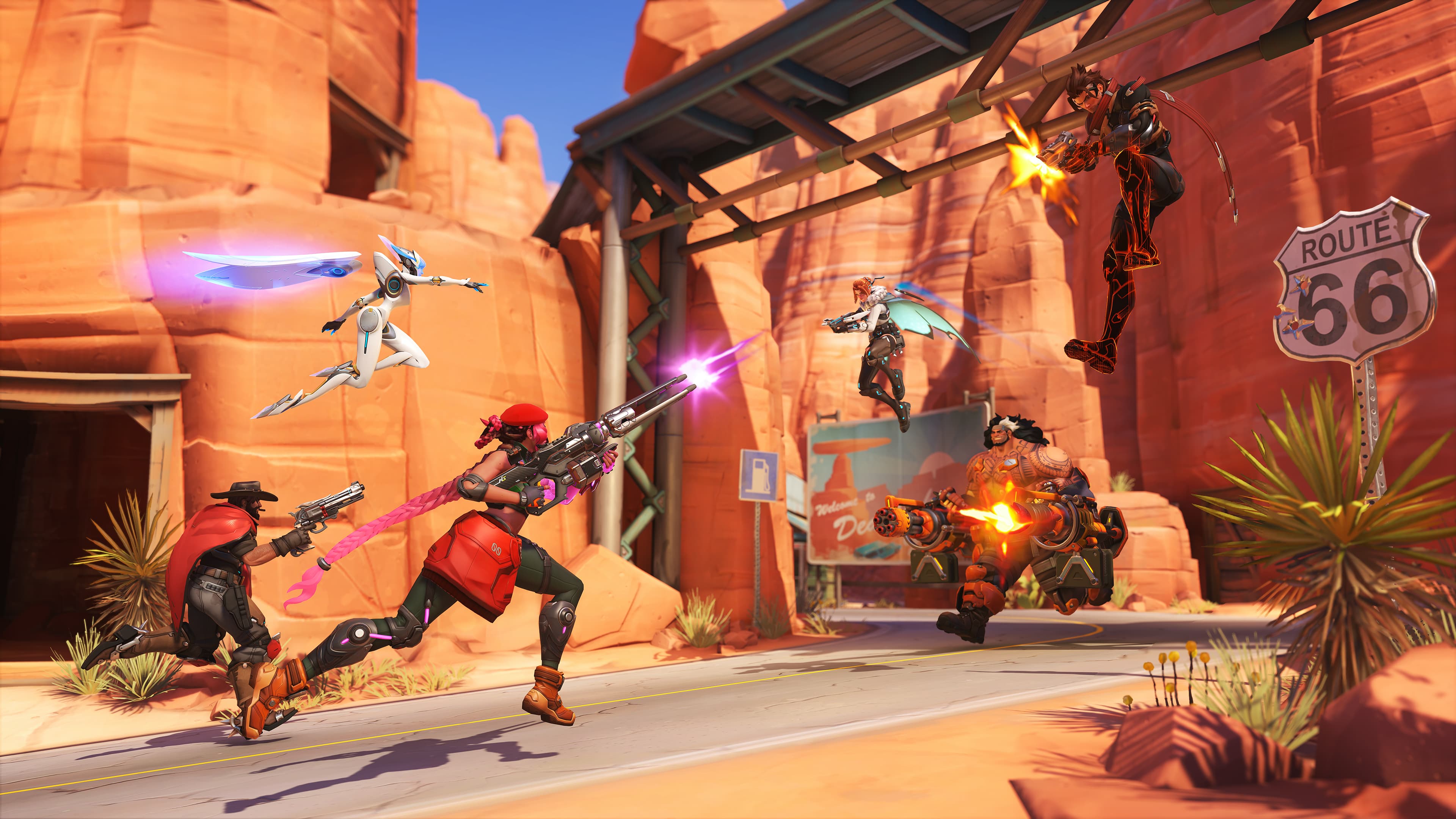
While I dabble in other Overwatch modes, I spend the vast majority of my time there in Mystery Heroes, a casual mode in which you load in as a random character and automatically switch to another one when you respawn. It's by far my favorite way to play Overwatch (which I do a lot!), since it helps me switch off and relax. Others play it as a warmup for competitive action. It requires a particular skillset, as players need a working knowledge of all 51 heroes to help them coordinate with teammates and know what the opponents have on deck. But with the arrival of the new Overwatch season this week, Blizzard changed Mystery Heroes, and made it much less fun to play.
The developers say they modified Mystery Heroes "to help keep the mode's casual pace intact while mitigating some of the more extreme pain points it's had in the past." That might have something to do with how the mode handled perks. In other modes, players earn perks (upgrades to their existing tools or entirely new abilities) throughout a match. In Mystery Heroes, they load into a round with random perks already equipped. That's fun! I love the chaos of Mystery Heroes and trying to make things work with whatever hero and perks I have.
Now, perks are gone from Mystery Heroes. I kind of get it. Nixing them helps players clock what's going on a bit faster — they won't feel the need to quickly check which perks they have when they're racing back to the action when the time is running out. Perks were only added to Overwatcha little over a year ago and they've helped make the game more enjoyable. Removing them from Mystery Heroes diminishes it compared with other modes, especially given that some heroes are now more oriented around their perks.
Overwatch
Blizzard Entertainment
The other major change in Mystery Heroes is a switch from teams of five players to 6v6. I'm fine with 6v6 in other game types, but it makes Mystery Heroes much worse.
In other 6v6 formats, you typically have two tanks, two supports and two damage heroes. In Mystery Heroes, the defense might load in with four tanks and two supports (teams are limited to three heroes from any class after respawns). While tanks generally have lower health pools in 6v6 modes, that's still an oppressive composition to run into. Attackers lack the agency to switch to other characters that can counter such a setup. For instance, if the attackers don't spawn in as heroes that can get behind a chokepoint and take out those supports, they might never break through. That doesn't make for a fun round. Trying to keep five other players alive as a solo support isn't exactly a blast either.
I’m not the only one who’s disappointed with these changes. In every single Mystery Heroes game I’ve played since the update, other players have lamented the loss of perks (the reaction to the 6v6 switch is more mixed). They're protestingonReddit and the Overwatch forums too.
It’s not like I’m averse to change. Blizzard has made a ton of updates to greatly improve Overwatch over the last few years. It added the big Stadium mode in 2025 and the game recently had a soft, successful relaunch. Even in this season, there are lots of positive tweaks, including some welcome hero updates (and some that are less welcome) and the return of post-match awards. New damage hero Sierra is rad too.
The Mystery Heroes changes, though, are a step in the wrong direction. I dearly hope Blizzard reverses course on those soon.
This article originally appeared on Engadget at https://www.engadget.com/gaming/blizzard-just-made-overwatchs-best-mode-much-worse-185114683.html?src=rss
Playdate is getting a third season of curated, surprise games, Panic announced today. We don't know much beyond the fact that Season Three is officially happening, but Panic's Head of Playdate Greg Maletic said in an announcement video that it will be here "in time for the holidays" this year. Considering we had to wait a whole three years for Season Two to come out following Season One's release with the console in 2022, that doesn't sound so bad.
Panic hasn't yet said how many games Season Three will include, or how much it will cost. While Season One had a total of 24 games — with a release schedule of two games per week for 12 weeks — last year’s Season Two had half the amount (plus Blippo+), and cost $39. But that drop in quantity thankfully didn't mean a drop in quality. Season Two was great, with a collection of games that felt stronger overall than the first. I, for one, can't wait to see what Season Three brings. In other exciting news, Panic also announced today that the much, much-awaited game Office Chair Curling is finally available for purchase on Playdate and Steam, with the option for online cross-play.
This article originally appeared on Engadget at https://www.engadget.com/gaming/playdate-season-3-is-coming-later-this-year-181340117.html?src=rss
If the real world isn’t grim enough for you, Ukranian developer 4A Games has your back: Metro 2039 has been announced and is scheduled to arrive this winter. And based on the developer’s first look at the title, Metro 2039 looks to be an even darker affair than previous titles in the series. A tall order, but the real-world turmoil that has enveloped 4A Games since Russia’s invasion of Ukraine sounds like it has turned into a painful inspiration for the developer.
The lengthy cinematic reveal, which also contains a brief bit of gameplay at the end, doesn’t give much of the story away. But it does serve to place you right in the ruined, terrifying world of the Metro series. Metro 2039 arrives about 25 years after a nuclear apocalypse wiped out most life on the planet. The series focuses on survivors who live in Moscow’s ruined metro system. 4A says that this time out, the different underground factions have been united by a group known as “the Novoreich,” complete with a new ruler, the Spartan known as Hunter.
Despite Hunter promising “salvation and a new life” for the survivors left on the surface, things aren’t exactly rosy underground. As you might expect, this supposedly “united” society is still a complete disaster, with propaganda, authoritarian rule and violence the hallmark of the regime.
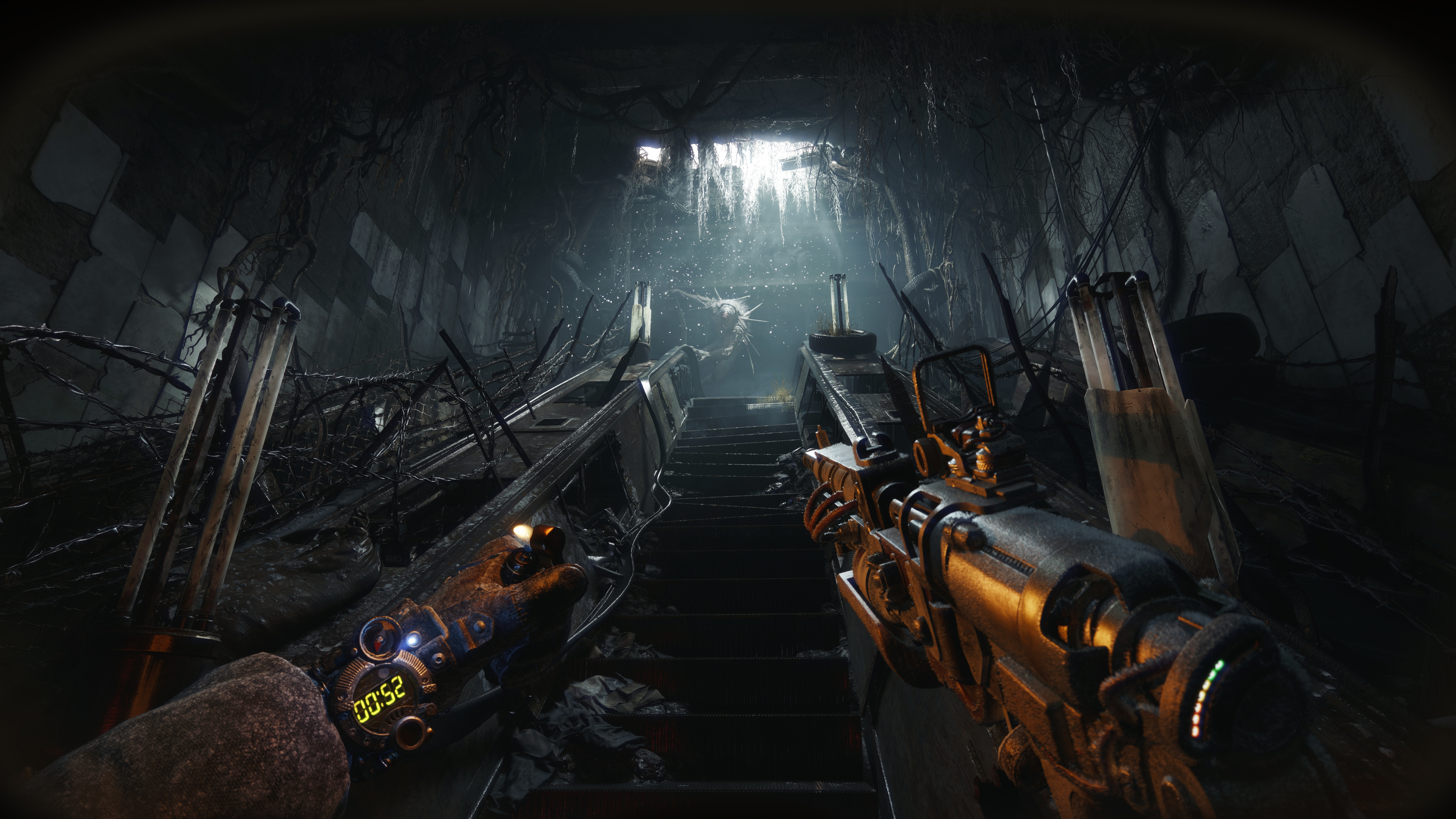
Screenshot from Metro 2039.
4A Games
The Metro series is based on novels by Dmitry Glukhovsky, a Russian author who has been in exile due to his public denouncement of Russia’s invasion of Ukraine. 4A Studios says that while this new game isn’t based specifically on one of his works, they worked in collaboration with Glukhovsky on the story for Metro 2039 “shaped by shared values of freedom and truth, and informed by the harsh realities of the world today.”
In statements from the studio, 4A directly acknowledges the conditions that Metro 2039 was created under. “Many developers continue to work from multiple locations, facing daily challenges never anticipated,” the studio says. “Through power outages, reliance on generators, and disruptions from missile and drone attacks, development has continued – driven by resilience, shared support, and a commitment to the work.”
It goes on to state that: “The war has directly shaped the development of Metro 2039, with its story focused acutely on choices, actions, consequences, and the cost of securing a future. While told from a distinctly Ukrainian perspective, Metro 2039 remains an authentic Metro story.” While the Metro series has been unfailingly bleak, it’s not hard to imagine how Russia’s invasion could have influenced the storytelling coming out of a Ukranian studio with an exiled Russian being part of the story team. But the limited bit of the game we’ve seen so far doesn’t make anything too explicit.
Screenshot from Metro 2039's reveal trailer.
4A Games
The trailer shows off the new player-character known as The Stranger, the first voiced protagonist in the series (though we don’t hear him do anything but scream in the preview). The Stranger has apparently been surviving in the above-ground wasteland but is forced to return to the metro. The little bit of gameplay we saw was the standard first-person shooter view of The Stranger heading underground to be immediately ambushed by a pretty horrific monster that he barely escapes from — he’s then dragged to “safety” by a group of survivors who just get the doors to their shelter shut before being overrun by a larger horde. Creepy stuff.
The rest of the preview largely feels like a dream (or nightmare) sequence — but while it’s hard to put together what is going on, there’s no doubt that the detail in the environments and characters is top-notch. Given that the last metro game, Metro Exodus, was released way back in 2019, it’s fair to say that we’re getting a more graphically impressive rendering of ruined Moscow and the tunnels beneath it.
There’s no exact release date yet, but 4A Games says Metro 2039 will arrive this winter for Xbox Series X/S, PlayStation 5 and PC.
This article originally appeared on Engadget at https://www.engadget.com/gaming/a-first-look-at-metro-2039-shows-how-its-ukrainian-developer-turned-the-darkness-up-to-11-171500713.html?src=rss
Last month, following reporting from The Wall Street Journal, OpenAI confirmed it was working on a desktop super app that would combine ChatGPT, its Codex coding agent and Atlas web browser into one cohesive experience. OpenAI is not releasing that application today. Instead, it's pushing out a major update to Codex that significantly expands what that software can do. However, the new release offers a glimpse of what OpenAI hopes to build with its latest effort.
"We're building the super app out in the open," said Thibault Sottiaux, the head of Codex, during a press briefing held by OpenAI. "This release is about developers. In the future, we will broaden it up to a wider audience." Until then, the latest version of Codex offers developers multi-purpose AI agents that can work across a "larger surface area," while being more proactive. In practice, that translates to a host of new capabilities, starting with computer use.
The agents inside of Codex can interact with other apps on your PC. When prompting one of OpenAI's models, you can name a specific program or let it determine the best application for the job. Computer use is available in competing apps like Claude Cowork, but where OpenAI believes Codex offers an edge in that department is in the "secret sauce" it built to allow an agent to run an app without bogging down your entire system, so the two of you can work in tandem. At the same time, OpenAI is releasing 111 new plugins for Codex that combine skills, app integrations and model context protocol server connections to give Codex more ways to gather context and use the tools developers depend on for their work.
The company has also added a built-in browser, with a commenting system that allows you to prompt Codex to make tweaks to specific parts of a webpage or web app you're building. In the demo OpenAI showed, one member of the Codex team used this tool to instruct Codex to change the margins on a graph so that the y axis wasn't cut off. Complementing this is built-in image generation. Codex can use gpt-image-1.5 to create product concepts, mockups, frontend designs and even assets for simple games. It also allows Codex to use screenshots to verify it's on the right track with a user request.
With today's update, OpenAI is also previewing a pair of memory features. The first allows Codex to recall context from previous tasks to inform how it goes about future prompts. According to OpenAI, with time, this will allow Codex to complete requests faster and to a higher standard. The app will also use the context it's gathered to suggest proactive actions. For example, at the start of your day, it might suggest you respond to a comment a coworker left on a Google Doc draft you wrote.
If you want to try the updated Codex for yourself, OpenAI is starting to roll out the new version to desktop app users who are logged in with their ChatGPT account. Computer use is available to macOS users first, with availability for people in the EU and UK to follow soon. Similarly, Brits and Europeans will need to wait to try the memory features OpenAI has built into Codex.
This article originally appeared on Engadget at https://www.engadget.com/ai/openais-latest-codex-update-builds-the-groundwork-for-its-upcoming-super-app-170000019.html?src=rss
Love 'em or hate 'em, no modern browser is complete without robust tab support, and so too would it seem Google's AI Mode. Starting today, the company is rolling out an update to users in the US that makes the tool better at interacting and understanding tabs.
To start, the next time you use AI Mode on Chrome for desktop and click on a link, the chatbot will open a new side-by-side interface that allows you to both browse the new webpage and ask questions of AI Mode. The connection allows the chatbot to maintain the context of the search that brought you to that website in the first place.
For instance, say you're looking for a new coffee maker to buy for your apartment. After AI Mode finds a handful of different models for you to compare, you can click on one to go to the manufacturer's website and ask additional questions of the chatbot like "how easy is this to clean?" Thanks to the expanded context window, you don't need to refer to the specific name of the model.
Meanwhile, if you have an existing tab or group of tabs that you'd like AI Mode to factor into a new search, you can do that now too. From the redesigned Plus menu, just click the new option that's there. While you're in the Plus menu, you can also prompt AI Mode to consider other materials, including images and PDFs, alongside any relevant tabs.
In testing, Google says users found the integration translated to less tab switching, and made it easier to focus. Mike Torres, vice-president of product for Chrome, said the new features represent a broader effort by Google to bring practical AI capabilities to its web browser. Torres added the company would soon bring today's updates to more places around the world.
This article originally appeared on Engadget at https://www.engadget.com/ai/google-chrome-makes-it-easier-to-wrangle-different-tabs-in-ai-mode-170000914.html?src=rss