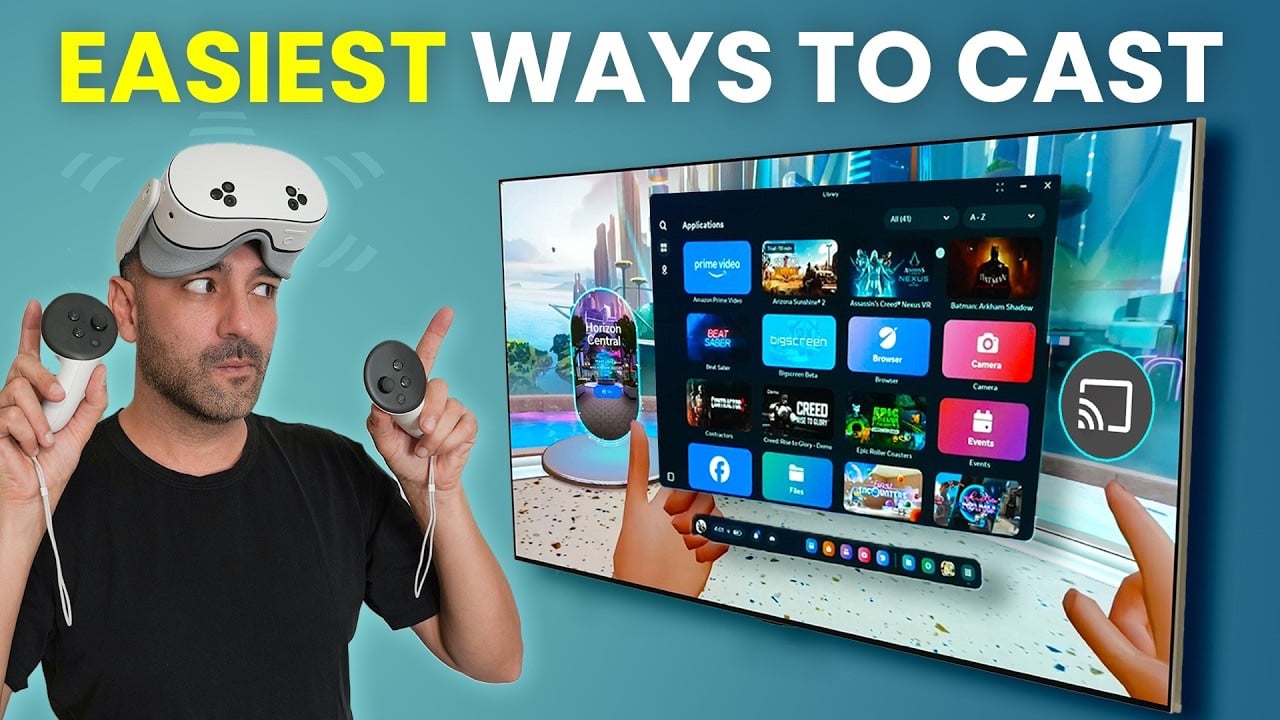
Casting your Meta Quest 3/3S VR headset to a TV is an excellent way to elevate your gaming experience and share the excitement with others. By displaying the action on a larger screen, you can create a more immersive and engaging atmosphere for both the player and spectators. This guide presents six methods to achieve […]
Blink just unveiled the Sync Module XR wireless extender, which is an update of the pre-existing Sync Module. This device is primarily intended to extend the wireless range of the company’s Outdoor 4 security camera. To that end, it can increase the range by up to 400 feet, which is four times the standard Blink Sync Module.
This means that users can plop the affiliated security camera pretty much wherever they want, even in the case of a large and expansive property. Blink says that “customers now have the freedom to install Outdoor 4 on their fence, gate, shed or entry of their driveway and know their cameras will stay online and connected.”
Blink
The company also says that the Sync Module XR can better penetrate obstacles to deliver a clean signal. This includes walls, shrubs and trees. However, it still says that performance may fluctuate “due to environment or other factors” and that “video resolution may vary.”
All Blink Outdoor 4 cameras can use this new module right out of the box, and it can support up to ten cameras at once. Jonathan Cohn, head of product at the company, said in a blog post that the Sync Module XR is intended to “make it easier for our customers to build a comprehensive home security system.”
The device also acts as a centralized system hub via the company’s proprietary app. This lets folks adjust any connected camera. Finally, there’s a MicroSD slot for clip storage. The Blink Sync Module XR is available for purchase right now in the US and Canada. It costs $60, though early adopters will get a free Outdoor 4 camera with a purchase.
This article originally appeared on Engadget at https://www.engadget.com/home/smart-home/blinks-new-sync-module-xr-extends-wireless-range-far-beyond-the-standard-version-140027521.html?src=rss
Microsoft Excel’s Copilot introduces a suite of significant updates that reshape the landscape of data management and analysis. These enhancements are designed to streamline complex tasks, making them more efficient and accessible for users of all skill levels. From summarizing text to generating insights, creating formulas, and applying conditional formatting, Copilot’s new features are engineered […]
Camera companies are starting to get the hang of marketing entry-level cameras with features that help beginners take great photos right away. Nikon's $910 Z50 II mirrorless joins that trend with a dedicated "Picture Control" button that produces fun, social media-ready looks. The new model also promises faster shooting speeds than the five-year-old Z50, improved autofocus and better-quality video.
There's no question that the Z50 II is aimed at the creator crowd with a host of new features borrowed from Sony, Fujifilm and Panasonic. That starts with the Picture Control button (not a dial) that offers 31 presets like Denim, Toy Camera and Carbon, for both photos and video. It also lets you download "Imaging Recipes" from the Nikon Imaging Cloud, with custom presets for color, brightness, hue and more, à laPanasonic's S9. On the video side, it now offers a Product Review Mode that immediately focuses from a creator's face to a product they hold up, exactly like Sony's Product Showcase feature.
Nikon
At the same time, the Z50 II is surprisingly powerful. You can shoot bursts at up to 30 fps (JPEG only) in electronic mode or 11 fps (RAW/JPEG) with the mechanical shutter. Autofocus has been overhauled to be more responsive and now includes 3D tracking with AI modes for animals, birds and vehicles — along with an auto mode that selects the subject for you.
Video is also much improved. It offers oversampled 4K 30p (no crop) and 4K 60p (1.5x crop), compared to just 4K 30p before. Better still, it now offers N-Log 10-bit shooting compared to just 8-bit with no log on the Z50. That should greatly improve dynamic range and give video shooters more room for creativity in the edit suite.
Steve Dent for Engadget
One downside to this camera is the resolution, which is on the low side in this price range at 20.9 megapixels. It also lacks in-body stabilization, so you'll need to rely on electronic stabilization for video (which adds a small crop) or purchase lenses with built in stabilization (VR, as Nikon calls it). I'm also not a fan of the boring body, but I imagine that Nikon will be releasing a Zfc II later with the same features in a retro design.
Other features include a built-in flash, flip-out display, brighter 2.36-million dot EVF (now 1,000 nits), a single UHS-II card slot, mic and headphone jacks, a tally lamp, waveform display, USB streaming support and a wider ISO range up to 512,000. The Nikon Z50 II is now on pre-order for $907 (body only) or $1,050 with a Nikkor Z 16-50mm f/3.5-5.6 VR kit lens.
This article originally appeared on Engadget at https://www.engadget.com/cameras/nikons-z50-ii-targets-creators-with-a-dedicated-film-simulation-button-133037492.html?src=rss
The Grok-2 API, developed by xAI, is now available in public beta, allowing broader access for application integration. This API supports both the Anthropics and OpenAI API structures and offers $25 of free credits monthly, facilitating experimentation without rate limits. The API is designed for ease of use in AI coding scenarios, with compatibility for […]
Artificial General Intelligence (AGI) represents a frontier in technological innovation, with the potential to transform industries and reshape societies. However, its development is fraught with significant challenges, particularly in the realms of safety and ethics. The recent departure of Miles Brundage, a prominent researcher formerly with OpenAI, has brought these concerns into sharp focus. His […]
When it comes to selecting a Mac Mini, you have a range of options to choose from, including the M1, M2, M2 Pro, M4, and M4 Pro models. Each of these variants offers distinct features and capabilities, catering to different user requirements. However, among these choices, the M4 Mac Mini stands out as a particularly […]
The New York Times Tech Guild asked the publication's readers not to play its games, including Wordle and Connections, in solidarity when it announced that it was going on strike on November 4. Now, the guild has released its own versions of the The Times' games so that readers can still play without crossing its digital picket line. Of course, the workers' versions won't be able to keep your Wordle streak running, but they're pretty much the same games you've been playing on the publication's website.
The guild is made up of over 600 unionized tech workers that include software engineers, product managers, data analysts and designers — the people behind the publication's games, as well as The Times' Cooking app. In the guild's GoFundMe for the strike, it said it's been bargaining for its first contract over the past two years, but the The Times' management "dragged its feet" and even allegedly committed unfair labor practices by implementing return-to-office mandates without bargaining and trying to intimidate members who were going on strike.
The guild explained that it's pushing for The Times to address racial disparities in its workers' pay and to ensure real job security. Apparently, the publication's management had fired someone days before a major brain surgery in the past and had used performance review plans as a pretense to fire employees. The guild is also accusing management of disproportionately targeting women and POCs with its "arbitrary disciplinary process."
PLAYING GAMES: In the great tradition of strike publications, we offer our tech-worker version.https://t.co/L46DXTrDsp
Now you can play and not be a scab. We also want to thank the multitude of @nytimes subscribers who have stopped playing and honored our digital picket line.
This article originally appeared on Engadget at https://www.engadget.com/general/nyt-tech-workers-on-strike-made-their-own-versions-of-wordle-and-connections-130047922.html?src=rss
The latest version of Matter, the open smart home standard that largely hasn’t yet lived up to its lofty promises for seamless device-agnostic integration, is now available. Hardware makers and platforms can integrate Matter 1.4 into their products on Thursday. The new version’s biggest feature may be Enhanced Multi-Admin, which aims to improve interoperability between different device ecosystems.
The Connectivity Standards Alliance, which manages Matter, describes version 1.4 as “a significant step forward in the Matter ecosystem.” It says the update resulted from the coalition’s hundreds of member companies (including Apple, Amazon, Google and Samsung) working with thousands of engineers and product experts. Given the platform’s struggles to deliver on its promise of a smooth and headache-free smart home, it could use all the help it can get.
One of the new highlights, Enhanced Multi-Admin, strives for less setup when connecting to multiple ecosystems (like Apple HomeKit, Google Home or Alexa). Matter 1.4 only requires user consent once. After that (at least in theory), new and existing devices will connect to multiple ecosystems without making you approve the same device for each additional platform. If hardware manufacturers implement the feature without issues (again, a big ask based on Matter’s rocky first two years), this could improve on a big pain point and move the platform’s big promises of seamless integration closer to reality.
The update also opens the door to Matter-certified routers and access points that securely store your Thread protocol credentials. The Alliance says the networking hardware will “provide the foundational infrastructure of smart homes by combining both a Wi-Fi access point and a Thread Border Router, ensuring these ubiquitous devices have the necessary infrastructure for Matter products using either of these technologies.”
Following the addition of basic energy management features in version 1.3, Matter 1.4 expands on that with support for new device types. Solar panels, batteries (including battery walls, storage units and Battery Energy Storage Systems), heat pumps and water heaters can now work with the standard. In addition, it now covers Electric Vehicle Supply Equipment (EVSE). So, EV owners can use the management features to specify when they want their car to be charged, choosing times based on convenience or cost.
Matter 1.4 also adds protocols to lengthen battery life for low-powered devices like switches, buttons and sensors that only connect intermittently. More flexible automation options for products like in-wall switches that control lights, fans and other non-smart appliances are also on the menu. This addresses yet another pain point in previous versions, which treated all of these device types as “lights.”
This article originally appeared on Engadget at https://www.engadget.com/home/smart-home/matters-latest-version-will-try-to-smooth-out-the-smart-home-platforms-rough-edges-130003372.html?src=rss
Navigating the world of Excel can sometimes feel like trying to solve a puzzle with missing pieces. If you’ve ever found yourself wrestling with the XLOOKUP function, only to be met with a chaotic spread of data spilling across your spreadsheet, you’re not alone. This “array of arrays” issue is a common conundrum that can […]