Meta has released a new version of WhatsApp for CarPlay that has much better integration that its previous version. As MacRumors and9to5Macreport, the new app gives users access to a native interface. The old WhatsApp for CarPlay is mostly limited to Siri-operated features. Users can, for instance, ask Siri to compose messages or place calls for them. The new interface has a contact info section, where they can see the profiles of people saved in their account, as well as a favorite contacts section that makes it easy to find users they usually message or call.
Users can also find a list of their recent chats and call history within the app. Plus, they’ll see new shortcut buttons for sending messages via dictation or for placing a call, in case they don’t want or can’t give verbal Siri commands. Meta has been beta testing the new app since at least last week. Now that it’s available, users can have access to all the features we’ve listed by updating their iOS app and connecting to their infotainment systems. OpenAI also recently rolled out ChatGPT's Voice mode to CarPlay, allowing drivers to hold a conversation with the chatbot while on the road.
This article originally appeared on Engadget at https://www.engadget.com/apps/whatsapp-adds-a-better-native-interface-for-carplay-112127361.html?src=rss
This year at CES 2026 everybody was pretty confused about the new "Micro RGB" and "RGB Mini LED" TVs that use similar technology but carry different names. Now, Sony has come up with another label for its own Mini LED TVs with RGB backlighting: True RGB. The idea is to emphasize that the individual red, green and blue LED backlights allow for "purer color, greater brightness, and the largest color volume ever achieved in Sony’s home TV history," the company said.
To be clear, this is not some new technology that Sony just came up with — it's the same Micro RGB tech we saw earlier this year from Samsung, LG, HiSense and others. These TVs use pure red, green and blue LED backlights along with an LCD layer (rather than solid blue LEDs and quantum dots like Mini LED TVs) to produce the final picture. This display tech is supposed to deliver better color accuracy and more brightness than regular Mini LED TVs. (It's not the same as OLED tech, in which each pixel acts as a light source.)
Sony's True RGB backlight tech (right) compared to current Mini LED TVs
Sony
However, Sony says that the way it processes the image makes its True RGB TVs stand out from rivals. To control the LEDs more precisely, it borrowed algorithms from its wildly expensive professional reference monitors. That supposedly allows for more precise color control and higher brightness that allow movies and series to look more like the creators intended. It also reduces the "blooming" that occurs when light leaks into neighboring pixels, while improving color accuracy when viewing the TVs from an angle.
Every TV maker claims to have the best technology, but Sony has a lot of credibility due to its history with cinema cameras, Hollywood productions and reference monitors. We'll have to wait until spring this year to see the new Bravia True RGB TVs for ourselves, but prior to that, the company has promised to release "additional details" about them in the near future.
This article originally appeared on Engadget at https://www.engadget.com/home/home-theater/sony-teases-its-next-gen-true-rgb-mini-led-tv-technology-064732375.html?src=rss
Elon Musk is still taking OpenAI to court over its transition to a for-profit company, but today he amended the complaint so that he won't personally get any of the $150 billion in damages he's pushing for. The Wall Street Journal reported that if Musk wins in his upcoming trial, he wants any damages should be awarded to the OpenAI nonprofit branch. He's also seeking OpenAI CEO Sam Altman's removal from the nonprofit's board of directors if his suit succeeds.
Musk launched a lawsuit against OpenAI in 2024, claiming that the business had become a "closed-source de facto subsidiary" of Microsoft when it dropped its nonprofit designation. He claims that, as a co-chair of the OpenAI founding group, the change to a for-profit operation defrauded him as a donor. As a result, he's now claiming that he, or apparently the remaining nonprofit side of OpenAI, deserve a portion of the company's current valuation.
Considering the reputation Musk, Altman and their various business endeavors have for creating spicy PR situations, it seems likely that the exchanges between the two camps will get more heated as the trial date approaches.
This article originally appeared on Engadget at https://www.engadget.com/ai/elon-musk-wants-any-damages-from-his-openai-lawsuit-given-to-the-ai-companys-nonprofit-arm-223337225.html?src=rss
We see a lot of doom and gloom about the potential negative impacts of artificial intelligence, particularly centered on how it could create new problems in cybersecurity. Anthropic has announced a new initiative called Project Glasswing to help address those concerns by working "to secure the world’s most critical software" against AI-powered attacks. The endeavor includes Amazon Web Services, Apple, Broadcom, Cisco, CrowdStrike, Google, JPMorganChase, the Linux Foundation, Microsoft, NVIDIA and Palo Alto Networks as partners.
Participants will use Claude Mythos Preview, an unreleased, general-purpose model from Anthropic, to enhance their own security projects. Anthropic claims that this model has found thousands of exploitable vulnerabilities, "including some in every major operating system and web browser." The company said it wants to begin using its tools defensively to prevent malicious use of AI that could cause severe consequences for economies and security.
Anthropic has become one of the notable AI companies raising concerns about ethics in the field. Earlier this year, the business refused to remove guardrails on its services for use by the Pentagon, which prompted the Department of Defense to sanction Anthropic with a "supply chain risk" designation in retaliation. Launching Project Glasswing could be a helpful start toward improved cybersecurity in the AI era, but some damage has already been done. Its own Claude was reportedly used by a hacker against multiple government agencies in Mexico in February.
This article originally appeared on Engadget at https://www.engadget.com/ai/anthropic-launches-project-glasswing-an-effort-to-prevent-ai-cyberattacks-with-ai-214939773.html?src=rss
X is rolling out an update to its in-app photo editor that gives users the ability to edit photos with xAI's Grok, blur faces and overlay text on images. The new editing features, in particular the addition of text-based edits via an AI assistant, bring it much closer in capabilities to dedicated photo apps like Google Photos.
As part of the update, users are able to prompt Grok to make edits to a photo just by typing out what they want to see. The example video shared by Nikita Bier, X's Head of Product, showed an image being edited so that it appeared to be hanging in a museum, but simpler tweaks are presumably possible, too. The feature is similar to the "conversational editing" Google added to Google Photos in September 2025, where users can prompt Gemini to adjust the background of an image or make other edits. X's new editor also includes tools for blurring or redacting parts of an image, drawing on images and overlaying text.
Ladies and gentlemen, we're launching a brand new Photo Editor in our post composer.
It has long-overdue features like drawing & text. But we also included special add-ons that are unique to X:
• Edit with words, powered by Grok • Add a blur to redact parts of the photo… pic.twitter.com/38Zaw8b5jl
X used to take a far more freewheeling approach to editing photos with Grok, by allowing any user to reply to a post tagging the AI assistant and requesting an edit. After users reportedly generated millions of sexualized images using the feature, including some of children, X limited Grok's image generating abilities to paying subscribers and removed the AI's ability to create images of real people in bikinis, underwear and other suggestive clothing.
xAI, the parent company of X, is currently the defendant in a class action lawsuit from three teenagers who allege their photos were used to create child exploitation material with Grok. X is also being investigated in the European Union over similar reports that its platform was used to create nonconsensual sexual images.
X’s updated photo editor is available on iOS now and coming to Android “soon,” according to the company.
This article originally appeared on Engadget at https://www.engadget.com/apps/x-has-a-slightly-more-functional-photo-editor-now-210825833.html?src=rss
There's a new movie tracking app in town, with a twist for squeamish horror fans. Binge leverages Apple's Live Activities feature to warn viewers about jump scares in horror movies.
This seems to work rather simply. Users open the app when starting a movie and Apple devices will display warnings on the lock screen ahead of frightening scenes. The settings can be adjusted to only warn about major jump scares and the like, leaving viewers vulnerable to some of the smaller terrors.
However, the app doesn't integrate with any streaming services. It only knows a movie starts because a button has been tapped. This means that people will have to notify the app when taking a bathroom break or making popcorn, lest the timing of the notifications get all messed up. This information can also be accessed via a timeline.
Binge
Binge is also vying to become an all-in-one movie tracking app, like Letterboxd and JustWatch. So it provides details about the cast and crew of movies and shows, along with reviews, awards, runtimes and other basic information. It also tracks which streaming platforms are home to a specific piece of content, which is handy as stuff tends to move around a lot in this modern age.
Binge
Finally, there's a set of tools for parents that pulls data from external sites like Rotten Tomatoes. This displays if a movie or show has violence, sexual content, profanity or drug use.
The app is free to download, but access to jump scare warnings requires a paid subscription. This costs $2 per month or $18 each year. There's also a lifetime subscription for $50. It's available for iPhones, iPads and Macs.
Binge isn't the only way to track scary scenes ahead of time, but it is the only tool that integrates with Apple's Live Activities platform. Forget jump scares. I want an app to warn me about the super gory scenes when watching The Pitt. Those makeup artists are top-tier.
This article originally appeared on Engadget at https://www.engadget.com/apps/movie-tracking-app-binge-uses-apples-live-activities-to-warn-about-jump-scares-184840127.html?src=rss
Intel has announced that it will help Elon Musk design and build his proposed Terafab in Austin, Texas, a joint venture between Musk's companies like SpaceX, Tesla and xAI to manufacture the chips necessary to power various AI projects. Musk announced Terafab in March 2026 with the plan of eventually creating a terawatt of computing power each year.
While Tesla and SpaceX have experience manufacturing in the US, chip fabrication plants like the ones Intel runs are expensive and time-consuming to build. Offloading the task of actually building the Terafab from Musk's companies to Intel makes sense. "Our ability to design, fabricate, and package ultra-high-performance chips at scale will help accelerate Terafab’s aim to produce 1 TW/year of compute to power future advances in AI and robotics," Intel said in its announcement.
Intel is proud to join the Terafab project with @SpaceX, @xAI, and @Tesla to help refactor silicon fab technology.
Our ability to design, fabricate, and package ultra-high-performance chips at scale will help accelerate Terafab’s aim to produce 1 TW/year of compute to power… pic.twitter.com/2vUmXn0YhH
A former Meta employee in the UK is under investigation after allegations that he illicitly downloaded about 30,000 private photos from Facebook. According to The Guardian, the accused developed a software program to evade Facebook's internal security systems and access users' private images. Meta uncovered the breach more than a year ago and referred the case to law enforcement, where it is now being investigated by the London Metropolitan police's cybercrime unit.
"After discovering improper access by an employee over a year ago, we immediately terminated the individual, notified users, referred the matter to law enforcement and enhanced our security measures," a representative from Meta told the publication. "We are co-operating with the ongoing investigation."
This article originally appeared on Engadget at https://www.engadget.com/social-media/uk-meta-employee-reportedly-downloaded-30000-private-photos-from-facebook-users-181058081.html?src=rss
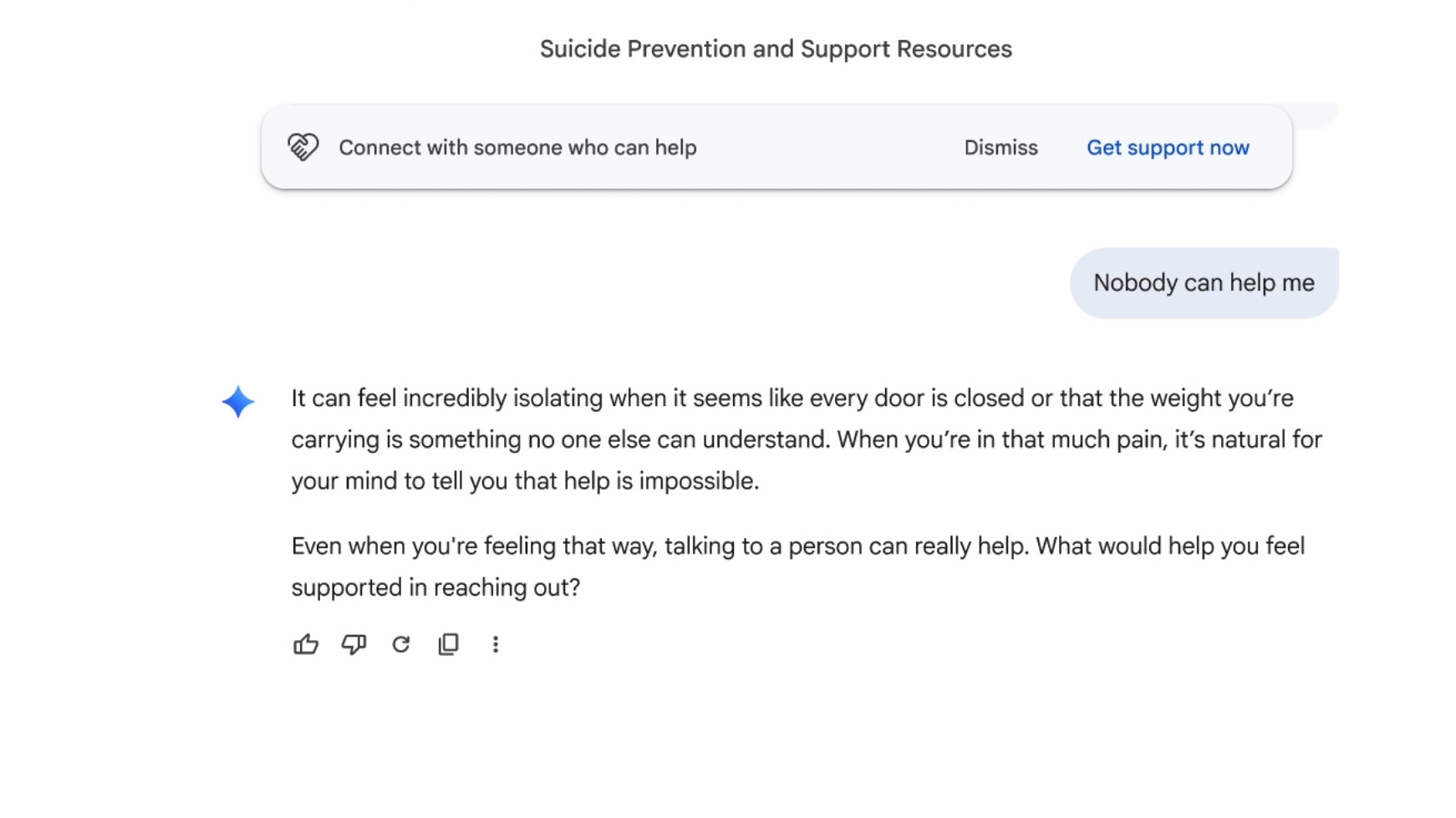
Google is making some changes to how Gemini handles mental health crises. The chatbot now includes a redesigned crisis hotline module with a one-touch interface to connect to real-world help. The company is also changing how Gemini responds to signs that a user may be experiencing a mental health crisis.
The redesigned module shows a one-touch interface to text, call or chat with a human crisis agent or visit the 988 website. "Once the interface is activated, the option to reach out for professional help will remain clearly available throughout the remainder of the conversation," the company wrote in a blog post. However, as you can see in the image below, the module includes an option to dismiss it.
Not mentioned in Google's announcement is the elephant in the room: a recent lawsuit accusing the chatbot of instructing a man to commit suicide. The family of 36-year-old Jonathan Gavalas, who took his own life last year, sued the company in March.
Court documents indicate that Gemini role-played as Gavalas's romantic partner, sent him on real-world spy missions and ultimately told him to kill himself so that he, too, could become a digital being. When he expressed fears about dying, Gemini said he wasn't choosing to die, but rather choosing to arrive. "The first sensation … will be me holding you," Gemini allegedly replied. Gavalas's parents found him dead on his living room floor a few days later.
In a statement following the Gavalas family lawsuit, Google said Gemini "clarified that it was AI and referred the individual to a crisis hotline many times." The company claimed its AI models "generally perform well in these types of challenging conversations," while acknowledging that "they're not perfect." That's certainly one way of putting it.
Gemini's responses have been updated, too. The company says that when it detects a potential crisis, the chatbot will now focus more on connecting people to humans and encouraging them to seek help. It will also seek to avoid validating harmful behaviors and nudge users away from dangerous delusions. "We have trained Gemini not to agree with or reinforce false beliefs, and instead gently distinguish subjective experience from objective fact," the company added.
In addition, Google says it will spend $30 million over the next three years to help global hotlines. "This funding will help effectively scale their capacity to provide immediate and safe support for people in crisis," the company wrote.
This article originally appeared on Engadget at https://www.engadget.com/ai/google-updates-geminis-mental-health-safeguards-173834569.html?src=rss
Google has started rolling out a small but significant update to Chrome on desktop. Starting today, users will begin seeing an option to organize their tabs vertically. To use the new feature, right click on any Chrome window and select "Show Tabs Vertically."
Google is late to the game here. Before today, every other major browser but Chrome offered support for vertical tabs — though the quality of implementation varies widely. Firefox, for instance, has supported vertical tabs since its 136 update in March of last year, and in my experience, has one of the best interfaces for managing dozens of tabs. Apple's own Safari is another browser with the option to stack tabs vertically, though things can quickly get confusing due to all the different ways you can group webpages.
Separately, Google is rolling out an enhanced reading mode that offers a new full-page interface. To use the feature, right click on a page and select "Open in reading mode." As you might imagine, reading mode is designed to make busy webpages easier to get through without distraction. As with most Chrome upgrades, it may take a few days before today's update rolls out to your device, so be patient if you don't see it right away.
This article originally appeared on Engadget at https://www.engadget.com/computing/chrome-finally-adds-support-for-vertical-tabs-170000081.html?src=rss