The Google Nest Wi-Fi Pro, which we named the best pick for people new to mesh Wi-Fi systems, is on sale for $220 for the two-pack. That's a 27 percent discount, which is the best price it's been all year and just $20 more than the all time low it hit for Black Friday last November. The set of two should provide coverage for 4,400 square feet. If you've got a particularly large home or tricky areas due to thick walls or other interference, you might want the three-pack. That set is down to $319 after a 20 percent discount.
Mesh Wi-Fi systems let you add a distributed set of smaller nodes around your home, solving a lot of connectivity problems including sub-par ISP-provided equipment and dead zones in far off or awkward corners. The Wi-Fi 7 standard was just released, but few devices support it just yet, and the speeds the protocol can potentially deliver (along with the price tag) are likely overkill for the average household. Wi-Fi 6E, on the other hand, is mature and much more affordable. It's plenty capable of giving a home superior wireless performance for those coming from prior Wi-Fi generations.
In our review, Engadget's Daniel Cooper noted that the Nest Pro system is neither faster (though it's plenty fast) nor more customizable than its competitors, but its one of the more affordable Wi-Fi 6E systems out there. It's also terribly simple to use, even for those who've never worked with mesh routers before. The Nest Pro should particularly appeal to anyone who has already bought into Google's smart home ecosystem, as it makes good use of the Home app, where many of your automated controls may already be living.
One of the bigger selling points is Google's promise of regular software updates, which means you should be able to set the system up and not have to think about your Wi-Fi configurations for several years.
This article originally appeared on Engadget at https://www.engadget.com/a-two-pack-of-googles-nest-wi-fi-pro-6e-mesh-routers-has-dropped-to-220-180024047.html?src=rss
The Google Nest Wi-Fi Pro, which we named the best pick for people new to mesh Wi-Fi systems, is on sale for $220 for the two-pack. That's a 27 percent discount, which is the best price it's been all year and just $20 more than the all time low it hit for Black Friday last November. The set of two should provide coverage for 4,400 square feet. If you've got a particularly large home or tricky areas due to thick walls or other interference, you might want the three-pack. That set is down to $319 after a 20 percent discount.
Mesh Wi-Fi systems let you add a distributed set of smaller nodes around your home, solving a lot of connectivity problems including sub-par ISP-provided equipment and dead zones in far off or awkward corners. The Wi-Fi 7 standard was just released, but few devices support it just yet, and the speeds the protocol can potentially deliver (along with the price tag) are likely overkill for the average household. Wi-Fi 6E, on the other hand, is mature and much more affordable. It's plenty capable of giving a home superior wireless performance for those coming from prior Wi-Fi generations.
In our review, Engadget's Daniel Cooper noted that the Nest Pro system is neither faster (though it's plenty fast) nor more customizable than its competitors, but its one of the more affordable Wi-Fi 6E systems out there. It's also terribly simple to use, even for those who've never worked with mesh routers before. The Nest Pro should particularly appeal to anyone who has already bought into Google's smart home ecosystem, as it makes good use of the Home app, where many of your automated controls may already be living.
One of the bigger selling points is Google's promise of regular software updates, which means you should be able to set the system up and not have to think about your Wi-Fi configurations for several years.
This article originally appeared on Engadget at https://www.engadget.com/a-two-pack-of-googles-nest-wi-fi-pro-6e-mesh-routers-has-dropped-to-220-180024047.html?src=rss
Google Docs is getting an annotation feature that will let you mark up your documents just like you might with a pen and paper. With today’s update, announced at MWC 2024, Google Docs users on Android devices can use a finger or stylus to write notes, highlight text and circle words to their heart’s desire. Google says the feature will work on Android tablets and smartphones, so it’s got some real potential to give devices like foldables even more of a productivity boost. It should also make for a smoother way to sign digital documents.
Android users will have access to multiple pen colors and highlighters with the new annotation tool for Google Docs, which is good news for anyone who loves color-coding their notes. If the popularity of digital notebooks like reMarkable’s tablets or Amazon’s Kindle Scribe has taught us anything, it’s that, as speedy as typing may be, plenty of people still prefer writing by hand when it’s an option. The only thing this update seems to be missing is the ability to convert handwriting to text, which would allow for more extensive writing tasks. Apple is a few steps ahead in that regard, offering the feature for Apple Pencil users on several of its native iPad productivity apps, like Pages and Numbers.
Catch up on all of the news from MWC 2024 right here!
This article originally appeared on Engadget at https://www.engadget.com/you-can-now-mark-up-your-google-docs-with-handwritten-notes-on-android-devices-080050320.html?src=rss
Google Docs is getting an annotation feature that will let you mark up your documents just like you might with a pen and paper. With today’s update, announced at MWC 2024, Google Docs users on Android devices can use a finger or stylus to write notes, highlight text and circle words to their heart’s desire. Google says the feature will work on Android tablets and smartphones, so it’s got some real potential to give devices like foldables even more of a productivity boost. It should also make for a smoother way to sign digital documents.
Android users will have access to multiple pen colors and highlighters with the new annotation tool for Google Docs, which is good news for anyone who loves color-coding their notes. If the popularity of digital notebooks like reMarkable’s tablets or Amazon’s Kindle Scribe has taught us anything, it’s that, as speedy as typing may be, plenty of people still prefer writing by hand when it’s an option. The only thing this update seems to be missing is the ability to convert handwriting to text, which would allow for more extensive writing tasks. Apple is a few steps ahead in that regard, offering the feature for Apple Pencil users on several of its native iPad productivity apps, like Pages and Numbers.
Catch up on all of the news from MWC 2024 right here!
This article originally appeared on Engadget at https://www.engadget.com/you-can-now-mark-up-your-google-docs-with-handwritten-notes-on-android-devices-080050320.html?src=rss
Google is finally giving Android smartwatch owners a feature they’ve been wanting for years: Google Wallet passes. Among its many announcements at MWC, Google said today that it’s officially bringing boarding passes, event tickets, gym memberships, loyalty cards and other passes that might be stored in your Google Wallet to Wear OS. It’s one area where Wear OS has lagged way behind the Apple Watch, which has long had passes.
While some users have sporadically reported seeing the feature pop up over the last month or so, Google is only now confirming its arrival. Any passes you’ve added to Google Wallet will show up with a QR code or barcode on your Wear OS watch with the update, and you can choose to hide whichever ones you don’t need at the moment. Google is also adding the ability to get detailed public transit directions on your watch so you don’t need to take out your phone to figure out where you’re going. You’ll be able to look up departure times from your wrist, and get step-by-step directions or a guided map view to your destination.
Catch up on all of the news from MWC 2024 right here!
This article originally appeared on Engadget at https://www.engadget.com/google-finally-brings-wallet-passes-to-wear-os-watches-along-with-transit-directions-080010242.html?src=rss
Google is finally giving Android smartwatch owners a feature they’ve been wanting for years: Google Wallet passes. Among its many announcements at MWC, Google said today that it’s officially bringing boarding passes, event tickets, gym memberships, loyalty cards and other passes that might be stored in your Google Wallet to Wear OS. It’s one area where Wear OS has lagged way behind the Apple Watch, which has long had passes.
While some users have sporadically reported seeing the feature pop up over the last month or so, Google is only now confirming its arrival. Any passes you’ve added to Google Wallet will show up with a QR code or barcode on your Wear OS watch with the update, and you can choose to hide whichever ones you don’t need at the moment. Google is also adding the ability to get detailed public transit directions on your watch so you don’t need to take out your phone to figure out where you’re going. You’ll be able to look up departure times from your wrist, and get step-by-step directions or a guided map view to your destination.
Catch up on all of the news from MWC 2024 right here!
This article originally appeared on Engadget at https://www.engadget.com/google-finally-brings-wallet-passes-to-wear-os-watches-along-with-transit-directions-080010242.html?src=rss
No one is suggesting that Microsoft should stop making video game hardware. What we've been considering, here in the dark and twisted Engadget Slack channels, is whether Microsoft should keep making generationally distinct consoles in the traditional hardware cycle. Basically, does Xbox need a box? Microsoft has been busy building the foundation of a platform-agnostic, cloud-first future for video games, and it consistently falls behind both Sony and Nintendo in the console race. So why are executives trying to get us excited about a superpowered 10th-gen Xbox?
Maybe Microsoft is hesitant to reveal a drastic ecosystem change after the chaos around the Xbox One and its always-on DRM features in 2013. After an outpouring of negative feedback at the idea of a persistently online console, Xbox had to rapidly reverse its launch plans, while Sony took the PlayStation 4 on an early victory lap. This fumble set the stage for the next decade of console sales, and it's a lesson that would stick with any studio — especially one that's trying to make streaming and cloud gaming the norm.
That's understandable, but it doesn't change the fact that accessible, affordable (and probably handheld) hardware makes a lot of sense for Microsoft's current vision and investments. More than an expensive console, at least.
This week's stories
A delicious Elden Ring entrée
Elden Ring’s Shadow of the Erdtree expansion will come to PlayStation, Xbox and PC on June 21. This one has been a long time coming: FromSoftware announced the DLC in February 2023, leaving plenty of time for players to get super psyched for more masochism. A new, three-minute trailer for Shadow of the Erdtree shows off sprawling locations and epic bosses inspired by chaotic combinations of animals, insects and elements. The expansion costs $40 and pre-orders are live now.
Borderlands by Cate Blanchett
I’m just gonna come out and say it: I think Cate Blanchett makes a great Lilith. The first trailer for this summer’s Borderlands movie is out and it looks like Mad Max meets Guardians of the Galaxy — which is Borderlands in a nutshell anyway. The film stars Blanchett, Jamie Lee Curtis, Kevin Hart, Jack Black and Ariana Greenblatt, it’s directed by Eli Roth, and it’s due to hit theaters on August 9.
Xbox should exit the console business
Last Thursday, Xbox executives made it clear that they weren’t about to abandon the traditional hardware market, and they teased a next-generation console that will represent “the largest technical leap you will have ever seen.” That’s cool, but considering Microsoft’s position in the industry, it doesn’t feel like Xbox needs to be making consoles any more.
After acquiring half of the industry, Microsoft is now a mega-publisher of games, with over 30 in-house studios. Many of these development teams are world-renowned, with rich, multi-platform histories. It’s also the operator of one of the largest game subscription services in the world, Game Pass.
Game Pass grew wildly during the pandemic, but subscriptions have stagnated. In court documents from April 2022, Microsoft revealed it had 21.9 million Game Pass subscribers and 11.7 million Xbox Live Gold members across its consoles, for a total user base of 33.6 million. Last week, Microsoft revealed Game Pass has 34 million subscribers, which includes PC Game Pass and Game Pass Core, the new name for Xbox Live Gold. Even assuming PC Game Pass had zero subscribers in 2022, this means Game Pass subscriptions grew just 1 percent over the past 22 months. The more likely scenario is that the total number of subscriptions actually shrank over this period — though it’s at least possible that more people are paying for the full-price service than before.
Microsoft’s plan for this console generation was clear for all to see: Sell hardware and upsell a subscription service populated by its own games. Turns out, it’s tough to sell Game Pass to someone without an Xbox, and not enough people are buying Xboxes. Microsoft stopped reporting hardware numbers during the Xbox One era, but analysts peg the combined sales of the Xbox Series consoles at around 25 million. Meanwhile, Sony has sold more than 50 million PS5s, and Nintendo has sold around 140 million Switches. This gap appears to be growing every day, and it’s far more pronounced in Japan and Europe than in the United States. If Microsoft wants to grow Game Pass, it seems like it’ll have to be on platforms outside of Xbox.
This week, Xbox confirmed plans to bring four formerly exclusive games to PlayStation and Nintendo consoles, and for years executives have been pitching an ecosystem where Xbox — and Game Pass — is playable on anything with a screen. Microsoft has a powerful cloud network that even Sony uses for game streaming, plus it owns more than 30 studios. Long-term, Microsoft is positioning Xbox to be a platform-agnostic, software-publishing powerhouse with the industry’s most stable streaming network at its back.
In this landscape, it’s surprising to hear Xbox talk about building a hyper-powered console for the next generation. I’m not advocating for Microsoft to ditch the hardware market — it makes sense for the company to focus on handheld devices and affordable streaming boxes that support Game Pass and cloud play. Xbox is working toward a future where its games and Game Pass are available everywhere, which raises a clear question about its current plans: Why bring an expensive next-gen console to a war that is actually about software, subscriptions and streaming?
Bonus Content
Sony president Hiroki Totoki told investors last week that the company would be more aggressive in bringing its PlayStation titles to PC.
Xbox has confirmed which of its games are coming to other consoles: Grounded and Pentiment will come to PlayStation and Switch, while Sea of Thieves and Hi-Fi Rush will only arrive on PS5. Both Sea of Thieves and Grounded will support crossplay across all platforms.
Now for a totally different port: The Pokémon Company has scheduled an anniversary stream for next Tuesday at 9AM ET. It might be a bit early for a gen-10 reveal, but a Switch remake of Black & White seems like a safe bet.
Now Playing
If you’re a Switch or PlayStation player curious about all of these Xbox games coming to your consoles, I have one easy and clear recommendation: play Pentiment. Obsidian’s narrative-driven, tapestry-looking game is a surprise and a delight, and I’ve had a lot of fun playing it on Game Pass recently. It's out now on PS4, PS5 and Switch, and I’m sure it’s just as great on those platforms.
This article originally appeared on Engadget at https://www.engadget.com/lets-talk-about-xbox--this-weeks-gaming-news-151608942.html?src=rss
Picture the scene: you've had an enjoyable day of playing around in mixed reality using Apple's Vision Pro headset. Once you're done for the night, you carefully pack the Vision Pro away while leaving the battery pack connected and soft front cover attached. But when you wake up to begin a new day of work while wearing the $3,500 headset, you spot a problem: a hairline crack has formed on the front cover glass.
That's a problem that at least a few users have encountered, according to a handful of reports on Reddit. It's unclear how many units have been affected, though AppleInsider, which first reported on the cracks, suggests it's a small number. The issue occurred on Engadget's review unit as well.
The cause of the problem is not yet known. But the similar appearance of the cracks and apparently small number of impacted units suggests that it's down to a manufacturing flaw. Engadget has contacted Apple for comment.
If Apple doesn't officially recognize the issue as a manufacturing defect, it may not cover the crack under the device's warranty. That's reportedly been the case for some of the affected users. As such, they're been put on the hook for $300 to repair the cover glass if they have AppleCare coverage. Otherwise, the cost is a stinging $800.
As MacRumorsnotes, Apple often offers special repair programs for recognized hardware issues, but that's only likely to happen if there are enough reports to warrant the company fully investigating the matter and identifying a common problem. Still, this gives more credence to the maxim that maybe you shouldn't buy a first-generation Apple product.
This article originally appeared on Engadget at https://www.engadget.com/some-apple-vision-pro-units-reportedly-developed-a-similar-hairline-crack-on-the-front-glass-173701528.html?src=rss
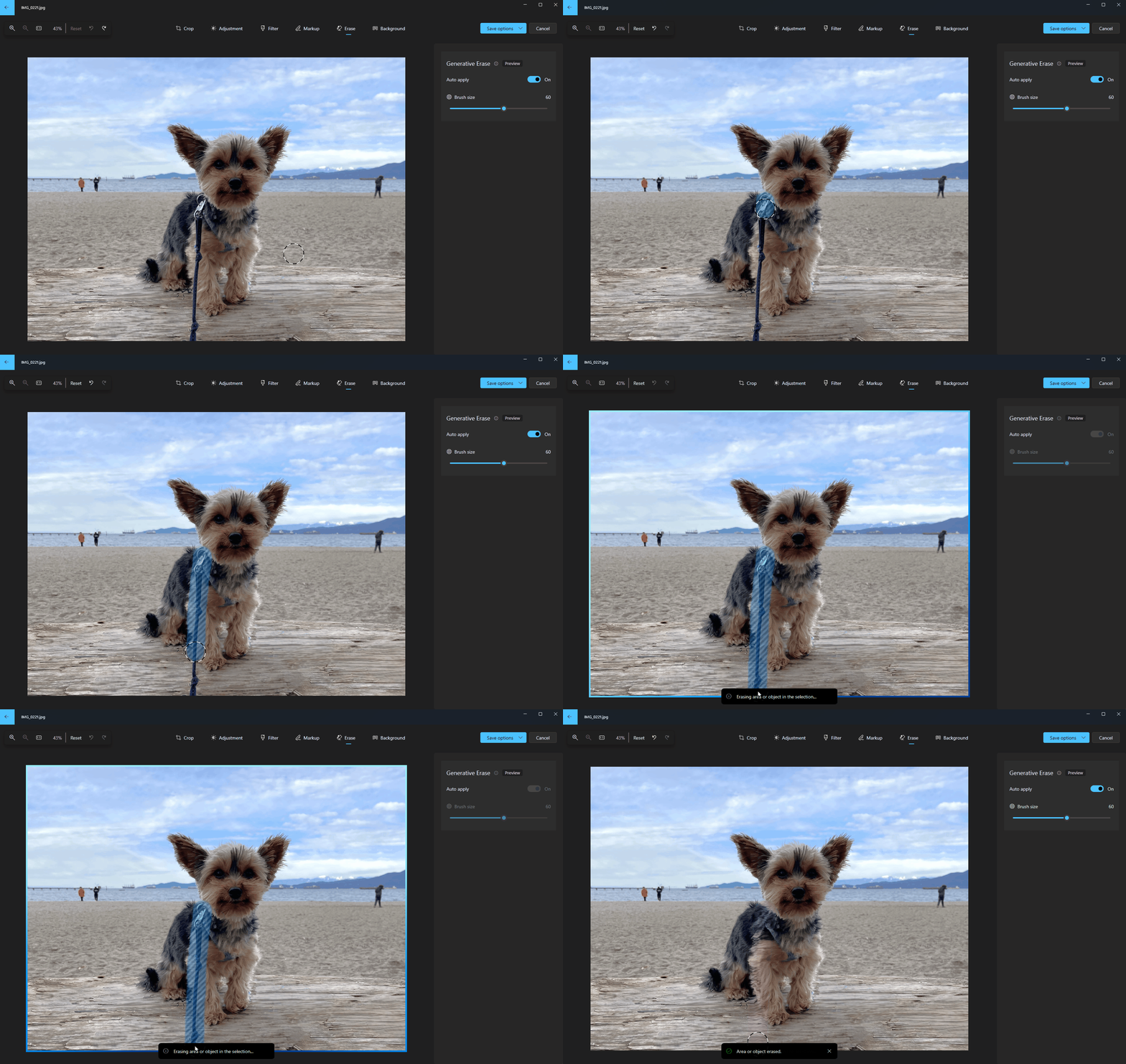
Microsoft has announced a generative-AI powered eraser for pictures, which gives you an easy way of removing unwanted elements from your photos. Windows Photos has long had a Spot Fix tool that can remove parts of an image for you, but the company says Generative erase is an enhanced version of the feature. Apparently, this newer tool can create "more seamless and realistic" results even when large objects, such as bystanders or clutter in the background, are removed from an image.
If you'll recall, both Google and Samsung have their own versions of AI eraser tools on their mobile devices. Google's used to be exclusively available on newer Pixel phones until it was rolled out to older models. Microsoft's version, however, gives you access to an AI-powered photo eraser on your desktop or laptop computer. You only need to fire up the image editor in Photos to start using the feature. Simply choose the Erase option and then use the brush to create a mask over the elements you want to remove. You can even adjust the brush size to make it easier to select thinner or thicker objects, and you can also choose to highlight more than one element before erasing them all.
At the moment, though, access to Generative erase is pretty limited. It hasn't been released widely yet, and you can only use it if you're a Windows Insider through the Photos app on Windows 10 and Windows 11 for Arm64 devices.
Microsoft
undefinedThis article originally appeared on Engadget at https://www.engadget.com/microsoft-is-giving-windows-photos-a-boost-with-a-generative-ai-powered-eraser-061851854.html?src=rss
8Bitdo makes some of the best third-party game controllers around, and one of them is now on sale for close to a record low price. TheUltimate C controller has dropped from $30 to $25.49 today only as it's an Amazon lightning deal. It’s only a few cents more than the lowest price we’ve seen for the peripheral to date.
The Ultimate C is compatible with a wide range of devices and platforms, including Windows PC, Steam Deck, Android and Raspberry Pi. It's a cheaper version of some of 8BitDo's other peripherals.
It doesn't rely on Bluetooth or a 2.5GHz connection. Instead, the Ultimate C connects to your gaming system via a 2.4GHz USB dongle. 8BitDo was also able to reduce costs by opting for a charging cable instead of a dock and removing the profile toggle seen in pricier models. There's no support for 8BitDo's Ultimate customization software either, but the firmware is upgradable.
The tradeoffs may just be worthwhile for an inexpensive gamepad from a well-known peripheral maker. The controller will run for up to 25 hours on a single charge, according to 8Bitdo, and there's support for asymmetrical rumble when playing games on Windows (where you can plug-and-play via a wired connection as well). The field green and lilac purple colorways are quite fetching too.
This article originally appeared on Engadget at https://www.engadget.com/the-8bitdo-ultimate-c-controller-is-on-sale-for-25-today-only-160914390.html?src=rss