If you have been reading Yanko Design for a while, you might remember the LUO studio project where they turned an abandoned bike share bicycle into a ladybug shaped mobile library. That is basically this studio’s whole personality in one sentence, take something humble, add almost no material, and make it do way more than it should. Their newest project scales that same instinct up into an actual building. West Garden Florist is a small flower shop and coffee counter in Beijing’s Haidian Park, and it looks like a giant mushroom sprouted out of the woods, all curved timber and a grassy green cap. It is also a pretty direct descendant of a couple of LUO studio’s earlier, smaller experiments in bent wood and minimal material use.
Architect Luo Yujie founded LUO studio in 2017 around the idea that you can build serious architecture with barely any material if you are clever about how you bend it. West Garden Florist, an 84 square meter pavilion completed in 2025, takes that same thin timber logic the studio tested on a rural library and a flower display shelf and blows it up into a full building with a planted roof and a wraparound veranda. The project recently won a Green Good Design Award from The Chicago Athenaeum. It is a small building, but it reads like the studio finally got to build the thesis statement they had been sketching out in smaller projects for years.
Designer: Luo Yujie, with Wang Beilei and Hong Lun of LUO studio


The site sits where three park pathways meet, right next to the lawn that has become the busiest patch of green space in the district, packed with kite flyers, picnickers, and the occasional soccer game. Instead of drawing a floor plan and asking the trees to deal with it, LUO studio flipped the process. The team mapped every trunk already standing in the grove and let the gaps between them dictate the building’s outline, which is why the footprint reads as an irregular blob instead of a tidy rectangle. That decision alone tells you a lot about where this studio’s priorities sit.


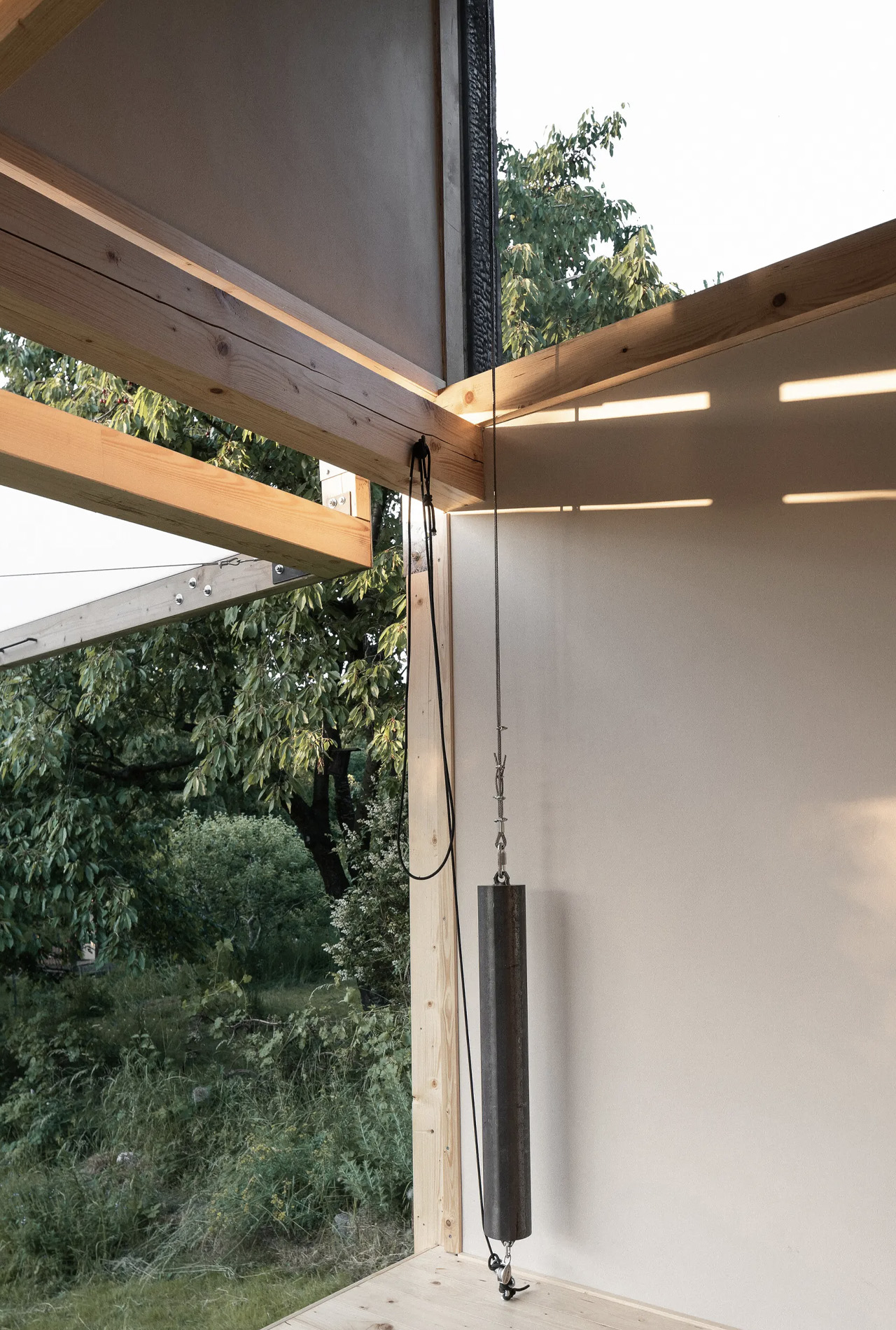
The structure itself is the real party trick. Thin timber slats, all cut to standard dimensions, get gathered into bundles that flare outward to form a ring of columns, then fold inward and interweave to build the curved canopy overhead. The gaps between the slats let light, shadow, and glimpses of the surrounding woodland filter straight through the walls, so the building never fully blocks the grove behind it. Circular skylights punched into the roof scatter changing patterns of sun across the floor all day, doing a passable impression of light falling through actual leaves.

Because this is a public park and not a construction site with unlimited access, LUO studio also had to think small on the build side. No heavy machinery could get near the site without tearing up the paths, so every component was sized for a crew to carry and assemble by hand. The foundation follows the same logic. Ground screws replace poured concrete, which spares the soil and means the whole pavilion could theoretically be unscrewed and moved somewhere else if the park ever needed the spot back.


West Garden Florist is not trying to out flex the rest of Haidian Park, which has spent recent years leaning hard into smart benches and AI branded amenities. It just sits quietly under the canopy doing its own thing, selling flowers and coffee to people who wandered off the lawn. Sometimes the most interesting building in the room is the one that skipped the upgrade entirely.


The post This Tiny Beijing Flower Shop Looks Like a Giant Mushroom Sprouting From the Woods first appeared on Yanko Design.