Valve’s strange history of talent acquisitions | This week’s gaming news

For Engadget’s 20th anniversary, we put together a package of stories about the most pivotal pieces of technology from the past two decades, and mine was on Steam. It’s difficult to overstate how influential Steam is to PC gaming, or how rich the storefront has made Valve. As a private company with infinite piles of Steam cash, Valve has the freedom to ignore market pressure from consumers, creators and competitors. It famously has a flat hierarchy with no strict management structure, and developers are encouraged to follow their hearts.

This has all resulted in an incredibly rich studio that doesn’t produce much. It may be a tired joke that Valve can’t count to three in its games, but we’re not talking about Half-Life today. We’re talking about Valve’s history of buying exciting franchises and talented developers, playing with them for a while, and then forgetting they exist. Real fuckboi behavior — but it’s just how Valve does business.

Let’s take a look at Valve’s history of talent acquisition. One of its oldest franchises, Team Fortress, started as a Quake mod built by a small team in Australia, and Valve bought its developers and the rights to the game in 1998. Team Fortress 2 came out in 2007 and it received a few good years of updates and support. Today, the game has a devoted player base, but it’s riddled with bots and it’s unclear whether anyone at Valve is consistently working on TF2.

Portal began life as a student project called Narbacular Drop, and Valve hired its developers after seeing their demo in 2005. Portal officially came out in 2007, Portal 2 landed in 2011, and both were instant classics. There hasn’t been a whiff of another Portal game since, even though one of the series writers, Erik Wolpaw, really, really wants Valve to make Portal 3.

Of all the Valve franchises that have been left to wither and die, I miss Left 4 Dead the most. Turtle Rock started building Left 4 Dead in 2005, and by the time that came out in 2008, Valve had purchased the studio and its IP outright. Citing slow progress and poor communication, Turtle Rock left Valve before helping the company make Left 4 Dead 2 in 2009. Turtle Rock went on to release Evolve in 2015 and Black 4 Blood in 2021, and is now owned by Tencent. Meanwhile, I’m here, dreaming of that third Left 4 Dead game.

In 2010, Valve secured the rights to the Warcraft III mod Defense of the Ancients, and hired its lead developer. Dota 2 came out in 2013 and became an incredibly successful esports title. Now, eleven years later, Dota 2 players are complaining about a lack of support and communication from Valve, especially in comparison with games like League of Legends.

Counter-Strike has received the most attention from Valve in recent memory, with the rollout of Counter-Strike 2 late last year. The original Counter-Strike was a Half-Life mod, and Valve acquired it and its developers in 2000. Counter-Strike 2 is the fifth installment in the series, released 11 years after its predecessor, Counter-Strike: Global Offensive. After this recent attention, it’s about time for Valve to start ignoring the Counter-Strike community again.

Valve has quietly continued to make acquisitions. In 2018, Valve hired all 12 developers at Firewatch studio Campo Santo, who were at the time working on a very-rad-looking new game, In the Valley of Gods. This could turn out to be another spectacular, genre-defining franchise for Valve’s resume of acquired IP, but there have been no updates from that team in nearly six years. In April 2018, Campo Santo said they were still building In the Valley of Gods at Valve, and promised regular blog posts and quarterly reviews. And then, nothing.

Matt Wood worked at Valve for 17 years, where he helped build Left 4 Dead, Left 4 Dead 2, Portal 2, CS:GO and both episodes of Half-Life 2. He left in 2019 and is now preparing to release his first independent game, Little Kitty, Big City. Wood told me in 2023 that Valve was “sitting on their laurels a little bit, and it’s like they weren’t really challenging themselves, taking risks or doing anything. Steam’s making a lot of money so they don’t really have to.”

Of course, Little Kitty, Big City is coming to Steam.

Steam’s unwavering success has helped turn Valve into a senior resort community for computer science nerds, where game developers go to live out their final years surrounded by fantastic amenities, tinkering and unsupervised. It’s a lovely scenario. At least developers there aren’t getting laid off — and I mean that sincerely. Steam is a great service, and Valve seems at least temporarily committed to the Steam Deck hardware, which is very cool. Still, I miss the games that Valve devoured. I have to wonder if the developers there do, too.

Valve’s treatment of legendary franchises and developers raises questions about its commitment to… anything, including Steam. What happens if Valve decides to pivot, or sell, or Gabe Newell retires and blows everything up? What would happen if Steam shut down? As a service with native DRM, all of our games would instantly disappear. Just like all those game devs.

This week's news

Playdate update

Playdate is one of my favorite gaming gadgets of the past decade, not only because it has an incredibly cute crank, but also because its low-res screen belies a buffet of strange and beautiful experiences pushing the boundaries of traditional play. Panic held a showcase for new Playdate games last week and the headliner was Lucas Pope’s Mars After Midnight, which is coming out on March 12. Pope is the developer of Papers, Please and Return of the Obra Dinn, two incredible games, and Mars After Midnight is set in the doorway of a crowded alien colony. Pope’s games were made for Playdate, this time literally.

Yuzu and Citra are gone

A week after Nintendo threatened to sue the creators of Yuzu into oblivion, the popular Switch emulator has been pulled off the market as part of a $2.4 million settlement. To make matters worse for the emulation community, the lead developer of Yuzu announced that they are also killing the 3DS emulator Citra. Both emulators were open-source, so it’s likely we’ll see Citra at least maintained by the broader community. It’s not clear whether anyone is willing to take on a fork of Yuzu and risk a lawsuit.

Bonus Content

  • Ghost of Tsushima will hit PC on May 16. It comes with all of its DLCs, and Sony says it’ll run on anything from high-end PCs to portable PC gaming devices.

  • Capcom's Kunitsu-Gami: Path of the Goddess is apparently coming out this year on PC, PlayStation and Xbox. It debuted at Summer Game Fest and looks pretty unique.

  • Hades hits iOS as a Netflix mobile exclusive on March 19. There are currently no plans for an Android version, which sucks for me.

Now Playing

I found This Bed We Made while doing research for the GLAAD Gaming report I covered a few weeks ago, and I’m incredibly pleased about it. This Bed We Made is an exploration and narrative-driven game set in a 1950s hotel, and it’s absolutely oozing drama and mystery. The writing is fantastic, the characters are complex, and there’s a thrilling storyline running through the whole thing. It’s available on PC and consoles now.

This article originally appeared on Engadget at https://www.engadget.com/valves-strange-history-of-talent-acquisitions--this-weeks-gaming-news-153020318.html?src=rss
Valve’s strange history of talent acquisitions | This week’s gaming news

For Engadget’s 20th anniversary, we put together a package of stories about the most pivotal pieces of technology from the past two decades, and mine was on Steam. It’s difficult to overstate how influential Steam is to PC gaming, or how rich the storefront has made Valve. As a private company with infinite piles of Steam cash, Valve has the freedom to ignore market pressure from consumers, creators and competitors. It famously has a flat hierarchy with no strict management structure, and developers are encouraged to follow their hearts.

This has all resulted in an incredibly rich studio that doesn’t produce much. It may be a tired joke that Valve can’t count to three in its games, but we’re not talking about Half-Life today. We’re talking about Valve’s history of buying exciting franchises and talented developers, playing with them for a while, and then forgetting they exist. Real fuckboi behavior — but it’s just how Valve does business.

Let’s take a look at Valve’s history of talent acquisition. One of its oldest franchises, Team Fortress, started as a Quake mod built by a small team in Australia, and Valve bought its developers and the rights to the game in 1998. Team Fortress 2 came out in 2007 and it received a few good years of updates and support. Today, the game has a devoted player base, but it’s riddled with bots and it’s unclear whether anyone at Valve is consistently working on TF2.

Portal began life as a student project called Narbacular Drop, and Valve hired its developers after seeing their demo in 2005. Portal officially came out in 2007, Portal 2 landed in 2011, and both were instant classics. There hasn’t been a whiff of another Portal game since, even though one of the series writers, Erik Wolpaw, really, really wants Valve to make Portal 3.

Of all the Valve franchises that have been left to wither and die, I miss Left 4 Dead the most. Turtle Rock started building Left 4 Dead in 2005, and by the time that came out in 2008, Valve had purchased the studio and its IP outright. Citing slow progress and poor communication, Turtle Rock left Valve before helping the company make Left 4 Dead 2 in 2009. Turtle Rock went on to release Evolve in 2015 and Black 4 Blood in 2021, and is now owned by Tencent. Meanwhile, I’m here, dreaming of that third Left 4 Dead game.

In 2010, Valve secured the rights to the Warcraft III mod Defense of the Ancients, and hired its lead developer. Dota 2 came out in 2013 and became an incredibly successful esports title. Now, eleven years later, Dota 2 players are complaining about a lack of support and communication from Valve, especially in comparison with games like League of Legends.

Counter-Strike has received the most attention from Valve in recent memory, with the rollout of Counter-Strike 2 late last year. The original Counter-Strike was a Half-Life mod, and Valve acquired it and its developers in 2000. Counter-Strike 2 is the fifth installment in the series, released 11 years after its predecessor, Counter-Strike: Global Offensive. After this recent attention, it’s about time for Valve to start ignoring the Counter-Strike community again.

Valve has quietly continued to make acquisitions. In 2018, Valve hired all 12 developers at Firewatch studio Campo Santo, who were at the time working on a very-rad-looking new game, In the Valley of Gods. This could turn out to be another spectacular, genre-defining franchise for Valve’s resume of acquired IP, but there have been no updates from that team in nearly six years. In April 2018, Campo Santo said they were still building In the Valley of Gods at Valve, and promised regular blog posts and quarterly reviews. And then, nothing.

Matt Wood worked at Valve for 17 years, where he helped build Left 4 Dead, Left 4 Dead 2, Portal 2, CS:GO and both episodes of Half-Life 2. He left in 2019 and is now preparing to release his first independent game, Little Kitty, Big City. Wood told me in 2023 that Valve was “sitting on their laurels a little bit, and it’s like they weren’t really challenging themselves, taking risks or doing anything. Steam’s making a lot of money so they don’t really have to.”

Of course, Little Kitty, Big City is coming to Steam.

Steam’s unwavering success has helped turn Valve into a senior resort community for computer science nerds, where game developers go to live out their final years surrounded by fantastic amenities, tinkering and unsupervised. It’s a lovely scenario. At least developers there aren’t getting laid off — and I mean that sincerely. Steam is a great service, and Valve seems at least temporarily committed to the Steam Deck hardware, which is very cool. Still, I miss the games that Valve devoured. I have to wonder if the developers there do, too.

Valve’s treatment of legendary franchises and developers raises questions about its commitment to… anything, including Steam. What happens if Valve decides to pivot, or sell, or Gabe Newell retires and blows everything up? What would happen if Steam shut down? As a service with native DRM, all of our games would instantly disappear. Just like all those game devs.

This week's news

Playdate update

Playdate is one of my favorite gaming gadgets of the past decade, not only because it has an incredibly cute crank, but also because its low-res screen belies a buffet of strange and beautiful experiences pushing the boundaries of traditional play. Panic held a showcase for new Playdate games last week and the headliner was Lucas Pope’s Mars After Midnight, which is coming out on March 12. Pope is the developer of Papers, Please and Return of the Obra Dinn, two incredible games, and Mars After Midnight is set in the doorway of a crowded alien colony. Pope’s games were made for Playdate, this time literally.

Yuzu and Citra are gone

A week after Nintendo threatened to sue the creators of Yuzu into oblivion, the popular Switch emulator has been pulled off the market as part of a $2.4 million settlement. To make matters worse for the emulation community, the lead developer of Yuzu announced that they are also killing the 3DS emulator Citra. Both emulators were open-source, so it’s likely we’ll see Citra at least maintained by the broader community. It’s not clear whether anyone is willing to take on a fork of Yuzu and risk a lawsuit.

Bonus Content

  • Ghost of Tsushima will hit PC on May 16. It comes with all of its DLCs, and Sony says it’ll run on anything from high-end PCs to portable PC gaming devices.

  • Capcom's Kunitsu-Gami: Path of the Goddess is apparently coming out this year on PC, PlayStation and Xbox. It debuted at Summer Game Fest and looks pretty unique.

  • Hades hits iOS as a Netflix mobile exclusive on March 19. There are currently no plans for an Android version, which sucks for me.

Now Playing

I found This Bed We Made while doing research for the GLAAD Gaming report I covered a few weeks ago, and I’m incredibly pleased about it. This Bed We Made is an exploration and narrative-driven game set in a 1950s hotel, and it’s absolutely oozing drama and mystery. The writing is fantastic, the characters are complex, and there’s a thrilling storyline running through the whole thing. It’s available on PC and consoles now.

This article originally appeared on Engadget at https://www.engadget.com/valves-strange-history-of-talent-acquisitions--this-weeks-gaming-news-153020318.html?src=rss

What’s new in macOS Sonoma 14.4 (Video)

macOS Sonoma 14.4

Apple enthusiasts and macOS users, you’ll be pleased to know that the latest macOS Sonoma 14.4 update is now available, bringing with it a suite of enhancements designed to enrich your user experience. If you’re keen on understanding what this update entails and how it can impact your daily computing, let’s dive into the details. […]

The post What’s new in macOS Sonoma 14.4 (Video) appeared first on Geeky Gadgets.

Why the 15-inch M3 MacBook Air is the best MacBook Air

Our review of Apple’s new MacBook Airs is out, and our esteemed reviewer Devindra Hardawar gave them both equal scores of 90. That’s a very good score! But I think Devindra’s underselling the 15-inch MacBook Air, which is the best laptop I’ve used in years. It deserves at least an extra point or two, in my humble opinion. For me, it’s a Goldilocks laptop, just right, and I think a lot of people would feel the same way if they managed to realize that a 13-inch laptop isn’t the end-all, be-all form factor that Apple has cast it as over the last decade.

For years now, the 13-inch Air has been Apple’s best laptop for most people, with an undoubtedly excellent combo of power and portability. After a total redesign in 2022, though, there’s not much to differentiate this year’s Air. That’s not bad in and of itself, as it’s a sign of a product that has matured over the years to near-perfection; this year’s model has a new chip to keep performance as fresh as possible.

At some point, due in large part to the MacBook Air’s decade-plus dominance, the 13-inch form factor became the de-facto laptop size for most people. Particularly those who wanted a Mac, because in the last ten years the 16-inch Macbook Pro (and the 15-inch model that preceded it) got way too expensive for most. As such, a large screen became a “pro” feature, not something most people could afford.

Fortunately, Apple addressed that last summer with the 15-inch MacBook Air, a computer that retains everything we like about the 13-inch model in a slightly larger and heavier package. In exchange for a little more cash and a slightly bulkier device, I got a bigger screen that I really appreciated when using the Air as my primary computer without a monitor. To me, 15 inches is the ideal laptop size. If you ever felt the same way but got priced out by Apple, you should definitely check out the 15-inch MacBook Air.

The 13-inch model will almost certainly remain the default option for most people — in part because it’s cheaper. And if you travel a lot, you’ll probably be happier with a smaller and lighter machine. But I believe that a lot of people would be much happier with the larger screen, because the 15-inch Air is still extremely thin and light. Devindra disagrees, noting the bigger laptop is a half-pound heavier, “more unwieldy” and a little “annoying to carry.” That’s fair — I didn’t have the same experience because I never used the 15-inch alongside the 13-inch. Instead, I compared it to Apple’s two MacBook Pro models, and the Air is lighter than both. In fact, it’s more than a pound lighter than the 16-inch MacBook Pro.

While I already believe that most people would be just as happy with the 15-inch Air, if not happier, there are a few use cases worth pointing out to hammer home the point. Devindra said the Air did pretty well playing some of the newer games available for it like Lies of P and Death Stranding. If you’re into games, whether they’re titles like those or more casual options from Apple Arcade, there’s little doubt they’re more fun on a larger display.

The 15-inch MacBook Air is also a great option for older users, or people with visual impairments (or, honestly, anyone who prefers bigger elements on their screen). When I use the 15-inch Air, I enjoy having more pixels to show more of whatever apps I’m using. But, you can just as easily scale up screen elements so you have the same canvas as the 13-inch Air, just on a greater scale. Naturally, the screens on the Air series aren’t as pixel-dense and sharp as the MacBook Pros, but they’re still lovely and won’t look overly pixelated if you decide to scale up the UI.

Forget about specific use cases, though. To put it simply, I’m a fan of the 15-inch Air. It just feels right — much more portable than a computer with a 15-inch display has any right to be. I don’t feel like I’m giving up screen size for something that’s easier to carry around; instead, it’s a computer that I can take anywhere and not feel constrained while using it. Maybe I’m overestimating the appeal — you can just plug the 13-inch Air into a monitor at home to get a bigger screen and then have a smaller computer when you’re on the go. But for someone who likes the idea of a single computer that can work in any context, the 15-inch Air fits my bill.

This article originally appeared on Engadget at https://www.engadget.com/why-the-15-inch-m3-macbook-air-is-the-best-macbook-air-150020238.html?src=rss

Why the 15-inch M3 MacBook Air is the best MacBook Air

Our review of Apple’s new MacBook Airs is out, and our esteemed reviewer Devindra Hardawar gave them both equal scores of 90. That’s a very good score! But I think Devindra’s underselling the 15-inch MacBook Air, which is the best laptop I’ve used in years. It deserves at least an extra point or two, in my humble opinion. For me, it’s a Goldilocks laptop, just right, and I think a lot of people would feel the same way if they managed to realize that a 13-inch laptop isn’t the end-all, be-all form factor that Apple has cast it as over the last decade.

For years now, the 13-inch Air has been Apple’s best laptop for most people, with an undoubtedly excellent combo of power and portability. After a total redesign in 2022, though, there’s not much to differentiate this year’s Air. That’s not bad in and of itself, as it’s a sign of a product that has matured over the years to near-perfection; this year’s model has a new chip to keep performance as fresh as possible.

At some point, due in large part to the MacBook Air’s decade-plus dominance, the 13-inch form factor became the de-facto laptop size for most people. Particularly those who wanted a Mac, because in the last ten years the 16-inch Macbook Pro (and the 15-inch model that preceded it) got way too expensive for most. As such, a large screen became a “pro” feature, not something most people could afford.

Fortunately, Apple addressed that last summer with the 15-inch MacBook Air, a computer that retains everything we like about the 13-inch model in a slightly larger and heavier package. In exchange for a little more cash and a slightly bulkier device, I got a bigger screen that I really appreciated when using the Air as my primary computer without a monitor. To me, 15 inches is the ideal laptop size. If you ever felt the same way but got priced out by Apple, you should definitely check out the 15-inch MacBook Air.

The 13-inch model will almost certainly remain the default option for most people — in part because it’s cheaper. And if you travel a lot, you’ll probably be happier with a smaller and lighter machine. But I believe that a lot of people would be much happier with the larger screen, because the 15-inch Air is still extremely thin and light. Devindra disagrees, noting the bigger laptop is a half-pound heavier, “more unwieldy” and a little “annoying to carry.” That’s fair — I didn’t have the same experience because I never used the 15-inch alongside the 13-inch. Instead, I compared it to Apple’s two MacBook Pro models, and the Air is lighter than both. In fact, it’s more than a pound lighter than the 16-inch MacBook Pro.

While I already believe that most people would be just as happy with the 15-inch Air, if not happier, there are a few use cases worth pointing out to hammer home the point. Devindra said the Air did pretty well playing some of the newer games available for it like Lies of P and Death Stranding. If you’re into games, whether they’re titles like those or more casual options from Apple Arcade, there’s little doubt they’re more fun on a larger display.

The 15-inch MacBook Air is also a great option for older users, or people with visual impairments (or, honestly, anyone who prefers bigger elements on their screen). When I use the 15-inch Air, I enjoy having more pixels to show more of whatever apps I’m using. But, you can just as easily scale up screen elements so you have the same canvas as the 13-inch Air, just on a greater scale. Naturally, the screens on the Air series aren’t as pixel-dense and sharp as the MacBook Pros, but they’re still lovely and won’t look overly pixelated if you decide to scale up the UI.

Forget about specific use cases, though. To put it simply, I’m a fan of the 15-inch Air. It just feels right — much more portable than a computer with a 15-inch display has any right to be. I don’t feel like I’m giving up screen size for something that’s easier to carry around; instead, it’s a computer that I can take anywhere and not feel constrained while using it. Maybe I’m overestimating the appeal — you can just plug the 13-inch Air into a monitor at home to get a bigger screen and then have a smaller computer when you’re on the go. But for someone who likes the idea of a single computer that can work in any context, the 15-inch Air fits my bill.

This article originally appeared on Engadget at https://www.engadget.com/why-the-15-inch-m3-macbook-air-is-the-best-macbook-air-150020238.html?src=rss

Smart gardening pot concept makes growing plants indoors less stressful

There has been a new kind of hobby that gripped the world in the past few years, especially when people were forced to stay home for a few months. “Home gardening” was no longer limited to having a small plot of soil outdoors, especially if you can just grow them in pots indoors. That said, it’s a process that still requires a bit of work and effort, especially if you want to keep your plants alive long enough to enjoy the fruits (or leaves) of your labors. Unsurprisingly, a rather niche market of indoor planter appliances has popped up, some including pretty smart functions to boot. This concept tries to offer the same conveniences in a more aesthetic presentation, providing a painless experience of growing plants in an automated environment that looks great as a piece of home decoration as well.

Designer: Saiyami Jhaveri

Just like with plants grown outdoors, indoor plants need regular maintenance from watering, sunlight, and even protection from pests. You can do all of those manually, of course, and some people do enjoy the satisfying feeling of getting down and dirty with such tasks. Others, however, find the process too time-consuming and burdensome, especially if all they want is regular access to fresh herbs or beautiful green plants to liven up a space.

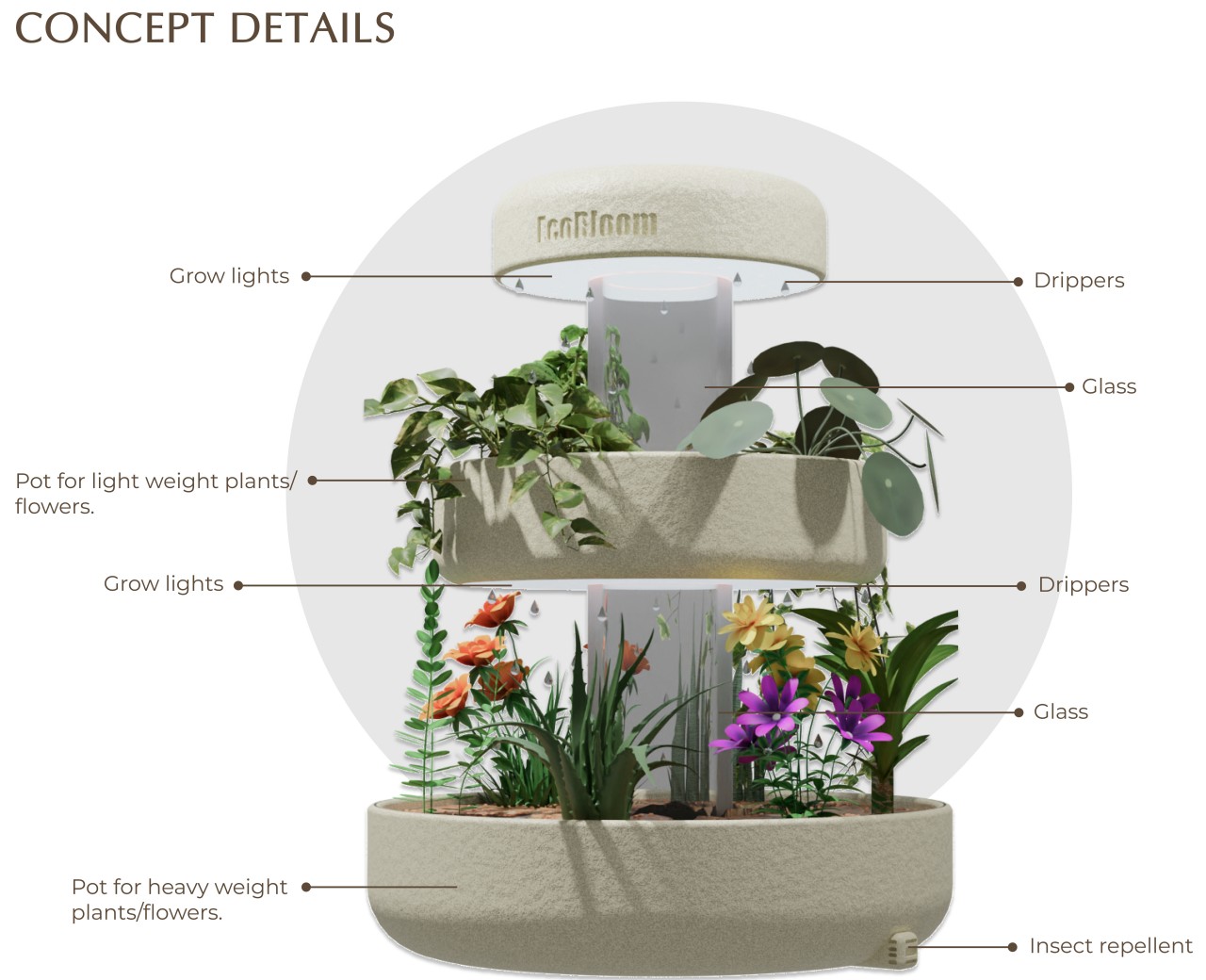
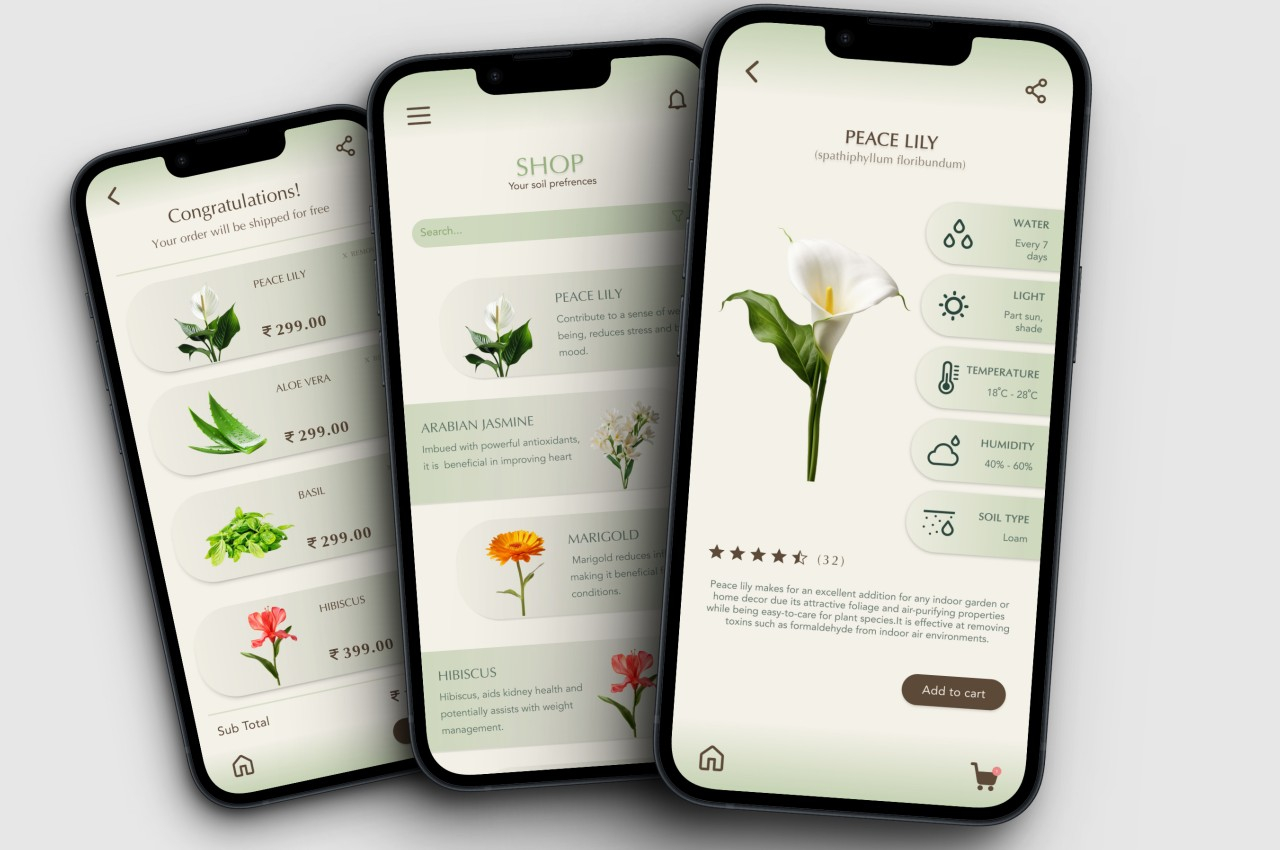
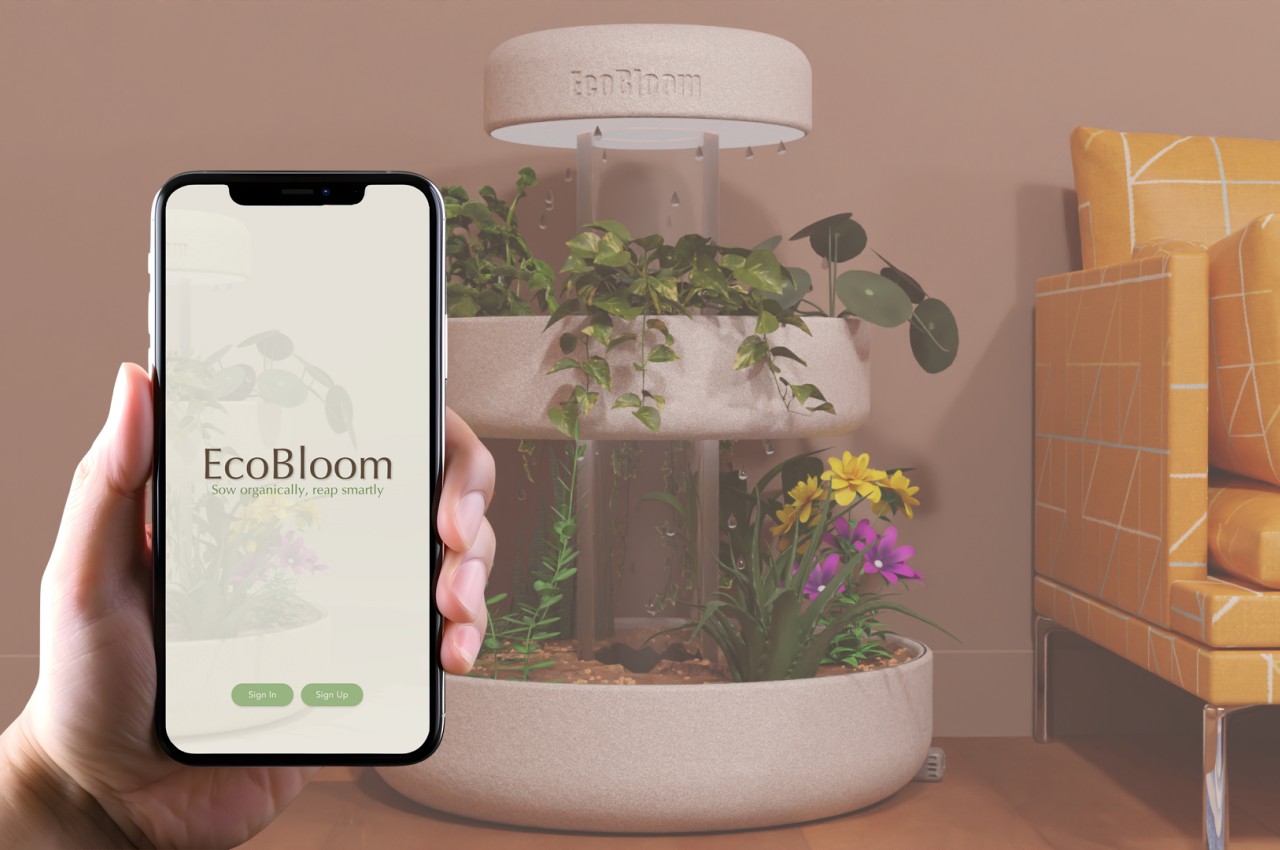
Ecobloom is a concept device that tries to take the drudgery out of this painstaking and laborious process. Almost all parts of that process are automated; all you really need to do is plant the greens and make sure the water tank at the top is filled. You don’t have to do guesswork on when it’s the right time to water the plants thanks to soil moisture sensors that determine the perfect moment for you. Drippers also make sure the plants don’t suddenly get drowned by dispensing the right amount of water as needed. And, of course, there are artificial “grow lights” that save you the trouble of having to put the pot out under the sun.

The smart gardening pot has an interesting function that you won’t always see in actual appliances. It is noted to have a built-in insect repellent to keep those pests away and protect your plants. The concept doesn’t exactly detail how this function works, but one can presume it will be using safe and scientifically tested methods that won’t harm humans and pets in the process.

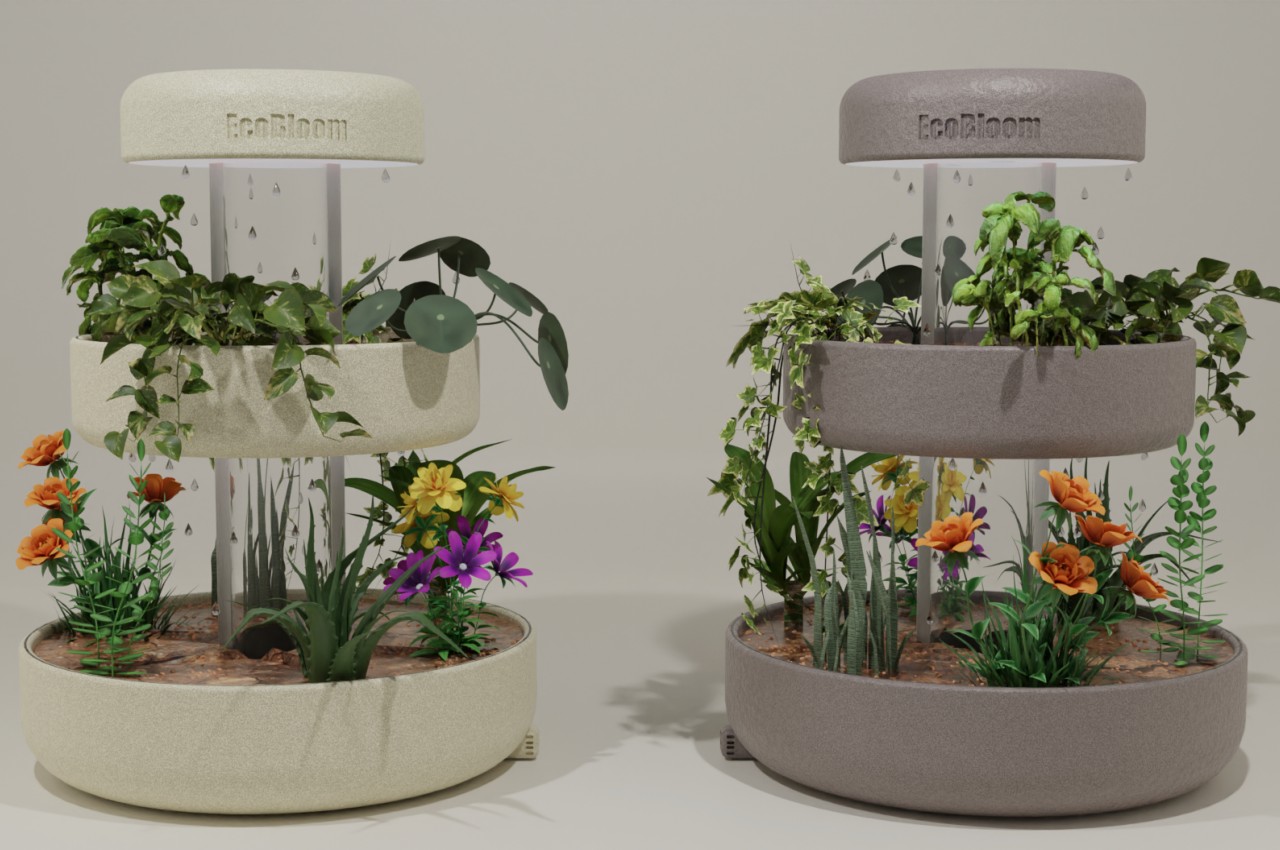
What makes Ecobloom really interesting is the form it comes in. It uses three concentric circles at different heights, with the topmost acting as the water tank. This gives the appliance a more pleasing appearance compared to just boxes or compartments. Ecobloom can thus be also used to decorate a space, giving as much enjoyment to the planting process as simply watching the plants grow.

The post Smart gardening pot concept makes growing plants indoors less stressful first appeared on Yanko Design.

How 19 years of Amazon Prime has satisfied our need for speed

Just as Engadget was hitting publish on its first posts, I was putting a freshly minted English degree to use working at an indie bookshop in Los Angeles. In seemingly unrelated news, Amazon had just reported its first profitable year after switching from selling books to selling “everything” four years before. (It still sold a lot of books.)

Our bookstore did a good job keeping shelves stocked with a balance of the more worthy popular hits and smaller, better fare. But we couldn’t have every book a customer might want, so we offered to order any in-print title. If a distributor had it, it’d take about a week to get in, longer if we had to go through the publisher. That seemed fine for most customers.

But sometimes “about a week” was too long. A few people came right out and said, “Nah, I’ll order it on Amazon.” In 2005, Amazon launched Prime, the membership program that, for $79 a year, gave customers unlimited two-day shipping on most orders. At launch, CEO Jeff Bezos called it “‘all-you-can-eat’ express shipping.” No one knew at the time how hungry the world was for Amazon’s brand of convenience. And now, nearly two decades later, we’ve seen the shifts that accommodate that buffet — in labor, retail and the entire customer experience.

Prime wasn’t an overnight success. It’s estimated that six years after launch, just four million households paid for the service. But 10 years later, in 2021, Bezos claimed it had accrued 200 million members worldwide. Outside of that milestone, Amazon hasn’t made its membership numbers public, but it’s likely the figure is higher now.

That shipping should be both free and fast has become an expectation, and no company has done more to alter the landscape of logistics than Amazon. On its own, the company operates over a hundred warehouses in the US, each ranging from 600,000 to four million square feet. Each one employs between 1,000 and 1,500 people, and an army of around 750,000 robots works alongside humans in many locations.

The company operates a fleet of cargo planes, is experimenting with drone deliveries and deploys thousands of delivery vans — though none of those Amazon-branded vans are driven by actual employees. Rather, separate companies, known as delivery service partners (DSP), subcontract drivers to operate those vans. Amazon employs 1.5 million people either full or part time (with one million in the US), but those figures don’t include independent contractors and temporary personnel. In addition to the DSP program, Amazon Flex lets individuals use their own cars to deliver smile-emblazoned packages to porches. The company outsources delivery to traditional providers too, relying on both UPS and the US Postal Service, the latter it has compelled to deliver packages on Sundays since 2013.

Such vast orchestration to deliver Stanley Quenchers and pimple patches faster than anyone has paid off. However, it’s hard to look at growth and revenue numbers without considering the human costs. Contracted drivers pee in bottles because meeting quotas leaves no time for bathroom breaks. Workers sustain serious injuries at automated warehouses. The company has been sued for retaliatory firing, intrusive employee surveillance practices and failure to follow COVID safety guidelines. Amazon again made the dirty dozen list in 2023 for workplace safety, according to the advocacy group National COSH. And while it has taken steps to improve, with better compensation, the company takes anti-union actions typical of a massive corporation, joining others in calling the National Labor Relations Board “unconstitutional.”

Apart from worker issues, Amazon’s dominance has made life harder for retail businesses in general, particularly the big chains. The Amazon Effect became shorthand for the mall-emptying squeeze of e-commerce on traditional retail. Even businesses that team up with Amazon don’t fare well. Third-party sellers on the site are subject to punitive measures and must contend with increasing fees, which sometimes put them out of business. Sellers who do perform well have seen products copied and sold by Amazon’s private label. Notable partnerships have had dismal results, such as when Borders outsourced its early web sales or the exclusivity deal with Toys ‘R’ Us. Of course, Borders no longer exists, and Toys ‘R’ Us filed for bankruptcy in 2017.

Trying to beat Amazon on speed and price is pointless. Joining them is unwise. So retailers compete in other ways. At the bookstore, we focused on our strengths: a varied, multi-talented staff who could size up a customer’s reading tastes and stick a good book in their hands. If someone came into our store circa 2005 and said they were into fantasy, there’s a good chance our book buyer would pass them a copy of George R.R. Martin’s latest, years before HBO had anything to do with it.

We had a curated ‘zine section and hosted live events with bestselling authors, cult magazine founders and local writers. But mostly, we capitalized on folks who wanted something more from their shopping experience than just speed and convenience, people who didn’t mind if it took a week to get a book, as long as it came with a little local community. Some just wanted to browse books while sitting under the tree (there’s a tree in the middle of the store), petting a cat (in my day, that was Lucy) and listening to what we felt were pretty wicked playlists.

Today, Skylight Books is still a force of creativity and verve in the Los Feliz neighborhood, and it has even expanded into an annex next door. In general, after the initial casualties from the retail apocalypse and COVID, independent bookstores are doing OK, with established names staying put and new stores opening. Elsewhere in the retail industry, big chains continue to close locations, but independent retail seems to be growing. Personally, I enjoy the new bakeries, brewpubs and bulk stores that have sprung up around the neighborhoods where I now live.

I can’t, as a commerce writer, ignore that a decent portion of my job directs readers to Amazon’s website. The company is playing a part in displaying the very words you’re reading, as Engadget’s site is facilitated by Amazon Web Services (AWS) through Yahoo’s cloud partnership. The company is one of the biggest on the planet, the second largest employer in the US and a good portion of every retail dollar spent in the US goes into Amazon’s revenue chest.

With its acquisition of Whole Foods’ 500+ stores, Amazon is doing fine in the physical retail sector. Yet the company doesn’t tend to win when it tries to fabricate other retail experiences. Amazon Books, Amazon Style and Amazon 4-Star were all small-scale retail spaces that tried to leverage Amazon’s brand, massive trove of buyer data and cutting-edge retail technology. At their peak, those stores comprised about 70 brick-and-mortar locations, all of which are now closed. The cashierless Amazon Go still has more than 20 locations in the US, but Amazon shut down nine of them in 2023 and hasn’t announced plans to open more.

Those misfires could be statistically inevitable; more than half of new businesses go under before they hit the 10-year mark. But perhaps those stores failed because, as physical spaces, they couldn’t capitalize on Amazon’s primary strength: zero-effort buying. Shopping at Amazon.com isn’t particularly pleasant. The website is cluttered and confusing. Suspect products and fake reviews erode shoppers’ trust. It isn’t even the cheapest place to shop. But that 1-Click™ buy button and turbo delivery makes stuff appear on our doorsteps like it slid there on greased rails.

Yet when people get up the energy to leave their homes, they may hope for more: human experiences created by people from their own neighborhoods who do what they do out of passion, not because market data indicates dollars to be had in a given sector. With its trillion-dollar valuation, Amazon isn’t going anywhere, but under its massive shadow, there’s still room for businesses that focus on the human element of commercial transactions, places where people might want to spend some of the time Amazon’s speed and convenience may have saved them.


To celebrate Engadget's 20th anniversary, we're taking a look back at the products and services that have changed the industry since March 2, 2004.

This article originally appeared on Engadget at https://www.engadget.com/how-19-years-of-amazon-prime-has-satisfied-our-need-for-speed-141557261.html?src=rss

How 19 years of Amazon Prime has satisfied our need for speed

Just as Engadget was hitting publish on its first posts, I was putting a freshly minted English degree to use working at an indie bookshop in Los Angeles. In seemingly unrelated news, Amazon had just reported its first profitable year after switching from selling books to selling “everything” four years before. (It still sold a lot of books.)

Our bookstore did a good job keeping shelves stocked with a balance of the more worthy popular hits and smaller, better fare. But we couldn’t have every book a customer might want, so we offered to order any in-print title. If a distributor had it, it’d take about a week to get in, longer if we had to go through the publisher. That seemed fine for most customers.

But sometimes “about a week” was too long. A few people came right out and said, “Nah, I’ll order it on Amazon.” In 2005, Amazon launched Prime, the membership program that, for $79 a year, gave customers unlimited two-day shipping on most orders. At launch, CEO Jeff Bezos called it “‘all-you-can-eat’ express shipping.” No one knew at the time how hungry the world was for Amazon’s brand of convenience. And now, nearly two decades later, we’ve seen the shifts that accommodate that buffet — in labor, retail and the entire customer experience.

Prime wasn’t an overnight success. It’s estimated that six years after launch, just four million households paid for the service. But 10 years later, in 2021, Bezos claimed it had accrued 200 million members worldwide. Outside of that milestone, Amazon hasn’t made its membership numbers public, but it’s likely the figure is higher now.

That shipping should be both free and fast has become an expectation, and no company has done more to alter the landscape of logistics than Amazon. On its own, the company operates over a hundred warehouses in the US, each ranging from 600,000 to four million square feet. Each one employs between 1,000 and 1,500 people, and an army of around 750,000 robots works alongside humans in many locations.

The company operates a fleet of cargo planes, is experimenting with drone deliveries and deploys thousands of delivery vans — though none of those Amazon-branded vans are driven by actual employees. Rather, separate companies, known as delivery service partners (DSP), subcontract drivers to operate those vans. Amazon employs 1.5 million people either full or part time (with one million in the US), but those figures don’t include independent contractors and temporary personnel. In addition to the DSP program, Amazon Flex lets individuals use their own cars to deliver smile-emblazoned packages to porches. The company outsources delivery to traditional providers too, relying on both UPS and the US Postal Service, the latter it has compelled to deliver packages on Sundays since 2013.

Such vast orchestration to deliver Stanley Quenchers and pimple patches faster than anyone has paid off. However, it’s hard to look at growth and revenue numbers without considering the human costs. Contracted drivers pee in bottles because meeting quotas leaves no time for bathroom breaks. Workers sustain serious injuries at automated warehouses. The company has been sued for retaliatory firing, intrusive employee surveillance practices and failure to follow COVID safety guidelines. Amazon again made the dirty dozen list in 2023 for workplace safety, according to the advocacy group National COSH. And while it has taken steps to improve, with better compensation, the company takes anti-union actions typical of a massive corporation, joining others in calling the National Labor Relations Board “unconstitutional.”

Apart from worker issues, Amazon’s dominance has made life harder for retail businesses in general, particularly the big chains. The Amazon Effect became shorthand for the mall-emptying squeeze of e-commerce on traditional retail. Even businesses that team up with Amazon don’t fare well. Third-party sellers on the site are subject to punitive measures and must contend with increasing fees, which sometimes put them out of business. Sellers who do perform well have seen products copied and sold by Amazon’s private label. Notable partnerships have had dismal results, such as when Borders outsourced its early web sales or the exclusivity deal with Toys ‘R’ Us. Of course, Borders no longer exists, and Toys ‘R’ Us filed for bankruptcy in 2017.

Trying to beat Amazon on speed and price is pointless. Joining them is unwise. So retailers compete in other ways. At the bookstore, we focused on our strengths: a varied, multi-talented staff who could size up a customer’s reading tastes and stick a good book in their hands. If someone came into our store circa 2005 and said they were into fantasy, there’s a good chance our book buyer would pass them a copy of George R.R. Martin’s latest, years before HBO had anything to do with it.

We had a curated ‘zine section and hosted live events with bestselling authors, cult magazine founders and local writers. But mostly, we capitalized on folks who wanted something more from their shopping experience than just speed and convenience, people who didn’t mind if it took a week to get a book, as long as it came with a little local community. Some just wanted to browse books while sitting under the tree (there’s a tree in the middle of the store), petting a cat (in my day, that was Lucy) and listening to what we felt were pretty wicked playlists.

Today, Skylight Books is still a force of creativity and verve in the Los Feliz neighborhood, and it has even expanded into an annex next door. In general, after the initial casualties from the retail apocalypse and COVID, independent bookstores are doing OK, with established names staying put and new stores opening. Elsewhere in the retail industry, big chains continue to close locations, but independent retail seems to be growing. Personally, I enjoy the new bakeries, brewpubs and bulk stores that have sprung up around the neighborhoods where I now live.

I can’t, as a commerce writer, ignore that a decent portion of my job directs readers to Amazon’s website. The company is playing a part in displaying the very words you’re reading, as Engadget’s site is facilitated by Amazon Web Services (AWS) through Yahoo’s cloud partnership. The company is one of the biggest on the planet, the second largest employer in the US and a good portion of every retail dollar spent in the US goes into Amazon’s revenue chest.

With its acquisition of Whole Foods’ 500+ stores, Amazon is doing fine in the physical retail sector. Yet the company doesn’t tend to win when it tries to fabricate other retail experiences. Amazon Books, Amazon Style and Amazon 4-Star were all small-scale retail spaces that tried to leverage Amazon’s brand, massive trove of buyer data and cutting-edge retail technology. At their peak, those stores comprised about 70 brick-and-mortar locations, all of which are now closed. The cashierless Amazon Go still has more than 20 locations in the US, but Amazon shut down nine of them in 2023 and hasn’t announced plans to open more.

Those misfires could be statistically inevitable; more than half of new businesses go under before they hit the 10-year mark. But perhaps those stores failed because, as physical spaces, they couldn’t capitalize on Amazon’s primary strength: zero-effort buying. Shopping at Amazon.com isn’t particularly pleasant. The website is cluttered and confusing. Suspect products and fake reviews erode shoppers’ trust. It isn’t even the cheapest place to shop. But that 1-Click™ buy button and turbo delivery makes stuff appear on our doorsteps like it slid there on greased rails.

Yet when people get up the energy to leave their homes, they may hope for more: human experiences created by people from their own neighborhoods who do what they do out of passion, not because market data indicates dollars to be had in a given sector. With its trillion-dollar valuation, Amazon isn’t going anywhere, but under its massive shadow, there’s still room for businesses that focus on the human element of commercial transactions, places where people might want to spend some of the time Amazon’s speed and convenience may have saved them.


To celebrate Engadget's 20th anniversary, we're taking a look back at the products and services that have changed the industry since March 2, 2004.

This article originally appeared on Engadget at https://www.engadget.com/how-19-years-of-amazon-prime-has-satisfied-our-need-for-speed-141557261.html?src=rss

How to build an AI assistant with real-time voice conversation using Python

Building in AI assistant using Python

If you are interested in harnessing the power of artificial intelligence (AI) in your business or daily workflow. You might be interested in building your very own AI assistant using Python, that can understand and respond to real-time audio providing a new direction for AI assistants. Imagine having your very own AI assistant and being […]

The post How to build an AI assistant with real-time voice conversation using Python appeared first on Geeky Gadgets.